

Practical Life for Older Students At Home and At School

How to Disagree with Your Teen in an Empowering Way


Book Review – Island of the Blue Dolphins

Island of the Blue Dolphins
By Scott O’Dell
The Island of the Blue Dolphins is a historical fiction novel, based on a true story about a girl named Karana, who was stuck living in isolation for 18 years. In the story, Karana lives on an island with her family, and the rest of the Ghalas-at people. They all live in peace until the Aleut people arrive and take their resources, and all the Ghalas-at people are forced to leave the island. They accidentally leave Karana behind, where she is to fend for herself.
The progression of this story’s plot was unlike many stories I’ve read before. It started as a simple story about a girl’s family and tribe life on San Nicolas Island and moved into a story about how a girl lived in isolation for so many years. Along with the progression of the plot came character development. Karana knew how to live her life with what she had, but this came into play when she was stranded.
I think that the Island of the Blue Dolphins is a great book because it portrays a way of life. It gives a new aspect to the reader about different lifestyles people have all around the world. Another reason I enjoyed this book was because of the plot twists; just when you thought something came to an end, it opened with a new beginning; it made this book all the more interesting to read and kept the reader hooked.
I would best recommend this book for ages 12+, and the reason for that is that the book has some themes, such as isolation and extreme perseverance. In the story, Karana goes through so much that I couldn’t imagine someone under 12 understanding. Another reason that I recommend this book to a 12+ audience is because of the style of writing. The way the book was worded might be hard for a younger audience to understand the concept.
Overall, I enjoyed the book and recommend it to anyone who likes to read true stories. This book will keep you reading. Between Karana’s adventures and how she keeps herself company, you won’t want to put the book down!
Reviewed by Danica Kovacevic, 8th grade, NewGate School, Sarasota, Florida

Rising Innovators in Class
RISING INNOVATORS IN CLASS
by Gillett Cole
As part of our microeconomics course, we partnered with Marc Seldin and Mark Tough to include a pilot of their college-level learning program called “Rising Innovators,“ for adolescents. Rising Innovators is an experiential course, providing students with an introductory blend of the hard and soft skills needed to begin their journey towards creating a new small business. The program included seven weeks of discussion, lecture, and the presentation of case studies, culminating in a team-based activity, focused on the creation of a business idea that was presented by teams at the final pitch competition, like “Shark Tank.” One of the judges on our panel coined it “Guppy Tank”.
The competition took place on Wednesday, February 23. There were six teams. The teams varied from a team of one to a team of five. The panel consisted of seven judges with a variety of experiences. Two of the judges were seniors in NewGate’s I.B. business program. One judge was a senior at the University of Tampa, and the other three judges had vast experiences owning and running successful small businesses.
The judges were handed a rubric to help score each team’s performance. Each team was evaluated on three components: a pitch deck (colored slides that discussed their big idea, target market, and market analysis); a one-sheet synopsis that captured their pitch deck’s main points (something they could leave behind for potential investors), and lastly, each team was evaluated on their overall presentation (style points, eye contact, and team coordination). After each pitch, the team was peppered with thoughtful (sometimes tough) questions by the judges. Team members had to quickly think on their feet, and some realized that they don’t have all the answers. They realized that when you don’t know the answer to something, sometimes the best response is, “That’s a great question; let me get back to you on that.” Most importantly, the question-and-answer session provided an amazing opportunity for the students to hear direct and honest feedback from the judges — valuable, honest feedback from adults who were not their teachers. As well, the judges were able to weave in bits of wisdom and common sense by providing constructive criticism for each team.
All six teams performed well. Their big ideas were truly innovative and varied. Some of the ideas were ways in which we could innovate the recycling of plastic grocery bags (building a hydro-powered generator that collects rainwater to power a home) and a shoe that grows with your feet. The students were well-poised and genuinely seemed excited to present their work. The winning team walked away with a cash prize and high-fives.
What lessons did the students receive from this course? By reading various case studies, the students realized that everyday folks, from young to old, were able to turn a big idea into a dream by taking initiative and working hard. They realized most ideas in our marketplace are not inventions, but rather, innovations. The idea that they can take something that is already out there and make it better, instead of trying to come up with something totally new was quite appealing to them. In this fashion, the task seemed more attainable. They began to understand that entrepreneurship requires a positive mental attitude, initiative, hard work, and followthrough — qualities we try to instill in our students at a young age. The students also realized that a fancy, well-designed pitch deck and one sheet are subordinate to their ability to tell a good story and maintain good eye contact with their audience. In fact, the most consistent feedback from the judges was whether or not the presenters made good eye contact. Students learned a valuable lesson — reading from a script does not earn you style points in public speaking. An important lesson for all. •
Gillett Cole is an AMI trained Montessori Guide who has been teaching for 13 years. He is currently teaching language arts, mathematics, and microeconomics to middle school students at the NewGate school in Sarasota, Florida. He and his family recently moved to Sarasota in August of 2021 from St. Paul, Minnesota. Gillett has two daughters, who both went to Montessori schools, and are now in college. Gillett loves the outdoors, swimming, sailing, and a good book.

50 Ways to Celebrate Summer Learning
50 Ways to Celebrate Summer Learning
by Cheryl Allen
Summer is a time of more daylight, warmer temperatures, and more time outdoors. We may think that, for children who are out of school in the summer, it is not a time of learning. Yet, it can be an incredible time of learning. Here are fifty ways to help your child learn and grow while not in school.
Explore
1. Let your child plan an activity for the day or some activities for the summer. They can use maps, stick to a budget, and do the research.
2. Go on a searching hike, in nature or an urban setting; look for objects in the shapes of the letters in your name, or in sets of your favorite number, or particular colors.
3. Learn about the plants and animals that are near you. What are those birds by your home? What are the names of the plants you see every day?
4. Walk at your child’s pace. Notice the smells of different plants, admire the bugs, follow your child’s lead.
5. Play board games.
6. Learn card or magic tricks.
7. Learn jokes and present a comedy show.
8. Play unplugged games, such as Hangman, your own version of Pictionary, I Spy, or other paper-and-pencil games.
9. Think of free or inexpensive ways you could help neighbors and act on them.
10. Create a scavenger hunt and follow the clues.
11. Try out new playgrounds nearby.
12. Go to a grocery store you do not usually go to, especially if it has a focus on an ethnicity different than your usual cooking.
13. Allow time for daydreaming.
14. Try outdoor science experiments.
15. Plan a dream vacation.
16. Find some art to admire, outside or in a museum. Discuss what each person likes about it.
17. Explore distances and make a map. How far are you from family members, favorite types of animals, friends, or any other thing that can be mapped?
Communicate
18. Make time for reading every day, or nearly every day.
19. Visit the library and allow your child to make choices of reading material on their own.
20. Encourage your child to tell a friend or a family member about a book they read; retelling helps develop understanding.
21. Write letters to friends and family.
22. Address the envelope for that letter. Writing the address correctly on an envelope takes practice.
23. Keep a summer journal or a travel journal. Write in it regularly and include printed photos, pressed flowers, or leaves, ticket stubs, maps, or any reasonably flat items that remind them of the events written about.
24. Have your child create lists for things to do, grocery lists, books read or books to read, movies to watch, anything that can be listed.
25. Write a letter to their future self and store it or use a site that will email you in a certain amount of time.
26. Create a kindness list; how many acts of kindness can be performed this summer?
27. Count cars, bikes, dogs, flowers, anything you see regularly in your travels.
28. Find letters of the alphabet or make up a silly sentence using letters or words on items in the grocery store. Only one word or letter per item!
Create
29. Build a design of your child’s own creation or follow the directions from a set, with Legos™, blocks, or other building materials.
30. Learn to build card houses.
31. Plan and build a birdhouse.
32. Make your own playdough and sculpt with it.
33. Water down paint, place paper outside, and use squirt guns filled with the watery paint for a creation.
34. Set up objects outside and trace their shadows onto paper.
35. Put on a show–write it, practice it, design costumes and props, and perform for others. Record the show to share it with family that cannot attend in person.
36. Use chalk to draw outside, then use water and a scrub brush to erase it.
37. Plan dinner for a night and help make it.
38. Make a salad. Make dressing to go with it for an extra skill-building opportunity.
39. Grow vegetables and harvest them for dinner.
40. Find a recipe and cook with a new-to-you food.
41. Shuck corn, peel potatoes, wash, and spin lettuce dry, participate in cooking preparation.
42. For older children, set a cooking challenge to use ingredients and make a meal.
43. Sketch or paint flowers at your home or a nearby location.
44. Draw self-portraits directly on the mirror using window markers.
45. Clean the mirror after drawing on it.
46. Wash windows (an adult may need to wash the top).
47. Water the garden or potted plants.
48. Organize an area of your home together, especially one that your child uses regularly.
49. Explore with cash, count coins, save for an item, buy something with cash and check the change received.
50. Make leaf or bark rubbings and label them with the type of tree or bush they came from. •
Cheryl Allen is the Associate Coordinator of the Montessori Family Alliance and is also a parenting educator and a Montessori consultant with the Montessori Foundation. Cheryl attended Montessori school as a child. After some time as a traditional Secondary teacher, she worked in Montessori classrooms, 3-6, 6-9, and 9-12, earning certifications from both AMS (3-6 and 6-9) and IMC (6-12). She is a teacher educator, workshop presenter, and member of IMC accreditation teams. Cheryl’s two children attended Montessori from age two through high school graduation.

A Sense of Place
Engendering Love of One’s Home with Adolescents
The NewGate School, Global Campus Students, Research Their Place on Earth and Weave a Story to Share
By Amy Kremer-Treibly and Elizabeth Hale
The NewGate School’s Global Campus is composed of students in seventh through twelfth grades who live in Canada, the US, the Caymans, and Tanzania. These students are the first cohort of the Global Campus, and they work together with a dedicated faculty for humanities, math, science, and Spanish academic courses, as well as working in their home communities on creativity, physical wellness, and service.
Adolescents seek answers to key questions: Who am I? Where am I? What’s happening?
In order to gain insights and impressions of where each student resides, they set out as investigators of their own backyard, town, city, and country, with special attention to who inhabited the land first, including animals, plants, and humans. Students have been sharing their stories as presentations to the community in Opening Meetings held each morning of the week. This project offers a rich opportunity for students to explore the question of where do I find myself living right now?
During this process, students access local historical societies and talk to family and neighbors about generational memories of the place. Some students highlight developments, such as industry and railroad access. Others brought names of indigenous tribes to our attention, as well as the plants and animals that have thrived in the past and either do or do not live now. Overwhelmingly, the students learn more about where they call home. In addition to acquiring knowledge of place, by pausing and giving attention to the land that supports our lives, the people who have come before, and the bounty that nourishes us, we all grow in our appreciation and gratitude for home.
It has been said that to love a place and show true care for it, one must spend time, look with earnestness for the hidden treasures to be revealed, and then we can fully celebrate our home. Indigenous wisdom embodies connection and relationship, and for that reason, we like to include the Haudenosaunee Thanksgiving Greeting, which we read aloud in turns during Council before Thanksgiving. •
REFERENCE
Smithsonian Museum Blog. https://tinyurl.com/mvvjxu4f
Amy Kremer-Treibly, M.A. earned her Bachelor’s Degree in Anthropology at Loyola University where she also enjoyed studying Spanish during a study abroad term in Quito, Ecuador, and learning about world religions as her minor. She began her teaching career in a refugee resettlement program teaching ESL to adult students from around the world followed by teaching Spanish at the elementary level. While teaching at a Great Books Foundation high school in Arizona, she earned her Master’s Degree in Experiential Education at Prescott College with a focus on building schools and learning experiences to promote engagement, eco-literacy, and stewardship.
Elizabeth Hale teaches Humanities and other courses with NewGate School’s Global campus. She spent the last 13 years developing Heartmoor Farm Education Centre in central Virginia teaching Literature, Humanities, and Mindfulness to adolescents while nurturing her connection with the natural world specifically through contemplative practices, the stewardship of plants, and formal study of Western Herbalism. With 24 years of teaching experience, in classroom environments from Oregon and Ohio to Virginia, she has worked with families through all stages of their children’s development.

An Online Montessori School for Teens
In the fall of 2020, the leadership of the Center for Guided Montessori Studies asked the question, “What would an authentic Montessori middle school look like if it were online?” This question was especially pertinent at the time, because we were all adjusting to “forced” online learning resulting from the COVID pandemic. The question that we asked ourselves was, “Can we build an adolescent Montessori program and community online?”
That winter, we decided to plan for a soft launch of what became the Bridgemont International School. We began with just one class of seventh- and eighth-grade students, all living within the time zones of the continental United States, led by certified and experienced Montessori Adolescent Guides.
Our plan is to add one grade a year, extending through high school over the next four years. We also plan to open additional cohorts in North America and other parts of the world as interest grows. As we have from the start, our goal is not to grow quickly, but rather with slow, careful steps to ensure that we establish programs that are excellent and sustainable.
The first question that we reexamined was, “What makes a Montessori adolescent (middle and high school) program authentically Montessori?” Even though we have been involved with Montessori programs at this level for years, there is (at this point) no one model for adolescent programs. Dr. Montessori died before she was able to define the “model” of what a secondary program looks like. Rather, there are a series of lectures and discussions that other Montessori educators have interpreted, leading to vastly different models of Secondary education.
Many are familiar with the farm-school model of Montessori Adolescent Education (Erdkinder), while others may be familiar with the curricular outlines of other Montessori Secondary training programs. While there are many different models, there are key components of Montessori for the student in the third plane.
Curriculum: Students need to learn! They should be culturally literate and develop the academic skills they will need if they decide to pursue post-secondary education. Even within this component, there are different definitions of what that means. I would suggest that students need to know basic information. What makes Montessori distinct at this level is the balance between helping students through the challenges of adolescence, while covering an excellent course of study. For us, a particular focus is helping teens to discover that what they learn in school is real, relevant, and interesting. We want to encourage their interests, help them to see the big picture, and think critically about what they study and how it relates to their own lives.
The core of our academic program is the Montessori educational syllabus, which consists of ‘integrated academic components’ in three overarching areas: self-expression; emotional development; and preparation for adult life.
Within these areas, Bridgemont offers rigorous coursework in a variety of academic subjects, experiential learning, and in-the-field experiences; a range of seminars and collaborative learning projects; training in organization and personal responsibility.
Even though our curriculum is highly integrated, courses have titles that are familiar to colleges and other schools including math, language arts, sciences, humanities, Spanish, health, arts, and electives.
Here is an example of a simple 7th- and 8thgrade science experiment that we did recently.
Is “earth-friendly” laundry detergent actually safe for the environment?
For this experiment, we planted radish seeds in potting soil. In Dish #1, we watered the seeds with a mixture of water and regular detergent. In Dish #2, we watered the seeds with a mixture of water and earth-friendly detergent. In Dish #3, we simply used regular tap water.
After 10 days, only one dish had germinated seeds. Can you guess which one???
The dish that used regular tap water was able to grow radish seeds. The other two dishes? Nothing.
In Dish #1, the regular detergent solution left a heavy film over the soil and seeds.
In Dish #2, the earth-friendly detergent solution did not leave as heavy a film; however, no seeds germinated.
Conclusion: “Earth-friendly” may not be all it is advertised to be; however, it certainly is “friendlier” in appearance.
Valorization: This is such a wonderful term that Dr. Montessori gave us. It is the key challenge of adolescence: the formation of a clear sense of identity, a moral compass, and feeling validated and valued for their contribution as an individual. As children transition from childhood through the teenage years, and then into the adult world, they need to feel a sense of responsibility and worth that leads them to confidence and independence. This can be accomplished in many ways; however, it is probably the single most important component of Montessori at this level.
Community: Community is, directly and indirectly, related to curriculum and valorization. Part of the work of adolescents is to discover their own strengths, style, and role in the community. This is done through deliberate and unexpected avenues. A most basic statement is that adolescents desire to be part of a community.
So, back to the question at hand; how does one create this from an online platform?
How can we deliver a rich curriculum that is more than mere memorization, create opportunities for students to feel valued and value in their work, and create a sense of community, when most of them have never actually met in person?
The students at Bridgemont spend approximately four hours a day in real-time engagement in a variety of activities, including (but not limited to) direct instruction, Socratic dialogue, independent and small-group work with peers, presentations, guest lecturers, working out, doing art, and the occasional Harry-Potter-themed “butter beer” parties.
So, can Montessori at this level be done from an online platform? YES!
A prepared environment at the Secondary level is much more about experiences rather than the materials and physical environments of the Early Childhood and Elementary levels. Can the Montessori guides create opportunities for authentic interaction, sharing, and developing a real sense of caring about one another? Can this be done while also helping students become culturally literate and explore their open passions? Again, YES!
Online learning gives students the space to comfortably participate and voice their opinions, which can ultimately help build confidence and positively reinforce their self-esteem.
At the half-year point, the discussion among the students and Montessori guides turned to gratitude. To our delight, what the students were most grateful for was the sense of community, greater than they had felt in their brick-and-mortar schools. What was our greatest concern, had become our greatest strength.
Community, in the case of the Bridgemont students, guides, and administrators, means kind, empathetic, interested young adults that are not just saying that they care, but honestly care about each other and are interested in the world in which they exist. While doing so, they are also being held to a high level of academic expectations that support each student’s progress and independence.
SOME ADDITIONAL INFORMATION:
Is Bridgemont accredited?
As Bridgemont International School is licensed in the state of Florida, it adheres to the graduation requirements of the State of Florida. (We teach the same courses; however, they are taught very differently.) The school plans to pursue accreditation by the International Montessori Council (IMC) and Cognia.
How does Bridgmeont address service learning, Erdkinder, etc.?
At Bridgemont, we recognize the importance of the “Montessori experience.” We intend to include each of these experiences; however, they will be different in that the students will have more responsibility in designing their experiences with the support of our Montessori guides. Rather than being provided with experiences, students will be actively involved in the design of the experiences that satisfy their requirements in their own communities.
Is it all online?
A goal for the near future is to have two live in-person experiences a year. The school year would start with a whole-school orientation, which would change from year to year and is meant to be a team-building and orientation program. The second experience is meant to be student-designed and will look different from year to year. This will be budgeted, designed, planned, and based on student feedback and student work. (COVID-19 has made this difficult, but it is a goal for the 2022-2023 school year, if possible).
How are time zones addressed?
Our courses and schedules are deliberately designed to meet the needs of students in the continental United States. With WIN (What I Need) hours scheduled on both sides of the “Core” curriculum, students from all parts of the United States can work together at times that are convenient and in line with best practices in adolescent psychology.
As the school grows, there will be timezone-specific cohorts. These will be times that are more specific to time zones and regions; however, there will be shared times with all available time zones to include students from other countries, continents, etc.
In summary, Bridgemont International School is an authentic Montessori School, where students from all over the United States and around the world have the opportunity to become what they are meant to be and have the fortitude, confidence, and support to go after it. •
If you are interested in learning more, please visit our website at www.bridgemontschool.com.

Robin Howe, Ed.D. is a Montessori kid, a Montessori certified teacher (at all levels except infants), and a Senior Consultant for the Montessori Foundation.

Looking Back on My Years in Montessori
A college essay by Douglas Delaney
I think my life will be a roller-coaster of emotion and experiences. I will never forget the beginning of my amazing ride at Beach Park, the Montessori school that I attended from preschool through eighth grade.
When I look back on those days, all I can think is that these are the moments that shaped me. They created the groundwork for who I am as a person. They also left me with stories that make others ask, “Did that really happen?” and all I can say back is, “yes, it did.” Many of my moments at my Montessori school shaped me, but what has shaped me the most is what the school practiced: Montessori.
I know that Montessori has a well-defined definition. Still, the only accurate way to describe how it affected me is to offer my own explanation. I think that Montessori allows for kids to grow into themselves. When I was in preschool, I chose my own work throughout the day and genuinely loved the work I was doing. Montessori allows students to learn what they love and have the resources to pursue it even at a young age. Through those experiences, I have discovered my love of mathematics. Montessori also allows students to grow at their own pace.
I remember in Lower Elementary, being allowed to choose my own daily work but still have specific things to accomplish by the end of the week. This gave us our own time and ability to decide what to do and when. It let each of us learn how to take charge and manage our own time. I remember when my sister first started college. She told my mom that almost no one around her knew how to self-plan without their parents, but she could come up with her own schedule and prepare her workload for that week. I genuinely believe that that skill came from her years in Montessori.
I had a special connection to the school and the people in it. I left Beach Park with only three other students, which was that year’s graduating class. Those three other people probably know more about me than any other people I know to this day. But it wasn’t just the students to whom I grew close; it was also my teachers and faculty. The school faculty were indeed the people who have had the most significant impact on me. Whether it be my eighth-grade teacher, Ms. Summer, who pushed me to my limits while preparing me for high school, my Upper Elementary teacher Mr. Greg who taught me the beginning of Algebra, or my PE teacher Ms. April whose son was one of my best friends; all of them have shaped me in ways that I cannot even begin to describe.
That tiny little school shaped me. Although those memories on the playground of Beach Park School are long behind me, I still look back on them fondly. The years that I spent in that small school prepared me in so many ways to take the next step into college. And even after finishing this wild ride through high school, I can’t help but look back to where it started, at a small school called Beach Park Montessori.
2020 NewGate School Seniors Interview

Bridgemont International School, An Innovative Approach to Montessori Secondary School
Bridgemont has been designed from the ground up to blend authentic Montessori practice with a modern understanding of teenagers’ developmental needs. This is a program like no other, with a heavy focus on collaboration and entrepreneurship, online learning blended with real world experiences. Join us to find out more about this unique program from Dr. Robin Howe, Head of School.

Practical Life for Grown-Ups
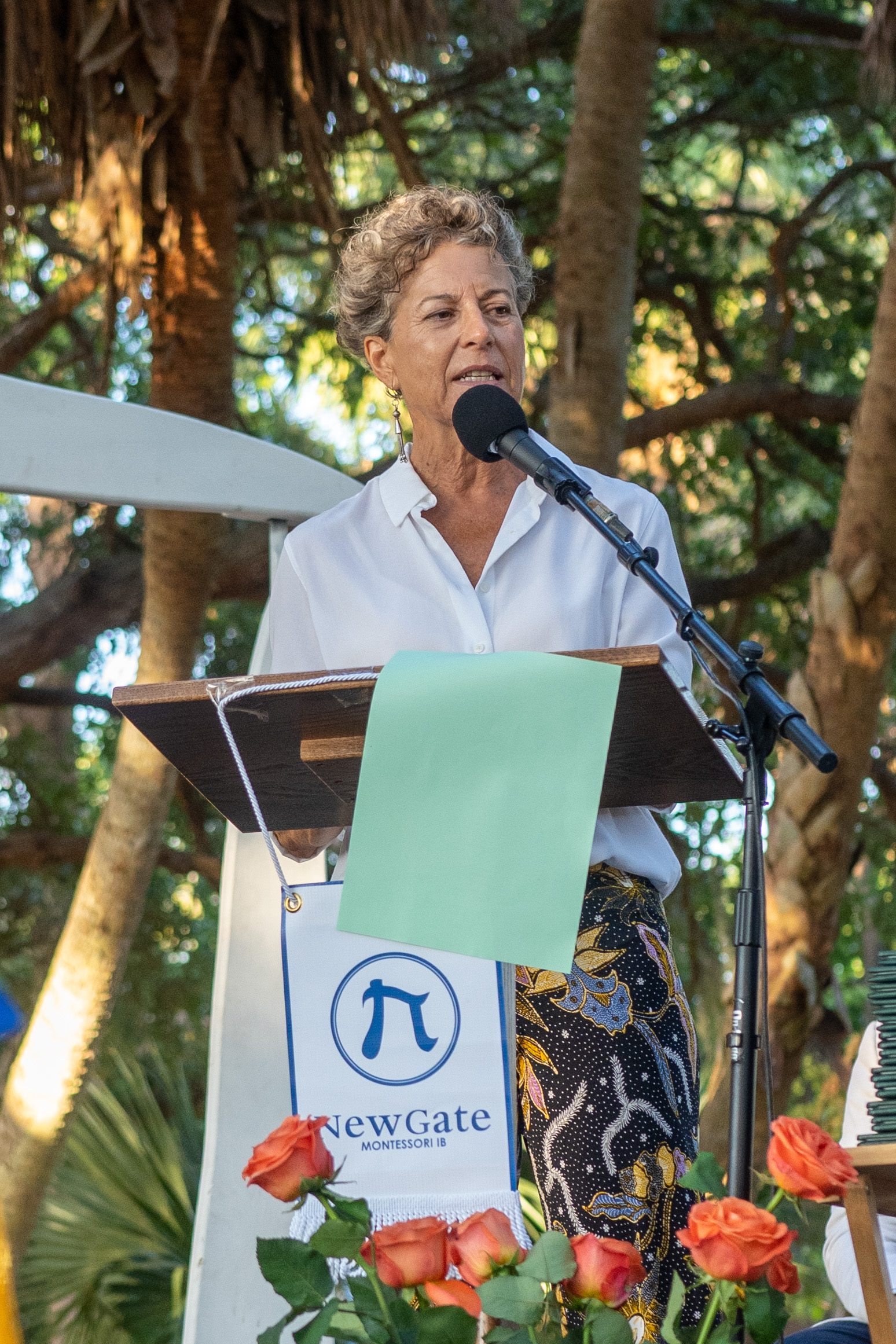
You Can Be a Montessori Adult: Practical Life for Grown-Ups
from Tomorrow’s Child – The Montessori Family Magazine – September/October 2021
By Scott Osborne
Commencement talk given at the NewGate High School May 28, 2021 in Sarasota, Florida
You are now graduating from a Montessori High School: prepare yourself for questions. For the rest of your life, this will be a curiosity to other people. They will ask you about it, and they probably won’t understand it. Embrace this!
If you were lucky enough to be in a Montessori school in your early years, you’ll be able to tell them about the Pink Tower or the Checkerboard or perhaps the big bang lessons. Or maybe you were here at NewGate for weeklong Opera planning or research trips or theater immersion weeks.
But whatever you remember about your Montessori years, embrace them. These experiences have helped make you who you are today.
But you’re no longer a Montessori child. So, tonight, I’m going to give you a few brief suggestions for keeping Montessori in your life – for being a Montessori adult.
I want to encourage you to think of your Montessori education not as something that’s done, something that’s over, but as something that is now in your hands to continue.
About 15 years ago, I was teaching NewGate middle and high school students not so different from yourselves. We used to have many discussions about what they would need going forward – what would help them be the adults they wanted to be.
These conversations about credit cards and college roommates and cooking skills and driving led me to develop what is now called The Competencies Project. It’s like Practical Life for grown-ups.
You undoubtedly know that “Practical Life” is an actual curriculum area in Montessori early childhood classrooms. It’s that time when tiny humans learn table washing and silver polishing, line walking, and water pouring.
Some of you – especially parents – undoubtedly wondered why three-year-olds were learning silver polishing and table washing, activities they were most certainly not doing at home. But Maria Montessori knew what she was doing when she created these lessons.
So, in her honor, I am going to suggest that you continue this Practical Life journey, that you set your sights on new Practical Life skills – adult ones. It’s like the Pink Tower for grown-ups.
These suggestions I am going to offer you today might someday turn your life around. I wager they will have far more impact than the college you (do or do not) attend or the career path you are (or are not) successful in following. These offerings are much like the Montessori Method itself: obscure to outsiders, deceptively simple, yet profoundly significant.
Be forewarned. These first suggestions will make you think I’m crazy, but hear me out.
Take up juggling. Play poker. Compose flower arrangements.
In addition, learn how to:
1. Iron a shirt
2. Sharpen knives
3. Hold a baby with confidence
4. Play pool and billiards (and, yes, poker)
5. Write a condolence note and attend a funeral in a tradition not your own
6. Make a free-standing fire, outdoors, with available materials
7. Eat with chopsticks
8. Tie a Windsor knot tie
9. Orient with a compass
10. Unclog a toilet
11. Open an IRA
12. Use a clock face for telling direction
13. Open a bottle of wine with a traditional wine opener
14. Call someone you do not know on the actual telephone!
15. Drive a manual-shift automobile
Okay, you think. But why? What’s the big deal?
Well, how about some more nuanced Practical Life skills? Can you:
16. Make socially appropriate introductions in any setting
17. Cook a meal in an unfamiliar kitchen, like someone else’s home, figuring out how to navigate neatly and effectively
18. Set up a simple outdoor tent
19. Bargain in markets where prices are not stated – which is most of the world
20. Entertain a group of six-year-olds for an hour
21. Recite a least one poem by heart
22. Make change in another currency
23. Play a portable musical instrument
Those are very hands-on. But what about things you should know?
For example: do you know, without looking them up or consulting an app:
24. Five major star constellations
25. The significant forms of economic production in four other countries
26. The most prevalent health indicators in those other countries
27. The basic principles and vocabulary of a few world sports
28. The fundamental principles of the major world religions
29. The sounds of individual instruments in the orchestra
Before I go on, let’s pause and think about some of these.
If you’re like most people, you will have identified a few of these skills you have mastered.
And for most of the rest of this list, you’ve thought: why bother? You might say: I’ll never need to tie a Windsor knot. And you would be right.
You might also say, And if I do need to tie a Windsor knot, I’ll look it up! You would also be right.
So what good do these do? Are these just nice party tricks or things that will turn your life around?
I would argue these competencies, and others like it (I currently have a list of almost 200) form your foundation, the same way that the Pink Tower and table washing in early childhood provided your foundation then.
Remember, three-year-olds don’t really need to know how to stack a Pink Tower or wash a table! In a way, those too were just cute party tricks for a small child. Yet those lessons opened the door to everything that followed. And you need to continue to open doors — to make your own Practical Life lessons — for a fulfilling and productive adult life.
Continuing to expand your competencies does two things.
First, it provides opportunities for continued mastery. You need to keep making opportunities to say to yourself, Hey, I can do that! Just resting on your laurels, on the skills you’ve learned, is not enough. You need an active means of stepping outside the familiar, stepping outside your comfort zone of abilities, and mastering the new and challenging.
You can’t wait until important, major life challenges come your way. You continue with these small skills — the ones you don’t need — because mastery of those will help give you the confidence to face the real challenges of life.
And second, the experience of learning new skills creates the brain and body architecture you need to master the next big challenges — to be able to do and know the things that are important to you.
Someday you’re going to need to learn something hard, overcome a huge challenge, or just enjoy something new. It is this diverse architecture of experiences — this foundation — that will permit you to do just that.
So I’m telling you to actively continue to develop Practical Life skills, not just career or academic skills (you’ll be faced with those anyway). These are the Montessori Practical Life lessons you’re going to create for yourself.
Let me give you some examples.
One day you’ll see a co-worker busy working on a project, but she’s juggling a baby and a keyboard (because that seems to be what a lot of women do). Because you know how to hold a baby, you can walk over and say, How about I take that little one while you finish working? In that one moment, you will make a new friend for life, you’ll have the amazing sensation of ethereal, soft baby skin next to yours, and you’ll feel like a hero.
Or when you know the major tenets of four world religions and the major export products of a few other countries, think about the insights you’ve gained! You will have a window into entire populations, plus foreign policy, culture, economics, and you’ll probably know a lot more about why your phone or t-shirt costs what it does, just from those few facts.
And when you can distinguish between the different sounds of an oboe and a clarinet and a flute, you’ll be creating pathways in your brain, you’ll be using your senses in new, unexpected ways — and those pathways and senses will be there when you need them.
These competencies – these Pink Towers for grown-ups – give you the stepping stones for where you want to go, just like that first Pink Tower led you to further learning. Only now, you’ll be creating the lessons for yourselves.
So okay, you think, I’ll learn to juggle. I’ll open bottles of wine and start fires and hold babies.
Great. Go for it. But that’s just the warm-up. Here are the big Practical Life skills you’ll want. Even if you ignore all the first ones, you really need these. And they are competencies, skills you can develop, not innate immutable characteristics. There are five.
One, learn to make friends at every stage of life. You’d be amazed at the number of adults who do not feel skilled at this; they literally don’t know how and they don’t talk about it. They just stagnate. You’re very fortunate to come from this supportive school community, this family, if you will. And many of us will always be here for you. But you’re going to change, you’re going to move to new towns, and you’re going to want new friends who are not provided for you, ready-made, at school or work. And you may even outgrow some old friends. You’ll have new interests. How do you find these new people who are right for you? Where would you start? Do you know? That’s a critical life competency and you can develop it. It will put you in good stead all your life.
Two, identify and manage your social anxieties. Can you keep up a reasonable conversation with a totally new person? You’ll want this on your first day of college or your first new job – in person or online – and for much of life thereafter. You need to be able to walk into a room of new people, calmly, solid in yourself. Social anxiety is everywhere – if you experience it, do not think you’re the only one!
The sooner you figure this one out, the sooner you will have removed a huge impediment in life. You show me the college student who drinks far too much every weekend, and I’ll show you the college student with serious social anxieties. This is a competency; the absence of it is not a character flaw. It is a Practical Life skill for grown-ups.
Three, be able to speak up to defend your personal values. I do a lot of advocacy work for causes I care about. Among other things, I do a lot of advising about gender equity – making the world better by helping everyone see past gender.
There’s one issue I get asked the most: how to confront something offensive. People will describe a setting, usually a social setting, where they were told or overheard an offensive remark: perhaps it was openly sexist or homophobic or racist. It made them cringe. And the listener didn’t know what to say or do. We are trained to be polite in social settings, yet how do we bring about changes in attitudes if we remain silent in the face of offensive or unjust comments? Learning what and how to state your own beliefs, appropriately, so you don’t cringe inwardly and don’t alienate people you love — that is a skill you will need. Whatever your strongly held beliefs might be, you’ll need to learn to talk about them outside the controlled setting of the classroom.
And now, the gold star of Adult Practical Life Competencies: Can you articulate personal vulnerabilities safely and honestly? Because you know why? Stuff happens! Someday, if you’re like the average person, you’re going to have some personal issues. When you’re in college, or later, at some point, you will have serious problems you’ll need to articulate and navigate through. We all have problems that come up: mortgages that can’t be met, marriages that dissolve. People find themselves drinking too much. Or maybe a family member is struggling with an eating disorder. This is life! How are you going to cope – with your own issues and those of your friends and family? Have you cultivated people in your life with whom you can share those issues? And this is not just about the dramatic, the cataclysmic. If you’re in the fifth week of college calculus and you have no idea what’s going on and are getting increasingly anxious about failing, can you speak up? You would be amazed at how many people struggle with this. This is a Practical Life competency. You develop it by learning to find people you trust, by starting with small topics.
Let’s be honest, America is a competitive society. People don’t want to reveal perceived weaknesses – they feel it is stigmatizing and will reduce their value, competitively. But that’s not life. For life, you want to practice articulating some problems. It’s a skill you’re going to need and yes, it could have huge ramifications on your future.
And, finally, number five and closely related to four, can you receive vulnerabilities from others? When your roommate turns to you and says, I don’t have any friends, or I can’t make my car payment, will you be ready? Will you be able to be a listener? Will you understand when to help solve a problem and when to just listen — without making the problem about yourself? Or shying away? Or stigmatizing the person? It takes two to be open. Be the other person. for yourself; being open to vulnerabilities; and listening to them from others. They are competencies — not character traits — and they will, over time, be huge determiners of your life.
And those ‘smaller’ skills? Those little ‘unnecessary’ skills, like juggling, using a compass, hearing the oboe? Keep building them. They will give you the confidence to do what you want in life, and they will give you the mind and body architecture to make all the other things possible.
So take up knot tying. And fires. And learn new currencies. And practice talking with openness and vulnerability. These skills can be developed and practiced. You can start from exactly where you are. You just have to be willing to be the learner, the skill developer, the Montessori child all your life. I know you’ll do wonderfully.
The NewGate School is the Lab School of the Montessori Foundation. Its is an international Montessori school for infants through 12th grade.
WWW.NEWGATE.EDU
Scott Osborne is a certified Montessori teacher. She is a lawyer, a nonprofit director, writer, and a gender equality advocate. Her first teaching experience was with the Peace Corps in West Africa, and she has worked primarily with international development organizations, living in seven countries on four continents. Most recently, she lived for three years in India working with small NGOs and teaching English to orphaned teenage girls. Scott is the Chair of Through Women’s Eyes, an international film festival now in its 23rd year. She is president of the United Nations Women-USA, Gulf Coast Chapter.
She raised two terrific Montessori children, who graduated from NewGate School and are both now young adults. Scott is also an avid amateur athlete. She received her bachelor’s degree from the University of Pennsylvania. She received her Juris Doctorate degree from New York University, and an MBA from Princeton University, but (according to her) Montessori certification was the most difficult educational experience she ever had.
This speech was given at the NewGate Montessori High School Commencement in May of 2021. It is part of a forthcoming book: The Competencies Project – How You Can be a Montessori Adult.
This story is from:”Tomorrow’s Child – The Montessori Family Magazine – September/October 2021″
pg 4-7
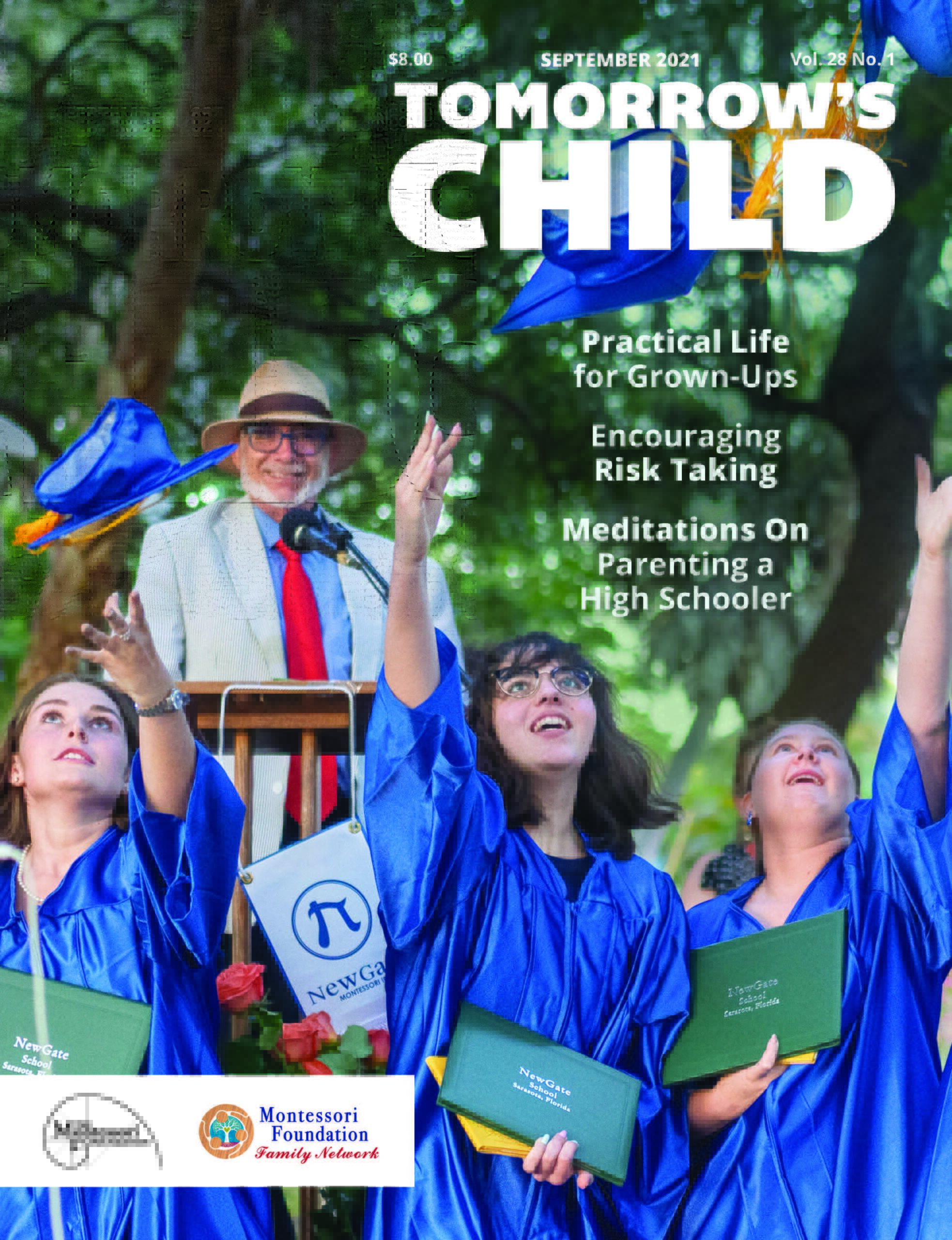

Grace & Courtesy: From Early Childhood to Beyond

from Tomorrow’s Child – The Montessori Family Magazine – September/October 2021
By Robin Howe, Ed.D.
“Each preceding phase prepares the one that follows, forms its base, nurtures the energies that urge toward the succeeding period of life”
Maria Montessori. (From Childhood to Adolescence, 134)
In early childhood (3 years to 6 years), there is a component of the Practical Life curriculum that is called “Grace and Courtesy.” It is a proper noun in that it has its own place in the early childhood curriculum. Some might say that it is the foundational piece, setting the expectations for behavior and interaction that lay the groundwork for successful work in the classroom; it is essential for the normalization of the class and the students in the class. As students progress through the early childhood and then elementary classrooms, Grace and Courtesy is acknowledged as an essential piece of Montessori, a continuum through which Montessori can effectively be implemented. As students get older, however, there seems to be a greater emphasis and division between a student’s behaviors (ability to demonstrate grace and courtesy) and their academic abilities. This does not mean that these two skills are mutually exclusive, but the importance or emphasis may change from the teachers’ perspective. In working with adolescents and adults, I consider myself lucky to have maintained contact with many past students, whom I have known through their childhood and into their adult lives. This has given me the opportunity to get to know these students as adults. Sometimes I wonder, though, if we have adequately prepared children for adulthood, and whether we allowed Grace and Courtesy to dissolve into memory from our early childhood years when children were learning how to walk carefully through a classroom while balancing a tray or how they politely interact-ed with others. Some questions I have been considering more and more are: • Does a four-year-old child having a tantrum in the middle of a grocery store have more leniency than a 17-year-old or a 25-year-old having the same level of a tantrum in the same grocery store? • Does a flippant remark from a six-year-old affect people differently than that of a 16-year-old?
Of course, the answer is yes! Even the most balanced four-year-old may have a moment when they lose control and it doesn’t matter why. Parents may be judged by bystanders on how they handle the situation but, ultimately, when the child is back in the car and eventually falls asleep to the motion of the vehicle, supporting a notion that the cause of this uncharacteristic outbreak was exhaustion, the situation is over. A young adult may not have this luxury. The threshold of understanding is much less for adults than it is for children and that is perfectly appropriate, based on our assumption that with age comes a level of self-control and maturity that would prohibit them from behaving in this way. So, my questions as a Montessori adolescent teacher are: • Are we adequately preparing our young adults for the succeeding period of life? • Are we preparing them for the expectations of existing in an adult world, even as they just enter adulthood?
I feel that Montessori does this better than other educational pedagogies in many ways. A few of them are outlined below. Internships and Work Experiences We encourage our students to explore careers and be amongst professionals, who may not have the patience of educators. The assumption is that if students behave outside of a span of “acceptable” behavior, they will be asked not to come back. Entrepreneurship Whether the students are participants in an Erdkinder program or other entrepreneurial experiences, they are learning about financial independence and being valued as part of the Montessori idea of “valorization.” A goal of any adolescent entrepreneurship experience is the appropriate appreciation for money, their own role in earning it, and an understanding of how their participation is something of value. Field Experiences Many Montessori secondary programs have opportunities for students to work both in their communities and the greater world beyond. The importance of a student experiencing other cultures and realizing that drinking water and plumbing are not guaranteed rights are incredibly important lessons. Leadership A tenant of any Montessori experience is the opportunity to be a leader. Whether the 6-year-old in the early childhood class or the 12th grader in a high school, this experience is incredibly powerful for both the student in a leadership role as well as the younger students who are observing. Each of these examples warrants entire courses and discussion, but is that enough?
On a recent trip with adolescent students, I passively listened to the conversations and observed behaviors, trying to demonstrate my own Montessori ability to know when and how to interact, while also trying not to be the misunderstanding adult, who (just a few years ago) might have been more understanding. While none of the behavior was egregious, in this heightened world of accountability, I found myself torn. Jokes that might have been accepted or even funny five years ago, may now be means for expulsion or even legal action. Flippant and loose language can be captured and reposted on a phone and can lead to the loss of scholarships and enrollment. Teachers do a lot, and some of these questions are the responsibility of the parent! Agreed! But, if we accept Montessori’s belief that “each preceding phase prepares for the one that follows,” are we doing enough? Should Montes-sori’s Grace and Courtesy curriculum more specifically prepare our young men and women for today’s world? Thinking back to that four-year-old who had the tantrum in the supermarket, do we have the expectation that young adults will have a much higher degree of control? But what if they don’t? How can we as Montessori parents, teachers, schools, and systems, support the changing expectations of young adults and prepare them for the post-secondary world where the expectations are higher than those of the four-year-old in the supermarket? The world we (the adults in the room) grew up in is not the same as that of our current students. Physiologically, science suggests that we are not different; however, earlier civilizations did not have cell phones and Instagram™. If our goal is ultimately to prepare students for the next stage of their life, whether it be university, a trade, etc. they have expectations as adults (even if they are not) that they need to be prepared for and the learning curve is not as long as it once was. In closing, while we consider Grace and Courtesy as a fundamental component of the Early Childhood curriculum, is it time to re-examine the importance for students in the third plane (12- to 18-year-olds)? As we prepare them for the succeeding experience, should this emphasis carry a capital G and C for our older students?

Meditations On Parenting A High Schooler

from Tomorrow’s Child – The Montessori Family Magazine – September/October 2021
by Christine Chapman
As I lay in savasana at yoga this morning, my teacher shared a quote that landed and resonated deeply for me as I reflected on parenting and guiding a high schooler to think about life after high school:
Awakening and enlightenment are accidents; but practice makes one accident-prone. Author unknown
As a parent, I’ve spent countless hours literally awakening (and, hopefully, enlightening) my children. In fact, I think that’s especially true now, as my first-born, Celia, progresses into her second year of high school, begins to grow independent, and starts to consider her future. Juggling my own work as an educational consultant and entrepreneur, along with managing all that comes with raising two kids in a COVID landscape, I often close my eyes, cross my fingers and hope that I am helping them attain their highest potential with what I am able to provide.
I first witnessed the aha moments I associate with awakenings and enlightenment when Celia was a student at a Montessori School on Cape Cod. She began at the Sandwich Montessori School at two years and nine months. She had always been that kid who insisted she could “do it myself!” and understanding that she had that spirit of exploration and that yearning to discover sensorily, I read everything I could about Montessori.
In Montessori, I believe Celia developed a solid foundation in math, language, and problem-solving, both academically and socially. But there was something more practical that drew me to the Montessori educational model; it was the life skills and sensory aspect to the program that I loved. Upon reflection, I believe these skills set Celia up for the awakenings and enlightenments she experienced in her early childhood. She practiced the work—whether it was learning to zip a garment, unbuckle a belt, sweep and mop, or pour and scrub. Through these Practical Life exercises, Celia learned to strengthen motor skills, navigate practical tasks in the world, and care for herself. She also learned about Grace and Courtesy in her interactions with her peers and adult guides. As a mom, I remember feeling a wave of emotion overcome me as I saw her developing in confidence and growing into independence, even as a three-year-old.
Flash forward a decade…
Celia was thirteen and in eighth grade when she approached me about educational alternatives for high school. I remember the morning well when she dropped ‘the bomb’ on me (her college counselor mom). She had decided she wasn’t really interested in attending our very highly ranked local public high school, and she was seriously considering our local vocational tech school to possibly major in cosmetology… unless I had other ideas or options I thought she should consider.
The vocational tech world was completely foreign to me, and the ignorant, college counselor snob in me just wasn’t ready to accept that pathway as a possibility for my very bright, capable, and talented first-born child. I threw myself into researching other options; digging into the different vo-tech programs and doing my due diligence by talking to parents, students, and alums. Celia ultimately applied to two vo-techs, understanding that our very strong public high school would serve as her backup option. We were thrilled and relieved when she received admissions to her first choice school: The Norfolk County Agricultural High School, with the intent to study animal science.
My daughter challenged my very traditional educational consultant viewpoint and approach, and she became my greatest educational experimental case. So far, the experience has exceeded my expectations in so many ways: Celia is life-ready, equipped with so many of the kinds of life skills that I marveled about when she was barely three and in Montessori. As a student in an agricultural vo-tech school, she’s learning about animals and plants, stewardship of the environment, woodworking, welding, and is even getting a little primer to mechanical engineering. I’m beyond proud; she’s acquired skills that I may never possess and, as her mom, I’m super grateful. Most importantly, she’s confident, happy, and not afraid of hard work.
The vocational route has opened my eyes and challenged my own preconceived notions of what a post-secondary path should look like. It’s also spurred many discussions about my daughter and her future plans. If my own experience as a mom and as an educational consultant/college coach can help inform some of your discussions with your children, as you embark on their post-high school plans, I’ll be pleased. But in order to write this piece, I’ve also had conversations with numerous parents who’ve been my predecessors on the journey to raising successful, introspective, and, ‘awakened’ adults.
“Remain open-minded. Don’t allow for any of your preconceived notions of what a postsecondary path should look like…”
So how do we, as parents, committed to the highest good of our children, engage our children in the practice of impactful communication about our futures? Talk to your kids. Remain open-minded. Remember, it’s theirs to own. Honor your child’s unique identity, experiences, and characteristics as you help them plan and navigate their own pathways.
Here are some additional tidbits of wisdom I’ve compiled that might help inform your practice of communication with your teen:
• Be transparent about issues around money and funding post-secondary education.
• Ask your children what brings them happiness and joy.
• Be open-minded and aware that our children (unlike our generation and previous generations) will have opportunities to pursue multiple career paths in their lifetime as working humans.
• Don’t be afraid of asking the big, seemingly daunting question: What do you want to do with your life? Don’t be alarmed when you face the big question mark in your child’s eyes. Instead, engage them in digging into the question by asking them what they imagine doing to make a living, what their goals are, and what their ideal work environment might look like. Do they imagine sitting at a desk? Working with their hands? With people? Behind the scenes?
• Ask them if they feel ready for college? If they’re not sure, give them the permission and guidance to look at other opportunities and jump in together. It might be a magical family experiment.
• Listen to them, poke and prod a bit at their responses to your questions, encourage them to both daydream and to be practical.
• Remind them that it takes time, inquiry, and a whole lot of practice to come to the awakenings/enlightenments and epiphanies that bring them the clarity they seek; and that they’re not alone.
Life’s road is not always a direct pathway to success. And taking the road less traveled may be exactly what your child needs permission to do. Remember that it’s often messy, muddy, and requires patience, space, and introspection.
As we started to come out of savasana this morning, my teacher shared a last tidbit that resonated with me on so many different levels. After class, I asked him for the full quote from the Tao Te Ching, or “The Way” by Lao Tzu:
Do you have the patience to wait until the mud settles and the water is clear?
For me, as a parent, the answer is a resounding yes. But the part of the extended quote that I didn’t hear in yoga class, but found even more relevant and resonated deeply with me as a parent, who is constantly trying to influence my children’s decisions and solve their problems for them was this line:
“Can you remain unmoving until the right action arises by itself?”
As a fellow parent, I challenge us to honor these deep pieces of wisdom and hope that we can help cultivate the practice of helping our kids become more “accident-prone” towards awakenings and enlightenment. As parents, all we can hope for, after all, is to guide our children towards becoming awakened towards their true paths and to honor their journeys as we walk alongside them: supporting, advising, challenging, and loving them along the way.
Christine Chapman is an educational consultant, and co-founder of Personalized Educational Solutions, Inc (www.pesglobal.org) and Education Station (www. educationstationhopkinton.com) She is grateful to do meaningful work that supports and empowers students from all over the world in finding their best educational matches in private schools and universities. She is a team builder, community contributor, and educational entrepreneur with almost 30 years of experience as a business owner involved in helping students develop and implement successful educational plans. She is a serial volunteer, lover of the arts, and committed to social and emotional wellness and youth empowerment. Christine is a musician, an aspiring yogi, lover of animals, and committed single mother of two amazing children.
As a committed, passionate college coach, Christine just started a new nonprofit called The College Axis Project (www. thecollegeaxisproject.org). She is grateful to be pursuing her vision and passion to make educational enrichment and college counseling available to everyone, regardless of race, socio-economic status, or gender/sexuality.

Towards best Practice: Lunch
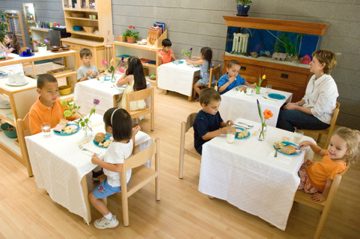
When Dr. Montessori first opened the original Casa dei Bambini she was intent on creating an environment that would meet all the needs of her students in a classroom setting that closely approximated the warmth and comfort of home. Children were given the responsibility of caring for this environment so that they would find pride in ownership and be fully invested in the community. One of the many approaches she instituted was the area we call practical life. Children as young as three years old were taught to sweep, cook, serve meals, clean up, and generally care for themselves as independently as possible. Each day they tended the garden, prepared their own meals, served them to each other and cleaned up after themselves. Astonished adults came from all over the world to witness the incredible achievements of the first Montessori children. Over the years, her method has continued, but many of the original ideas have been substantially diluted. It has always been a source of major discussion among the various groups that claim the Montessori name.
Montessori philosophy does not limit itself to academic concerns only. Dr. Montessori is often quoted for her belief that education is for life. Life, as we all know, does not contain itself to the cognitive. Our reality flowers in the human complex, which is at once, physical, emotional, cognitive, social, and spiritual. Therefore, as a school, we have the obligation to address all the facets of our humanity. We are concerned about the child’s life in each of these areas. Just as parents are responsible for the growth and development of their children, we take seriously our responsibility to create and maintain the best possible environment for children so that they may grow into full and complete human beings. To ignore any area of development would be offering an incomplete educational experience.
In 1998, we instituted a fuller use of the practical life area in the elementary class by allowing the children to prepare their lunch at school each day. We have worked as a community for a long time and the children are accustomed to classroom jobs. Food preparation, set up, and clean up became part of this daily activity. A simple lunch consists of fruit, homemade bread, cheese, peanut butter, and a soup, stew, casserole, or chili. The children prepare the menu and agreements are made by consensus of the group. At the Preprimary level the children prepare fresh fruits and vegetables and sandwiches and the parent from a specific list of choices determines the menu. The parents at each level provide the basic ingredients on a rotating basis. Parents are asked to supply the groceries generally for a week at a time. They are sorted and stacked by the children who do the inventory. As a result of our work together the children have enjoyed all the physical and spiritual benefits that come from working cooperatively, eating well and sharing meals in community.
In response to the many needs of our families and children today, we have developed a comprehensive program that speaks to the body, mind, and spirit of the child.
Program goals
- Community Building and Celebration
- Developing Independence and Self-confidence
- Developing Good Nutritional Habits, Physical Wellness, and Consumer Awareness
- Developing and Applying Practical Life Skills
- Developing Good Table Manners and Grace and Courtesy
- Reducing Waste and Connection to Environmental Studies
Elementary children make the bread in bread machines first thing in the morning. The main meal consisting of a:
- Soup
- Stew
- Chili or
- Casserole
is prepared in an electric pot or on the stove.
Children get to practice peeling, cutting, chopping, grating, and sautéing thus expanding their practical life skills and learning the rudiments of basic cooking. They learn to measure, and calculate. They use their imagination and creativity as well. It is the tangible application of practical life skills.
At the Preprimary level the children are guided by the classroom assistant to prepare the vegetables and fruit and make the sandwiches.
Set Up:
Twenty minutes before lunch time the elementary set-up crew or supervisor:
- Sets the tables with plates, cups, napkins, and tableware
- Makes the drinks and puts out the pitchers
- Puts out the peanut butter and cheese on each table
- Prepares and puts out the salad or fruit and vegetable trays
Clean up
- When tables are called the elementary children bring their dishes to the common area for rinsing and loading into the dishwasher. Preprimary children wash their dishes at the dishwashing table.
- Table ?captains? or designated supervisor clears and wipes the tables and sweeps the floor. Preprimary children are responsible for their own spot.
- Teachers assist as needed.
- Children who are finished wait quietly with a book before everyone is dismissed to go outside.
Jobs and duties are organized and displayed in classroom charts. Sometimes seating is
also rotated on a chart.
Parent responsibilities
- Class coordinator formulate the schedule for bringing groceries.
- Each parent generally has no more than two weeks a year.
- Parents are encouraged to come as our guests.
- A parent helper sometimes assists with unloading and storing groceries and
keeping inventory at the lower elementary level.
Outcomes include:
- Better Eating Habits
- Children expand their food choices and experience different kind of foods.
- Better attendance, less sickness
- Children become more independent and confident.
- They learn to be confident creative cooks and carry it home.
- Children practice their academic skills.
- Pleasant lunchtime atmosphere.
- Relationships enhanced between children and their peers and children and their teachers.
- By working together from start to finish real community is practiced every day.
- Staff gets lunch as well.
- Children, parents, and staff learn cooking skills.
- Less Waste and trash
- Gardening and composting are an extension in order to teach the full cycle.
Everyone benefits! What could be more archetypal than coming together to break bread with each other each and every day? We invite you to join us for lunch any day.
Montessori Curriculum Theory Workshop
Sharon Caldwell and Hillary Drinkell presented this Power Point at the 2013 IMC conference.
Peacemaking Circles
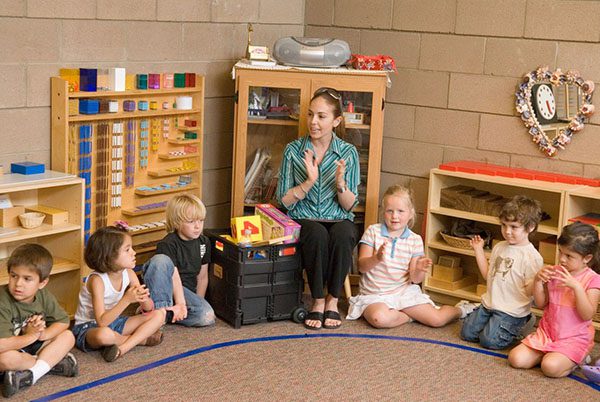
Montessorians are familiar with the daily “Circle” and use this important practice for starting or closing the day, but the Peacemaking Circle or Conferencing approach has become part of restorative practices in schools, workplaces, prisons, and Court systems around the country and throughout the world. Based on ancient practices of aboriginal peoples, this approach creates an intentional space with a particular process designed to:
- support participants in bringing forward their ‘core self”
- to help them conduct themselves based on the values that represent who they are when they are at their best
- make visible our interconnectedness even in the face of very serious differences
- recognize and access the gifts of every participant
- elicit individual and collective wisdom
- engage participants in all aspects of the human experience – mental, physical, emotional and spiritual or meaning-making
- practice ‘core self,’ value-based behavior when it might feel risky to do so.
The more people practice that behavior in circle, the more those habits are strengthened to carry that behavior into other parts of their lives. Create a space and time for participants to voice their thoughts and feelings, to take ownership for their behaviors, connect them to others, and learn from the collective wisdom of the group.
Peacemaking Circles: Creating Peace in Our Schools One Circle at a Time
Presented by Claire J. Salkowski IMC Peace Conference
ADR Specialist and Educational Consultant Nov 4, 2012
Planning the Specifics of the Circle – The Keeper puts together the circle plan answering the following questions:
• Who will be part of the circle?
• What time?
• Where?
• What will be the talking piece?
• If and what will be in the center?
• What opening ceremony will be used?
• What question will be used to generate values for the circle?
• What question will be used for an introduction or check-in round?
• Is there a need for further relationship building before getting into the issues? If so, how will that be done?
• What question(s) will be used to begin the dialog about the key issues?
• What further questions might be useful if the group is not getting deeply enough into the issues?
• What closing ceremony will be used?
Circle Outline
The detail in this outline is provided to offer concrete examples and stimulate creative thinking. It is not intended to be prescriptive. The circle is not a rigid process. It is always important to be responsive in the moment to the needs of the circle participants which may not follow the outline you planned. Nonetheless, it can be useful to have an outline to guide you as a keeper.
Welcome: Welcome everyone to the circle. Thank them for coming. Express appreciation for the willingness to work together in a shared space.
Opening: Openings mark the time and space of the Circle as a space apart from the pace and tone of everyday life. The opening ceremony is designed to help participants center themselves, be reminded of core values, clear negative energies, encourage optimism and honor the presence of everyone there. Lead the group in whatever opening ceremony you have chosen
Explain center: If you have created a centerpiece, identify any items in the center and why they are there.
Explain Talking Piece: Explain that the talking piece is a critical element of creating a space in which all participants can both speak and listen from a deep place of truth. The person holding the talking piece has the opportunity to speak without interruption while everyone else has the opportunity to listen without the need to respond. The talking piece will be passed around the circle from person to person. Only the person holding the talking piece may speak. It is always okay to pass the talking piece without speaking. The keeper may speak without the talking piece if necessary to facilitate the process. If the talking piece has a particular meaning explain that.
Purpose: Remind participants of the purpose of the circle
Introduction/Check-in Round: Tell participants that you are going to pass the talking piece around so that we can all hear how everyone is doing today. Invite participants to introduce themselves if they are not already acquainted. We suggest the keeper share first. People will most likely model their response after the keeper. Be authentic. Pass the talking piece and ask, “How are you feeling today?” “Is there anything you feel is important for us to know about how you are doing?” Sometimes it is useful to pose a question in this round that invites sharing about oneself so the participants get to know one another better.
Values/Guidelines: Before the circle starts place a paper plate or half sheet of paper and a marker at each seat. Ask participants to think of a value they feel would be important in order to feel safe to speak from the heart and listen from the heart. Ask them to write the value on the paper plate or sheet of paper. Pass the talking piece and ask them to share the value they chose, explain why it is important, and place their value in the center of the circle. Keeper models.
After establishing values, develop guidelines for the circle. The guidelines of the Circle are the agreements that participants make with one another about how to behave in the Circle. They establish clear expectations and common ground to provide a space where people feel safe to speak in their authentic voice, connect to others in a good way and ensure a space that is respectful for all. Pass the talking piece and ask participants to name one agreement important to their participation in Circle. (e.g. “Speak only for yourself.” or “Keep body language respectful.”) Write down the suggested guidelines on a sheet of paper or flip chart. When the talking piece has gone all the way around, read the list. Pass the talking piece and ask participants to indicate whether they accept these guidelines. If there are objections explore the objections and the original purpose of the person who proposed that guideline and work to find wording that is acceptable to everyone.
Extensive conversation about the guidelines can be good practice for working through a difference in opinion or perspective in a respectful way. In an on-going circle group the values and guidelines generated at the first circle are brought back to any subsequent circles.
Storytelling round: In some circles it is crucial to take the time for people to share stories from their own lives to increase understanding of one another or to build empathy. Stories often shatter stereotypes or assumptions people have about one another making it possible for them to hear one another more clearly when they discuss sensitive issues later in the circle. The Keeper generally goes first in a storytelling round.
Exploring the topic of the circle: Pass the talking piece, posing a question about the issue or topic that is the purpose of the circle. Alternatively, direct participants in an activity which helps participants connect with their thoughts and feelings on the topic. Follow with multiple rounds reflecting on the experience of the activity or exercise and reflections about the topic. Thank participants for the wisdom shared in the process. Acknowledge the courage that it takes to speak and listen from the heart.
Check-out Round: Pass the talking piece around and ask participants to share their thoughts about the Circle or one word that sums up how they are feeling right now as the Circle comes to a close.
Thanks: Thank everyone for coming and for their efforts to understand themselves and others in a way that allows everyone to be at peace with themselves.
Closing: Lead the circle in a closing ceremony. Closing activities bring closure to the circle, help participants feel centered and mark the ending so that everyone can transition from the reflective circle space back to the outer world. It maybe a poem, quote, song or music or it could be a ritual such as extinguishing a candle flame or ringing a soft bell.
Materials Needed: Determine from the outline all the materials you need to bring to the circle (e.g. paper plates for values, markers, talking piece, center items, readings or other opening materials, the circle outline, etc.)
Circle Prep Sheet for Longer Circles
Preparation
• Co-Keepers:
• Circle Purpose:
• Where and When:
• Talking Piece, center piece and what other things you need to bring:
• Who do you have to talk to and what prep do you do ahead of time:
Circle
• Opening Ceremony/Activity:
• Check-in question:
• Questions for going into guidelines (what you might be able to ask):
• Story telling/Trust Building Question:
• Guiding Questions on the Topic or Issue:
• Guiding question for consensus building, planning or summary round:
• Check-Out round question – what you might be able to ask:
• What “must” be addressed in the circle:
• What is the follow-up:
• Closing Ceremony/Activity:
Circle Prep Sheet for (Shorter) Classroom Circles
Preparation
• Co-Keepers:
• Topic:
• Talking Piece, center piece and what other things you need to bring:
Conducting the Circle
• Opening Ceremony/Activity:
• Quick Check-in round question:
• Guiding Questions on the Topic or Issue:
• Question to elicit Storytelling/Personal experience related to the Topic:
• Questions for Deepening Round(s):
• Question for consensus building/decision making/planning/summary:
• Check-Out round question:
• Closing Ceremony/Activity:
Follow-up
• Decisions/Insights that need to be shared with others:
• Work that needs to be implemented before the next Circle:
Revised and adapted by C.J. Salkowski from Heart of Hope Resource Guide by Kay Pranis and Carolyn Boyes-Watson
CONDUCTING THE CIRCLE
As keepers or facilitators you are responsible for creating and keeping the “form” of the circle. The basic manner of interacting in the circle generally involves use of a talking piece which is passed from member to member during sharing “rounds.” Only the person holding the talking piece may speak and they may do so as long as they have the talking piece. Typically the talking piece is passed around the circle, in order, although the keepers may choose to use a different form of passing the piece. The circle may also use other activities to move the group. These are described more fully below.
Keepers or facilitators act as guides to move the circle through the phases of circle it needs to experience. Note that these phases are flexible depending on the purpose for which a circle has been called. In a school setting, the circle can be used for many purposes. Circles can be used with the children in the classroom, faculties or parent groups. They can be the vehicle for discussions, resolving conflict, celebration, healing or learning about a particular topic.
It is important that all circles include an opening and closing, and that these two elements are always given time and depth.
Four phases of circles – Although the content or topical focus of circles may vary, all circles generally follow four phases. How you facilitate these phases is flexible. For example, a new group may need to spend more time on guidelines and on storytelling rounds. As keeper, trust your instincts on how to structure the circle, and be flexible enough to let the circle move in the way that it needs.
The four phases of circles are:
Phase One – Introductions
Phase Two – Building Trust
Phase Three – Issues
Phase Four – Solutions
Phase One – Introductions
The introductions phase of circle may include the following elements, all of which are designed to create safety and form and to begin to prepare participants for deeper sharing and understanding. This phase generally should include the following:
Welcoming – Make sure everyone is greeted warmly.
Opening ritual – All circles start with an opening ritual that helps us make the transition from the outer world and into the reflective circle space. Openings are designed to help us feel more centered and open to sharing. Openings may involve burning sage or incense which someone either places in the middle of the circle or passes over participants, using a feather to move the smoke around them – allowing people to cleanse themselves of negative energies and to prepare for sharing deeper emotions. They may include a poem, song or meditative music. Consider asking one of the participants (in advance), to offer the opening. With children and adults, I have found that using the Tibetan bells as an initial opening and a final closing, offers a quick way to a begin and end the circle when time is a perplexing concern. If they are used consistently in an on-going group it becomes a valuable ritual in itself. With children they will often ask to ring the bells in order to open or close the circle. We ring the bells three times with a sustained moment to let the sound move out into the group and find its own ending. It creates a reverence for what we are doing and brings us to that place of quiet and peace.
Introductions and check-in – In the first round, the keepers ask participants to introduce themselves by name (perhaps first name only), how they feel, why they are here in circle, and what they hope for.
Seeking consensus around guidelines – If it is a new group, then participants develop guidelines of how they want to be together while in circle (e.g. respect all opinions, confidentiality, etc.) Then, take a complete round of the circle to ensure that each person indicates support of the guidelines. If it is an ongoing circle, then the keeper might review the basic circle guidelines and if invite the group to add any additional guidelines if necessary. Take a full round to be sure everyone has a chance to comment on the guidelines and to demonstrate their support of the final list. Remember that the guidelines are a “living document” and may be revised in circle at any time.
Acknowledgment of those present – Remember to acknowledge those present in circle, especially if the circle is gathered to discuss a difficult topic or resolve a conflict or find healing and resolution for an incident of harm. It takes courage and commitment to participate in circle. Also be sure to acknowledge the volunteers who have helped make the circle happen.
Clarifying the purpose of circle – The keeper summarizes what has been experienced in phase one of the circle, using this summary to further set the tone of the circle and to clarify the purpose of the circle.
Phase Two – Building Trust
Next, the keepers move the circle into deeper sharing as a way of increasing the level of trust among members. This may take a variety of forms. Depending on the nature of the circle, keepers may guide it toward a single or multiple rounds of sharing, and may or may not choose to use other methods of sharing such as ice breakers, art work, individual reflection or small group activities depending on the amount of time available.
Ice breaking – With groups involving young people it might be useful to begin with individual reflection, or sharing in pairs or small groups. Consider using art supplies to having members (individually or as teams), draw representations related to themselves or the purpose of the circle. Or consider using icebreaking activities that are neutral to the purpose of the circle, but which help members to get to know one another as people.
Storytelling round – If the issue or purpose for the circle involves a difficult issue, it may be useful to have a storytelling round. Invite participants to share a personal life experience related to the issue offers (perhaps in a very indirect way.) Storytelling is a powerful way to move beyond masks and appearances and to develop a better understanding of one another. Story telling is a powerful way to share our wisdom with each other and allows us to take in what we might otherwise reject if we were simply “told” in some other form.
Deepening rounds – The circle may move into deepening rounds of sharing. These rounds get to the heart of why the circle was called or if time allows, a topic is explored in depth for further insight and deeper learning. Depending on why it was called, these rounds may include an expression of needs and interests (in the case of a conflict circle), sharing memories and grief (in the case of a healing circle). If small group activities or dyad sharing feels appropriate they may be used here, but always come back to the circle and to sharing in the full circle.
Phase Three – Issues
In this phase, the focus expands from what’s gone wrong or what’s hurting to what can be done to make things right, to promote healing, or to initiate positive change. In many circles, such as those focused on healing, listening may be what’s most needed – giving people a chance to tell their story and to have it received deeply. In other circles, though, exploring options helps break the sense of being stuck in either a painful experience or a self-destructive way of life.
Phase Four – Solutions
Some circles, such as those involved in healing or understanding, do not require decision making. In these circles, the focus of the keeper may be to work toward creating a sense of unity. Other circles do require decision making or resolution of conflict. In these circles the keeper attempts to build consensus by building on each circle participant’s input, until a decision is reached that all members are at least “able to live with.”
Consensus involves an agreement among all participants to “live with the outcome” – to accept a decision or course of action because it promises the best for everyone given the circumstances. Generating consensus involves patience, creativity, candor about interest and concerns, and a willingness to think outside the box. We are challenged to set aside our personal agendas and fixed notions about outcomes, so that something may emerge that is larger than any one person’s preconceived ideas. Consensus is about dialogue, listening and honesty.
To help the group move toward a consensus decision the keep
1. Help participants to identify areas of disagreement,
2. Encourage participants to explore and understand one another’s perspectives, and
3. Work with participants toward final consensus decisions that are as inclusive as possible, and that are respectful of differing viewpoints.
Reaching decisions by consensus often takes more time than other decision making models, such as voting. The strength of the process is that it assures that all participants will “own” and support the decision. In consensus there are no winners and losers, but rather everyone is in agreement and willing to move forward on whatever plan or decision has been devised. When using this process it is important that the group commit to addressing issues or concerns that may be raised on the way to achieving a consensus decision.
Closing
All circles end with a closing ceremony that helps us make the transition from the reflective circle space back to the outer world. Closings are designed to help us feel centered and to bring a sense of closure to the circle. They may include a poem, song or meditative music. Consider asking one of the participants (in advance), to offer the closing.
AFTER THE CIRCLE (FOLLOW UP)
Follow-up is one of the greatest challenges of the successful use of circles. Follow up may include:
• If strong emotions are shared in circle, affected individuals need to be contacted to see how they are doing and ensure that they are getting the support they need.
• Planning one or more follow up circles, if necessary.
• Discussions with people who were not in the circle, but who have relevant information or position to affect issues discussed in circle.
• If agreements are made in the circle, it is important that someone follow up to see if people are accountable to those agreements.
One of the responsibilities of the circle keepers is to attend to follow up. It is not necessary that the keepers handle all follow up activities, only that they ensure that members commit to specific follow up. It is the keepers’ responsibility to follow up with those individuals to ensure that follow up is in fact occurring.
Adapted by C.J. Salkowski From Circle Keepers Manual (draft) by Kay Pranis
For more information or to schedule a circle session or training contact:
Claire J. Salkowski
410-593-9601
410-499-4732
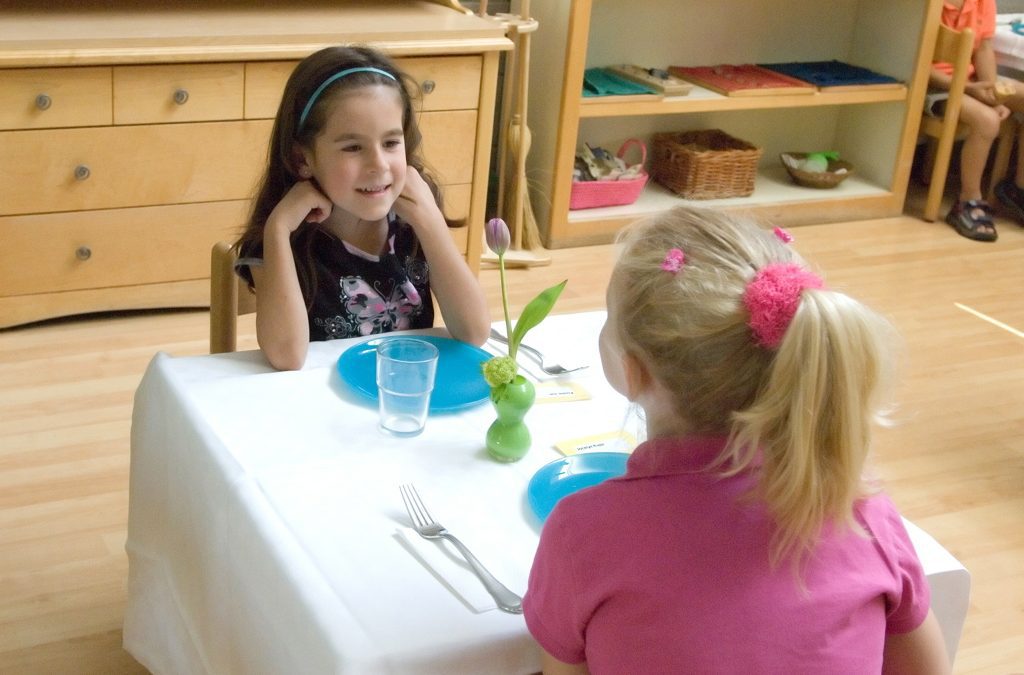
Toward Best Practice: The Exercises of Practical Life
By Tim Seldin and Jonathan Wolff
The exercises in Practical Life are the very heart of Montessori education. As young children wash tables, pour liquids, polish silver, sweep and dust, they are developing the inner aptitudes of calmness, order, concentration, coordination, and fine motor skills. At the same time, through the process of learning to meet their own needs, learning to take care of the classroom environment, and through the experience of helping others, children in Montessori programs begin to develop independence, self-confidence, and self-respect.
Observations and Reflections on Current Practice
As Montessori consultants and teacher educators, between us we have observed hundreds of Montessori programs all over the United States. Among countless examples of beautiful environments and excellent Montessori classes at work, we have tended to notice that the area of Practical Life in many Montessori classrooms deserves a fresh look.
For example, in many early childhood programs, there seems to be the assumption that five-year-olds are ready for “real work.” New Practical Life lessons are no longer presented and the older children are discouraged from wasting their time doing Practical Life activities. But while these children may have mastered the simple tasks that absorbed them when they were three, and while they may not particularly enjoy table scrubbing any longer, Practical Life is just as vital as it was before.
The key is to keep in mind once again the two distinct objectives of Practical Life at any age level:
1) to help children continue to develop concentration, coordination, self-reliance, and self-discipline; and
2) to help children master increasingly challenging and developmentally appropriate tasks and situations that lead them toward the care of self and of the social community within which they live and learn.
Observation in many Montessori classrooms we see children rarely spending much time on Practical Life after age four-and-a-half as if it is not developmentally or socially necessary.
Reflection The fine motor development that children are working toward in the basic Practical Life tasks needs to continue through the elementary years and into adolescence, as does the development of calmness, concentration, order, and independence. Often times in classrooms where teachers complain about children who are restless, disruptive, and unfocused, you see an absence or weak presence of Practical Life work.
Observation Many Montessori teachers rapidly rotate their Practical Life materials; every month we see new variations on the basic exercises.
Reflection Montessori pedagogy is based on allowing children to move toward self-mastery. If we rotate exercises out of the environment too quickly, we prevent them from mastering each task in turn. For example, when we begin to teach young children how too pour liquids, we show them how to hold the front of the pitcher with their non-dominant hand. The extension of this exercise comes when the child is ready to pour using just one hand.
Observation In many classes, we find a great many short sequence activities, such as cloth folding, water pouring, rice spooning, as opposed to the more complex sequence exercises, like table washing, dishwashing, food preparation, and polishing.
Reflection If there is one developmental competency lacking in American children of all ages it is the ability to focus on one task through to completion. In providing children with Practical Life activities that are completed very quickly with just a few steps, we are not adequately addressing the need for children to interactively practice skills of concentration and perseverance. In following the many steps involved in washing a table, children learn to attend to an entire sequence of visual-motor tasks.
Observation In many classrooms, Practical Life exercises tend to be discrete developmental tasks on a shelf. There is no transfer of the skills learned abstractly to the real-life application of caring for the environment or oneself. For example, in some classes, children learn to sweep by pouring dried beans on the floor and sweeping them onto a square laid down with tape, but then fail to progress to taking charge of sweeping the room on a daily basis.
Reflection The Montessori classroom for three, four, and five-year-olds is designed to be a “Children’s House.” The children are guided to participate fully in the actual life of their community. They help to prepare snacks and meals, clean the environment, and maintain the order of the classroom. In this way, they develop not only muscular control and competency over daily tasks, but a deep sense of self-respect, independence, and interdependence.
Observation In many classrooms, we observe teachers presenting most of the lessons to younger children themselves instead of encouraging older children to take the lead.
Reflection Who ultimately do we want to own and operate the classroom community: the children or the adults? Who ultimately needs to learn to lead, mentor, and be mentored by their peers? Who ultimately ties the shoes in your classrooms? Who prepares the snacks? Who sets the tables, washes the dishes, and cleans up the spills? What is the role of the older children? Do they mentor and teach the younger ones?
Toward best practice: Suggestions for enhancing the Exercises in Practical Life
• When new materials arrive from the manufacturer, consider showing the children how to carefully unwrap and unpack them; just one more exercise in Practical Life and a first step toward appreciating the beauty of the materials and the importance of using them carefully.
• Place a photo on each shelf showing how the entire shelf looks when it is set up with all the materials that belong there placed in proper order. This allows the children to use the photo as a Control of Error whenever they take the materials off the shelves to work, dust, polish, or inspect them for damage.
• When a piece of Montessori material needs repair, rather than taking it home or working on it after school, consider working on it right in the classroom when the children are present. Where appropriate and practical, teach the children how to help you repair or do simple repairs themselves.
• Likewise, when you have new card materials that have been laminated, consider sitting back to quietly observe the children at work while you cut them out from the laminate. Older children can be taught how to help you with this process.
• Demonstrate how you personally take responsibility for the care of the environment and encourage the children to do likewise on a daily basis. Draw their attention to the small details, such as picking up stray paper, beads, or other debris from the floor.
• In selecting trays, pitchers, and other utensils for Practical Life exercises, look for the most attractive materials that you can find and afford. Design activities that will draw the child’s interest and create a prepared environment that is harmonious and beautiful.
• If possible, avoid using plastic pitchers, bowls, trays, and other materials in preparing Practical Life activities. Children respond to the beauty of wood, glass, silver, brass, and similar natural materials.
• Whenever possible, Montessori exercises are designed with a control of error. By the same principle, Practical Life exercises should be created with materials that will break if they are dropped or misused. This becomes a superb teaching tool for the child in the prepared environment, and an opportunity for a re-presentation by the teacher or further exploration by the child. It may also lead to a new lesson in problem-solving (“How do I gather up all those beads?” or safely clean up the broken pieces. )
• Practical Life exercises should not be confined to a small tiled area of the room, with the exception of exercises that may lead to damaged carpet or similar concerns. Practical Life should be integrated into every area of the classroom throughout the day and should be a natural outgrowth and progression from the introductory shelf exercises designed to help the children gain initial mastery and control. For example, every shelf and piece of material in the prepared environment can be regularly dusted, washed or polished, and inspected for damage; books returned to order on the shelf; plants watered, and class pets feed.
• In providing opportunities for young children to negotiate across the classroom carrying materials balanced on a tray, children are challenged to become courtesy and self aware of others’ needs. Being careful not to step on other children’s work or bump into them, walking slowly and carefully, and remaining aware of the tray’s position in space are all integrated.
• Two critical areas of Practical Life that are often underdeveloped are grace and courtesy (the language of respect) and lessons in control and coordination of movement.
A few grace and courtesy lessons
• Saying please and thank you
• Using an appropriate indoor voice
• Begging pardon/apologizing
• Asking for permission to observe
• Asking for assistance
• Asking for permission to join in an activity
• Declining a request graciously
• Greetings
• Shaking hands
• Greeting visitors/offering coffee or tea/serving as a tour guide
• Expressing complements and appreciation
• Expressing one’s feelings appropriately
• Setting personal boundaries and being appropriately assertive
Experiences in the control and coordination of movement:
• Montessori saw a direct correlation between the child’s ability to move through the environment gracefully with control. In orienting and reorienting children into your class, take care to emphasize the importance of careful and purposeful movement.
• Remember the importance of modeling the process of walking on the line every day. Teach the children to walk along the line that you have made on your classroom floor, walking heel to toe, carefully balancing their bodies while carrying small flags. They can do the same exercise while carrying things on trays or cups on saucers.
The under-utilized and unappreciated Silence Game:
• The Silence Game helps children to develop a higher level of self-discipline, along with a greater awareness of the beauty of silence and subtlety of sound.
• In this group activity, the teacher will get the children’s attention either by ringing a small bell or by hanging up a sign with the command “Silence.” The children stop where they are or gather on the line, close their eyes, and try to remain perfectly still. The children sit still with their eyes shut and wait to hear the teacher whisper their name. When they hear it ever so softly spoken, they silently rise and join the teacher. Sometimes the teachers will vary the Silence Game by challenging the children to carry bells across the room with allow them to ring, or they may use the calm atmosphere to introduce the children to guided visualization. At first, the younger children may not be able to hold the silence for more than 20 or 30 seconds, but gradually their ability to relax, listen and appreciate the perfectly calm environment increases. In many classes, the Silence Game is an important daily ritual.
A few examples of elementary and middle school exercises in Practical Life
• Animal training
• Assertiveness skills
• Self-defense
• Affirmation skills
• Project and time management
• Stress management
Setting personal goals
• Knowledge and respect for common laws
• Calligraphy
• Care of one’s clothing: ironing, using the washing machine, spot removal
• Child care & baby-sitting
• Computer skills
• Cooking
• Public speaking
• Dancing
• Peer mediation
• Community service
• Mentoring younger children
• Craft skills: how to make gifts
• Earning your own spending money
• First aid and CPR
• Group communication skills
• Growing flowers in the garden
• Growing food in the garden
• Growing plants in a greenhouse
• Hobby skills: model building
• How to resolve conflicts peacefully
• How to use a public library
• How to use public transportation
• How to win and keep friends
• How to write formal letters
• Map reading – finding your way about town
• Nutrition: menu planning
• Operating audio-visual equipment
• Outdoor camping and hiking skills
• Photography
• Physical fitness: keeping in shape
• Planning a luncheon for guests
• Planning your own field trip
• Practical politics: How to speak out effectively on public issues
• Practical rules of social etiquette
• Preparing food for a large group
• Preserving food: canning, drying
• Public speaking
• Raising classroom pets
• Raising small farm animals: chickens, ducks, rabbits, goats, or sheep
• Safety at home and school
• Sewing and knitting: making clothes
• Shorthand
• Simple acts of charity and kindness
• Study skills
• Swimming and canoeing skills
• Test-taking skills: playing the game well
• The young citizen and the law
• Typing: speed and accuracy
• Using hand tools for simple carpentry
• Writing and putting together a play
In summary, we recommend that Montessori teachers keep 5 points about Practical Life in mind:
Practical Life exercises have individual developmental objectives like calmness, concentration, cooperation, self-discipline, and self-reliance.
Practical Life exercises have social objectives, such as self-awareness, sensitivity to others, and service to the community.
To have meaning, Practical Life exercises must be applied to real life.
Lessons in Practical Life skills and their application to daily living are as important at age 18 as they are at age 3 and at every age in between.
As Montessori teachers, we bear the responsibility of setting the tone and serving as daily role models for Practical Life skills. We need to be poised, purposeful, precise, caring and giving.
Quotes
“In the special environment prepared for him in our schools, the children themselves found a sentence that expressed their inner need: “Help me to do it by myself!” His work will no longer weigh him down.” Montessori
“No one can be free unless he is independent. Little children, from the moment they are weaned, are making their way toward independence.” Montessori
“The essence of independence is to be able to do something for one’s self.” Montessori
“Such experience is not just play. It is work he must do in order to grow up.” Montessori
“Just as the little child cries out “help me to do it by myself” through his actions, so does the older child demonstrate the same need at successive levels of sophistication as he grows.” Montessori
Featured
-
 Montessori Family Alliance School Group Membership (Print & Digital 2026 1/2 year pricing)
Original price was: $30.00.$15.00Current price is: $15.00.
Montessori Family Alliance School Group Membership (Print & Digital 2026 1/2 year pricing)
Original price was: $30.00.$15.00Current price is: $15.00.
-
The Montessori Way, Revised and Expanded: An Education for Life; A Comprehensive Guide for Parents and Teachers
$25.00
-
The Montessori Child: A Parent's Guide to Raising Capable Children with Creative Minds and Compassionate Hearts (The Parents' Guide to Montessori)
$20.00
-
The Montessori Toddler: A Parent's Guide to Raising a Curious and Responsible Human Being (The Parents' Guide to Montessori)
$20.00
-
Montessori in Action: Building Resilient Montessori Schools 1st Edition
$29.95