

How to Disagree with Your Teen in an Empowering Way


Book Review – Island of the Blue Dolphins

Island of the Blue Dolphins
By Scott O’Dell
The Island of the Blue Dolphins is a historical fiction novel, based on a true story about a girl named Karana, who was stuck living in isolation for 18 years. In the story, Karana lives on an island with her family, and the rest of the Ghalas-at people. They all live in peace until the Aleut people arrive and take their resources, and all the Ghalas-at people are forced to leave the island. They accidentally leave Karana behind, where she is to fend for herself.
The progression of this story’s plot was unlike many stories I’ve read before. It started as a simple story about a girl’s family and tribe life on San Nicolas Island and moved into a story about how a girl lived in isolation for so many years. Along with the progression of the plot came character development. Karana knew how to live her life with what she had, but this came into play when she was stranded.
I think that the Island of the Blue Dolphins is a great book because it portrays a way of life. It gives a new aspect to the reader about different lifestyles people have all around the world. Another reason I enjoyed this book was because of the plot twists; just when you thought something came to an end, it opened with a new beginning; it made this book all the more interesting to read and kept the reader hooked.
I would best recommend this book for ages 12+, and the reason for that is that the book has some themes, such as isolation and extreme perseverance. In the story, Karana goes through so much that I couldn’t imagine someone under 12 understanding. Another reason that I recommend this book to a 12+ audience is because of the style of writing. The way the book was worded might be hard for a younger audience to understand the concept.
Overall, I enjoyed the book and recommend it to anyone who likes to read true stories. This book will keep you reading. Between Karana’s adventures and how she keeps herself company, you won’t want to put the book down!
Reviewed by Danica Kovacevic, 8th grade, NewGate School, Sarasota, Florida

A Sense of Place
Engendering Love of One’s Home with Adolescents
The NewGate School, Global Campus Students, Research Their Place on Earth and Weave a Story to Share
By Amy Kremer-Treibly and Elizabeth Hale
The NewGate School’s Global Campus is composed of students in seventh through twelfth grades who live in Canada, the US, the Caymans, and Tanzania. These students are the first cohort of the Global Campus, and they work together with a dedicated faculty for humanities, math, science, and Spanish academic courses, as well as working in their home communities on creativity, physical wellness, and service.
Adolescents seek answers to key questions: Who am I? Where am I? What’s happening?
In order to gain insights and impressions of where each student resides, they set out as investigators of their own backyard, town, city, and country, with special attention to who inhabited the land first, including animals, plants, and humans. Students have been sharing their stories as presentations to the community in Opening Meetings held each morning of the week. This project offers a rich opportunity for students to explore the question of where do I find myself living right now?
During this process, students access local historical societies and talk to family and neighbors about generational memories of the place. Some students highlight developments, such as industry and railroad access. Others brought names of indigenous tribes to our attention, as well as the plants and animals that have thrived in the past and either do or do not live now. Overwhelmingly, the students learn more about where they call home. In addition to acquiring knowledge of place, by pausing and giving attention to the land that supports our lives, the people who have come before, and the bounty that nourishes us, we all grow in our appreciation and gratitude for home.
It has been said that to love a place and show true care for it, one must spend time, look with earnestness for the hidden treasures to be revealed, and then we can fully celebrate our home. Indigenous wisdom embodies connection and relationship, and for that reason, we like to include the Haudenosaunee Thanksgiving Greeting, which we read aloud in turns during Council before Thanksgiving. •
REFERENCE
Smithsonian Museum Blog. https://tinyurl.com/mvvjxu4f
Amy Kremer-Treibly, M.A. earned her Bachelor’s Degree in Anthropology at Loyola University where she also enjoyed studying Spanish during a study abroad term in Quito, Ecuador, and learning about world religions as her minor. She began her teaching career in a refugee resettlement program teaching ESL to adult students from around the world followed by teaching Spanish at the elementary level. While teaching at a Great Books Foundation high school in Arizona, she earned her Master’s Degree in Experiential Education at Prescott College with a focus on building schools and learning experiences to promote engagement, eco-literacy, and stewardship.
Elizabeth Hale teaches Humanities and other courses with NewGate School’s Global campus. She spent the last 13 years developing Heartmoor Farm Education Centre in central Virginia teaching Literature, Humanities, and Mindfulness to adolescents while nurturing her connection with the natural world specifically through contemplative practices, the stewardship of plants, and formal study of Western Herbalism. With 24 years of teaching experience, in classroom environments from Oregon and Ohio to Virginia, she has worked with families through all stages of their children’s development.

An Online Montessori School for Teens
In the fall of 2020, the leadership of the Center for Guided Montessori Studies asked the question, “What would an authentic Montessori middle school look like if it were online?” This question was especially pertinent at the time, because we were all adjusting to “forced” online learning resulting from the COVID pandemic. The question that we asked ourselves was, “Can we build an adolescent Montessori program and community online?”
That winter, we decided to plan for a soft launch of what became the Bridgemont International School. We began with just one class of seventh- and eighth-grade students, all living within the time zones of the continental United States, led by certified and experienced Montessori Adolescent Guides.
Our plan is to add one grade a year, extending through high school over the next four years. We also plan to open additional cohorts in North America and other parts of the world as interest grows. As we have from the start, our goal is not to grow quickly, but rather with slow, careful steps to ensure that we establish programs that are excellent and sustainable.
The first question that we reexamined was, “What makes a Montessori adolescent (middle and high school) program authentically Montessori?” Even though we have been involved with Montessori programs at this level for years, there is (at this point) no one model for adolescent programs. Dr. Montessori died before she was able to define the “model” of what a secondary program looks like. Rather, there are a series of lectures and discussions that other Montessori educators have interpreted, leading to vastly different models of Secondary education.
Many are familiar with the farm-school model of Montessori Adolescent Education (Erdkinder), while others may be familiar with the curricular outlines of other Montessori Secondary training programs. While there are many different models, there are key components of Montessori for the student in the third plane.
Curriculum: Students need to learn! They should be culturally literate and develop the academic skills they will need if they decide to pursue post-secondary education. Even within this component, there are different definitions of what that means. I would suggest that students need to know basic information. What makes Montessori distinct at this level is the balance between helping students through the challenges of adolescence, while covering an excellent course of study. For us, a particular focus is helping teens to discover that what they learn in school is real, relevant, and interesting. We want to encourage their interests, help them to see the big picture, and think critically about what they study and how it relates to their own lives.
The core of our academic program is the Montessori educational syllabus, which consists of ‘integrated academic components’ in three overarching areas: self-expression; emotional development; and preparation for adult life.
Within these areas, Bridgemont offers rigorous coursework in a variety of academic subjects, experiential learning, and in-the-field experiences; a range of seminars and collaborative learning projects; training in organization and personal responsibility.
Even though our curriculum is highly integrated, courses have titles that are familiar to colleges and other schools including math, language arts, sciences, humanities, Spanish, health, arts, and electives.
Here is an example of a simple 7th- and 8thgrade science experiment that we did recently.
Is “earth-friendly” laundry detergent actually safe for the environment?
For this experiment, we planted radish seeds in potting soil. In Dish #1, we watered the seeds with a mixture of water and regular detergent. In Dish #2, we watered the seeds with a mixture of water and earth-friendly detergent. In Dish #3, we simply used regular tap water.
After 10 days, only one dish had germinated seeds. Can you guess which one???
The dish that used regular tap water was able to grow radish seeds. The other two dishes? Nothing.
In Dish #1, the regular detergent solution left a heavy film over the soil and seeds.
In Dish #2, the earth-friendly detergent solution did not leave as heavy a film; however, no seeds germinated.
Conclusion: “Earth-friendly” may not be all it is advertised to be; however, it certainly is “friendlier” in appearance.
Valorization: This is such a wonderful term that Dr. Montessori gave us. It is the key challenge of adolescence: the formation of a clear sense of identity, a moral compass, and feeling validated and valued for their contribution as an individual. As children transition from childhood through the teenage years, and then into the adult world, they need to feel a sense of responsibility and worth that leads them to confidence and independence. This can be accomplished in many ways; however, it is probably the single most important component of Montessori at this level.
Community: Community is, directly and indirectly, related to curriculum and valorization. Part of the work of adolescents is to discover their own strengths, style, and role in the community. This is done through deliberate and unexpected avenues. A most basic statement is that adolescents desire to be part of a community.
So, back to the question at hand; how does one create this from an online platform?
How can we deliver a rich curriculum that is more than mere memorization, create opportunities for students to feel valued and value in their work, and create a sense of community, when most of them have never actually met in person?
The students at Bridgemont spend approximately four hours a day in real-time engagement in a variety of activities, including (but not limited to) direct instruction, Socratic dialogue, independent and small-group work with peers, presentations, guest lecturers, working out, doing art, and the occasional Harry-Potter-themed “butter beer” parties.
So, can Montessori at this level be done from an online platform? YES!
A prepared environment at the Secondary level is much more about experiences rather than the materials and physical environments of the Early Childhood and Elementary levels. Can the Montessori guides create opportunities for authentic interaction, sharing, and developing a real sense of caring about one another? Can this be done while also helping students become culturally literate and explore their open passions? Again, YES!
Online learning gives students the space to comfortably participate and voice their opinions, which can ultimately help build confidence and positively reinforce their self-esteem.
At the half-year point, the discussion among the students and Montessori guides turned to gratitude. To our delight, what the students were most grateful for was the sense of community, greater than they had felt in their brick-and-mortar schools. What was our greatest concern, had become our greatest strength.
Community, in the case of the Bridgemont students, guides, and administrators, means kind, empathetic, interested young adults that are not just saying that they care, but honestly care about each other and are interested in the world in which they exist. While doing so, they are also being held to a high level of academic expectations that support each student’s progress and independence.
SOME ADDITIONAL INFORMATION:
Is Bridgemont accredited?
As Bridgemont International School is licensed in the state of Florida, it adheres to the graduation requirements of the State of Florida. (We teach the same courses; however, they are taught very differently.) The school plans to pursue accreditation by the International Montessori Council (IMC) and Cognia.
How does Bridgmeont address service learning, Erdkinder, etc.?
At Bridgemont, we recognize the importance of the “Montessori experience.” We intend to include each of these experiences; however, they will be different in that the students will have more responsibility in designing their experiences with the support of our Montessori guides. Rather than being provided with experiences, students will be actively involved in the design of the experiences that satisfy their requirements in their own communities.
Is it all online?
A goal for the near future is to have two live in-person experiences a year. The school year would start with a whole-school orientation, which would change from year to year and is meant to be a team-building and orientation program. The second experience is meant to be student-designed and will look different from year to year. This will be budgeted, designed, planned, and based on student feedback and student work. (COVID-19 has made this difficult, but it is a goal for the 2022-2023 school year, if possible).
How are time zones addressed?
Our courses and schedules are deliberately designed to meet the needs of students in the continental United States. With WIN (What I Need) hours scheduled on both sides of the “Core” curriculum, students from all parts of the United States can work together at times that are convenient and in line with best practices in adolescent psychology.
As the school grows, there will be timezone-specific cohorts. These will be times that are more specific to time zones and regions; however, there will be shared times with all available time zones to include students from other countries, continents, etc.
In summary, Bridgemont International School is an authentic Montessori School, where students from all over the United States and around the world have the opportunity to become what they are meant to be and have the fortitude, confidence, and support to go after it. •
If you are interested in learning more, please visit our website at www.bridgemontschool.com.

Robin Howe, Ed.D. is a Montessori kid, a Montessori certified teacher (at all levels except infants), and a Senior Consultant for the Montessori Foundation.
2020 NewGate School Seniors Interview

BOOK REVIEWS assembled by Lorna McGrath
Animals Reviewed
by Association of Zoos & Aquariums

Elementary and middle school children, along with their parents and teachers, will love this book. It is a hilarious review of wild animals from around the world! Each animal is rated in a humorous way that tells the reader a little something about the creatures. Animals Reviewed also includes the common name for the animal, its scientific name, and a zoo or aquarium where it can be found. This information is great because some of these animals may tickle a child’s curiosity and may motivate them to do more in-depth research about the animal. They may even be able to go see the animal in person if a zoo or aquarium nearby has one in residence. Enjoy!
 ”I declare after all there is no enjoyment like reading! How much sooner one tires of any thing than of a book! When I have a house of my own, I shall be miserable if I have not an excellent library.”
 ”I declare after all there is no enjoyment like reading! How much sooner one tires of any thing than of a book! When I have a house of my own, I shall be miserable if I have not an excellent library.”
—JANE AUSTEN
Make Music!
by Norma Jean Haynes, Ann Sayre Wiseman, and John Langstaff

Another wonderful book for adventurous children and grown ups who want to have fun making music! The book is laid out in categories starting with Beginning Notes (pun intended I’m sure!); Household Things that Ring and Ping; Body Music; Percussion Beats and Rhythms; Breath Music: the Winds, The String Section; Instruments from the Workshop; and Creating Music. I’m excited just writing down the names of the sections and that’s not all. This book has beautiful photos of real children in action and having so much fun with music. Make Music is a great resource for an afterschool studio or for the vacation home or cabin, or at home on a school break, or ongoing project. The audience for the projects would probably be elementary-age children because of their skill and social levels; although, very clever teachers or parents could probably modify some of the projects for younger children as well.
Hatching the Cosmic Egg
Written by Michael Dorer Illustrated by Beth Wilson Music by Andrew Kutt

Michael Dorer, a well- known Montessori educator, author, and conference presenter, has now written his first children’s book and it’s ‘wonder-full.’ Hatching the Cosmic Egg opens with a request for the reader to “think of the very biggest thing you can.” I’m already intrigued and excited, and I think elementary children will be, too!
On each of the next few pages is a gorgeous, two-page, colorful drawing of very large earthly things that children might imagine and the author asking; Is it a great, gray elephant? Next two-page spread: A tall, snowy mountain? And so on. Then he begins to ask about more stellar images like the sun and the stars. This is so cool because the book brings the child’s mind to bigger and bigger images leading up to: It’s the UNIVERSE!
Now the story begins! This book encourages and entices children to think big about the universe, about themselves, and their part in the universe. Dorer, being the great storyteller that he is, seamlessly incorporates concepts from the great lessons and brings the readers to an awesome affirmation that they are connected to and part of everything in the universe.
Beth Wilson’s illustrations are perfect for the story, both in style and simplicity. They add to the wonder of this book. And, there’s more. With each book comes a CD with music and song by Andrew Kutt that enhances the story for readers in a totally different genre. This book needs to be in every home and classroom!
The Memory Box
Written by Joanna Rowland Illustrated by Thea Baker

Editor’s Note: I would like to personally thank Lorna for picking this book to review. My family suffered a great loss this year. It has had an enormous impact on all of us, especially my two grandsons (ages seven and eight). After reading this review, I immediately ordered this book on Amazon. This is such a difficult part or ‘adulting,’ but it is so needed to help children who struggle (often silently) to understand and find a way to celebrate and remember someone they loved so much.
The Memory Box is a very helpful book for children who have lost a loved one. It brings to light a variety of emotions from fear to sadness to happiness that children may experience as they go through the grief process and beyond. Sometimes, adults find it difficult to talk about feelings and death, especially if the person who has died is someone they loved as well. This book helps adults, as it tells a story about a child who is grieving, what feelings she experiences, and how she creates a “memory box.” The illustrations are lovely, almost whimsical, and yet realistic. At the end of the book there is a section to help adults support children through their loss. Children four years old through elementary and possibly the middle school years would benefit from The Memory Box.
Treasure Basket Explorations
Written by Laura Wilhelm Photos by Gryphon House and Shutterstock

Treasure basket exploration is a terrific idea for not-yet-mobile infants. The concept could be modified in some ways to better fit toddler’s through kindergartener’s strong sense of order. I struggled a little bit with this concept because I know from my own observations, as well as those of Maria Montessori and interactions with children in the early childhood years (birth-6 years old), that this period of time in a child’s development is crucial for preparing an environment that instills a very orderly way of thinking. At the infant and toddler stage of development, little ones are all about moving and exploring, so the baskets work well. There is a certain amount of order to it because the objects are contained within the basket. They come out of the basket and, when finished, return to the basket (sometimes by the infant or toddler—more often than not by the parent or teacher). The baskets are almost like introductory work for the primary level (3-6 years old), where the activities are contained in baskets or on trays but are designed to teach a skill rather than just allow for exploration.
I need to do more research about “heuristic learning” to truly understand what it is. As I read this book, it sounds like you put a bunch of stuff in a pile and the children get to “explore” it. For me it sounds a bit too unstructured for 3-6-year-olds, as they are really ready for order and imitation rather strictly exploration. Their activities always have some flexibility for exploration but also have a beginning, a middle, and end within each activity.
So, there are some very usable ideas for the infant-toddler years, and some ideas that can be modified for older children in Treasure Basket Exploration.
The Montessori Toddler: A Parent’s Guide to Raising a Curious and Responsible Being
Written by Simone Davies Illustrated by Hiyoko Imai

When I looked at the cover of this book I was intrigued. It was simple with a kind of unique illustration of a shelf with activities, and it was written for parents of toddlers—encouraging signs. Then I looked at the table of contents which was 3.33 pages long. Hmmm. Busy parents with small toddlers. Looks a little off-putting to me. So, I flipped through the book. I like photos and illustrations. There were very few photos and quite a few illustrations, but lots of words to read in this 248- page volume. Oh boy!
I made myself look more closely, and what I found was delightfully appealing. That huge table of contents I discovered was because the author listed each topic in each chapter, so it looked a lot more daunting than it truly is. Many of the topics listed are half a page to two pages at most. A parent can easily read a quick snippet and put the book down. They can also easily look up a specific topic that they are interested in because the topics are listed in such detail.
After looking more carefully, I really like the design. Simone Davies is very thorough. Her knowledge, understanding, and enjoyment of this age group is very apparent, and she shares it well with her audience. Often toddlers are misunderstood and so behave in ways that parents find difficult. Davies touches on some key points when thinking about toddlers. The first two chapters give parents valuable information about this stage in a child’s development and a brief introduction to Montessori. The rest of the book helps parents see their role as changing from a servant during infancy to a guide during toddlerhood and beyond. She brilliantly describes how to create a home environment that supports toddler success, both physically and emotionally, with furnishings and activities, as well as discipline.
The Montessori Toddler is a great resource for parents of infants, so that they can prepare for toddlerhood and for parents of toddlers who are already in the midst of toddlerhood.
TOMORROW’S CHILD © • NOVEMBER 2019 • WWW.MONTESSORI.ORG

BOOK REVIEWS by NewGate Secondary Students
Six of Crows
by Leigh Bardugo

If you like complex characters, a thrilling story, and Victorianesque setting, then you will love Six of Crows by Leigh Bardugo. This book tells the story of a convict, a sharpshooter, a runaway, a spy, a heart render, and a thief who band together to pull off an impossible heist.
Six of Crows takes place in the Grishaverse, a world where certain people called Grisha have the power to manipulate the tides, the wind, or even the chemicals in your body. Every chapter in this book follows the story from a different character’s point of view. The narrative switches between Kaz Brekker, a criminal underworld mastermind; Jesper, a sharpshooter, who can’t walk away from a bet; Wylan, the runaway son of a rich merchant; Inej, a circus performer turned into a deadly assassin; Nina, a Grisha heartrender far from home; and Matthias, a Drüskelle, witch hunter, and a convict. All of them must put aside their differences to complete an impossible heist, not only to save the world but for the money.
The first half of this book takes place in the city of Ketterdam, a city based on Amsterdam, specifically in The Barrel, the part of town with all the gambling halls are where anyone will do anything for the right price. The Barrel is home to thieves, conartists, and, most importantly, gangs. It’s a place where everyone is trying to outsmart everyone else. The second half takes place in the faraway country of Fjerda, a cold unforgiving country filled with Drüskelle. Overall, I loved the setting; I just wish we could have explored The Barrel more. Kaz, also known as Dirtyhands, is a lieutenant in a gang called the Dregs. Inej is a kind, yet dangerous, Suli acrobat who, through a series of unfortunate events, finds herself an assassin. Jesper is a jittery and funny sharpshooter, who can’t walk away from a wager. Nina is decisive and independent. Matthias is cold and a good soldier. Wylan is the moral compass of the team.
Six of Crows is a must-read for anyone who enjoys thrilling, suspenseful, and magical books. With its complex characters, engaging, and intriguing setting, Six of Crows is not only a good book but a masterpiece.
Reviewed by Daniel Pellizzari,10th grade
Matched
by Ally Condie

In the book Matched, a girl named Cassia lives in a tightly controlled society where decisions are made for her. Officials decide, no one else. They decide whom you love, where you work, when you die, and more.
Ally Condie’s husband gave her the idea to write the book, Matched. She had a conversation with him about marriage in the fall of 2008. He asked, “What if someone wrote the perfect algorithm for lining people up, and the government used it to decide whom you married, when you married, etc.?” But some of Condie’s inspiration also came from general experiences, such as becoming a parent and falling in love.
The main characters in this book are Cassia Reyes and Bram Reyes, Bram and Cassia’s parents, Cassia’s grandfather (Xander), and Ky. My favorite character is Cassia’s grandfather (aka Samuel Reyes) because he’s so sweet and he understands Cassia. He’s kind and gentle to everybody, and he loves poetry. In this story, Samuel is always there for his family, as well.
I would like to experience what living in that society would be like. Cassia is so closely monitored all the time and isn’t free to do whatever she pleases—other people control everything Cassia does from the time that she eats to the time that she dies. It would be really interesting to see what that would be like.
Matched is definitely one of my favorite books. It’s very well written and interesting to read. The book has many unexpected twists, turns, and lies that make you need to keep reading. If I could change one thing about this book, I would change something that happens to Cassia’s grandfather. If you want to know what happens to him, you should read the book!
I highly recommend this book because it opens up your mind and makes you more grateful to know that you aren’t always being watched or monitored at all times. It’s so crazy to think how free we are compared to these people who live in a place where they’re just like everyone else—from clothes, to school, to work, and even to falling in love. If you’re the type of person who likes family, adventure, fantasy, and love, then I believe that this would be the perfect book for you!
Reviewed by Maya Stutzman,9th grade
Flowers for Algernon
by Daniel Keyes

Flowers for Algernon is highly acclaimed, having earned the Nebula Award for Science fiction and Hugo award for best novel and considered a classic by many. Written initially as a short story in 1959, it was later expanded into a novel in 1966. The book challenges the status quo of science fiction, focusing not on laser guns, but on the human mind. When it was released in 1959, it changed the very definition of science fiction. However, besides the science aspect of the book, it also has a more important message about humanity.
The story follows Charlie Gordon, a developmentally delayed man who wants more than anything to be smart. When two scientists choose him to be part of a science experiment meant to raise his IQ, his view of the world is completely changed. Now he has to deal with the difficulties that come with intelligence and the painful memories that begin to manifest in his head. I won’t say that this book will change your life, but it should definitely make you think. For me, Flowers for Algernon really pulled at my heartstrings and made me feel emotions that few books have been able to elicit.
Before I elaborate more on the story, I would like to mention that this book is not for kids any younger than secondary school age or those who are afraid to feel a little uncomfortable. The reason I say this is as Charlie remembers more and more of his past, the book takes a darker turn. There are also some slightly mature moments in the second half of the book.
Charlie’s character goes through multiple changes as his intelligence increases. He starts off as a man who has the mind of a kid, working at a bakery owned by a family friend. This is the only place he is able to work, and the owner acts as a father figure to him. He can’t remember anything and is constantly bullied by the other workers. Then, when he receives surgery that slowly increases his intelligence, his character completely changes. He becomes a hyperintelligent person who remembers everything and is able to learn twenty different languages, but now he realizes everything that has happened to him in his life. He now understands that he was previously living in the moment but not able to understand the moment. He had no control over his life, yet now he does, and he’s impossibly frustrated by this. People treat him completely differently and are scared of him. He’s mad at the world, at people, and at his circumstances. He only finds true companionship with the lab mouse, Algernon, that was the scientists original laboratory test subject.
A cool aspect of Flowers for Algernon is how the book itself is written. The story is told in the first person and is written in progress reports by Charlie. This gives the reader a new way to look into the protagonist’s mind, and I really enjoyed reading something that is written so uniquely.
One of the major reasons why I truly recommend this book is its great message. It shows that people who have mental disabilities are still people. We shouldn’t treat people differently just because they struggle with simpler tasks. If anything, we should support them and help them like we would any other person.
Reviewed by Micah Levine,10th grade
Between Shades of Gray
by Ruta Sepetys

“Have you ever wondered what a human life is worth? That morning, my brother’s was worth a pocket watch.”
Between Shades of Gray is a historical fiction novel written by Lithuanian-American writer, Ruta Sepetys. Sepetys’ heritage inspired the creation of Between Shades of Gray, her first novel. This chilling novel is centered around the soul-crushing events of the sovietinvasion within the country of Lithuania in 1941. During this time, soviet police took men, women, and children and dispersed them wherever they pleased, all while leaving the captives uninformed of their destination. The soviets would tear families apart, leaving them to question the fate of their loved ones. The soviets essentially forced the Lithuanians to live as slaves under extremely harsh, inhumane conditions, while having to comply with every order given to them; if they failed to comply, it could mean instant death.
Between Shades of Gray begins with backstory on Kostas Vilkas. Kostas is the husband of Elena and father to Lina and Jonas. Like many other able-bodied men, he was taken and separated from his wife and children. His wife, Elena, is an intelligent and caring woman. Elena can be seen taking on the role of the voice of reason, as well as being a source of positivity. Their daughter, Lina, is a young teenage girl with a passion for art, only 15, when she and her family were taken from their home. Lina’s younger brother, Jonas, was only ten years old when their family was taken. Although they do have their mother by their side the majority of the time, both Lina and Jonas are forced to grow up extremely quickly due to the hardships they face within their situation. However, when the children briefly reconnect with their father, bumping into him in a nearby train car, Kostas gives the children words of wisdom, telling them to stay strong and not to give up. This empowers Lina and Jonas, making them want to keep going despite all their struggles.
The family, minus the father, was forced aboard a train headed towards Siberia. Here, they meet many fellow Lithuanian captives; most memorably, they meet Andrius Arvydas.
Andrius is around the same age as Lina, and during the novel, they become love interests. The family also meets Mr. Stalas, Mrs. Grybas, Ona, and others. They all soon come to be familiar with Komorov, the commander. It seems as if Komorov is the embodiment of evil; he is the main antagonist. Along with the commander, the Lithuanians also get to know Nikolai Kretzsky. Kretzsky is another soldier who takes part in torturing and ordering the captives around. However, as time progresses, Elena strikes an odd friendship with Kretzsky and it’s revealed that he isn’t completely evil.
Between Shades of Gray demonstrates many important themes, including: morality, sacrifice, integrity, strength, and much more. I love watching the characters develop and grow throughout their story. Each character looks at what it was like to be a captive in the mid 1900s from different perspectives; and you are somewhat put into their shoes. I especially appreciate that, to create this novel, Septeys interviewed real survivors of this time. The fact that everything happening directly stems from those peoples’ truths gives the story life; it gives the story more real feelings and emotions. It shows a more historically accurate representation of their hardships. Their stories must be shared, and the way Septeys delivers their stories is beautiful. Septeys makes the story more personal, incorporating thoughts directly from the protagonists’ minds.
Septeys brings to light the crushing tragedy of the persecution of Stalin’s victims in such a way that is extremely powerful and full of raw emotions. This novel covers such a real and touching topic, I would direct the novel to a more mature audience. Anybody who enjoys more intimate, emotional novels will love this book. Be warned, Between Shades of Gray is a rollercoaster; you better make sure to buckle up.
Reviewed by Katherine Laub,9th grade
Ninth and tenth grade students at NewGate School are reading and writing like crazy! Writing reviews for real publications provides students with an authentic reason for writing. Do you have students or children who would like to send in reviews? For submission guidelines, contact: lornamcgrath@montessori.org.
TOMORROW’S CHILD © • NOVEMBER 2019 • WWW.MONTESSORI.ORG

IB Is Something I Never Expected I Would End Up Doing
by Madison Dodd, NewGate Student
I have always pursued alternative education, whether that be through Montessori, Waldorf, or homeschool. Therefore, it was a shock to me to think that I would be involved in a program so widely recognized across all types of schools. I remember my first day touring NewGate School as a high school freshman. I met with Tim Seldin, who showed me around campus and encouraged me to give the IB Diploma Program a shot once my junior year came, to which I replied, “But I can’t do math!” (to which he replied, “Just do an IB Certificate!”).
I did not expect how much I was going to push myself over the course of these two years. I wasn’t aware of how much I was truly capable of. I remember the first day of our science (Biology HL) class, our teacher told us there was going to be a ‘learning curve’ and that we should prepare ourselves to not always get A’s on our test like we may be accustomed to. Although my classmates and I took in this information, it didn’t quite set in until we all studied for one of our first big tests We thought it was our best work yet, but then we realized that we all just scored in the ‘2-3 range’ … out of 7!
Suddenly, our teachers were no longer there to give us all the tools to get a good grade in the class, to make sure our homework was done on time, or to make sure we were present for the lessons. By IB’s design, the weight was now put on us, as the students, and it was time to get to work.
WHAT IS IB?
In a nutshell, IB is a two-year diploma or certificate program that is internationally recognized across universities to award college credit. That means that from junior to senior year, you will be in the same classes preparing for (depending on your course) between two to three final exams that will be scored from 1 to 7 in each subject. These courses will be three higher level (HL) courses and three standard level (SL) courses. The difference simply being that a HL course may have some extra requirements that SL students don’t have to complete.
Along with the end-of-year exams, there is the Internal Assessment that you must complete in each IB course. In Biology, that might look like a science experiment that you write a paper about. In Literature and Performance, you adapt a short story or poem into a play. The teachers grade it and then send it off to IB to be assessed by them.
I did not enter the program feeling that I was someone who was even remotely able to tackle all of these requirements. However, by putting in the work, learning how to manage my time, and not get in the way of myself, I’m able to positively reflect on it now.
In addition to your coursework, you must complete the Extended Essay (EE), which is a 4000-word research paper that is situated in one of your six IB courses. Then, there is the additional class you must take called “Theory of Knowledge” or “TOK.” This is essentially a philosophy class, and the only two requirements for it are that you complete:
• One TOK essay using one of IB’s supplied prompts
• A TOK presentation in which you develop your own research question and explore it using a real-world example
All of these go towards your final IB score, which can be up to 45 points. I promise this will all begin to make more sense once you are in the course.
Finally, at the heart of IB’s program, there is CAS (Creativity, Action, and Service). This is something you complete outside of school and, most of the time, you are already doing it. Do you play a sport or an instrument? If so, the action and creativity boxes are already checked off.
The only requirement for CAS is that you create a portfolio containing reflections about these activities throughout your two years (mine is in the form of a blog) and that you complete one CAS project, which can involve one or all of the CAS components, and is at least six weeks long. While this does not go towards your score, you will not receive your diploma if you do not complete it.
Overall, IB takes a global approach by looking at big ideas across disciplines. You will notice yourself finding connections between something you learned in science class with something you are talking about in Spanish. No matter what you’re studying, students dig deep into subjects and try to find answers.
WHAT IF YOU DON’T WANT TO COMMIT TOALL THAT EXTRA COURSEWORK?
For whatever reason, if a student does not want to do the full IB Diploma, they can take up to three IB courses; they only need to complete what is required in that course. That means no CAS, no EE, and no TOK. This represents the difference between the higher level and the standard level requirements in the courses. This is beneficial for a student who might have a tighter schedule and doesn’t have time for the full diploma or has a subject area they do not want to take at such an intensive level.
MY EXPERIENCE
IB is usually perceived as a big, scary, and difficult program that only those suited for ivy leagues can survive. However, through my experience, I have learned that it is not the skills that you enter the program with that matter; rather, it is the skills you will acquire throughout the program that will carry you to the exams.
I did not think, at the beginning of my junior year, that I would be leading a discussion in my social and cultural anthropology class about hegemony in marginalized groups in East Harlem. I also did not think I would ever receive a 90 percent on a math test, but it happened! For me, IB has been a journey full of self-discovery and lots and lots of struggling. However, my own academic struggles have taught me so much about who I am and what I am capable of.
I did not enter the program feeling that I was someone who was even remotely able to tackle all of these requirements. However, by putting in the work, learning how to manage my time, and not get in the way of myself, I’m able to positively reflect on it now. I can’t speak for every school, but at New- Gate the support system from the teachers and students is something I attribute to why I entered IB in the first place. Therefore, I encourage anyone considering the program to try it. Your name is not even registered as an IB student until late in your senior year, meaning you have time to see if the program works for you and adapt accordingly.
Looking back, all the stress tears I cried, the coffee I consumed, and nights I stayed up were all formative in enabling me to believe in myself. Even though I am not at the finish line, it is now in my line of sight, and I am sprinting towards it faster than I ever have before, with my teachers and family cheering me on until I arrive. •

Madison Dodd is a high school senior in the IB Diploma Program attending NewGate School. She lives in Sarasota, Florida with her parents and younger brother.
Sample Study Guide for Secondary Students
Upper School Study Guide
Student ______________________
Week of ________________
Science ____________
Skills and knowledge_________________________________________________
_____________________________________________________________________
_____________________________________________________________________
Lessons and experiences _____________________________________________
_____________________________________________________________________
_____________________________________________________________________
Assignments _________________________________________________________
_____________________________________________________________________
_____________________________________________________________________
Math __________________
Skills and knowledge_________________________________________________
_____________________________________________________________________
_____________________________________________________________________
Lessons and experiences ______________________________________________
_____________________________________________________________________
_____________________________________________________________________
Assignments _________________________________________________________
_____________________________________________________________________
_____________________________________________________________________
Humanities
History
Skills and knowledge_________________________________________________
_____________________________________________________________________
_____________________________________________________________________
Lessons and experiences _____________________________________________
_____________________________________________________________________
_____________________________________________________________________
Assignments _________________________________________________________
_____________________________________________________________________
_____________________________________________________________________
Economics
Skills and knowledge__________________________________________________
______________________________________________________________________
______________________________________________________________________
Lessons and experiences ______________________________________________
______________________________________________________________________
______________________________________________________________________
Assignments _________________________________________________________
_____________________________________________________________________
_____________________________________________________________________
Cultural and physical geography
Skills and knowledge__________________________________________________
______________________________________________________________________
______________________________________________________________________
Lessons and experiences ______________________________________________
______________________________________________________________________
______________________________________________________________________
Assignments __________________________________________________________
______________________________________________________________________
______________________________________________________________________
Current Events
Skills and knowledge__________________________________________________
______________________________________________________________________
______________________________________________________________________
Lessons and experiences ______________________________________________
______________________________________________________________________
______________________________________________________________________
Assignments __________________________________________________________
______________________________________________________________________
______________________________________________________________________
Civics
Skills and knowledge__________________________________________________
______________________________________________________________________
______________________________________________________________________
Lessons and experiences ______________________________________________
______________________________________________________________________
______________________________________________________________________
Assignments __________________________________________________________
______________________________________________________________________
______________________________________________________________________
English
Composition
Skills and knowledge__________________________________________________
______________________________________________________________________
______________________________________________________________________
Lessons and experiences ______________________________________________
______________________________________________________________________
______________________________________________________________________
Assignments __________________________________________________________
______________________________________________________________________
______________________________________________________________________
Research skills
Skills and knowledge__________________________________________________
______________________________________________________________________
______________________________________________________________________
Lessons and experiences ______________________________________________
______________________________________________________________________
______________________________________________________________________
Assignments __________________________________________________________
______________________________________________________________________
______________________________________________________________________
Literature and poetry
Skills and knowledge__________________________________________________
______________________________________________________________________
______________________________________________________________________
Lessons and experiences ______________________________________________
______________________________________________________________________
______________________________________________________________________
Assignments __________________________________________________________
______________________________________________________________________
______________________________________________________________________
Language B _______________
Skills and knowledge___________________________________________________
______________________________________________________________________
______________________________________________________________________
Lessons and experiences _______________________________________________
____________________________________________________________________
____________________________________________________________________
Assignments _________________________________________________________
____________________________________________________________________
____________________________________________________________________
Visual and performing arts
Skills and knowledge________________________________________________
____________________________________________________________________
____________________________________________________________________
Lessons and experiences ____________________________________________
____________________________________________________________________
____________________________________________________________________
Assignments ________________________________________________________
____________________________________________________________________
____________________________________________________________________
Philosophy and ethics
Skills and knowledge________________________________________________
____________________________________________________________________
____________________________________________________________________
Lessons and experiences ____________________________________________
____________________________________________________________________
____________________________________________________________________
Assignments ________________________________________________________
____________________________________________________________________
____________________________________________________________________
Human relations and conflict resolution skills
Skills and knowledge________________________________________________
____________________________________________________________________
____________________________________________________________________
Lessons and experiences ____________________________________________
____________________________________________________________________
____________________________________________________________________
Assignments ________________________________________________________
____________________________________________________________________
____________________________________________________________________
Leadership training and cooperative teamwork skills
Skills and knowledge________________________________________________
____________________________________________________________________
____________________________________________________________________
Lessons and experiences ____________________________________________
____________________________________________________________________
____________________________________________________________________
Assignments ________________________________________________________
____________________________________________________________________
____________________________________________________________________
Health and physical education
Skills and knowledge________________________________________________
____________________________________________________________________
____________________________________________________________________
Lessons and experiences ____________________________________________
____________________________________________________________________
____________________________________________________________________
Assignments ________________________________________________________
____________________________________________________________________
____________________________________________________________________

Practical Life for Grown-Ups

You Can Be a Montessori Adult: Practical Life for Grown-Ups
from Tomorrow’s Child – The Montessori Family Magazine – September/October 2021
By Scott Osborne
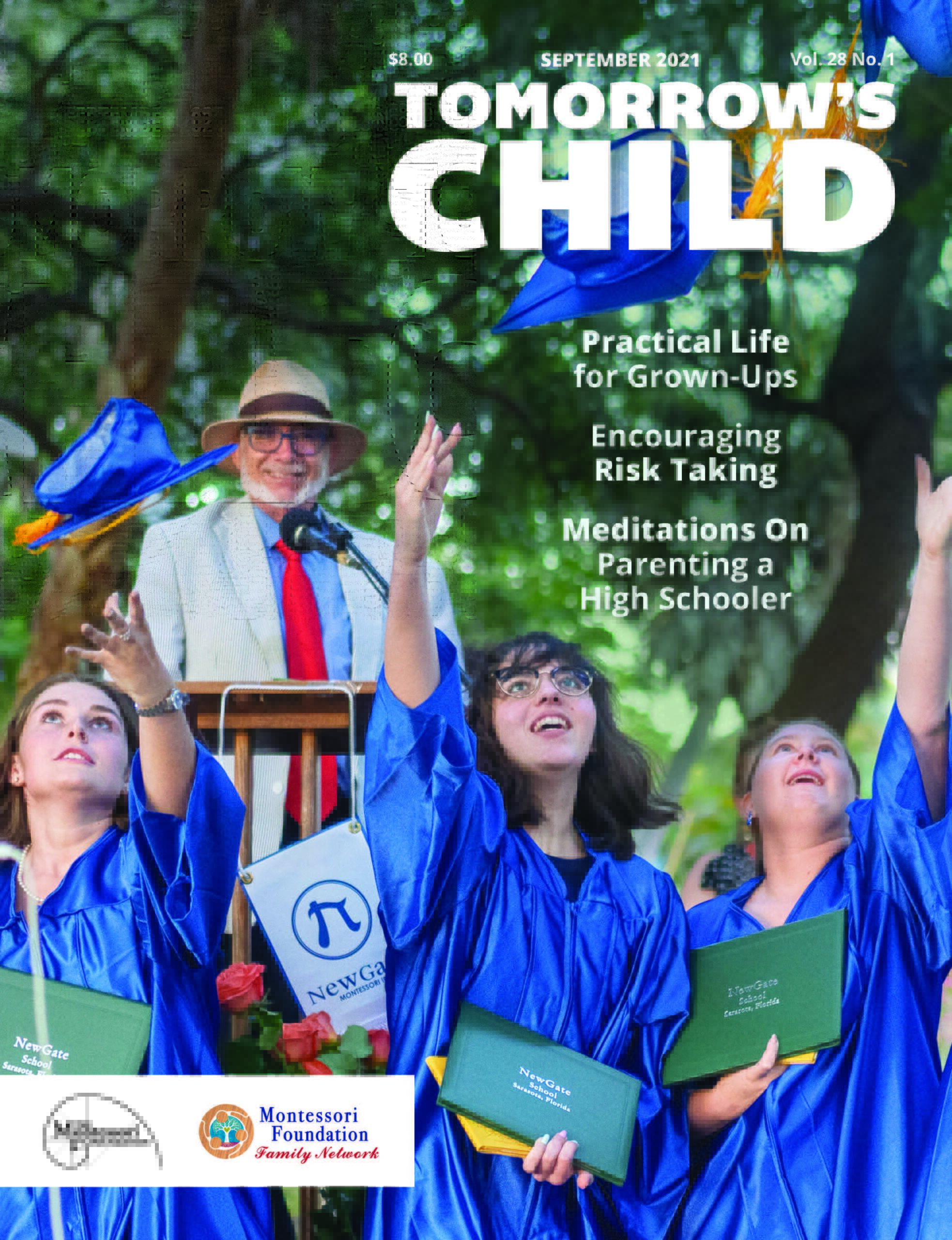
Commencement talk given at the NewGate High School May 28, 2021 in Sarasota, Florida
You are now graduating from a Montessori High School: prepare yourself for questions. For the rest of your life, this will be a curiosity to other people. They will ask you about it, and they probably won’t understand it. Embrace this!
If you were lucky enough to be in a Montessori school in your early years, you’ll be able to tell them about the Pink Tower or the Checkerboard or perhaps the big bang lessons. Or maybe you were here at NewGate for weeklong Opera planning or research trips or theater immersion weeks.
But whatever you remember about your Montessori years, embrace them. These experiences have helped make you who you are today.
But you’re no longer a Montessori child. So, tonight, I’m going to give you a few brief suggestions for keeping Montessori in your life – for being a Montessori adult.
I want to encourage you to think of your Montessori education not as something that’s done, something that’s over, but as something that is now in your hands to continue.
About 15 years ago, I was teaching NewGate middle and high school students not so different from yourselves. We used to have many discussions about what they would need going forward – what would help them be the adults they wanted to be.
These conversations about credit cards and college roommates and cooking skills and driving led me to develop what is now called The Competencies Project. It’s like Practical Life for grown-ups.
You undoubtedly know that “Practical Life” is an actual curriculum area in Montessori early childhood classrooms. It’s that time when tiny humans learn table washing and silver polishing, line walking, and water pouring.
Some of you – especially parents – undoubtedly wondered why three-year-olds were learning silver polishing and table washing, activities they were most certainly not doing at home. But Maria Montessori knew what she was doing when she created these lessons.
So, in her honor, I am going to suggest that you continue this Practical Life journey, that you set your sights on new Practical Life skills – adult ones. It’s like the Pink Tower for grown-ups.
These suggestions I am going to offer you today might someday turn your life around. I wager they will have far more impact than the college you (do or do not) attend or the career path you are (or are not) successful in following. These offerings are much like the Montessori Method itself: obscure to outsiders, deceptively simple, yet profoundly significant.
Be forewarned. These first suggestions will make you think I’m crazy, but hear me out.
Take up juggling. Play poker. Compose flower arrangements.
In addition, learn how to:
1. Iron a shirt
2. Sharpen knives
3. Hold a baby with confidence
4. Play pool and billiards (and, yes, poker)
5. Write a condolence note and attend a funeral in a tradition not your own
6. Make a free-standing fire, outdoors, with available materials
7. Eat with chopsticks
8. Tie a Windsor knot tie
9. Orient with a compass
10. Unclog a toilet
11. Open an IRA
12. Use a clock face for telling direction
13. Open a bottle of wine with a traditional wine opener
14. Call someone you do not know on the actual telephone!
15. Drive a manual-shift automobile
Okay, you think. But why? What’s the big deal?
Well, how about some more nuanced Practical Life skills? Can you:
16. Make socially appropriate introductions in any setting
17. Cook a meal in an unfamiliar kitchen, like someone else’s home, figuring out how to navigate neatly and effectively
18. Set up a simple outdoor tent
19. Bargain in markets where prices are not stated – which is most of the world
20. Entertain a group of six-year-olds for an hour
21. Recite a least one poem by heart
22. Make change in another currency
23. Play a portable musical instrument
Those are very hands-on. But what about things you should know?
For example: do you know, without looking them up or consulting an app:
24. Five major star constellations
25. The significant forms of economic production in four other countries
26. The most prevalent health indicators in those other countries
27. The basic principles and vocabulary of a few world sports
28. The fundamental principles of the major world religions
29. The sounds of individual instruments in the orchestra
Before I go on, let’s pause and think about some of these.
If you’re like most people, you will have identified a few of these skills you have mastered.
And for most of the rest of this list, you’ve thought: why bother? You might say: I’ll never need to tie a Windsor knot. And you would be right.
You might also say, And if I do need to tie a Windsor knot, I’ll look it up! You would also be right.
So what good do these do? Are these just nice party tricks or things that will turn your life around?
I would argue these competencies, and others like it (I currently have a list of almost 200) form your foundation, the same way that the Pink Tower and table washing in early childhood provided your foundation then.
Remember, three-year-olds don’t really need to know how to stack a Pink Tower or wash a table! In a way, those too were just cute party tricks for a small child. Yet those lessons opened the door to everything that followed. And you need to continue to open doors — to make your own Practical Life lessons — for a fulfilling and productive adult life.
Continuing to expand your competencies does two things.
First, it provides opportunities for continued mastery. You need to keep making opportunities to say to yourself, Hey, I can do that! Just resting on your laurels, on the skills you’ve learned, is not enough. You need an active means of stepping outside the familiar, stepping outside your comfort zone of abilities, and mastering the new and challenging.
You can’t wait until important, major life challenges come your way. You continue with these small skills — the ones you don’t need — because mastery of those will help give you the confidence to face the real challenges of life.
And second, the experience of learning new skills creates the brain and body architecture you need to master the next big challenges — to be able to do and know the things that are important to you.
Someday you’re going to need to learn something hard, overcome a huge challenge, or just enjoy something new. It is this diverse architecture of experiences — this foundation — that will permit you to do just that.
So I’m telling you to actively continue to develop Practical Life skills, not just career or academic skills (you’ll be faced with those anyway). These are the Montessori Practical Life lessons you’re going to create for yourself.
Let me give you some examples.
One day you’ll see a co-worker busy working on a project, but she’s juggling a baby and a keyboard (because that seems to be what a lot of women do). Because you know how to hold a baby, you can walk over and say, How about I take that little one while you finish working? In that one moment, you will make a new friend for life, you’ll have the amazing sensation of ethereal, soft baby skin next to yours, and you’ll feel like a hero.
Or when you know the major tenets of four world religions and the major export products of a few other countries, think about the insights you’ve gained! You will have a window into entire populations, plus foreign policy, culture, economics, and you’ll probably know a lot more about why your phone or t-shirt costs what it does, just from those few facts.
And when you can distinguish between the different sounds of an oboe and a clarinet and a flute, you’ll be creating pathways in your brain, you’ll be using your senses in new, unexpected ways — and those pathways and senses will be there when you need them.
These competencies – these Pink Towers for grown-ups – give you the stepping stones for where you want to go, just like that first Pink Tower led you to further learning. Only now, you’ll be creating the lessons for yourselves.
So okay, you think, I’ll learn to juggle. I’ll open bottles of wine and start fires and hold babies.
Great. Go for it. But that’s just the warm-up. Here are the big Practical Life skills you’ll want. Even if you ignore all the first ones, you really need these. And they are competencies, skills you can develop, not innate immutable characteristics. There are five.
One, learn to make friends at every stage of life. You’d be amazed at the number of adults who do not feel skilled at this; they literally don’t know how and they don’t talk about it. They just stagnate. You’re very fortunate to come from this supportive school community, this family, if you will. And many of us will always be here for you. But you’re going to change, you’re going to move to new towns, and you’re going to want new friends who are not provided for you, ready-made, at school or work. And you may even outgrow some old friends. You’ll have new interests. How do you find these new people who are right for you? Where would you start? Do you know? That’s a critical life competency and you can develop it. It will put you in good stead all your life.
Two, identify and manage your social anxieties. Can you keep up a reasonable conversation with a totally new person? You’ll want this on your first day of college or your first new job – in person or online – and for much of life thereafter. You need to be able to walk into a room of new people, calmly, solid in yourself. Social anxiety is everywhere – if you experience it, do not think you’re the only one!
The sooner you figure this one out, the sooner you will have removed a huge impediment in life. You show me the college student who drinks far too much every weekend, and I’ll show you the college student with serious social anxieties. This is a competency; the absence of it is not a character flaw. It is a Practical Life skill for grown-ups.
Three, be able to speak up to defend your personal values. I do a lot of advocacy work for causes I care about. Among other things, I do a lot of advising about gender equity – making the world better by helping everyone see past gender.
There’s one issue I get asked the most: how to confront something offensive. People will describe a setting, usually a social setting, where they were told or overheard an offensive remark: perhaps it was openly sexist or homophobic or racist. It made them cringe. And the listener didn’t know what to say or do. We are trained to be polite in social settings, yet how do we bring about changes in attitudes if we remain silent in the face of offensive or unjust comments? Learning what and how to state your own beliefs, appropriately, so you don’t cringe inwardly and don’t alienate people you love — that is a skill you will need. Whatever your strongly held beliefs might be, you’ll need to learn to talk about them outside the controlled setting of the classroom.
And now, the gold star of Adult Practical Life Competencies: Can you articulate personal vulnerabilities safely and honestly? Because you know why? Stuff happens! Someday, if you’re like the average person, you’re going to have some personal issues. When you’re in college, or later, at some point, you will have serious problems you’ll need to articulate and navigate through. We all have problems that come up: mortgages that can’t be met, marriages that dissolve. People find themselves drinking too much. Or maybe a family member is struggling with an eating disorder. This is life! How are you going to cope – with your own issues and those of your friends and family? Have you cultivated people in your life with whom you can share those issues? And this is not just about the dramatic, the cataclysmic. If you’re in the fifth week of college calculus and you have no idea what’s going on and are getting increasingly anxious about failing, can you speak up? You would be amazed at how many people struggle with this. This is a Practical Life competency. You develop it by learning to find people you trust, by starting with small topics.
Let’s be honest, America is a competitive society. People don’t want to reveal perceived weaknesses – they feel it is stigmatizing and will reduce their value, competitively. But that’s not life. For life, you want to practice articulating some problems. It’s a skill you’re going to need and yes, it could have huge ramifications on your future.
And, finally, number five and closely related to four, can you receive vulnerabilities from others? When your roommate turns to you and says, I don’t have any friends, or I can’t make my car payment, will you be ready? Will you be able to be a listener? Will you understand when to help solve a problem and when to just listen — without making the problem about yourself? Or shying away? Or stigmatizing the person? It takes two to be open. Be the other person. for yourself; being open to vulnerabilities; and listening to them from others. They are competencies — not character traits — and they will, over time, be huge determiners of your life.
And those ‘smaller’ skills? Those little ‘unnecessary’ skills, like juggling, using a compass, hearing the oboe? Keep building them. They will give you the confidence to do what you want in life, and they will give you the mind and body architecture to make all the other things possible.
So take up knot tying. And fires. And learn new currencies. And practice talking with openness and vulnerability. These skills can be developed and practiced. You can start from exactly where you are. You just have to be willing to be the learner, the skill developer, the Montessori child all your life. I know you’ll do wonderfully.
The NewGate School is the Lab School of the Montessori Foundation. Its is an international Montessori school for infants through 12th grade.
WWW.NEWGATE.EDU
Scott Osborne is a certified Montessori teacher. She is a lawyer, a nonprofit director, writer, and a gender equality advocate. Her first teaching experience was with the Peace Corps in West Africa, and she has worked primarily with international development organizations, living in seven countries on four continents. Most recently, she lived for three years in India working with small NGOs and teaching English to orphaned teenage girls. Scott is the Chair of Through Women’s Eyes, an international film festival now in its 23rd year. She is president of the United Nations Women-USA, Gulf Coast Chapter.
She raised two terrific Montessori children, who graduated from NewGate School and are both now young adults. Scott is also an avid amateur athlete. She received her bachelor’s degree from the University of Pennsylvania. She received her Juris Doctorate degree from New York University, and an MBA from Princeton University, but (according to her) Montessori certification was the most difficult educational experience she ever had.
This speech was given at the NewGate Montessori High School Commencement in May of 2021. It is part of a forthcoming book: The Competencies Project – How You Can be a Montessori Adult.
This story is from:”Tomorrow’s Child – The Montessori Family Magazine – September/October 2021″
pg 4-7

Grace & Courtesy: From Early Childhood to Beyond

from Tomorrow’s Child – The Montessori Family Magazine – September/October 2021
By Robin Howe, Ed.D.
“Each preceding phase prepares the one that follows, forms its base, nurtures the energies that urge toward the succeeding period of life”
Maria Montessori. (From Childhood to Adolescence, 134)
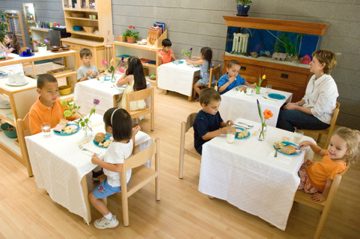
In early childhood (3 years to 6 years), there is a component of the Practical Life curriculum that is called “Grace and Courtesy.” It is a proper noun in that it has its own place in the early childhood curriculum. Some might say that it is the foundational piece, setting the expectations for behavior and interaction that lay the groundwork for successful work in the classroom; it is essential for the normalization of the class and the students in the class. As students progress through the early childhood and then elementary classrooms, Grace and Courtesy is acknowledged as an essential piece of Montessori, a continuum through which Montessori can effectively be implemented. As students get older, however, there seems to be a greater emphasis and division between a student’s behaviors (ability to demonstrate grace and courtesy) and their academic abilities. This does not mean that these two skills are mutually exclusive, but the importance or emphasis may change from the teachers’ perspective. In working with adolescents and adults, I consider myself lucky to have maintained contact with many past students, whom I have known through their childhood and into their adult lives. This has given me the opportunity to get to know these students as adults. Sometimes I wonder, though, if we have adequately prepared children for adulthood, and whether we allowed Grace and Courtesy to dissolve into memory from our early childhood years when children were learning how to walk carefully through a classroom while balancing a tray or how they politely interact-ed with others. Some questions I have been considering more and more are: • Does a four-year-old child having a tantrum in the middle of a grocery store have more leniency than a 17-year-old or a 25-year-old having the same level of a tantrum in the same grocery store? • Does a flippant remark from a six-year-old affect people differently than that of a 16-year-old?
Of course, the answer is yes! Even the most balanced four-year-old may have a moment when they lose control and it doesn’t matter why. Parents may be judged by bystanders on how they handle the situation but, ultimately, when the child is back in the car and eventually falls asleep to the motion of the vehicle, supporting a notion that the cause of this uncharacteristic outbreak was exhaustion, the situation is over. A young adult may not have this luxury. The threshold of understanding is much less for adults than it is for children and that is perfectly appropriate, based on our assumption that with age comes a level of self-control and maturity that would prohibit them from behaving in this way. So, my questions as a Montessori adolescent teacher are: • Are we adequately preparing our young adults for the succeeding period of life? • Are we preparing them for the expectations of existing in an adult world, even as they just enter adulthood?
I feel that Montessori does this better than other educational pedagogies in many ways. A few of them are outlined below. Internships and Work Experiences We encourage our students to explore careers and be amongst professionals, who may not have the patience of educators. The assumption is that if students behave outside of a span of “acceptable” behavior, they will be asked not to come back. Entrepreneurship Whether the students are participants in an Erdkinder program or other entrepreneurial experiences, they are learning about financial independence and being valued as part of the Montessori idea of “valorization.” A goal of any adolescent entrepreneurship experience is the appropriate appreciation for money, their own role in earning it, and an understanding of how their participation is something of value. Field Experiences Many Montessori secondary programs have opportunities for students to work both in their communities and the greater world beyond. The importance of a student experiencing other cultures and realizing that drinking water and plumbing are not guaranteed rights are incredibly important lessons. Leadership A tenant of any Montessori experience is the opportunity to be a leader. Whether the 6-year-old in the early childhood class or the 12th grader in a high school, this experience is incredibly powerful for both the student in a leadership role as well as the younger students who are observing. Each of these examples warrants entire courses and discussion, but is that enough?
On a recent trip with adolescent students, I passively listened to the conversations and observed behaviors, trying to demonstrate my own Montessori ability to know when and how to interact, while also trying not to be the misunderstanding adult, who (just a few years ago) might have been more understanding. While none of the behavior was egregious, in this heightened world of accountability, I found myself torn. Jokes that might have been accepted or even funny five years ago, may now be means for expulsion or even legal action. Flippant and loose language can be captured and reposted on a phone and can lead to the loss of scholarships and enrollment. Teachers do a lot, and some of these questions are the responsibility of the parent! Agreed! But, if we accept Montessori’s belief that “each preceding phase prepares for the one that follows,” are we doing enough? Should Montes-sori’s Grace and Courtesy curriculum more specifically prepare our young men and women for today’s world? Thinking back to that four-year-old who had the tantrum in the supermarket, do we have the expectation that young adults will have a much higher degree of control? But what if they don’t? How can we as Montessori parents, teachers, schools, and systems, support the changing expectations of young adults and prepare them for the post-secondary world where the expectations are higher than those of the four-year-old in the supermarket? The world we (the adults in the room) grew up in is not the same as that of our current students. Physiologically, science suggests that we are not different; however, earlier civilizations did not have cell phones and Instagram™. If our goal is ultimately to prepare students for the next stage of their life, whether it be university, a trade, etc. they have expectations as adults (even if they are not) that they need to be prepared for and the learning curve is not as long as it once was. In closing, while we consider Grace and Courtesy as a fundamental component of the Early Childhood curriculum, is it time to re-examine the importance for students in the third plane (12- to 18-year-olds)? As we prepare them for the succeeding experience, should this emphasis carry a capital G and C for our older students?
Towards best Practice: Lunch
When Dr. Montessori first opened the original Casa dei Bambini she was intent on creating an environment that would meet all the needs of her students in a classroom setting that closely approximated the warmth and comfort of home. Children were given the responsibility of caring for this environment so that they would find pride in ownership and be fully invested in the community. One of the many approaches she instituted was the area we call practical life. Children as young as three years old were taught to sweep, cook, serve meals, clean up, and generally care for themselves as independently as possible. Each day they tended the garden, prepared their own meals, served them to each other and cleaned up after themselves. Astonished adults came from all over the world to witness the incredible achievements of the first Montessori children. Over the years, her method has continued, but many of the original ideas have been substantially diluted. It has always been a source of major discussion among the various groups that claim the Montessori name.
Montessori philosophy does not limit itself to academic concerns only. Dr. Montessori is often quoted for her belief that education is for life. Life, as we all know, does not contain itself to the cognitive. Our reality flowers in the human complex, which is at once, physical, emotional, cognitive, social, and spiritual. Therefore, as a school, we have the obligation to address all the facets of our humanity. We are concerned about the child’s life in each of these areas. Just as parents are responsible for the growth and development of their children, we take seriously our responsibility to create and maintain the best possible environment for children so that they may grow into full and complete human beings. To ignore any area of development would be offering an incomplete educational experience.
In 1998, we instituted a fuller use of the practical life area in the elementary class by allowing the children to prepare their lunch at school each day. We have worked as a community for a long time and the children are accustomed to classroom jobs. Food preparation, set up, and clean up became part of this daily activity. A simple lunch consists of fruit, homemade bread, cheese, peanut butter, and a soup, stew, casserole, or chili. The children prepare the menu and agreements are made by consensus of the group. At the Preprimary level the children prepare fresh fruits and vegetables and sandwiches and the parent from a specific list of choices determines the menu. The parents at each level provide the basic ingredients on a rotating basis. Parents are asked to supply the groceries generally for a week at a time. They are sorted and stacked by the children who do the inventory. As a result of our work together the children have enjoyed all the physical and spiritual benefits that come from working cooperatively, eating well and sharing meals in community.
In response to the many needs of our families and children today, we have developed a comprehensive program that speaks to the body, mind, and spirit of the child.
Program goals
- Community Building and Celebration
- Developing Independence and Self-confidence
- Developing Good Nutritional Habits, Physical Wellness, and Consumer Awareness
- Developing and Applying Practical Life Skills
- Developing Good Table Manners and Grace and Courtesy
- Reducing Waste and Connection to Environmental Studies
Elementary children make the bread in bread machines first thing in the morning. The main meal consisting of a:
- Soup
- Stew
- Chili or
- Casserole
is prepared in an electric pot or on the stove.
Children get to practice peeling, cutting, chopping, grating, and sautéing thus expanding their practical life skills and learning the rudiments of basic cooking. They learn to measure, and calculate. They use their imagination and creativity as well. It is the tangible application of practical life skills.
At the Preprimary level the children are guided by the classroom assistant to prepare the vegetables and fruit and make the sandwiches.
Set Up:
Twenty minutes before lunch time the elementary set-up crew or supervisor:
- Sets the tables with plates, cups, napkins, and tableware
- Makes the drinks and puts out the pitchers
- Puts out the peanut butter and cheese on each table
- Prepares and puts out the salad or fruit and vegetable trays
Clean up
- When tables are called the elementary children bring their dishes to the common area for rinsing and loading into the dishwasher. Preprimary children wash their dishes at the dishwashing table.
- Table ?captains? or designated supervisor clears and wipes the tables and sweeps the floor. Preprimary children are responsible for their own spot.
- Teachers assist as needed.
- Children who are finished wait quietly with a book before everyone is dismissed to go outside.
Jobs and duties are organized and displayed in classroom charts. Sometimes seating is
also rotated on a chart.
Parent responsibilities
- Class coordinator formulate the schedule for bringing groceries.
- Each parent generally has no more than two weeks a year.
- Parents are encouraged to come as our guests.
- A parent helper sometimes assists with unloading and storing groceries and
keeping inventory at the lower elementary level.
Outcomes include:
- Better Eating Habits
- Children expand their food choices and experience different kind of foods.
- Better attendance, less sickness
- Children become more independent and confident.
- They learn to be confident creative cooks and carry it home.
- Children practice their academic skills.
- Pleasant lunchtime atmosphere.
- Relationships enhanced between children and their peers and children and their teachers.
- By working together from start to finish real community is practiced every day.
- Staff gets lunch as well.
- Children, parents, and staff learn cooking skills.
- Less Waste and trash
- Gardening and composting are an extension in order to teach the full cycle.
Everyone benefits! What could be more archetypal than coming together to break bread with each other each and every day? We invite you to join us for lunch any day.
Towards best Practice: The Educational Program Lunchtime
Lunch should be made a major focus of the day, with children and teachers eating together in their classroom as a community with real tablecloths, napkins, plates, flower vases, pitchers, and silverware. Children should do almost all of the work of setting up, serving, and cleaning. Tablecloths and napkins should be purchased in enough quantity for three days or so per class, and dirty ones taken home at night to be washed and ironed by each family in turn.
Although local laws and issues of practical logistics normally get in the way, ideally, every classroom should include a kitchen designed with children in mind. Low worktables should allow children to cut, mix, roll dough, pour, and participate in virtually all of the steps of food preparation. Small refrigerators should keep perishables within reach. A low two- or three-part sink, or small dishwasher makes it possible for children to wash their glasses, plates, and silverware after eating. Front loading washers and dryers are available that can be built right into the classroom off in a small alcove. If you decide to explore these options, and find it difficult to locate very small appliances, consult a yachting supply company, such as BoatUS in the USA. The problem of small washers, dryers, dishwashers, and refrigerators was addressed long ago in the boating community.
If your children need to bring in their own lunch, we recommend that they use containers that can be reused rather than disposable drink containers and plastic bags to hold sandwiches and
other food items. Set aside a specific place in each class for lunch boxes and have the children remove their lunch and return the lunch box to the shelf before sitting down. Even in areas where local regulations prevent food preparation, you should be able to create a pleasant atmosphere by using table clothes or place mats.
Again, ideally each classroom should have access to a coffee pot and kettle for making tea. The children should be taught how to offer and prepare tea or coffee for visitors.
Older students (elementary and secondary) can make wonderful use of complete kitchens and benefit from having similar more formally organized meals together, especially when they themselves have planned, prepared, and serve the food, as well as cleaning up afterward.
Montessori Curriculum Theory Workshop
Sharon Caldwell and Hillary Drinkell presented this Power Point at the 2013 IMC conference.
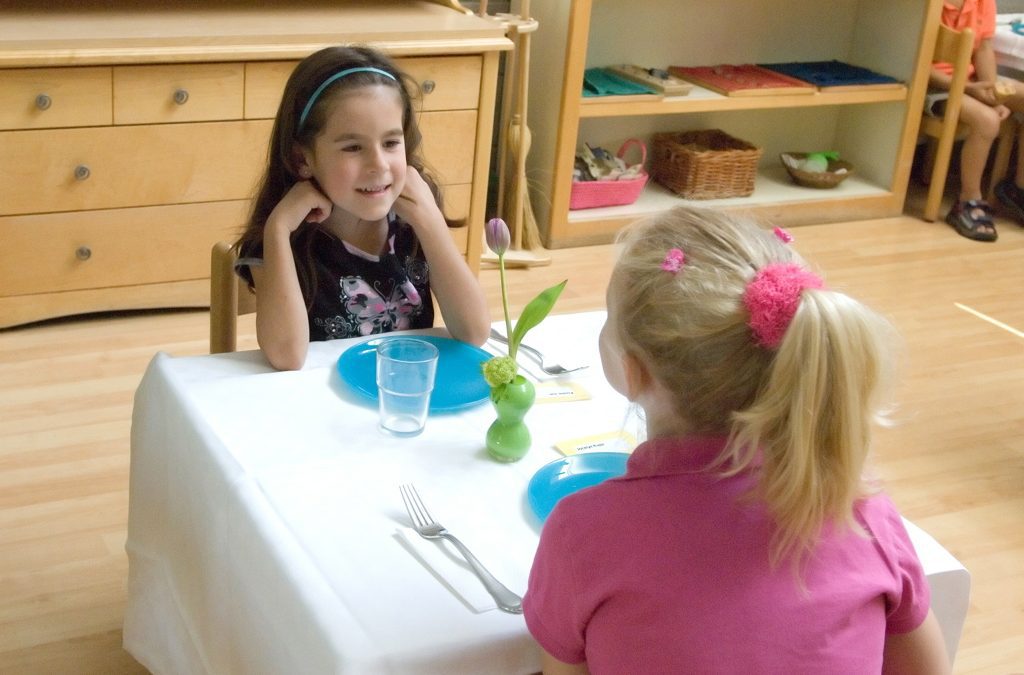
Toward Best Practice: The Exercises of Practical Life
By Tim Seldin and Jonathan Wolff
The exercises in Practical Life are the very heart of Montessori education. As young children wash tables, pour liquids, polish silver, sweep and dust, they are developing the inner aptitudes of calmness, order, concentration, coordination, and fine motor skills. At the same time, through the process of learning to meet their own needs, learning to take care of the classroom environment, and through the experience of helping others, children in Montessori programs begin to develop independence, self-confidence, and self-respect.
Observations and Reflections on Current Practice
As Montessori consultants and teacher educators, between us we have observed hundreds of Montessori programs all over the United States. Among countless examples of beautiful environments and excellent Montessori classes at work, we have tended to notice that the area of Practical Life in many Montessori classrooms deserves a fresh look.
For example, in many early childhood programs, there seems to be the assumption that five-year-olds are ready for “real work.” New Practical Life lessons are no longer presented and the older children are discouraged from wasting their time doing Practical Life activities. But while these children may have mastered the simple tasks that absorbed them when they were three, and while they may not particularly enjoy table scrubbing any longer, Practical Life is just as vital as it was before.
The key is to keep in mind once again the two distinct objectives of Practical Life at any age level:
1) to help children continue to develop concentration, coordination, self-reliance, and self-discipline; and
2) to help children master increasingly challenging and developmentally appropriate tasks and situations that lead them toward the care of self and of the social community within which they live and learn.
Observation in many Montessori classrooms we see children rarely spending much time on Practical Life after age four-and-a-half as if it is not developmentally or socially necessary.
Reflection The fine motor development that children are working toward in the basic Practical Life tasks needs to continue through the elementary years and into adolescence, as does the development of calmness, concentration, order, and independence. Often times in classrooms where teachers complain about children who are restless, disruptive, and unfocused, you see an absence or weak presence of Practical Life work.
Observation Many Montessori teachers rapidly rotate their Practical Life materials; every month we see new variations on the basic exercises.
Reflection Montessori pedagogy is based on allowing children to move toward self-mastery. If we rotate exercises out of the environment too quickly, we prevent them from mastering each task in turn. For example, when we begin to teach young children how too pour liquids, we show them how to hold the front of the pitcher with their non-dominant hand. The extension of this exercise comes when the child is ready to pour using just one hand.
Observation In many classes, we find a great many short sequence activities, such as cloth folding, water pouring, rice spooning, as opposed to the more complex sequence exercises, like table washing, dishwashing, food preparation, and polishing.
Reflection If there is one developmental competency lacking in American children of all ages it is the ability to focus on one task through to completion. In providing children with Practical Life activities that are completed very quickly with just a few steps, we are not adequately addressing the need for children to interactively practice skills of concentration and perseverance. In following the many steps involved in washing a table, children learn to attend to an entire sequence of visual-motor tasks.
Observation In many classrooms, Practical Life exercises tend to be discrete developmental tasks on a shelf. There is no transfer of the skills learned abstractly to the real-life application of caring for the environment or oneself. For example, in some classes, children learn to sweep by pouring dried beans on the floor and sweeping them onto a square laid down with tape, but then fail to progress to taking charge of sweeping the room on a daily basis.
Reflection The Montessori classroom for three, four, and five-year-olds is designed to be a “Children’s House.” The children are guided to participate fully in the actual life of their community. They help to prepare snacks and meals, clean the environment, and maintain the order of the classroom. In this way, they develop not only muscular control and competency over daily tasks, but a deep sense of self-respect, independence, and interdependence.
Observation In many classrooms, we observe teachers presenting most of the lessons to younger children themselves instead of encouraging older children to take the lead.
Reflection Who ultimately do we want to own and operate the classroom community: the children or the adults? Who ultimately needs to learn to lead, mentor, and be mentored by their peers? Who ultimately ties the shoes in your classrooms? Who prepares the snacks? Who sets the tables, washes the dishes, and cleans up the spills? What is the role of the older children? Do they mentor and teach the younger ones?
Toward best practice: Suggestions for enhancing the Exercises in Practical Life
• When new materials arrive from the manufacturer, consider showing the children how to carefully unwrap and unpack them; just one more exercise in Practical Life and a first step toward appreciating the beauty of the materials and the importance of using them carefully.
• Place a photo on each shelf showing how the entire shelf looks when it is set up with all the materials that belong there placed in proper order. This allows the children to use the photo as a Control of Error whenever they take the materials off the shelves to work, dust, polish, or inspect them for damage.
• When a piece of Montessori material needs repair, rather than taking it home or working on it after school, consider working on it right in the classroom when the children are present. Where appropriate and practical, teach the children how to help you repair or do simple repairs themselves.
• Likewise, when you have new card materials that have been laminated, consider sitting back to quietly observe the children at work while you cut them out from the laminate. Older children can be taught how to help you with this process.
• Demonstrate how you personally take responsibility for the care of the environment and encourage the children to do likewise on a daily basis. Draw their attention to the small details, such as picking up stray paper, beads, or other debris from the floor.
• In selecting trays, pitchers, and other utensils for Practical Life exercises, look for the most attractive materials that you can find and afford. Design activities that will draw the child’s interest and create a prepared environment that is harmonious and beautiful.
• If possible, avoid using plastic pitchers, bowls, trays, and other materials in preparing Practical Life activities. Children respond to the beauty of wood, glass, silver, brass, and similar natural materials.
• Whenever possible, Montessori exercises are designed with a control of error. By the same principle, Practical Life exercises should be created with materials that will break if they are dropped or misused. This becomes a superb teaching tool for the child in the prepared environment, and an opportunity for a re-presentation by the teacher or further exploration by the child. It may also lead to a new lesson in problem-solving (“How do I gather up all those beads?” or safely clean up the broken pieces. )
• Practical Life exercises should not be confined to a small tiled area of the room, with the exception of exercises that may lead to damaged carpet or similar concerns. Practical Life should be integrated into every area of the classroom throughout the day and should be a natural outgrowth and progression from the introductory shelf exercises designed to help the children gain initial mastery and control. For example, every shelf and piece of material in the prepared environment can be regularly dusted, washed or polished, and inspected for damage; books returned to order on the shelf; plants watered, and class pets feed.
• In providing opportunities for young children to negotiate across the classroom carrying materials balanced on a tray, children are challenged to become courtesy and self aware of others’ needs. Being careful not to step on other children’s work or bump into them, walking slowly and carefully, and remaining aware of the tray’s position in space are all integrated.
• Two critical areas of Practical Life that are often underdeveloped are grace and courtesy (the language of respect) and lessons in control and coordination of movement.
A few grace and courtesy lessons
• Saying please and thank you
• Using an appropriate indoor voice
• Begging pardon/apologizing
• Asking for permission to observe
• Asking for assistance
• Asking for permission to join in an activity
• Declining a request graciously
• Greetings
• Shaking hands
• Greeting visitors/offering coffee or tea/serving as a tour guide
• Expressing complements and appreciation
• Expressing one’s feelings appropriately
• Setting personal boundaries and being appropriately assertive
Experiences in the control and coordination of movement:
• Montessori saw a direct correlation between the child’s ability to move through the environment gracefully with control. In orienting and reorienting children into your class, take care to emphasize the importance of careful and purposeful movement.
• Remember the importance of modeling the process of walking on the line every day. Teach the children to walk along the line that you have made on your classroom floor, walking heel to toe, carefully balancing their bodies while carrying small flags. They can do the same exercise while carrying things on trays or cups on saucers.
The under-utilized and unappreciated Silence Game:
• The Silence Game helps children to develop a higher level of self-discipline, along with a greater awareness of the beauty of silence and subtlety of sound.
• In this group activity, the teacher will get the children’s attention either by ringing a small bell or by hanging up a sign with the command “Silence.” The children stop where they are or gather on the line, close their eyes, and try to remain perfectly still. The children sit still with their eyes shut and wait to hear the teacher whisper their name. When they hear it ever so softly spoken, they silently rise and join the teacher. Sometimes the teachers will vary the Silence Game by challenging the children to carry bells across the room with allow them to ring, or they may use the calm atmosphere to introduce the children to guided visualization. At first, the younger children may not be able to hold the silence for more than 20 or 30 seconds, but gradually their ability to relax, listen and appreciate the perfectly calm environment increases. In many classes, the Silence Game is an important daily ritual.
A few examples of elementary and middle school exercises in Practical Life
• Animal training
• Assertiveness skills
• Self-defense
• Affirmation skills
• Project and time management
• Stress management
Setting personal goals
• Knowledge and respect for common laws
• Calligraphy
• Care of one’s clothing: ironing, using the washing machine, spot removal
• Child care & baby-sitting
• Computer skills
• Cooking
• Public speaking
• Dancing
• Peer mediation
• Community service
• Mentoring younger children
• Craft skills: how to make gifts
• Earning your own spending money
• First aid and CPR
• Group communication skills
• Growing flowers in the garden
• Growing food in the garden
• Growing plants in a greenhouse
• Hobby skills: model building
• How to resolve conflicts peacefully
• How to use a public library
• How to use public transportation
• How to win and keep friends
• How to write formal letters
• Map reading – finding your way about town
• Nutrition: menu planning
• Operating audio-visual equipment
• Outdoor camping and hiking skills
• Photography
• Physical fitness: keeping in shape
• Planning a luncheon for guests
• Planning your own field trip
• Practical politics: How to speak out effectively on public issues
• Practical rules of social etiquette
• Preparing food for a large group
• Preserving food: canning, drying
• Public speaking
• Raising classroom pets
• Raising small farm animals: chickens, ducks, rabbits, goats, or sheep
• Safety at home and school
• Sewing and knitting: making clothes
• Shorthand
• Simple acts of charity and kindness
• Study skills
• Swimming and canoeing skills
• Test-taking skills: playing the game well
• The young citizen and the law
• Typing: speed and accuracy
• Using hand tools for simple carpentry
• Writing and putting together a play
In summary, we recommend that Montessori teachers keep 5 points about Practical Life in mind:
Practical Life exercises have individual developmental objectives like calmness, concentration, cooperation, self-discipline, and self-reliance.
Practical Life exercises have social objectives, such as self-awareness, sensitivity to others, and service to the community.
To have meaning, Practical Life exercises must be applied to real life.
Lessons in Practical Life skills and their application to daily living are as important at age 18 as they are at age 3 and at every age in between.
As Montessori teachers, we bear the responsibility of setting the tone and serving as daily role models for Practical Life skills. We need to be poised, purposeful, precise, caring and giving.
Quotes
“In the special environment prepared for him in our schools, the children themselves found a sentence that expressed their inner need: “Help me to do it by myself!” His work will no longer weigh him down.” Montessori
“No one can be free unless he is independent. Little children, from the moment they are weaned, are making their way toward independence.” Montessori
“The essence of independence is to be able to do something for one’s self.” Montessori
“Such experience is not just play. It is work he must do in order to grow up.” Montessori
“Just as the little child cries out “help me to do it by myself” through his actions, so does the older child demonstrate the same need at successive levels of sophistication as he grows.” Montessori
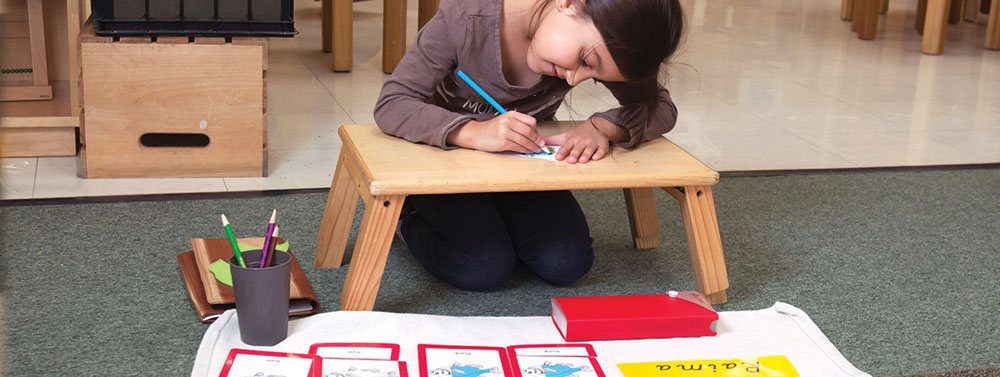
Understanding the Three-Hour Work Cycle
Tired and agitated, Sara got ready for bed. What had happened to the day? She had woken up fresh that morning, ready to have a productive day.
During breakfast, Sara’s assistant had called to alert Sara that she wouldn’t be in to copy the reports for the next day’s meeting. When Sara went to make copies of her presentation, the toner cartridge was low, the paper jammed and the machine ran out of staples. When Sara reviewed the copies, page 17 had been skipped by the machine. Sara’s lunch appointment cancelled while Sara was waiting in the restaurant. After lunch, she couldn’t get online to do some research. Then Ron, a co-worker, came in and complained about his weekend for half an hour. What went wrong with Sara’s day? Sara was unable to get a work cycle completed.
A work cycle consists of selecting an activity, doing it, achieving some internal satisfaction for the work and then selecting the next task.
When we experience this cycle of ”choose-do-return to order-satisfaction, then choose again,” we create a powerful success
cycle with feelings of accomplishment and contentment.
When we are having a productive work cycle, we’ll say we are ”on a roll.” We go from task to task, choosing progressively harder tasks as time allows. On those high-achieving days, we feel unstoppable.
Then there are the days when we get off to fits and starts because we are interrupted, don’t have enough time to complete a task before another commitment or lack the necessary supplies. How that trip to the hardware store can sabotage the best efforts for a productive workday!
Most of us, even small children, have a built-in three-hour work cycle. We might contrast and compare it to our sleep cycle. When we know we have at least three hours of uninterrupted time, we will tackle a multitude of jobs and enjoy doing it. If our time is interrupted, we may not even try to start anything. ”It’s not worth the effort,” or ”I don’t feel like doing anything,” we might say. Sound familiar?
When given a regular three-hour period, children (and adults) learn to tap into a success cycle. After accomplishing a series of short and familiar tasks in a 90-minute time frame, a child will choose a task that is challenging and represents ”true learning.” At this 90-minute mark there is a period of restlessness that lasts about ten minutes, until the choice for the challenging activity is made. The new activity may last for 60 to 90 minutes.
Here’s an example of a recent Saturday morning three-hour work cycle for me. Not very glamorous, but I was on a roll.
Clean kitchen, 15 minutes. Start laundry, 15 minutes. Make phone calls for appointments, 20 minutes. Vacuum, 20 minutes. Feeling of restlessness. What should I do next? Cup of coffee, 10 minutes. Balance bank statements and pay bills, 90 minutes.
Here’s an example of a four-and-a-half-year-old’s work cycle that I recently observed. Work puzzle, 10 minutes. Build with blocks, 15 minutes. Water plants, 20 minutes. Sweep floor, 10 minutes. Number counting cards, 15 minutes. Walk up and down steps, 5 minutes. Talk with dad, 10 minutes. Do 100-piece puzzle, 45 minutes. Practice tying shoes, 45 minutes.
When we have achieved a three-hour work cycle, normally we are eager to begin the next cycle. Productive adults have two to four work cycles a day. Children under the age of five usually have one work cycle a day. Around five, children will start a second work cycle if given the opportunity.
The gift of uninterrupted time gives us, children and adults, the opportunity to engage in our own powerful three-hour work cycles, creating personal success in learning, concentration and independence.
Next Week: Punishing with Rewards
Kids Talk™ is a column dealing with early childhood development issues written by Maren Stark Schmidt. Mrs. Schmidt founded a Montessori school and holds a Masters of Education from Loyola College in Maryland.

Montessori Mathematics
The Challenge of Mathematics
We use mathematics in almost every aspect of our everyday lives. As Dr. Montessori would often point out, much of our civilization is based upon mathematics. Science and technology depends upon mathematical calculations. Computers are totally mathematical devices. Businesses, research, and governmental agencies all rely upon the collection and interpretation of data and statistics. Art and music have direct connections to math. Despite its importance and many attempts at educational reform, mathematics continues to be a subject that many students find difficult.
Dr. Montessori observed that reason so many students struggle with math stems from the way it has traditionally been taught.
Numbers are symbols that help us to think about things, just as words do. When taught by workbook, text, and blackboard, math is almost totally abstract. Students who learn math by rote memory often have a fragile understanding and little or no ability to put their skills to use in everyday life. Learning comes much more easily when they work with concrete educational materials that graphically show what is taking place in a given mathematical process.
The study of math can become a fascinating occupation if it is begun at an early age and taught with hands-on experience and concrete materials to make abstract concepts clear.
Montessori’s Concrete Approach to Math
Beginning in the early childhood years, Montessori students use hands-on learning materials that make abstract concepts clear and concrete. Working with these fascinating educational tools, they can literally see and explore what is going on as each math process unfolds before their eyes. This approach to teaching mathematics offers a clear and logical strategy for helping students understand and develop a sound foundation in mathematics and geometry.
At the Children House level, children as young as three and four are form their first concepts of quantity and number symbols, and go on to enthusiastically explore the decimal system and arithmetical operations like addition and subtraction with materials such as the Golden Beads. The goal is to provide a concrete representation of a abstract idea, such as carrying forward when we add numbers greater than nine, which allows children to develop a clear inner image of mathematical concepts, such as how big is a thousand, what is meant by the ‘hundreds’ column, and what is taking place when we divide one number by another. This is consistent with everything that we know from research about the way young children think and learn.
Yes, mastering many math concepts will also require a certain degree of raw practice and, even in Montessori, students eventually have to memorize their math facts, but the process is greatly facilitated by helping them to develop a much more concrete grasp of the process at work. And yes, even in Montessori, some children will find math to be easy, while others may find it to be more challenging. The great strength of the Montessori approach is its ability to individualize to meet children’s different learning styles, pace of development, interests, and basic needs.
“Unified” Math
The Montessori math curriculum is based on the European tradition of “Unified Math,” which has only recently been discovered by leading American educators. Unified Math introduces elementary students to the study of the fundamentals of algebra, geometry, logic, and statistics along with the principles of arithmetic. This study continues over the years, weaving together subjects that traditional schools normally ignore until the secondary grades.
In operations concerned with measurement, geometry shows them how to perform their calculations. In operations concerned with figures, algebra gives a system of still more abstract symbols by means of which more complicated relationships can be comprehended. The calculations of area and volume, of squares and square roots are examples in which algebra, arithmetic, and geometry are all involved. For Montessori students, arithmetic, algebra, and plane and solid geometry have never been arbitrarily separated. Four- and five-year-old Montessori children can name geometric forms that most adults wouldn’t recognize.
Montessori mathematics includes a careful study of the practical application of mathematics in everyday life, such as measurement, handling finances, making economic comparisons, or in gathering data and statistical analyses.
The Elementary Years
Many parents and teachers think that the Montessori math materials are all very well for children under six, but when they go on to the elementary grades students shouldn’t need these artificial ‘toys’ or ‘crutches’. This represents an unfortunate misunderstanding of how children this age think and learn. Until a child can think at a high level of abstraction, which rarely occurs before early adolescence, he depends upon concrete experience and practice over a number of years before mathematical concepts begin to take firm root in his mind.
During the elementary years children almost never possess the capacity to think abstractly. Everything is either based on concrete experience or is “magic and mystery.” Math by its very nature is abstract. Montessori math uses the concrete mathematical material to help the child develop an inner picture of mathematics that will last a lifetime.
Naturally the child can’t depend on the materials forever. Can you see your child at age sixteen walking in to take the SATs carrying the Golden Beads? Dr. Montessori compared them to an airport runway which provides a smooth surface on which the plane can roll faster and faster until its built up enough speed to fly. The entire purpose of the Montessori Math curriculum is to make the abstract concrete, until the child can close her eyes and visualize mathematical processes at work. Step by step, the materials become less concrete and more symbolic. Step by step, the child is challenged to demonstrate her understanding by teaching what she’s learned to younger children, which also tends to reinforce and clarify the tutor’s grasp on the subject as much as teach something to the one being tutored.
Elementary Montessori students continue to gain hands-on experience by applying math in a wide range of projects, activities, and challenges, such as graphing the daily temperature and computing the average for each month, or adjusting the quantities called for in a recipe for a larger number of people. Because children love to work outdoors, teachers try to prepare tasks that use the school grounds whenever possible. For example, using simple geometry, children can determine the height of a tree or measure the dimensions of the buildings. They prepare scale drawings, calculate area and volume, construct three-dimensional geometric models, and build scale models of historical devices and structures.
Summary
It has often been said that either we find mathematics elegant in its logic, or terribly confusing. Our goal is at least to avoid the latter, and attempt to lead as many students as possible to discover that the first is indeed correct.
The Red and Blue Rods are the young child’s first introduction to Mathematics. These rods have the same dimensions as the Red Rods found in the Sensorial area of the Montessori classroom. Here, however, the rods are painted in alternating patterns of red and blue to distinguish their length in segments of one tenth of a meter (a decimeter). The first rod is one decimeter long and is just painted red. The second is two decimeters long, and is divided into two segments, one red and one blue. This continues through all ten rods.
As with the Red Rods, the children arrange the Red and Blue Number Rods into a stair from largest to smallest. Then they count each alternating colored segment. One of the insights that children begin to get from working with the rods is the nature of addition and the concept that two numbers can add to another. For example, when the children place the “one” number rod at the end of the “two” rod, they create a new rod that is the same length as the “three” rod just above. They explore similar relationships with all of the numbers 1 to 10. For example, they discover that the “four” and the “six” together are the same length as the “ten”.
Montessori found that young children find it difficult in the beginning to grasp the concepts of numbers by counting separate objects. While they can learn to “count” by rote, reciting the sequence of numbers from one to ten, most cannot easily grasp the difference between one quantity and another when looking at more than three or four objects. It’s almost as if they are thinking: “One, two, three….Many!” This is easily avoided by allowing children to visualize the concept of numbers and quantity by using this series of segmented rods of increasing length in the beginning, rather than trying to teach them to count sets of separate objects.
The children also use the sandpaper numerals to label each number rod. These tablets are designed and used in the same way as the Sandpaper Letters described in the section on Language Arts above.
The Spindle Boxes provide a nicely structured way for young children to make the next step in coming to understand the concepts of number and quantity. The material is made up of two wooden boxes which are divided into ten compartments, each labeled with the numerals from zero through nine. In a separate box or basket are forty-five wooden spindles used for counting. The exercises calls for the child to count out the correct number of spindles to go in each compartment: one, two, three…all the way to nine. Naturally the compartment labeled “0” is left empty, teaching the child at a very early age the concept of zero as an empty set. If the child has counted correctly there will not be any spindles left over when she fills up the compartment labeled “9”.
The Number Cards and Counters: After considerable experience with the more structured introductions to number and quantity created by the Red and Blue Number Rods and the Spindle Boxes, the child is finally ready to tackle the task of associating cards on which the numerals have been printed and objects to count.
The child begins by arranging the numeral cards in order from 1 to 10 Then she begin to count out the appropriate number of counters, placing them in parallel rows of two after the number one. Obviously, even numbers end with an even number of counters in the bottom row; odd numbers only have one. This begins to focus the child’s attention on the concept of odd and even numbers.
The Golden Beads: An Introduction to the Decimal System: Dr. Montessori developed a wonderful educational material to concretely illustrate the nature of the decimal system and its basic operations called the Golden Beads. The name comes from the beautiful color used for the enamel finish on this set of one centimeter diameter glass beads.
A single bead by itself represents a “unit of one”. Thus the quantity five would be represented by a collection of five unit beads.
Ten unit beads strung together on a length of wire represents a “unit of ten.” Three ten bars collected together actually consists of thirty unit beads, or three “tens”. The children quickly discover that ten unit beads is exactly the same as one ten-bar. They also begin to count not only the individual unit beads, but by units of ten: “ten, twenty, thirty…one hundred.”
Ten ten-bead bars naturally equals the quantity one hundred. Units of one hundred are made-up of ten ten-bead bars laid side by side to form a square, and wired together as a unit.
Ten hundred squares stacked one on top of the other form a square containing a thousand unit beads. They are permanently wired together to form the thousand cube.
Using these concrete materials, even very young children can build and work with great numbers. In a typical early lesson with the Golden Beads, the teacher might challenge the child to “Bring me three thousands, five hundreds, six tens, and one unit.” While they will also work with prepared problem cards, children often enjoy thinking up numbers for themselves..
The Number Cards: This special set of number cards is used to help the children learn to read numbers up to 9,999. Used to label the units, tens, hundreds, and thousands columns in which the Golden Beads are laid out, they help the children to begin to understand the concept of the hierarchy of the decimal quantities and how we borrow and exchange from the next column in mathematics operations. Notice how the size of the cards and the color coding to represent units, tens, hundreds, and thousands, makes it easy for children to understand how large quantities are written out from left to right, and worked with in vertical columns.
The Bank Game: The Bank is a name given to a collection of Golden bead materials, which should include enough units, ten bars, hundred squares, and thousand cubes to allow several children to each create large numbers.
In one of the first exercises, the children explore the equivalencies of the decimal system. They learn that ten units can be exchanged at the bank for a ten bar, and that a ten bar can be exchanged for ten units. They also find that ten tens can be exchanged for a hundred square, ten hundreds for a thousand, and that each can in turn be broken down into its equivalent in the smaller quantity.
Using the Golden Bead material, the children can build two or more large numbers and add them together. By going through the steps of addition in this very concrete manner, the children a clear impression about what addition means. They also come to understand the process of exchanging, as they count the new quantities in each of the columns, and trade in groups of ten units for one ten bar which they place in the tens columns, ten bars for one hundred, and ten hundreds for one thousand.
Once they understand how to add with the Golden Beads, Montessori children begin to use them to multiply, subtract, and divide. For example, to divide the quality 3,333 by three, a child would set out three wooden skittles, and, beginning with the largest quantity, in this case the thousand cubes, he gives one thousand to each skittle. He continues on with the hundreds, tens, and units. If the child were challenged to divide this same quantity by four, he would begin by exchanging the 3 thousands for 30 hundred squares, which he would distribute equally. After placing 6 thousands beneath each of the 3 skittles, he exchanges the remaining 2 hundreds for 20 ten bars. This process of exchanging continues until the final answer is derived.
The Short Bead Stair: Using the Golden Bead material, the child see the numbers one through nine represented as individual units. But, as we mentioned above, although the child can count the beads one at a time, it takes many years before most children can recognize and really understand the idea of numbers greater than three except by one to one correspondence. To help the child truly begin to grasp the idea of quantities from two through nine, Dr. Montessori prepared a set of colored glass beads, one centimeter in diameter, in which each quantity is represented by the appropriate number of individual beads wired together as a bar with a specific, easily recognizable color. In this material, a one is represented by a single red bead, a two by two green beads strung together, the quantity three by three pink beads, and so on, up through the ten golden beads that represent a unit of ten.
The children work with the Short Bead Stair for many years, using them to add and subtract, exchange, borrow, explore multiples, and many other arithmetic processes. For example, to multiply 9 by 8, the children would lay out 8 nine-bars or 9 eight-bars. By counting the result, they can check their work.
The Teens and Tens Boards: This material is made up of two different sets of boards used by the child to explore the nature of quantities and numbers greater than nine. Each set consists of two boards, which are laid in a vertical row. The two boards are divided into nine sections, each of which is fitted with a thin frame into which the children can slide wooden cards on which the numbers 1 through 9 have been printed. Numbers have also been printed on the surface of the board, spaced so that when the cards are slid into the frame they will cover up one of the two digits.
On the Teens Boards, the number 10 is printed in the nine spaces created by the frames. The children arrange the number cards from 1 to 9 in order, and slide them into the frames, creating the numbers 11, 12, 13..and so on through 19. Using the “Ten Bead Bars” and the Short Bead Stair material described above, the children lay out the numbers 11 through 19 concretely. For example, the number eighteen would be formed by placing one ten bar in the tens column and one brown eight bar in the unit column. This gives them a very clear picture of how the teens are formed and written: ten and one is eleven, ten and two is twelve, etc.
On the Tens Boards, the numbers 10, 20, 30, 40 through 90 are printed in the nine spaces created by the frames. They use the individual number cards to form numbers in the tens, such as 53, 24, 79, etc. and use the Golden Bead tens and unit beads to build their concrete representations along side.
The Hundred Board challenges the young child who can count aloud from one to one hundred to lay out the numerals in the same sequence. The Board is a square divided into ten rows with ten small squares along each row. The children work with a set of one hundred wooden tiles that are labeled from 1 through 100. They spread them out on the rug, arrange them in numerical order, and place them, one tile at a time, on the Hundred Board, working from the upper left corner along each row to the right, down to next row, and so on until complete. When they are comfortable with this, they attempt the same exercise by filling in the squares on a blank chart drawn to duplicate the surface of the hundred board.
The Hundred and Thousand Chain: Another way that the children practice their counting and develop an increasingly clear concept of how big is a hundred and a thousand, is the working with the chains. These are long chains created by connecting 10 ten bars together to form a chain 100 beads long, or in the case of the thousand chain, by connection 100 ten bars together to form a chain of 1,000. The children lay the chains out, duplicating them by creating a second line of individual ten bars. At the far end, they place the hundred square or thousand cube, as appropriate. When working with the Thousand Chain, they also set out hundred squares after every 10 ten bars along the chain, representing that the next hundred has been crossed. In another exercise, they work with number cards printed with the numbers 1 to 100 or 1 to 1,000 counting by tens. The children sort them in order and place them along the chain. They tend to be quite impressed when they first see the Thousand Chain laid out across the classroom floor.
The Squaring and Cubing Material: Following the same concept, the Squaring and Cubing Material introduces the child to the concept of skip counting by ones, twos, three, fours, etc., through tens. Each chain is constructed by connecting multiples of the short bead stair, using the same color scheme that the children learned before: red units, green two bead bars, pink three bead bar, etc. The material also introduces the children to the concept of the squares and cubes of the numbers one through ten. There are two chains for each number: one set representing the squares of the numbers one through ten, and the other representing the cubes. Thus, the square of five is shown as a chain of five bead bars (the square of 5=25), and the cube as a chain of twenty-five five bead bars (five cubed=125).
(NOTE; photo close up of squares and cubes 1-10 laid side by side) The material also includes a set of bead bars connected to show the squares and cubes of the numbers as actual squares and cubes. The children use the bead chains to skip count, working with number arrows similar to those used with the Hundreds and Thousand Chains.
The Fraction Material: As the children become more and more comfortable with the Golden Beads, they eventually begin to ask whether there is anything smaller than the unit. The Fraction Skittles, and many experiences in the classroom, gradually introduce them to the concept of a quarter, half, and whole. The Fraction Circles take this concept much further. It is a set of ten metal frames into which are set ten circles, one left intact, one divided into two parts, another into thirds, fourths, fifths through tenths.
The children learn the terminology, how to write fractions out as figures, and begin to explore first the concepts of equivalence (2/4 = 1/2) and basic operations with fractions (1/2 + 2/4=1).
The Stamp Game represents the first step on the Second Plane of Abstraction in the Montessori Math curriculum. Where in the First Plane, the Golden Beads and Colored Bead Bars concretely represented quantities as three dimensional objects, the materials used in the second plane are much more abstract. At this level they are essentially tokens, symbolic counters identical in size and differing only in color and in how they are labeled, but which represent different quantities. The Stamp Game is a box containing little wooden tiles (originally Montessori used paper squares that looked like postage stamps). Some are colored green and labeled “1” to show that they are units. Some are colored blue and labeled “10” to show that each represents a set of ten units. Some are colored red and labeled “100”, and the last set is colored green and labeled “1,000” to show that each represents a unit of 1,000 units.
The children use the Stamps just like they did the Golden Beads, laying out quantities using the symbolic tokens and adding them together, subtracting, multiply, and dividing. By this level, the children are normally writing their work out on paper and using the Stamps to help them visualize the process. For example, to subtract 822 from 1,000, the child would create four rows of stamps, beginning on the left with the thousands, then the hundreds, the tens, and the units. In to the top row she would place a single thousand stamp in the thousand column. Below, she would place nothing in the thousand column, eight hundreds stamps in the hundred column, two ten stamps in the tens column, and two units in the unit column. Beginning with the units, the child seeks to take two stamps away from the quantity above in that column. Since the column is empty, she turns to the row to the left (the tens), which is also empty. Eventually she finds that her only choice is to exchange the one thousand stamp for 10 hundreds, which she places in the tens column. Now she exchange one of the hundreds for 10 tens, which she places in the tens column. Finally, she is ready to borrow from the tens column to solve her problem. She exchanges one ten from the tens column and exchanges it for 10 units and places them in the unit column in the top row. From this ten, she takes away two, leaving 8 units. This process continues, until she finds that her top row contains the correct answer: no thousands, 2 hundreds, 8 tens, and 8 units ( 1,000 – 822 = 288).
The Short Multiplication offers another pathway to abstraction the child lays out individual unit beads on a board organized into nine rows of nine shallow holes. The child lays out the beads in rows, for example 4 * 8 would be four rows of eight beads per row.
The Division Board is similar, except that here each vertical column of shallow holes represents one equal share, where a quantity is divided into two or more groups. The child places one small skittle at the top of each column to mark the number of shares that will be in her divisor; to divide 24 by 6, she begins by placing 6 skittles along the top. Then she counts out the number of beads that she wants to divide and begins to distribute them, placing one bead in each hole from the top left to right and then down a row, until she finally has shared her quantity equally among the vertical columns. Any beads left over are her “remainder.”
The passage to abstraction: By this stage the children are recording their work on paper, although many won’t be able to solve the same problems if asked to work with paper and pencil alone without the visual aid of the Montessori materials..
Montessori uses a wide range of parallel materials and exercises to help the child extend his knowledge and gradually memorize the basic math facts that every one of us is expected to know. As parents, you will eventually begin to hear about materials with odd names like the Snake Game, the Addition and Subtraction Strip Boards, the Negative Snake Game.
Space doesn’t allow us to describe every one of the Montessori Math materials, but your child would probably be delighted to introduce them to you.
Children work on mastering their addition facts with the Addition Strip Board.
There are also an involved series of Memorization Charts and associated exercises that help the children in their final stages of mastering the addition, subtraction, multiplication, and division charts. The young fellow in this picture is working on memorizing his subtraction facts, exploring the combinations when the numbers 1 to 18 are subtracted from one another.
When the children have begun to show that they are ready for still more abstract exercises, they’re introduced to another series of math materials at the next plane of abstraction.
For example, the Bead Frames (or abacus) challenge the child to solve problems in a slightly more abstract process. The Short Bead Frame (shown) allows the child to work with quantities up to 9,999. The Long Bead Frame uses quantities as large as 9,999,999.
The Long Division Material (Racks and Tubes) allows the children to solve complex problems in long division. Its not unusual for elementary students to work through problems using numbers much larger than a trillion.
The Multiplication Checkerboard is still another more advanced material that introduces Long Multiplication.
(Slide: girl with geometry sticks) Geometry continues on from its early introduction in the Sensorial curriculum into the elementary level. This young lady is exploring angle and the construction of different geometric figures.
(Slide child with geometry definition cards) At the elementary level, the children move on beyond learning the names of geometric figures to mastering the definitions as well. they also begin to construct geometric forms with protractor and compass.
Featured
-
Montessori Family Alliance School Group Membership (Print & Digital 2026 1/2 year pricing)
Original price was: $30.00.$15.00Current price is: $15.00.
-
The Montessori Way, Revised and Expanded: An Education for Life; A Comprehensive Guide for Parents and Teachers
$25.00
-
The Montessori Child: A Parent's Guide to Raising Capable Children with Creative Minds and Compassionate Hearts (The Parents' Guide to Montessori)
$20.00
-
The Montessori Toddler: A Parent's Guide to Raising a Curious and Responsible Human Being (The Parents' Guide to Montessori)
$20.00
-
Montessori in Action: Building Resilient Montessori Schools 1st Edition
$29.95