by The Montessori Foundation | Fundraising, MFA, Parent Education, School Leadership, School Resources, TC May 2021, Tomorrow's Child Online Issue

Bake sales, special events, art auctions, annual funds, capital campaigns, endowments… It sometimes seems like the nonprofits in our lives are constantly asking us to give. Even if your children attend a local public or charter school, it’s likely that fundraising through the parents’ association goes on year after year. Why?
Philanthropy – literally
a “love of one’s fellow human beings.”
You may find this particularly galling if you send your children to a private school, and you are already paying a not inconsiderable tuition every year.
“So, tell me again why most schools ask parents to make donations of time, money, or something tangible like an old car or maybe some stocks when we’ve already paid our tuition or taxes?”
It’s a fair question. We are often asked why schools don’t simply make do with what they bring in from tuition or government funding? Or, in the case of private schools, why don’t they simply raise the price of tuition?
The answer is fairly straightforward. In many cases, unless the government offers funding that supports children’s tuition, most schools can’t set a tuition that’s high enough to cover all of the schools operating expenses, while also set money aside in reserve for emergencies and major capital investments.
Education is expensive, and most independent schools want to attract as diverse a community of learners as possible. This is why so many colleges and schools of all sorts create a financial-aid program, setting aside some of the funds that come in to provide scholarships or financial aid to families who, otherwise, could not afford to enroll their children.
Fundraising is an essential element for almost every public and private school. It’s a rare situation where government funding is adequate to cover all the programs that school parents might want for their children. As a result, parent-teacher associations have historically raised money year after year.
Non-public schools are independent of the government, leaving them dependent on tuition, gifts, and grants.
This is especially true when schools need to make a major purchase, such as a new facility, an expansion, or a major repair. These (often unexpected) expenses usually can’t be covered by most schools’ operating budgets.
So, in countries like the United States, where there has been a tradition of support for independent or faith-based non-public schools, families (along with extended family and friends) are asked to help the school accomplish important goals.
Fundraising is probably easiest to understand when the entire school community recognizes the need to buy a new building or expand what they have; however, it’s not always obvious why the same school would run a fundraising campaign every year.
The answer is fairly simple.
In much of the world, gifts made to non profit charitable organizations, such as a non profit school, may be deducted from corporate or personal income tax. This can have significant advantages to the donor. One member of a board would often propose that we should have school tuition set at $10 a year and ask everyone to make a “gift” of $10,000 to $20,000. At first glance, it sounds appealing, because a tax deduction means a true saving on taxes paid and may even lower the donor’s tax bracket. Many people prefer the ability to designate some of their tax dollars to a worthy cause of their own choosing.
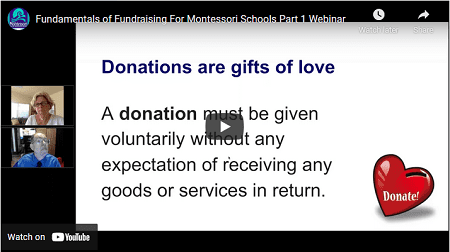
However, gifts must be made voluntarily. If a nonprofit school required parents to make a donation in order to send their children to school, their “gift” is unlikely to be considered tax-deductible.
So, whether your children attend a private school or one that is publicly funded, you are likely to be asked to support their fundraising efforts. Montessori schools are no exception.
The relationship between fundraising and independent schools is complex.
Giving takes many forms. Whether a gift takes the form of a monetary contribution, a gift of stock, or the giving of one’s time and talent (usually not tax deductible), the act of giving is an important demonstration of
support and recognition for the ideals, philosophy, and goals we all share for our children.
Fundraising should not feel like arm twisting. It should be a kind invitation to join with other families, grandparents, faculty, and friends of the school to achieve a specific goal. Wise schools cultivate a culture of community, caring, and support. They encourage their stakeholders to consider their ties to the school and discover the many ways people share the gifts of time, talents, experience, wisdom and financial support with the enduring institution called the School.
Gifts to Montessori schools are an important source of revenue not only to accomplish
the school’s present goals but to provide the type of ongoing support that enables it to remain on the cutting edge and remain true to its mission.
Because of the support of faculty, families, and alumni, Montessori schools become strong and stable; and it is the responsibility of all who love a particular school to maintain this strength by responding generously when they are asked to give. ′