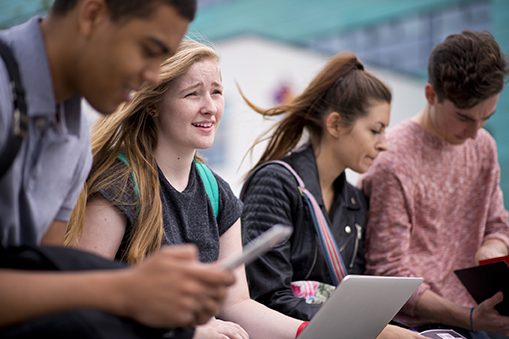
Just when parents think they have it down—that their child is gracious and engaged, academically sound if not accelerated, physically coordinated and mature—the kid goes and turns into an adolescent! Sometimes coming of age is a slow boil. And other times it’s like adding rice stick noodles into a wok full of oil. I absolutely love the quizzical look on the faces of the most well-meaning parents who thought that, for some reason, the wave might miss them.
Well, I tell them, take heart! You are not alone. And you have done it before. Yes, even if this is the first adolescent you have raised, you have done this work before!
While in a much tinier package, that kid was once an infant person—awkward, scared, fussy, beautiful, knowing what she wanted but not knowing how to get it. And parents usually do just fine. Everyone remains alive to tell the story. If the description of the infant sounds like the adolescent you are now wondering what to do with, then you understand the connection. Adolescents, at their best or worst, are really infant adults. They are entering a world that is changing for them. It doesn’t feel like the safe “womb” of their elementary years because they naturally are adopting and adapting to a new purpose. That might be alarming to some kids. It might not be that big of a deal to others. Regardless, our brand-new adults need a new understanding of themselves and their world. They need to know how they fit into family and society with a new and maybe, as yet, fuzzy purpose. Like it or not, their changing mental viewpoint is often accompanied by some pretty dramatic physical changes. You remember puberty. Phew! There is a lot going on when someone is transforming.
So how is a Montessori secondary program so valuable in this transformation?
I’ve observed that a Montessori education becomes as valuable to the adolescent student and his family as it is in the early years. If so much in life is new for a tween or teen as it is for a baby, why wouldn’t that person need a cosmic education just as much when they are hitting their early adult chapter. And while each generation has its share of challenges, today’s child is growing up in an era of such hyper change, it’s difficult to know how to prepare them for future success. Therefore, we must give them the gift of critical thinking, an ability to achieve and manage independence and self awareness, and a proper sense of how they fit in society. There is no better educational platform for an adolescent than one supported by Montessori, where work is authentic, satisfying, and tailored to strengthen not only the academic ego but also the soul-filled character.
Today’s educational world is abuzz with concepts such as project-based learning, hands-on education, choice experiences, global awareness. But these have been essentials of a Montessori education since the early 1900s. At every stage of development, skilled Montessori guides are trained and focused on essential elements that define what we call a cosmic education: the carefully prepared environment that promotes independence, critical thinking and character education; the practice of building a community, from the classroom to the world, based on courtesy and respect and observation that is fundamental to understanding how to meet the unique needs of each student. In this fragile third plane of development, ages 12 -18, we see justice, valorization, and authenticity as crucial. A Montessori secondary education not only includes these as components but prioritizes them. They aren’t consequences or bi-products; they are goals. Learning in a Montessori environment prepares the individual for whatever is ahead, and what’s ahead for the adolescent is big stuff that can’t all be learned by sitting in a classroom.
In her book, The Soul of Education, Rachel Kessler identifies seven basic needs, which she calls gateways, of an adolescent. Not one of her seven includes getting into a good college, making the football team, getting a job. Montessori educators by no means diminish the importance of these or any other outcomes of a rounded education, but we do acknowledge that adolescents need to get through the gateways first before anything else can matter. By looking closely at these gateways, Kessler offers a blueprint for structuring the ideal Montessori adolescent program. Setting up our programs to enable passage through these gateways equates to preparing the environment in a way that offers safety, independence, joy—even thrill—and meaning. What more could a student or guide want out of the daily learning experience? Picture that first smile on your infant’s face when he recognizes something as pleasing. Picture the smile you want to see on your teen’s face when she recognizes she is pleased with herself.
Take a look at these gateways and perhaps that wonderful infant adult will make more sense.
Gateway #1
The yearning for deep connection describes a quality of relationship that is profoundly caring, is resonant with meaning, and involves feelings of belonging or of being truly seen and known. Students may experience deep connection to themselves, to others, to nature, or to a higher power.
Gateway #2
The longing for silence and solitude, often an ambivalent domain, is fraught with both fear and urgent need. As a respite from the tyranny of “busyness” and noise, silence may be a realm of reflection, of calm or fertile chaos, an avenue of stillness and rest for some, prayer or contemplation for others.
Gateway #3
The search for meaning and purpose concerns the exploration of big questions, such as “Why am I here?” “Does my life have a purpose? How do I find out what it is?” “What is life for?” “What is my destiny?” “What does my future hold?” and “Is there a God?”
Gateway #4
The hunger for joy and delight can be satisfied through experiences of great simplicity, such as play, celebration, or gratitude. It also describes the exaltation students feel when encountering beauty, power, grace, brilliance, love, or the sheer joy of being alive.
Gateway #5
The drive for creativity, perhaps the most familiar domain for nourishing the spirit in school, is part of all the gateways. Whether developing a new idea, a work of art, a scientific discovery, or an entirely new lens on life, students feel the awe and mystery of creating.
Gateway #6
The urge for transcendence describes the desire of young people to go beyond their perceived limits. It includes not only the mystical realm, but experiences of the extraordinary in the arts, athletics, academics, or human relations. By naming and honoring this universal human need, educators can help students constructively channel this powerful urge.
Gateway #7
The need for initiation deals with rites of passage for the young—guiding adolescents to become more conscious about the irrevocable transition from childhood to adulthood. Adults can give young people tools for dealing with all of life’s transitions and farewells. Meeting this need for initiation often involves ceremonies with parents and faculty that welcome them into the community of adults.
While Dr. Montessori left no prescribed materials nor curriculum design beyond the elementary level, she did write about the needs of adolescents and essentials to include in a Montessori secondary program. Read her Appendix A and B in From Childhood to Adolescence, specifically the section titled “Erdkinder.” Compelling research since her writings indicates she was correct and is still advanced beyond where education is today. The transformation in education is still going on. The rise in Montessori secondary training programs and secondary school programs indicates that, while nothing is new when it comes to adolescence, we are making progress in how to help them root deeply as thinkers and humanitarians—with skills and an independent spirit that is vital to success in the 21st century.
A secondary program, so true to Montessori education at all levels, most certainly includes but is not restricted to the classroom. We know that when we pull together our understanding of this wonderful third plane of development with the creative application of Dr. Montessori’s vision for a secondary program—rigorous academics, community building, the running of a business, outdoor education, field experiences, project-based learning, and service learning—we will help our adolescents through the gateways and usher them into their rightful role as an adult.
Tomorrow’s Child / September 2017 / p 16