The following very brief introduction was prepared by Tim Seldin, President of The Montessori Foundation during his
years as Headmaster of The Barrie School in Silver Spring, Maryland (1971-1993).
Montessori schools are designed to prepare children both for university and for life.
There are three key ideas that are central to the mission as a Montessori school:
– It is not the adult who shapes the child; it is the child who, through his experiences, creates an adult human being.
– Teaching is not something that one can do to another; we can only facilitate the natural process of learning.
– There is a clear connection between one’s sense of self, of being fully alive and open to new ideas and experience, and ability to learn.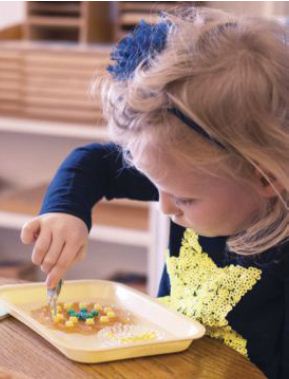
Recognizing this, we are engaged in a process of facilitating the development of self-actualized
renaissance men and women. Such people are ‘teacher-proof.’ They have learned how to learn and see school as a center of an enjoyable, lifelong experience. Children with values such as these will normally go on to college, perhaps after first taking a year off for work or travel, as the natural extension of their previous education. There is a great debate over the appropriate balance between Montessori’s objective of cultivating the child’s spontaneous interest in learning and the expectations of parents and society.
Normally, a school is perceived as the transmitter of culture from one generation to the next, through a formal curriculum. This is certainly an important part of the mission. However, as a Montessori school, we are equally committed to the development of responsible members of the human family and the protection of the child’s fragile spark of curiosity and creativity.
Most children know far more about the world before they start school than they will show a few years later when they have learned to be passive learners who don’t trust their senses, intellect, and imagination. Therefore, our greatest task is to help our students to rediscover their brain’s ability to think, intuit, discover and to develop a sense of independence, sequence, and order – to learn how to learn.
At the same time, as an independent school, parents come to us and pay a great deal of money in tuition for services available from the public schools, for which they have already paid through their taxes.
They come to us seeking quality programs and services! Their highest priorities are:
1. academic excellence
2. character development
Clearly, they expect their children to be well prepared for college, but, beyond this, they are looking for a school experience that will offer something special. They want a school experience that is intellectually exciting and that will develop a wide range of talents and interests.
The delivery of these services is difficult to document from the school’s end, and, from the parent’s end, even more difficult to evaluate. Thus, parents expect to be kept abreast of the programs that address these goals and their children’s progress in each program. As a result, we work carefully to maintain this delicate balance.
The curriculum can be thought of as having two aspects:
1. The school’s basic expectations for what will be first introduced, worked on, or reviewed and targeted for mastery by 85 to 90 percent of all students at each age/grade level.
2. The lessons that arise out of the children’s natural curiosity. While we follow a planned syllabus to give us cohesion and structure, we should never be satisfied with a year spent giving students set lessons from a prescribed syllabus. By providing children with all sorts of books, pictures, specimens, and artifacts, we can almost guarantee that we will encourage their curiosity and expand their scope of learning. By this, we mean to suggest that, instead of moving through the set curriculum more quickly, we allow children to explore additional related topics that capture their interest.
Montessori curriculum is designed to intrigue children and develop a lifelong love of learning. No topic is presented just once and forgotten; lessons are introduced quite concretely in the early years and are reintroduced later at increasing degrees of complexity and abstraction.Students gain experience and develop skills at one level of understanding, which prepares them for more complex lessons at the next level.
The spiral of the Montessori curriculum has no end, and the depth to which any topic can be pursued is limited only by a student’s interests and ability. At the same time, our expectations are quite high; challenging each student to his/her fullest individual potential, establishing a clear standard of achievement and quality of thought and work.We encourage accelerated students to expand their studies horizontally, researching topics at greater depth and a more sophisticated level of thought and analysis.
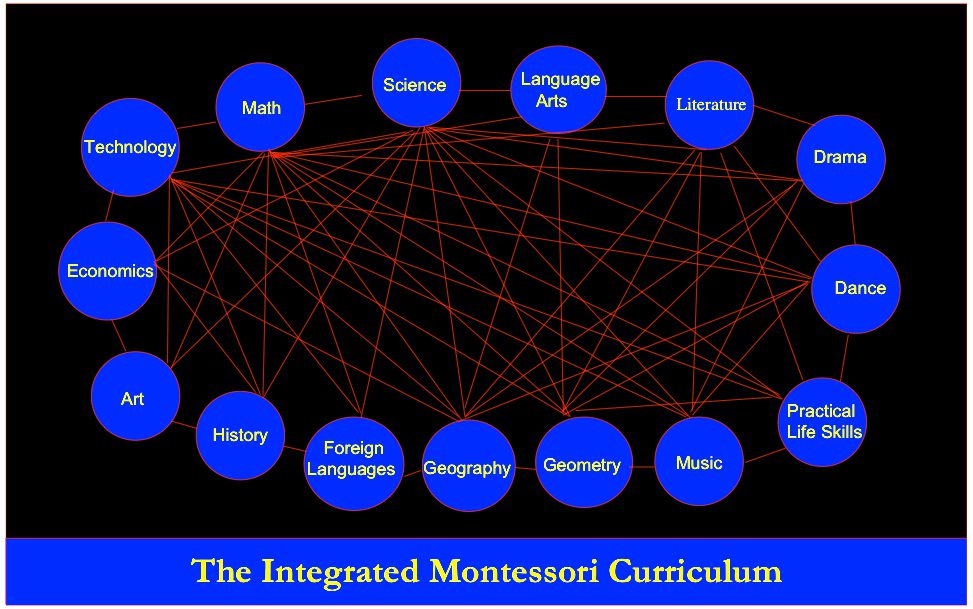
 Our course of study is consciously multidisciplinary.It is an examination of the natural world and the human experience that interconnects the traditionally separate subject disciplines. Units of study cut across the curriculum, weaving together, as one example, the land, flora and fauna, folktales, art, dance, poetry, architecture, history, everyday life, and cooking of a country under study.
The curriculum has no outer limits except for humanity’s knowledge and imagination.At the same time, our core curriculum has been carefully structured to establish benchmarks for achievement by most students by the end of each level.
At its finest, Montessori is an incredibly elaborate model of education. We don’t advocate using all these tricks and devices simply to make the school day pass more pleasantly or to prepare students for their standardized tests at the end of the year. The real aim of education, as we see it, is to prepare children to live lives filled with personal satisfaction, as responsible, concerned citizens of the Earth.
An important element in achieving that goal is the development of knowledge and understanding about the world: civilization.However, along with this must come self-knowledge, self-respect, compassion, and a mind and heart open to new ideas and information.Our goal is to help children to learn how to learn.
The Montessori Learning Materials Are Not the ‘Method
**Editor’s Note**: This introductory section has been written by me: a Montessori mom, and long-time editor of *Tomorrow’s Child* … but not a trained Montessorian. These are my observations, based on how I have come to understand the role of the Montessori materials over the years. – **Joyce St. Giermaine, Editor**
 Most newcomers to Montessori are awestruck at the array of colorful materials, purposefully arranged throughout the classroom. It is an amazing sight for adults and children. The materials almost call out to be picked up, handled, and treated with respect.
The materials, however, are not the ‘Method.’ The ‘M’ in Method is capitalized, at least in my mind, for a reason. Think of Montessori as a five-star restaurant, recognized for the best cuisine for miles around. You make a reservation, and the day arrives when you are finally seated at a beautiful table: linen tablecloth and napkins, fresh-cut flowers, exquisite water goblets, and silverware that is just the right weight to rest comfortably in your hand.There is soft music playing in the background, the lighting is just right. The restaurant is warm and inviting, the waitstaff is calm and respectful and happy to attend to your every need. In the food-service industry, we would call this ‘ambience.’ In Montessori, we would call it a ‘prepared environment.’
When the food is served, it is everything you expected and more. You leave the restaurant feeling satisfied and happy; you made a good choice. For a minute, let’s consider how you would feel if the food were not particularly good. No amount of ambience will make up for a mediocre meal, especially if you are paying top dollar for it. Now, let’s consider how you would feel about receiving the same great meal at a small restaurant, with plastic cutlery, rock music blaring in the background, and a predominantly take-out clientele. It would certainly be a different experience, and you might actually be in the mood for something loud and fun, but maybe not every day or for a special occasion. You might be willing to overlook the lack of ambience if the food is good. If the food isn’t good, you probably won’t return.
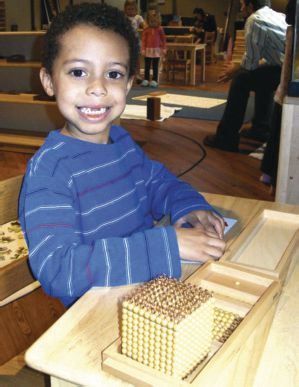
Not all Montessori schools can be compared to an expensive five-star restaurant, nor should they. Montessori education takes place in the most prestigious locales throughout the world; it is also found in migrant-worker camps and impoverished countries, where parents and teachers make their own materials from whatever is available to them in their region.
Montessori materials are ‘tools’ that Dr. Montessori developed to complement and expand the principles of her Method. Although there is something called a ‘control of error’ incorporated into the design of each material, the materials, themselves, are not a substitute for the lessons they represent. Going back to our restaurant analogy: ambiance, excellent food, and great service need to go together to produce a quality product.
Montessori materials are deceptively ‘simple’ in appearance, but they are surprisingly complex in design and purpose.Think of the puzzle boxes you may have had as a child. There were star-shaped holes, round holes, and square holes, along with correspondingly shaped pegs. Most of us quickly concluded that the square pegs just didn’t work in the round holes. Some of us took a bit longer, and even if we continued to disagree on a philosophical level that round and square should be interchangeable, we eventually realized that it was a waste of time to continue to try to force something to fit where it clearly didn’t belong. That’s control of error.
But what else did it teach us? Did we learn that the shapes were geometric figures? Did we learn the names of each shape? Did we discover on our own that one shape weighed more or less than the other? Could we close our eyes and recognize each shape by touch alone?Could we use our finger to draw the shape in a tray of sand? Could we sound out the letters in the word star? What else is round? A plate, the Earth, a goldfish bowl? And so on. The possibilities are endless. That is the Method.
Take a look at the Knobbed Cylinders on page 42. Notice the concentration and excitement on the little boy’s face.To the casual observer, he is having fun with a puzzle. To a Montessori teacher, he is learning to understand the concepts of *length, circumference, weight*, and *depth*. And he’s enjoying the satisfaction of his ‘work.’
At The Montessori Foundation, we get many phone calls from well-intentioned parents and ‘traditional’ educators, who want to incorporate Montessori into their school or home environment.
 Often, they just want to know where they can obtain Montessori materials. This comes from the erroneous belief that it is the materials that define the methodology.Despite the elegant simplicity of the materials, there is more than one hundred years of pedagogy and implementation behind their design, and Montessori teachers are specifically trained to incorporate each material into the bigger picture of what we call the Montessori Method.
At this point, our phone callers usually ask to buy the Montessori ‘manual’ to explain how to use the materials. Sometimes, they become frustrated and disappointed that such a book is not available, probably thinking that it’s a big secret that we are keeping to ourselves to the exclusion of the rest of the world. Not so. A good Montessori teacher, we explain, spends years of classroom study, along with classroom internship, working with children under the guidance of master Montessori teachers, to become qualified to provide lessons incorporating the Montessori materials.
As you read through the descriptions of the materials in this issue, please remember that every exercise and material has a specific purpose, usually involving many steps, along with a built-in control of error.It is the coming together of methodology and materials that is behind the genius of the Montessori Method. Although the teachers are never intended to be the focal point in a Montessori classroom, it is the teachers, with their knowledge of the intended learning objectives of each lesson, the proper use of the corresponding materials, and their ability to “follow the child,” who are committed to providing the environment and guidance to implement the methodology that allows children to learn new skills, incorporate new information, and maximize their years in Montessori.