Have you ever had a full night’s sleep and woke up still feeling exhausted? Do you lie in bed at night unable to shut off your mind? Do you find yourself feeling overwhelmed by sounds and lights? If so, you might be experiencing a rest deficit! So often we confuse rest with sleep, leaving us feeling incomplete even when we are “fully rested.” Discover the 7 different types of rest necessary for each of us to reach our fullest potential and learn how they can be used to help each of us become the Prepared Adult Dr. Montessori so often described.
This originally appeared in the Introduction to The Montessori Way by Tim Seldin and Paul Epstein, 2003
Editor’s Note: January 6, 2023 was the 116th anniversary of the opening of the first Montessori Children’s House in Italy. We included this article in honor of Dr. Montessori’s work around the world.
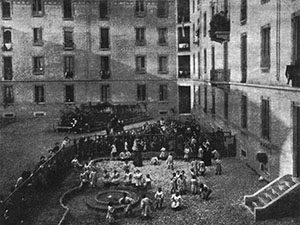
In 1907, an Italian physician was invited to open a child-care facility for fifty preschool-aged children in a section of Rome that was avoided and neglected because of its oppressive poverty and crime. The children’s parents worked sixteen or more hours a day. In the absence of adult supervision, these children were vandalizing recently renovated housing. Years later, Dr. Maria Montessori recalled her experience of personal transformation in which she discovered something previously unknown about children:*
“What happened will always remain a mystery to me. I have tried since then to understand what took place in those children. Certainly, there was nothing of what is to be found now in any House of Children. There were only rough large tables. I brought them some of the materials which had been used for our work in experimental psychology, the items which we use today as Sensorial and Practical Life materials. I merely wanted to study the children’s reactions. I asked the woman in charge not to interfere with them in any way, as otherwise I would not be able to observe them. Someone brought them paper and colored pencils, but, in itself, this was not the explanation of the further events. There was no one who loved them. I myself only visited them once a week, and during the day, the children had no communication with their parents.
The children were quiet; they had no interference either from the teacher or from the parents, but their environment contrasted vividly from that which they had been used to; compared to that of their previous life, it seemed fantastically beautiful. The walls were white, there was a green plot of grass outside, (though no one had yet thought to plant flowers in it), but most beautiful of all was the fact that they had interesting occupations in which no one, no one at all, interfered. They were left alone, and little by little, the children began to work with concentration, and the transformation they underwent was noticeable. From timid and wild, as they were before, the children became sociable and communicative. They showed a different relationship with each other, of which I have written in my books. Their personalities grew and, strange though it may seem, they showed extraordinary understanding, activity, vivacity, and confidence. They were happy and joyous.
This fact was noticed after a while by the mothers who came to tell us about it. As the children had had no one to teach them or interfere with their actions, they acted spontaneously; their manners were natural.
But the most outstanding thing about these strange children of the San Lorenzo Quarter was their obvious gratitude. I was as much surprised by this as everyone else. When I entered the room, all the children sprang to greet me and cried their welcome. Nobody had taught them any manner of good behavior. And the strangest thing of all was that although nobody had cared for them physically, they flourished in health, as if they had been secretly fed on some nourishing food. And so they had, but in their spirit. These children began to notice things in their homes: a spot of dirt on their mother’s dress, untidiness in the room. They told their mothers not to hang the washing in the windows but to put flowers there instead. Their influence spread into the homes, so that after a while these also became transformed.
Six months after the inauguration of the House of Children, some of the mothers came to me and pleaded that as I had already done so much for their children and they themselves could do nothing about it because they were illiterate, would I not teach their children to read and write?
At first I did not want to, being as prejudiced as everyone else that the children were far too young for it. But I gave them the alphabet in the way I have told you. As then it was something new for me also. I analyzed the words for them and showed that each sound of the words had a symbol by which it could be materialized. It was then that the explosion into writing occurred.
The news spread, and the whole world became interested in this phenomenal activity of the writing of these children who were so young and whom nobody had taught. The people realized that they were confronted by a phenomenon that could not be explained. For besides writing, these children worked all the time without being forced by anyone to do so.
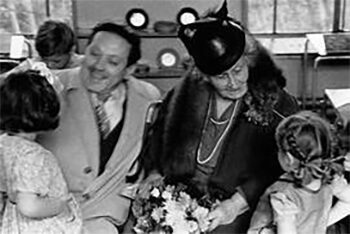
This was a great revelation, but it was not the only contribution of the children. It was also they who created the lesson of silence. They seemed to be a new type of children. Their fame spread and, in consequence, all kinds of people visited the House of Children, including state ministers and their wives, with whom the children behaved graciously and beautifully, without anyone urging them. Even the newspapers in Italy and abroad became excited. So the news spread, until finally also the Queen became interested. She came to that Quarter, so ill famed that it was considered hell’s doors, to see for herself the children about whom she had heard wonders.
What was the wonder due to? No one could state it clearly. But it conquered me forever, because it penetrated my heart as a new light. One day I looked at them with eyes which saw them differently, and I asked myself: ‘Who are you? Are you the same children you were before?’ And I said within myself: ‘Perhaps you are those children of whom it was said that they would come to save humanity. If so, I shall follow you.’ Since then, I am she who tries to grasp their message to follow them. And in order to follow them, I changed my whole life. I was nearly forty. I had in front of me a doctor’s career and a professorship at the university. But I left it all, because I felt compelled to follow them and to find others who could follow them, for I saw that in them lay the secret of the soul. You must realize that what happened was something so great and so stirring that its importance could never be sufficiently recognized. That it will never be sufficiently studied is certain, for it is the secret of life itself. We cannot fully know its causes. It is not possible that it came because of my method, for at the time my method did not yet exist. This is the clearest proof that it was a revelation that emanated from the children themselves.
My educational method has grown from these, as well as from many other revelations, given by the children. You know, from what I have told you, that all the details included in the method have come from the efforts to follow the child. The new path has been shown us. No one knows exactly how it arose; it just came into being and showed us the new way.
It has nothing to do with any educational method of the past nor with any educational method of the future. It stands alone as the contribution of the child himself. Perhaps it is the first of its kind, which has been built by him, step by step. It cannot have come from an adult person; the thought, the very principle that the adult should stand aside to make room for the child, could never have come from the adult.
Anyone who wants to follow my method must understand that he should not honor me, but follow the child as his leader.”
Maria Montessori discovered that when young children concentrate and investigate a set of purposefully designed activities, they tend to develop self-control; their movements become ordered; and they appear peaceful. Their demeanor towards others becomes kind and gentle.
These characteristics and other discoveries made with the children of San Lorenzo in 1907 were quickly replicated, as new Montessori schools opened throughout Europe and around the world. Children in elementary and secondary Montessori schools displayed tremendous enthusiasm as they explored and studied topics in great detail. Their learning achievements were profound. The overall Montessori experience, however, is deeper than an academic course of study. Because the Montessori process fully engages children’s natural learning potentials, Montessori students learn about themselves, develop self-confidence, communicate effectively, and work well in groups. Today’s Montessori schools incorporate the discoveries of Maria Montessori as well as recent understandings of how learning and development take place. Montessori schools are now found in private, public, and homeschool settings in the United States and abroad. The educational programs located in these schools range from infant care to high school students.
Many of these schools are affiliates of, or are accredited by, one of a dozen national and/or international Montessori organizations. Teachers receive Montessori teacher certification after completing rigorous courses of study. Many teachers describe their own experiences of personal transformation as they, too, witness in children astounding capabilities. From a family’s perspective, becoming part of a Montessori school could be thought of as adopting a natural lifestyle we call the Montessori Way.
Omni Montessori School’s Unique Owl’s Nest Treehouse Library
by Hannah Earnhardt, Omni’s Director of Development, Omni Montessori, Charlotte, NC
The things he sees are not just remembered, they form a part of the soul.
-Maria Montessori
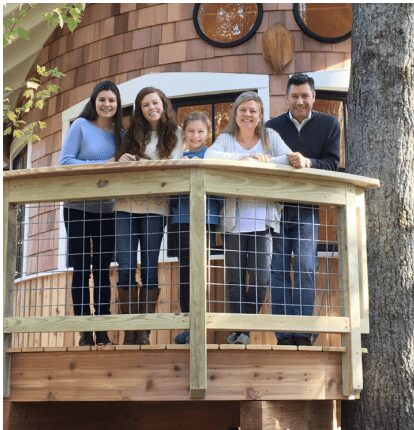
If you listen carefully, the echoes of children’s laughter complement the crunching of the fallen leaves scattered across the forest floor as you make your way through the Omni Montessori School (Omni) Blakeney campus. Nestled among the trees, at the center of the property, a wise owl peers through the branches with a welcoming demeanor. The clomping of small boots makes their way up the wooden ramp to the Owl’s Nest; a treehouse plucked straight from the pages of a fairytale. Grasping the iron handles and pushing through the wooden doors, the sweet aroma of pine, cedar, and other locally sourced woods float through the air. Lovingly crafted shelves lined with books, greet students, and provide access to unlimited worlds. Like an owl’s habitat, the treehouse is a space of comfort for the Omni students – an enchanting place to grow and to explore.
Labor of Love
Such a structure doesn’t miraculously appear; it was a true labor of love. In 2016, Omni Montessori School embarked on an adventure with Animal Planet’s Treehouse Masters. At that time, Alan Gardner, was an Omni parent and board of trustees president, and he envisioned the treehouse library concept after working with Pete Nelson and the Treehouse Masters team on a treehouse guest house at his Waxhaw, North Carolina property.
Translating the Owl’s Nest vision from a concept to a reality would require many hands and giving hearts, so during the 2016 Omni Montessori School Annual Auction, Alan and Gwen Gardner approached fellow Omni family, DJ and Maureen Baudhuin, with the idea of the Owl’s Nest. DJ Baudhuin recalls discussing the need for space for a library and the group collectively agreed how wonderful it would be for the school to have a library treehouse. For the Baudhuins, their financial support was an easy decision. In Maureen Baudhuin’s view,
We are forever grateful for having this Montessori wonderland for our kids and for us too. So, it was always very natural, of course, that we were going to help in any way or donate.
Following the initial conversation with the Baudhuins, Alan Gardner reached out to Pete Nelson and presented the idea for the Owl’s Nest. DJ Baudhuin recalls, “It was less than a month from when Alan made the call that Pete was walking around the [Omni property] looking for a place to build.” Within six months from the start of the conversation the project began. Reflecting on the endeavor, Pete Nelson stated, “Anytime we can create a treehouse that is open to a broader group of people, we get excited. In this case, a treehouse library for Omni Montessori School—could anything be better than that?”
With any project, there can be obstacles. Alan Gardner recalls the various ups and downs of creating such a spectacular space. “It started with the generous offer from Maureen and DJ Baudhuin with what we expected would be the total cost of the treehouse, but we did not realize how difficult it would be to get the building permits from Mecklenburg County for a private school.” After dozens of meetings with the county planners, there were shifts in the plans and the overall costs. Alan Gardner stated, “There were some tough discussions, but the result was that the Baudhuins, Pete Nelson, and Gwen and I ultimately decided we had to step up to cover the difference. At times I thought we would not make it to the finish line, but in the end it worked.”
What would normally take years to complete, all came together through the vision and support of individuals committed to empowering children in a community faithful to the teachings of Maria Montessori. As Maureen Baudhuin perfectly stated, “It was definitely written in the stars.”
Special Features
While the exterior of the Owl’s Nest feels like something out of a fairytale, the interior is just as magical. The bookshelves are made from locally sourced wood from around the Charlotte area. Establishing roots within nature is an important aspect of Montessori education and trees are a connecting piece throughout the Omni Blakeney campus. Gwen Gardner recalls, “The primary children would come out to visit our farm, where they loved to play on a swing that hung from a big red oak tree. The tree eventually died, and we took it down, but kept the lumber. When they were building the treehouse, Pete came out to our farm to specifically select the wood to craft some of the bookshelves in the treehouse.”
The attention to detail and commitment to using materials from within the community further amplifies the love that is thread throughout the Owl’s Nest.
Along with the individualized bookshelves, the sitting area is inspired. Pete Nelson was committed to integrating aspects of surprise throughout the Owl’s Nest, stating, “The exterior was fashioned in the form of a wise owl, and that curved ‘face’ led to the creation of an interior sitting area shaped and highlighted in a Fibonacci curve.” With support from the Omni Parent Association to ensure the addition of the spiral shelves and seating, students can peer out of the large windows that overlook the outdoor stage, while simultaneously basking comfortably in the natural light with a good book. Inspiration was flowing during the development of the Owl’s Nest, and it continues to inspire the Omni community.
Lasting Impact
Maria Montessori believed, “the goal of early childhood education should be to activate the child’s own natural desire to learn.” With a space like the Owl’s Nest, Omni students are sparked with continuous curiosity. Darcy McDonnell, librarian and aftercare specialist, sees the impact of the Owl’s Nest daily. According to Darcy, “Our Owl’s Nest treehouse library provides students with a peaceful, cozy nook to browse, seek out resources for their work, and cuddle up to read. As they enter, students often remark that they love the cedar scent, and the intimate setting helps younger students feel comfortable exploring books.”
Over the last six years, students have walked in and out of the doors of the treehouse with their giggles wafting from under the doorframe, as smiles permanently stretch across their faces while burying their noses in literary adventures. Looking back on the development of the Owl’s Nest, DJ Baudhuin emphasized that “we wanted to do things for the kids and wanted to give back. At the time there was a need for a library structure. This was creative and whimsical. We thought it would be fun for the kids.” The work of the Baudhuins, the Gardners, Pete Nelson and his team, the Parent Association, as well as the Omni Board of Trustees, has created an enduring and endearing place that will continue to inspire students for years to come.
The best environments for children are the ones that show them how to use their hearts.
Love is the most essential element in our Montessori communities. It is the foundation of learning and teaching. Like breathing, love is a thing that comes so naturally. We breathe deeply and truly in a way that feeds our bodies, our hearts, and our souls. We love the same way.
Love is the container that holds all the essential elements that make up a fully implemented Montessori program. Selecting a school for your children can be a daunting task, especially since the ‘Montessori’ name is in the public domain. Dr. Maria Montessori never trademarked the moniker, and she didn’t patent her teaching methods. This void makes recognizing a fully implemented Montessori school more important for families.
Through Dr. Montessori’s work, teachings, notes, and writings, several Montessori organizations that are dedicated to teaching and promoting the work of Dr. Montessori were able to extrapolate quality characteristics that sustain the efficacy of a Montessori school and its educational outcomes for the child. While they may differ on qualifying some of the implementation of the methodology, there are universally agreed-upon tenets that a fully implemented Montessori school should embody. What follows are characteristics of a high-fidelity Montessori school. We invite you to consider these when exploring Montessori schools in your area.
The Montessori learning environment is a place that…
· strives to offer each student an individualized experience that fosters the whole child and is a child-centered environment.
· offers each classroom as a living ecosystem that truly “follows each child” by utilizing multi-sensory experiences and adapting the environment to meet the needs of the individual learner.
· employs the finest in Montessori materials in each classroom as is appropriate to each developmental plane.
· allows for a 2.5-to-3-hour uninterrupted work cycle, meant to build independence, concentration, order, and coordination.
· provides ‘windows’ and ‘mirrors’ by which children see themselves in the books in the library, the art on the walls, and the work on the shelves.
· is beautiful, peaceful, and welcoming; there is a busy hum of focused engagement; children move about with purposeful intention respecting their peers and the environment.
Montessori learning activities…
· are individualized (meeting the age and developmental abilities of the child).
· allow children to be independent learners, who are active participants, problem solvers, and planners.
· enable children to learn with engaging hands-on materials that make abstract concepts concrete.
· allow children to learn through direct experience and social interactions.
· are complete and sequential with common elements from beginning to completion.
· support spontaneous activity. The environment and teacher encourage children to explore their interests, as well as introducing them to new challenges and areas of possible interest.
· permit freedom within limits.
· nurture intrinsic motivation. Children do work for the love of learning and not for any external rewards.
· are international in heritage and focus and consciously seek to promote a global perspective.
Montessori Involves a Community of Learners where…
· the child’s developmental needs are met by providing multi-aged classes, which allow the child to learn from an extended group of peers. Students stay with one class and its teachers for an entire 3-year cycle. This 3-year program provides leadership opportunities, peer learning, depth of diversity, a growth mindset, and it minimizes transitions.
· individual learning happens, augmented by cooperation and collaboration within the class.
· children learn how community can be an extended family through supportive relationships with individuals and groups, both in and out of the classroom, while applying that knowledge to the global community.
· teachers model lifelong learning alongside their students.
Montessori awakens and nurtures the human spirit by…
· offering and teaching reflection, soulful learning, and honoring the dignity of each child.
· teaching emotional intelligence skills.
· giving children opportunities to serve others and the environment, inside and outside of the school.
· supporting children as they grow and discover who they are and what they can give to the world.
· teaching self-empowerment and peace through social-emotional learning, diversity, equity, inclusion, and building self-esteem through character education.
· designing social communities and educational experiences that cultivate the child’s agency, independence, self-respect, love of learning, and ability to respect and celebrate the individual spirit within people of all ages and the value of all life.
· emphasizing grace and courtesy that encapsulates basic universal values. These values include self-knowledge and respect, acceptance of the uniqueness and dignity of all human beings, kindness, peacefulness, compassion, empathy, service, personal responsibility, and the capacity to speak one’s truth.
The Montessori faculty and staff are…
· properly credentialed. This requires A Montessori teacher who can thoroughly and specifically respond to the academic, social, emotional, spiritual, and developmental needs of the child at the age level with whom they work.
· affiliated with and/or accredited by a Montessori accrediting agency, for example the American Montessori Society (AMS), the Association Montessori International (AMI), the International Montessori Council (IMC), or the Montessori Accreditation Council for Teacher Education (MACTE).
· mature, skilled, and experienced as observers, facilitators, and guides helping the multiple gifts in each child emerge.
· able to use the needs of the students to determine allocation of resources.
· dedicated to making decisions based upon the mission of the school.
· of the belief that all children should be honored.
· models of grace and courtesy and are, thus, loving, joyous, optimistic, kind, caring, compassionate, empathetic, vulnerable, honest, respectful, and able to see different perspectives.
· of the belief that parents are partners with the school in the growth and transformation of the child.
These guidelines are a great starting point in identifying a high-fidelity Montessori program. You will probably find several Montessori schools, each with its own personality and culture. There may be schools that do not adhere to all of these guidelines and only partially-implement the Montessori Method. You may not be able to access a Montessori school but have access to a school that uses elements of Montessori. Follow your intuition and what feels like the right fit for not only your child but for your family as a whole.
I was once told by a mother looking for a school that the only thing she needed from us was to love her son. She had trouble finding a school that could serve him because of his special emotional needs. It wasn’t that she did not care about a high-fidelity school, just that it may not be her first consideration.
One day, I was asked to come help calm her son, who was having a hard time. He and I had formed a trusting relationship. He knew our agreement: when I came to see him, he would sit on my lap so we could talk. It took him a while to find his way to my lap, but, once he did, I wrapped my arms around him, and we breathed. As we sat there, his back to my heart, I noticed that our breaths and our heartbeats were synchronizing. I could feel it in my bones. There was a place in his heart the exact size as me. There was a place in mine the exact size as him. Every child before this moment had stretched out my heart just so it could be big enough to beat for all of them. I could ‘see’ him in all his glory and aberrations. At that moment, he knew I understood him. His body started to relax; his edges began to soften; he became lighter, yet grounded. He was able to find safety, comfort, and love. He knew I would not let him disappear. He knew it was safe for his heart to beat here… in this Montessori school.
This story is not unique. Such events happen in schools around the world, schools that lead with love. If a child doesn’t feel safe and loved in their learning environment, it is impossible for them (or the teacher or the school) to grow and transform. Love should flow in whatever school you choose for your family. You should feel it, in your bones and in your soul; your pulse will grow, so loud and clear. Plant your family flag in the place most dear and know it’s safe for your child’s heart to beat here.
Summer is a time of more daylight, warmer temperatures, and more time outdoors. We may think that, for children who are out of school in the summer, it is not a time of learning. Yet, it can be an incredible time of learning. Here are fifty ways to help your child learn and grow while not in school.
Explore
1. Let your child plan an activity for the day or some activities for the summer. They can use maps, stick to a budget, and do the research.
2. Go on a searching hike, in nature or an urban setting; look for objects in the shapes of the letters in your name, or in sets of your favorite number, or particular colors.
3. Learn about the plants and animals that are near you. What are those birds by your home? What are the names of the plants you see every day?
4. Walk at your child’s pace. Notice the smells of different plants, admire the bugs, follow your child’s lead.
5. Play board games.
6. Learn card or magic tricks.
7. Learn jokes and present a comedy show.
8. Play unplugged games, such as Hangman, your own version of Pictionary, I Spy, or other paper-and-pencil games.
9. Think of free or inexpensive ways you could help neighbors and act on them.
10. Create a scavenger hunt and follow the clues.
11. Try out new playgrounds nearby.
12. Go to a grocery store you do not usually go to, especially if it has a focus on an ethnicity different than your usual cooking.
13. Allow time for daydreaming.
14. Try outdoor science experiments.
15. Plan a dream vacation.
16. Find some art to admire, outside or in a museum. Discuss what each person likes about it.
17. Explore distances and make a map. How far are you from family members, favorite types of animals, friends, or any other thing that can be mapped?
Communicate
18. Make time for reading every day, or nearly every day.
19. Visit the library and allow your child to make choices of reading material on their own.
20. Encourage your child to tell a friend or a family member about a book they read; retelling helps develop understanding.
21. Write letters to friends and family.
22. Address the envelope for that letter. Writing the address correctly on an envelope takes practice.
23. Keep a summer journal or a travel journal. Write in it regularly and include printed photos, pressed flowers, or leaves, ticket stubs, maps, or any reasonably flat items that remind them of the events written about.
24. Have your child create lists for things to do, grocery lists, books read or books to read, movies to watch, anything that can be listed.
25. Write a letter to their future self and store it or use a site that will email you in a certain amount of time.
26. Create a kindness list; how many acts of kindness can be performed this summer?
27. Count cars, bikes, dogs, flowers, anything you see regularly in your travels.
28. Find letters of the alphabet or make up a silly sentence using letters or words on items in the grocery store. Only one word or letter per item!
Create
29. Build a design of your child’s own creation or follow the directions from a set, with Legos™, blocks, or other building materials.
30. Learn to build card houses.
31. Plan and build a birdhouse.
32. Make your own playdough and sculpt with it.
33. Water down paint, place paper outside, and use squirt guns filled with the watery paint for a creation.
34. Set up objects outside and trace their shadows onto paper.
35. Put on a show–write it, practice it, design costumes and props, and perform for others. Record the show to share it with family that cannot attend in person.
36. Use chalk to draw outside, then use water and a scrub brush to erase it.
37. Plan dinner for a night and help make it.
38. Make a salad. Make dressing to go with it for an extra skill-building opportunity.
39. Grow vegetables and harvest them for dinner.
40. Find a recipe and cook with a new-to-you food.
41. Shuck corn, peel potatoes, wash, and spin lettuce dry, participate in cooking preparation.
42. For older children, set a cooking challenge to use ingredients and make a meal.
43. Sketch or paint flowers at your home or a nearby location.
44. Draw self-portraits directly on the mirror using window markers.
45. Clean the mirror after drawing on it.
46. Wash windows (an adult may need to wash the top).
47. Water the garden or potted plants.
48. Organize an area of your home together, especially one that your child uses regularly.
49. Explore with cash, count coins, save for an item, buy something with cash and check the change received.
50. Make leaf or bark rubbings and label them with the type of tree or bush they came from. •
Cheryl Allen is the Associate Coordinator of the Montessori Family Alliance and is also a parenting educator and a Montessori consultant with the Montessori Foundation. Cheryl attended Montessori school as a child. After some time as a traditional Secondary teacher, she worked in Montessori classrooms, 3-6, 6-9, and 9-12, earning certifications from both AMS (3-6 and 6-9) and IMC (6-12). She is a teacher educator, workshop presenter, and member of IMC accreditation teams. Cheryl’s two children attended Montessori from age two through high school graduation.
“What the hand does, the mind remembers.” – Dr. Maria Montessori
If a child is able to use their hands to discover, their discoveries become more meaningful to them. The concepts they learn are much more rooted than any rote memorization could be, because in using their hands, they experience their learning. They are an active participant.
Active Education
If you picture a traditional classroom, you would likely see a teacher standing at the front of the room near a black- or whiteboard, speaking to children who are lined up in desks, memorizing facts, or attentively looking at and listening to their instructor.
In recent years, concepts such as “table groups” and “flexible seating,” where children can sit in small groups, or choose where they sit, have allowed for some redesign throughout the classroom.
In addition to the arrangement of the environment itself, many teachers and administrators have also looked to hands-on or non-traditional classroom experiences like “project-based learning,” “design thinking,” “the maker movement,” and “the flipped classroom,” for ways to engage children in their learning.
These shifts in education are a reminder that schooling isn’t one-size-fits-all. Individual needs can be addressed when we take the time to step back, assess what we are doing, and make the decision to move forward with purpose. Need some guidance for change? Read on!
Making Changes
If you are unsure where to start, let me give you one powerful idea.
Start with the child’s hands. Sure. Easy. The child’s hands. What? Let me explain.
If you can make a change in learning, begin with just one simple step. Try this: begin by watching hands. Hands are smart. Really smart. Just like our heads. Often, however, this seems to be forgotten.
If you ever have the opportunity to observe someone learning a new skill, I would challenge you to watch their hands. It is through touching and manipulating that information is taken in through the hands and delivered to the brain.
Use Your Hands!
Adults seem to think that it is okay for younger children to work with their hands when they are learning. Think about it: sandboxes, water tables, Play-doh™! But somewhere along the way, these manipulatives got a bad rap for being “childish.” Why?
If you’ve ever seen someone participate in an activity they love, you’ve very likely seen them using their hands! You’ve likely witnessed someone building with tools, fixing up a vehicle, or playing an instrument. How about someone turning the page of a book, digging in the dirt while gardening, or making food?
Why should learning through math, science, history, or languages be any different? Utilize an abacus for addition, measure velocity when launching a marshmallow with a spoon, tea-dye a map, or handle pairs of objects that rhyme. Whether formal or informal education, using your hands helps!
In the Montessori Classroom
Dr. Maria Montessori was a scientist who spent time observing children. In doing so, she realized that children wanted real-world, hands-on application for learning. Not only did they want it, but they also experienced joy in using their hands.
Through experimentation and careful calculation, Montessori developed materials for children to use. These lessons intentionally foster self-discovery and serve learning goals. Over one hundred years later, the observations she made then still hold true. Regardless of subject matter, children enjoy, and benefit from, using their hands to learn.
In a Montessori classroom you will see hands-on learning EVERYWHERE! A child washing a table is learning care of their environment, while also preparing their hand muscles for similar movements in writing. Placing cubes on top of one another for the Pink Tower allows children to learn precision of movement, while also allowing their body to experience, physically, the difference in 1 cubic centimeter ten times over! Not only this, but it is also teaching the basics of the mathematics base ten system. Rarely is a lesson in a Montessori classroom taught for one purpose only, and usually, with time, the hands-on learning leads to multiple objectives.
A Personalized Journey
Learning is not a race with a finish line. It’s a constant stroll through a variety of experiences that all necessitate different paths and use different materials.
Whether Montessori is your muse, you want to improve learning for your students, or you just personally like to get your hands dirty, don’t wait! The world is waiting for you. Explore! Dig in! •
Mary Ellen Maunz is the Founder and Program Director of Age of Montessori. She has more than 50 years of experience inMontessori education for both teachers and parents. She collaborated for two decades with Dr. Elisabeth Caspari, student and personal friend of Maria Montessori. She is an international authority on Early Childhood and Elementary education and has lectured and taught students in seven countries on five continents. Internationally-renowned author and lecturer, Maunz is on a lifelong mission to help parents understand the underlying needs of the developing child. Find our blogs, webinars, professional development and MACTE certified teacher education courses at: ageofmontessori.org
Join our special guest Renee DuChainey-Farkes and other school leaders as we talk about how to support and meet the needs of our faculty as they continue to move forward. The faculty are the heartbeat of our schools. What do we know about their needs?
Over the years, it’s quite common for parents to come to us to say that, since their child is so advanced academically, they worry that the class they are in now is not sufficiently challenging. It is not unusual for parents to ask the school to move them up a year early next term.
There’s no one response that schools offer, but I think there are a few things to consider.
Typically, parental fear of their child being disadvantaged by being the most advanced in a Montessori classroom is based on a misperception.
Unlike traditional schools, where the pace of education is based upon the norm of the class, the Montessori curriculum follows an international model rather than what is commonly taught in American schools. In general, Montessori programs are more sophisticated and individualized in many ways.
In the United States, in the first three grades (kindergarten through second grade), it is fairly common to teach children number recognition and simple mathematical operations with one or two-digit quantities. Math can be very abstract, and some children memorize answers but may or may not understand what they’re doing.
Likewise, with reading, many children are asked to read from simplistic texts or workbooks that have more to do with spelling and vocabulary than with really giving them a love of the written word, no less a desire to express themselves in writing.
While there is a real concern about math education in the United States, many students are not culturally literate in history, geography, economics, science, civics, and our cultural heritage found in the arts and literature.
Like most schools that follow European tradition, Montessori places a huge emphasis on what some people call the ‘cultural subjects.’ These topics include, science; technology; history; geography; international studies; the foundations of industry and trade; architecture; engineering; and so much more. Montessori’s breadth of curriculum tends to produce young people who have far more knowledge of their country’s history, government, and heritage than most Americans.
So, we have three basic issues. The first is that in Montessori, children don’t learn at a preestablished pace. They are not only able to choose the things that most interest them but to learn in ways that they find most appealing. Children are different. Some learn best by listening to someone else talk; others learn by observing, and many need to directly experience to understand and remember. There are so many variations in the way children learn, and it’s challenging to know what’s right for an individual child.
The second issue is that no teacher can work with each child every moment of the day. That’s the beauty of Montessori’s prepared learning environment. It allows children to find meaningful work without having to depend on a teacher telling them what to do throughout the day.
Another consideration is that most of us learn best not by simply receiving a lesson; repeated experiences along with the opportunity to help (or teach) other children solidifies the skill or concept. The best teacher of the typical student is usually not the adult with a master’s degree in education; rather, it is often other students who have a grasp of the material and are willing to share their understanding with a fellow student.
The third point is that a child who remains in a Montessori multi-age class is surrounded by other students (younger and older) who have their own gifts and talents to share. They stimulate each other. The beauty of the Montessori experience is that the class is a community, not simply a group of children who are focused on the lesson that the teacher happens to be giving. This ongoing set of relationships builds a sense of safety and security for most children, both with their peers and with the adults in their lives. As parents, we need to understand how incredibly valuable that is.
So, the trade-off to having a child move up a year early is not so much that the child will get lessons that they couldn’t get in the younger class, as much as that they would be moving up into a class, where the age range is going to be three or four years beyond their current level.
Every child is different and there are times when moving a child up early actually is worth considering. In my experience, I never followed a hard and fast rule. We always try to explore with the family why they feel this is a good idea? Here are some points parents and educators should consider:
• Is it accurate that the current class really can’t meet the child’s intellectual and academic needs?
• Do the parents feel a strong urge to push their child ahead more quickly? If so, why? What do they hope to gain? What are the pros and cons?
• Or is it fear that their child will miss opportunities that they would have at the next level?
These are all legitimate questions, but we must weigh them against the advantage of stable, continuing relationships. Having been one of those students, who was moved up a year early at one point along my journey, I found it difficult to be a year younger than the youngest child in the classroom. So, if you ever come to the conclusion that, perhaps, your child might do well to move up, try to really think it through with the school and weigh the pros and the cons.
Montessori is based on the idea that each child follows her own pace and that education is a journey, not a race.
Montessori classes are not only about academics. The focus is social and emotional, as well. While a five-year-old may be reading like a six-year-old, this same child may socially and emotionally be better suited to remaining in a class with familiar children. Being among the oldest and most advanced creates the possibility of becoming a leader. Don’t undervalue how wonderful that experience can be.
Montessori is based on the idea that each child follows her own pace and that education is a journey, not a race.
Other than saving a year’s tuition if your child attends a private Montessori school, there are few (if any) benefits for a child who finishes high school early. Beginning university younger than the other students in their class may again present same social, emotional, and academic challenges, depending on the student.
Appreciating Montessori’s ability to meet children at their intellectual level is one of the greatest gifts of Montessori education. I always recommend that parents follow their hearts, but I do advise every parent to be thoughtful and careful before leaping to a decision.
Try to find the best path for your child, and always remember that it’s important to ask them what they really want to do. Listen carefully to their reasoning. Sometimes the reasoning makes perfect sense; sometimes it doesn’t make any sense at all. Weigh your conclusions and follow your parental instincts. That’s all any of us can do. •
Editor’s Note: Families have been inspired by Montessori to home-school their children for years. The trend seems to be expanding. Something new grew out of the pandemic: online education at the adolescent level that is consciously based on Montessori guidelines. One of those schools is the Bridgemont International School. Another is a branch of the Montessori Foundation’s Lab School, The NewGate School’s Global Campus. We understand that others are being organized as well. While most students attend schools in person, we feel that these new models should be of interest to Montessori families anywhere in the world. If you have a student who is thriving in Montessori, but there is no adolescent program where you live, these online schools may be an option to consider.
In the fall of 2020, the leadership of the Center for Guided Montessori Studies asked the question, “What would an authentic Montessori middle school look like if it were online?” This question was especially pertinent at the time, because we were all adjusting to “forced” online learning resulting from the COVID pandemic. The question that we asked ourselves was, “Can we build an adolescent Montessori program and community online?”
That winter, we decided to plan for a soft launch of what became the Bridgemont International School. We began with just one class of seventh- and eighth-grade students, all living within the time zones of the continental United States, led by certified and experienced Montessori Adolescent Guides.
Our plan is to add one grade a year, extending through high school over the next four years. We also plan to open additional cohorts in North America and other parts of the world as interest grows. As we have from the start, our goal is not to grow quickly, but rather with slow, careful steps to ensure that we establish programs that are excellent and sustainable.
The first question that we reexamined was, “What makes a Montessori adolescent (middle and high school) program authentically Montessori?” Even though we have been involved with Montessori programs at this level for years, there is (at this point) no one model for adolescent programs. Dr. Montessori died before she was able to define the “model” of what a secondary program looks like. Rather, there are a series of lectures and discussions that other Montessori educators have interpreted, leading to vastly different models of Secondary education.
Many are familiar with the farm-school model of Montessori Adolescent Education (Erdkinder), while others may be familiar with the curricular outlines of other Montessori Secondary training programs. While there are many different models, there are key components of Montessori for the student in the third plane.
Curriculum: Students need to learn! They should be culturally literate and develop the academic skills they will need if they decide to pursue post-secondary education. Even within this component, there are different definitions of what that means. I would suggest that students need to know basic information. What makes Montessori distinct at this level is the balance between helping students through the challenges of adolescence, while covering an excellent course of study. For us, a particular focus is helping teens to discover that what they learn in school is real, relevant, and interesting. We want to encourage their interests, help them to see the big picture, and think critically about what they study and how it relates to their own lives.
The core of our academic program is the Montessori educational syllabus, which consists of ‘integrated academic components’ in three overarching areas: self-expression; emotional development; and preparation for adult life.
Within these areas, Bridgemont offers rigorous coursework in a variety of academic subjects, experiential learning, and in-the-field experiences; a range of seminars and collaborative learning projects; training in organization and personal responsibility.
Even though our curriculum is highly integrated, courses have titles that are familiar to colleges and other schools including math, language arts, sciences, humanities, Spanish, health, arts, and electives.
Here is an example of a simple 7th- and 8thgrade science experiment that we did recently.
Is “earth-friendly” laundry detergent actually safe for the environment?
For this experiment, we planted radish seeds in potting soil. In Dish #1, we watered the seeds with a mixture of water and regular detergent. In Dish #2, we watered the seeds with a mixture of water and earth-friendly detergent. In Dish #3, we simply used regular tap water.
After 10 days, only one dish had germinated seeds. Can you guess which one???
The dish that used regular tap water was able to grow radish seeds. The other two dishes? Nothing.
In Dish #1, the regular detergent solution left a heavy film over the soil and seeds.
In Dish #2, the earth-friendly detergent solution did not leave as heavy a film; however, no seeds germinated.
Conclusion: “Earth-friendly” may not be all it is advertised to be; however, it certainly is “friendlier” in appearance.
Valorization: This is such a wonderful term that Dr. Montessori gave us. It is the key challenge of adolescence: the formation of a clear sense of identity, a moral compass, and feeling validated and valued for their contribution as an individual. As children transition from childhood through the teenage years, and then into the adult world, they need to feel a sense of responsibility and worth that leads them to confidence and independence. This can be accomplished in many ways; however, it is probably the single most important component of Montessori at this level.
Community: Community is, directly and indirectly, related to curriculum and valorization. Part of the work of adolescents is to discover their own strengths, style, and role in the community. This is done through deliberate and unexpected avenues. A most basic statement is that adolescents desire to be part of a community.
So, back to the question at hand; how does one create this from an online platform?
How can we deliver a rich curriculum that is more than mere memorization, create opportunities for students to feel valued and value in their work, and create a sense of community, when most of them have never actually met in person?
The students at Bridgemont spend approximately four hours a day in real-time engagement in a variety of activities, including (but not limited to) direct instruction, Socratic dialogue, independent and small-group work with peers, presentations, guest lecturers, working out, doing art, and the occasional Harry-Potter-themed “butter beer” parties.
So, can Montessori at this level be done from an online platform? YES!
A prepared environment at the Secondary level is much more about experiences rather than the materials and physical environments of the Early Childhood and Elementary levels. Can the Montessori guides create opportunities for authentic interaction, sharing, and developing a real sense of caring about one another? Can this be done while also helping students become culturally literate and explore their open passions? Again, YES!
Online learning gives students the space to comfortably participate and voice their opinions, which can ultimately help build confidence and positively reinforce their self-esteem.
At the half-year point, the discussion among the students and Montessori guides turned to gratitude. To our delight, what the students were most grateful for was the sense of community, greater than they had felt in their brick-and-mortar schools. What was our greatest concern, had become our greatest strength.
Community, in the case of the Bridgemont students, guides, and administrators, means kind, empathetic, interested young adults that are not just saying that they care, but honestly care about each other and are interested in the world in which they exist. While doing so, they are also being held to a high level of academic expectations that support each student’s progress and independence.
SOME ADDITIONAL INFORMATION:
Is Bridgemont accredited?
As Bridgemont International School is licensed in the state of Florida, it adheres to the graduation requirements of the State of Florida. (We teach the same courses; however, they are taught very differently.) The school plans to pursue accreditation by the International Montessori Council (IMC) and Cognia.
How does Bridgmeont address service learning, Erdkinder, etc.?
At Bridgemont, we recognize the importance of the “Montessori experience.” We intend to include each of these experiences; however, they will be different in that the students will have more responsibility in designing their experiences with the support of our Montessori guides. Rather than being provided with experiences, students will be actively involved in the design of the experiences that satisfy their requirements in their own communities.
Is it all online?
A goal for the near future is to have two live in-person experiences a year. The school year would start with a whole-school orientation, which would change from year to year and is meant to be a team-building and orientation program. The second experience is meant to be student-designed and will look different from year to year. This will be budgeted, designed, planned, and based on student feedback and student work. (COVID-19 has made this difficult, but it is a goal for the 2022-2023 school year, if possible).
How are time zones addressed?
Our courses and schedules are deliberately designed to meet the needs of students in the continental United States. With WIN (What I Need) hours scheduled on both sides of the “Core” curriculum, students from all parts of the United States can work together at times that are convenient and in line with best practices in adolescent psychology.
As the school grows, there will be timezone-specific cohorts. These will be times that are more specific to time zones and regions; however, there will be shared times with all available time zones to include students from other countries, continents, etc.
In summary, Bridgemont International School is an authentic Montessori School, where students from all over the United States and around the world have the opportunity to become what they are meant to be and have the fortitude, confidence, and support to go after it. •
Robin Howe, Ed.D. is a Montessori kid, a Montessori certified teacher (at all levels except infants), and a Senior Consultant for the Montessori Foundation.
An excerpt from Montessori For Every Family, published by DK Press, 2021
In most families, there are hobbies, interests, and activities that can be messy, need to be left in place to continue to work on later, or where special tools and supplies can be kept on hand and are easily found as needed. A messy space like this could be a spare room in your house, in the basement if you have one, or in your family garage.
It could be a craft and art studio for sculpting or making pottery or an area for woodworking with a workbench with tools arranged on shelves or hanging from a pegboard. It might be a room where you keep your paints and an easel, a photography or video studio with lighting and backdrops, or a space for tools to work on your cars or bicycles.
Keeping order in mind as you plan and organize the space is key to reducing frustration when you can’t find a tool you need or something you’ve just created gets knocked over. When there is clutter and disorder, accidents are more likely to happen and safety to be compromised. It also becomes more difficult to concentrate on the project at hand.
In a Montessori-inspired home, we want to think about what kind of space is needed for your interests or hobbies with all members of the family in mind. Your children are likely to want to be around you as much as possible, as well as needing a space where they can do the things that they prefer. So the idea is to think about the activities that your family members enjoy and consider which ones can be done in the same space.
Many families do not have a spare room, a basement, or even a garage that could be turned into a messy room. What are you to do then? Of course, everything depends on the ages and interests of your children, which may be very different from child to child, but the basic concepts remain the same. Our goal is to allow children to do activities that may be too messy to allow in their bedrooms, the kitchen, or the living room. When you live in a small apartment or home, you have to think outside of the box. You may make an exception to the general rule, and create a small area in the child’s bedroom where you lay down a protective heavy plastic covering on the floor and allow your child to paint, work with clay, glue models together, and other things using a washable covering to protect the surface of the kitchen table. The goal is to encourage children to feel that they can explore hobbies and interests while having your house (or backpack) become a mess.
Real-life story: When Jennie first went to school, she was fascinated with the art materials in her Montessori class. She loved to paint and draw with the beautiful beeswax crayons and colored pencils that were part of the classroom environment. When she would come home, she would often ask her mom if she could have an art studio. Jennie and her mom bought her a set of simple water paints and brushes, a small tabletop easel, and a stack of water-paint paper. They set up a little art studio with tile on the floor that could be easily cleaned if any paint spilled. Mom also bought some picture frames made from matte board so Jennie could hang her favorite paintings. As time went by, Jennie moved from water paints to charcoal and pastels and finally tempera and oil paints. but her interest in drawing and painting never faded away. Today, Jennie has grown up and has a career in science, but she still enjoys painting and loves going to art galleries.
Real-life story: I started noticing my son’s school backpack was full of what I considered trash. Broken rubber bands, the inner ring from a roll of tape, bits of string, etc… for and he just said that he needed them. Then, I started noticing items moving from the recycle bin to his bedroom. Egg cartons, milk jugs, cardboard boxes of all sizes…..it was looking like a recycling center in his room. I would ask him what they were. He kept saying he “needed” it all, so I walked out, took a deep breath, and went with it when what I really wanted to do was put it all back in the trash and have a clean house! Then, one day, he emerged from his room with a giant “smoothie shop” that served all types of smoothies (made out of cardboard and “trash”). This shop was so amazingly detailed and each bit of “trash” served a thought-out purpose. He used amazing grace and courtesy to take our orders and serve us smoothies. We all drank some delicious smoothies that day, and I silently thanked all of his Montessori teachers for teaching me to follow his interests… even when those interests looked like “trash!” —Tara, mother of John 9 years old
Lorna McGrath, M.Ed., is Director of IMC School Accreditation, Program Director of the Montessori Family Alliance, and Senior Consultant of The Montessori Foundation. Lorna has 41 years of experience in the field of education, teaching children from 18 months through 6 years old and from 12 through 18 years old in both public schools and independent Montessori schools. Lorna is a Montessori teacher educator, conference presenter, and school consultant. She can be reached at lornamcgrath@montessori.org.
Tim Seldin is President of the Montessori Foundation and Chair of the International Montessori Council. His more than40 years of experience in Montessori education includes 22years as Headmaster of the Barrie School in Silver Spring, Maryland, his alma mater from toddler through high school graduation. Tim was Co-Founder and Director of the Institute for Advanced Montessori Studies and the Center for Guided Montessori Studies. He earned a B.A. in History and Philosophy from Georgetown University, a M.Ed. in Educational Administration and Supervision from The American University, and his Montessori certification from the American Montessori Society. Tim Seldin is the author of several books on Montessori Education, including How to Raise An Amazing Child, The World in the Palm of Her Hand, and his new book, Montessori for Everyone, co-authored with Lorna McGrath.
Normalization is a term that Montessori teachers exhaust at the beginning of each school year.
“The children are normalizing.”
“Normalization is a delicate process.”
“We’re almost normalized.”
But what is normalization?
Dr. Montessori described normalization in this way: “And in these qualities of the child, she sees man as he ought to be: the worker who never tires, because what drives him on is perennial enthusiasm. She sees one who seeks out the greatest efforts because his constant aspiration is to make himself superior to difficulties; he is a person who really tries to help the weak, because in his heart there is the true charity which knows what is meant by respect for others, and that respect for a person’s spiritual efforts is the water that nourishes the roots of his soul. In the possession of these characteristics, she will recognize the true child, who is father of the true man.” (p. 257).
These are some of the faces of ‘normalization.’ The children are demonstrating independence, perseverance, repetition, and concentration to the exclusion of all the sights, sounds, sensations, and activity around them, because they have a greater task at hand. The children are constructing their own learning; they are shaping their own personalities; and they are building the adults that they are yet to become.
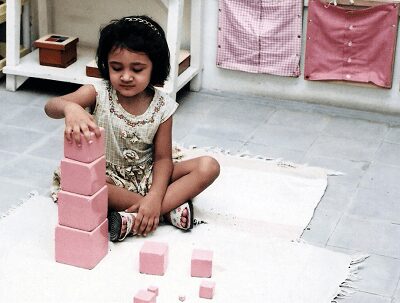
Anika places a large pink cube atop a small pink cube and the cubes fall. She removes the large cube and chooses another somewhat smaller cube. This cube also falls. She removes the small cube and replaces it with a larger cube. She places the smaller cube atop and, later, the smallest cube at the top of the tower. She sits back, observes her balanced tower, and her eyes sparkle as she smiles. one who seeks out the greatest efforts because his constant aspiration is to make himself superior to difficulties; he is a person who really tries to help the weak, because in his heart there is the true charity which knows what is meant by respect for others, and that respect for a person’s spiritual
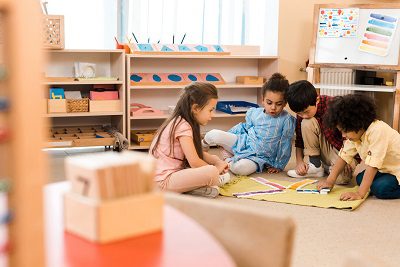
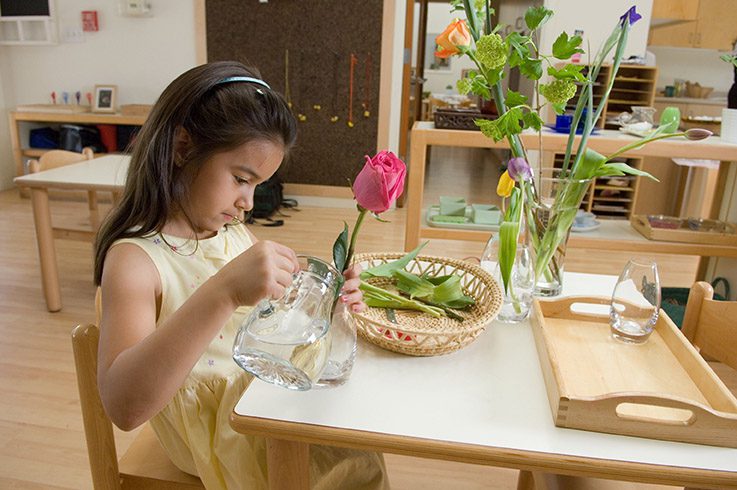
To the onlooker, it appears that the children are cleaning, building, and working on skills. They appear to be manipulating letters, numbers, and tablets of color. They carry long red rods, stack pink cubes, and lug heavy brown pieces of wood to awaiting throw rugs. These observations are accurate; however, the process of normalization involves a great many skills, some that are visible and some that are less obvious. These children (and others like them) are learning, growing, and developing in a specially prepared environment that fosters the love of activity, concentration, self-discipline, and sociability. This process is facilitated by a sensitive adult, who has prepared the environment with order, consistency, warmth, and the removal of obstacles that could prevent this development.
Martin enters his classroom, says hello to a few friends, and walks directly to the shelf that contains the materials necessary for the parts of the tree puzzle. First he retrieves and unrolls his rug with attention to its position and smoothness. Then he gathers his puzzle and places it on the rug. He builds, disassembles and rebuilds his puzzle without fatigue, but with joyful energy.
Dr. Montessori’s discovery of the “secret of the child,” i.e., their hidden potential, had yet to be revealed and understood by adults. Dr. Montessori’s skills in observation and the circumstances that placed her in the company of children in need of a place to call their own (the slums of San Lorenzo, Rome) found a fertile place for the revelation to occur. She shared with her adult students at the second Indian Montessori training course, that the children came “undernourished, dirty, and uneducated.” “And these very small children, from three to six, did wonderful things. They had wonderful revelations. All these revelations of how to learn to write and to read by themselves at such a young age (and in the midst of joy) resulted in a transformation of their character.”
Liam is building the triangles with deep concentration. Somewhere in the room a tray falls, a child coughs, and an adult walks past. Outdoors a horn sounds and a truck rumbles past. Meanwhile, he continues the assembly of the triangles, the triangles that he has constructed many times before, without interruption.
Then and today, children enter Montessori settings with capabilities that suit them for the work and activity they will encounter. They bring bodies designed for purposeful movement, coordination, grace, and stamina. Their hands and senses serve them by allowing them to interact with and come to experience their environments. They are equipped with a mind that absorbs impressions from all around them; a mind that organizes, problem solves, adapts, remembers, is curious, is capable of long periods of attention and concentrates with little effort and without fatigue. When the body and the mind are satisfied, the true character of children is disclosed. They are peaceful, joyful, sociable, helpful, self-disciplined, satisfied, and their inquisitive and loving souls are made evident. ¢
Montessori, M. and Claremont, C. A. (2019). The Absorbent Mind. Montessori-Pierson Publishing Company.
Dorothy Harman is an AMS Early Childhood credentialed Montessori guide. She holds a BA in Early Childhood Education and a M. Ed in Curriculum and Instruction with an Emphasis in Creative Arts. Dorothy Harman serves as a Montessori consultant and Adjunct Lecturer at the University of Nebraska- Kearney. She serves as a Field Consultant for the Center for Guided Montessori Studies and was a 2018 recipient of an AMS Peace Seed Grant. She is the author of Intentional Connections: A Practical Guide to Parent Engagement in Early Childhood and Lower Elementary Classrooms, published through Parent Child Press.
“As well as being part of our history and a way of understanding other people’s experiences, art is also a form of personal expression, like poetry, song, dance, and telling stories. It is a form of human connection that can evoke feelings, thoughts, and hopefully appreciation and understanding. Montessori encourages families to expose children to as many forms of art as possible. Encouraging your child’s interest in art and giving them room to be creative provides them with experiences that will endure.” — Excerpt from Montessori for Every Family by Lorna McGrath & Tim Seldin
The new book, Montessori For Every Family: A practical parenting guide to living, loving, and learning, by Lorna McGrath and Tim Seldin, shares some ways to encourage an enjoyment of art and to set up a space to create. We have searched out materials to help you set up an inviting art space in your home.
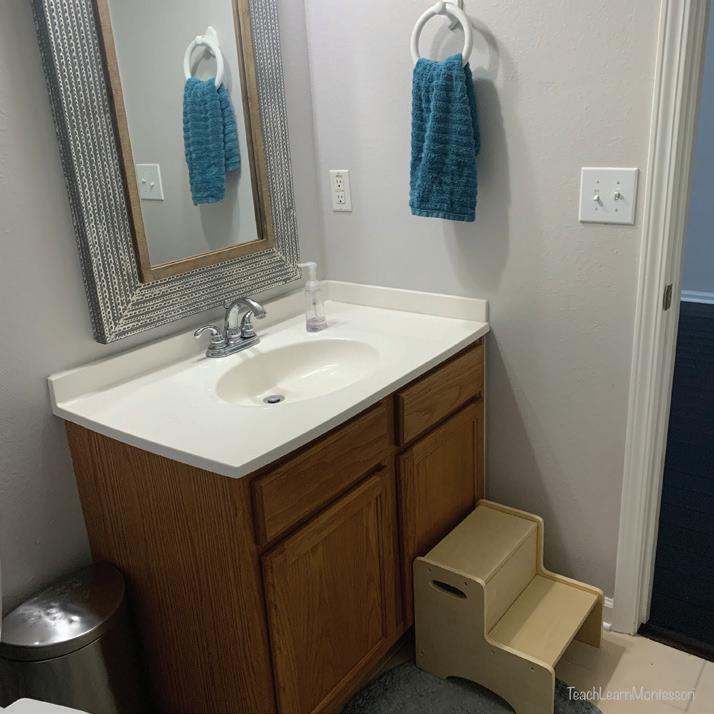
A child-sized wooden table can be your art area for years. Look for a sturdy table and chairs that fit under the table. If you do not have space for a separate art table, consider a coffee table with storage nearby.
Pictures by different artists can be chosen by you or your child if you visit an art museum, or ordered from art.com. Also consider a piece of wood with clips attached and a variety of postcards for a changing display.
You may want a paper roll so you can create different sized pieces of paper.
The MÅLA
Paper roll holder with storage is a good choice. It is available from several vendors, including Amazon. Here is a link to one from IKEA: tinyurl.com/ mrxfc27e
MÅLA Apron
Keeping clothes neat during art exploration is difficult for some of us, so a smock can be a beneficial part of any art set up. tinyurl.com/2zzsetah
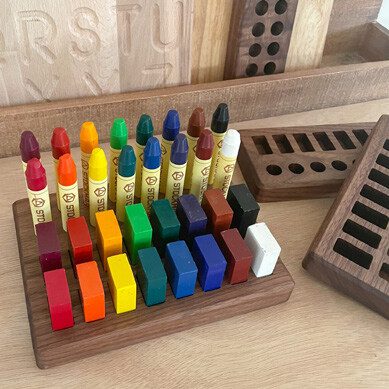
Stockmar Beeswax Crayons
Beeswax crayons allow for layering of colors and draw smoothly. They also last longer than traditional crayons. tinyurl.com/289usjem
Eco Finger Paint
Changing out art materials for different ages can help keep their interest up. Young children enjoy the opportunity to finger paint; this finger paint is made with food-grade materials, so you do not need to worry too much when painty fingers go into mouths. ecokidsusa.com/ eco-finger-paint/
Watercolor Pencils
Older children may like the many different ways to draw with watercolor pencils. tinyurl.com/2p9a6d5n
This all-natural, set of opaque watercolors has magnetic pots of color, so just a few can be used at a time. tinyurl.com/3ruhf9yu
Honeysticks
For younger children, who may even like to taste their paints, Honeysticks is a set made from food-grade ingredients. tinyurl.com/bdfjy9w9
Beeswax or Soft Dough
Younger children may find beeswax or soft dough easiest to use. Stockmar modeling beeswax warms up in your hands and smells delicious. tinyurl.com/mws8axc3
Include a container or two, to collect items for collage and sculpture making. Egg cartons, confetti, rubber bands, pom poms, whatever could be reused and is appropriate for their use, can go in the containers for building and creating. Be creative, and follow your child’s interests. Have fun with these ideas and supplies, and add your own art area in your home.
Editor’s Note: We know that the authors of this article really meant it to help teachers remember how important setting up children’s environments is to maximize the potential of each child at each stage during the early childhood years. However, because of how broadly they talk about the classroom environment, the principles can also be applied to the home environment. If you are a parent, there may be two “take-aways’’ for you. One might be that you have a better understanding of the many facets to be considered by Montessori teachers as they prepare their classrooms for your child. The second might be ideas for setting up a rich and supportive environment for your child at home. I found it helpful to change the word “materials” in this article to toys or activities as I read through it.
Early Childhood, the period between birth and age six, is the most critical period in postnatal human development and learning. During this time, basic movements are mastered, speech is developed, senses are consolidated, and bodies acclimate to sensory input. With this tremendous development taking place, the environment where children spend their days must reflect the constantly changing needs of childhood.
During their first months, children are in a state of unconscious absorption in which they learn from their environment spontaneously and effortlessly. This period of intense mental activity gradually leads to a state of conscious absorption, allowing for more purposefully chosen activities. At the same time, there is a tremendous quest toward both independence and a need for order. The optimal early childhood environment will have opportunities for children to gain the self-help skills they need in order to build confidence and realize self-liberation; providing order in the physical arrangement of the furnishings, the materials, and the activities offered.
The role of the caregiver, or educator, is to prepare the environment to meet the needs of the unique group of children in their care. There are several factors that need to be considered in order to provide a space that will enrich their experience in a developmentally appropriate manner:
MEETING THE NEED FOR MOVEMENT
As we learned from Dr. Maria Montessori (1870 – 1952), movement is intrinsically satisfying. It also affects psychic and spiritual energies; eventually, it helps children acquire abstract thinking by first enabling them to experience abstract concepts through concrete forms. Young children need to move! Knowing the ages, developmental levels, and needs of the children in your care will enable you to arrange the environment to provide the appropriate amount of physical activity.
Infants and Toddlers: If you are serving infants, who need to creep or crawl, provide open, obstacle-free spaces with warm flooring surfaces of varying textures that they can safely navigate and explore. Toddlers need space for independent exploration, as well as secure objects for grasping and pulling themselves into sitting and standing positions. Later. they will need apparatus for stretching and developing their arm and leg muscles, such as climbing triangles, dome climbers, and short sets of stairs. At this age children begin to learn when and where it is appropriate to run and climb and when it is safer to walk or keep feet on the ground. With guidance, toddlers will start to make the appropriate choices.
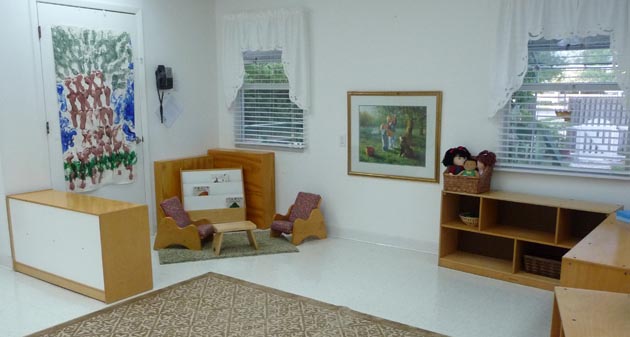
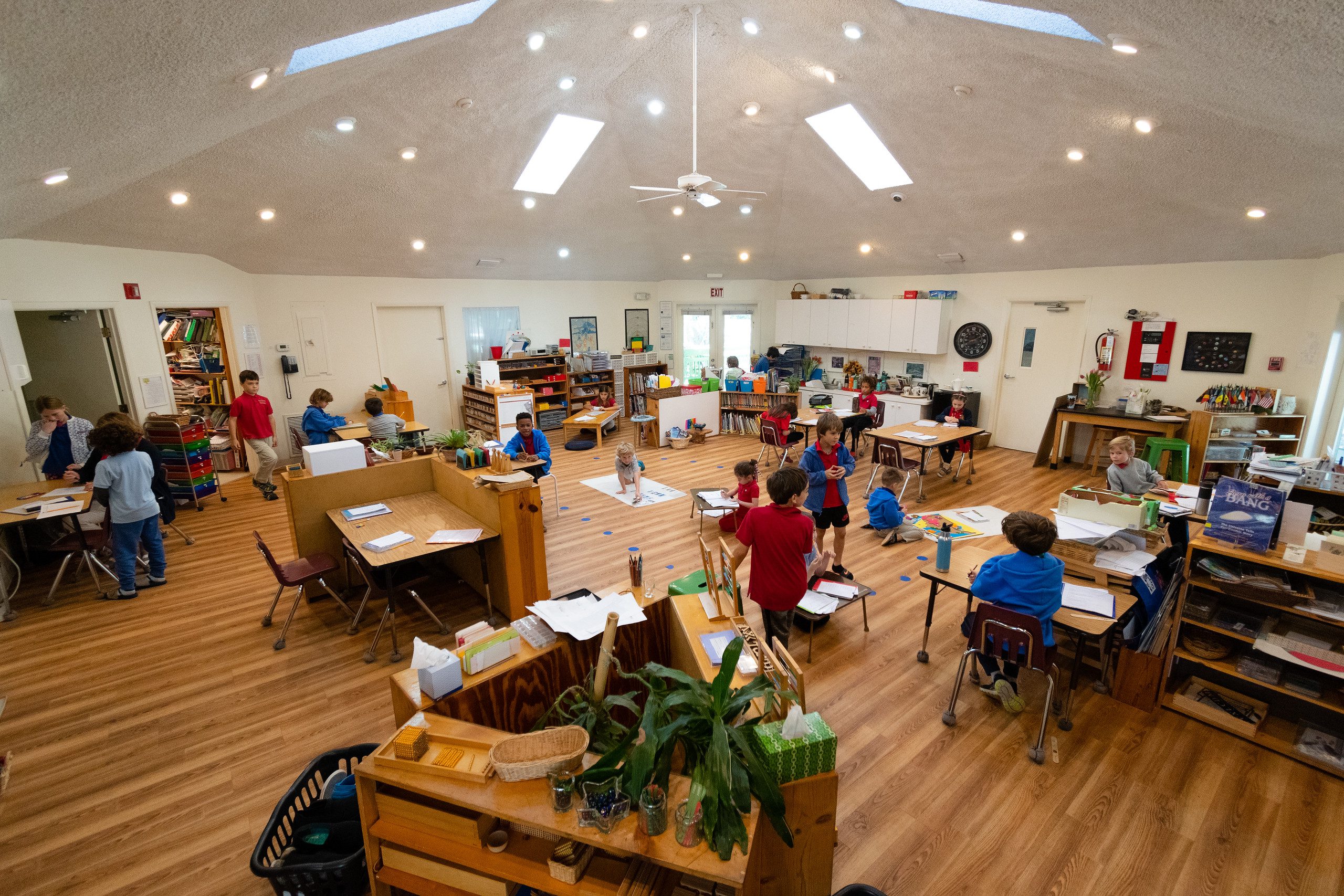
Preschoolers (ages 3—6): Preschoolers need spaces to: move back and forth between shelves, tables, and large open floor areas for unencumbered work; individual spaces, such as cozy reading corners, where they can settle, concentrate, and focus; and spaces to congregate in small and large groups. Long narrow openings tend to encourage running, which can be a safety hazard. Try to break up these long expanses with furniture or plants. A combination of child-sized tables and chairs (preferably adjustable to each child’s height); shelves and cubbies that they can comfortably reach; and open floor space will accommodate multiple types of activities.
MEETING SENSORY NEEDS IN THE ENVIRONMENT
Visual Component: Because young children are constantly adjusting to the barrage of sensory impressions they receive, what children see plays an important role in environment preparation. We live in a world focused on extensive visual stimulation. Although there is a trend to provide eye-popping bright colors or bold primary colors in early childhood environments, a palette of neutral colors and/ or colors from nature can be more conducive to learning and to promoting a sense of calm. A subtler background allows the materials to stand out and attract the child’s interest. In addition, urged on by décor manufacturers, early childhood educators (and parents) often plaster their environments with posters and other materials. However, uncluttered walls can be comforting, soothing, and far less distracting. Be selective and discriminating in choosing what is displayed and hang thoughtfully chosen artwork at the child’s eye level.
Considering your lighting is also important. Lots of natural light is optimal in any setting. If artificial lighting is also necessary, using incandescent bulbs will lend a warmer glow to your environment than the cool blue of fluorescents. You might also want to explore energy-efficient LEDs. In any case, remember safety considerations with young children, ensuring stability, taking care with cords, hot bulbs, and shades.
Auditory Component: Have you considered the sounds the children can hear in your learning environment? Just as your classroom can be visually cluttered, noises such as side conversations, small-group lessons, musical instruments, the rustle of leaves, or even the whisper of wind can make the classroom feel cluttered auditorily. Determine which of these noises are appealing and conducive to learning and which are distracting. Try to adjust the ones you’d like to control or mitigate by using sound-absorbing materials such as rugs and carpeting. Add soft pillows and child-sized upholstered chairs to the reading nook. Hang fabric curtains at the windows or draped across ceilings. If your budget allows, you may also want to consider unobtrusive acoustic panels for walls and ceilings.
Tactile Component: Are the surfaces of your furniture smooth and free of dangerous or pointy edges? Do you provide a variety of materials that appeal to the sense of touch, such as soft woolens, smooth silks, warm wooden objects, and cool metals, which encourage the child to explore and discover the unique characteristics of each? For babies and toddlers still crawling and creeping, have you considered the different sensations they feel on their hands and knees as they make their way around on varying surfaces?
Olfactory Component: What smells greet the children? Whenever possible, avoid the use of harsh-smelling chemical cleaners. Allow fresh air to permeate the environment. Objects with appealing scents, such as a cinnamon bark box or a clove box, can be enjoyed by the children. Fragrant herb plants that are safely edible, such as sage, rosemary, and lavender, also make lovely additions. Allow children to use a mortar and pestle to crush them to release their enticing scents into the air.
Choosing Materials: Besides the physical attributes of your home, there are various considerations to take into account regarding learning and play materials:
Quality: Are the materials constructed to last through use by many children?
Are they safe and free of sharp edges and small parts not suitable for children under three? Are they attractive and inviting?
Relevance: Do the materials embody and respect the personal identifiers that make up the diversity of your family and the wider community in which you live, such as race, ethnicity, and languages? Do they take into consideration the children’s interests, and inspire new ones?
Developmental levels: Do the materials and activities provide appropriate learning experiences for all the ages and ability levels in the class?
Language development: Does the variety of materials offered expose the children to the vast array of living and non-living things offered by our world and the rich vocabulary associated with them to expand their burgeoning language development? Are there opportunities for them to express themselves?
In Conclusion: Considering these various factors when creating living and learning environments for young children will help you provide spaces that benefit them by enriching their experience in a developmentally appropriate manner that contributes to their physical, cognitive, and social-emotional growth and learning.
REFERENCES:
Bagnoli, D. (2021) “Montessori by Design: School Spaces That Stay True to the Montessori Method.” Montessori Life. 33 (1). 26 – 35.Montessori, M. (1964). The Montessori Method. New York, NY: Schocken Books.
Photos in this article courtesy of Alicia Diaz-David.
Marie M. Conti, M.Ed. is head of The Wetherill School in Gladwyne, PA, and a former member of the American Montessori Society board of directors. She has more than 40 years of experience as a Montessori classroom teacher and administrator. Contact her at marie@wetherillschool.org.
Marcy K. Krever is a freelance writer and the former Senior Director of Communication & Community at the American Montessori Society. Contact her at marcykremer@gmail.com.
So, you’re considering a Montessori school. Maybe you’ve read about the growing evidence that supports the long-term benefits of Montessori education. Maybe someone you know enrolled their child in a program and is always pestering you to put your child there. Maybe it’s just an accident (as happened with me) that when you feel your child is ready for school, the closest one to you happens to be a Montessori school. Whatever the reason, when you show up, you want to know that this particular school is a good school.
THE PHYSICAL SPACE Now we can’t all live in the Taj Mahal, so the school may not be housed in the most modern building (we all have to start somewhere), but what you should see is that the space has something lovely about it. You’ll have a feeling that someone cared about the entryway, the hallways, the offices, the rooms, and, oh yes, the bathrooms. The walls will not be cluttered or overwhelming. Overall, it will feel calm, inviting, and maybe even elegant.
It may also make you feel like a bit of a giant because the whole school should be adapted to fit the smaller physical bodies of the students it serves. You should see benches, chairs, and/or tables that are quite small. Sinks will likely be lowered or the ground raised with solid stools. At all points, there will be a sense of order, care, and intelligence in the physical design.
OBSERVING Once you’ve walked through the door, the staff at a good Montessori school will make you feel welcome. They will greet you and, even though they will be exceptionally busy, they will make you feel like your visit matters. At some point, they will invite you to see the classrooms in action. They’ll call this “observing” and in Montessori, scientific observation by the adult is essential.
You see, Montessori teachers are actually all scientists. We are trained to carefully and objectively notice what is going on with each child. We observe how the children use their hands and feet, how they articulate words, how they interact socially with others, how persistent they are in getting what they want, etc. All of these observations are then used by the teacher to customize each child’s curriculum. Every child is allowed to go at their own pace, repeating as often as they need to in order to figure something out.
On your first visit, you will receive some basic instructions on how to observe. You’ll be asked to enter the classroom very quietly so as not to interrupt the class. You’ll be shown to a chair where you can sit and maybe given a notepad, so you can write down your reflections. You are asked to be polite with the children but not to engage with them excessively. Instead, you are to put yourself busily to the task of seeing what’s happening.
Sometimes the school will even give you a sheet with written observation instructions. I think every school should put a big caution statement on the top of the observation instruction sheet. “WARNING: Sitting quietly and observing Montessori children without chatting or interfering is sometimes associated with excessive discomfort. Particularly gregarious people may experience mild dizziness, vertigo, or a twitching jaw.”
That’s meant to be a joke, but I’m actually serious. Our culture does not teach us to sit back and let children be children. Our culture teaches us that good parents/adults jump in and engage with children and direct them towards doing ‘important things.’ And at this moment, the Montessori school is asking you to go against our culture, sit down, and be quiet. Isn’t that the opposite of what good education is all about?
Actually, when it comes to education, what we really want is for the students to be active and for the adults to be in a support role. It’s like each child is the superhero, and the teacher is the sidekick. We’re the wingman. The Children
In the midst of all this patience rooted in scientific observation, you’ll see a mixed-age group of children doing all kinds of things. In a normalized classroom, the children will be quite busy. Some of them will be working by themselves at a table or on a rug. Some will be walking about gathering things or tidying things. Some will be chatting with another child or doing some activity together. Some will be tending to their physiologic needs. And, of course, some will be on the edge of mischief. The important things to look for in the children is that they seem to be interested in what they are doing and that the work seems to have some logical purpose. They won’t be playing with dolls or toys but will be using real-life materials (like real glasses, pitchers, and bowls) to do intelligent things. You will also usually see a sense of order in what they are doing.
You will also see a mixed-age group, generally with a three-year span. So for a primary or preschool/kindergarten class, this would mean around ages three to six. Now the really important thing to notice is that the younger children will look to the older children for guidance and the older children will be happy to offer it. Let me repeat that last part… the older children will be happy to offer help. I’m not kidding. That is the coolest part of the three-year mixed-age group. The older kids get to be leaders. They really flex their “I’m the one who knows how to do this and who can teach others” muscles. It’s gorgeous to watch.
Of course, the younger children also benefit tremendously because all humans learn more easily from peers than from authority figures. So, when the new children start coming to school, they will have a whole community of people who can help them learn the ropes, most of whom are about their same size.
The Teacher The children will most likely be utterly accustomed to having observers visit. A few children may come over to greet you and welcome you to their room. Most will ignore you. Yes, that’s right, you will be less interesting to them than the schoolwork they are doing. There you have it; the next humbling truth of Montessori. The grown-up is the least revered thing in the room.
When you finally find the adult in the room, you should notice someone who:
§ Precisely and objectively watches the children
§ Dynamically engages the children with the hands-on materials
§ Models the most gracious, welcoming, and kind behavior you have ever seen
§ Demonstrates an insane amount of patience in waiting for the children to speak and get to where they need to go
Concentration Okay, so all of these things are going on all around us as we take our seat in our observation chair. And, despite the observation instructions, usually the first thing we want to do is start talking with some child or children so we can see what they are doing. We want to strike up a nice little dialogue with one of these perfect Montessori students we’ve heard so much about. I mean, this is our chance to get the inside scoop from the ones who really know what’s going on, right? If we can just talk to the right child, we’ll find out what we really need to know.
Now, resist the urge, step back for a moment, and consider this. In the 21st century, one of the primary goals of education is to develop the capacity to pay attention to what is important and ignore what is not. Every day, we are immersed in an ocean of information overload. Somehow, we adults have to figure out what doesn’t matter, what does, and then maintain our attention on what does, so we can see a task through to completion. So school isn’t just about teaching factual knowledge anymore (although that’s fun and has its place). It’s much more about creating executive function or higher thinking capacities.
So if we succumb to our little bout of curiosity and interrupt a child so we can find out the real dirt on the school, we are actually interfering with the development of that child’s attention span. This is the cardinal sin of Montessori. The big teaching in Montessori is to prepare the environment so children can get what they need, teach the children how to engage with the environment, and then let them have at it! At this point, the adult is careful to fade and observe. If the child needs help, we offer it. If not, we disappear because we know that it is their effort that makes the difference, not ours.
Sit down, relax into your observation chair, and just enjoy what you see. Are the children happy? When there is a conflict or challenge, is it handled compassionately by the teacher and/or the children? Is there a light buzz of meaningful dialogue? Does everyone seem to know what they are doing?
You’ll know if it’s a good school or not because it will make you think…what if the world were like this?”
Really, everything I’ve said above is a distraction. You’ll know if it’s a good school or not, because it will make you think…what if the world were like this? What if everyone knew that they had something valuable to do and that they could do it on their own or with others, at their own pace, and get help if they needed it? What if everyone could apply themselves to work that matched their interests and strengths? What if everyone helped to care for the physical environment and helped those in need? These are the questions you will find yourself pondering while you relax into the observation chair of a good Montessori school.
This article was originally published in the July 2016 issue of Tomorrow’s Child.
Julia Volkman is the president/founder of Maitri Learning, a teaching fellow in the Neuroscience of Learning course at Harvard University (Extension School), a Montessori mentor (AMI primary/early childhood), and a mother of two. Julia learned her first second language during high school, where she participated in a student exchange program to France. After two weeks, she had her first dream in French, and everything became easy after that. She completed her Montessori studies in Montreal (a bilingual program where she was always asked to team up with the French speakers), studied German in college, and taught herself survival Russian to prepare for her two-month adoption journey through Kazakhstan. She has taught English to students from China, Cameroon, and Russia.
It is the week before school starts. I am busy setting up our 3-6 year old classroom, checking for parts of activities, making class lists and acclimating our new assistant. I look at the names of the children and carefully arrange them by age from youngest to oldest as I do each August. I stop, think about the third year children and smile! I begin making a list of work to have available the first day of school. Third year children are eager and ready for so much. I want our environment to be prepared with the most advanced material they might look for. I remember these children from last year and think about their work Juan and Sam love to build the 1-100 board, carefully arranging the tiles in order and then writing each number. I write, “1-100 papers” on my list.
Karen spent the last month of last year doing metal insets with three different shapes. She really did interesting things with the pentagon and the trapezoid. Although I usually start the year with just basic metal inset shapes available, I know Karen will need more than that. I write, “Put out all metal insets” on my list. Kasi loves to water the plants and cares so nicely for our plants. Some years I introduce that work after a week or so but I know it helps Kasi center and it gives him a feeling of importance in our class. He will help the youngest children learn to care for nature just by his example. So I write, “plant watering work” on my list. Mary Katherine ended last year reading a book for early readers every day. She will need a quick review I am sure, but I anticipate that she will be ready for work with ‘silent ‘E’ very shortly. I write ‘“silent e’” work on my growing list. Andres ended last year knowing all the States of the Union. He had begun coloring a big map but he was not finished. I know he will look for it first thing. So I write, “Find Andres’’ half colored map.”” On my list of things to do. These children, like millions of Montessori children around the world will use their third year to build on the foundation they created in the first two years. As their teacher, I will already know them very well. I know their families, their social needs and their learning style. The relationship built up during these years of working together is a basic feature of teaching in the Montessori way. We pick up in September right where each child left off. Many children actually choose their most advanced work from the previous year, when they were four, as their first work of their third year in the 3 to 6 class! As we get ready for a new school year, I try to anticipate what each child is ready for so that I will have it ready. I am right! When school reopens, Juan goes right for the 1-100 board and Sam skips a bit as he gets the familiar rug. Juan comes right over and announces Are we are going to write it down too! Boy am I glad I already xeroxed the papers. Kasi comes over and asks, ““Do we have any thirsty plants in our room. None of the little ones know how to do it yet! But I do. I’ve been here for a long time!?” I smile and nod as another year begins with the third year children setting the pace and leading the way!
Quite often, we don’t give teachers the credit they deserve. I mean, first of all, they spend all day with kids—something that would drive most of us mad. But beyond that, they do so much more. Not only do they teach our children, they spend more time with our children than we (parents) do; they are trusted with caring for their well-being: socially, mentally, and physically. They are mothers, fathers, brothers, sisters, friends, and counselors to our children. While this may seem like enough of a job in itself, they also have to squeeze in some teaching along the way.
Here’s ten things all great teachers do:
1. First, they know every child’s name, not just in their class, but in the entire school, they say, “Hello,” to every child they meet and always engage in conversation where possible. “How are you? Did you watch the game? How’s your dad? You look cool today!”
2. They talk to children like adults. They reason with them and make them understand that, yes, there are rules and expectations in school and this is why, “You can’t run in the classroom, not because I said so, but because you might trip, fall into a sharp pencil, and stab yourself, and because I care for you so much that I don’t want you to get hurt.”
3. They allow children to ask questions and investigate, and they don’t pretend to know everything. “So that sums up our study of the human heart, class!” said Mr Johnson.
“Sir, why do heart attacks occur?”
“Actually I don’t know, but how about you go and find out and tell us all next week!”
This instills a sense of reality, responsibility, and pride as the children get to provide feedback to the group. Allow them to be the teacher; allow them to be the expert in the field.
4. They make things real. If you’re teaching Pythagoras, and a child asks why we have to learn it, you’ve got an answer. If you’re teaching expository writing, you allow the children to write an actual letter to a real person, persuading them to do something. Teachers make learning purposeful and real.
5. They practice what they preach. If you tell your class to be on time, dress smart, show respect, keep their voice down, and show kindness and gratitude—well, you better be doing that yourself. Children are very observant, and they will quickly call you out on it. The the old saying, “Do as I say, not as I do,” is just not good enough.
6. They tell stories. They tell their class about what they’ve been up to, how their evening was, and what they’ve got planned. Children like to know that teachers are human. They like to know that teachers don’t live in the art cupboard and that they do normal human things, like shopping, watching movies, and even understanding feelings like that time a student felt down or lonely. Teachers are human beings; let the students know.
7. Teachers trust their students. Teachers explain to the children that the classroom is an extension of their home, and they should feel safe there. “I’m going to leave my wallet on my table and my cell phone on my desk, I trust you won’t touch them, because you trust that when you need me, I’ll be there for you.” Mutual respect equals mutual trust, and if and when that trust is broken, it will be a huge learning curve.
8. They tell children that they matter, and so do their opinions. An opinion box on your desk, where children can leave anonymous changes they’d like to see in the classroom, is a great idea; a daily reflection card, allowing children to express what they liked and didn’t like about that day is a great idea. Great teachers ask the class to anonymously review their teaching. Teachers might think they’re the greatest, coolest teacher in the world, but how do you know if they’re never evaluated by the very people who look at them all day?
9. They share ideas with the wider community. A great teacher doesn’t create materials and keep them a secret so they look better than everyone else. They think of education as a whole, a world vision, a change for the future of mankind and, with that, great teachers share great ideas and great resources. If they discover that something works, they shout it from the top of the highest mountain and throw samples from airplanes high in the sky so that everyone gets a copy. Good ideas change lives.
10. This is the most important one of all, and it is one that we only find very rarely. Great teachers don’t teach; they inspire. They don’t say, “This is how you do it; now go do it.” They don’t say, “Here’s the equation; now solve it.” They don’t say, “This is what it looks like; now copy it.” They say, “How do you think you do it? Please tell me!” They say “Can you find the equation? Please test it!” They say, “What do you think it looks like? Go find out!” If you know a teacher who does any of the above, please share this article with them or any teachers who might like these ideas.