 The Pink Tower(left) is one of the Sensorial materials that children enjoy working with early in their Montessori experience. The Pink Tower, or Tower of Cubes, is composed of a graduated series of ten wooden cubes. The largest cube has a square section of 10 centimeters per side and is 10 centimeters high. Thus, it measures 10 x 10 x 10 centimeters.The square section and height of each of the succeeding cubes decreases by 1 centimeter, down to the smallest cube, which measures 1 x 1 x 1 centimeter.
Children carefully carry the Tower, cube by cube, to a little rug that defines their work area. They carry each cube comfortably at waist height, as they take the cubes and place them in random order upon the carpet. As they manipulate the cubes and carry them across the room, children get a very strong impression of size and weight. When all the cubes have been carried to the rug, a child looks for the largest one and begins to build the Tower, one cube at a time. At each step, he looks through the cubes that have not yet been added to the Tower to find the largest. As each is placed on the Tower, the child controls his movements to place the cube gently down right in the center of the larger cube on which it is rested. Once the Tower has been constructed, the child carefully takes it down and either begins again or returns the cubes, one by one, to their proper place on the shelf.
Some people have heard that in Montessori, children are taught that there is only one way to work with each material. In truth, the children explore and discover all sorts of creative ways to work with them. For example, students will construct the Tower horizontally, or line up two edges to create a vertical stairway. The children will also build the Pink Tower in various combinations with the Brown Stair along with some of the other Sensorial materials.
The Montessori Bells
 The Montessori Bells (below left) extend the child’s ability to distinguish sounds into the area of musical pitch. They are a lovely set of bells fixed to little wooden bases. Each bell is tuned to either a whole or a half note on the standard musical scale. The entire set comprises one entire octave, including sharps and flats. The set includes one set of bells with tan bases for both half and whole notes; there is a second set in which the bases of the bells that sound the whole notes are painted white, and those for the sharps and flats are painted black.
At first the children learn how to strike the bells with a small mallet to produce a clear note and dampen them with a little felt-covered rod.
Then the teacher will set out two or three pairs of bells from the two sets. The children match the pairs that produce identical notes. When they can do this easily, additional pairs are added until they can match entire sets.
A more difficult exercise challenges the children to grade the bells of just one set by pitch, from the lowest to highest notes. As they become more familiar with the bells, children will commonly learn how to play and compose little melodies.
The Brown Stair … also known as the Broad Stair
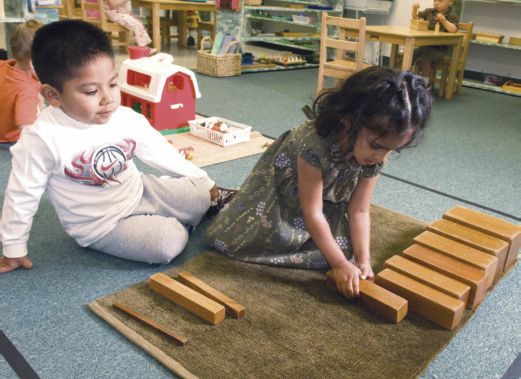 The Brown Stair,which is sometimes called the Broad Stair, is made up of ten rectangular prisms, with bases that have exactly the same graduated measurements as the cubes of the Pink Tower, but which are uniformly 20 centimeters long. The child is challenged to scatter them around her rug and then sort them by size to place all ten prisms in proper order from thickest to thinnest.This results in a graduated series of rectangular prisms that resembles a little stairway. Because the squared sides of each prism correspond to the dimensions of the cubes of the Pink Tower, the two materials are often used together for all sorts of exploration and designs.
The Sensorial Exercises
A child interacts with the physical world through her senses. From birth, she will look, listen, touch, taste, pick up, manipulate, and smell almost anything that comes into her grasp. At first, everything goes into the mouth. Gradually, she begins to explore each object’s weight, texture, and temperature. She may watch something that catches her attention, such as a butterfly, with infinite patience. The Sensorial curriculum is designed to help children focus their attention more carefully on the physical world, exploring with each of their senses the subtle variations in the properties of objects.
At first, children may simply be asked to sort among a prepared series of objects that vary by only one aspect, such as height, length, or width. Other exercises challenge them to find identical pairs or focus on very different physical properties, such as aroma, taste, weight, shades of color, temperature, or sound. These exercises are essentially puzzles, and they tend to fascinate children because they are just difficult enough to represent a meaningful challenge. Each has a built-in control of error that allows children who are observant to check their own work.
The Sensorial exercises include lessons in vocabulary, as the children master the names of everything from sophisticated plane and solid geometric figures to the parts of familiar plants and animals. As the Inuit people of the Arctic demonstrate to us with their many different words for snow, we observe that as the children learn the correct names for things, the objects themselves take on meaning and reality as the children learn to recognize and name them.
Why is it so important to educate the young child’s senses? We certainly don’t believe that we can improve a child’s hearing or sight through training. However, we can help children to pay attention, to focus their awareness, and to learn how to observe and consider what comes into their experience. In a way, the Sensorial curriculum accomplishes something like a course in wine tasting or music appreciation; one learns to taste, smell, or hear what is experienced with a much deeper awareness and appreciation. These exercises can help children understand and appreciate their world more fully.
Red Rods
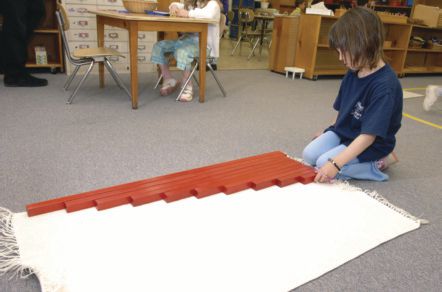
The Red Rods (above) are a series of ten rods (thin rectangular prisms) of which the height and width are uniform; however, they range in length from 1 decimeter (10 centimeters) to a full meter (10 decimeters or 100 centimeters).
The child scatters the rods around her rug and looks for the longest.As each is arranged next to the others in a series, the child discovers the regular progression of length. The teachers introduce vocabulary: short, shorter, shortest; long, longer, longest.
The Red Rods are exactly the same dimensions as the Red and Blue Rods in the Math area, which help children learn to count by showing the growth of quantity as length, distinguished by alternating patterns of red and blue to represent each number.
The Knobbed Cylinder Blocks
 The Knobbed Cylinder Blocks are a set of four naturally finished (unpainted) rectangular blocks of wood, into which have been cut ten cylindrical holes. Each hole is filled with a matching wooden cylindrical inset, fitted with a little knob on the top to make it easy for a child’s small hand to grasp and lift it out of its perfectly fitted hole.
Each set of cylinders is constructed to vary in a regular sequence by either diameter, length, or both. The children remove each cylinder in turn, carefully tracing its length and circumference and the depth and circumference of each hole with one finger.
Knobless Cylinders
 Once all ten cylinders have been removed and placed on the rug, the children take each in turn and find the hole into which it fits perfectly, with the top of the cylinder flush with the top of the cylinder block. If they’ve made a mistake, the children can normally see it for themselves because all ten cylinders will not fit correctly.
The children quickly begin to challenge themselves by attempting to ‘see’ which hole is likely to fit the cylinder in their hand rather than trying to fit each into one hole after the other. After a while, they will begin to do the same exercise with their eyes blindfolded, relying on touch alone. When they are ready for a greater challenge, the children will mix the cylinders from two, three, or all four blocks together and try to fit them all into the corresponding holes.
The Knobless Cylinders correspond to the four Knobbed Cylinder Blocks. With this material, each of these sets is painted red, yellow, blue, or green. With no cylindrical holes, the children depend upon sight or touch alone to arrange the cylinders.
Children will sometimes work with both the Knobless Cylinders and the more familiar Knobbed Cylinders, finding the match between each brightly painted and unpainted cylinder in turn. By working with all four sets of Knobless Cylinders together, children discover all sorts of geometric patterns and progressions within the material.
Mystery Bag or Mystery Box
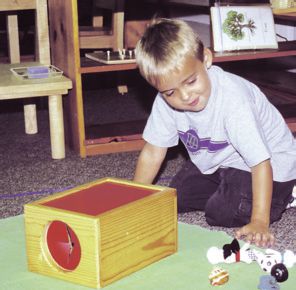 One of the children’s favorite activities is the Mystery Bag or Box (shown above).Normally, it is simply a cloth bag or box with a hole for their hands in which they touch and manipulate objects that they cannot see. One activity is to place things that are familiar to the children inside and challenge them to identify them by touch alone.
Rough & Smooth Boards
 Another exercise begins with the Rough and Smooth Boards (shown above), which have a surface that alternates between the roughness of sandpaper and a smooth finished surface.The children wash their hands in warm water before beginning to make them more sensitive.
Sandpaper Tablets
 The Sandpaper Tablets (above) are a set of wooden tablets covered with several different grades of sandpaper. The challenge is to identify pairs that have the same degree of roughness, working by touch alone. An extension of these activities is commonly created by assembling a collection of pairs of cloth swatches cut from many different materials, each with its own texture. Again, working with eyes blindfolded, the children attempt to find the pairs by touch. Like all Montessori exercises, there is a built-in control of error. In this case, the children learn to check their work by removing the blindfold and seeing if they have identified the correct pair.
The Color Tablets
 The Color Tablets help the child learn to distinguish among primary and secondary colors and tones, while mastering the words used to describe each color and shade.There are three separate boxes of Color Tablets.All of the tablets have the same shape and differ only in color. The first box of Color Tablets contains six tablets, two each of yellow, red, and blue. The children simply match the pairs and learn the spoken names of the colors. The second box of Color Tablets contains eleven pairs of secondary colors and tones, which the children match and name. The third box of Color Tablets contains seven different shades of nine different colors, which the children learn to sort in order from lightest to darkest shade.
When all of the tablets are laid out in an array it creates a lovely display of color. There are many ways in which the children and teachers can make the color tablets more challenging.For example, the children will try to find the tablet that is closest in color to something in the environment. Another challenge is to give the child a color tablet from the third box and ask him to go to the box and, by memory alone, bring back the tablet that is just one shade lighter or darker.
The Smelling Jars
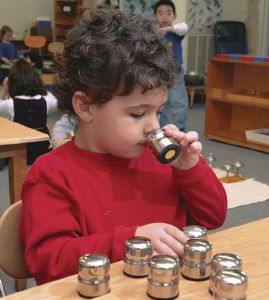
Children enjoy using the Smelling Jars to learn to identify different non-toxic smells using their olfactory senses. Typically, aromatic oils or extracts (such as lemon or peppermint) are placed inside the canister (using a cotton ball and a few drops of oil). Other cannisters might contain spices, such as cinnamon.
The Sound Cylinders


The Sound Cylinders are six pairs of sealed containers filled with substances that make distinct sounds when shaken, such as beach sand or dried peas of different sizes. The children carefully listen to the sounds and match the containers that have the same sound.
The Geometry Cabinet
 The Geometry Cabinet is a set of puzzles made in the shapes of the essential plane geometric figures. It consists of six drawers, each of which is fitted with several wooden frames, inset with a geometric form. In addition to the familiar circle, square, and rectangle, the child is introduced to a much broader array of complex figures, from the right scalene triangle to the decagon; and from ellipse to the curvilinear triangle through the quatrefoil.
In addition to removing the pieces and replacing them in their frames, children sequence some shapes by size and classify other shapes by type. They also learn how to match them against three sets of printed cards that represent the same figures in increasing degrees of abstraction. The first set represents each shape completely colored in on the card in the same size as the piece from the cabinet. The children simply cover each card with the matching puzzle piece.
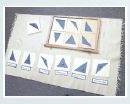 In the second set, the geometric shapes are printed as outlines drawn with broad lines that leave the inner area white. In the third set, the figures are simply traced with thin lines. As children gradually begin to recognize the more abstract representations of the three-dimensional objects, they are preparing themselves to recognize the little lines and squiggles of the written word.Gradually, children learn the names of each of the geometric shapes. Once children begin to read and can verbally identify the shapes, they begin to label them with pre-printed name cards. Eventually, the children will be able to prepare their own cards from scratch.
The Geometric Solids
 The logical basis for the Geometry Cabinet is the set of Geometric Solids. The children learn the names of these beautiful wooden forms, identifying them, at first, by sight and eventually when blindfolded.
The set includes a sphere, cube, rectangular prism, a square-based and broad pyramid, triangular pyramid, ovoid, ellipsoid, and a cone. The children quickly begin to look for each geometric form in their environment. They also begin to discover the relationship between the two-dimensional figures and the solid forms: a circle is related to a sphere; a square to a cube; etc.
As they begin to read, children will learn to match Geometric Solids to a set of prepared label cards. Eventually, they will be able to prepare their own. This early introduction to geometry continues in the Elementary Montessori program. After years of hands-on experience with geometric figures and other mathematical exercises, children normally find it very easy to grasp more advanced concepts, from the definitions of geometric terms to the calculation of area, volume, and circumference.
The importance of puzzles in the Montessori approach

This young child is working with a Number Puzzle
Everyone who has worked with young children, whether a parent or teacher, knows how much they enjoy wooden puzzles; however, most of us take puzzles for granted and fail to appreciate their hidden potential as an educational tool. The puzzles that we commonly give to young children depict little animals or cute scenes.
Dr. Montessori came to recognize that the attraction of fitting the pieces of a puzzle into the insets on their frames lies in the process of manipulating an object in all directions and finally discovering the one and only correct way that it will fit. There is more to all this than simply the satisfaction of solving a puzzle. Somehow, we find that young children experience things that they can touch and manipulate quite differently from a picture of something printed on a piece of paper. In short, the positive and negative insets of a puzzle are much more real and interesting to a child than a simple two-dimensional picture.
In the Montessori classroom, puzzles are not only used to help children learn to manipulate objects and assemble a complex whole from several parts; they are used to introduce children to a tremendous range of concepts and vocabulary, from geometric shapes to the countries of the world and the parts of a Flower.
The Binomial & Trinomial Cubes
 These cubes are two of the most fascinating materials in the Montessori curriculum.At one level, they are simply a complex puzzle in which the child is challenged to rebuild the cubes and rectangular prisms contained in the box back into the form of a larger cube. Color coding on the outside of the box and the sides of certain pieces helps the child detect the pattern. The material is also an exercise in algebra and geometry, representing in concrete form the cube of a binomial (a+b)3 (above left) and a trinomial (a+b+c)3 (left) where a=2 cm., b=3 cm., and c=4 cm.

A Trinomial Cube
Editorial Note: The materials described on these two pages may not seem to the layperson to be Sensorial in nature, as much as algebraic or geometric.They are, however, included in the Sensorial curriculum, because this is where they are introduced to Montessori students in the early years.
The Constructive Triangles
 The Constructive Triangles allow children to explore the geometric possibilities inherent within several different types of triangles. The material consists of six boxes, each of which contains a set of brightly colored, flat wooden triangles, which can be manipulated like a puzzle to explore congruency and equivalence. For example, two right triangles joined together along the hypotenuse form a rectangle. To help the young child recognize the essential relationships, most of the triangles have a line drawn along those edges that join together to form new figures, such as rectangles, squares, trapezoids, and polygons. Working with the Constructive Triangles, children explore how various triangles can form regular polygons in geometry.