






After five years of consulting private schools on how to use communication tools to grow enrollment, and keep enrolled parents engaged, one thing has become painfully obvious to me:
Almost without exception, I find that people who are in school leadership positions have little to no business education or training before they take the position.
The only real expertise that exists within the school staff is education. So, generally speaking, schools are businesses that are run by teachers.
Don’t get me wrong; I prefer this for my children. I would rather place them in a school that has a thinner profit margin but is being run by someone who is an exceptional educator, than someone who has an MBA just focused on the bottom line.
But this creates challenges, and in today’s private school market, which is growing and likely to explode, schools are not equipped to face the challenges of competition for enrollment. In fact, the numbers clearly show this.
In the diagram below, you can see how the market is growing, but the enrollment rates are decreasing. This trend means competition is making it harder to keep schools full, and unfortunately, school leaders are not equipped to compete on a business level.

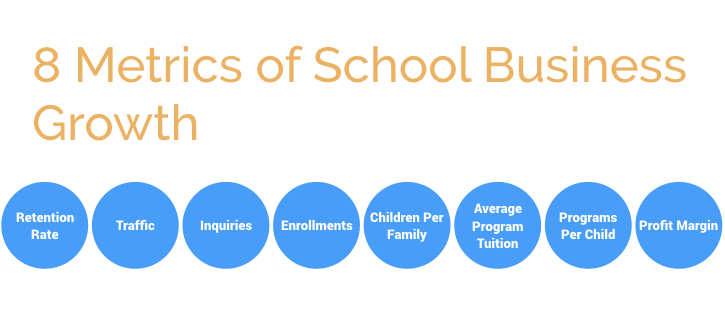
I’ve developed a framework for schools, to help them understand what their key business performance indicators are. This information is nothing new; it’s just business basics. However, I’ve translated it into a jargon of which a school director can relate.
You can watch a recording of a recent webinar I co-hosted on this topic along with Jonathan Wolf where we dig much deeper.
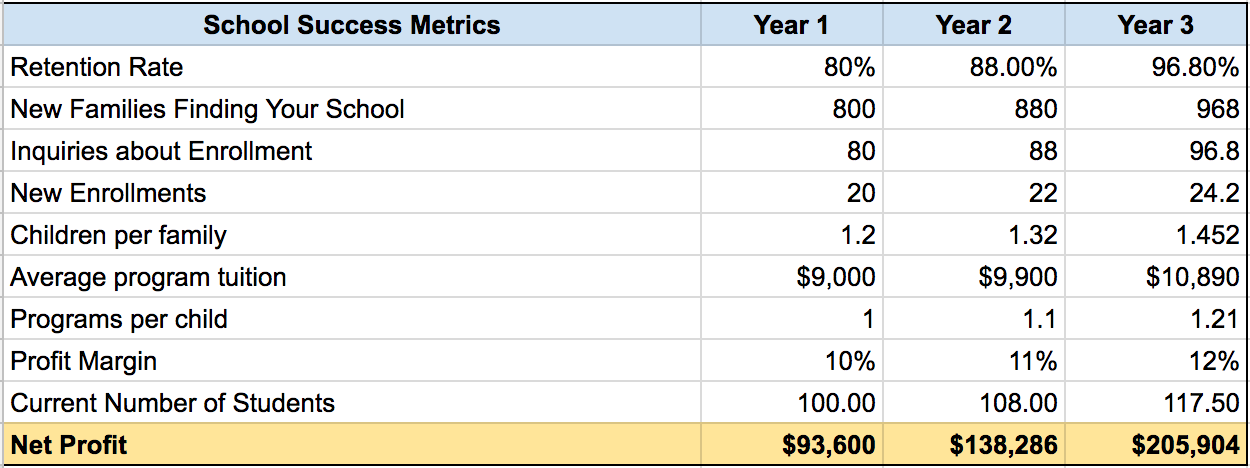
Below is a simple spreadsheet that identifies eight key business metrics. Schools should focus on improving these metrics year over year.
It also shows how an incremental growth of only 10% in each of these metrics, year over year, will more than double the net profits for a school starting with 100 students.
In the “Year 1” column, we input some industry benchmarks. In the “Year 2” column, we increased each metric by only 10%, and then, in “Year 3,” we increased the previous year’s results by another 10%.
Now let’s break each one of these down.
Retention Rate
Retention is pretty obvious, but essential. It’s always WAY easier to keep families than it is to find and enroll new ones. Now, you will always have kids graduating, so you will never hit that 100% mark, but the goal is to increase the retention of non-graduating students.
The easiest way to retain children is to improve your parent communication system. You might have the best teachers in the world, but if the parents don’t know what is going on, or if they dislike the communication experience, they leave. And when families leave, they usually take one or two more families with them.
Alternatively, if they love the communication experiences with your school, not only will they stay, but they will also promote you to other parents. Word-of-mouth referrals make marketing for new families substantially easier and cheaper.
New Families Finding Your School A.K.A “Traffic.”
So, if you were running a shoe store, the traffic would be the number of people walking by your store in the mall; however, in the school enrollment marketing world, this would mean the number of parents who saw an ad or got a referral from another parent.
So how do you improve this?
Well, I already mentioned that your best way to promote ‘word-of-mouth’ marketing is with happy parents. But, as far as advertising goes, I would say that hands down, Facebook ads are the easiest and most productive way to promote your school to families that match your school’s culture.
Inquiries About Enrollment A.K.A. “Opt-ins.”
Again, if you were a shoe store, opt-ins would be people walking into the store and trying on a pair of shoes. Whereas in a school, this would be parents going to your website and filling out an inquiry form, or just calling or walking into the school to get some info.
The design of your marketing website has the biggest impact here. Too often, I see schools handing off the management of their website to a parent volunteer. Now, if you want to know why that is a horrible idea, you should read this blog post.
Suffice it to say, your website does not need to win a design award, but the content and layout should be designed to push prospective parents toward the first step in the enrollment process, which is inquiring.
Here is the rule of thumb that all schools need to follow: You should have, at least, four times the amount of inquiries coming into the enrollment process, as you have spots to fill. If you don’t, you can quickly end up with your back up against the wall accepting whoever will apply, just so that you can meet your payroll.
This is how you end up with problem parents and people that need a different type of school. These are the folks that tax your staff, leave after one year, take families with them, and in extreme scenarios, bring you to court or shut your school down entirely.
IT HAPPENS EVERY DAY, trust me.
New Enrollments
This one needs no analogies, but just in case you didn’t realize it, yes, this is a school’s version of someone buying a pair of shoes.
Children Per Family
Now, you might be thinking “Hold on, how are we supposed to convince our families to have more children?” Well, let’s go back to the ratio of inquiries to openings you should have.
If you have enough inquiries coming in, you could prioritize families with more kids, and ideally, families where the oldest child is going to start in your earliest program.
How much easier is it to run your school when you have families that are a perfect fit AND have two or three children enrolling in your earliest programming options.
Average Program Tuition
Tuition increases are where school leaders wimp out. Your rates need to increase. Your average tuition across all of your programs should be growing, at the very LEAST, with inflation, and there is no reason why rates can’t move up faster.
If you are achieving the right number of inquiries, you can be more selective with your enrollment. So, every year you should not only the be accepting families that fit the culture and have multiple children that can all start in your youngest programming, BUT also, families that have the means to pay a slightly higher tuition.
Programs Per Child
If you don’t have multiple types of programming, you should. Selection is another basic strategy that ALL businesses need to implement. I mean, just imagine a shoe store with only one type of shoe — aside from that being my dream shoe-shopping experience — it would not be great for business.
Every year, you should be testing and developing new programming, while also marketing these programs to your current parents.
There is no easier sale to make than to an existing customer.
Some ideas that I see all the time are:
- Sports programs
- Arts programs
- Camps
- Early drop-off
Profit Margin
If you don’t know your profit margin per child, you should. What we usually see in schools is something around 10%. Now, if you were going to try to sell that to the average business man, you would probably get a pretty cold response.
Unfortunately, that is often the result only after doing major fundraising campaigns.
The reality is, schools can and should be doing much better than a 10% profit margin, and they can do it by focusing their time and resources on better business management, rather than capital campaigns that are usually poorly executed.
That’s a whole blog post in and of itself, so let me know if you want me to write that one and send it to you.