The Peace Rose: A Priceless Gift… from the Dollar Store!
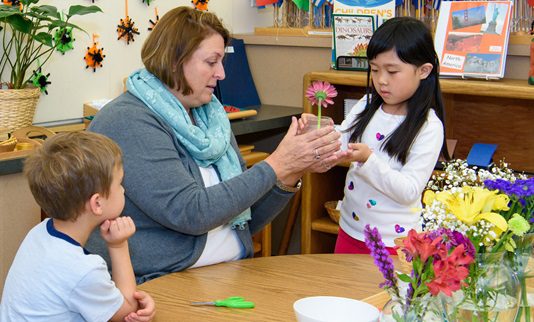
I glanced across to the Peace Table in the far corner of the classroom. Belssy and Nia were sitting across from each other, ‘doing’ the Peace Rose. Unbeknownst to me, Belssy had quietly initiated this activity, which meant she had asked Nia to “do the Peace Rose,” feeling that something occurred between them that needed to be resolved.
I continued with the math lesson I was giving, while keeping an eye on the girls. I observed Belssy pick up the red silk Peace Rose and the ‘dialogue card’ from the low table. Though they were speaking quietly, I knew what they were saying—it was a familiar and well practiced scene in my public school Montessori classroom.
The child is both a hope and a promise for mankind.
– Dr. Maria Montessori, Education and Peace –
Holding the rose and reading from the card, Belssy would be saying, “Nia, I didn’t like it when you grabbed the scissor without asking ‘cuz I wasn’t done with it!” Passing the rose and the accompanying card to Nia, I could preempt the response: “I hear that you didn’t like it when I took the scissor because I didn’t ask and you weren’t done with it.”
Then the rose and card were passed back again.
Belssy would now be saying, “I would like you to say sorry and ask next time when you want something I’m using.” Passing the rose and card back a final time, Nia would then answer, “I’m sorry. I’ll try not to do that again.” Finally, holding the rose together, they would declare “Friends!” and each calmly return to their work.
Of all the events in the classroom, children solving interpersonal issues independently feels most important. This memory of mine, of Belssy and Nia, is not a unique moment or a ‘fluke,’ but is the outcome and reward of very intentional and deliberate teaching and modeling of social skills and personal problem-solving procedures, done with the aid of a very important tool in the classroom—the Peace Rose.
In the early days of school each Fall, teachers mindfully set the stage for the rest of the year.
This is inclusive of Grace and Courtesy lessons, co-creating classroom agreements, alongside the practice of routines and procedures. And with all of this, a strong focus on how to peacefully resolve interpersonal issues is crucial.
Interpersonal challenges invariably come up quite regularly in the peer relationships of the classroom. The Peace Rose ritual is a powerful way we can enable children to address these conflicts independently, and in a manner where both parties feel the issue was addressed, and, at the same time, have their dignity preserved. Given the opportunity to learn, practice, and the provision of the right tools, the majority of children will accept the responsibility of skillfully settling their interpersonal problems on their own.
Preventing conflicts is the work of politics; establishing peace is the work of education.
– Dr. Maria Montessori, Education and Peace –
The Peace Rose was first introduced to me during my Montessori training. When I tried it in the early days of my E1 teaching, my assistance was needed too often. The children often fell into arguing about what had occurred and I saw the need for the modelling of skillful ways to express and respond to hurt feelings. I introduced a procedure, in the form of a simple dialogue on a card that they could use each time they used the Peace Rose, without needing a teacher to mediate.
Practicing short scenes through roleplaying is an important way to provide students with the practice that is necessary for it to become a standard response to conflicts. So, I created roleplaying cards, each with a one sentence scenario of typical classroom conflicts. Two children at a time would act out the scene in the center of the class meeting circle, using the Peace Rose to signify whose turn it was to talk, and the dialogue card to help structure the conversation. Nearly everyone was eager for a turn.
“If we are among the men of good will who yearn for peace, we must lay the foundation for peace ourselves, by working for the social world of the child.”
Maria Montessori, International Montessori Congress, 1937
As we know, children need structure, predictability, and clear expectations. They need to be explicitly shown positive social skills, which often includes modeling the words they haven’t yet learned, so that they can express themselves in ways that are both respectful and honest. They also need opportunities to practice these new skills.
Along with the Peace Rose and their accompanying dialogue cards, highlighting the simple phrase, “If I did that, I’m sorry” proved to be a magical statement that could be said by a child who was not, for whatever reason, able to acknowledge what their classmate was asking them to address. Rather than telling a child to (disingenuously) say “I’m sorry,” the use of these simple words nipped many a stalemate or argument in the bud.
Phrases such as: “I didn’t like it when…” “My feelings were hurt when…” “I would like you to…” “I hear that you feel…” “Next time I will…” are ways children learn to express their feelings without attacking the other person. Another useful phrase in response to hurtful behavior is, “We don’t say that in our classroom” or “In our classroom we… (use kind words),” which adults model and children are encouraged to say to someone who is not following a class agreement.
For our returning students, these lessons provide opportunities to show leadership, as well as reminders of how we do things in our classroom. Our new students benefit from their older, more experienced classmates’ guidance and support, as they ‘pass down’ the culture of the classroom. This includes the caveat that when you are asked to do the Peace Rose, you can say you need some time before you do it, but it needs to be done before the class eats lunch or goes home.
If we are among the men of good will who yearn for peace, we must lay the foundation for peace ourselves, by working for the social world of the child.
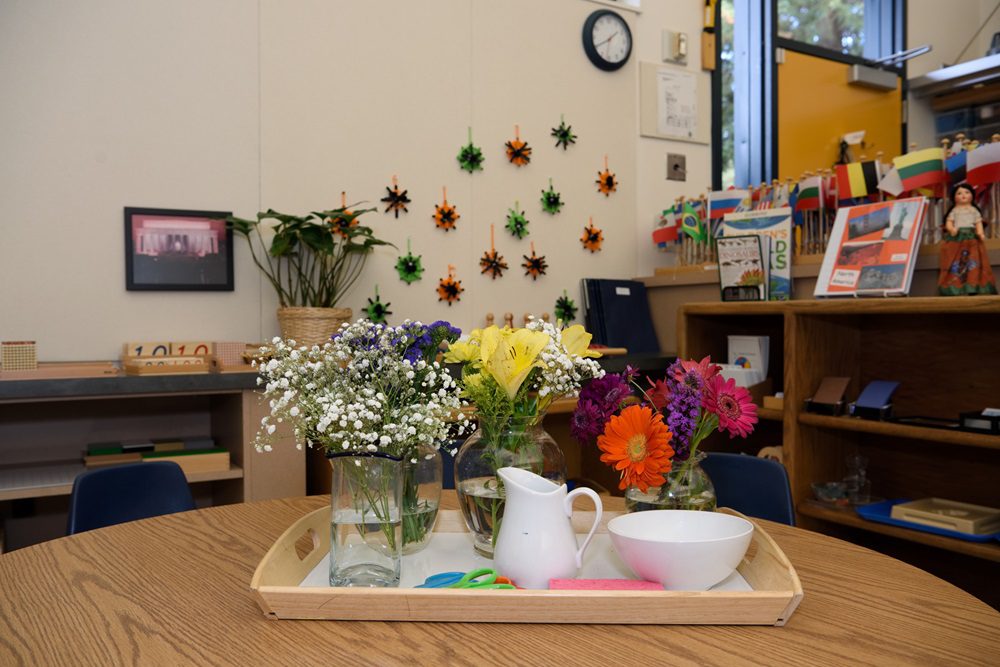
When the Peace Rose is given a place on our classroom Peace Table, it transforms from being a decorative item from The Dollar Store to an object that embodies a message of peace, understanding and skillful problem solving. It becomes a tool for the children to actualize the ethos of the classroom— a commitment to working together to create a caring, peaceful community of learners, where children can accept the responsibility that comes with living and working side by side in an environment rich with dignity and respect for oneself and for others.
Sensitivity to the feelings of others, moving from an egocentric viewpoint to understanding and caring about the feelings of others, is a major development in the child’s social and moral development. This needs the support of a classroom environment that teaches, models, and believes in the peaceful resolution of conflict. The Peace Rose approach is a simple, powerful, and effective way to empower our students and create a more peaceful classroom!

Julie Shornstein Cash is an E1 Montessori guide recently retired from teaching at a public Montessori program in Kingston, New York. Throughout her teaching career she has had a special interest in creating a strong sense of community and promoting student-centered, humanistic and democratic values in the classroom. Julie integrated music, art, and drama, along with daily singing with her guitar, into the daily life of her classroom. Using the Writer’s Workshop Approach she developed a robust writing program where the children’s authentic life experiences inspired their work and created a strong and supportive community of writers. Julie received numerous grants that provided funding for authentic learning experiences through field trips and having specialists in the arts contribute to a project-based, integrated curriculum. She graduated from the Bank Street College of Education and completed three levels of the Responsive Classroom training.