by Hillary Drinkell | Montessori Administrators, School Leadership, The International Montessori Council
 It is unusual for Montessorians to discuss the subject of bullying; in fact, in our well-prepared peace environments and community conscious classrooms, bullying is rarely an issue. However, it seems that more and more scenarios that would fit within the definition of bullying are cropping up in our elementary and upper school environments. The following points serve as a platform to assist you in recognizing the basics surrounding this topic. We welcome your feedback, experiences, and solutions.
Bullying is repetitive, hurtful behavior with a conscious intent to hurt someone. The person being bullied often does not have the skills to defend himself and hence the repetitive nature of the act
Types of bullying: physical, such as hitting, and taking belongings; verbal, such as insults, name-calling or racial remarks; psychological (emotional), spreading rumors, excluding someone from a group
A bully: attention seeker; tests limits and receives no repercussions to the behavior thus perpetuating it; power/popularity seeker
A victim: poor social skills; few friends; lacks self-confidence; often thinks he is deserving of the bullying
Warning signs of bullying: withdrawal from usual behaviors, complaints regarding physical symptoms such as headaches, stomachaches and the like, withdrawal from friends, changes in work habits or in enjoyment of school
Administrator’s role: have clear policies and guidelines in the parent and faculty handbooks specifying bullying behaviors and consequences (remember to include social media within these guidelines); talk openly with faculty – spend time role-playing how to handle a variety of situations; discuss, record and maintain consistent classroom management expectations and how to work with students if needed – consistency is key here; talk openly with parents about school policy on this issue; follow through on policy and be consistent with your response/s if needed
Faculty’s role: discuss openly with your class community (preferably at neutral moments at the beginning of the school year) what bullying is and the community’s expectations community regarding this; brainstorm and create a class community contract that sets the stage for a well-functioning, peaceful class community; give students opportunities and skills to voice their concerns in an open, supportive forum; ensure that you have clearly communicated how students can get help from each other or adults if they feel unsafe – most times guides have a series of steps to help students work out their differences, but to also enlist the help of others when needed; if you have an issue with bullying behavior in the class, ask the class community for help and brainstorm how to resolve it, if the victim is comfortable with this – if the situation persists, speak to your administrator; have regularly scheduled class meetings, preferably once per week so students feel class community ownership and develop the skills to communicate kindly and respectfully with each other; check in with your classroom management style – is it consistent, kind, but firm?
The Montessori environment’s advantage: we support a curriculum of peace; we work to enhance students’ exposure to many cultures thereby developing tolerance of differences; we look at the big picture and how we fit into it, developing a sense of belonging and unity; we are a community, at the class level, then at the school level, thereby helping to avoid a sense of isolation from any stakeholders and hopefully developing tolerance of all community members
Resources:
www.onenessfamily.org/blog.html
www.interventioncentral.org
www.tolerance.org
www.nobully.org.nz/guidelines.htm
www.helpguide.org/mental/bullying.htm
www.apa.org/helpcenter/bullying.aspx
Join the conversation, email Hillary Drinkell.
Montessori Leadership / Summer 2013 / p 21
by Hillary Drinkell | MFA, Montessori Family Life, Montessori Parenting, Montessori students, Montessori Teachers, School Leadership, The International Montessori Council
I’ve been in the field of Montessori for about 30 years, and within the last several years, I’ve noticed how, even within Montessori environments, children, parents, and faculty were showing many signs of stress, and often I was working with students who were struggling with a variety of anxiety-related conditions.
Because I have always been interested in a holistic approach to health, I decided to look into courses that might be useful in helping all constituents within schools and beyond, acquire techniques to relieve stress and develop sustained calm to ensure success. As such, I became a Chopra Certified Meditation and Yoga instructor and then went further to become an Ayurvedic Wellness Practitioner. All these modalities include breath techniques to positively change the physiology of the body. Interestingly, even though we breathe to sustain life, we often don’t think about the way we breathe, as our breath is controlled by the autonomic nervous system.
Breath work to help relieve stress is simple to do, and several of the techniques are easy for everyone to do without the guidance of a qualified teacher. One of the most important aspects of learning breath techniques is that we become aware of our breath and can recognize when we may not be breathing in a manner that is conducive to our health.
Breath work also helps ground our bodies, which allows for less anxiety and usually a calmer response to stress-related issues. When we say to a child, ‘Just take a breath,’ we don’t realize that often we don’t know how to take such a breath, let alone the child.
As you are reading this article notice how you are breathing at this moment. Are you breathing from the belly or the chest; is your breath slow and deep or quick and shallow? If you are at all stressed, you might notice how your breath is located higher in the chest and, at times, your shoulders creep up towards your ears.
Not only is this not a comfortable position to be in, but it is also not efficient for good oxygenation of the body. When we are stressed and we do not breathe correctly, our heart rate increases, which ultimately can lead to long-term stress; this unhealthy cycle often continues, which keeps the body in the stress-related fight-and-flight response.
Let’s dive into a basic breath technique, which is to breathe in and out through the nose. When we do this the breath enters into a warm, moist environment, which makes it easier for the lungs to receive. Not only does this enable a better quality of air to enter the lungs, but tiny nose hairs also filter the air before it enters the lungs.
By breathing through the nose, the airway is open longer and prolongs the exhalation, which generally slows the breath, as the nose is a smaller passageway than the mouth. This technique is similar to pursed-lips technique, which is often used in asthmatics to allow for a better quality of breath. When the breath slows down, it automatically calms the body and allows us to feel more secure, grounded, and confident. There is a definite sense of peace when you are not breathing fast and hard.
Another way to breathe that enables the body to remain calm and secure is relaxed-abdomen breathing. In this type of breath technique, when we inhale we balloon the belly outwards away from our body and then when we exhale, we think about bringing the belly back down as close to our spine as possible. This is not atomically/technically correct, but it does allow for great visualization as to how we should breathe correctly. The idea is that this would look and feel like calm waves washing onto shore at the beach.
Stop reading for a moment and practice breathing through your nose and mouth. Notice how you feel. Now, practice breathing through your nose with the emphasis on deep belly breathing. Notice how you feel. By slowing the breath down, especially when exhaling, we create a relaxation response that helps us develop control over how we respond to the many environmental stimuli we are faced with each day.
When our breathing is governed by the autonomic nervous system, there is a natural pause at the beginning of the inhalation, where the breath seems suspended in time. In times of stress, we lose these natural pauses in our breath and, thereby, lose the natural pauses in our lives. This is a very subtle response from the body, but one that has direct effects on how we respond to stress and life’s challenges.
When we work with controlled-breath techniques in children, we do not recommend holding the breath, as initially children need to develop good breath control, and they still need time to develop an understanding as regards the length of the breath holds. However, adults benefit from practicing a slight hold in the breath.
The following are some easy breath techniques that can be practiced, and which help calm the body and reduce stress by activating the vegus nerve.
Deep-Belly Breathing with Props: To assist with visualization of the length and pace of deep-belly breathing, a Hoberman Sphere may be used. When working with younger children, they can lie on their backs and have a rubber ducky or other such item placed on the belly area, so that they can observe the object going up and down as they take deep belly breaths.
Volcano Breath: This technique is sometimes used in therapeutic situations and is another fun and helpful breath to practice. Place the hands together at the heart, breathe in and, keeping the hands together, hold the breath until the arms are moved overhead, then breathe out through the nose as arms float gently downwards with palms face upwards. (Note that we use a slight hold of breath here with children; this is not a long hold and is directed by movement; as such, it is safe for children to do.)
Pinwheel Breath: Breathe in through the nose and then breathe out pursing the lips while letting out a slow, steady stream of breath onto a pinwheel so that the pinwheel spins around. This encourages the exhalation of breath to slow, which is great for
asthmatics and for calming the central nervous system.
Synchronizing Breath: This can be done with movement or yoga poses. Generally, on the inhalation, the arms go up, and on the exhalation the arms down. This can be practiced with any physical activity and will often enhance one’s abilities.
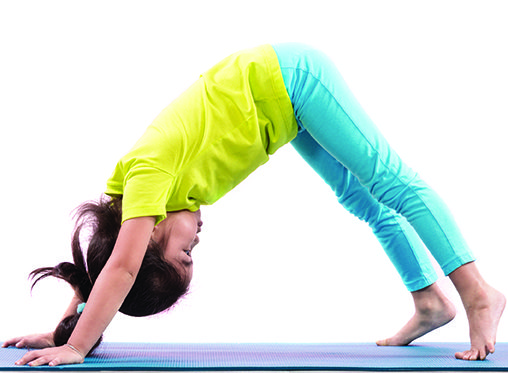
Back Breathing: This is a practice that requires a partner. The partner puts her hands on either side of the back of your spine as she encourages you to breathe into her hands. This technique needs a level of trust for someone to put her hands on a partner’s back. This technique can be done in either a seated position or with the partner in the yoga pose called Child’s Pose.
Practicing one or more of these breath techniques for a few minutes a day can have a direct impact on stress levels and on the way an individual responds to daily challenges. May you enjoy many hours of continued deep calm breaths!
Montessori Leadership / February 2017 / p 10