A Tour of a Montessori Classroom: Lessons in Grace, Courtesy, & Community Service
Lessons in Grace, Courtesy & Community Service
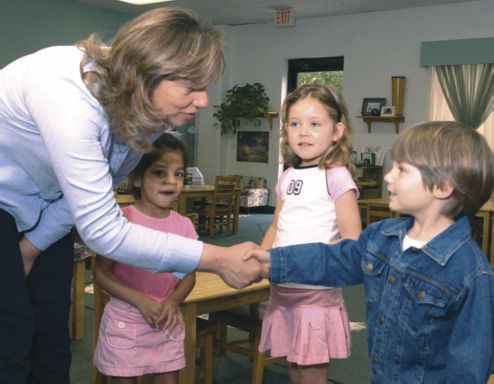
Learning how to work and play together with others, in a peaceful and caring community, is perhaps the most critical life skill that Montessori teaches. Learning how to greet someone graciously is one of the first acts of courtesy learned in the Montessori classroom.
Everyday kindness and courtesy are vital Practical Life skills. Lessons in Grace and Courtesy teach everyday social customs, such as: how to enter a room; how to act in a way that does not disturb another’s work; how to ask if you may join in an activity; how to decline an invitation graciously; how to use table manners; and how to offer an apology.
Even the youngest child is treated by her teachers and classmates with dignity and respect, and the everyday example of the older children behaving graciously reinforces the lessons in kindness.
Montessori students come to understand and accept that we all have responsibilities to other people. They learn how to handle new situations that they will face as they become increasingly independent. They develop a clear sense of values and social conscience and absorb everyday ethics and interpersonal skills from the earliest years.
The Silence Game
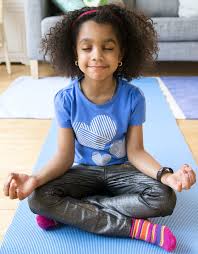
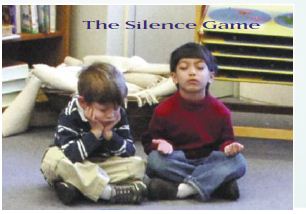 The Silence Game helps children develop a much higher level of self-discipline, along with a greater awareness of the sounds around us that most people take for granted. In this group activity, the teacher will get the children’s attention, either by ringing a small bell or by hanging up a sign with the command Silence. The children stop where they are or gather on the line, close their eyes, and try to remain perfectly still. The children sit still, with their eyes shut, and wait to hear the teacher whisper their name. When they hear it ever so softly spoken, they silently rise and join the teacher.
Sometimes, the teachers will vary the Silence Game by challenging the children to carry bells across the room without allowing them to ring, or they may use the calm atmosphere to introduce the children to guided visualization. At first, the younger children may not be able to hold the silence for more than 20 – 30 seconds, but gradually their ability to relax, listen, and appreciate the perfectly calm environment increases. In many classes, the Silence Game is an important daily ritual.
Teaching Peace & Compassion
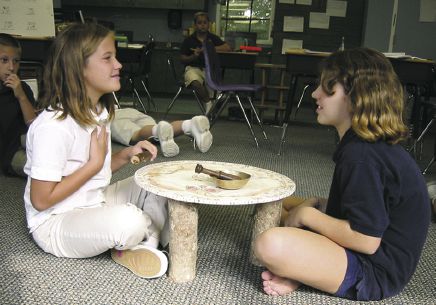
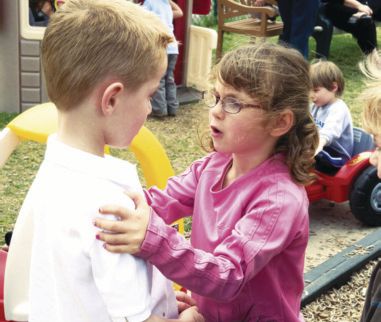
The Peace Table plays an important role in Montessori classrooms.Two children having a disagreement will normally decide to retreat to the Peace Table to solve their problem. Sometimes, children may not remember, and the suggestion might come from the teacher.When classmates observe an ongoing disagreement, somebody might bring them a peace rose with the reminder to solve their problem at the Peace Table.
Once arrived at the table, the child who feels wronged places her hand on the table, indicating that she wants to have her say without interruption. The other hand she places on her heart, indicating that she speaks the truth, from the heart.She then looks the other in the eye, speaks her name, “Lisa,” and proceeds to state how she feels, “Lisa, I feel very angry …” and continues to state why she feels that way, “… because you didn’t let me play with you and Lily!” She states how she wants to resolve the conflict: “And I don’t want you to do that ever again, if you want to be my friend!” Now that she has stated her case and opened the door for further discussion, she withdraws her hand from the table and from her heart and gives Lisa a chance to respond.
Lisa proceeds that same way. She places a hand on the table and one on her heart, looks Eleanor in the eye, and responds: “Eleanor, I feel unhappy that you are angry. I did not mean to hurt your feelings. However, Lily is a good friend of mine also, and the game we played can be played by only two children.If I had been playing it with you, nobody else could have joined us either.So, you see, it’s just one of those things.I want to remain your friend.”
With that, Lisa is finished and withdraws her hands. Now it is Eleanor’s turn to agree or disagree. In any case, they continue the dialogue until they reach some kind of agreement, even if that means that they disagree. At least they are talking, without yelling, screaming, and blaming.They want to solve the problem. When they have reached an agreement, they ring the bell to let the others know. In case they cannot come to a positive conclusion, they may ask for a mediator. This may be one of the older children, who has been trained to be impartial and to listen well.
However, if the problem or conflict is too involved, then one of them may ask for a pow-wow. During a pow-wow, the entire class, or a large part of the class, sits in a circle, listens to first one, then the other person’s side of the story. The class members contribute what they can, either as facts of what they have seen or heard, as ethics (right and wrong), or in perspective to class rules, upon which all have agreed previously. It is wise for the teacher to observe and monitor the entire process from the sidelines.
The core experience the students gain from these procedures is that it is necessary to solve disturbances honestly and with good will to maintain a harmonious and cooperative atmosphere in the community
Community Service
 Community service is an important element in Elementary and Secondary Montessori programs. Even very young children can learn to share with friends and help their classroom community.