by Lorna McGrath | Book Reviews, Infant, Infant-Toddler (0 to 3), Lower Elementary (6-9), Mindfulness, Tomorrow's Child, Tomorrow's Child Online Issue
Henry Helps with the Laundry
by Beth Bracken
illustrated by Ailie Busby
Henry Helps with the Laundry is one in a series of books that describe how a young child can be involved in family life from laundry to planting a garden to cleaning his room and more. As you read these stories with your child, you and your child will begin to recognize how easy, fun, and engaging the routine activities of life can be. When you involve your child in daily activities, she will be empowered, she will feel valued, and she will feel loved. When children’s emotional needs are met, they have less need to misbehave. You and your child will have more time to enjoy each other. Henry Helps is a very nice series for parents and children.
Tomorrow’s Child/ September 2018/ pg30
by Joyce St. Giermaine | Empowerment, Family Resources, Infant, Infant-Toddler (0 to 3), Mindfulness, Montessori Parenting, Practical Life, Sensitive Periods, Tomorrow's Child, Tomorrow's Child Online Issue
 When it comes to postpartum depression, which (by the way) is a very real thing, our minds naturally go to the effect of this condition on moms, but a recent article in JAMA (the Journal of the American Medical Association) suggests that depression among new dads is almost as likely in new dads.
While postpartum depression may have different causes and symptoms for moms and dads, welcoming a new baby into the family can be a stressful and exhausting time for both parents.
Researchers conducted a study of 9,600 parents in the Indianapolis area who were present during their newborn pediatric visits to reach this conclusion.
While it is customary to screen moms for this condition during visits, dads normally do not receive the same consideration. This is, in part, due to the fact that dads are less likely to be present during pediatric visits; however, the most likely time to see dads in the pediatricians’ offices is during the newborn visits.
The study found that 4.4 percent of fathers and 5 percent of mothers screened positive for depression.
Because parental depression can have lasting physical and mental health effects on young children, the American Academy of Pediatrics recommends that all parents (both mothers and fathers) get screened for depression during well-baby and well-child visits. Although it is not the responsibility of pediatricians to treat parental depression, by including both moms and dads in this screening process, pediatricians may be the best opportunity to help new parents find help and resources to help them through this first parenting transition process.
The Case for Parental Leave
Twenty-five years ago, President Bill Clinton signed the Family and Medical Leave Act. The first and only federal leave legislation in the United States, guarantees nearly 60% of employees 12 weeks of job-protected unpaid leave to take care of a new baby, a sick relative or their own serious medical condition.
It leaves out lots of men and women (it doesn’t cover freelancers and those who work at companies with fewer than 50 employees, for example). It offers nothing in the way of income replacement, and the time period is too short, at least compared with more family-friendly countries such as France, the Netherlands and Spain, all of which offer 16 weeks at full wage replacement.
The United States still holds the unenviable title of being the only industrialized country that does not offer all of its citizens paid family leave.
The majority of women (and men) around the world live in countries that acknowledge the attendant challenges of this time and provide parents with some support. It’s about time Americans get to join them.
Retrieved from https://www.yahoo.com/news/dads-depression-screening-too-210730588.html
Retrieved from http://bit.ly/2JMuxfL JAMA Pediatrics, online July 23, 2018
Tomorrow’s Child/ September 2018/ Pg 33
by Margot Garfield-Anderson | Discipline, Early Adolescence (12-15), Empowerment, Kindergarten, Later Adolescence (15-18), Mindfulness, Mixed Ages, Montessori Education, Montessori Parenting, Practical Life, Prepared Environment, Primary (3-6), Tomorrow's Child, Tomorrow's Child Online Issue, Young Adolescent, Young Adults
Your child’s Montessori guide spends a tremendous amount of time planning and organizing the classroom. Modifications and adjustments are sometimes done daily, depending upon the need. When you step into a Montessori classroom you might be awestruck by the highly organized, simple beauty of the room.
Here children are given some of their first lessons on care for their environment. They are taught, along with grace and courtesy, to replace any of the materials they can freely explore on the shelves, in the same order in which they found them. They learn to put their uneaten food in the trash and their dishes in the sink or the wash bin. When they spill a liquid, they rush to get the proper materials to clean up after themselves. They learn how to sweep and table wash. Why can we not expect the same behavior at home?
Ask yourselves, why did I choose Montessori for my child(ren)? Montessori is much more than a method of learning. It prepares children to be active, responsible participants with academic and everyday living skills. Being organized is a great way to support Montessori in the home.
Stop for a second and look around you, right now, no matter where you are reading this article. What do you see? Are you in the kitchen with dishes and food on every surface? What about your bedroom? Is last week’s unfolded laundry still sitting on a chair? What about the lawn? Are bags of discarded yard waste still sitting there all wet and soggy after last night’s rain?
We live BUSY lives. We rush from one activity to the next. Weekends are just as crazy with errands and other activities. Who has the time to organize? Here’s the thing; you are the most influential role model your child(ren) have. You need to set the bar by being the living example to them and not the taskmaster! That simply doesn’t work.
I once read a book from a Montessori guide who became a family counselor. He said the first exercise he put families in stressful times through was putting everything from the playroom into a pile in the middle of the room. When they were done, they realized that the children still only used the things they had on the outside of the mountain. Everything else could be donated or thrown away. That one thing can be the very catalyst to start the process with your family. It’s important that the children realize why you are doing it and the whole family will be invested in the process.
Next, Montessori children understand responsibility. They can certainly set the table for dinner, clear their own plates and bring them to the sink, sweep up the crumbs on the table or floor, and other simple tasks. Matching socks is a great skill to teach your little ones; they can make a game out of it.
Do you have a child who fights you on what they are wearing to school in the morning? Try starting the process while they are getting ready for bed the night before. Let them choose between two outfits and then do not waffle in the morning if they aren’t willing to wear one or the other. Remind them, this was their choice and they still have two choices. Then have them put the one they didn’t choose back into the drawer.
Spend a few minutes after dinner asking your child to show you any paperwork that might have come home in their folders or backpacks. Mornings are stressful enough without having to discover it was your morning to provide a snack for the entire class or money is needed for a class trip and you don’t have cash in your wallet. Work together with them.
Taking simple first steps to get organized at home might take some initial time and, perhaps, a long time to become a habit, but in the long run, it will reduce stress and you will find yourself with more time at the end of the day and an organized home. You’ll also be less stressed when you look around to see the order in your lovely prepared environment.
Tomorrow’s Child/ September 2018/ pg 20
by Lydia Dumais MS | Early Adolescence (12-15), Later Adolescence (15-18), Mindfulness, Mixed Ages, Montessori Middle School, Montessori Parenting, Montessori Secondary / High School, Montessori students, Montessori Teachers, Tomorrow's Child, Tomorrow's Child Online Issue, Upper Elementary (9-12), Young Adolescent, Young Adults
Reduce, reuse, recycle is a common theme in a Montessori classroom. We teach the different categories of recyclable materials and have students sort paper, plastic, and metal. We use real cutlery and plates over plastic and paper products. We encourage students to bring reusable water bottles and discuss with them the environmental impact of plastic water bottles. We talk about care for the environment and take walks to pick up trash around our campus. We have our students recycle cardboard and plastic at school, and we encourage parents to recycle at home with their children.
Something that is not often discussed is how we should be dealing with a new, and growing, type of waste: electronics. As guides, many of us are grappling with the increasing presence of technology in our classrooms. Elementary students now come to school with cell phones. Young adolescents are learning how to navigate their digital lives. Something that is often overlooked is how we can engage our students in a meaningful discussion of how those electronic devices are produced, their impact on the environment, and what happens to those devices when they are no longer being used.
It is not easy to apply “Reduce, Reuse, Recycle” to our technological lives. If your household is like mine, there is likely a plethora of unused cell phones or maybe a laptop or tablet collecting dust in a closet. The average American replaces their cell phone approximately once every two years and replaces their laptop approximately every three and a half years. That is about 125 million new cell phones and 90 million new laptops being purchased each year.
What happens to these devices we are replacing? We all know we can’t throw those items into a landfill, so we end up holding onto them. Although there are recycling bins for paper products and plastics in both schools and at home, there is not yet a convenient way to recycle the growing amount of electronic items we are all accumulating. As our students are growing up in an increasingly technological world, we should be beginning a conversation with them about the kind of impact those items have on the planet, the same way we talk with them about how to manage paper and plastics.
One way to begin this conversation is to start an electronics recycling program at school. Today it can be surprisingly easy. One option is to start a program through MyWay2Give. There is no cost to participate, and they accept a multitude of electronic items that will be refurbished, reused, or responsibly recycled. Common items like smartphones, laptops, and tablets can all be recycled, as well as game consoles, controllers, video game disks, and peripheral items such as keyboards. The program also acts as a fundraiser, because any electronics that are able to be successfully refurbished or sold for parts earns money for the school. This is a program that can serve several purposes.
Students can easily manage the program, as all that needs to be done is to pack up a box (or boxes) of the electronics collected, print out and tape on a shipping label. The packaging material does not have to be anything special. Reuse any old box and reuse packaging material or recycled paper. Students can wrap up their electronics in the recycled paper, gently pack the box so the items don’t slide around in transit, and then ship the box on its way. This could become a care-of-environment task for your students, the way students may sort other recycling bins at school. Signing up to start your own electronics recycling program is as simple as visiting www.MyWay2Give.com.
As students, parents, and guides continue to learn how to navigate this new technological frontier, it is important for us to also acknowledge its impact on the environment. Starting an electronics recycling program can help students add a new facet to their relationship with those devices by understanding what went into their production and our responsibility to the environment to do something sustainable with them. It is also a service we can provide our families, friends, and neighbors by giving the community a simple, convenient way to recycle their electronics, benefiting both the environment and their school. ν
Lydia Dumais, M.S. teaches middle and high school science. She is also an International Baccalaureate Diploma Program Instructor. This is Lydia’s 5th year at NewGate. She graduated from New College of Florida, with a double major in Biology and History and an M.S. in Biology from Clemson University. She presented academic papers at the Florida Historians Conference and New Scholars. Part of her undergraduate research included working with wild sea turtles in Costa Rica as part of international conservation efforts. As a life-long learner and having earned the IB Diploma in high school, she brings enthusiasm, hands-on learning, and a spirit of keen intellectual inquiry to the secondary program. In her spare time, she works on conservation projects, including working with leatherback sea turtles, gopher tortoises, and wetlands water quality monitoring.
Tomorrow’s Child/ September 2018/pg 16
by Christine M A Lapierre PhD | Adolescence, Communication, Empowerment, Infant-Toddler (0 to 3), Lower Elementary (6-9), Mindfulness, Mixed Ages, Montessori Parenting, Tomorrow's Child, Tomorrow's Child Online Issue, Young Adolescent
I believe that every child is born with a unique purpose in life, as did Maria Montessori.
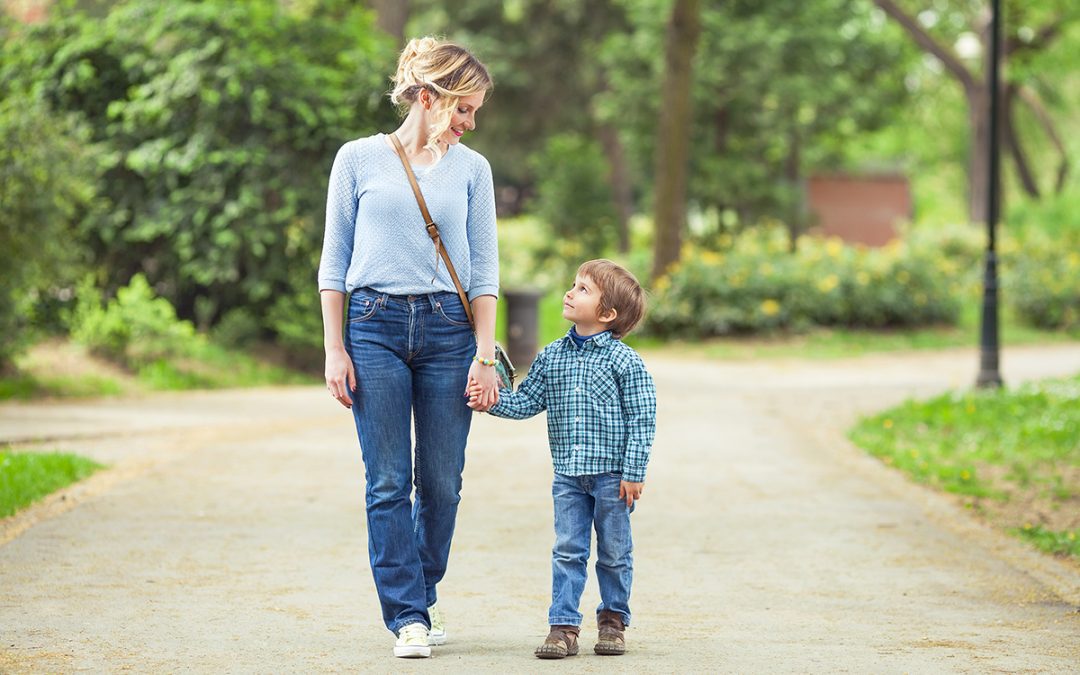
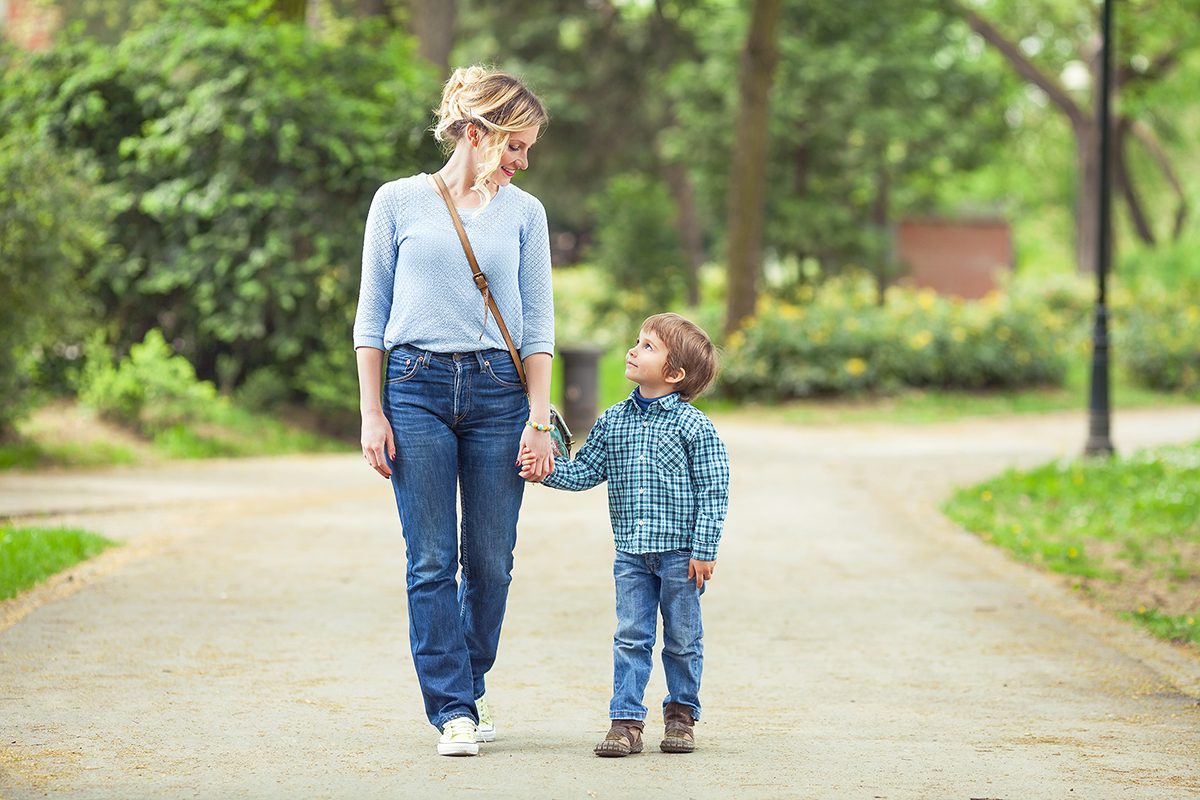
Young mother and her cute little son walking in a park
With all her endeavors, Montessori was trying to improve the world by discovering the true nature of the child (1972). It is understandable, then, that parents are the child’s first and long-lasting teachers. Their role is to observe the interests of their child so that, in turn, they can learn how to best support his developmental efforts.
How can parents achieve this? Some ways I will explore are: to become acquainted with their own childhood issues, to support the child’s inner-teacher, to do self-care activities, such as breathing, to perceive oneself as a learner, and to develop humility.
Children are naturally kind, loving, compassionate, and truthful. When the child is in a loving and kind environment, he blossoms into who he really is as an individual. For this to happen, parents must know and understand themselves so that they are not affected by “hot buttons” that their child presses when he misbehaves. The resource Parenting from the Inside Out (Siegel & Hartzell, 2003) provides great support to parents to fully understand and resolve their own childhood experiences so that, in turn, they can raise a joyful and happy child.
One way for parents to achieve this goal is to nurture their own inner-teacher, a Montessori concept. Montessori stated, “It must be remembered that in the small child of three years, the inner-teacher is still at work guiding him unerringly, and when we speak of a free child, we mean one following the guidance of that nature, which is powerful within him.” (Montessori, 1972, p. 42). This inner-teacher is of a spiritual nature. It helps the child to walk, to talk, to develop the pincer grip to pick up small objects and to learn how to read and write. In the adult, the inner-teacher is sometimes referred to as the voice of conscience or higher self. When the inner-teacher of the parents is honoring and respecting the inner-teacher of the child, they feel peaceful and calm.
One way for parents to re-connect with that sense of calm when peace is disrupted with anger or irritation is to take a few minutes away from the situation and focus on their breathing. Breathing exercises decrease stress and anxiety; they activate the body’s relaxation response (Newberg & Waldman, 2010). Parents can practice breathing with their child or just comfort the child until her calm returns. Using a combination of strategies (Siegel & Bryson, 2016), parents can learn how to peacefully and lovingly reconnect with their child when she misbehaves, while continuing to set clear limits.
For that reason, parents should see themselves as perpetual learners. They are continuously learning about themselves as persons and as parents, as they cultivate their relationship with their child. When faced with a challenging situation, or any novel circumstance, of which there are many, parents can ask themselves: “What can I learn from this situation?” They can adopt the attitude of constantly learning alongside their child. This takes humility.
Humility is one of the qualities that Montessori (1995) spoke of in developing a positive relationship with the child. When parents are humble, they attribute the young child’s growth and development to the guidance of the child’s inner-teacher and spiritual nature, rather than their own authority. They are in fact, supporting the efforts of their child’s inner-teacher.
These simple, yet very effective, ideas on how to parent more successfully can be expanded to the whole family. In the process, parents will be building a more peaceful world.
References
Montessori, M. (1972). The secret of childhood. New York, NY: Random House Publishing Group.
Montessori, M. (1995). The absorbent mind. New York, NY: Holt Paperbacks.
Newberg, A., & Waldman, M. R. (2010). How God changes your brain. New York, NY: Ballantine Books.
Siegel, D. J., & Hartzell, M. (2003). Parenting from the inside out. New York, NY: Penguin Books.
Siegel, D. J., & Bryson, T. P. (2016). No-drama discipline. New York, NY: Bantam Books.
Christine M. A. Lapierre Ph.D. enjoys motherhood and all its rewards. She is passionate about the role of parents in bringing out their best for a peaceful family. She is a MACTE trained early childhood teacher and believes very strongly in Montessori’s recommendations to parents to bring Montessori principles into the home. As a consultant, she offers parent workshops, teacher workshops, and coaching. Christine can be reached at clapierr@ucalgary.ca.
Tomorrow’s Child/ September 2018/ Pg 22
by Punum Bhatia Ph.D | Infant-Toddler (0 to 3), Lower Elementary (6-9), Maria Montessori, Mindfulness, Mixed Ages, Montessori Parenting, Montessori Teachers, Practical Life, Tomorrow's Child, Tomorrow's Child Online Issue
“Practical Life activities keep children at the leading edge of their skill development, building their intelligence, deepening their concentration, and giving them a new appreciation of their expanding capabilities.” —Lillard and Jessen (2008)
It was during my recent consultation visit to a Montessori school in India that I found myself required to convince others, more than I had ever needed to do before, of the importance of Practical Life skills in a child’s life. India is a large country with the second largest population in the world and has a very strong belief that the earlier a child can be started on reading, writing and numeracy skills the sooner and better prepared the child will be to enter the rat race of school and college admissions and later secure a job in life.
Practical Life, in my opinion, has never received the importance it so truly deserves. It is the foundation of the Montessori classroom. In the first Casa dei Bambini in San Lorenzo, Maria Montessori had noticed the children’s interest in the tasks of everyday living and carefully formulated activities which would enable the children to learn how to dress themselves, sweep the floor, prepare and serve food, and do other daily tasks. In doing so, the children became more independent, more aware of their environment and more dexterous. She also taught them how to behave courteously, thus endowing them with social as well as practical skills.
In India, and I am sure in many other countries, the need for the child to do these activities is not considered important because they have domestic help/servants who sweep and clean their homes, cook for them, do their laundry, etc. The families argue with the schools that they do not send their children to school to learn these skills but to learn to read and write. I knew at the outset convincing them of the importance of this area of the Montessori curriculum was not going to be an easy one, but I was determined to do so for the sake of the child. If I had my way, I would strip the classroom of other areas and keep just the Practical Life activities for the first month or so. Maria Montessori’s first biographer, E.M. Standing writes:
“Yet, in point of fact, no other occupations which could be undertaken by the children at this stage (3-5) could be more important for their whole development—physical, mental, and moral—than these ‘exercises of practical life,’ as they are called.” (1957, p.213)
I began at the very beginning by explaining how Maria Montessori had observed that very young children are frequently frustrated in their attempts to do things for themselves and that what they need is to have specific exercises, as closely linked to real life as possible, that allow them to master the tasks that they see going on around them in everyday life. The Exercises of Practical Life do just that—they bridge the gap between the home and the school. The child is fascinated by these activities that he has seen his parents perform daily since birth, and tries to copy and learn from them. It is the child’s way of adapting to the world and constructing his own sense of reality.
Maria Montessori also saw that, unlike the adults in their lives, children are not interested in the activity itself, but in the process of learning. This is the difference between the adult and the child—the child is focused on the process and the adult on the product. As a result, the child happily repeats the exercises again and again until he feels satisfied. Practical Life activities are therefore an important part of the Montessori environment.
The young child is attracted to activities that he sees going on around him and that gives him independence and control of his own life. I could see where the Indian families were coming from, for the Practical Life exercises can seem routine and mundane—after all, we all dress ourselves each day. What these families needed to understand was how fundamental the skills learned in Practical Life are to the whole Montessori philosophy, and to her concept of holistic education.
According to Angeline Lillard, “Some of the main purposes of including such exercises in the classroom are (1) to educate children’s movements to be geared to a purpose; (2) to develop children’s ability to concentrate on a task; (3) to help children learn to carry out a series of steps in sequences; and (4) to help children learn to care for the environment. As such, these exercises are foundational to many aspects of Montessori education.” (2005, p. 48).
Through the Practical Life activities, the child is not only preparing himself for later intellectual work but also developing his emotional and social skills, expanding his knowledge of his environment, increasing his physical skills, and engendering a sense of community. Nothing else prepares a child better for life than these activities. “The first thing to realize about these exercises of practical life is that their aim is not a practical one. Emphasis should be laid not on the word practical but on the word life.”(Standing. 1957, p. 213) Through the Exercises of Practical Life, the child learns the skills that enable him to become an independent human being. That is why once he has been shown a skill, he needs the freedom and the opportunity to practice and perfect it. Through this greater independence grows greater self-confidence, which is reflected in every area of the classroom.
When a child becomes totally absorbed in an activity and repeats it over and over again, he begins to develop his powers of concentration. That is why a well-trained Montessori teacher spends so much time observing the children in her classroom, assessing their needs and interests, so she can prepare the environment to entice the child to work with the materials. The more he repeats the activity, the more his concentration develops. At Montessori Casa International, the teachers do everything they can to prepare the Practical Life shelves so the children are drawn to the activities. We know that concentration can only begin in Practical Life and we do everything we can to get the children in this area and keep them there!
The Exercises of Practical Life look so simple that they are almost deceptive. They encourage the child to develop through activity many of his large and small motor movements. A child who sorts and threads different sizes of beads washes a chair or table, prepares a snack, or waters the plants in the classroom will have greater control over his movements. Polishing activities and the dressing frames develop eye-hand coordination. Besides and most importantly, all of these activities prepare the child’s hand indirectly for the time when he will hold a pencil to write. For instance, the transferring activities with the tongs and spoons develop the pincer grip. As a result, we find that when the time comes, we really do not have to show a Montessori child how to hold a pencil correctly.
As the child develops his Practical Life skills, he becomes more independent and confident. Now that he can put on his own smock and button all the buttons himself, for example, his self-confidence grows and his self-esteem becomes stronger and more positive. Pretty soon he will be helping the younger/newer children in the classroom with their smocks, and this will not only boost his own self-esteem, but it will reinforce his own understanding. He will feel a valuable member of the community and this, in turn, will lead to a greater sense of consideration for others and a feeling of belonging. Through the exercises of grace and courtesy, the child develops social graces. He learns, for example, to use “walking feet”; “inside voices”; how to interrupt others and in doing so learns the acceptable behavior of his own and other cultures.
Practical Life is the soul of the Montessori classroom. Every activity contributes to the child’s intelligence. “Practical Life activities educate the child to carry out organized sequences of activity, employing the body in the service of the mind.” (Lillard, 2005, p. 49) They develop the child’s sense of order—he learns where to find specific activities, conduct the activity in the proper sequence and then return the material from where he got it. The cycle of activity encourages logical thinking and develops the child’s inner sense of order.
At Montessori Casa International, we change the theme in Practical Life every two to three weeks in an attempt to draw children to this area. New colors of pitchers, new objects to sort or transfer, a tarnished silver object in the middle of the table calling to be polished, all bring the children in and, we hope, will develop in them a sense of order, concentration, coordination, and independence which will be the foundation for all the skills they will eventually learn in the other areas of the classroom.
I left India slightly optimistic and very hopeful. The realization that Practical Life is a building block for Math and Literacy and helps the child in his progress towards normalization had started to come to those who had considered it to be a waste of time. A few of the activities of Practical Life, including grace and courtesy, have now been included in the curriculum of the school I have been working with. This is a beginning but there is still so much work to be done.
References:
Lillard, P. & Jessen, L., (2008). Montessori from the start: The child at home, from birth to age three. Schocken.
Lillard, A. S. (2005). Montessori: The science behind the genius. New York: Oxford University Press.
Standing, E.M. (1957). Maria Montessori: Her life and work. New York: Penguin.
Punum Bhatia, Ph.D. was inspired by Dr. Maria Montessori’s philosophy, Punum Bhatia, PhD has dedicated her life to Montessori education as a parent, teacher, and teacher educator for nearly thirty years. She completed her Bachelor’s degree in English Literature; earned Masters’ degrees in English Literature and Education from the University of Calcutta; and completed a certificate diploma in Montessori Pedagogy. She earned her Doctor of Philosophy from the University of Colorado Denver in 2012 for her work on the Self-Efficacy of Montessori teachers. In her efforts to understand children and the environments necessary for them to grow and flourish, Punum focuses on Maria Montessori’s original philosophy and techniques. After teaching the Montessori method to cohorts all around the world, she is now the proud owner of her very own bilingual preschool. (www.mcidenver.edu/ www.punumbhatia.com)
Tomorrow’s Child/ September 2018/ pg 17
by Joyce St. Giermaine | Communication, Mindfulness, Mixed Ages, Montessori Family Life, Montessori Parenting, Sensitive Periods, Tomorrow's Child, Tomorrow's Child Online Issue
” Crying with strangers could change the world”—bREné Brown
The Changing Times of Parenting
I just returned from a week with my Maryland family: my 95-year-old mother; my 37-year-old daughter and her husband; my five- and seven-year-old grandsons … and a six-month-old-completely-out-of-control bernadoodle.
Seven days of trying to move seamlessly between four generations left me exhausted, but clear on three points: parenting is hard work; parenting well is even harder; and mindsets matter.
My mother’s mindset of frugality was deeply influenced by growing up during the depression. I grew up with the mindset of determination in the chaos of the sixties with assassinations, protest marches, war, and the demand for equal rights. My children experienced greater gender and racial equality and the rapid growth of technology. My grandchildren are digital natives.
No matter where we self-identify on the timeline of history, our parenting challenges were not necessarily easier or harder; they were just different. My mother certainly could not have imagined the challenges of parenting in the age of social media. The epidemic of school shootings was never on my radar. My daughter cannot imagine being denied a career choice because of her gender but is clearly struggling with the you-can-do-it-all mindset facing millennials. By the time my grandchildren are parents, who know what challenges they will face.
There is no going back, and we don’t know the future, so how do we prepare our children? I truly believe that one way or the other, they will learn what they need (and want) to learn academically. If it is true that ‘hate’ is something that is taught, let’s make it our mission to teach empathy, tolerance, respect, a sense of humor, responsibility, and care for our environment and each other instead.
Whether it’s the best of time or the worst of times, we all have choices. Brené Brown wrote: “Crying together with strangers could save the world.” I think she’s probably right.
Next week, I’m going on a road trip with my grandchildren, and I will be reminded that some things remain the same. Instead of becoming frustrated, I will hold in the back of my mind the vision of a young child, tugging on his mother’s dress, while wind-whipped seas battered the Mayflower as it approached a new world and unknown challenges, persistently asking the age-old question: “Are we there yet?”
Joyce St. Giermaine, Editor
Tomorrow’s Child/ September 2018/ pg 5
by Paul Epstein, PhD | Adolescence, Empowerment, Infant-Toddler (0 to 3), Later Adolescence (15-18), Mindfulness, Mixed Ages, Montessori Family Life, Montessori Parenting, Planes of Development, Practical Life, Psychology, The International Montessori Council
Mom and her daughter child girl are playing, smiling and hugging. Family holiday and togetherness.
The experience of authentic unconditional love differs from romantic and other types of love. Unconditional love is not based on possessing or acquiring. When we know this love, we experience personal and universal peace. And while this love is observed and discussed repeatedly by the world’s great teachers, we seldom consider how this love also emanates from children. The smallest of babies cause us to smile. They and older children awaken us, and we engage in peaceful action.
Parents know unconditional love. A parent may be overwhelmed by tremendous joy and happiness when holding her or his child for the first time. We remember the sweetness of our newborn child, and we remember the love that overwhelms us. I recall saying a prayer. Not a formal, religious prayer, but a prayer nevertheless. Actually, I do not recall my words, but I do recall how I felt: whole, peaceful, and unimaginably happy. I prayed for my child’s lifelong health, safety, and happiness. I also felt too small to hold the amount of love that was wanting to burst from me. I still feel that kind of too small.
I also recall that I did not speak words like these: “Watch over my child, and make sure she has the best test scores for entrance to the top university.” Those words came later.
Unconditional love involves acceptance, but not always agreement. I accept you 100 percent the way you are, and I accept you 100 percent the way you are not. This kind of love involves self-love too. I accept myself 100 percent the way I am, and 100 percent the way I am not. Unconditional love may be transformative. However, reading the words of great teachers is not enough. Transformation involves a commitment to practicing a way of living. A life with children can bring forth this kind of love. In the presence of children, adults may aspire to spiritual growth.
Dr. Maria Montessori wrote, “[The] child is the true maker of our spirituality. He teaches us the plan of nature for giving form to our conduct and character.”One form of conduct with children is to learn how to serve and not be their servants. Specifically, we learn to guide children to become independent and self-reliant. Then children become normalized; they fulfill more of their unique potential. When we observe and accept children, we also experience the assistance they give to us as we learn how to guide. They assist us through love.
If we want to produce harmony in the world, it is clear that we ought to think more about this … The child is the only point on which there converges from everyone a feeling of gentleness and love. People’s souls soften and sweeten when one speaks of children; the whole of mankind shares in the deep emotions which they awaken. The child is a well-spring of love. Whenever we touch the child, we touch love. It is a difficult love to define; we all feel it, but no one can describe its roots or evaluate the immense consequences which flow from it …. In the vicinity of children, mistrust melts away; we become sweet and kindly, because, when we are gathered about them, we feel warmed by that flame of life which is there, where life originates.
“Mistrust melts away; we become sweet and kindly.” To become receptive to the child’s power of love, we must, Montessori wrote, “remove the accretions of years that prevent us from really understanding children and acquiring an intuitive knowledge of their souls.” We must learn enlightenment; we need to learn to truly see.
“Our social mentality,” wrote Montessori, has not grasped the idea that we can receive help from the child, that the child can give us a light and a lesson, a new vision and a solution for inextricable problems. The child, Montessori asserted, can “help adults solve their own individual and social problems.”
Accepting children’s influence as our teachers, Montessori championed, will help us create a peaceful society. Montessori spoke these words to the graduates of her 1937 training course:
You and I have been, as it were, seduced by something attractive and deep in the child …. We began with the methods of education and culture for the child, and we end by acknowledging that he is our teacher … one who can reveal to us, as no other, our own nature and its possibilities. Therefore we are drawn towards the child, as individuals, as members of society, and for the good of the human race as
a whole.
“For the good of the human race as a whole,” Montessori spoke to world leaders about world peace. The Sixth International Montessori Congress took place in Copenhagen in 1937. Representatives from twenty nations were in attendance. Montessori declared in her keynote speech the child’s power to unify adults in peace.
The adult must understand the meaning of the moral defense of humanity, not the armed defense of nations. He must realize that the child will be the creator of the new world peace. In a suitable environment, the child reveals unsuspected social characteristics. The qualities he shows will be the salvation of the world, showing us all the road to peace.
The child’s power of love can bring adults to “the road to peace.” This congress took place thirty years after the first Montessori school had opened in 1907. Since then, children enrolled in Montessori schools show ‘unsuspected social characteristics’ including a tremendous ability to concentrate when they engage with Montessori learning activities. Montessori understand concentration as a foundation for children’s spiritual growth.
We tend to describe children’s physical, cognitive, emotional, and social development. Montessori advocated for a fifth development, spirituality. Accordingly, to become a Montessori classroom guide, an adult engages in a transformative preparation. This preparation wrote Montessori, “is something far more than the learning of ideas. It includes the training of character; it is a preparation of the spirit. This begins, Montessori taught, with humility. “If we touch children, she wrote, “we touch humanity. We must educate adults to realize that we can only better humanity through the child. We must realize that the child is the builder of man.”
There is a special relationship: As adults transform, we notice changes taking place within children. Children progress through a series of spiritual growths that bring them to normalization. Montessori wrote that with normalization, “A unique type of child appears, a ‘new child’; but really it is the child’s true ‘personality’ allowed to construct itself normally ….” For Montessori, normalization was “the most important single result of our whole work.”
Children who are not normalized may tire from academic study, and they cannot concentrate for long periods of time. They may be timid, anxious, possessive, depressed, unable to focus, and dependent upon others. These children have grown up in an educational system in which teachers dispense knowledge according to external standards. These teachers manage the learning process, including schedules, types of activities, and assessments without regard for children’s individual needs and learning differences. And, the teachers manage children’s behavior through external praise and reward. The design of this educational system is to render children compliant and also ignorant about their own potential.
Children enrolled in Montessori schools learn to think, create, communicate, and solve problems. These children demonstrate tremendous self-discipline, resilience, and grit. Normalized children display a deep love of order, work, profound concentration, silence, sharing, obedience, self-discipline, independence, and joy. Normalized children are not interested in external rewards; they learn for the joy derived from understanding. Normalized children are cooperative, creative, innovative, and empathetic.
Montessori classroom guides show children how to become independent. The guides also model for children how to respect themselves, others, and the environment. Children normally develop self-acceptance which is a foundation for accepting others. Montessori children in primary and secondary programs study a wondrous, integrated curriculum called Cosmic Education. They may discover a personal calling called noble work. Children and adolescents do normally empathize, care for, and contribute to others. This is evident from the testimonies heard from Montessori graduates throughout the world.
For example:
Students in Montessori schools are taught to ask the question, “How can I make the world a better place?” This is the fundamental difference in the Montessori curriculum; it teaches a higher purpose …. It has taught me to strive to do noble works.”
Another Montessori graduate summarized her education:
In order to gain a global perspective, you need to have a really strong foundation. That foundation, in our case, is local or even internal. So, if you know how to trust, and you know how to respect, and you know how to question – once you have those main principles, once you are unleashed into the world, you are a little more prepared and ready to take on what it has to offer.
Adults typically awaken when surrounded by the child’s power of love. As we learn to guide children spiritually, so too do we learn about our true selves. Montessori described how a life with children can bring the adult to experience this new kind of love.
When the children show [an adult] their real natures, she understands, perhaps for the first time, what love really is. And this revelation transforms her also. It is a thing that touches the heart, and little by little it changes people. Once these facts have been seen … nothing can cancel the impression their spirits have made and the love they were able to awaken.
ML/ September 2018/ pg 24
by The Montessori Foundation | Communication, Infant-Toddler (0 to 3), Kindergarten, Later Adolescence (15-18), Lower Elementary (6-9), MFA, Mindfulness, Mixed Ages, Montessori Education, Montessori Middle School, Montessori Parenting, Montessori Secondary / High School, Montessori Teachers, Parent Education, Primary (3-6), School Leadership, The International Montessori Council, Upper Elementary (9-12)
Montessori guides are highly skilled and trained professionals, so why do many parents ask: “Why do they need to attend conferences?” After all, it’s an inconvenience for the parent if the school has to be closed down to allow for travel and participation.
There are several compelling reasons for parents to encourage and support teachers attending a conference:
1. In many states, early childhood teachers are required to take a certain number of professional development hours to keep their licenses up to date. The number of hours can vary greatly from state to state. Attending a conference such as the annual event the Montessori Foundation and IMC host in Sarasota, Florida can earn a guide 2.5 CEU (Continuing Education Units) from Lander University in Greenwood, South Carolina. Since many states require 3-5 units every few years, this single event brings them closer to fulfilling the required hours.
2. With the explosion in the field of Neuroscience, Dr. Montessori’s postulations can now be proven with science. Montessori guides need to adjust and fine-tune their presentations accordingly. This benefits the children.
3. Teachers often feel depleted and need to ‘recharge their batteries.’ I recently spent an entire day with my four-and-a-half-year-old granddaughter. We did something like ten activities during the day, all modeled on Montessori experiences in the primary classroom. At the end of the day, when she literally fell asleep in my arms, I thought to myself: This was one child! How tired is a guide with 26 students at the end of each day? The event we hold each November is intimate and planned to provide an easy pace so that participants have an opportunity to network and discuss what they are learning and experiencing in their own classrooms without feeling rushed. Bouncing ideas off one another brings a sense of renewal and enthusiasm back into the classroom.
4. Highly respected Montessorians are carefully chosen to present and keynote at this event. We cover all ages, from infant/toddler through secondary, with workshops throughout the weekend designed to appeal to each level. Administrators and guides who need spiritual renewal also find many workshops geared just for them. We even have workshops on advocacy and public school Montessori issues, which focus on the need to have a clear voice and strong messaging.
5. Community and partnerships. We eat all of our meals communally. The menu is custom crafted with healthy and delicious meals in mind and, working with our host hotel (for 10 years now) The Hyatt Regency, Sarasota, our attendees rave about the food and presentation. Our meals allow for more networking time and, over the years, school attendees have developed relationships with other schools all over the world. A truly Montessori global experience takes place. You can feel the energy build over the days we spend together.
6. Teachers who have the opportunity to participate in an event such as ours are usually more grateful, engaged, enthused and excited to try out all the things they’ve learned when they return to the classroom. Parents should know that their child is the recipient of all this renewed spirit.
We highly recommend that schools, along with parents, find ways to help teachers attend conferences such as ours. Think about helping them come next year. We are already planning for it and so should you.
ML/ September 2018 / pg 22
by Christine Lowry | Empowerment, Mindfulness, Montessori students, Peace Education, Psychology, Sensitive Periods, The International Montessori Council
This was to be the last in a series of three articles on Advocacy. Instead, it is an article on the power of community and the passion and commitment that leads to action. This is true grassroots advocacy.
MARCH FOR OUR LIVES March 24, 2018, Washington, DC and 800 other cities around the world
Reflections: Watching and listening to these children (9 to 18 years of age), who have been forced to grow up too soon, experiencing trauma that no one should have to experience. This is their moment—their passion, their commitment, their deeply honest truth, spoken from the heart.
The crowd of young people, grown “children” with their parents, families, grandparents able to stand together in silence for 4 minutes and 20 seconds. A community with differences but coming together to shout “No More” “Enough is Enough” “Never Again.”
The striking inclusiveness of the organizers, the speakers, the events that brought them to this day and to this place. Speakers who suffered the loss of siblings, speakers who were themselves, victims, a 9-year-old girl (Yolanda Renee King) whose grandfather, 50 years before her, led those who suffered and suffer still. They each shared their voice, they each were heard, and the community came together.
All shared their strength, their courage, and their conviction.
“If the processions of children appeared among us we would have to welcome them reverently and bow down before them in admiration. The child would appear before us as the teacher of peace.” —Dr. Maria Montessori.
As I stood in amazement at the power and grace of these “children” sharing their pain, speaking so boldly, I reflected on our role as leaders and educators. We are raising the generation that will follow, the generation that will lead.
As Montessori educators, we attempt to follow in Dr. Montessori’s footsteps. We teach peace, we believe in the children who can be the force of peace to change the world. We believe in the values of compassion, empathy, and a strong community. As we stand in admiration, and maybe a bit of awe, of these “children” who captured the attention of the world, can we use this as an opportunity to remind ourselves of our values, can we reflect on how we as a community, and each of us individually, can contribute to peace?
How do we live, how do we teach, how do we strive to solve problems and respect the “messiness” of each of us reflecting, growing, and developing at our own pace? Do we really appreciate diversity—not just racial or economic or religious or gender identity- but of the ways we each offer the best we can in whatever way, and whatever time? Do we honor and respect and accept that we, like our students, are individuals who each bring our story, our experience, our education to this task of becoming a Montessori educator? And most of all, can we as adults, as educators and school leaders, share in the collective reflection that will guide us as we guide our students?
The most basic foundation of “advocacy” for Montessori education begins with each of us as educators, in our respect and acceptance of the value of each student in our classroom. As school leaders, we honor each student, regardless of need or life situation. We honor each family as giving the best that they can. We honor and support each educator in our school regardless of position, experience, or training. To follow in Dr. Montessori’s footsteps means to be willing to actively participate in this “transformation” of our personal biases, our values, our beliefs, and our behavior. We make mistakes, we stumble, but we are open to learning and listening because, truly, we share the common goal of supporting our children as they grow toward their role as “the teacher of peace.”
Grassroots advocacy and activism is local, it is “common, ordinary” people building community through inclusive and engaging collaborative effort.
At the classroom level, we prepare an environment that becomes a “social environment.” “It is perhaps a natural thing—something that allows easy communication between individuals—sympathy, cooperation, etc. I have called this society by cohesion.” (Dr. Montessori). At the school level, this cohesion becomes a social organization that “connects all the people together.” In our greater Montessori community, we have leaders who are moving beyond organizational goals to acknowledge our collective goals while accepting and respecting our diversity. This is our time to come together. It is for the children.
As we look at the children who spoke with such eloquence, such passion, and such grace as they marched for their lives, we can use this as our opportunity to reflect on how we serve the children we guide every day. Our students each have their stories, their struggles, their challenges, and their joys and achievements. We contribute to who they will become. Let’s give them our best.
“We see the child who stands before us with arms held open, beckoning humanity to follow.” (Dr. Montessori.) ′
Christine Lowry has served children and families as a special educator, Montessori teacher, and a school leader. She guides schools and Montessori communities as they support students with challenges. Her commitment to Montessori education has led to experiences in support of local, state, and national organizations as they engage in advocacy efforts. She can be reached at christine@montessori-now.com or christinehlowry@gmail.com.
ML/ September 2018/ pg16
by Cheryl Allen | Adolescence, Communication, Early Adolescence (12-15), Empowerment, Later Adolescence (15-18), Lower Elementary (6-9), MFA, Mindfulness, Montessori Family Life, Montessori Parenting, Montessori Teachers, Practical Life, Upper Elementary (9-12), Video, Webinars / MFA
Montessori said, “Only practical work and experience lead a child to maturity.” Cheryl Allen will share ideas that will help children at home and in the classroom to prepare for life during the elementary years and beyond. She will show how Practical Life activities change as children grow from pouring and scooping lessons during Early Childhood to money management, planning a vacation, performing in a play or opera, and more.
by Tim Seldin | Communication, Empowerment, MFA, Mindfulness, Mixed Ages, Montessori Parenting, Psychology
On December 15th, Jon Wolff and the panel explored a difficult but timely topic:
How to Support Children in Times of Crisis, Conflict, and Tragedy
What Is Appropriate to Share with Different Age Children?
What Is the Language of Support?
Our world and media seem to be saturated these days with events and incidents of profound human suffering: natural disasters, regional warfare, acts of terror, unprecedented gun violence, and hostility toward and alienation of people from certain cultures and countries.
How do we explain the sights and sounds of human pain and loss to children who, in one way or another, are likely to be exposed to these events?
What is developmentally appropriate communication about these kinds of occurrences with children of various age levels?
In this week’s Montessori Foundation webinar we will address how to help children understand and process the shock of large-scale tragedies that are often incomprehensible to us, their caregivers and teachers.
by Christine Lowry | Empowerment, Maria Montessori, Mindfulness, Mixed Ages, Montessori students, Peace Education, The International Montessori Council
This was to be the last in a series of three articles on Advocacy. Instead, it is an article on the power of community and the passion and commitment that leads to action. This is true grassroots advocacy.
MARCH FOR OUR LIVES March 24, 2018, Washington, DC and 800 other cities around the world
Reflections: Watching and listening to these children (9 to 18 years of age), who have been forced to grow up too soon, experiencing trauma that no one should have to experience. This is their moment—their passion, their commitment, their deeply honest truth, spoken from the heart.
The crowd of young people, grown “children” with their parents, families, grandparents able to stand together in silence for 4 minutes and 20 seconds. A community with differences but coming together to shout “No More” “Enough is Enough” “Never Again.”
The striking inclusiveness of the organizers, the speakers, the events that brought them to this day and to this place. Speakers who suffered the loss of siblings, speakers who were themselves, victims, a 9-year-old girl (Yolanda Renee King) whose grandfather, 50 years before her, led those who suffered and suffer still. They each shared their voice, they each were heard, and the community came together.
All shared their strength, their courage, and their conviction.
“If the processions of children appeared among us we would have to welcome them reverently and bow down before them in admiration. The child would appear before us as the teacher of peace.” —Dr. Maria Montessori.
As I stood in amazement at the power and grace of these “children” sharing their pain, speaking so boldly, I reflected on our role as leaders and educators. We are raising the generation that will follow, the generation that will lead.
As Montessori educators, we attempt to follow in Dr. Montessori’s footsteps. We teach peace, we believe in the children who can be the force of peace to change the world. We believe in the values of compassion, empathy, and strong community. As we stand in admiration, and maybe a bit of awe, of these “children” who captured the attention of the world, can we use this as an opportunity to remind ourselves of our values, can we reflect on how we as a community, and each of us individually, can contribute to peace?
How do we live, how do we teach, how do we strive to solve problems and respect the “messiness” of each of us reflecting, growing, and developing at our own pace? Do we really appreciate diversity—not just racial or economic or religious or gender identity- but of the ways we each offer the best we can in whatever way, and whatever time? Do we honor and respect and accept that we, like our students, are individuals who each bring our story, our experience, our education to this task of becoming a Montessori educator? And most of all, can we as adults, as educators and school leaders, share in the collective reflection that will guide us as we guide our students?
The most basic foundation of “advocacy” for Montessori education begins with each of us as educators, in our respect and acceptance of the value of each student in our classroom. As school leaders, we honor each student, regardless of need or life situation. We honor each family as giving the best that they can. We honor and support each educator in our school regardless of position, experience, or training. To follow in Dr. Montessori’s footsteps means to be willing to actively participate in this “transformation” of our personal biases, our values, our beliefs, and our behavior. We make mistakes, we stumble, but we are open to learning and listening because, truly, we share the common goal of supporting our children as they grow toward their role as “the teacher of peace.”
Grassroots advocacy and activism are local, it is “common, ordinary” people building community through inclusive and engaging collaborative effort.
At the classroom level, we prepare an environment that becomes a “social environment.” “It is perhaps a natural thing—something that allows easy communication between individuals—sympathy, cooperation, etc. I have called this society by cohesion.” (Dr. Montessori). At the school level, this cohesion becomes a social organization that “connects all the people together.” In our greater Montessori community, we have leaders who are moving beyond organizational goals to acknowledge our collective goals while accepting and respecting our diversity. This is our time to come together. It is for the children.
As we look at the children who spoke with such eloquence, such passion, and such grace as they marched for their lives, we can use this as our opportunity to reflect on how we serve the children we guide every day. Our students each have their stories, their struggles, their challenges, and their joys and achievements. We contribute to who they will become. Let’s give them our best.
“We see the child who stands before us with arms held open, beckoning humanity to follow.” (Dr. Montessori.) ′
Christine Lowry has served children and families as a special educator, Montessori teacher, and a school leader. She guides schools and Montessori communities as they support students with challenges. Her commitment to Montessori education has led to experiences in support of local, state, and national organizations as they engage in advocacy efforts. She can be reached at christine@montessori-now.com or christinehlowry@gmail.com.
Montessori Leadership/ May 2018/ Pg 16
by Cindy Acker | Mindfulness, Mixed Ages, Montessori Family Life, Montessori students, Peace Education, The International Montessori Council, Young Adolescent, Young Adults
I wanted you to know that our students sent this email to Montessori elementary schools across the nation on the day that students nationwide did a ‘walk out.’ I asked them to think of something else that they could do rather than a walkout, and this is what they shared.
Dear Montessori Students,
“I will write peace on your wings and you will fly all over the world.” —Sadako Sasaki
We write to you hoping we can all come together and call out for peace. The students at the Child Unique Montessori Elementary School of Alameda have been impacted emotionally and spiritually with the violence happening all around us. In the spirit of Dr. Maria Montessori, who believed in peace, we call for a change.
One ancient Japanese legend states that if one folded one thousand cranes, a wish would come true. The crane is also a symbol of hope and healing.
We plan to fold over one thousand cranes as a symbol of peace. Our wish is for world peace.
We invite you to join in on our mission to create one thousand cranes to help make the world a better place. The cranes will be sent to Major Stoneman Douglas High School in Florida and to Washington DC as a way to stand in solidarity.
“We realize the importance of our voices only when we are silenced.” —Malala Yousafzai
Sincerely, MESA students
Montessori Leadership/ May 2018/ Pg15
by Lorna McGrath | Book Reviews, Early Adolescence (12-15), Later Adolescence (15-18), Mindfulness, Mixed Ages, Tomorrow's Child, Tomorrow's Child Online Issue
The Song From Somewhere Else
Written by A. F. Harrold
Illustrated by Levi Pinfold
I’m not a big fan of science fiction and probably wouldn’t have read this book if I had known that it is science fiction. I was happily surprised at how much this book captivated me. There were a few things that stand out for me. One, there is a mystery to the story and I kept going because I wanted to find out the answer to the mystery. Two, it was a story of acceptance, friendship, and making hard decisions. Three, the illustrations were done in shades of gray which added to the eeriness of the story’s plot.
One suggestion that I have for teachers and parents is to read and discuss the decisions that the teens in the book made about bullying. I felt that the issue of bullying that the teens suffered in silence was not explored enough. Also, the main character made several decisions in very threatening situations that could use some group discussions.
Great book. I would definitely recommend this for early teens.
Tomorrow’s Child/ April 2018/ Pg 32
.
by Paul Epstein, PhD | Mindfulness, Mixed Ages, Parent Education, Tomorrow's Child, Tomorrow's Child Online Issue
Mom and her daughter child girl are playing, smiling and hugging. Family holiday and togetherness.
The experience of authentic, unconditional love differs from romantic and other types of love. Unconditional love is not based on possessing or acquiring (Valentine. M. Love Is the Way). When we know this love, we experience personal and universal peace. And while this love is observed and discussed repeatedly by the world’s great teachers, we seldom consider how this love also emanates from children. The smallest of babies cause us to smile. They and older children awaken us, and we engage in peaceful action.
Parents know unconditional love. A parent may be overwhelmed by tremendous joy and happiness when holding her or his child for the first time. We remember the sweetness of our newborn child, and we remember the love that overwhelms us. I recall saying a prayer. Not a formal, religious prayer, but a prayer nevertheless. Actually, I do not recall my words, but I do recall how I felt: whole, peaceful, and unimaginably happy. I prayed for my child’s lifelong health, safety, and happiness. I also felt too small to hold the amount of love that was wanting to burst from me. I still feel that kind of too small.
I also recall that I did not speak words like these: “Watch over my child, and make sure she has the best test scores for entrance to the top university.” Those words came later.
Unconditional love involves acceptance, but not always agreement. I accept you 100 percent the way you are, and I accept you 100 percent the way you are not. This kind of love involves self-love too. I accept myself 100 percent the way I am, and 100 percent the way I am not. Unconditional love may be transformative. However, reading the words of great teachers is not enough. Transformation involves a commitment to practicing a way of living. A life with children can bring forth this kind of love. In the presence of children, adults may aspire to spiritual growth.
Dr. Maria Montessori wrote, “[The] child is the true maker of our spirituality. He teaches us the plan of nature for giving form to our conduct and character.”(Montessori, M. The Advanced Montessori Method). One form of conduct with children is to learn how to serve and not be their servants. Specifically, we learn to guide children to become independent and self-reliant. Then children become normalized; they fulfill more of their unique potential. When we observe and accept children, we also experience the assistance they give to us as we learn how to guide. They assist us with love.
If we want to produce harmony in the world, it is clear that we ought to think more about this …. The child is the only point on which there converges from everyone a feeling of gentleness and love. People’s souls soften and sweeten when one speaks of children; the whole of mankind shares in the deep emotions which they awaken. The child is a well-spring of love. Whenever we touch the child, we touch love. It is a difficult love to define; we all feel it, but no one can describe its roots or evaluate the immense consequences which flow from it …. In the vicinity of children, mistrust melts away; we become sweet and kindly, because, when we are gathered about them, we feel warmed by that flame of life which is there, where life originates (Montessori, M. The Absorbent Mind).
“Mistrust melts away; we become sweet and kindly.” To become receptive to the child’s power of love, we must, Montessori wrote, “remove the accretions of years that prevent us from really understanding children and acquiring an intuitive knowledge of their souls.” (Montessori, M. The Secret of Childhood). We must learn enlightenment; we need to learn to truly see. (Standing, E.M. Maria Montessori).
“Our social mentality,” wrote Montessori, “has not grasped the idea that we can receive help from the child, that the child can give us a light and a lesson, a new vision and a solution for inextricable problems” (Montessori, M., The Formation of Man). The child, Montessori asserted, can “help adults solve their own individual and social problems” (Montessori, M. The Secret of Childhood).
Accepting children’s influence as our teachers, Montessori championed, will help us create a peaceful society. Montessori spoke these words to the graduates of her 1937 training course:
You and I have been, as it were, seduced by something attractive and deep in the child…. We began with the methods of education and culture for the child, and we end by acknowledging that he is our teacher … one who can reveal to us, as no other, our own nature and its possibilities. Therefore we are drawn towards the child, as individuals, as members of society, and for the good of the human race as a whole (Standing, E.M. Maria Montessori).
“For the good of the human race as a whole,” Montessori spoke to world leaders about world peace. The Sixth International Montessori Congress took place in Copenhagen in 1937. Representatives from twenty nations were in attendance. Montessori declared in her keynote speech the child’s power to unify adults in peace.
The adult must understand the meaning of the moral defense of humanity not the armed defense of nations. He must realize that the child will be the creator of the new world peace. In a suitable environment, the child reveals unsuspected social characteristics. The qualities he shows will be the salvation of the world, showing us all the road to peace (Kramer, R. Maria Montessori).
The child’s power of love can bring adults to “the road to peace.” This congress took place thirty years after the first Montessori school had opened in 1907. Since then, children enrolled in Montessori schools show “unsuspected social characteristics” including a tremendous ability to concentrate when they engage in Montessori learning activities. Montessori understood concentration as a foundation for children’s spiritual growth (Montessori, M. The Advanced Montessori Method).
We tend to describe children’s physical, cognitive, emotional, and social development. Montessori advocated for a fifth development, spirituality. Accordingly, to become a Montessori classroom guide, an adult engages in a transformative preparation. This preparation wrote Montessori, “is something far more than the learning of ideas. It includes the training of character; it is a preparation of the spirit (Montessori, M. The Absorbent Mind). This begins, Montessori taught, with humility. “If we touch children,” she wrote, “we touch humanity. We must educate adults to realize that we can only better humanity through the child. We must realize that the child is the builder of man” (Montessori, M., The 1946 London Lectures).
There is a special relationship: as adults transform, we notice changes taking place within children. Children progress through a series of spiritual growths that bring them to normalization. Montessori wrote that with normalization, “A unique type of child appears, a ‘new child’; but really it is the child’s true ‘personality’ allowed to construct itself normally …” For Montessori, normalization was “the most important single result of our whole work” (Montessori, M. The Absorbent Mind).
Children who are not normalized may tire from academic study, and they cannot concentrate for long periods of time. They may be timid, anxious, possessive, depressed, unable to focus, and dependent upon others. These children have grown up in an educational system in which teachers dispense knowledge according to external standards. These teachers manage the learning process, including schedules, types of activities, and assessments without regard for children’s individual needs and learning differences. And, the teachers manage children’s behaviour through external praise and reward. The design of this educational system is to render children compliant and also ignorant about their own potential.
Children enrolled in Montessori schools learn to think, create, communicate, and solve problems. These children demonstrate tremendous self-discipline, resilience, and grit. Normalized children display a deep love of order, work, profound concentration, silence, sharing, obedience, self-discipline, independence, and joy (Standing, E.M. Maria Montessori). Normalized children are not interested in external rewards; they learn for the joy derived from understanding. Normalized children are cooperative, creative, innovative, and empathetic.
Montessori classroom guides show children how to become independent. The guides also model for children how to respect themselves, others, and the environment. Children normally develop self-acceptance which is a foundation for accepting others. Montessori children in primary and secondary programs study a wondrous, integrated curriculum called Cosmic Education. They may discover a personal calling called noble work. Children and adolescents do normally empathize, care for, and contribute to others. This is evident from the testimonies heard from Montessori graduates throughout the world. For example:
Students in Montessori schools are taught to ask the question, “How can I make the world a better place?” This is the fundamental difference in the Montessori curriculum; it teaches a higher purpose .It has taught me to strive to do noble works” (Butler, C. IMC 2003 Congress).
Another Montessori graduate summarized her education:
In order to gain a global perspective, you need to have a really strong foundation. That foundation, in our case, is local or even internal. So, if you know how to trust, and you know how to respect, and you know how to question—once you have those main principles, once you are unleashed into the world, you are a little more prepared and ready to take on what it has to offer.
Adults typically awaken when surrounded by the child’s power of love. As we learn to guide children spiritually, so, too, do we learn about our true selves? Montessori described how a life with children can bring the adult to experience this new kind of love.
When the children show [an adult] their real natures, she understands, perhaps for the first time, what love really is. And this revelation transforms her also. It is a thing that touches the heart, and little by little it changes people. Once these facts have been seen … nothing can cancel the impression their spirits have made and the love they were able to awaken
(Montessori, M. The Absorbent Mind). ν
Resources
Valentine M. Love Is the Way.
Butler, C. IMC 2003 Congress.
Kramer, R. Maria Montessori: A Biography
Montessori, M. The Advanced Montessori Method.
Montessori, M. The Absorbent Mind.
Montessori. M. The Secret of Childhood.
Montessori, M. The Formation of Man.
Montessori, M. The 1946 London Lectures.
Standing, E.M., Maria Montessori: Her Life and Work.
Tomorrow’s Child/ April 2018/ pg 7
by Lorna McGrath | Mindfulness, Mixed Ages, Tomorrow's Child, Tomorrow's Child Online Issue
A Letter from the Montessori Family Alliance Director
“Preventing war is the work of politicians, establishing lasting peace is the work of educators.” —Maria Montessori
Dear Friends and Members,
In light of the recent school tragedy in Parkland, FL, and because Montessorians are called to be peacemakers and peace educators, we want to affirm the world-changing work that you do every day with the children and families in your school. The students you serve will change the world and become the peacemakers of the future.
Like many of us, who are feeling it is time for action and advocacy, we encourage you to look beyond the environment of your classroom to find ways in which to become involved in the community, state, or national dialogues on this vital issue.
In looking at the challenge of gun violence, there are a number of areas that Montessori teachers, school leaders, and parents can have a voice and lend a hand. Here are just a few:
♣ Increasing the safety and security of
our campuses
♣ Communicating the issue to children in
a developmentally-attuned and
emotionally-safe manner
♣ Becoming aware of current legislation
and the complexity of the issue
♣ Advocating for legislation that will
create safer schools and communities
♣ Utilizing your vote to bring about change
and encouraging others to do the same
♣ Addressing the issue of accessibility
and safe storage of guns
♣ Creating community forums to discuss
the issues respectfully and responsibly
♣ Speaking out with your views, ideas, concerns and questions. The IMC “Courage to Speak” initiative is a forum designed to encourage meaningful dialogue. We’ll be accepting your written (150-word limit) and video (2-minute limit) submissions at kathyleitch@montessori.org. See more about this in Montessori Leadership magazine.
In the Montessori classroom, we guide students to use what they have learned to serve others, to contribute to their communities, to make a difference in the world. We guide young people to view problems as opportunities for learning, community building, and transformative solution-making. In alignment with our philosophy of learning, we encourage all Montessorians to become informed and get involved in helping our society find solutions to the problem of gun violence.
The Montessori Foundation and the International Montessori Council stand ready to provide support and resources for networking like-minded people and providing a respectful forum for inquiry, discussion, and advocacy.
Again, thank you for helping make our planet peaceful, equitable, and sustainable through your work with the citizens of the future.
Lorna McGrath
Montessori Family Alliance Director
IMC School Accreditation Director
Senior Consultant, The Montessori Foundation
Tomorrow’s Child/ April 2018/ pg 5
by Kath Kvols | Family Resources, MFA, Mindfulness, Montessori Family Life, Montessori Parenting, Parent Education, Video, Webinars / MFA
Do you worry when your child goes to a sleepover so you call her several times that evening? Do you stress about whether you’ve made the right choice of schools? Are you fearful about whether your child will be safe if you are not right there with him? Are you anxious that you’re not doing enough for your family – money-wise, time-wise, providing for enrichment opportunities, etc? This session will offer suggestions and ideas for reducing the stress and enjoying life more.