
Online Marketing the Correct Way
April 9, 2015 Online marketing specialist, Barry Abraham, joined us this week to discuss online marketing: google ads, re-marketing, gather testimonials from families, and Google analytics.

April 9, 2015 Online marketing specialist, Barry Abraham, joined us this week to discuss online marketing: google ads, re-marketing, gather testimonials from families, and Google analytics.

On November 21st, Tim Seldin was joined by Marc Seldin and Rachel Kincaid. They shared practical insights into how we can more effectively get our message across and build our enrollments.
On September 18th, 2014, Kathy Leitch and Tim Seldin were joined by Marc Seldin, whose business and marketing background and Montessori leadership experience make him a very popular presenter at conferences. Together, we shared practical insights into how we can more effectively get our message across and build our enrollments.

PDF of essay from Bridgestar (www.bridgestar.org) discussing how nonprofits can recruit effective board members.

On September 11th, 2014 Kathy Leitch and Tim Seldin explored how we can convince parents that Montessori works? How can we refine the Montessori Message? What tangible things can we do to help parents see the difference and conclude that staying with Montessori (or beginning the journey) is right for them and for their child(ren)? Coming up with an effective Montessori Elevator Speech.

On April 3, 2015 Kathy Leitch from the International Montessori Council and Sara Wilson from the American Montessori Society joined Tim Seldin for our weekly live web conversation, which this week focused on options in Montessori School Accreditation.
Click Here to Listen to Podcast
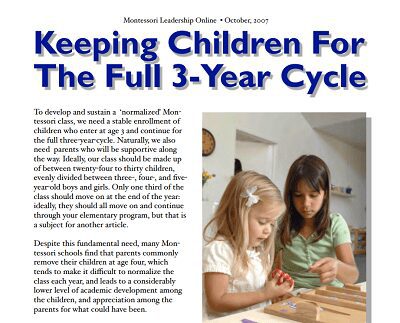
To develop and sustain a ‘normalized’ Montessori class, we need a stable enrollment of children who enter at age 3 and continue for the full three-year-cycle. Naturally, we also need parents who will be supportive along the way. Ideally, our class should be made up of between twenty-four to thirty children, evenly divided between three-, four-, and five-year-old boys and girls. Only one third of the class should move on at the end of the year: ideally, they should all move on and continue through your elementary program, but that is a subject for another article.
Despite this fundamental need, many Montessori schools find that parents commonly remove their children at age four, which tends to make it difficult to normalize the class each year, and leads to a considerable lower level of academic development among the children, and appreciation among the parents for what could have been.
This may be the greatest challenge schools can face to the development of authentic Children’s House programs. As a school administrator or trustee, you should be clear about this pattern, and consciously work toward the day when attrition is kept very low. Here are some ways successful Montessori schools accomplish this goal.
You need to be clear about your expectation that children will continue for at least the first full three-year-cycle, and parents should understand that every child in the class, including the ones who leave, lose something important when the oldest children, who both lead and teach the younger ones in the room, leave. Many schools have annual contracts which states that parents must fully intend to keep their child in the school until age six or later. It is a matter of honor that they do so.
It is very important to defuse the influence of the parking lot recruited – parents who, having decided to transfer their children to the local public schools or another private school, stand in the parking lot enthusiastically urging their friends to follow. They want their friends to transfer their children as well to justify their position and to ensure that their child will not feel alone. Their process actually takes place all over town, at birthday parties, play dates, soccer games, and on the phone. The only antidote to this natural process is to encourage your parents who are committed to counteract the inaccurate information that is normally being spread by explaining why they are pleased with Montessori and your school from a positive parents perspective.
Generally it is a parents value systems, rather than income, which determines who stays. Some schools, however, find that offering a financial incentive to stay could be helpful. A $1,000 enrollment deposit or bond, collected at age three and four and applied to the third years tuition, or some times refunded after completion of the full three years, but forfeited if they do not stay for the third year, may be effective.
Also take a look at your schools’ pricing structure. A higher tuition charged for the third year (or any other higher level) is a disincentive for staying.
There has been a huge and significant change in public schools in recent years: Our tax dollars are now covering full day kindergartens and after school care in public school, and that hurts private programs. After all, why should any family pay for a service available free from their local schools? The answer of course is that you will only succeed with parents who can see and appreciate the difference between your program and the local schools enough to pay for what you offer. Enrollment follows top quality programs.
It is not uncommon when parents transfer children from Montessori to local public schools for them to run into not to subtle remarks about how different the Montessori program and curriculum is from theirs, and what they must do to teach the child how to adjust. Ideally your school should have a strong elementary program, but whether you do, or do not, you can counteract some of this tension by developing a good relationship with the local elementary. As most schools understand how Montessori works, they tend to welcome children who transfer in at age six or later, despite the differences.
Day care centers and child care programs play an important social role, but any authentic Montessori school offers a very different program. The issue is not the length of time that children spend with you; many Montessori schools have offered all day programs from the early 1900s. The difference is the stability of the relationships between children and adults, the special training of the teaching staff, and the sophistication of the curriculum. In many child care centers, group leaders have minimal professional education, are paid poorly, and turnover rates are often high.
As a Montessori program, you will want to foster parents’ perception that you are a “school”, and not a daycare center or typical nursery school.
Parents who are only looking for a preschool for their children at age three and four will rarely stay once free public kindergarten is available. This can be a simple matter of perception held in a parents mind. If you take yourself seriously, you will find many families begin to do so as well.
By Aleta Ledendecker
Within our Montessori schools, we should remember that communication is one of the keys to creating a true community. The stronger the sense of community, the more our children will benefit.
There are many lines of communication among the teachers, parents, administration and children. It is easy to take communication styles and modes for granted, but in a community of respect it is important to consider the effects of all communication, whether face-to-face, on the telephone, by email, surface mail, or newsletters, and among all constituents.
Most people consider face-to-face communication the most reliable as far as understanding the intent of the person “sending” the message, but even in that mode, it is easy for misunderstanding to occur. Clear communication requires skill on both the sending and receiving ends. The Center for Nonviolent Communication (CNVC) has some excellent resources for speaking from the heart and listening empathetically. Visit www.cnvc.org for more information.
A good rule of thumb for any kind of communication is to send only those messages that you would say to a person in a face-to-face conversation. Or if you are tempted to say something about someone, stop for a moment and consider how the person would feel knowing that you had said whatever you are considering sharing about them. If you are sure that only pleasure would result from what you say, by all means go ahead. If not, keep those thoughts to yourself. If you want to complain about something stop to remember appropriate ways to address those conflicts that arise in normal human relationships.
It is essential to bring complaints directly to the person or group with whom you are having a problem. This is what we teach the children and we adults must be diligent in following the same rule if we want our children to learn by example. Complaining to others does nothing to help solve the problem, and only serves to make the problem more difficult to solve. There are four easy steps to sharing what is bothering you. This is the basis for sharing from the heart as advocated by CNVC. Even children can learn these steps, so they must not be too difficult!
After these steps listen carefully. If necessary, repeat the above steps until everyone feels heard and respected.
Listening empathetically is also based on observations, feelings, needs, and requests, but from a different viewpoint. Sometime the person “giving” the message does not understand all these components of compassionate communication. When that is the case, the listener can help reframe the communication along these lines. Reframing involves reflecting the communication back to the sender for verification at each step. This helps the speaker feel heard and accepted, an important component of clear communication.
Another important part of communication is to be sure you have your facts correct before sharing information with anyone. When in doubt, verify the accuracy of your intended statements. Speculation about others ma can be very damaging. It is far better to remain silent then to start or feed a rumor mill. And should a rumor get started, stop it in its tracks by demanding verification from the source. Don’t play into the hands of gossip-mongers.
These simple policies will go far in helping the community of our Montessori schools stay connected and caring.
Aleta Ledendecker is the Director of the New Horizon Montessori School in Louisville, Tennessee, USA her email address is aletaledendecker@earthlink.net
Montessori Leadership Online • October, 2007
On June 24th, 2015 Josie Zinninger joined host Tim Seldin to discuss the development and leadership of fully implemented public and charter Montessori schools.

Recorded Webinar July 1, 2015
When we recorded this, I was sharing my screen and Jon had provided me with a Word doc. When you watch, it will look as if you are looking at my desktop. I highlight topics as he covers them and scroll down. Don’t be disconcerted by the lack of a Power Point. This is a very interesting talk.

Montessori teachers tend to be in short supply world-wide. In part this is because of the rapid expansion of Montessori charter schools opening in the USA who need 10, 20, or more Montessori teachers all at once. Another reason is because Montessori is expanding rapidly outside of the United States, and more American Montessori teachers are finding themselves drawn to the interesting experiences of teaching in China or elsewhere.
After May or June (in the Northern hemisphere) it is very difficult for any school to find a new Montessori teacher for the fall. The normal cycle is to either advertise year-round, or to begin advertising in the late fall for an position that will begin in June or August of the following year.
Montessori teachers are normally formally committed to their current schools somewhere between March and April. Obviously teachers occasionally move, sometimes they become disillusioned with their current school, intrigued by a new school that’s opening up, or the school where they are teachers experiences a drop in enrollment and lets them go.
Be very careful about hiring anyone who is willing to leave an employer from June onward. Someone who is willing to do this to their school has either been seriously professionally mistreated, or is someone willing to leave his or her employer and students in the lurch for a better offer. Someone who will do this to one employer, may do it again to your school someday.
To find great teachers, it almost always takes time to get the word out, get them interested in the possibility of working at your school, and finally to get them to make a commitment.
If you live in a major community where there are many many Montessori schools, large teacher training centers, and an abundance of teachers who are retired, or working part time, or coming into the profession for the first time, it is much more likely that one will be able to find teachers were already living there.
If your school is not fortunate enough to find someone who is already living in your community, you’ll discover that it’s quite difficult at times to convince someone to move to a new city or state, no less across the country or abroad, to, and work at a school that they do not already know well.
Montessori teachers are in short supply. It’s been this way from the start.
Salary alone is often not enough to attract Montessori educators to work and stay at a particular school.
Montessori teachers are often very idealistic, and are often drawn to seek a position at a particular school because of its reputation, the city and which is located, or the beautiful facilities or something else that they understand about this particular school. For example, our Lab School, the New Gate school in Sarasota Florida, attracts teachers from all over the United States and abroad because of our reputation and because we go through high school. Having the opportunity as a mother or father of a Montessori child for your child/ren to complete Montessori through high school is one example of something that is highly motivating to many Montessori teachers.
Some teachers are very focused on finding a school where everyone comes from the same training background. This is most common among AMI teachers where there is a real concern that teachers from a different background may be so incompatible in their understanding and practice of Montessori as to create a frustrating environment in which to work.
Two other issues that many Montessori teachers look at is a school’s facilities and the sense of what kind of parent support are they going to get. While these two things may not seem to be connected, quite often they go hand-in-hand. Montessori teachers are almost always anxious to find a strong sense of supportive parent community and involvement. And they are definitely drawn to a lovely campus and beautiful and well-equipped classrooms. Keep in mind, not all Montessori teachers want parents to be involved, but the idea of knowing that parents will be an asset and not an obstacle is often one of the deciding factors as teachers make a decision about where to take a job offer.
Obviously, there are situations where your school’s location can be one of your greatest selling points.
If people often move to the community in which your school is located because they have friends or family there, or because it’s a community that is highly appealing, you are much more likely to see a steady stream of unsolicited resumes come in.
Reaching out to teacher training centers is often one of the most basic things that we all do, but keep in mind that it is very rare to see someone in Montessori teacher training who does not already have a job at another Montessori school, and often student teachers are sponsored through the training by that school in return from their commitment to teach after training for a period of three years or longer.
While it is possible that a training center may be aware of people who are looking for a new position, Montessori teacher do not need to use their connections to find a job. After few years, they usually hear about which schools are the most appealing to work at, and they often send off resumes in hope that there will be an opening.
Placing Classified Ads:
Schools definitely recruit teachers by placing ads. In the United States, the most common places to advertise would be in the pages of Tomorrow’s Child magazine (www.Montessori.org) because it has the largest distribution in the Montessori community in the English language and because the Montessori Foundation also places classified ads from Tomorrow’s Child on their website https://stage.montessori.org/classified-ads
Schools that are members of the international Montessori Council can place free classified ads online at the Montessori foundation/IMC website at https://stage.montessori.org/classified-ads
If your school belongs to the American Montessori Society, you can advertise on their website when you have job openings. About 20-25% of the Montessori schools in the United States belong to AMS, and while the majority of Montessori schools do not belong to any one organization, AMS is the largest Montessori professional organization in the world. So if your school does belong, placing classified ads on their website is one of the benefits.
If your school belongs to the Association Montessori Internationale in the United States, AMI-USA as a job opportunities page on their website at http://amiusa.org/jobs/ this is an excellent source if you’re in search of AMI trained Montessori guides
Another other major online job opportunity website is run by the North American Montessori Teachers Association. NAMTA is a highly respected and very well known Montessori professional organization, similar in many ways to the Montessori Foundation, but affiliated with AMI. Many schools place ads on their website http://www.montessori-namta.org/Advertising

Jonathan Wolff joined us on July 22, 2015. Most school heads have experienced teachers who are not in step with the school’s standards of Montessori practice. This webinar focused on how instructional leaders can guide rigid and resistant teachers toward instructional improvement and higher levels of professionalism.
This week, Kathryn Kvols and Tim Seldin discussed the Montessori Family Alliance.
On August 25th, 2015, Tim Seldin’s guest was Senior Montessori Foundation consultant, Jonathan Wolff.
The topic: The importance of supporting new staff members early and often in the school year – BEFORE they go off course
Common wisdom among Montessori school leaders is to give new staff members the time and space to settle in and normalize their classrooms before beginning to observe and assess their performance. We take issue with this approach. There is too great a chance that new people may get off on the wrong foot, acting in ways that are out-of-tune with the standards and values of your school community, and, in doing so, can have an adverse affect on student learning and parent perceptions.

Starting The New School Year webinar with Michael Dorer August 12, 2015

Dr. Michael Dorer gave this presentation during our weekly webinar for school administrators on August 26, 2015
Jonathan Wolff on Supporting new teachers early and often.

On September 9, 2015 Christine Lowry joined Tim Seldin and Dr. Michael Dorer to discuss some of the core issues of leading a Montessori school from the Montessori perspective.
 Montessori Family Alliance School Group Membership (Print & Digital 2026 1/2 year pricing)
Original price was: $30.00.$15.00Current price is: $15.00.
Montessori Family Alliance School Group Membership (Print & Digital 2026 1/2 year pricing)
Original price was: $30.00.$15.00Current price is: $15.00.
 The Montessori Way, Revised and Expanded: An Education for Life; A Comprehensive Guide for Parents and Teachers
$25.00
The Montessori Way, Revised and Expanded: An Education for Life; A Comprehensive Guide for Parents and Teachers
$25.00
 The Montessori Child: A Parent's Guide to Raising Capable Children with Creative Minds and Compassionate Hearts (The Parents' Guide to Montessori)
$20.00
The Montessori Child: A Parent's Guide to Raising Capable Children with Creative Minds and Compassionate Hearts (The Parents' Guide to Montessori)
$20.00
 The Montessori Toddler: A Parent's Guide to Raising a Curious and Responsible Human Being (The Parents' Guide to Montessori)
$20.00
The Montessori Toddler: A Parent's Guide to Raising a Curious and Responsible Human Being (The Parents' Guide to Montessori)
$20.00
 Montessori in Action: Building Resilient Montessori Schools 1st Edition
$29.95
Montessori in Action: Building Resilient Montessori Schools 1st Edition
$29.95