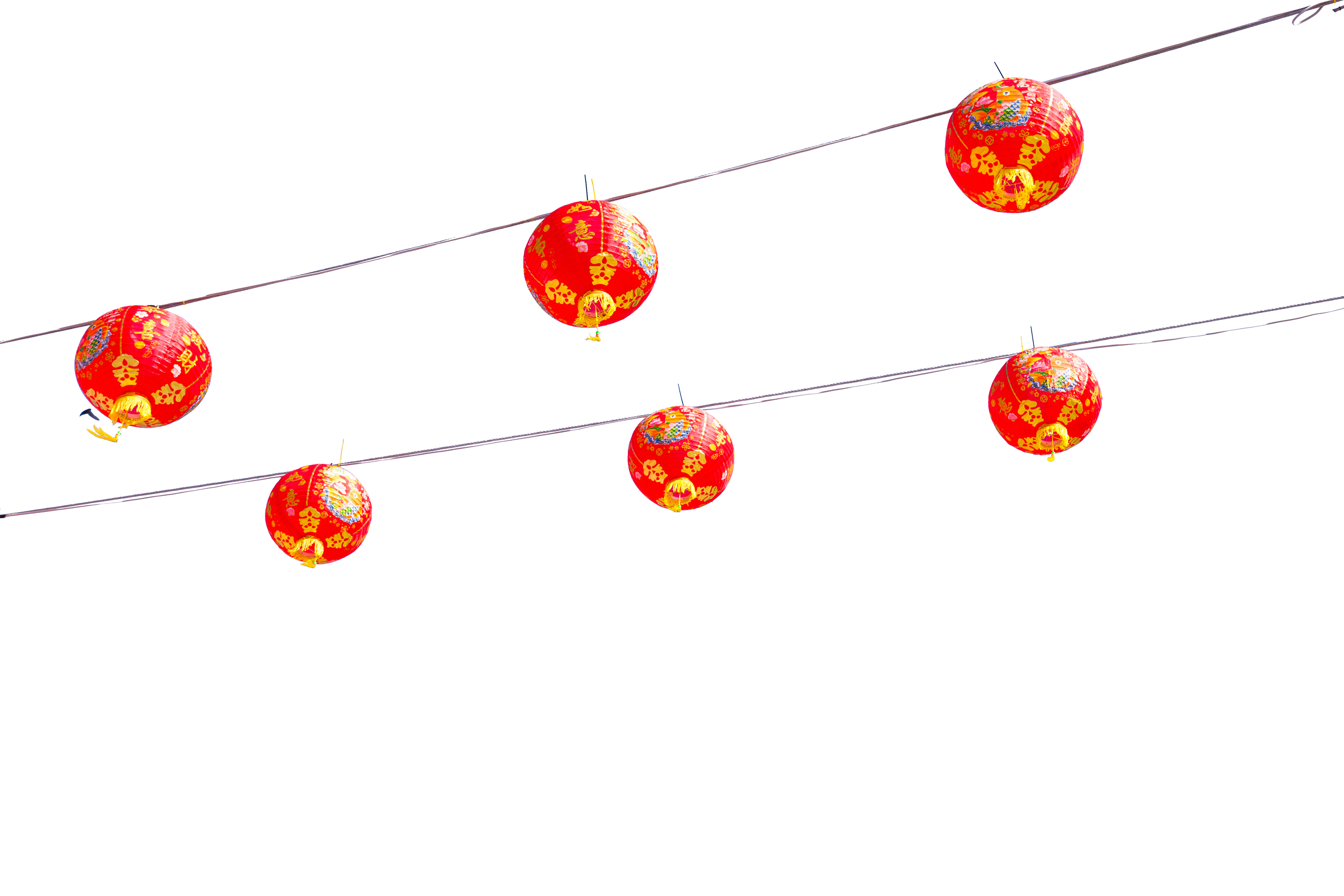
Chinese lanterns isolate on white.
Chinese New Year must be around the corner, for our school is decked in red and gold. Chinese New Year is celebrated according to the Lunar Calendar, sometime in January or February each year. It marks the coming of spring and new beginnings and is usually a two-week celebration. As in other cultures, there are many preparations leading up to the event. The week before the holiday, families clean their homes to sweep away all traces of misfortune. Shops and homes are decorated with lanterns, flowers, and bright banners. The color red and fireworks are used to frighten away monsters and evil spirits and to gain the attention of the Gods. On the night before the New Year, families celebrate with a family dinner, board games and midnight fireworks. On New Year’s Day, children are given presents of money in red envelopes and often visit neighbors and friends, with gifts of food and wishes of good fortune.
On the 15th and last day of the New Year celebration, the Chinese people celebrate what is called the Lantern Festival. Everyone goes out at night with colorful lit lanterns. Often children march in a lantern parade. The lanterns are left lit all night to thank the Gods for returning the daylight to them at this time of year. It is a time to celebrate nature, family, and friends and a time to pray for good fortune in the coming year. The day is filled with eating rice balls, family reunions, and solving puzzles often found on the outside of many of the lanterns.
Preparation in our classroom centers around a beautifully adorned display table with red and gold New Year banners, pictures of Chinese people celebrating all over the world, artifacts including the Great Wall, lanterns, dragons, and Chinese dolls. There are New Year signs on our windows and doors that welcome the children and get them excited and
curious at the same time.
In the Practical Life area, there are brightly colored Chinese bowls and spoons for transferring activities, and a variety of new ingredients for pouring including lotus nuts, rice and melon seeds. Chopsticks and a variety of culinary delights, such as star anise and peanuts, replace tongs and beads and erasers. In the flower-arranging area, fresh spring flowers are brought in and arranged for good luck with red adornments. Children learn to make a pot of tea and share it with their friends in a little ritualistic tea ceremony.
In Sensorial, the fabric box has the most gorgeous silks and other fabrics from China for the children to match. In our smelling bottles, we put a variety of spices including star anise, mixed spices, and jasmine tea. The stereognostic bags have Chinese coins, small pandas, moneybags, and little Chinese hats! Among the cultural ideas on our shelves are pairing cards of beautiful silk, weaving, and a box of objects from China, which the children can explore in conjunction with the puzzle map and flag.
The art area is a riot of activities, from appreciating Chinese artists to calligraphy and cutouts of the good-luck sign. There are fans for the children to fold and make and lanterns for them to cut, as well as firecrackers to roll and hang around the classroom.
Our talks during the week about the Chinese New Year describe the rituals performed by the Chinese people at this time of the year. We talk about the significance of the colors red and yellow, which are worn to bring good luck. We read Chinese poems and stories every day. One told about a New Year’s reunion; another of the dancing dragon; but the favorite is An Invitation to the Great Race. This tells the story of how the Chinese solar-lunar calendar came into being. We talk about the animals of the years in which they were born, and they learn more about this in literacy and have an opportunity to color and display the order of the animals in the race.
All of this leads to the very exciting event: the celebration of the festival itself. Family and friends are invited and encouraged to wear red and gold. The children carefully sweep and clean their classroom in true Chinese tradition. The performance starts with the Kindergartners introducing the audience to China and speaking not only of Chinese New Year but also of the Great Wall; the importance of the lion statues; the clothes and the money. It goes without saying that this is all done in Chinese! Chinese New Year songs follow and then, of course, the Lion Dance. It is all energy, color, and life—an experience enjoyed thoroughly by the lion dancers, themselves, and all the audience. Maria Montessori once said that, when bringing in other cultures all items, “would be received with enthusiasm,” and that “a child’s mind can acquire culture at an earlier age when involved with the movement,” as the lion dance shows.
The celebrations continue with The Great Race. The children enact the race called by the Jade Emperor with the animals gathering on the shore and crossing the river. The years of the Chinese calendar follow the order in which the animals arrived on the other side of the river. Their costumes are simple with black leotards and masks and tails. We keep their lines to one or two so they can easily memorize them and recite without stage fright! They do such a good job and hopefully, when they look back at their first acting stints, it will be a pleasant memory.
The Chinese teachers present the children with the lucky red envelope, which have some chocolate coins in them, as is the tradition in China. This is followed with a feast of all things the Chinese people consider auspicious to eat for Chinese New Year. There are dumplings, sticky Chinese New Year cake, watermelon seeds, New Year lucky candy, cookies, oranges, and jasmine tea. I overhear a parent telling a child, who insist the mother try some of the dumplings, “You are so lucky to have these opportunities I never had.”
It is true, the world is a really small place and festivals are a superb way of introducing children to different cultures and providing them with an enriching experience.
“All mankind shares a common history, a common world of cultures, and struggles toward a common future. The child should be given a sense of our heritage, our culture and our potential destiny from the earliest moments of sensitivity.
The needs of mankind are universal. Our means of meeting them create the richness and diversity of the planet. The child should come to relish the texture of that diversity.”
—Maria Montessori
Punum Bhatia, PhD has dedicated her life to Montessori education as a parent, teacher, and teacher educator for nearly thirty years. She completed her Bachelor’s degree in English Literature; earned Masters’ degrees in English Literature and Education from the University of Calcutta; and completed a certificate diploma in Montessori Pedagogy. She earned her Doctor of Philosophy from the University of Colorado Denver in 2012 for her work on the Self-Efficacy of Montessori teachers. In her efforts to understand children and the environments necessary for them to grow and flourish, Punum focuses on Maria Montessori’s original philosophy and techniques. After teaching the Montessori method to cohorts all around the world, she is now the proud owner of her very own bilingual preschool. (www.mcidenver.edu/ www.punumbhatia.com).
Tomorrow’s Child / Nov 2018 / Pg 21