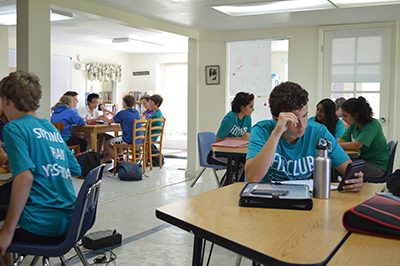
 Montessori Extends through High School
Everyone remembers their high school years. Few of us want to remember middle school. And no one, except perhaps our mothers, remembers the preschool that we attended until we were old enough to go to ‘real school.’
But wait, that may be true for most of us, but it is rarely true among children who grow up in Montessori schools.
Originally developed to serve children under age six, most Montessori schools today extend at least through age twelve, and increasingly they are adding on adolescent communities for the middle school years. Today, more and more Montessori high schools can be found in the US and abroad.
Adolescence (age 12 to 18) is the developmental period in which a child begins the transition into adulthood. It is normally a time of life marked by uncertainty, self-consciousness, and conflicting emotions. Most adults recognize that the teenage years are a difficult passage. Leaving the childhood years behind, young adolescents enter a stage of life in which their very bodies betray them. Not only must they cope with their emerging sexuality, but as sudden spurts of growth begin, they often become so awkward and gangly that the body’s center of balance is thrown off. At the same time, as their muscular development proceeds, many literally don’t know their own strength. It is not surprising that so many teens worry about the image they project to the outer world!
Here’s a shockingly simple concept: secondary education does not need to dehumanize adolescents any more than early childhood and elementary programs need to destroy children’s creativity and joy for learning!
Working a hundred years ago in Europe, Maria Montessori recognized that the basic developmental tasks of adolescence are not scholastic but, rather, social and emotional. She believed that the ultimate objective of education at the secondary level must be to help young people to discover, accept, and confirm themselves as individuals.
Montessori observed that adolescents often find it difficult to concentrate on their studies, even though they are expected to prepare for university or most careers, until their social and emotional needs are met.
Normally, schools see their role as presenting students with its curriculum: factual knowledge that is often outdated soon after it is taught. In Montessori, we cover the curriculum that universities expect, but we also focus on helping students to really learn how to learn. Instead of giving them the right answers, we most often pose the right questions! They learn to do their own research, think deeply, and are encouraged to think outside of the box. They develop executive function and self-regulation skills, such as goal setting, planning, monitoring, organization, positive thinking, stress management, and a balanced daily routine.
Here’s a shockingly simple concept: secondary education does not need to dehumanize adolescents any more than early childhood and elementary programs need to destroy children’s creativity and joy for learning!
What makes a Montessori approach to education so viable and increasingly preferable to other models? Nationally and around the world, students who stay in a Montessori environment seem to never lose their sense of wonder, their love for learning, creating, and building. They innovate. They collaborate. They celebrate their lives. If you’ve known any Montessori graduates, you’ve probably seen this for yourself. The genius of Maria Montessori’s work lives through each graduate, and we believe as she did, that “wisdom begins in wonder.”
As a physician doing pioneering work on brain development and child psychology, Dr. Maria Montessori was also well aware of the rigors of the European educational system, so she never dismissed the adolescent’s need to develop intellectually; she simply heralded a new approach to academics in harmony with the adolescent’s developmental needs. She recognized and identified four different planes of development and characterized development as “a series of rebirths” (Montessori, The Absorbent Mind). Montessori saw adolescence, the third plane of development, as a period of great creativity, specific psychological needs, and intense physical and emotional transformations. She identified and articulated the fundamental human needs as both physical
and spiritual.
Montessori envisioned adolescents living, learning, and working in a carefully managed rural residential learning community, a farm school, close to nature, and involved with a variety of lessons in practical life skills and learning how to live and work with others in a model society. The farm was to be their ‘Land Lab,’ and the adolescents, ‘Children of the Earth’ or ‘Erdkinder.’ Many secondary Montessori programs across the country still look to this model as an ideal, but during Montessori’s lifetime, boarding schools were a much more common option in Europe. These options are not as popular, or readily available in the United States. Today, and only a few boarding Montessori middle and high schools have been formed.
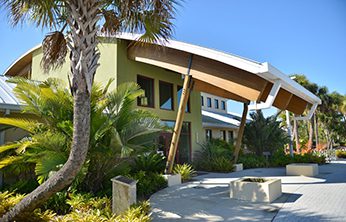 The NewGate School
NewGate is the Montessori Foundation’s Lab School in Sarasota, Florida. It is an international school, attracting students and families, who move to Sarasota as a destination for their children’s education. At NewGate, students can start in Montessori classrooms as toddlers and go all the way to graduation in 12th grade. NewGate graduated its first senior class in 2004, and each year its high school graduates have gone on to university and beyond, leading fulfilled and productive lives.
And this year, NewGate’s Montessori Secondary Program has a new home: the former Center For Building Hope, a Gold Level Green Building set on 5 acres. The setting is lovely. There are benches everywhere, quiet spots for contemplation, bubbling fountains, a labyrinth, a walking trail, and a tower to observe the beauty of the adjacent lake. The building itself is a children’s house on a much larger scale. It is perfect for up to 150 students for grades 7 to 12.
NewGate prepares students for life in the 21st century by incorporating Montessori’s philosophy, and vision for adolescent education focusing on the activities of practical life, wellness education, and valorizing the distinct needs of each adolescent.
The core of a Montessori education is based on the Montessori educational syllabus, which consists of ‘integrated academic components’ in three overarching areas: Self-Expression; Social, Emotional and Spiritual Development; and Preparation for Adult Life. Within these recognized areas, NewGate’s Upper School offers its students rigorous coursework in a variety of academic subjects, including: our much-celebrated drama-immersion weeks; experiential learning and in-the-field experiences; a variety of seminars and collaborative learning projects; training in organization and personal responsibility; and an annual internship week, which has proven very successful over the years. NewGate’s international emphasis also offers students opportunities for travel, not to mention a rich international student population, which brings the world home to NewGate, broadening student perspectives and engaging different ideas and ideologies. In addition, NewGate’s dedication to the development of the whole human being emphasizes community meetings and adherence to Montessori rules of grace and courtesy, which govern and inform all interactions on campus.
NewGate School understands that an education is not simply learned in books and through academic coursework. As Montessori defined it, education is “an intellectual and moral process that renders individuals capable of making their own way in life.” In her 1937 Public Lecture, she added: “Adaptability is the most essential quality, for the progress of the world is continually opening new careers and at the same time closing or revolutionizing the traditional types of employment. This does not mean that in secondary schools, there should be no preparation for intellectual professions, and still less that ‘culture’ should be neglected. On the contrary, education must be very wide and very thorough, and not only in the case of professional intellectuals but for all [men] [and women] living at a time that is characterized by progress of science and its technical applications….” (“A New Education for the Secondary School,” Public lecture given at Ulrecht [January 19, 1937])
NewGates Secondary or, as we call it, ‘Upper School’ reflects this commitment to prepare graduates for a constantly changing world within the context of three, 2-year cycles. The First Cycle is comprised of 7th and 8th-year students. The Second Cycle consists of 9th and 10th-year students; and the Third Cycle defines the 11th and 12th-year students. This approach allows for a symbiotic and seamless incorporation of Montessorian values with the International Baccalaureate Program.
NewGate is an International Montessori IB World School and, following Montessori principles, students continue to work in multi-age learning environments. By the last two years of high school, they are more capable of abstract thought and more comfortable and capable of exercising their independence. They are interested in a wider social context outside of their immediate peers, and they have a desire to more fully understand adult behavior.
The coursework in this cycle of the program spirals up, and responds to the student who is now ready to refine and apply his or her skills and knowledge with deeper understanding. Students participate in challenging seminar, labs, and project-based courses lasting for two years in Science, Mathematics, History, English, Spanish, Art, Physical Education, and Service Learning that foster the academic and intellectual capacities of adolescents and set the foundation for college-level work. These courses require in-depth and self-motivated participation, close attention to detail, self-directed independent work, writing, solid research, discussion, and analysis, and a learned trust that their guides and other members of their community will provide the support necessary. That is, students at NewGate are nurtured through every step of their human development. Class meetings provide support and structure for their work.
While some of our students do not elect to sit for the IB Diploma examinations, they participate fully in the IB course of study. At the end of the program, students have a greater depth of understanding about themselves and the world, sophisticated reasoning abilities, and experience with a wide range of tools, modes of expression, and courses that prepare them for college, life, and thoughtful citizenship. The goals begin and remain meaningful, and as secondary students at NewGate move through their studies they are encouraged to ask the important questions: Who am I? Who do I want to be? Where is my place in the history of humankind? Where is my voice in the great conversation? What will I say, and what will be my contribution to society? How will I encourage peace in the world? How will I exercise my freedom to choose?
An education based on the freedom to learn in a safe and nurturing environment allows students to ask these very questions. In this manner, their education informs the totality of their human development. Maria Montessori once said, “Free choice is one of the highest of all the mental processes.” The programs of study in the Upper School stress Montessori’s definition of freedom with the understanding that not only does freedom come with the burden of responsibility, sustaining and developing freedom for individuals and the community is also an intellectual and ethical process to which all must commit if we hope to create peace in the world. In her seminal book, Education and Peace (1949), Montessori wrote:
“Peace is a goal that can only be attained through common accord, and the means to achieve this unity for peace are twofold: first, an immediate effort to resolve conflicts without recourse to violence—in other words, to prevent war—and second, a long-term effort to establish a lasting peace among men.”
She expressed consternation that a recognized ‘science of war’ existed but not a ‘science of peace,’ and she poignantly asked, “In comparison with the problem of Peace, of what value are even the most sublime branches of human knowledge?”
Montessori expressed that the values attached to life and the principles involved in preserving life were entirely contradictory to war, and she pressed that if civilized society truly wanted to begin a “sane and psychical rebuilding” of humankind, we would have to return to the child “as an inspired being and a regenerator of society.” This hope for peace that Montessori saw in the proper development of the child is at the core of NewGate’s mission to cultivate a love of life.
In fact, at the heart of our move to the new campus, The Center for Building Hope, NewGate’s commitment to Montessori’s values finds expression in a pedagogy of place. The new campus will encourage students to connect their lived Montessori experience to the message of the original organization.
After years of serving the community of Sarasota, NewGate has been working to revolutionize the way we educate teenagers in America and abroad.
Tomorrow’s Child / November 2016 / p 6