In a Montessori learning environment, the child makes most of the choices for their learning. The teacher is a guide and a resource for the child rather than the giver of knowledge. A Montessori teacher, or guide, is more like a coach than a traditional teacher.
We all appreciate the teachers in our lives, but how do we share that gratitude when we may not know much about them beyond the classroom? Here are ten ideas:
1. Say thank you, and be specific about it: in person or by taking the time to write a note from you or helping your child write one.
2. Tell the administrators what you see and appreciate. The positive information does not get shared as often as concerns, so share your positive observations.
3. Offer to buy or do something specific for the classroom. “I hear you are looking for more plants for the garden, could my child and I get some for you?”
4. Provide a gift card related to what you notice in the classroom. Are fabulous art projects coming home? Get a gift card to the local art supply store.
5. Bring coffee and muffins or lunch to the teachers.
6. Give movie tickets, so your teacher has a chance to relax.
7. Give a gift card to a local bookstore (most teachers love to read).
8. Discover a restaurant they like. A gift certificate for a dinner out is always appreciated.
10. Present a gift card for a local grocery store. It can reduce a little stress during high-spending times.
Gifts should be a joy to give and receive, yet sometimes they can cause us stress. In Montessori, we consider how any item will help the child build themselves into the adult they are meant to be. To invite Montessori into your home and family, consider toys that encourage the child to think creatively and independently; toys that will last longer than the box; and realize that fewer toys that meet these criteria may be more engaging than an over-abundance of toys. We are sharing some ideas for all budgets, mostly from smaller sites, which work for a variety of ages and interests to get you started.
Here are some examples of some Montessori-inspired gifts. The Montessori Foundation is in no way affiliated with any of these companies or products. We just like them. If you are interested in a product, the QR-code or the tiny-URLs will help you find it. You will probably find other companies that offer the same product at more or less cost. You may also find some products that are sold out, you know, because of Covid and shipping delays. Sigh!
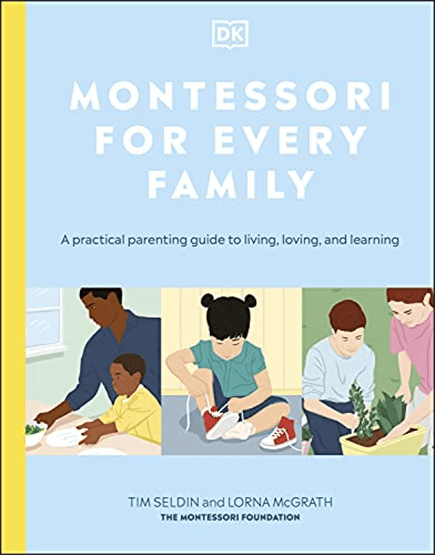
Tim Seldin and Lorna McGrath, both senior consultants with the Montessori Foundation, have released a new book, Montessori for Every Family: A practical parenting guide to living, loving, and learning. This book is truly for every family, those that are in a Montessori school, those who Montessori homeschool, those who wish to be in a Montessori school, and those who have not even heard of Montessori. The three chapters, “What Is Montessori?”, “Montessori Family Life”, and “Family Life Through a Montessori Lens” take the reader through an introduction to Montessori, practice with Montessori, and application of Montessori philosophy to their own family.
Parents can read it straight through, or simply choose a topic and read about that. The book is easy to read either way, with most topics covered in a single two-page spread with beautiful illustrations and clear explanations. Included with most topics, the “Ages and Stages” sections help families adjust their approach for young children (18 months to 6 years); elementary-aged children (6 years to 12 years); and adolescents (12 years to 18 years). Also included are real-life stories, sharing how different families have managed these topics.
Tim Seldin and Lorna McGrath have worked with families as Montessori guides, school administrators, and parent educators for years, as well as raising their own families and enjoying grandchildren. Their depth of understanding and experience with a variety of families is shown in this book. As a parent, you can find some suggestions you are already practicing with your family and some that you feel you could strengthen to make your family life more enjoyable. Each topic is presented as a practical way to engage as a family and invites you to try it out. This book is intended to help families connect and celebrate themselves and their daily life. It will help every family that reads it and applies even one topic to their own family.
Lorna described the reason, in part, behind the creation of this book as a step toward world peace. She said, “World peace begins at home…If families are all on the same page, we will create world peace. I totally believe that, and it’s why I do what I do, and have done throughout my career.” I highly recommend this practical, beautiful, and easy to read book for families, schools, and guides to strengthen their connections and language with all their children.
Montessori for Every Family: A Practical Parenting Guide to Living, Loving, and Learning can be purchased for Kindle, Audio, and paperback on Amazon.
This is a truly gorgeous book for children! Cynthia’s words flow as you turn the pages, and she describes how the natural world is constantly transforming. The photographs superbly illustrate the transformations in nature. The message is about paying attention and being in awe of all that is around us in the world and realizing how dynamic nature is. And watch for this – “What goes around, comes around.”
And Five Things Your Montessori Teacher Might Hesitate to Tell You (in descending order)
Make sure your child can dress themselves in the clothes worn to school. High-top sneakers look so cute, but if your child can’t put them on and tie them, they need to be only for out-of-school days and times.
Let your child walk to the classroom. Carrying your child tells your child they can’t do it on their own, and we want to encourage independence.
Make sure your child can manage their lunch items. Practice at home can help make lunch smoother for your child. If your older child will be cooking something in the microwave, let them try it at home first.
Limit the electronic babysitter, especially around school time. Screens certainly have their place, but try to use the time before and after school for music, audiobooks, conversation, or reading. This helps your child transition to and from school more easily.
Focus on specifics rather than giving a consistent “good job.” Share what you noticed (“I saw you running around the whole field.”)
Come to school on time. Make getting out the door on time a team effort by having your child complete some morning jobs. Getting to class on time allows your child more comfort when beginning their school day.
Communicate with your child’s guide, but consider the time. Let your child’s guide know if there is something that may affect the day, but try not to have a longer conversation just as class starts.
Help your child to “do it themselves.” Take the time to teach and then give the extra time it will take to allow your child to do whatever they can, from putting on shoes to preparing their lunch.
Ask “tell me more” before complaining about any information you hear from your child. Often, clarification makes a concern a funny story. For example, a child told her teacher that another child, “Said the f-word.” When the child was asked to whisper what was said, he leaned into me and said, “He said fat.” Crisis averted.
Always know that we are all on the same team: Team Your Child. Even when any of us have concerns, our goal is always to support your child to succeed.
And now…
Five Things Your Montessori Teacher Might Hesitate to Tell You:
Watching TV shows on the way to school does affect the way your child settles into class. Frankly, we do not move as fast and engage the brain the same way electronic screens do, so making that change can be difficult for many children.
Asking your child, “Why did you do that?” is not helpful and will probably not get a real answer. Try asking them to tell you the story of what happened, and ask how they were feeling before the incident; rarely do people know why they did something.
Have times when you are off your phone while you are with your child. Multitasking is sometimes necessary and so seductive, but some time without your child needing to compete with your phone is beneficial for both of you. Drop off and pick up from school are great times to be off your phone.
Be careful about what you say about the school, your child’s teacher, or your child’s classmate. Your child is probably listening. Vent to family or a friend at an appropriate time and place, or consider if it needs to be said at all.
When you talk about your child, as if they are not there, when they actually are there, they will hear you. Consider how children will take the information if it is new to them, and how they will feel about you sharing the information if it is not new. And, by the way, nobody appreciates being labeled
Here are a few ways in which you might be able to help your school.
There are some things that even money can’t buy, and one of the most valuable contributions that families make to a school is the gift of their time and expertise.
Parents, grandparents, and friends of the school are often found helping in the office, assisting in the classrooms, serving as field-trip drivers, offering a special class, planning the next special event, coaching, or serving on parents’ associations or school committees.
Parents play a crucial role in Montessori. Our schools are communities of parents and educators (many of whom will also have children enrolled at the school). Our ideas and input often help to shape the school.
Montessori schools are normally very responsive to suggestions and concerns.
Most Montessori schools encourage families to participate in the broader life of the school through social and educational activities. Although many parents spend considerable amounts of time as volunteers, except for parent-cooperative schools, there is normally no expectation for a set-time commitment.
Parents and grandparents who give of their time and talent share with their children special memories of experiences and friendships that endure well beyond their graduation.
Volunteer a few hours a week to help in the office.
Lend your time and support to our fundraising efforts.
Serve as a class parent.
Help to organize a reunion for former students and their families.
Help out in the library.
Help put together the school newsletter.
Join in at open houses to meet prospective families.
Teach a special course.
Volunteer to be an Ambassador Family to parents new to the school.
Help the teachers organize field trips or special lessons.
Help organize special events.
Help students work in the garden.
Serve on one of the school’s committees. Share your talents and special interests, such as playing a musical instrument, speaking a language, or making a craft. Volunteer your time to help the school prepare major mailings. Volunteer your time to coach a team or after school club.
In this session, “Math Without Workbooks,” Cheryl Allen shares many opportunities for practicing math which are right there in front of us in our everyday lives if we just take advantage of them. Hands-on experiences help children internalize concepts that might otherwise seem difficult to understand or unimportant to them. In addition to great ideas for learning math in fun ways, Cheryl also includes a wonderful list of books for the elementary years that are not only about math but also many of them are quite humorous which children of this age love.
Lorna McGrath spoke with Cheryl Allen, an Elementary Guide and Montessori teacher educator. Even Montessori parents and guides sometimes become anxious in this time of so much emphasis on “achievement” about making sure that our children are keeping up during school breaks. Cheryl has some really great ideas for activities for keeping young minds active and challenged in fun ways when “school’s out.” You won’t want to miss this session.
Sessions are recorded and, when uploaded and are available to members of the Montessori Family Alliance in the Alliance Members’ Resource Center a few days after each session. An individual Family Alliance username and password are required. Recordings can be viewed at your leisure.
The Montessori Family Alliance is a new international network of Montessori parents, teachers, and friends of Montessori. We focus on issues of children, Montessori education, and Montessori family life from infants and toddlers through teens.
The Montessori Family Alliance reaches out to parents like you who have interest in or a connection to the Montessori community, encouraging them to choose Montessori for their children, assisting the schools that they choose to help orient them to the principles of Montessori education, inspiring them to become more supportive and positively engaged in their children’s school communities, and to share stories about how specific Montessori schools have designed new facilities and developed fascinating programs, sharing stories of present and former Montessori student, educatioand continuing to share information about ongoing research that supports the effectiveness of Moneducation.
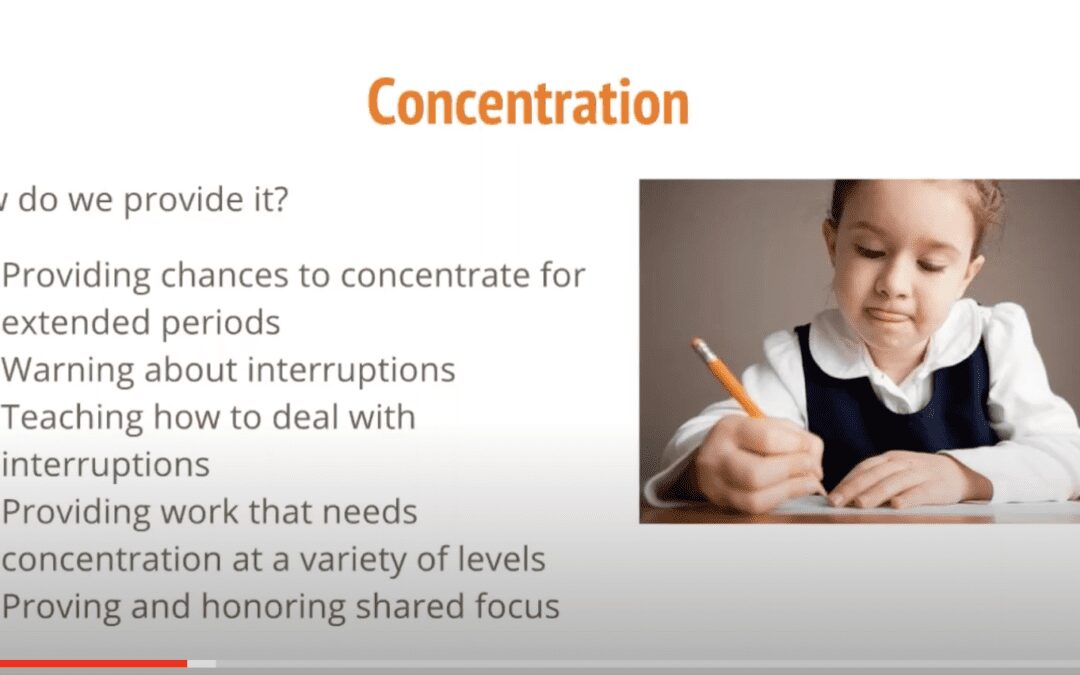
Some may say, “What is OCCI?” Some may say, “I thought OCCI was just during the Primary years.” Cheryl says, “Let’s see how we can continue to support the development of order, concentration, coordination, and independence during the elementary years.” Join us for some interesting insights.
Nearly every afternoon in our class, after the end-of-day hustle and bustle of classroom jobs, one of us will reach for the wreath hanging on the wall, and a student will always say, “It’s the kindness wreath! It’s time for the kindness wreath!” In a time when increasing numbers of acts of violence are witnessed by these same children on the TV shows they watch and the electronic games they play, being excited about kindness is rarer than it should be.
In an effort to put our attention toward all the good that is happening in our environment, we started a kindness wreath this year. The wreath hangs near our reading corner. In the beginning of the year, it was an empty wire wreath form. Nearby is a jar of cut ribbons, a container for notes, and a container of blank paper for writing the notes. On the first day of school, we discussed what acts of kindness are and talked about noticing them and writing them down. We decided that they would write a note for something they observed or something someone did for them, not something that they did.
That first week, the container for written notes was almost empty for most of the week until we, the guides, paid attention and wrote a note for each child sharing an act of kindness we had observed. Even the students who were still adjusting to school performed many acts of kindness, and they were the most thrilled to hear about one of them.
At the end of the day, we take the wreath down and bring the written notes and the cut ribbons to our circle. We choose a note and read it aloud. Often the person who wrote it recognizes the paper (we use cut pieces of scrapbook paper and write on the white side) and just radiates with excitement as we open the note and read it; sometimes, they will add details after we have read the note. The person who is being recognized comes to the wreath and chooses a ribbon that we then tie on the wreath. They get to keep their note and choose the next one for us to read.
I had hoped that the wreath would help students think about being kind and strengthen our classroom community. I had no idea how much it would touch the children or myself. Watching a child’s face light up when a note that recognizes him or her is read is amazing; the child is always so happy to be noticed for their act of kindness. We have all heard about (and tried to catch) a child ‘being good,’ but there is exponential power in that catch when another child does it. Even more than that, I love to hear how the children comment, “I saw that too,” “You always help with that,” or a simple, “Way to go!”
It is a wonderful way for them to support and cheer for each other without having any other group that they are against. I see children keep their notes as little treasures and maybe reminders for themselves. I watch children greet parents with the information that they received an act of kindness note and what it was for — even before they say hello. I hear that it has become a part of dinner table conversation and that whole families are thinking about acts of kindness and maybe being a little more kind themselves. Sharing kindnesses that we see has become a special part of the day for all of us.
As adults, we often think of memorable acts of kindness as the best and most important acts of kindness such as a donation or a gift. As so often happens, the students have reminded me that my adult mind sometimes forgets to notice the little details that make up the big picture. For them, the act of picking up a pencil, holding open a door, or staying quiet while others are talking are just as important, maybe more so, than bringing a plant for the garden or driving on a field trip. Since these are acts we perform every day, it is lovely to see them noticed, remarked upon, and thanks given.
I hope that the students are building the habit of performing acts of kindness, recognized or not, everyday and noticing acts of kindness that are performed for them and around them. A kindness wreath, a thank-you box, taking time for compliments and acknowledgements, or whatever way or ways you celebrate helping others may help bring lasting happiness and a habit of kindness to all who participate. Performing acts of kindness has been shown to lower stress levels and increase happiness.
For our class, that wreath full of ribbons reminds us that we are kind and considerate each time we look at it, and hearing some of the acts performed each day, ends our day on a positive note. Like the other materials in our class, the wreath is beautiful in a visual sense, and the way it works and guides is also beautiful.