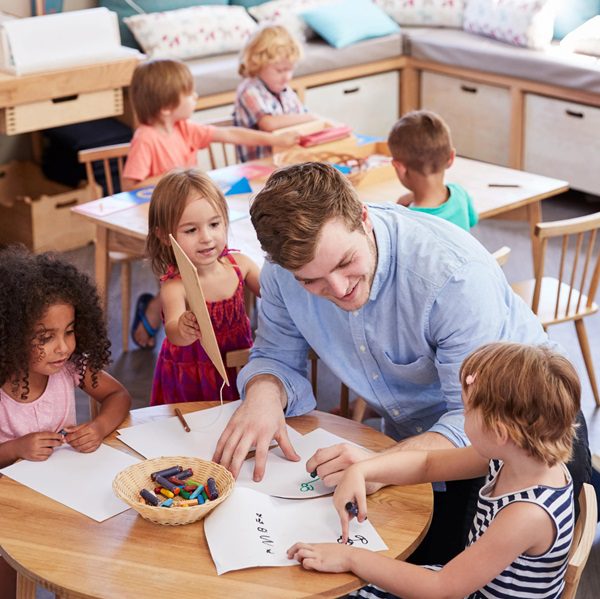
The sunshine filters across the glistening beads as a student carefully counts them. Another student is on the patio applying strokes of paint to a new design. Two more children work in the garden, and several sit at separate tables, intent on their work. It is a typical day in an Early Childhood class, except that these children are wearing face masks. It is July 2020, and we are in the depths of the COVID-19 pandemic.
Our school in Park City, Utah, was shut down for ten weeks through the spring. Teachers worked industriously to provide work for students at home during the shutdown, but we weren’t sure that our students, who are mostly under the age of 6, got as much out of the packets, emails, slide shows, video links, Zoom meetings, and Google Classrooms as we had hoped. So, we were determined to offer what they needed most – time in our
prepared environment.
Our whole faculty spent the ten weeks of shutdown carefully planning. Through a series of emails, Zoom meetings, phone calls, Google docs, and texts, we began to sort out the best way to proceed. Not only were there new protocols to adopt, but also new employment considerations, government hoops to jump through, and all the discussions on how to maintain
Montessori philosophy and pedagogy under such dire circumstances. Our local and global Montessori communities provided a daily influx of support and ideas. Our task was to sort out the useful items between our small faculty and administration team and determine how best to apply them.
Our School Director, Leah Linebarger, got right to work with the local health department on a task force focused on establishing new protocols during the pandemic. This provided the groundwork for how we would proceed. Our Administrator, Bruce King, found sorting the details of employment law a full-time job as he diligently searched for the best ways to support our faculty. Our Utah Montessori Council (UMC) shared precious documents, websites, and platforms as each school crafted our path forward. UMC Administrator Teas moved from once-a-month elegant tea parties to twice-per-month sleeves-rolled-up Zoom support meetings. We found that we gained significant insight from other schools’ heads from across our state as we shared ideas and learned from each other. Two of the schools, Anchored Roots Montessori and Dancing Moose Montessori School, remained open through the shutdown, and their experiences were invaluable as we headed into the unknown.
After months without income and missing the culminating events of the previous year, closing ceremonies, our school fair, and our faculty end of the year party, we were not sure what to expect for the future of our school. We knew we had to provide normalcy for the children. We knew we had to support the families. We knew we had to get back into the classroom.
After wrestling with all of these plans, ideas, and endless checklists, we cautiously opened our school again on June 1st. We simplified rosters so we could begin with just ten students per class. Students attended mornings only for the first week while we smoothed out the wrinkles. Teachers simplified materials so children could choose their work, return it to a cleaning shelf, and an adult could sanitize it and return it to its place in the classroom. There were fewer choices, but we were reminded of Angeline Lillard’s (2012) words on keeping materials to the most necessary. Having fewer materials on the shelf ensured that all were sparkling clean, complete, and orderly at all times. Teachers rotated materials to meet student needs. Our classrooms looked like the photos of Montessori’s original classrooms, with each child focusing on the simple, classic material before them.
We simplified and expanded drop-off and pick-up so that classes were not mixing, and parents were not coming into the building; children were having their temperatures and symptoms checked at the exterior classroom door at drop-off. We discontinued our snack and lunch programs and asked parents to provide them. Although it hurt to eliminate the classic community exercises of meal preparation, this greatly simplified our daily preparation process and allowed additional sanitizing time.
Sanitizing everything in the room twice a day was the protocol we worried about most until one of our comrades at another school discovered that isopropyl alcohol could be used. It was simply sprayed on and allowed to evaporate. Alcohol is hard on wood, so we used soap and water for our wooden equipment. We have tried to substitute plastic materials wherever possible to save our wood. Others are reporting happy results using foggers, electrostatic sprayers, and various disinfectants.
Acquiring enough thermometers, gloves, masks, smocks, hand sanitizer, hand soap, paper cups, paper plates, and paper placemats is an ongoing task. Teachers created individual packets of crayons, pencils, scissors, glue sticks, and paper for Early Childhood students so that those things did not need to be individually sanitized after each use. Maintaining all the necessary inventory is probably the most significant ongoing expense. On top of the greatly reduced income through the ten weeks of closure, we are all taking a substantial financial hit. As we have learned through the past recessions, all we have to do is cut back, pull together, and the economy will come around again, eventually.
We’ve had to eliminate assemblies, guest speakers, and events, but this results in a simpler routine and fewer interruptions to the work period. We avoid mixing classes, but this makes the prep and cleaning schedule simpler when each teaching team is taking care of their own classroom instead of relying on someone to come in to help them. With the simplification of so much of our day, teaching teams have more time to maintain their own environments.
Masks were a daunting prospect. We started by recommending that students wear masks as a sign of respect for others, and many did. Then, our town adopted a mask mandate, and our students cheerfully went along with it. They have been much more amenable to it than most adults. Now, all Early Childhood and Elementary students wear masks into and out of school and while inside, unless they can stay 6 feet apart. Early Childhood and Elementary students also have assigned work tables or mats to mix less within the classroom. When lining up, they space themselves a healthy distance or an arm’s length from the person in front of them. Outside they are free to play as they always have, but teachers may remind them to give each other healthy space. We spray all equipment with alcohol, using a fertilizer sprayer, between classes.
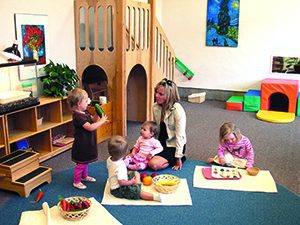
Other than the temperature and symptom checks at drop-off, increased cleaning routines, and the smaller class sizes, the infant and toddler school days are essentially unchanged. Teaching teams are careful to sanitize work after each use, wear masks and gloves, and infant faculty wear lab coats or smocks, as well.
Although we are respectful of each other and generally stay 6 feet apart, teachers are very sensitive to their students’ needs and give hugs and physical reassurance whenever appropriate. It is daunting enough that we cannot see each other’s expressions, so we can at least hug a child.
After the months of planning and preparation with our teaching teams, a few of our teachers did not feel comfortable coming back to school during a pandemic, and we honor their decisions. You have to want to do this. It is a risk to be at school, even with a mask, gloves, and smocks, interacting with children and families every day. In order to offer the extension for our students, we again called on our Montessori community, borrowed teachers, and hired a few who considered the risk worthwhile.
During the closure, our school’s families stepped forward to offer funds for our faculty whose income was suddenly cut in half when their spouses and roommates lost their jobs. Parents brought groceries and surprises to teachers’ doorsteps. Some of the teachers decided to wait to feel more comfortable before returning to school. Enrollment dropped, and then we began to get calls from families looking to move to our little mountain town from the big cities. The rosters are filling again, and we have some eager new employees enthusiastic about all things Montessori.
We have found that children are generally better at adapting to these changes than adults. They don’t understand what or why coronavirus is, but they understand that we have to help each other stay healthy and safe by wearing masks, washing hands, giving safe space, and being careful of what they touch. Lunch is different, group lessons are different, and moving in and out of school is different. Most of what goes on in between is pretty much the same, and for that normalcy, we are forever grateful. When I stand at the gate and greet families each morning, I accept loads of thanks and praise. One day in early June, it snowed in our little mountain town. There were our families, having scrambled to find their winter wear, as well as their face masks, lining up at the orange cones placed 6 feet apart at each door and still smiling and giving thanks for being able to bring their children to school for a few hours.
Since it is summer, we’ve spent much more time outside, making use of our patios, gardens, playground, creek, and field as we’ve never used them before. We’ve taken time outdoors to observe native plants and animals. Most of our children now know the Uinta Ground Squirrel’s call and where the voles and garter snakes live. They know where to find strawberries, chives, honeysuckle, and the lavender used in all types of Practical Life projects. They have discovered the beauty of our campus that is so often missed in the summer when our student population typically falls off.
Winter will bring more problems to solve – where to store snow clothes so children can access them without coming into contact with children from other classes; lunching socially and at a healthy distance; how to keep classrooms adequately staffed when winter illnesses make their rounds. And, there will be questions we can’t even foresee now.
Early on in the pandemic, I thought about how few world crises we have experienced in the past few decades. Those of us of a certain age lived through polio, the Cuban Missile Crisis, the Vietnam War, AIDS, the Gulf War, September 11th, the Iraq War, the War in Afghanistan, mass shootings, and a plethora of environmental crises. Our parents and grandparents told us about the World Wars, Pearl Harbor Day, the Spanish flu, scarlet fever, and smallpox. An elderly cousin of mine recently remarked that Americans were on rations for four years after WWII in a tone that made me think, “we ain’t seen nothin’ yet.” It could be worse. We have examples before us of how to behave during a crisis. Following our ancestors’ lessons, we will look around, lend a hand to those who need it, summon our courage, face down our fears, and step into the fray to contribute whatever we can. As we face each challenge, we have to remind ourselves that the entire population of the world is in distress right now. Within each of us is the ability to lighten another’s load with a smile, a few words, or an act of kindness. Now is the time to fight this good fight with great honor.
We will not be the same school again. We will not be the same people also. But, along this journey, we have found the beauty in simplifying, enjoying what we can do together, and the joy of returning to the classroom where both children and adults are getting something essential. When we recall the COVID years, we will remember the lessons learned, and we will carry them with us. We are learning to slow down, focus on the moment, and fully support one another.