Understanding the importance of integrating a visual art curriculum into the classroom is crucial in today’s educational landscape, especially with the emphasis on STEAM programming. The “A” in STEAM signifies arts, showcasing the increasing recognition of arts within this educational movement across all grade levels. This approach, combining science, technology, engineering, arts, and mathematics through project-based learning, not only prepares children for future jobs but also nurtures their creative problem-solving skills.
Changing our View of Education: A Positive Approach
The positive nature of the Montessori approach, with its emphasis on process and discovery, is central to why it works so well for children in their development. When Dr. Montessori lectured in London in 1946, she pointed out that conventional education focuses on mistakes.
Think of your own experiences and how your schooling was structured; you will probably remember that there was constant attention given to your errors. Avoiding errors was the thrust of the system. Even with a few enlightened, kind teachers here and there, who emphasized process and exploring bravely, the main message for how you were to learn things was by having your mistakes pointed out to you daily in the form of testing, performing in front of classmates, and reaching for the one “correct” answer to each question. This emphasis, by design, encourages children to lose confidence in their originality. And, yet, we know that developing unique perspectives is invaluable. Thus, the very thing that makes society prosper is being discouraged on a daily basis in our conventional school model.
You may be wondering how there could be another way to teach, when there are certain areas in life where there really is just one correct answer. Mathematics and science are not a matter of opinion, for instance. There are facts that children must learn in order to succeed in some areas. Which is more important: the process, which leaves room for originality, or the answer, which must be consistent with the truth? The answer is both, and Montessori’s approach allows for this interesting dynamic to play out in the classroom, as it does in real science laboratories and in sophisticated math discussions. Dr. Montessori discovered that there is an alternative way that children learn about exact answers.
Montessori’s view was that there is exactness in mathematics and science, which gives our universe balance and beautiful symmetry. Realizing this is truly awe-inspiring for children! But instead of having this phenomenon of exactitude dominate the whole educational approach (by trying to stuff answers into children’s minds), Montessori sought to awaken their wonder for exploration and to help children discover pathways of thinking that lead to correct answers. A prime example of this is the way elementary-aged children explore math through the specially designed materials that require several steps and attention to detail. The children ultimately arrive at the correct answer and are often quite satisfied with themselves after much effort; all the while, they are developing cognitive processes and character traits that contribute to future learning and problem solving.
…the very thing that makes society prosper is being discouraged on a daily basis in our conventional school model.
Discovery and Ownership
Through the materials and how they are presented by the trained teacher, Montessori children in an Elementary classroom search for the paths to find the true answers; when they get there, the results are their own discovery, just as if they were the first mathematicians to discover them. The result of this repeated experience makes children view mathematics as the wonderful puzzle that it is. The idea of being embarrassed at arriving at an incorrect answer is foreign to these children, for whom the taste of finding the right answer is so sweet that they want to explore other avenues and learn more. Mistakes are integral steps in every journey, and this reality becomes familiar and acceptable through repeated experience.
The Montessori materials guide children to find the ways that work, making the adult corrector obsolete in many cases. For instance, when two children do long division problems together with a material called Racks and Tubes, there are many places they might err. They could start off incorrectly by placing the tens board to the right of the units and work through the whole problem incorrectly, only to find at the end that their answer is incorrect (either by bringing it to an older friend who can do the problem longhand on paper, to the teacher who can check it, by using another math material to do the inverse problem and see if it matches, or by checking it themselves against a calculator).
They go back to their work—puzzled—and like two detectives, they re-examine how they set up the problem (which is often when they will identify this first mistake), or they employ a friend to see if they can identify where they may have lost the path. In my experience as a Montessori Elementary teacher, this is when the fun really begins if the adult supports an attitude of curiosity about finding the error.
Children will repeat a problem over and over, sometimes eliminating just one of several mistakes at a time in the same math equation or process. The important thing is for the teacher and community to support the quest to get to the end, so that the children do not fall into a habit of giving up too easily or repeat making the same mistake so many times that it gets ingrained! By keeping tabs on their progress, the teacher can see when to step in and point children in the right direction, perhaps making an observation and/or asking a question: “Oh! Wait, I see—look where your units board is. Do you remember where it belongs?” This is usually all that is needed to get an “Ah-ha!” and a delighted, re-energized effort to try the whole thing again. Children are remarkably resilient, especially when working with a friend and being allowed to own the whole process of the math equation. When they finally, leaning over the calculator with suspense, find that they have achieved the correct answer by their own efforts, it is an excited triumph that feeds the urge to tackle more and more problems.
Very rarely have I seen children want to get to the answer easily so they can quit. There are some who will be tempted to use a calculator to find the answer and just write it in, sometimes several times, to create the illusion that they have accomplished a lot of “work.” You may be surprised to hear that in a Montessori environment, that is the exception and not the norm. Teachers usually catch that pretty quickly, but even if they didn’t, and even if other children did not point to it and demand that the child work honestly and just as hard as them, the child who does this often abandons the practice after watching others glean the internal rewards of sustained efforts and true glory of finally getting that answer.
As children experience this quest again and again, they hone their skills each time. Eventually, the exercise becomes too easy for them, and they are ready to advance to another math process that brings them to their next level of challenge.
Developing Persistence
To describe all the ways children might error in the process of long division with Racks and Tubes would take too long here, but I’ll give you a sense: One child may write the problem down differently than their companion and, therefore, lay out some incorrect amounts when distributing the beads to be used (a mere flipping of two numbers, perhaps). This carelessness will eventually be discovered, and both children will realize the importance of double-checking with each other before they begin. They also might place the working number of beads in the wrong category or confuse the order of the categories (units, tens, hundreds, etc). Again, these are mistakes that reflect the need to double-check their layout before they begin the process.
Another place they may err is in physically dropping a bead or beads, losing them as they spring across the floor and losing count of how many were in the bowl to be distributed. This reminds them to slow down, be careful, and focus on their physical movements. They could also lose count or forget a step if they are interrupted by conversation or stop what they are doing to attend to something else in the middle of their process. This would illustrate the importance of sustaining their focus on the task at hand until finished. Finally, they might write the numbers down in the wrong order at the end, showing again a need for more careful, focused attention and awareness.
Montessori teachers tend to inspire a sense of wonder and nurture children’s curiosity and imagination.
Sometimes, two children have two different answers written down, and they’ll be perplexed about which one is correct, garnering more discussion and a backtracking of their steps. Watching all this is incredible; the amount of teamwork, social interaction, struggle, humor, fun, and agony that can accompany such a process as doing long division is positively brilliant in the sense of integrating all aspects of a child’s development as a person and a mathematician.
For a Montessori teacher, bearing witness to such self-discoveries is joyful. It is a special experience to spend one’s days in an Elementary Montessori classroom with children working with the Racks and Tubes! It can take more than an hour for children to complete a challenging problem (if you account for the self-correcting, they may need to do), but the learning that occurs is immeasurable. And the more children work with such processes, the faster they achieve success each time, fueling their desire to tackle more challenges all over the classroom.
This is just one example of how Montessori fuels the development of children’s resilience and perseverance in a very direct and effective way. And because a Montessori classroom is a vibrant community where everyone is working simultaneously on different things and seeing what others are doing, the practice of pushing oneself until achieving success is contagious. Children will stop and help each other, discuss, and share a conundrum, and sometimes get intrigued with each other’s experiences of learning. The learning is, therefore (in economic terms), a positive externality, meaning that the network of students spreads newfound information via witnessing and sharing experiences; this happens naturally in a Montessori Elementary classroom because of children’s gregarious social behavior at these ages. This is another example of where Dr. Montessori designed an approach that employs (rather than fights against) the developmental characteristics of children in this stage of life between ages six and twelve, specifically, their tendency to be very social and to always want to find out what their peers are doing.
In the above example, students may use the mantras they learned in their Primary years (ages five and six), such as “The units always go on the RIGHT” and “We always begin with the UNITS” (“except in division, when we begin with the highest category present”). Students love these little cues, and when the Primary teacher says them each time, she is with children in a math presentation, the children often chant along. There are just a few such mantras that carry over from Primary to Elementary, so children tend to remember these. We have found that children benefit from having such important points of interest brought to their attention regularly, so that they can commit them to memory.
When working on math and science, the children in a Montessori classroom don’t just value the exactness of a true answer; they love that there are answers to find, and they see each exact answer as a part that connects to a greater whole, creating a universal balance in which each component matters. With the Montessori approach (where the processes of discovery appeal to our children’s developmental characteristics at each age), finding correct answers is fun, sometimes eventful, and always intrinsically rewarding.
Paula Lillard Preschlack is a writer and a speaker. She has spent 25 years as a teacher and the head of school at Forest Bluff School. She just released her first book about Montessori education, The Montessori Potential. Paula Preschlack has given over 100 talks at Forest Buff School and at other Montessori schools, teacher training courses, and conferences. Her work focuses on the principles and successes of the Montessori approach, learned from over 25 years of teaching and observing children from birth to adulthood.
Paula is a graduate of Hampshire College and has a master’s degree in education from Loyola University, Baltimore, MD. She is AMI certified for all Montessori age levels: Assistants to Infancy, Primary, and Elementary, and she audited the NAMTA/AMI Orientation to Adolescent Studies in 2018.
Many parents and schools focus on basic skills: reading, writing, and math. But the basics are truly keys that allow learners to get access to the real curriculum, which should be thought of as an interwoven tapestry of the sciences, technology, literature, society, and all of the things human beings have done throughout history.
If children are exposed to a rich curriculum in a way that feels inviting (and not stressful) they tend to become excited about learning how the world works. This is what makes children want to read and do research. It’s what helps them to understand how and why we use mathematics.
Whether it’s business economics, anthropology, archeology, the story of famous lives, architecture, engineering, invention, the true curriculum is endless.
Our goal is to sow seeds of wonder and to ignite children’s curiosity, interest, and imagination.
In Montessori, a key part of how we approach this is by helping children to see that we are all members of the human family. Our roots lie in the distant past, and history is the story of our common heritage.
Without a strong sense of history, we cannot begin to know who we are as individuals today. Our goal is to develop a global perspective, and the study of history and world cultures forms a key cornerstone of the Montessori curriculum.
We use many learning strategies to begin this journey, beginning with stories, but also using timelines, illustrations, and hands-on experiences to help children begin to imagine how the world as we know it came to be.
Montessori described this as a “Cosmic Curriculum,” which may sound odd at first, but is meant to imply a child coming away with a broad sense of the birth of the universe, earth science, the formation of life, and how human beings met their needs and developed societies and the cultures of the world.
These studies begin to simply weave together everything from astronomy, physics, chemistry, biology, anthropology, archeology, linguistics, mathematics, geometry, architecture, industry, trade, and civic life.
Montessori’s Cosmic Curriculum helps children to see the how everything is interconnected in the universe. It is a steppingstone to lifelong learning.
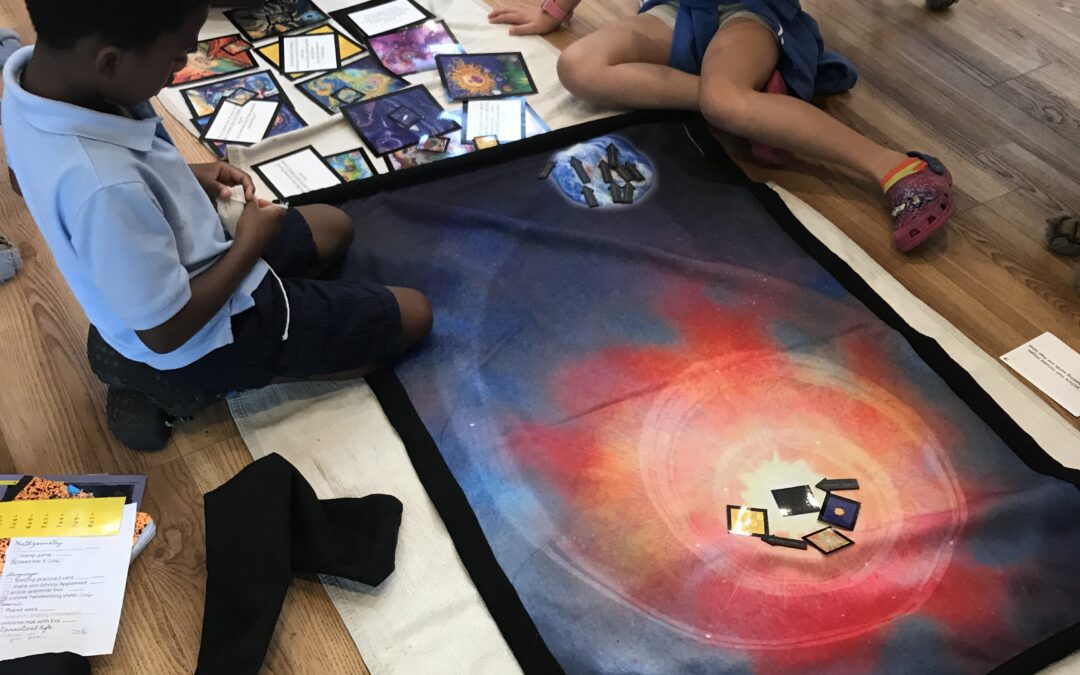
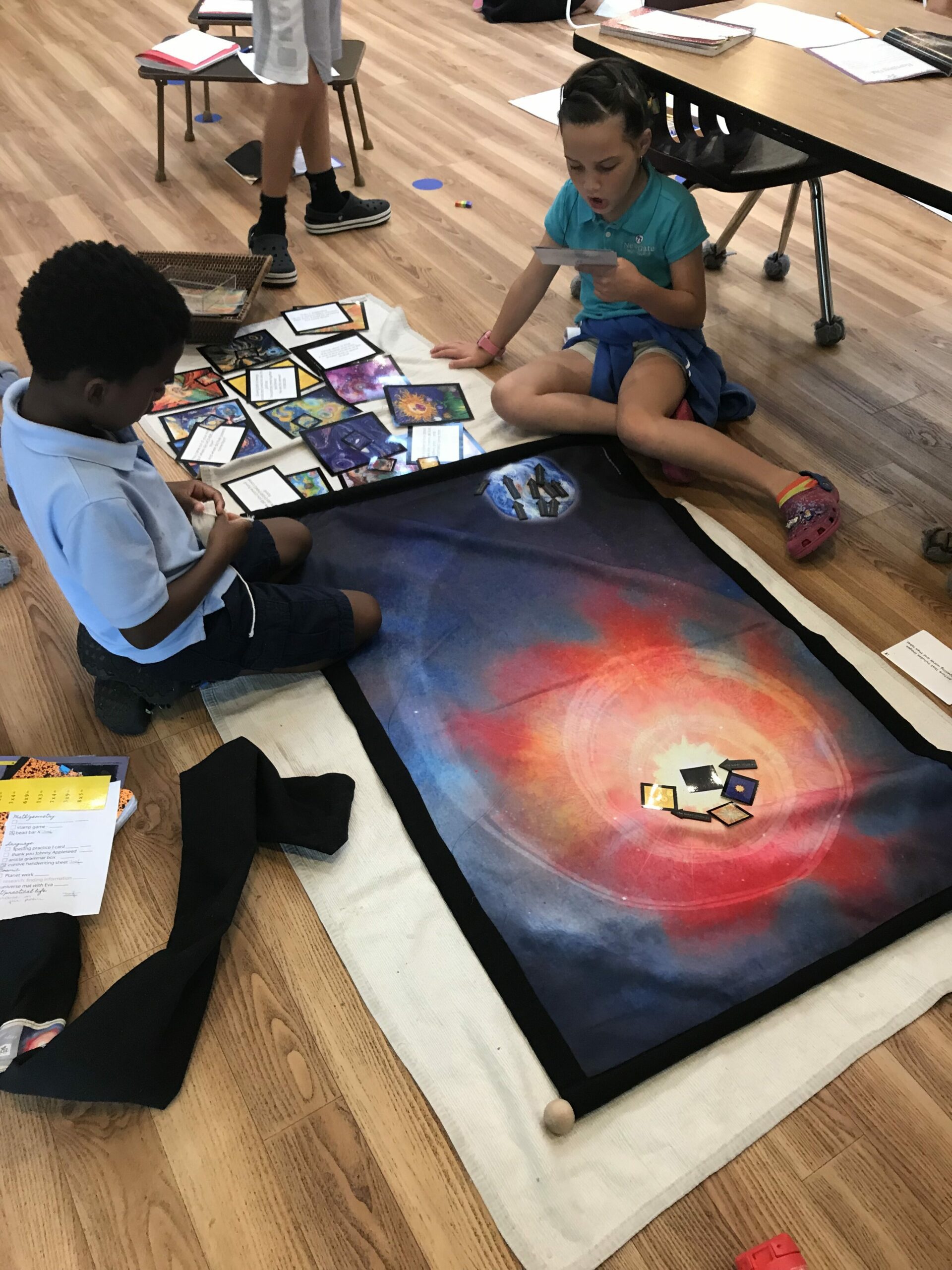
One of the key components of the Montessori cosmic curriculum is the use of what Montessori calls the “Great Lessons”. The Great Lessons are a classic element in the Montessori curriculum, especially during the elementary years, although we can introduce them even earlier and expand on them in the adolescent years.
Among other things, the Great Lessons are powerful and inspiring stories that are used to introduce children to the interconnectedness of all things in the universe. They are typically presented in a dramatic and engaging way, using storytelling, props, and hands-on science experiments and activities.
They are a set of five stories or lessons that are designed to ignite a child’s imagination and deeper interest in learning about the world around them. These lessons are an integral part of the Montessori curriculum and are typically introduced to children between the ages of six and twelve.
The five Great Lessons are:
1. The Story of the Universe: This lesson introduces children to the formation of the universe, the formation of the Earth and our solar system. This lesson and the follow up activities take a first look at the question of how the world began, different stories that people have told, and what scientists believe, in simple terms, about the Big Bang, formation of the stars, gallaxies, and solar systems, and how the Earth changed over the geologic eras setting the stage for life to emerge.
2. The Story of Life: This lesson explores the origins and evolution of life on Earth, including the characteristics of living organisms, the classification of living things, and the interdependence of all living things. Most children tend to be fascinated by dinosaurs. During the Second Great lesson, we helped them to understand how life evolved from simple organisms to the plants and animals that we see today. Learning about the fossil records, and the way animals changed over time and adapted to their environment is all part of this element of the overall curriculum. While the lesson is just the introduction, the ongoing study of biology continues throughout the curriculum in Montessori all the way through high school.
3. The Story of Human Beings: This lesson delves into the evolution of humans, including the development of language, culture, and civilization. Beginning with a broad overview of the evolution of modern people from our Neolithic ancestors, and how archaeologists have found evidence of the way people lived many years ago. Children are introduced to the fundamental needs that all human beings share, how we have met those needs in different parts of the world, early tools, and how civilization developed.
4. The Story of Writing: This lesson explores the history of writing, including the development of different writing systems and the role of writing in human communication.
5. The Story of Numbers: This lesson introduces children to the concept of numbers and their importance in human society, including the development of different number systems and the use of numbers in science, mathematics, and technology.
The Great Lessons are not simply stories that are told to children but are opportunities for children to engage in hands-on learning activities and explore their own interests and curiosity.
These lessons from the center of the elementary curriculum, with all areas of the classroom spiraling out from the Great Lessons. The Story of the Universe leads to science and geography. The Story of Life leads to the study of biology and zoology. The Story of Human Beings leads to cultures of the world. The Story of Writing leads to the language area. The Story of Numbers leads to mathematics and geometry. These five lessons lead to all the other materials and lessons throughout the six years of elementary and beyond.
By presenting these lessons in a way that is engaging and accessible to children, Montessori educators aim to inspire children to become lifelong learners who are passionate about exploring the world around them.
References
Sapiens: A Brief History of Humankind and 21 Lessons for the 21st Century by Yuval Noah Harari, Harper; Illustrated edition, 2015
The Deep Well of Time by Michael Dorer, Parent Child Press, 2016
Tomorrow’s Children: A Blueprint For Partnership Education In The 21st Century by Riane Eisler, Basic Books, 2001
Children of the Universe (An introduction to the Great Lessons), by Michael & D’Neil Duffy, Parent Child Press, 2016
Exercising the Imagination – Big Bang! Small Hands … Big Ideas! Creative Woodwork in Early Childhood Education
Millie (four) has a satisfied, radiant glow. She is admiring her work after spending two hours in the woodwork area, where she has been engrossed in constructing a bed for a princess. She used the hammer, hand drill, screwdriver, and a small pull-saw. It was a complex process, first designing, then making, adapting, and resolving problems as she went.
She had to adapt, and problem solve, using creative and critical thinking skills throughout; for example, cutting sections of wood so they would be the right size to fit. She joined the four legs but was disappointed to discover that the bed was wobbling. On closer examination, she realized this was because one leg was too long. The next problem was how to remove it, and then how to make it the right length … woodwork certainly throws up lots of problems! Millie finished by elaborately decorating the bed with beads and buttons, ensuring it was a bed fit for a princess.
Millie made a wonderful bed, but what was really ‘made’ was within Millie. Seeing her sense of agency flourish as she put her ideas into action and seeing her confidence grow as she mastered the tools were both clearly visible. We also know that by using the multitude of creative and critical thinking skills involved in the making, new neural connections and pathways will have been established. This is the wonder of woodwork. It can be truly transformational.
If you’re new to woodwork with young children, you may well have some initial concerns. But once some very basic health and safety measures are put in place, you’ll see that woodwork is low risk and makes a wonderful addition to early childhood programs. In this article, I’ll give some insight into the value of woodwork and provide some safety pointers for working with young children.
The value of woodwork
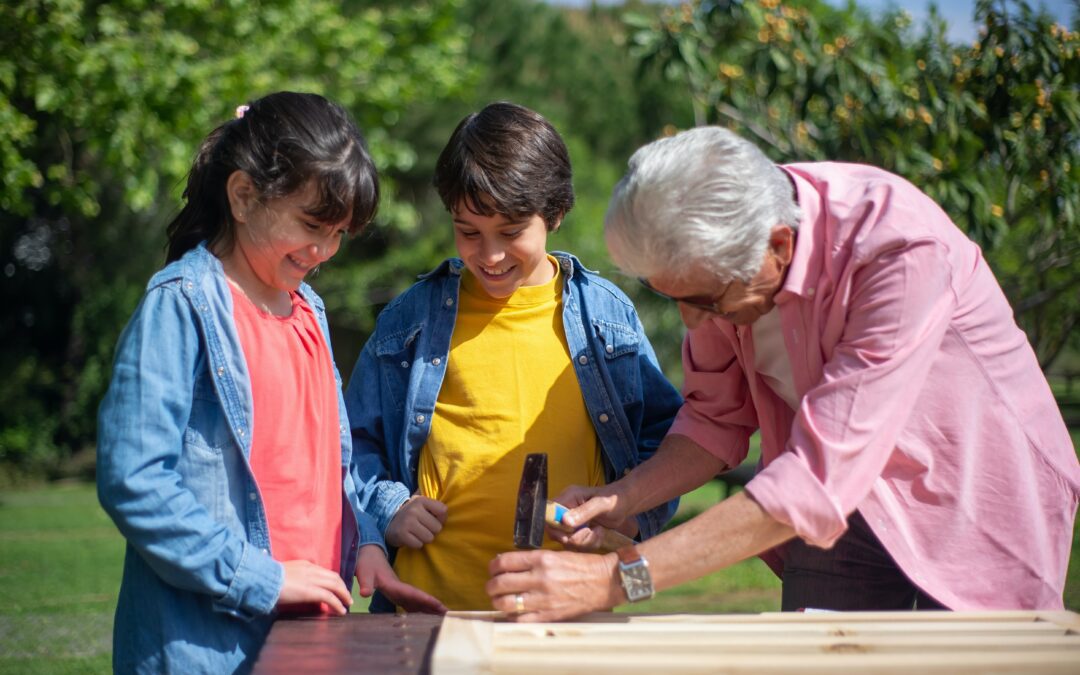
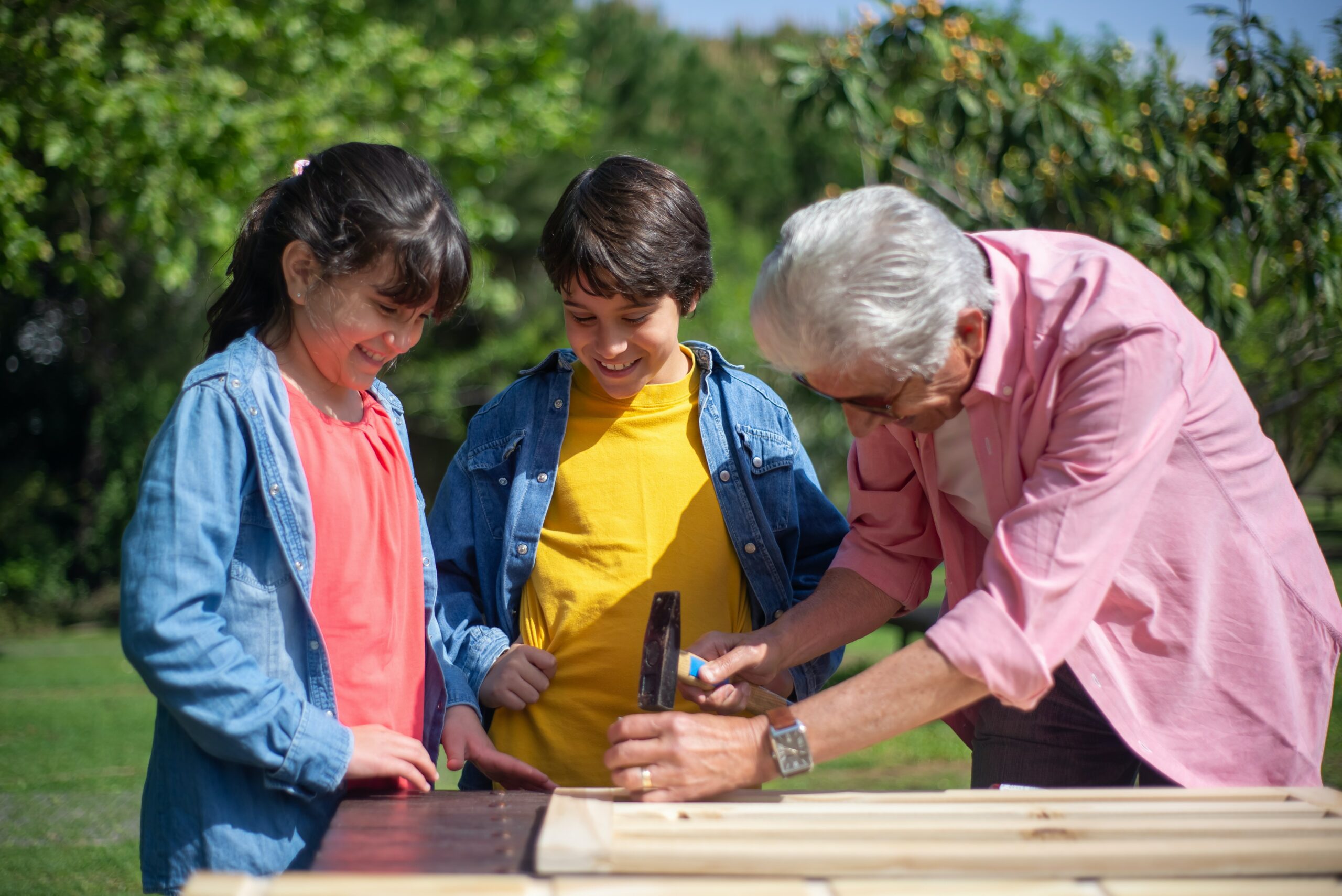
There is something special about woodwork. It is so different from other activities. The smell and feel of wood, using real tools, working with a natural material, the sounds of hammering and sawing, hands and minds working together to express their imagination and to solve problems, the use of strength and coordination all go together to captivate young children’s interest.
‘We observe children working with their hands, tinkering, constructing models, and working on projects but, in fact, the real transformation is inside the child – personal development is at the heart of woodwork.’
These are exciting times. Currently, around the world, we are seeing a surge of interest in woodwork within early childhood education, with examples from all corners of the globe. In some schools, this will be starting from scratch; in others, it’s a case of dusting down the workbench and digging out the tools after many years of neglect.
This is very welcome, as the benefits of woodwork run deep. Teachers who provide woodwork regularly observe exceptional levels of sustained engagement, with deep focus, concentration, and perseverance with challenging tasks — especially with complex problem solving. It is not unusual for children to spend all morning at the woodwork bench. Woodwork really engages hands, minds, and hearts.
When we analyze a woodworking session it is extraordinary to see just how much learning is involved. It’s truly holistic, encompassing all areas of learning and development and invites connections between different aspects of learning. In this sense, woodwork really can be central to the curriculum. It incorporates mathematical thinking, scientific investigation, knowledge of technology, a deepening understanding of the world, as well as physical development, coordination, communication, language, and personal and social development. This is evidenced by research from ‘The Big Bang Research Project’ for which the interim research findings are now available.
Children are particularly drawn in as they explore possibilities, rise to challenges, and find solutions. Woodwork is really unrivalled in terms of providing children with problem-solving opportunities and challenges. With woodwork, children can develop their learning at their own pace and find their own challenges. Once they have mastered basic skills, they move into open-ended exploration — initially tinkering, exploring possibilities, and then starting to make unique creations, drawing on previous experiences and their emerging knowledge of tools.
“The child who concentrates is immensely happy; he ignores his neighbors or the visitors circulating about him. For the time being, his spirit is like that of a hermit in the desert; a new consciousness has been born in him — that of his own individuality.” (Montessori, 1949, p. 273)
Sustainability
In terms of sustainability, woodwork helps counteract the current culture of ‘consume and dispose’ by introducing an understanding of the value of making and repairing. Children also discover how they can re-purpose materials by making models from a selection of recycled wood and other materials. In addition, the understanding of where wood comes from and seeing the beauty of wood can develop respect for the value of wood and inspire us to take responsibility for our shared environment.
Woodwork for all
To ensure equal opportunities, introduce the tools to all children so they all feel comfortable in the woodwork area. In that way, they can make an informed decision as to whether they want to choose to do woodwork. It’s important to acknowledge that there is often gender stereotyping around woodwork and sometimes an assumption that only boys will be interested. However, after an initial introduction, we notice no gender difference in who chooses woodwork. It’s hard to become what you don’t see, so support equality by having books with positive role models of girls and women using tools.
Woodwork captures children’s curiosity, and it has been particularly successful in significantly engaging children who may be less confident and have more difficulty focusing. Giving children a high level of trust and responsibility is empowering, and woodwork so often has been key to unlocking certain children’s learning and really building their self-esteem and confidence.
Establishing your own woodwork provision
Woodwork is perhaps one of the more difficult activities to offer. There is a fair bit of tools, wood, and other materials, such as: corks and bottle tops; nails and screws; sandpaper; safety glasses; and a workbench all need to be sourced. A sturdy workbench is essential as the wood being sawn must be clamped tight in a vice.
When it comes to your toolbox, only four tools are essential for children:
• Hammers
• Hand drills (manual, non-electric drills)
• Screwdrivers
• Pull saws
Having incremental progression is important in responding to each individual child’s stage of development and confidence. Avoid introducing too much challenge too soon.
Introduce the tools in small groups. For younger children, starting with a softer material such as balsa wood makes for a much more positive initial experience. Gradually, increase the level of challenge; start with small nails, and thin wood to join to blocks before slowly introducing a wider selection of wood sizes and larger nails.
As children gain confidence, woodwork can become a continuous project or be made available to larger groups at specific times. Continuous access gives children more choice and autonomy, but it only works well if you have enough resources, and children can go through a lot of resources fast! What is important is that working with wood is a rich experience, with enough resources to allow complexity in thinking.
Risk
If you have not done woodwork before, it’s natural to feel a little apprehensive! It’s easy to conjure up images of accidents with children wielding saws around! But those who have embraced woodwork find that it’s surprisingly safe. Woodwork is low risk when introduced correctly and basic safety measures are put in place. I have been providing woodworking for young children for over 25 years with no significant incidents. I would advise introducing woodwork from three or four years old.
We are now seeing a more balanced attitude to risk. Health and safety measures should enable children to experience new opportunities safely, not deny them. It is important that children get to experience risk within controlled experiences, as they need to learn to understand and manage risk. This way they learn to self-manage and make decisions and judgments to better protect themselves in the future. Giving children a high level of trust and responsibility is also empowering, and woodwork so often has been key to unlocking certain children’s learning and building their self-esteem and confidence.
Of course, health and safety does need to be taken seriously. After all, it is our prime responsibility as educators to ensure the physical and emotional care of our children. We need to put in measures to reduce risk, such as using the most appropriate tools and taking proper safety precautions.
Key Health and Safety
• Safety glasses must be worn at all times to eliminate the risk of eye injury. Children are more comfortable and are safer in safety glasses than chunky goggles.
• Ensure children are given instruction on the correct use of all tools. Take time to discuss safety together and draw attention to hazards. Children need to understand why health and safety measures are put in place.
• Monitor sawing with a 1:1 ratio. Ensure no children are watching from in front of the sawing area. The teacher should stand in this area to prevent other children from getting close to the saw. Pull saws (held with both hands) are easier and safer for young children. After use, the saw is to be put out of reach. Wood is always to be clamped in a vice when being sawn. An adult must check that the vice is clamped tight.
• Hammering follows gentle taps to get the nail standing up. Then hold the wood well away from the nail before hammering hard. Embed this practice right from day one.
• Be sure to check wood for splinters. We need to limit exposure to splinters. Avoid rough splintery wood. Sand the edge after sawing if rough.
• Children should be monitored at all times, initially with close supervision. When children are confident using tools, ratios can be relaxed and they can work independently, with the exception of sawing which is always done with a 1:1 ratio. A staff member should always remain within line of vision of the woodworking area.
Final thoughts
Woodwork is a symbolic language of shape, form, and space. It encompasses a way of working that develops over time as children express their ideas with increasing fluency and complexity. As children tinker and experiment and then construct, create, and explore narratives, these experiences can combine to build rich foundations for children’s healthy emotional, physical, and cognitive development. Woodwork can promote an experimental mindset, and, at the workbench, children ‘become’ innovators, makers, sculptors, tinkerers, engineers, and architects.
“As children make with wood, they will be learning skills that will empower them to shape their world.”
Woodwork is certainly a very popular activity and incorporates so much learning – a real win-win. It would be wonderful for all children to have this opportunity to flourish at the woodwork bench.
There’s something interesting that I’ve learned about children through Montessori, and it’s the incredible power of imagination for elementary children, not younger ones. Imagination is something we often attribute to small children. During preschool years we might say, “Look at how much they pretend!” For the elementary years, society expects rote learning of concrete facts; however, as Montessori parents, we recognize that it’s quite the opposite. Young children live in a concrete world and elementary children have boundless imagination.
Montessori Elementary: The Power of Imagination
Maria Montessori observed that small children in the First Plane of development were created to learn and absorb everything around them. From language to their culture, the littlest children are naturally drawn to the basic realities around them. They learn about these realities through their senses. Children in the First Plane manipulate the world around them to learn.
“Touching for the younger child is what imagining is for the older one. On the former age level, we would have worked on the Sensorial plane; as for the latter, we work on the level of the imagination.” Maria Montessori, From Childhood to Adolescence (p. 20)
But, once the Second Plane of development hits, the world and its possibilities explode. No longer are children limited by the experiences that they can absorb. They move into abstraction because they can imagine. They can understand things that they cannot possibly hold. They crave big, new, and grand impressions. Maria Montessori goes so far as to call this a “sort of sensory period for the imagination.” (From Childhood to Adolescence p. 22)
This is the age to give children more. It is the time to set their interests ablaze through supporting their imagination. It’s not the time for just facts, just math problems, just history, or just rules. They are more than that. They are people capable of making connections, seeing the big picture, and the abstraction of all sorts of knowledge.
“Human consciousness comes into the world as a flaming ball of imagination. Everything invented by man, physical or mental, is the fruit of someone’s imagination. In the study of history and geography, we are helpless without imagination, and when we propose to introduce the universe to the child, what but imagination can be of use to us? I consider it a crime to present such subjects as may be noble and creative aids to the imaginative faculty in such a manner as to deny its use and, on the other hand, to require the child to memorize that which he has not been able to visualize. These subjects must be presented to touch the imagination of the child, make him enthusiastic, and then add fuel to the burning fire that has been lit.” Maria Montessori, To Educate the Human Potential (p. 8)
Imagination becomes the driving force of learning. If we can spark an imaginative thought, Second-plane children can run with it. This isn’t mere fantasy; it is imagining solutions to real problems, imagining the vastness of the universe, and imagining the past. We touch the imagination, and we open the world.
Harness the Power of Imagination in the Second Plane
So, practically, what does this mean as a Montessori parent? This means you need to tap into the incredible powers of imagination for your elementary-aged child. We can’t rely as much on modeling expectations we want to see; we can’t hope they are going to observe us and want to follow along. No, we need to harness their imagination and use it to engage our child in their learning of both our family’s expectations and academic subjects.
> Introduce more fantasy in media: The second plane of development is the time to introduce fables, myths, and other fantasybased works of fiction. They love it all: big stories, other worlds, and the unreal. It all opens with incredible interest. Find your child’s love and go with it.
> Consider the Great Lessons: Even if your child isn’t attending a Montessori school, opening the world to elementary-aged children through these incredible stories can help unlock a love of learning. The great lessons can spark the imagination and provide context for what they are learning in school.
> Use stories to teach: Even if you must make them up, there is incredible power in helping your child make connections through a story. For the elementary-aged child, rules, morals, social manners, and values can be taught by engaging their imagination. When you’re able to do this, you spark a real interest and have a lasting impact on your child.
> Imagine with your child: Take time to imagine with your child. Things like, “What could the consequences be if XYZ happens?” or, “What could a solution to that problem look like?” Children can exercise their creative imaginative powers right alongside you.
> Ask for their help with issues: The imaginative power of elementary kids can lead to some very creative solutions and, some much happier participants, when they have a say in the solution to the problems that involve them.
> Give them time to play, imagine, and create: Playtime isn’t just for small children. Don’t rush your elementary kid away from open-ended toys, from creating, or from imagining. Don’t overschedule elementary children; make sure they still have time to play.
Montessori parenting is, at its core, about reaching, respecting, and responding to the developmental needs of our children and their unique paths. And, for children in the second plane of development, that is reaching them through the imagination.
An excerpt from Montessori For Every Family, published by DK Press, 2021
In most families, there are hobbies, interests, and activities that can be messy, need to be left in place to continue to work on later, or where special tools and supplies can be kept on hand and are easily found as needed. A messy space like this could be a spare room in your house, in the basement if you have one, or in your family garage.
It could be a craft and art studio for sculpting or making pottery or an area for woodworking with a workbench with tools arranged on shelves or hanging from a pegboard. It might be a room where you keep your paints and an easel, a photography or video studio with lighting and backdrops, or a space for tools to work on your cars or bicycles.
Keeping order in mind as you plan and organize the space is key to reducing frustration when you can’t find a tool you need or something you’ve just created gets knocked over. When there is clutter and disorder, accidents are more likely to happen and safety to be compromised. It also becomes more difficult to concentrate on the project at hand.
In a Montessori-inspired home, we want to think about what kind of space is needed for your interests or hobbies with all members of the family in mind. Your children are likely to want to be around you as much as possible, as well as needing a space where they can do the things that they prefer. So the idea is to think about the activities that your family members enjoy and consider which ones can be done in the same space.
Many families do not have a spare room, a basement, or even a garage that could be turned into a messy room. What are you to do then? Of course, everything depends on the ages and interests of your children, which may be very different from child to child, but the basic concepts remain the same. Our goal is to allow children to do activities that may be too messy to allow in their bedrooms, the kitchen, or the living room. When you live in a small apartment or home, you have to think outside of the box. You may make an exception to the general rule, and create a small area in the child’s bedroom where you lay down a protective heavy plastic covering on the floor and allow your child to paint, work with clay, glue models together, and other things using a washable covering to protect the surface of the kitchen table. The goal is to encourage children to feel that they can explore hobbies and interests while having your house (or backpack) become a mess.
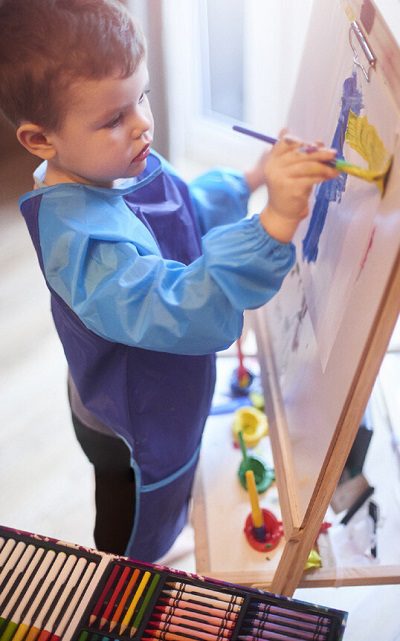
Real-life story: When Jennie first went to school, she was fascinated with the art materials in her Montessori class. She loved to paint and draw with the beautiful beeswax crayons and colored pencils that were part of the classroom environment. When she would come home, she would often ask her mom if she could have an art studio. Jennie and her mom bought her a set of simple water paints and brushes, a small tabletop easel, and a stack of water-paint paper. They set up a little art studio with tile on the floor that could be easily cleaned if any paint spilled. Mom also bought some picture frames made from matte board so Jennie could hang her favorite paintings. As time went by, Jennie moved from water paints to charcoal and pastels and finally tempera and oil paints. but her interest in drawing and painting never faded away. Today, Jennie has grown up and has a career in science, but she still enjoys painting and loves going to art galleries.
Real-life story: I started noticing my son’s school backpack was full of what I considered trash. Broken rubber bands, the inner ring from a roll of tape, bits of string, etc… for and he just said that he needed them. Then, I started noticing items moving from the recycle bin to his bedroom. Egg cartons, milk jugs, cardboard boxes of all sizes…..it was looking like a recycling center in his room. I would ask him what they were. He kept saying he “needed” it all, so I walked out, took a deep breath, and went with it when what I really wanted to do was put it all back in the trash and have a clean house! Then, one day, he emerged from his room with a giant “smoothie shop” that served all types of smoothies (made out of cardboard and “trash”). This shop was so amazingly detailed and each bit of “trash” served a thought-out purpose. He used amazing grace and courtesy to take our orders and serve us smoothies. We all drank some delicious smoothies that day, and I silently thanked all of his Montessori teachers for teaching me to follow his interests… even when those interests looked like “trash!” —Tara, mother of John 9 years old
Lorna McGrath, M.Ed., is Director of IMC School Accreditation, Program Director of the Montessori Family Alliance, and Senior Consultant of The Montessori Foundation. Lorna has 41 years of experience in the field of education, teaching children from 18 months through 6 years old and from 12 through 18 years old in both public schools and independent Montessori schools. Lorna is a Montessori teacher educator, conference presenter, and school consultant. She can be reached at lornamcgrath@montessori.org.
Tim Seldin is President of the Montessori Foundation and Chair of the International Montessori Council. His more than40 years of experience in Montessori education includes 22years as Headmaster of the Barrie School in Silver Spring, Maryland, his alma mater from toddler through high school graduation. Tim was Co-Founder and Director of the Institute for Advanced Montessori Studies and the Center for Guided Montessori Studies. He earned a B.A. in History and Philosophy from Georgetown University, a M.Ed. in Educational Administration and Supervision from The American University, and his Montessori certification from the American Montessori Society. Tim Seldin is the author of several books on Montessori Education, including How to Raise An Amazing Child, The World in the Palm of Her Hand, and his new book, Montessori for Everyone, co-authored with Lorna McGrath.
What is executive functioning and why is it important? What is meant by working memory, cognitive flexibility, and inhibition control? Do they matter? How can storytelling support and improve these abilities? Join Michael to answer these questions and then see how storytelling enhances and develops executive functioning, aiming at all three of these key abilities. This may be an essential approach to enhance executive functioning in young people. Please join us!!
NOTE TO THE READER: This page is a work in progress. I will continue to update it as I find more resources and information. Please email me at sharoncaldwell@montessori.org with suggestions and requests. Please also check out the Cosmic Education section in Links. Most of my favorite links are there and may not be duplicated in this article.
We must be careful not to fix the details of the Great Lessons so that they become so precisely accurate that they become mere catalogs of facts. The need to remain stories of inspiration. We as teachers need to be clear that these Lessons must set the children’s hearts and minds on fire. This is our first priority. As the children break off from the Great Lessons to do research, there they will find the facts. – Robyn – Montessori-L discussion Group
Theory of Cosmic Education:
The AMI elementary trainers are unanimous in saying that we should present all the Great Stories within the first 2 – 6 weeks of the school year and that there should be no follow-up work assigned. – John Snyder, Austin Montessori School. (in an email to Montessori-L discussion list).
If the children are not doing spontaneous follow-up work it means they aren’t inspired – the teacher must then work out why her lessons are not exciting the children. It is also OK if some children do not do follow-up work. They are hearing the stories and also hearing discussions that lead from them as the teacher continues to unpack the stories as the year progresses. The stories are not meant to “teach” factual knowledge but rather to evoke a sense of wonder and a deep appreciation of the interconnectedness of everything. They are intended to spark an understanding of the Cosmic Task of Man.
Cuevas, Eduardo J. G. Liberty: Spiritual Freedom and Moral Responsibility. 25th International Montessori Congress Papers.
Duffy, M & D. Cosmic Education in the Elementary Classroom, Parent Child Press, 2002.
Grazzini, Baiba Krumins, “The Role of the Disciplines for Cosmic Education”, Communications 2006/1, 64 – 74.
Hayes, Mary Montessori’s View of Cosmic Education, 25th International Montessori Congress Papers.
Hilson, Patricia. Laying the Foundations for Cosmic Education in the Child 3 – 6 Years.
Montessori, Maria. To Educate the Human Potential. – Especially important is the first essay: “The Six Year Old Confronted with the Cosmic Plan.”
ORIGIN OF THE UNIVERSE
Some Great Books to inspire extensions from First Great Lesson:
Wikipedia History of Earth is a good place to start looking for info.
The Authors, How To Create a Flawless Universe in Just Eight Days, Godfather Publications, No Location, 597b.
– Yes, this is a real book – but written with tongue firmly locked in cheek. 6 – 12s really enjoy it.
Parallel to the story of life you begin to explore Classifications/Taxonomy. Depending on the background of your students you can start off with simple “Who am I?” activities to extend exposure to the natural world – either using objects (shells, etc.) or model animals (must be realistic) or picture cards. With children who are reading, you can use “First Stories” which combine short descriptive paragraphs with names and pictures of plants and animals.
Bang, Molly and Chisholm, Penny. Living Sunlight: How Plants Bring the Earth to Life. Blue Sky Press. 2009. [Recommended by Priscilla Spears.]
THE STORY OF HUMANS
www.handprint.com – This is one of my favorite teacher resource sites, although older children enjoy it too. I love it especially because it highlights the hand-brain connection so integral to Dr. Montessori’s thinking.
Christ as the center of human history – see www.montessoriforeveryone.com for a free download timeline. The instructions include some interesting information on dating. NOTE: This is a resource developed by Montessori educators of that faith. The same strategies can be used in many other ways
The word “story” comes from the ancient Greek word “histor” and means literally “a narration from a learned man.” Since the beginnings of human time, noble men and women who had survived life long enough to be old would share stories of wisdom to all who would gather around the fire and listen. I say they were “stories of wisdom” because in the particular happenings they told about the hero survives by not being foolish. A great story told has always been the leading edge of personal communication for it is the sharing of a wisdom – a piece of common sense – a tale of selfless courage – a victory of the good — which can provide those who hear the chance to share in a life experience in a way that makes words come alive and practical advice about living become personal and truly experiential.
The problem in sharing wisdom with others is that the profundity – the complexity — of the human person makes every personal experience hard to express directly for often the truth within a human life is ineffable: “more than words can tell” as the saying goes when we are in love.
Such personal living is based on a felt experiencing that has more to do with the revelation of truth and beauty (or lies and chaos, or of the good and the evil, or of our deepest hopes and fears) than words by themselves could ever relate. And this is precisely what storytelling is all about. It must be a personal telling if it will have the power to uncover the “heart of the matter” for those who can hear. By telling the story one is able to share a human act on a much higher level of communication than just talking can, and that is so because storytelling is an art form, while mere blabbing is not. Coming to meet and know a life story gives one the opportunity to meditate on its reality and then to contemplate the storyteller ‘s personal communion with it measure for measure. Such a story is full of accessible wisdom.
The telling of a story from the storyteller ‘s heart/mind/soul imbues the saying with the magic inherent to every truly creative act. A story well told has the power to set imaginations aflame, to engage the listener ‘s feelings, to become a matter of life revealing life. The art of storytelling involves the storyteller filling the story with vitality. When the storyteller tells a story rather than merely reciting the cold facts, he or she recreates a human experience that has vibrant existence. When storytelling has vitality, it will reveal to those listening a life-reality with all its possible dangers together with all its hopeful victories – and also with the choices that must be met. As the ancient prophet has God say to a man: “I put before you life and death, my child. Choose life. ”
The prophetic revelation of the storyteller is always brand new news — even if that means newly seeing something that has been there around the listeners a long time without them coming to know about it really. So the storyteller is a modern day prophet who stands up before a crowd and proclaims a story that says: “Once upon a time, a man had to make a choice because he was free to choose. This is what he did. This is what happened. ” Within such a listening, one is deeply touched by the act of deciding and feels the decision was made for all mankind. The listener in a secret, deep way lives the consequences of the hero ‘s choice and within the sacred place of conscience actually weeps or rejoices over it. “Did the hero choose wisely or foolishly? What would I choose if such a choice came to me? ” From such an encounter, wisdom is gained – and with the story, a way has been found to share such wisdom with others.
The primary problem to overcome by anyone moving to take the first steps toward becoming a storyteller is how to move away from the strong habit of conceptualization (surface-thinking) which our past schooling has laid on us all. We are in the habit of looking at a “tree” as a noun, as an abstraction. There are no inch worms on its juicy leaves – no squirrels scurrying up its trunk – no man sitting in its shade thinking, resting, soon to get up and return to work. No in our schooling we are introduced and kept focused on the noun “tree ” which had no real living going on – and so Montessori suggests to the child to place a black triangle shape over it like a tombstone. A tree is a tree, is a tree (to hint at Gertrude Stein ‘s insight) and the mental presumption of sameness obscures us from the innate gift of intuition that here is life with all its wonder happening gloriously right there before us. Perceiving living trees and all the living going on within their noble company through the myriad seasons is the life spark of religious experience and the blossoming of our inner life where music is felt and art created and is the communion that is knowing becoming loving care.
The path to becoming a storyteller requires us to develop in our daily life a new habit of being aware of our immediate and direct experiencing. We have to become attentive to the concrete in the here and now – and to become aware at the same time of the meanings – the connections – the implications — existing within the “thing ” we are experiencing.
To experience human life in such an existential manner we must become like the experiencing child – or like the alert native walking off trail moving through a primeval forest so keenly sensing everything out there, above him, around him, and under each stepping foot. To be able to do this, we each must stop being a “somebody” and begin to become for that time of observation a “nobody.” By that I mean, being a “somebody” is when you are focused on yourself — on your cortex thinking – on ideation rather then on the ongoing experiencing of what is there outside of you with all its existential reality. Being a “nobody ” is when you are so focused on observing the other that you are no longer conscious of your self but completely taken up in the taking in of what is there in all its immediacy – there dragging its past, showing its present, and so obviously leaning into its future. This “nobody, ” philosopher ‘s teach, is our soul ‘s “I ” which is able to experience truly with humility and disinterest and is open enough to meet the other as a “thou ” – and so perhaps to connect personally enough to commune with this other being – becoming for that time a mutually beneficial “we. ” It is when the artist before the stretched canvas or the athlete on the cinder track, or the child at play or the native in the deep forest becomes such a “nobody ” that instinct and body knowledge and intuition and creative genius take over and accomplish truly wonderful deeds.
The tragedy is that such existential experiencing was so naturally ours when once we were babies and little children – when we all were “little Indians ” — before our schooling caused us to be almost always completely distracted by thoughts and so hindered from experiencing our experiences. Our schooling did not reward intuition or creativity or any other jazzy human act. Too interested in the products of their teaching – the ability to do the times table thoughtlessly – the ability to remember without a shudder of horror the date in Civil War history when thirty thousand young men died in bloody battle – the ability to copy and copy correctly paragraph after paragraph of their chalk written notes on the big black board without ever being given the opportunity to compose anything of our own, to be creative –no, our teachers were trained to be solely interested in the testable products of their teaching. And because of this regime of mass teaching, our teachers were too uninterested in what was going on there within us where the authentic organic life of our truest selves reigned in a so hidden kingdom. They were more interested in teaching us something. They would have us skip over the beginnings and put our energies on the finished work — not respecting the primacy of the sacred ground that personal experience of a truth is for all people.
So what are we to do? Here is Montessori ‘s answer: Bring everything to the children “indirectly ” through a storytelling that reveals to their deepest knowing the challenge, the truth, the meaning that lies hidden within. Storytelling is the only way. Storytelling has the power to give the experience of that which is ineffable — that given reality of another which can never be put into words but only can be captured in the life of the telling – in the drawing – in the music – in the dance – in the story. Sharing such a given causes a communion to take place between us, the educators, and them, the listeners sitting right there before us. The magic comes from the fact that in the act of storytelling we ourselves return to innocent experiencing, to that primeval connecting with others sitting around the fire that alone is the sacred place of wisdom sharing. To become a storyteller we must first of all be gloriously alive–alive to ourselves–alive to all that is going on around us–alive in our seeing, hearing, touching. The sure sign that we are becoming the storytellers we need to be will be found in the pure fact of this happiness of our being alive.
Storytelling every “academic subject ” with the children enables us to possess and share with them every aspect of human life in a timeless experiential way that has wisdom at its core. Once the story has had its way with them, they are ready to work and to make all their learning a personal, self-motivated act. The profoundly personal sharing that is storytelling is the beginning of wisdom for children — and is the wellspring of human compassion without which knowledge is soulless and without purpose. Without wisdom and human compassion, knowledge is pernicious. So of all the skills we must master in our craft as Montessori educators, the art of storytelling is primary.
Do you often separate scientific topics from artistic or creative ones? Do you think of the study of science as different from the study of literature and art? Cynthia will guide us through a discussion of how scientific topics can relate to and inspire artistic and creative pursuits. She will include ideas for outdoor and indoor activities that bridge these connections, touching on observation, nature journaling, classification, and more. Cynthia will suggest creative writing activities and also recommend several exciting resource books.
Dr. Angeline Lillard presents Maria Montessori’s key insights about childhood education, the subsequent educational research that has validated her approach, and how these ideas are implemented in a modern Montessori classroom.
When you embody the story, when you can feel excited and curious and delighted, the child cannot help but be brought in, too! All you need is a little bravery and a good helping of enthusiasm. Join Caitlin Roper for some wonderful,important tips for great story telling.
Have you ever thought about allowing your 3-6 year old to use real tools and wood to create sculptures or toys? And then were your next thoughts, “Oh no. It’s too dangerous,” “She’s too young,” or “I have no idea where to start.” If any or all of those things have gone through your head, then this session is for you! Presenters Regina Abraham and Lisa Stearns, both from Summit School, Phoenix, AZ, love to do woodworking with their children at school and are happy to share how, what, why, and where with you. Join us for some practical information and advise.
In this session Sue Fitzpatrick discusses each of the six interconnected components of STEM that in 2016 the US Department of Education described as key to putting the program into classrooms. She gives actual photos and examples of Montessori students in action for each of the components. Participants will go away with lots more information about STEAM and a better understanding of its goals and how it fits with Montessori.
What kinds of life skills will your child need to be successful – happy, healthy, and productive – in the 21st century? Beyond facts, figures, and formulas, what will young people need to know to find their way and make their mark in a world which increasingly demands higher order thinking, social intelligence, and self-organizing abilities? In this workshop for parents Jonathan Wolff, international Montessori consultant, teacher and school leadership educator, will illustrate how the Montessori Method not only produces capable scholars, but more importantly, empowers young people to think for themselves, think of others, and think out-of-the box.
This book might as well be glued to your hands because it is so suspenseful that it is practically impossible to put down. The Hunger Games by Suzanne Collins will take your breath away with all of its action and suspense. The story follows Katniss who nominated herself to fight to the death in an event called the Hunger Games. The story starts out slowly then quickly hurls you into a literal and metaphorical firestorm of action. Once you get to this point, you will find it very hard to put the book down as you see people getting knocked out one by one.
I could not believe that no matter how fast-paced and action-packed the book got, it still conveyed meaningful messages about family, honor, and loyalty. Some of these messages found in the book include if your work as a team could determine your likelihood of survival and dying with honor would beat a life of hatred. The overarching theme of this book seemed to be that family always comes first and can be worth risking your life. The biggest example of this theme takes place in the very beginning of this book where Prim, Katniss’ little sister, got chosen at random to participate in the Hunger Games. Out of devastation Katniss came forward and took her sister’s place with little hesitation.
I really enjoyed reading this book because it always kept me guessing about what would happen next. Just when I thought I knew exactly what would happen, everything seemed to flip upside down and the exact opposite would happen. I also appreciated the book’s use of detailed imagery to paint vivid pictures of the events taking place in the mind of the reader. A perfect example of this is in chapter 22, where the author wrote, “The sound of rain drumming on the roof of our house gently pulls me towards consciousness.” (285) This quote not only creates an image, but it gives you auditory feedback as you read it.
I disliked only a few minor things about the book. If I could change one thing about the book, I would give more details about how a certain character died. I liked the part of the book, however, when Katniss has a run in with Thresh. I enjoyed this part the most because it feels like an explosion of chaos, bloodshed, and action. Because of the violence, I would recommend this book to anyone in middle school and up.
Overall, I really liked The Hunger Games because of its constant action and suspense. I would recommend this book to anyone who enjoys fast-paced adventure novels. I would rate this book 5 stars because, after the first 50 pages, it never has a boring moment.
Do you ever question or are asked, “How do STEM and Montessori overlap?” or “Should I choose a STEM or Montessori school for my child?” We’ll take a look at how Montessori incorporates STEM philosophy, and what you can do next.