by Paul Epstein, PhD | MFA, Montessori Education, Montessori Family Life, Montessori Parenting, Montessori Teachers, School Resources
The educator must be as one inspired by a deep worship of life, and must through this reverence respect … the development of the child’s life.”
On January 6, 2017, we celebrated the 110th anniversary of the opening of the first Montessori school. What’s remarkable is that few educational movements persist this long, and even fewer contribute as effectively to today’s urgent need to reform education and school practice. Successful living in our digitized world requires a different approach to how and what children learn. Education based on memorization can no longer adequately ready children for today’s ever-changing, unknown future. Memorization teaches compliance and how to forget. In an ever-changing future, digitized information is immediately available and voice accessible. What’s imperative now is learning to think, inquire, understand, adapt, innovate, and more.
This describes partially what children learn in Montessori schools. But children develop more because Montessori pedagogy builds upon essential truths regarding the purpose of childhood and the necessary role of adults to guide children to fulfill that purpose. Dr. Maria Montessori understood the child’s purpose when she wrote, “[Childhood] constitutes the most important element in an adult’s life, for it is in his early years that an adult is made …. Whatever affects a child affects humanity, for it is in the delicate and secret recesses of the soul that an adult’s education is accomplished.” 3
Soul is seldom discussed in education reform today. Reformers focus instead on achievement. According to them, we should live in a world of high stakes testing. Political leaders agree, and they believe children’s test scores should assess teacher performance: the better the teacher, the better the test scores. These leaders also believe that children’s test scores represent more than learning. They believe test scores predict a nation’s economic future. And, they believe that parents believe and want this too.
Despite such rhetoric, children are designed for a different education. The purpose of their childhood is not to improve test scores; the purpose of their childhood is not to improved their performance. The purpose of childhood is to become the adult you are meant to be. This means know yourself. This means develop habits of persistence and speak fluently the language of compassion and empathy. This means identify and pursue a purpose that, larger than yourself, contributes mightily to life quality.
A teacher’s work in the testing regime is difficult. The work of a Montessori teacher is even more so. In addition to mathematics, science, history, languages, the arts, physical and health education, Montessori guides assist children with becoming adults. This is a whole person education. Montessori defined serving each child’s soul as the work of the Montessori guide.
Without doubt we are making a profound change in the type of teacher. She becomes a person who, besides acting, observes the person. Her virtue consists in never interrupting the work of the child, but, at the same time, giving help where she sees that help is necessary …. One might say that she is serving while she is directing this class of children.4
This understanding of childhood and education changes the work of a teacher and parent. Knowledge of child psychology and subject information is needed, but these are not enough. In an education in which soul matters, adults do not teach. In support of each child’s inherent purpose to grow and become, the essential role of the adult is to love, observe, understand, accept, guide, and not control. The essential role is to understand and know how to serve life. Montessori defined the purpose of serving: “We must help the child to act for himself, will for himself, think for himself; this is the art of those who aspire to serve the spirit.”5
To Guide
Montessori guides attend to the whole child: their physical, social, emotional, cognitive, and spiritual development. Montessori understood that “the concept of education centered upon the care of the living being alters all previous ideas. Resting no longer on a curriculum, or a timetable, education must conform to the facts of human life.”6 These facts are astonishing: No two children (or adults) learn in the same way or in the same amount of time.
Montessori guides do not dispense information. We share a conviction that adult success in life is directly tied to the degree to which adults experienced themselves as capable, independent children. When we guide, we assist children to discover and develop their unique capabilities. A goal is to help each child become independent and self-reliant. Our mantra is, never, ever(!) do anything for a child if, instead, you can show them how to do it for themselves.
It is not we who teach [the child]. This child can run, walk, talk, and notice tiny little things. He has done it all by himself. It is not we adults who have done it for him …. We cannot be teachers but we can help children, and our work must be to render this tremendous work of exploration which he carries out, easier. We must try to prepare for him a suitable and favourable environment. We must be persuaded that we are humble people who cannot do anything but witness this enormous capacity for self-development in the child. 7
We understand that the real work of becoming belongs to the individual child. The art of guiding requires focusing on the needs of the child and discerning how each child learns. Each child is respected and treated as a unique individual learner who learns optimally at her own pace and style. Rather than merely require right answers from children, we guide children to ask questions, think for themselves, explore, investigate, discover, develop their natural love of learning, and come to their own conclusions.
We routinely seek to understand each child’s strengths, interests, and challenges. The art of guiding requires discovering how to personalize each lesson so that a child becomes engaged in discovery and investigation and is challenged to reach for more. Placing the child first, Montessori wrote, is transformative and requires “a fundamental change of outlook.”
The basis of this preparation consists in going through a fundamental change of outlook. The teacher needs to acquire a deeper sense of dignity of the child as a human being; a new appreciation of the significance of his spontaneous activities; a wider and more thorough understanding of his needs; and a quicker reverence for him as the creator of the adult-to-be. 8
Personal Work: Spiritual Preparation
To make a “fundamental change of outlook,” we commit to continuous personal work. We prepare through rigorous self-study. We prepare for the child rather than prepare the child for us. This work is spiritually transformative and purposeful. Our purpose is to “assist the psychic life of children.”9 Again, we learn how to show children, how to guide them to fulfill themselves. We learn to see and accept each child without judgment and evaluation. To accept each child, we must first learn to accept ourselves.
[The] object of the schoolmaster is man himself; the psychical manifestations of children evoke something more in him than interest in the phenomenon; he obtains from them the revelation of himself, and his emotions vibrate at the contact of other souls like his own.10
Montessori challenges us to reach within and remove personal obstacles which could prevent our being fully present to each child. These personal lessons, Montessori wrote, transform us. Our personalities and character include patience and a mastery of our own will. We become more respectful and kind. “Kindness,” Montessori noted, “consists in interpreting the wishes of others, in conforming one’s self to them, and sacrificing, if need be, one’s own desire.11 Children, and not test scores, come first.
Our process of personal transformation begins often with humility; we accept the essential influence of children. They educate us; we learn from children. “Our social mentality,” Montessori wrote, “has not grasped the idea that we can receive help from the child, that the child can give us a light and a lesson, a new vision and a solution for inextricable problems.”12
In addition to humility, Montessori asks us to overcome pride, diminish avarice, check anger, conquer prejudice, control loose conduct, and eliminate envy. Montessori understood well that this is difficult and demanding work. But failure to do so, Montessori observed, limits our ability to understand ourselves and guide the child.
To truly see children, we must, Montessori wrote, “remove the accretions of years that prevent us from really understanding children and acquiring an intuitive knowledge of their souls.”13 This involves identifying erroneous beliefs and conclusions about children removing our biases and prejudices that are based on those incorrect beliefs. We must understand that the mind of a child is not empty; children are not waiting for us to fill them through our teaching. Such beliefs, Montessori wrote, negatively impact and interfere with children’s development.
[Adults] look upon everything pertaining to a child’s soul from their own point of view and, consequently, their misapprehensions are constantly on the increase. Because of this egocentric point of view, adults look upon a child as something empty that is to be filled through their own efforts, as something inert and helpless for which they must do everything, as something lacking an inner guide and in constant need of direction …. An adult who acts in this way … unconsciously suppresses the development of the child’s own personality.14
Adults too often believe their role is to do everything for children. But children do not need adults to correct or even guide all the time. “Never,” Montessori declared, “has anyone been so completely and utterly dependent on another as the child is on the adult.”15 Adults, charged with insuring a child’s safety, decide what young children will eat, when they will eat, what they will wear, when they will change, what they will do, where they will go, how long they will stay, and still more. Adults may “mean well,” but these traditional beliefs and decisions thwart and block the child’s normal process of becoming. An incomplete psychic—cognitive, emotional, and spiritual—development occurs.
Montessori asked adults to consider that their unexamined beliefs truly impede the child’s development.
This is a question we must face. Have we helped the child to develop, or have we impeded the child’s development, or even diminished it? Which have we done? It is certain that even if we hinder the child, such a power of self-development exists in the child that he still develops pretty well. Yet, still, we must ask ourselves: have we helped or hindered the child’s self-development? This is the question and the problem.”16
To guide, we must be willing to be guided. We must understand children and ourselves spiritually. Instead of choosing to control, choose the profound relationship of unconditional love. Instead of treating children as one and the same, respect each individual child and know how to guide her to self-fulfillment.
Footnotes:
- This essay is an excerpt from Paul Epstein’s forthcoming book, Maria Montessori: In Her Own Words.Maria Montessori.
- The Montessori method, pp. 104-105.
- Maria Montessori. The secret of childhood, p. 4.
- Maria Montessori. The California lectures of Maria Montessori, 1915, p. 61.
- Maria Montessori. Education for a new world, p. 69.
- Maria Montessori. The absorbent mind, p. 12.
- Montessori. Creative development in the child, p. 38.
- E. M. Standing. Maria Montessori. Her life and work, p. 298.
- Maria Montessori. The secret of childhood, p. 12.
- Maria Montessori.The advanced Montessori method–1, p. 106.
- Maria Montessori. Dr. Montessori’s own handbook, p. 133.
- Maria Montessori. The formation of man, p. 31.
- Maria Montessori. The secret of childhood, p. 5.
- Maria Montessori. The secret of childhood, p. 16.
- Maria Montessori. Basic ideas of Montessori’s educational theories, p. 2.
- Maria Montessori.The California lectures of Maria Montessori,1915, p. 34.
References:
- Montessori, M. (1967/2000).Basic ideas of Montessori’s educational theory. Lawrence Salmon, Trans. Oxford, England: Clio Press.
- Montessori, M. (1939/1994).Creative development in the child. Volume One. Madras, India: Kalakshetra Publications.
- Montessori, M. (1914/1965). Dr. Montessori’s own handbook.New York: Schocken Books.
- Montessori, M. (1949/1999). Education and peace. Oxford, England: Clio Press.
- Montessori, M. (1989). Education for a new world. Oxford, England: Clio Press.
- Montessori, M. (1949/1994).The absorbent mind. Oxford, England: Clio Press.
- Montessori, M. (1918/2004). The advanced Montessori method-1. Oxford, England: Clio Press.
- Montessori, M. (2008). The California lectures of Maria Montessori, 1915.
- Collected speeches and writings. R. G. Buckenmeyer, Ed. Amsterdam, The Netherlands: Montessori-Pierson Publishing Company.
- Montessori, M. (1955/2003). The formation of man. Oxford, England: Clio Press.
- Montessori, M. (1912/1964). The Montessori method. New York: Schocken Books.
- Montessori, M. (1972). The secret of childhood. New York: Ballantine Books.
- Standing, E. M. (1957/1962). Maria Montessori. Her life and her work. New York: Mentor-Omega Books.
Tomorrow’s Child / May 2017 / p 7
by Lorna McGrath | MFA, Montessori Education, Montessori Family Life, Montessori Parenting, Montessori students, Montessori Teachers, Video
Student Demonstration Night provides students with a platform to share their favorite classroom materials and spend time connecting with their parents in a new way.
At the Montessori Foundation, we encourage schools to offer Student Demonstration Night at least once or twice a year, usually in the fall and spring. Some schools call it Parent Night. We like to call it Student Demonstration Night because it better describes the event. This time is designed to allow parents (and/or another adult) to come to school to be with their child in the class for about an hour. Although parents do not have to stay for the whole hour, they usually enjoy focusing on their own child and spending time together. It’s more of an open-house atmosphere, rather than a class meeting or typical parent-education experience. If a parent can’t be present, an aunt or close family friend might come to be with the child.
Some schools like to use time during the school day for student demonstration. Other schools like to offer meetings in the evening, hoping that this will be more convenient for working parents, who can’t easily come to school during the day. Also, with so many parents in the room, a Student Demonstration event can be over-stimulating and might disrupt the rest of any typical school day. Still, other schools invite parents and students to come on a weekend.
At Student Demonstration Nights, the students become the teachers, demonstrating materials to their parents, as if they were the teachers and the parents were the students. Parents see how enthusiastic their child is about showing them the material—whatever activity it happens to be—from plant care to square roots.
Often, the Montessori guide will help the students (especially the younger ones) pick two or three activities that they really would love to share with their parents. With older Primary and Elementary-age students, the guides normally don’t have to do as much of the planning and preparation, because these children are much more self-directed. They have been in Montessori for some years, and they have experienced Student Demonstration Nights before, so they don’t need quite as much coaching as the little ones.
Maybe it’s math or maybe it’s practical life, or perhaps they will share a science or geography lesson. Little children get really excited about certain activities and, for parents, it’s such a great opportunity to see what their children are learning. We always encourage parents to appreciate that this is a time to be with their children, to see what they are learning, and to see how much they know.
Elementary-age students usually do their first demonstration in a way very similar to Demonstration Nights for the early childhood class. They choose the activities that they want to present to their own parents. The student and the parents stay together for the entire time. Later in the year at the spring demonstration night, the students are ready to go on to the next challenge: presenting materials to adults other than their parents. Guides will often ask each student to pick one or two lessons to demonstrate not only to their own parents but to others attending the Demonstration Night. In this way, parents rotate around the room to different students.
For example, if I were a student, I might choose to demonstrate the Checkerboard Material to my own parents first. Once my parents were finished, they would move on to another student in my class and learn another lesson (maybe the Timeline of Life), while I continue to demonstrate the Checkerboard to a classmate’s parents or a grandparent of another student in my class.
Students get to demonstrate a Montessori material to many adults. That’s really empowering for students because, for that time, they are the experts on the materials. They are very proud of themselves for being able to demonstrate and able to answer questions; it’s a very different experience than students demonstrating only to their own parents. They know that their own parents love them and are going to be very excited about whatever they do. They don’t know that somebody else’s mom or dad or grandma or grandpa are going to be excited about what they do. So, it gives them a really different experience.
We don’t do Student Demonstration Nights with toddlers since they are usually in bed or sitting down for dinner at that time of night, and most toddlers would never be able to handle having all those grown-ups and their parents in the classroom. We start at age three with the Primary (Age 3 to 6) Class and we move through the Elementary years.
I was talking to a parent of an Upper Elementary child recently, and she mentioned that she used to get so excited and was so enthusiastic about going to Student Demonstration Night when her children were younger. But now that her child is in Upper Elementary, she found that it’s not quite as exciting. However, she said, “I’m going to go tonight because my Upper Elementary child really wants me to be there. He’s made a commitment to his class to demonstrate a particular piece of material, and he’s very excited about keeping his commitment. He wants me to be there to see him and his classmates take part in it as well. So, I will be there.”
At the Montessori Foundation we highly recommend that schools give their families the opportunity to experience Student Demonstration Night. There’s no better experience for a parent than to see their own child being enthusiastic about learning and working with the amazing materials that we have in Montessori classrooms. Parents really get some new insights into what their child knows and how well they present themselves in this front-and-center type of situation. This is another powerful way for parents to see what and how their child and other students are learning in our Montessori classrooms.
Tomorrow’s Child / January 2017 / p15
by Joyce St. Giermaine | MFA, Montessori Education, Montessori Family Life, Montessori Parenting, School Resources
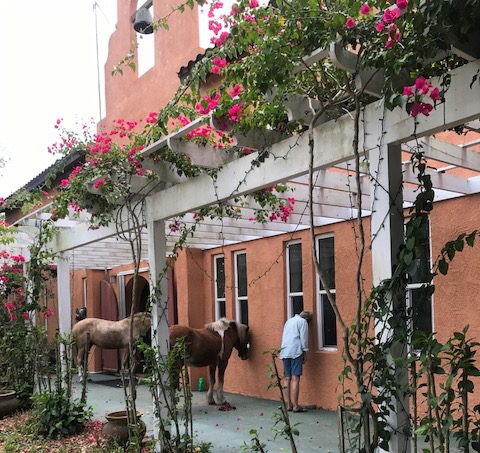
Figuring that the horses must know something … Joyce takes a break from creating the Montessori Family Alliance website!
If you are receiving this issue from your child’s school, you are already a member of The Montessori Foundation’s Montessori Family Alliance (MFA) … even if you don’t know it. Individual subscribers are also members.
What does Alliance membership get you? Actually, quite a lot … with more information being added every day.
The Montessori Foundation’s staff is busy culling through more than twenty years of Tomorrow’s Child, Montessori Leadership, leadership workshops, webinars, and parenting, and resources, samples of school advertising and administrative forms, videos, audio recordings … basically everything we have ever done.
It goes something like this. Cut. Paste. Proof. Add graphics. Label with titles, categories, authors, Montessori materials, lessons, book reviews, name of publication, month, year, volume, issue, page. Then index and cross-reference everything. Whew! This really is BIG work!
When we are done (well, done enough since it’s an ongoing process), we will have one of the largest archives of all-things Montessori for educators, parents, and anyone who wants more information about Montessori. Yes, membership is required but it’s also included for all school families who receive standing bulk orders of Tomorrow’s Child … and that is just one more good reason for schools to order.
In the hiatus of our May and September issues, be sure to watch for our July digital issue. It is soooo much more fun to create than a paper issue, and we hope you will enjoy it. Digital for us does not just mean an electronic version of the magazine; it’s an interactive issue that includes videos to watch, webinars to listen to, and direct links to products and services that are of interest to Montessori administrators, teachers, and parents. We even plan to have projects and educational fun stuff for children of all ages.
This is all part of what you and your school’s families receive as members of the Montessori Family Alliance.
I’ll let you in on my not-so-secret hope for the Montessori Family Alliance. I want it to be the go-to interactive app for everyone involved in Montessori in schools and at home. Eventually, I want it to include Tomorrow’s Child and Montessori Leadership as digital publications. Not only would it save a lot of trees, it would also save us printing and mailing costs and allow us to hire more Montessori writers, artists, and educators to make our publications even more interactive and exciting. I want to see thoughtful articles, fun vocabulary-building challenges for children of all ages, weekend projects for families, and so much more.
I want to see something new every day that delights adults and children and is something to look forward to when we have those precious few free minutes to engage our sense of belonging to something bigger and better that we can share with other like-minded people who understand that raising children the Montessori way is a win-win for all of us. And for our world.
Yes, it is BIG work, but if it were easy everybody would do it.
Happy summer vacation to our schools in the northern hemisphere.
Tomorrow’s Child / Jan2017 / p 5
by The Montessori Foundation | Family Resources, MFA, Montessori Family Life, Montessori Parenting, Webinars / MFA
Kathryn Kvols, Kathy Leitch, and Tim Seldin. Duration 52 minutes.
It starts with who gets to use the bathroom first, then it is someone looked at the other person the wrong way at the breakfast table! The arguing continues as they fight over who gets to lock the front door! For some parents, it feels like the fighting will never end.
Quarrelsome behavior drains everyone’s energy and can try the patience of the most peaceful parent! In this webinar you will learn:
1. When it is important to intervene and when not to.
2. What you may doing to inadvertently increase sibling rivalry.
3. Tools to help your children resolve their own conflicts.
by Sir Ken Robinson | MFA, Montessori Education, Montessori Family Life, Montessori Parenting, Montessori students, Video
In this acclaimed TED Talk, Sir Keneth Robinson makes an entertaining and profoundly moving case for creating an education system that nurtures (rather than undermines) creativity.
http://www.ted.com/talks/ken_robinson_says_schools_kill_creativity?language=en
by Tim Seldin | MFA, Montessori Education, Montessori Family Life, Montessori Parenting, School Resources, Video
In 2013, Trevor Eissler challenged the Montessori Community to prepare 60 second elevator speeches to explain Montessori in a nutshell. Here is one done on the spot by Montessori Foundation President, Tim Seldin. There are several videos in the series that we have included in the members’ library.
by Hermosa Montessori School | MFA, Montessori Charter Schools, Montessori Education, Montessori Family Life, Montessori Parenting, Montessori students, School Resources, Video
In 2013, Trevor Eissler challenged the Montessori Community to prepare 60-second elevator speeches to explain Montessori in a nutshell. Here is one done by the Hermosa Montessori School, a Montessori Charter School in Tucson, Arizona. There are several videos in the series that we have included in the members’ library.
by Clark Montessori School | Adolescence, Later Adolescence (15-18), MFA, Montessori Education, Montessori Family Life, Montessori Graduates, Montessori Parenting, Montessori students, Montessori Teachers, Video
19 Montessori High School Seniors Reflect on Their Education
Filmmaker Erick Johnson recorded seniors at Clark Montessori High School in Cincinnati, Ohio USA
by Tim Seldin | Family Resources, MFA, Montessori Education, Montessori Family Life, Montessori Parenting, Montessori students, School Resources, Video
This is a talk given by Tim Seldin at the Montessori Foundation conference in Hong Kong presented to parents at the International Montessori School of Hong Kong. It is more than an hour, but may be interesting. In this presentation, Tim speaks about Montessori, child development, and Montessori’s lasting impact on children.
by Steve Hughes, MD | Brain Development, MFA, Montessori Education, Montessori Family Life, Montessori Parenting, Montessori students, Montessori Teachers, Video
by Sir Ken Robinson | MFA, Montessori Education, Montessori Family Life, Montessori Parenting, Montessori Teachers, Video
by Montessori Guide | MFA, Montessori Education, Montessori Family Life, Video
One of our favorite Montessori resources is Montessori Guide, which has been organized by the Association Montessori Internationale
This particular video is a lovely glimpse into Montessori programs for birth to six: Journey to Independence. The main website is www.montessoriguide.org
Journey to Independence from Montessori Guide on Vimeo.
by Kath Kvols | MFA, Montessori Education, Montessori Family Life, Montessori Parenting, Start of School Year, Webinars / MFA
Lorna McGraht and Kathryn Kvols explored the issues of supporting children through the first weeks of school.
Download File
by Kath Kvols | MFA, Montessori Family Life, Montessori Parenting, Montessori students, Start of School Year, Webinars / MFA
Kath Kvols and Lorna McGrath offer still more advice on helping your child(ren) get into the swing of school, whether this will be their first year in Montessori or their 16th!
by Alfie Kohn | MFA, Montessori Education, Montessori Family Life, Montessori Parenting, Montessori Teachers
Is this working? [taps microphone] I do believe it is!
OK, if everyone can please find a seat, we’d like to get started. Thanks so much for coming out tonight! We’ve reserved plenty of time for discussion obviously I’m not going to talk at you all evening, just as our teachers don’t spend most of class time talking at your kids ? but as the principal I did want to try to give you a sense of what _________ School stands for, and what your student, and you, can expect this year.
Our top priority here and I mean a real, honest-to-goodness commitment, not just a slogan on the website or in a mission statement is to learn about and support each student’s interests. What questions do they have about the world? How can we help them build on and find answers to those questions? When we meet as a staff, it’s usually to think together about how best to do that, how to create a school that’s not just academic but intellectual.
We don’t want to write a detailed curriculum or devise a bunch of rules in advance and then spend the year demanding that kids conform to them. Our main concern is that what students are learning, and how they’re helped to learn it, make sense for the particular kids in a given room. That’s why our teachers spend a lot more time asking than telling and even more time listening to what the kids wonder about. The plan for learning is created with your kids, not just for them.
Take Ms. _______ and Mr. ________, who are both standing in the back of the room, over there near the fire alarm. (Say hello!) They teach the same grade and the same subjects, but do they have the same curriculum, the same topics in the same order with the same reading list and assignments? Well, of course not! They teach different kids! And I happen to know that much of what each of them is teaching this year is different from what they were teaching last year. For the same reason.
A good way to tell how successful we are is how excited the students are about figuring stuff out and playing with ideas. Nurturing their desire to learn is more important to us than cramming them full of definitions and dates and details that they’re likely to forget anyway. Plus, in my experience, when that excitement is there, academic excellence tends to follow assuming they’ve been given the support and resources they need.
So if your children ever seem reluctant to come to school, if you get a sense that they see what they’re doing here as a chore, please let us know! Hating school isn’t a fact of life; it’s a problem to be solved. We’re not going to talk about how to motivate them or just expect them to improve their attitude; it’s our responsibility to improve what happens in school. And if it turns out that the curiosity of our students is being smothered by practices that we’ve come to take for granted, well, we’re not going to say, Too bad. That’s life. We’re going to rethink those practices.
You want a couple of examples? Well, I think I can safely say and feel free, teachers, to contradict me here that all of us on the staff used to assume that things like grades, tests, homework, and textbooks were just part of the educational package. So we focused on the details of how we did them what seem to us now like piddly little questions. We would solemnly ask: Should grades be posted online and what’s the best way to do that? Or: Exactly how many minutes of homework should be assigned? Should students be permitted to retake tests? Should textbooks be available digitally? (Boy, that’s innovation for you, huh? The same collection of predigested facts from a giant publishing conglomerate but, hey, now it’s on an iPad!)
Anyway, we gradually realized that because we were so busy asking how to implement x, y, and z, we had let ourselves off the hook by failing to ask whether x, y, or z should be done at all. For instance, a lot of studies have shown that when you give kids grades, they tend to lose interest in what they’re learning ? and also become less thoughtful in the way they learn it. So if we can offer kids (and also you parents) much more meaningful feedback about how they’re doing in school through written observations and, better yet, in-person conversations then why would we risk smothering their excitement about learning by slapping a letter or number on them? We were doing real damage by training kids to think that the point of going to school is to get A’s. The solution wasn’t to implement standards-based grading, or to change A to greatly exceeds expectations, or ramp up the use of rubrics (which basically take all that’s wrong with grades and intensify it). No. The solution was to get rid of grading entirely and replace it with something better. So that’s just what we’ve done. And the results have been nothing short of amazing.
The same thing is true with other old-fashioned practices. Homework creates frustration, anxiety, boredom, exhaustion and it’s no fun for the kids either! (Ba-dum-bum). So we really paid attention when we discovered teachers some in our school, some in other schools who had completely stopped assigning homework and found real improvement in the way kids felt about school, about learning, about themselves, and about their teachers all without detracting from the quality of their learning. True, kids end up doing less drill and practice when they’re free to do what they enjoy after school, but our teachers have gone way beyond the old drill-and-practice approach anyway!
We’ve seen similar benefits after educating ourselves about how to evaluate kids’ understanding of ideas without using tests. And about how textbooks can be left on the shelves, to be consulted occasionally like reference sources, rather than dictating course content. What? A school without tests or textbooks? Yes. It’s not only possible; it opens new possibilities for learning to the point that we wondered why we hadn’t ditched these relics years ago.
Well, let’s be honest. Some of us wondered that. Others of us are still a little, um, uneasy about completely getting rid of these traditional practices. Some of us understandably need help teaching with primary sources instead of textbooks. Or getting better at knowing how well students are doing (or how we’re doing) without giving kids tests and quizzes. Or doing what needs to be done during class instead of saddling kids with more schoolwork after the school day is over.
So we’re still struggling with some of this. But we’re pretty sure at least we’re asking the right questions now. And I’m happy to report that this shift is taking place in all the schools in our district elementary, middle, and high schools, since everything I’m talking about tonight is relevant to all grade levels. In fact, at the risk of making your head explode, I could mention that the same is true of a bunch of other features of Old Style education that we’re also starting to look at skeptically now: segregating kids by age, or teaching different subjects separately, or even making kids raise their hands so that the teacher alone decides who gets to talk when. If there are solid reasons to keep doing these things, fine. If not, well, ”that’s the way things have always been done” is a pretty lame justification for not making a change, isn’t it?
Maybe you won’t be surprised to hear that those of us who are committed to doing right by kids tend not to take kindly to dictates handed down by people who have never met your kids. If distant authorities announce a new set of standards you know, All nth graders will now have to be taught such-and-such? and we just followed their orders blindly, well, we wouldn’t be acting like professional educators, would we? Our classrooms are student-centered and much of the learning is student-designed. It’s organized around their questions, around projects and problems that intrigue them. (By ‘them’, I mean not only individual kids but whole classrooms; the learners think these things through together.) So if, after the fact, we can figure out a way to draw a connection between their learning and the latest top-down standards, well, peachy. That reassures people higher up the food chain and makes my job a little more secure. But for heaven’s sake, we’re not going start with those one-size-fits-all standards and let them determine what we teach!
And if that’s true, we’re sure as heck going to resist being judged by standardized tests. It’s bad enough when the word ‘data is overused as if learning, and learners, can be reduced to numbers. It’s even worse when those numbers turn out to be test scores. Please, folks, don’t ever assume that just because it’s a number that means it’s objective. Or meaningful. We often come across students who are incredibly impressive thinkers but just don’t test well. Frankly, we also see some whose thinking isn’t all that amazing but, holy cow, they’re awfully good at taking tests. The test results make the first group look bad and the second group look great. In other words, those numbers are really misleading about kids and also, I have to say, about teachers. What I’ve learned from all my years in education is that the main thing standardized tests do is make mediocre teaching seem impressive. At the same time, they fail to capture the results of amazing teaching.
Because we don’t think your kids’ achievements and potential can be captured by how many bubbles they fill in correctly, you’ll never catch us bragging about the school’s test results or training students to be better test takers. Hold us accountable for helping your child to be a deep thinker who loves learning. Expect creativity. Expect curiosity. But don’t expect us to raise their scores. I don’t doubt that we could produce impressive results on unimpressive tests. But to do that, we’d probably have to scale back music and the arts, get rid of those wonderful democratic class meetings that build community and empower students, eliminate hands-on projects outside the school that we’re famous for, and give kids less time to read for pleasure. Among many other things. We’d become, excuse the expression, a crappy school that looks good to real estate agents and politicians and newspaper editorial writers. So please, please, please don’t judge us by test results. Judge us by what matters. We’ll return the favor by teaching what matters to your kids. (And if you have questions about more meaningful indicators of success and failure, just send me an e-mail or stop by my office, and I’ll gladly talk your ear off.)
Speaking of talking your ear off, what time is it? [Looks at watch.] Yikes. I want to get to your questions and reactions, and then of course we’re going to break up in small groups, as we always do on Back to School night, to talk about education. (We’ve noticed that when we raise big issues with parents, they take us up on our invitation to discuss them. Whereas if we just list rules and procedures, then that’s all they ask about.) Anyway, bear with me as I quickly touch on a couple more issues.
We talk a lot about the importance of creating a caring community of learners. Actually, I guess lots of schools use phrases like that, but one way we prove we really mean it is by making sure we don’t do anything that disrupts a feeling of community like setting kids against each other in a contest for awards or recognition. The day we start publicly singling out one child as better than everyone else is the day we’ve given up on the ideal of community. This doesn’t mean we don’t care about excellence. Just the opposite! Real excellence comes from helping students to see one another as potential collaborators. Sorting them into winners and losers leads each kid to see everyone else as a rival. That undermines achievement (as well as caring and trust) for winners and losers alike. So instead of awards assemblies, you can expect to be invited to student-designed celebrations of what all of us have accomplished together. These ceremonies can be amazingly moving, by the way. If you’re used to those rituals where a few kids are called up to the stage to be applauded for having triumphed over their peers, well, you’re in for a real treat.
Because we take kids, all kids so seriously here at _________, and because we treat them, and their ideas, with respect, we tend to have remarkably few discipline problems. Few, not none. When there is a problem, we don’t talk about it in terms of a kid’s ‘behavior’ that needs to be changed; we ask what’s going on beneath the behavior. Sometimes what’s going on is that something about the school isn’t working for that child. That’s not a signal to fix the child, to lean on him until he does what he’s told. You’re sending us your children, not your pets, so we don’t use rewards and consequences. We don’t bribe or threaten them to make them behave. Hey, we don’t like to be treated that way, so why would we treat our students that way? We don’t use point systems, or dangle prizes in front of them, or use other strategies of control. Those gimmicks don’t really work in the long run, and they’re an awfully disrespectful way to treat people of any age. Besides, we find that when the learning is engaging, when our requests are reasonable, when we view students as people to be consulted rather than as bundles of behaviors to be reinforced, most of the time they live up to our expectations. Or even go beyond them.
As the year unfolds, we’ll send you occasional letters and e-mails and update our website about how all this is playing out, about how your child is doing and, more important, what your child is doing. Some teachers host their own blogs or send out periodic newsletters. But don’t be worried if sometimes they write things like, We had a conflict in class that made some kids unhappy so we called a class meeting to work it out or Hey, I tried a new way to introduce an unfamiliar concept today, and it bombed so I’m not likely to do that again. If we sent you updates that were always upbeat, implying that every kid loved and succeeded at every activity, we’d quickly lose all credibility and you’d discount everything you heard from us. So we’ll be tactful but honest in sharing the challenges we’re facing.
By the same token, I’m not going to close now by offering clichés about how precious your children are to us. Instead, I figure we’ll show you by what we do as the days go by and, just as important, by what we don’t do. I try to steer away from empty, feel-good sentiments like, for example, All children can learn, which is kind of silly. All children can learn what is how you’d probably respond. Obviously everyone can’t learn everything, but the more important question is whether a given thing we’re asking them to learn is really worth learning. That’s what we should be talking about. And that’s what we do talk about not only at staff meetings but with the kids. That’s what defines our approach to education, in fact.
Is this working? I do believe it is!
Inspired by an occasional feature in Mad magazine called “Scenes We’d Like to See.” And counter inspired by some back-to-school talks we’ve actually heard.
Copyright 2015 by Alfie Kohn. Reprinted with the author’s permission. For more, please visit www.alfiekohn.org.
by Dr. Jane Bluestein | Book Reviews, MFA, Montessori Family Life, Montessori Parenting, Psychology, Webinars / MFA
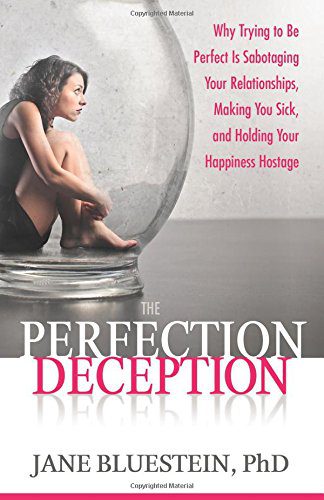
On October 6th, our guest was Dr. Jane Bluestein. We discussed her latest book, The Perfection Deception.
Most people mistakenly confuse perfectionism with a healthy striving for excellence, but there is a big difference. One can lead to great achievement or at least great learning by allowing us to take risks, make mistakes, and forge ahead anyway. The other is a psychological wound that invites constant comparison with others and traps us with all-or-nothing thinking that can paralyze us in a cycle of indecision, fear, and self-loathing. We discussed how to help children achieve their personal best, learn from mistakes and, understand that no one is perfect.
Download File
by Lorna McGrath | Book Reviews, Family Resources, MFA, Montessori Family Life, Psychology, Social Media
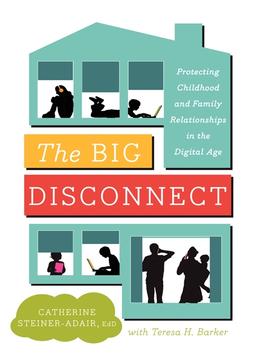
I had the opportunity last week to attend a lecture by Catherine Steiner-Adair, Ed.D., author of The Big Disconnect. The information and stories that she shared were powerful! Here is a little bit about Dr. Steiner-Adair.
Dr. Catherine Steiner-Adair is an internationally recognized clinical psychologist, school consultant, speaker and author. Dr. Steiner-Adair has consulted with over 350 independent and public schools, parents and students on a wide range of topics related to strengthening children’s social and emotional development, shaping school culture, and deepening parents’ connections to their children. Dr. Steiner-Adair also works with professional organizations and businesses re-visioning work-family-life integration in the age of technology.
Her passion for helping adults raise strong, savvy and resilient children extends to boys and girls from preschool through college. ?her warmth, humor and compassionate understanding of children and the adults who care about them is extremely compelling. Her ability to weave research and real-life stories together left everyone in the audience feeling intellectually and emotionally smarter and equipped with new strategies.
I had the opportunity to interview Dr. Steiner-Adair the next morning at the Hyatt before she left town, and I want to share the recording of that interview with all of you. She has important information for all of as we raise our children and grandchildren in this age and time.
Click the link below to hear our conversation:
If you like what you hear in the interview, I strongly encourage you to read her book, The Big Disconnect.
by Kathy Leitch | MFA, Montessori Family Life, Montessori Parenting, Webinars / MFA
Lorna McGrath and Kathy Leitch explore family traditions. I had been called out of town unexpectedly, and you may get a chuckle as they work out the best way to get started, but their conversation, as always, is practical and very interesting. I hope that you enjoy it. Tim Seldin