by Paul Epstein, PhD | MFA, Primary (3-6), TC February 2024
Independent work begins with choice, and choice is a necessary work element for self-development.
Look in a Montessori classroom with twenty or more very busy children between the ages of almost three and six, and you will see children who are passionate about their work. They are focused, self-directed, and persistent. Three-year-old John cuts an apple and then shares apple slices with his friends. Four-year-old Peter traces metal shapes with colored pencils. Five-year-old Sara counts colored wooden squares and then writes numerals on a math paper. When children work with passion, they are curious, creative, inquisitive, imaginative, constructive, thoughtful, orderly, and more. Children love to work. This is how they grow.
Children’s “work” has many meanings.
In a Montessori setting, the word “work” conveys several meanings. Work identifies a learning activity. For example, a food preparation work, a writing work, or a math work. When a child uses a learning activity, he may say, “This is my work.”
Work activities occur during the “work period.” The classroom schedule may include a 2 ½ to 3 hour morning work period. The schedule may also include a shorter afternoon work period. During the work period, children may choose work that is for one child; other works may be used by two or more children. Some works are designed to be used on a table. Other work is used on a floor. Before bringing it to the floor, children will unroll a work rug. The work rug assists the young child with keeping the learning objects together on the rug. The work rug also announces to the other children, “Please walk around my work.”
“Work” also describes a child’s responsibilities for taking care of the work materials. It can happen that a child finishes her work, and then she may decide to go to the shelf and choose another work, another learning activity. The teacher will offer the child a gentle reminder, “Please put your work away before you choose another work.”
Children’s work has both practical and developmental purpose.
“Work” refers to the practical purpose found in each learning activity. For example, a child works with the subtraction strip board and learns a subtraction process. Another child works with the bow-tying dressing frame and learns a bow-tying process. Work has yet another meaning. The child’s process of self-development is also called work. For this reason, we do not interrupt children when they work. They are developing their potential within themselves. The work of the child is to become an adult.
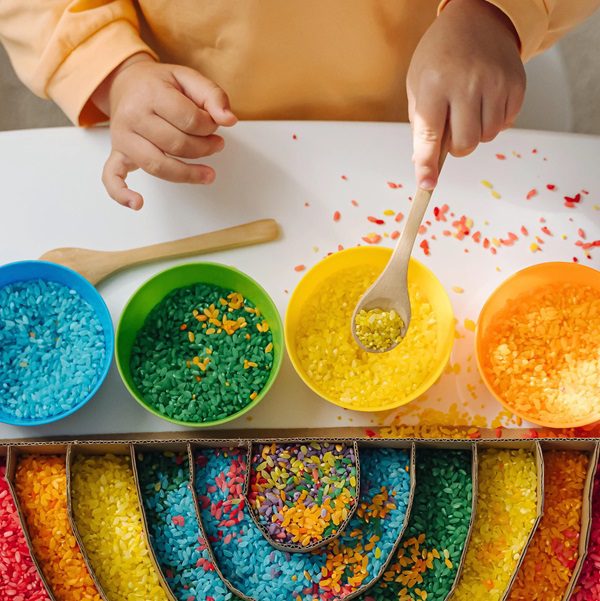
For example, three-year-old Martha transfers dried beans from one bowl to a second with a wooden tong. The practical purpose for this work is to learn to use tongs. The developmental purpose is to learn to concentrate and strengthen and develop hand coordination, a necessary preparation for learning to write when she is older.
Children’s work has several more characteristics.
Several more characteristics describe children engaged in purposeful, self-development work. Children will work independently from others. They become absorbed and concentrate for long periods of time. Children will use learning activities with tremendous repetition; they complete a work task, and then they do it all over again. And they are not concerned about making mistakes; mistakes are children’s recipes for learning.
Children make independent choices when they work.
Remarkably, young children are compelled to engage in activities by themselves. They are not directed by teachers. In the Montessori classroom, a teacher will not do anything for children if they are ready for us to show them how to do it themselves.
Independent work begins with choice, and choice is a necessary work element for self-development. When children make independent choices, they learn to become self-directed and self-disciplined. Children choose their own work. Each child will also choose how to use it and how long to use it. When children choose their own work, they are choosing what they need for their growth and development. They choose what they need to develop their unique potential. Consequently, no two children learn at the same time or in the same way, and each child will only learn when she is ready.
Children who are independent can choose their own work and work with concentration. They can persist, overcome challenges, and self-correct. They have developed habits of learning.
Children develop understanding when they work.
Work with the Montessori materials assists children with developing conceptual understanding. For example, size is an abstract concept. If young children could reason and learn solely with language, we could tell them the meaning of size, and they would understand. Instead, young children are perceptual learners. Young children learn with their senses (sight, sound, touch, taste, and smell) and from what they can do with objects.
Perceptual learners “think” with objects. They understand concepts by arranging and comparing objects. Something is rough because it is not smooth. Something is sweet because it is not sour.
For example, four-year-old Martin arranges a set of ten wooden rods. A practical purpose for this material is to understand length. Each rod is painted in the same red color. The shortest red rod is 10 cm. long; the next is 20 cm. long; and the next rods progress in length by ten more centimeters to the longest red rod which is 100 cm. or 1 meter long. Martin places the red rods randomly on his work rug. He then places two rods side-by-side, compares their lengths, and in this way arranges all ten rods from shortest to longest. Martin now mixes the rods and sorts them by length again. Martin repeats his work with the red rods six times.
Children prefer the process of work and not results.
Children are not result oriented. They are, instead, process oriented, and they are compelled to work with repetition. Children may prefer process because they are not interested in perfection. Perfection is a final state; there is no further growth after becoming perfect. The child’s purpose is to develop his or her unlimited potential, and repetition is how they do this.
For example, two-year-old Beth has been working with an apron for about ten minutes. She puts it on over her head, and then she takes it off. She looks at the apron, turns it sideways, and then puts it on over her head. And then takes it off, and then puts it back on. At any moment an adult could help Beth, but Beth does not ask for help. Apparently, she is not interested in wearing the apron. Beth’s choice is developmental. She is purposefully practicing putting it on and taking it off.
Three-year-old Tommy picks up a pitcher containing red-colored water. Tommy places a funnel into an empty jar, he pours the colored water into the funnel and watches the water drain into the jar. Now he places the funnel into a second jar, pours water into the funnel, and again watches the water drain. Some water spills onto the table. He places the pitcher on the table, picks up a small sponge, wipes the water spill, and squeezes the sponge into the pitcher. He now pours the jar water back into the pitcher. Then he does it all over again, and then again. Tommy busies himself for some 25 minutes with this activity. Sometimes he pours slowly, sometimes quickly, sometimes with the funnel, and sometimes without. The practical purpose of this work is to learn to pour liquids through a funnel and to decide to stop pouring when the jars are filled. The developmental purpose is to develop coordination, concentrate, and make judgments.
Children develop both practical skills and satisfy developmental purposes from repetition and practice. They develop their abilities to concentrate, observe, compare, make decisions, innovate, and more. For example, four-year-old Michelle has been sorting and building with 27 colored blocks already for 15 minutes. The colored blocks make up ten different combinations of sizes and colors. When put together, the blocks form a trinomial cube. Michelle is absorbed. She sorts the blocks by sizes and colors, builds the cube, and then takes it apart. Then she builds the cube all over again, each time beginning with a different block. Perhaps she is fascinated with the size and color patterns; perhaps she is fascinated with how these blocks always come together and form a cube.
Children’s work includes making many mistakes.
Children are mistake oriented; they are not afraid to make many, many mistakes. We should celebrate the necessity of making mistakes because this is how children learn. Their work process is to explore, investigate, make mistakes, discover, and then do It again. For example, learning to pour requires developing eye and hand coordination that prevents spilling. Learning to spell requires developing writing coordination and knowledge of English phonemes that prevent writing pear as pair or writing see as sea.
The Montessori learning materials are designed to guide children to learn to recognize and then self-correct their mistakes. For example, Tammy works with the Knobbed Cylinder Block. The purpose of this material is to learn about size and to develop the ability to reason and make judgments. There are ten cylinders in the block. The ten cylinders are the same length, and they differ in diameter. Each cylinder fits exactly into one hole in the block. Tammy takes out each cylinder and then puts them back into the block. Sometimes she puts cylinders in the wrong places — the cylinders do not fit into the wrong places. Once the cylinders are properly returned, she repeats and does it all over again. Some children will repeat this work process 15, 20, or more times.
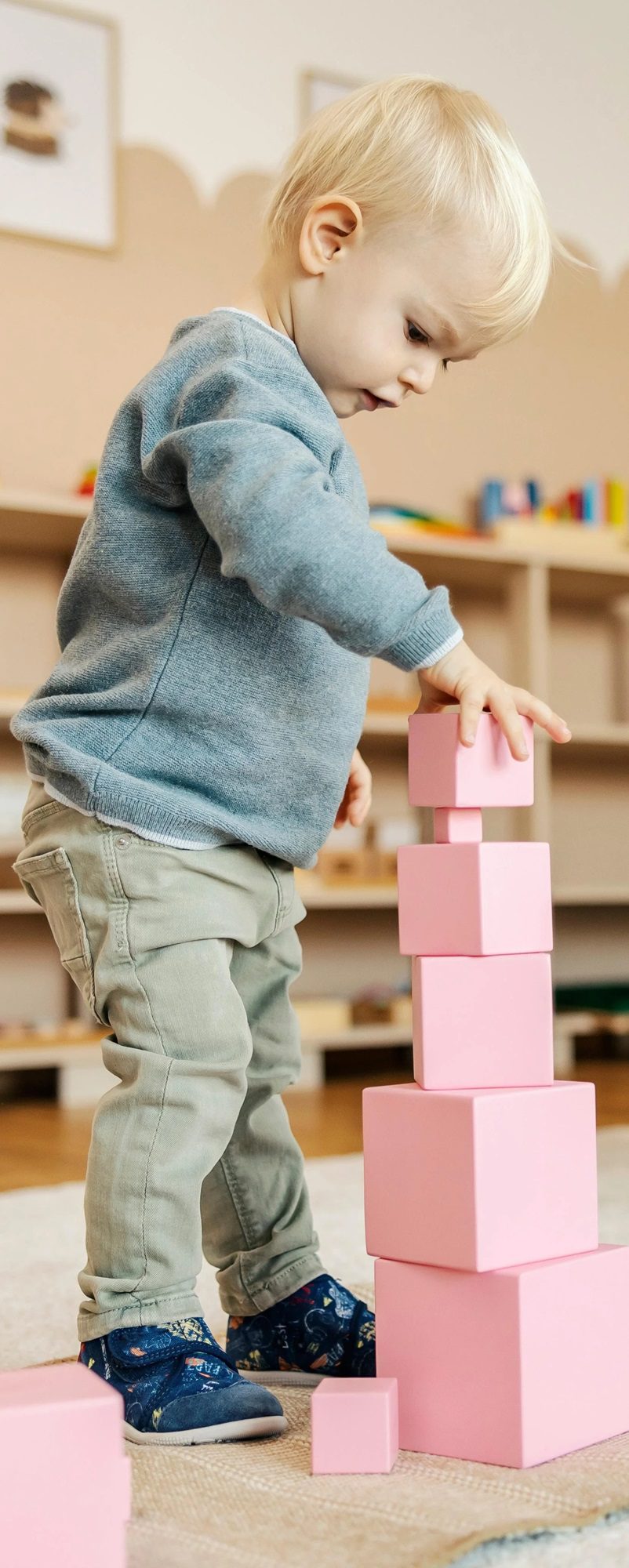
Erin builds a block tower, and the tower falls. She tries again, and she stacks the blocks in a different way. The tower falls again. From these building mistakes, Erin gains valuable experiential knowledge about cause and effect, balance, creative problem solving, and the value of learning from trial and error. This work is called the Pink Tower. This is a set of ten cubes, and the cubes are painted in an identical pink color. The cubes are not the same size. They are graded in size from 1 cm3 to 10 cm3. The purpose of this work is for the child to develop an understanding of size. Children develop this understanding with their senses. They hold and see each cube, compare the sizes and weights of each cube, and arrange the cubes in order from largest to smallest or from smallest to largest.
When children work, their repetition guides them to learn how to self-correct. Although the cubes differ in size, the child may place some of the cubes in the wrong size order. Should this happen, the teacher will merely observe and patiently wait and see what the child will do next. Will the child notice the sequence of cubes is not in a size order? Will the child self-correct and rearrange the cubes?
Children’s work differs from adults’ work.
Remarkably, work does not tire children. Instead, they become energized from engaging in work they have chosen. Adults, of course, also work, and we also develop ourselves from our work. For example, we go to the gym and “workout.” We can work to master some knowledge and skills and better ourselves. We also work to produce results. We often work efficiently and effectively to produce the most results we can, in the least amount of time, and with the least amount of effort. We love results, and we feel satisfied when we check it off the list. We adults are motivated to work for intrinsic and extrinsic rewards. We work out at the gym for the benefit of health and strength. And we may work at work for the benefit of a salary.
Children work for the benefit of growing up and becoming adults, and they do this without a contract or promise of salary in exchange for their time and the value they produce. When young children finish an activity, they do not check it off a list. Instead, they may do their work all over again. Children’s work often lacks efficiency and effectiveness. They may make unpredictable movements, and they may make many messes. Unlike an adult, young children do not work with minimal effort. They are “all in!” They love to work! Dr. Maria Montessori described a child’s work process:
[The] child has a personality which he is seeking to expand; he has initiative, he chooses his own work, persists in it, changes it according to his inner needs; he does not shirk effort, he rather goes in search of it, and with great joy overcomes obstacles within his capacity. (Dr. Montessori’s Own Handbook, pp.77- 78.)
For children, work is a continuous process of self-development, and children must work to develop everything: their personalities and walking, running, climbing; understanding and speaking language; socializing and expressing emotions; reasoning and creating; overcoming obstacles and persisting; solving problems, being creative, and more.
Children passionately engage in work because they are passionate to grow and become themselves. When they work, they are scientists, filled with wonder and curiosity. They are intent on investigating the world and developing themselves. They are not afraid to experiment and see what will happen when they try this and then that. For children, it’s all in a day’s work.
Paul Epstein is the educational director of Designs for Lifelong Learning. He has worked in education as an administrator, university professor, teacher trainer, classroom teacher, researcher, consultant, and author.
Paul brings transformative learning experiences to educators and parents throughout the world. He is the author of numerous articles and books including An Observer’s Notebook: Learning from Children with the Observation C.O.R.E. He is also the co-author of The 60-Day Montessori Observation Workbook and The Montessori Way, a definitive work on the Montessori experience.
His administrative experiences include working as a head of Montessori schools, and he brought the International Baccalaureate Middle Years Program to one of the schools. Paul also works as a director and instructor of Montessori teacher education programs. He has been a Montessori classroom teacher in Montessori early childhood, middle, and high school programs.
Paul holds Montessori teacher certification in early childhood and secondary levels one and two from the American Montessori Society and his doctorate is in Cultural Anthropology.
by Paul Epstein, PhD | Child's Work, Computers in the Classroom, Educational Program Coordination, Montessori Education, Montessori Family Life, Montessori Parenting, Online Learning, Parenting on the Same Page, The International Montessori Council, Tomorrow's Child
What are we (as Montessori educators and parents) to do with this new reality?
What will Montessori be in an ever-changing future?
We now live in an ever-changing future, and our Montessori goals are necessary preparations for children who need to learn how to adapt. We’ve been citizens in this kind of future for some time, and I suggest this one is different from other changing futures, such as the agricultural revolution or the industrial revolution. This one is different because its magnitude is all at once. It is continuous, and it is global. We are all affected; the sheer speed of this ever-change can be instantaneous. ‘Viral’ was once a feared proclamation of a deadly outbreak of disease. Today ‘going viral’ is a popularity contest based on a number of ‘thumbs ups’ and ‘likes.’
Montessori Students /Digital Natives
When I began teaching in the mid-seventies, children lined up waiting for their turn with the Geometric Cabinet. It was so popular that I used to think about getting a second one for my classroom. I never did, because that would have violated the one-material rule: Have one set of the material to cause sharing and respect. There were other very popular materials, too, that children waited for their turn, more or less patiently.
For some time now, I’ve noticed a different interest from children who are growing up as Digital Natives. There are children who are no longer drawn to many of our treasured didactic materials. Very few young children today are drawn to the Touch Tablets and more. This is a serious turn of events. The materials provide a concrete representation of an idea, and the idea is understood through tactile and other sensory exploration. According to Montessori theory, repeated use of the materials leads children to understand the embedded idea and grow cognitively. The use of the materials also leads children to develop concentration, persistence, and self-discipline. And it’s not just the children. We are also seeing a different interest from parents who grew up as Digital Natives. They were born in the digital world, and they know no other. Digital Natives are digital learners. Digital learners come with an expectation for “what is learning” that is different from our own. They use digital technologies incessantly. And this is transforming human relationships in fundamental ways.
Digital learners live much of their lives through their devices and without distinguishing between the online and the offline. Instead of thinking of their digital identity and their real identity as separate, they are just one identity with representations in two, or three, or more different spaces, real and virtual. We used to teach children not to hit anyone. Today a ‘hit’ and a ‘like’ are synonymous. Now it is good to ‘hit.’ Digital Natives learn software and shareware ‘instantly.’ They are endlessly and relentlessly creative. They construct and express themselves in new social environments. They take (online) courses to learn how to better position themselves in the digital marketplace.
Design usurps memorization as the fundamental learning activity. As stated by Google CEO, Eric Schmidt, in The New Digital Age, digital learners “perceive information as malleable; it is something they can control and reshape in new and interesting ways. That might mean editing a profile … or encyclopedia entries on Wikipedia, making a movie or online video, or downloading a hot music track … Whether or not they realize it, they have come to have a degree of control over their cultural environment that is unprecedented.”
There is also growing fear among digital learners. There is incredible access to uncensored information: access to hate information, cyber bullying, addiction to violent games, online predators, and more. Unsupervised and unsafe Internet usage can lead to identity theft and even abduction. We are tasked to educate children in safety. We are tasked to give children the tools and skills to keep themselves out of harm’s way.
I have long been a proponent of including technology in our prepared environments. I admit now that I am very worried—not just for the children—but for the future of our Montessori pedagogy. I used to say our Montessori materials engage a child with all of her senses, and this is optimal for full-brain development and learning. Now, the children and their parents, who come to our schools, bring different expectations, understandings, and aspirations.
Here is what we are seeing from the digital learners at our school:
- Many of our three-year-olds prefer working with others instead of choosing their own work or participating in parallel play. Why? Are they isolated from humans because at home and elsewhere they are using iPads or other digital devices? Is it because they are watching movies or TV on smart phones when immobilized in car seats or when they are at older siblings’ sports or other events?
- Many children want an initial presentation at the shelf. That is, they are not willing to carry all of the materials to a table or rug on the floor. They even comment that, on their tablets, they can see some of what the activity will be about before deciding to do it.
- A five-year-old declared he knew all about the 100 Board because he has that app on his tablet. When using the real 100 Board in the classroom, however, he could go no further than 30 because, he said, “The iPad always resets at the third row.” He had at home, in other words, the unpaid app version of the 100 Board.
- Another five-year-old knew the Addition Strip Board because, he said, “I do that on my iPad.” The classroom guide observed that when he used the real classroom version, he computed sums by counting on his fingers. When she asked him if he did the same thing with his iPad, he said, “No. I just punch the square, and if it’s wrong, it goes away.
Until recently, I was comfortable with technology as a supplement to our catalogue of materials; a supplement and not a replacement. But now, in our ever-changing future, certain technological advancements are occurring, and we will soon face a real ‘game changer.’ In the language of technological innovation, I fear that we are about to become disrupted.
The Evolution of Education
Our pedagogy is based on Dr. Maria Montessori’s discoveries of the child, beginning in the late 1890s and continuing through 1952. Montessori discovered that when children are placed in an environment designed for how they naturally learn, children will experience a transformation from impulsive behaviors. They will concentrate. And when children concentrate, they next develop self-reliance and become self-disciplined. For this to occur, the design of the environment, the design of the materials, and our own preparation must enable a child’s choice and spontaneous activity.
The whole of our pedagogy is rooted in touch, in the work of the hands. With the coordination of the hands comes independence and the child’s triumphant cry of, “I can do it!” With the coordination of the hands comes the development of intelligence. In her book, The Montessori Method, Montessori wrote:
I teach the child how to touch, that is, the manner in which he should touch surfaces. For this it is necessary to take the finger of the child and to draw it very, very lightly over the surface… Often, after the introduction of such exercises, it is a common thing to have a child come to you, and, closing his eyes, touch with great delicacy the palm of your hand or the cloth of your dress, especially any silken or velvet trimmings.
To touch is to learn. This occurs throughout the world and throughout time. The Sandpaper Letters, for example, are used by children to develop a cognitive understanding of the phonetic sounds of the alphabet. The child traces the letter and voices its sound. The child develops further literacy by associating objects with each letter and sound. The textures, colors, sizes, and weights of the objects are designed to attract and hold the child’s attention. This is true for all of the materials we place in our prepared environments. The materials call children to explore, investigate, concentrate, and make discoveries. The objects seem to express, “Do you want to know? Come find out.”
During the 20th century, our Montessori heritage stood in marked contrast to what we still call ‘traditional education.’ I can speak only for myself; perhaps you enjoyed your schooling. What I remember most was the agony of boredom, the fear of a teacher’s ridicule, the embarrassment of being wrong when called on, and the shame of being laughed at by others. Traditional education is rooted in a factory model of education. Teachers act like top-down managers and dispense information and assignments to children in predefined units and grades. We were told which book to take out, and for how long, and who would answer the first question, then the second, and then time was up. And, ready or not, interested or not, we moved on at the direction of the teacher/manager.
Throughout the education-as-manufacturing process, a ‘one size fits all’ controls the procedure. Instead of individualized instruction, children are interchangeable products. As children progress from grade to grade, they become more assembled. The teacher/manager measures success and failure in terms of grades and promotions. The teacher/manager is measured in turn by student test scores. A finished product occurs at graduation. The parallels between the school house and the factory are clear: teachers are managers; school assignments prepare children for work place tasks; grades will become salaries.
Memorization is the primary basis for learning. We memorized teacher-dispensed content, facts, dates, and formulas. We memorized the information and gave it back. We were scored for an accuracy of recall, and then we forgot about it. Many of us did fairly well; however, some of us fell within a tolerance of the education/manufacturing process known as one or more ‘standard deviations.’
In a traditional 21st century classroom, students are praised for their ability to find correct answers to predetermined questions. Intellectual risk taking, creative thinking, and asking questions is often discouraged. The ability to get a good score on a test is valued more than the ability to get fully engaged in the learning process and pursue ideas that excite a student. (www.wordpress.bhmschools.org/integration)
We memorized because it was assumed that what we needed to know was all that which our parents and our grandparents needed to know. Our future, when we grew up, would, resemble their own. We were raised in an ever-similar future.
Throughout the education-as-manufacturing process, a ‘one size fits all’ controls the procedure. Instead of individualized instruction, children are interchangeable products.
This kind of pedagogy stands in sharp contrast with our Montessori pedagogy. Our legacy is that of the prepared environment and developmentally appropriate, multi-sensory, hands-on learning activities. Montessori teachers are guides, who help children engage in investigation and discovery. Our goals include fully developing each child’s potential and forming habits of lifelong learning. Learning to think is not the same as learning to memorize. Developing habits of persistence, taking on challenges, engaging with problems, and creatively designing solutions are not the same as learning to memorize.
We now live in an ever-changing future, and our Montessori goals are necessary preparations for children who need to learn how to adapt. We’ve been citizens in this kind of future for some time, and I suggest this one is different from other changing futures, such as the agricultural revolution or the industrial revolution. This one is different because its magnitude is all at once. It is continuous, and it is global. We are all affected; the sheer speed of this ever-change can be instantaneous. ‘Viral’ was once a feared proclamation of a deadly outbreak of disease. Today ‘going viral’ is a popularity contest based on the number of ‘thumbs ups’ and ‘likes.’
Most telling, we are also the producers of this global change. Not feudal lords, dukes, and kings. Not mad men. Not industrial giants and manufacturing companies. Our everchanging future is driven by technological innovation and planned economic disruption. It is driven by a global participation in the consumption of digital devices and by the incessant 24/7/365 use of those devices. We each access more digital power than all other generations combined. Our access to knowledge and information multiplies daily. More and more of us text, and instant message, and take pictures, and make videos, and use FaceTime. We like, tweet, post, blog, open source, and do a whole host of verbs that didn’t exist just a few years ago. We’re all participants in producing constant change.
That we do all of this social media may yet prove to democratize our entire planet. And, if we are truly clever, we may yet even save ourselves from, at least, one other ‘everchanging future.’ This one is the ever-massive environmental destabilization, including the destruction of drinkable water. Say what you will about real reality and virtual reality. The ever-changing future is really real.
So, what is Montessori in this ever-changing future? Will children touch tablets? Will parents, who grew up as Digital Natives, identify with and understand our didactic materials? Will they want these for their children?
Certainly we have contended with technology in our prepared environment for some while now. I still recall personal computers in my middle school classrooms in the early 1980s. A ‘new generation’ of software appeared in the 1990s, offering Montessori-like computer based learning. More recently, there are Montessori apps, lots of them. I have felt for many years that our heritage was secure. And parents were in agreement. I would ask, “Do you prefer your child push—with their mouse or finger—an image of a pink cube, or carry real cubes?” I would ask, “Do you prefer less sensory stimulation from computer screens and tablets, compared with all senses engaged?”
These questions are about to become irrelevant because this digital world with these kinds of apps is about to go away. The kinds of digital learning about to become possible will require us to ask, what will Montessori be in an ever-changing future?
Teaching Thinking
Digital learners throughout the world are expressing changed expectations for how, what, where, and when to learn. It is no longer about does the app mimic a Montessori didactic material? In the 21st-century digital classroom, the profile of learning has changed. Digital learners do not memorize. They expect to learn how to think, create, analyze, evaluate, and more. This is not the factory model of schooling, and we are no longer the only non-factory game in town. Digital learners in non-Montessori schools routinely connect and collaborate with one another in real and virtual time and space. They explore, investigate, collaborate, solve problems, and communicate. They expect to become lifelong learners. Digital learners expect teachers to provide differentiated, personalized instruction. They expect hands-on learning experiences. They expect to explore real-world issues using models and simulations.
These words should sound familiar. We’ve used these words and their synonyms to describe and promote our legacy since 1907. Now, throughout the world, educators are determined: The factory model of traditional education will give way to teaching thinking. In digital classrooms, teachers are no longer a main source of information; text books are no longer a main source of information. Learning is no longer at the discretion of the teacher as factory manager. Given the omnipresent Internet, learning is whenever, wherever, and forever. Twenty-first century students collect and create information anywhere and anytime. They Bing, Google, Ask, Yahoo, Amazon, text message, blog, podcast, flip board, YouTube, mp3, mp4, RSA, Wiki, Facebook, FaceTime, crowdsource, and tweet. Twenty-first century students collect and create information when they publish and evaluate work using Ning, OneNote, Wiki, Picasa, Shutterfly, Photoshop. They collaborate with SkyDrive, Dropbox, Facebook, Skype, and Twitter.
The 21st century teacher is an information architect who guides students to validate information, problem solve, and communicate information Twenty-first century goals for students include developing a questioning disposition, embracing change, and thinking like entrepreneurs. Technology is not used to entertain. Using technology, a 21st century teacher can offer flexible learning paths— individualized instruction with open-ended, higher-order questions. Using technology, a 21st century teacher can evaluate authentic applications of learned knowledge and skills. (http://bionicteaching.com) The digital classroom is likely to be flipped—you take your lessons at home, and then work with your teacher/guide at school.
Twenty-first century homework engages students in collaborating, creating, publishing, and more. At any given moment, a learning experience might include:
- What are the effects of erosion on an average beach? How can we counteract this? Use any resource you wish.
- You have $1,000 to donate towards hunger relief. To which organization in which country would you give? How could you assess the impact of your donation?
- Make a model of one trillion.
- Read the terms and conditions of YouTube and summarize the key ideas.
In an ever-changing future, children use technology to think and to make changes and design their future as engaged participants. They collaborate as authors, originators, inventors, creators. They are learning to plan, design, implement, and communicate. How will our didactic learning materials stand up to technology that enables simulations, modeling, systems thinking, and still more? We are oriented towards children developing coordination which, in turn, will enable them to concentrate, develop self-reliance, and become independent. Can we be so sure that these occur exclusively with only our didactic materials? Will parents, who are also Digital Natives, still choose Montessori? I cannot definitively answer this question. But these data are suggestive:
Sources: Laura Devaney (10/28/13)-eSchool News
A year ago, we decided not to permit Minecraft during our afterschool programs. Several parents protested—not their children!—and they came back loaded with evidence of the educational whole-child benefits of Minecraft. Their sources included faculty at MIT and elsewhere. Minecraft is a thinking tool.
Children can plan entire cities, study environmental issues, and learn a programming language. Research on the benefits of Minecraft documents that children develop spatial reasoning, construction skills, and habits of learning how to learn.
Do Digital Devices Belong in the Montessori Prepared Environment?
Montessori educators have debated for several decades whether or not digital devices belong in the prepared environment. Some are adamant and proclaim no. Some ask what Dr. Montessori would do. Some are concerned that excessive use of digital devices erodes the child’s brain. And there is still more that is about to occur.
“Five years from now,” states an announcement from IBM, we will be able to understand touch and smell through our digital devices. IBM. (Touch: 5 future technology innovations from IBM) This to me is the real game changer. Touch and smell through our devices. Our brains will not differentiate real from virtual; our brains will not care. Already people wear sensing digital devices to frame a scene with their fingers and then take a picture. Other devices project images we see onto any surface. We continue, in other words, to learn through touch, but digitally. This is not the distant future; we should expect a new generation of digital classroom experiences rather soon.
There is no reason for us to think either/or—either our didactic materials or technological devices. Many of us do, instead, think both/and, both materials and devices. Each is a tool for learning, for communicating, for solving problems, and more. The Pink Cubes are a tool that offers a possibility not presented in other tools. A digital device offers a possibility for thinking not found in other tools.
There is, presumably, more to life than being logged into a digital device. I sincerely believe that in the ever-changing future there will be device-free learning moments. I sincerely believe that these moments are necessary complements and will perhaps even prove to make possible a whole-child education, with or without our Montessori devices. For example, since this past summer, outdoor construction has occupied most of our first through sixth graders during recess time. Their constructions have had various names and purposes. They began as office buildings. Then they became forts, but early in the fall, it was generally agreed that forts were not in keeping with our Montessori peace education purposes. So, their constructions were renamed as houses and shops. Well, renamed sort of. Last fall, a student paper came out from our E2 program with the headline, “Fort Crown: Split Up in the Big Fort.” The article went on to state, “Bill and Tom split up with the hotel. The hotel members are fine, happy, and they rebuilt very well. Bill and Tom also built their pawn shop there.”
These are essential opportunities in which children engage and participate. They collaborate as authors, originators, inventors, creators. They think, plan, design, implement, and communicate. I do agree with Richard Louv’s Last Child in the Woods:
Nature—the sublime, the harsh, and the beautiful—offers something that the street or gated community or computer game cannot. Nature presents the young with something so much greater than they are; it offers an environment where they can easily contemplate infinity and eternity. A child can, on a rare clear night, see the stars and perceive the infinite from a rooftop… Immersion in the natural environment cuts to the chase, exposes the young directly and immediately to the very elements from which humans evolved: earth, water, air, and other living kin, large and small. Without that experience … “we forget our place; we forget that larger fabric on which our lives depend.”
The Role of Montessori Educators and Parents in the Ever-Changing Future
What role will Montessori educators and parents play in an ever-changing future? I propose the establishment of a Montessori task force charged with establishing a 21st Century Montessori Pedagogy. I suggest we begin to:
- Develop 21st-century vision and purposes for schools;
- Evaluate developmental/brain studies;
- Define learning in the context of the ever-changing future;
- Identify principles for real and digitally prepared environments and learning materials and experiences;
- Research uses of digital and Montessori learning tools;
- Analyze the current catalog of Montessori materials;
- Propose Montessori digital learning tools; and
- Implement a Montessori digital teacher education.
Not either/or. How will we incorporate our Montessori heritage and legacy with emerging digital-based learning possibilities? How should we prepare environments when the distinction between real and virtual is collapsed? Which historic didactic materials should we maintain when digital devices will enable us to experience a full sensory array? What new materials do we need now? How will we design our Montessori ever-changing future?
TOMORROW’S CHILD © ♦ APRIL 2014 ♦ WWW.MONTESSORI.ORG
by Paul Epstein, PhD | Brain Development, Emotional Intelligence (EQ), Emotionally Healthy Children, Family Resources, MFA, Montessori Education, Montessori Family Life, Montessori Leadership Magazine Online Issue, Montessori Parenting, Montessori Teachers, The International Montessori Council
This article appeared in Montessori Leadership in 2010
Test taking and test scores have become the singularity of education. Teacher performance and, in turn, school house performance, is validated primarily through children’s test scores. The rationale is that teachers are teaching, performing if, and only if children
achieve high test scores. The justification is, finally, if children achieve high test scores, Americans will retain our position as the economic superpower.
Perhaps prayer does help. Nevertheless, I propose to test this logic? To test the test.
Download File
by Paul Epstein, PhD | Challenging Behaviors, Computers in the Classroom, Lower Elementary (6-9), MFA, Montessori Education, Montessori Teachers, Primary (3-6)
by Dr. Paul and Ann Epstein
Computers in Montessori early childhood classroom deserve careful study. Just as Dr. Maria Montessori scientifically observed children and developed her didactic materials, we must also completely examine a computer’s benefits and barriers to learning.
We believe that computers are tools for thinking and communication. We further believe that computers will augment or enhance the kinds of thinking and communication children now experience with the didactic materials. Young children are using computers to predict, problem solve, explore relationships, and design two or three-dimensional graphs. Children can also develop spatial relationships by selecting directions. For example, should I go two blocks east or two blocks north to reach my destination? Young children use programs to create their own stories. They select settings (perhaps an island) and appropriate equipment (boats and snorkels, instead of rockets and space suits). Other software includes video and music. Animal behaviors and seasonal migrations are the subject of still another developmentally appropriate computer program.
Computers appear to help young children with early signs of attention deficit disorder. These children often demonstrate difficulty maintaining concentration with activities on rugs and tables. They struggle to follow through, even though the materials are carefully designed and the teacher’s demonstrations are clear and precise. In contrast, children who are otherwise off task concentrate for longer periods with educational computer programs. Knowing they will be successful, they excitedly look forward to their computer experiences. Their behavior is not an issue when they learn with computers.
However, these scenarios are not yet fully documented by research. We are reminded of Dr. Maria Montessori’s earliest days with young children. Living in an emerging industrial era she was called upon in 1907 to open a day care center for some sixty children left alone in a suburb of Rome while their parents worked in factories. The “secrets of childhood” Montessori discovered there astonished the world. Montessori held her audiences spellbound as she articulated a vision of childhood that differed from the prevailing belief that children were miniature adults. What new secrets of childhood will computers reveal?
Nearly one hundred years ago, Montessori observed the children of San Lorenzo. She formulated hypotheses and experimented. Determined to develop sets of hands-on learning materials that would engage children in investigation and discovery, she designed one after another. Each was presented to children, and Montessori closely observed their responses. Eventually, she discovered how many items to put on a tray, in a basket or in a box. She noted what children did with the objects, how long they were occupied, and how often they returned for further explorations. She made refinements to the sizes, colors, shapes, and quantities of objects. Some of Montessori’s decisions involved chance – a certain color of paint or type of wood was available at the time. Montessori finally determined the materials were “right” when children displayed a meditative-like concentration as they repeatedly explored the learning material.
In the same spirit, we must ask, what is the optimal size of a computer screen for young children? How should a keyboard and mouse be designed to best fit a young child’s emerging fine-motor and eye-hand coordination? More importantly, can children use more of their natural learning abilities with computers?
Children require multiple experiences that allow them to move and engage all of their senses. Computers will not replace a child’s interest in the didactic materials. We should not think of computers in terms of “either/or”: either a child will prefer the computer or the child will prefer the didactic materials. It is simply premature to foreclose on computers in the classroom because we fear some children might prefer computers screens to carrying and stacking pink cubes or brown prisms. Carrying cubes or prisms is of course a very different learning experience. But using a mouse to drag cubes and prisms is also a learning experience. Children sequence sizes visually. In a computer environment, children organize a larger, perhaps more interesting, variety of objects.
There is no compelling evidence to conclude learning, for example, addition facts with a computer program will replace the addition strip board. The research is lacking: Will young children abandon the didactic materials in favor of computer software? Many young children do not prefer computers. But there are also children who do not care for either the addition strip board or the addition charts. These materials offer one way of learning. We know children’s styles of learning vary. Some are tactile, and learn through the hand; others prefer a visual mode of learning. Computer programs offer alternative ways to learn. A computer, like any of the didactic materials, is a tool with which to think, investigate, explore, communicate, express ideas, and solve problems.
We should, then, welcome computers in the spirit of Montessori. The computer offers a unique opportunity to engage in the legacy of scientific pedagogy. Just as we would with any new piece of material introduced into the classroom, we need to observe and study children’s responses to computers.
A computer introduces both hardware and software issues of management and pedagogy into the classroom. These issues are similar to the concerns raised whenever any new piece of material is placed into the classroom. How will children access the computer? How long will their turns last? Children need presentations on how to turn the computer on and how to shut down. They need lessons on how to use the mouse and keyboard. And, they need lessons on how to access software programs.
We should develop a set of software selection criteria. While selection criteria are readily available on the Internet at, for example, state departments of education and school district web sites, these may not apply to Montessori settings and needs. Curiously, software accepted by other approaches to early childhood education could be rejected by a set of criteria developed for Montessori early childhood programs. Some computer programs offer creative simulations and interesting explorations requiring reasoning, planning, and solving problems. Others are competitive, explosive, and violent; these themes have no place in our schools.
We are not placing computers into classrooms of the 19th century industrial era in which Montessori lived and worked. The 21st century is a world Montessori could not anticipate. There were few digital computers in the 1940s and early 1950s. They occupied large rooms, required large numbers of vacuum tubes and electricity, and could complete only the simplest of calculations. The desktop computer we are using to write this article simultaneously runs word processing, database, spreadsheet, presentation, and multimedia programs. While working with these tools, we can listen to CD recordings or watch a DVD movie. We are also connected to the Internet accessing a vast library of information and communications.
The larger question is, then, can children use computers to think and learn in new ways? Montessori’s didactic materials bring a specific body of knowledge and method of learning to young children. Recent brain research suggests new theories and possibilities for facilitating young children’s learning. It may be that observing and studying how young children learn with computers will reveal new secrets of childhood.
by Paul Epstein, PhD | MFA, Montessori Education, Montessori Family Life, Montessori Grandparenting, Montessori Parenting, Montessori Teachers, Webinars / MFA
Paul Epstein joined us on September 16, 2015 to explore Inquiry-Based Learning in Montessori
by Paul Epstein, PhD | Family Resources, MFA, Montessori Parenting, Webinars / MFA
Dr. Paul is an expert in observing children the Montessori way. Some of you are spending hours at home with your children as they learn through virtual platforms while others of you are seeing your children at home after school, in the evenings, and on the weekends. Many of you may be wondering, “What should I be looking for? What can I learn about my child? Who, if anyone, should I share my observations with?”
by Paul Epstein, PhD | Adolescence, Empowerment, Infant-Toddler (0 to 3), Later Adolescence (15-18), Mindfulness, Mixed Ages, Montessori Family Life, Montessori Parenting, Planes of Development, Practical Life, Psychology, The International Montessori Council
Mom and her daughter child girl are playing, smiling and hugging. Family holiday and togetherness.
The experience of authentic unconditional love differs from romantic and other types of love. Unconditional love is not based on possessing or acquiring. When we know this love, we experience personal and universal peace. And while this love is observed and discussed repeatedly by the world’s great teachers, we seldom consider how this love also emanates from children. The smallest of babies cause us to smile. They and older children awaken us, and we engage in peaceful action.
Parents know unconditional love. A parent may be overwhelmed by tremendous joy and happiness when holding her or his child for the first time. We remember the sweetness of our newborn child, and we remember the love that overwhelms us. I recall saying a prayer. Not a formal, religious prayer, but a prayer nevertheless. Actually, I do not recall my words, but I do recall how I felt: whole, peaceful, and unimaginably happy. I prayed for my child’s lifelong health, safety, and happiness. I also felt too small to hold the amount of love that was wanting to burst from me. I still feel that kind of too small.
I also recall that I did not speak words like these: “Watch over my child, and make sure she has the best test scores for entrance to the top university.” Those words came later.
Unconditional love involves acceptance, but not always agreement. I accept you 100 percent the way you are, and I accept you 100 percent the way you are not. This kind of love involves self-love too. I accept myself 100 percent the way I am, and 100 percent the way I am not. Unconditional love may be transformative. However, reading the words of great teachers is not enough. Transformation involves a commitment to practicing a way of living. A life with children can bring forth this kind of love. In the presence of children, adults may aspire to spiritual growth.
Dr. Maria Montessori wrote, “[The] child is the true maker of our spirituality. He teaches us the plan of nature for giving form to our conduct and character.”One form of conduct with children is to learn how to serve and not be their servants. Specifically, we learn to guide children to become independent and self-reliant. Then children become normalized; they fulfill more of their unique potential. When we observe and accept children, we also experience the assistance they give to us as we learn how to guide. They assist us through love.
If we want to produce harmony in the world, it is clear that we ought to think more about this … The child is the only point on which there converges from everyone a feeling of gentleness and love. People’s souls soften and sweeten when one speaks of children; the whole of mankind shares in the deep emotions which they awaken. The child is a well-spring of love. Whenever we touch the child, we touch love. It is a difficult love to define; we all feel it, but no one can describe its roots or evaluate the immense consequences which flow from it …. In the vicinity of children, mistrust melts away; we become sweet and kindly, because, when we are gathered about them, we feel warmed by that flame of life which is there, where life originates.
“Mistrust melts away; we become sweet and kindly.” To become receptive to the child’s power of love, we must, Montessori wrote, “remove the accretions of years that prevent us from really understanding children and acquiring an intuitive knowledge of their souls.” We must learn enlightenment; we need to learn to truly see.
“Our social mentality,” wrote Montessori, has not grasped the idea that we can receive help from the child, that the child can give us a light and a lesson, a new vision and a solution for inextricable problems. The child, Montessori asserted, can “help adults solve their own individual and social problems.”
Accepting children’s influence as our teachers, Montessori championed, will help us create a peaceful society. Montessori spoke these words to the graduates of her 1937 training course:
You and I have been, as it were, seduced by something attractive and deep in the child …. We began with the methods of education and culture for the child, and we end by acknowledging that he is our teacher … one who can reveal to us, as no other, our own nature and its possibilities. Therefore we are drawn towards the child, as individuals, as members of society, and for the good of the human race as
a whole.
“For the good of the human race as a whole,” Montessori spoke to world leaders about world peace. The Sixth International Montessori Congress took place in Copenhagen in 1937. Representatives from twenty nations were in attendance. Montessori declared in her keynote speech the child’s power to unify adults in peace.
The adult must understand the meaning of the moral defense of humanity, not the armed defense of nations. He must realize that the child will be the creator of the new world peace. In a suitable environment, the child reveals unsuspected social characteristics. The qualities he shows will be the salvation of the world, showing us all the road to peace.
The child’s power of love can bring adults to “the road to peace.” This congress took place thirty years after the first Montessori school had opened in 1907. Since then, children enrolled in Montessori schools show ‘unsuspected social characteristics’ including a tremendous ability to concentrate when they engage with Montessori learning activities. Montessori understand concentration as a foundation for children’s spiritual growth.
We tend to describe children’s physical, cognitive, emotional, and social development. Montessori advocated for a fifth development, spirituality. Accordingly, to become a Montessori classroom guide, an adult engages in a transformative preparation. This preparation wrote Montessori, “is something far more than the learning of ideas. It includes the training of character; it is a preparation of the spirit. This begins, Montessori taught, with humility. “If we touch children, she wrote, “we touch humanity. We must educate adults to realize that we can only better humanity through the child. We must realize that the child is the builder of man.”
There is a special relationship: As adults transform, we notice changes taking place within children. Children progress through a series of spiritual growths that bring them to normalization. Montessori wrote that with normalization, “A unique type of child appears, a ‘new child’; but really it is the child’s true ‘personality’ allowed to construct itself normally ….” For Montessori, normalization was “the most important single result of our whole work.”
Children who are not normalized may tire from academic study, and they cannot concentrate for long periods of time. They may be timid, anxious, possessive, depressed, unable to focus, and dependent upon others. These children have grown up in an educational system in which teachers dispense knowledge according to external standards. These teachers manage the learning process, including schedules, types of activities, and assessments without regard for children’s individual needs and learning differences. And, the teachers manage children’s behavior through external praise and reward. The design of this educational system is to render children compliant and also ignorant about their own potential.
Children enrolled in Montessori schools learn to think, create, communicate, and solve problems. These children demonstrate tremendous self-discipline, resilience, and grit. Normalized children display a deep love of order, work, profound concentration, silence, sharing, obedience, self-discipline, independence, and joy. Normalized children are not interested in external rewards; they learn for the joy derived from understanding. Normalized children are cooperative, creative, innovative, and empathetic.
Montessori classroom guides show children how to become independent. The guides also model for children how to respect themselves, others, and the environment. Children normally develop self-acceptance which is a foundation for accepting others. Montessori children in primary and secondary programs study a wondrous, integrated curriculum called Cosmic Education. They may discover a personal calling called noble work. Children and adolescents do normally empathize, care for, and contribute to others. This is evident from the testimonies heard from Montessori graduates throughout the world.
For example:
Students in Montessori schools are taught to ask the question, “How can I make the world a better place?” This is the fundamental difference in the Montessori curriculum; it teaches a higher purpose …. It has taught me to strive to do noble works.”
Another Montessori graduate summarized her education:
In order to gain a global perspective, you need to have a really strong foundation. That foundation, in our case, is local or even internal. So, if you know how to trust, and you know how to respect, and you know how to question – once you have those main principles, once you are unleashed into the world, you are a little more prepared and ready to take on what it has to offer.
Adults typically awaken when surrounded by the child’s power of love. As we learn to guide children spiritually, so too do we learn about our true selves. Montessori described how a life with children can bring the adult to experience this new kind of love.
When the children show [an adult] their real natures, she understands, perhaps for the first time, what love really is. And this revelation transforms her also. It is a thing that touches the heart, and little by little it changes people. Once these facts have been seen … nothing can cancel the impression their spirits have made and the love they were able to awaken.
ML/ September 2018/ pg 24
by Paul Epstein, PhD | Communication, Empowerment, Maria Montessori, Mixed Ages, Montessori Education, Montessori Family Life, Montessori Parenting, Practical Life, The International Montessori Council
The experience of authentic, unconditional love differs from romantic and other types of love. Unconditional love is not based on possessing or acquiring. When we know this love, we experience personal and universal peace. And while this love is observed and discussed repeatedly by the world’s great teachers, we seldom consider how this love also emanates from children. The smallest of babies cause us to smile. They and older children awaken us, and we engage in peaceful action.
Parents know unconditional love. A parent may be overwhelmed by tremendous joy and happiness when holding her or his child for the first time. We remember the sweetness of our newborn child, and we remember the love that overwhelms us. I recall saying a prayer. Not a formal, religious prayer, but a prayer nevertheless. Actually, I do not recall my words, but I do recall how I felt: whole, peaceful, and unimaginably happy. I prayed for my child’s lifelong health, safety, and happiness. I also felt too small to hold the amount of love that was wanting to burst from me. I still feel that kind of too small.
I also recall that I did not speak words like these: “Watch over my child, and make sure she has the best test scores for entrance to the top university.” Those words came later.
Unconditional love involves acceptance, but not always agreement. I accept you 100 percent the way you are, and I accept you 100 percent the way you are not. This kind of love involves self-love too. I accept myself 100 percent the way I am, and 100 percent the way I am not. Unconditional love may be transformative. However, reading the words of great teachers is not enough. Transformation involves a commitment to practicing a way of living. A life with children can bring forth this kind of love. In the presence of children, adults may aspire to spiritual growth.
Dr. Maria Montessori wrote, “[The] child is the true maker of our spirituality. He teaches us the plan of nature for giving form to our conduct and character.” One form of conduct with children is to learn to how to serve and not be their servants. Specifically, we learn to guide children to become independent and self-reliant. Then children become normalized; they fulfill more of their unique potential. When we observe and accept children, we also experience the assistance they give to us as we learn how to guide. They assist us through love.
If we want to produce harmony in the world, it is clear that we ought to think more about this … The child is the only point on which there converges from everyone a feeling of gentleness and love. People’s souls soften and sweeten when one speaks of children; the whole of mankind shares in the deep emotions which they awaken.
The child is a well-spring of love. Whenever we touch the child, we touch love. It is a difficult love to define; we all feel it, but no one can describe its roots or evaluate the immense consequences which flow from it …. In the vicinity of children, mistrust melts away; we become sweet and kindly, because, when we are gathered about them, we feel warmed by that flame of life which is there, where life originates.
“Mistrust melts away; we become sweet and kindly.” To become receptive to the child’s power of love, we must, Montessori wrote, “remove the accretions of years that prevent us from really understanding children and acquiring an intuitive knowledge of their souls.” We must learn enlightenment; we need to learn to truly see.
“Our social mentality,” wrote Montessori, has not grasped the idea that we can receive help from the child, that the child can give us a light and a lesson, a new vision and a solution for inextricable problems. The child, Montessori asserted, can “help adults solve their own individual and social problems.”
Accepting children’s influence as our teachers, Montessori championed, will help us create a peaceful society. Montessori spoke these words to the graduates of her 1937 training course:
You and I have been, as it were, seduced by something attractive and deep in the child …. We began with the methods of education and culture for the child, and we end by acknowledging that he is our teacher … one who can reveal to us, as no other, our own nature and its possibilities. Therefore we are drawn towards the child, as individuals, as members of society, and for the good of the human race as
a whole.
“For the good of the human race as a whole,” Montessori spoke to world leaders about world peace. The Sixth International Montessori Congress took place in Copenhagen in 1937. Representatives from twenty nations were in attendance. Montessori declared in her keynote speech the child’s power to unify adults in peace.
The adult must understand the meaning of the moral defense of humanity, not the armed defense of nations. He must realize that the child will be the creator of the new world peace. In a suitable environment the child reveals unsuspected social characteristics. The qualities he shows will be the salvation of the world, showing us all the road to peace.
The child’s power of love can bring adults to “the road to peace.” This congress took place thirty years after the first Montessori school had opened in 1907. Since then, children enrolled in Montessori schools show ‘unsuspected social characteristics’ including a tremendous ability to concentrate when they engage with Montessori learning activities. Montessori understand concentration as a foundation for children’s spiritual growth.
We tend to describe children’s physical, cognitive, emotional, and social development. Montessori advocated for a fifth development, spirituality. Accordingly, to become a Montessori classroom guide, an adult engages in a transformative preparation. This preparation, wrote Montessori, “is something far more than the learning of ideas. It includes the training of character; it is a preparation of the spirit. This begins, Montessori taught, with humility. “If we touch children, she wrote, “we touch humanity. We must educate adults to realize that we can only better humanity through the child. We must realize that the child is the builder of man.”
There is a special relationship: As adults transform, we notice changes taking place within children. Children progress through a series of spiritual growths that bring them to normalization. Montessori wrote that with normalization, “A unique type of child appears, a ‘new child’; but really it is the child’s true ‘personality’ allowed to construct itself normally ….” For Montessori, normalization was “the most important single result of our whole work.”
Children who are not normalized may tire from academic study, and they cannot concentrate for long periods of time. They may be timid, anxious, possessive, depressed, unable to focus, and dependent upon others. These children have grown up in an educational system in which teachers dispense knowledge according to external standards. These teachers manage the learning process, including schedules, types of activities, and assessments without regard for children’s individual needs and learning differences. And, the teachers manage children’s behavior through external praise and reward. The design of this educational system is to render children compliant and also ignorant about their own potential.
Children enrolled in Montessori schools learn to think, create, communicate, and solve problems. These children demonstrate tremendous self-discipline, resilience, and grit. Normalized children display a deep love of order, work, profound concentration, silence, sharing, obedience, self-discipline, independence, and joy. Normalized children are not interested in external rewards; they learn for the joy derived from understanding. Normalized children are cooperative, creative, innovative, and empathetic.
Montessori classroom guides show children how to become independent. The guides also model for children how to respect themselves, others, and the environment. Children normally develop self-acceptance which is a foundation for accepting others. Montessori children in primary and secondary programs study a wondrous, integrated curriculum called Cosmic Education. They may discover a personal calling called noble work. Children and adolescents do normally empathize, care for, and contribute to others. This is evident from the testimonies heard from Montessori graduates throughout the world. For example:
Students in Montessori schools are taught to ask the question, “How can I make the world a better place?” This is the fundamental difference in the Montessori curriculum; it teaches a higher purpose …. It has taught me to strive to do noble works.”
Another Montessori graduate summarized her education:
In order to gain a global perspective, you need to have a really strong foundation. That foundation, in our case, is local or even internal. So, if you know how to trust, and you know how to respect, and you know how to question – once you have those main principles, once you are unleashed into the world, you are a little more prepared and ready to take on what it has to offer.15
Adults typically awaken when surrounded by the child’s power of love. As we learn to guide children spiritually, so too do we learn about our true selves. Montessori described how a life with children can bring the adult to experience this new kind of love.
When the children show [an adult] their real natures, she understands, perhaps for the first time, what love really is. And this revelation transforms her also. It is a thing that touches the heart, and little by little it changes people. Once these facts have been seen … nothing can cancel the impression their spirits have made and the love they were able to awaken.
Montessori Leadership/ May 2018/Pg 24
by Paul Epstein, PhD | Mindfulness, Mixed Ages, Parent Education, Tomorrow's Child, Tomorrow's Child Online Issue
Mom and her daughter child girl are playing, smiling and hugging. Family holiday and togetherness.
The experience of authentic, unconditional love differs from romantic and other types of love. Unconditional love is not based on possessing or acquiring (Valentine. M. Love Is the Way). When we know this love, we experience personal and universal peace. And while this love is observed and discussed repeatedly by the world’s great teachers, we seldom consider how this love also emanates from children. The smallest of babies cause us to smile. They and older children awaken us, and we engage in peaceful action.
Parents know unconditional love. A parent may be overwhelmed by tremendous joy and happiness when holding her or his child for the first time. We remember the sweetness of our newborn child, and we remember the love that overwhelms us. I recall saying a prayer. Not a formal, religious prayer, but a prayer nevertheless. Actually, I do not recall my words, but I do recall how I felt: whole, peaceful, and unimaginably happy. I prayed for my child’s lifelong health, safety, and happiness. I also felt too small to hold the amount of love that was wanting to burst from me. I still feel that kind of too small.
I also recall that I did not speak words like these: “Watch over my child, and make sure she has the best test scores for entrance to the top university.” Those words came later.
Unconditional love involves acceptance, but not always agreement. I accept you 100 percent the way you are, and I accept you 100 percent the way you are not. This kind of love involves self-love too. I accept myself 100 percent the way I am, and 100 percent the way I am not. Unconditional love may be transformative. However, reading the words of great teachers is not enough. Transformation involves a commitment to practicing a way of living. A life with children can bring forth this kind of love. In the presence of children, adults may aspire to spiritual growth.
Dr. Maria Montessori wrote, “[The] child is the true maker of our spirituality. He teaches us the plan of nature for giving form to our conduct and character.”(Montessori, M. The Advanced Montessori Method). One form of conduct with children is to learn how to serve and not be their servants. Specifically, we learn to guide children to become independent and self-reliant. Then children become normalized; they fulfill more of their unique potential. When we observe and accept children, we also experience the assistance they give to us as we learn how to guide. They assist us with love.
If we want to produce harmony in the world, it is clear that we ought to think more about this …. The child is the only point on which there converges from everyone a feeling of gentleness and love. People’s souls soften and sweeten when one speaks of children; the whole of mankind shares in the deep emotions which they awaken. The child is a well-spring of love. Whenever we touch the child, we touch love. It is a difficult love to define; we all feel it, but no one can describe its roots or evaluate the immense consequences which flow from it …. In the vicinity of children, mistrust melts away; we become sweet and kindly, because, when we are gathered about them, we feel warmed by that flame of life which is there, where life originates (Montessori, M. The Absorbent Mind).
“Mistrust melts away; we become sweet and kindly.” To become receptive to the child’s power of love, we must, Montessori wrote, “remove the accretions of years that prevent us from really understanding children and acquiring an intuitive knowledge of their souls.” (Montessori, M. The Secret of Childhood). We must learn enlightenment; we need to learn to truly see. (Standing, E.M. Maria Montessori).
“Our social mentality,” wrote Montessori, “has not grasped the idea that we can receive help from the child, that the child can give us a light and a lesson, a new vision and a solution for inextricable problems” (Montessori, M., The Formation of Man). The child, Montessori asserted, can “help adults solve their own individual and social problems” (Montessori, M. The Secret of Childhood).
Accepting children’s influence as our teachers, Montessori championed, will help us create a peaceful society. Montessori spoke these words to the graduates of her 1937 training course:
You and I have been, as it were, seduced by something attractive and deep in the child…. We began with the methods of education and culture for the child, and we end by acknowledging that he is our teacher … one who can reveal to us, as no other, our own nature and its possibilities. Therefore we are drawn towards the child, as individuals, as members of society, and for the good of the human race as a whole (Standing, E.M. Maria Montessori).
“For the good of the human race as a whole,” Montessori spoke to world leaders about world peace. The Sixth International Montessori Congress took place in Copenhagen in 1937. Representatives from twenty nations were in attendance. Montessori declared in her keynote speech the child’s power to unify adults in peace.
The adult must understand the meaning of the moral defense of humanity not the armed defense of nations. He must realize that the child will be the creator of the new world peace. In a suitable environment, the child reveals unsuspected social characteristics. The qualities he shows will be the salvation of the world, showing us all the road to peace (Kramer, R. Maria Montessori).
The child’s power of love can bring adults to “the road to peace.” This congress took place thirty years after the first Montessori school had opened in 1907. Since then, children enrolled in Montessori schools show “unsuspected social characteristics” including a tremendous ability to concentrate when they engage in Montessori learning activities. Montessori understood concentration as a foundation for children’s spiritual growth (Montessori, M. The Advanced Montessori Method).
We tend to describe children’s physical, cognitive, emotional, and social development. Montessori advocated for a fifth development, spirituality. Accordingly, to become a Montessori classroom guide, an adult engages in a transformative preparation. This preparation wrote Montessori, “is something far more than the learning of ideas. It includes the training of character; it is a preparation of the spirit (Montessori, M. The Absorbent Mind). This begins, Montessori taught, with humility. “If we touch children,” she wrote, “we touch humanity. We must educate adults to realize that we can only better humanity through the child. We must realize that the child is the builder of man” (Montessori, M., The 1946 London Lectures).
There is a special relationship: as adults transform, we notice changes taking place within children. Children progress through a series of spiritual growths that bring them to normalization. Montessori wrote that with normalization, “A unique type of child appears, a ‘new child’; but really it is the child’s true ‘personality’ allowed to construct itself normally …” For Montessori, normalization was “the most important single result of our whole work” (Montessori, M. The Absorbent Mind).
Children who are not normalized may tire from academic study, and they cannot concentrate for long periods of time. They may be timid, anxious, possessive, depressed, unable to focus, and dependent upon others. These children have grown up in an educational system in which teachers dispense knowledge according to external standards. These teachers manage the learning process, including schedules, types of activities, and assessments without regard for children’s individual needs and learning differences. And, the teachers manage children’s behaviour through external praise and reward. The design of this educational system is to render children compliant and also ignorant about their own potential.
Children enrolled in Montessori schools learn to think, create, communicate, and solve problems. These children demonstrate tremendous self-discipline, resilience, and grit. Normalized children display a deep love of order, work, profound concentration, silence, sharing, obedience, self-discipline, independence, and joy (Standing, E.M. Maria Montessori). Normalized children are not interested in external rewards; they learn for the joy derived from understanding. Normalized children are cooperative, creative, innovative, and empathetic.
Montessori classroom guides show children how to become independent. The guides also model for children how to respect themselves, others, and the environment. Children normally develop self-acceptance which is a foundation for accepting others. Montessori children in primary and secondary programs study a wondrous, integrated curriculum called Cosmic Education. They may discover a personal calling called noble work. Children and adolescents do normally empathize, care for, and contribute to others. This is evident from the testimonies heard from Montessori graduates throughout the world. For example:
Students in Montessori schools are taught to ask the question, “How can I make the world a better place?” This is the fundamental difference in the Montessori curriculum; it teaches a higher purpose .It has taught me to strive to do noble works” (Butler, C. IMC 2003 Congress).
Another Montessori graduate summarized her education:
In order to gain a global perspective, you need to have a really strong foundation. That foundation, in our case, is local or even internal. So, if you know how to trust, and you know how to respect, and you know how to question—once you have those main principles, once you are unleashed into the world, you are a little more prepared and ready to take on what it has to offer.
Adults typically awaken when surrounded by the child’s power of love. As we learn to guide children spiritually, so, too, do we learn about our true selves? Montessori described how a life with children can bring the adult to experience this new kind of love.
When the children show [an adult] their real natures, she understands, perhaps for the first time, what love really is. And this revelation transforms her also. It is a thing that touches the heart, and little by little it changes people. Once these facts have been seen … nothing can cancel the impression their spirits have made and the love they were able to awaken
(Montessori, M. The Absorbent Mind). ν
Resources
Valentine M. Love Is the Way.
Butler, C. IMC 2003 Congress.
Kramer, R. Maria Montessori: A Biography
Montessori, M. The Advanced Montessori Method.
Montessori, M. The Absorbent Mind.
Montessori. M. The Secret of Childhood.
Montessori, M. The Formation of Man.
Montessori, M. The 1946 London Lectures.
Standing, E.M., Maria Montessori: Her Life and Work.
Tomorrow’s Child/ April 2018/ pg 7
by Paul Epstein, PhD | Adolescence, Brain Development, Early Adolescence (12-15), MFA, Montessori Middle School, Montessori Parenting, Montessori Secondary / High School, Montessori students
Adolescent development is guided by self-expression, trust, commitment, and new ways of thinking. The ideal environment for the adolescent is a small learning community which mirrors adult society.
I spoke recently with a friend about a course I led in Warsaw, Poland for teachers. The focus of the course concerned the design and implementation of Montessori education for adolescents. I then listened to his concerns about his teenage daughter. She’s not who she once was, he lamented. I asked, how is she different? His answer was that of a person in mourning, mourning how she used to share her enthusiasm to understand bugs and math problems and geographical land and water forms.
He missed riding bikes together and reading bedtime stories. They used to do just about everything together. As he continued, he focused on one difference in particular: she used to love to learn in school. Now all she wants to do is talk and text with friends, and, as far as he could tell, these distract from her school work. I asked him to describe her school work, and, not too surprisingly, it mostly involved memorization.
Sadly, too many children today are learning to memorize when they must learn to think. Most of us (parents) memorized throughout our school years, and most of us did really well. We memorized because the world we grew into required compliance, and the world we would occupy as adults was supposed to resemble that of our parents. So, what they memorized would serve us well, too.
But we now live in an ever-changing future. The world now requires creativity and innovation. We live in a world of planned and conducted disruption. Most professions today are not conducting their business or practices the way they did just a few months ago. And many of these professions may actually disappear during the next few months. At the same time, there is more information than there is time for its consumption. We must ask ourselves now, “memorize why?” Why when everything is but a Google and Siri away?
In a world of massive and relentless change, learning to think is essential. Thinking differs from memorization. Thinking involves a host of skills such as creativity, problem solving, implementing ideas, communication, persistence, applying understanding to new situations, and much more. Learning to think means knowing how to create a future.
The Montessori understanding about learning is stated simply: Children work constantly, and the purpose of their work is to become an adult. Remarkably, no two children do their work in the same way or in the same time. And, children will always develop only when they are ready. Montessori understood that certain features of development take place during specific developmental stages. She called these stages the planes of development, and she thought of each plane as a new birth. Each stage takes places across six years: birth to age six; age six to age twelve; and age twelve to age eighteen. Montessori also described briefly an adult plane, ages eighteen
to twenty-four.
Learning to think occurs in developmentally specific ways. Children during the first plane (birth to six) are concerned primarily with becoming independent, with doing “everything” by themselves. They do this by developing coordination. Without coordination, in other words, they cannot become independent. A new born gradually develops strength and coordinates physical movements such as sitting, rolling over, crawling, walking, running, jumping. The development of coordination evolves brain structures.
The newborn and the toddler render heard sounds into comprehensive language and speech. Curiously, adults would never ask toddlers to stop moving, although they once did. Adolescents are also movement oriented, and they learn—and develop their brains—by talking. Oddly, too many adults still ask adolescents to stop talking.
Children during the second plane (ages six to twelve) seek to understand “everything” there is to know about the entire universe including their place, purpose, and contribution to it. They do this with a profound capability of imagination and wonderment. Elementary children continue to evolve their ability to be independent along with learning to collaborate, make shared decisions, and learn with others. Adolescents during the third plane (ages twelve to eighteen) seek to enter society and take their place alongside of adults. They do this by learning to make economic decisions.
Montessori also understood that optimal development occurs when children and adolescents work in environments prepared specifically for their developmental tendencies. Children and adolescents learn to think with objects, and they learn best from experience.
In the Montessori environment children choose and explore, investigate, and make discoveries using a large variety of learning activities. Children during the first plane explore nearly one hundred activities that strengthen fine motor coordination and introduce the concepts of number and arithmetic operations, geographical and science concepts, and begin to write and read. Children in Montessori classrooms during the second plane build upon these foundations and also explore a larger collection of activities organized into five Great Lessons which integrate anthropology, biology, chemistry, earth science, geography, history, languages and literature, mathematics, and more. The Montessori elementary classroom resembles a hands-on museum; the Great Lessons take six years to complete.
The Montessori classroom for adolescents represents the society into which they are growing and will contribute. Their academic studies take them out into the larger community and even throughout the world as they travel for study and participate in community service activities.
A Montessori education is an education of the whole person. The adolescent, by design, evolves from childhood to adulthood. But adolescence is not a transitional life stage to pass through; it is a stage that establishes the foundational capabilities of the adult. Adults occupy numerous social roles—employer, employee, colleague, co-worker, producer, consumer, healer, educator, spouse, parent, child, sibling, friend, and much more. We expect appropriate behavior for each role. Appropriate occurs when we follow social rules for when to talk, what to talk about, with whom, for how long, and how to signal a change in roles. For example, we usually restrict loud yelling, screaming, and jumping up on our feet to stadiums rather than coffee shops. Adults are both socialized and able to create new social forms. Children and adolescents are figuring all of this out.
Montessori described the adolescent as a “social newborn.” They must begin again as they are immersed in tremendous physical, cognitive, emotional, and spiritual growth. Throughout puberty they learn newly about the adult world of work and economic decision-making, decisions which can contribute to and support life as well as decisions that may destroy the world.
Adolescent development is guided by self-expression, trust, commitment, and new ways of thinking. The ideal environment for the adolescent is a small learning community which mirrors adult society. The adolescent engages in study, business decision-making, community service, travel, and more.
Self-Expression
Adolescent talk is a primary means for developing conscious awareness of self and others. The expression of self is an essential developmental experience, and adolescents need multiple forms. Self-expression occurs in art, drama, music, sports, and more. Although students may display finished art, compete in a sport, or perform in a drama or musical production before a live audience, the purposes are much greater. The process of producing art or a sport involves nurturing creativity. The adolescents engage in expressions that sponsor the gradual creation of an adult self.
Adolescents (and children) require environments that sponsor safe explorations of materials and activities. Drama, for example, gives adolescents opportunities to try on a variety of roles and modes of expression that may not be available to them in everyday life. Students can be someone from another time or culture1. Students can safely explore the circumstances others faced, the decisions they made, as well as the results of those decisions. We learn how to develop ourselves as we learn about others. The adolescent may ask, what would I do? Would I have done what they did?
Trust
The adolescent looks to adults for guidance, mentorships and possibility. The adolescent asks, “Who am I becoming?” “What does it mean to be an adult?” Regretfully, they find too often an answer in the stereotypes portrayed in the media, television, and movies. But this is not what adolescents want. They yearn to trust themselves and others. They want adults to be present and to be honest and sincere. They search for adults who can and will listen without judgment while offering guidance.
Adolescents are, at the same, “realistic.” They know adult lives may be difficult and filled with challenges and obstacles. Nevertheless, the adolescent seeks vision and possibility. Their lives may be awkward and uncomfortable; they also confront and are confronted by others. How, they ask, do adults understand their challenges? What, they ask, are their strategies for dealing with everyday stress? They want to learn from adults how to influence and be effective in the world. And, they search in the adult for possibilities of what it means to be human.
Commitment
The adolescent understands that commitment defines them as reliable and dependable. They learn that these qualities also define being responsible which, in social life, establishes and maintains trust. In its simplest form, commitment involves giving and keeping your word. Adolescents learn that they and everyone matter.
Service to others and operating a business are two essential components of the prepared environment for the adolescent. Montessori adolescent programs throughout the world have student businesses such as farm management, bicycle repair shops, food services, manufacturing learning materials, and more. Marketplace realities are powerful teachers. Adolescents learn that business have needs greater than their own. They learn to attend to production and sales regardless of personal issues and feelings. Montessori adolescents are challenged to get along with others as they create their business vision and mission, plan and implement procedures, design and implement marketing, and attend to customer expectations and needs.
As they come into direct contact with economic realities, adolescents learn about interdependence, organization, and procedure. And they learn commitment sponsors influence: they can address concerns and change situations.
New Ways of Thinking
The redesign of the child during adolescence brings about capabilities of abstract thought, reason, and creativity. But not all at once. Their growth process continues for several years during which adolescents experience intense, compelling, and even competing thoughts and feelings.
The content of courses for adolescents may be prescribed by governmental requirements and the standards of academic disciplines. But the format of instruction that best serves adolescents is known as structured inquiry. Content drawn from the academic disciplines are interrelated and presented thematically and with a focus on key concepts and essential questions. In general, structured inquiry guides explorations of enduring human opportunities and challenges. Students may consider general questions such as, What are my capabilities? What is worth pursuing, what is wanted and needed? With whom will I collaborate? How will I do this? What is my contribution?
A historical study of the industrial era and modern technology, for example, asks students to explore the effects of innovative ideas on humanity. An essential question that guides this inquiry asks adolescents to investigate, “How might my ideas change society?”
The work of the child and adolescent is to become an adult. The adolescent truly wants meaningful work with which to fully develop. A graduate described her Montessori adolescent experience: “In order to gain a global perspective, you need to have a really strong foundation …. So if you know how to trust, and you know how to respect, and you know how to question – once you have these main principles, once you are unleashed into the world, you are a little more prepared and ready to take on what it has to offer.2”
The work of the adolescent requires opportunities for self-expression, forming trust, making commitments, and developing new abilities for thought. They need adults who understand them, and who also understand what it means to be human. Having raised two children who became adolescents and then adults, I do miss reading them bedtime stories. But I am so amazed by who they are today.
References
- McNees, D. (2015). Exploring the adolescent’s creative pathways: Mindfulness, role fluidity, story, and the dramatic curriculum. The NAMTA Journal 40 (3):55-74.
- 2.The development of the Montessori adolescent. https://www.youtube.com/watch?v=WYUbsZtyE_Q
Tomorrow’s Child / September 2016 / p 19
by Paul Epstein, PhD | Adolescence, Early Adolescence (12-15), Emotional Intelligence (EQ), Later Adolescence (15-18), Montessori Middle School, Montessori Secondary / High School, The International Montessori Council, Webcasts / IMC
This is the recording of the third webcast in Dr. Paul Epstein’s series on Montessori adolescent programs.
Paul uses the term the “Welt Schüler”: or students of the world.
Montessori’s few insights about adolescent education outlined a living/learning farm-based experience for the seventh and eighth grader. Given geographical locations and circumstances, the Erdkinder may be possible for some, but not for other Montessori schools.
We propose applying Montessori principles to a more comprehensive and modern orientation, one that is more consonant with 21st-century developments: the “Welt Schüler,” the student of the world.
Join our conversation as we describe our framework for program design, curriculum, and more. We also look forward to sharing with you the new IMC Secondary Teacher Education Program from the Center for Guided Montessori Studies that opens this summer.
Download PDF PowerPoint
by Paul Epstein, PhD | Adolescence, Later Adolescence (15-18), MFA, Montessori Middle School, Montessori Secondary / High School, Video, Webinars / MFA
This was one of Lorna McGrath’s weekly Montessori Family Life webcasts.
Find out how Montessori programs for adolescents prepare young people for the “ever-changing future” with Dr. Paul Epstein.
Download PDF PowerPoint
by Paul Epstein, PhD | Adolescence, Later Adolescence (15-18), MFA, Montessori Education, Montessori Middle School, Montessori Secondary / High School, Montessori Teachers, Video, Webinars / MFA
The “Welt Schüler / The Student of the World)
This was one of Lorna McGrath’s weekly Montessori Family Life webcasts.
Montessori’s few insights about adolescent education outlined a living/learning farm-based experience for the seventh and eighth grader. Given geographical locations and circumstances, the Erdkinder may be possible for some, but not for other Montessori schools. We propose applying Montessori principles to a more comprehensive and modern orientation, one that is more consonant with 21st-century developments: the “Welt Schüler,” the student of the world.
by Paul Epstein, PhD | MFA, Montessori Education, Montessori Family Life, Montessori Parenting, Montessori Teachers, School Resources
The educator must be as one inspired by a deep worship of life, and must through this reverence respect … the development of the child’s life.”
On January 6, 2017, we celebrated the 110th anniversary of the opening of the first Montessori school. What’s remarkable is that few educational movements persist this long, and even fewer contribute as effectively to today’s urgent need to reform education and school practice. Successful living in our digitized world requires a different approach to how and what children learn. Education based on memorization can no longer adequately ready children for today’s ever-changing, unknown future. Memorization teaches compliance and how to forget. In an ever-changing future, digitized information is immediately available and voice accessible. What’s imperative now is learning to think, inquire, understand, adapt, innovate, and more.
This describes partially what children learn in Montessori schools. But children develop more because Montessori pedagogy builds upon essential truths regarding the purpose of childhood and the necessary role of adults to guide children to fulfill that purpose. Dr. Maria Montessori understood the child’s purpose when she wrote, “[Childhood] constitutes the most important element in an adult’s life, for it is in his early years that an adult is made …. Whatever affects a child affects humanity, for it is in the delicate and secret recesses of the soul that an adult’s education is accomplished.” 3
Soul is seldom discussed in education reform today. Reformers focus instead on achievement. According to them, we should live in a world of high stakes testing. Political leaders agree, and they believe children’s test scores should assess teacher performance: the better the teacher, the better the test scores. These leaders also believe that children’s test scores represent more than learning. They believe test scores predict a nation’s economic future. And, they believe that parents believe and want this too.
Despite such rhetoric, children are designed for a different education. The purpose of their childhood is not to improve test scores; the purpose of their childhood is not to improved their performance. The purpose of childhood is to become the adult you are meant to be. This means know yourself. This means develop habits of persistence and speak fluently the language of compassion and empathy. This means identify and pursue a purpose that, larger than yourself, contributes mightily to life quality.
A teacher’s work in the testing regime is difficult. The work of a Montessori teacher is even more so. In addition to mathematics, science, history, languages, the arts, physical and health education, Montessori guides assist children with becoming adults. This is a whole person education. Montessori defined serving each child’s soul as the work of the Montessori guide.
Without doubt we are making a profound change in the type of teacher. She becomes a person who, besides acting, observes the person. Her virtue consists in never interrupting the work of the child, but, at the same time, giving help where she sees that help is necessary …. One might say that she is serving while she is directing this class of children.4
This understanding of childhood and education changes the work of a teacher and parent. Knowledge of child psychology and subject information is needed, but these are not enough. In an education in which soul matters, adults do not teach. In support of each child’s inherent purpose to grow and become, the essential role of the adult is to love, observe, understand, accept, guide, and not control. The essential role is to understand and know how to serve life. Montessori defined the purpose of serving: “We must help the child to act for himself, will for himself, think for himself; this is the art of those who aspire to serve the spirit.”5
To Guide
Montessori guides attend to the whole child: their physical, social, emotional, cognitive, and spiritual development. Montessori understood that “the concept of education centered upon the care of the living being alters all previous ideas. Resting no longer on a curriculum, or a timetable, education must conform to the facts of human life.”6 These facts are astonishing: No two children (or adults) learn in the same way or in the same amount of time.
Montessori guides do not dispense information. We share a conviction that adult success in life is directly tied to the degree to which adults experienced themselves as capable, independent children. When we guide, we assist children to discover and develop their unique capabilities. A goal is to help each child become independent and self-reliant. Our mantra is, never, ever(!) do anything for a child if, instead, you can show them how to do it for themselves.
It is not we who teach [the child]. This child can run, walk, talk, and notice tiny little things. He has done it all by himself. It is not we adults who have done it for him …. We cannot be teachers but we can help children, and our work must be to render this tremendous work of exploration which he carries out, easier. We must try to prepare for him a suitable and favourable environment. We must be persuaded that we are humble people who cannot do anything but witness this enormous capacity for self-development in the child. 7
We understand that the real work of becoming belongs to the individual child. The art of guiding requires focusing on the needs of the child and discerning how each child learns. Each child is respected and treated as a unique individual learner who learns optimally at her own pace and style. Rather than merely require right answers from children, we guide children to ask questions, think for themselves, explore, investigate, discover, develop their natural love of learning, and come to their own conclusions.
We routinely seek to understand each child’s strengths, interests, and challenges. The art of guiding requires discovering how to personalize each lesson so that a child becomes engaged in discovery and investigation and is challenged to reach for more. Placing the child first, Montessori wrote, is transformative and requires “a fundamental change of outlook.”
The basis of this preparation consists in going through a fundamental change of outlook. The teacher needs to acquire a deeper sense of dignity of the child as a human being; a new appreciation of the significance of his spontaneous activities; a wider and more thorough understanding of his needs; and a quicker reverence for him as the creator of the adult-to-be. 8
Personal Work: Spiritual Preparation
To make a “fundamental change of outlook,” we commit to continuous personal work. We prepare through rigorous self-study. We prepare for the child rather than prepare the child for us. This work is spiritually transformative and purposeful. Our purpose is to “assist the psychic life of children.”9 Again, we learn how to show children, how to guide them to fulfill themselves. We learn to see and accept each child without judgment and evaluation. To accept each child, we must first learn to accept ourselves.
[The] object of the schoolmaster is man himself; the psychical manifestations of children evoke something more in him than interest in the phenomenon; he obtains from them the revelation of himself, and his emotions vibrate at the contact of other souls like his own.10
Montessori challenges us to reach within and remove personal obstacles which could prevent our being fully present to each child. These personal lessons, Montessori wrote, transform us. Our personalities and character include patience and a mastery of our own will. We become more respectful and kind. “Kindness,” Montessori noted, “consists in interpreting the wishes of others, in conforming one’s self to them, and sacrificing, if need be, one’s own desire.11 Children, and not test scores, come first.
Our process of personal transformation begins often with humility; we accept the essential influence of children. They educate us; we learn from children. “Our social mentality,” Montessori wrote, “has not grasped the idea that we can receive help from the child, that the child can give us a light and a lesson, a new vision and a solution for inextricable problems.”12
In addition to humility, Montessori asks us to overcome pride, diminish avarice, check anger, conquer prejudice, control loose conduct, and eliminate envy. Montessori understood well that this is difficult and demanding work. But failure to do so, Montessori observed, limits our ability to understand ourselves and guide the child.
To truly see children, we must, Montessori wrote, “remove the accretions of years that prevent us from really understanding children and acquiring an intuitive knowledge of their souls.”13 This involves identifying erroneous beliefs and conclusions about children removing our biases and prejudices that are based on those incorrect beliefs. We must understand that the mind of a child is not empty; children are not waiting for us to fill them through our teaching. Such beliefs, Montessori wrote, negatively impact and interfere with children’s development.
[Adults] look upon everything pertaining to a child’s soul from their own point of view and, consequently, their misapprehensions are constantly on the increase. Because of this egocentric point of view, adults look upon a child as something empty that is to be filled through their own efforts, as something inert and helpless for which they must do everything, as something lacking an inner guide and in constant need of direction …. An adult who acts in this way … unconsciously suppresses the development of the child’s own personality.14
Adults too often believe their role is to do everything for children. But children do not need adults to correct or even guide all the time. “Never,” Montessori declared, “has anyone been so completely and utterly dependent on another as the child is on the adult.”15 Adults, charged with insuring a child’s safety, decide what young children will eat, when they will eat, what they will wear, when they will change, what they will do, where they will go, how long they will stay, and still more. Adults may “mean well,” but these traditional beliefs and decisions thwart and block the child’s normal process of becoming. An incomplete psychic—cognitive, emotional, and spiritual—development occurs.
Montessori asked adults to consider that their unexamined beliefs truly impede the child’s development.
This is a question we must face. Have we helped the child to develop, or have we impeded the child’s development, or even diminished it? Which have we done? It is certain that even if we hinder the child, such a power of self-development exists in the child that he still develops pretty well. Yet, still, we must ask ourselves: have we helped or hindered the child’s self-development? This is the question and the problem.”16
To guide, we must be willing to be guided. We must understand children and ourselves spiritually. Instead of choosing to control, choose the profound relationship of unconditional love. Instead of treating children as one and the same, respect each individual child and know how to guide her to self-fulfillment.
Footnotes:
- This essay is an excerpt from Paul Epstein’s forthcoming book, Maria Montessori: In Her Own Words.Maria Montessori.
- The Montessori method, pp. 104-105.
- Maria Montessori. The secret of childhood, p. 4.
- Maria Montessori. The California lectures of Maria Montessori, 1915, p. 61.
- Maria Montessori. Education for a new world, p. 69.
- Maria Montessori. The absorbent mind, p. 12.
- Montessori. Creative development in the child, p. 38.
- E. M. Standing. Maria Montessori. Her life and work, p. 298.
- Maria Montessori. The secret of childhood, p. 12.
- Maria Montessori.The advanced Montessori method–1, p. 106.
- Maria Montessori. Dr. Montessori’s own handbook, p. 133.
- Maria Montessori. The formation of man, p. 31.
- Maria Montessori. The secret of childhood, p. 5.
- Maria Montessori. The secret of childhood, p. 16.
- Maria Montessori. Basic ideas of Montessori’s educational theories, p. 2.
- Maria Montessori.The California lectures of Maria Montessori,1915, p. 34.
References:
- Montessori, M. (1967/2000).Basic ideas of Montessori’s educational theory. Lawrence Salmon, Trans. Oxford, England: Clio Press.
- Montessori, M. (1939/1994).Creative development in the child. Volume One. Madras, India: Kalakshetra Publications.
- Montessori, M. (1914/1965). Dr. Montessori’s own handbook.New York: Schocken Books.
- Montessori, M. (1949/1999). Education and peace. Oxford, England: Clio Press.
- Montessori, M. (1989). Education for a new world. Oxford, England: Clio Press.
- Montessori, M. (1949/1994).The absorbent mind. Oxford, England: Clio Press.
- Montessori, M. (1918/2004). The advanced Montessori method-1. Oxford, England: Clio Press.
- Montessori, M. (2008). The California lectures of Maria Montessori, 1915.
- Collected speeches and writings. R. G. Buckenmeyer, Ed. Amsterdam, The Netherlands: Montessori-Pierson Publishing Company.
- Montessori, M. (1955/2003). The formation of man. Oxford, England: Clio Press.
- Montessori, M. (1912/1964). The Montessori method. New York: Schocken Books.
- Montessori, M. (1972). The secret of childhood. New York: Ballantine Books.
- Standing, E. M. (1957/1962). Maria Montessori. Her life and her work. New York: Mentor-Omega Books.
Tomorrow’s Child / May 2017 / p 7
by Paul Epstein, PhD | Adolescence, Early Adolescence (12-15), Later Adolescence (15-18), MFA, Montessori Education, Montessori Family Life, Montessori Parenting, Montessori students, Webinars / MFA
Find out how traditional education fails to prepare young people for the “ever-changing future” in the 21st century. Paul’s knowledge and insights with regard to adolescents and Montessori are not only encouraging but also clearly stated and practical.
Download File
by Paul Epstein, PhD | MFA, Montessori Education, Montessori Family Life, Montessori Parenting, Montessori Teachers, Psychology
Small changes in what we say to our children can make a big difference in the way they develop their independence, self-reliance, and creativity.
It’s a typical school morning, and already I’ve lost count of the number of times I hear parents tell their children, “Good job.” I’m standing in the school’s morning drop-off area. Your car pulls up, I open the door, and I happily offer a “Good morning.” Meanwhile, your child is working to unbuckle her seat belt, collect her lunch bag, and step out of the car. While she manages all of this, you say, “Good job! I love you!” Well, after all, who doesn’t feel enormous pride and love for their child? And when your child is successful, what’s wrong with praising?
Despite our common-sense beliefs, praised children (and adults) do less well than their intrinsically motivated peers (Kohn 2001; Kohn 2005). In fact, a diet of external motivation results with the opposite of what we intended. Instead of sustained academic achievement, praised children produce lower test results; instead of compliance, praised children may act out with resentment and exhibit behavioral issues. And it’s no different for us adults. Daniel Pink (2009) summarizes the situation like this:
“Too many organizations — not just companies, but governments and nonprofits as well — still operate from assumptions about human potential and individual performance that are outdated, unexamined, and rooted more in folklore than in science. They continue to pursue practices such as short-term incentive plans and pay-for-performance schemes in the face of mounting evidence that such measures usually don’t work and often do harm. Worse, these practices have infiltrated our schools, where we ply our future workforce with iPods, cash, and pizza coupons to ‘incentivize’ them to learn. Something has gone wrong.” (p. 15)
For several reasons, this is proving really, really hard to do. First, external praise and reward is imbedded into our cultural being. Praising children begins at a surprisingly early age, and its generic form is Good job! when very young children are praised for smiling, holding a spoon, using the spoon, holding a cup, and drinking from the cup.
Second, from continually hearing praise, we just know praise works just as we know its opposite, punishment and taking punitive action, works too. After all, we were raised with praise and with punishment, and it’s very likely that we will actively seek it or compensate for it when praise is withheld. And so, third, we are addicted. We are praise junkies. Praise surrounds us, and its forms permeate our lives both tangibly and imaginably. Who doesn’t smile, relax, and feel really good when told, Good job! Who doesn’t welcome a pay raise, and who doesn’t work harder to avoid being fired? In behavioral terms, this is known as operant conditioning.
We receive a stimulus, and then we respond. When we are reinforced for that response, we are likely to respond in the same way when we again receive the stimulus. For example, you tell your child it is bath time (a stimulus). She responds with a big smile and heads to the bathroom. Your pleased Good job should reinforce her cooperative response. The next evening, you again tell your daughter that it is bath time (a stimulus). She again smiles cheerfully and heads for the bath with your accompanying Good job! On the third evening, your daughter responds by screaming, No! Instead of praising her with Good job, you threaten to punish: “If you don’t come to the bath right now, I will not read you a story.”
Operant conditioning seems straightforward, but it is not. If she stops playing after your threat, what behavioral response did you just reinforce? If she continues to scream, and you offer another threat, what response did you just reinforce now? Kohn (2001) warns:
“Indeed, an impressive body of scientific research has shown that the more we reward people for doing something, the more they tend to lose interest in whatever they had to do to get the reward. Now the point isn’t to draw, to read, to think, to create—the point is to get the goody, whether it’s an ice cream, a sticker, or a ‘Good job!’”
The American Heritage Dictionary defines operant conditioning as: A process of behavior modification in which the likelihood of a specific behavior is increased or decreased through positive or negative reinforcement each time the behavior is exhibited, so that the subject comes to associate the pleasure or displeasure of the reinforcement with the behavior.
And conditioning is defined as a learning process in which an organism’s behavior becomes dependent on the occurrence of a stimulus in its environment.
In principle, conditioning is based on the idea that how we act is who we are. External rewards and punishments teach us how to act; the rewards and punishments reinforce or extinguish behavior. So, we should reward (praise) children for acting how we want. When they don’t act in ways we want, we should withhold the things they like. This is known as conditional love (Kohn, 2005).
We love children for what they do or don’t do and not who they are. Our children earn praise and rewards (love) according to external standards. And, we should never reward unacceptable behaviors with pleasant consequences. According to this system of beliefs, we should never do the following: Your child screams and throws her toys instead of taking her bath. When she calms down, you read her favorite story. Reading her favorite story would reinforce her screaming and throwing. Reading her favorite story is “giving in,” and your young daughter is now in control; she has conditioned you!
A powerful reinforcement or punishment is our use of love. If you do things I don’t like, I will withdraw my love and ignore you, put you in timeout, express my disapproval, or remove myself. Because children want our approval, these are forms of control and manipulation. When we withhold our love and approval, younger children experience anxiety. Older children may experience depression. Teenagers may lose touch with their real selves and pretend to be a person whom their parents would love. In sum, the more we offer children conditional love, the lower their self-perception of self-worth and self-esteem (Kohn, 2005).
A key word in the definition of conditioning is dependent.
Children become dependent on external motivation instead of satisfaction from the task or learning itself. Instead of reading for the enjoyment and sake of reading, children read for a sticker. They become dependent on someone else to know how they are doing. And if the sticker is withheld, why read? If someone else receives a sticker, why read? And if everyone receives a sticker, certificate, medal, or trophy, why bother?
Praising and rewarding children should work, but it does not. When the stimulus children have been conditioned to respond to is absent, children may be at a loss for what to do.
Learning from conditioning is very different than learning from creativity.
Becoming obedient from praise or punishment may also be temporary. Children stop doing tasks when there is no longer a reward or when the reward is of equal or lesser value. Children (and adults, too) can lose interest and then become less successful at tasks, even when rewarded for doing them. Other research suggests that when children are rewarded for doing something nice, they do not think of themselves as nice, and they are less likely to be helpful when they are not given rewards.
Children hear, “I love you, but ….” So, while a child may initially feel good from hearing your praise, they also become suspicious, uncertain, guilty, and dependent. They have learned to listen for the “but.” This is conditional love instead of unconditional love.
There is a world of difference between the bumper sticker that reads, “I am proud of my child who was student of the month,” and, “I am proud of my child” (Kohn, 2005).
We say Good job! so readily. Perhaps we’ve been conditioned to say “Good job.” How would you break this habit? What would you do if you stopped saying Good job? What would you say the next time your child shows you his picture? How would you express your delight and love? Kohn (2005) suggests:
“It’s harder to make sure children feel loved unconditionally than it is just to love them. It’s harder to respond to them in all their complexity than it is to focus just on their
behaviors. It’s harder to try to solve problems with them, to give them reasons for doing the right thing (let alone to help them formulate their own reasons), than it is to control them with carrots and sticks. ‘Working with’ asks more of us than does ‘doing to.’” (p. 118)
When we connect with children with unconditional love, we can respond with encouragement and gratitude. It’s bath time, and your child screams and throws her toys instead of taking her bath. You respond with empathy and connect with her feelings and needs. When she calms down, you read her favorite story. Instead of believing you are rewarding her tantrum behaviors, you attend to your child with understanding; her behaviors are expressions of unmet needs, intentions, feelings, and thoughts. After the story, you and your child can talk together about different ways to meet her needs and yours.
In keeping with unconditional love, encouragement and gratitude are two strong alternatives to praise and punishment. Montessori (1949/1994) endorses encouragement but with a word of caution.
“It makes us think of the first tottering steps of the baby, when he still needs to see an adult’s outstretched arms waiting to catch him, although he may already have within him the power to begin walking and of learning to do it perfectly. The teacher must then respond with a word of approval, encouraging him with a smile, like that of a mother to her baby …. Perfection and confidence must develop in the child from inner sources with which the teacher has nothing to do.” (pp. 250-251)
Once a child engages in an activity, Montessori (1949/1994) explicitly requires teachers (and parents too) to refrain from praise.
“The teacher, now, must be most careful. Not to interfere means not to interfere in any way. This is the moment at which the teacher most often goes wrong …. If, as she passes, the teacher merely says, “Good,” it is enough to make the trouble break out all over again. Quite likely, it will be another two weeks before the child takes an interest in anything else …. Praise, help, or even a look, may be enough to interrupt him, or destroy the activity.” (p. 255)
Gratitude is an essential alternative to praise, and as Mogel (2001) declares, it must be taught.
“In order to effectively teach children gratitude, we parents must start with ourselves. If you lift your mood by a trip to the mall or try to maintain your status by keeping up with the Ornsteins, your children will pick up the not-very-hidden message that acquiring things is a way to reward yourself, feel important, or cheer yourself up. Even if we manage to get our children to stop asking for so many things, they still won’t learn how to be grateful unless they see us practicing gratitude. No one is born feeling grateful; it’s an acquired skill.” (pp. 125-126)
Gratitude is expressed as a celebration of life. Gratitude is neither reward nor praise, and gratitude is not a judgment. Gratitude is a system of feelings that tell us we have met our need to enrich and serve life (Rosenberg, 2003).
When your child shows you her picture, you can express an observation, your feelings, and your met needs: “When I look at your picture, I feel so happy, because I enjoy creativity.”
Expressing unconditional love, encouragement, and gratitude eliminates the detrimental effects of praise (and punishment). Children become independent and more able to develop their unique capabilities. Montessori (1949/1994) defines the role of the adult in guiding children to become independent in this way:
“[In the] relationship between teacher and child, the teacher’s part [is] to serve, and to serve well: to serve the spirit….The child has to acquire physical independence by being self-sufficient; he must become of independent will by using in freedom his own power of choice; he must become capable of independent thought by working alone without interruption….We have to help the child to act, will, and think for himself. This is the art of serving the spirit, an art which can be practiced to perfection only when working among children.” (pp. 256-257)
References
Kohn, A. (2001). “Five reasons to stop saying ‘good job!’ Young Children. Retrieved June 3, 2012, from http://www.alfiekohn.org/parenting/gj.htm
Kohn, A. (2005). Unconditional Parenting. Moving from Rewards and Punishments to Love and Reason. New York: Atria Books.
Mogel, W. (2001). The Blessing of a Skinned Knee. New York: Penguin Group.
Montessori, M. (1949/1994). The Absorbent Mind. Oxford, England: Clio Press.
Pink, D. (2009). Drive. The Surprising Truth about What Motivates Us. New York: Riverhead Books.
Rosenberg, M. B. (2003) Nonviolent Communication. A Language of Life (2nd ed.). Encinitas, CA: PuddleDancer Press. n
Tomorrow’s Child/ Nov 2012/05
by Paul Epstein, PhD | Maria Montessori, MFA, Montessori Education, Montessori Family Life, Montessori Parenting, Montessori students, Social Media
“Digital Natives”
We now live in an ever-changing future, and our Montessori goals are necessary preparations for children who need to learn how to adapt.We’ve been citizens in this kind of future for some time, and I suggest this one is different from other changing futures, such as the agricultural revolution or the industrial revolution. This one is different because its magnitude is all at once. It is continuous, and it is global. We are all affected; the sheer speed of this ever-change can be instantaneous. ‘Viral’ was once a feared proclamation of a deadly outbreak of disease. Today ‘going viral’ is a popularity contest based on a number of ‘thumbs ups’ and ‘likes.’
For some time now, I’ve noticed a different interest from children who are growing up as Digital Natives. There are children who are no longer drawn to many of our treasured didactic materials. Very few young children today are drawn to the Touch Tablets and more. This is a serious turn of events. The materials provide a concrete representation of an idea, and the idea is understood through tactile and other sensory exploration.
According to Montessori theory, repeated use of the materials leads children to understand the embedded idea and grow cognitively. The use of the materials also leads children to develop concentration, persistence, and self-discipline. And it’s not just the children. We are also seeing a different interest from parents who grew up as Digital Natives. They were born in the digital world, and they know no other. Digital Natives are digital learners. Digital learners come with an expectation for “what is learning” that is different from our own. They use digital technologies incessantly. And this is transforming human relationships in fundamental ways.
Digital learners live much of their lives through their devices and without distinguishing between the on- line and the offline. Instead of thinking of their digital identity and their real identity as separate, they are just one identity with representations in two, or three, or more different spaces, real and virtual. We used to teach children not to hit anyone. Today a ‘hit’ and a ‘like’ are synonymous. Now it is good to ‘hit.’ Digital Natives learn software and share- ware ‘instantly.’ They are endlessly and relentlessly creative. They construct and express themselves in new social environments. They take (online) courses to learn how to better position themselves in the digital marketplace.
Design usurps memorization as the fundamental learning activity. As stated by Google CEO, Eric Schmidt, in The New Digital Age, digital learners “perceive information as malleable; it is something they can control and reshape in new and interesting ways. That might mean editing a profile … or encyclopedia entries on Wikipedia, making a movie or online video, or downloading a hot music track … Whether or not they realize it, they have come to have a degree of control over their cultural environment that is unprecedented.”
There is also growing fear among digital learners. There is incredible access to uncensored information: access to hate information, cyber bullying, ad- diction to violent games, online predators, and more. Unsupervised and unsafe Internet usage can lead to identity theft and even abduction. We are tasked to educate children in safety. We are tasked to give children the tools and skills to keep themselves out of harm’s way. I have long been a proponent of including technology in our prepared environments. I admit now that I am very worried—not just for the children—but for the future of our Montessori pedagogy. I used to say our Montessori mate- rials engage a child with all of her senses, and this is optimal for full-brain development and learning. Now, the children and their parents, who come to our schools, bring different expectations, understandings, and aspirations.
Here is what we are seeing from the digital learners at our school:
- Many of our three-year-olds prefer working with others instead of choosing their own work or participating in parallel pla Why? Are they isolated from humans because at home and elsewhere they are using iPads or other digital devices? Is it because they are watching movies or TV on smart phones when immobilized in car seats or when they are at older siblings’ sports or other events?
- Many children want an initial presentation at the shelf. That is, they are not willing to carry all of the materials to a table or rug on the floor. They even comment that, on their tablets, they can see some of what the activity will be about before deciding to do it.
- A five-year-old declared he knew all about the 100 Board because he has that app on his tablet. When using the real 100 Board in the classroom, however, he could go no further than 30 because, he said,“The iPad always resets at the third row.” He had, at home, in other words, the unpaid app version of the 100 Board.
- Another five-year-old knew the Addition Strip Board because, he said, “I do that on my iPad.” The classroom guide observed that when he used the real classroom version, he computed sums by counting on his fingers. When she asked him if he did the same thing with his iPad, he said,“No. I just punch the square, and if it’s wrong, it goes away.”
Until recently, I was comfortable with technology as a supplement to our catalogue of materials; a supplement and not a replacement. But now, in our ever-changing future, certain technological advancements are occurring, and we will soon face a real ‘game changer.’ In the language of technological innovation, I fear that we are about to become disrupted.
The Evolution of Education
Our pedagogy is based on Dr. Maria Montessori’s discoveries of the child, beginning in the late 1890s and continuing through 1952. Montessori discovered that when children are placed in an environment designed for how they naturally learn, children will experience a transformation from impulsive behaviors. They will concentrate. And when children concentrate, they next develop self-reliance and become self-disciplined. For this to occur, the design of the environment, the design of the materials, and our own preparation must enable a child’s choice and spontaneous activity.
The whole of our pedagogy is rooted in touch, in the work of the hands. With the coordination of the hands comes independence and the child’s triumphant cry of, “I can do it!” With the coordination of the hands comes the development of intelligence. In her book, The Montessori Method, Montessori wrote:
I teach the child how to touch, that is, the manner in which he should touch surfaces. For this it is necessary to take the finger of the child and to draw it very, very lightly over the surface… Often, after the introduction of such exercises, it is a common thing to have a child come to you, and, closing his eyes, touch with great delicacy the palm of your hand or the cloth of your dress, especially any silken or velvet trimmings.”
To touch is to learn. This occurs throughout the world and throughout time. The Sandpaper Letters, for example, are used by children to develop a cognitive understanding of the phonetic sounds of the alphabet. The child traces the letter and voices its sound. The child develops further literacy by associating objects with each letter and sound. The textures, colors, sizes, and weights of the objects are designed to attract and hold the child’s attention. This is true for all of the materials we place in our prepared environments. The materials call children to explore, investigate, concentrate, and make discoveries. The objects seem to express, “Do you want to know? Come find out.”
During the 20th century, our Montessori heritage stood in marked contrast to what we still call ‘traditional education.’ I can speak only for myself; perhaps you enjoyed your schooling. What I remember most was the agony of boredom, the fear of a teacher’s ridicule, the embarrassment of being wrong when called on, and the shame of being laughed at by others. Traditional education is rooted in a factory model of education. Teachers act like top-down managers and dispense information and assignments to children in pre-defined units and grades. We were told which book to take out, and for how long, and who would answer the first question, then the second, and then time was up. And, ready or not, interested or not, we moved on at the direction of the teacher/manager.
Throughout the education-as-manufacturing process, a ‘one-size fits-all’ controls the procedure. Instead of individualized instruction, children are interchangeable products. We memorized because it was assumed that what we needed to know was all that which our parents and our grandparents needed to know. Our future, when we grew up, would, resemble their own. We were raised in an ever-similar future.
Most telling, we are also the producers of this global change. Not feudal lords, dukes, and kings. Not mad men. Not industrial giants and manufacturing companies. Our ever-changing future is driven by technological innovation and planned economic disruption. It is driven by a global participation in the consumption of digital devices and by the incessant 24/7/365 use of those devices. We each access more digital power than all other generations combined. Our access to knowledge and information multiplies daily. More and more of us text, and instant message, and take pictures, and make videos, and use FaceTime. We like, tweet, post, blog, open source, and do a whole host of verbs that didn’t exist just a few years ago. We’re all participants in producing constant change.
In a traditional 21st-century classroom, students are praised for their ability to find correct answers to predetermined questions. Intellectual risk taking, creative thinking, and asking questions is often discouraged. The ability to get a good score on a test is valued more than the ability to get fully engaged in the learning process.”
This kind of pedagogy stands in sharp contrast with our Montessori pedagogy. Our legacy is that of the prepared environment and developmentally appropriate, multi-sensory, hands-on learning activities. Montessori teachers are guides, who help children engage in investigation and discovery. Our goals include fully developing each child’s potential and forming habits of lifelong learning. Learning to think is not the same as learning to memorize. Developing habits of persistence, taking on challenges, engaging with problems, and creatively designing solutions are not the same as learning to memorize.
We now live in an ever-changing future, and our Montessori goals are necessary preparations for children who need to learn how to adapt. We’ve been citizens in this kind of future for some time, and I suggest this one is different from other changing futures, such as the agricultural revolution or the industrial
That we do all of this social media may yet prove to democratize our entire planet. And, if we are truly clever, we may yet even save ourselves from, at least, one other ‘ever-changing future.’ This one is the ever-massive environmental destabilization, including the destruction of drinkable water. Say what you will about real reality and virtual reality. The ever-changing future is really real.
So, what is Montessori in this ever-changing future? Will children touch tablets? Will parents, who grew up as digital natives, identify with and understand our didactic materials? Will they want these for their children?
Certainly we have contended with technology in our prepared environment for some while now. I still recall personal computers in my middle school classrooms in the early 1980s. A ‘new generation’ of software appeared in the 1990s, offering Montessori-like computer-based learning. More recently, there are Montessori apps–lots of them. I have felt for many years that our heritage was secure. And parents were in agreement. I would ask, “Do you prefer your child push—with their mouse or finger—an image of a pink cube, or carry real cubes?” I would ask, “Do you prefer less sensory stimulation from computer screens and tablets, compared with all senses engaged?”
These questions are about to become irrelevant because this digital world with these kinds of apps is about to make these questions go away. The kinds of digital learning about to become possible will require us to ask, what will Montessori be in an ever-changing future?
Teaching Thinking
Digital learners throughout the world are expressing changed expectations for how, what, where, and when to learn. It is no longer about does the app mimic a Montessori didactic material? In the 21st-century digital classroom, the profile of learning has changed. Digital learners do not memorize. They expect to learn how to think, create, analyze, evaluate, and more. This is not the factory model of schooling, and we are no longer the only non-factory game in town. Digital learners in non-Montessori schools routinely connect and collaborate with one another in real and virtual time and space. They explore, investigate, collaborate, solve problems, and communicate. They expect to become lifelong learners. Digital learners expect teachers to provide differentiated, personalized instruction. They expect hands-on learning experiences. They expect to explore real-world issues using models and simulations.
These words should sound familiar. We’ve used these words and their synonyms to describe and promote our legacy since 1907. Now, throughout the world, educators are determined: The factory model of traditional education will give way to teaching thinking. In digital classrooms, teachers are no longer a main source of information; text books are no longer a main source of information. Learning is no longer at the discretion of the teacher as factory manager. Given the omnipresent Internet, learning is whenever, wherever, and forever. Twenty-first century students collect and create information anywhere and anytime. They Bing, Google, Ask, Yahoo, Amazon, text message, blog, podcast, flip board, YouTube, mp3, mp4, RSA, Wiki, Facebook, FaceTime, crowdsource, and tweet. Twenty-first century students collect and create information when they publish and evaluate work using Ning, OneNote, Wiki, Picasa, Shutterfly, Photo- shop. They collaborate with SkyDrive, Dropbox, Facebook, Skype, and Twitter.
The 21st-century teacher is an information architect who guides students to validate information, problem solve, and communicate information 21st-century goals for students include developing a questioning disposition, embracing change, and thinking like entrepreneurs. Technology is not used to entertain. Using technology, a 21st-century teacher can offer flexible learning paths— individualized instruction with open-ended, higher-order questions. Using technology, a 21st-century teacher can evaluate authentic applications of learned knowledge and skills. (http://bionicteaching.com) The digital classroom is likely to be flipped—you take your lessons at home, and then work with your teacher/guide at school.
Twenty-first century homework engages students in collaborating, creating, publishing, and more. At any given moment, a learning experience might include:
- What are the effects of erosion on an average beach? How can we counteract this? Use any resource you wish.
- You have $1,000 to donate towards hunger, To which organization, in which country, would you give? How could you assess the impact of your donation?
- Make a model of one trillion.
- Read the terms and conditions of YouTube and summarize them.
In an ever-changing future, children use technology to think and to make changes and design their future as engaged participants. They collaborate as authors, originators, inventors, creators. They are learning to plan, design, implement, and communicate. How will our didactic learning materials stand up to technology that enables simulations, modeling, systems thinking, and still more? We are oriented towards children developing coordination which, in turn, will enable them to concentrate, develop self-reliance, and become independent. Can we be so sure that these occur exclusively with only our didactic materials?
Will parents, who are also Digital Natives, still choose Montessori? I cannot definitively answer this question. But these data are suggestive:
A year ago, we decided not to permit Minecraft during our after school programs. Several parents protested—not their children!—and they came back loaded with evidence of the educational whole-child benefits of Minecraft. Their sources included faculty at MIT and elsewhere. Minecraft is a thinking tool. Children can plan entire cities, study environmental issues, and learn a programming language. Research on the benefits of Mine- craft documents that children develop spatial reasoning, construction skills, and habits of learning how to learn.
Do digital devices belong in the Montessori prepared environment?
Montessori educators have debated for several decades whether or not digital devices belong in the prepared environment. Some are adamant and proclaim no. Some ask what Dr. Montessori would do. Some are concerned that excessive use of digital devices erodes the child’s brain. And there is still more that is about to occur.
“Five years from now,” states an announcement from IBM, we will be able to understand touch and smell through our digital devices. IBM. (Touch: 5 future technology innovations from IBM) This to me is the real game changer. Touch and smell through our devices. Our brains will not differentiate real from virtual; our brains will not care. Already people wear sensing digital devices to frame a scene with their fingers and then take a picture. Other devices project images we see onto any surface. We continue, in other words, to learn through touch, but digitally. This is not the distant future; we should expect a new generation of digital classroom experiences rather soon.
There is no reason for us to think either/or—either our didactic materials or technological devices. Many of us do, instead, think both/and, both materials and devices. Each is a tool for learning, for communicating, for solving problems, and more. The Pink Cubes are a tool that offers a possibility not presented in other tools. A digital device offers a possibility for thinking not found in other tools.
Since this past summer, outdoor construction has occupied most of our first through sixth graders during recess time. Their constructions have had various names and purposes. They began as office buildings. Then they became forts, but early in the fall, it was generally agreed that forts were not in keeping with our Montessori peace education purposes. So, their constructions were renamed as houses and shops. Well, renamed sort of. Last fall, a student paper came out from our E2 program with the headline,“Fort Crown: Split Up in the Big Fort.” The article went on to state,“Bill and Tom split up with the hotel. The hotel members are fine, happy, and they rebuilt very well. Bill and Tom also built their pawn shop there.”There is, presumably, more to life than being logged into a digital device. I sincerely believe that in the ever-changing future there will be device-free learning moments. I sincerely be- lieve that these moments are necessary complements and will perhaps even prove to make possible a whole-child education, with or without our Montessori devices. For example,
These are essential opportunities in which children engage and participate. They collaborate as authors, originators, inventors, creators. They think, plan, design, implement, and communicate. I do agree with Richard Louv’s Last Child in the Woods:
Nature—the sublime, the harsh, and the beautiful—offers something that the street or gated community or computer game cannot. Nature presents the young with something so much greater than they are; it offers an environment where they can easily contemplate infinity and eternity. A child can, on a rare clear night, see the stars and perceive the infinite from a rooftop…Immersion in the natural environment cuts to the chase, exposes the young directly and immediately to the very elements from which humans evolved: earth, water, air, and other living kin, large and small. Without that experience … “we forget our place; we forget that larger fabric on which our lives depend.”
The Role of Montessori Educators and Parents in the Ever-Changing Future
What role will Montessori educators and parents play in an ever-changing future? I propose the establishment of a Montessori task force charged with establishing a 21st Century Montessori Pedagogy. I suggest we begin to:
- Develop 21st-century vision and purposes for schools;
- Evaluate developmental/brain studies;
- Define learning in the context of the ever-changing future;
- Identify principles for real and digitally prepared environments and learning materials and experiences;
- Research uses of digital and Montessori learning tools;
- Analyze the current catalog of Montessori materials;
- Propose Montessori digital learning tools; and
- Implement a Montessori digital teacher education
Not either/or. How will we incorporate our Montessori heritage and legacy with emerging digital-based learning possibilities? How should we prepare environments when the distinction between real and virtual is collapsed? Which historic didactic materials should we maintain when digital devices will enable us to experience a full sensory array? What new materials do we need now? How will we design our Montessori ever-changing future? ¨