by The Montessori Foundation | MFA, Montessori Administrators, Montessori Education, Montessori Family Life, Montessori Parenting, Montessori Teachers, Tomorrow's Child

A Vintage Typewriter on a wooden table.
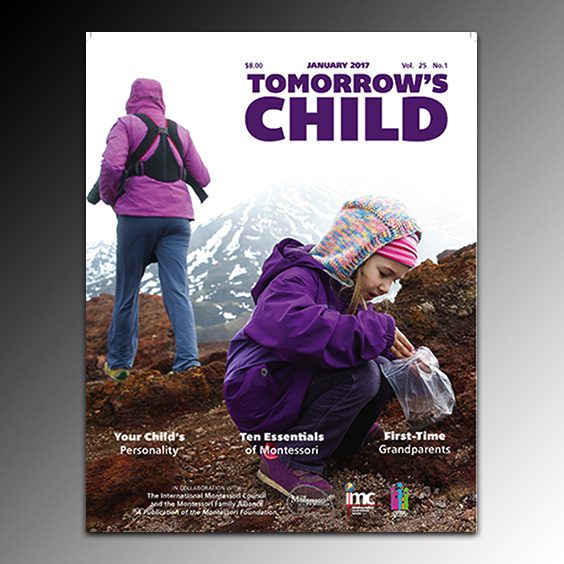
We are grateful to all who wish to contribute an article or photo essay to share with the readers of Tomorrow’s Child magazine. Over the years, we’ve been asked many questions regarding format, length, usage, etc so we’ve put together this checklist to help the novice writer through the process.
Articles should be submitted in a word document or in the body of an email. PDFs are not accepted.
Do not worry about grammar issues, our editorial staff is here to help with that aspect.
Articles do not have word count minimums or maximums, as each story is different. A general rule of thumb is somewhere between 1,000 and 1,500 words.
Submissions with Artwork / Graphics
When you embed a graphic into a word document, it is the equivalent of a placeholder. The artwork should be attached as an EPS, JPEG or TIFF. If it was created in a program such as IllustratorTM or PhotoshopTM, the native AI or PSD files will work as well.
Photographs need to be high resolution (300 DPI). Photo releases for any picture with children or staff must either be on record at the Foundation or sent with your articles, so that we have permission to use.
Citations used in any article should be included at the end of each article. This includes the use of any internet references.
Bios of each writer should be sent each time you submit an article in its entirety. We do not maintain a database of each, so it’s important for the author to update accordingly.
Articles that have appeared in any other publication carrying a trademark or copyright must be submitted with a copy of a permission from that publication’s editor or equivalent, allowing us to not only reprint but reformat it into our magazine’s specs. This is for everyone’s protection. Please send your submissions to: info@montessori.org. Should your photo files be too big to attach we can arrange for you to upload to a Dropbox folder.
We are grateful to all who wish to contribute an article or photo essay to share with the readers of Tomorrow’s Child magazine. Over the years, we’ve been asked many questions regarding format, length, usage, etc so we’ve put together this checklist to help the novice writer through the process.
Articles should be submitted in a word document or in the body of an email. PDFs are not accepted.
Do not worry about grammar issues, our editorial staff is here to help with that aspect.
Articles do not have word count minimums or maximums, as each story is different. A general rule of thumb is somewhere between 1,000 and 1,500 words.
When you embed a graphic into a word document, it is the equivalent of a placeholder. The artwork should be attached as an EPS, PDF, JPEG or TIFF. If it was created in a program such as Illustrator™ or Photoshop™, the native AI or PSD files will work as well.
Photographs need to be high resolution (300 DPI). Photo releases for any picture with children or staff must either be on record at the Foundation or sent with your articles, so that we have permission to use.
Citations used in any article should be included at the end of each article. This includes the use of any internet references.
Bios of each writer should be sent each time you submit an article in its entirety. We do not maintain a database of each, so it’s important for the author to update accordingly.
Articles that have appeared in any other publication carrying a trademark or copyright must be submitted with a copy of a permission from that publication’s editor or equivalent, allowing us to not only reprint but reformat it into our magazine’s specs. This is for everyone’s protection. Please send your submissions to: info@montessori.org. Should your photo files be too big to attach we can arrange for you to upload to a Dropbox folder.
- What makes your school special?
- An event your students helped to plan and carry out.
- Charitable works your students led and implemented.
- Global connections with other schools.
- Celebrations of holidays that are universal and show your school’s cultural diversity.
- Student-led micro-economies.
- Book reviews.
- Alumni updates: where are they now and what great works are they doing?
- How you’ve involved parents and grandparents into your school’s community.
- And, of course, why Montessori is so important to your school’s community.
Tomorrow’s Child / January 2017 / p 23
by Tim Seldin | Kindergarten, MFA, Mixed Ages, Montessori Education, Montessori Family Life, Primary (3-6)
It’s re-enrollment time again, and in thousands of Montessori schools all over America parents of four-almost-five-year-olds are trying to decide whether or not they should keep their sons and daughters in the final year of their primary Montessori experience or send them off to kindergarten in local, non-Montessori schools.
The advantages of using the local schools often seem obvious, while those of staying in Montessori are often not at all clear. When your child can attend the local schools for free, why would anyone want to invest thousands of dollars in another year’s tuition?
It’s a fair question, and it deserves a careful answer. Obviously, there is no one right answer for every child. Often, the decision depends on where each family places its priorities and how strongly parents sense that one school or another more closely fits with the hopes and expectations they have for their children.
Naturally, to some degree the answer is also connected to the question of family finances, although, we are amazed at how often families of very modest means make their children’s education a top priority and see the choice of staying in Montessori as an important investment in their children’s future.
So here are a few answers to some of the questions parents often ask about Montessori for the kindergarten-age child.
In a nut shell, what would be the most important short-term disadvantage of sending my five-year-old to a local school?
When a child transfers from Montessori to a new, traditional kindergarten, she spends the first few months adjusting to a new class, a new teacher, and a whole new system with different expectations. This, along with the fact that most traditional kindergartens have a much lower set of expectations for five-year-olds than Montessori programs, severely cuts into the learning that could occur during this crucial year of their lives.
In most cases, Montessori kindergarten children have already been exposed to a great deal of learning. For example, their understanding of the decimal system, place value, mathematical operations, and similar information is usually very sound. With reinforcement as they grow older, it becomes internalized and a permanent part of who they are. When they leave Montessori before they have had the time to internalize these early concrete experiences, their early learning often evaporates, because it is neither reinforced nor commonly understood.
What would be the most important advantages of keeping my five-year-old in Montessori?
Montessori is an approach to working with children that is carefully based on what we’ve learned about children’s cognitive, neurological, and emotional development from several decades of research. Although sometimes misunderstood, the Montessori approach has been acclaimed as the most developmentally appropriate model currently available by some of America’s top experts on early childhood and elementary education.
One important difference between what Montessori offers the five-year-old and what is offered by many of today’s traditional kindergarten programs has to do with how it helps the young child learn how to learn.
Over recent years, educational research has increasingly shown that students in many schools don’t really understand most of what they are being taught. As Howard Gardner, a leading educational psychologist and advocate of school reform, wrote: “Many schools have fallen into a pattern of giving kids exercises and drills that result in their getting answers on tests that look like understanding. Most students, from as young as those in kindergarten to students in some of the finest colleges in America, do not understand what they’ve studied in the most basic sense of the term. They lack the capacity to take knowledge learned in one setting and apply it appropriately in a different setting.”
Montessori is focused on teaching for understanding. In a primary Montessori classroom, three- and four-year-olds receive the benefit of two years of sensorial preparation for academic skills by working with the concrete Montessori learning materials. This concrete, sensorial experience gradually allows the child to form a mental picture of concepts, such as: How big is a thousand? How many hundreds make up a thousand, and what is really going on when we borrow or carry numbers in
mathematical operations?
The value of the sensorial experiences that the younger children have had in Montessori has often been underestimated by both parents and educators. Research is very clear that young children learn by observing and manipulating their environment, not through textbooks and workbook exercises. The Montessori materials give the child concrete sensorial impressions of abstract concepts, such as long division that become the foundation for a lifetime of understanding.
But won’t my five-year-old spend her kindergarten year taking care of younger children instead of doing her own work?
No, not at all! When older children work with younger students, they tend to learn more from the experience than their ‘students.’ Experiences that facilitate development of a child’s independence are often very limited in traditional schools.
Five-year-olds are normally the leaders and role models in the primary Montessori classroom. They help to set the tone and serve as an example of appropriate behavior for the class. They often help younger children with their work, actually teaching lessons or correcting errors.
Most five-year-olds have been waiting for the longest time to be one of the ‘big kids.’ The experience of playing the leadership role does wonders to reinforce the five-year-olds’ sense of autonomy and self-confidence.
And finally …
Five-year-olds are beginning to reflect upon the world. They pay closer attention, notice more details, ask more questions, and begin to explain the world in their own terms. The kindergarten year is a time when the child begins to integrate everything she learned in the first few years.
By the end of age five, Montessori students will commonly develop academic skills that may be quite advanced; however, academic progress is not our ultimate goal. Our real hope is that these children will feel good about themselves and enjoy learning. Mastering basic skills is a side goal.
The key concept is readiness. In Montessori, if a child is not developmentally ready to advance to a new skill or level of understanding, he or she is neither left behind nor made to feel like a failure. Our goal is not ensuring that children develop at a predetermined rate, but to ensure that whatever they do, they do well and feel good about themselves as learners.
When the time comes to decide, we hope you will choose to give your child the gift of Montessori for the kindergarten year.
Tomorrow’s Child / January 2017 / p 2o
by Margaret Combs Sitinee Sheffert | MFA, Montessori Education, Montessori Family Life, Peace Education, Psychology
childhood, leisure, friendship and people concept – happy little boy giving maple leaves to girl in autumn park
This is the story about a little girl named Rachel. For Rachel’s 9th birthday, she wanted to do something different. Instead of receiving gifts, she wanted to raise $300 for Charity Water, a non-profit organization bringing clean and safe drinking water to people in developing countries. One month later, Rachel passed away in a tragic accident. The pastor at her church continued her fund-raising campaign for Charity Water, and, as word spread about her generosity and compassion for helping others, donations came pouring in.
At the end of Rachel’s Charity Water campaign, she raised $1.2 million. Because of her wish, 143 water projects were built, providing 37,700 people with clean water. Her story inspired almost 32,000 people from all over the world to donate to her cause.
This story shows the powerful impact one child’s action can make on the world. It is also a great example of how a young child can look beyond him or herself. How can we facilitate and inspire more of this kind of action with children?
THE PURPOSE OF OUR TEDX TALK
We believe that all people are born inherently good. We have experienced the capacity within children for kindness, compassion, and empathy. As adults who engage with children (as parents, teachers, relatives or friends), we have the obligation to nurture this goodness and to teach children that they have power to make a positive impact in the world.
Even better, we can help children make the transition naturally, from a tendency to think of themselves first to empathetic and active contributors in society. How? By providing repeated and intentional giving experiences, where children begin to own their transition.
In the words of Maria Montessori:
“The child is constructing the person he will become.”
THE STORY OF TRANSFORMATION
With this in mind, we wanted to explore the idea of involving children in creating a charitable project to show them
firsthand their personal ability to help others.
Charitable projects can come in all different forms, from raising money to service projects. And service projects can vary, from volunteering in a homeless shelter to collecting cans at school for a food drive. We chose to focus on projects where children use their own hands to create items to donate. At this age, children understand the value of their own time and effort much more than the concept of monetary value.
In the beginning, we were not sure how kids would embrace this project. Our exploration involved young children, ages 5 and 6, who generally have a more egocentric mindset. At a certain age, however, children begin to have the capacity for generosity. According to a study in the academic journal Infancy, children started showing signs of generosity at the age of two. With this in mind, we were cautiously optimistic that our project would help nurture that generosity and help show the children that they were capable of making a difference in the world.
We wanted to begin our work with the children by sharing real stories related to social issues to allow children to develop empathy and a stronger connection to the project. Through these stories, the children would begin to understand the positive impact their actions could have on others.
PREEMIE HATS
The first project we took on with the children was to knit hats for babies born prematurely and, therefore, at risk. The donation of handmade hats was a means of sharing hope and love to the preemies and their families. Here, and with subsequent projects, we considered the age of the children we were working with to guide how we approached sensitive topics.
As the children worked, we saw an amazing change within them. The children began supporting and encouraging each other’s work. As they got closer to the finished product, the discussion among the children was inspiring: I can’t wait for a preemie to wear this hat!; Can we make another one when
we finish?
Their excitement grew as they finished the project and then came the realization that their own hands, their time, their effort just made something special that would help somebody else.
But we didn’t just stop at one project.
The children began to feel a sense of ownership, empowerment, and selflessness. As we brought more projects to the children on a regular basis, their engagement grew. Conversations became more meaningful, and the children stopped asking if they would get to keep the project for themselves. They now realized that each one of them had the capacity and power to make a difference.
SERVICE LEARNING
Our approach to service learning is to engage the children’s time, energy, and skills to craft items to give to others. We have seen firsthand how parents and schools are embracing the concepts of service-based learning through crafting. Giving Artfully Kids (givingartfullykids.com) started with a few students and has grown to include hundreds of children participating in the making of thousands of items to be given to others.
In support of this, a meta-analysis of 62 studies involving 11,837 students indicated that, compared to controls, students participating in service learning programs demonstrated significant gains in five outcome areas: attitudes toward self; attitudes toward school and learning; civic engagement; social skills; and academic performance. Though this study referred to older children, we have found the same evidence proven in our work with children of all ages.
As parents, we can testify to the fact that these can be some of the most difficult things to impart in our kids: self-view; worldview; and attitude towards learning.
REFLECTION/FEEDBACK
We started this talk with a heroic story about one child’s impact on a larger cause; however, we want to stress that helping just one other person can make a difference and cause a ripple effect. Just a month ago, a video went viral of a little girl, at a restaurant, walking outside with her dinner plate to give to a homeless man. The difference she made for that man on that day not only impacted him but also touched hundreds of thousands of people.
With homelessness in mind, another project we chose was to have children make blessing bags for the homeless. Homelessness is an issue many children see first hand in their communities; it evokes many questions. We talked about needs versus wants to give some context on the issue.
Children filled bags with basic necessities, such as soaps, shampoos, and granola bars. We then asked the children and their parents to disperse the bags when they saw the homeless in their communities.
Tackling such a complicated issue with children is challenging; however, we knew this project hit the mark when we received the following response.
“Thank you so much for the intentionality of teaching our children about caring for others. [My girls] were thrilled to hand out their blessing bags while we were downtown today. We even kept our distance and watched as the woman poured over her bag excitedly.”
We love this story because it not only showed the children’s excitement in helping someone, but it also allowed the children to directly experience the appreciation of the recipient.
A CALL TO ACTION
We have witnessed first hand the transformation that is created within a child from thinking mostly of him or herself to consciously thinking of others. We have an incredible opportunity to shift our culture and to invest in the potential generosity of our children.
Will you join us today on this journey? It can be as simple as making blessing bags for the homeless, cards for children in a local hospital, or gifts for residents of your local senior center. The possibilities are endless.
And as each child makes an individual change, a collective change occurs within society. We know we can create a kinder, more compassionate and empathetic society, one child at a time.
Tomorrow’s Child/pg11/Jan2017
by Tim Seldin | Book Reviews, Brain Development, Family Resources, Montessori Education, Montessori Family Life, Montessori Parenting, Montessori students, School Resources
By recognizing, accommodating, and celebrating our children’s different personalities, we show that the world welcomes them as individuals.
Understanding Personality Types
When you were young, were you the child who ran into class, excited to be there, or were you hesitant? Were you the most popular one in class, or often alone? Did you enjoy team sports from an early age or prefer to read a book? Perhaps one of the hardest things for us to recognize as parents is that our children are not ourselves. You may be surprised at the distinct differences between your personality and your child’s, or maybe your child’s behavior reminds you of something in your own personality that you wish you could change.
Each of us is unique: parent, child, grandparent. We have different interests, temperaments, and abilities, and each of us sees the world and interacts with others somewhat differently. Children benefit from discovering this basic fact—and so do parents.
Temperament and Personality
Your baby comes into the world with an underlying temperament. You may have a cranky infant, who wails pitifully in unfamiliar arms, a sleepyhead, or a gregarious baby, who smiles and coos at everyone. Even in babyhood, a one-size-fits-all approach to parenting will not work. As babies become toddlers, temperament evolves into behavior traits. Your toddler may be shy, cautious, and defensive, often absorbed in his own activities and hesitant about new experiences. Easy-going, even-tempered types adapt more readily to most situations, while high-spirited toddlers tend to dive in head first. If you regularly “watch and follow your child,” you will soon develop a good understanding.
The Shy Child
The introverts of this world may suffer more than most, and this can be especially true in childhood. We have all seen the despairing mom at a party pushing her daughter into games, or the dad in the playground, urging his timid son to the top of a climbing frame. If, instead, we acknowledge and validate how a child is feeling, it sends the message to a child that it is OK to be who he is: “I know you don’t like those horses on the carousel, Jack. When you are bigger you might want to have a go.” When a situation might be taxing for a child, lay the foundation with quiet conversations.
“We are going to a party for Grandpa’s 70th birthday. Your cousins and aunts and uncles will be there, along with people and children that you don’t know. When we sing Happy Birthday, where do you want us to be?” Remember, too, that sometimes children will surprise us with a response that we would have not predicted. A typical example is the child who is hesitant with strangers and new situations but goes off to Montessori school, and, after a day, cannot wait to get back to school each morning.
Challenging Behavior
What do we mean by challenging behavior? It pushes our buttons? It is particularly serious? Nothing is working and we’ve tried all the usual things? The first question to ask is whether this is normal behavior for the age. Toddlers have limited attention spans, poor social skills, and are inclined to throw things and explore beyond the limits of their own safety. Managing their behavior is often a matter of managing your own expectations: avoiding high-end restaurants; monitoring situations that trigger tantrums; offering a boisterous toddler opportunities to let off steam; and finding quiet corners in busy places for a nervous child.
“Perhaps one of the hardest things for us to recognize as parents is that our children are not ourselves.”
Is it common behavior when you consider the situation? When there is a new baby in the house, attention for the older child is often in short supply. “That’s a beautiful new baby sister,” a grandma told her truculent grandson. “But now, I want to read a story to someone who can talk to me.” When all the relatives are at our house for the holidays or a family reunion, we may briefly see unrecognizable traits in an excited group of over-stimulated children, and we make allowances. That said, some children seem to pitch headlong into every situation, and there are times when it feels as if their behavior is beyond control. Such a child needs regular reminders of the ground rules: you may not hurt or endanger yourself, other people or living things, nor may you deliberately damage the environment, whether your own belongings or those of others. This child needs to be offered outdoor activity in all kinds of weather and plenty of interesting pursuits indoors.
Challenging children often come to expect negative reactions, so notice and reward good words and deeds. Remember that children change as they grow and what you find challenging when they are young, may develop into positive characteristics as they get older. Children amaze us because they are people right from the start. Sometimes we forget.
Tomorrow’s Child / January 2017 / p22
by Tim Seldin | Brain Development, MFA, Montessori Education, Montessori Family Life, Montessori Parenting, Montessori students, Montessori Teachers, Practical Life
A caring family life and an environment rich in activities, offers everything a child needs to develop higher-level brain processes.
In essence, the brain’s executive functions allow us to plan, organize, and complete tasks. Montessori would not have recognized the term, yet most of her activities are tailor-made for these higher-brain processes. Infants as young as seven months start to exercise these cognitive skills with simple games like peekaboo or hiding a toy under a blanket.
A baby uses working memory as he tracks the hiding places and exercises inhibitory control as he waits for someone or something to pop back into view. Working memory and impulse control are both at work when he wriggles with excitement as an action song like Round and Round the Garden builds to a predictable climax.
As toddlers turn into preschoolers, matching and sorting games, memory games, and puzzles are great exercises for visual working memory. Children become more flexible in their thinking and can pay attention to different demands in games, such as Follow the Leader and Simon Says. Imaginary play enhances planning skills and self-regulation, especially if children are asked to organize the setting and decide who is going to be the mom, dad, or the doctor before they start. When you cook with your children, they develop the ability to wait for instructions, keep tasks in working memory, and pay attention to measuring and weighing.
From age four or five, board games in which children have to wait their turn, follow a rule, and, later on, involve strategy, use a trio of executive functions: working memory, flexibility, and self-control. Puzzle and brain-teaser books exercise attention and problem-solving skills. I Spy and 20 Questions are good logic and reasoning games.
Problem-solving
As children grow, parents can help develop their problem-solving capabilities by presenting them with small tasks that encourage them to consider situations, plan, and come up with solutions.
Finding a solution to a problem involves a set of distinct steps: Identify the problem; look at the factors that make up the problem; use what you know, your skills, and what you have available to develop a solution; then decide if it worked. Adults have a range of strategies and blueprints based on previous experience that speed up our problem solving. Children also develop strategies over time, but in the early years, life is rich in novelty, which makes planning and finding solutions especially rewarding. Try the following with your child:
Before a holiday or trip, give her a small suitcase, ask her to plan what she needs, and let her pack things like a toothbrush, pajamas, and beach toy.
At a family meeting, ask your wise child to consider a problem and offer advice.
Before a play or puppet show, get the children to organize props and plan who is doing what.
Invite your child to solve an everyday dilemma: “Our baby hates being in the supermarket cart. How can we make it fun for him?”
Tomorrow’s Child / January 2017 / 20
by Tim Seldin | Family Resources, MFA, Montessori Family Life, Montessori Parenting, Prepared Environment, Primary (3-6), Psychology, Sensitive Periods
Montessori believed in a necessary relationship between children and their environment. Children must find a properly prepared environment if they are to fully develop their unique human potentials.
In addition to determining children’s eventual height, hair color, and other physical characteristics, there is another cognitive plan which determines the unique emotional and intellectual qualities of each child. These qualities develop through what Montessori referred to as “the sensitive periods.”
Each sensitive period is a specific kind of compulsion, motivating young children to seek objects and relationships in their environment with which to fulfill their special and unique inner potentials..
Montessori believed that children will develop to their full human potential when everything in the environment is “just right.” Everything: food; furniture; learning activities; social relations; clothing; routines; and rituals must all be “just right” in order for them to develop their fullest potential as human beings. Young children are neither consciously aware (nor capable) of directly communicating their interests and developmental needs. In Montessori’s Early Childhood programs, teachers are charged with providing learning environments in which everything is “just right.” For more than one hundred years, Montessori educators have observed a set of motivations shared by young children around the world. What Dr. Maria Montessori discovered in the St. Lorenz Quarter in 1907 was that children are self-motivated to learn from their environment.
Borrowing a term from biology, she called these stages the “sensitive periods,” after similar developmental stages in animals. The idea seemed revolutionary at the time, and took many years, following Piaget’s extensions of Montessori’s initial explanation, to become generally accepted in child psychology. Today, whether we use Montessori’s terminology or not, the description of child development she first presented at the turn of the century rings true.
Each sensitive period is:
- A period of special sensibility and psychological attitudes.
- An overpowering force, interest, or impetus directing children to particular qualities and elements in the environment.
- A period of time during which children center their attention on specific aspects of the environment, to the exclusion of all else.
- A passion and a commitment.
- Derived from the unconscious and leads children to conscious and creative activities.
- Intense and prolonged activity which does not lead to fatigue or boredom, but instead leads to persistent energy and interest.
- A transitory state once realized, the sensitive period disappears. Sensitive periods are never regained, once they have passed.
Dr. Montessori identified eleven different sensitive periods occurring from birth through age six. Each refers to a predisposition, compelling children to acquire specific characteristics as described below. When Montessori teachers speak about children being “inner-directed,” they are referring to an inner compulsion or sensitive period. A Montessori teacher would say, for example, “This child is in her sensitive period for order.” These phrases point to each child’s predisposition to follow her own daily classroom routine in which she chooses the same materials and in the same sequence. Ages of the onset and conclusion of each sensitive period are approximate and are indicated after the general description.
- Movement – Random movements become coordinated and controlled: grasping, touching, turning, balancing, crawling, walking. (birth — one)
- Language – Use of words to communicate: a progression from babble to words to phrases to sentences, with a continuously expanding vocabulary and comprehension. (birth — six)
- Small Objects – A fixation on small objects and tiny details. (one — four)
- Order – Characterized by a desire for consistency and repetition and a passionate love for established routines. Children can become deeply disturbed by disorder. The environment must be carefully ordered with a place for everything and with carefully established ground rules. (two — four)
- Music – Spontaneous interest in and the development of pitch, rhythm, and melody. (two — six)
- Grace & Courtesy – Imitation of polite and considerate behavior leading to an internalization of these qualities into the personality. (two — six)
- Refinement of the Senses – Fascination with sensorial experiences (taste, sound, touch, weight, smell) resulting with children learning to observe and with making increasingly refined sensorial discriminations. (two — six)
- Writing – Fascination with the attempt to reproduce letters and numbers with pencil or pen and paper. Montessori discovered that writing precedes reading. (three — four)
- Reading – Spontaneous interest in the symbolic representations of the sounds of each letter and in the formation of words. (three — five)
- Spatial Relationships – Forming cognitive impressions about relationships in space, including the layout of familiar places. Children become more able to find their way around their neighborhoods, and they are increasingly able to work complex puzzles. (four — six)
- Mathematics – Formation of the concepts of quantity and operations from the uses of concrete material aids. (four — six)Note: This list does not include the sensitive periods found in the development of older children and adolescents. However, it does suggest to the early childhood educator some of the things that young children absorb, or will if they are given exposure and opportunity.Keep in mind that the child’s learning during these early stages is not complete, nor has it reached the internalized abstraction stage that will develop as she grows older. It is, however, the foundation upon which much that follows will be built. Wherever this solid foundation is lacking, children will experience difficulty in learning and operating later on.
by The Montessori Foundation | Family Resources, MFA, Montessori Family Life, Montessori Parenting, Video
The Parenting Puzzle is a new parenting course from The Montessori Foundation led by Lorna McGrath, Coordinator of The Montessori Family Alliance
This course is designed to help parents turn their homes into peaceful havens rather than battlefields. Based on years of working with children of all ages, Lorna provides by cultivating closeness, cooperation, and communication.
Learn how to stop squabbles, resolve conflicts peacefully, encourage each person to do their personal best, reduce power struggles, meet children’s emotional needs, and create strong parenting partnerships.
Along with issues raised by parents participating in this course, we will address the following issues:
- having time to breathe
- cooperation
- raising confident children
- feeling part of a family community
- communicating with honesty and respect
- enjoying your time together as a family
- learning how to work out solutions without creating excessive family drama
- creating a home environment that is is filled with peace, understanding, and harmony
- Participant Bonuses
Downloadable resources (checklists, worksheets, PDF guides, etc.)
Access to a private group with other students
1-on-1 or group coaching calls
Direct email access
Monthly live calls or webinars with you
Discounts on other products or services
Course completion certification
Coming Soon!
by Kath Kvols | MFA, Montessori Family Life, Montessori Parenting, Parenting on the Same Page, Video, Webinars / MFA
If you struggle to fit everything into your life – work, family, faith, leisure time – then this session will give you some ideas to create balance in your life.
by Tim Seldin | Family Resources, Infant, Infant-Toddler (0 to 3), MFA, Montessori Education, Montessori Family Life, Montessori Parenting, Parenting on the Same Page, Primary (3-6), School Resources, The International Montessori Council, Video, Webinars / MFA
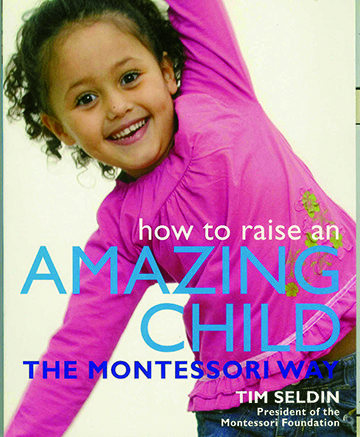
Author, Tim Seldin, talks about the 2nd edition of his practical guide to parenting the Montessori Way called How to Raise an Amazing Child. In this new edition Tim introduces some new topics of interest to parents.
by Tim Seldin | Montessori Education, Montessori Family Life, Primary (3-6), The International Montessori Council, Video
On May 1e were joined by Jan Selby and Vina Kay to talk about their highly anticipated video documentary project, Building The Pink Tower. We shared some clips from the film, but the real story is how two Montessori parents came to the conclusion that they could use their skills to help.
“Building the Pink Tower” is a documentary film that reimagines schools and learning through the lens of Montessori education. It will be a powerful tool to help change the conversation about education on the local and national levels.
When they began, they created an absolutely stunning trailer for the “Building the Pink Tower” fundraising campaign. It features great interviews with Dr. Steve Hughes, AP of Pediatrics and Neurology at University of Minnesota Medical School, Molly O’Shaughnessy, Executive Director of the Montessori Training Center of Minnesota, Liza Davis, Director of Cornerstone Montessori, as well as numerous other interviews with teachers and Montessori alumni.
Montessori schools, teachers, and friends of Montessori began to raise money in 2014 to make this feature film length film possible. This is the time for their final push to get the film done this year.
www.donatepinktower.org
by Lindsay Palmer | MFA, Montessori Education, Montessori Family Life, Montessori Materials, Montessori Parenting, Montessori students, Montessori Teachers, Webinars / MFA
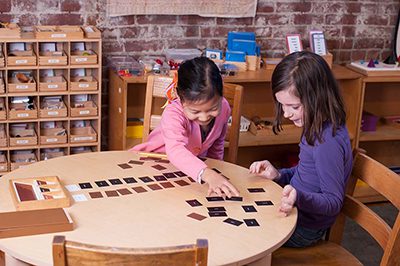
A 3-hour Montessori work cycle.
by Christine Lowry | Family Resources, MFA, Montessori Education, Montessori Family Life, Montessori Parenting, Montessori students, Start of School Year, Webinars / MFA
Montessori consultant, Christine Lowry. The topic is What to Expect in the First Month of School.
by NewGate School | Maria Montessori, MFA, Montessori Education, Montessori Family Life, Montessori Parenting, Montessori students, Video
by Lorna McGrath | Brain Development, Emotional Intelligence (EQ), Health / Nutrition, MFA, Montessori Education, Montessori Family Life, Montessori Parenting, Montessori students, Webinars / MFA
Lorna McGrath and Tim Seldin spoke with Montessori Mom, Ann-Mari DeCilis.
by Lorna McGrath | Family Resources, MFA, Montessori Education, Montessori Family Life, Montessori Parenting, Montessori Teachers, School Resources
I became frustrated and very disheartened at the way teachers were expected to treat the children in their classrooms and the environments in which children were placed to learn when I taught in conventional schools. And now, having left that environment decades ago, I continue to be appalled at seeing that nothing has changed except becoming more entrenched in pigeonholing children, insisting that memorization of facts and figures constitutes a ‘good’ education, and persisting in advancing the idea that adults know what and when children should be learning. So I began to question whether anyone outside of Montessorians were paying attention to what we know about children and learning.
It’s now been 110 years since Maria Montessori started her journey into the “discovery of the child.” Through her astute observations, adults began to see children differently than they had in the previous century. It might be wise for us to refresh our memories about her observations.
She saw that within groups of children there were social/emotional needs and ways of processing experiences and information that were characteristic of certain time periods in children’s growth and development. Learning about friendship, resolving conflicts, doing things for the good of all, enjoying activities that involve the senses, experiencing ideas and concepts in a hands-on way are all examples of patterns that she saw within groups of children and time periods. She called them sensitivities or sensitive periods. And, within those time periods, she saw the uniqueness of individuals; each child learned at her own pace, had her own interests, and had her own way of learning. Maria Montessori said that classrooms needed to be multi-age environments that allowed for individual, experiential learning and social interaction. She said that the adult’s role is one of a guide or facilitator, who prepares an enticing environment with many learning activities from which a child could choose.
Let’s take a look at some of the things she said regarding:
- Uniqueness: “Look at the child. She did not say ‘a’ child, not ‘all’ the children but the child right there in front of you.”
- Interests: “Little he cares about the knowledge of others; he wants to acquire knowledge of his own…to experience the world through his unaided efforts… Children want to find out things according to their interests and their time.”
- Learning: The senses, being explorers of the world, open the way to knowledge… She saw that the senses were the key to learning for young children— to touch, to see, to taste, to hear, to smell, to experience!
- Choice: The child chooses what helps her to construct herself… Children must have the freedom to show us what they need and not be controlled by a one-size-fits-all curriculum.
- Mind: The mind of the young child is different from ours…When we recognize the limitations of reaching her through verbal instruction, then the whole concept of education changes. It becomes a matter of providing an appropriate environment, not forcing our words upon her ears… We talk, talk, talk, talk, talk too much—especially to young children. Children must be allowed the opportunity to experiment, manipulate, and try out ideas and concepts rather than become comatose from our lengthy lectures.
So, my question remained, “Is Anyone Paying Attention?” Gladly, I found that the answer is, “Yes.” A book called The Importance of Being Little by Erika Christakis, former early childhood educator at Yale Child Study Center and a graduate of Harvard University, was sent to me for review. Turns out, Ms Christakis is paying attention.
She says, in her book, that excellent early childhood education centers include adults who:
- Spend time building relationships with children;
- Pay a lot of attention to how children think;
- Connect how children think to how they communicate; and
- Fnd ways to help children express their thoughts and ideas.
Those bullets sound like the things that we do in our classrooms every day: building community through relationships and multi-year age groupings; observing; reflecting; listening to children; and asking reflective questions.
Ms Christakis also says that conventional school still clings to the false belief…that learning must come from somewhere outside of the child to be given, or withheld, by a qualified adult…. Montessorians agree that adults in classrooms, and I use the word classrooms broadly, are meant to be facilitators, guides, and observers, who ask questions rather than give right answers.
She says that it’s not enough to have knowledge of child development. Teachers must pay really careful attention to children… In fast paced conventional centers that are designed for one-size fits all curriculum and have one year age groupings, it is almost impossible to do. In our classrooms the curriculum is rich and widely varied. It can be expanded to include individual interests and skills. And, we have at least three years to cover it.
I also found a very powerful blog, “What the Modern World Has Forgotten about Children and Learning,” by Carol Black, writer and director of a documentary film—Schooling the World, who studied literature and education at Swarthmore College and UCLA. She wrote the blog in answer to a claim that, “Spontaneous reading happens for a few kids. The vast majority need (and all can benefit from) explicit instruction in phonics.” She responded specifically in regard to how children learn to read. However, many of her points can be taken more generally when we think of how children learn.
Ms Black sees conventional schools as unnatural environments for learning. She says that, People today do not even know what children are actually like. They only know what children are like in schools. She so aptly puts it, …collecting data on human learning in school is like collecting data on killer whales based on their behavior at Sea World.
Ms Black says that there are species-specific social structures. Human social structures include the following:
- Small, mixed-age communities;
- Engagement in meaningful activities;
- Inclusion of younger and older children and adults
- Immersion in the natural world;
- Freedom to move, play, and exercise; and
- Opportunity to observe, imitate and participate in adult work as they are ready.
As I read what Ms Black had to say I recognized, once again, that even though we have classrooms in Montessori schools, they are designed to look and feel more like home—with areas for preparing food and eating; areas and supplies for cleaning up; and outdoor areas for experiencing the natural world and for gardening. There are places for children to read—alone or with a friend. There are few, if any, large group lessons. Rather, there are individual children working on learning activities that interest them, small groups receiving an introductory lesson from a guide, or an older child giving a lesson to one or two younger children. There might even be a grandparent in the room, reading to children or listening to them read. It seems to me that I have just described a species-specific social structure as Ms Black would say.
I am encouraged by 110 years of paying attention to what children have been teaching us about how they learn, by Montessorians who are creating environments that support how they learn, and by finding people in the world outside of Montessori who understand children and who are advocating for a different kind of education than the conventional one that most children in the US experience.
References:
Wolfe, A. (1978). Look at the child. Parent Child Press.
Christakis, E. (2016). The importance of being little, Viking Press (an imprint of Penguin/Random House LLC)
Black, C. (2016). “What the modern world has forgotten about children and learning.”
Schoolingtheworld.org
Tomorrow’s Child / January 2017 / p 24
by John Long | Kindergarten, Mathematics, MFA, Montessori Education, Montessori Family Life, Montessori Parenting, Uncategorized
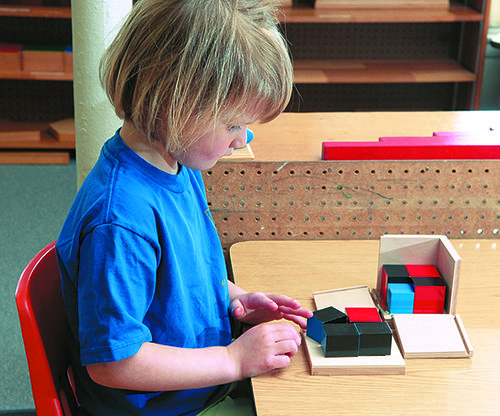
This is a story about eight wooden blocks and a five-year-old girl. The eight wooden blocks are nestled in a hinged wooden box. The five-year-old girl is sitting alone at a small wooden table. She is very good at arithmetic, her teacher tells me, but rarely chooses to work with this kind of spatial, three-dimensional puzzle.
That’s interesting because, in an expression of her mathematical genius, Dr. Montessori developed learning materials integrating arithmetic, geometry, and algebra. It’s also interesting to note that there is a significant body of contemporary research exploring the relationship of spatial ability, mathematical achievement, and gender: 687,000 Google hits.
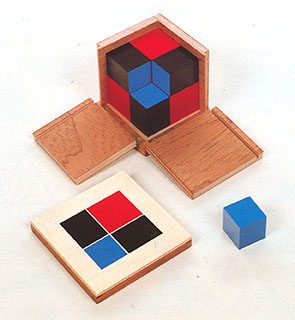
These eight wooden blocks are called The Binomial Cube because they are a concrete representation of the algebraic binomial (a + b)3, although our five-year-old will not encounter the algebraic presentation until she reaches upper elementary four years from now. The blocks include one small and one large cube and six prisms of two different sizes. You stack them in two layers to form a composite cube. There is one right way to put them together.
I watched as she built the bottom layer of the cube inside the hinged box. She knew it was not right (I could tell from her body language) but even so, she attempted to fold up the sides of the box, checking to see if the blocks fit. They did not, so she tried again. And again. And again.
She turned sideways in her chair and looked across the classroom. She turned back and tried again. Still no better. From the other side of the observation window, I could see her error. I was only six feet away from her. I wanted to reach out and fix it, to show her how to do it, to make her problem go away. At the same time, I knew that to do so, to rescue her, would rob her of the chance to handle it herself. She had been working at this for eight or nine minutes and was stuck. She stopped again, got up, and went to talk to her teacher.
Her teacher came to the table and sat down. Two other children came to watch, holding their hands behind their backs in ‘observation pose.’ The child explained her dilemma. The teacher spoke a few words. One of the two observers, another five-year-old girl, reached out and turned one of the cubes. The sun emerged from behind the clouds. The teacher and the other children watched as she put the fourth piece in place on the bottom layer and quickly put the four blocks in place on the top layer.
She closed the box and put the lid on. It all fit. It was right. She had done it. Herself. With a little help. She looked up and smiled.
Her teacher and the other two children walked away. She opened the box and took out the blocks again. She rebuilt the puzzle. She looked up again and smiled. She walked over to her teacher to report her success and her teacher matched her smile. She went back to the table and took out the blocks again. She rebuilt the puzzle and smiled again. She took out the blocks a fourth time and rebuilt the cube. And a fifth.
Finally, she was done, satisfied for now that she knew how to build this puzzle. She looked around the classroom. Next to her was a friend holding a chart of numbers showing sums. This is work she knows well. Her friend asked her a question, looking at the chart, and she was able to help, showing how to slide her index fingers down and across to find the answer.
She was ready now, so she carried the box back to the shelf and returned it to the place it belonged. She went on to other work.
What did she learn while honing her spatial ability? She chose this work herself and initially experienced frustration. She could have been defeated by that, given in to her negative feelings, and simply avoided that work or anything like it in the future. Instead, she persevered in the face of difficulty. She asked for help when she needed it, and this simply reaffirmed her image of herself as resourceful. She repeated the construction successfully, experiencing the emotional satisfaction that comes from mastering something difficult.
Next time she encounters an intellectual or physical challenge, she will know that she is capable of mastering it. She will know that she has resilience and resourcefulness as well as intelligence at her command. She has advanced the construction of her own brain for a lifetime of success.
We want to once again thank John Long and the Post Oak School for allowing us to republish John’s wonderful essays in Tomorrow’s Child and in our online resource collections.
by John Long | MFA, Montessori Family Life, Montessori Parenting, Montessori students, School Resources, Writing
In The Celebration of Thinking Elliot Eisner, professor of education and art at Stanford University writes,:
We should be concerned about curricula that place a heavy emphasis on limited forms of learning and thinking. When limited forms of learning dominate curricula, they also cultivate a disposition. Following rules and applying algorithms do not match the kinds of problems with which most people must deal in life outside of school. Life’s problems almost always have more than one solution, and they typically require judgment and trade-offs”
Upper elementary students have been working on different kinds of writing, and one day last week their teacher invited them to write an opinion paragraph. Now asking a Montessori student to express an opinion could be described as redundant. Nevertheless, it is good to put that opinion in writing, to capture an otherwise fleeting thought, to give it shape and to refine it. A sixth-grade student, who had been working with a tutor outside of school to learn test-taking skills, spoke up and said, “They are looking for an opening sentence, two or three supporting sentences and a conclusion.”
“Who are they?” asked his teacher.
“The testing people,” answered the student, and then he added, “We have to set a time limit.”
There is something wrong here and I want to see if I can wrestle it to the ground and identify it. It is not that this student was studying with an outside tutor. It is OK that his parents want him to study ‘Test Taking’ as an extra-curricular skill akin to piano lessons or ice skating. That is one way to develop talents beyond what the school can do. No, what makes me uneasy is the student’s certainty that expressing an opinion in writing requires no less than four and no more than five sentences (‘Following rules and applying algorithms’ as Eisner said.) And that the audience one aims to persuade is ‘the testing people.’ For some reason that gives me the creeps.
There is a truth in experimental science that says the act of measuring a phenomenon changes it. I hear it in this eleven-year-old child’s answer. Is he writing to please himself, to know that he can clearly express an idea, to write with power and elegance? Or is he writing to persuade his classmates or, perchance, the headmaster, as a group of his peers have attempted to do by writing a request that the school install a scoreboard in the gym? No, neither, not any of the above. His attention has been diverted to those ephemeral monitors of worth, ‘the testing people.’ And now he wants to impose a time limit. Is it a real deadline, required by the exigencies of life – such as the need to publish this newsletter for Friday morning delivery to the classrooms? No, it is an artificially imposed restriction to simulate what social scientists call a Standardized Strange Situation (in this case, time limits on a standardized test). I fear this child’s vision has been clouded by an evil test genie. (For those of you scoring this opinion paragraph, that is the concluding sentence.)
Eisner continues, “I am painfully aware that the current educational climate for the ideas that I have expressed are not as hospitable as they might be. We do not typically pay much attention to celebrating thinking, or curiosity, or imagination, or creativity in our schools. In addition, we have a strong tendency to want to monitor the quality of schooling by implementing a common program and applying common standards to determine who wins. The results, like the results at the Belmont race track and the Kentucky Derby, are published in the newspapers.”
I roamed the halls in search of thinking or curiosity or imagination or creativity. In one primary classroom five- and six-year-olds were painting portraits of each other. In another, six-year-old Avery had written a story so long she taped pages and pages together to encompass it. The story was about Leonardo da Vinci, and she has painted her own version of the Mona Lisa to illustrate it. I began to feel better.
I drop in on the middle school. They are just launching a study of world religions and have come to the first session with personal written responses to some of the ‘Great Questions. Josh, who is an eighth grader, says that he believes that God created the earth and all of us and that He has a plan for each of us. The group explores the limits of God’s influence in our lives. Is our life preordained, scripted in advance by an omnipotent and omniscient Creator? Or has God placed us in a magnificently prepared environment with free will, to make mistakes in searching for the true way? Brittany, a seventh grader, declares, “If God has planned your whole life and expects you to trust Him, that’s not a very good basis for a relationship, because it means He doesn’t trust you to make decisions you need to make to become what He wants you to be.”
I scrambled to find a pen and paper to jot down notes from this conversation, to capture the subtlety of the argument, the clarity of expression and the bright flame of maturing spirituality. And then I was at peace.
We want to once again thank John Long and the Post Oak School for allowing us to republish John’s wonderful essays in Tomorrow’s Child and in our online resource collections.
by John Long | Family Resources, MFA, Montessori Education, Montessori Family Life, Montessori Parenting
Last week was the first session of “Montessori Talks to Parents,” a series of six meetings. It is but one opportunity from among a rich offering from the parent education committee. I laud their efforts. In trying to respond to your needs, the committee is offering a variety of programs focused on Montessori education, parenting skills, and broader issues of child development. Sessions are being offered during the evening and at different times during the day. Some are directed by school staff, others by parents and others by outside experts.
So I found myself sitting with twenty parents to discuss the prepared environment of the home. There was no lecture – I hope they weren’t disappointed–because we all, as parents, struggle with these issues, and it was much more valuable to hear from each other and to compare notes on the range of responses to universal issues of parenting – all within the context of Montessori thought as presented in a little magazine distributed to participants.
The prepared environment of the home – what does that mean to them? They identified many issues central to child rearing from a Montessori point of view. We talked about “child proofing” a home. Yes, it’s important to prevent children from endangering themselves, so use safety latches on the cupboards containing household chemicals. However, children need to explore in order to learn, and they have a powerful need to belong to the family. So don’t imprison children in playpens.
We talked about Montessori’s recommendation that every room of the house have a “child’s corner” because young children always want to be where you are. We talked about putting up breakables. It was pointed out that children will learn to respect your wishes regarding fragile items–either to handle them gently or to look but not touch–if you take the time to instruct them. Remember, though, that young visitors to your home may not have learned the same lessons. It was also suggested that irreplaceable heirlooms be put away if leaving them out will make you uncomfortable. For less valuable breakables, children learn the lessons of graceful controlled movement when they can see the results of their actions. For this reason, and for their intrinsic beauty, which children do appreciate, it is better to use glass drinking vessels rather than plastic. If it bounces when you drop it, what’s the motivation for being more attentive?
We talked about helping the child to achieve independence. Are your children able to get a snack for themselves? Parents talked about different ways to enable this. Put a low table and chairs in the kitchen, and put containers of healthy snack food on low shelves in the cupboard and refrigerator. We also talked about baby sitters and grandmothers who would rather feed the child than help him feed himself.
At what age can children begin to dress themselves? When can they choose their own clothes? How do you limit their choices? How are their clothes stored? At what age can children begin to wash their own clothes? The variety of answers to these questions gave everyone something to think about. The struggle Kathy and I had to persuade an eighteen year-old of the virtue in learning to do his own laundry would have been vastly relieved had we taught him to do so at six years-old as one mother has done in her house. Montessori said we enslave children when we fail to help them achieve independence.
And what about toys? There were some wonderful responses to why people use low shelves instead of toy boxes. As one person said, “Would you like to have all of your things piled in a big box?” We talked about limiting the number of toys and games on the shelf at any one time. When asked how many was the right number, one parent suggested no more than the child can care for. Another parent has a system of rotating toys between the shelf and the attic so that old favorites seem new when they reappear. Several parents help their children to learn about selflessness and giving by teaching them to donate toys that are in good repair but no longer used to hospitals, shelters or charities.
We laughed; we puzzled over our own conundrums; we asked, “How many of you do this?”; and I hope we deepened our partnership an inch or two more.
We want to once again thank John Long and the Post Oak School for allowing us to republish John’s wonderful essays in Tomorrow’s Child and in our online resource collections.