by Cathie Perolman | Family Resources, MFA, Montessori Family Life, Montessori Parenting, Psychology
 Dear Cathie:
The topic of bullying seems to be all over the press. My child has just started preschool, but I want to be proactive in being sure that my child does not become either a bully or the victim of bullying. Is it too soon to think about this now? — A Proactive Mom
Dear Mom:
I applaud you for already thinking about the tough issues. Bullying is a highly discussed topic now and many schools, religious organizations, and community groups are working hard to raise awareness and develop training and interventions to counteract this behavior! There are mixed views about the reality of bullying in preschool. I am in the camp that some children begin to show signs of bullying behavior as young as three, and these behaviors need to be addressed as soon as they appear. Luckily, Montessori guides are trained to do just that. We are taught to work with children in challenging interpersonal situations and help both the bullies and the bullied develop appropriate actions and reactions in the social world.
Let’s look at bullying from a few angles. When can bullying begin? What does it look like? What kinds of interventions are possible with such young children? Children are able to begin to understand and appreciate the feelings of another when they are about three years of age. Prior to that age, children are totally self- absorbed. They have a limited capacity to put themselves in the place of another person and see how that person might feel in a certain situation. The development of empathy is at the heart of social learning during the early years.
What actually constitutes bullying behavior? The answer lies primarily in the motivation for the behavior. If a child deliberately does harm to another and smiles about it, that is bullying. If a child regularly hits, kicks, or punches another, that is bullying. It is also bullying to repeatedly call another child ‘names,’ exclude him from play or put him down with either words or actions. It is bullying behavior to recruit other children to misbehave and to sneak to do things. Bullies also intimidate their victims by hurting a child or threatening to hurt a child and demanding that she keep it a secret.
In reality, many preschoolers do engage in some of the behavior listed above. The challenge is to make a distinction between normal preschool squabbles and actual bullying. This is the time in life when children ‘try out’ many types of behavior in order to learn how to interact with others. They work to understand the power of their actions and the power of their words. Preschool children who are just learning to socialize may do things that are thoughtless, unkind, or even downright mean. In an effort to secure a friendship, Samantha may boss Rachel around and get her to do what Samantha tells her to do.
My most memorable story about this was a child who ordered another child to use a specific potty in the bathroom at school. Even though it made her friend cry she was adamant day after day. Upon discussion, she really wanted the child (her friend) to use the potty next to her so they could sit together. “That is what friends do, Miss Cathie. They sit together,” she told me, nodding solemnly. So this was not bullying but a misunderstood code of conduct in friendship. The difference is that the negative consequences of these behaviors do not bring the child satisfaction or joy. One of the main symptoms of bullying behavior is that it is repeated and has a deliberate intent to scare, harm, or upset another.
In most preschool conflicts, the power is balanced. Let’s look at a typical example. David and Paul both three-year-old boys are playing in the sandbox. They see a popular red dump-truck. They both grab for it and a conflict begins. “It’s mine! I had it first,” they both cry. One pulls the truck, and the other falls over crying. The child has his truck, and he walks away leaving the crying child in the sandbox. This conflict will take some teacher interaction to resolve, but it is not bullying. Neither boy wanted to harm the other. Learning to share, take turns, and care about the feelings of others is an important component in preschool social learning. In working with children to resolve squabbles, I find that children are often truly surprised that their actions caused another child to be upset or to cry. They are so egocentric at this age that they just want what they want, and they only think about getting it and do what they need to get what they want.
What can you do if you feel there is a bullying situation brewing in your child’s class? The first thing to do is to try to get as much information as possible and then talk to your child’s teacher. While the adults in your child’s classroom are great observers and see much that happens in the classroom, they are not able to see everything. Therefore, they need your input on how things are feeling to your child. Some children are shy (especially in their first year) and do not feel comfortable talking to the teacher. They only share those serious feelings with their parents at home. And a bully may be sneaky, and it may be hard for your child to make sense of the situation.
How do Montessori guides work with children on these skills? We explain to children that “you can’t have your fun by making other people sad.” This is the basic anti-bullying mantra. When squabbles arise, Montessori works with both children to discuss, analyze, and resolve the conflict. They help each child to listen, while the other tells their side of the story and identify the way the conflict made them feel. Then the children and the guide brainstorm for ways to resolve the problem. “What do you need to make you feel better?” is a question we often ask. We expect that the child who was hurt to initiate the conversation. “It is not Ok for anyone to hurt your body or your feelings.” We expect the child who did the hurting to ‘fix the problem. Problems are not left until they are resolved. The child who was hurt (or bullied) is helped to stand up for himself, and the child who was doing the hurting (or bullying) is taught to listen and make amends.
So in the Montessori Method, both types of children are taught anti-bullying strategies. Guides in 3-6 classrooms spend significant time each day dealing with these sorts of problems. And most children do this sort of self-advocacy independently by the end of their four-year-old year.
For further reading on this subject I recommend:
- Carpenter, D. The Everything Parent’s Guide to Dealing with Bullies: From Playground Teasing to Cyber Bullying – All You Need to Ensure Your Child’s Safety and Happiness
- Corollas, B. The Bully, the Bullied, and the Bystander: From Preschool to High School–How Parents and Teachers Can Help Break the Cycle
- Otoshi, K. One (a children’s picture book)
Tomorrow’s Child / November 2012 / p 6
by Terri Sherrill | Family Resources, MFA, Montessori Family Life, Montessori Parenting
I was recently contemplating some of the long held theories about birth order (and some of its possible effects on our lives). In his book Born to Rebel: Birth Order, Family Dynamics, and Creative Lives, Frank Sulloway of MIT, presents statistical data supporting the idea that children born later into a family have disproportionately been the catalysts of change throughout history. They have been many of the scientists on the edge of cutting research, the reformers, the abolitionists, the attention getters, and the creative artists — those who explore new ideas and who “boldly go where no one has gone before.” Sulloway says that each position within a family has different resources available to them, so children adopt strategies that will match their niche. In other words, because the youngest children must do something to differentiate themselves from the siblings that got there before them — they tend to explore new ideas, to make more noise, or attempt to be more entertaining — in order to get attention.
He does not say this to slight oldest or middle children. They too seem to have positive characteristics that might be generally attributed to their ranking within the family. For instance, oldest children can often be “left in charge” of their younger brothers or sisters, so they may be given more opportunities to develop leadership skills. Sulloway says that older children gain extensive intellectual benefits when they help teach younger children. Yet, in the book The Secret Power of Middle Children, Catherine Salmon and Katrin Schumann say that because middle children do not always have the spotlight focused on them (as the oldest or youngest sometimes do), they might experience less stress and measurably more freedom—and therefore may have a tendency to be more independent, flexible, and open minded as a result. Many of us appreciate that time spent without the pressure of meeting external expectations can feel like a true gift.
Whether or not these claims hold true in every case, there are still several reasons why these generalities are interesting in relationship to the Montessori model of education. Most obvious is that students in multi-aged classrooms spend an entire year occupying the various positions (youngest, middle, oldest) and therefore receive firsthand knowledge and opportunities for building skills that might not have otherwise been available to them.
One can observe some of these characteristics as we watch the children within a classroom over time. While there is absolutely no doubt that each child is incredibly unique, we still marvel as they are able to move from a novice –to a person who is able to master many lessons and materials, and who confidently takes initiative and displays leadership skills. In their first year, a young child enters the classroom needing help and support in order to navigate their new environment. Most young children look up to the older ones, and try to imitate them. The following year, the same child will often not need or want very much help. They prefer to learn indirectly (by standing off to the side and watching) and then testing their ideas quietly on their own. Then, more often than not, a child will enter their third year as a young expert — happy to help others, proud to be an example, and ready to take on the responsibilities of the “oldest” in the Children’s House.
As students move from one developmental stage and classroom level to the next, the process repeats itself as they continue their Montessori education through the higher grades. They become proficient at growing from a small fish to a big fish in a little pond — to developing the courage and becoming comfortable with the practice of beginning again and again — as they become bigger fishes in ever bigger and more complex ponds.
Yet, the Montessori model might also play a larger social role if demographic trends continue into the future. Only one hundred years ago (and actually through most of human history) family sizes were larger (averaging 7-10 people in 1910). Extended families and neighborhoods were filled with children playing together. Yet, today family sizes in many industrialized nations, including the United States, are less than the replacement rate (less than two children per couple). Looking to China for predictive outcomes when entire populations are comprised of individuals who have grown up without siblings, the article Little Emperors: Behavioral Impacts of China’s One-Child Policy, published in Science (2013), provides empirical evidence that this arrangement has produced significantly less trusting, less trustworthy, less entrepreneurial, more risk-averse, more pessimistic, and a less conscientious citizenry. Without younger siblings, there seems to be a shortage of innovators, risk takers, or creative thinkers willing to lead reforms.
As I pondered and researched ideas about birth order, I found arguments both for and against its theories (often citing the importance of temperament, genes, as well as other factors). Sulloway himself says that it would not be the child’s actual numerical ranking within a family structure that would most contribute to a given outcome, but rather the repeated opportunities to practice certain skill sets to proficiency that most likely makes the measurable difference. And, it is these precise opportunities (and the ability to naturally develop leadership skills, flexibility, and innovation) that I find inherent in our children’s experiences –as they meet the challenges and benefits of filling the roles of the oldest, middle, and youngest within our classroom communities.
Even though I know Dr. Montessori spent 50 years of her life observing children from all over the world, applying her knowledge as a physician, a psychologist, an anthropologist, and an academic, to her work of creating environments well suited for the early periods of human development (birth through adolescence) — I am still constantly amazed at the richness and texture of this model of education – and the multiple levels of holistic development that it offers to our children. It is my hope that there will always be generations of courageous reformers, critical thinkers, and conscientious leaders – who will continue to have all the skill sets they need to face the challenges of their time.
by Tim Seldin | Family Resources, MFA, Montessori Education, Montessori Family Life, Research, School Resources, The International Montessori Council
Every year we receive more and more inquires about formal research evidence that validates Montessori’s effectiveness.
More than two hundred studies have been published about the long-term academic and social development of children who attended Montessori schools in the United States. However, educational research is not often taken seriously by scientists. What do we really know?
Montessori education is characterized by multi-age classrooms, a special set of educational materials, student-chosen work in long time blocks, a collaborative environment with student mentors, absence of grades and tests, and individual and small-group instruction in academic and social skills. More than 5,000 schools in the United States, including more than 300 public schools, use the Montessori Method.
In recent years, several well-known public figures have attributed no small degree of their success to their Montessori education. These former Montessori students include Larry Page and Sergie Brin, the young self-made billionaires who founded Google.com, Jeff Bezos of Amazon.com, and Steven Case, founder of America On Line.
Similar personal experiences abound, providing anecdotal evidence passed along by Montessori teachers and supportive parents, attesting to Montessori’s long-term outcomes. For example, Katherine Graham, who owned and served as long-term editor of the Washington Post, and former first lady Jacqueline Bouvier Kennedy Onassis, both attended Montessori schools. Anne Frank, the young girl whose war years diary made her a household name, as well as Nobel Prize winner for Literature, Gabriel Garcia Marquez, were also Montessori students. So was rap musician Sean (P. Diddy) Combs . Prince William and Prince Harry, of the English royal family, both attended Montessori preschool. World-famous chef and star of TV cooking shows, Julia Child, was a Montessori child, as was fellow celebrity chef, author, and restauranteur Alice Waters of Chez Panisse. The list goes on, including famous doctors, scientists, artists, actors, and entrepreneurs.
While these examples are useful and important, every year we receive more and more inquiries about research evidence that validates Montessori’s effectiveness. More than two hundred studies have been published about the long-term academic and social development of children who attended Montessori schools in the United States; unfortunately, this educational research is not often taken seriously by scientists.
Citing the difficulty of controlling experimental variables in school settings, most of the studies done thus far are not considered rigorous enough in their design, nor statistically significant, to qualify for inclusion with studies done in the hard sciences. After all, how do we know what influenced the outcome: the background of the children, the teacher’s preparation, the program being tested, or the presence of a disruptive class down the hall?
As a result, relatively few studies have been done on the effectiveness of Montessori education, even though, after one hundred years, vast numbers of satisfied parents and successful Montessori graduates around the world have long provided anecdotal evidence that Montessori works. From the perspective of true research, whenever any attempt is made to study an elusive phenomenon, such as the outcome of a specific educational approach (in this case, Montessori), were the outcomes the result of other factors?
For example, are the families who choose Montessori for their children more concerned about their children’s education than the parents of children with whom they are compared, which might be likely to influence how well they would do in any school?
The best known and most respected study thus far was published in 2006 by a former Montessori student, Dr. Angeline Stoll Lillard. Her work, which was one of the few examples of educational research to ever be published in the prestigious journal Science, compared the outcomes of children who attended the public Montessori schools in Milwaukee, Wisconsin with a similar population who attended other school programs in the city’s public school system. Dr. Lillard and her collaborator Nicole Else-Quest found that the Montessori children, at the end of their kindergarten year, were significantly better prepared for elementary school, outscoring their peers in reading and math skills. They also tested better on “executive function,” the ability to adapt to changing and more complex problems, which is an indicator of future school and life success. At the end of their elementary program, Montessori students showed greater gains in language. They wrote more creative essays using more complex sentences. (Lillard and Else-Quest, 2006)
In her earlier work, Montessori: The Science Behind the Genius, Dr. Lillard offered a very different, but equally important analysis through a careful review of the major findings of research into child development. By demonstrating that the principles of best practice recommended by research to facilitate children’s learning are central principles of authentic Montessori education, Lillard made an indirect, but compelling, case in support of the Montessori approach.
According to Dr. Lillard, research shows:
- Children learn best when they are allowed to move, manipulate, and do things, rather than simply watch and listen to lessons. Montessori does this by design, and the hands-on Montessori learning materials are world famous.
- Children tend to learn more and become more emotionally mature and well-balanced when they have a sense of freedom, choice, and control over their daily lives. Considerable freedom of movement and choice of activity are basic aspects of Montessori. The culture of the Montessori class is peaceful and based on partnership and respect.
- Children learn better when they are interested in what is being taught.
Montessori teachers follow their students’ interests and nurture their curiosity and imagination, while ensuring that essential skills are learned.
- Tying extrinsic rewards to learning — such as giving high grades for doing well on a test or rewarding children for getting good grades — tends to backfire. Students tend to lose their motivation to engage in that activity once the reward is no longer offered. Montessori cultivates children’s self-motivation; our assessment approaches are holistic, and students don’t compete against each other for grades.
- Collaborative learning with other students tends to facilitate learning. In traditional schooling, teachers give lessons and children rarely learn from each other. In Montessori, children work and learn from, and with, each other all the time.
- Learning situated in meaningful contexts is often deeper and richer than learning in abstract contexts. In traditional schooling, children sometimes learn without understanding how their learning applies to anything besides school tests. In Montessori, children learn by doing and learning is situated in real-world application and contexts.
- Particular forms of adult interaction are associated with more optimal child outcomes. While traditional education is sometimes authoritarian, and progressive schools may be too permissive, Montessori follows an authoritative approach known to be associated with the most optimal child outcomes. Montessori’s authoritative approach is both highly structured and consistent, while being warm and empathic. Kind, courteous, and responsible behavior is the norm in Montessori programs.
- Order in the environment is beneficial to children. Montessori classrooms are very organized, both in terms of layout and design. While the very carefully designed Montessori prepared environments may turn some people off, research suggests that order is very helpful to learning and children’s long-term development.
Many of the other studies done to date have looked at academic progress among students enrolled in Montessori school. While typical of most educational research lacking the strict controls of rigorous scientific research, in general, findings over the years suggest that Montessori students achieve at greater levels than their non-Montessori peers and develop more positive social skills.
Social and emotional development is an area of direct correlation to academic success, and Lillard’s findings have been supported by other studies. For example, a study published in 2003 by Dr. Kevin Rathunde found that students enrolled in Montessori middle schools reported a significantly better quality of experience in academic work. Compared to their non-Montessori peers, the Montessori students felt more active, strong, excited, happy, relaxed, sociable, and proud. They enjoyed their studies more, had greater interest in their work, and they wanted academic work more than the traditional students. (Rathunde, 2003)
Christopher M. Glenn, Consulting Research Director at Franciscan Montessori Earth School, conducted a number of studies, both analyzing the student body of this highly regarded Montessori school and comparing their development to students in traditional school programs. A key aspect of this work involved an 18-year longitudinal study begun in 1984 to assess the effects of a Montessori education well into adulthood. The study was designed to assess the participants and follow them through their school years, including their adjustment related to family and career. The results supported the study’s two primary hypotheses that the number of Montessori education years would be positively related to those qualities that are emphasized in the Montessori teaching environment and that children who attend Montessori programs would be successful in later life.
By the spring of 1993, the long-term assessment study population was found, on all assessment criteria, to fall into the range that was best described as “normal or healthy social and emotional development.” Achievement test results were above national norms on all scales. The students, both those still attending Montessori and those now attending other schools, were described by their parents to be easy to communicate with, willing to do household chores, and generally positive members of the family. Present teachers rated them as having a high ability to fit in socially, cooperate with teachers and peers, work alone, finish a project, handle stress, and accomplish academic tasks. This was particularly pronounced in the case of Montessori educated students, who were now attending traditional schools, when compared by their teachers to other students who had not attended Montessori school in earlier grades. Students also reported that they felt positively about their school experience.
Similar findings have been reported by other researchers, such as Angeline Lillard and Nichole Else-Quest, who found that Montessori children in their kindergarten year demonstrated greater social development in the areas of sense of reasoning, justice, and fairness.
They were more likely to engage in emotionally positive play with peers and less likely to engage in rough, aggressive forms of play. By the end of their elementary program, Montessori children offered more positive solutions to social challenges. Several years earlier, Boehnlein found that higher levels of self-confidence and greater participation in social interaction and for longer periods were found in Montessori students (1990).
As mentioned above, more than two hundred formal studies have been published, plus a much larger number of unpublished research studies done by graduate school students at the master’s and doctoral levels, that have examined a wide range of areas in Montessori practice. Here are just a few examples of this body of work:
- Montessori students scored 10 – 20 points higher on the California Achievement Test, compared with students in traditional classrooms. (reported in Pubic School Montessorian, 1990)
- A majority of students scored above the 50th percentile on the Iowa Test of Basic Skills at the MacDowell Ele-mentary School, a Montessori magnet school program in the Milwau-kee, Wisconsin school district. (Duax, 1989)
- Black and Hispanic Montessori students scored significantly higher than other minority students on both the Iowa Test of Basic Skills and the Metropolitan Achievement Test 6 in Houston, Texas. (Dawson, 1988)
- Seventy-five percent of low SES children who attended a Montessori preschool in Cleveland, Ohio, scored above school norms on the California Achievement Test. (Takacs & Clifford, 1988)
- Montessori students were rated by their middle grades teachers in Milwaukee as “above average” on “follows directions, completes work on time, listens attentively, uses correct grammar and spelling, class enthusiasm, multi-cultural awareness, and responsibility and dependability.” (Duax, 1989)
- High school students who attended a Montessori Head Start program achieved higher levels of mathematics and reading, compared with students who attended other types of Head Start programs. (Miller & Medley, 1984)
- Highest high school graduation rate, lowest grade level retention rate, and highest school success ratings were achieved by students who attended Montessori early childhood programs. (Karnes, Shwedel, & Williams, 1983)
- Increases in attention strategies, general intelligence, and academic achievement occurred over time by Montessori students from all socio-economic levels. (Chattin-McNichols, 1992)
Research thus far does provide some indication about how children benefit from a Montessori education. By its very nature, however, research suggests but does not prove or conclude. The premises, methods, and findings of research studies are open to scrutiny and interpretation. Montessori students score highly in one study; another suggests they do not fare as well. Researchers try to take into account the backgrounds of the students and their parents including the involvement of parents in their children’s education. A child’s signals to her, or his, parents are perhaps the most important indicator: parents know when their children thrive.
Research has focused on: the history of Montessori education; beliefs and attitudes of Montessori teachers; benefits from a Montessori education for children who are either at-risk or who are exceptional learners; and achievement and social development for Montessori students versus non-Montessori students. In general, research findings over the years suggest that Montessori students achieve at greater levels as compared to their non-Montessori peers and develop more positive social skills. The best results most likely occur for children who complete the entire three-year early childhood Montessori program and then continue through the entire elementary and middle school programs.
References:
- Boehnlein, Mary Maher. (1990). “Research and Evaluation Summary of Montessori Programs. In Implementing Montessori Education in the Public Sector.” Cleveland, Ohio: NAMTA.
- Boehnlein, Mary Maher. (1988). “Montessori Research: Analysis in Retrospect.” The NAMTA Journal, 13(3), 1-119.
- Chattin-McNichols, John. (1992). “What does research say about Montessori? Margaret Howard Loefller (Ed.), Montessori in Contemporary American Culture (pp. 69-100). Portsmouth, N.H.: Heinemann Educational Books.
- Chattin-McNichols, John. “(2002). What does research say about Montessori?” Seattle University and Montessori Education Institute of the Pacific Northwest
- Dawson, Marcella. (1988). “A Comparative Analysis of the Standardized Test Scores of Students Enrolled in the HISD Montessori Magnet and Traditional Elementary Classrooms.” Texas Southern University: Unpublished Master’s Thesis.
- Lillard, Angeline Stoll. (2005), Montessori: The Science behind the Genius, Oxford University Press
- Lillard, Angeline Stoll & Else-Quest,Nicole. (2006) “Evaluating Montessori Education,” Science, 29 September 2006, Vol. 313. no. 5795, pp. 1893 – 1894
- North American Montessori Teachers’ Association (NAMTA), The NAMTA Bibliography Online, http://www.montessori-namta.org/bib/main/, NAMTA Burton, Ohio.
by Michael Dorer, EdD | Family Resources, MFA, Montessori Education, Montessori Family Life, Montessori Parenting, Montessori students, Montessori Teachers, Tomorrow's Child
Picture yourself in this situation. You notice a child wandering around the Montessori classroom. It seems that she has been on the move for quite a while, without finding any constructive work. You decide that it is time to intervene.
When you approach her, which of following do you say?
- Would you like to do some work?
- What work do you want to do?
- You need to do some work.
- I need you to do some work.
- Do some work for me.
- Can you do me a favor? Please do some work.
Have you chosen which to say?
The answer is actually none of the above. Every one of these commonly-used phrases should be avoided in the Montessori classroom–as well as in home school or family situations. Let’s see why.
Would you like to do some work?
There is a Montessori tenet that says, “Never ask a child a question for which you do not want to hear the answer.” This is one of those difficult questions. If she answers “No,” then you as the guide are left uncomfortably hanging. It doesn’t seem right to say, “All right then, skip work,” but neither is it right to say something like, “That is the wrong answer. You have to do some work.”
The best solution is to always avoid this kind of question. Instead try offering the child a choice of two possible activities—not as a question but as a statement. Try saying, “I would like to work with you. Let’s pick either the Pink Tower or the Sandpaper Letters.” The important thing is to offer two things that are substantially different from each other and which can both be done by the child successfully. Offering the choice as a statement instead of a question avoids the deadly “No!” Once she is engaged with the work, you can move on to other children.
What work do you want to do?
The plain fact is that if the child is wandering about the room and simply looking at the shelves, he probably does not know what he wants to do. Asking him to choose something by saying, “What work do you want to do?” or “Please choose some work” will either result in an entirely random choice— some activity that’s simply within the child’s visual range—or an answer like “Nothing.” Again, not very helpful responses.
As before, the solution is to sidestep the question entirely: offer the child a choice. Suggest a selection of two activities to which the child has been introduced. “Let’s choose either the Color Tablets or Metal Polishing.”
Once you offer a choice and the child selects material, accompany the child around the room as he moves the work from shelf to workspace. Stay with the child until he is engaged, and then, politely excuse yourself: your role is done.
You need to do some work.
Saying, “You need to do some work,” is not only authoritarian but offers a false diagnosis. It is directive, declaring to the child what he needs, unequivocally. It suggests that the adult sees the needs of the child and can diagnose the solution.
It is important in a Montessori classroom, possibly in every classroom, that the adults work to avoid presenting themselves as “know-it-alls.” We are just as human as the children, and the children need to see this. When we claim to know the child’s need, we set ourselves up to be viewed as arrogant self-proclaimed experts—not a desirable position.
Instead, try saying, “Let’s do the Stamp Game!” You may suggest any activity that you think will best meet what you see as the needs of the child at that time. And again, stay with the child as she accesses the material from the shelf and until she begins to work with it.
I need you to do some work.
This statement changes the classroom paradigm by making the work or choice about you instead of being about the children. It suggests that your personal needs essentially trump the needs and wants of the child: it is the opposite of our true message.
I often hear this type of statement at clean-up time: “I need you to clean up that spill” or “I need you to put your work away.”
Become aware of your own language. This phrase, “I need you to…” is so common that it can be unconsciously absorbed. Pay attention and stay alert to your own subconscious tendencies.
Instead, try a request: “Please roll up that rug and put it away.” It’s okay to be straightforward, and by doing so we keep things focused on the child’s responsibilities, avoiding inherently false questions or inappropriate statements of our adult needs.
Do some work for me.
This is another statement that places adult needs or wishes above the needs of the child, suggesting that the children’s occupations should be chosen for the adult instead of the child’s own need. Really think about this: why should the children be working for the adult? I would suggest that this kind of statement is not only inappropriate but actually dangerous, in that it suggests that the children’s work is not actually for them, but is for the adult.
Instead of, “Please put those paints away for me,” simply try, “Please put those paints away.” This is clear, direct, and doesn’t reference the adult.
Can you do me a favor? Please do some work.
Like the previous two examples, this implies that the child is working for the adult instead for herself, but this makes an additional egregious mistake of suggesting that work can be done as a special favor to garner adult approval.
As always, be direct, simply asking the child to do the specific work that you feel would be appropriate: “Now, please do these addition problems.” The only exception to this is when you are actually asking a child for a real favor, which can’t be a command as favors are always requests “Can you do me a favor? Can you help me move these books?” An important thing to remember is that favors are freely given, true choices of the child. So you can ask for one, but you cannot require it. Ask, and be prepared to accept the possibility that your request may be declined.
One More Thing: What is it?
The six statements at the heart of this piece all address wandering or distracted children. But there is one more extremely common phrase to avoid using with children, and it has to do with our response to their artwork. When a child presents us with his latest drawing or sculpture, asking, “What is it?” not only suggests that her artwork is unrecognizable, but implies that “good” art needs to be representational. Asking them to tell us what it is often sends the child back to the drawing board for a redo in her attempt to win our adult approval.
Art is an important area not only for self-expression but also for self-esteem. Judgmental statements or questions about what it is have the potential to be really harmful.
Instead, try non judgmental statements like, “You used a lot of colors,” “I can tell that you really are proud,” or “Tell me about your picture.” You can also give a noncommittal “Hmm!”—if delivered with a smile and a nod of the head, this often suffices.
Every day we speak with the children in our classroom, but it’s too common that we slip into unwanted habits of speech that might be hurtful, disrespectful, or thoughtless. It helps to be alert to these usages and self monitor as best you can.
And remember that it is not only the words that we say, but how we say them. Adult tones should be low and pleasing. Approach children at about an arm’s length when you are about to speak with them to avoid the discord of raising your voice and calling across the room.
It helps, especially with young children, to lower your body at the knees when speaking with them. Instead of standing above them or bending from the waist and “talking down” to them, approach them face to face to establish a position of equality with them.
Have this discussion with your colleagues and see what other phrases or questions you can add to improve your vocabulary and avoid damaging statements and questions. Think about common incidents and situations that might elicit raised voices. Ask adult peers to help you by spotting the opportunities to better phrase your interactions with students, and give each other positive feedback when you see successful phrasing statements and requests of children.
Being careful in your speech will reduce the times you cringe and say, “Oh no, I did not just say that! Instead you can be pleased because, “That’s how to say it.”
Tomorrow’s Child / May2017
by Cathleen Haskin | Family Resources, MFA, Montessori Education, Montessori Family Life, Montessori Parenting, Montessori students, Montessori Teachers, Psychology
“… We are confronted with having to explain atrocities which we struggle to understand ourselves. We are often at a loss to explain the inexplicable …”
In the shadows of some of our nation’s recent and catastrophic tragedies (the massacre at Columbine High School nearly fourteen years ago, the murder of five Pennsylvania Amish girls in the classroom of a one-room schoolhouse in the autumn of 2006, and, most recently, the Sandy Hook Massacre in an elementary school in Newtown, Connecticut last December), parents and teachers across the country are faced with having to help children deal with events we wish they had never heard about or that we could shield them from in the first place. We are confronted with having to explain atrocities that we struggle to understand ourselves. We are often at a loss to explain the inexplicable.
The hard reality, as we know all too well, is that we can’t always protect our children from knowing about such events, but what we can and should do is give them tools and support that will enable them to see in the world, their country, and communities something bigger and more powerful than senseless acts of violence and inexplicable atrocities. Perhaps the answers we seek are not so much about how to explain these horrendous tragedies, but to teach children, instead, to set their intentions on those things that are based in goodness and love. We must teach them to actively look for the good, to be alert to acts of kindness and love, and to find the beauty that is abundant in everyday living. Children need to know that goodness and love overpower hate and violence, and that they, even as children, can contribute to making the world a more peaceful and love-filled place.
We may not always have answers to the questions children ask about why bad things happen, and we cannot always provide satisfying explanations for why people do hateful things, but we can assure children that the world is brimming with goodness, love, and beauty and that by putting our attention on these qualities, and by focusing our minds and hearts on doing good, they are making the world a better place.
Acknowledge the Power of Children to Evoke Change
It’s important that young children recognize their own potential to be active participants in the work for good in the world. They need to see themselves as capable of contributing to the forces that actively promote kindness and service in their communities, schools, and homes. The very act of working for change gives children the knowledge that they have a role to play in making the world a better place.
Montessori schools are based on the idea that a more just and peaceful world begins with the child. In fact, Maria Montessori believed that if human beings are to become more peaceful, and if a world is to be created in which love and peace prevail rather than violence and hatred, adults must change how we work with and parent children.
It is our responsibility to help children see themselves as active participants in creating this new world. One important way in which we do this is to focus on experiences in which children can learn to see themselves as peacemakers, not at some future time when they become adults or even teenagers, but at this time now, when they are in the early formative years. We can achieve this goal by talking with children about what it means to be a peacemaker and by acknowledging and affirming behaviors that promote peace and love.
Compromise, patience, forgiveness, helpfulness, compassion, and service to others are all qualities of a peacemaker – whether that peacemaker is a famous person or a child. When we witness these qualities in children, we can point it out, talk about it, and encourage them to continue to grow in the behaviors, language, and attitudes of peacemaking. It is important that we tell them that these are the ways in which a more loving world is created and that they are participating in that creation. We can remind them that the world needs peacemakers and that peacemaking is something that we can do wherever we are, at any time. Children have the power to make their world more peaceful and goodness filled. The role of the adult is to make them aware of this potential and to remind them that each day is an opportunity for all of us, both adults and children, to work for peaceful change in our world.
Be Seekers of Goodness & Beauty
Reflective adults have learned that the attitude we maintain about any given event or experience, down to the most ordinary, seemingly mundane occurrences in our daily lives, shapes how we feel about our world and ourselves. If we look at the glass as half empty, we focus on not having enough, not being enough, or not doing everything we think we should be doing. Negative feelings take over. On the other hand, if we look at the glass as half full, we are more likely to see the goodness and beauty that surrounds us; thus, we are apt to feel happier and feel joy more often. If, in our daily interactions with children, we model with language and gratitude how looking for the good in every situation is an act of peace, we are teaching them to do the same.
We want children to know that when we choose to see what is good in the world, when we appreciate simple acts of kindness and acknowledge the beauty in our lives, we contribute to the good in the world. By encouraging mindful behaviors (slowing down, paying attention, and being observant of the world around us), we nurture a way of being that helps children to learn how to be seekers of goodness and beauty.
Do All the Good You Can
Build up or tear down? Many times throughout every day, we make decisions that determine whether we will build up or tear down, create or destroy. Consider the following words by eighteenth century theologian John Wesley, words I often posted on the door to my classroom, or kept framed on a shelf in the room:
- Do all the good you can.
- By all the means you can.
- In all the ways you can.
- In all the places you can.
- At all the times you can.
- To all the people you can.
We can help children to understand the power they have to do good in the world and how those acts of love and goodness counter the hate and violence that we often don’t have control over.
When children are engaged in conscious acts of goodness they are deliberately looking for where help might be needed, a hand extended, an act of kindness bestowed. I regularly reminded my students before outside/recess time to be on the lookout for anyone who might need a friend or who seemed lonely or left out. We talked about the conflicts that were apt to arise at these times of day as opportunities to build up relationships rather than tear down friendships. When the children returned, we spent time sharing their noon-hour observation and experiences. Were there opportunities for them to be peacemakers? Did their actions create positive, loving feelings in themselves and others? Did their choices contribute to peace in the world?
In Montessori schools, children are engaged at a very young age in service projects-collecting items for an animal shelter, a food pantry, or The Red Cross, for example. Community outreach is an inherent element in Montessori environments; there is an emphasis on community service and volunteerism. With these opportunities to serve, children have concrete experiences in which they are actively engaged in doing good.
Adults reinforce the importance of the child’s contributions by discussing with them that it is not only adults who work for good in the world, but that children have contributions to make, too. We must sincerely value the work of children in this world and help them to find ways to participate in doing good.
When children understand that they have the power to work for peace in the world just as adults do, when they learn how to be seekers of goodness and beauty, and when they are able to see themselves as agents for good, making choices to build up rather than tear down, they will be armed with tools for creating peace. We may not always know how to explain to children why people do bad things or why there is violence in the world, but what we can do is teach them to counter violence and hatred with love and peace, and in the end, that might be exactly what is needed.
Tomorrow’s Child / April 2013 / p. 13
by Alfie Kohn | Brain Development, Family Resources, MFA, Montessori Education, Montessori Family Life, Montessori Parenting, Montessori students, Montessori Teachers
This essay is an abridged version of the introduction to Feel-Bad Education … And Other Contrarian Essays on Children and Schooling (Beacon Press, 2011)
The field of education bubbles over with controversies. It’s not unusual for intelligent people of good will to disagree passionately about what should happen in schools. But there are certain precepts that aren’t debatable, that just about anyone would have to acknowledge are true.
While many such statements are banal, some are worth noticing because in our school practices and policies we tend to ignore the implications that follow from them. It’s both intellectually interesting and practically important to explore such contradictions: If we all agree that a given principle is true, then why in the world do our schools still function as if it weren’t?
Here are 10 examples.
1. Much of the material students are required to memorize is soon forgotten
The truth of this statement will be conceded (either willingly or reluctantly) by just about everyone who has spent time in school — in other words, all of us. A few months, or sometimes even just a few days, after having committed a list of facts, dates, or definitions to memory, we couldn’t recall most of them if our lives depended on it. Everyone knows this, yet a substantial part of schooling – particularly in the most traditional schools – continues to consist of stuffing facts into students’ short-term memories.
The more closely we inspect this model of teaching and testing, the more problematic it reveals itself to be. First, there’s the question of what students are made to learn, which often is more oriented to factual material than to a deep understanding of ideas. (See item 2, below.) Second, there’s the question of how students are taught, with a focus on passive absorption: listening to lectures, reading summaries in textbooks, and rehearsing material immediately before being required to cough it back up. Third, there’s the question of why a student has learned something: Knowledge is less likely to be retained if it has been acquired so that one will perform well on a test, as opposed to learning in the context of pursuing projects and solving problems that are personally meaningful.
Even without these layers of deficiencies with the status quo, and even if we grant that remembering some things can be useful, the fundamental question echoes like a shout down an endless school corridor: Why are kids still being forced to memorize so much stuff that we know they won’t remember?
Corollary 1A: Since this appears to be true for adults, too, why do most professional development events for teachers resemble the least impressive classrooms, with experts disgorging facts about how to educate?
2. Just knowing a lot of facts doesn’t mean you’re smart
Even students who do manage to remember some of the material they were taught are not necessarily able to make sense of those bits of knowledge, to understand connections among them, or to apply them in inventive and persuasive ways to real-life problems.
In fact, the cognitive scientist Lauren Resnick goes even further: It’s not just that knowing (or having been taught) facts doesn’t in itself make you smart. A mostly fact-oriented education may actually interfere with your becoming smart. “Thinking skills tend to be driven out of the curriculum by ever-growing demands for teaching larger and larger bodies of knowledge,” she writes. Yet schools continue to treat students as empty glasses into which information can be poured — and public officials continue to judge schools on the basis of how efficiently and determinedly they pour.
3. Students are more likely to learn what they find interesting
There’s no shortage of evidence for this claim if you really need it. One of many examples: A group of researchers found that children’s level of interest in a passage they were reading was 30 times more useful than its difficulty level for predicting how much of it they would later remember. But this should be obvious, if only because of what we know about ourselves. It’s the tasks that intrigue us, that tap our curiosity and connect to the things we care about, that we tend to keep doing — and get better at doing. So, too, for kids.
Conversely, students are less likely to benefit from doing what they hate. Psychology has come a long way from the days when theorists tried to reduce everything to simple stimulus-response pairings. We know now that people aren’t machines, such that an input (listening to a lecture, reading a textbook, filling out a worksheet) will reliably yield an output (learning). What matters is how people experience what they do, what meaning they ascribe to it, what their attitudes and goals are.
Thus, if students find an academic task stressful or boring, they’re far less likely to understand, or even remember, the content. And if they’re uninterested in a whole category of academic tasks — say, those they’re assigned to do when they get home after having just spent a whole day at school — then they aren’t likely to benefit much from doing them. No wonder research finds little, if any, advantage to assigning homework, particularly in elementary or middle school.
4. Students are less interested in whatever they’re forced to do and more enthusiastic when they have some say
Once again, studies confirm what we already know from experience. The nearly universal negative reaction to compulsion, like the positive response to choice, is a function of our psychological makeup.
Now combine this point with the preceding one: If choice is related to interest, and interest is related to achievement, then it’s not much of a stretch to suggest that the learning environments in which kids get to make decisions about what they’re doing are likely to be the most effective, all else being equal. Yet such learning environments continue to be vastly outnumbered by those where kids spend most of their time just following directions.
5. Just because doing x raises standardized test scores doesn’t mean x should be done
At the very least, we would need evidence that the test in question is a source of useful information about whether our teaching and learning goals are being met. Many educators have argued that the tests being used in our schools are unsatisfactory for several reasons.
First, there are numerous limitations with specific tests. Second, most tests share certain problematic features, such as being timed (which places more of a premium on speed than on thoughtfulness), norm-referenced (which means the tests are designed to tell us who’s beating whom, not how well students have learned or teachers have taught), and consisting largely of multiple-choice questions (which don’t permit students to generate or even explain their answers).
The third reason is the problems inherent to all tests that are standardized and created by people far away from the classroom — as opposed to assessing the actual learning taking place there on an on-going basis.
This is not the place to explain in detail why standardized tests measure what matters least. Here, I want only to make the simpler — and, once again, I think, indisputable — point that anyone who regards high or rising test scores as good news has an obligation to show that the tests themselves are good. If a test result can’t be convincingly shown to be both valid and meaningful, then whatever we did to achieve that result — say, a new curriculum or instructional strategy — may well have no merit whatsoever. It may even prove to be destructive when assessed by better criteria. Indeed, a school or district might be getting worse even as its test scores rise.
So how is it that articles in newspapers and education journals, as well as pronouncements by public officials and think tanks, seem to accept on faith that better scores on any test necessarily constitute good news, and that whatever produced those scores can be described as “effective”? Parents should be encouraged to ask, “How much time was sacrificed from real learning just so our kids could get better at taking the [name of test]?”
6. Students are more likely to succeed in a place where they feel known and cared about
I realize there are people whose impulse is to sneer when talk turns to how kids feel, and who dismiss as “soft” or “faddish” anything other than old-fashioned instruction of academic skills. But even these hard-liners, when pressed, are unable to deny the relationship between feeling and thinking, between a child’s comfort level and his or her capacity to learn.
Here, too, there are loads of supporting data. As one group of researchers put it, “In order to promote students’ academic performance in the classroom, educators should also promote their social and emotional adjustment.” And yet, broadly speaking, we don’t. Teachers and schools are evaluated almost exclusively on academic achievement measures (which, to make matters worse, mostly consist of standardized test scores).
If we took seriously the need for kids to feel known and cared about, our discussions about the distinguishing features of a “good school” would sound very different. Likewise, our view of discipline and classroom management would be turned inside-out, seeing as how the primary goals of most such strategies are obedience and order, often with the result that kids feel less cared about — or even bullied — by adults.
7. We want children to develop in many ways, not just academically.
Even mainstream education groups have embraced the idea of teaching the “whole child.” It’s a safe position, really, because just about every parent or educator will tell you that we should be supporting children’s physical, emotional, social, moral, and artistic growth as well as their intellectual growth. Moreover, it’s obvious to most people that the schools can and should play a key role in promoting many different forms of development.
If we acknowledge that academics is just one facet of a good education, why do so few conversations about improving our schools deal with — and why are so few resources devoted to — non-academic issues? And why do we assign children still more academic tasks after the school day is over, even when those tasks cut into the time children have to pursue interests that will help them develop in other ways?
Corollary 7a: Students “learn best when they are happy,” as educator Nel Noddings reminded us, but that doesn’t mean they’re especially likely to be happy (or psychologically healthy) just because they’re academically successful. And millions aren’t. Imagine how high schools would have to be changed if we were to take this realization seriously.
8. Just because a lesson (or book, or class, or test) is harder doesn’t mean it’s better.
First, if it’s pointless to give students things to do that are too easy, it’s also counterproductive to give them things that they experience as too hard. Second, and more important, this criterion overlooks a variety of considerations other than difficulty level by which educational quality might be evaluated.
We know this, yet we continue to worship at the altar of “rigor.” I’ve seen lessons that aren’t unduly challenging yet are deeply engaging and intellectually valuable. Conversely, I’ve seen courses — and whole schools — that are indisputably rigorous . . . and appallingly bad.
9. Kids aren’t just short adults.
Over the past hundred years, developmental psychologists have labored to describe what makes children distinctive and what they can understand at certain ages. There are limits, after all, to what even a precocious younger child can grasp (e.g., the way metaphors function, the significance of making a promise) or do (e.g., keep still for an extended period).
Likewise, there are certain things children require for optimal development, including opportunities to play and explore, alone and with others. Research fills in — and keeps fine-tuning — the details, but the fundamental implication isn’t hard to grasp: How we educate kids should follow from what defines them as kids.
Somehow, though, developmentally inappropriate education has become the norm, as kindergarten (literally, the “children’s garden”) now tends to resemble a first- or second-grade classroom — in fact, a bad first- or second-grade classroom, where discovery, creativity, and social interaction are replaced by a repetitive regimen focused on narrowly defined academic skills.
More generally, premature exposure to sit-still-and-listen instruction, homework, grades, tests, and competition — practices that are clearly a bad match for younger children and of questionable value at any age — is rationalized by invoking a notion I’ve called BGUTI: Better Get Used To It. The logic here is that we have to prepare you for the bad things that are going to be done to you later . . . by doing them to you now. When articulated explicitly, that principle sounds exactly as ridiculous as it is. Nevertheless, it’s the engine that continues to drive an awful lot of nonsense.
The obvious premise that we should respect what makes children children can be amended to include a related principle that is less obvious to some people: Learning something earlier isn’t necessarily better. Deborah Meier, whose experience as a celebrated educator ranges from kindergarten to high school, put it bluntly: “The earlier [that schools try] to inculcate so-called ‘academic’ skills, the deeper the damage and the more permanent the ‘achievement’ gap.” That is exactly what a passel of ambitious research projects has found: A traditional skills-based approach to teaching young children — particularly those from low-income families — not only offers no lasting benefits but appears to be harmful.
Corollary 9A: Kids aren’t just future adults. They are that, of course, but they aren’t only that, because children’s needs and perspectives are worth attending to in their own right. We violate this precept — and do a disservice to children — whenever we talk about schooling in economic terms, treating students mostly as future employees.
10. Substance matters more than labels
A skunk cabbage by any other name would smell just as putrid. But in education, as in other domains, we’re often seduced by appealing names when we should be demanding to know exactly what lies behind them. Most of us, for example, favor a sense of community, prefer that a job be done by professionals, and want to promote learning. So should we sign on to the work being done in the name of “Professional Learning Communities”? Not if it turns out that PLCs have less to do with helping children to think deeply about questions that matter than with boosting standardized test scores.
The same caution is appropriate when it comes to “Positive Behavior Support,” a jaunty moniker for a program of crude Skinnerian manipulation in which students are essentially bribed to do whatever they’re told. More broadly, even the label “school reform” doesn’t necessarily signify improvement; these days, it’s more likely to mean “something that skillful and caring teachers wouldn’t be inclined to do unless coerced,” as educational psychologist Bruce Marlowe put it.
In fact, the corporate-style version of “school reform” that’s uncritically endorsed these days by politicians, journalists, and billionaires consists of a series of debatable tactics — many of them amounting to bribes and threats to force educators to jack up test scores. Just as worrisome, though, is that these reformers often overlook, or simply violate, a number of propositions that aren’t debatable, including many of those listed here.
This essay is an abridged version of the introduction to Feel-Bad Education … And Other Contrarian Essays on Children and Schooling (Beacon Press, 2011)
Copyright © 2011 by Alfie Kohn. Permission granted to reprint this article. For more information, go to the Contact Us page at http://www.alfiekohn.org
Tomorrow’s Child / April 2012 / p. 11
by Chelsea Howe, PsyD | Family Resources, MFA, Montessori Education, Montessori Family Life, Montessori Parenting, Montessori students, Montessori Teachers, School Resources
About a year ago, my parents were moving to a new house. My mom called me and told me, as any mother would, that she has a lot of old boxes that were mine that she wanted to give to me (Oh, the joys of moving!). Needless to say, when I received the boxes, and opened them, very carefully, I saw a colorful design that greeted me. A smile swept across my face. I began turning through the pages of my Autobiography, a project that I did at Barrie School in Silver Spring, Maryland, and I almost began to cry.
How different my life is now. It is amazing to re-read the dreams that inspired me at the grand old age of 11, reminding me of how significant my values, specifically those of my family, were back in those days. Those memories never change, but having my Autobiography, written so many years ago, is valuable and precious.
Back in late 2004, I remember watching The Today Show. One somber morning, Susan Saint James, an actress and a beautiful mother of five children, was being interviewed about a personal tragedy that had taken the life of her son, Teddy. During Thanksgiving that year, her husband, Dick Ebersol (a famous TV sports personality), and two of her sons (Charlie and Teddy) were aboard a plane that crashed. While Dick and Charlie survived the crash, Teddy died at the age of 14, a tragedy that took his life far too soon.
Ms. Saint James spoke so eloquently about the memories of her son and how she wanted to remember him, sharing such beautiful stories. In particular, she mentioned that Teddy had recently completed an autobiography project at his Montessori school—a project that had meant so much to her and became even more valuable after his death. At the end of the show, viewers were encouraged to write if they were interested.
Immediately, I went to the NBC website to find the address. I wrote to Ms. Saint James and Mr. Ebersol and shared my condolences. But, I also wanted to share with them that I, too, had attended a Montessori school and completed that very project. I shared that it was a project that, for me, impacted my life significantly, as it becomes so valuable when life throws curve balls. For me, it helped ‘ground’ me in the midst of my parents’ divorce, allowing me to recall memories that had become fuzzy over the years, and gave me a sense of who I was and what I valued while I was merely in middle school. Years later, getting my Autobiography back, in perfect form, wrapped carefully and placed neatly in a padded envelope, was a blessing.
I contacted Ms. Saint James to ask her if she would be willing to share her story with me — rather, Teddy’s story. I spoke with her one afternoon this past summer. I was a little nervous at first but, after about twenty seconds, my nerves faded. Ms. Saint James, who introduced herself as Susan seemed like an old friend — she was as friendly, comforting, and kind as any person I had ever met.
Susan shared that Teddy had attended a Montessori school, something that she said she wished all of her other children had done, stating, “It’s a much better way to start life out… It’s a tremendous, beautiful thing.” When the Ebersol family moved to Connecticut, they chose a nearby Montessori school for Teddy. She talked about how much Teddy loved his school, explaining, “Teddy knew as many first graders as he did eighth graders!” In particular, one project stood out. When he was in his seventh/ eighth grade program, he was responsible for completing the infamous Montessori Autobiography Project.
Now, the Autobiography is a long project, one which I remember well. It contains many chapters that discuss aspects of your life, goals for your life, important people, and so on. Susan expressed that she worked with Teddy on this project for a really long time. She remembers speaking with teachers, who “reminded” her that Teddy needed to place emphasis on other areas of his life, not solely his family members. Susan understood, but really let Teddy take the lead. Teddy was insistent on continuing to focus his project on his relationship with family members, describing favorite memories and family stories. The project was due two weeks before he graduated from his Montessori school. He finished it, doing so in his own unique style, despite his teachers’ urgings for him to include other elements of his life. Susan gave up even trying to expand his focus, she explained. She helped him organize the project and helped him with scrapbooking, but allowed him to place his own spin on it!
Months later, the unimaginable happened — Teddy died. Susan spoke of the tragedy and the incredibly painful and unexpected way in which everything happened.
As she was trying to come up with the words for the eulogy, she had great difficulty, as I imagine any parent would. During this painful time, she found Teddy’s Montessori Autobiography and was more appreciative than ever that Teddy hadn’t heeded the advice to expand his writing beyond his life experiences with his family — his life was his family. She expressed great gratitude towards her son’s school for assigning this project and allowing her to experience what he had lived for so many years, through his own words. She made numerous copies and gave them all to close family members. This, she explained, was his gift, and it “is the most precious gift in this world.”
Susan spoke of the funeral services, one of which was held in the gymnasium of the Montessori school that Teddy attended. They had chosen to hold a Quaker service and opened it to the community for anyone who wanted to come, even those affiliated with NBC, Mr. Ebersol’s network.
The community came together—members from the school, their community, the NBC family, even members of the NBA came all in unison to support the Ebersol family and recognize the life of Teddy Ebersol. Members sang four of his favorite songs before a traditional moment of silence was given, in remembrance of Teddy.
Susan remembered the silence as being “longer than comfortable.” She described the room as being packed with at least a thousand people, from all walks of life. There were students, parents, and faculty along with sports figures and other television stars. All that was asked was that, if anyone was moved to speak, they would not speak directly to Mr. or Mrs. Ebersol.
After that long pause — the one that lasted a little longer than expected — a little voice perked up. It was “a tiny little kid who spoke first,” saying that Teddy was like his “brother.” Another said, “Teddy used to bring me Fruit by the Foot™,” followed by other “little voices” of “little kids saying how much they will never forget Teddy.” His teacher later on noted, “During his Autobiography project, I’d get on him about talking too much about his family… Aren’t we glad that’s what he did?” Susan described this experience as being so precious.
Many years later, Susan is still healing. She took a lot of comfort in talking to her priest and spending time with family and friends. She described grief as being different for every person. For her, she has taken up many creative projects and finds that “Teddy is with me, always with me, all the time.” She said, she’s “looking for her second act,” including spending more time with her own pursuits, serving on the Board of her Montessori school, and spending more time with family and friends.
This interview was really about Teddy, and about how much one project can truly change the lives of others. It was also about the beauty of one person who had his own “will,” his own desire, and was confident in his abilities to express who he was, despite the rules that were given. It’s about how the Montessori Method encourages each student to be his or her own person, allowing them to take the lead and march to the beat of their own drum. And, it’s particularly about the value that a mother found in a son’s project that became a priceless gift.
Speaking with Ms. Saint James was also a gift given to me. She reminded me of how priceless life is and how we should value the things we are given, tangibly or intangibly, every day. She expressed her enthusiasm in following the human spirit, wherever it may lead, and allowing one to experience life to its fullest, no matter what obstacles it may bring. And, finally, she reminded me how precious my Montessori experience had been and how fortunate I was to have been given my own gift and my own healing.
In her parting words, she eloquently expressed her thoughts on this one component of Montessori: “There should be an obligation of doing an Autobiography. It’s tremendous!” And, I couldn’t agree more.
by Margot Garfield-Anderson | Infant-Toddler (0 to 3), MFA, Montessori Family Life, Montessori Parenting, Psychology
Transitions: What to do when there’s baby number two?
Montessori Foundation, IMC Membership Director & Montessori Grandparent
Transitioning from one phase of our life cycle to the next can impact our entire family. We often don’t take a moment to stop and think about this, as it just seems to happen regardless. Recently, our extended family went through several transitions, and when you break them all down and look at the events as cycles and steps, it’s quite a complex set of changes to take in. As most of our readers know, I became a first-time grandmother who writes for this publication about being a Montessori grandmother, with the hope that my experiences may help other families with involved grandparents keep a Montessori way of life going in the home.
It’s difficult for me to believe this, but Blakely Jayne turned three at the end of March. How can that be when I was just rocking her in my arms, changing her diapers, and able to kiss her dumpling cheeks without her squirming to get away? As the Fleetwood Mac song Landslide reminds us, “Children get older and I’m getting older too.”
As children transition from one age group to the next, the family has to move along with the child. After all, aren’t we reminded in Montessori to always “follow the child?” We’ve gone through her learning how to sleep through the night, drink from a cup, feeding using hands and then implements, potty training, and most recently getting ready to welcome some new family members into the fold. While the passage of time seems subtle while you are going through it, one day you can be hit in the face with the reality of it.
I was recently forwarded a picture of my granddaughter donning a brand new swimming suit, a gift from her paternal grandmother. They live close to one another (while I travel 1,500 miles each way), and Nonnie takes her for weekly swim lessons at the YMCA, so she will be safe around the family’s built-in swimming pool. Gone were the chubby little thighs, the slightly round tummy, and the toddler look on her face, and here now stood a girl child, confident and all knowing. And while I’m so fortunate to see her almost monthly, the change in her appearance just stopped me in my tracks and took away my breath.
As much as we’d like to make time stand still so that we can enjoy whatever particularly enjoyable phase our grandchildren are in — it just doesn’t happen that way. Whereas I used to softly speak in short, simple sentences to explain something, I now talk to her with real intent. There is none of the baby talk spoken with her. I don’t refer to either of us in the third person (e.g., “Grammy wants you to go with her,” or, “Blakely needs to put her toys away now so we can go eat.”) She developed amazing verbal and cognitive skills early on from the entire family speaking this way and clearly expresses her thoughts with emotions and an understanding of consequences to the point that I often forget she is only just three.
She’ll be a big sister by the time this article is read. She’ll go from being the sole center of this family’s world to having to share that spot with not only her new sister but also her cousin, Aubrey, born in January. And, yes, that now makes me the grandmother of three granddaughters! They will benefit from her life experiences, and she will help them transition along their respective journeys as well. After all, she has a Montessori grandmother just a Facetime™ call away.
Transition Happens
When a family gets ready to welcome a second or subsequent child into their home, everyone is impacted and affected, not just the child. Even grandparents not living in the home all the time experience a set of transitions, and the balance scale can sometimes tip in many different directions before a new “normal” is established.
In our case, the family had to prepare for the arrival of a second child (grandchild) into my daughter and son-in-law’s house. With the impending arrival of this child, the decision was made to move my husband and me into a newly built-on room, Blakely into a bigger room, and give the new baby the “nursery.” This set of moves for Blakely involved many steps: first, introducing the subject, then painting walls and refreshing furniture, a new bed, and a different view outside her window, as well as getting used to it not being Grammy and Grandpa’s room but hers.
To make the transition into the new room more seamless, mom and dad began talking it over with her many months in advance and, in no way correlated it to her baby sister’s impending arrival. They wanted this to be her transition into the next phase of her life. They involved her in some of the design choices. Did she like the new comforter they were leaning toward? What color did she like for her walls and so on.
Since her new room had always been where we slept when we visited, I invited her to take her naps in there for a few weeks so she could get used to the new environment. I supported the information given to her by her parents in explaining that this was going to become her room very soon, but in the meantime, I wanted her to share the bed with us. She liked that idea and slept deeply and soundly in this knowledge. Her parents didn’t minimize her feelings either; they listened to her input, and they spoke to her with respect.
Thus far it’s all gone well. She harbors no jealousy at her baby sister having taken over her space, because she’s well established in her new room. While we didn’t make a big deal out of the process, we were all on the same page as to how to approach this so that it was an easy transition, while also celebrating her passage into the next phase of development.
Sharing the Limelight
Blakely has been the center of our family for the past several years. In January, she met her newborn cousin, Aubrey, for the first time. She was most anxious to hold and feed this baby. She’s at that stage where she plays endlessly with her dolls: feeding, changing diapers, strolling, talking in calm loving tones to them, basically recreating the way she was always treated. When we all gathered to introduce Aubrey, Blakely asked to hold the baby. Making certain she was sitting comfortably and seemed ready for this, we placed the baby in her arms. She was very tentative at first but soon relaxed as we silently acknowledged she was holding the baby correctly. She even held her long enough to start the one bottle feeding of the day and seemed like a natural. But then she signaled us that she’d had enough baby time. It was only a few minutes of time, and she set the boundary for us that we respected.
The weekend was spent all getting to know this new family member, but each of us also had our special times with Blakely. She and I had two lovely tea parties, played beauty parlor, did matching cards, and read our books together. This is a potentially difficult transition for small children, who all of a sudden, have to share the time and energy of family members who used to have all kinds of time for just them. We want to make certain that she knows she is loved as much as before and is always valued and respected.
The next set of transitions to observe will be how she interacts and reacts with her new sibling. I’ll keep you all posted on that one as well.
Tomorrow’s Child / April 2013 / p. 22
by Maren Stark Schmidt | Brain Development, Family Resources, Health / Nutrition, MFA, Montessori Education, Montessori Family Life, Montessori Parenting, Psychology
Boy watchng tv from the bed.
All man’s miseries derive from not being able to sit quietly in a room alone.—Blaise Pascal (1623 -1662)
“I can tell you exactly the year that my students changed,” my college professor told our class in the 1970’s. “I’d ask a question and nobody made any attempt to answer it. They thought they were watching TV. My students expected me to give them the answer.”
And so it goes.
Today our children are more tuned in than ever to TV, DVD’s, video games, computers, text messaging cell phones, and personal music devices. With so many devices turned on, what have our children tuned out?
Silence and the ability to listen to themselves. During our children’s day, when do they have quiet time to think their own thoughts and reflect on their own lives?
How can we help our children unplug from other people’s voices and dramas, and tap into listening to their own voices?
Be the adult in charge. Use common sense rules and keep television and computers out of bedrooms. Keep computers in common areas so that the screens are easy to monitor. Make rules limiting phone and other devices. Recently I have seen children as young as five with personal cell phones and computer pads. The Kaiser Family Foundation found that American children and adolescents devote an average of 7 hours and 38 minutes to using entertainment media across a typical day, which is more than 53 hours a week. The American Academy of Pediatrics recommends limiting screen time to two hours or less for children over the age of two. For children under two years they recommended no screen time.
Use low-tech devices to engage your children. Jig-saw puzzles, reading books out loud, cooking, after dinner walks, model building, crossword puzzles, sudoku—all these can help your child and you unplug and engage in interpersonal and intrapersonal communication.
Take a vacation from electronics. Have a “power outage” at your house one evening a month. Sit around the fire or in the yard to watch fireflies. Play charades, board games or cards games by candlelight. Fix a special snack and enjoy each other’s company.
Turn off your electronic media for a week. If your power outage night was a success, think about unplugging for a week. Coordinate with few friends or neighbors to plan some group activities that don’t involve television, computers, or video games.
A twenty-year study on the qualities associated with success suggests that certain personal attributes contribute to one’s sense of achievement. Success was defined as having positive family relations, good friends, being loved, self-approval, job satisfaction, physical and mental health, financial comfort, spiritual contentment and an overall sense of meaning to one’s life.
The qualities that contribute to the richness of life were self-awareness, being proactive, perseverance, goal-setting, effective support systems, and emotional coping strategies. Do our children’s plugged in devices contributing to the building of these qualities?
The research also suggests that these characteristics may influence success and self-fulfillment more than such factors as academic performance, gender, socio-economic status, ethnicity, and intelligence quotient.
Our children need peace and quiet to think their own thoughts and to learn to enjoy being with the person they’ll live with all their lives—the person in the mirror. Our children need time with family and friends to build life-long positive relationships. Let’s be sure our children, tempted with a variety of electronic media, are not tuning out the ability to love their lives.
For more information about unplugging from media, visit www.turnoffyourtv.com.
Tomorrow’s Child / January 2012 / p. 13
by Maren Stark Schmidt | Family Resources, MFA, Montessori Education, Montessori Family Life, Montessori Parenting
As parents, we now have a choice to make regarding how we approach this paradox in our own household. How do we balance freedom and limits? When do we give a choice and when do we just make the choice? How much stuff do we have readily available in our homes, and how much more should we bring in? Gosh, with the selection of choices available to us, we might be a little bit overwhelmed and unsure of how to choose. Now just imagine being a two-year-old trying to negotiate the choices that confront us daily in this world.
Failure is not an option; neither is success. An interesting idea. But isn’t it true that we learn most effectively when we’ve had to figure out a problem through trial and error?
On my typewriter (remember those things?) during my early 20s, I had a saying taped to it that read: “Babe Ruth struck out 1,330 times.”
Goodness, was I afraid of failure. Somehow I had snuffed out any risk taking in my life or looking like I didn’t know something. The quest for the good grade or the recognition for a job well done created a sickening feeling of fear in the pit of my stomach. A highly critical boss, who today we would say was verbally abusive, didn’t ease my situation. I was terrified of making a mistake.
Luckily, I had friends who could fall flat on their faces doing something new, laugh, and get right back up. I admired their verve and I tried to model some of their unflappability.
When I started looking for and believing in ways to be friendly with error for myself, I began to see an imperfect world that struggled towards perfection, but never actually arrived to that point. Everybody made mistakes.
The important work I learned through my trials and errors was to engage in new activities with new ideas and new people. I discovered that learning and growth occurred at the leading edge of my experimenting.
As we experiment with the new we should try to minimize risk, control variables as well as understand the consequences and opportunities of our endeavors. I think we used to call this common sense.
Of course when we are trying something new, we want to minimize the risk for failure or injury. We want to ensure success. Want to learn how to climb a hundred foot rock wall? First, learn to tie a bowline, how to put on a climbing harness, and find an experienced teacher. In short, learn to play safe and the next step seems challenging but headed in the right direction – up!
We also need to control the variables when we are learning so that we can focus and maximize what is put in our brain. This is one of the reasons for the advice to study with the radio/tv/computer/music off. Memory works differently in every person, and what may seem like background noise to one person may be the main attraction for another. Studying for an algebra test with Lady Gaga in the background? You might learn more lyrics than linear regressions.
Clarity supports positive learning experiences. If we know what we are supposed to be learning and why, the variables for learning can be addressed.
To be friendly with error means understanding the consequences of our actions. In Montessori classrooms, we show three-year-olds how to use glassware and other fragile items. Yes, objects get broken, but the child who breaks a glass learns to self-correct by moving more carefully. The child who witnesses a breakage also learns about consequences. As adults, we realize that the crystal bowl may break but recognize that when an accident occurs important learning follows.
True learning occurs at the edge of experimentation, and we should create opportunities for children’s investigation and exploration in a wide variety of situations that includes tools, people, ideas and nature. We prepare a place for this experimentation (aka learning) that can be directed through minimizing risk, controlling variables, and understanding consequences. We want to create places where ideas, tools, people and the outdoors can be explored, experienced and evaluated. We want to create places where everyone wants to be in the game of life, even if they’ve struck out 1,330 times.
Life is a ball. Play ball!
by Maren Stark Schmidt | Family Resources, MFA, Montessori Family Life, Montessori Parenting, Montessori students
Guess what the number one stressor is in our families today?
It doesn’t take a wild guess. Financial decisions are creating the most pressure in our homes right now. The economic changes in the past two years have affected most everyone on this planet — from the goat herder in Kashmir to the knitted-goods manufacturers around the world, to the person wealthy enough to purchase a cashmere sweater. In the United States, 59 percent of women and 38 percent of men say their financial situation is worse than a year ago.
As a country, we are going through the five stages of grief when dealing with our changed circumstance. Denial. Anger. Bargaining. Depression. Acceptance.
Perhaps, when we get to the point of acceptance, this financial situation can help us restore and renew some of the values that created the cornucopia enjoyed by the United States (and other countries) from its inception.
Nathan Dungan, a longtime financial advisor, founder of the organization, Share, Save and Spend, and author of the book Prodigal Sons and Materials Girls: How Not to Be Your Childs’ ATM (sold online at stage.montessori.org), suggests that we need to see money as more than a way of making financial transactions. We need to see money as a way to interact with others to express our values and culture, both as an individual and as a multi-generational family.
We can share our values through stories and modeling in a way that Dungan calls Share, Save, Spend. These three basic actions are where we need to focus when using our money and our time. When we begin to shift our thinking from money as only a transaction and begin to view our relationship with money as an interaction, the share, save, and spend approach acts as a roadmap on how to live our lives.
We must be intentional about our values regarding money. Intentionality will help us develop healthy money habits, which will bring us financial success. Financial success in this meaning is not necessarily about getting rich. It is about being successful in reaching personal goals.
The habit of sharing helps us consider the needs of others and instills in us a sense of gratitude. The habit of saving creates patience and inner discipline. The habit of spending can help us discern between a need and a want. Habits will serve us well in reaching personal goals.
Dungan gives five steps to healthy money habits:
- Understand your personal money values and make a plan.
- Be a share-save-spend money mentor.
- Understand that money mistakes are okay. It’s part of the learning process.
- Engage in experiential philanthropy, which is a combination of giving time and money
- Initiate a process and system for success.
Share. Save. Spend. Because the choices we make with our money can change the world, our families, and ourselves for the better. Visit www.sharesavespend.com for more information.
Tomorrow’s Child / March 2010
by Joyce St. Giermaine | Family Resources, Maria Montessori, MFA, Montessori Education, Montessori Family Life, Montessori Parenting, School Resources
The child is much more spiritually elevated than is usually supposed. He often suffers, not from too much work, but from work that is unworthy of him. There is a part of a child’s soul that has always been unknown but which must be known.With a spirit of sacrifice and enthusiasm we must go in search, like those who travel to foreign lands and tear up mountains in their search for hidden gold. In their dealings with children, adults do not become egotistic but egocentric. They look upon everything pertaining to a child’s soul from their own point of view and, consequently, their misapprehensions increase.” — Maria Montessori
On a long car ride back from a meeting with new friends who wanted to talk about Montessori, I asked my husband, Tim Seldin (President of The Montessori Foundation) why he had devoted his life to Montessori. His answer was quick: “I see Montessori as the best hope for saving our planet.”
The gist of our meeting that morning had been a discussion about the resistance from mainstream education to embrace Montessori (even after more than 100 years) and the frustration of just finding common ground among the various Montessori professional organizations to agree on a definition of “authentic Montessori.”
So, at the risk of being politically incorrect, I’d like to offer the following thoughts after observing Montessori for the past twenty-plus years as Executive Director of The Montessori Foundation along with some new personal insights into the continuing value of Maria Montessori’s brave and groundbreaking work.
Why is Montessori relevant?
Montessori is relevant because the world is in crisis. This crisis is pandemic and, like a virus, it is moving swiftly, so swiftly that our governments, our schools, and our families cannot keep up. It is hitting us from the air that we breathe, to the food we feed our children, to the price of gas we need to get to work, to having a job at all. Despite the many ways in which we have tried to solve these problems, nothing seem to work — or last. Clearly, we need to consider new ways to effect change on both short- and long-term bases. We need a paradigm shift on a large scale that goes beyond who we elect to govern us. We have to start with ourselves, our families, and our children.
We have become so frantic about our personal survival that we have lost sight of the bigger picture. We have speeded up our lives to the point that it has all become a blur. We are running so fast that we don’t even know where we are going anymore. Myself included! Are we trying to be the first to cross the finish line, or are we actually running so fast in an attempt to escape? When we are in competition with ourselves, there can be no winners.
Montessori the Activist
Maria Montessori died the year I was born (sixty years ago). She became a doctor when women were still treated as inferior to men in every way except child bearing.
In 1896, Montessori became the first woman in Italy to receive the degree of Doctor of Medicine. This, of course, attracted a fair amount of attention from the press, and she soon became somewhat of a celebrity. She also was chosen to represent the women of Italy at a feminist congress and became a strong advocate for the rights of women and children.
After graduation from medical school, Montessori was given her first assignment as assistant doctor at the Psychiatric Clinic of the University of Rome. This formerly government-sponsored insane asylum had only recently been transferred to the university for management. In the clinic, Montessori found herself confronted by a group of children who presented with profound mental, psychological, and physical disabilities. It really was a ‘hardship’ assignment, and I can’t help but imagine that she may have received that position due in large part to the fact that she was a woman, and I also suspect that she was set up to fail.
Under Montessori’s guidance, the ‘clinic’ transitioned into an orthophrenic ‘school’ that helped children to better themselves in whatever way they could to become a more functional member of society. Clearly, many of the existing staff members, who referred to their young patients as “animals,” resented Montessori and the changes in management she represented.
Although faced with an almost impossible challenge, Montessori not only rose to the challenge but came to the astounding conclusion that what society saw as mental deficiencies were not just medical but, instead, pedagogical issues. This conclusion required a complete shift in the manner in which the staff worked and interacted with these disabled people. To the shock of everyone, Montessori achieved a remarkable degree of success with these “unteachables.” In fact, the press called her success a “miracle.”
It was during this same timeframe that Montessori began to research the studies of other professionals interested in the study of children with disabilities, specifically the work of Jean Itard and Eduard Seguin, innovative educators of their time. Montessori sought out these fellow travelers who had found success with disabled children, including the blind, working with materials that were soon to become Montessori’s “movable” alphabet and sandpaper letters. She found their contributions so important, yet undervalued, that she, herself hand transcribed their work so that it would not be be lost . In the process of expanding her own knowledge, she became even more convinced of the correlation of science and pedagogy and the importance of paying careful attention to even the smallest details.
A Scandal that Could Have Ended Montessori’s Career
After her success working with disabled children and her continuing research into the work of Itard and Seguin, varying accounts report that Montessori retreated to the countryside to allow herself a “time of reflection.” It was during this period that Montessori gave birth to her son, Mario (1898 – 1982), the father of whom was a fellow physician who was also very involved in the same philosophical, medical, and social issues that consumed Montessori.
While this seems of little importance to us in the 21st century, an unwed mother in such a professional and public position would have certainly been ostracized and condemned. In short, a baby out of wedlock would have been the end of her career. She and the baby’s father reputedly made a pact that neither would marry (a very grand, egalitarian gesture for the time). While Maria kept her promise, Mario’s father did not. Once again, Montessori felt the sting of sexism as she resigned herself to the need to conform to the social necessity of becoming “aunt” to her own child.
Although, she could not directly participate in Mario’s life as his mother, Montessori did have the opportunity to spend time with him and watch him grow. In the process, she became even more interested in the physical, psychological, and spiritual development of the young child. Maria and Mario’s true relationship was not revealed to him until he was 15 years old. How sadly ironic that someone who did so much for other people’s children could not openly embrace her own child when he was young. Perhaps this only made their later personal and professional relationship all that much sweeter. From what I have read, Mario became what we’d refer to today as Maria’s ‘rock.’
Marilena Henny (Montessori) speaks fondly of her father, Mario Montessori (www.montessori-ami.org):
He was a born teacher. He loved children, especially tiny babies, whom he called miracle makers and with whom he held long conversations, which the newborns, staring at his lips, followed with fascination. But all his many loves were nothing compared to his love for his mother and her work. An all encompassing love which dominated his whole existence. His dedication to her was conscious and free choice, not a result of mother/son attachment. After all he was almost fifteen years old when he first knew and lived with her – too late in life to grow a subconscious Oedipus complex. She had no place in his absorbent mind period. There could have been no question on either side of being unable to sever the umbilical cord. He lived for her, with her but not through her. The amazing thing about this man with no real scholastic or academic background was the clarity of his total understanding of the working of her mind. His intuitive intelligence and openness of spirit allowed him to keep abreast with her quantum leaps from the first to the nth dimension – even sometimes arriving just ahead, thus enabling her to soar even further. Nothing she deducted, developed or stated ever surprised him.”
Finally — the Opportunity to Work with “Normal” Children’
Eventually, Montessori returned to work and began to search for her next career opportunity. After observing how well her new techniques worked with children with profound disabilities, Montessori began to lobby for a chance to try out her theories on ‘normal’ children. Finally, persistence paid off and a group of businessmen asked her to become director of a daycare program for the children of factory workers, who were too young to attend school and who were running amok while their parents were at work during the day. It sounds a lot like a virtual “Lord-of-the-Flies” situation with bored, dirty, hungry children playing in filth, urinating in the hallways, fighting with each other, and causing destruction to property.
Ironically, teaching children was the one career option that Montessori had always rejected. Even if she had wanted to be a teacher, can you imagine walking into a situation where you were responsible for a pack of unruly, unwashed street urchins? Regardless of the difficulties, she began the process of creating order out of chaos.
She studied these disadvantaged, inner-city children with the skills of a researcher and, in that process of scientific inquiry, discovered that there was a lot more going on in the minds of these young humans than even she had previously understood. Then, doing what we now refer to as “following the child,” she figured out an alternative way to tap into the hidden potential she now saw in each child. Beginning with what we would now refer to as ‘Practical Life,’ Montessori had the more capable older children helping to care for the younger ones, and everyone became involved in the care of their classroom environment, cooking, cleaning and taking care of each other with what we now refer to as ‘Grace and Courtesy.’
While creating the Montessori Method may not be as exciting as inventing Facebook or discovering a new solar system, when you think back to the not-so-distant “children-should-be-seen-but-not heard” “spare-the-rod-and-spoil-the-child” method of parenting and educating, Montessori’s findings were quite revolutionary. Children were capable of independent thought, compassion for others, yearned for self-respect and autonomy, and enjoyed working with their minds and their hands! Who knew?
At first, Montessori was praised because of the results she achieved. Then, she fell out of favor and, to a real extent, she has remained out of favor except for a relatively small, brave band of worldwide followers (readers included). She was nominated for the Nobel Peace Prize (three times!) for her work on behalf of women, children, and the anti-war movement. Her Method, although never receiving the recognition it deserved, has been copied, plagiarized, cannibalized, and given sexy new labels over the years by other educators and government programs trying to achieve better test scores.
What these imitators didn’t understand is that Montessori’s Method is a complete, scientifically designed program of working with children at critical points in their development in a very well-defined environment that provides the materials and trained guides, all of which are needed to achieve success.
Maria Montessori was a scientist. She developed, through trial and error, a program that worked. Like a scientific formula that shows us how to split an atom or a recipe for the perfect chocolate cake, it just doesn’t work to substitute or leave out key ingredients: the right environment, educated guides, supportive families. This takes time, money, and commitment. There are no short-cuts.
Why is there so much resistance to implementing Montessori in our schools?
The answer is both easy and complicated. The easy answer is that Montessori is expensive. Before becoming certified, a Montessori teacher must have already obtained at least a bachelor’s degree, received many hours in post-graduate training from an accredited Montessori teacher training program, and then served at least a year-long, in-class internship under the supervision of a master Montessori educator. It is expensive, time-consuming, and often logistically impractical.
This is why, there is a growing appeal to apply the use of high-speed internet and the abililty to combine onsite and distance-learning Montessori teacher-traning programs. To meet this need, there are now MACTE accredited programs for Primary through Upper Elementary certification. (www.guidestudies.com).
Then there is the cost of the materials …
While the value of the Montessori material is only as high as the training of the Montessori guides who work in the classrooms. Without trained guides, it’s like having a beautiful concert- quality baby-grand piano but not knowing how to play, and, yes, there actually is a real difference between high-quality Montessori materials and cheap imitations.
Like the weight and substance of elegant cutlery, the way it rests and balances in your hand, even the untrained can feel the difference in the quality of Montessori materials. Take a look at the bead cabinet someday. If your school is fortunate to have real glass beads, hold them in your hand. Feel the weight and the smoothness. Now imagine the same material, this time manufactured in plastic. It’s rough. The color’s a bit off. Without the weight, it doesn’t hang or lay properly. Now imagine that you’re not an adult, but, instead a small child with just the beginning of fine-motor skills, and you need that extra bit of substance to make the material work just right with your clumsy hands. Or take a look at a Pink Tower in your child’s classroom. For it to balance properly, it needs to be solid wood, and wood is expensive.
Classrooms need to be larger, too. Why? Because Montessori children are encouraged to move around. You can pack a lot more kids into neat rows of desks than providing space for the child who likes to work spread out, tummy to the floor.
Challenges & Opportunities
Now that we’ve established the basic costs of Montessori that are readily understood, let’s look at the hidden resistance.
Our culture, at least here in North America,, is so heavily invested in the traditional forms of “kill and drill” to succeed in standardized testing that it is simply too overwhelming to consider the cost and work involved with all the changes needed to implement Montessori on a large scale. Add to that the need to convince influence powerful teacher unions and even confront the incredibly lucrative field of the textbook industry.
It is also very challenging for Montessori schools to convince state officials that Montessori children are being adequately educated by this alternative method and that results on standardized tests are arbitrary at best and generally not valuable.
There is a definite need for more research that proves the value of the Montessori approach. For more information on research, pick up Angelina Lillard’s book, Montessori: The Science behind the Genius.
There is also a need for Montessori schools to work with each state’s department of education to provide a detailed Montessori curriculum that responds to the state curriculum concerns, demonstrating ways in which Montessori is able to align its curriculum without compromising on the important principles that define Montessori. The Montessori Foundation is able to help schools with this process.
Finding a way to work “with” the system and with each other will help all Montessori schools navigate the ins and outs of bringing Montessori more into the mainstream of education.
Montessori Works: Get On with It
Montessori came to understand that each child had the spark of genius and the potential to become a unique, contributing member of the world community, if given the chance to develop. I wonder if she saw in these children the opportunities she wished she could have experienced as a child. Instead of beating them (literally and figuratively) into compliance, she created ways to empower children with the self-esteem and tools that allowed them to become active participants in their own growth and transformation.
Montessori’s findings were clearly ahead of her time. It’s good to remember how many truths we take for granted now without acknowledging the incredible cultural revolutions that needed to take place before these concepts became reality. How could we (can we) ever have rationalized that one race, religion, or gender is of greater or lesser value? But we did and still do. People of color were considered chattel. Women, in general, didn’t fare much better and couldn’t vote, obtain higher education, or own property. In the early 1900s, the concept that children deserved to be heard and respected must have been just as revolutionary as the earlier attempts to abolish slavery or give women the right to vote. And just as scary. Give people a voice, and the next thing you know, women will be running corporations and becoming doctors, and people of color will be able to own property, vote, and might just get elected to run countries. And, as for children, who knows what they might accomplish if they were not treated as one of a billion small, invisible cogs in a system that requires everyone to be on exactly the same page on any given day?
Is it at all conceivable that Maria Montessori’s thoughts about the empowerment of children and women were just too politically incorrect for the time in which she lived? As government-sponsored educational “reform” was striving to create a new generation of factory workers who would be content to serve their time on the assembly line, Maria Montessori was looking for generations of children who would become thinkers and activists — children who would grow up with the tools (not as the tools) and knowledge that they could change their (and our) world for the better.
It takes the ‘right’ parents and brave parents to choose Montessori for their child
While it might be argued that Montessori is effective for almost any child, it is not the right choice for every family. Parents who want instant validation for their child should not choose Montessori, because Montessori did not (and does not) consider genius to be rare.
Montessori’s work with children gave her the insight that every child was endowed with gifts and talents that were their’s alone. This sounds good, but is it realistic? The desire to allow every person to succeed and live to their fullest potential is something that we give lip service to, but something that actually scares most of us. It is sad but true (at least in my experience) that it is simply not within our human nature to invest ourselves in the success of others. Are we happy that our best friend wins the lottery, or are we jealous? Are we thrilled that our sister’s children have been accepted into a gifted and talent program, but our own children are “just” happy, well-adjusted kids working “just” at or slightly above grade level?
Instead of worrying about what college our preschooler will attend, how would our world change if we looked deeply into the eyes of each three-year-old with an open mind and asked the questions: Who are you? What wonderful gift do you have to contribute to your family, your school, your community, your planet? How can I help you succeed?
Who will your child become? While I’m not an advocate for free-range parenting, there seems a real need to find some sane way to keep the innate spirit of uniqueness alive and functioning in our children. These are the same people who will grow up to become the leaders of tomorrow, the caretakers of our future.
Montessori wrote: “There is in the soul of a child an impenetrable secret that is gradually revealed as it develops.” To me, this implies that a child needs the time, the opportunity, and the resources to explore the gifts with which he was born, not simply to conform as one of the herd.
A well-run Montessori classroom and understanding parents have to be willing to trust and say: Here are the tools; here is the environment; here is our support and love … now show us what you’ve got!
That’s a big leap of faith for most parents. It wasn’t the way we were raised (and look how well we turned out!). Well, let’s take a closer look at that concept. How many of us honestly find our jobs/careers rewarding? How many of us actually define our greatest potential and value by the amount of our next paycheck? When it comes time for our life to end, what can we say we did that made a positive difference even in our own little carbon footprint on this planet? Do we really not want more for our children and grandchildren?
Montessori Is a Movement that Might Change the World
It might be argued that Montessori has not been adopted on a grand scale, not because it doesn’t work, but because it does. If more children had access to Montessori, the world might change and change is threatening.
The fact that it has not become mainstream requires even those of us who really value our children’s future to continue to defend the ways in which we have chosen to interact with our very young. We need to be their advocate and protect their creativity. We need to safeguard their dreams and potential until they are strong enough to defend their uniqueness on their own
Montessori, during her lifetime, gave voice to those who had no voice. One hundred years later, now, more than ever, we need children who will become adults who can bring their skills and compassion to solve problems and serve as the catalyst for the next paradigm shift: creating a new way of living together on this planet that is based on dignity for all, respect, partnership, and collaboration.
If one person can change the world, what could we accomplish collectively?
Dare to become a Montessori activist for our children. Together, we might just change the world.
Tomorrow’s Child / January 2012 / p. 5
by Sharon Caldwell | Family Resources, MFA, Montessori Education, Montessori Family Life, Montessori Parenting, School Resources
Generally, people have the idea that society is the result of a community having common interests. Whereas, society, as the children show it, is due to intercommunication. That is the beginning. It is not merely an attraction; it is an exchange of a sort of metabolism that comes not only from the intellectual study but also from the moral side. One is necessary to the other. It is this exchange, this interchange, that is alive. It is based on sentiment, which is based on intellectual understanding, and helps that translate into actions. This is what forms the essence of society, where there is a sort of aura, an atmosphere of interchange and attraction. This is arrived at as a form of maturity — a form of live organism that grows. No one acting upon it from the exterior can arrive at this.”— Maria Montessori (Karachi Lecture No. 32. 1946)
“Ssuch was the transformation that Maria Montessori witnessed amongst the children in the classes under her direction. One of the most notable outcomes of Montessori education is the way it transforms the people (adults and children) who embrace it. Dr. Montessori believed that the children who were brought up and educated in an atmosphere of respect, compassion, empathy, and kindness would be able to transform the world. This is no small hope but a noble ideal, one that is cherished by tens of thousands of people who work in Montessori schools worldwide and by the countless parents who entrust children into their care.
While it would be unfair and inaccurate to suggest that it is only Montessori schools that subscribe to this vision, it is in Montessori that these principles are able to be fully applied in every aspect of the school — from administration and governance through to the pedagogical approach and curriculum structure. Montessori works best when the approach is adopted as an integrated whole, when the parts work together, and when the school community evolves as an organism that is stronger than the sum of its parts. This is the feature that distinguishes a great Montessori school from all the rest.
It is often quite easy to identify features that result in dysfunctional schools. You see various camps whose needs and goals seem to be in direct opposition to one another: faculty and support staff in conflict; parents and teachers at loggerheads; principals and administrators distrustful and disrespectful of parents; students fearful of adults; and even levels of bullying aggression and other distrustful behaviors when there are no adults around to enforce discipline. These scenarios are so common in some schools that they are accepted as ‘unavoidable.’ In some ways, this is just a reproduction of the ‘real world’ for which some parents and educators believe we need to prepare children to survive. I use the word survive deliberately. For many, life is about survival and struggle, of one-upsmanship, of succeeding when success is measured at the expense of others. Of a scramble to get to the top. Many of us were educated (or even parented) in an environment where winning (which means that someone else loses) was valued more than the showing of compassion and empathy.
Let me give you an example that was cited by Dr. Montessori herself. She related how her students found it really difficult when they were later required to write examinations. The children could not understand why they could not help one another! Now, let us pause for a minute to contemplate what it may be like to live in a world where cooperation is favored above competition. This is the world that Dr. Montessori believed that children could lead us to, if we, as adults, could just allow ourselves to observe and learn from young children. She discussed this idea in some detail in her 1946 lecture, “Society in Cohesion.”
Some successful Montessori schools simply apply the Montessori Method and use the materials, and many are able to provide their children with an excellent education. But some schools go further and embrace the Montessori vision — what Maria Montessori called “society in cohesion.”
A cohesive vision, developed by the founder and the school’s leadership, clearly communicated to the faculty, parents, and students is the first essential ingredient. Any level of ambiguity or lack of clarity can result in confusion and disappointment. For example, parents placing high value on academic achievement and rigor may become dissatisfied with a school that places more value on tolerance of diversity and cooperation, where more time is spent on developing social skills than on purely intellectual pursuits.
This leads to a second ingredient — which is referred to as ‘buy-in’ from all groups in the community. Parents, faculty, leadership, and students need to not only understand the goals of the school, they also need to be fully committed to those goals, and towards evolving strategies that will meet them. While the school has a responsibility to communicate fully its principles to parents before admission, so parents are responsible for honoring the ethos of the school once they have accepted admission. To illustrate: A school might offer higher-than-average test scores as an expected outcome. If this is the case, the parent may be justified in accepting that some pressure may be placed upon the children to prepare for tests, while a school that states that it does not test cannot be criticized for not focusing on those skills. The point here is that communities thrive on honesty; clarity and integrity are the foundation for communication and trust, and this works both ways. Parents cannot hold a school accountable for things it does not offer but can, and should, expect delivery on the principles it advertises.
The children are so engrossed in their work that they never quarrel over the objects. If anyone does something extraordinary, he finds someone who will admire and be delighted with his work. No heart bleeds at the good of others; the success of each is the joy and wonder of the rest. And this often creates eager imitators. All seem to be happy and satisfied with doing what they can. The activities of others do not arouse their envy or painful rivalry, nor are they, themselves, inflated with empty pride. A child of three works peacefully alongside a boy of seven and is as contented with his own work as he is about the fact that he is shorter and does not have to envy the older boy’s height. They all grow up in the most profound peace.” — Maria Montessori (The Discovery of the Child)
These two aspects (clarity of vision and buy-in) combine in intent. Truly cohesive communities are always intentional. People coming together freely with a common goal will be able to transcend many personal differences and challenges that would appear insurmountable to people with similar abilities and conditions but different goals.
The next essential ingredient is real communication — ongoing, no-holds-barred communication. Children are able to do this — often to the horror of adults. They say what they feel and describe what they see until they learn not to. As adults, we avoid this and put politeness ahead of honesty until we are unable to communicate meaningfully at all. We tolerate conditions that do not meet our needs rather than risk upsetting someone else, until that discontent festers into bitterness and comes out as anger and vindictiveness.
The type of communication that supports true community is based on an honesty of expression that is nurtured by openness and the development of what could best be called ‘thick skins.’ Of course, we should try to be polite, not to be deliberately hurtful or insulting, but I would argue that often it is the very requirements of civility that serves to silence the honest expression of needs. Community puts honesty before kindness and compassion before judgment. Community leaders (be they parents or staff) can support this by ensuring a safe place for expressing needs, feelings, and wants. When people, be they staff members, students, or parents know that it is safe to express themselves, they are less likely to form cliques that undermine the community.
The type of honesty I am advocating requires leadership, not in the sense of having people in control or people telling others what to do and how to do it, but rather a leadership that displays empathy and a willingness to forgive. We often see children developing these traits in our Montessori classrooms, as they gather around to comfort a child who has dropped a glass pitcher, or to help someone with a task, or to spontaneously mediate for two children who may be fighting. This relates to my next point.
Yes, you read that correctly. If we accept conflict as a social mistake, rather than some heinous sin to be avoided at all costs, we can feel safe to bring our disagreements out into the open before they become insurmountable. Children do this all the time and develop ways of resolving their differences so that they can move forward to achieve a common aim.
Strong communities develop mechanisms for dealing with grievances, disappointments, miscommunication and do so in ways that do not undermine the community as a whole. This requires that everyone’s position be taken seriously and treated with respect and empathy. Sometimes, the requirements of honesty, clarity, and compassion dictate that a particular individual (be it parent, child, or even teacher) is not being best served by, nor is able to be, contributing to a particular community. It takes courage and commitment to face this, but the survival of any community depends on the recognition that any community cannot possibly serve everyone.
A noble and ethical community is able to come to this type of decision and communicate it in a way that is nurturing and loving rather than recriminatory. It is a difficult task, one that is not always achievable, but the goal should be to enable those who leave to say goodbye with love and gratitude rather than disappointment and anger.
A final point I would like to bring up in this complex subject is that of work. I would like to suggest that working together can be a strong factor in cementing a community. It was working together that first brought human beings together into social groups, communities, towns, and cities. Working together and division of labor are features of civilization and the means by which human beings have survived where other species have perished. History abounds with examples of how people have come together for small and great projects, from putting up a neighbor’s barn to building city walls and cathedrals.
Again, this drive to work together, as a human trait, was recognized by Maria Montessori in the way that children almost intuitively evaluated the needs of others. Good Montessori classes do not insist that children wash their own dishes or put away their own work (a common misconception) but rather support their efforts at working for the community as a whole. Two children might wash the plates for the whole class, a child may leave her own work to help another child carry a table, a small child will ignore her own hunger while serving her classmates. All of these are examples described by Dr. Montessori in the first Casa classes in Rome, which are still in evidence in Montessori classes around the world today.
“The usefulness of a real organization is in work; society cannot live without work. It is a common instinct. You must have noticed that children organize society through work. When a work becomes useful to a group and not necessarily useful to an individual, himself or his personality, then everyone begins to love work. That becomes useful to the group and eventually also to himself. So the organization of the group becomes effective through work.”— Maria Montessori (Karachi Lecture 32)
School communities are strengthened when all members bring their skills to work to meet the needs of the community as a whole. This can take many forms. The most obvious and simple is to have school ‘work days,’ where parents, staff, and children dig gardens or paint classrooms. This is not simply a matter of saving the cost of paying for labor; instead, it is the spiritual, emotional investment in collaboration. Work is a great equalizer within a community, and the high earning executive can find common purpose with a janitor when both are working together to turn the sod in a new playground for their children. It is sometimes easier for those who can afford to make large donations to do so instead of actually participating in such work groups. I would say: Make the donations and turn up on the day. You will find out why it is so easy for children to cross the barriers of class and caste that are so divisive for adults.
There is a lot more that could be said about growing and nurturing community. I will end with just one final point. Montessori school communities start and end with the children. The children, who so inspired Dr. Montessori over a century ago, can still inspire us today. Truly great Montessori schools see the children as an integral part of the community and involve them in every aspect of school life, as the architects of their own future. Their opinions are solicited and respected, their labor valued, and their participation and company are regarded as a benefit rather than a distraction. It is, after all, the children’s house!
by Tim Seldin | MFA, Montessori Education, Montessori Family Life, Montessori Parenting
Bastille Day is the French national holiday which is celebrated on July 14th of each year. In France, it is formally called La Fête Nationale (The National Celebration) and commonly le quatorze juillet (the fourteenth of July). It commemorates the 1790 Fête de la Fédération, held on the first anniversary of the storming of the Bastille on 14 July 1789; the anniversary of the storming of the Bastille fortress-prison was seen as a symbol of the uprising of the modern nation, and of the reconciliation of all the French inside the constitutional monarchy which preceded the First Republic, during the French Revolution. Festivities are held on the morning of 14 July, on the Champs-Élysées avenue in Paris in front of the President of the Republic.
Literature
There is an excellent source of books on the following website – http://www.childrenslit.com/childrenslit/th_bastilleday.html
These books cover all age ranges, not included is Charles Dickens’ A Tale of Two Cities which would be an excellent literature study for secondary students.
Preparation of the Children
Primary – Ask students if they have ever been hungry? Discuss how it makes them feel. Tell them that there was once a time in France when people went without food for many days. Ask the children how it would make them feel if that happened to them. Explain that the hungry people in France got angry and “stormed the Bastille”, letting out the people who had been arrested for stealing food.
Elementary – Begin a discussion about Bastille Day by relating the fight for freedom to the reasons we celebrate the Fourth of July. Tell the children that 250 years ago life was very different than it is for them right now. People in France did not have enough to eat and the King and Queen were not helping the citizens. Explain that the hungry people in France got angry and “stormed the Bastille”, letting out the people who had been arrested for stealing food. Ask students to brainstorm a list of rights that should be given to all people of the world.
Tell the children what the terms Liberty, Equality and Fraternity mean. Ask them to compare the French fight for freedom with the American Revolution. Play the Marseilles (French National Anthem).
Secondary – Have students research the French Revolution and the events that led up to it. Research the key players in the events.
Preparing the Environment
Primary/Lower Elementary – Decorate the room with French flags, have materials available for students to make their own flags. Using the puzzle map, show where France is located. Students can find Paris on a map of France. Have photos and books about the Palace of Versailles. Find pictures that depict how the lower class lived. Compare the dwellings of the different classes.
Upper Elementary/Secondary – Read or watch Victor Hugo’s Les Miserables. Read Charles Dickens’ A Tale of Two Cities.
Activities
The following ideas come from ehow.com
Mock up the facade of the Bastille with some old cardboard boxes and washable paints. Remember to cover the kids’ clothing with painting smocks or change into old clothes before getting started.
Describe how the storming of the Bastille turned out to be the beginning of the French Revolution and how under the tyrannous rule of King Louis XVI and Queen Marie Antoinette the people were starving. Don’t forget to include Marie Antoinette’s alleged remedy to the plight of the starving citizens, “Let them eat cake.”
Get “inside” your Bastille and have the kids “storm” the Bastille. Let them beat on the door till the whole thing falls down.
Teach the kids some basic French words like “Yes” and “No”, “Oui” and “No” respectively. Try teaching older kids the battle cry of the citizens who stormed the real Bastille, “Liberte`, Egalite`, Fraternite`”, which means “Liberty, Equality, Fraternity” in English.
Set your dinner table for a feast after the storming of the Bastille. Decorate with red, white and blue, the colors of the French flag.
Have a French feast to celebrate Bastille Day, the anniversary of the storming of the French prison, the Bastille, on July 14, 1789. Serve some “French” fare, Perrier, cheese and maybe even petit fours from the local bakery.
Upper Elementary/Secondary –
Have a mock trial for someone who stole a loaf of bread because his or her children were starving.
Help out at a soup kitchen or food bank.
Discuss class differences; does the upper class have an obligation to help those in need? What are the rights of everyone?
French Recipe Ideas
Crepes – This recipe is from epicurius.com. Have the children fill the crepes with berries and other fruits.
- 1 1/3 cups whole milk, room temperature
- 1 cup all purpose flour
- 3 large eggs
- 3 tablespoons unsalted butter, melted
- 1 tablespoon sugar
- 1/4 teaspoon salt
- Nonstick vegetable oil spray
Preparation
Mix first 6 ingredients in blender just until smooth. Cover batter and chill at least 15 minutes and up to 1 day.
Spray 7-inch-diameter nonstick skillet with vegetable oil spray and heat over medium heat. Pour 2 tablespoons batter into pan and swirl to coat bottom. Cook until edge of crepe is light brown, about 1 minute. Loosen edges gently with spatula. Carefully turn crepe over. Cook until bottom begins to brown in spots, about 30 seconds. Transfer to plate. Cover with paper towel. Repeat with remaining batter, spraying pan with oil spray as needed and covering each crepe with paper towel. (Can be made 1 day ahead. Cover and chill.)
Read More http://www.epicurious.com/recipes/food/views/Easy-Crepes-5385#ixzz1PXNGGva0
Quiche – This recipe is from Cooks.com, you can switch the broccoli and ham to other meats and veggies, try chicken and peas!)
Ingredients
- 2 cups milk
- 4 eggs
- 3/4 cup biscuit baking mix
- 1/4 cup butter, softened
- 1 cup grated Parmesan cheese
- 1 (10 ounce) package chopped frozen broccoli, thawed and drained
- 1 cup cubed cooked ham
- 8 ounces shredded Cheddar cheese
Directions
- Preheat oven to 375 degrees F (190 degrees C). Lightly grease a 10 inch quiche dish.
- In a large bowl, beat together milk, eggs, baking mix, butter and parmesan cheese. Batter will be lumpy. Stir in broccoli, ham and Cheddar cheese. Pour into prepared quiche dish.
- Bake in preheated oven for 50 minutes, until eggs are set and top is golden brown.
(Suggestion- Instead of using a traditional pie pan, use muffin tins and each child will be able to have his or her own quiche. This will reduce cooking time, so check at 40 minutes to see if the eggs have set, if not check every 5 minutes until it is done!)
Fondue – Here is an easy recipe that the children can help make from Cooks.com.
| BAKED CHEESE FONDUE |
|
Read more about it at www.cooks.com/rec/view/0,191,145188-235200,00.html
Content Copyright © 2011 Cooks.com – All rights reserved.16 slices white bread with crusts removed
4 c.milk
6 eggs
1 tsp. dry mustard
1 tsp. salt
3 c. grated cheddar cheeseButter bread. Place buttered side down in 9 x 12 baking dish. Sprinkle with one half of the cheese. Place remaining 3 slices butter side up on top. Sprinkle with remaining cheese.Beat eggs, milk, and seasonings and pour over bread. Bake at 350 degrees for one hour. Fondue will puff and must be served immediately. It is better to prepare this ahead of time and allow to stand overnight in refrigerator. |
by Cathie Perolman | Family Resources, Kindergarten, MFA, Montessori Education, Montessori Family Life, Montessori Parenting, Montessori students, School Resources
Dear Cathie:
My three-year-old is starting Montessori school in the fall, and they want her to go every day. The school has a three-day-a-week option, and that seems to be plenty of time in school to me. I know that very young children do advanced academic things in a Montessori school, and while I want my child to advance as quickly as she can, I don’t want her under that amount of pressure every day. Is it really necessary for a child to go every day? My child is quite bright, and I am confident she will learn easily.— A Conflicted Mom
Dear Mom:
The Montessori Method is all about helping children reach their maximum potential. This is done by creating an environment that is rich in developmental opportunities for young children. Children then choose activities from this smorgasbord. They try new things and develop new skills, a process which takes time and repetition. During the course of the work time, the guide invites the child to new lessons, suggests activities that they might enjoy or benefit from, and watches as they choose and complete activities of their choice. The classroom develops a social culture, where children invite others to share a table, do an activity together, have snack with a friend, sit together on the circle at group time, or play together outside. This social experience parallels real life and requires repeated experiences to master.
Maria Montessori wrote extensively about the Sensitive Periods. These are times in a child’s life when they are particularly drawn to certain activities and when learning of a certain type occurs with great joy and ease. This effortlessness will never again exist in the child’s life. Yes, children will be able to learn the same skills at an older age, but never will it be this simple. The Montessori classroom maximizes these periods by allowing/encouraging children to work extensively in an area during this time. This can only occur with regular attendance and opportunities for work time in the classroom.
When most children attend full time and some children only attend part time, the social culture of the class is affected, as a part-time child cannot be fully integrated into the class. On the days he attends, he needs to make up for the time he did not attend. Thus, his time in the class is used somewhat artificially. He has to socialize with more intensity, as he has less time to do it.
This affects not only the choices he makes in the classroom, but those that the other children make as a result of his sporadic presence. He is often either more sought after than other children or somewhat ignored. Young children are just not that good at understanding time and predicting when to expect a part-time classmate and when not to. This creates a somewhat artificial social situation for the part-time child, more in keeping with part-time preschool than the Montessori environment.
Part-time attendance often has an effect on the child’s academic growth as well. It is true that parents and Montessori guides want children to progress academically. This happens naturally when children have enough time to explore all the activities in the classroom at their developmental level. When a child only comes part time, she does not have this time. Thus, she never gets to do all the activities she wishes to do.
These children choose a higher proportion of social works and more works that are new to the environment. They repeat activities less often, thus delaying the natural mastery of skills. Other part- time children opt to do the same activities every day they come, as they are too overwhelmed by the classroom to try new things. Thus, this child may need more than an average amount of adult attention to work at her developmental level.
This explains why parents of part- time children often view the Montessori classroom as mostly academic activities, placing high pressure on children. In order for these children to progress, they have to spend a higher proportion of their school day working on academic tasks. This may make the class tend toward a more teacher-directed style of Montessori that is not in keeping with the original philosophy.
While five days a week may feel like a lot to you, it is actually more predictable and comfortable for your child. Many families of beginning children do take a day off occasionally when they feel that their child needs a break. This is perfectly fine and is in keeping with the philosophy of “Follow the Child.”
Some Montessori schools do offer three-day-a-week programs, but their motivation is generally to meet the requests of parents and fill their spaces. Montessori guides almost unanimously agree that a child who attends five days has a richer and more authentic and complete experience.
by Cathie Perolman | Family Resources, Infant-Toddler (0 to 3), Kindergarten, MFA, Montessori Education, Montessori Family Life, Montessori Materials, Montessori Parenting, Montessori students, Montessori Teachers
Dear Cathie,
We are starting to look at schools for our child who will be three years old this summer. While we are drawn to the Montessori Schools we have visited and the activities we see there, we are finding the price quite off setting. Can you make any justification for the price of a preschool education? Also we see such variation among the Montessori schools in our area. Isn’t Montessori a brand name or a franchise? -–A Frugal Parent
Dear Frugal,
We applaud you for spending the time and energy to make a conscientious decision about your child’s education! And you are so right that visiting schools, talking with the staff, and observing functioning classrooms is the best way to get a feel for what a school is all about.
I will answer your second question first. No, Montessori is not a franchise. Each school is independently owned and operated. There is no real unifying body accrediting Montessori schools. So, while all Montessori schools ascribe to follow the writings and teachings of Dr. Maria Montessori (the creator of the ‘Method’ in the early 1900s), each school’s freedom to interpret the writings and teachings independently account for the differences you see among Montessori Schools. Some are more nature based and others more academic in their focus. Some only go through kindergarten and others all the way through high achool. Some encompass the infant/toddler age groups and others begin at age three.
All parents want to get the best value for their tuition dollars. But already you can see a cost benefit relation to a Montessori education. Why is a Montessori school costly? It is partly based on the extensive training that teachers undergo.
Training for Montessori teachers is roughly equivalent to a master’s degree in education. Although there are wide variances in length and style of training programs, teachers generally study for a year at the infant/toddler and 3-6 year old level and two years at the 6-12 year-old level to become trained in the philosophy and method of Montessori education. Some of these courses are full time; others meet once a month, and still others only for an intensive summer session. Most include a yearlong internship phase, where the teacher trainee is mentored by an experienced teacher in the same classroom. All programs include both practical and written exams to ensure mastery.
This is significantly different from the training of traditional preschool or daycare teachers. Their training is simply a 90-hour course in the safety and the basics of child development. In many non-Montessori programs teacher candidates are not even required to have completed college to attain certification.
The Montessori Method is based on scientific observation and specific teaching. Each skill is broken down into small components, which are taught in a child-friendly, hands-on manner. Children actually touch, move, and manipulate the materials growing the pathways of their brain as they do so. Although the classroom may look free and unstructured, each activity is created for a specific learning purpose. Montessori educators are trained in all of these areas.
The Montessori materials are also quite costly. The cost of furnishing a new Montessori classroom can be about $30,000. Each material is carefully made to a specific set of criteria. The activities for which these materials are used require master workmanship as the materials are teaching tools and are used daily by children. They periodically need to be replaced when they are no longer visually appealing or accurate according to size. All the Montessori equipment and furnishings are aesthetically beautiful and are an important aspect of the children’s environment, adding to the overall beauty and ambiance of the classroom. I think that this feature is obvious when visiting Montessori classrooms and often is enticing and drawing to both parents and children.
As you review the schools you have visited, I encourage you to consider the things that make Montessori education unique; level of teacher education, quality of the teaching materials and learning opportunities and the freedom of choice afforded to the children to follow their own learning path!
by Cathie Perolman | Family Resources, MFA, Montessori Education, Montessori Family Life
Dear Cathie:
My daughter loves playing in her cousin’s play kitchen. Whenever we are over there, she gravitates to that activity and spends a lot of time there. We have visited quite a few Montessori programs, and we notice that they do not have a play cooking area. We thought the Montessori Method encouraged children to do things they were interested in. Why don’t Montessori classrooms have play kitchens, or is it just the schools we have visited and not the norm? -–Puzzled Parents
Dear Parents,
You are very observant on two counts! Children (even very young children) are naturally drawn to the activities that happen in the kitchen and those that surround eating and cooking. They love to do the things that they see their parents, older siblings, and caregivers do. They are called to be a part of the community happenings surrounding snacks, meals, and food preparation.
Montessori classrooms do not have these activities in play form in their environments. Dr. Maria Montessori noticed that, when given the choice, children were not interested in playing about food preparation. What they were really seeking was real life experience surrounding food preparation, serving, and cleaning up. They wanted to do the things that adults do with genuine utensils that were right size for them. The Montessori environment does just that. The typical Montessori classroom provides experiences in authentic life activities, such as pouring water from a pitcher for your own snack or serving yourself crackers from a communal bowl. A child as young as two or three is serving himself food when he is hungry and cleaning up after himself when he is finished. He might also be involved in setting up the lunch for the entire class, putting out placemats, silverware, plates and glasses. This helps the classroom operate much like a real family, practicing manners and grace and courtesy skills daily.
Children have experiences preparing their own snack. They might spread butter on toast, make their own fruit salad by counting: three pieces of apple; two pieces of pear; one grape that they cut in half themselves; or dip three chips in salsa.
The shelf contains self-selected activities that develop these skills at different levels. Children learn to pour from one vessel to another. Later, they practice pouring up to a line as they will need to do when they are measuring wet ingredients. They might have an exercise pouring from a pitcher into four glasses, as if they were serving four friends. As the skill level of the class grows, the offerings on the shelves change, and the skill level of the entire class grows. These skills come together in real cooking experiences in the classroom.
Children are shown how to do the things that adults do by breaking the tasks down into small steps and practicing each step until it is mastered. Adults in the environment provide tasks that are appropriate for each child’s development. For example, a class might make tomato soup. Younger students might mash one whole canned tomato. Older students might cut the fresh seasoning into small pieces with scissors. A child might cut the bread into squares to make croutons. Others will grate the parmesan cheese. Some children will toss the croutons in the olive oil and in the grated cheese. Using tongs they will carefully lift each crouton and place it on the cookie sheet where it will toast. The adult will mix the soup using the infusion blender, as that part is too sophisticated for a child. Later, they will add vegetable broth and a small amount of pasta to the soup. (In one class, they added whipped cream that the children shook themselves and did not add the pasta.) For snack, the children had tomato soup, ladled out by the child and topped with croutons, counted out by the child. The completion of this exercise provides each child with the pride of accomplishment as well as the completed product.
Montessori classrooms do not have any play kitchens or pretend toys; rather, we have real exercises that practice real skills. These build on each other to help children learn to do more and more complicated sequences of skills, such as baking.
I hope this helps clarify the difference between playing with cooking toys that one might see in a home play room and having real Practical Life and cooking experiences that are a part of the Montessori classroom experience.
by Cathie Perolman | Family Resources, Infant-Toddler (0 to 3), MFA, Montessori Education, Montessori Family Life, Montessori Parenting, School Resources
Dear Cathie,
I have been considering using flashcards with my young toddler. I read that children can do amazing things by using the flashcard method, and I want to give my child every opportunity to reach her potential! Some of my friends are doing this and say it is a great way to spend time with their child and ensure that their child is learning what she needs to know. When is the best time to start this teaching, and what are the best flashcards to use? -–An Excited Mom
Dear Mom,
I applaud your enthusiasm and decision to do everything you can to help your daughter reach her potential! I can tell that you are a person who is well-read on parenting and education. As a parent, you will hear about and consider many techniques, ideas, and suggestions regarding your parenting. While each of these may be worth reading about and reflecting upon, not all will be things you will embrace or even try! It is good to ponder such things from many angles, and I am happy to share my thoughts.
Glenn Doman developed the idea of using flashcards to “teach” infants and toddlers. His work began with children who had brain damage, autism, and developmental delays. His institution, The Institute for the Advancement of Human Potential, grew out of this work, and he began applying these techniques to children who were developing normally.
While there is nothing inherently wrong or damaging about using flashcards with your child, you should consider some aspects of this approach. For example, a flashcard program is a program that is administered to the child by the parent. It is done on the parent’s timetable and at the decision and will of the parent. While it is a way for parents and children to spend time together, it is scripted time in which the child has very little input or control. Although the child may indicate that he enjoys the flashcards and the special time with his parent, he is not choosing that activity. At the heart of the Montessori Method is the belief that children inherently know what they need to do to develop themselves.
All children enjoy one-on-one time with their parents, and most parents have a limited amount of time to spend with their child. So, while doing flashcards might be interesting and fun (even productive), is that the best way to spend your limited time with your child? Might your time be better spent doing an activity that lets you really see and experience your child’s personality, interests, curiosity, or creativity?
Flashcards are externally administered. An adult chooses which flashcards to use, how many cards to present in a session, how fast to change them, and how often to practice them. Time spent using flashcards does not allow the child time to explore, make sense of his environment, or practice developing his own interests.
My last concern is that children who have had significant experiences with flashcards may see information as something that is decided upon and presented to them from the adults in their lives. While this is one way to get information, in the Montessori Method, we encourage children to learn from their interaction with activities, as well as by experimentation.
These thoughts do not apply to older children using flashcards to master math facts or other information. Many students find this a useful technique and even create their own flashcards. This is positive when it is student initiated and self-driven. Many Montessori classrooms have flashcards as part of their shelf work, and the students enjoy quizzing themselves and each other.
So, while it will not hurt your typically developing infant or toddler to spend some time with flashcards, I suggest it is not the best use of your time, your child’s time, or your special time together. Spend time together experiencing nature, visiting museums, playing games, sharing cooking experiences, reading books, building something, or doing a craft or a science experiment! You and your child will find this time more fulfilling educationally, and you will have shared experiences and memories.
Best Wishes,
Cathie

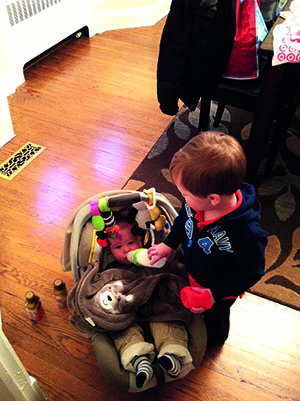

 “… We are confronted with having to explain atrocities which we struggle to understand ourselves. We are often at a loss to explain the inexplicable …”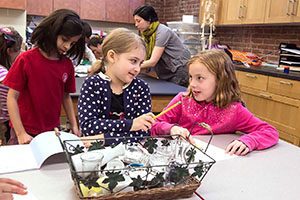
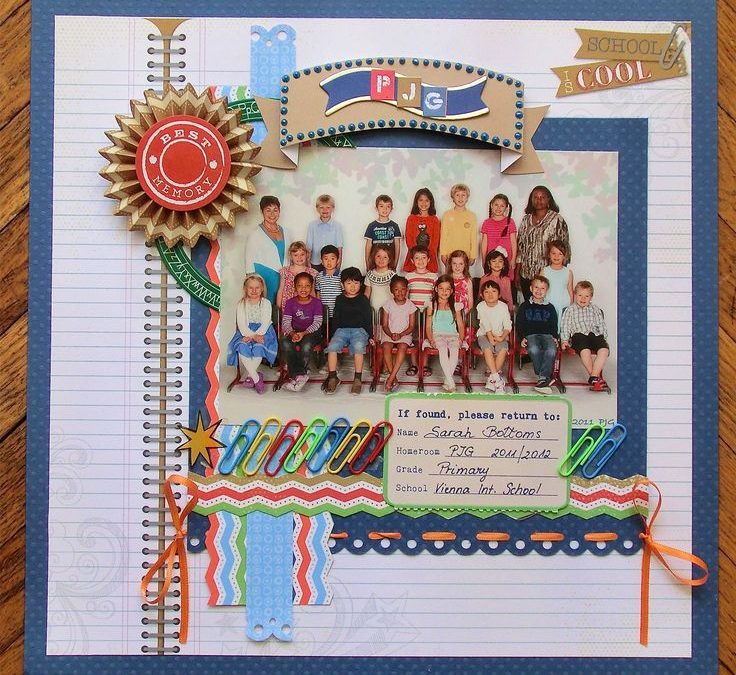
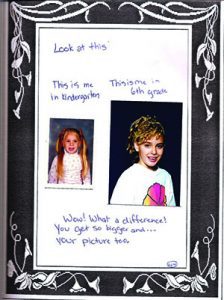
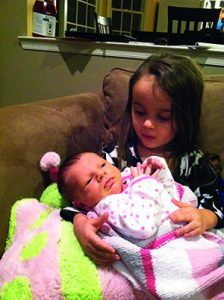 Transitions: What to do when there’s baby number two?
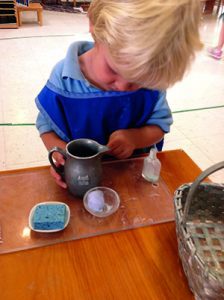

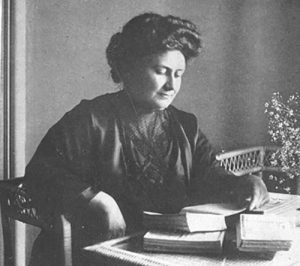

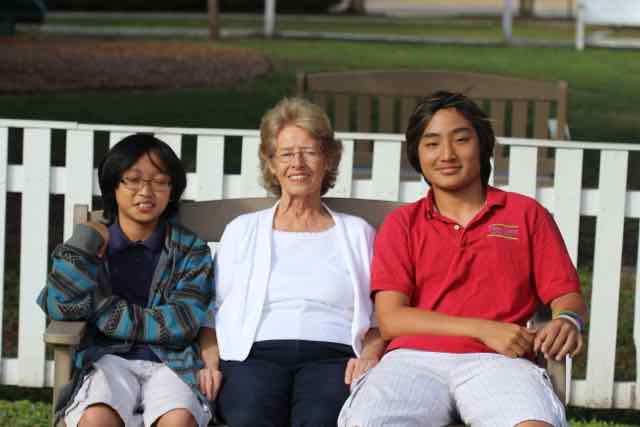

 Bastille Day is the