by Tim Seldin Paul Epstein | Free Reads, MFA, Montessori Education, Montessori Teachers, Primary (3-6), The International Montessori Council, The Montessori Way
Over the last century, Dr. Maria Montessori’s ideas have had a growing influence on education around the world. However, while individual elements of her program find their way into more classrooms every year, there is a cumulative impact when schools fully implement the entire Montessori model. When done well, something that is quite distinct for children is possible. Montessori schools are designed to help each student discover and fully develop her unique talents and possibilities. They treat each child as a unique individual, allowing her to learn optimally at her own pace and in the way that best suits her learning style. They strive to be flexible and creative in addressing each student’s needs.
Learning the right answers may get a child through school, but learning how to become a life-long, independent learner will take her any- where. Montessori teaches children to think, not simply to memorize, feedback, and forget.
Rather than presenting students with the right answers, Montessori educators lead students to ask their own questions and to discover how to find the answers for themselves. Older students are encouraged to do their own research, analyze what they have found, and come to their own conclusions. Teachers encourage children to think for themselves and become actively engaged in the learning process.
Intrinsic Motivation
One of Montessori’s key discoveries is the idea that children are intrinsically motivated. They are driven by their desire to become independent and competent beings in the world. They naturally learn and master new ideas and skills. For this reason, outside rewards are unnecessary. Outside rewards create a dependency on external motivation. Far too many children become dependent on others to define their self-image or obtain permission to follow their dreams. In the process of making independent choices and exploring concepts largely on their own, Montessori children construct knowledge, their own sense of individual identity, and their own understandings of moral right and wrong.
Montessori saw children as far more than students. In her view, each child is a full and complete human being, the mother or father of the adult man or woman he or she will become. Even when very young, they share humanity’s hopes, dreams, fears, emotions, and longings. From her perspective, this goes beyond mental health to the very core of one’s inner spiritual life. Montessori programs offer consciously designed experiences that cultivate the child’s sense of independence, self-respect, love of peace, passion for self-chosen work done well, and the ability to respect and celebrate the individual spirit within people of all ages and the value of all life.
Independence and Movement: Acquiring Self-Discipline
Montessori teachers share a conviction that success in school is directly tied to the degree to which children believe they are capable, independent human beings. Young children are shown how to pour liquids, write letters, and compute sums. Older children are shown research techniques, Internet search routines, and forms of expository writing. When children develop a meaningful degree of independence, they set a pattern for a lifetime of good work habits, self-discipline, and a sense of responsibility.
Children readily take pride in doing things for themselves carefully and well. All children learn through movement. They must actively explore and examine the world around them. Montessori environments encourage children to move about freely, within reasonable limits of appropriate behavior.
Much of the time they select work that captures their interest and attention, although teachers also help them choose activities that will present new challenges and new areas of inquiry. Montessori teachers also direct students to master the basic skills of their culture.
Children learn by doing, and this requires movement and spontaneous investigation. Children touch and explore everything in their environment. The mind is handmade, because, through movement and touch, the child investigates, manipulates, and builds up a storehouse of impressions about the physical world around her. Children develop thinking through hands-on learning.
Montessori children enjoy considerable freedom of movement and choice. Montessori children freely move about, work alone, or with others at will. However, their freedom always exists within carefully defined limits on the range of their behavior. Free to do anything appropriate within the ground rules of the community, children are consistently redirected promptly and firmly if they cross over the line. Children may select an activity and work with it as long as they wish, so long as they do not disturb anyone or damage anything. When finished, they are expected to put materials back where they belong. Becoming self-disciplined is a major goal of Montessori programs. Students are taught to manage their own community, and they develop strong leadership skills and independence.
Respectful Communities of Mixed-Age Groups
Montessori schools are warm and supportive communities of students, teachers, and parents. As children grow older and more capable, they assume a greater role in helping to care for the environment and meet the needs of younger children in the class. The focus is less on the teachers and more on the entire community of children and adults, much as one finds in a real family. A child experiences courtesy and trust, two important aspects of optimal learning conditions.
The number of students in a Montessori class is determined by: the physical size of the classroom; regulations governing children-to-adult ratios; and the beliefs of the school community. Originally, Montessori enrolled more than forty-five children in a classroom. Her purpose for this was to ensure that her teachers would help children become capable, independent learners, children who would also turn to one another for lessons and guidance.
Classrooms today are typically much smaller (usually there will be twenty-five to thirty-five children), bringing children together in multi-age groups, rather than classes comprised of just one grade level. Schools that place children together into small groups assume that the teacher is the source of instruction, a very limited resource. They reason that as the number of children decreases, the time that teachers have to spend with each child increases. Ideally, we would have a one-on-one tutorial situation.
But the best teacher of a three-year-old is often another child who is just a little bit older and has mastered a skill. This process is good for both the tutor and the younger child. In this situation, the teacher is not the primary focus. Instead, a larger group size puts the focus less on the adult and encourages children to learn from each other. By having enough children in each age group, all students will find others at their developmental level. By consciously bringing children together in a group that is large enough to allow for two-thirds of the children to return every year, the school environment promotes continuity and the development of a very different level of relationship among children and their peers, as well as among children and their teachers. Classes tend to be stable communities, with only the oldest third moving on to the next level each year.
A strong community develops as teachers and children create close and long-term relationships. Teachers know each child’s temperament, personality, and learning style. Ideally, there would be an equal number of girls and boys evenly divided among the three age levels.
With the strong emphasis on international education, many Montessori schools attract a diverse student body representing many ethnic, religious, and international backgrounds. The curriculum is international in its heritage and focus and consciously seeks to promote a global perspective, promoting mutual respect. The intent is for children to regard diversity as a call for celebration and not a cause for fear. Older students learn to care about others through community service.
The Montessori Peace Education curriculum supports this purpose. Montessori’s spiritual perspective leads Montessori schools to make a conscious effort to organize programs of community service, ranging from daily contributions to others within the class or school setting to community-outreach programs that allow children and adults to make a difference in the lives of others. The fundamental idea is one of stewardship. Students also develop a love for the natural world. Natural science and outdoor education are important elements of our children’s experience.
The Prepared Environment: Curriculum and Materials
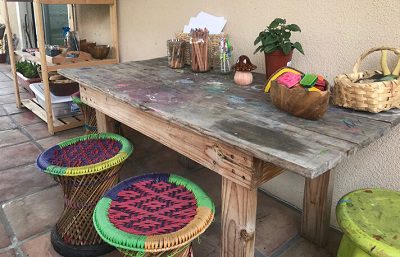
Montessori classrooms tend to fascinate both children and their parents. They are normally bright, warm, and inviting, with an abundance of plants, animals, art, music, and books. Shelves are filled with intriguing learning materials, fascinating mathematical models, maps, charts, fossils, historical artifacts, computers, scientific apparatus, a natural-science collection, and animals that the children are raising. Montessori classrooms are commonly referred to as prepared environments. Each is a learning laboratory in which the children are allowed to explore, discover, and select their own work. The independence that the child gains is not only empowering on a social and emotional basis, but it is also intrinsically involved with helping the child become comfortable and confident in her ability to master the environment, ask questions, puzzle out answers, and learn continuously instead of waiting for adult direction.
The Montessori goal is less to teach the child facts and concepts, but rather to help her fall in love with the process of focusing her complete attention on some challenge and solving its riddle with enthusiasm and joy. Work assigned by the adult rarely results in such enthusiasm and interest as does work that children freely choose for themselves.
The classroom is organized into several curriculum areas, usually including language arts (reading, literature, grammar, creative writing, spelling, and handwriting); mathematics and geometry; everyday living skills; sensory- awareness exercises and puzzles; geography; history; science; art; music; and movement. Most rooms will include a classroom library. Each area is made up of one or more shelf units, cabinets, and work tables with a wide variety of materials on open display, ready for use as the children select them.
Students are typically found scattered around the classroom, working alone or with one or two others. They tend to become so involved in their work that visitors are immediately struck by the peaceful atmosphere. It may take a moment to spot the teachers within the environment. They will be found working with one or two children at a time, advising, presenting a new lesson, or quietly observing the class at work. The focus of activity in the Montessori classroom is on children – who each one is, his or her interests, and styles of learning. The teacher is a guide, providing direct learning experiences whenever possible.
A Montessori classroom is filled with vast arrays of sequenced learning activities known as the Montessori materials. The materials are displayed on open shelves sized for the height of the children. They are arranged to provide maximum eye appeal without clutter. Each object has a specific place on the shelves, arranged from the upper left-hand corner in sequence to the lower right.
The materials are arranged in sequence from the most simple to the most complex, and from the most concrete to those that are more abstract. Because of the order with which they are arranged in the environment, children can find precisely what they need whenever they wish.
When children choose a material, they develop an array of personal traits such as independence, responsibility, and time management. While investigating and using the materials to sort, arrange, build connections, and problem-solve, they develop cognitive capabilities. Educational theorists now advocate learning through direct experience and the process of investigation and discovery. The child must be active and engaged, constructing her or his own knowledge. Most students do not retain or truly grasp much of what they “learn” through memorization. Instead, children need to manipulate and explore everything that catches their interest. Part of Montessori’s contribution was her discovery of what is now assumed. But, she went further. Montessori developed a series of sequenced learning materials designed with incredible precision.
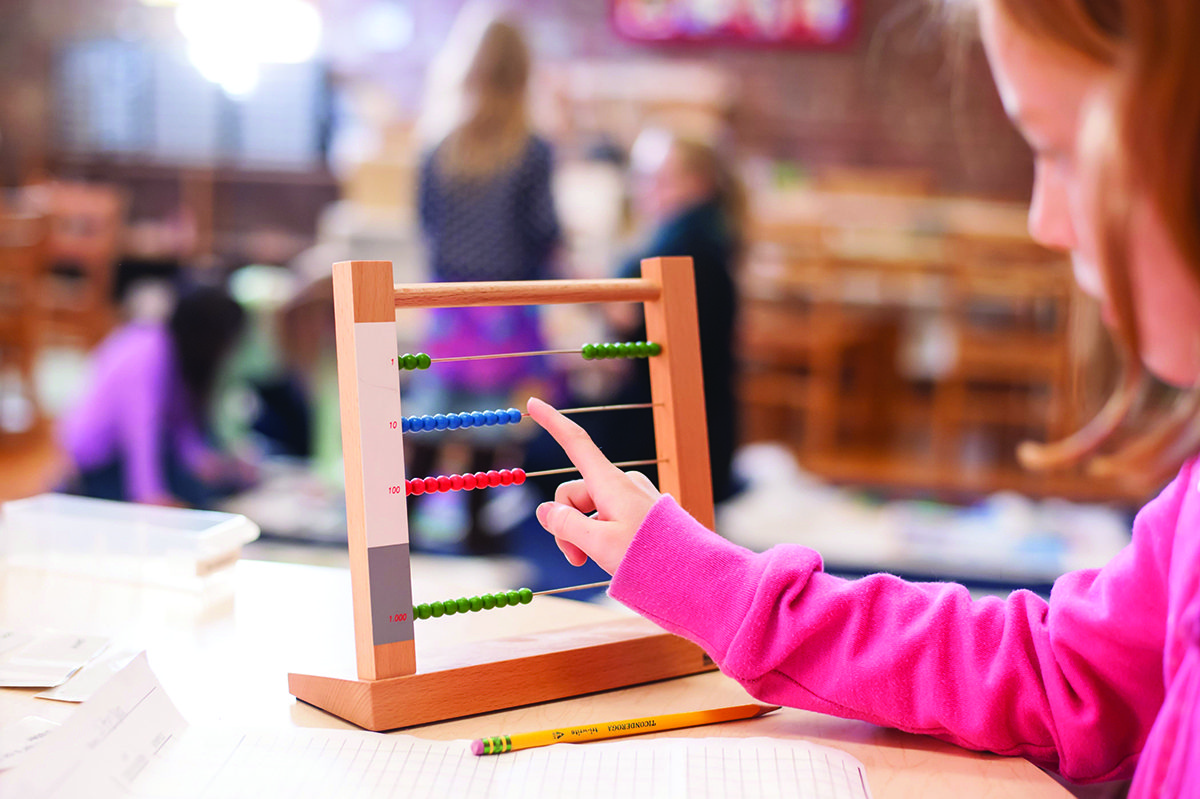
Each material is a concrete representation of an abstract idea. Depending upon the ages of the children, they will use the materials to explore and investigate ideas found in anthropology, art, astronomy, biology, botany, chemistry, earth science, geography, geology, geometry, history, language, m a t h e m a t i c s , music, physics, and sociology. Some materials isolate and teach one concept or skill at a time. Length, for example, is explored by three-year-olds arranging a set of ten rods. The first is 10 centimeters long; the second is twice this length. This progression continues until the tenth rod is in place with its length of 1 meter.
Children from ages two to six are interested in sequencing and sorting objects. They are drawn to the sensory properties of objects within the classroom: size, shape, color, texture, weight, smell, sound, etc. Children of this age tend to repeat exercises. With repetition, their movements slow and become more precise. Their attention to detail increases; they discover small details in the objects and classroom as they observe and appreciate their environment.
This is a key in helping children discover how to learn. Elementary and secondary students are interested in sequencing and sorting ideas. They are drawn to the interpretive meanings of literary works, social and historic events, scientific findings, and issues of moral justice.
Elementary and secondary classrooms are designed to facilitate student discussion and stimulate collaborative learning. In group discussions, students readily propose and debate solutions to open-ended problems. A goal is to pursue topics in depth rather than to “cover the material.”
At the secondary level, an integrated thematic approach is used to connect the otherwise separate disciplines of the curriculum into studies of the physical universe, the world of nature, and the human experience. Literature, the arts, history, social issues, political science, economics, science, and the study of technology all complement one another.
The organization of the Montessori curriculum from early childhood through secondary programs could be thought of as a spiral of integrated studies rather than a traditional model in which the curriculum is compartmentalized into separate subjects, with given topics considered only once at a specific grade level. The Montessori curriculum is carefully structured and integrated to demonstrate the connections among the different subject areas. History lessons, for example, link architecture, the arts, science, and technology.
An especially important aspect of the materials is that they offer multiple levels of challenge and can be used repeatedly at different developmental levels. For example, the Trinomial Cube, which presents a complex and challenging twenty-seven-piece, a three-dimensional puzzle to the five-year-old, is used to introduce the older elementary and secondary child to the algebraic concept of the exponential powers of polynomials.
The teacher presents the materials with precision and offers each child an initial exploratory procedure; the child is able to imitate what the teacher did. The teacher’s presentation also enables children to investigate and work independently. A goal is for the children to become self-disciplined, able to use the materials and manage the classroom without direct adult supervision.
Children progress at their own pace, moving on to the next step in each area of learning as they are ready. Initial lessons are brief introductions, after which the children repeat the exercise over many days, weeks, or months until they attain mastery. Interest leads them to explore variations and extensions inherent within the design of the materials at many levels over the years.
The Montessori learning materials are not the Method itself; they are simply tools used to guide children into logical thought and discovery. The Montessori materials are provocative and simple; each is carefully designed to appeal to children at a given level of development.
In developing these materials, Dr. Montessori carefully analyzed the skills and concepts involved in each subject and noted the sequence in which children most easily master them. She then studied how children seemed to be able to grasp abstract concepts most easily and designed each element to bring the abstract into a clear and concrete form.
The Control of Error
The design of many of the materials gives children immediate feedback. Called the Control of Error, this feature makes it possible for Montessori students to determine for themselves if they have done each exercise correctly.
Children choose their learning activities within carefully defined limits as to the range of their behavior. Making mistakes is a vital part of the learning process. Discovery, investigation, and problem solving involve making wrong turns, getting stuck, and trying again. An important part of the learning experience is to recognize an error and learn how to make corrections.
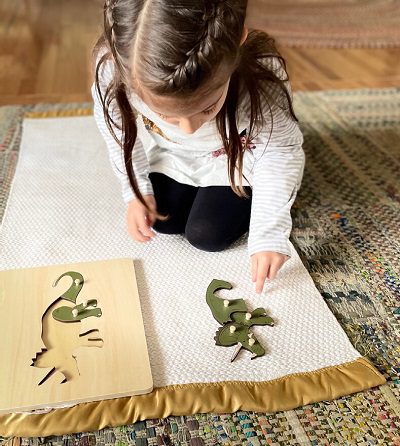
These experiences are part of the process of becoming self-disciplined. A young child takes ten cylinders out of a wooden case; the cylinders vary in height and diameter. The control of error lies in the construction of the objects: a cylinder can only fit into one place in the wooden case. Another child learns the names of African nations. In this case, the control of error is initially found with the teacher, who uses the “Three-Period Lesson” to teach and re-teach the correct names of nations. Once the child knows these names, the control of error becomes his own knowledge.
Each repetition is not an exact copy of the previous use. Children continuously refine their work and learn more. The principle of control of error guides this process. In addition to the design of the materials, prior knowledge is also a control of error.
Knowledge of colors, shapes, and size for younger children — knowledge of addition and multiplication for older children — results with self-corrected learning. The Three-Period Lesson Montessori teachers will use the Three-Period Lesson to help children develop a rich vocabulary in all areas of study. Children best learn the meaning for names when they can associate the name with an object. In the following example, a young child is taught the names of secondary colors. During the first period, the child is shown an orange-colored tablet. The teacher names the color: “This is orange.” The child is now shown a green-colored tablet. The teacher names this color: “This is green.” Finally, a purple-colored tablet is shown, and the teacher states, “This is purple.” During the second period, the child makes a link between the language and her own experience. The teacher gives the name, and the child finds the object. The teacher asks, “Show me orange.” The child points to the orange tablet. “Show me purple.” The child now points to the purple tablet.
Considerable learning and teaching occur during the second period. If the child is asked, “Show me green,” but she points to the purple tablet, the teacher simply re-teaches. Returning to the first period, the teacher points to the purple tablet and restates, “This is purple.” The teacher again points to the green tablet and restates, “This is green.” In the final period, the teacher points to one of the tablets and asks, “What is this?” The child answers, “Orange.” If the child answers one of the other colors, the teacher will again re-teach the colors by renaming and reconfirming them using the first- and second-period lesson formats. Maria Montessori understood that learning occurs best when stress and apprehension are removed from the learning situation.
The Three-Period Lesson format is based on readiness. Complex vocabulary words are introduced when it is appropriate. Montessori educators believe that it is important for children to learn vocabulary, which is why so much emphasis is placed on nomenclature (enhanced vocabulary). The three- and four-year-olds do not merely identify triangles; our teachers name triangles precisely: isosceles triangle or scalene right triangle. A rich vocabulary is also taught to lower elementary students; such as terms from botany as well as the various land and water forms that make up our planet’s surface. The more words children know, the more they actually see around them.
by The Montessori Foundation Staff | Free Reads, MFA, Montessori Education, Montessori Family Life, Montessori Grandparenting, Montessori Parenting, Montessori Teachers, Parent Education
Isn’t Montessori elitist?
Montessori is an educational philosophy and approach that can be found in all sorts of settings, from the most humble to large, well equipped campuses. In general, Montessori schools consciously strive to create and maintain a diverse student body, welcoming families of every ethnic background and religion, and using scholarships and financial aid to keep their school accessible to deserving families. Montessori is also found in the public sector as magnet public-school programs, Headstart centers, and as charter schools.
Is Montessori opposed to competition?
No. Dr. Montessori simply observed that competition is an ineffective tool to motivate children to learn and work hard in school. Traditionally schools challenge students to compete with each other for grades, class rankings, and special awards. For example, tests are graded on a curve developed from the performance of the students in that class. Students are constantly measured against their classmates, rather than considered for their individual progress.
In Montessori schools, students learn to collaborate with each other rather than mindlessly compete. Students discover their own innate abilities and develop a strong sense of independence, self-confidence, and self-discipline. In an atmosphere in which children learn at their own pace and compete only against themselves, they learn not to be afraid of making mistakes. They quickly find that few things in life come easily, and they can try again without fear of embarrassment.
Dr. Montessori argued that for an education to profoundly touch children’s hearts and minds, they must learn because they are curious and interested, not simply to earn the highest grade in the class. Montessori children compete with each other every day, both in class and on the playground. Dr. Montessori, herself an extraordinary student and a very high achiever, was never opposed to competition in principle. Her objection was to using competition to create an artificial motivation to get students to achieve. Montessori schools allow competition to evolve naturally among children, without adult interference unless the children begin to show poor sportsmanship. The key is the children’s voluntary decision to compete, rather than having it imposed on them by the school.
Is it true that Montessori children never play?
All children play. They explore new things playfully. They watch something of interest with a fresh, open mind. They enjoy the company of treasured adults and other children. They make up stories. They dream. They imagine. This impression stems from parents who don’t know what to make of the incredible concentration, order, and self-discipline that we commonly see among Montessori children. Montessori students also tend to take the things they do in school seriously. It is common for them to respond that “this is my work,” when adults ask what they are playing with. They work hard and expect their parents to treat them and their work with respect. But it is joyful, playful, and anything but drudgery.
Is Montessori opposed to fantasy and creativity?
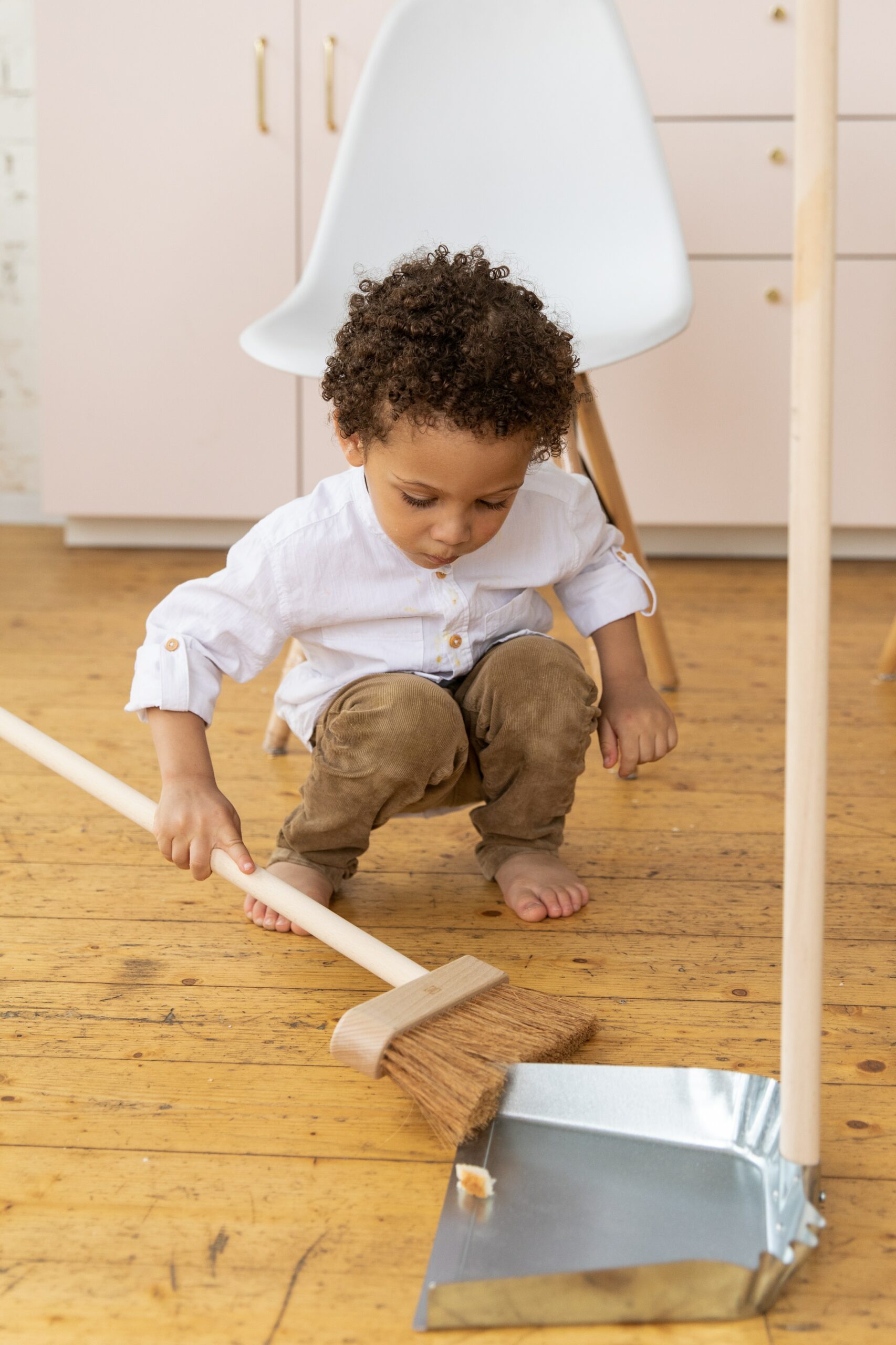
You will not generally find play kitchens, dress-up corners, or dolls in a Montessori class for children under age six, because children are using real tools
and doing real things, instead of pretending. However, fantasy and creativity are important aspects of a Montessori child’s experience.
Montessori classrooms incorporate art, music, dance, and creative drama throughout the curriculum. Imagination plays a central role as children explore how the natural world works, visualize other cultures and ancient civilizations, and search for creative solutions to real-life problems.
In Montessori schools, the arts are normally integrated into the rest of the curriculum. They are modes of exploring and expanding lessons that have been introduced in science, history, geography, language arts, and mathematics.
Art and music history and appreciation are woven throughout the history and geography curricula. Traditional folk arts are used to extend the curriculum as well. Students participate in music, dance, and creative movement with teachers and specialists. Students’ dramatic productions make other times and cultures come alive.
What if a child doesn’t feel like working?
While Montessori students are allowed considerable latitude to pursue topics that interest them, this freedom is not absolute. Within every society, there are cultural norms; expectations for what a student should know and be able to do by a certain age. Experienced Montessori teachers are conscious of these standards and provide as much structure and support as is necessary to ensure that students live up to them. If for some reason, it appears that a child simply needs time and support until he or she is developmentally ready to catch up, Montessori teachers provide it nonjudgmentally.
Is Montessori opposed to homework, tests, and grades?
Many parents have heard that Montessori schools do not believe in homework, grades, and tests. This is really a misunderstanding of Montessori’s insights.
Homework
Most Montessori schools do not assign homework at all below the elementary level. When it is assigned to older children, it rarely involves page after page of busywork; instead, it involves meaningful, interesting assignments that expand on the topics that the children are pursuing in class. Many assignments invite parents and children to work together.
Homework should never become a battleground between adult and child. One of our goals as parents and teachers should be to help the children learn how to get organized, budget time, and follow through until the work is completed. Ideally, home challenges will give parents and children a pleasant opportunity to work together on projects that give both parent and child a sense of accomplishment. They are intended to enrich and extend the curriculum.
Homework doesn’t need to be boring! Montessori challenges children to think, explore, and pursue tangible projects that give them a sense of satisfaction. Homework is intended to afford students the opportunity to practice and reinforce skills introduced in the classroom.
Moreover, there is a certain degree of self-discipline that can be developed within the growing child through the process of completing assignments independently.
Many elementary Montessori classes send home packets of At-Home Challenges for each age group in the class. The children have an entire week to complete them. When the week is over, teachers will normally sit down with the children to review what worked, what they enjoyed, and what they found difficult or unappealing.
Depending on the child’s level, assignments usually involve some reading, research, writing, and something tangible to accomplish.
They may be organized into three groups:
1) Things to be experienced, such as reading a book, visiting the museum, or going to see a play;
2) Things to learn, stated in terms of skills and knowledge, such as See if you can learn how to solve these problems well enough that you can teach the skill to a younger student; and
3) Things to be submitted, such as a play, essay, story, experiment, or model.
When possible, teachers will build in opportunities for children to choose among several alternative assignments. Sometimes, teachers will prepare individually negotiated weekly assignments with each student.
Tests
Montessori children usually don’t think of our assessment techniques as tests so much as challenges. Early childhood Montessori teachers observe their children at work or ask them to teach a lesson to another child to confirm their knowledge and skill.
Most elementary Montessori teachers will give their students informal, individual oral exams or have the children demonstrate what they have learned by either teaching a lesson to another child or by giving a formal presentation. The children also take and prepare their own written tests to administer to their friends. Students are working toward mastery, rather than being graded using a standard letter grade scheme.
Standardized Tests
Very few Montessori schools test children younger than the first or second grade; however, most regularly give elementary students quizzes on the concepts and skills that they have been studying. Many schools ask their older students to take annual standardized tests.
While Montessori students tend to score very well, Montessori educators frequently argue that standardized testing is inaccurate, misleading, and stressful for children. The ultimate problem with standardized tests in our country is that they have often been misused, misunderstood, and misinterpreted in other schools. Tests can be fairly useful when seen as a simple feedback loop, giving both parents and school a general sense of how students are progressing.
Although standardized tests may not offer a terribly accurate measure of a child’s basic skills and knowledge, in our culture, test-taking skills are just another practical life lesson that children need to master.
Reporting Student Progress
Because Montessori believes in individually paced academic progress, and encourages children to explore their interests rather than simply complete work assigned by their teachers, we don’t assign grades or rank students within each class according to their achievement.
At the elementary level, students will often prepare a monthly self-evaluation of the previous month’s school work. When completed, they will meet with the teachers, who will review it and add their comments and observations.
In many Montessori schools, children compile a collection of their work that is pulled together in a portfolio of the year’s work.
Most schools schedule family conferences two or three times a year to review their children’s portfolios and self-evaluation and go through the teachers’ assessment of their children’s progress.
Typically, once or twice a year, Montessori teachers will prepare a written narrative evaluation of the students’ work, social development, and mastery of fundamental skills.
What about children with special needs?
Every child has areas of special gifts, a unique learning style, and some areas that can be considered challenges. Each child is unique. Montessori is designed to allow for differences. It allows students to learn at their own pace, and is quite flexible in adapting for different learning styles. In many cases, children with mild physical handicaps or learning disabilities may do very well in a Montessori classroom setting. On the other hand, some children do much better in smaller, more structured classrooms. Each situation has to be carefully evaluated individually to ensure that the program can successfully meet a given child’s needs and learning style.
Is Montessori right for my child?
Most Montessori educators would agree that Montessori is a good fit for most children — but it may not be the right match for their parents.
Everything depends on what your family believes to be true about your children and important in their education.
Do you believe that children should be treated with dignity and respect and be encouraged to be independent, self-confident, and self-disciplined?
Do you believe that the best way to discipline is by being consistent, modeling the correct behavior, and by consciously teaching children how to do things correctly?
Do you believe that education should be enchanting, intriguing, and delightful, rather than traditionally structured and highly competitive?
If so, Montessori may be right for you.
But aren’t there some children who just won’t do well in Montessori?
The answer is both yes and no. Montessori schools are often successful with children, who would challenge any school, including the highly distractible
and impulsive ones, for whom parents typically have the most concern. The reason why should be obvious: Montessori is designed to be flexible, adapting
the program to meet the needs of each given child. It also allows children to move about, socialize independently (rather than work as part of a group), and progress at their own pace. This doesn’t mean, though, that every class and every Montessori teacher can meet the needs of every child.
This is especially true if a child is violent, destructive, or excessively disturbing of the peace and order of the classroom. Each decision has to be made on a case-by case basis
Why is there so much variation among Montessori schools?
Many people assume that all Montessori schools are essentially the same. In reality, Montessori schools can differ dramatically, in size, facilities, programs, and emotional climate. They share a common philosophy and basic approach, but there may be tremendous variation among schools that use the name Montessori. There are more than four thousand Montessori schools in North America, but every one is unique. Even within the same school, each class may look and feel quite different from the others, reflecting the interests and personalities of the teachers; however, certain characteristics will be found in all classes that are honestly following the Montessori approach.
Dr. Montessori was a brilliant student of child development, and the approach that has evolved out of her research has stood the test for more than ninety years in Montessori schools around the world. The Montessori approach has three great qualities: the model is replicable, it can be adapted successfully into all sorts of new situations, and it is sustainable.(Montessori programs don’t tend to self-destruct after a few years, as do many other educational reforms.) However, the only ‘pure’ Montessori educator was Dr. Maria Montessori herself. The rest of us interpret and filter her ideas through our personalities and experience.
Free parenting tips online. Check out this website and sign up for free daily parenting tips and other fun stuff for families: www.parenting.com