


Part I: Your Rookie Year as a Montessori Family (0-6 Years Old)
During the next three webinars our team will guide you through important considerations and steps in preparing to become part of a Montessori learning community. Each webinar will concentrate on one stage of child development. This session will focus on the Early Childhood Years. Our team will share insights for you and your child as you begin this Montessori journey along with your child. Come with us as we travel together through this new and exciting educational adventure for your whole family.
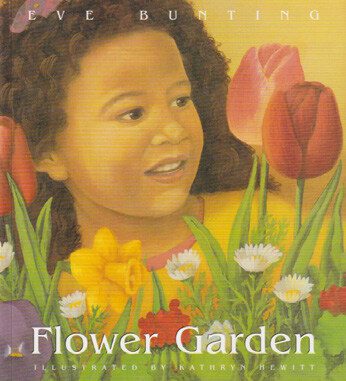
Book Review – Flower Garden

Flower Garden
Written by Eve Bunting Illustrated by Kathryn Hewitt
Another book by Eve Bunting! This talented woman has written many books for children from two years old to teenagers, in all different settings, and in varied real-life situations. She doesn’t try to hide the truth or to tip toe around uncomfortable topics. Her stories have heart and sometimes raw emotion. The illustrations in her books are usually quite realistic and enhance her words beautifully. Her books raise her readers’ social consciousness – sometimes subtly and sometimes flat out!
Flower Garden is the story of a dad and his daughter putting together a beautiful surprise for his wife and her mother’s birthday. It’s set in a city where they live several stories up in an apartment building. They ride public transportation to and from the grocery store, where they buy plants, a window box, and cake and ice cream.
Mom isn’t home, so they can quickly plant the flowers in the window box before she arrives. She is surprised and happy when she gets home!
In this book the words rhyme. Young children love rhyming! In this book, the reader may not be aware that they are learning about people of different races, or they may recognize themselves in the characters. It is a beautiful book that young children will enjoy over and over again at home or in school.
Reviewed by Lorna McGrath

Book Review – Hold This!

Hold This!
As a dad and his young daughter, Mika, take a walk through the woods, Mika finds so many treasures that she wants to keep and take home. She finds a stick and a frog and some water and leaves and a sparkling stone and more. Mika wants her dad to put these items in his backpack or pockets, but he reminds her several times that she is a “big girl” and can carry her own treasures. At the end, Mika asks once more, “I know I’m a big girl, but…will you hold this?” as she reaches her hand up to him.
Written by Carolyn Cory Scoppettone Illustrated by Priscilla Alpaugh
Children love to collect things in nature. We often encourage them to leave them there or to carry the treasures themselves. Really, the very best part of a walk-in nature is the time spent together. Children two to six years old will enjoy this book.
Reviewed by Lorna McGrath

10 Ways to Prepare for Summer

10 Ways to Prepare for Summer
by Cheryl Allen & Lorna McGrath
1. Maintain a routine–getting up at a similar time each day, eating at regular times, keeping enough routine to keep your child comfortable. This is important for all ages. It gives them a sense of stability. It is especially important in early childhood, as these children are especially sensitive to order and consistency.
2. Keep up your family meeting schedule. Remember that family meetings provide opportunities for everyone to have a voice, be a leader, and take part in shaping the summer. If you have visitors, invite them to join your meeting.
3. Create and discuss family expectations for behavior at home, out on the town, and when traveling. These are great topics for family meetings as you prepare for summer.
4. Find out what each family member is hoping for from the summer and see if you can meet each family member’s goal. This is another topic for a family meeting. Remember to break down preparation topics into manageable pieces so that you don’t feel as if everything has to be covered in one meeting.
5. If possible, schedule only one or two activities or camps in the summer to provide consistency. Also, if these activities or camps can be chosen with your family values about respectful interactions among participants and adults in mind, the experience will probably be more enjoyable and productive for your child.
6. Let your child know about plans for the day and what may be required ahead of time so your child can plan. Even though you will share with each other at your family meetings what’s up for the week, it is important to look at each day in more detail as the day begins.
7. Allow for relaxation time each day, especially if you are traveling or have visitors. As always, we suggest that consciously planning for downtime is as important as planning for activities.
8. Encourage time for practical life activities–gardening, cooking, and cleaning. Practical life activities bring us back to our family community, interacting together, doing meaningful work, and learning to use math and science in our everyday lives.
9. If you don’t already have this, develop a quieting space for each family member. Creating “quieting spaces” for each family member involves multiple family meetings, so start planning them now. As school comes to an end, consider quieting spaces for summer travels.
10. Plan your schedule so that you’re home in time to prepare for the new school year. We always think that summer will last forever, but before we know it, it’s time to go back to school. It’s helpful to the whole family to get back into a home routine at least a week before school starts. •
Cheryl Allen is the Associate Coordinator of the MontessoriFamily Alliance and is also a parenting educator and a Montessori consultant with the MontessoriFoundation. Cheryl attended Montessori school as a child. After some time as a traditional Secondary teacher, she worked in Montessori classrooms, 3-6, 6-9, and 9-12, earning certifications from both AMS (3-6and 6-9) and IMC (6-12). She is a teacher educator, workshop presenter, and member of IMC accreditation teams. Cheryl’s two children attended Montessori from age two through high school graduation.
Lorna McGrath, MEd, is Director of IMC School Accreditation, Program Director of the MontessoriFamily Alliance, and Senior Consultant of The Montessori Foundation. Lorna has 41 years of experience in the field of education, teaching children from 18 months through 6 years old and from 12 through 18 years old in both public schools and independent Montessori schools. Lorna is a Montessori teacher educator, conference presenter, and school consultant. She can be reached at lornamcgrath@montessori.org

Beyond Bribes, Rewards, and Punishments

A Montessori Approach to Clean…
Beyond Rewards, Bribes, & Punishment
A Montessori Approach to Building Intrinsic Motivation
42 ways that the Montessori approach builds intrinsic discipline in our children.
by Simone Davies
In my last article on a Montessori approach to discipline, I mentioned that we don’t use rewards, bribes, or punishment in a Montessori classroom. And there is not a teacher at the front telling everyone what they need to do. Yet, if you observe in a Montessori classroom, there is a gentle hum of conversation and movement and a lot of concentrated children who are motivated to work.
So, not surprisingly, I received many questions about a Montessori approach to building intrinsic motivation in the child. Intrinsic motivation is doing something because you have the inner drive to do it, not because of some external reason like a reward or threat.
I love a good list so here are 42 ways that the Montessori approach builds intrinsic discipline in our children.
Note: It’s a holistic approach where each part is intrinsically linked. So, while it may seem overwhelming to do all these things, rest assured they also naturally build on one another.
42 Ways to Build Intrinsic Motivation
1. Build an environment where they can have success; knowing where they can find things and having things at their level.
2. Create opportunities for them to build independence – they see themselves as capable.
3. Cultivate opportunities to work together, cooperate and care for others – they see their input matters; a 0-3 child is observing and beginning their social development in their family. With a care giver, and/or nursery; the 3-6 child is part of their family and their class; and the 6-12 child wants to work and be a part of a group.
4. Value process over product; there is more learning in the doing than in the result.
5. Use encouragement rather than praise. When they hear, “You worked hard to get your shirt on all by yourself ” rather than “good job,” they learn to look to themselves to understand what worked, rather than looking to us for praise.
6. Give them freedom to work on things they are interested in – rather than what the teacher/adult tells them – or a timeline.
7. Provide safe limits. Offer security and show that someone cares about them.
8. Allow them the freedom to choose what, where, and with whom they’d like to work.
9. Provide a clear rhythm to their day so that they know what to expect.
10. Help them learn respect for themselves, each other, and the environment – they feel truly accepted and learn to accept others.
11. Encourage those agreements are made together – they feel like a valued member of the community.
12. Let them know that it’s a safe place to practice boundaries – we can support them with words if needed, “I’d like to work by myself right now. It will be available soon.”
13. Honor who they are; each member is unique and valued – builds their sense of self.
14. Help them learn to look after themselves, others, and the environment – it’s empowering to be able to do this for themselves.
15. Show trust in them – by removing external rewards and punishments.
16. Help them to make amends when needed – they know that when they get it wrong, they will take responsibility and learn from the experience.
17. Value curiosity – learning is about finding out rather than memorizing facts
18. Allow them to have choices – they have ‘agency’ in their days
19. Provide honest, instructive feedback – we see what’s going well and how they can do better; give them gentle guidance to keep improving.
20. Offer different ways to learn; we all learn in different ways and on different days; the materials appeal to kinesthetic, visual, and aural learners, and they can choose how they’d like to present their work, from a booklet to a survey to a poster etc.
21. Be their guide – not their boss or servant
22. Help children build ‘scaffold skills’ – where each activity builds on the next to allow mastery.
23. Support them to develop their own routines/ rhythms, such as taking an activity to a table or mat and returning it when it’s done.
24. Help children develop their thinking skills – they are learning to learn through hands-on learning and making discoveries for themselves; they help younger children and consolidate their own learning; they reflect on what they have learned.
25. Keep it real; children are not learning just for the sake of learning. They are learning how it applies in the real world giving meaning to their work.
26. The absence of tests or punishments allows a natural love of learning, while maintaining their creativity and interest in learning
27. Model intrinsic motivation ourselves as adults; our actions are more powerful than our words.
28. Provide control-of-error activities, which will allow children to discover their errors and try again.
29. Offer challenges at the appropriate level. Children do not feel unmotivated, because they know that they can do hard things, and they do not want to give up.
30. Encourage service in the community. This allows children to see and appreciate the impact of their work.
31. Children can have a healthy relationship with failure: the guide and classmates are supportive; children are able to stay with something until they master it and are ready to move onto the next activity; and they learn to ask for help if needed.
32. Remove competition for sticker charts or praise; children do not need rewards from others. Help them look to themselves instead of someone else.
33. Allow time to help children build skills, e.g., planning skills, learning to dress themselves, how to make a report, etc.
34. Children are in charge of their own learning: they learn uniquely, have their unique interests; and are on their own unique timeline.
35. Adults can trust the Montessori process, without forcing their own agenda.
36. Help children support themselves as they become members of their society.
37. Be patient; learning happens at its own pace and isn’t forced.
38. Plant seeds of curiosity, enough to get them interested, and not too much to allow them to discover the rest for themselves.
39. Encourage the possibility for big work and big ideas that looks at the interdisciplinary nature of the universe.
40. Allow space for all voices; we want everyone in our community to feel valued, accepted, and safe.
41. Avoid criticism or correction; instead, observe where children are in their process, and offer another opportunity to teach it again.
42. Learn from others. We can see others learning and be inspired to learn that too.
It’s never too late to start applying these principles. We can even scaffold the skills with a child in Upper Elementary (9-12 years), first helping them plan, then letting them take over more and more steps themselves. •
Simone Davies is the author of The Montessori Toddler and co-author of The MontessoriBaby, comprehensive guides to raising toddlers and infants in a Montessori way. The books are based on her 15+ years’ experience working as an AMI Montessori teacher in Sydney and in Amsterdam. She also has a popular blog, Instagram, and podcast “The Montessori Notebook”.She is also mother to two young adults.Simone currently runs parent-childMontessori classes in Amsterdam at her school, Jacaranda Tree Montessori, and is working on another book with Junnifa Uzodike, The Montessori Child for children from 3-12 years.
With hundreds of practical ideas for every aspect of living with a toddler, here are five principles for feeding your child’s natural curiosity, from “Trust in the child” to “Fostering a sense of wonder.” Step-by step ways to cultivate daily routines with ease, like brushing teeth, toilet-training, and dealing with siblings

The Dump Truck Story
The Dump Truck Story
What happens when we normalize ‘disaster’ thinking and accept the mess
by Alicia Diaz-David
When my son was two years old, he scribbled on his dump truck with a brown marker and announced that he would wash it right there in the middle of our living room floor. My first reaction was to gasp when I noticed the brown scribbles. My second reaction was to see where his plan of action would take him.
So, I watched as he used the foaming soap dispenser to lather his hands and then rub the foam on the dump truck that was still on the living room floor. And I watched as he headed to the bathroom to fill his large bath-time cup with water to rinse off the foamy soap.
And that’s when I jumped in. Not stopping him but offering him another line of thinking by asking what would happen if he poured the water on the truck right there where it was. Thankfully, he responded that it would spill. I suggested we bring the dump truck outside to our front steps, where a giant water spill would not matter as much.
And the rest happened as you might imagine. My son happily poured water over the soapy brown marker and watched as it splashed on the cement pavers, instead of the living room floor. He went back inside the house to get a towel, which he smoothed over the water droplets on his beloved dump truck. And he smiled proudly at all that he had done.
If you are familiar with the principles of Montessori and the practice of following the child, this story may seem reasonable enough. It may seem as nothing more than a toddler exploring and experimenting with his dump truck and a mom observing and conscientiously guiding the learning moment that would unfold. However, when I submitted this story for a recent publication, it was changed. The edited version included the words, “This is going to be a disaster,” and I admit it stopped me in my tracks when I read it.
Not only was I impacted by the fact that a piece of original writing would be so altered, but also by the idea that our current thinking about children exploring and experimenting is so readily equated to things turning into a disaster.
The truth is, there is a great deal of learning in the so-called disaster. The mindful parent recognizes the learning potential when a child is following her own reasoning. The prepared adult is ever-present, jumping in to help only with the hard parts. That is the true meaning of Montessori parenting, as I’ve read in countless books, learned in Montessori training, and experienced personally with my own children at home.
So, I write today to challenge this thinking and normalize what we would otherwise consider a ‘disaster.’ When we let our children explore their ideas, when we observe this process, we realize that we are truly being given the gift of watching a genius at play.
Our job as adults is not to limit or edit this experience but to let it unfold and only redirect it when necessary. What I learned from my two-year-old son that day—what I witnessed—was a young toddler exhibiting complex executive-function skills, a little boy filled with resolute determination, a confident multi-cultural child ready and willing to solve problems in the world.
I hope that in the future, we don’t edit stories like this. These are moments to cherish for what they are … the awakening of life itself. •
Alicia Diaz-David is a parent and educator with over 15 years’ experience in education. She has followed the Montessori approach at home since her children were born and is a certified Montessori guide for ages 3-6. She is also the founder of TeachLearnMontessori.org, which is dedicated to helping parents better understand the Montessori philosophy and simplify the approach. You can learn more about supporting children’s growth and development using Montessori via the real-life stories she shares on Instagram @MontessoriwithAlicia or on her blog at TeachLearnMontessori.org.

Less Talk – More Respect
Do you feel like you talk too much about your child’s behavior? Are you constantly repeating your requests and explaining things your children already understand? Joe Newman, the author of “Raising Lions” will talk about how replacing our explanations and lectures with action boundaries, will get better behavior from our kids and will raise those kids into adults who are both confident about themselves and connected to other’s feelings and needs.
2020 NewGate School Seniors Interview
Three Rules for Positively Guiding Toddlers
How do we decide when a toddler’s behavior is inappropriate? Together we will discuss the questions to ask ourselves before we intervene in a child’s play. Then, we will consider three simple, easy to understand rules that aid toddlers’ understanding, support collaboration and help avoid power struggles.

Helping Children to Be Successful: Developing Grit
by Rachel Buechler
 A little girl sits at the table with the Snap Dressing Frame. She has picked it up several times before today and quickly returned it to its stand after a short attempt. Today she picks it up and places it on the table. She tries the first snap; it doesn’t connect. She looks at the snap from the left side, then the right side. She tries again; it doesn’t connect. She looks at her teacher for help. The teacher demonstrates how to connect the snap then returns it to its unconnected state. The child moves onto the snap above and, as she pushes down, she hears it connect. She pauses, smiles. Then goes back to try the first one; it still doesn’t connect. She squeals in frustration. She takes a moment to look again and again; then she keeps trying. This continues for twenty minutes until she looks at the dressing frame and the three connected snaps. She sighs and smiles then exclaims, “I did it!” Her teacher says, “You did it!” The little girl continues to look at the completed work before quickly taking it apart again to repeat the lesson.
There is so much for us to learn from this toddler’s determination to work on mastering this lesson. She is showing us how we can develop a skill that will place us ahead of others in the working world: grit. Grit is what keeps us working with our children, even when it is hard, even when we think we aren’t getting the results we want, or the progress is slower than we hoped. No matter what, we keep thinking of new ideas to try and keep believing we will see results. We are displaying grit. How can you help your students, or your own children, develop grit?
1. EXPRESS FRUSTRATION
Let the child experience frustration. This is hard to do when we can see the solution to their problem is so easy for us to fix. As they try to fit puzzle pieces into a board, we can see they just need to turn it a little further, and we can feel so helpful if we just showed them how it fit by reaching over to place the piece. If we continue to solve the child’s frustrations, we are robbing them of the opportunity to feel greater success in working through the issue. We are also telling them that anytime they are frustrated, they should rely on an adult to solve the issue. We need our future leaders to learn how to problem solve and persist to solution by accepting frustration, then working through it.
2. THE RIGHT AMOUNT OF HELP
During the Dressing Frame story, the teacher did show that the snap can be connected and, thus, modeled the action for the child. The teacher also returned the snap to its original state so the child would continue to work from where she left off. Deciding exactly what help children need is critical to allowing them to persist with the challenge, but not discourage them by completing it on their behalf. It also helps children to learn when to ask for help.
If we continue to solve the child’s frustrations, we are robbing them of the opportunity to feel greater success in working through the issue.
3. ENCOURAGE REPETITION
Even if children don’t succeed with lessons, tomorrow might just be the day they will figure it out. Maria Montessori believed repetition was the key to mastering a skill. If an infant went to walk for the first time but fell after one step, and we said: “Looks like that’s not the activity for you,” they would likely feel discouraged from attempting it again. Our response is more likely to be supportive, helping them up and encouraging them to try again and again until they are walking with stability. This is how we should help our children attempt many lessons in different areas of the classroom or skills at home. There are times when a child masters a difficult skill and then finds joy from repeating the lesson over again, as it gets easier and easier each time. As new skills are developing, mistakes will be made. When mistakes are made, we must be matter of fact about them. As the book, The Montessori Toddler, says, “Mistakes are simply opportunities to learn… if they break or spill things, we can have things at the ready for them to help tidy it up…. We can model being friendly about mistakes by not taking ourselves too seriously when we make mistakes” (Davis, 2018, p.93).

4. CELEBRATE VICTORY
The child had picked up the Snap Dressing Frame several times on various days before and realized, through self-awareness, that this was not a task that would give her immediate success. There were other skills that needed to be built first. This shows great knowledge in knowing her own abilities and where she is ready to seek the next challenge. By allowing children to guide their own learning journeys through choice and freedom, they develop more than the academic skills. They build skills in planning, organization, order, and determination (or grit). The growth of these skills allows children to feel internal celebration when they complete activities on which they have been working. This grows confidence as children learn how to fail and keep persisting until they succeed. As the book, The Confidence Code, says, “failing fast allows for constant adjustment, testing, and then quick movement toward what will actually work” (Kay & Shipman, 2014, p. 140).
ADULT INTERVENTIONS THAT DISCOURAGE THE DEVELOPMENT OF GRIT:
• Jumping in to help before you have assessed exactly how much help the child truly needs. Give only this amount of help. The joy within the child comes from persisting through a difficult task to reaching completion.
• Saying “good job” or “I like it when you_____”. These statements make the success about you and not about the internal development of the child.
• Moving the child away from a task because you think it looks too difficult prevents developing grit. Let them try; model it. Help them to determine what is too difficult. Don’t become frustrated or upset about mistakes made.
REFERENCES:
Davies, S. (2018) The Montessori Toddler. Amsterdam: Jacaranda Tree Publishing Kay, K. & Shipman, C. (2014). The Confidence Code. New York: HarperCollins
Rachel Buechler earned her BA in Education in 2009 before relocating to Charlotte, NC from England, UK. She joined Charlotte Montessori School in 2010and was the Lead Toddler Teacher for three years. During that time she earned her Infant/Toddler Montessori Certification. Ms. Buechler enjoys the individualization of the Montessori classroom foreach child and watching them follow their own unique interests as they learn and grow in the classroom.
TOMORROW’S CHILD © • NOVEMBER 2019 • WWW.MONTESSORI.ORG

Five day a week attendance
A parent wrote, “I am the board president of a Montessori School . Our school is a pre-K through K school. We are considering a move to change the slots we offer. Currently we offer 3 half-day slots and 3 full-day slots as well as 5 half-day and 5 full-day slots. We are the only Montessori school we know of offering 3 day slots. We are considering limiting or cutting the 3 half-day slots (maybe the 3 full-day slots, as well) in part because it is a financial burden on the school but also because the teachers feel it is best for the children for them to be at the school 5 days a week. If you could give us any advice in this area we would really appreciate it. In particular, we are looking for anything in Montessori’s writings that address the issue of the importance of 5-day-a-week attendance. So far we haven’t been able to find anything.”
There is no question that five day programs create the consistency that is so important in developing strong Montessori programs. Three day programs may be attractive to parents seeking Montessori more as a form of play group or child care, goals which are completely reasonable on their part, but run counter to a fine Montessori school’s goal of achieving normalized classes and children who realize the emotional, physical, social, and intellectual gains considered the hallmark of Montessori education.
Adding to that the loss of income that schools experience when they discount tuition for children attending half days or three days out of five, and you have a prescription for financial weakness.
We recommend that Montessori schools who are committed to excellence only offer five-day programs.
We recommend that schools establish one flat fee for any child attending at any age, except perhaps infant/toddler programs, which should be high enough to cover the cost, and regardless of whether the child comes half or full day, or whether he is in primary, elementary, or middle school.
Think of your tuition as a membership fee, like a club or congregation. Members may use some services more or less, but they combine together to support the health of the entire institution. If you cannot bring yourself to literally charge the same for half day as full, consider raising the fee to 85%-90% of full day.
Unless you bring in a separate group of children in the afternoon, which we strongly recommend against, your costs do not go down because a child goes home. By eliminating fees for different lengths of stay or age levels, you eliminate the additional financial and psychological barrier to continued enrollment at key age break points. We strongly recommend that schools organize themselves to provide Montessori all day programs in the same environment (a napping room on the side is a fine idea) with Montessori guides from the time school opens (even if that means 7 am) until it closes.
Further, we recommend that while three year olds may be permitted to attend just half day, that four and five year olds be asked to attend for full day. This has to do with the need for much more than a half day program to achieve the level of concentration and educational gains that we read about in Montessori but so rarely see in practice these days.

The Genius of Natural Childhood: Infants and Toddlers
This is a PDF of a Power Point used by Terri Sherill at the 2013 IMC conference.
Practically Speaking (About Practical Life)
The practical life exercises are the very foundation for the Montessori classroom. Concentration and development stem from these essential exercises. In this essay, I will discuss the importance of these exercises in conjunction with their aims and presentation.
Practical life exercises take on different appearances in different cultures. No matter if a child is setting the table with polished silverware or polished chopsticks one thing remains undisputed, these exercises are fun. Certainly they have aims and controls of error. They are preparation for countless developmental and academic skills, but what draws the child to practical life and keeps him coming back is sheer pleasure. E. M. Standing writes, ‘The first thing to realize about these exercises of practical life is that their aim is not a practical one. Emphasis should be laid not on the word ‘practical’ but on the word ‘life’.’ (Maria Montessori – Her Life and Work, page 213)
The American Heritage Dictionary includes in its definition of ‘practical’, ‘Designed to serve a purpose without elaboration’. Therefore, these exercises can be viewed as purposeful and sensible, yet powerful. They are individual yet cumulative, simple, enjoyable tasks with a multiplicity of rewards.
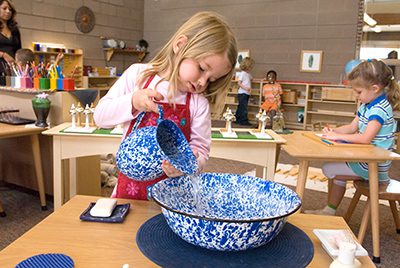
Initially, a child is drawn to the practical life exercises by the design and attractiveness of the material. A table washing activity for example could involve a brightly colored bucket with coordinating basin, pitcher and cleaning supplies.
The lessons in the practical life area should be presented with precise movements and as few words as possible. The teacher must always bear in mind that the child will absorb more from watching than from verbal instructions. She should make every effort to maintain that the child’s attempt will be successful, thereby allowing him the freedom to pursue his inner needs and sensitivities. This is the direct aim of all practical life activities, to set forth the child’s ability and freedom to work in his own time and space. Indirectly, the child, through practical life, is addressing his attention to detail as each activity has a certain regiment of procedure and placement. While to the curious onlooker, these steps and placements seem tedious and exaggerated; it is satisfying to the child. We must remember that the purpose of these exercises such as polishing, may not be the end result of a polished piece of silver, but the concentration and attention given within the process itself.
Maria Montessori viewed the practical life area as the most critical are of the classroom. Some instructors believe that this vital area should account for 25% of the classroom environment. It is in this area that a new student is introduced to his taste of freedom through movement, and the unfolding mind awakens to new discoveries. Each activity of practical life, through its pleasure to the child, has an indirect preparation for things to come. As a whole, practical life subtly invokes independence, leading to greater self-confidence. Concentration is enhanced through repetition. I have observed many children who will wash the same table, day after day. Recently one girl brought in every shoe in her house which could be polished and rhythmically and enthusiastically polished every one, every day until she was finished. Did she know that the circular motion in which she used to polish the shoe was an indirect preparation for handwriting? She did not care. It was fun!
The child in the Montessori classroom has no physical or social restrictions, leaving him free to socialize while enjoying his work. This social interaction will develop self-esteem and social awareness. As the child becomes more proficient in his work, his sense of worth will be further boosted by his ability to present a lesson to a younger child. Acceptable social behaviour will evolve through interaction encouraged in practical life. The grace and courtesy lesson will enable the young child to proceed in life with respect for himself and his peers. He will have the vocabulary and manners necessary for polite and interesting conversation. Furthermore, this simple lesson in practical life will lay the foundation for his sense of community.
‘Through practical life exercises of this sort the children develop a true ?social feeling’, for they are working in the environment of the community in which they live, without concerning themselves as to whether it is for their own, or for common good.’ (The Discovery of the Child, page 95)
The child’s spirit is nurtured through such activities as the silence game. In this lesson, the child learns reverence for himself, and his ability to create his own surroundings. The game, often played collectively, allows the individual child to be in touch with himself, even his soul. It teaches the child how to create and appreciate silence, not as punishment, but as a joy of controlling oneself, a joy of living.
Exercises such as walking on the line and rolling a mat develop the refinement of the child’s large motor skills and movement around others. Presentations of such exercises can be given collectively, individually, or to a small group. Other activities within practical life promote fine motor skills, dexterity and coordination. The dressing frames promote all of these physical attributes, yet self-esteem is readily displayed the first morning a child dresses himself.
Polishing and pouring promote hand-eye coordination captivating the child through the points of interest within the exercises. In later years as he is writing and reading, he will not realize that these simple activities helped foster his current skills and love of learning.
The practical life exercises should entice, enrich and encourage the child. Intellectual enrichment is achieved through the child’s ability to absorb through his environment. He learns to organize his workspace in accordance with his environment. The cycle of activity in each exercise calls to his sense of order and self-esteem. I have seen children return their work to the shelf with great pride, then summon another child that the lesson is now ready for him. This independent cycle of activity invokes responsibility.
As adults, we would do these activities with our thoughts in a thousand different places doing different things. No so with the child. The child’s mind is focused on his task and each particular step involved. He is in control of each step, producing logical thinking. His inner sensitivity of order is rewarded through this methodical, precise exercise. The control of error in each exercise does not produce feelings of frustration, but feelings of logical order and control leading to self-confidence. ?Although the exercises are skill-oriented in the sense that they involve washing a table or shining one’s shoes, their purpose is not to master these tasks for their own sake. It is rather to aid the inner construction of discipline, organization, independence and self-esteem through concentration on a precise and completed cycle of activity.? (Montessori, A Modern Approach, page 71)
So one might ask, how, through this methodical, logical area of the Montessori classroom can the child enhance his creativity? Each unique practical life exercise has a point of interest, a part that draws the child from within.
Table washing has the soap on the sponge, the circles on the table made by the brush, the waterfall made by pouring the water from bucket to the floor sink. Many times children have brought me a sponge with a mound of suds on it and said, ‘Look Mrs. Bayliss, I made a wave.’ The points of interest are aptly named, and become points of creativity.
Practical life exercises have amazing purposes, aims, and developmental qualities, but I find that the beauty of practical life is that it is a place for children to relax. Time and time again, I have seen an older child busy with the rigors of the moveable alphabet or decimal system, then, their work complete, they enjoy a respite of pleasure through practical life. This phenomenon was illustrated to me recently at my own home. My eight year-old daughter had been in a Montessori school for four years. Now she is in a more traditional school with an adequate amount of homework. After we worked on her homework for a while, I gave her a break to go outside and play, to run off some energy before tackling another difficult phase of her studies. After some time outside, she came to me beaming, holding with the dog’s water bowl. ‘I washed the dog’s water bowl, doesn’t it look better?’ I laughed out loud and called her my Montessori child. She found solace and relaxation through her own practical life activity.
Practical life activities are to adults, a futile exercise, mundane drudgery, a means to an end. Yet to children, they are open doors to life and development. They are an enjoyable, intriguing adventure, a social gathering, a soothing comfort, a place to unwind. Practical life exercises are fun.

Sample Toddler Curriculum Scope & Sequence Age 1 1/2 to 3
This is a static image of the Montessori Foundation’s Toddler curriculum scope and sequence database, available from our publications center.
We have an even more comprehensive version as part of the Montessori Compass student record keeping and parent communication software solution: www.montessoricompass.com

My Child’s Learning Experiences in Their School and Classroom: Parent Involvement and Support
Many parents ask, “What opportunities are there for me at my child’s school and in the classroom that would allow me to be involved and supportive?” Our Montessori experts will give you many ideas and suggestions for parents to think about and to ask their child’s teacher or school administrator about. Join us for this very informative session.
The Making of Great Little People – A Diet For Little Learners
Food balancing, fats, and focusing
The wonderful thing I love about teaching one and two-year-olds is they wear their hearts on their sleeves. Their immeasurable emotional honesty is heartwarming to watch. If they fall down or get their feelings hurt, they cry instantaneously. When they run and play their faces light up with joy, and if they take something from a friend or push someone down, when asked, by reflex they’ll admit it.
Very early learners also wear what they have eaten or not eaten into their classroom or life’s experience.
I have stumbled into this awareness after many years of observing uncharacteristic behavioral changes in some children from one day, sometimes one minute to the next!
Why did Wyatt who normally is well mannered at the lunch table suddenly become a loud, kick your neighbor kind of a child? And how could good-natured, Maxie transform into a grumpy, aggressive bully twenty minutes after arriving to school?
The coup de grace unfolded one day when exceptionally focused, even-tempered Ellen came to school portraying an easily distractible, hysterical child who couldn’t follow the simplest of directions. I began to ask myself, “Are little children just naturally moody and unreasonable? Is their educability just a crapshoot dependent on the barometric pressure or the day of the week?” Thoroughly confused and exhausted I decided to do a little investigating. Through lunchbox analysis, persistent cross examinations of parents, and consults with local nutritional gurus it became evident that diet could be playing a significant role in this inexplicable emotional drama playing out before my tired eyes and body. My grandmother was right. As trite as it seemed at the time, we truly are what we eat. But just to make sure I decided to peruse the books and periodicals in the library and do a search on the Internet and read everything I could about early childhood education and nutrition as it applies to the very early learners mood, behavior, and ability to focus. This was no easy task as there are 123,334 websites and experts and scientists in the field of human nutrition, brain development, visual acuity and every shade of learning style and difference in between are written up in 80 % of them.
Though intimidated at times by the blood brain barrier and reduced neuronal phospholipid turnover when I came upon the phrase carbohydrate addiction and brain fog, I knew I had found the Holy Grail!
Food balancing
Let’s begin with Ellen Satter, an authority on feeding infants and children. In her book, Child of Mine, Feeding with Love and Good Sense she talks about food balancing and the staying power from eating when the meal or snack is high in sugar, starch, protein, fat, and all four. She provides the reader with a series of charts that illustrate how quickly a child feels satisfied after eating certain foods and using a time line, when they will be hungry again. She also points out that there are also physical and emotional variables that can make the charts subjective.
The first graph shows satisfaction from consuming a sugar only meal or snack. The satisfaction response is quite fast because sugar enters into the bloodstream very quickly with little if any digestion required. It causes an increase in blood glucose. Looking at the graph you see the instant surge of satisfaction drop down just as quickly as it shot up. The child who has eaten a sugar only snack or meal will soon be hungry and may even become unmanageable as a result of it. AHA! That explains Wyatt at lunchtime. His lunch consisted of sugar-laden entrees such as sweetened yogurt, a banana, and a juice box. Within minutes his little legs starting to kick softly under the table. Then his voice started to escalate. Next thing I knew, he was reaching for his neighbors raisins. Next, the soft kicking became foot thrashing under the table. This is called a high glycemic response. Blood sugar levels escalate giving the child a surge of energy. In this altered state, Wyatt was sipping on his juice box straw and by the end of “happy hour” couldn’t focus long enough to pack up his lunchbox. As I continued my research into daily requirements of sugar for small children I learned that simple sugars should constitute 10 % of the child’s total daily caloric intake. Based on a 900 calorie a day meal plan, Wyatt was enjoying his recommended weekly sugar allotment!
The next graph shows the satisfaction from consuming a sugar and starch meal or snack. The satisfaction response is slightly slower than sugar only because the starch has to be digested before it can be absorbed into the bloodstream. However the staying power is limited (around twice that of sugar) and the child will soon be hungry. And if this is an active child (what child isn’t?) it will even be shorter!
That explains why Maxie knocked his friend down on the playground twenty minutes after coming to school. His graham cracker breakfast didn’t have the staying power he needed to get him through to snack time. He became cranky and ill tempered because of his nutritional letdown. He was hungry!
The third graph shows the satisfaction from consuming sugar, starch, and a protein. In adding protein to a snack or meal it makes it last longer. It takes awhile for the protein to be satisfying because it has to be broken down into amino acids before it can be absorbed into the bloodstream. It has about three times the staying power of a sugar only meal or snack.
The last graph illustrates the satisfaction from consuming sugar, starch and protein and fat. The presence of fat in a snack or a meal slows down the rate in which the whole meal is used. Fat retards the emptying of the stomach. It makes the meal stay around considerably longer. In fact, if you look at the chart, it’s well over six times the staying power of a sugar only meal or snack.
This certainly explains why Ellen had such a rough morning. When I called her mother to find out what she had for breakfast she told me nothing. They were rushed that morning. Poor Ellen didn’t have anything to satisfy her hunger and fuel her body to get to school let alone give her the extra energy to focus on anything.
Fats
In her book, Ellen Satter not only talks about food balancing, but also gives us daily recommendations and servings for all of the basic food groups. And for little children we do not limit fats. We serve to appetite! This was my first introduction to the multi-faceted benefits of fat in a child’s diet.
Since I am a Montessori teacher and follow her timeless methodologies for guiding my students I decided to go back nearly hundred years and research everything she wrote on childhood nutrition. I found an entire chapter dedicated to Refection, the child’s diet in her book, the Montessori Method. The following was translated from Italian into English in 1912.”The fundamental substances of diet are three in number, starches, fats, and proteins.” Then she gives us a list of whole foods to serve to children such as meatballs made with grated meat and bread, milk, beaten eggs, and then fried in butter. She also gives us recipes for vegetable and beef purees and soups laden with naturally occurring saturated fats and olive oil. “The diet of little children should be rich in fats for reserve matter. Instead of removing the grease from the broth it is well to add butter to it, or, a spoonful of olive oil but substitutes for butter, such as margarine should never be used.”
I had always heard that children require more fat in their diets than adults but I never understood why or it’s physiological complexities. Nor did I realize that the role of dietary fats and oils in human nutrition is one of the most important areas of concern and investigation in the field of nutritional science!
The Joint Fats and Oils/World Health Organization, an international group of experts in nutrition, public health, food science, and technology conclude that both the amount and quality of dietary fat consumed can affect child growth and brain development. One of their main areas of concern is weaning. Between 50 to 60 per cent of energy provided from breast milk is from fat, and during the weaning period care needs to be taken to prevent dietary fat intakes from falling too rapidly or below the required levels. They recommend the use of fat, especially vegetable oils, in foods fed to weaning infants and young children as an effective way to maintain the energy density of their diets.
As I continued reading I came to understand what many researchers and nutritional scientists are also concerned with, the child’s consumption of adequate amounts of essential fatty acids which are needed for normal growth and development. AA (arachidonic acid) and DHA (docosahexaenoic acid) are naturally occurring essential fatty acids in breast milk. They are extremely important for brain development and visual acuity in infants and young children. In well-nourished women, an average of approximately 2.2 grams of essential fatty acids are deposited in maternal and fetal tissues each day throughout pregnancy.
The experts recommend that during weaning and at least until 2 years of age 30-40 per cent of a child’s diet under two should provide these highly unsaturated fatty acids (omega-6 and omega-3) at levels similar to those in breast milk.
Essential fatty acid deficiencies during the early years can lead to a constellation of behavioral and learning difficulties later on such as impaired motor-coordination, difficulties with attention and impulse control, and delayed language and social skills.
Professor Michael Crawford, director of the Institute of Brain Chemistry and Human Nutrition at the University of North London paints a colorful, scientific metaphor that illustrates the specialty in human brain nutrition as compared to that of the white rhinoceros. He compares the growth of the two brains pointing out that within a span of 4 years the white rhino weighs one ton and it’s brain weighs ?s of a pound. It consumes all of the protein it needs to reach its massive rate of body growth from the simplest food resource, grass. It does not get the lipids (fats) required for brain development. At 4 years of age a human child weighs about 44 pounds and his brain growth is nearly complete at close to 3 pounds.
The province of early childhood development is focused on the brain. Body growth is something that happens later in life. Seventy percent of the energy that is devoted to fetal development is focused on the brain, and post natal it drops only to 60 %. The brain is not made of protein. Sixty percent of the structural material of the brain is fat or lipid. The reason for this high investment in lipids is that the brain functions by sending messages which are dependent on the lipid or fat properties of cell membrane being able to separate two water phases. This allows ionic charges to be built up on one side and held until a signal is received. The transmission of these messages involves the opening and closing of special channels, the action for which is intense in the brain and requires a high degree of flexibility within the membranes.
Two lipids important to the brain are the omego-6 and the omega-3 fatty acids. Low levels of omega-3 fatty acids in a diet can cause vision problems especially by affecting the retina, which is composed of 30 percent highly unsaturated fatty acids. The Omega-6 oils are common to the foods we eat, such as salad dressing, mayonnaise, safflower and sunflower oil. Omega-3 fatty acids are found naturally in fish, flaxseed oil, wheat germ, and nuts and seeds.
In refection, the child’s diet Maria Montessori suggested that we feed our children only natural occurring fats. She tells us emphatically that fat substitutes like margarine or trans fats are not nutritionally sound for little learners Let’s talk about trans fats like the ones found in margarine, shortening, commercial cookies, cakes, candies, crackers, French fries, and in most breakfast, and energy bars. Trans fats are unsaturated vegetable oils such as soybean and cottonseed oil that have been injected with hydrogen, a pressured gas that changes the liquid oil into a solid and alters its molecular structure to resemble saturated fat. It’s man-made shortening! Trans fats aren’t natural or essential and provide no health benefit unlike saturated fat which is a natural fat found in oils, dairy and meat that provide energy and aids in the absorption of fat soluble vitamins. Trans fats fool the body and get into the places where natural fats should be and block the good fats from being absorbed into the body and destabilize cell membranes. They can even prevent the synthesis of important essential fatty acids.
Focusing
While discussing the effects of trans fats and their impact on learning how to learn Simon comes to mind. Despite conference after conference with his parents to express my concern for his learning indifference, limited concentration skills, and depressive state he still sachets into school after eating a breakfast bar at home drinking 8 ounces of take-out orange juice (a toddler sized portion is 2 ounces) and chewing on a fried fast food “unhappy” meal.
He walks around the classroom as if in a fog and I honestly don’t know if he can see the work on the shelves clearly enough to get excited about any of it. I asked his mother if he ever ate any fish or took any nutritional supplements and she said, “never.”
This could be where deficiencies of essential fatty acids comes into play in regards to vision which is a key component of brain development. Vision is learned. A child learns how to see just like he learns how to walk and talk. When learning how to walk or talk the child has the distinct opportunity of imitating his parents and siblings. In addition, parents can observe the child to determine if walking and talking are developing properly. Vision development on the other hand generally proceeds without much concerned awareness on the part of the parents.
The following are a few visual skills needed for academic success:
Visual acuity, clarity, sharpness: How well a child can see at a distance of twenty feet or at a learning distance of approximately eleven to sixteen inches. (This gives a whole new meaning to the phrase learning to focus. There’s always that child in the classroom who takes a little bit longer to find the place on the shelf to return his activity or like Simon, has trouble finding work, period)
Binocular coordination: the ability to use two eyes together
Adequate convergence: the demand for the eyes to go inward so they are aimed at the task at hand for developing hand eye coordination. If the eyes have a tendency to go outward, the child must use excess effort and energy to focus. In fact, in some children the eyestrain can create a short attention span. These children can become dyspraxia, dyslexic, and learning disabled.
Dr. Donald J. Getz published an article about eyesight in the journal of applied Nutrition. He ends his article with a paragraph about nutrition and vision. I quote, “When I see a child with a learning problem, I feel very strongly that there usually is not just a single cause. For example, when I find a visual problem, if I probe a bit further a nutritional problem will be found as well. Children often walk into the office eating a candy bar or sipping on a cola or other sweet drink. When they are asked what they had for breakfast, the response usually falls in the sugary breakfast mode or the answer is no breakfast at all.”
Conclusion
I feel like the scattered pieces of this giant nutritional jigsaw puzzle are finally coming together however, these revelations wouldn’t be complete without mentioning a research scientist who like me was an educator and very interested in diet and it’s potential effect on learning styles. Though I don’t plan to go back to the University and get a doctorate degree in the field of nutrition and biochemistry like Dr. Alex Richardson I’d like to share some of her clinical findings and compelling words from the Nutrition Practitioner:
Current practice within our education and health care systems involves separate diagnostic labels for dyslexia, dyspraxia, attention-deficit/hyperactivity disorder and autistic spectrum disorders. Each refers to a specific pattern of behavioral and learning difficulties in the planning and coordination of movement. These developmental conditions are remarkably common, affecting up to 20% of the population to some degree, and they account for the vast majority of children with special educational needs. The associated difficulties usually persist into adulthood, with enormous consequences for the individuals affected, their families and society as a whole.
In none of these conditions is the possible role of nutrition considered as part of standard evaluation and management, despite its obvious and fundamental importance for optimal functioning of the brain. A whole range of micronutrients is essential in this respect, but in particular there is mounting evidence that deficiencies or imbalances in certain highly unsaturated fatty acids of the omego-3 and omega-6 series may contribute to both the predisposition and the development expression of dyslexia, dyspraxia, ADHD and autism.
As educators, administrators, grandparents, and parents we must feed our children with the utmost of consciousness and responsibility so they can enter into the world with a natural learning style. It concerns me that poor nutritional habits can set a child up for patterns of erratic behavior, unfair consequence, and difficulty concentrating that could cause him a lifetime struggle.
Maria Montessori teaches us to be active in preparing the classroom environment and take constant and meticulous care of it so the child has the “best” means for development. And I quote, “Always treat the child with the best of good manners and offer him the best you have in yourself and at your disposal.”
Collectively, we must continue to take a serious interest in the child’s “inner prepared environment,” the nutritional playing field we can’t see but whose impact can surely be measured through observation and investigation.
I would love to hear from you. Please send your questions or comments as they relate to this article to Jan Katzen-Luchenta. c/o Tomorrow’s Child. We will contact you if your request is printed, etc.
Jan Katzen-Luchenta is a teacher and the author of Nutrition for Learning and Awakening Your Toddler’s Love of Learning. She recently produced a classroom video, The Making of Great Little People. Visit her website at www.thetoddlertutor.com

The Power of Storytelling Part 1
Webcast presented August 10, 2016
This week Dr. Michael Dorer began a special 2-part webinar on The Power of Storytelling – Creating a Story-Centered School
You can bring the fun, energy, and power of storytelling to your classroom or home with this new storytelling guide. Gain insights that will help you become an accomplished storyteller, an essential skill for Montessori practitioners as well as all teachers.
Join Michael in a journey of stories. Stories of all kinds.
Now we begin, Once upon a time …
This presentation is based on Michael’s new book, The Deep Well Of Time, which is about to be released by Parent-Child Press
http://www.montessoriservices.com/parent-child-pre…
The recordings of the webinars are archived in the IMC member’s resource center.
Featured
-
 Montessori Family Alliance School Group Membership (Print & Digital 2026 1/2 year pricing)
Original price was: $30.00.$15.00Current price is: $15.00.
Montessori Family Alliance School Group Membership (Print & Digital 2026 1/2 year pricing)
Original price was: $30.00.$15.00Current price is: $15.00.
-
The Montessori Way, Revised and Expanded: An Education for Life; A Comprehensive Guide for Parents and Teachers
$25.00
-
The Montessori Child: A Parent's Guide to Raising Capable Children with Creative Minds and Compassionate Hearts (The Parents' Guide to Montessori)
$20.00
-
The Montessori Toddler: A Parent's Guide to Raising a Curious and Responsible Human Being (The Parents' Guide to Montessori)
$20.00
-
Montessori in Action: Building Resilient Montessori Schools 1st Edition
$29.95