

Storytelling and Executive Functioning
All classroom teachers have had experiences with children who have difficulty in school; often, it’s unclear why. We might try a number of things and still find frustration. Often, the students clearly want to do well and evince great potential, but their difficulties or challenges aren’t attributable to any sort of obvious learning disability or special need.
In these elusive cases, it is important to consider that there may be impediments to executive functioning, the set of key skills that we use every day in our daily lives, our learning, our work, and in any sort of performance.
We also regularly work with young people who seem to “get it.” They are attentive, seem to follow our lessons, and appear to understand essential concepts embedded in our lessons. In these cases, it is important to consider that these students may have greater capability in the key areas of executive functioning.
Executive functioning is key to our ability to navigate the world.
Simply stated, executive functioning is a set of essential mental skills that we employ at all ages, from early childhood through adulthood. Three of these functions, possibly the most important, are: working memory; cognitive flexibility; and inhibition control.
Working memory refers to our everyday memory, our use of it, and our ability to access it. Cognitive flexibility is adaptable, manageable, and responsive thinking. Inhibition control refers to the willpower that one manifests over one’s own actions, such as restraint, self-control, and discretion.
I cannot overstate how important these three skills are. They underlie most successful behaviors in school and, indeed, our entire professional adult life. Executive functions make possible a large number of intellectual and psychological achievements, including: advanced thinking, or mentally playing with ideas; careful planning, or taking time before acting or performing; flexibility, or meeting unexpected or unanticipated challenges; perseverance, or resisting temptation and developing stick-to-itiveness and maintaining focus.
The good news is that these skills or abilities can be nurtured, developed, and refined, so that even if one or more of them is at a less-than-ideal level, they can be improved and maintained. In short, they can be taught in our classrooms in a way that promotes their growth and utility. How? We can do this by using, quite possibly, the most ancient teaching technique: storytelling.
Storytelling has a unique relationship to each of these skills: it directly addresses and encourages working memory, cognitive flexibility, and inhibition control. Let’s look at each one and see how storytelling can benefit and support its growth.
Whenever we need to remember something important, such as our list for the supermarket, where we parked our car, a friend’s phone number, or a set of instructions for any task, we rely on working memory. Working memory is simply the ability to hold information in one’s mind over a brief period of time and being able to apply that information to various scenarios.
Most neuroscientists agree that there is some limitation to the capacity for working memory, although that limitation (and whether it can be adjusted) is up for debate.
Of course, memories do get lost or diluted over time, but there are some ways to slow or even stop that process.
One way to improve working memory is what researchers call maintenance rehearsal, or simply repeating information mentally without regard to its significance or meaning. An example might be going over and over in one’s mind the exact items on a grocery list in the hope that nothing will be forgotten. This method may be used productively, though with limited utility, in school settings: memorizing arithmetic fact tables; conjugating verbs; or drilling spelling lists and foreign language vocabulary.
A second approach is what researchers call elaborative rehearsal: recognizing some significance or meaning about certain information, then associating it with other information. Mnemonic devices fall into this category, as do any associations or relationships that can be established among and between various ideas, facts, or procedures. An interesting note is that researchers believe that elaborative rehearsal can help move information from working memory into long-term memory. This makes any experience that creates associations especially valuable for learners. Storytelling offers particular and substantial opportunities for elaborative rehearsal. First of all, stories often relate immediate impressions or bits of information to larger pictures which can, in turn, be applied to actual life situations. For example, who can forget the image of the grumbling fox stomping off, muttering “Sour Grapes!” in Aesop’s fable The Fox and the Grapes? Who can avoid applying the story’s implicit insights to everyday situations?
Stories create an image repertoire that is accessible through working memory and can be applied to situations both familiar and unanticipated. After hearing the story of the Four Strange Brothers from The Deep Well of Time, children have come to me years later still characterizing the four arithmetic operations as brothers and using the images in that story as mental hooks which have been translated into long-term memory.
One of the most important characteristics of classroom storytelling is repetition, which aids listeners in not only following the story but developing and utilizing the working memory to learn the story themselves. The repetition sets up what amounts to a series of mental guideposts that children can (and do!) follow in re-telling the story.

There are two forms of repetition that are common in storytelling: pattern repetition and word or phrase repetition.
Pattern repetition is the reiteration of specific behaviors, situations, or ways of communicating or acting. Regularly repeated patterns frequent the plots of many stories and folktales the world over. Well known examples are The Little Red Hen or Stone Soup. Another example is in the descriptions of each character in The Four Strange Brothers. The repeated patterns in these stories and others like them provide a well-defined structural framework for working memory.
One of the most common pattern repetitions in traditional storytelling is the “rule of three.” This refers to a pattern in which there are three characters or three situations—the first two somehow fail, but the third is successful, however unlikely it may seem. The Three Little Pigs, Goldilocks, and the Three Bears, and The Fool of The World (a Russian folktale) all employ the rule of three. Another example is my story Measuring the Farm, in The Deep Well of Time.
Becoming familiar with the rule of three encourages the listener to make predictions based on the unfolding three-part storyline. This involves working memory on several levels. Memory usage is encouraged by the three-part structure, and it is also rewarded when that structure is revealed to be a unifying plot element, as had been anticipated. This involves the listener in making predictions, creating a hypothesis of what will unfold. “Minds exist to predict what will happen next. They mine the present for clues they refine with help from the past…to anticipate the immediate future.” (Boyd, page 134).
The second form of repetition used in stories is direct word or phrase repetition. This refers to a specific pattern of words literally and exactly repeated. In the opening moments of a story, these words or phrases become immediately recognizable to the listeners. The children may even chant along, “Run, run as fast as you can! You can’t catch me, I’m the gingerbread man!”
In The Deep Well of Time, an example of specific word patterning occurs in The Four Strange Brothers. Recalling these specific passages can sometimes be enhanced by being written in a rhythmic or poetic format.
The gift of the memorable is one of the key benefits of storytelling that I introduced in The Deep Well of Time. The gift of the memorable refers to the presentation of stories or lessons, or even components of them—like striking images, characters, or incidents—in such a way as to facilitate children’s recall, even many years later. This concept exemplifies an important way that more constricted short-term working memory moves into more stable, long-term memory. By using stories, teachers can consciously and intentionally create memorable moments in their classrooms. These moments may well be recorded in a child’s memory for years to come.
Orally told stories are rich with images, characters, and plot devices, as well as patterns. These all have the capacity to stand out and find a special place in children’s memories. These memories are of a specific kind called episodic memories. Episodic memory records particular events that a child experiences. It can be linked to a specific place or time that essentially ‘grounds’ the incident or image.
These episodic memories are not always related to actual events in the child’s life: they are just as often based on events, places, people, or times that are experienced vicariously—through stories. This is how we may remember the evil queen in Snow White reciting “Mirror, mirror on the wall…,” the Mad Hatter’s tea party from Alice’s Adventures in Wonderland, or Cinderella’s glass slipper. These story-based images are recorded in episodic memory.1

For children to follow a story and then later discuss and comment on its content and meaning is oral comprehension, an important precursor to any form of reading or literary comprehension. Oral comprehension clearly requires working memory. Listening to stories, discussing them, and using them as bases for comprehension exercises also develops episodic working memory.
In the same way, when children use those orally told stories as launching pads to make up their own stories, orally and in writing, working memory is required. There may be no other activity in the classroom which has so many applications to working memory as stories and all that goes with them: storytelling; story absorption; acting out stories; retelling stories; and writing story-based compositions.
Cognitive Flexibility
The second major pillar of executive functioning is cognitive flexibility: the ability to switch between thinking about two different concepts or to think about multiple concepts simultaneously. It includes: mentally rearranging; reevaluating, and integrating a variety of ideas and images, many of them new or unusual, as well as sometimes challenging preconceived notions. The term also applies to our ability to consider or adopt alternative approaches, solutions, or courses of action.
One of the essential characteristics of cognitive flexibility is the ability to think in images, archetypes, representations, and metaphors – “out of the box” thinking. This flexibility allows us to hold in our minds an external “reality” like everyday life, while we simultaneously immerse ourselves in metaphorical worlds of fiction, fantasy, or make-believe
In the stories in The Deep Well of Time, geometric shapes get together to plan clubs based on their characteristics; numbers conspire to form groups; and triangles try to fit into rooms that just seem too small. In other stories, nouns and verbs have active discussions, cats tell tales, elves make materials, and strange images from dreams become reality. Metaphorical thinking, which is innately flexible, is at the heart of storytelling. The very essence of meta-phorical thinking is the manipulation of images and ideas, changing established rules of existence, and putting ideas, images, people, thoughts, animals, or supernatural beings into situations, which are unusual, impossible, or unheard of in the ‘real’ world. This is clearly thinking about multiple concepts simultaneously.
Story listeners and story participants develop the ability to appreciate these situations and use this sort of thinking in a variety of situations. Doing so keeps us fresh, or at least keeps our thinking fresh. This is essential, not only in young people but in adults as well. Magnusson and Brim (2014) draw attention to the fact that “Cognitive flexibility declines with age and often results in an inability to adapt to new situations and environments.”
I believe that this effect of age can be diminished, at least somewhat, by active story participation. Storytelling, story listening, participation, and story creation all demand and utilize cognitive flexibility. Just as all physical exercise maintains and increases fitness, ongoing exercise of metaphorical thinking and applied imagination can maintain and strengthen cognitive flexibility and “cognitive fitness.”
More, listeners to stories react emotionally as well as cognitively to the story. This dual response demands key components of cognitive flexibility: imagination, visualization, interpretation, personification, and identification. It means putting one’s imaginative self into the story and leaving one’s real, earthbound, strictly logical self behind. It may mean accepting what seems to be impossible and then examining the consequences.
Thinking only in straightforward patterns and within highly structured and rigid organization is simply not possible while being immersed in stories. Stories take us to a higher place. In support of this idea, I wrote in The Deep Well of Time (p.22) that,
As soon as words like “once upon a time” are uttered … children enter into what poet Samuel Taylor Coleridge called the “willing suspension of disbelief” (Coleridge, 1817, p. 174). This stimulates the motivation of a story listener to accept and enter into the world of a fictional or fantastical tale as if it were literally true, even while he or she fundamentally understands that it is not. Children in the elementary years relish this distinction, just as we adults do when we enjoy novels, theatre, and film.
Inhibition Control
The third of the three critical components of executive functioning is inhibitory (or inhibition) control, sometimes also called response inhibition. Inhibition control is the ability to put off gratification, to not require immediacy in response, or to avoid acting impulsively. It means not getting what one wants immediately but being able to wait patiently. Inhibition control suggests planning, forethought, and anticipation of responses or repercussions.
Inhibitory control involves being able to control one’s attention, behavior, thoughts, and/or emotions to override a strong internal predisposition or external lure; instead, to do what’s more appropriate or needed. Without inhibitory control, we would be at the mercy of impulses, old habits of thought or action (conditioned responses), and/ or stimuli in the environment that pull us this way or that. (Diamond, 2013, ¶ 1).
Inhibitory control is essential in social situations and is at the core of many traditional manners lessons, not to mention the “Grace and Courtesy” element of the Montessori classroom. It is an essential component of self-regulation in any setting; it prevents us from making fools of ourselves!
Problems with inhibition are seen at three levels (Brenitz, 2020): motor, attentional, and behavioral.
Attentional control issues appear as distractibility or difficulty paying attention. For example, during a lesson or while at work, a child is easily distracted by a sound outside, another child in the classroom, or even some innocuous object.
Poor control in motor behavior often manifests in overactive or uncontrolled movement. For example, certain children may not be able to control their movements during a presentation or lesson. In that case, a child may fidget, get up and wander around, or even roll about on the floor.
Behavioral control issues present as impulsive behavior that cannot be inhibited. It might include shouting, hitting, or bumping into another child.
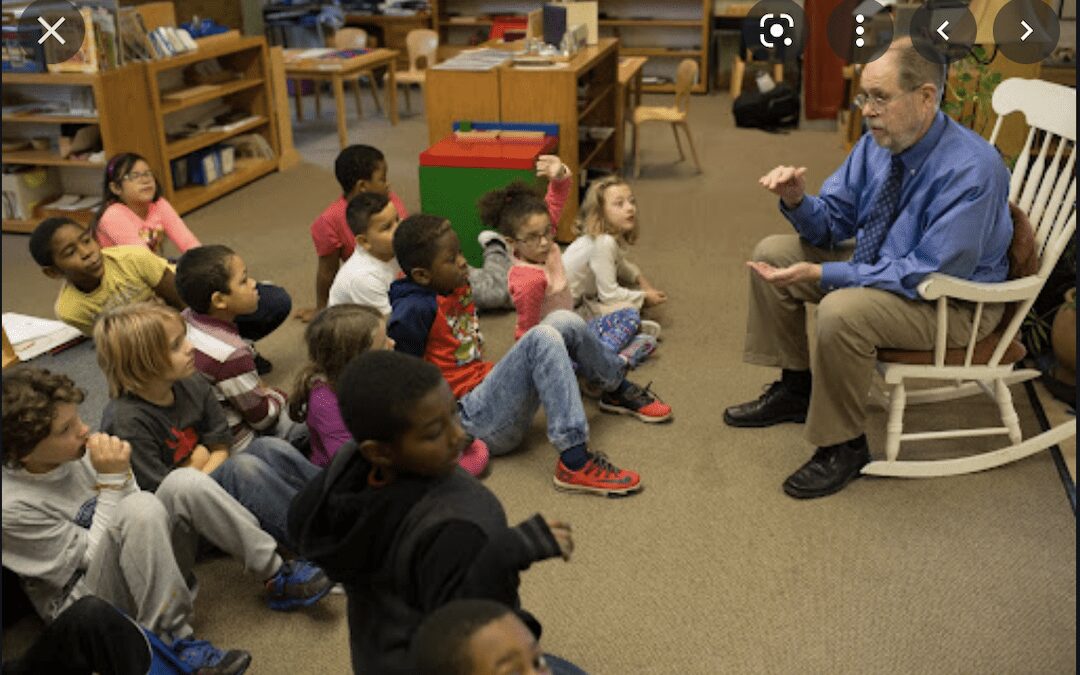
One of the first things that story listeners need to master is control of their bodies, voices, and minds. They quickly learn not to shout out comments or questions in the midst of a story or to jump up and make physical gestures. Story appreciation means controlling one’s impulses for questions and responses until the story has been concluded. Discussion of the story not only requires cognitive flexibility but also develops inhibition control; one must avoid immediate and thoughtless responses to others that can damage or destroy the discussion process.
When I tell stories as a visitor, teaching artist, or artist-in-residence, I always explain to my young audience that I have two rules, and two rules only. First, they are to stay quiet. No questions, no hands up, no whispering. However, I do assure them that if they have questions, I will certainly address those questions immediately after the story.
The second rule is: Keep your hands and your bodies to yourselves. This means no touching, poking, or high-fiving.
Essentially, I am asking them to develop and exhibit inhibitory control. This kind of inhibition makes it possible for them to stay quiet and focused when a story is being told, even though they may want to say or do something.
Amazingly, these rules work. In classes that I have led, for toddlers through teens, the listeners almost invariably practice inhibition control. The only groups with whom I sometimes have problems are adult learners, but they, too, eventually practice control.
The reason my rules work is that stories are intrinsically rewarding. They are, by their very nature, so positive and engaging that students and other listeners want very much to hear what comes next and how it all turns out. They don’t want to be shut out of the remainder of the story because of an untoward word, action, or behavior. As a result, they learn, quite successfully, higher degrees of self-control. This also translates into a sort of shared group expectation of controlled behavior.
When these three elements (working memory, cognitive flexibility, and inhibition control) are established, and in place, they are not limited to the storytelling and story listening context. In fact, once these skills are learned and mastered through stories and storytelling, they can be transferred to many other areas and contexts within the classroom and the school. They simply become habits of mind, regular, reinforcing tendencies that produce consistent, beneficial results.
This constitutes a strong argument for emphasizing storytelling in every area of the curriculum and throughout the school. It can be foundational in the development and support of executive functioning.
There are, of course, many other excellent reasons, discussed here and in many other articles, for stories to be told in schools of every sort and at every age level. However, every one of those other benefits is enhanced by working memory, cognitive flexibility, and inhibition control. One of the wonders of storytelling is that it successfully develops and enhances these skills, intrinsically and joyfully rewarding the listener, the entire student population, and the storyteller as well.
1 Thank you to Ashley Darcy, Montessori teacher educator, for suggestions and valuable ideas on repetition and working memory. (Personal communication, November 21, 2020).
References
Boyd, B. (2009). On the origin of stories: Evolution, cognition, and fiction. Cambridge, MA: Harvard University Press
Brenitz, S. (2020). Inhibition: Cognitive ability making up part of our executive functions. Retrieved from: https://www.cognifit.com/ science/cognitive-skills/inhibition
Carroll, L. (1869). Alice’s adventures in wonderland. Boston: Lee and Shepard.
Coleridge, S. T. (1817, reprinted 1834). Biographia literaria. New York: Leavitt, Lord & Co.
Diamond, A. (2013). Executive functions. Annual Review of Psychology Vol. 64: 135-168 (Volume publication date January 2013). First published online as a Review in Advance on September 27, 2012. Retrieved from: https://doi.org/10.1146 annurev-psych-113011-143750
Dorer, M. (2016). The deep well of time:The transformative power of storytelling in the classroom. Santa Rosa, CA: Parent Child Press.
Magnusson, K.R. & Brim, B.L. (2014). “The aging brain.” In Reference module in biomedical sciences. Retrieved from: https:// www.sciencedirect.com/topics/ neuroscience/cognitive-flexibility

Webinar: What Do You Read – Inspiring the Literary Artist in Your Child
Join Nora Faris and Cheryl Allen to get tips on what to look for in books for children that will inspire, delight, and touch their creative spirits. From rhyming and repetition for the youngest ones, to tales of adventure and mystery for the elementary years, to classics and modern drama for the adolescents, our guests will peak your excitement about an in person trip to your local bookstore or online to pick out books for holiday giving.
Storytelling and Emotional Intelligence
What is executive functioning and why is it important? What is meant by working memory, cognitive flexibility, and inhibition control? Do they matter? How can storytelling support and improve these abilities? Join Michael to answer these questions and then see how storytelling enhances and develops executive functioning, aiming at all three of these key abilities. This may be an essential approach to enhance executive functioning in young people. Please join us!!

How Montessori educators use stories in the Montessori program
Story Telling In Montessori Education
by Dr. Paul Clement Czaja
The word “story” comes from the ancient Greek word “histor” and means literally “a narration from a learned man.” Since the beginnings of human time, noble men and women who had survived life long enough to be old would share stories of wisdom to all who would gather around the fire and listen. I say they were “stories of wisdom” because in the particular happenings they told about the hero survives by not being foolish. A great story told has always been the leading edge of personal communication for it is the sharing of a wisdom – a piece of common sense – a tale of selfless courage – a victory of the good — which can provide those who hear the chance to share in a life experience in a way that makes words come alive and practical advice about living become personal and truly experiential.
The problem in sharing wisdom with others is that the profundity – the complexity — of the human person makes every personal experience hard to express directly for often the truth within a human life is ineffable: “more than words can tell” as the saying goes when we are in love.
Such personal living is based on a felt experiencing that has more to do with the revelation of truth and beauty (or lies and chaos, or of the good and the evil, or of our deepest hopes and fears) than words by themselves could ever relate. And this is precisely what storytelling is all about. It must be a personal telling if it will have the power to uncover the “heart of the matter” for those who can hear. By telling the story one is able to share a human act on a much higher level of communication than just talking can, and that is so because storytelling is an art form, while mere blabbing is not. Coming to meet and know a life story gives one the opportunity to meditate on its reality and then to contemplate the storyteller ‘s personal communion with it measure for measure. Such a story is full of accessible wisdom.
The telling of a story from the storyteller ‘s heart/mind/soul imbues the saying with the magic inherent to every truly creative act. A story well told has the power to set imaginations aflame, to engage the listener ‘s feelings, to become a matter of life revealing life. The art of storytelling involves the storyteller filling the story with vitality. When the storyteller tells a story rather than merely reciting the cold facts, he or she recreates a human experience that has vibrant existence. When storytelling has vitality, it will reveal to those listening a life-reality with all its possible dangers together with all its hopeful victories – and also with the choices that must be met. As the ancient prophet has God say to a man: “I put before you life and death, my child. Choose life. ”
The prophetic revelation of the storyteller is always brand new news — even if that means newly seeing something that has been there around the listeners a long time without them coming to know about it really. So the storyteller is a modern day prophet who stands up before a crowd and proclaims a story that says: “Once upon a time, a man had to make a choice because he was free to choose. This is what he did. This is what happened. ” Within such a listening, one is deeply touched by the act of deciding and feels the decision was made for all mankind. The listener in a secret, deep way lives the consequences of the hero ‘s choice and within the sacred place of conscience actually weeps or rejoices over it. “Did the hero choose wisely or foolishly? What would I choose if such a choice came to me? ” From such an encounter, wisdom is gained – and with the story, a way has been found to share such wisdom with others.
The primary problem to overcome by anyone moving to take the first steps toward becoming a storyteller is how to move away from the strong habit of conceptualization (surface-thinking) which our past schooling has laid on us all. We are in the habit of looking at a “tree” as a noun, as an abstraction. There are no inch worms on its juicy leaves – no squirrels scurrying up its trunk – no man sitting in its shade thinking, resting, soon to get up and return to work. No in our schooling we are introduced and kept focused on the noun “tree ” which had no real living going on – and so Montessori suggests to the child to place a black triangle shape over it like a tombstone. A tree is a tree, is a tree (to hint at Gertrude Stein ‘s insight) and the mental presumption of sameness obscures us from the innate gift of intuition that here is life with all its wonder happening gloriously right there before us. Perceiving living trees and all the living going on within their noble company through the myriad seasons is the life spark of religious experience and the blossoming of our inner life where music is felt and art created and is the communion that is knowing becoming loving care.
The path to becoming a storyteller requires us to develop in our daily life a new habit of being aware of our immediate and direct experiencing. We have to become attentive to the concrete in the here and now – and to become aware at the same time of the meanings – the connections – the implications — existing within the “thing ” we are experiencing.
To experience human life in such an existential manner we must become like the experiencing child – or like the alert native walking off trail moving through a primeval forest so keenly sensing everything out there, above him, around him, and under each stepping foot. To be able to do this, we each must stop being a “somebody” and begin to become for that time of observation a “nobody.” By that I mean, being a “somebody” is when you are focused on yourself — on your cortex thinking – on ideation rather then on the ongoing experiencing of what is there outside of you with all its existential reality. Being a “nobody ” is when you are so focused on observing the other that you are no longer conscious of your self but completely taken up in the taking in of what is there in all its immediacy – there dragging its past, showing its present, and so obviously leaning into its future. This “nobody, ” philosopher ‘s teach, is our soul ‘s “I ” which is able to experience truly with humility and disinterest and is open enough to meet the other as a “thou ” – and so perhaps to connect personally enough to commune with this other being – becoming for that time a mutually beneficial “we. ” It is when the artist before the stretched canvas or the athlete on the cinder track, or the child at play or the native in the deep forest becomes such a “nobody ” that instinct and body knowledge and intuition and creative genius take over and accomplish truly wonderful deeds.
The tragedy is that such existential experiencing was so naturally ours when once we were babies and little children – when we all were “little Indians ” — before our schooling caused us to be almost always completely distracted by thoughts and so hindered from experiencing our experiences. Our schooling did not reward intuition or creativity or any other jazzy human act. Too interested in the products of their teaching – the ability to do the times table thoughtlessly – the ability to remember without a shudder of horror the date in Civil War history when thirty thousand young men died in bloody battle – the ability to copy and copy correctly paragraph after paragraph of their chalk written notes on the big black board without ever being given the opportunity to compose anything of our own, to be creative –no, our teachers were trained to be solely interested in the testable products of their teaching. And because of this regime of mass teaching, our teachers were too uninterested in what was going on there within us where the authentic organic life of our truest selves reigned in a so hidden kingdom. They were more interested in teaching us something. They would have us skip over the beginnings and put our energies on the finished work — not respecting the primacy of the sacred ground that personal experience of a truth is for all people.
So what are we to do? Here is Montessori ‘s answer: Bring everything to the children “indirectly ” through a storytelling that reveals to their deepest knowing the challenge, the truth, the meaning that lies hidden within. Storytelling is the only way. Storytelling has the power to give the experience of that which is ineffable — that given reality of another which can never be put into words but only can be captured in the life of the telling – in the drawing – in the music – in the dance – in the story. Sharing such a given causes a communion to take place between us, the educators, and them, the listeners sitting right there before us. The magic comes from the fact that in the act of storytelling we ourselves return to innocent experiencing, to that primeval connecting with others sitting around the fire that alone is the sacred place of wisdom sharing. To become a storyteller we must first of all be gloriously alive–alive to ourselves–alive to all that is going on around us–alive in our seeing, hearing, touching. The sure sign that we are becoming the storytellers we need to be will be found in the pure fact of this happiness of our being alive.
Storytelling every “academic subject ” with the children enables us to possess and share with them every aspect of human life in a timeless experiential way that has wisdom at its core. Once the story has had its way with them, they are ready to work and to make all their learning a personal, self-motivated act. The profoundly personal sharing that is storytelling is the beginning of wisdom for children — and is the wellspring of human compassion without which knowledge is soulless and without purpose. Without wisdom and human compassion, knowledge is pernicious. So of all the skills we must master in our craft as Montessori educators, the art of storytelling is primary.
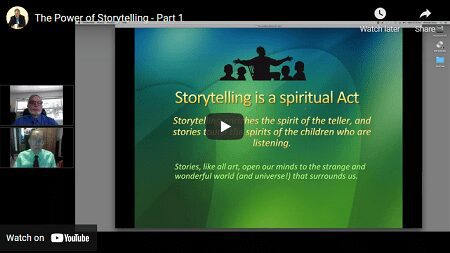
The Power of Storytelling Part 1
Webcast presented August 10, 2016
This week Dr. Michael Dorer began a special 2-part webinar on The Power of Storytelling – Creating a Story-Centered School
You can bring the fun, energy, and power of storytelling to your classroom or home with this new storytelling guide. Gain insights that will help you become an accomplished storyteller, an essential skill for Montessori practitioners as well as all teachers.
Join Michael in a journey of stories. Stories of all kinds.
Now we begin, Once upon a time …
This presentation is based on Michael’s new book, The Deep Well Of Time, which is about to be released by Parent-Child Press
http://www.montessoriservices.com/parent-child-pre…
The recordings of the webinars are archived in the IMC member’s resource center.
The Power of Storytelling Part 2
August 17, 2016 This week Dr. Michael Dorer concluded a special 2-part webinar on The Power of Storytelling – Creating a Story-Centered School
You can bring the fun, energy, and power of storytelling to your classroom or home with this new storytelling guide. Gain insights that will help you become an accomplished storyteller, an essential skill for Montessori practitioners as well as all teachers.
Join Michael in a journey of stories. Stories of all kinds.
Now we begin, Once upon a time …
This presentation is based on Michael’s new book, The Deep Well Of Time, which is about to be released by Parent-Child Press
http://www.montessoriservices.com/parent-child-pre…
The recordings of the webinars are archived in the IMC member’s resource center.
Featured
-
 Montessori Family Alliance School Group Membership (Print & Digital 2026 1/2 year pricing)
Original price was: $30.00.$15.00Current price is: $15.00.
Montessori Family Alliance School Group Membership (Print & Digital 2026 1/2 year pricing)
Original price was: $30.00.$15.00Current price is: $15.00.
-
The Montessori Way, Revised and Expanded: An Education for Life; A Comprehensive Guide for Parents and Teachers
$25.00
-
The Montessori Child: A Parent's Guide to Raising Capable Children with Creative Minds and Compassionate Hearts (The Parents' Guide to Montessori)
$20.00
-
The Montessori Toddler: A Parent's Guide to Raising a Curious and Responsible Human Being (The Parents' Guide to Montessori)
$20.00
-
Montessori in Action: Building Resilient Montessori Schools 1st Edition
$29.95