by Tim Seldin Paul Epstein | Free Reads, MFA, Montessori Education, Montessori Teachers, Primary (3-6), The International Montessori Council, The Montessori Way
Over the last century, Dr. Maria Montessori’s ideas have had a growing influence on education around the world. However, while individual elements of her program find their way into more classrooms every year, there is a cumulative impact when schools fully implement the entire Montessori model. When done well, something that is quite distinct for children is possible. Montessori schools are designed to help each student discover and fully develop her unique talents and possibilities. They treat each child as a unique individual, allowing her to learn optimally at her own pace and in the way that best suits her learning style. They strive to be flexible and creative in addressing each student’s needs.
Learning the right answers may get a child through school, but learning how to become a life-long, independent learner will take her any- where. Montessori teaches children to think, not simply to memorize, feedback, and forget.
Rather than presenting students with the right answers, Montessori educators lead students to ask their own questions and to discover how to find the answers for themselves. Older students are encouraged to do their own research, analyze what they have found, and come to their own conclusions. Teachers encourage children to think for themselves and become actively engaged in the learning process.
Intrinsic Motivation
One of Montessori’s key discoveries is the idea that children are intrinsically motivated. They are driven by their desire to become independent and competent beings in the world. They naturally learn and master new ideas and skills. For this reason, outside rewards are unnecessary. Outside rewards create a dependency on external motivation. Far too many children become dependent on others to define their self-image or obtain permission to follow their dreams. In the process of making independent choices and exploring concepts largely on their own, Montessori children construct knowledge, their own sense of individual identity, and their own understandings of moral right and wrong.
Montessori saw children as far more than students. In her view, each child is a full and complete human being, the mother or father of the adult man or woman he or she will become. Even when very young, they share humanity’s hopes, dreams, fears, emotions, and longings. From her perspective, this goes beyond mental health to the very core of one’s inner spiritual life. Montessori programs offer consciously designed experiences that cultivate the child’s sense of independence, self-respect, love of peace, passion for self-chosen work done well, and the ability to respect and celebrate the individual spirit within people of all ages and the value of all life.
Independence and Movement: Acquiring Self-Discipline
Montessori teachers share a conviction that success in school is directly tied to the degree to which children believe they are capable, independent human beings. Young children are shown how to pour liquids, write letters, and compute sums. Older children are shown research techniques, Internet search routines, and forms of expository writing. When children develop a meaningful degree of independence, they set a pattern for a lifetime of good work habits, self-discipline, and a sense of responsibility.
Children readily take pride in doing things for themselves carefully and well. All children learn through movement. They must actively explore and examine the world around them. Montessori environments encourage children to move about freely, within reasonable limits of appropriate behavior.
Much of the time they select work that captures their interest and attention, although teachers also help them choose activities that will present new challenges and new areas of inquiry. Montessori teachers also direct students to master the basic skills of their culture.
Children learn by doing, and this requires movement and spontaneous investigation. Children touch and explore everything in their environment. The mind is handmade, because, through movement and touch, the child investigates, manipulates, and builds up a storehouse of impressions about the physical world around her. Children develop thinking through hands-on learning.
Montessori children enjoy considerable freedom of movement and choice. Montessori children freely move about, work alone, or with others at will. However, their freedom always exists within carefully defined limits on the range of their behavior. Free to do anything appropriate within the ground rules of the community, children are consistently redirected promptly and firmly if they cross over the line. Children may select an activity and work with it as long as they wish, so long as they do not disturb anyone or damage anything. When finished, they are expected to put materials back where they belong. Becoming self-disciplined is a major goal of Montessori programs. Students are taught to manage their own community, and they develop strong leadership skills and independence.
Respectful Communities of Mixed-Age Groups
Montessori schools are warm and supportive communities of students, teachers, and parents. As children grow older and more capable, they assume a greater role in helping to care for the environment and meet the needs of younger children in the class. The focus is less on the teachers and more on the entire community of children and adults, much as one finds in a real family. A child experiences courtesy and trust, two important aspects of optimal learning conditions.
The number of students in a Montessori class is determined by: the physical size of the classroom; regulations governing children-to-adult ratios; and the beliefs of the school community. Originally, Montessori enrolled more than forty-five children in a classroom. Her purpose for this was to ensure that her teachers would help children become capable, independent learners, children who would also turn to one another for lessons and guidance.
Classrooms today are typically much smaller (usually there will be twenty-five to thirty-five children), bringing children together in multi-age groups, rather than classes comprised of just one grade level. Schools that place children together into small groups assume that the teacher is the source of instruction, a very limited resource. They reason that as the number of children decreases, the time that teachers have to spend with each child increases. Ideally, we would have a one-on-one tutorial situation.
But the best teacher of a three-year-old is often another child who is just a little bit older and has mastered a skill. This process is good for both the tutor and the younger child. In this situation, the teacher is not the primary focus. Instead, a larger group size puts the focus less on the adult and encourages children to learn from each other. By having enough children in each age group, all students will find others at their developmental level. By consciously bringing children together in a group that is large enough to allow for two-thirds of the children to return every year, the school environment promotes continuity and the development of a very different level of relationship among children and their peers, as well as among children and their teachers. Classes tend to be stable communities, with only the oldest third moving on to the next level each year.
A strong community develops as teachers and children create close and long-term relationships. Teachers know each child’s temperament, personality, and learning style. Ideally, there would be an equal number of girls and boys evenly divided among the three age levels.
With the strong emphasis on international education, many Montessori schools attract a diverse student body representing many ethnic, religious, and international backgrounds. The curriculum is international in its heritage and focus and consciously seeks to promote a global perspective, promoting mutual respect. The intent is for children to regard diversity as a call for celebration and not a cause for fear. Older students learn to care about others through community service.
The Montessori Peace Education curriculum supports this purpose. Montessori’s spiritual perspective leads Montessori schools to make a conscious effort to organize programs of community service, ranging from daily contributions to others within the class or school setting to community-outreach programs that allow children and adults to make a difference in the lives of others. The fundamental idea is one of stewardship. Students also develop a love for the natural world. Natural science and outdoor education are important elements of our children’s experience.
The Prepared Environment: Curriculum and Materials
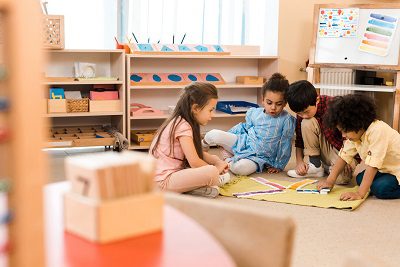
Montessori classrooms tend to fascinate both children and their parents. They are normally bright, warm, and inviting, with an abundance of plants, animals, art, music, and books. Shelves are filled with intriguing learning materials, fascinating mathematical models, maps, charts, fossils, historical artifacts, computers, scientific apparatus, a natural-science collection, and animals that the children are raising. Montessori classrooms are commonly referred to as prepared environments. Each is a learning laboratory in which the children are allowed to explore, discover, and select their own work. The independence that the child gains is not only empowering on a social and emotional basis, but it is also intrinsically involved with helping the child become comfortable and confident in her ability to master the environment, ask questions, puzzle out answers, and learn continuously instead of waiting for adult direction.
The Montessori goal is less to teach the child facts and concepts, but rather to help her fall in love with the process of focusing her complete attention on some challenge and solving its riddle with enthusiasm and joy. Work assigned by the adult rarely results in such enthusiasm and interest as does work that children freely choose for themselves.
The classroom is organized into several curriculum areas, usually including language arts (reading, literature, grammar, creative writing, spelling, and handwriting); mathematics and geometry; everyday living skills; sensory- awareness exercises and puzzles; geography; history; science; art; music; and movement. Most rooms will include a classroom library. Each area is made up of one or more shelf units, cabinets, and work tables with a wide variety of materials on open display, ready for use as the children select them.
Students are typically found scattered around the classroom, working alone or with one or two others. They tend to become so involved in their work that visitors are immediately struck by the peaceful atmosphere. It may take a moment to spot the teachers within the environment. They will be found working with one or two children at a time, advising, presenting a new lesson, or quietly observing the class at work. The focus of activity in the Montessori classroom is on children – who each one is, his or her interests, and styles of learning. The teacher is a guide, providing direct learning experiences whenever possible.
A Montessori classroom is filled with vast arrays of sequenced learning activities known as the Montessori materials. The materials are displayed on open shelves sized for the height of the children. They are arranged to provide maximum eye appeal without clutter. Each object has a specific place on the shelves, arranged from the upper left-hand corner in sequence to the lower right.
The materials are arranged in sequence from the most simple to the most complex, and from the most concrete to those that are more abstract. Because of the order with which they are arranged in the environment, children can find precisely what they need whenever they wish.
When children choose a material, they develop an array of personal traits such as independence, responsibility, and time management. While investigating and using the materials to sort, arrange, build connections, and problem-solve, they develop cognitive capabilities. Educational theorists now advocate learning through direct experience and the process of investigation and discovery. The child must be active and engaged, constructing her or his own knowledge. Most students do not retain or truly grasp much of what they “learn” through memorization. Instead, children need to manipulate and explore everything that catches their interest. Part of Montessori’s contribution was her discovery of what is now assumed. But, she went further. Montessori developed a series of sequenced learning materials designed with incredible precision.
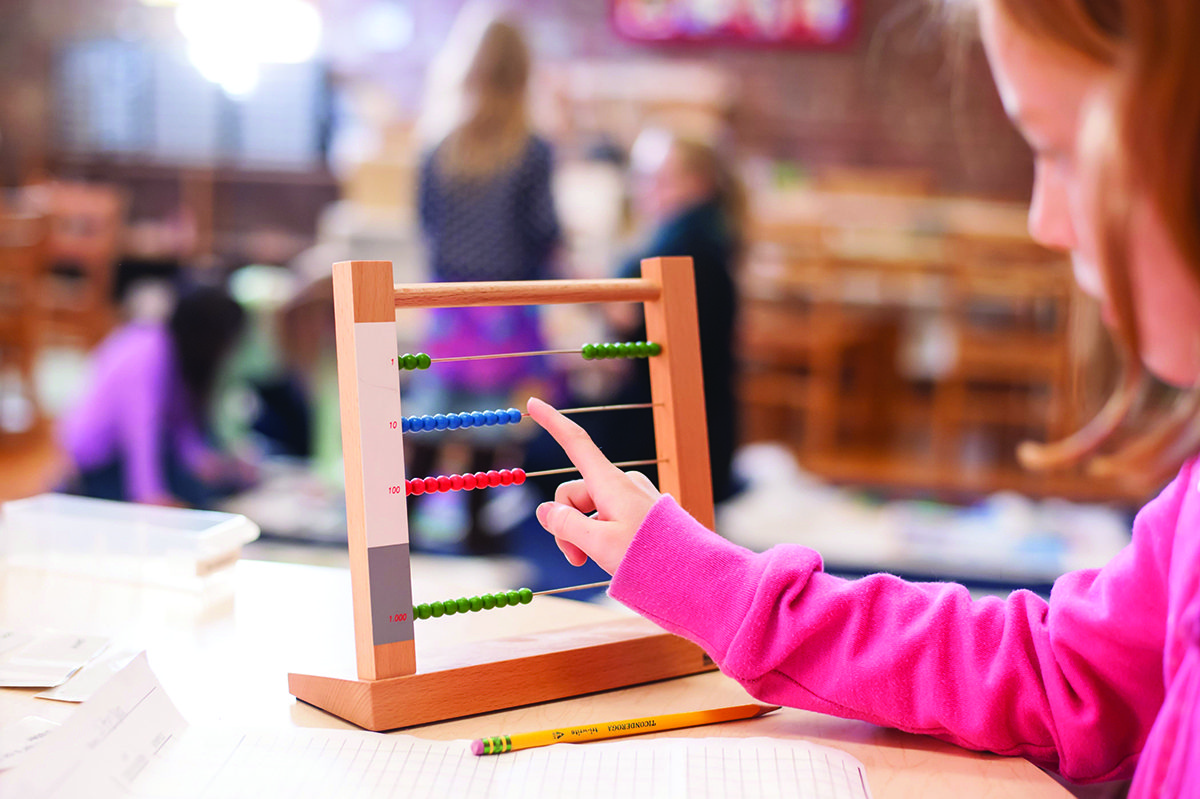
Each material is a concrete representation of an abstract idea. Depending upon the ages of the children, they will use the materials to explore and investigate ideas found in anthropology, art, astronomy, biology, botany, chemistry, earth science, geography, geology, geometry, history, language, m a t h e m a t i c s , music, physics, and sociology. Some materials isolate and teach one concept or skill at a time. Length, for example, is explored by three-year-olds arranging a set of ten rods. The first is 10 centimeters long; the second is twice this length. This progression continues until the tenth rod is in place with its length of 1 meter.
Children from ages two to six are interested in sequencing and sorting objects. They are drawn to the sensory properties of objects within the classroom: size, shape, color, texture, weight, smell, sound, etc. Children of this age tend to repeat exercises. With repetition, their movements slow and become more precise. Their attention to detail increases; they discover small details in the objects and classroom as they observe and appreciate their environment.
This is a key in helping children discover how to learn. Elementary and secondary students are interested in sequencing and sorting ideas. They are drawn to the interpretive meanings of literary works, social and historic events, scientific findings, and issues of moral justice.
Elementary and secondary classrooms are designed to facilitate student discussion and stimulate collaborative learning. In group discussions, students readily propose and debate solutions to open-ended problems. A goal is to pursue topics in depth rather than to “cover the material.”
At the secondary level, an integrated thematic approach is used to connect the otherwise separate disciplines of the curriculum into studies of the physical universe, the world of nature, and the human experience. Literature, the arts, history, social issues, political science, economics, science, and the study of technology all complement one another.
The organization of the Montessori curriculum from early childhood through secondary programs could be thought of as a spiral of integrated studies rather than a traditional model in which the curriculum is compartmentalized into separate subjects, with given topics considered only once at a specific grade level. The Montessori curriculum is carefully structured and integrated to demonstrate the connections among the different subject areas. History lessons, for example, link architecture, the arts, science, and technology.
An especially important aspect of the materials is that they offer multiple levels of challenge and can be used repeatedly at different developmental levels. For example, the Trinomial Cube, which presents a complex and challenging twenty-seven-piece, a three-dimensional puzzle to the five-year-old, is used to introduce the older elementary and secondary child to the algebraic concept of the exponential powers of polynomials.
The teacher presents the materials with precision and offers each child an initial exploratory procedure; the child is able to imitate what the teacher did. The teacher’s presentation also enables children to investigate and work independently. A goal is for the children to become self-disciplined, able to use the materials and manage the classroom without direct adult supervision.
Children progress at their own pace, moving on to the next step in each area of learning as they are ready. Initial lessons are brief introductions, after which the children repeat the exercise over many days, weeks, or months until they attain mastery. Interest leads them to explore variations and extensions inherent within the design of the materials at many levels over the years.
The Montessori learning materials are not the Method itself; they are simply tools used to guide children into logical thought and discovery. The Montessori materials are provocative and simple; each is carefully designed to appeal to children at a given level of development.
In developing these materials, Dr. Montessori carefully analyzed the skills and concepts involved in each subject and noted the sequence in which children most easily master them. She then studied how children seemed to be able to grasp abstract concepts most easily and designed each element to bring the abstract into a clear and concrete form.
The Control of Error
The design of many of the materials gives children immediate feedback. Called the Control of Error, this feature makes it possible for Montessori students to determine for themselves if they have done each exercise correctly.
Children choose their learning activities within carefully defined limits as to the range of their behavior. Making mistakes is a vital part of the learning process. Discovery, investigation, and problem solving involve making wrong turns, getting stuck, and trying again. An important part of the learning experience is to recognize an error and learn how to make corrections.
These experiences are part of the process of becoming self-disciplined. A young child takes ten cylinders out of a wooden case; the cylinders vary in height and diameter. The control of error lies in the construction of the objects: a cylinder can only fit into one place in the wooden case. Another child learns the names of African nations. In this case, the control of error is initially found with the teacher, who uses the “Three-Period Lesson” to teach and re-teach the correct names of nations. Once the child knows these names, the control of error becomes his own knowledge.
Each repetition is not an exact copy of the previous use. Children continuously refine their work and learn more. The principle of control of error guides this process. In addition to the design of the materials, prior knowledge is also a control of error.
Knowledge of colors, shapes, and size for younger children — knowledge of addition and multiplication for older children — results with self-corrected learning. The Three-Period Lesson Montessori teachers will use the Three-Period Lesson to help children develop a rich vocabulary in all areas of study. Children best learn the meaning for names when they can associate the name with an object. In the following example, a young child is taught the names of secondary colors. During the first period, the child is shown an orange-colored tablet. The teacher names the color: “This is orange.” The child is now shown a green-colored tablet. The teacher names this color: “This is green.” Finally, a purple-colored tablet is shown, and the teacher states, “This is purple.” During the second period, the child makes a link between the language and her own experience. The teacher gives the name, and the child finds the object. The teacher asks, “Show me orange.” The child points to the orange tablet. “Show me purple.” The child now points to the purple tablet.
Considerable learning and teaching occur during the second period. If the child is asked, “Show me green,” but she points to the purple tablet, the teacher simply re-teaches. Returning to the first period, the teacher points to the purple tablet and restates, “This is purple.” The teacher again points to the green tablet and restates, “This is green.” In the final period, the teacher points to one of the tablets and asks, “What is this?” The child answers, “Orange.” If the child answers one of the other colors, the teacher will again re-teach the colors by renaming and reconfirming them using the first- and second-period lesson formats. Maria Montessori understood that learning occurs best when stress and apprehension are removed from the learning situation.
The Three-Period Lesson format is based on readiness. Complex vocabulary words are introduced when it is appropriate. Montessori educators believe that it is important for children to learn vocabulary, which is why so much emphasis is placed on nomenclature (enhanced vocabulary). The three- and four-year-olds do not merely identify triangles; our teachers name triangles precisely: isosceles triangle or scalene right triangle. A rich vocabulary is also taught to lower elementary students; such as terms from botany as well as the various land and water forms that make up our planet’s surface. The more words children know, the more they actually see around them.
by Tim Seldin | Early Adolescence (12-15), Educational Program Coordination, Lower Elementary (6-9), MFA, Montessori Curriculum, Montessori Education, Montessori Middle School, The International Montessori Council, The Montessori Way, Upper Elementary (9-12)
By Tim Seldin
This is an excerpt from the Second Edition of The World In The Palm Of Her Hand.
The Imaginary Island Project was developed by my friend, Harvey Hallenberg, and introduced to the Montessori community in the 1980s through the Institute for Advanced Montessori Studies in Silver Spring, Maryland, which we co-founded.
In the Montessori curriculum, children in the early childhood and elementary classes are of course introduced to an extensive set of land and water forms. They first see them as three-dimensional models and three-part cards, learning the vocabulary and definitions of not only the introductory land and water forms taught in most Montessori classrooms.
In the elementary classes, older children go beyond the basic land and water forms to learn many more land features in Physical geography, such as foothills, summit, river delta, marshlands, tributary, archipelago, lagoon, and many more. Children construct models of these landforms out of clay and in combinations on sand and water tables.
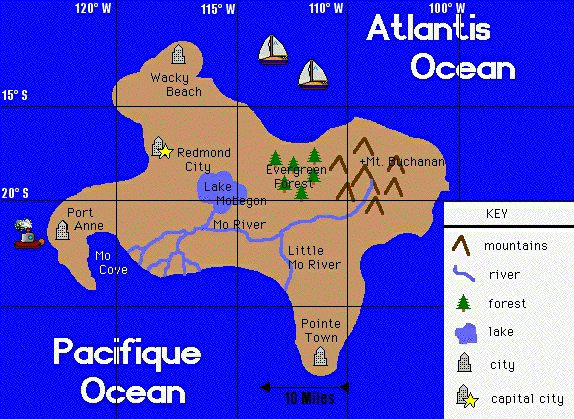
As the extension of all this work, we invite interested children to create an entire island from their imagination.
The Areas of the Curriculum: Physical and Cultural Geography
Materials That You Will Need:
The children will be creating both two-dimensional drawing and three-dimensional dioramas of their imaginary islands and will need a wide range of art supplies: large sheets of paper, drawing pencils or charcoal, pastels or paints to create pictures of their islands, and clay or some other modeling media for constructing their dioramas (which will then be painted). They will also need various materials like sawdust dyed green to simulate grass, lichen, and small twigs to simulate trees and materials from which they can construct small model houses, such as small rectangular blocks of balsa wood.
Our Aims: To help the children to integrate their present level of understanding about physical geography, biomes, how human beings meet their needs in different settings, and cultural geography through the creative development of imaginary islands placed somewhere on the globe.
Preparation: Children can participate in this activity at many different levels of understanding, depending on their interest and grasp of the many concepts involved in physical geography, earth science, biomes, and how human societies may be organized. A good basic level of preparation would include work with the land and water forms, land features, an introduction to biomes, the needs of human beings, and experiences in cultural geography.
Age: This activity has been used with children from as young as age five through early adolescence. In some schools, it will be reintroduced in the upper elementary of junior high school levels. We might recall that books like Frank Herbert’s Dune are based on an entire planet—its climate, ecology, and human civilization—created from the author’s imagination.
Presentation:
The First Activity:
Invite the children to imagine an island somewhere in the oceans of the world, where they can decide everything from its size and shape, rivers and lakes, cities and villages, as well and the plants, animals, and people who live there.
To get the children started, you might want to make a first crude drawing of an island yourself with charcoal. Now invite the children to prepare a drawing of their own imaginary island, coloring it in with paints or pastels, and showing anything on it that they wish. Challenge them to place their lakes, rivers, mountains and cities carefully, because once there, they would be very hard to move, no?
You might want to give the children a paper like this to remind them of points to consider:
The name of my island is _____________
Are there any mountains?
Are there any lakes?
Are there any rivers?
Are there any roads?
What is the name of the capital city?
How many people live in the capital city?
Are there any other cities and villages?
Are there any beaches?
Are there are forests on your island?
Is there an isthmus on your island?
Is there a peninsula on your island?
Is there a cape on your island?
Is there a bay on your island?
Is your island part of an archipelago?
Is your island an atoll?
Are there any valleys on your island?
Does your picture of your imaginary island show them? Have you given them names and labeled them on your picture?
When the children are done, invite them to share with you and their friends anything they wish to tell about their island. Some will say little; others will most likely come up with involved explanations and stories. Ask them if they have thought of a name for their island. Some will have named their island, others may prefer to wait until the right name comes to mind.
The Second Activity:
Ask the children if any would be interested in making a new drawing/painting of their islands. This time invite them to label their drawing with a name for their island and to think about what sort of animals and plants live there. As the children complete their work and share with their friends, continue to ask them new questions, like the ones below, and invite them to either prepare still another drawing of their island showing these things or add them to the drawing that they’ve made.
Are there any people on the island? Show what their houses look like. Do they live alone, in villages, or in cities? Invite the children to begin to name these cities and villages, as well as any major
What is the weather like on the island? What sort of clothes do they wear?
How do they get from place to place? Do they walk everywhere, ride horses, or drive cars?
What food do they eat on the island? Where does it come from? Is it grown there or brought in by ship or airplane? Where do ships dock and where do airplanes land, if they do stop at the island?
How many people are on the island? How did they come to be there?
Are there any children on the island? Where do they go to school? What is their school like? Is it shown on the map yet? What do the children do for fun on the island?
What natural resources are there on the island? How have people used them to make things for their own use or to export to other places?
Continue to gather informally with individual children or small groups who finish, to discuss what they found in their imagination. This process normally goes on over many days or weeks, and sometimes, over many years.
The Third Activity:
Prepare a three-dimensional model showing the island to scale, with land features, cities, roads, etc. depicted as realistically as the child can using art and craft materials.
Hold a geography fair in which all of the children’s imaginary islands are displayed in the school’s halls or All-Purpose room.
An Optional Introductory Activity: The Imaginary Island Puzzle
This material was developed by Judy Martell and is available from Mandala Classroom Resources. As an elementary teacher, Judy found that while many students loved the imaginary island project, others found the project “too huge, too open-ended, too full of possibilities; they needed the door cracked open a little rather than flung wide.” * To meet their needs, Judy designed a new classroom material to bridge this gap.
Judy wanted to create something that could act as a springboard to the Imaginary Island Project without limiting it; a way for students to be invited naturally to use the vocabulary of the land and water forms as they moved toward the Imaginary Island Project, gaining confidence in their own imagination and exploring without inhibition.
The Imaginary Island Puzzle is a set of 84 square cards showing various individual land and land and water features that can be combined in many different ways to depict an imaginary island. Students use them to create an infinite variety of islands, modifying them at will and using the vocabulary words easily in conversation in the process.
Judy found that the puzzle acted as a springboard for the Imaginary Island Project. “Children who had been overwhelmed at first could more easily visualize their personal island after shaping it with the pieces of the Imaginary Island Puzzle. They could then elaborate on their islands and move into greater and greater detail as Harvey Hallenberg’s project invited them to, eventually putting their creations on paper, writing their reports, and presenting them to others.”
* Please Pass the Penisula: A Recipe for a New Montessori Material, Judy Martell, Tomorrow’s Child Magazine, May, 1997/Vol 5/Number 3
Mandala Classroom Resources
1001 Green Bay Rd. #190
Winnetka, IL 60093-1721
Phone: 847-446-2812
Points of Interest: The combination of various land and water features. The creative and intellectual activities blended together to construct the island in one’s imagination.
Points of Consciousness: The idea that an island is a complete and independent system of land, plants, animals, climate, natural resources, and people’s impact on the environment.
Control of Error: There really is none in this activity, except that ideas proposed by the children can be challenged or confirmed by research into various areas of geography, climate, ecology, and cultural patterns found in islands located in that general area of the Earth.
Extensions:
Locate the imaginary islands precisely on the globe in terms of degrees of longitude and latitude.
Determine the distance from given points of the Earth to this location in terms of miles and kilometers.
Determine the course one would have to follow by boat or airplane, in terms of degrees on the compass rose, to travel from given points of the Earth to this location.
Identify the nearest points of land within 500 miles of this location, if applicable. Research one or more of these nearby islands to see what can be learned by comparing the climate, rainfall, biomes, and lifestyle of the people who inhabit those islands.
Study wind patterns and ocean currents to see how they might influence the climate and weather patterns on the imaginary island.
Prepare a more precise scale map of the island, and calculate the distances between given points by both direct point-to-point measurement and by following the routes made practical because of the island’s geography.
Prepare a topographical map of the island.
Prepare an illustrated history of the people who inhabit your imaginary island.