










You Don’t Have to Be a Teacher to Bring Montessori Home

You Don’t Have to Be a Teacher to Bring Montessori Home

parents at home

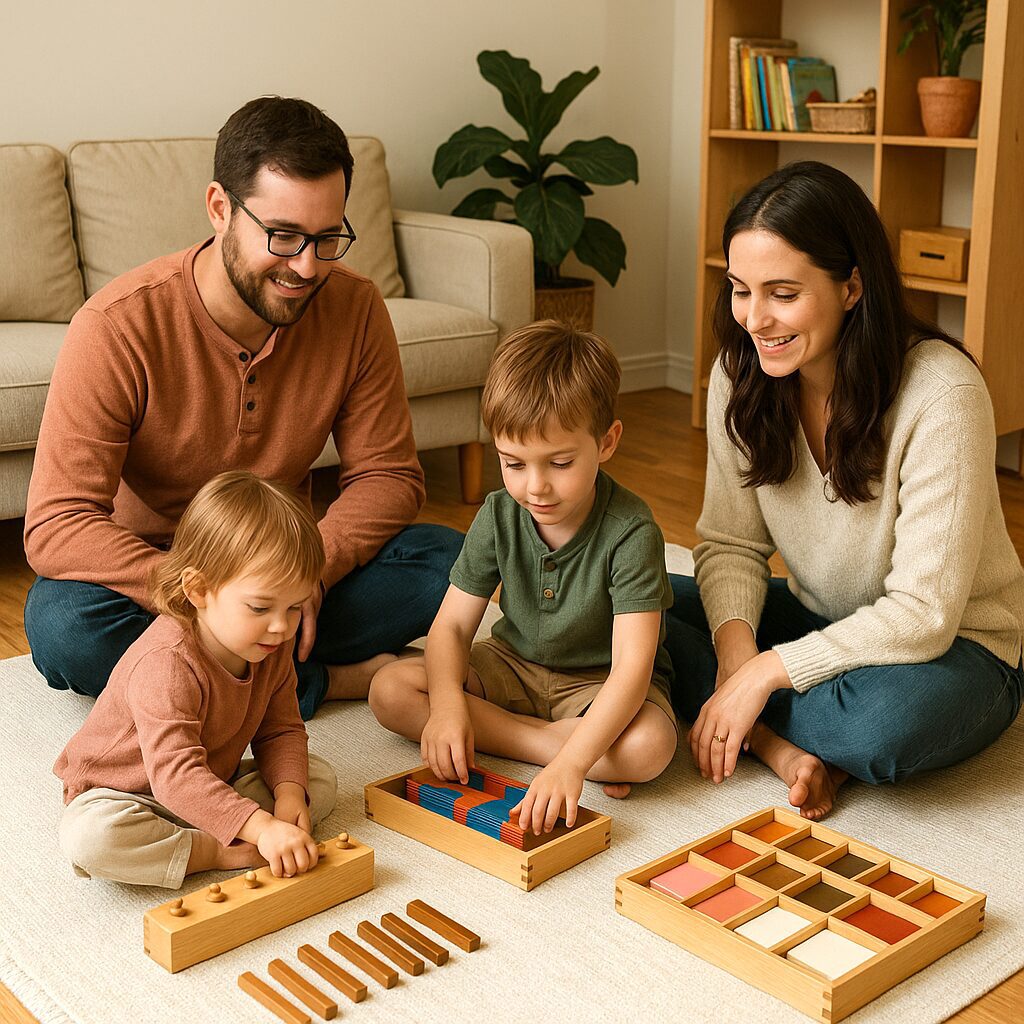
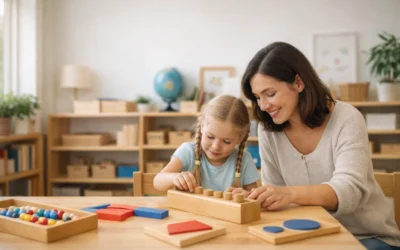
A common worry I hear from parents is: “I love Montessori, but I’m not a trained teacher.” It’s a real concern, especially for parents of toddlers and young preschoolers just discovering the Montessori approach. But let me be clear—you don’t need a credential to bring Montessori into your home. What you need is a curious spirit, a respectful relationship with your child, and a willingness to slow down and be present.

Montessori at home doesn’t require you to recreate a classroom. You don’t need specialized training or a room full of wooden materials. The real magic happens in the everyday moments—in the rhythm of daily life, where your child learns by doing, by observing you, and by participating in the meaningful work of your home.

Picture a mixed-race couple in their bright kitchen, sunlight pouring in through the windows. Their three-year-old daughter stands on a wooden learning tower, stirring batter in a bowl while her father holds it steady. Her mother is nearby, placing muffin tins on the counter and chatting gently about what they’re baking. This is Montessori at home. It’s not about lesson plans. It’s about inviting your child to be part of your world, to do real things with real tools, and to feel capable and trusted.

Children between the ages of one and a half and four are in a powerful stage of development. They crave participation and purpose. In Montessori, we honor this by including them in the real work of daily life. Helping with breakfast, watering plants, sorting socks, brushing the dog, or cleaning up a spill—these are all learning opportunities. They build fine motor skills, coordination, and—most importantly—confidence. Children begin to feel that they matter. That they can do things for themselves. That they are not just observers in the family—they are participants.

We often underestimate what young children are capable of. But if you slow down and invite them in, they will surprise you. A toddler can carry their own plate to the sink. A three-year-old can help fold napkins or dust a shelf. It may take longer, and it may not be perfect, but that’s not the point. What matters is that the child begins to see themselves as competent.

Montessori also teaches children to follow a process. When we give them time and space to work through a task—whether it’s slicing a banana or cleaning up spilled water—they develop executive function skills that will serve them for life. They learn to plan, to concentrate, to finish what they start. These early experiences lay the foundation for attention, memory, and self-control.

And beyond skills, there’s something even deeper being nurtured: the child’s sense of self. When a child contributes to their home—not because they are told to, but because they want to—they feel dignity. They feel belonging. And they begin to understand what it means to be part of a community.

That’s the real work of Montessori at home. It’s not about educational outcomes or hitting milestones. It’s about building strong relationships within the family and giving your child a sense of purpose and pride. When your child is invited to help wash vegetables for dinner, or put on their own shoes, or carry a basket of clean laundry, they are learning responsibility, independence, and grace.

We want to encourage parents to let go of busywork and worksheets and instead embrace the richness of real life. A worksheet may keep a child occupied, but it doesn’t nurture their spirit. It doesn’t build connection. It doesn’t say, “You belong here.” The daily tasks of the home do. And that’s the heart of Montessori.

You don’t have to do it all at once. You don’t need to be perfect. You just need to begin. Start by slowing down. Watch what your child is drawn to. Invite them into your world. Let them mix the pancake batter, match socks, and scrub potatoes. Be patient. Be present. And trust that these small acts—done together with love—are building something powerful.

No, you don’t have to be a teacher to bring Montessori home. You just have to be a parent who believes in your child and values the time you spend together. And when you do, your home becomes more than just a place of shelter. It becomes a place of learning, of growth, of joyful connection—and a space where independence, grace, and belonging quietly take root.

How Montessori Brings Clarity and Freedom to Overwhelmed Parents

How Montessori Brings Clarity and Freedom to Overwhelmed Parents

mom and son

Real-life reflections for parents walking the Montessori path

Parenting small children can feel like navigating a fog. The days are long, the nights are short, and your mind is cluttered with questions you didn’t know you’d be asking: Should she be talking more? Why is he still having tantrums? Are we too strict? Too lenient? What’s normal? What’s best?

Montessori doesn’t hand you all the answers, but it does offer something just as powerful—a lens. A way of seeing. And for many overwhelmed parents, that’s exactly what they need.

When you begin to understand Montessori, you find yourself breathing a little easier. This isn’t a trendy method that requires you to throw out your furniture or memorize scripts. It’s a way of tuning into your child’s development, seeing who they really are and what they truly need—and letting go of the pressure to force growth that isn’t ready to happen.

You stop asking, “Why isn’t she reading yet?” and begin noticing how she studies letters on the cereal box, asks about the sounds in her name, and joyfully pretends to be the teacher reading a story aloud to her stuffed animals. You realize she’s absorbing everything, even when it’s not measurable on a chart.

In the early childhood years, this shift is subtle but profound. A parent might find themselves rearranging a corner of the kitchen so that their three-year-old can reach their own dishes, learning to pour water from a small pitcher, and taking part in preparing their snack. It’s not about making your home look like a classroom. It’s about inviting your child into real life in ways that feel natural and affirming for both of you.

A Montessori home doesn’t need to be minimalist or magazine-perfect. It just needs to function in a way that says to the child, “You belong here. You’re capable.” Low hooks for a coat. A little basket of socks by the door. Fewer toys, but ones that invite deep play. Predictable routines that create calm instead of chaos. These are the kinds of quiet adjustments that bring surprising peace to a household.

As the fog begins to clear, many parents find that they begin watching their children differently. Instead of correcting or rushing in, they pause. They observe. They start to notice the concentration in their toddler’s face as she buttons her sweater, or the quiet determination of their preschooler trying to sweep a spill without being asked. They begin to trust that their child is learning all the time—even in moments that look messy or slow.

There’s a relief in letting go of the race. Montessori parents often find themselves resisting the pressure to overschedule, to push early academics, or to compare. They start to protect unhurried time. They linger at the park. They choose books over apps. They spend more time in conversation and less in correction. Slowly, the parenting experience becomes less about managing behavior and more about building a relationship.

Of course, this doesn’t mean everything is smooth. There are still meltdowns. Still piles of laundry and sibling squabbles. Montessori doesn’t promise a perfect child—it just helps you see the challenges with clearer eyes. When you know that tantrums are part of healthy emotional growth, you don’t take them quite so personally. When you see that independence is built through repeated effort, you stop rushing to tie every shoe or pack every lunch.

For those who have chosen to send their child to a Montessori school, the experience deepens even further. The philosophy of the classroom begins to echo at home. Parents hear their children using phrases like “I’m working” or “Can I have a turn?” They see their child choosing to set the table, folding napkins carefully, or explaining the life cycle of a butterfly with quiet authority. And instead of wondering where this self-discipline or inner calm came from, they begin to understand that it was there all along—just waiting to be nurtured.

Montessori is not a quick fix. It’s not a method you try for a week and judge by results. It’s a path you walk slowly, thoughtfully, with as much grace for yourself as for your child. It teaches you to focus on process rather than product, and to see effort as more important than outcome. Your child may pour water and spill it a hundred times, but each time, their hands grow steadier. Their confidence grows stronger. And so does yours.

For many parents, the greatest gift of Montessori isn’t a better-behaved child. It’s the clarity that comes from knowing what matters most: connection, rhythm, trust, and presence. When you embrace this, parenting shifts from something you’re trying to survive to something you’re learning to live—moment by imperfect, beautiful moment.

Are Montessori Homeschoolers and Montessori School Parents on a Shared Journey?

Are Montessori Homeschoolers and Montessori School Parents on a Shared Journey?

montessori homeschool

Are parents who choose to use Montessori to homeschool and parents who send their children to a Montessori school following a similar path? In many ways, the answer is yes. While their environments, schedules, and supports may look different, both sets of parents are inspired by the same vision: to raise children who are curious, independent, capable, and connected to the world around them. Montessori offers a philosophy, not just a curriculum, and that philosophy can guide learning both at home and in a school setting.

Still, it’s worth exploring the strengths, challenges, and motivations of each path—and what unites them at the core.

Montessori Homeschooling: Flexibility, Family, and Deep Connection

Parents who choose to homeschool the Montessori way often do so because they value time together as a family. For many, it’s not a rejection of professional educators or social opportunities, but rather a choice to prioritize the bond between parent and child. In a homeschool environment, parents can closely observe their children, follow their individual pace of development, and cultivate a home rhythm that reflects their unique family values.

Some families participate in Montessori co-ops or parent-led learning groups to ensure their children have social experiences beyond the home. Others create close-knit communities through shared homeschooling networks. They may fully understand the trade-offs—fewer materials, less outside input, fewer chances for peer collaboration—but feel that the intimacy, trust, and continuity of homeschooling more than compensate.

Financially, homeschooling may also be a practical necessity. High-quality Montessori schools can be costly, and for families with two or more children, tuition may exceed the income a parent could earn by returning to the workforce. For some, choosing to stay home is both a philosophical and an economic decision.

Montessori Schools: Expertise, Socialization, and Structure

Parents who choose Montessori schools often do so for a different but equally valid set of reasons. Many are working professionals who want their children to be in a nurturing, thoughtfully designed environment during the day while they pursue their careers. These parents may deeply value being part of their child’s life but also recognize that they thrive when working in a professional community with other adults.

Montessori schools offer structured opportunities for social learning, exposure to peers of various ages, and the leadership of trained educators who bring objectivity, developmental knowledge, and years of experience. In these classrooms, children benefit not only from the prepared environment and carefully sequenced materials but also from teachers who understand subtle developmental cues and can respond in ways that support long-term growth.

Many parents also find reassurance in partnering with professionals who bring insight and perspective they may not have. It’s not about abdicating responsibility, but about recognizing the value of collaborative care—trusting that trained Montessori guides can work alongside the family to nurture the whole child.

The Common Ground: Prepared Adults and Trust in the Child

Regardless of which path a family chooses, success in Montessori education depends less on the setting and more on the mindset of the adults involved. Both homeschooling and school-based parents are called to prepare themselves: to observe rather than control, to guide rather than direct, and to trust rather than rush.

Montessori parents—whether at home or partnering with a school—learn to slow down, simplify, and create meaningful opportunities for their children to act with purpose. They cultivate an environment of respect, order, and beauty. They resist the impulse to over-schedule or micromanage, instead inviting children to engage with real work and follow their curiosity.

Many families blend the two approaches. A school-based Montessori parent may create a home life filled with independence and practical life activities. A homeschooling parent may seek out community groups, Montessori co-ops, or part-time programs to offer social interaction. The lines are often softer than we imagine.

Conclusion: Two Roads, One Vision

So are Montessori homeschoolers and Montessori school parents following the same path? Not quite—but they are certainly moving in the same direction. Both want their children to become confident, joyful, lifelong learners. Both believe in the dignity of childhood. And both recognize that education is not something we do to children, but something we support in partnership with them.

In the end, it’s not about choosing the “right” way to do Montessori. It’s about committing to the work of presence, patience, and preparation—whether that happens in a classroom or at your kitchen table.

Keeping Your New and returning families engaged over the summer

Keeping Your New and returning families engaged over the summer

summer family

How Smart Schools Use Summer to Deepen Connection and Boost Engagement

By Tim Seldin
President, The Montessori Foundation

Summer may feel like the quiet season in schools—but in truth, it’s a golden opportunity. A chance to build relationships, deepen family engagement, and get ahead on the work that ensures a strong start to the new school year.

At a recent Montessori Foundation and AIMS (Admissions Inquiry Marketing Software) webinar, we had a lively and insightful conversation about what schools can do now—before families drift into vacation mode—to keep the spark alive. Here’s what we learned from each other and from years of real-life experience in school leadership.

Summer Is a Season of Opportunity

Let’s start by acknowledging a simple truth: during the summer, many families disengage. They mean well. But life happens—travel, camps, work, fatigue. We become a vague memory until a back-to-school email jolts everyone back to reality.

But it doesn’t have to be that way.

In fact, summer is a critical window to:

  • Reinforce your school’s place in the heart of the family

  • Build anticipation and belonging for new families

  • Strengthen bonds with returning families

  • Head off potential attrition before it happens

The key is intentional, consistent outreach.

Three Audiences, Three Needs

As we discussed in the session, your community isn’t one-size-fits-all. Most schools have three key audiences to think about:

  1. New Families – They’ve just joined your community. This is your chance to build excitement, answer questions, and offer a warm welcome. The goal: help them feel like they already belong before the school year begins.

  2. Returning Families – These families may seem secure, but summer is often when people reconsider decisions. Life changes—moves, divorces, job shifts—can lead to surprise withdrawals. Keep them engaged so that leaving feels hard.

  3. Waitlisted or Prospective Families – Don’t forget them. The more they hear from you, the more likely they’ll stay excited and committed if a space opens up.

What Works? Practical Strategies from the Field

Here are a few of the top strategies we discussed that schools can use to engage families all summer long:

1. Email Campaigns That Build Trust

Create a simple series of emails to:

  • Welcome new families and introduce key staff

  • Share summer fun ideas and Montessori-friendly home activities

  • Offer quick “Did You Know?” insights about your program

  • Answer FAQs before they’re asked

  • Promote social media accounts (many families still don’t follow!)

Consistency matters more than volume. Even one message every two weeks can be powerful.

2. Family Outreach: Ask and Listen

Send a thoughtful message asking:

  • What are your summer plans?

  • Anything going on we should know?

  • What are your hopes for the coming school year?

You’ll learn so much—and your teachers will love starting the year already knowing what matters to each child.

3. Parent and Student Ambassador Outreach

Activate your room parents or PTA members to welcome incoming families. A quick phone call or coffee invitation can make a world of difference. Consider pairing students too, especially in upper grades.

4. Create a Summer Video Montage

Record short “welcome back” clips from teachers, students, and staff. Compile them into a joyful, authentic video and send it out in August. It’s a low-cost, high-impact way to rekindle excitement.

5. Summer Socials and Ice Cream Events

If families are in town, invite them in:

  • Ice cream socials

  • “Meet the Teacher” picnics

  • Pool parties or open playground days

These informal gatherings spark friendships and belonging early on.

6. Reframe Tuition Reminders with Heart

No one loves bills—but they don’t have to be cold. Consider a friendly message with your invoice:

“Think of this not as a payment, but as an investment in the joyful journey your child is on. We’re honored to walk this path with your family.”

It’s a small touch that reminds people why they’re here.

7. Support for Overloaded School Leaders

Let’s be real—many of us are juggling admissions, finances, summer camp, and gala prep all at once. Lean on tools like AIMS or Montessori Compass to streamline communication and automate reminders where you can. And when in doubt, send a short note that simply says: We’re thinking of you. We care.

Final Thoughts

We don’t stop being a community in June. If anything, these quieter months are the time to double down on connection. Show families that they matter, that their presence is missed, and that they are part of something special.

When you do, you’ll find fewer surprises in August—and more smiles on the first day of school.

Let’s not disappear in the summer haze. Let’s lead with presence, warmth, and intention.

A Living Work of Art: Why Montessori Schools Are So Much More Than Schools

A Living Work of Art: Why Montessori Schools Are So Much More Than Schools

Every Montessori school is a living, breathing work of art.

Unlike businesses that exist solely to deliver a product or generate profit, schools—especially Montessori schools—are something more organic, more soulful. They are shaped not just by strategy or budgets, but by the hearts and hands of the people who govern, lead, and teach within them. In this light, school leaders, teachers, and even parents become artists—co-creating something deeply human and beautiful: a community that nurtures children and helps them grow into their fullest selves.

This is why so many Montessori educators feel such a powerful, often lifelong bond with the schools they help shape. The connection goes far beyond employment. We don’t just work at a school—we *give ourselves* to it. We invest not only our time and energy, but our hopes, our creativity, and our love.

Montessorians know this: education is not assembly-line work. Each school, like each child, is a unique creation. The way we prepare the environment, interact with families, guide children, and design learning spaces is all a form of artistic expression—not in the sense of decoration or aesthetics alone, but in the deeper sense of crafting something meaningful, responsive, and alive.

To run a school, of course, is also to manage practical realities: payrolls, admissions, tuition, staffing, compliance. Even nonprofit schools need financial sustainability to exist. But in a Montessori school, money isn’t the mission. The mission is transformation. We are here to shape lives, to build peace, to cultivate independence, empathy, and a love of learning in children—and in ourselves.

And what we create together—the school community—is never static. Like any great work of art, it evolves. New families arrive. Children grow and graduate. Staff come and go. Challenges arise, new ideas take root. Through it all, the culture of the school shifts, expands, deepens—always becoming. The artist’s hand never leaves the canvas.

This is why we care so deeply when something threatens the life of a school. Why we grieve when a program closes or a beloved teacher leaves. Why we work late, show up early, volunteer for things that were never in our job description. We are not just protecting a structure—we are protecting a vision, a community, a sacred trust.

At its heart, a Montessori school is not a building or a business. It’s a collective expression of love—for children, for humanity, for the possibilities of a better world. It is a place where purpose and practice meet, where people—children, parents, and educators alike—are nurtured, challenged, and transformed.

And like all great art, it leaves an impression on everyone who experiences it.


“Is That a Rat… or a Class Pet?” Why Every Montessori School Needs a Pest Policy

“Is That a Rat… or a Class Pet?” Why Every Montessori School Needs a Pest Policy

picture of class pet

If you haven’t reviewed your employee handbook lately—or haven’t yet written one—consider this your gentle nudge. In the Montessori world, we tend to take a compassionate view of the natural world. We teach children to observe living creatures with curiosity and care. That’s beautiful—and exactly what we want to nurture.

But every now and then, that curiosity extends a little too far… like when a well-meaning teacher picks up a “dead” rat on the playground, only to discover it was still very much alive.

Yes, it really happened.

Fortunately, the teacher was okay (after a trip to the doctor), but the incident prompted an important realization for the school leader: We need a clear policy about what to do when pests show up at school.

Because let’s face it—at some point, they will. Whether it’s a wasp nest in the outdoor classroom, a snake curled up in the garden, or a mouse making itself at home behind the snack cabinet, every Montessori campus eventually has an unexpected visitor.
And because Montessori teachers are a special kind of human—nurturing, unflappable, and almost unfailingly kind—we’re the folks most likely to say, “Aww… look at that little guy!” instead of backing away and calling for help.

That’s why your staff handbook should spell out a simple, clear, no-room-for-interpretation Pest Encounter Policy. Something that says: Don’t touch it. Keep children away. Notify administration immediately. Let trained professionals handle it. Document the incident.
Not only does this keep your team and your students safe, it also protects your school from liability. It shows you’ve prepared your staff, and you’re taking proactive steps to manage risks thoughtfully and responsibly.

If you don’t already have a pest policy in place—or if you’re not sure whether yours covers all the bases—now’s a good time to review it. And if you’re starting from scratch, you’re welcome to use or adapt this sample policy we just helped a client develop.

Click this link to download the sample Pest Encounter Policy

https://lnkd.in/eJP6bzP3

Feel free to customize it for your own school’s name and context.

As Montessori leaders, we model calm, capable responses to the unexpected. Having the right policies in place gives our team the confidence to do just that.

And if you do end up with a class pet rat? Well—just make sure it came from the pet store and not the playground,

Admissions: Recruiting Your Ideal Enrollment and Building a Strong School Community

Admissions: Recruiting Your Ideal Enrollment and Building a Strong School Community

In the ever-evolving landscape of education, Montessori schools face the dual challenge of staying true to their mission while navigating the practical realities of enrollment. Many families today are overwhelmed, time-constrained, and simply looking for a school that feels safe, nurturing, and convenient. Often, their first priority is to solve a problem—find a school that fits their child’s immediate needs and secure a spot quickly. Yet behind this urgency is a deeper desire: to find a place where their child can thrive and where they, as parents, feel a sense of trust and belonging.

Recognizing this, Montessori schools must meet prospective families where they are—acknowledging the pressure and pace of modern parenting—while gently guiding them toward a fuller understanding of what it means to join a Montessori community. This article presents a refined approach to enrollment and engagement—one grounded in relationship-building, authentic storytelling, and an unwavering commitment to the school’s mission. We call it “Finding the Perfect Match.”

Traditional enrollment strategies often follow a transactional model: attract attention, provide information, and ask for a decision. This approach treats parents as consumers and education as a product. In contrast, the Montessori approach to enrollment invites families into a journey of mutual discovery. It allows prospective parents to engage not only with what Montessori education is, but with what it feels like to be part of a deeply connected school community. The goal shifts from simply filling seats to forming genuine partnerships that support the child’s development and the school’s long-term culture.

The first step in this relationship-based model is to increase visibility and awareness in the local community. Schools must be intentional in making their presence known—not through broad marketing campaigns, but through targeted, values-driven outreach. This might include participating in community festivals, setting up interactive Montessori exhibits at farmers’ markets, offering parenting workshops at local libraries, and creating vibrant, informative bulletin boards in nearby cafes and businesses. These outreach efforts are led by admissions and development staff but must be supported by the broader school community. Consistency and follow-through are essential. A member of the admissions team should be assigned to track outreach events, update materials, and personally follow up with contacts.

Once a prospective parent makes initial contact—whether through an email, a website inquiry, or by visiting the school—it is vital to respond promptly and personally. The initial reply should reflect warmth and attentiveness. Ideally, the response includes an invitation to visit, observe a classroom, and speak with a school leader or experienced teacher. The process should feel welcoming and affirming, not automated or rushed. Each inquiry is a potential relationship, and how that relationship begins often shapes whether it continues. For parents in crisis mode, who simply want to enroll quickly, the key is responsiveness and clarity—combined with gentle pacing that opens the door to deeper engagement once the immediate need is met.

Rather than relying solely on a single tour or presentation, schools can create an intentional series of touchpoints that gradually deepen engagement. A family might begin with an observation morning, followed by an invitation to attend a community event or curriculum night. They may be offered an opportunity to speak with current parents or receive a series of short, mission-driven emails that highlight key aspects of Montessori education. At each step, the emphasis should be on listening, understanding, and trust-building. The admissions team should develop and manage a simple CRM system or tracking tool to log these touchpoints and ensure follow-up is timely and meaningful.

Equally important is the active participation of the current parent community. These parents serve as natural ambassadors and advocates when invited to do so. Schools can provide them with tools such as “invite a friend” postcards, social media graphics, or talking points about Montessori education. Admissions staff can host informal gatherings or coffee chats where current families invite neighbors or friends to visit the school. This parent-to-parent outreach feels more personal and authentic than traditional marketing and can be an especially effective way to reach values-aligned families.

When a family decides to enroll, the onboarding process should be seen not as an administrative task, but as the beginning of a long-term partnership. New families should be welcomed with intention and care. This may include a personalized welcome packet, a video or letter from the Head of School, and an invitation to a new family orientation. Pairing each new family with a mentor family offers an additional layer of support and connection. The admissions team and classroom guides should check in during the first few weeks, ensuring that new families feel seen, supported, and empowered to participate.

A successful community is not built solely through events—it is built through ongoing, meaningful communication. Families should be regularly informed not only of upcoming activities but of the deeper purpose behind those activities. School leaders should share stories from the classroom, reflections on Montessori principles in action, and opportunities for involvement that go beyond volunteering. Families need to know that their voice matters, their ideas are welcome, and their contributions—whether time, talent, or financial support—make a meaningful difference.

To support this, schools should implement structures that facilitate two-way communication. Parent surveys, listening circles, and community forums provide families with avenues to share their experiences and offer input. Classroom guides and administrators must be accessible and responsive. A family liaison or community engagement coordinator can help manage these connections and ensure that families remain engaged over time.

The implementation of this approach requires clearly defined roles and responsibilities. The admissions team leads the design and execution of the enrollment pathway, including outreach, tours, and follow-up. The Head of School ensures alignment between the school’s philosophy and the admissions process, while teachers and classroom guides provide key insights and help families experience the pedagogy in action. Parent volunteers serve as hosts, mentors, and storytellers. All of this is guided by a shared commitment to cultivating a vibrant, values-aligned community.

This approach to enrollment and engagement is not about fast growth or flashy campaigns. It is about honoring the values that Montessori education holds dear: respect for the individual, trust in human development, and the power of authentic relationships. By focusing on fit, cultivating connection, and supporting families with care and intention, Montessori schools can create communities that are not only full—but full of purpose, joy, and enduring commitment.

Finding the perfect match means telling the truth about who you are, what you believe, and what it means to be part of your school. When this message is conveyed consistently and sincerely, the right families will not only find your school—they will help it flourish.

The Intersection of Montessori and Science

The Intersection of Montessori and Science

Teacher training

The Intersection of Montessori and Science

In Montessori education, we are continuously testing and refining our understanding. Science is not about believing something because a public figure says it; it is about seeking reliable information. The same principle applies to education—our approach must be guided by observation, adaptation, and evidence-based methods.

One significant challenge in many Montessori schools today, especially in public settings, is that students are not entering at the optimal age. Montessori education is most effective when children begin at age three. If a child enters at four or five, they have already missed critical developmental time. While they may eventually catch up, their experience will not be the same as that of a child who had the full early childhood Montessori experience. If we seek the best outcomes associated with Montessori, we must adhere as closely as possible to the principles and methods that made it successful.

Maria Montessori herself evolved her methods over time. For example, in her early writings, she suggested young children needed sugar—a belief we now understand differently. It is essential to contextualize her work historically while maintaining fidelity to her core principles.

Integrating Late-Entry Students into Montessori

In public Montessori schools, it is common for students to join at later grade levels, such as second or third grade, without prior Montessori experience. This presents challenges, but they are not insurmountable. The key is diagnostic, prescriptive teaching—analyzing what the child knows, identifying gaps, and meeting them where they are. We celebrate what they already understand to build confidence and create a safe, supportive environment for learning.

A crucial goal is to prevent children from feeling embarrassed or insecure about their knowledge gaps. Fear and shame are barriers to learning. When children feel safe, valued, and free from ridicule, they are more likely to engage with and absorb new material. Emotional safety is not just an educational priority—it is a foundation for overall well-being. Many school shootings, for example, stem from a lack of emotional security. The more we create emotionally safe schools, the more physically safe schools.

Understanding the Montessori Curriculum

For Montessori-trained educators, the curriculum is often thought of in terms of the albums used for training. However, in public school settings, the curriculum is defined by state standards. Montessori is a European-derived educational approach, which is why its math sequence differs from the typical American sequence. In Montessori, fractions are introduced around age five, whereas many public schools do not introduce them until third or fifth grade.

Montessori education is a tool—one that must be adapted within various educational frameworks. The materials themselves are beautifully designed, but they are not magical. Simply having them in a classroom does not ensure learning. The effectiveness of Montessori education depends on how we use these tools to support individual students.

Historically, Montessori teachers relied on handwritten records to track student progress. While these methods worked, they were not always reliable. In the private sector, some schools have faced lawsuits for failing to document student progress adequately. In public Montessori schools, record-keeping is critical for accountability and ensuring students are meeting benchmarks.

A common issue in Montessori is that students may appear to understand a concept but later struggle with it. For example, a child may demonstrate mastery of long division using Montessori materials but forget how to apply it months later. This is what we call “orbital velocity” in learning—students must reach a point where their knowledge is deeply ingrained rather than temporarily memorized. Authentic learning is a permanent change in the learner.

The Role of Assessment and Curriculum Planning

Montessori education emphasizes hands-on, experiential learning, but it is essential to have a structured way of assessing progress. The Montessori Foundation provides a detailed scope and sequence that outlines learning objectives across different age levels. Teachers must continually assess whether students have mastered concepts and ensure they retain knowledge over time.

In traditional education, scaffolding is used to build upon prior knowledge systematically. In Montessori, learning is more fluid, with constant cycles of reinforcement. Teachers must ask themselves: Is this lesson essential for the child’s progression? Some skills, such as handwriting, may be deprioritized in certain districts, yet they remain vital in others. It is up to the educator to determine what is necessary and how to adapt within their given framework.

Ultimately, Montessori education is a philosophy and a tool. It requires educators to be adaptable, observant, and deeply committed to guiding each child toward meaningful learning. By fostering a culture of curiosity, respect, and perseverance, we empower students to reach their full potential.

Looking Ahead

Montessori educators must navigate the complexities of curriculum adaptation, student integration, and record-keeping while maintaining the integrity of Montessori principles. As we move forward, it is essential to continue refining our methods, supporting teachers, and ensuring that all students—regardless of when they enter Montessori—receive the best possible education.

Education is an evolving journey. Whether in public or private Montessori settings, our goal remains the same: to provide children with the tools, confidence, and knowledge they need to succeed in an ever-changing world.

The Heart of Montessori: Building Connections and Community

The Heart of Montessori: Building Connections and Community

volunteer

Teaching is not just about academics—it is about connecting with human beings. We may think we are here to teach mathematics, grammar, and vocabulary, but our real job is to build relationships. Some children enter the classroom open and eager to connect, while others challenge us, testing boundaries and seeking attention in unconventional ways.

One key lesson in working with children is not allowing one or two difficult students to overshadow the growth and well-being of the entire group. This does not mean leaving struggling children behind but rather ensuring that the community remains strong. A harmonious classroom culture—where students feel connected, valued, and engaged—becomes a foundation for individual growth. The more we foster a culture of belonging, the more children will respond positively to their learning environment.

Across different cultures, parents and teachers have intuitively understood this. In some Indigenous communities, for example, adults tend not to become frustrated with children’s disruptive behavior; they recognize it as part of the learning process. They guide children with patience, knowing that they will eventually mature. This perspective reminds us that discipline should be rooted in understanding rather than frustration.

A strong classroom culture starts with recognizing and nurturing the willing—the students who are ready to engage. These students become role models, influencing their peers far more effectively than any adult can. Children listen to each other in ways they may not always listen to adults, making peer relationships a powerful tool for guiding behavior.

At the heart of effective teaching is the idea that every child must feel loved and respected, even when their behavior is challenging. This does not mean tolerating all actions but rather setting clear, firm, and consistent boundaries while maintaining a sense of care. A child may act out, but they need to know they are still valued. This principle echoes in the best examples of teaching across history, where educators have combined firm expectations with a deep personal investment in their students’ success.

Discipline is not about control—it is about guidance. Yelling at a child to stop shouting, for example, only reinforces the behavior. The goal is to model the behavior we want to see and to create an environment where children understand expectations naturally. Some children are naturally oppositional, always looking for a conflict, but that does not mean they are beyond reach. It simply means we have not yet found the right approach to connect with them.

Beyond academics, our work is to form relationships. This starts with simple gestures: sitting at a child’s level, looking them in the eye, and listening—genuinely listening. When children feel seen and heard, they are more likely to engage positively. Not every child will respond immediately, but fostering a culture of respect and care creates long-term change.

The Montessori approach, at its core, is about human development. Maria Montessori herself was a trailblazer—more than just an educator, she was a scientist, a feminist, and a visionary who challenged the status quo. She saw potential in children that society overlooked, particularly those from marginalized backgrounds. Her work was not just about teaching; it was about reshaping society by nurturing individuals who could think, create, and contribute meaningfully.

Her first significant work with children took place in an institution for those deemed “deficient,” many of whom were abandoned and neglected. Within two years, Montessori’s methods enabled these children to pass standardized exams designed for their typically developing peers. This success led her to ask: If these children, considered to be at a disadvantage, could achieve so much, what untapped potential lay in all children?

Montessori’s work was not just about education—it was about shaping a more peaceful world. She lived through a time of global conflict, witnessing the brutality of industrialized warfare. Her belief was that actual change could only come from raising children in a way that nurtured empathy, independence, and a sense of responsibility to others. This is why dictatorships—whether Nazi Germany, Fascist Italy, or Soviet Russia—feared and shut down Montessori schools. They understood that free-thinking, self-directed children grow into empowered adults who are more challenging to manipulate.

The impact of Montessori education is profound. While not every student will carry Montessori principles with them for life, many do, and those who do are forever changed. The goal is to create individuals who are not just academically competent but who embody what in Yiddish is called a “Mensch”—a genuinely good and decent person.

For those working in education today, especially in Montessori settings, the mission is clear: we are not just teaching subjects; we are shaping lives. Every day spent with students is an opportunity to make a difference and to create a world where children grow into thoughtful, compassionate, and capable adults.

This work is not always easy, but it is always meaningful. And that, more than anything, is why it matters.

Integrating Technology into Montessori

Integrating Technology into Montessori

Integrating Technology in Montessori Education

Explore how technology can enhance learning while staying true to Montessori principles, fostering independence and creativity in students.

The Role of Technology in Montessori

Incorporating technology into Montessori education requires a delicate balance to ensure it complements rather than replaces hands-on learning. Our mission is to guide educators in using digital tools to support student-led inquiry, creativity, and practical life skills, while maintaining the integrity of Montessori’s core values. We believe in a thoughtful integration that respects the developmental stages of children, using technology as a bridge to enhance cultural studies, global connections, and real-world applications.

Key Features of Technology in Montessori

Enhancing Cultural Studies

Utilize digital resources like virtual field trips to deepen students’ understanding of diverse cultures and global perspectives.

Supporting Creativity and Independence

Encourage students to use digital storytelling and multimedia projects to express their ideas and reflect on their learning journey.

Promoting Logical Reasoning

Introduce coding and robotics to develop problem-solving skills and computational thinking, aligning with Montessori’s emphasis on practical life activities.

Integrating Technology in Montessori Classrooms

Step 1

Step 1: Assess the Needs – Begin by evaluating the current curriculum and identifying areas where technology can enhance learning without overshadowing traditional Montessori methods.

Step 2

Step 2: Select Appropriate Tools – Choose digital tools that align with Montessori principles, such as research apps, digital storytelling platforms, and coding programs.

Step 3

Step 3: Implement Gradually – Introduce technology in stages, starting with older students, to ensure a smooth transition and maintain the integrity of Montessori education.

Technology Integration in Montessori Education

How can technology be used without disrupting Montessori principles?

What is the best age to introduce technology in Montessori schools?

Technology is best introduced in lower elementary (6-9 years) with limited use, expanding in upper elementary and adolescence with more complex tools.

How does technology support Montessori learning?

Technology supports Montessori learning by providing resources for research, creativity, and collaboration, enhancing hands-on experiences.

What are some recommended digital tools for Montessori classrooms?

Recommended tools include Google Earth for geography, Book Creator for storytelling, and Scratch for coding, all of which encourage active learning.

How can we ensure technology use is developmentally appropriate?

Ensure technology is used intentionally, interactively, and integrated into meaningful, student-led learning experiences.

How do we balance screen time with hands-on activities?

Maintain a balanced approach by designating tech-free zones and specific technology windows to minimize screen exposure.

What role does technology play in public Montessori programs?

In public Montessori programs, technology helps meet state mandates for digital literacy while supporting Montessori’s discovery-based learning approach.

Can technology replace traditional Montessori materials?

No, technology should complement, not replace, hands-on Montessori materials, ensuring students engage in self-correcting, experiential learning.

How can technology enhance cultural studies in Montessori?

Technology can enhance cultural studies through virtual field trips and global video conferencing, expanding students’ understanding of the world.

What strategies help integrate technology effectively?

Effective integration involves using technology to extend cultural studies, support student independence, and maintain a balanced approach.

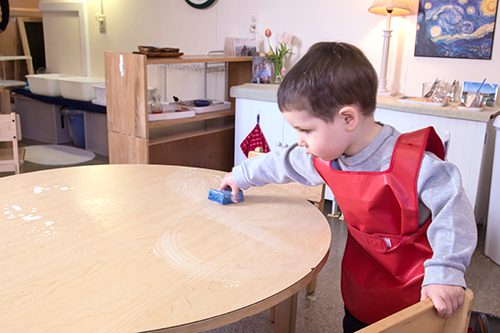
Why is my child washing tables all day? The value of the lessons in practical life

Why is my child washing tables all day? The value of the lessons in practical life


“All activities connected with caring for oneself and the environment—like getting dressed, preparing food, setting the table, wiping floors, clearing dishes—these are tasks that adults often avoid. Yet, for children between one and four, these jobs are a source of joy, and they eagerly rise to the invitation to participate.”

— Dr. Silvana Montanaro

“I love Montessori! I get to make snacks and serve them to my friends. It’s like being a real waiter.”
— Phillip, age 5

This photograph from a century ago shows a young Montessori child ladling soup for her classmates at lunchtime. It’s easy to imagine her parents asking the same question many do today: “What does this have to do with learning to read or write?” In Montessori, Practical Life activities—like washing tables, pouring water, polishing, sweeping, and dusting—are not just chores; they are foundational learning experiences.

Through these hands-on tasks, children develop an inner sense of order, focus, and independence. By caring for their environment, meeting their own needs, and helping others, Montessori students learn more than just skills—they learn how to learn.


Here’s a glimpse into a Montessori day that captures this philosophy:

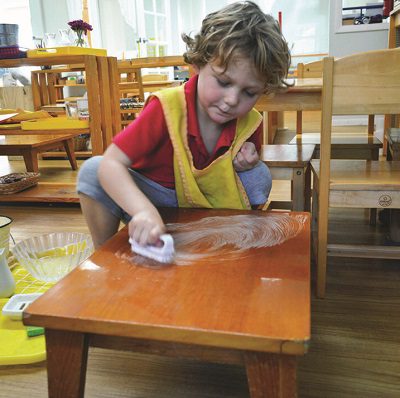
It’s 10 o’clock, and Amani is hungry. She heads over to the snack table and prepares celery sticks with peanut butter, pouring herself apple juice from a pitcher made for small hands. When she finishes, Amani carefully wipes her placemat. This inspires her to clean, so she gathers a small bucket, sponge, brush, towel, and soap and starts washing a table methodically. 

As she scrubs, she’s absorbed by the patterns of the soap suds. When she’s done, she tidies up, leaving the table somewhat clean—but that’s not the point. What Amani is truly learning is patience, independence, and the ability to concentrate on a sequence of steps.

Another child, Meredith, sees that the widows need to be cleaned. She gathers the window washing kit and begins to spray a nontoxic solution on the glass. She uses a small squeegee and wipes it with a clean cloth. When done, she moves on, choosing activities that interest her. 

In a Montessori classroom, children are genuinely responsible for their space. When hungry, they prepare snacks; when spills happen, they clean up. They practice self-care and community care—each action cultivating confidence and independence.

A Foundation Beyond Skills

Montessori isn’t just about teaching children to count or read. It’s about shaping the people they will become. We focus on developing self-discovery, resilience, and a joyful pursuit of knowledge. This isn’t merely an academic education but an education of the heart and mind. In this setting, children learn with patience, curiosity, and a sense of personal responsibility.

Montessori’s classroom for children between three and six years old is called a Children’s House—a true community of young children. Dr. Maria Montessori’s vision was not to create a more advanced kindergarten but an empowering environment where children are respected as individuals. Here, they develop social and emotional connections, form lasting friendships, and take pride in their shared responsibility for the space and each other.

As children thrive in this nurturing community, they begin to believe in themselves. In this atmosphere, they maintain their natural curiosity and willingness to explore. They learn that mistakes are not failures but stepping stones to growth. With this foundation, they grow to view learning as a journey rather than a destination.

Growing up this way

As a child, I attended the Barrie School in Washington, D.C. Barrie was founded by my mother in 1932. Later, I returned to teach and eventually served as headmaster for 22 years. 

As a child, I remember arriving at school on frosty mornings, stopping by the kitchen for a piece of toast or some cereal, and helping myself with a bit of guidance from older students. As we grew, so did our contributions to the school.

Barrie was a community of several hundred children ranging in age from two to eighteen. Our food was homemade in the school kitchen, and older students volunteered to help with preparation. I spent mornings peeling potatoes and stirring stew alongside our cook, Edith, and friends.

After meals, we carried dishes back to the kitchen, washed them by hand, swept sidewalks, watered gardens, fed animals, and tutored younger students. 

These daily acts connected us with everyone on campus—from the bus drivers to teachers. They taught us the importance of community, and to this day, I still enjoy washing dishes.


The Lifelong Value of Practical Life Skills

“In the special environment prepared for the child, they express an inner need: ‘Help me to do it by myself!’ Their work will no longer weigh them down.” — Dr. Maria Montessori


In Montessori, the classroom itself is a “children’s house,” where children play an active role in caring for the space. They prepare snacks, clean tables, sweep floors, and organize shelves. Through these activities, they learn much more than basic tasks; they develop self-respect, resilience, and a love for learning.

Confidence grows when children feel capable and independent. Montessori classrooms are designed to foster this growth. Here, children’s actions say, “Help me learn to do it for myself!” By encouraging them to be self-sufficient and organized, we set the stage for a lifetime of strong work habits and a sense of responsibility.

Independence does not magically appear as children grow; it must be nurtured. In Montessori, children start young, learning to tie their shoes or pour their own milk. Small successes like these lead to a sense of confidence and pride.

As they mature, Montessori students learn Practical Life skills that prepare them for daily living, like cooking, sewing, managing money, gardening, and even simple home repairs. However, perhaps the most essential skill is learning how to work and play with others kindly. Kindness and respect are daily practices in the Montessori classroom, where children learn to be thoughtful and responsible toward their community. They learn to treat themselves and others with dignity.

Montessori schools aim to be close-knit communities where people learn together in an atmosphere of warmth, respect, and cooperation. Teachers are mentors and guides, helping children grow in understanding and compassion for each other’s unique backgrounds and interests.

Montessori Practical Life activities are the heart of Montessori education. They teach children to be confident, responsible, and independent human beings who find joy in learning and meaningful work.


Consultation and Resources

Leadership Development Workshops

Curriculum Design Consultation

Parent Education Seminars

Classroom Environment Optimization

Teacher Training Programs

Conflict Resolution Strategies

Community Engagement Initiatives

Resource Library Access

Montessori Materials Guidance

School Accreditation Support

Strategic Planning Sessions

Financial Management Advice

Marketing and Outreach Planning

Technology Integration in Montessori

Sustainability Practices in Schools

Insights and Advice for Montessori Parents

INSIDE Montessori: DOcumentary

INSIDE MONTESSORI: A DOCUMENTARY  INSIDE MONTESSORI (82:05) is a documentary film and library of short videos (chapter & focus videos and bonus videos) that reframe the national education conversation toward creating learning environments that allow children to...

Special MFA Members’ discount code for The Parenting Puzzle

To receive your Montessori Family Alliance member discount when you register for the Parenting Puzzle - The Basics  go to https://montessorifoundation.thinkific.com/courses/the-parenting-puzzle-the-basics-updated Choose the MFA Member price on check out. As a member,...

Supporting the Development of Concentration

Concentration: What is it? n a LinkedIn post this past June, “Want Kids to Succeed?  Teach them Focus,” Daniel Goleman explains why concentrating is a precursor for both learning something new and developing self-control. We all know that success...

Being Together With Your Child in Nature

Montessori education places great importance on caring for and preserving our natural resources and the planet, and there is no better place to begin than in your own family life. In a Montessori-inspired home, spending time outside together is one of the simplest and...

The Moment a Parent Begins Looking Elsewhere: A lesson for every Montessori school leader

A few weeks ago, I received a phone call from a mother whose identity — and whose school — will remain completely confidential. She wasn't angry. She wasn't demanding a tuition refund. She wasn't threatening legal action. She simply sounded tired. Over the next hour,...

Reclaiming Attention: Helping Children Focus in a World of Constant Stimuli

  Many parents notice this behavior even when a child is doing something small. Perhaps they're building with blocks. Maybe a story is being read aloud. Or they might be drawing or painting a picture on their own. For a couple of minutes or possibly longer, the...

The Children’s House – A Community of Connection and Self-Discovery

By Tim Seldin I recently read a thoughtful essay by my friend and colleague Tammy Oesting entitled What Have We Lost? In it, Tammy reflects on stories from the early Montessori movement and asks whether, somewhere along the way, we may have unintentionally left behind...

Easy and Affordable Ways for Parents to Solve Family Chaos and Stay Organized

Busy parents juggling work, school, and home life often aren't disorganized; they're overloaded by family organization challenges that multiply quietly. The core tension is simple: every day demands fast decisions, but childcare scheduling changes, family document...

Holding Two Truths: Montessori, Inclusion, and the Courage to Be Honest

A 1950s-era Hermes Rocket portable typewriter similar to the one that I wrote with every day from age 5 through university.    The Promise — and Limits — of Montessori Inclusion: Following Every Child Honestly   A recent video by Montessori educator...

Measuring Child development in the Early Years: Three Tools

Three Tools That Finally Match What Montessori Does I rarely advocate for specific products in print. I have been around long enough to be skeptical of anything that presents itself as the answer to a problem our schools have been navigating for decades. But...

The Early Childhood transition Playbook: Big changes without the burnout

Families navigating the early childhood years are juggling a stack of major life transitions all at once: a new baby, a new identity as parents, new care decisions, new housing needs, and new financial math. It can feel like you're sprinting through a season that's...

How Montessori Builds Independence in Early Childhood

by V Narsimhan - Early Childhood Education Advocate and Marketer, Brixton House Montessori, Chennai, India   One of the most common phrases heard in homes with young children is: "Let me do it for you." Whether it is buttoning a shirt, pouring water, arranging...

Why Child Care Is So Expensive — and Why It’s Worth the Investment

1907-2026 Welcome to the 120th Montessori School Year!   Last year, Jordan McGillis published an article in The Washington Post on August 18, 2025, titled “Why child care costs so much — and how to fix it”. It raised important points about the rising cost of...

Join Our Montessori Community

Discover the transformative power of Montessori education. Connect with us for a personalized consultation or subscribe to our newsletter for insightful resources that empower school leaders and parents alike.

Setting Tuition: FInding The Right Balance

Setting Tuition: FInding The Right Balance

Empowering Montessori Schools Through Strategic Tuition Planning

Unlock the Potential of Your School's Financial Future

Discover how strategic tuition planning can enhance your school’s sustainability and strengthen community trust. Learn to balance affordability with quality education.

The Importance of Strategic Tuition Planning

At this time of the year, many of us who lead private schools have just gone through the process of setting tuition for next year. The odds are that we simply took last year’s numbers and adjusted them by a factor representing our projected increased cost of operations and wages.

Strategic tuition planning is crucial for Montessori schools as it directly impacts financial sustainability and community relationships. By understanding the unique needs of families and aligning tuition with the school’s mission, leaders can ensure long-term success. This approach not only supports operational costs but also enhances educational quality, making it accessible to a diverse range of families.

Challenges in Tuition Setting

Setting the right tuition is a complex task for schools, balancing financial needs with community expectations.

Exclusivity Concerns

High tuition rates can inadvertently exclude families, reducing diversity and accessibility within the school community.

Budget Dependency

Tuition is often the primary source of income, making schools vulnerable to fluctuations in enrollment and economic conditions.

Emotional Impact

Unexpected tuition increases can lead to dissatisfaction and erode trust if not communicated effectively to families.

Common Questions About Tuition Planning

Explore answers to some of the most frequently asked questions regarding tuition planning and management for Montessori schools.

What factors should be considered when setting tuition?
When setting tuition, consider factors like market research, parent demographics, school value proposition, and operational costs. These elements ensure that tuition aligns with both financial goals and community expectations.
How can schools communicate tuition changes effectively?
Effective communication involves announcing changes well in advance, explaining the reasons behind them, and inviting feedback from families. Transparency and openness help maintain trust.
What are common mistakes in tuition setting?
Common mistakes include ignoring the socioeconomic makeup of families, setting tuition without data, and failing to communicate changes clearly. These errors can lead to dissatisfaction and enrollment issues.
How does tuition affect school branding?
Tuition reflects the perceived value of a school. A higher tuition can signal premium quality, while a lower tuition might attract a broader audience but could also imply lower quality. Balance is key.
What role does market research play in tuition planning?
Market research helps identify the financial capacity of families and compares the school’s offerings to competitors. It provides data-driven insights essential for informed tuition decisions.
How can discounts be used strategically?
Discounts, such as sibling or referral discounts, can attract and retain families while ensuring fairness. They should be part of a broader strategy to balance affordability and revenue.

Understanding Our Process

Step 1

Our consultation process begins with an initial assessment of your school’s unique needs and challenges.

Step 2

Next, we conduct thorough market research to gather data on parent demographics and competitive analysis.

Step 3

Finally, we provide tailored recommendations and strategies to optimize tuition planning and communication.

Common Mistakes in Tuition Setting

One of the most frequent errors in tuition setting is neglecting to consider the diverse demographics of the parent community. Schools must understand the financial backgrounds and expectations of their families to set a tuition that aligns with their needs. Additionally, failing to communicate changes effectively can lead to mistrust and dissatisfaction. Schools should ensure that any adjustments to tuition are clearly explained and justified to maintain transparency and trust.

Strategic Tuition Planning

Strategic tuition planning involves a comprehensive approach that balances financial sustainability with the school’s mission and values. Key considerations include understanding the market, defining the school’s value proposition, and using tuition as a marketing tool. Schools should conduct market research to assess the financial capacity of their parent body and compare their offerings to competitors. Defining a clear value proposition helps communicate the benefits and quality of the education provided, ensuring that tuition reflects the school’s worth.

The Role of Communication

Effective communication is crucial when introducing tuition changes. Schools should announce increases well in advance and provide clear reasons for the changes, such as rising operational costs or enhanced educational offerings. By inviting families to discuss concerns and providing a platform for feedback, schools can foster trust and mitigate resistance. Highlighting the value and benefits that tuition supports, through testimonials and success stories, helps reinforce the positive impact of the investment families make in their children’s education.

Key Takeaways for Strategic Tuition Planning

Essential Insights for Effective Tuition Management

Strategic tuition planning is crucial for aligning your school’s financial goals with its mission. Start by conducting thorough market research to understand your community’s demographics and financial capabilities. Clear communication is key; ensure families understand the reasons behind tuition changes to build trust. Flexibility in pricing, such as offering discounts or financial aid, can help balance affordability with revenue needs. By integrating these strategies, schools can maintain enrollment and ensure long-term sustainability.

Partner with Us for Strategic Tuition Success

Are you ready to optimize your school’s tuition strategy? Our team of senior Montessori school consultants and coaches is here to support you in developing a comprehensive plan that aligns with your school’s values and financial objectives. Please reach out to us today to schedule a consultation and explore how we can help in enhancing your tuition planning process. Together, we can ensure your school thrives while maintaining strong community relationships.

Recruiting great Families: Following Up

Recruiting great Families: Following Up

Building Strong Relationships Through Effective Follow-Ups

In the competitive landscape of private education, Montessori schools have a unique advantage: a foundation built on trust, relationships, and a genuine commitment to the growth of children and families. Yet, even the most mission-driven schools can need help with a critical piece of the admissions process: follow-ups. The challenge is clear—how do you nurture prospective families and move them from interest to enrollment in a way that reflects Montessori values? The answer lies in effective, thoughtful, and well-structured follow-ups.

The Importance of Relationships in Admissions

At its core, Montessori education is about relationships between teachers and students, parents and schools, and children and the broader community. Admissions should mirror this philosophy. Families aren’t looking for a hard sell; they seek warmth, authenticity, and evidence that your school is the right partner in their child’s journey.

Our goal is to be approachable, kind, and genuinely interested in the families we serve. It’s not about pushing for enrollment; it’s about building trust and offering value.

Follow-ups allow Montessori schools to showcase these qualities, positioning themselves as trusted advisors rather than salespeople.

Understanding the Family Journey

Data shows that most families don’t make enrollment decisions overnight. In fact, 60% of families take six months to two years to decide on a school, and nearly two-thirds consider three or more options before enrolling. This prolonged decision-making process highlights the need for ongoing engagement.

A well-designed follow-up system ensures your school remains at the top of their mind throughout this journey. It provides families with the information they need, answers their unspoken questions, and reassures them that they’re making the right choice.

Crafting a Montessori-Inspired Follow-Up System

Effective follow-ups are more than just emails—they’re a blend of strategy, authenticity, and content that resonates with your audience. Here’s how Montessori schools can build a follow-up system aligned with their values:

1. Automate Without Losing the Personal Touch

Tools like AIMS, Hubspot, or Mailchimp can help automate routine follow-ups, ensuring no family falls through the cracks. However, automation should complement, not replace, personal interaction. For families expressing immediate interest, a quick phone call or personalized email can make all the difference.

2. Deliver Meaningful, Montessori-Aligned Content

Families value content that answers their questions and addresses their concerns. Consider creating a series of follow-up emails that highlight different aspects of your school, such as:

  • A welcome email that warmly introduces your school’s mission and values.
  • Videos showcasing your classrooms and Montessori materials in action.
  • Quick facts about your school’s programs, extracurricular activities, and alumni success.
  • Testimonials from current families and students.
  • Insights into what graduates achieve after leaving your school.

This sequence not only educates prospective families but also reinforces your credibility and expertise.

3. Engage Families Based on Their Needs

Every family is unique. Some may prioritize academic excellence, while others seek a nurturing environment or strong extracurricular programs. Use surveys or forms to understand their priorities and deliver customized follow-ups that address their specific interests.

For example, a family interested in athletics could receive content about your school’s sports programs, while a family exploring alternatives to public schools might appreciate insights into Montessori’s approach to personalized learning.

4. Leverage Technology to Stay Consistent

A robust follow-up system ensures consistency even during busy times. Platforms like Aims allow schools to create automated email sequences, track engagement, and adjust strategies based on what works. Tools like ChatGPT can also streamline content creation, helping you generate blog posts, emails, and social media updates quickly.

5. Incorporate Retargeting Ads

Beyond emails, retargeting ads on platforms like Facebook and Google help keep your school visible. These ads remind families of your school after they visit your website, encouraging them to re-engage.

Why Follow-Ups Matter

A robust follow-up system doesn’t just increase applications and tours—it builds trust, fosters relationships, and reflects the Montessori philosophy of respect and partnership. As Clint Losch, an admissions expert, explains, “Follow-ups are about keeping families engaged, answering their questions, and showing them you care. It’s one of the most important steps in admissions.”

Montessori school leaders must view follow-ups not as a task to check off but as an opportunity to connect with families on a deeper level. By implementing a thoughtful, well-structured follow-up process, your school can stand out in a crowded marketplace while staying true to its values.

Take Action

If your school doesn’t have a follow-up system in place, now is the time to act. Start small by creating a series of automated emails or setting up a retargeting campaign. Over time, build a library of content that addresses families’ needs and showcases the unique strengths of your Montessori school.

There’s no more important job than responding to inquiries with care and attention. A great follow-up system ensures that every family feels seen, heard, and valued.

With the right approach, follow-ups can transform your admissions process and strengthen your school community—one relationship at a time.

Which should I choose, AMS or AMI?

As Montessori school leaders and consultants, we are often asked about preferences in Montessori training or organizations.

It’s a common misconception to think of Montessori as being divided into two distinct “tribes,” such as AMI and AMS, each with rigidly defined philosophies.

In reality, Montessori is much broader and more nuanced. In North America, there are numerous Montessori organizations, with AMI, AMS, and IMC being the largest.

For teacher training programs in the U.S., the key credential to look for is accreditation by the Montessori Accreditation Council for Teacher Education (MACTE), which ensures a high standard of quality.


Philosophical and Practical Differences

    • AMI (Association Montessori Internationale): Founded by Dr. Montessori herself, AMI emphasizes fidelity to her original principles, practices, and lessons. It tends to adhere closely to Montessori’s core methodologies and may emphasize certain materials or approaches with greater consistency.

    • AMS (American Montessori Society): AMS embraces a broader and more inclusive interpretation of Montessori, allowing for differences in implementation and some incorporation of modern educational elements. AMS training often reflects a more diverse set of influences, including greater flexibility for adapting Montessori principles to different contexts.

    • IMC (International Montessori Council): IMC generally aligns more closely with AMI in its emphasis on Montessori’s original philosophy but also incorporates a contemporary perspective that supports practical application in a wide range of schools and communities.

That said, all three organizations share more in common than what divides them. They are united by their commitment to fostering respect for children’s natural development and supporting the spiritual transformation of the adult—a cornerstone of the Montessori approach.

Choosing the Right Training Program

When deciding between AMI, AMS, or another MACTE-accredited program, consider the following factors:

    1. Training Center Rigor: The quality and rigor of individual training centers can vary within any organization. Research the reputation and approach of the specific center you’re considering.

    1. Budget: Training programs can differ significantly in cost. Make sure the program aligns with your financial resources.

    1. Personal Learning Style: Some training centers emphasize hands-on practice, while others may focus more on theoretical discussions or group learning. Choose a program that matches your preferred way of learning.

    1. Long-Term Goals: If you aim to work in a particular type of Montessori school (e.g., AMI-affiliated, AMS-accredited, or independently Montessori), align your training choice with their requirements or preferences.

Hiring and Faculty Development: An Administrative Perspective

From a school administrator’s perspective, the practical challenge often lies in finding and retaining qualified Montessori teachers. Most schools aim to hire the best-trained Montessori educators available. However, the availability of AMI, AMS, or IMC-trained teachers can vary depending on location, budget, and timing.

Many schools also sponsor non-Montessori-trained teachers through a Montessori teacher education program that best fits the school’s needs and the candidate’s availability and learning style.

This approach can result in a faculty with diverse Montessori backgrounds, training experiences, and interpretations of best practices. While this diversity can enrich the school, it also presents challenges in ensuring consistency and coherence across classrooms. Administrators play a critical role in helping teachers find common ground and align on how Montessori principles are implemented throughout the school.

Strategies for Building a Cohesive Faculty

To support a faculty with diverse Montessori training, administrators can take the following steps:

Establish Clear Guidelines for Montessori Best Practices: Create a shared vision and expectations for how Montessori principles are applied in the school. This will ensure consistency while respecting individual teaching styles.

Invest in Professional Development: Provide ongoing training and workshops to deepen teachers’ understanding of Montessori philosophy and methods. These can be opportunities to bridge gaps between different training backgrounds.

Facilitate Collaboration: Encourage faculty collaboration to share ideas, address challenges, and build a cohesive understanding of Montessori best practices. Cross-classroom observations and peer mentoring can be particularly effective.

Emphasize Community and Culture: Help teachers focus on the heart of Montessori—how they connect with children and families and conduct themselves in the presence of children. This shared commitment to the spiritual transformation of the adult can unify a diverse team.

Support Non-Trained Teachers in Training: For teachers in the process of earning their certification, provide mentorship and classroom support to ensure they can immediately begin applying Montessori principles in their work.

Evaluate Montessori Teacher Preparation Program Fit: When sponsoring teachers for training, consider the strengths and needs of the individual and the school. Align the choice of training program with the school’s philosophy, budget, and the teacher’s ability to attend in-person or online sessions.

Ultimately, whether hiring trained teachers or sponsoring new ones, Montessori school administrators must prioritize cultivating a strong, unified culture of Montessori practice. By supporting a diverse faculty to align on shared principles, schools can ensure a consistent and high-quality Montessori experience for all children and families.


The Heart of Montessori

Finally, remember that learning Montessori lessons and philosophy is only part of the journey. Montessori education is fundamentally about how we connect with children and families and how we conduct ourselves in their presence. This is often referred to as the spiritual transformation of the adult—the deep personal growth and humility required to truly guide and nurture children as they explore and discover their world.

Rather than focusing solely on organizational affiliations, look for a training program and community that resonate with your values, inspires you to grow, and prepares you to make a meaningful impact on children and families.

The Montessori Foundation Is Here To Help!

The Montessori Foundation is an international Montessori nonprofit organization that provides school consulting, mentorship, and professional development onsite and online to Montessori schools around the world. We’re here to help.

Info@montessori.org

We can help your students become true entrepreneurs  

We can help your students become true entrepreneurs  

We can help your students become true entreprenurs

risinginnovator

The Montessori Foundation is proud to be collaborating with the team at Rising Innovator to develop a range of Montessori-inspired economic and business education programs to mentor, inspire, and support young innovators and entrepreneurs.

As Montessori educators, we all want to help our students develop entrepreneurial skills.

Whether the adolescents you work with want to be athletes, bankers, or computer programmers, learning entrepreneurship will help them to shape their own futures!

We have created a unique curriculum that helps adolescents develop entrepreneurial skills.

We have three options:

  • you can download the free basic Business Innovation Journey Lite course
  • use the full and more robust Business Innovation Journey Hosted online course learning platform to teach your students yourself
  • or arrange for the Business Innovation Journey Course PRO, where one of our guides will teach the course for you live online during the day, after school, or even in the evening. 

In our Business Innovation Journey, your students will build actual businesses around their interests. Working in collaboration with other students around their own ages, they will be led through the processes that actual entrepreneurs use to identify opportunities and innovate.

risining innnovator students

This 15 week course teaches the following key competencies of entrepreneurship:

  • Creativity and Problem Solving, the creative skills and impulses to identify opportunities and solve them
  • Teamwork, a vital skill for success in any venture
  • Entrepreneurial Mindset, such as building character and perseverance
  • Leadership, including such skills as planning, organizing, self-analysis, management of self and others
  • Empathy and Ethics, including how understanding people can help turn their problems into sales
  • Market Analysis, including defining the market for a product or service and potential the competition
  • Marketing Strategy, learning how to best reach your customers
  • Finances, such as understanding profitability, cost/price, planning and management, and financial reports
  • Launching a Startup, we will teach the Lean Startup Method to help the children prototype and test their ideas
  • Presentation, success doesn’t just come from having a great idea, but also requires clear and effective communication for your content

Our course was developed by experienced Montessori educators, business educators, and curriculum designers working in partnership with multiple experienced entrepreneurs. 

Built atop the Montessori method of education, it is an experiential learning opportunity unlike any other.

The Business Innovation Journey course launched last year with school partnerships all over the US. We received rave reviews for being both fun and effective. Now we’ve expanded our offerings:

Course

Cost

Description

Business Innovation Journey Lite

Free

Downloadable materials for the complete 14 session course including power points, instructor notes, and handouts.

Business Innovation Journey Hosted

$200/student up to a maximum of $1500/classroom

Everything in the Lite course plus:

  • Hosted on our online learning management platform
  • Additional cases and resources
  • Additional class session
  • Includes our online accounting tool to help teens track their money


Business Innovation Journey PRO
$300/student up to a maximum of $2500/classroom

Everything in the Hosted course but led by one of our master/mentor teachers.

“As a Montessori instructor for 7th and 8th grade microeconomics, it made good sense to incorporate a curriculum that taught entrepreneurship. Rising Innovator’s was a natural fit! We are about half-way through the course and thus far the students are engaged with the material. They enjoy reading and discussing the case studies. The idea of being a member of a team in an ultimate pitch competition is especially appealing to them!”

– Gillett Cole,
Newgate School,
Sarasota, Florida

Quick facts about Business Innovation Journey™

  • For students aged 12 to 18
  • 15 weeks long (It can be completed in 8 weeks)
  • Online course meeting once a week in the evenings for 1 hour each session (Hosted and Pro only)
  • Team based, students will create small groups to pursue business ideas
  • Free downloadable materials, reasonable prices for hosted or taught options
  • Contact us now with further questions or to enroll!
rising innovator 2 students

Why did we create the Business Innovation Journey™?


The future belongs to people who can look at the world and figure out how to change it. An entrepreneur sees beyond a problem in the world into the opportunity that lurks beyond it. The skills that allowed Steve Jobs and Henry Ford to revolutionize society are the same that any activist or artist needs to thrive in our information driven age. We know the world belongs to young innovators. Changemakers. Trailblazers. Leaders. Those that come up with ideas that make our lives better, in ways both big and small.

 Research has shown that adolescents who learn about entrepreneurship benefit from:

  • Developing creativity and collaboration skills.
  • Identifying and recognizing problems and thus, adapting to changes.
  • Developing resilience and perseverance.

This 15-session course is structured to inspire, educate, mentor, and support young entrepreneurs with the tools and information designed to help them start and run a successful business.  Interested in learning more or enrolling? Email us now!

Networks of New For-Profit Montessori Schools Continue to Grow In the US

Networks of New For-Profit Montessori Schools Continue to Grow In the US

ace-montessori


The Montessori Way: School Leadership

About 90% of the Montessori schools in the US are nonpublic. While many are nonprofit, the number of new for-profit privately owned Montessori schools continue to expand, and we see a growing number of networks or chains of schools cropping up. 

In the early days of the Montessori movement in the US, new Montessori teachers often dreamed of having a school of their own. Sometimes opened with family money, perhaps a parent partner, and sometimes on a shoestring in a single classroom, Montessori has always had a sector of schools run as private businesses.

At the Montessori Foundation, we celebrate the many faces of Montessori, whether public, charter, private nonprofit, or private for-profit. 

Some of the most interesting and stable Montessori schools are private businesses run by owners who love their school, offer exemplary Montessori programs, and earn a return on their investment.

While most Montessori educators want to see more programs offered to children who cannot afford private school tuition, creating and sustaining a high-fidelity Montessori school within the public sector has always been a challenge.  

Even well-established public Montessori schools can suddenly go in a different direction if there is a change in school leadership, state regulations, or district priorities.

Nonprofit private Montessori schools can also find it challenging to stay true to their original vision and mission over time with an ever-changing board, school leaders who are not committed to Montessori, and the challenges often created by parent expectations.

We find it interesting to note the wide range and continuing growth of new schools opening in the small business world. 

Let’s take a case in point: Painted Tree, a new residential community in McKinney, Texas, announced plans for a new Montessori school. Recently, the McKinney Courier-Gazette ran this story:

Oxland Group, a Dallas/Fort Worth-based development firm, today announced plans confirmed by the City of McKinney for the development of a Montessori school within Painted Tree. The 12,000-square-foot school will be located on a two-acre site on the northeast corner of Hardin Boulevard and Taylor Burke Drive. Developers will break ground on the new site in August 2022, enrollment will begin in January 2023, and the school is expected to open in the Summer of 2023.

“We couldn’t be more thrilled to bring a high-quality education facility to future residents of Painted Tree and greater McKinney,” says Tom Woliver, co-president and founder of Oxland Group. “The Montessori experience parallels our own vision for Painted Tree in fostering exploration, curiosity and engaging the natural world around us.”

The Montessori School at Painted Tree will provide educational experiences to approximately 200 students, ages 6 weeks to 6 years old. The school will offer employment to approximately 25 teachers and staff, following a curriculum that balances academic, creative and outdoor activities. Montessori education is student-led and self-paced but guided, assessed, and enriched by knowledgeable and caring teachers, leadership of their peers and a nurturing environment.

“Incoming residents and community partners have expressed a strong desire for a Montessori school at Painted Tree,” says Indu Pancharpula, owner and operator of Learning Tree Montessori. “We have found a great place for our future home at Painted Tree and look forward to raising up children and future generations for years to come.”

In addition to the Montessori school at Painted Tree, Pancharpula owns and operates three existing schools in Prosper, Anna, and Princeton; plans to open two locations in Celina and South McKinney in July 2022; plus, three more in Celina, Melissa and Frisco over the next two years.

https://starlocalmedia.com/mckinneycouriergazette/painted-tree-residential-community-announces-plans-for-montessori-school/article_096ac1d4-f6f2-11ec-bca1-9f607a41ac89.html

 We have not verified the facts in the story. Still, it illustrates a growing trend across the United States.

 Investment groups or small partnerships see the potential of running Montessori programs in multiple locations with many centralized administrative functions.

A few well-known examples are the Le Porte schools, Guidepost Montessori, Montessori Unlimited, and Endeavor schools.

There are many smaller networks, such as the Montessori Schools of Silicon Valley that began in the Milpitas, California area and are now starting to expand to Texas. 

 We will continue to monitor this trend. 

 There is nothing inherently antithetical to Montessori if a school is run on a for-profit basis. My own family ran the Barrie School in Washington, DC that way for more than 50 years.

 Even though the Montessori Foundation works within the nonprofit sector, we appreciate the stability and consistency that can be achieved with private ownership, especially when operating at a scale that allows for shared administrative coordination. 

While many Montessori parents and teachers may feel that schools should be nonprofit, every school—public, private nonprofit, or private for-profit— is a business. 

What matters most is the quality of the school’s programs and services and whether its culture leads to high staff morale, well-educated Montessori children, and satisfied families. 

There is a myth that being for-profit is inherently inconsistent with authentic Montessori. 

We have seen that be the case from time to time, but we see it just as often in nonprofit, public, and charter Montessori schools.

Let’s appreciate quality Montessori wherever we find it. We celebrate that families have a choice of where to send their children to school and recognize that Montessori schools are allowed to offer a program that is usually very different from most state schools.

Schools continue to look for ways to create a more diverse school community through the strategic use of financial aid drawn from within the school’s budget, or working with government income-based scholarship funds wherever they exist. 

Always consider the trade-offs when we accept government money through programs that provide financial assistance to low-income families to help them afford the cost of preschool or alternative nonpublic school options. Look at the compromises we may be forced to make to qualify for those programs and consider whether the price is worth the reward.. 

If the price of participating in any state-funded program is unacceptable, is to charge tuition high enough that makes it possible to set aside a portion of your funds to provide your own need-based financial aid programs. Some schools do this on a sliding scale tuition basis. Instead, we recommend an outside financial aid management service that screens applications for your school.

United Nations Convention on the Rights of the Child

United Nations Convention on the Rights of the Child

UN Logos


Most of us are aware that the United Nations adopted a declaration on the universal rights of the child, but many of us have not read it. Here is the introduction and the link to the full text. We encourage you to revisit it from time to time and reflect on the vital message and vision within.


Convention on the Rights of the Child

ADOPTED

20 November 1989

BY

General Assembly of the United Nations

resolution 44/25

Entry into force: 2 September 1990, in accordance with article 49

Preamble

The States Parties to the present Convention,

Considering that, in accordance with the principles proclaimed in the Charter of the United Nations, recognition of the inherent dignity and of the equal and inalienable rights of all members of the human family is the foundation of freedom, justice and peace in the world,

Bearing in mind that the peoples of the United Nations have, in the Charter, reaffirmed their faith in fundamental human rights and in the dignity and worth of the human person, and have determined to promote social progress and better standards of life in larger freedom,

Recognizing that the United Nations has, in the Universal Declaration of Human Rights and in the International Covenants on Human Rights, proclaimed and agreed that everyone is entitled to all the rights and freedoms set forth therein, without distinction of any kind, such as race, colour, sex, language, religion, political or other opinion, national or social origin, property, birth or other status,

Recalling that, in the Universal Declaration of Human Rights, the United Nations has proclaimed that childhood is entitled to special care and assistance,

Convinced that the family, as the fundamental group of society and the natural environment for the growth and well-being of all its members and particularly children, should be afforded the necessary protection and assistance so that it can fully assume its responsibilities within the community,

Recognizing that the child, for the full and harmonious development of his or her personality, should grow up in a family environment, in an atmosphere of happiness, love and understanding,

Considering that the child should be fully prepared to live an individual life in society, and brought up in the spirit of the ideals proclaimed in the Charter of the United Nations, and in particular in the spirit of peace, dignity, tolerance, freedom, equality and solidarity,


Click the link below to read the full text:

https://www.ohchr.org/en/instruments-mechanisms/instruments/convention-rights-child