by Eva Nislev | Infant-Toddler (0 to 3), MFA, Montessori Family Life, Montessori Parenting
 Your children are busy exploring and learning from an incredible collection of materials and activities in their Montessori classrooms. Parents often ask how much of the special learning materials they should purchase for their child to use at home. We answer: None! Children need other activities to complement what they are doing at school.
Montessori is a way of life. It is a philosophy about how human beings might live their lives and treat one another. It is an attitude of respect and encouragement for each human being, no matter how young or how old. Rather than power and authority, it is a sense of partnership.
Newborn infants come into our lives lacking the ability to be self-sufficient and independent. We not only provide nurturing and protection, we help them learn how to do things for themselves. Independence is the single greatest drive of the young child. The desire to feel competent, capable, and to know that we are seen as being worthy of respect is one of the most powerful human emotions. Because of their intense desire to become competent, toddlers often become extremely frustrated, resulting in the tantrums that are common in the toddler years.
Children who are treated with respect and who are gently encouraged to try new skills more readily learn to do things for themselves. Parents who, instead, take delight in doing things that their children are capable of doing for themselves, delay their children’s independence and hold back the development of their self-esteem. Dr. Montessori taught that a child who feels respected and competent will develop a far greater level of emotional well being than a child who is simply loved and doted upon. She wrote, “The adult should be an aide to life. We must help the child learn how to do it for himself.”
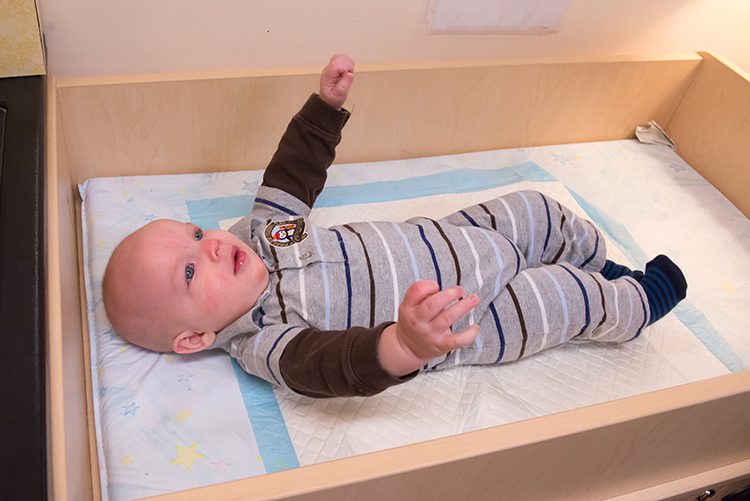
A lamb’s wool mat on the floor, low shelves filled with interesting objects, and a nearby mirror provide many opportunities for babies to explore the world around them.
by Tim Seldin | MFA, Montessori Education, Montessori Family Life, Montessori Parenting
The Bedroom
We must give the child an environment that he can utilize by himself: a little washstand of his own, a bureau with drawers he can open, objects of common use that he can operate, a small bed in which he can sleep at night under an attractive blanket he can fold and spread by himself. We must give him an environment in which he can live and play; then we will see him work all day with his hands and wait impatiently to undress himself and lay himself down on his own bed.”– Maria Montessori
Children’s bedrooms should clearly reflect their personalities and current interests. Even though on their own they may tend to create chaos, young children have a tremendous need and love for an orderly environment. Everything should have its own place and the environment should be organized to make it easy for the child to maintain a neat, well organized atmosphere.
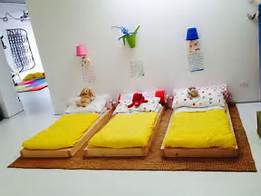
- Ideally, the young child’s bed should be low to the floor, making it easy for toddlers to get in and out on their own. Rather than a crib, Montessori urged parents to modify the bedroom to facilitate both the child’s safety and his early independence. Consider a Japanese futon or a mattress without the bed frame.
- By age five, you may wish to allow your child to use a sleeping bag on his bed instead of sheets and blankets. This will make it easy for him to make his own bed in the morning.
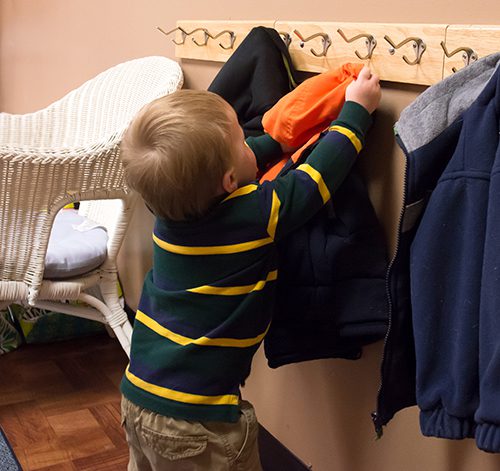
- Mount a nice little coat and hat rack low on one wall where your child can reach them easily.
- Decorate the walls with high quality art prints of children or animals hung at the child’s eye level.
- Mount a wall clock at the child’s level. Select one with a large easily read face.
- Modify your light switches with extenders to allow the young child to turn his lights on and off independently.
- Hang a bulletin board on the wall at your child’s eye level on which he can hang art work school papers.
- Don’t use a toy box. Imagine the chaos in your kitchen or workshop if you threw your tools and utensils together in a chest. Instead use low shelves to display books and toys Try to duplicate the look of your child’s classroom.
- Notice how Montessori teachers avoid clutter. Place toys with many pieces in appropriate containers, such as tupperware “boxes” with lids, basket, or in a sturdy plastic bag.
- Use a sturdy wooden crate to hold your child’s building blocks.
- You may want to create a model town or farm on piece of heavy plywood. Paint it green and sprinkle model railroad “grass” on it to simulate a meadow. Placed on a low table, your child can create wonderful displays with model buildings made of wood or plastic. Add little trees and people from a model railroad set. You could set up a doll house this way as well.
- Store Lego blocks in a large, colorful and sturdy canvas bag with handles. Sew on strips of velcro to fasten the bag closed. In your child’s bedroom the bag will serve as a sack to contain his Legos. When you travel it is very easy to pick the bag up to come along.
- Make sure that your child’s clothes chest has drawers that are the right height for him or her to open and look inside. Label the drawers: underwear, socks, etc.
- Flower vases: Encourage your child to collect flowers from the fields or garden for his room.
- Provide some shelf space for a small nature museum in your child’s room. Here he can display rocks that he finds, interesting seeds, and (in small cages) interesting ‘critters.’
- Music should be an important part of every child’s life. Set some space aside for a simple stereo system and collection of recordings.
The Bathroom
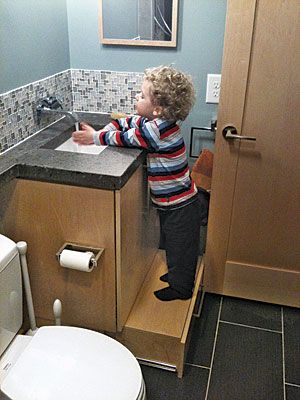
The bathroom must be prepared for your child. He should be able to reach the sink, turn on the water, and reach his toothbrush and toothpaste without help. There should be a special place where he can reach for his towel and washcloth. Most parents provide bathroom stools, but small wobbly stools often do not provide enough secure, comfortable space for bathroom tasks.
Build wooden platforms 6-8 inches high that actually fit around toilets and sinks.
An Art and Crafts Area
• Set up an art area with an easel and a spacious art table for drawing, craft work and clay. Cover the table with a washable tablecloth.
• Children’s art supplies can be neatly stored in separate Tupperware™ containers. Depending on your child’s age, the art supplies that you prepare might include washable magic markers, crayons, paste, paper, fabric scraps and recycled household articles for making collages You can keep tempera paint fresh by mixing it in Tupperware containers that are divided into three or more inner compartments.
The Kitchen
- Make room in your kitchen for a child-sized work table for young cooks.
- Set aside the bottom shelf in your refrigerator for your children. Here you can store small drink pitchers, fruit, and the ingredients for making sandwiches and snacks. Use non-breakable Tupperware™ containers to hold peanut butter, jams, lunch meats, and spreads. A child of two can open the refrigerator and get her own prepared snack or cold drink stored in a little cup. A slightly older child can pour her own juice and make her own lunch.
- Use a bottom drawer to hold forks, knives and spoons.
- Mount a low shelf on a wall for plates, cups, and napkins.
Children Can Help around the House
If presented correctly, children from age two to six take delight in caring for their environment, dusting, mopping, scrubbing, cleaning and polishing, and they should be able to do so as easily at home as at school. It is perfectly reasonable to ask older children to straighten up their rooms and help with simple household chore.
- Give your child his own little broom or dust buster.
- Hang a feather duster on a hook.
- Provide a hamper for your child’s dirty clothes. Ask him to carry them to the laundry room on a regular basis.
- The bathroom should have a small bucket with a bathtub scrub brush and a sponge.
- Folding towels and napkins is a good activity to teach the young child.
PS: If you need good ideas, look for inspiration at pinterest.com
by Hillary Drinkell | MFA, Montessori Family Life, Montessori Parenting, Montessori students, Montessori Teachers, School Leadership, The International Montessori Council
I’ve been in the field of Montessori for about 30 years, and within the last several years, I’ve noticed how, even within Montessori environments, children, parents, and faculty were showing many signs of stress, and often I was working with students who were struggling with a variety of anxiety-related conditions.
Because I have always been interested in a holistic approach to health, I decided to look into courses that might be useful in helping all constituents within schools and beyond, acquire techniques to relieve stress and develop sustained calm to ensure success. As such, I became a Chopra Certified Meditation and Yoga instructor and then went further to become an Ayurvedic Wellness Practitioner. All these modalities include breath techniques to positively change the physiology of the body. Interestingly, even though we breathe to sustain life, we often don’t think about the way we breathe, as our breath is controlled by the autonomic nervous system.
Breath work to help relieve stress is simple to do, and several of the techniques are easy for everyone to do without the guidance of a qualified teacher. One of the most important aspects of learning breath techniques is that we become aware of our breath and can recognize when we may not be breathing in a manner that is conducive to our health.
Breath work also helps ground our bodies, which allows for less anxiety and usually a calmer response to stress-related issues. When we say to a child, ‘Just take a breath,’ we don’t realize that often we don’t know how to take such a breath, let alone the child.
As you are reading this article notice how you are breathing at this moment. Are you breathing from the belly or the chest; is your breath slow and deep or quick and shallow? If you are at all stressed, you might notice how your breath is located higher in the chest and, at times, your shoulders creep up towards your ears.
Not only is this not a comfortable position to be in, but it is also not efficient for good oxygenation of the body. When we are stressed and we do not breathe correctly, our heart rate increases, which ultimately can lead to long-term stress; this unhealthy cycle often continues, which keeps the body in the stress-related fight-and-flight response.
Let’s dive into a basic breath technique, which is to breathe in and out through the nose. When we do this the breath enters into a warm, moist environment, which makes it easier for the lungs to receive. Not only does this enable a better quality of air to enter the lungs, but tiny nose hairs also filter the air before it enters the lungs.
By breathing through the nose, the airway is open longer and prolongs the exhalation, which generally slows the breath, as the nose is a smaller passageway than the mouth. This technique is similar to pursed-lips technique, which is often used in asthmatics to allow for a better quality of breath. When the breath slows down, it automatically calms the body and allows us to feel more secure, grounded, and confident. There is a definite sense of peace when you are not breathing fast and hard.
Another way to breathe that enables the body to remain calm and secure is relaxed-abdomen breathing. In this type of breath technique, when we inhale we balloon the belly outwards away from our body and then when we exhale, we think about bringing the belly back down as close to our spine as possible. This is not atomically/technically correct, but it does allow for great visualization as to how we should breathe correctly. The idea is that this would look and feel like calm waves washing onto shore at the beach.
Stop reading for a moment and practice breathing through your nose and mouth. Notice how you feel. Now, practice breathing through your nose with the emphasis on deep belly breathing. Notice how you feel. By slowing the breath down, especially when exhaling, we create a relaxation response that helps us develop control over how we respond to the many environmental stimuli we are faced with each day.
When our breathing is governed by the autonomic nervous system, there is a natural pause at the beginning of the inhalation, where the breath seems suspended in time. In times of stress, we lose these natural pauses in our breath and, thereby, lose the natural pauses in our lives. This is a very subtle response from the body, but one that has direct effects on how we respond to stress and life’s challenges.
When we work with controlled-breath techniques in children, we do not recommend holding the breath, as initially children need to develop good breath control, and they still need time to develop an understanding as regards the length of the breath holds. However, adults benefit from practicing a slight hold in the breath.
The following are some easy breath techniques that can be practiced, and which help calm the body and reduce stress by activating the vegus nerve.
Deep-Belly Breathing with Props: To assist with visualization of the length and pace of deep-belly breathing, a Hoberman Sphere may be used. When working with younger children, they can lie on their backs and have a rubber ducky or other such item placed on the belly area, so that they can observe the object going up and down as they take deep belly breaths.
Volcano Breath: This technique is sometimes used in therapeutic situations and is another fun and helpful breath to practice. Place the hands together at the heart, breathe in and, keeping the hands together, hold the breath until the arms are moved overhead, then breathe out through the nose as arms float gently downwards with palms face upwards. (Note that we use a slight hold of breath here with children; this is not a long hold and is directed by movement; as such, it is safe for children to do.)
Pinwheel Breath: Breathe in through the nose and then breathe out pursing the lips while letting out a slow, steady stream of breath onto a pinwheel so that the pinwheel spins around. This encourages the exhalation of breath to slow, which is great for
asthmatics and for calming the central nervous system.
Synchronizing Breath: This can be done with movement or yoga poses. Generally, on the inhalation, the arms go up, and on the exhalation the arms down. This can be practiced with any physical activity and will often enhance one’s abilities.
Back Breathing: This is a practice that requires a partner. The partner puts her hands on either side of the back of your spine as she encourages you to breathe into her hands. This technique needs a level of trust for someone to put her hands on a partner’s back. This technique can be done in either a seated position or with the partner in the yoga pose called Child’s Pose.
Practicing one or more of these breath techniques for a few minutes a day can have a direct impact on stress levels and on the way an individual responds to daily challenges. May you enjoy many hours of continued deep calm breaths!
Montessori Leadership / February 2017 / p 10
by Christine Lowry | MFA, Montessori Education, Montessori Family Life, Montessori Parenting
Join us for an overview of helping your child develop self-regulation – an important skill for children in all areas of their lives – academic, social, and more.
Christine Lowry and Lorna McGrath
Download File
by Cathie Perolman | Kindergarten, MFA, Montessori Education, Montessori Family Life, Montessori Parenting, Montessori students
Dear Cathie,
How important is it to keep my child in the Montessori class through the kindergarten year? After all, she will have to transition to her neighborhood school at some point. Isn’t it best that she do it when all of the children are entering the local elementary school? If we don’t transition at kindergarten, how will it be any different at first grade?
—A PRAGMATIC DAD
Dear Dad,
I think you are raising an issue that many parents consider. The short answer is that the best time to transition to traditional school is after the kindergarten year. It is best to complete the three-year cycle in the Montessori 3-6 program.
The public or non-Montessori kindergarten teacher meets each child as an unknown entity. She has to begin from scratch learning about what your child knows, how your child behaves, how your child learns, and what your child finds interesting and motivating. Not only does the teacher need to learn about your child but every other child in the class as well. The teacher does this at the same time as establishing the school and classroom routines, as well as keeping all the children busy by giving them ‘activities’ and ‘work’ that keeps the entire class busy regardless of their knowledge and skill level.
These activities are probably not interesting, fun, or challenging to children who already read and have mastery of the basics of academics. These are probably even less enticing for a child who has been academically challenged in a Montessori environment. It takes a teacher a significant amount of time to figure out the learning style and knowledge base of each child in the class and, by the time this has occurred, many weeks will have passed, and your child will have lost that learning opportunity and have begun to form an opinion of school.
Contrast this with the beginning of kindergarten in a Montessori school. When your child enters kindergarten in the Montessori school, her guide knows her well. Your child’s guide knows what has occurred in the class in previous years, what is challenging and what is enjoyable. From the first day of the kindergarten year, your child’s learning progresses according to her own pace in all aspects of the curriculum. She is viewed as a leader by all members of the community and enters the classroom with joy and confidence. She chooses work that she enjoys.
The local traditional kindergarten also teaches to the average child in the class. The teacher is responsible to make sure that each child masters the learning objectives of the local school district and often the Common Core curriculum. While there may be some grouping made for children who are advanced in language or math skills, much of your child’s day will be spent learning with the class as a group mastering those basic skills. Children have little chance to follow their passions and learn about the things that interest them.
In the Montessori kindergarten, children progress at their own pace in all aspects of the curriculum. Once a child has mastered the basic skills of the kindergarten level, she seamlessly moves past that level and is introduced to more challenging work in that area. If children show interest in a particular subject or area, they are introduced to work in that area on their instructional level.Thus, each child is constantly challenged based on their individual level of functioning.
By first grade in local elementary schools, children have been grouped academically, and all children are familiar with the basics of the school routine and the expectations of school. Now your child can slide into the class, be placed into an instructional group that is appropriate for her functioning and lose much less time academically. There will definitely be a transition. Traditional schools function much differently than Montessori schools, and that is important to discuss with your child as she prepares for the change.
There is no doubt in my mind that the third year in a primary Montessori class is well worth the time and money! Parents often tell me that it is the most worthwhile year their child has spent, and children look back on it with the most joy and fondness! It lets your child have the chance to be a leader in the classroom and contribute to the classroom from which she received so much when she was three and four years old.
Tomorrow’s Child / April 2016 / p 34
by Joyce St. Giermaine | MFA, Montessori Family Life
Margot Garfield-Anderson and I have worked together for so long that we are more family than co-workers, sharing good times and not-so-good challenges along the way.
Another thing we have in common is grandchildren, albeit Margot has four granddaughters and I have two grandsons. All of our grandchildren are in the infant to five-year-old range. Reading Margot’s grandparenting articles are so completely different from my experiences that I sometimes feel compelled to offer the other side of grandparenting boys (ages three and four).
Margot and I both live in Florida, and our grandchildren live “up north,” so we both miss spending day-to-day time with the kids. Invariably, we also both return home sick from germy little hands no matter how many pre-visit vitamins we consume.
That’s where the similarities end.
Margot goes north with learning activities planned, shopping list at the ready, prepared for princess-themed movie nights, tea parties, and events designed to be remembered as important quality time with grammie.
My grandparenting experiences are memorable, sometimes physically painful, and always mentally challenging. I often joke that I should receive “combat pay” when asked to babysit, because, in my efforts to keep them alive throughout the “play” that often becomes a series of improvised mixed martial arts events, somebody often gets hurt (usually myself included).
Separated by just 15 months (and the younger one being as big as his older brother) makes for intense competition with each other for EVERYTHING: which car seat they choose; who gets the Spiderman pajamas; what plate serves their food; the air that they breathe. Add to that mixture of high-octane energy, two quick minds, a freakishly young understanding of sarcasm, and an unending quest for misadventures, and you may understand why a successful visit with my grandchildren is more based on mitigation of damages and the goal of survival than on learning or making memories.
Both boys have been in Montessori since they were infants. No, Montessori has not failed (imagine what they would be like without Montessori!), and, yes, there are discipline and rules at school and at home. They are who and what they are. If you have children who share an excess of enthusiasm, you’ll understand and may appreciate this small chapter from a book I am going to review in the book review section. It comes from Geek Parenting: What Joffrey, Jor-El, Maleficent, and the McFlys Teach Us about Raising a Family, by Stephen H. Segal and Valya Dudycz Lupescu. If you are the parent or grandparent of a child who walks on the wild side, always or occasionally, you absolutely must read this little book to help put what you are experiencing
into perspective.
With the authors’ permission, I include this little chapter from Geek Parenting based on the comic strip Calvin and Hobbes and I include it because it reminds me of my grandchildren and may strike a resonant chord with some of our readers. ¢
Calvin and his parents teach us:
“Just Because They Build Snowman Murder-Investigation Scenes Doesn’t Mean There’s Something Wrong with Them”
Freshly fallen snow has pristine, untouched potential, like a blank canvas. Our kids look at all that white and cannot wait to charge outside to manifest some imagined landscape: a magic castle with unicorn sentries, a rebel base on Hoth, or–if our kid is the star of Calvin and Hobbes–a frozen apocalypse peopled with snowman horror-movie scenes.
Like most children, Bill Watterson’s comic-strip protagonist Calvin creates pretend personas to act out his fantasies and work out his frustrations: Stupendous Man! Spaceman Spiff! Tracer Bullet! Calvin’s parents generally take his action in stride and with good humor. But what would happen to Calvin if he were a real boy today, dreaming of Deranged Mutant Killer Monster Snow Goons in an era when school systems are perhaps more gun-shy than ever about odd nonconformists?
Our lives, and teachers’ lives, would certainly be easier if kids didn’t challenge authority. But do we really want neat rows of children following orders, reciting answers and never asking any distracting questions? It sounds pretty great, but seems just a few short steps away from Nineteen Eighty-Four or Brave New World. Maybe young readers are hungry for dystopian tales that depict the horror of extreme conformity because sometimes they feel we’re steering them in that very direction.
Our world needs more creative thinkers and visionaries, not fewer. Which is why Calvin’s parents are such good role models, offering common sense and calm guidance that reigns in Calvin’s imagination when necessary, without quashing it. Because it’s the children with adventurous spirits who will go off into the unknown to answer the call of Calvin’s last line in the final strip of the series: “Let’s go exploring!”
Tomorrow’s Child / April2016 / pg 30
by Terri Sherrill | Brain Development, Infant, Infant-Toddler (0 to 3), MFA, Montessori Family Life, Webinars / MFA
Join Kathy Leitch and Terri Sherrill as they discuss the importance of the first three years as your child’s brain grows more and more neural networks.
by Margot Garfield-Anderson | Book Reviews, Family Resources, MFA, Montessori Family Life, Montessori Parenting
Blakely and I have been cooking in the kitchen together since she was just a toddler. I started by taking her to the market to pick out fruits and vegetables and using the process to engage her in food selection, thus expanding her palette. Children will be more likely to eat a diverse diet when they have invested time and energy into the preparation. So when we found this book we thought it the perfect opportunity to try some of the fun and healthier-style recipes.
We actually made homemade butter! In all my years of cooking I’ve never done that before, and it was easy and a lot of fun. We used our butter on our grilled cheese sandwiches and our corn on the cob. The whole family enjoyed this special treat. We talked about where cream came from and how we get buttermilk from the process before it turns to butter. Just enough information to keep a four-year-old interested.
Next we made the chickpea patties. I was explaining how onions made your eyes water and she said she had an idea. She came back wearing her snorkel goggles and said she was now not worried about her eyes! What a clever kitchen trick that is! We made a lot of extra patties and then froze what we didn’t eat. These are a great on-the-run breakfast food, as well as an easy dinner recipe the entire family can enjoy.
Interspersed with the recipes are some projects related to cooking you can do with children, such as making a volcano (with baking powder and dishwashing liquid), a chef’s hat, a cake plate, and even some homemade modeling dough.
The book’s photographs show the absolute joy children get out of shaking and baking and rolling and patting. Even the youngest can squish through their fingers to just experience the textures of different foods. My son-in-law tried to capture the joy and pleasure we took in our cooking time as well. Blakely and I had a fun time and know you and your favorite child will as well.
Cheerful Chickpea Cakes: Chickpeas are super healthy for healthy bodies. These handy, snack-size, savory cakes team up all that goodness with a cheesiness that makes them irresistible.
- ²/³ cup fava beans
- 1 (15-ounce) can chickpeas, drained and rinsed
- ½ cup shredded cheddar cheese
- ½ cup shredded Gruyere cheese
- 1 small red onion, finely chopped
- 2 tablespoons chopped mint
- 1 egg, plus 1 egg yolk
Preheat the oven to 350° F. Line a baking sheet with parchment paper.
Cook fava beans in a saucepan of boiling water for 3 minutes. Drain; then coarsely chop.
Place the chickpeas in a bowl. Crush with a fork. Alternatively, process the chickpeas briefly in a food processor. Mix together the crushed chickpeas, chopped beans, cheeses, onion, mint, egg, and egg yolk until well combined and the mixture easily sticks together when pressed with a spoon.
Place a 2 ½ inch round cutter on the prepared sheet, and pile some of the mixture into it. Pack down firmly with the back of a spoon and carefully twist and lift away the cutter. Repeat with the remaining mixture to make 10 cakes, rinsing and drying the cutter if the mixture starts to stick to it.
Bake the cakes in the oven for 20 minutes until firm and just beginning to turn pale golden around the edges. Let cool. The cakes are best eaten on the day you make them, but you could store them overnight in an airtight container in the refrigerator.
NOTE: We chose this particular recipe because it is gluten-free, one of several in the book. We substituted Vidalla onion for red onion and decided to eliminate the mint. We also decided to make this a scooping exercise, as well, using a muffin pan and scooper for more careful portion control. One of the great outcomes of cooking with children is the ability to modify recipes to their particular tastes or nutritional restrictions.
Tomorrow’s Child / September 2014 / p 31
by Joyce St. Giermaine | MFA, Montessori Education, Montessori Family Life, Montessori Parenting, Montessori students, Montessori Teachers
Sometimes when I read or hear an advertisement for a school, I just marvel at some of the terms that are used, implying that some particular school does something so worthwhile that you absolutely must enroll your children. Often, these traditional schools are promoting exactly what thousands of children have experienced in Montessori schools for the past hundred years. So, here are some secrets that traditional schools (public and private) don’t want you to know.
Your Child Is Unique.
Everybody says that and, as parents, we know that to be true. All we have to do is take a close look at our own families. Our children and grandchildren are different even from their siblings. Unless you have identical twins, it’s pretty useless to expect the exact same growth, developmental markers, learning styles, or interests. Even twins are their own persons with differences in personality that make them unique.
Traditional education, on the other hand, is geared to serve the needs of the average child en masse. In the early 20th century, when schooling became available to a greater number of children, schools were actually designed to produce a much-needed supply of factory workers. Curriculum was designed to meet the needs of the ‘average’ American child, which required a curriculum that was achievable by the majority. With this goal in mind, how could schools have enough resources to individualize a common curriculum to meet the needs of students who did not conform, either by being too advanced for their years or by being challenged by disability or circumstance? It couldn’t and it didn’t.
Dr. Maria Montessori saw this as an opportunity to try something different by creating what we now call a ‘casa’ for the children of underprivileged factory workers in Rome. In 1907, she was able to open a classroom for these street urchins who were quite literally running amok while their parents were at work.
The world was amazed at the success of her program, and Montessori schools began to take hold, showing that what worked with severely disadvantaged children would work even better with ‘normal’ children.
The Montessori Method’s ability to serve a diverse population may be the reason behind a common misperception that Montessori is either 1) just for the gifted and talented or 2) specifically designed for students with a wide scope of learning exceptionalities. Neither assumption is true.
The most important concept to acknowledge is that while Montessori is really different from other traditional approaches, the resulting content of a Montessori education is not so different from what is learned in traditional programs. The difference is in the delivery and the outcomes.
In Montessori classrooms, from Infancy through Secondary, each child is allowed to maintain the personal integrity and uniqueness with which they were born. While Montessori may not be the right fit for every student or every family, in general, it works very well for children and parents who, for whatever reason, want something different and who are comfortable with taking the path less chosen.
Today’s Cutting-Edge Curriculum Was Borrowed From Montessori (It Just Took Traditional Schools 100+ Years to Begin to Catch Up).
Some of the best advances in contemporary, cutting-edge curriculum and classroom environments, such as child-sized furniture, self-correcting manipulatives, and hands-on learning are not new to Montessorians.
Dr. Montessori developed these amazing advances more than one hundred years ago. Neither is “learning at your own pace.” Traditional public and private schools for children of all ages openly use these terms as if they were just invented! Montessori children have had them all along.
Montessori Has A Very Well-Defined Curriculum.
A shocking number of college graduates with degrees in education know nothing about the Montessori Method. I don’t know exactly why that is, except that maybe the ongoing need for trained assembly-line teachers, who are willing to teach to the test, is so great that there is no room to include the pedagogical and developmental discussions that comprise so much of Montessori teacher training.
Montessori teachers come to Montessori from all walks of life. Some already have a degree in education and turn to Montessori to re-ignite the spark that has long been dimmed in traditional schools; others come from different professions (such as, doctors, lawyers, banking, opera singers, and more); many are parents. Regardless of what these future Montessori teachers bring to the table, training for Montessori certification at every level takes two to three years of study and internship, and that is on top of whatever college and post-graduate degrees they may have
already earned.
Montessori’s curriculum is often referred to as the “Scope & Sequence.” It includes every Montessori material and every lesson from Infants to Upper Elementary (age 12), and, whenever possible, it is aligned to the Common Core Standards. Even a ‘simple’ lesson, such as washing a table, has more than 30 steps. At the higher, more abstract levels, older students transition from the Montessori manipulative materials to equally detailed lessons that correspond nicely to what is being taught in other, more traditional programs, with the exception that Montessori adds ‘real-life’ experiences to make the learning process relevant, memorable, and usually less painful.
Montessori Classrooms Are Beautiful and Calm
Did you know that dogs can smell stress? Well, it’s true. This is a secret of working in stressful situations (such as competitive events) with dogs: disguise the scent of stress by popping a mint in your mouth, because if you, as the handler, are stressed, your dog will know it. We like to say, “It goes down the leash.”
Going back to children, what do you think happens when they are required to endure a stressful school environment day after day
after day? Row after row after row. Most teachers know that their employment depends on their students’ test scores. Do you remember the humiliation of a teacher walking down a row of desks to return a less-than-stellar test paper in full view of other class members? Unfortunately, I do.
In younger classes, stress often takes the form of chaos, comprised of noise and un-focused activity. Often, the teacher needs to raise her voice to command attention, At the high school levels, the stress is palpable as teachers and students struggle to keep up with hormones and state-mandated curriculum— their futures seemingly at stake based on the outcome of their efforts.
If you can, visit different types of schools before deciding on Montessori. Then, visit a Montessori classroom. Although there will be a buzz of activity in Montessori classrooms, the energy is good. It is a learning environment. No matter how ‘highly’ (code for ‘overly’) energized the child, when she enters her classroom, decorum prevails. It is not imposed on the classroom; it is the classroom.
Instead of the garish primary colors often found in early learning environments, the colors of the walls, the curtains, and the flooring are neutral and soothing. There is plenty of color in the Montessori materials that have special places on wooden shelves or the vases of flowers. The materials are made from heavy wood, polished or painted to perfection.
There is substance and gravitas that entices and grounds young students. Posters of far-away lands and famous artwork adorn the walls. Children work where they are comfortable, which may be at a table or on the floor, alone or in small groups. They are given the opportunity of choice and the responsibility of caring for and about themselves, their environment, and their classmates. Often, music accompanies the children as they work. It is a place of calm, where learning happens.
Montessori Schools Are Not Afraid to Test. While Montessori schools may not endorse standardized or any other form of testing, it is not because they fear that students are too fragile for this particular ‘real-world’ experience. Montessori teachers, who have been with their students for three years, are well-tuned to their students’ needs.
They observe and make notes. Many schools are now using computer software, such as MontessoriCompass, to simplify the note-taking process for teachers and to allow parents to follow their child’s progress online. Montessorians are very dedicated to ensuring that students in their care learn all the tools that they will need for college and beyond; this includes testing. The difference for Montessori educators is that they feel no need to test in order to compare students against other students.
Instead of using testing as a weapon to control funding, employment, and allocation of resources, testing in Montessori is just one more way to make sure that learning is happening. At NewGate (the Montessori Foundation’s Lab School in Sarasota, FL), we ran a pilot program using the Scantron Global Scholars Performance Series formative assessment program last year to help teachers understand what information and lessons students have already mastered. Students are invited to use the untimed, highly individualized online testing in class, one at a time, and it has proven to be a valuable and enjoyable classroom resource. In fact, most students enjoy it!
Although nationally standardized and correlated to the Common Core State Standards, this is very different from the once-a-year week-long high stakes achievement tests used in many schools. It allows us to track students’ ongoing individual academic progress over the years. It also gives them excellent practice in test taking skills. Beginning this fall, we invited interested Montessori schools to join the Montessori formative assessment program. Contact Montessori Foundation President, Tim Seldin, for more information (timseldin@montessori.org).
Montessori High Schools DO Exist. Everything that parents and students love about Early Childhood and Elementary Montessori experiences is becoming more available at the high school level. Some schools have adopted Dr. Montessori’s Erdkinder approach, which involves creation of a self-sustaining young adult community that lives and works together in an agriculture environment; more often, other schools have adapted Montessori curriculum to meet the needs of young adults in urban and suburban areas.
In more and more Montessori secondary programs, such as the NewGate School (Sarasota, FL), the Westwood School (Dallas, TX), the Montessori High School at University Circle (Cleveland, OH), and the Montessori School of the Virgin Islands, to name only four, the Montessori curriculum has been aligned and integrated with the International Baccalaureate’s Diploma Programme (IB). While maintaining the kindness, humanity, and broad reaching depth of Montessori’s curriculum for its older students, IB accreditation helps provide an academic infrastructure that is recognized worldwide.
It is the goal of these high school programs to reduce the crushing stress to perform that our society has imposed on our young adults. This theme is explored in the evocative documentary, The Race to Nowhere, “featuring the heartbreaking stories of students across the country who have been pushed to the brink by over-scheduling, over-testing and the relentless pressure to achieve.” See more at www.racetonowhere.com.
We believe that these re-designed high school programs are effective, viable, replicable, and very much needed!
Montessori Grads Get into College. Montessori graduates have no problem getting into the colleges of their choice–usually with scholarships. So do home-schooled kids, for that matter. College is not the holy grail of learning that deserves the stress that usually accompanies the American high school experience. While Montessori educators do not propose that its students should not do extra work at home or strive to achieve their dreams and better themselves, it is hard to believe that the key to success is directly linked to the number of hours of homework given and done.
Even Montessori students have to learn how to spell and memorize math facts, but ‘homework’ in Montessori is usually just an extension of what is being done in the classroom. It represents an opportunity for students of all ages to explore and go deeper into subjects and interests than time permits in a normal school day. In Montessori, long projects are assigned to teach collaboration with peers, research, and time management. These are the real-life skills that will not only get Montessori grads into college but, most importantly, allow them to graduate.
Tomorrow’s Child / September 014 / p 8
by Robby Schlesinger | Brain Development, MFA, Montessori Family Life, Montessori Parenting, Montessori Teachers, Psychology
Roberta (Robby) Schlesinger, better known to her students as Ms. Robby, is an award-winning botanical artist. She has been both a parent and art teacher at NewGate for some years. She is also an International Baccalaureate Diploma Program Instructor. Robby is a graduate of the Botanical Art and Illustration Program at Ringling College of Art and Design in Sarasota, Florida.
Inattention, hyperactivity, and impulsivity are the key behaviors of ADHD. It is normal for all children to be inattentive, hyperactive, or impulsive sometimes, but for children with ADHD, these behaviors are more severe and occur more often.
Remember, only a qualified, licensed healthcare professional can diagnose ADD or ADHD.
My two sons, now young men, both have Attention Deficit Hyperactivity Disorder. I have ADHD. My adopted daughter has ADHD. When we adopted our beautiful little girl, the fates must have had a hand in it. The powers that be must have looked down from above and said, “Let’s give that little girl to that mom —the one who looks worn-out already.” My daughter’s ADHD is severe and only a mom with thirty plus years experience was qualified. I often joke that at least her ADHD isn’t my fault. Which brings up the first thing I’ve learned:
ADHD is not anyone’s fault. ADHD just is. Someday science will know what causes it, but in the meantime, don’t speculate, don’t worry, don’t blame, just deal with it.
Here are some things I’ve learned:
You can choose medication and/or therapy. What you can’t choose is to do nothing!
ADHD is not one size fits all. Don’t assume that your child needs to have all the symptoms on the checklist to have attention issues. Find a good psychiatrist you can trust. Listen to him/her.
Treat the ADHD first. Learning difficulties, memory problems, impulsivity and even sensory issues can all be connected to ADHD. Deal with the disorder first, you may find that the other issues aren’t nearly as troublesome.
ADHD should be called Attention Variability Disorder. Just because your child can hyper-focus on Legos™, or Minecraft™ doesn’t mean they don’t have attention or impulsivity issues. There are other indicators. See a doctor.
About medication: Don’t be daft. Please, don’t make up your mind about meds until you talk to a doctor. ADHD medications have been around for decades and they are safe.
ADHD itself is more dangerous than any medication. Kids with ADHD are often impulsive risk takers. Slowing down those impulses will help your child live a safer, and more secure life. Medication is not the only piece of the puzzle, but it’s an important piece.
Medication will not make your child behave. Only you (and good teachers) can teach your child appropriate behavior.
What medication can do is this: increase your child’s attention span so that they can learn. This includes learning appropriate behavior.
Medication is a commitment. Controlled substances are a pain. You will spend a lot of time filling prescriptions, changing prescription doses, monitoring meds and seeing doctors. This is a fact of life for parents of kids with ADHD.
Therapy is also a commitment. Cognitive therapies, behavioral therapies, auditory therapies (even acupressure) will all help. You must make the commitment to do them. Get to the appointments, follow the at home instructions, do it right.
Here are a few coping strategies for everyday life that I have learned:
Look at your child objectively. Let go of the child in your head, the one you hoped to have back when you decided to become parents. That child was a daydream, but the beautiful, challenging, exuberant, impulsive, wonderful child right in front you is the one you have to raise. Don’t let ADHD get in the way of a happy childhood. Get help.
Avoid potential disasters and impossible situations. Know your child and their limitations. Example, if your kid can’t stand in line for more than a minute without melting down then stay away from Disney World during Christmas week!
Talk about it. Find a support group. Seek out other moms and dads dealing with ADHD. Tell teachers, babysitters, and coaches the truth. The worst thing you can do is try to hide your child’s ADHD. Be open and fair to teachers and activity directors by disclosing your child’s challenges. If the teacher isn’t sympathetic and helpful, you don’t want them anyway; find another teacher.
One last thing. A happy childhood is the best gift you can give your child. ADHD can be controlled; your child can be a confident, capable, happy child. It’s up to you.
Tomorrow’s Child /September 2015 / p 36
by Sonnie McFarland Jim McFarland Ph.D | MFA, Montessori Family Life, Montessori Parenting, Planes of Development, Prepared Environment, Sensitive Periods
Since Dr. Maria Montessori’s discovery of the true nature of childhood over a century ago, children around the globe have benefitted from Montessori education. However, even parents who have children enrolled in Montessori schools could derive further benefits through the implementation of Montessori principles and practices in the home .
Children reap the rewards when, at home, both parents are consistent in their expectations and styles of parenting. Similarly, children thrive when there is consistency between the home and the school. Helping parents create a child-friendly environment in the home is a beginning; however, we can go much deeper. We can bring greater definition to best practices of Montessori parenting, so parents can better understand and appreciate why children blossom in Montessori classrooms and how they can implement Montessori principles and practices in the home.
Recognizing Children’s Authentic Nature
First, we must help parents recognize the authentic nature of each of their children. Without this understanding, it is difficult to put Montessori principles into practice. To know who the child is helps us to know how to be with the child. Montessori saw children as endowed with a spiritual embryo that served as a fulcrum around which each child’s mental and spiritual life is organized.
If the work of man on the earth is related to his spirit, to his creative intelligence, then his spirit and his intelligence must be the fulcrum of his existence and of all the workings of his body. About this fulcrum his behavior is organized and even his physical economy. The whole man develops within a kind of spiritual halo. (Montessori, 1988, p. 56)
This spiritual halo can be seen as the nurturing emotional, social, and spiritual milieu where children are respected because of their inherent worth. Montessori recognized that children are endowed with capacities to fulfill their potentials. When parents and teachers recognize children’s intrinsic goodness, and reflect it back to them, children naturally develop healthy self-images and positive patterns of growth. A self-fulfilling prophecy is created, and children are empowered to follow their natural developmental processes toward self- actualization.
The Map of the Mind and Spirit visually (next page) clarifies the various functions of mind and its relationship to the Spirit or Authentic Self. No one aspect of mind can stand alone, as there is a holistic, dynamic interconnection between them. (McFarland, 2011, pp. 50–51)
Sensory-Motor: The function of this aspect of mind is to bring the external world into awareness through the five senses. These sensorial impressions automatically embed themselves in the subconscious area of the memory bank where engrams and associations are created. The sensory-motor part of the mind coordinates motor activity within the external environment.
Memory Bank: The subconscious mind, or mneme, that houses the engrams and associations, racial memories, and potentials, is located at the base of the memory bank. “Memory” (that which we consciously remember) is located above the subconscious mind on the map.
One of the most startling discoveries that Montessori made was to come to a clearer understanding of how a child learns and matures. She observed that there are dynamic forces determining the development of his personality, intelligence, and talents that are hidden within his memory bank or unconscious mind . . . She came to understand how these inner forces worked together and how each contributed to the growth of the child. (McFarland, 2011, p. 55)
It is not an accumulation of memories that is left in the mneme, but a power to recall experiences to the conscious memory . . . Thus it is not the experiences in themselves, but the traces of them left behind in the mneme, which makes a mind powerful; such traces being known as engrams. (Montessori, 1989, p. 13).
As engrams form, they spontaneously seek to organize by connecting to other engrams to create associations based on such things as commonalities and contrasts.
When a child’s interest is aroused through sensory stimulation and the impressions enter the unconscious mind, the mind spontaneously calls forth all those related memory traces or engrams to form a new or expanded idea. This is how the intellect grows. (McFarland, 2011, p. 57)
One additional function of the subconscious mind is to spontaneously release hidden impressions or mindsets onto the sensory-motor screen. Because the sensory-motor aspect is unable to make decisions as to what to do with this released material, it is up to the ego or inner guide to respond.
Ego: This function of mind is where the sense of separation or “I-ness” is located. It has the power to make decisions from incoming sensorial impressions.
Inner Guide: The inner guide is the power of discrimination that observes and evaluates incoming sensorial and memory impressions, helps balance the ego, and makes decisions as to what action to take. This aspect is directly connected to the Authentic Self/Spirit and the vital life force. It is the source of wisdom and the seat for self-observation. When we say that we trust the child to make decisions as to his work choices, it is because we trust the child’s inner guide.
Montessori recognized the bridge between the conscious and unconscious mind and saw the inner guide as a mysterious power that guides, oversees, and directs the child’s fulfillment. It is through quieting the lower mind that the inner guide is accessed.
Vital Life Force: Montessori recognized the presence of the vital life force and referred to it as “horme.” She observed that children were naturally motivated to learn and develop their individual potentials. “A vital force is active within him, and this guides his efforts towards their goal…” (Montessori, 1988, p. 76). This invisible force of life propels the child toward self-fulfillment.
Authentic Self/Spirit: This aspect is nothing less than humanity’s true nature of divine love and light—the personal expression of Cosmic Consciousness. The Authentic Self is the source of all positive virtues such as joy, faith, courage, honesty, and compassion. It is what brings peace and purpose to life. When we witness these qualities in children, we know they are manifesting their Spirit or Authentic Self.
Cosmic Consciousness: This is the source of all life and love. It is a dynamic energy that touches all that is. All aspects of the mind and spirit are connected to form a dynamic whole that includes the Cosmic Consciousness. It is reassuring to know that the spiritual embryo of the child is connected to Cosmic Consciousness and that we can trust that there is a natural path prepared for children to unveil their Authentic Self and fulfill their cosmic tasks. (McFarland, 2011, p. 64)
When parents see their children as divine beings striving to develop their human potentials, rather than willful children purposely annoying them, they can learn to approach them from an entirely different perspective. Montessori parenting begins with recognition, acceptance, and respect for the child’s Authentic Self.
“When we understand the inner nature of the child, we trust the child and become selflessly centered on the child and less on ourselves…. Our first teacher, therefore, will be the child himself, or rather the vital urge with the cosmic laws that lead him unconsciously.”
(Montessori, 1991, p. 20)
Unveiling the Authentic Child
Children come to earth as pure spiritual beings, endowed with many gifts; however, at birth, an invisible veil is drawn over their awareness of who they really are. Fortunately, each child’s Authentic Self, inner guide, and vital life force retain the knowledge of the child’s true identity and cosmic task. Within the sanctity of Montessori classrooms, children systematically enter into continual cycles of unveiling their Authentic Selves and discovering their interests and capabilities. To bring greater clarity to this process, we have designed a model we call the VEIL Model.
The VEIL Model has four interacting phases that continually repeat themselves as children interact with their environments and master new concepts. The four phases are: Volition, Engagement, Integration, and Love.
Each time children are motivated to engage in an appropriate activity (Volition), receive sensory stimulation (Engagement), and assimilate and master the information (Integration), they catch a glimpse of who they are and what they are capable of understanding (Love). Each time children exercise Volition and choose to engage in a new activity, they enter another learning cycle that takes them through the phases of Engagement and Integration. Each time they master an activity, they enter into the Love phase. In this phase, children experience joy and confidence that propels them to begin a new cycle of learning. “The more this Unveiling Cycle is repeated, the greater is the child’s ability to recognize his authenticity and realize his potentials. He enters into an upward cycling spiral towards self- actualization” (McFarland, 2011, p. 71).
Within each of the four phases of the Unveiling Cycle, we identify four principles or practices that are essential keys to the implementation of Montessori’s work.
The Volition Phase
Volition is the first phase of the VEIL Model and focuses on four qualities that are embedded within children’s spiritual embryo. The qualities that naturally motivate children toward self-actualization and fulfillment are: 1) Need Fulfillment; 2) Quest for Self-Mastery; 3) Sensitive Periods; and 4) Compelling Interests.
Need Fulfillment: The desire to have their basic needs met is one of the most powerful motivating forces embedded within children. When these needs are not met, their behavior is directly affected. Abraham Maslow (1971) identified the basic human needs as: 1) physiological needs; 2) safety needs; 3) love and belonging needs; 4) esteem needs; and 5) self-actualization needs. His research indicates that need fulfillment begins with the most basic physiological needs and moves sequentially up the pyramid as each need is fulfilled, culminating in the fulfillment of the self-actualization needs.
It is important for parents to know that children’s behavior is directly related to these basic needs. When children’s needs are met, they are content; however, when one of the need levels is not met, children demonstrate challenging behavior. Parents benefit from knowing that the needs of children often fluctuate depending on the situation and circumstance. For example, a child may be happily involved in an activity, operating at the esteem-need level, when he is frightened by something and falls back to the safety-need level, where he now requires comfort and reassurance. If he receives it, he can move to the next level of love and belonging. If this need is satisfied, the child can again enjoy being at the esteem level. Encouraging parents to view children’s challenging behavior as a call for a need to be met can help them remember to focus on what need requires attention and what they might do to restore balance to the child.
Quest for Self-Mastery: Children are wired for success. They come equipped with the vital life force that propels them toward self-actualization and an inner guide to wisely direct this energy. When children have the opportunity to engage in environments designed to meet their interests and the adults encourage their independent exploration, children naturally move toward self-mastery. According to Montessori:
We must clearly understand that when we give the child freedom and independence, we are giving freedom to the worker already braced for action, who cannot live without working and being active. This he has in common with all other forms of life, and to curb it makes him degenerate. (1988, p. 83)
When parents do for their children what the children want to do for themselves, children receive the message that they are incapable and weak. As parents understand that children are naturally programmed for self-mastery and benefit from prepared environments, at home and school, it will be easier for them to encourage children’s independence and let go of the need to do too much for their children.
Sensitive Periods: As we know, children pass through specific periods of sensitivity that last for months or years. A few of these periods relate to the acquisition of language, a need for order and precision, mastery of movement, and social relationships. When a child’s physical body and mental capacity are prepared, the vital force and the inner guide motivate sensitive periods. During these periods of sensitivity children’s attention is intently focused on self-mastery, sometimes to the exclusion of other things. Helping parents understand what these sensitive periods are and how they can support the children through them is vital.
Compelling Interests: Children’s interests are internally motivated by a combination of a deep love for life, the vital force, inner potentials, and previous positive experiences registered in the memory bank. These internal factors compel children to spontaneously engage in and learn from their environments. “The environment must be rich in motives that lend interest to activity and invite the child to conduct his own experiences” (Montessori, 1988, p. 84).
The Engagement Phase
Engagement, the second phase of the VEIL Model, is the process that allows children to take in stimuli from their environments. The four qualities that naturally facilitate the Engagement Phase are: 1) Absorbent Mind to Inquiring Mind; 2) Meaningful Work; 3) Movement; and 4) Freedom of Choice
Absorbent Mind to Inquiring Mind: The minds of young children, between birth and age 6, are uniquely designed to absorb the sensorial stimulation around them and automatically embed these impressions into their subconscious mind. These impressions form engrams that join together to create associations that forever become part of the child’s soul.
Around the age of six, the absorbent mind of the child becomes an inquiring mind. Children now have the ability to reason as well as to consciously select and remember what they are learning. This is a time when they want to know the why and how of things and demonstrate the power of their imaginations. It is this inquiring mind, guided by the vital life force and the inner guide that naturally propels children to engage with their environments.
Meaningful Work: One of the secrets of engaging children is to provide them with meaningful work. For work to be “meaningful,” it must capture the child’s attention and engage her
concentration. This level of engagement reflects the real work of self-construction, motivated by the vital life force and the
inner guide.
If the child lacks the external means to adapt, he has no way to utilize the great energy that is his. Moreover, he is impelled instinctively towards activity that utilizes all his energies because, in this way, he can perfect his faculties. Everything depends on this. (Montessori, 1991, p. 47)
Parents will appreciate knowing that when they provide meaningful work opportunities in the home, their children will engage themselves at deeper levels of concentration, which will most likely result in children being calm and happy.
Movement: From the moment of birth, children engage through movement. This movement adds to their developing intelligence by bringing sensorial impressions into the subconscious mind. In addition, children’s movements develop both their muscular as well as their neurological structures.
For children’s optimal intellectual development, it is essential for parents to give their children the freedom to move about and engage themselves in the exploration of their surroundings as much as possible. Movement within the environment increases children’s ability to experience their environments in a multi-sensory manner.
Freedom of Choice: Children are more likely to engage in meaningful work when they have freedom to choose what to do. It is easier to trust that children will make appropriate choices when we remember that their inner guide is there to assist them in their choices. It is important to note that children are most successful in accessing their inner guide when their lower mind is calm. Deep breathing, silence, and working alone enhance children’s ability to listen to their
inner guide.
“The child must learn by his own individual activity, being given a mental freedom to take what he needs, and not be questioned in his choice” (Montessori, 1989, p. 5). When adults make unnecessary choices, children forget how to access their inner knowledge and their ability to relate to their authenticity becomes unstable. Instead of learning self-reliance, children learn to rely on others to make their decisions.
The Integration Phase
Integration, the third phase of the VEIL Model, focuses on how children assimilate and process the information they receive from their environments. The four qualities are: 1) Concentration; 2) Repetition; 3) Emotional Safety; and 4) Meaningful Context.
Concentration: Concentration is the bridge to the inner guide and Authentic Self. To reach this state, children must ignore the distractions of sensorial sensations, memories, fantasies, and general wanderings of the mind. Achieving this state of concentration occurs when children find an activity that captures their deepest attention. Montessori recognized the relationship between integration and concentration:
He is agitated until he seeks something within the depths of his mind that he has not yet found for him- self. It must hold his entire attention; he must concentrate and consecrate his entire being; he must be free from everything that goes on around him. This is what we call the great work. (1991, p. 63)
It is important that parents and teachers are sensitive to this delicate state of concentration and seek to protect it. When children are concentrating, it is best to leave them alone. If it is imperative to disturb a child in deep concentration, do so gently. Another unintentional disturbance of a child’s concentration is to say “good job!” while the child is working. This breaks her flow of concentration.
Repetition: Children’s ability to integrate, assimilate, and remember what they are learning is enhanced by repetition. As children repeat activities, they strengthen the neural pathways of the brain, the power of their memory increases, and constructive habits are formed. When parents understand the importance of repetition, they are more able to be patient when their children repeat the same work over and over again.
Emotional Safety: When children experience negative emotional feelings, ranging from low-level anxiety to extreme fear, their capacity to integrate new concepts and remember what they have learned is deeply affected. According to Daniel Goleman, “When emotions overwhelm concentration, what is being swamped is the mental capacity cognitive scientists call ‘working memory,’ the ability to hold in mind all information relevant to the task at hand” (1995, p. 79). Emotional safety for children is best achieved when parents and caregivers demonstrate respect and offer encouragement to children. When children experience positive regard, they develop self-confidence and the courage to attempt new things.
Meaningful Context: Children integrate and assimilate information more effectively when what they learn is related to concepts previously learned and/or presented in the context of the greater whole. This is possible because of the existing engrams and associations in their subconscious mind. In addition, children’s ability to learn is greater when they view the work as meaningful. Parents who are more aware of what their children have experienced can provide new input that is connected to former concepts.
The Love Phase
Love is the culmination phase of the VEIL Model; it is where children experience the joy of mastering a concept. This spontaneous joy embeds itself in their subconscious memory and becomes the seed of motivation. The successful completion of an Unveiling Cycle motivates children to reach out and learn more. They confidently enter another cycle of learning, creating a spiral effect that continues to unveil their Authentic Self. The four elements of the Love Phase are: 1) Normalization; 2) Authenticity and Self-Actualization; 3) Creativity; and 4) Self-Discipline.
Normalization: When children are encouraged to live and work in harmony with the natural laws of child development, they manifest positive psychological characteristics such as enthusiasm, thoughtfulness, and joy. Montessori saw this state of equilibrium as the normal state of healthy children and called it “normalization.” She also recognized that when children are unable to organize their personality with the natural developmental principles, they often manifested negative behaviors. Montessori described this state of negativity as being a deviation from the norm.
But when the attractions of the new environment exert their spell, offering motives for constructive activity, then all these energies combine and the deviations can be dispersed. A unique type of child appears, a “new child”; but really it is the child’s true “personality” allowed to construct itself normally. (Montessori, 1988, p. 185)
Authenticity and Self-Actualization: As children naturally move through their Unveiling Cycles and connect with their authenticity, they begin to manifest the same qualities that Abraham Maslow (1971, pp. 45-49) identified as the qualities of
Self-Actualization:
- Experiencing fully, vividly, selflessly with full concentration and total absorption
- Making growth choices rather than fear choices Allowing Self to emerge
- Being honest and taking responsibility for one’s own actions
- Listening to one’s own inner voice
- Being surprised by joy—“peak experiences” or transient moments of self-actualization
- Opening up to one’s authentic self and letting go of defenses
Self-actualization is not a permanent state of being but rather a gradual process of becoming more connected to the Authentic Self and acting from authenticity. The more adults model this behavior, the easier it is for children to do the same.
Creativity: Each time children reach the Love Phase of the Unveiling Cycle, they experience self-confidence, enthusiasm, trust, and determination, the qualities at the heart of the creative process. In addition to being ready to master a new concept, children often want to be creative with what they already know. “Whether on the outer or inner plane, there is a tiny light in the unconscious
of mankind, which guides it toward better things” (Montessori, 1988, p. 191).
Self-Discipline: As children engage themselves in the Unveiling Spiral, they develop the power of will, the root of inner discipline. A partnership between the vital life force and the inner guide develops:
The vital force is the energy of impulse and the inner guide is the voice of discrimination or inhibition. Impulse by itself leads to erratic and meaningless activity. Inhibition by itself leads to timidity and dependence on others. . . . As they [children] are allowed to follow their internal laws of development they naturally find the balance between the two and the will is formed. (McFarland, 2011, p. 112)
Montessori witnessed three stages of will:
- Attention and Attraction to the Environment: Children are attracted to specific activities and unconsciously eliminate other activities. This is the beginning of inner discipline.
- Conscious Self-Discipline: During the second stage, children move from unconscious will development to conscious self-discipline. Realizing the inner satisfaction of being involved with constructive work, children continue to make constructive decisions.
- Obedience: At this stage, children, being filled with love for self, others, and the environment, willingly.
This is possible because they are primarily operating from their Authentic Self and their egos are not threatened by others giving directions.
Life’s greatest creation is the inner-directed process that children experience as they unveil their Authentic Self. The more educators and parents work together and honor children’s natural process of development, the more children will be able to manifest their greatest potentials and lead us to a brighter future. Maria Montessori saw this possibility over a century ago.
When prejudice is vanquished by knowledge, then there will appear in the world a “superior child” with his marvelous powers which today remain hidden. Then there will appear the child who is destined to form a humanity capable of understanding and controlling our present civilization. (Montessori, 1991, p. 16)
Sonnie McFarland and Jim McFarland, PhD are co-authors of Montessori Parenting: Unveiling the Authentic Self. Sonnie is the AMS 2011 Living Legacy and is AMS- credentialed (Early Childhood). She is the chair of the AMS Peace Committee. Contact Sonnie at sonnie@shiningmountainspress.com and Jim at jim@shiningmountainspress.com.
References
- Goleman, D. (1995). Emotional intelligence. New York, NY: Bantam Books.
- Maslow. A. (1971). The further reaches of human nature. New York, NY: The Viking Press.
- McFarland, S. and J. (2011). Montessori parenting: Unveiling the authentic self. Buena Vista, CO: The Shining Mountains Press.
- Montessori, M. (1988). The Absorbent Mind. Oxford, England: Clio Press Ltd.
- Montessori, M. (1989). To educate the human potential. Oxford, England: Clio Press Ltd. Montessori, M. (1991). The child in the family.
Madras, India: Kalakshetra Press.
- Montessori, M. (1991). The formation of man.Madras, India: Kalakshetra Press.
Tomorrow’s Child / April 2015 / p 30
by Margot Garfield-Anderson | Family Resources, MFA, Montessori Family Life
- I’m not always available to be there.
- I feel guilty at times because I’m not there.
- I feel as if my grandchild only knows me from the voice over the phone or a short SkypeTM or FacetimeTM conversation.
- I don’t want to be remembered as the typical Floridian grandparent they only saw once a year.
I wrestle with these emotions as much as I do about not seeing my daughters, so how did I make certain I was an integral part of the lives of my grandchildren when I lived so far away?
When my first grandchild, Blakely, came along I spent the first month of her life at my daughter’s, helping to support she and her husband during those first critical weeks at home. I then made a commitment to myself, my daughters, and my husband that this would be a big priority in my life. We’ve given up trips that we might have otherwise taken, but I’ll never have a second’s regret for using these dollars to purchase plane tickets. It’s a big trip, but I do it as often as I can (sometimes monthly), so that I can be involved and create memories with them. One day in the distant future, they will look back and say, “Yeah, remember when grammie was here and we…”
How I Interact When I Am There
When I’m there with them I want to be with them, doing and watching and most importantly, listening to where they want a conversation to go. That’s not always an easy thing to do with an active toddler or preschooler who is always on the go. Have you observed that your 2-4 year old grandchild just can’t sit still? That’s perfectly normal, they don’t yet possess the inner discipline they will master in their Montessori school to be able to control this, so don’t try to pin them down. When this is at it’s peak in the day, plan an activity that allows for lots of running around or energy to be released.
My oldest granddaughter, Blakely, has just completed Kindergarten so I can’t ask mom and dad to keep her out of school when I’m there. Now I wait until she’s home from school and has had some time to wind it down. Trying to engage her in a lot of meaningful dialogue when she’s been at school all day is usually not a good idea, so again, I take my cues from her.
My two 3.5 year olds (cousins) love to play dress up, and (with or without Blakely) they love to play BarbieTM and beauty parlor. Yes they are all very girlie girls. But we go out, and I show them how to draw a hopscotch board on the driveway and we play. I’ve pushed them in their car trikes 1,000 miles so far. We take nature hikes. We go to the zoo, museums, the library, park, and the YMCA to swim. We read. We play Goldfish, endlessly! We play board games and Legos™. We cook, we clean, we bounce balls, we do yoga. We watch the Nutcracker ballet and dance to Frank Leto. We look at lots of family pictures, so they know where they’ve come from. Sometimes, we just sit and snuggle, while I rub a back or tickle a tummy. We hug and we kiss.
How I Interact When I Am Not There
When we aren’t on a visit in person, we have to satisfy ourselves with today’s technology. When Blakely was little we SkypedTM while I was on my first trip to Hong Kong. At three, she asked me, “Grammie, why you in China? Why you not in Florida?” I bought her a laminated map with the world on one side and the US on the other. She quickly learned where Rochester, New York and Sarasota, Florida were on that map, and each time I travel, we get the map out and review where I am. It’s helping her gain a real sense of how big the world is and what it means to travel. She’s been on a plane often enough now to have something relatable to talk about.
Now that Aubrey and Raegan are conversational, they love to show me what they are painting or eating (occasionally still trying to feed me cherry tomatoes through the computer), or sing me a song.
I love to hear about what books Blakely is reading in her class or with mom and dad at night. If she’s had a great soccer practice or game, she likes to tell me about it. She has an amazing memory and shares past things we have done together as our little secrets. She’ll run and show me she’s lined up all the Naturalist-in-a-Box™ animals just so I know she still loves them. Again, I take my cues from her.
Recently, I noticed they were not in the mood to talk and almost resented the intrusion of the call. I asked mom to perhaps figure out a time when they weren’t in the middle of something they wanted to be doing. Instead, I suggested, “Can you wait to call during a meal when eating didn’t take them from something they were playing with and they were sort of in a fixed position?” My daughter took that advice (it’s all in how you phrase it) and next time called during lunch. They were delighted to talk and see me and show me what they were eating. They were nice and relaxed and we had a great visit.
It’s often difficult not to be offended by some of their actions but I’ve learned to put all that aside and realize that I do respect them and if they don’t want to talk it’s not a great idea to force them to do so. They will only end up resenting these visits and then it’s not a good experience for anyone.
A Bond That Will Always Be There
Blakely went through a phase from about 4.5 years old to just recently when she would cry hysterically when I’d be leaving to go home, she’d be leaving to go home or we were talking on the phone. She’d call me crying, saying she missed me. It tore me up inside to think that she was so sensitive to the situation.
Instead of feeding on that feeling, (since my next visit was assuredly already on the books!), I’d tell her to start the countdown all over again and each time we talked she had to tell me how many more days it was until we saw each other again. The other three haven’t yet reached that age. I wonder if they will go through the same thing, but I know how to ease that pain now. I try not to be sad myself so they don’t sense it from me. Inside I’m conflicted. I hate to see her so upset, and yet, I am secretly flattered she loves me so much that she misses me that intensely.
Finally, her other grandmother, who does live right around the corner is wonderful at sending me photos and video clips of our girls in action or FaceTiming™ with me if time allows. It makes me feel included and she loves to share her time with me.
I’m fortunate enough to have one foot in the door with them and not so fortunate because I’m not a constant everyday presence. But by figuring all this out with my Montessori background, I’ve found what I think to be a middle ground for all of us. This is how I cope with being an away grandparent.
Tomorrow’s Child/pg22/Sept 2016
by Teresa Gonsoski | Brain Development, MFA, Montessori Education, Montessori Family Life, Montessori Parenting, Montessori students, Montessori Teachers, Psychology
The Importance of Creating a “Yes” Environment for Children
When was the last time you took a risk? How did you feel? When children take risks and succeed, they feel proud and self-confident. When things don’t go as planned, they feel frustrated, learn that things don’t always happen as predicted, and maybe even decide to try it again.
Risk is a vital component of children’s play. It allows children to be challenged, to face uncertainty, to problem solve, to work with others to find a solution, and to think outside the box. All of these qualities serve to expand children’s cognitive, physical, and social-emotional abilities. They become the building blocks for later learning and managing of experiences, both throughout school and as an adult.
Allowing children to take risks in their play gives them the opportunity to develop the use of their judgment. When a child starts to climb the side of the play structure, our first instinct might be to say, “Don’t go up that high.” In taking away the experience from the child, however, he never learns what might be unsafe about climbing.
He also never learns to balance his feet, grip tightly, and steady himself if he slips. He definitely doesn’t get the opportunity to figure out how to climb down after going up. He may later find himself in a situation—perhaps his friends are climbing a tree in the neighborhood, out of view of an adult’s eye—in which he doesn’t feel comfortable participating because he never learned to climb. Or maybe he does climb and falls because he never learned how to do it!
Risk-taking can also occur in activities that are less gross motor-centered. A child can take a risk and explore gooey sensory materials. Perhaps a child who has never wanted to get her feet wet finally does, shoes and all. Risks can happen when exploring real tools, such as scissors or a mallet, that are a bit beyond the child’s developmental level. When the child decides to give it a try, even when the adults present don’t think he has the capability to do it, he is taking a risk.
When we support children in taking risks, we give them the chance to learn something new about themselves, their physical abilities, and their thought processes.
The Role of the Teacher
When creating a “yes” environment in the classroom, the most challenging thing for the teacher to provide may be opportunities for risk-taking. We may not feel at ease being taken out of our comfort zones to allow for activities we feel aren’t safe. We might want to step in and move the child, or say, “Don’t do that. It’s not safe.” Doing these things, though, tells the child she is not competent and cannot be trusted to figure out how to complete the task on her own. If she is not allowed to fall or push the limits of her abilities, she also never learns the feeling of pride she’ll achieve when she accomplishes the challenging activity all by herself.
The teacher’s role is to create a safe space in which children can take risks. We check the yard for hazardous objects, like broken glass or exposed nails, and we remove broken toys and equipment. We step in if it looks like a child might hurt himself or hurt another child. We stay close to a child who is climbing or balancing and remain calm to show the child that we trust her abilities. The main thing we have to do is to accept that there will be some risks in children’s play. Allowing those risks helps to expand their confidence, their thought-processes, their creativity, and their fine and gross motor abilities.
In the event that a child does get hurt, it’s important to remember that scrapes and bruises are a part of childhood. All children experience these small injuries. Children are still small, and if they fall, they’re not so far from the ground. Their bodies are resilient, and a bump doesn’t stop them for long. We remain nearby to comfort, give first aid, and encourage the child to think about what happened and perhaps try again.
Opportunities for Risk-Taking
It’s important that we include spaces in our environments where children can challenge their physical abilities. They need to be able to learn to balance, hang, climb, and build the necessary muscles to do these things. When climbing areas are created with intention, they can also be created with safety in mind, by including tumbling mats or pillows to cushion children when they fall.
There are ways to promote risk in play that don’t involve gross motor. Giving children opportunities to experience messy play, whether it’s with water, mud, or paint, allows children to take risks through experimentation of materials. Letting a child get wet or muddy shows that you trust them to manage themselves and use the materials in a way that is comfortable for their bodies. (It also shows you understand that hands, feet, and clothing are washable!)
Including open-ended materials is another way to promote risk. Simple wooden blocks, loose parts such as craft sticks and cardboard tubes, and costume items such as scarves and fabric remnants give children the chance to experiment with how they can be manipulated and to apply their creativity in new ways. Children can take risks by trying out different ideas, seeing if they work, and trying again if it doesn’t work the first time. Items from nature, such as sticks, rocks, or pinecones, can also be used in this way.
Just as crucial is the use of real tools in the classroom. Giving children an opportunity to use scissors on paper or mallets on clay helps them to learn how to use these tools properly. Putting them out in the classroom environment may be more about the process, how to hold scissors, rather than the product, paper cut into strips. Perhaps using real tools only happens when there is an adult available to supervise the activity, but allowing for these sorts of risk-taking opportunities helps the child build self-confidence and develop new skills.
When we allow children to take risks, not only do we give them opportunities to experience how much we trust them, we also allow them to learn how to trust themselves when trying out new things. Children can have safe experiences with risk-taking if we’re doing our jobs to guide them. We as teachers have to be open and willing to push the boundaries of our comfort zones at the same time that the children are testing out the limits of their own cognitive and gross motor abilities.
Tomorrow’s Child / September 2016 / p 28
by Wendy Elwell | Family Resources, MFA, Montessori Family Life, Montessori Parenting
Yogi Bhajan, known for bringing Kundalini Yoga to the west in the late 1960s, said, “if you want to understand something, write about it, if you want to master something, teach it.” So what happens then, when we make yoga part of education?
Perhaps to best understand some of the many benefits of practicing yoga within our schools to help our students learn, we’ll start with a “lesson!”
Yoga, comes from the Sanskrit word and means “to yoke together” or union of body, mind, and spirit. While its exact origins are not fully clear, historians agree that its roots go back at least 5,000 years to Northern India. Although yoga is not a religious practice, its origins can be traced back to Hinduism, Buddhism, and Jainism. References to yoga can be found in the oldest text called the Rig-Veda, a composition of hymns. Yoga was first used as a means of understanding the world and became a way to understand the world through the understanding of self.
The history of yoga is classified into four periods of time: the Pre-Classical period (dating back 5,000 to possibly 10,000 years ago); the Classical Period, which marks the first systematic presentation of the teachings in Patanjali’s Sutras; the Post-Classical Period, which was the first time the physical practice of yoga (the postures) were the predominant aspect of the practice. This brings us up to date with the Modern Period, which began in the late 1800s, early 1900s and includes more than a dozen ‘types’ of yoga including: Amrit; Anusara; Ashtanga; Bikram; Hatha; Hot; Iyengar; Jivvamikti; Kids; Kripalu; Kundalini, Laughing; Prenatal; Vinyasa; Yin; and Yoga Nidra.
Within the types, there are eight limbs (or branches) that contain the importance, the elements of the teachings of yoga. The first is Yama (the moral code), which includes truthfulness and non-harm. The second is Niyama, personal behavior. The third is Asana, the postures. The fourth is Pranayama, breath. The fifth is Pratyahara, withdrawal of the senses for focus. The sixth is Dharama, concentration. The seventh is Dhyana, meditation. The eighth is Samadhi, the transcendence of self, the interconnectedness of all living things, and the merging with the divine.
So, how does all this relate to education? The first two, a moral compass and a sense of self-responsibility, are essential to creating an environment that is safe and open to learning. Research shows the connection between physical activity and learning. So when we add in the third element (or branch) as part of the way to start the day in the classroom, we are opening space for our children to learn.
A few postures, even while sitting at the desks or standing beside them, is enough to set the tone for the entire day. Later in the day, as attention spans begin to wane, the power of four (breath, five, focus, and six, concentration) are essential to success in learning. Seven and eight are great tools for stress relief.
Speaking of stress relief, the practice of Yoga Nidra is a powerful sleep-based stress-relief technique that can be practiced in a chair, at a desk, or lying down in Savasana pose. The beauty of this type of yoga is anyone can do it. It’s accessible and inclusive for all! While it’s completely non-physical, the physical benefits to and for the body are incredible. Fifteen to twenty minutes a day is the equivalent to three hours of sleep! Just imagine the benefit this could have not only for students but for teachers who are overworked, tired, and would benefit from some deep rest.
Yoga Nidra takes you gently from beta, down into alpha, theta and even delta brainwaves, and then back to beta. Kamini Desai, Education Director for the Amrit Yoga Institute, reminds us that children under the age of seven spend a lot of time in theta; they are very open. Because of this, they will benefit from even a practice of a few minutes a day. Just enough to form a habit—to create a space beyond the mind, beyond the emotions. From age eight to preteen, 7 to 11 minutes supports their ability to focus while relieving stress and tension. Karena Virginia, Author, lifestyle expert and Kundalini Yoga teacher concurs, “Children are like sponges. They need to learn healthy outlets for the energy they are picking up.” Imagine, if that ‘healthy outlet’ could be part of their curriculum.
Kamini agrees: “Even young kids experience stress, too. Yoga Nidra is a great touchstone for them to be able to manage their emotions and to help them have an active role in creating their sense of self. As they grow into their teenage years, it’s a great tool for peer-pressure and creates a great foundation for a healthy life. And besides that, they love it and, therefore, respond to it really well.” As our children approach the teenage years, with the foundation of their early development, yoga is a great ‘go-to’ for managing the developmental changes associated with transitioning into young adulthood.
Karena knows it’s an essential tool, saying, “The frontal lobe on teens is not developed yet, so teens often make impulsive decisions. With yoga, we can show them how to pause before they act. It’s very powerful.” Roger Cole, Ph.D., Iyengar Instructor and a graduate of Stanford University and the University of California, writes, “Yoga is varied and powerful. Many yoga communities are passing along great aspects of the yoga tradition or developing wonderful new practices that people outside the community are not aware of. In my travels teaching throughout the US and over the world, I find little gems of wisdom and skill everywhere.”
In sharing yoga with our students, not only are we, together, mastering the practice of yoga, we are giving our students tools they can use to master life—and well-being. The alpha and theta brainwave states are associated with increased retention of learned material and long-term memory as published in the March, 2014 issue of The Journal of Neuroscience: Slow-Wave Sleep-Imposed Replay Modulates Both Strength and Precision of Memory.
Researchers at The University of California, Los Angeles, published a study in the April 2016 Journal of Alzheimer’s Disease, that found that yoga and meditation had equaled and then topped the benefits of twelve weeks of brain training in a study that divided the volunteers into two groups: one group that experienced Kundalini Yoga (Kirtan Kriya) and the other group that participated in a brain-training class. Brain scans before and during the twelve-week timeframe, showed yoga and meditation as more beneficial than the brain training over the three-month period. A 2008 study at Bridgeport Hospital found that yoga and meditation created significant reductions in blood pressure, heart rate, and Body Mass Index (BMI), while the exercise participants showed no change in those that just came for laboratory work.
While all the studies and research are impressive, in my experience of teaching yoga in the classroom daily for six months as part of my volunteer hours for my own certification, first-hand, the results were amazing.
The director of the school noticed a marked improvement in both behavior and test scores. Parents noticed changes in their children’s’ attitudes and motivation. What stood out most for me, though, was what the kids themselves had to say about their own well-being, their confidence, their self-esteem. At the end of each class when they bowed to themselves and each other speaking, namasté—the light in me sees the light in you. That’s a lesson that speaks for itself and lasts a lifetime.
Tomorrow’s Child / September 2016 / p 11
by Claire Salkowski | Family Resources, Lower Elementary (6-9), MFA, Montessori Education, Montessori Family Life, Montessori Parenting, Montessori students
about the time my son turned six or so, I vividly recall wondering who took my sweet little boy and replaced him with this foreign being! Much to my chagrin, I remember remarking to my son that I didn’t know who this new creature was, and I wanted the old one back! Some thirty years later, I deeply regret that callous statement, but such was the nature of this mammoth developmental change, as he moved from early childhood into the
elementary years.
The little boy, who previously enjoyed staying close to home and liked to be close to his sisters (“sandwiched between two girls,” as he used to say), now wanted more than anything to be the explorer and shunned girls, wanting to be with his male friends rather than just the family. The child, who happily played in the tub with his sisters as a three- and four-year-old now had to be coerced to bathe or shower.
Where before tears came easily, now it was a mark of toughness not to cry at all, no matter what the injury or insult. Rather than wanting to know what something was, he wanted to know the why or how of it all. “Why do I have to take a bath or make the bed when I’m just going to get dirty and get in it tonight? How do scientists know how old the universe is? Why did the
dinosaurs disappear? “
Where before he worshipped his father, now there were other heroes that captivated his admiration and imagination. Sports heroes and ‘super heroes’ were all the rage. He would spin a tale rife with pure imagination, fanciful journeys, and wild adventures and then spend hours writing it down to create his own adventure books. Once he was determined to write numbers “all the way to a billion” and created a number line that circled the house! He would roam the neighborhood collecting objects and items that would be carefully classified and squirreled away in drawers and hidden shelves. Everything had to be ‘fair,’ and he always had a reason and specific logic for when it wasn’t. I remember once when his sister and he were in the throes of some mighty squabble, he bounced on my bed and said with adamant fervor, “we needed a mediation.” Such was the quest for justice!
As a talented young gymnast, people often commented on his prowess, remarkable strength, and endurance. He seemed to need to prove how tough he could be and was willing to take risks to succeed at gymnastic feats that sometimes made his parents cringe. He practiced for hours on end, as maximum effort gave a feeling of conquest and accomplishment. As a young male, in a sports-crazed American society, athletic achievement provided easy entry into the path of peer approval.
He was also sensitive to the plight of others and, on more than one occasion, he and his sisters ventured out and marched with us to protest the injustices of war and collected food for the poor and clothes for the needy. He felt deeply that these things were not ‘fair’ and wondered aloud, “How could people treat each other that way?” He hoped that one day he could invent a machine that would allow us to make enough food to feed the world!
As I look back on those years, as a Montessori parent, teacher, and school administrator, it warms my heart to remember those days within the framework of time and the lens of development. That dear little boy, who graced our family and our first Montessori classrooms, just like his two amazing sisters, is a wonderful compassionate, caring and creative human being, all grown up with a son of his own. And now, as a Montessori grandmother (or “Gram”), we both get to watch as he now moves into this marvelous time of life when the small child becomes a ‘real boy.’
My daughters exhibited the same pattern of development that Montessori observed so keenly over a hundred years ago. They, too, became social beings, demonstrating what Montessori refers to as the “herding instinct,” spending hours with girlfriends roaming the neighborhood making up their own games. They began to reason and ask why, challenging the way things were and remarked on the ‘fairness’ of just about everything. Their curiosity reached into many areas of interest, each with their own eagerness to find out why.
They also demonstrated that tendency for elementary children to become ‘territorial,’ and each desperately wanted their own space. Sometimes it was literally drawing a line down the center of the room, or guarding a special drawer in the dresser; or keeping a secret box in the closet. They used their imaginations to create plays and shows, complete with costumes and handmade scenery, much to the delight of aunts and uncles at every holiday or special occasion. They collected My Little Ponies™, while their brother collected Super Heroes, Star Wars™ action figures, and rocks. They were each able to act on that natural impulse of the elementary child for collecting and categorizing.
I fondly remember my own childhood, as the eldest, directing my younger sisters in a host of ‘plays’ performed in our garage and hosting ‘fairs’ with my siblings and neighborhood friends to make some extra pocket money, another fascination of the elementary child. With a mere ten cents in my pocket, I could then walk to the Pollyette, a small old-time store that boasted a large penny-candy display. Feeling quite satisfied and rather excited, we could walk back to the neighborhood with a small paper bag full of our favorite sweets.
As a young little Catholic girl, my own ‘heroes’ were the saints, and I was captivated by their biographies, reading every book on saints in the public library. My childhood collections began with small statues, which I then used to create my own creative and much-protected ‘altar!’
After school, I walked to the library, read on my own, and then waited for a ride home from my father, who worked around the corner. It was my responsibility to make sure I appeared at his office at the appointed time; otherwise, I was expected to walk home and keep an eye on the younger ones. I am grateful for the fact that my own parents were willing to trust me with such responsibilities and freedoms. By the time I was twelve, I was babysitting the children of neighbors and was thrilled to be able to earn my own money on a regular basis.
And now my grandsons have a lemonade and cookie stand, complete with the requisite façade at every family yard sale, while eagerly earning the coveted cash. The others also spend hours sorting through, researching, then pricing their own toys and books, deciding which ones to sell, which to give away, and which to retain. They write their own adventure stories and make them into ‘books,’ and all five happily took part in a recent three-day ‘treasure hunt,’ complete with pirate chest and padded lock.
Each day, they had a series of clues they had to solve in order to collaboratively work out the math problem to find the numbers of the combination lock that held the treasures within. My eldest grandson suggested the hunt, following our years of storytelling about the ‘Fearsome Five,’ my nickname for the band of cousins, whose pirate adventures became the stuff of nighttime stories before bed and continue on, even now, as we create the story of the evolution into the ‘Sensational Six’ to accommodate the latest addition to the family.
During the week they recently spent at ‘Gram and Grandad’s Camp on the Creek,’ they devised their own job chart so that they could all take responsibility for managing mealtime with the most efficiency and fairness. Each meal was divided into five tasks, including meal prep; set-up; table clearing; dishes; checking the crab pots; and watering the plants when all their crab catch had been consumed. Given the opportunity, elementary children will take on great responsibility, meeting the highest of expectations. It never ceases to amaze me how much (and how well) they can do so many things socially, intellectually, emotionally, and morally. Sometimes, we simply need to set the parameters and then stand back and watch. For sure, personality puts its own mark on each child, but there is, no doubt, a pattern of development that unfolds in the form of each unique individual, generation after generation.
As parents and grandparents, you can certainly encourage and support these wonderful traits that evolve in the elementary years. Look for ways for children to take greater responsibility within the family. Let them join classes, clubs, and teams, so that they can satisfy that ‘herd instinct’ and find their place in the social structure of their peers.
Answer their questions about the why and how of things, as you listen to the news, read the paper, or follow local and global events. Let them research their own interests, discover what entices them in the vast universe, and help them turn it into something that informs their days and their lives.
You’ll find that they will willingly invest hours of hard work into creating a final ‘product’ that they will proudly want to share or display. Let them test their strength, both physically (with challenging tasks or games) and emotionally (with the expectation to ‘work things out when something becomes difficult or the problem seems unsolvable). Offer help and assistance only when needed or requested. Remember that the need for independence is great, and, by working through difficulties, they gain that all-important sense of success. Don’t be tempted to rescue them when things get tough, as they inevitably will, since that is the very nature of life.
Give them their own space in the house or yard, both literally and figuratively. Over fifty years later, I still remember how my mother gave each of us a small space to create our own garden and how proud I was of the flowers and vegetables I was able to grow. I spent hours carefully cultivating each tiny plant and was amazed when seeds blossomed into green shoots and plants ripened into something I could share with the family. That love of the outside and gardening is still with me today.
Allow your elementary children to take responsibility for helping with all the tasks of running the household and being part of a family and community. Let them cook, clean, do laundry, mow the lawn, walk dogs, or make and sell things. Let them earn their own money by working in earnest. Teach them how to manage it well, by setting up a bank account or running a small ‘business.’ Allow them to take responsibility for caring for pets or younger siblings. Have them take responsibility for their own belongings, and give them a role in choosing what to recycle, give away, sell or carefully keep. Most of all, indulge their curiosity and encourage creativity in all its forms: from putting on plays to creating their own videos; writing; telling stories; painting; programming the computer; or exploring the myriad other electronic devices that are part of their world.
Remember that children are far more capable than we believe, so set the bar high and expect to be proud and amazed! This was Montessori’s message to us more than a century ago, as she, too, marveled at the ingenious way human beings evolve, develop, and find their place in the world. Although the personalities are different, as are the social times, this way of developing continues from generation to generation, and what was true about this age of 6-12 year-olds remains true today.
Elementary children need to test their wings, solve their own problems, and, ultimately, find their own place in the social order of their society. Our job is to nurture; encourage with opportunity; and support without suffocating their curiosity, creativity, and ways of reasoning. When we do our part well, we are able to witness the evolution of the child into the competent and capable adult, who contributes to us all. For me, there is no greater gift.
Claire J. Salkowski is a member of the International Montessori Council’s (IMC) Board of Trustees; Co-Chair of the IMC Accreditation Commission; founder and former Head of Freestate Montessori, Fork, MD.
Tomorrow’s Child / September 2016 / p 15
by Terri Sherrill | Book Reviews, Infant-Toddler (0 to 3), MFA, Montessori Education, Montessori Family Life, Montessori students
Thirty-plus years ago, at the age of two, my son was the youngest child at his Montessori school. Now, many Montessori schools have Infant/Toddler programs for children as young as 18 months. These schools usually keep a couple of spaces available in their Early Childhood classrooms to enable toddlers (who are ready) to “move-up” if their internal biological/developmental clocks are not synced to the school year schedule. Nobody wants a bored toddler!
More and more schools (probably driven by begging parents with older siblings) now have infant classes for babies as young as six weeks, which makes a lot of sense in today’s economy, where two-working-parent families have pretty much become the norm.
Becoming a Montessori Infant/Toddler guide requires specialized Montessori training, just as it does at every other level. More and more teacher training courses, designed just for this special age group, are becoming available. If an Infant/Toddler Montessori program is not available in your school community, just hang on … it may be coming soon.
But before you get too excited, it’s important to remember that the younger the children, the lower the ratio for children to teachers. These programs also require more supervision and involvement from your local health department. Rightly so! However, these factors contribute to making an Infant/Toddler class an expensive program to operate — but so worth it from the parents’ and children’s perspective.
We are so grateful for the faculty, staff, and parents at Love of Learning Montessori School in Columbia, Maryland for allowing our favorite photographer, Larry Canner, access to their classrooms to document Montessori infants and toddlers at play, at ‘work,’ and asleep!
Love of Learning was founded 28 years ago by Awilda Torres and has truly become a family effort with her own children in the classroom and administrative offices (and grandchildren in the classes). At present, Love of Learning has approximately 200 children, spanning the range of infants through upper elementary. It is a warm, loving environment for all the students … but those Infant/Toddler classrooms are so special! I know that parents who are lucky enough to have children in this program wish they could bottle all that love and calm and bring it home with them at the end of the day!
PS: You don’t have to wait for an Infant/Toddler class at your school to bring Montessori Infant/Toddler strategies home. Pick up a copy of How to Raise an Amazing Child the Montessori Way (by Tim Seldin) available through our Montessori Store. CLICK HERE TO ORDER
Tomorrow’s Child /January 2014 / p 5
by Maren Stark Schmidt | Family Resources, MFA, Montessori Family Life, Montessori Parenting
We get so busy doing that we neglect to stop and consider our being.
A quote from Kurt Vonnegut reminds me of that innate human need to maintain balance between doing and being.
To be is to do – Socrates
To do is to be – Sartre
Do Be Do Be Do – Sinatra”
When we get the balance between do and be, life is improvisational. Doing gives us experience. Being helps us take the time to assimilate all that we have learned through doing. Taking the time to reflect about what we have done and where we are going lets us decide what to do next. It gives us time to make sure we are doing what we want to do and making the progress we want – not just keeping busy. If we’ve taken a wrong turn, pausing to ‘be’ will help us make some important realizations; if we’re headed in the wrong direction, we don’t need to go faster. We need to stop. Our be-ing informs our do-ing.
Quiet time is important for our children to take their experiences (their doing) and assimilate those experiences into their being. We (child and adult) need a place and time to simply ‘be’ – a place where we can stop in solitude and gather our thoughts while having time to examine those thoughts.
Children need opportunities to simply sit, rest, observe, quietly explore, and be. We need to offer a balance between activity and tranquil, undisturbed time.
Children bustle off to gym class, to swim, to dance, to lesson after lesson in order to maximize their learning or prevent them from being bored. Instead of trying to cram learning with activity after activity, it is better to have an environment where children can quietly explore, investigate and inquire with help from a guide. If a child is interested in looking at rocks, an adult can offer a bit of information by perhaps pointing out the different structure of the rocks (igneous, sedimentary or metamorphic) and then retreat, offering the child the quiet opportunity to do further exploration, think, or simply consolidate new and old information.
If we each look at our individual style of learning, we’ll perhaps see that we learn best when we choose our activity, do it to our satisfaction, and then have a period of rest or contemplation to unify our thoughts. When I’m mentally stuck during a project, a quiet walk helps me consolidate new ideas and incubate my impressions into intentions.
Children’s learning and growing also need this time to consolidate new experiences and then to choose what activity to do next to create meaningful learning. By the process of selecting what to do, our children reveal to us who they are. With time to choose, learning becomes personal and powerful. Through their choices, our children are telling us their likes, their dislikes, their interests, their passions, their weaknesses, and their strengths. It all begins with being quiet and having time that is unencumbered with activities that aren’t evaluated, judged, or prioritized by adults.
When we fill our children’s days with busy work that does not tap into our being’s powerful way to learn through quiet reflection and choice, we do our children a disservice. Our children need quiet time to let actions and thoughts sort out and result in robust learning and growth. For optimum development, we each need quiet time, to sit and think, and time to do nothing. Quiet time is important.
Do Be Do Be Do. A reminder to take some time to simply be.
Tomorrow’s Child / January 2014 / p 27
by RB Fast | MFA, Montessori Education, Montessori Family Life, Montessori Parenting
As parents we all have the same primary, long-term concern for our children: we want them to be successful people who lead fulfilling lives. As a society, we have collectively defined those qualities that we most admire in others, and we have used them to define what makes a person ‘successful.’ Some of those qualities include: being smart, attractive, friendly, strong, and creative. Although these are all positive qualities that we regularly see in people, we have turned them into something more concerning: labels.
The 1970s marked a turning point in the culture of parenting in America. This is when the concept of parenting for self-esteem became the norm. Parents began to teach their children to feel good about themselves and believe in themselves so that they could see the infinite possibilities for success in their lives. This practice has resulted in parents working to give their children positive labels to live up to. At this point, I would like to clarify that I think self-esteem is fantastic and important, but it needs to be built in a way that is intentional and approaches the child as a whole being.
When a child is given a label, be it positive or negative, the child begins to define himself as that label. The child will work very hard to ensure that everyone can see that he can live up to his label, and he will shy away from any situation that might challenge that label.
It is easy to see this example when it comes to the way children are sometimes negatively labeled. For example, the class ‘bad boy’ would be the last person to volunteer for a school improvement activity, even if it involved something that interested him. This is because it would compromise the niche that he has, and it is a very scary thing to step out of a social niche, especially in school. The same situations can arise when we put ‘positive’ labels on children. We are so concerned with helping our children feel good about themselves that we talk them into situations where they feel so imprisoned by their label, that they ultimately end up restricting the possibilities of their own lives out of fear.
One of the most common positive labels that we use in our culture is ‘beautiful’ or ‘pretty.’ We are especially focused on developing strong self-esteem in our girls when it comes to their physical self-image. An easy way to try to do this is to repeatedly tell them how pretty they are.
It is true that the child will believe that she is pretty, but she will also begin to believe that this ‘pretty’ thing is very important, because people tell her about it all the time. This, then, becomes so important to the child that she can become afraid to ever not be pretty. This fear shows itself in the form of young girls who won’t be seen in public without full make-up, won’t eat in front of boys, or won’t participate in activities that they would enjoy because of fear of how their body might look while doing it. Most often, these girls are extremely ‘pretty’ people, but they are paralyzed by their need to maintain the perception of beauty, and it causes them to struggle in other areas of their life.
The other label that can be incredibly hurtful to a child’s long-term success is ‘smart.’ We all want our kids to be smart. The fact is all of our kids are smart. They are inquisitive and creative, and they absorb all of the knowledge we give them with a full acceptance of it as the truth. There was a very interesting study about using the ‘smart’ label with fourth-grade children. These children were given a very simple puzzle to complete. One group of children was told that they must have completed the puzzle successfully because they were smart; one group was told they were successful because they tried hard. Then they were given a second puzzle that was much more difficult. Most of the children in the ‘smart’ group refused to try the puzzle. All of the children in the ‘tried-hard’ group tackled the puzzle enthusiastically. The ‘smart’ label seemed to create a fear in the children that if they weren’t successful at the difficult puzzle, people wouldn’t think they were smart anymore, so they chose to not compromise their
label by not trying.
We want our children to be happy, well-rounded, successful people. However, our job is to let them know that we believe in them and allow them to define themselves and their place in the world. I want my daughter to tackle her life with enthusiasm, and it is my hope that she never stops herself from trying something new because she fears that it will alter someone else’s definition of who she is. We can all work to emphasize hard work and good choices with a respect for self, others, and environment.Then, we can rest assured that our children are constructing themselves with genuine self-esteem.
The word education must not be understood in the sense of teaching but of assisting the psychological development of the child.” – Dr. Maria Montessori
Tomorrow’s Child / January 2014 / p 28


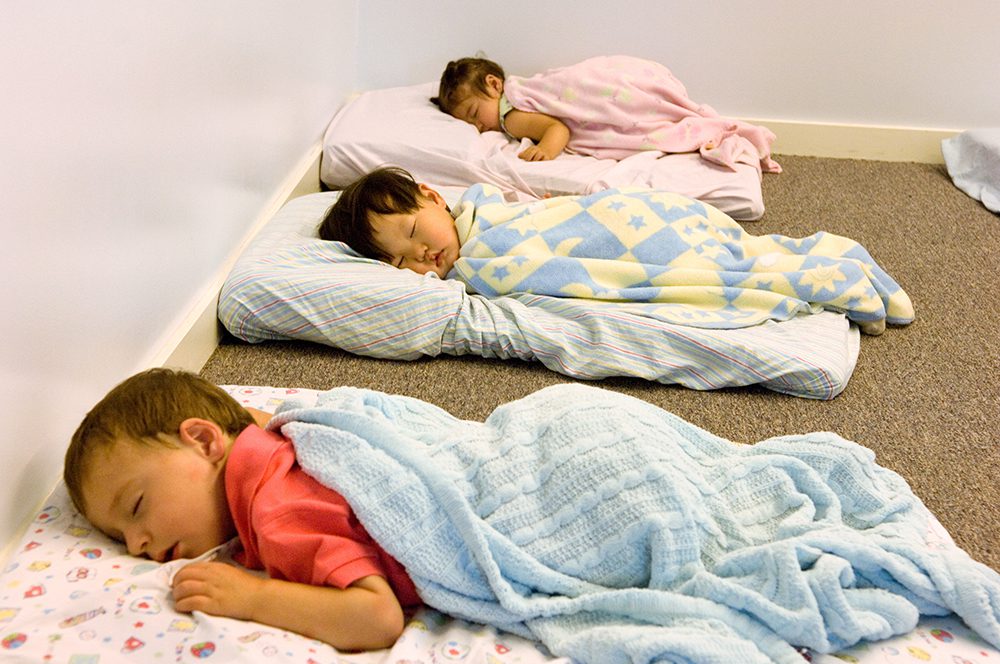 Your children are busy exploring and learning from an incredible collection of materials and activities in their Montessori classrooms. Parents often ask how much of the special learning materials they should purchase for their child to use at home. We answer: None! Children need other activities to complement what they are doing at school.