by Robin Howe, EdD | Mathematics, MFA, Montessori Education, Montessori Materials, Montessori students, Primary (3-6)
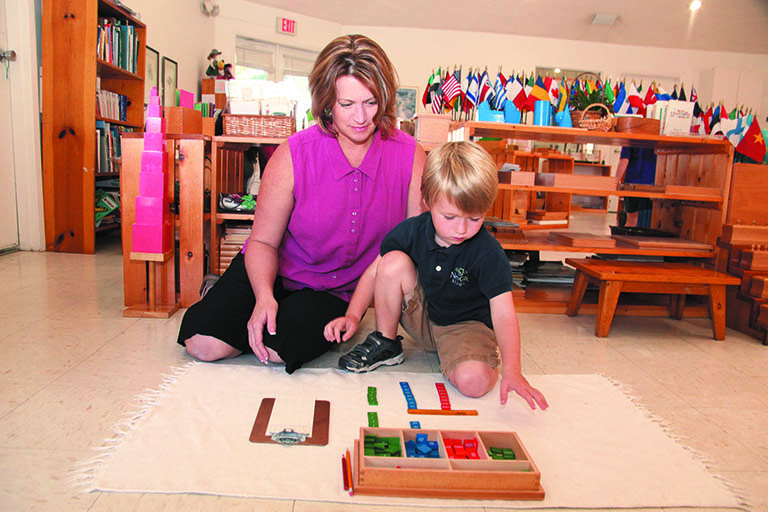
Montessori children work with hands-on learning materials that make abstract concepts clear and concrete. The materials allow young students to develop a clear inner image of concepts in mathematics, such as value and the ability to conceptualize how big a thousand is, what we mean when we refer to the ‘hundreds’ column, and what is actually happening when we divide one number by another. This approach makes sense to children. Developed by Dr. Montessori over one hundred years ago, today’s research consistently shows that this ’innovative’ approach, which is beginning to work its way into more traditional leading schools, works exceptionally well with most children.
As an example, let us consider the decimal system, which forms the basis of mathematics: units, tens, hundreds, and thousands. Normally, young children find it difficult to understand or operate with quantities larger than twenty. They cannot grasp the value of a hundred, thousand, or million … much less the idea that one thousand is equal to ten hundreds or one hundred tens.
Montessori overcame this obstacle by developing concrete, tangible materials that not only represent the values, but are equal in scale, representing each value of the decimal system. Units are represented by single 1-centimeter beads; a unit of 10 is made up of a bar of 10 unit beads strung together; hundreds are squares made up of 10 ten-bars; and thousands are cubes made up of 10 hundred-squares. Each one of these corresponding materials is presented to the child in a manner that shows how ten of each is equal to one of the values of the next place value: 10 units are equal to 1 ten; 10 tens are equal to 1 hundred; etc. Furthermore, because the corresponding values are constructed from smaller values, they are to scale in weight and size.
Together, they form a visually and intellectually impressive tool for learning. Great numbers can be formed by very young children. Able to identify each value and its corresponding bead material, the pre-school age child can actually build numbers by playing the Bring Me Game. “Please bring me 3 thousands, 5 hundreds, 6 tens, and 1 unit.”
From this foundation, all of the operations in mathematics, such as the addition of quantities into the thousands, become clear and concrete, allowing the child to internalize a clear picture of how the process works.
Often, two children will work together to construct and solve a mathematical problem. Using sets of numeral cards, each will collect a quantity for addition by deciding how many units, tens, hundreds, and thousands will be in his or her addend.
The corresponding cards themselves follow a color code in which the cards, showing the units 1 to 9 are printed in green; the cards showing the numbers from 10 to 90 are printed in blue; the hundreds from 100 to 900 are printed with red ink; and the cards showing the numbers 1,000 to 9,000 are printed in green again because they represent units of thousands. As the child progresses in arithmetic, this color scheme continues into the millions, each hierarchy (or family) is represented by the green of units, blue of tens, and red of hundreds.
As the children construct their number, they will decide how many units they want in their number, find the corresponding cards that represent that quantity, placing the created number at the upper right-hand corner of their work space. Next, they go to the ‘bank,’ or central collection of Golden Bead material and gather that number of unit beads that corresponds with the numeral cards selected. This process is repeated with the tens, hundreds, and thousands. By doing this, they are not only becoming familiar with place value and developing the skills of naming numerals, but they are developing the deeper understanding of the value of thousand, hundreds, tens, and units.
Next, the two addends are combined, which we call the operation of addition. Beginning with the units, the children count the combined quantities to determine the result of adding the two together. If the result is nine or lower, they simply find the large numeral card that represents the answer.
As the children count, if the quantity in the column is ten or greater, they stop at the count of ten and exchange them for the next highest quantity.
For example, in this case, when the units from both addends were combined, we had 13 units. The child gathers 10 units and carries them back to the bank to exchange them for a ten-bead bar: 10 unit beads is equal to 1 unit of ten. He has also used the large number cards to show the remaining number of units, which is 3.
This process is repeated with the ten’s column. Here, for example, we added 6 tens and 9 tens, plus the additional 10 that we carried forward. This gives us 16 tens. Our young friend gathers 10 ten-bead bars and takes them to the bank to exchange for another hundred square, which he places in the hundreds column. Finally, the child selects the correct numeral card to represent the total of the remaining ten bars, which is 6 tens. The process is continued with the hundreds and thousands. Helping the children to understand that 10 tens is the equivalent of a hundred leads Montessori students to more easily grasp complex concepts in the addition of large quantities, subtraction, multiplication, and division.
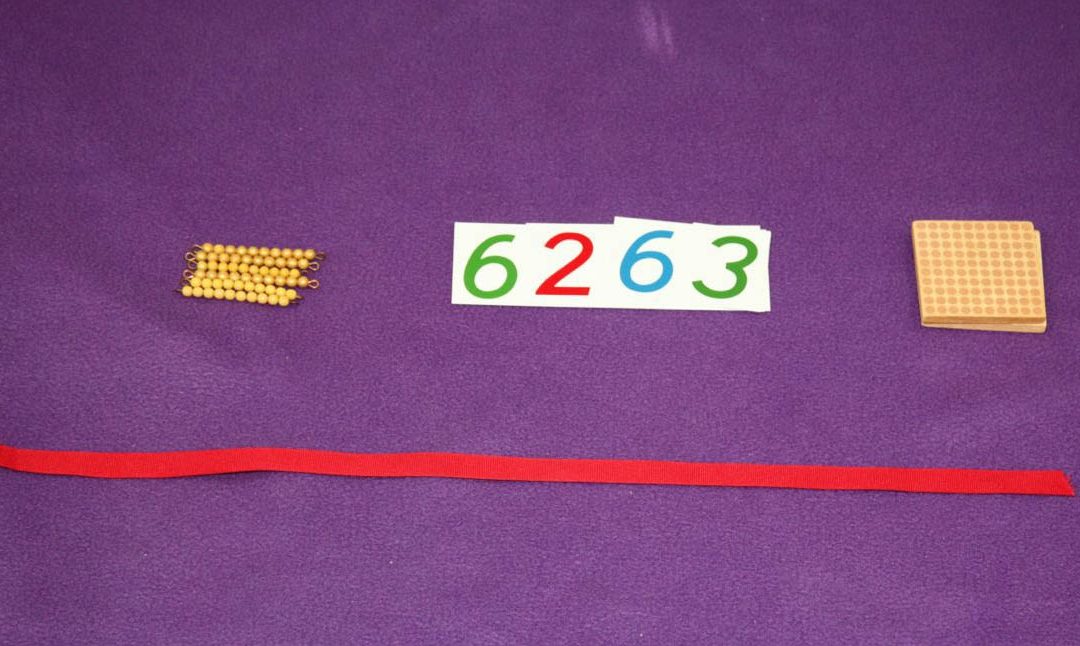
When everything is done, the children have their answer: 2,468 + 3,795 = 6,263
Notice how the cards increase in length as we grow from units to tens, then hundreds, and thousands. When the cards are laid down with the thousands on the bottom, each of the columns is shown in the answer: 6 thousands, 2 hundreds, 6 tens, and 3 units.
The Stamp Game
Once the children have mastered the Golden Beads, they progress into more abstract materials that represent value but are not equal in size or weight.
A favorite of Montessori students and parents alike is the Stamp Game that has small 2cm wooden stamps that represent each value. Like the cards used with the Golden beads, the stamps follow the same color scheme: green for units; blue for tens; red for hundreds; and again green for thousands. This same color scheme is used with Montessori materials that the children will use later to find square roots and in the study algebraic concepts.
The students will perform the same operation as they did with the Golden Beads; however, because the stamps are the same size, this requires more abstract comprehension of the material. They can use the Stamp Game on a smaller work space, creating both addends and then adding them, exchanging when the number of each place value is greater than nine.
Like the Golden Beads, the children create the first addend with the stamps, starting with the units and proceeding with the tens, hundreds, and thousands. After they have created their first addend, they build a second addend, leaving a space to clearly separate the two addends. Once the two numbers are created in two columns for each place value of each addend, they are pushed together to make one value, representing the sum of the two addends.
Starting with the units, the student counts the stamps, recording the number. In the example shown, there were 10 units of tens, which need to be exchanged for 1 unit of a hundred. This yields a total of 9 hundred tiles in the hundreds column.
By this stage, in addition to constructing the answer with the number cards, most children will also record their work on large square graph paper. The final sum of 2,468 + 3,795 = 6,263.
Many parents and teachers think that, while the Montessori math materials are appropriate for children during the preschool and kindergarten years, when they go on to the Elementary grades, children shouldn’t need them. In fact, as the children progress into ‘more difficult or advanced math,’ continuing to provide concrete opportunities for learning becomes even more important.
Elementary students rarely have the ability to think abstractly. Things that are not connected to their own concrete experience tend to be confusing. Mathematics is inherently abstract. Montessori’s objective is to use these concrete mathematical materials to help children develop an inner picture of mathematics that will last a lifetime.
Montessori often used the analogy of the purpose of preparing a smooth runway for an airplane. Once the plane has gained enough speed to fly, it can travel in any direction at great speed. However, the problem is how to provide a safe, smooth environment in which the airplane can begin the transition from a stationary object on the ground to a soaring thing of flight. The runway is the prepared environment essential for the aircraft. The Montessori math materials reflect an attempt to prepare an environment in which children can come to understand mathematics and begin to think and operate mathematically. n
by Michael Dorer, EdD | Family Resources, MFA, Montessori Education, Montessori Materials, Montessori Parenting
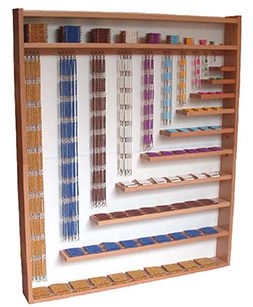
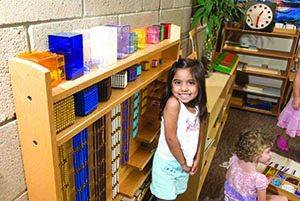
A focal point in every Montessori classroom is the shimmering display of multicolor beaded chains hanging in a custom wooden cabinet. Adult visitors always notice it, wanting to reach out, to feel and hold the strands: they are that compelling. And it’s no different with children: they, too, are attracted to these gleaming chains, squares, and cubes. These materials call to us all, saying “pick me up; handle me; work with me!”
This remarkable, iconic display is the Montessori Bead Cabinet, an organizer for several foundational materials and innumerable activities appropriate for Children’s House (Primary), Elementary, Secondary, and even collegiate and post-graduate work! The cabinet offers innumerable applications in mathematics: counting, skip counting (counting by fours, counting by fives, etc.), multiplying, squaring, cubing, manipulating polynomials, and exploring base systems beyond regular old base 10.
With its myriad offerings, the Montessori Bead Cabinet merits a closer look.
Description
The bead cabinet is a simple wooden stand, specially made to hold two sets of bead chains (long and short), an intriguing array of beaded squares and cubes, and twenty containers of arrow-shaped labels. It may also have an additional set of bead bars, each of which represents a number from one to ten.
The Colors
Each number represented by the beads is color-coded with a distinct hue, using this system:
| One |
Red |
| Two |
Green |
| Three |
Pink |
| Four |
Yellow |
| Five |
Light Blue |
| Six |
Lavender |
| Seven |
White |
| Eight |
Brown |
| Nine |
Dark Blue |
| Ten |
Gold |
The Colored Bead Bars
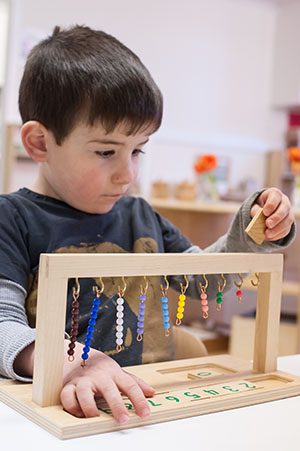
This is a set of ten different bead bar lengths representing the numbers from one to ten and using the color scheme introduced above. The beads are of glass or plastic, and they may be strung on wire or fused. The fused beads are frequently preferred for elementary work and are sometimes kept in a different location.
Thus, the “One Bar” consists of one red bead threaded by a small metal wire with looped ends, effectively giving the bead a set of tiny handles. The “Two Bar” consists of two green beads connected by the metal thread. The “Seven Bar:” is seven white beads threaded by metal wire. And so on.
The Squares
The Squares of the Numbers (sometimes called the Bead Squares or Squares of the Beads) are accurate representations of the numerical squares of all the numbers one through ten composed of glass or plastic beads colored like the bars and chains, that have been fused or wired together. There are as many squares of each color as the number of that color; thus, there are three squares of three, eight squares of eight, and so on, making fifty-five squares in all. The squares are kept on special shelves in the Bead Cabinet.
The Cubes
The Cubes of the Numbers (also called the Bead Cubes) are actual geometric cubes of the numbers one through ten, composed of glass or plastic beads colored according like the squares, that have been fused or wired together. One cube for each number makes a total of ten cubes, each aligned on display along the top shelf of the Bead Cabinet.
The Chains
Ten Short Chains, kept in specially designed “troughs” on the Bead Cabinet (sometimes hung on a separate wall hanger) are made of colored beads using the consistent color system. The Short Chains correspond in equal number to the Squares of the Numbers (the Bead Squares) but are here arranged in linear form – stretched out like lines.
Ten Long Chains also hang on the Bead Cabinet, one for each number, one through ten, colored as indicated above. Each bead chain corresponds to the cube of its representative number: this means that it contains precisely the same number of beads as the Bead Cubes, except that the chains are stretched out like a line. The chains are made of bead bars of the appropriate color all linked together.
Here are the values of all of the chains. Remember that the Short Chains are equal to the Squares of Numbers and the Long Chains equal the Cubes of Numbers.
|
|
The Short Chains
Squares of Numbers |
|
The Long Chains
Cubes of Numbers |
|
|
With Exponents |
Number Values |
|
With Exponents |
Number Values |
| The One Chain |
|
12 |
1 |
|
13 |
1 |
| The Two Chain |
|
22 |
4 |
|
23 |
8 |
| The Three Chain |
|
32 |
9 |
|
33 |
27 |
| The Four Chain |
|
42 |
16 |
|
43 |
64 |
| The Five Chain |
|
52 |
25 |
|
53 |
125 |
| The Six Chain |
|
62 |
36 |
|
63 |
216 |
| The Seven Chain |
|
72 |
49 |
|
73 |
343 |
| The Eight Chain |
|
82 |
64 |
|
83 |
512 |
| The Nine Chain |
|
92 |
81 |
|
93 |
729 |
| The Ten Chain |
|
102 |
100 |
|
103 |
1000 |
The Arrows
The Arrows are simply arrow-shaped labels contained in two sets of boxes: one set for the Short Chains and one set for the Long Chains. Made of wood or plastic, the arrows are color-coded to match the beads and are printed with the value of the bead to which they should point. The boxes are usually kept on a special shelf on the Bead Cabinet.
***************
All of these colorful materials are especially attractive to children who usually begin using them in the preschool years and continue with them through upper elementary and even beyond, doing different mathematical exercises along the way.
What is it for?
Children first use the chains for linear counting, or counting one at a time, like 1, 2, 3, 4, 5, etc. Using first the short chains to 100 and then the Long Chain to 1,000, the children enjoy counting and writing these numbers. Sometimes they write the numbers on ling strips of adding machine tape (possibly its only use today).
Later, children begin to count the chains using skip counting. This is simply counting while skipping some numbers, like counting by twos, threes, fours, etc.— every number through ten. Children can also practice regressive counting, counting or skip counting backwards. That is a harder than it may seem: just try counting backward by sevens from 49! You will quickly appreciate the challenge that these children eagerly embrace.
When chains are matched with the squares and the cubes, children can discover on their own that they are equal and most often enjoy folding the short chains to makes square and the long chains to make many squares. They can then skip count by squares, for example, 25, 50, 75, 100, 125. They might end at the cube or, especially if they are at the elementary level, go farther!
While skip counting, children can place the arrows to match the beads. Later, the children may choose to place only every other arrow, or the even numbered arrows, or the arrows divisible by three, experimenting with many creative patterns. Though the arrows are colored coded to match the chains, at later levels children often mix them up, using one arrow color with a contrasting chain.
Connections
One of the reasons that the Bead Cabinet is so powerful is that it connects so many diverse areas in mathematics. As children use this material, they discover that while it begins with counting, it is much more than that. Here are some of the additional activities and connections:
- Blank arrows. Using a set of blank arrows that should be kept in the classroom, the adult or a child writes any number on an arrow, for example, 365. Let the children count a chain, find the exact bead, and place the arrow. Children can also use the arrows to practice counting and marking just as they wish (by elevens, for example.). Sometimes classrooms have a basket of randomly numbered arrows for this activity.
- Non-linear arrangement. Children love to arrange the chain in zigzag, spiral, or other shapes, and they can do this and then proceed to count as usual.
- Multiplication facts. All of the chains directly correspond to the multiplication tables, with which so many children struggle. With this material, that struggle evaporates and understanding dominates; the skip counting exercises directly aid memorization of multiplication facts.
- Squaring and Cubing. Because the chains equal squares and cubes, they encourage unwitting memorization of the squares and cubes of all of the numbers from one to ten, a huge benefit to upper elementary and even adolescent exercises. They also assist with square and cube roots while providing a concrete model for what those terms mean.
- Squares of squares. The students compare the chains that are themselves the squares of other long chains; i.e., 4 and 2; 9 and 3. The Eight Chain represents the cube of the Two Chain, another area of fascination for the children to “discover” on their own.
- Taking two or more chains together represents an algebraic idea called a polynomial. In the elementary classroom, the most explored of these is called the Decanomial, the result of the somewhat intimidating expression (1+2+3+4+5+6+7+8+9+10)2 = 3,025. This Decanomial is represented by all ten of the long chains taken together. Laid out all together and marked with their corresponding arrows like a sunburst produces the Chain Decanomial.
- Base systems. The Bead Cabinet is ideal for introducing Mathematical Base Systems other than Base Ten. Our number system is called Base Ten because it uses ten number symbols: 0, 1, 2, 3, 4, 5, 6, 7, 8, and 9, which we use to create all of our numbers. With the cabinet, we can explore other base systems, such as Base Five, in which we only use five digits: 0, 1, 2, 3, and 4. Figuring out how to write values in this system is like breaking a code; the Bead Cabinet provides the perfect introductory material for doing it.
- Every chain has a relationship to geometry. Each of the long and short chains – three through ten – form, successively, a triangle, a square, a pentagon, a hexagon, a heptagon, an octagon, a nonagon, and a decagon. While the One and Two Chains do not form geometric figures, they do suggest a point and an angle. The children use the chains to construct these geometric figures then write and draw them in their notebooks.
- Finally, there are so many vocabulary words associated with this work that it needs to be thought of as having a role in the language area. Just a small sampling of the important vocabulary words that can be introduced and practiced with the Bead Cabinet materials are: squares, cubes, squaring, cubing, linear counting, regressive counting, skip counting, arrows, numerals, Long Chains, Short Chains, bead bars, and the colors of the chains.
Summary
The next time you peek into a Montessori classroom, make a point to examine the Bead Cabinet – you should find it in every classroom from Children’s House up through Upper Elementary, and you may find it in higher-level classrooms as well. As you admire the squares, cubes and chains, I hope you think of all of the exciting and insight-producing math work represented in this one cabinet.
Just imagine what the world could be like if we all had had a Bead Cabinet in our own math background. What a gift it is to our children!
Tomorrow’s Child / May 2017
by Cathie Perolman | Family Resources, Infant-Toddler (0 to 3), Kindergarten, MFA, Montessori Education, Montessori Family Life, Montessori Materials, Montessori Parenting, Montessori students, Montessori Teachers
Dear Cathie,
We are starting to look at schools for our child who will be three years old this summer. While we are drawn to the Montessori Schools we have visited and the activities we see there, we are finding the price quite off setting. Can you make any justification for the price of a preschool education? Also we see such variation among the Montessori schools in our area. Isn’t Montessori a brand name or a franchise? -–A Frugal Parent
Dear Frugal,
We applaud you for spending the time and energy to make a conscientious decision about your child’s education! And you are so right that visiting schools, talking with the staff, and observing functioning classrooms is the best way to get a feel for what a school is all about.
I will answer your second question first. No, Montessori is not a franchise. Each school is independently owned and operated. There is no real unifying body accrediting Montessori schools. So, while all Montessori schools ascribe to follow the writings and teachings of Dr. Maria Montessori (the creator of the ‘Method’ in the early 1900s), each school’s freedom to interpret the writings and teachings independently account for the differences you see among Montessori Schools. Some are more nature based and others more academic in their focus. Some only go through kindergarten and others all the way through high achool. Some encompass the infant/toddler age groups and others begin at age three.
All parents want to get the best value for their tuition dollars. But already you can see a cost benefit relation to a Montessori education. Why is a Montessori school costly? It is partly based on the extensive training that teachers undergo.
Training for Montessori teachers is roughly equivalent to a master’s degree in education. Although there are wide variances in length and style of training programs, teachers generally study for a year at the infant/toddler and 3-6 year old level and two years at the 6-12 year-old level to become trained in the philosophy and method of Montessori education. Some of these courses are full time; others meet once a month, and still others only for an intensive summer session. Most include a yearlong internship phase, where the teacher trainee is mentored by an experienced teacher in the same classroom. All programs include both practical and written exams to ensure mastery.
This is significantly different from the training of traditional preschool or daycare teachers. Their training is simply a 90-hour course in the safety and the basics of child development. In many non-Montessori programs teacher candidates are not even required to have completed college to attain certification.
The Montessori Method is based on scientific observation and specific teaching. Each skill is broken down into small components, which are taught in a child-friendly, hands-on manner. Children actually touch, move, and manipulate the materials growing the pathways of their brain as they do so. Although the classroom may look free and unstructured, each activity is created for a specific learning purpose. Montessori educators are trained in all of these areas.
The Montessori materials are also quite costly. The cost of furnishing a new Montessori classroom can be about $30,000. Each material is carefully made to a specific set of criteria. The activities for which these materials are used require master workmanship as the materials are teaching tools and are used daily by children. They periodically need to be replaced when they are no longer visually appealing or accurate according to size. All the Montessori equipment and furnishings are aesthetically beautiful and are an important aspect of the children’s environment, adding to the overall beauty and ambiance of the classroom. I think that this feature is obvious when visiting Montessori classrooms and often is enticing and drawing to both parents and children.
As you review the schools you have visited, I encourage you to consider the things that make Montessori education unique; level of teacher education, quality of the teaching materials and learning opportunities and the freedom of choice afforded to the children to follow their own learning path!
by Mark Fish | Children with Exceptionalities, MFA, Montessori Education, Montessori Family Life, Montessori Materials, Montessori Parenting, Montessori students
Somewhere along the way, some talented spin doctors convinced us all that desks in rows, subject-specific textbooks that fail to make connections between academic disciplines, large numbers of children in age-specific groups, highly defined short time periods for subject-matter study, rote learning, and adult-centered teaching constitute “traditional” education. I object, vigorously and vociferously. If adult-centered, textbook-oriented, rote learning is “traditional”, where does that leave child-centered learning-by-doing? What does that make the Montessori approach? “Alternative?” “Non-traditional?” I object, vigorously and vociferously. I suggest that the “alternative” mantle, which has been placed on our shoulders, does not fit, and I reject the “non-traditional” label.
Instead, I embrace the adjectives “timeless” and “classical,” and I urge Montessori parents and educators to do the same. To do anything less unfairly marginalizes the Montessori movement and diminishes its importance in a timeless educational continuum. Why? Because the philosophy and concept at the heart of the Montessori methodology and approach are as old as the Chinese, as classical as the Greeks, and as timeless as Socrates and Plato. They are shaped by Comenius and honed by Pestalozzi. They are ageless, they are time-tested, and they are proven. And, inasmuch as Montessori is in the tradition of the great educators of the world, Montessori is traditional.
At least until the graduate level must concern itself. In his book The End of Education, in which he seriously questions the current course of education in the United States, Neil Postman writes, “Our genius lies in our capacity to make meaning through the creation of narratives that give point to our labors, exalt our history, elucidate the present, and give direction to our future.” In one sentence he has defined the heart of Montessori education.
“Without a narrative, life has no meaning. Without meaning, learning has no purpose. Without a purpose, schools are houses of detention, not attention, ” Postman continues. More often than not, he argues, that is what our schools have become: houses of detention, where we avoid profound truths, where we sidestep moral instruction, and where the “means ” somehow become disconnected from the “ends ” of education. It is with the end of education- “a transcendent and honorable purpose ” that allows children to prepare for life (and not just to prepare to make a living) — that Montessori education has always concerned itself, and it is that premise, and the carefully devised curriculum and materials that result, which makes Montessori enduring and successful.
If “traditional ” does not feel quite right, use “timeless ” and “classical. ” There is no question that Montessori is most certainly those. And when you refer to commonly accepted teacher-centered, textbook-oriented methodologies, refer to them as “conventional ” not “traditional. ” The roots of the time-honored moniker “traditional ” belong just as well with our Montessori schools
by Lorna McGrath | Child's Work, Kindergarten, Language, Language & Reading, Lower Elementary (6-9), MFA, Montessori Education, Montessori Materials, Montessori Teachers, Primary (3-6), Reading, The International Montessori Council, Upper Elementary (9-12), Webinars / MFA, Writing
Join Lorna McGrath for a look at a powerful teaching for the introduction of new vocabulary or information called the Three Period Lesson. Find out how and when it is used in a Montessori classroom.
Download File

 The Arrows