by Tim Seldin | Kindergarten, Lower Elementary (6-9), Mixed Ages, Montessori Curriculum, Montessori Education, Montessori Materials, Montessori Teachers, Parent Education, Primary (3-6), Sensorial
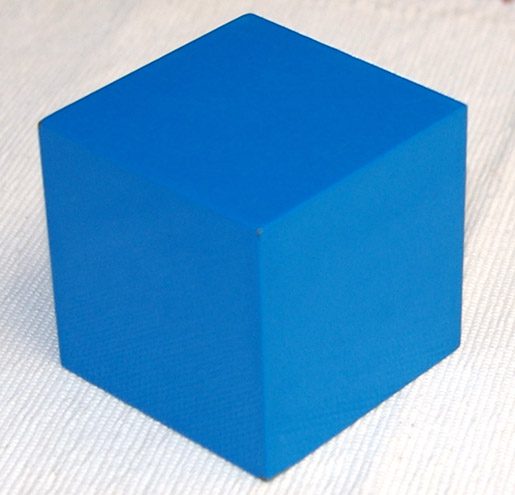
 The Pink Tower(left) is one of the Sensorial materials that children enjoy working with early in their Montessori experience. The Pink Tower, or Tower of Cubes, is composed of a graduated series of ten wooden cubes. The largest cube has a square section of 10 centimeters per side and is 10 centimeters high. Thus, it measures 10 x 10 x 10 centimeters.The square section and height of each of the succeeding cubes decreases by 1 centimeter, down to the smallest cube, which measures 1 x 1 x 1 centimeter.
Children carefully carry the Tower, cube by cube, to a little rug that defines their work area. They carry each cube comfortably at waist height, as they take the cubes and place them in random order upon the carpet. As they manipulate the cubes and carry them across the room, children get a very strong impression of size and weight. When all the cubes have been carried to the rug, a child looks for the largest one and begins to build the Tower, one cube at a time. At each step, he looks through the cubes that have not yet been added to the Tower to find the largest. As each is placed on the Tower, the child controls his movements to place the cube gently down right in the center of the larger cube on which it is rested. Once the Tower has been constructed, the child carefully takes it down and either begins again or returns the cubes, one by one, to their proper place on the shelf.
Some people have heard that in Montessori, children are taught that there is only one way to work with each material. In truth, the children explore and discover all sorts of creative ways to work with them. For example, students will construct the Tower horizontally, or line up two edges to create a vertical stairway. The children will also build the Pink Tower in various combinations with the Brown Stair along with some of the other Sensorial materials.
The Montessori Bells
The Montessori Bells (below left) extend the child’s ability to distinguish sounds into the area of musical pitch. They are a lovely set of bells fixed to little wooden bases. Each bell is tuned to either a whole or a half note on the standard musical scale. The entire set comprises one entire octave, including sharps and flats. The set includes one set of bells with tan bases for both half and whole notes; there is a second set in which the bases of the bells that sound the whole notes are painted white, and those for the sharps and flats are painted black.
At first the children learn how to strike the bells with a small mallet to produce a clear note and dampen them with a little felt-covered rod.
Then the teacher will set out two or three pairs of bells from the two sets. The children match the pairs that produce identical notes. When they can do this easily, additional pairs are added until they can match entire sets.
A more difficult exercise challenges the children to grade the bells of just one set by pitch, from the lowest to highest notes. As they become more familiar with the bells, children will commonly learn how to play and compose little melodies.
The Brown Stair … also known as the Broad Stair
The Brown Stair,which is sometimes called the Broad Stair, is made up of ten rectangular prisms, with bases that have exactly the same graduated measurements as the cubes of the Pink Tower, but which are uniformly 20 centimeters long. The child is challenged to scatter them around her rug and then sort them by size to place all ten prisms in proper order from thickest to thinnest.This results in a graduated series of rectangular prisms that resembles a little stairway. Because the squared sides of each prism correspond to the dimensions of the cubes of the Pink Tower, the two materials are often used together for all sorts of exploration and designs.
The Sensorial Exercises
A child interacts with the physical world through her senses. From birth, she will look, listen, touch, taste, pick up, manipulate, and smell almost anything that comes into her grasp. At first, everything goes into the mouth. Gradually, she begins to explore each object’s weight, texture, and temperature. She may watch something that catches her attention, such as a butterfly, with infinite patience. The Sensorial curriculum is designed to help children focus their attention more carefully on the physical world, exploring with each of their senses the subtle variations in the properties of objects.
At first, children may simply be asked to sort among a prepared series of objects that vary by only one aspect, such as height, length, or width. Other exercises challenge them to find identical pairs or focus on very different physical properties, such as aroma, taste, weight, shades of color, temperature, or sound. These exercises are essentially puzzles, and they tend to fascinate children because they are just difficult enough to represent a meaningful challenge. Each has a built-in control of error that allows children who are observant to check their own work.
The Sensorial exercises include lessons in vocabulary, as the children master the names of everything from sophisticated plane and solid geometric figures to the parts of familiar plants and animals. As the Inuit people of the Arctic demonstrate to us with their many different words for snow, we observe that as the children learn the correct names for things, the objects themselves take on meaning and reality as the children learn to recognize and name them.
Why is it so important to educate the young child’s senses? We certainly don’t believe that we can improve a child’s hearing or sight through training. However, we can help children to pay attention, to focus their awareness, and to learn how to observe and consider what comes into their experience. In a way, the Sensorial curriculum accomplishes something like a course in wine tasting or music appreciation; one learns to taste, smell, or hear what is experienced with a much deeper awareness and appreciation. These exercises can help children understand and appreciate their world more fully.
Red Rods
The Red Rods (above) are a series of ten rods (thin rectangular prisms) of which the height and width are uniform; however, they range in length from 1 decimeter (10 centimeters) to a full meter (10 decimeters or 100 centimeters).
The child scatters the rods around her rug and looks for the longest.As each is arranged next to the others in a series, the child discovers the regular progression of length. The teachers introduce vocabulary: short, shorter, shortest; long, longer, longest.
The Red Rods are exactly the same dimensions as the Red and Blue Rods in the Math area, which help children learn to count by showing the growth of quantity as length, distinguished by alternating patterns of red and blue to represent each number.
The Knobbed Cylinder Blocks
The Knobbed Cylinder Blocks are a set of four naturally finished (unpainted) rectangular blocks of wood, into which have been cut ten cylindrical holes. Each hole is filled with a matching wooden cylindrical inset, fitted with a little knob on the top to make it easy for a child’s small hand to grasp and lift it out of its perfectly fitted hole.
Each set of cylinders is constructed to vary in a regular sequence by either diameter, length, or both. The children remove each cylinder in turn, carefully tracing its length and circumference and the depth and circumference of each hole with one finger.
Knobless Cylinders
Once all ten cylinders have been removed and placed on the rug, the children take each in turn and find the hole into which it fits perfectly, with the top of the cylinder flush with the top of the cylinder block. If they’ve made a mistake, the children can normally see it for themselves because all ten cylinders will not fit correctly.
The children quickly begin to challenge themselves by attempting to ‘see’ which hole is likely to fit the cylinder in their hand rather than trying to fit each into one hole after the other. After a while, they will begin to do the same exercise with their eyes blindfolded, relying on touch alone. When they are ready for a greater challenge, the children will mix the cylinders from two, three, or all four blocks together and try to fit them all into the corresponding holes.
The Knobless Cylinders correspond to the four Knobbed Cylinder Blocks. With this material, each of these sets is painted red, yellow, blue, or green. With no cylindrical holes, the children depend upon sight or touch alone to arrange the cylinders.
Children will sometimes work with both the Knobless Cylinders and the more familiar Knobbed Cylinders, finding the match between each brightly painted and unpainted cylinder in turn. By working with all four sets of Knobless Cylinders together, children discover all sorts of geometric patterns and progressions within the material.
Mystery Bag or Mystery Box
One of the children’s favorite activities is the Mystery Bag or Box (shown above).Normally, it is simply a cloth bag or box with a hole for their hands in which they touch and manipulate objects that they cannot see. One activity is to place things that are familiar to the children inside and challenge them to identify them by touch alone.
Rough & Smooth Boards
Another exercise begins with the Rough and Smooth Boards (shown above), which have a surface that alternates between the roughness of sandpaper and a smooth finished surface.The children wash their hands in warm water before beginning to make them more sensitive.
Sandpaper Tablets
The Sandpaper Tablets (above) are a set of wooden tablets covered with several different grades of sandpaper. The challenge is to identify pairs that have the same degree of roughness, working by touch alone. An extension of these activities is commonly created by assembling a collection of pairs of cloth swatches cut from many different materials, each with its own texture. Again, working with eyes blindfolded, the children attempt to find the pairs by touch. Like all Montessori exercises, there is a built-in control of error. In this case, the children learn to check their work by removing the blindfold and seeing if they have identified the correct pair.
The Color Tablets
The Color Tablets help the child learn to distinguish among primary and secondary colors and tones, while mastering the words used to describe each color and shade.There are three separate boxes of Color Tablets.All of the tablets have the same shape and differ only in color. The first box of Color Tablets contains six tablets, two each of yellow, red, and blue. The children simply match the pairs and learn the spoken names of the colors. The second box of Color Tablets contains eleven pairs of secondary colors and tones, which the children match and name. The third box of Color Tablets contains seven different shades of nine different colors, which the children learn to sort in order from lightest to darkest shade.
When all of the tablets are laid out in an array it creates a lovely display of color. There are many ways in which the children and teachers can make the color tablets more challenging.For example, the children will try to find the tablet that is closest in color to something in the environment. Another challenge is to give the child a color tablet from the third box and ask him to go to the box and, by memory alone, bring back the tablet that is just one shade lighter or darker.
The Smelling Jars
Children enjoy using the Smelling Jars to learn to identify different non-toxic smells using their olfactory senses. Typically, aromatic oils or extracts (such as lemon or peppermint) are placed inside the canister (using a cotton ball and a few drops of oil). Other cannisters might contain spices, such as cinnamon.
The Sound Cylinders
The Sound Cylinders are six pairs of sealed containers filled with substances that make distinct sounds when shaken, such as beach sand or dried peas of different sizes. The children carefully listen to the sounds and match the containers that have the same sound.
The Geometry Cabinet
The Geometry Cabinet is a set of puzzles made in the shapes of the essential plane geometric figures. It consists of six drawers, each of which is fitted with several wooden frames, inset with a geometric form. In addition to the familiar circle, square, and rectangle, the child is introduced to a much broader array of complex figures, from the right scalene triangle to the decagon; and from ellipse to the curvilinear triangle through the quatrefoil.
In addition to removing the pieces and replacing them in their frames, children sequence some shapes by size and classify other shapes by type. They also learn how to match them against three sets of printed cards that represent the same figures in increasing degrees of abstraction. The first set represents each shape completely colored in on the card in the same size as the piece from the cabinet. The children simply cover each card with the matching puzzle piece.
In the second set, the geometric shapes are printed as outlines drawn with broad lines that leave the inner area white. In the third set, the figures are simply traced with thin lines. As children gradually begin to recognize the more abstract representations of the three-dimensional objects, they are preparing themselves to recognize the little lines and squiggles of the written word.Gradually, children learn the names of each of the geometric shapes. Once children begin to read and can verbally identify the shapes, they begin to label them with pre-printed name cards. Eventually, the children will be able to prepare their own cards from scratch.
The Geometric Solids
The logical basis for the Geometry Cabinet is the set of Geometric Solids. The children learn the names of these beautiful wooden forms, identifying them, at first, by sight and eventually when blindfolded.
The set includes a sphere, cube, rectangular prism, a square-based and broad pyramid, triangular pyramid, ovoid, ellipsoid, and a cone. The children quickly begin to look for each geometric form in their environment. They also begin to discover the relationship between the two-dimensional figures and the solid forms: a circle is related to a sphere; a square to a cube; etc.
As they begin to read, children will learn to match Geometric Solids to a set of prepared label cards. Eventually, they will be able to prepare their own. This early introduction to geometry continues in the Elementary Montessori program. After years of hands-on experience with geometric figures and other mathematical exercises, children normally find it very easy to grasp more advanced concepts, from the definitions of geometric terms to the calculation of area, volume, and circumference.
The importance of puzzles in the Montessori approach
This young child is working with a Number Puzzle
Everyone who has worked with young children, whether a parent or teacher, knows how much they enjoy wooden puzzles; however, most of us take puzzles for granted and fail to appreciate their hidden potential as an educational tool. The puzzles that we commonly give to young children depict little animals or cute scenes.
Dr. Montessori came to recognize that the attraction of fitting the pieces of a puzzle into the insets on their frames lies in the process of manipulating an object in all directions and finally discovering the one and only correct way that it will fit. There is more to all this than simply the satisfaction of solving a puzzle. Somehow, we find that young children experience things that they can touch and manipulate quite differently from a picture of something printed on a piece of paper. In short, the positive and negative insets of a puzzle are much more real and interesting to a child than a simple two-dimensional picture.
In the Montessori classroom, puzzles are not only used to help children learn to manipulate objects and assemble a complex whole from several parts; they are used to introduce children to a tremendous range of concepts and vocabulary, from geometric shapes to the countries of the world and the parts of a Flower.
The Binomial & Trinomial Cubes
These cubes are two of the most fascinating materials in the Montessori curriculum.At one level, they are simply a complex puzzle in which the child is challenged to rebuild the cubes and rectangular prisms contained in the box back into the form of a larger cube. Color coding on the outside of the box and the sides of certain pieces helps the child detect the pattern. The material is also an exercise in algebra and geometry, representing in concrete form the cube of a binomial (a+b)3 (above left) and a trinomial (a+b+c)3 (left) where a=2 cm., b=3 cm., and c=4 cm.
A Trinomial Cube
Editorial Note: The materials described on these two pages may not seem to the layperson to be Sensorial in nature, as much as algebraic or geometric.They are, however, included in the Sensorial curriculum, because this is where they are introduced to Montessori students in the early years.
The Constructive Triangles
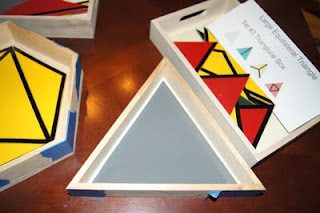
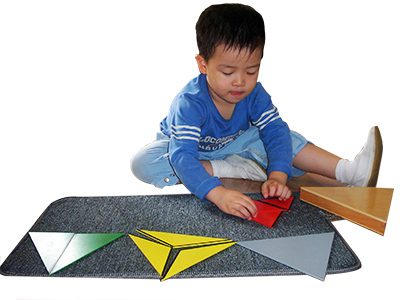
The Constructive Triangles allow children to explore the geometric possibilities inherent within several different types of triangles. The material consists of six boxes, each of which contains a set of brightly colored, flat wooden triangles, which can be manipulated like a puzzle to explore congruency and equivalence. For example, two right triangles joined together along the hypotenuse form a rectangle. To help the young child recognize the essential relationships, most of the triangles have a line drawn along those edges that join together to form new figures, such as rectangles, squares, trapezoids, and polygons. Working with the Constructive Triangles, children explore how various triangles can form regular polygons in geometry.
by Tim Seldin | Lower Elementary (6-9), Montessori Curriculum, Montessori Education, Montessori Materials, Parent Education, Prepared Environment
The following very brief introduction was prepared by Tim Seldin, President of The Montessori Foundation during his
years as Headmaster of The Barrie School in Silver Spring, Maryland (1971-1993).
Montessori schools are designed to prepare children both for university and for life.
There are three key ideas that are central to the mission as a Montessori school:
– It is not the adult who shapes the child; it is the child who, through his experiences, creates an adult human being.
– Teaching is not something that one can do to another; we can only facilitate the natural process of learning.
– There is a clear connection between one’s sense of self, of being fully alive and open to new ideas and experience, and ability to learn.
Recognizing this, we are engaged in a process of facilitating the development of self-actualized
renaissance men and women. Such people are ‘teacher-proof.’ They have learned how to learn and see school as a center of an enjoyable, lifelong experience. Children with values such as these will normally go on to college, perhaps after first taking a year off for work or travel, as the natural extension of their previous education. There is a great debate over the appropriate balance between Montessori’s objective of cultivating the child’s spontaneous interest in learning and the expectations of parents and society.
Normally, a school is perceived as the transmitter of culture from one generation to the next, through a formal curriculum. This is certainly an important part of the mission. However, as a Montessori school, we are equally committed to the development of responsible members of the human family and the protection of the child’s fragile spark of curiosity and creativity.
Most children know far more about the world before they start school than they will show a few years later when they have learned to be passive learners who don’t trust their senses, intellect, and imagination. Therefore, our greatest task is to help our students to rediscover their brain’s ability to think, intuit, discover and to develop a sense of independence, sequence, and order – to learn how to learn.
At the same time, as an independent school, parents come to us and pay a great deal of money in tuition for services available from the public schools, for which they have already paid through their taxes.
They come to us seeking quality programs and services! Their highest priorities are:
1. academic excellence
2. character development
Clearly, they expect their children to be well prepared for college, but, beyond this, they are looking for a school experience that will offer something special. They want a school experience that is intellectually exciting and that will develop a wide range of talents and interests.
The delivery of these services is difficult to document from the school’s end, and, from the parent’s end, even more difficult to evaluate. Thus, parents expect to be kept abreast of the programs that address these goals and their children’s progress in each program. As a result, we work carefully to maintain this delicate balance.
The curriculum can be thought of as having two aspects:
1. The school’s basic expectations for what will be first introduced, worked on, or reviewed and targeted for mastery by 85 to 90 percent of all students at each age/grade level.
2. The lessons that arise out of the children’s natural curiosity. While we follow a planned syllabus to give us cohesion and structure, we should never be satisfied with a year spent giving students set lessons from a prescribed syllabus. By providing children with all sorts of books, pictures, specimens, and artifacts, we can almost guarantee that we will encourage their curiosity and expand their scope of learning. By this, we mean to suggest that, instead of moving through the set curriculum more quickly, we allow children to explore additional related topics that capture their interest.
Montessori curriculum is designed to intrigue children and develop a lifelong love of learning. No topic is presented just once and forgotten; lessons are introduced quite concretely in the early years and are reintroduced later at increasing degrees of complexity and abstraction.Students gain experience and develop skills at one level of understanding, which prepares them for more complex lessons at the next level.
The spiral of the Montessori curriculum has no end, and the depth to which any topic can be pursued is limited only by a student’s interests and ability. At the same time, our expectations are quite high; challenging each student to his/her fullest individual potential, establishing a clear standard of achievement and quality of thought and work.We encourage accelerated students to expand their studies horizontally, researching topics at greater depth and a more sophisticated level of thought and analysis.
Our course of study is consciously multidisciplinary.It is an examination of the natural world and the human experience that interconnects the traditionally separate subject disciplines. Units of study cut across the curriculum, weaving together, as one example, the land, flora and fauna, folktales, art, dance, poetry, architecture, history, everyday life, and cooking of a country under study.
The curriculum has no outer limits except for humanity’s knowledge and imagination.At the same time, our core curriculum has been carefully structured to establish benchmarks for achievement by most students by the end of each level.
At its finest, Montessori is an incredibly elaborate model of education. We don’t advocate using all these tricks and devices simply to make the school day pass more pleasantly or to prepare students for their standardized tests at the end of the year. The real aim of education, as we see it, is to prepare children to live lives filled with personal satisfaction, as responsible, concerned citizens of the Earth.
An important element in achieving that goal is the development of knowledge and understanding about the world: civilization.However, along with this must come self-knowledge, self-respect, compassion, and a mind and heart open to new ideas and information.Our goal is to help children to learn how to learn.
The Montessori Learning Materials Are Not the ‘Method
**Editor’s Note**: This introductory section has been written by me: a Montessori mom, and long-time editor of *Tomorrow’s Child* … but not a trained Montessorian. These are my observations, based on how I have come to understand the role of the Montessori materials over the years. – **Joyce St. Giermaine, Editor**
Most newcomers to Montessori are awestruck at the array of colorful materials, purposefully arranged throughout the classroom. It is an amazing sight for adults and children. The materials almost call out to be picked up, handled, and treated with respect.
The materials, however, are not the ‘Method.’ The ‘M’ in Method is capitalized, at least in my mind, for a reason. Think of Montessori as a five-star restaurant, recognized for the best cuisine for miles around. You make a reservation, and the day arrives when you are finally seated at a beautiful table: linen tablecloth and napkins, fresh-cut flowers, exquisite water goblets, and silverware that is just the right weight to rest comfortably in your hand.There is soft music playing in the background, the lighting is just right. The restaurant is warm and inviting, the waitstaff is calm and respectful and happy to attend to your every need. In the food-service industry, we would call this ‘ambience.’ In Montessori, we would call it a ‘prepared environment.’
When the food is served, it is everything you expected and more. You leave the restaurant feeling satisfied and happy; you made a good choice. For a minute, let’s consider how you would feel if the food were not particularly good. No amount of ambience will make up for a mediocre meal, especially if you are paying top dollar for it. Now, let’s consider how you would feel about receiving the same great meal at a small restaurant, with plastic cutlery, rock music blaring in the background, and a predominantly take-out clientele. It would certainly be a different experience, and you might actually be in the mood for something loud and fun, but maybe not every day or for a special occasion. You might be willing to overlook the lack of ambience if the food is good. If the food isn’t good, you probably won’t return.
Not all Montessori schools can be compared to an expensive five-star restaurant, nor should they. Montessori education takes place in the most prestigious locales throughout the world; it is also found in migrant-worker camps and impoverished countries, where parents and teachers make their own materials from whatever is available to them in their region.
Montessori materials are ‘tools’ that Dr. Montessori developed to complement and expand the principles of her Method. Although there is something called a ‘control of error’ incorporated into the design of each material, the materials, themselves, are not a substitute for the lessons they represent. Going back to our restaurant analogy: ambiance, excellent food, and great service need to go together to produce a quality product.
Montessori materials are deceptively ‘simple’ in appearance, but they are surprisingly complex in design and purpose.Think of the puzzle boxes you may have had as a child. There were star-shaped holes, round holes, and square holes, along with correspondingly shaped pegs. Most of us quickly concluded that the square pegs just didn’t work in the round holes. Some of us took a bit longer, and even if we continued to disagree on a philosophical level that round and square should be interchangeable, we eventually realized that it was a waste of time to continue to try to force something to fit where it clearly didn’t belong. That’s control of error.
But what else did it teach us? Did we learn that the shapes were geometric figures? Did we learn the names of each shape? Did we discover on our own that one shape weighed more or less than the other? Could we close our eyes and recognize each shape by touch alone?Could we use our finger to draw the shape in a tray of sand? Could we sound out the letters in the word star? What else is round? A plate, the Earth, a goldfish bowl? And so on. The possibilities are endless. That is the Method.
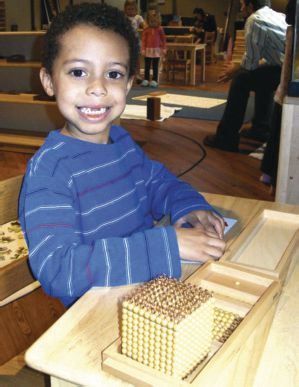
Take a look at the Knobbed Cylinders on page 42. Notice the concentration and excitement on the little boy’s face.To the casual observer, he is having fun with a puzzle. To a Montessori teacher, he is learning to understand the concepts of *length, circumference, weight*, and *depth*. And he’s enjoying the satisfaction of his ‘work.’
At The Montessori Foundation, we get many phone calls from well-intentioned parents and ‘traditional’ educators, who want to incorporate Montessori into their school or home environment.
Often, they just want to know where they can obtain Montessori materials. This comes from the erroneous belief that it is the materials that define the methodology.Despite the elegant simplicity of the materials, there is more than one hundred years of pedagogy and implementation behind their design, and Montessori teachers are specifically trained to incorporate each material into the bigger picture of what we call the Montessori Method.
At this point, our phone callers usually ask to buy the Montessori ‘manual’ to explain how to use the materials. Sometimes, they become frustrated and disappointed that such a book is not available, probably thinking that it’s a big secret that we are keeping to ourselves to the exclusion of the rest of the world. Not so. A good Montessori teacher, we explain, spends years of classroom study, along with classroom internship, working with children under the guidance of master Montessori teachers, to become qualified to provide lessons incorporating the Montessori materials.
As you read through the descriptions of the materials in this issue, please remember that every exercise and material has a specific purpose, usually involving many steps, along with a built-in control of error.It is the coming together of methodology and materials that is behind the genius of the Montessori Method. Although the teachers are never intended to be the focal point in a Montessori classroom, it is the teachers, with their knowledge of the intended learning objectives of each lesson, the proper use of the corresponding materials, and their ability to “follow the child,” who are committed to providing the environment and guidance to implement the methodology that allows children to learn new skills, incorporate new information, and maximize their years in Montessori.
by Greg Hicks | Mathematics, MFA, Montessori Education, Montessori Materials, Primary (3-6), Sensorial
It was Plato who said,
Geometry is the experience of the eternally existent. The study of the ‘One’ is among those that lead the mind on and turn it to the vision of reality.”
This is the basis of the sacred work of geometry. It is the study of the universe, the world we live within, and our interconnected relationship with it. It is called ‘sacred’ not because it adheres to a specific religious or spiritual ideology but, rather, because it offers the practitioner a way to appreciate the world with wonder and to explore life’s most fundamental questions. This is done through physical means, through the practice of geometry. Maria Montessori shared in this vision of geometry in speaking of, “the reciprocal relationship between man and the objects of the environment.”
It is this geometric exploration into the interconnectedness of the universe and themselves that truly speaks to the child. Children look upon the world to explore, discover, and reveal who they are: psychologically, emotionally, physically, and spiritually. This happens through their interactions with, and observations of, this relative, physical world. It is in this pursuit that sacred geometry entices the child. It offers the child a spiritual exploration through physical means, that guides and leads the child to the mystical wholeness they find within their own hearts and minds. In the child, Sacred Geometry fosters wonder, keen observation and a holistic understanding of the universe and the environment where they live.
It begins with the study of the ‘One,’ as Plato suggests. This is shown through the circle.
Children will find delight in using the compass to form all sorts and sizes of circles. The circle manifests as the image of oneness and is well represented in the art and architecture of the world’s great spiritual traditions, as in the “O of Giotto,” the Zen “Enso,” or in the stained glass of the famous Chartres Cathedral in Paris, France. Through the meditative practice of creating the circle, and reflecting on it, the image of wholeness is reflected back as the child’s own completeness.
The child then discovers how the ‘One’ becomes two. This is represented through creating an exact emanation of the original circle, formed on the circumference of the original. This precise emanation creates the birthplace of geometric shapes, the coming of duality and the construction of the world as we experience it.
This space, within the intersecting points of the two circumferences sharing the same radius is called the “Vesica Piscis,” or “Bladder of the Fish.” The “Vesica Piscis” holds the pure creative potentiality of the universe. It is at this point that children’s creative energy will flow freely and their minds are “turned to the vision of reality” as they discover the many shapes, images and artwork that arises within the “Vesica Piscis” and, ultimately, from the original circle or oneness.
They discover a line and its division, the constructive triangle, the manifest square, rectangle, and the many polygon constructions. Children’s sensitive periods for imagination are stimulated and come to life as they construct and observe each shape and experience the structures of the world. The child finds familiarity in these shapes through observing their environment and within themselves.
As children continue creating polygons within the original, with more and more sides through the bisection of the constructive triangles, they find something quite extraordinary: the many has returned to the “One.” How is this possible?
We experience it in geometry as the polygon slowly becomes the circle again, as more and more sides are added to it. The child might even say, “Look, it’s becoming the circle again!” But how does the “eternally existent” manifest in our own lives? This is the real question of Sacred Geometry and one for each of us to discover through our own practice, as the child does quite naturally through concentrated work. (Please note that this is a very brief introduction and overview of this topic and process, and is in no way meant to be taken as an exhaustive account.)
Each step along this geometric journey affords the child the opportunity to realize something about themselves and the environment in which they live. This ultimately manifests in beautiful artwork and mandalas that the children create from the spark in their heart/mind. Not just artwork on paper but the beautiful artwork of their being.
It is important that children are able to discover of their own accord and not be told what they might find or experience through this work. While this description is quite abstract, the child’s experience is real and actual and devoid of such unneeded intellectualizing. Any such explanation would only serve to diminish the child’s interest and wonder.
The study is also one that will take time and patience. No specific timeline should be set, it will come when it is ready. Some guidance on the process is all that is needed; a direction into the use of the compass and straight-edge and how to create the basic constructions is helpful. This is truly a journey of self-exploration and it is through the child’s self-discovery that Maria Montessori’s vision of peace in the world becomes a reality of humankind’s future.
Now, for the Montessori guide, the practice of Sacred Geometry leads us into our own inquiry. It offers us a medium for the internal work and preparation necessary to follow and guide the child with fresh eyes; within our classrooms and in the world. Working with the compass and straight-edge, we find a meditation on the building blocks of our life. Like the child, we begin with the circle and move step-by-step. We encounter our edges as we bump up against our own challenges. We must learn and practice patience and focus as we come to the work each time.
It gives us insight into the child’s challenges as well, as we realize our own limitations. Perhaps we notice our own insecurities in our ability to create the work as we would like. Or, we struggle with our desire for perfection, and with our comparisons to others. Ultimately, through practice, we come to see the shapes as complete as they are and realize that we, too, are complete as we are.
As we gaze upon these shapes and observe our world, we see that geometry is everywhere; it is this life itself and in and through each and every one of us. It is nature and the whole of the universe. Like the child, we discover things about ourselves that helps us appreciate our children and the wonder they experience in the world.
I encourage each and every one us to join in this exploration of the fascinating and awe-inspiring practice of Sacred Geometry. Learn and guide your children in how to utilize the geometer’s tools, the compass and straight-edge, to create inspiring geometric works, and take a personal journey of self-discovery, as we explore the structures and building blocks of the world in which we live.
Tomorrow’s Child / Sept 2016 / p 9
by Michael Dorer, EdD | Kindergarten, Language, Montessori Curriculum, Montessori Education, Montessori Materials, Montessori Teachers, School Resources, The International Montessori Council, Upper Elementary (9-12), Video, Webcasts / IMC, Writing
Function of words part 2 slides
This week, Dr. Michael Dorer will present the second half of Functions of Words: Making Grammar Exciting and Fun!
Is grammar a scary subject to you, or do you even find it useless?
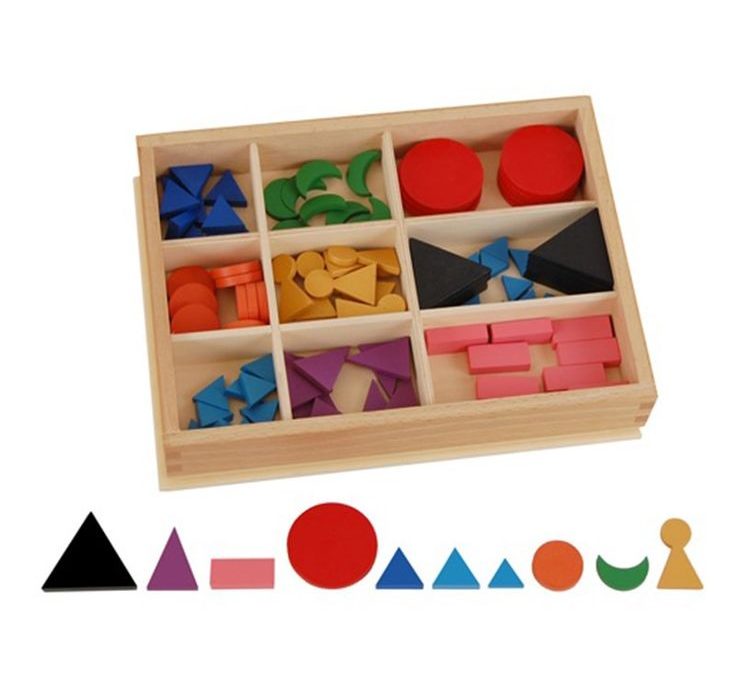
Join Michael in a two-part romp through the world of words and their functions in the Montessori way. Discover symbols, stories, parsing, and parts of speech in an exploration of one of Montessori’s most creative and innovative subject areas.
Believe it: grammar can be great!
by Michael Dorer, EdD | Kindergarten, Language, Lower Elementary (6-9), Montessori Curriculum, Montessori Education, Montessori Materials, Montessori Teachers, Primary (3-6), Reading, The International Montessori Council, Upper Elementary (9-12), Video, Webcasts / IMC, Writing
Download PDF of slides Grammar Webinar Part One
This week, Dr. Michael Dorer presented the second half of Functions of Words: Making Grammar Exciting and Fun!
Is grammar a scary subject to you, or do you even find it useless?
Join Michael in a two-part romp through the world of words and their functions in the Montessori way. Discover symbols, stories, parsing, and parts of speech in an exploration of one of Montessori’s most creative and innovative subject areas.
Believe it: grammar can be great!
by Michael Dorer, EdD | Lower Elementary (6-9), Montessori Administrators, Montessori Charter Schools, Montessori Curriculum, Montessori Education, Montessori Materials, Montessori Teachers, Prepared Environment, Primary (3-6), School Leadership, School Resources, The International Montessori Council, Upper Elementary (9-12)
Authorized List of Montessori Materials for Montessori Classrooms
Organized and Edited by Michael Dorer
Contributors: Michael Dorer, Syneva Barrett, Lois Bobo, Rose Dorer, Peter Hanson, Shanna Honan, Maria Kaminstein, Angela Lord-Carsrud, Ann Luce, Chris Sacerdote, Larry Shankar, Maria Verhaal
Copyright Michael Dorer Shared with members and students on the Montessori Foundation and International Montessori Council with the author’s permission.
Montessori Materials List for age 3 to 12 from Michael Dorer
by Tim Seldin | Montessori Curriculum, Montessori Materials, Prepared Environment, School Leadership, School Resources, The International Montessori Council, Webcasts / IMC
>
This week we discussed the topic of what belongs in an early childhood Montessori classroom. We share a suggested list of materials and furnishings with you. Our goal was not to cover each material, but to discuss the issue in broader terms and to explore the issue of materials from outside of Montessori.
by Tim Seldin | Montessori Materials, Montessori Teachers, Primary (3-6), Sensorial, The International Montessori Council, Video, Webcasts / IMC, Webinars / MFA
This week, we will take a look at that most iconic Montessori material, the Pink Tower.:
What is it?
How is it used?
What does it teach?
Why is it pink?
What about all of those variations and extensions? Where do they fit in?
by Michael Dorer, EdD | MFA, Mixed Ages, Montessori Education, Montessori Materials, Montessori Middle School, Montessori Secondary / High School, Prepared Environment, Primary (3-6), Sensitive Periods
When people first come to study the approach that bears Dr. Maria Montessori’s name, they often see it as simplistic—easily grasped and even more easily implemented. It is not uncommon to hear Montessori principles boiled down: it’s “all about choice”; “independence is the centerpiece”; or “it focuses upon the idea of ‘work.’” Montessori is much more than any of these oversimplifications.
Experienced Montessorians know that the approach is exceptionally complex, employing and depending upon many principles, procedures, and concepts of human development that are intertwined so closely that it can be very difficult to separate them into individual discrete strands.
Still, many people do make that attempt, and this represents one such effort. A few weeks ago, Tim Seldin challenged me to identify the ten (only ten!) most significant principles of Montessori theory and approach. While it is evident that ten is just an arbitrary number and that there are many more key elements of Montessori education, I was able to identify ten important principles, and while they may not encompass the whole of Montessori theory, they do represent essential components without which Montessori viewpoints cannot be fully understood.
There was only one problem – how to bring those ten principles into being in a real Montessori setting. That called for a little addition – Ten plus One. Let’s look at the essential ten principles first:
Respect
Respect is a core notion essential to understanding Montessori. A Montessori classroom conveys respect not only for children but for all living things. On a global or cosmic basis, a respectful relationship with the Earth, its resources, its life forms, and, indeed, the entire universe, is central to Montessori philosophy. At the same time, respect in the immediate environment calls for reverence and appreciation for the developing lives of children and requires that they are treated appropriately so that the culture models the essential respect deserved by every human being, both in the school as well as in the entire world.
Creativity
Creativity in Montessori theory refers to two quite different concepts. In volume one and two of Montessori’s Creative Development in the Child, (Montessori, 1998) the term creativity refers to the child’s inner creation of his or her personality or psyche. According to Montessori theory, every person is the creator of the adult, which he or she will become. This act of creation is what Montessori calls a Great Work and is the reason that the activities and play undertaken by children are referred to as ‘work.’ Although on the surface it may look like play, Montessori appropriately identifies the behaviors of childhood as the unconscious work of their own creative development.
The other meaning of creativity is, of course, the more conventional one— inventiveness, resourcefulness, and innovation—it’s conventionality not implying any less importance. In fact, this valid definition of creativity, the engagement of the imaginative mind—is, itself, essential in Montessori education. While creativity in this sense leads to new ideas or new knowledge, it also serves a developmental purpose in expansion and growth of the mind. It is for this reason that creativity is considered the top level of higher-order thinking in the new revised version of Bloom’s taxonomy of educational objectives, a classic study of thinking (D.R. Krathwohl, 2002.)
In the first Children’s House in the Roman suburb of San Lorenzo, Dr. Montessori offered three freedoms to the children, over time: the freedom of movement, the freedom of choice, and the freedom to repeat. Each of these is an essential principle of Montessori theory and philosophy. The stories of the discoveries and implementation of these freedoms are fascinating, but are subjects for a separate article.
Freedom of Movement
Movement is absolutely essential to the authentic Montessori environment. The key to understanding the idea of movement is that it must be purposeful and serve the child’s developmental needs; therefore, the aim is controlled movement over that which is random or disorderly movement.
There are two general sorts of movement in the Montessori classroom: large-motor movement and fine-motor movement. Large-motor movement refers to movements of the large muscles of the body. Montessori schools offer large-muscle movement when children carry materials to and from shelves, walk the line, practice certain verb commands, clean and tidy, and in dance or drama work. Purposeful and serving educational functions, these activities are proper and desirable. Fine-motor movement in the Montessori classroom occurs when children manipulate materials, such as: beads, blocks, or cubes; practice and execute handwriting skills; sew or knit; paint or sculpt. Fine-motor skills are even practiced through appropriate gestures that accompany speech.
Montessori theory postulates that there is a developmental and intellectual connection between the movements of the hands and the growth of mental understandings – a hand /mind connection. As suggested by Dr. Montessori herself, writing, “The hands are the instrument of Man’s intelligence,” (Montessori, The Absorbent Mind, p. 27) fine-motor movements are central to young people’s growing mental abilities.
Freedom of Choice
Children in Montessori programs are faced with many choices every day. This is intentional. With choice, there is occasional failure or misjudgment, and that is also intentional. By making choices and discovering the consequences of each choice, children grow and learn.
Not every choice is possible. Choices are limited by safety, kindness, respect for self and others, proper use of the materials and environment, and, to some extent, by cultural norms. However, within this context children have a wide range of potential choice-making opportunities. Children may usually choose where to work, with whom to work, when to work on a particular task, and even what material or task to engage with. Like movement, choice is essential to a Montessori program but should be purposeful, deliberate, and appropriate. With the possibilities of choice extended to them, young people become better and wiser choosers, readying themselves for the world of choice that exists outside the school walls.
Freedom to Repeat
Very early on, Dr. Montessori observed that, when given an opportunity to do so, children tend to repeat certain tasks many times. Sometimes, this repetition may be tiresome or even annoying to adults: a child may stand at a light switch, repeatedly flipping it on and off, for example. They may also request the same bedtime story repeatedly, to the point that the adult wishes for a change.
Montessori saw this tendency in children’s work with classroom materials, and she saw her earliest teachers stopping such behavior, telling the children that their time was up or that they needed to make work available for other students. Montessori’s great discovery was seeing that these tendencies do not represent selfishness or meanness but a deep-seated need that children have to repeat. This is why in Montessori schools, today, children are allowed and even encouraged to repeat their exercises with materials frequently. Later, they may be asked to recap or restate their learning, another form of repetition.
This concept is sometimes challenging to grasp since it flies in the face of the been-there-done-that notion common in our society. Traditional education and our culture in general tend to view repetition of completed tasks as useless or a waste of time. However, from a developmental perspective, frequent repetition is critical. Far from being selfish or unkind, repetition of work offers children an opportunity to fulfill their essential developmental needs at their own pace and offers them deeper opportunities for true mastery of concepts.
Prepared Environment
Montessori classrooms are not the same as other school rooms. The core difference is that while the conventional school room is a place for instruction, the Montessori environment is designed as a place for human development. Certainly learning and instruction will take place. However, they are part of a larger goal: the unfolding of each child’s potential.
In utero, babies first encounter a prepared environment in the womb itself. There is no instructional function present there, but nature prepares all the appropriate developmental resources for the fetus. This is the model for a Montessori setting. The arrangement of the room – its beauty, its variety of attractive materials, and its general psychological warmth – act as invitations to the children to become part of the welcoming environment.
Indeed, Montessori did not call her environment a classroom, but instead a Casa dei Bambini – Italian for a Children’s House or Home. Her Children’s Houses were meant to manifest the warm welcoming and secure feelings of a home, specifically tailored to the needs of children.
The materials within the environment are not randomly selected toys. Instead, Montessori referred to them as materialized abstractions – abstract ideas rendered in wood and metal. Thus, ideas like color, size, shape, and even advanced notions like the Theorem of Pythagoras or cube root are made into beautiful, attractive materials. The abstract ideas have become material. These scientifically designed objects call to children to engage, and then to repeat. They represent an indispensable part of the Prepared Environment.
Planes of Development
Dr. Montessori was a developmental theorist. She did not see human growth as following an inclined plane model of development. Nor did she see young children as smaller replicas of adults. Instead, Montessori saw that human growth and development occurs in distinc t phases or levels, which she called planes of development. Montessori identified four of these six-year planes; each marked by a physiological event as well as inner psychological change.
The first plane of development occurs from birth to approximately age six. Of course, the physiological marker of the initiation of this plane is birth. Montessori called this the period of the Absorbent Mind – a time when the child’s developmental task is sensorial orientation to her environment. First-plane children are explorers, voyaging from birth into a new world rich in sensations and language, which they soak up.
Between ages five and seven, children’s minds begin to change. They no longer simply absorb impressions but begin to think deeply and intellectually about them. This is the beginning of the Reasoning Mind – the mind and mental capacity that we retain into adulthood. The physiological marker initiating this plane is the shedding of the baby teeth. At this age, the Montessori approach turns from an individual and sensorial orientation to a group- and imagination-based plan. As children progress through this plane to about the age of eleven or twelve, their capacity for thought and reasoning becomes increasingly abstract.
Puberty is the physiological marker of the beginning of the third plane of development, which lasts to around the age of eighteen. This plane, Adolescence, is a social period, marked by what Montessori calls a “Rebirth as a Social Being.”
Although young people at this stage exhibit an interest in social activities such as dances or dating, the social age also refers to the growing interest in social issues like poverty, global warming and climate change, human suffering, politics, or other similar concerns. If young people find meaning and appropriate development during the second plane, then in the third plane they tend to plunge into these issues with enthusiasm. If not, they may seek social meaning in inappropriate social venues and experiences.
Eventually, the wisdom teeth emerge. This is the physiological marker of the beginning of the fourth plane of development, which can last until the mid-to-late twenties. This is a period of intellectual activity and the beginning of Maturity. At this time, young people prepare themselves for their life’s work, what Montessori calls a Cosmic Task, and begin to undertake it. They may focus on discovering themselves and finding what it is that makes them tick. Given a successful third plane experience, this fourth plane should lead to satisfaction with the life path that the young person is following.
After these four planes, the next level is Adulthood. Of course we know that these young adult years are also developmental, although in differing ways. These mature years were not part of Dr. Montessori’s studies, interesting as they may be.
Mixed Ages
Unlike some animals, human beings are not born in litters. Instead, we are born into families, which may contain one or many family members of a variety of ages. This human characteristic is manifested in the mixed-age groupings in Montessori schools. Children are always placed in classes, which contain a developmental range within a given Plane of Development. For the Children’s House through the secondary programs, this is a three- to four-year age range. Infants and toddlers are grouped in somewhat smaller, yet still developmental, age ranges.
Within a three-year age range, children have three distinct experiences. They enter as neophytes, newcomers. Though they may be a bit apprehensive or tentative at first, they engage in learning the mores, rituals, and expectations of their new group.
In the second year, they have grown into a sense of ownership. The environment is theirs; they have brought it into themselves and share that ownership with others – especially the new first year students. They have a pride in their membership in this community.
The third year children are in a position of leadership. They feel that they own the class and are models and exemplars to the younger children. They develop leadership skills and mature in their responsibilities.
During this three-year period, there is one constant adult – the Montessori teacher, or guide. The adult has three years to interact with the children, to know them deeply, to capitalize upon their strengths and address their needs for growth. The relationship that is nurtured between adult and child is rich in understanding, respect, compassion, and love.
Its true mixed-age classroom makes Montessori a uniquely relationship-based approach. The bonds among the community of children and between the adult and each child are rich, enduring, and valuable.
Independence
Independence means different things for different ages. To a young child, it may mean the ability to put on his own jacket or tie her own shoes. To a teenager it might mean having a car or unsupervised free time. Later, it usually implies an economic component, having a sufficient income to provide for one’s lifestyle.
In the Montessori school, independence is usually marked by the absence of an adult’s interference in accomplishing developmentally appropriate tasks. Thus, Montessori adults are cautioned not to hover and to intervene in children’s work as little as possible.
Independence means the opportunity and ability to make one’s own choices – and bear the responsibility for those choices. The child growing in independence may make errors. This is expected and accepted – it is part of the process.
Additionally, adults in a Montessori environment refrain from offering praise and rewards, including traditional grades, in recognition that such external validations are counter-productive to the emergence of true independence. Instead, the Montessori environment offers inner-satisfaction that can only be produced through the awareness of sincere effort and mastery.
From independence grows interdependence. By the elementary years of Montessori education, the period of Cosmic Education is underway. Among other things, Montessori’s Cosmic approach emphasizes the relationships between all things. This helps children to see that all independent life forms live in a web of inter-relationships. They can be independent and interdependent simultaneously.
Holism
Holism is a word that means approaching something from the perspective of the whole system. It is similar to what is called a “systems approach.” In a holistic system of education, the broadest, most inclusive viewpoint is presented first, and then its constituents are examined. Later, they are once again related back to the whole.
This is actually the methodology of human learning. Consider language. In learning a native tongue an infant is not presented with a set of grammatical structures, pattern words, regular verbs, or lessons on syntax. Instead, babies are immersed in the whole of human language: conversation; argument; discussion; musings; and even song and poetry. These aren’t presented in any particular order but are transmitted just as they happen. Only later do students learn grammatical rules, spelling patterns, and reading. This is holism in action. Children are exposed to language holistically.
In the Montessori school, this same sort of approach is employed whenever possible. First children are exposed to the biggest impression that can reasonably be offered. Sometimes it is a real thing, like a plant or a fish. Other times it is a model, like a glacier or a volcano. Only later is there an analysis of all of the details.
In the elementary and secondary classes, this reaches high peaks with the Great Lessons. These are five holistic tales meant to give as big a picture as possible of the development of the universe, life, humanity, and human inventions like language and mathematics. After these are given, the elementary and secondary classes can hunker down with details.
Holism acts as an umbrella, under which all of the subject areas and kinds of knowledge can be classified. It is an essential element of the Montessori approach.
Though Montessori is much more than any list of ten key principles, these are essential. For a program to be authentically “Montessori,” these principles must be honored. It may be that by themselves they are not sufficient to create total authenticity, but under any circumstances they are absolutely necessary.
As I wrote this article, I frequently reflected on how these principles can be realized in a Montessori school. There is no doubt that a genuine Montessori school or classroom does not simply happen. There must be a force to bring it about. This is the adult or guide.
The authentic Montessori program implementing these ten principles can only be fulfilled properly by a qualified, certified, compassionate, kind, and respectful Montessori guide. The guide is the essential spark that brings all of the ten elements together.
The guide is not a Montessori principle, but a catalyst. This adult is so essential to any Montessori program, that I added Plus One to the ten principles. He or she is the implementer that brings these principles to active, vibrant life.
The guide carefully creates the and maintains the environment arranged for a particular plane of development. It is the guide who offers and supports the three essential freedoms. The respectful guide offers a creative, holistic program to a mixed-age class, always with an eye to independence.
In your school, look for these ten principles, plus one. They should be central to every element of each classroom as well as the school as a whole.
Now when people tell you that they can explain Montessori with one word, such as work, choice, order, or hands-on; you are prepared to share the larger view of Montessori Principles.
by Lindsay Palmer | MFA, Montessori Education, Montessori Family Life, Montessori Materials, Montessori Parenting, Montessori students, Montessori Teachers, Webinars / MFA
A 3-hour Montessori work cycle.
by Lorna McGrath | MFA, Montessori Education, Montessori Materials, Webinars / MFA
Tim Seldin briefly discusses the Role of Montessori Materials
by The Montessori Foundation | MFA, Montessori Education, Montessori Materials, Montessori Parenting, Montessori students, School Resources
This publication is copyright protected but is available in our store. CLICK HERE TO ORDER
by Maria Kaminstein | Brain Development, Computers in the Classroom, Montessori Education, Montessori Materials, Montessori Parenting
Computers have opened up all sorts of educational opportunities in the last twenty years. Any student pursuing research, from first grade through graduate school, needs to have access to the internet, encyclopedias on CD rom, library data bases, and word processing. Most communications in universities and much of that in the professional world take place via e-mail. Knowing how to use a computer is an essential school skill. If that is the case, shouldn’t pre-school-age children get a head start by learning computers as soon as they can stop smearing grape jelly on the keyboard? Not necessarily. Our Montessori school has thoughtfully made the decision to leave computers out of the classrooms for a number of sound developmental reasons.
Children need multi-sensory experience. An essential aspect of early childhood development is the multiple sources of information which young children receive during their daily round of activities. Building various-sized blocks into a sequential tower, for example, involves much more than the visual sense. The child also experiences the heft of a block, the feel of the dimensions in the hand, the sound of disaster when the tower crashes down, the joy of victory when delicately placing the smallest block on top, watching it teeter, then hold. Each part of this experience is teaching a child something different about the material world. The child learns about weight, dimension, rudimentary geometry and gravity, among other pieces of information. A computer game trying to teach a similar sequencing concept involves only the visual sense, with perhaps some auditory feedback – a much less enriching experience for the child.
Children need to move. It is important to remember that learning in early childhood is not simply a matter of accumulating information. The brain is actually being structured during children’s first five years, and the types of experiences they have directly affect the brain’s patterns of learning and attention. Jane Healy, in her comprehensive and thought-provoking book on brain development, Endangered Minds, discusses research that suggests that movement is very important to future school success: “‘Thought is constructed, not only out of perceiving objects, but also out of physical activities with them.’ When a child plays and exercises large muscles or pursues games and hobbies that build fine- motor skills (e.g. constructing models, carpentry, sewing, playing jacks), he or she is strengthening motor synapses that are next-door neighbors to the neurons that manage mental behaviors – including attention.” (p.170)
A Montessori classroom offers thousands of activities involving movement, from carefully counting of small beads in Bank Game, to lifting a heavy bucket of water, to walking a balance beam. Every skill is taught with a variety of large and small muscle activities, a far more valuable experience for the children than the small finger movements used in computer games.
Children need activities that promote discovery and experimentation. Even the best computer games for young children involve an element of “guess and test.” To do well at the games, children have to learn how the game programmer wants them to respond rather than to the logic of the material being explored or the child’s unique responses to information. Computer games do not adapt well to a “what would happen if I did this?” approach. Though the Montessori materials have a base of structure and order, there is plenty of room for children to try out their own ideas. After learning all the basic combinations of the primary colors in the color mixing game, for example, a child may try various combinations and concentrations to see what happens. After building the brown stair and pink tower, a child may try building them upside down, or combine the two materials and build them end to end. A child colors black around the world map he or she has traced, and draws in stars, reflecting recent discussion of the solar system. It is important for children to learn in an environment which does not evaluate every effort as “right” or “wrong,” the only two responses which come up on computer games. The kinds of problems which have to be solved by the child in later school life are best approached with the “what if?” attitude than the “what’s the right answer?” mentality.
Children need varied repetition. Children learn from repetition, but they learn best when the repetition takes various forms. Improving at one game for math skills may increase a child’s ability at that game, but the learning may not transfer if the math information is required in an unfamiliar setting (i.e. out of the game). To best master material, children need to work on math facts, for example, via a variety of games and materials. I quote Healy again:
If a child spends an inordinate amount of time on video games (or television, or even other types of computer use) instead of playing and experimenting with many different types of skills, the foundations for some kinds of abilities may be sacrificed. These losses may not show up until much later, when more complicated kinds of thinking and learning become necessary.” (Endangered Minds p. 206)
A Montessori classroom has at least six different games for teaching addition facts, for example, in addition to a variety of exercises for using the facts after they’ve been learned. Every area of the classroom is approached with the same kind of depth of experience, so that a child can really use what he or she knows once the material has been mastered.
Children need the thrill of accomplishment that comes from hard work. Computer games are seductive because you can generate incredible effects from the push of a button. All sorts of action occurs with almost no effort on the part of the operator. And if you don’t like the results, you can push another button and make the whole screen disappear. The trouble with this is that most really satisfying accomplishments involve some struggle. I am reminded of a boy in my class who was laboriously coloring the map of the United States which he had traced from puzzle pieces. He’d been working on it, off and on, for days, and he sighed, “I wish there was a button I could push, and then it would be finished.” I empathized, and suggested that he take a break, but I encouraged him to finish, which he did. The experience did not discourage him, and he kept on working at maps, trying even harder ones than the U.S.A., coloring them beautifully, and with much greater ease as he went on. Eventually, he began to write in the names of states and countries, as well. By the end of his time at Montessori school, map creation was a source of great pride for him. More important than his skill with maps, however, was his experience of working hard and mastering something difficult. The confidence this brings will stay with him far beyond his time in our school. Such an experience is never gained at the push of a button.
Computers have a great deal to offer, but should not be viewed as an educational magic wand, especially during the pre-school years when so many other experiences are much more important, even crucial, to children’s growth. Computer games at home can be one of a variety of fun activities available to young children, but should not be one of the main ways they gain information, or even one of their primary play activities. The children are in the Montessori classroom for only a few hours each day, and we want to give them what they need most: hands-on materials which teach them real skills, with lots of sensory in-put, logical feed-back and room for personal creativity. With this behind them, we hope that they will approach their first computer-based research project in elementary school with joy and confidence.
Additional Note: Jane Healy has published a book which deals exclusively with the issues of computers and the learning process, Failure to Connect: How Computers Affect Our Children’s Minds – For Better and Worse. I strongly suggest that parents and teachers read this book as part of an on-going investigation of the role of computers in our children’s lives.
by Lorna McGrath | Language, MFA, Montessori Education, Montessori Materials, Primary (3-6), Webinars / MFA
Sandpaper Letters are one of the top three materials used in the Language area of the 3-6 classroom for supporting children’s learning to associate the sight, sound, and shape of the letters in the English alphabet. They are a brilliantly designed multi-sensory material used in conjunction with the Three Period Lesson to assist young children in learning about the written language. Participants will find out ways that the letters are used in the classroom, some ideas to be used at home, and the importance of this material in developing the writing skills (handwriting) and in combining sounds to form words (encoding).
Download File
by Christine Lowry | Language, MFA, Montessori Education, Montessori Materials, Primary (3-6), Webinars / MFA
This is the third in a series of talks about the essential Montessori language materials. Tune in to find out more about what the purpose of the Moveable Alphabet is and how we use it in our classrooms. Montessori said that children can write before they read.
Download File
by Kris Exline | Health / Nutrition, MFA, Montessori Education, Montessori Family Life, Montessori Materials, Montessori Parenting
In November of 1974, young father and husband Herk Exline was just launching into a career in the family printing business, and the dreams of a parent of a blossoming ten-month-old daughter who was the “apple of his eye.” His wife, Kris, had just learned that they would be having a second child in June. Returning from a hunting trip at his family’s cottage in Canada with his best friend, their car was hit head on.
In an instant so many lives were changed forever. Herk’s friend was killed instantly, and Herk was in critical condition with a traumatic brain injury. He remained in a coma for months, finally returning to a hospital closer to home where daily visits became ‘normal’ life for Mom and baby. When Herk was able to go home, Kris was determined to find activities that would stimulate his memories, his speech, his ability to walk, and to sharpen his awareness of his surroundings.
When Cathy turned three and Paul eighteen months, Kris enrolled them at Solon Montessori School (Cleveland, OH), run by Mildred Gunewardena and her daughter Nelun Rajapakse. “Mrs.G” received her Montessori training directly from Maria Montessori, and Nelun with Mario Montessori. What angels these two women were for the young family! With their gentle demeanor and total respect for the child’s opinions, Mrs. G and Nelun encouraged a different approach to the traditional American parent/child relationship. Parents were encouraged to lead by example, not by authority. In turn, the children would have the freedom to discover for themselves the adults they would become.
One day Mrs. G met Herk and suggested that he meet with her after school. She believed that Montessori methods and materials could awaken his senses as they did with the young child. Days turned into weeks, and Herk was using sandpaper letters, sound cylinders, listening to poetry, beating rhythms with his hands, and so much more, stimulating not only his intellect but his physical deficits. Herk was learning to speak more clearly, repeating sounds, and matching pictures to appropriate words. He stretched out his arms holding onto longer and longer lengths of red rods. He worked with stacking the pink tower, learning sequencing.
Eventually Herk’s family grew to four children, and a commitment to the “Montessori Way” became the family’s way of life. Each child continued their Montessori schooling through eighth grade at Ruffing Montessori School. Herk was able to remain at home and to be a part of their daily activities. He and Kris credit the time spent as an adult in the Montessori classroom with adding to his return to daily living with senses and awareness more attuned to his surroundings.
by Margot Garfield-Anderson | Family Resources, MFA, Montessori Education, Montessori Family Life, Montessori Materials, Montessori Parenting, Montessori students, Montessori Teachers, Primary (3-6)
Economic Struggles Unite a Soup Kitchen, Market, Social Services, & Montessori to Serve a Community in Need
Community Montessori School
Ft. Myers, Florida
Several years ago I met a young Montessori teacher at one of our international conferences. I often keep in touch with many such people because I love hearing about what they are up to. Such is the case with Cindy Venezia. She is now the Montessori Director at the Community Montessori School in Ft Myers, FL, just 90 minutes south of Sarasota where the Foundation’s headquarters are located. Cindy attended the conference in Sarasota last year and came away inspired by the keynote speaker Cynthia Burns’ (Maui, Hawaii) school’s greening initiative and micro-economies. I was then inspired by what Cindy put into action and asked her if I could come down and see what they had done. All I can say, after visiting with her, is that I was so wowed and thinking so hard about what I had seen that I actually missed my highway exit on the way home!
A little background before I begin.
Community Coop Ministries, INC (CCMI) was founded in 1984. Its primary mission was to provide a soup kitchen and low-cost child care. Approximately five years ago, several agencies merged together: the soup kitchen, preschool (by then in its second year of being a Montessori school), a market, social services, and Meals on Wheels. All now come under the CCMI banner. With some government funding (not in the Montessori school), they mostly rely on private donations, well-researched grants and, a lot of sweat equity from volunteers. The population that CCMI serves falls between 150-200 percent below the poverty level.
Why Montessori?
Sarah Owens, a parent of a student where Cindy was a Montessori teacher, asked Cindy if she were interested in joining her, as she became the CEO of CCMI. Sarah is also Montessori trained and was interested in turning the existing preschool/daycare into a Montessori school. Cindy was hooked and joined Sarah in the planning stages. Cindy remembers her first tour of the facility, where five-tiered bookshelves were laden with ‘stuff.’ The tall shelves were soon replaced with low shelving much better suited for children of this age. Whereas, before, there wasn’t a single living plant, now each of the two classes is filled with plants, fish tanks, low shelving, work mats, and baskets along with the familiar Montessori didactic manipulatives. It had become a Montessori environment.
Working with the state agencies that monitor such programs has been a process of education, Cindy tells me. They have checklists of standards, and if they don’t immediately see it for what they think it should look like a little “tick mark” of deficiency is placed on the paper. Once Cindy was able to explain how and why Montessorians do things, those tick marks got erased. She’s become a master at being able to translate so that these agencies’ criteria are being met on Montessori terms.
The Struggles of the Children
The first year, Cindy dedicated her efforts with the first group’s social and emotional development. “They weren’t ready for much in the way of academics, because when you are living so far below the poverty level even the most basic skills involving gross- and fine-motor skills have to improve first. Getting them to trust the teachers and the materials, getting them to connect and make eye contact was enough of a challenge.”
Most programs group 3-6 year old children together. Here, the children weren’t ready to be in a primary room until at least 31/2 . They were just behind. After working with them now for the second year, they’ve been able to back this up to 3 years and two months. They are thrilled with this huge success.
What made the biggest impact on these children?
Art, Water, and Gardening
Cindy credits three different projects for the biggest transformations in the children. Most of these children had never been exposed to working with soil, creative writing, art materials, let alone, knowing how trees produced fruit, needed water to grow, or the names of any of the great masters of art. At first, most of the children were too afraid to touch anything for fear of being reprimanded for making a mess. But, once the programs got under way, the change in the children became apparent. Cindy remembers, months into the program, hearing some children independently reading and commenting out loud, “This is Kandinsky’s art work.”
Local artists taught the art programs. One memorable project involved tracing their bodies onto paper and coloring them to represent different aspects of weather. The school hosted a gallery night for the parents. At first, the parents saw them as just scribbles on paper until the idea was explained to them. It opened their eyes to the possibilities of what their children were capable of doing, thinking, and feeling.
Ten fruit trees and a small vegetable garden were planted by the children with the assistance of two groups: ECHO (Educational Concerns for Hunger Organization) and the Junior League. The Junior League actually asked to fund the vegetable garden as a part of their program to create good nutritional programs in schools.
Remember earlier when I mentioned that Cindy had been inspired by one of our keynote speakers? Well, she went back to school and told Sarah that they needed to create a business out of their trees and vegetables. Cindy describes Sarah as a visionary and this idea took hold for her.
What they decided to do was transform, and then model, their food bank into a market experience Sarah had seen in another state. In this way, people could come to the market, give the volunteers the vouchers from Social Services, and then shop. Volunteers lead clients through the aisles to select the foods that meet their individual family’s needs and tastes. No longer is this seen as just a hand-out to the needy. The point is to restore the dignity of people and help them shop for the foods that they want. The market aisles and walls are adorned with baskets, dried flowers, and displays similar to what we see in stores such as Fresh Market and Whole Foods but on a much smaller scale. Local bakeries donate day-old, unsold cakes and breads, and one store even donated many dispensers with bulk- assorted jelly beans for extra treats to bring home.
As for the fresh produce sold in the market? Why, of course, the students at the Montessori school grow it! They raise, harvest, and nurture it – all while learning about local agriculture, the running of business, and tending to a garden and nature. They are learning to work with others within a community to make an impact. The lessons this project teaches the students will last a lifetime. It’s all so circular, because we want our children to understand community on so many levels, and what CCMI has created and what they are doing with their children and parents speaks to this in every way that you can imagine.
These children might have otherwise fallen through the cracks. Now, they have a solid chance of transitioning into school programs on a more level playing field. The progress in their social and emotional development improves all the time, and this opens them up to succeed in the academic areas as well.
The Parents
Reaching the parents and getting them involved and invested was the final piece to making this all work. Cindy has seen, slowly but steadily, parents becoming involved in all aspects of the school. They now get some parents coming in to read to the children. This is amazing, as most of these parents have precious little free time during the day to spare. So the students have a corner in the room, where they made honorary plaques to present to parents who participate in classroom activities. Cindy sees more and more parents coming to meetings and even volunteering in the other areas that CCMI serves, such as the soup kitchen.
The Community
The children also believe in giving to other partners within their community. They sold some of the produce and some spices they ground up into powders and managed to raise $40 in this enterprise. They presented a check for the $40 to the United Way in a ceremony that was covered by local media.
Montessori schools strive to create community. CCMI strives to create pride in their community. The combination of the two works well. Sarah, Cindy, and their staff are on to something that empowers children and adults. Cindy invites you to contact her should you have any questions about the programs they run or how you can create a similar program in your community. You can contact Cindy at: cindy@ccmileecounty.com.c
Tomorrow’s Child/ Sept 2010/ p31
by Tim Seldin | Kindergarten, Lower Elementary (6-9), MFA, Montessori Education, Montessori Materials
The Town Game
This is a wonderful activity for either the classroom or home. It helps children learn how to read a map, follow directions, and practice their reading.
Materials:
Provide a large piece of heavy-grade vinyl (thick enough that it lays flat but can still be rolled up like a rug). On this sheet the layout of a village is drawn, with streets, squares, traffic circles, streams, a lake, and so forth plainly marked with paint or a heavy magic marker. Each street, traffic circle, or town square is plainly labeled with a place name: Main Street, Oak Lane, Town Square, and so on. There should not be too many streets; five running vertically and five running horizontally are sufficient. At one corner of the sheet the outline of a large circular compass is drawn, and the notations and arrows for north, northeast, east, southeast, south, southwest, west, and northwest are clearly shown.
You will also need a large, easy-to-read compass. The compass will be placed in the circle of the drawn compass on the sheet, and the direction of north indicated on the sheet will be aligned with true north shown on the compass.
To complete the set, collect attractive village buildings, each clearly distinguishable from the other: school, church, town hall, white house with a green roof, red house with a white roof, and so forth. Trees and people made to the same scale can be included for the child to place as she wishes. (You can purchase model railroad structures and figures already made.)
Finally, prepare a set of cards with printed directions telling the child where to place each building on the map. According to the nature of your class, more than one set can be developed: a first set with simple directions ( “Place the church at the corner of Main Street and Oak Lane ”) and a second set with more complex directions ( “Place the church at the northeast corner of the intersection of Main Street and Oak Lane”).
The Goal:
The goal is to give your children increasingly sophisticated experience in reading and following written directions and to help them learn how to work with a map (in this case, to place the buildings on a large and simple map in reference to a street grid). This will also help to prepare children to be able to read more symbolic maps.
The Game:
- Bring the rolled-up map drawn on the heavy vinyl to a work area and unroll it.
- Bring the compass and set it down in the circle drawn in a corner of the map.
- Allow the needle of the compass to settle onto true north and note which direction this is within the room. (Ideally, children should already know about using a compass from the earlier lesson described in the text box on page 25.) Turn the entire map slowly until the printed arrow marked north on the map is pointing toward north as shown on the compass.
- Bring the buildings to the map and set them down on the tray next to it.
- Now bring over the cards with the simplest written directions for placing the buildings.
- Take a seat beside the child and begin by reintroducing her to the buildings and their names. (Ideally your child will already be familiar with these or similar buildings from earlier work.)
- Show your child the map and explain that this is a map of a little town. Indicate the streets and show her how their names are printed along each one. Read them together.
- Explain that when two streets come together, this is called an intersection.
- Point to the compass again and ask your child to show you which way is north on the map, which way is south, and so on.
- Explain that in this town “Streets run north and south, or they run east or west,” pointing the directions with your hand. Ask your child to show you a street that runs north and south, or one that runs east and west. Repeat the exercise. Then name a street and ask her to find it. Now ask her if it is a north/ south or an east/ west street?
- Now focus your child’s attention on the corners of the intersections while explaining, “Buildings can be placed on one of these four corners that you will find at every intersection. This is the northeast corner, because it is on the north side of Fern Street and on the east side of Park Avenue. (If your child has trouble with this concept, go back to finding streets and having the child indicate which is the north or south side of the street.)
- This is probably enough for the first lesson. Go on to the next when your child is interested. (You may continue if you sense her readiness.)
- When your child seems read for another lesson, take the first direction card from the set. Say, “These cards tell us where to place each building. Each card tells us where one building goes. Let’s read the first card together.” Read it and carry out the direction: “Place the school on the north side of the intersection of Main Street and Vine Road.”
- Continue until all buildings are placed; allowing your child to set out model trees and people as she wishes.
- When she can follow these simple directions, introduce a more complex set of directions.
Variations:
Use other buildings; prepare a more intricate map surface from Plaster of Paris or papier-mâché on a board with three-dimensional details and greater realism.
Extensions:
Work out a route for a toy car from one spot to another. Prepare cards giving the toy car directions: “Go two blocks and turn left. Head north for three blocks and stop. Where are you?”
This has been excerpted from The World in The Palm Of Her Hand by Tim Seldin. To purchase a copy, CLICK HERE.
Tomorrow’s Child/ January 2007/pg24

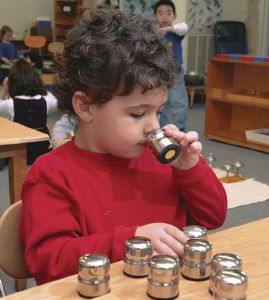
 The Montessori Bells (below left) extend the child’s ability to distinguish sounds into the area of musical pitch. They are a lovely set of bells fixed to little wooden bases. Each bell is tuned to either a whole or a half note on the standard musical scale. The entire set comprises one entire octave, including sharps and flats. The set includes one set of bells with tan bases for both half and whole notes; there is a second set in which the bases of the bells that sound the whole notes are painted white, and those for the sharps and flats are painted black.
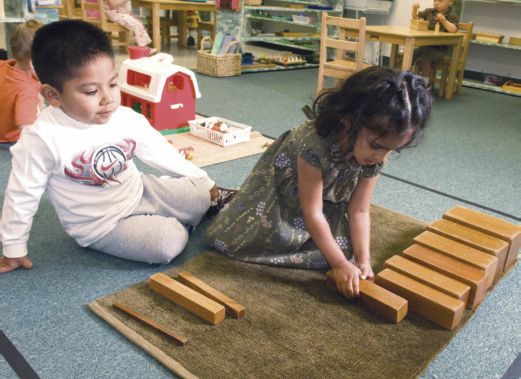 The Brown Stair,which is sometimes called the Broad Stair, is made up of ten rectangular prisms, with bases that have exactly the same graduated measurements as the cubes of the Pink Tower, but which are uniformly 20 centimeters long. The child is challenged to scatter them around her rug and then sort them by size to place all ten prisms in proper order from thickest to thinnest.This results in a graduated series of rectangular prisms that resembles a little stairway. Because the squared sides of each prism correspond to the dimensions of the cubes of the Pink Tower, the two materials are often used together for all sorts of exploration and designs.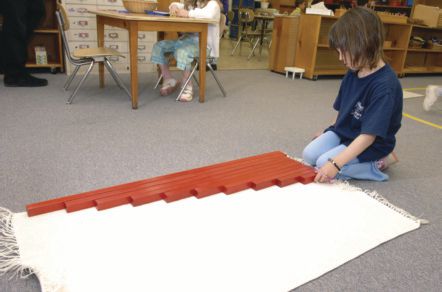
 The Knobbed Cylinder Blocks are a set of four naturally finished (unpainted) rectangular blocks of wood, into which have been cut ten cylindrical holes. Each hole is filled with a matching wooden cylindrical inset, fitted with a little knob on the top to make it easy for a child’s small hand to grasp and lift it out of its perfectly fitted hole.
 Once all ten cylinders have been removed and placed on the rug, the children take each in turn and find the hole into which it fits perfectly, with the top of the cylinder flush with the top of the cylinder block. If they’ve made a mistake, the children can normally see it for themselves because all ten cylinders will not fit correctly.
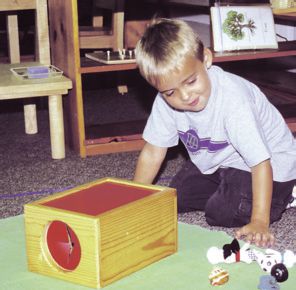 One of the children’s favorite activities is the Mystery Bag or Box (shown above).Normally, it is simply a cloth bag or box with a hole for their hands in which they touch and manipulate objects that they cannot see. One activity is to place things that are familiar to the children inside and challenge them to identify them by touch alone.
 Another exercise begins with the Rough and Smooth Boards (shown above), which have a surface that alternates between the roughness of sandpaper and a smooth finished surface.The children wash their hands in warm water before beginning to make them more sensitive.
 The Sandpaper Tablets (above) are a set of wooden tablets covered with several different grades of sandpaper. The challenge is to identify pairs that have the same degree of roughness, working by touch alone. An extension of these activities is commonly created by assembling a collection of pairs of cloth swatches cut from many different materials, each with its own texture. Again, working with eyes blindfolded, the children attempt to find the pairs by touch. Like all Montessori exercises, there is a built-in control of error. In this case, the children learn to check their work by removing the blindfold and seeing if they have identified the correct pair.
 The Color Tablets help the child learn to distinguish among primary and secondary colors and tones, while mastering the words used to describe each color and shade.There are three separate boxes of Color Tablets.All of the tablets have the same shape and differ only in color. The first box of Color Tablets contains six tablets, two each of yellow, red, and blue. The children simply match the pairs and learn the spoken names of the colors. The second box of Color Tablets contains eleven pairs of secondary colors and tones, which the children match and name. The third box of Color Tablets contains seven different shades of nine different colors, which the children learn to sort in order from lightest to darkest shade.


 The Geometry Cabinet is a set of puzzles made in the shapes of the essential plane geometric figures. It consists of six drawers, each of which is fitted with several wooden frames, inset with a geometric form. In addition to the familiar circle, square, and rectangle, the child is introduced to a much broader array of complex figures, from the right scalene triangle to the decagon; and from ellipse to the curvilinear triangle through the quatrefoil.
 In the second set, the geometric shapes are printed as outlines drawn with broad lines that leave the inner area white. In the third set, the figures are simply traced with thin lines. As children gradually begin to recognize the more abstract representations of the three-dimensional objects, they are preparing themselves to recognize the little lines and squiggles of the written word.Gradually, children learn the names of each of the geometric shapes. Once children begin to read and can verbally identify the shapes, they begin to label them with pre-printed name cards. Eventually, the children will be able to prepare their own cards from scratch.
 The logical basis for the Geometry Cabinet is the set of Geometric Solids. The children learn the names of these beautiful wooden forms, identifying them, at first, by sight and eventually when blindfolded.
 These cubes are two of the most fascinating materials in the Montessori curriculum.At one level, they are simply a complex puzzle in which the child is challenged to rebuild the cubes and rectangular prisms contained in the box back into the form of a larger cube. Color coding on the outside of the box and the sides of certain pieces helps the child detect the pattern. The material is also an exercise in algebra and geometry, representing in concrete form the cube of a binomial (a+b)3 (above left) and a trinomial (a+b+c)3 (left) where a=2 cm., b=3 cm., and c=4 cm.
 The Constructive Triangles allow children to explore the geometric possibilities inherent within several different types of triangles. The material consists of six boxes, each of which contains a set of brightly colored, flat wooden triangles, which can be manipulated like a puzzle to explore congruency and equivalence. For example, two right triangles joined together along the hypotenuse form a rectangle. To help the young child recognize the essential relationships, most of the triangles have a line drawn along those edges that join together to form new figures, such as rectangles, squares, trapezoids, and polygons. Working with the Constructive Triangles, children explore how various triangles can form regular polygons in geometry.