by Charlie Biggs | Administrative Team, Communication, Educational Program Coordination, Faculty, Montessori Administrators, School Leadership, School Resources, The International Montessori Council, Video, Webcasts / IMC
People have different ways of making sense of their work and relationships, as well as the feedback they receive. To matter, feedback has to acknowledge that people on both the giving and the receiving ends will have very different lenses through which they are sense of the world, and different capacities to hear and grow.
by Christine Lowry | Faculty, Montessori Administrators, Montessori Teachers, School Leadership, School Resources, The International Montessori Council, Video, Webcasts / IMC
Are you wondering how you, and your staff, can support and serve the increasing number of students with differences in learning and behavior in a Montessori classroom? Do you wish you had an understanding of how you could lead your school community with a clear vision, and practical strategies that would support your staff, your students, and their families?
Join Christine Lowry, Montessori- special educator, in conversation on how we can stay true to our Montessori philosophy while including guidance and systems for successful inclusive education that works for most all students.
by Cindy Acker | Administrative Team, Black History, Communication, Educational Program Coordination, Faculty, Montessori Administrators, Montessori Teachers, School Identity, School Leadership, School Resources, Social Justice, The International Montessori Council, Video, Webcasts / IMC
We are approaching the third year of acknowledging Juneteenth as a formal holiday, but how are we using THI (teaching with historical integrity) to educate our parents, and our staff for truthful curriculum? How does our school recognize this day? But what is more – what really happened, and why we’re enslaved people celebrating, not June 19th, but January 1st? Come together for honest conversations about this day.
by Jody Malterre | Administrative Team, Communication, Educational Program Coordination, Faculty, Montessori Administrators, School Leadership, School Resources, The International Montessori Council, Video, Webcasts / IMC
Leadership roles show up in many ways in our Montessori schools. The obvious role is the administrative team. Teachers and parents, of course, are leaders as well. What we model trickles down to students in their opportunities to lead. Let’s explore the idea of horizontal versus vertical leadership.
by James Moudry | Administrative Team, Communication, Faculty, Montessori Administrators, Re-enrollment, Recruitment & Admissions, School Identity, School Leadership, School Resources, The International Montessori Council, Video, Webcasts / IMC
Is your school community a little stagnant, feeling ‘negative’, or just not where you want it to be? School leadership often involves just trying to figure out how to move forward on large, abstract goals like “”create and sustain a positive culture.”” Where does culture come from? What can you do? Who should be involved? Where do you start? Join James Moudry for a conversation to start working to create the school culture that matches your vision!
by Jonathan Wolff | Administrative Team, Communication, Empowerment, Faculty, Montessori Administrators, School Leadership, School Resources, The International Montessori Council, Video, Webcasts / IMC
In a recent article in Harvard Business Review, thusly entitled, author, professor of leadership development, and executive coach, Manfred F.R. Kets de Vries states “If you want to be fulfilled and successful at work, it’s important to acknowledge when you’re working beyond your individual capacity and be open to seeking assistance.” In this Leadership Forum, Jonathan Wolff will guide a discussion on the key inhibitors to asking for help: fear of being vulnerable; need to be independent; fear of losing control; fear of rejection; over-empathizing with others; and harboring a sense of victimhood. Most importantly, you will have an opportunity to examine how to “rewrite the inner script,” which will enable you and those you lead to overcome self-doubt and self-limiting mindsets and reach out for support.
by James Moudry | Administrative Team, Communication, Faculty, Montessori Administrators, Re-enrollment, Recruitment & Admissions, School Identity, School Leadership, School Resources, The International Montessori Council, Video, Webcasts / IMC
Is your school community a little stagnant, feeling ‘negative’, or just not where you want it to be? School leadership often involves just trying to figure out how to move forward on large, abstract goals like “”create and sustain a positive culture.”” Where does culture come from? What can you do? Who should be involved? Where do you start? Join James Moudry for a conversation to start working to create the school culture that matches your vision!
by Renee DuChainey Farkes | Montessori Administrators, School Leadership, School Resources, Social Media, The International Montessori Council, Video, Webcasts / IMC
Join us for a thoughtful discussion about how the world around us is intentionally putting obstacles in our way to negatively impact our ability to focus, concentrate, and do our best work. We will review the 12 main factors that are contributing to our collective loss of concentration and shortening of our attention span. Findings are obtained from Johann Hari’s most recent book, Stolen Focus. Although this is intended for school leaders, we will also touch on how this “targeted distraction” is impacting the children we serve as they grow and learn to be our future leaders.
by Hillary Drinkell | Communication, Montessori Administrators, Recruitment & Admissions, School Identity, School Leadership, School Resources, Start of School Year, The International Montessori Council, Video, Webcasts / IMC
Join us this week as Hillary Drinkell leads our discussion on enrollment and marketing. Are you reaching the families you want to enroll in your school? Do you have an enrollment management strategy that fills your school and is manageable? Hillary has some great tips to share and we look forward to hearing what’s working for you.
by Christine Lowry | Administrative Team, Challenging Behaviors, Children with Exceptionalities, Educational Program Coordination, Montessori Administrators, Research, School Resources, The International Montessori Council, Video, Webcasts / IMC
For many of us, facing today’s challenges as school leaders and educators can feel overwhelming. What if we could embrace those challenges with a sense of hope and courage instead?
In this 2 part exploration, we will consider how the source of our challenges might be a disconnect with our core values, how we can reframe and accept those challenges as opportunities, and consider strategies to prepare, plan and motivate ourselves and our staff to explore those challenge with confidence and maybe even some excitement for the future.
Outcomes:
1. Gain confidence in your ability and capabilities as a school leader in these times of challenge.
2. Learn strategies for building a strong, collaborative school team with your staff.
3. Identify your current great challenge and plan how you and your team can take positive actions that will align with your values and mission.
by Christine Lowry | Administrative Team, Challenging Behaviors, Children with Exceptionalities, Educational Program Coordination, Montessori Administrators, Research, School Resources, The International Montessori Council, Video, Webcasts / IMC
For many of us, facing today’s challenges as school leaders and educators can feel overwhelming. What if we could embrace those challenges with a sense of hope and courage instead?
In this 2 part exploration, we will consider how the source of our challenges might be a disconnect with our core values, how we can reframe and accept those challenges as opportunities, and consider strategies to prepare, plan and motivate ourselves and our staff to explore those challenge with confidence and maybe even some excitement for the future.
Outcomes:
1. Gain confidence in your ability and capabilities as a school leader in these times of challenge.
2. Learn strategies for building a strong, collaborative school team with your staff.
3. Identify your current great challenge and plan how you and your team can take positive actions that will align with your values and mission.
by Jonathan Wolff | Administrative Team, Communication, Mindfulness, Montessori Administrators, Research, School Identity, School Leadership, School Resources, The International Montessori Council, Video, Webcasts / IMC
In this Leadership Forum, based on a recent article in Harvard Business Review, we will explore the mental shifts needed to be an effective and resilient school leader and handle the challenges you encounter. “The process involves identifying and communicating your core values and learning how to approach tough decisions. It requires setting the bar for your team’s performance and learning to compartmentalize so that you can find the right pace for yourself. And it requires expanding your self-awareness and paying attention to the stories you tell yourself about your experiences.” Join Jonathan Wolff, Montessori school consultant and school leadership coach, for a lively discussion on the mindsets of successful Montessori leaders.
by Kristen Ancker MS. Ed. | Administrative Team, Educational Program Coordination, Mindfulness, Montessori Administrators, Research, School Identity, School Leadership, School Resources, The International Montessori Council, Video, Webcasts / IMC
Discover the art behind the science that unlocks a student and a guide’s potential–observation. In this session, we’ll review the types, stages, and the C.O.R.E. of observation, sharing strategies that allow us to develop a deeper self-understanding and to empower classroom teachers to improve their practice. We’ll share recording methods that might be useful in various observational settings and will discover how to analyze our observations to determine action plans. Come be inspired to accept the challenge of engaging in the regular practice of the art of observation!
by Heather White | Administrative Team, Communication, Educational Program Coordination, Faculty, Montessori Administrators, Montessori Teachers, School Leadership, School Resources, The International Montessori Council, Video, Webcasts / IMC
Discover the art behind the science that unlocks a student and a guide’s potential–observation. In this session, we’ll review the types, stages, and the C.O.R.E. of observation, sharing strategies that allow us to develop a deeper self-understanding and to empower classroom teachers to improve their practice. We’ll share recording methods that might be useful in various observational settings and will discover how to analyze our observations to determine action plans. Come be inspired to accept the challenge of engaging in the regular practice of the art of observation!
by Tanya L. Ryskind J.D. | Facilities, ML January 2024, The International Montessori Council
Montessori education is a child-centered approach that values the physical and social environment in which learning occurs. Therefore, the management of school facilities plays a critical role in creating positive Montessori learning communities. No matter who is directly responsible for managing your facility, the ultimate responsibility falls on the school leader’s shoulders. So when I read the following statement in the review of Facilities Management: What Really Matters: A Guide To The Human Aspect of Successful Facilities Management by Doug Pearson, it struck me.
“The ideal facility manager must have Aristotle’s logic and Solomon’s wisdom, a priest’s discretion, a gambler’s poker face, a lawyer’s shrewdness and a marketing director’s charm, a gladiator’s guts, a marathon runner’s perseverance and a sprinter’s speed, a leatherneck’s toughness and a dancer’s agility, lots of good luck and 30 hours per day.”
After reading this statement, I began to wonder: How well-equipped are we to understand the needs and tendencies of our buildings, grounds, and infrastructure?
Is this the area we spend the least time understanding and discussing, but it takes up gobs of our time when we least expect it? Are facility crises the bane of our professional existence?
Instead of getting overwhelmed with the heating system or the broken toilets, I reframed my thinking about the buildings, grounds, and infrastructure by intentionally looking at each of these things in light of the bigger picture – how does our attention to buildings, grounds, and infrastructure further our brand, nurture our educational programs, and adhere to our core values? This way of thinking about facilities management has helped me align our weekly walk-throughs, our monthly assessments, and even future thinking with who we are – a Montessori school that behaves in the best interest of our students.
Managing school facilities in a Montessori learning community requires a thoughtful and intentional approach. Using a matrix for intentional facilities management, and a time-oriented checklist, helps organize our attention, identify needs and resources, and strategize our action plan.
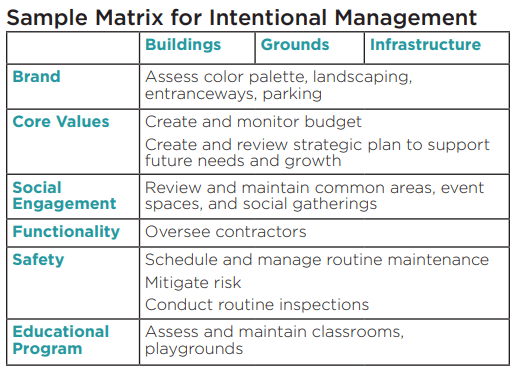
When we consider our facilities in alignment with our educational programming, we can find ways to manage the buildings and grounds that promote positive Montessori learning communities. For example,
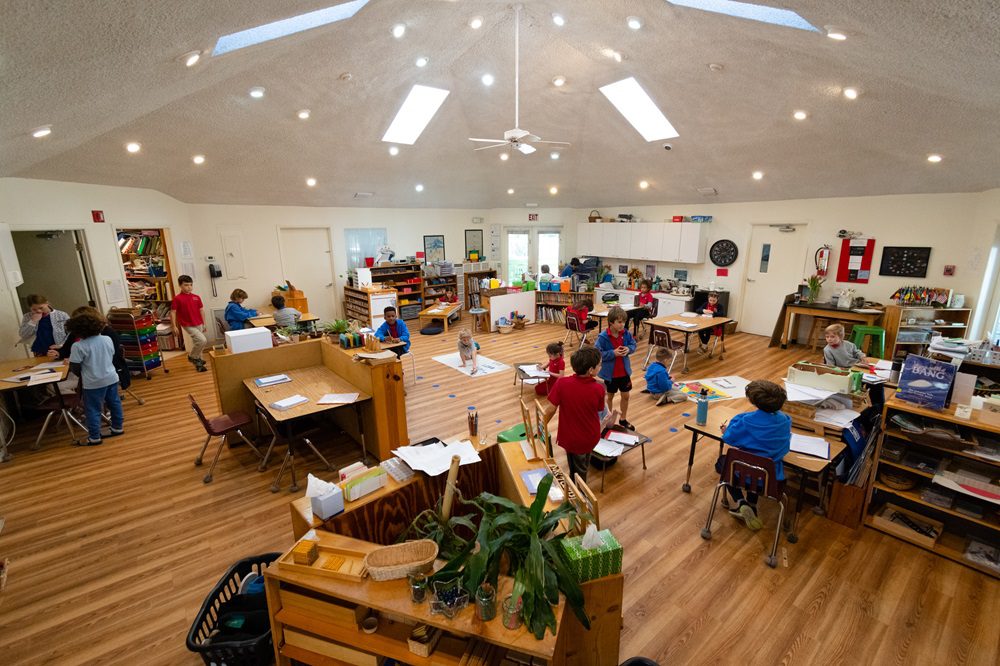
- Create an organized and safe environment: A well-organized and safe learning environment is essential to a positive Montessori learning community. Ensure that the facilities are clean, well-lit, and free from hazards. Labeling shelves, cabinets, and drawers with pictures or words can also help create a sense of order and organization.
- Provide opportunities for movement: Movement is a fundamental aspect of Montessori education. Create spaces encouraging children to move freely, such as large open areas, comfortable reading nooks, and cozy corners.
- Foster independence: Montessori education emphasizes independence and self-reliance. Create facilities that promote independence, such as child-sized furniture, accessible materials, and low shelves that allow children to easily access learning materials.
- Encourage collaboration: Montessori education also emphasizes collaboration and socialization. Provide opportunities for children to work together, such as creating group work and play areas.
- Incorporate nature: Nature plays an essential role in Montessori education. Incorporate natural elements into the learning environment, such as plants, natural lighting, and outdoor spaces.
- Communicate effectively: Effective communication is critical to managing school facilities in a way that promotes positive Montessori learning communities. Communicate clearly and consistently with parents, teachers, and staff members.
The functionality of our facilities is only as good as the health of the infrastructure. For example, when we manage to support functionality, we can explore these four areas.
- Buildings and infrastructure: Ensure that the school buildings and infrastructure are well-maintained, safe, and clean. This can be done by conducting regular inspections, identifying necessary repairs, and addressing them in a timely manner. Additionally, ensure that the buildings are accessible to all students, including those with disabilities.
- Janitorial services: Maintaining cleanliness and hygiene is critical to promoting a healthy and safe Montessori learning environment. Hire a professional cleaning service to ensure that the school is cleaned thoroughly on a regular basis, including classrooms, restrooms, and common areas.
- Roofing: The school roof is crucial to the building’s infrastructure. Make sure that the roof is well-maintained and that any necessary repairs are addressed promptly. A leaking roof can not only damage the interior of the building but also cause health and safety hazards.
- Interior and exterior painting: A fresh coat of paint can transform the look and feel of the school environment. Choose calming and soothing colors, and avoid bright and distracting colors. In addition to the aesthetic benefits, painting can also help protect the building’s surfaces and make them easier to clean.
Anticipate and plan for emergencies. Brainstorm with professionals, families in your school, and others to solicit responses to weather, safety, and disastrous events. When our school was hit by Hurricane Ian and rain was coming through the roof, it was a parent who was able to rally a roofing company to quickly and efficiently tarp our roofs so we could stay open. When we had a termite infestation, our high school biology teacher helped me understand how common termites are in Florida. And when the school’s property got struck by lightning in the middle of the night, it was the alarm company that talked me through the process so I could help the firefighters address the issue quickly.
These experiences, and many more, have taught me to be ready to be a substitute custodian and be prepared to work overtime when emergencies arise to prevent disruptions. Funny to think that the tool bag of a school leader includes a plunger, drill, ladder, flashlight, and most importantly, speed dial to professional support services.
by James Moudry | Administrative Team, Adolescence, Educational Program Coordination, Faculty, Montessori Administrators, Montessori Education, Montessori Middle School, Montessori Secondary / High School, Recruitment & Admissions, School Resources, The International Montessori Council, Video, Webcasts / IMC
Join James Moudry for a conversation about keeping your adolescent programs on track for students and parents. Learn about the top student and parent concerns and how to create and sustain a program that is engaging and worth raving about.
by Kathy Leitch | Administrative Team, Communication, Faculty, Montessori Administrators, School Leadership, School Resources, The International Montessori Council, Video, Webcasts / IMC
Harvard Business Review author Alex Liu refers to ‘the connective power of joy.” We can lead our staff and faculty to create a fulfilling work environment by tapping into our collective purpose and passion. We’ll discuss three practices that will enhance your school culture…and maybe even your retention rate!
by Cindy Acker | Administrative Team, Black History, Communication, Faculty, Montessori Administrators, Montessori Teachers, School Identity, School Leadership, School Resources, Social Justice, The International Montessori Council, Video, Webcasts / IMC
As curriculum and discussion laws dealing with LGBTQ and African Americans have surfaced affecting public and private schools, are you aware of how this has or may affect your school, staff, or families? Rather than waiting for this issue to hit your school or state, join us to discuss how you may have been affected or how we can protect our schools and support our staff and student body. This is not a discussion of right or wrong personal views but a conversation in a safe space to understand what may be affecting us, education of information needed, and ways to support each other now and in advance.