One of the most wonderful things about toddlers is how they so inherently want to help. They are eager to be involved, be near us, and participate in our day-to-day activities. What we deem “chores,” toddlers see as what they are: meaningful contributions to our family or community.
After toddlerhood, we often notice a shift. Children seem less intrinsically motivated to help and view helping more as a chore. This is a natural part of development: they are more independent and focused on their own work and play. They are discovering who they are and where their own interests lie, which is a beautiful thing. It also doesn’t mean it’s the end of helping!
How do we continue to foster this motivation and raise helpers beyond the toddler years? Here are a few tips that I’ve been keeping in mind in our own home lately. These can be incorporated in toddlerhood and well beyond!
Help Our Children
Our children learn how to help through us helping them. When we respond to their requests for help, they are more likely to do so in return. Helping doesn’t mean doing a task for them, but rather offering just enough help to get them through a tough spot.
Model It
Not only should we think about how we are offering help to our children, but how can we offer help to our partner, a friend, or our community? The more our children see us being helpers, the more likely they will want to be a helper too.
Talk About It
“In our family, we help each other.” This is a phrase that we repeat often at home. The more we say and hear this, the more ingrained it becomes and the more natural it feels to be a helper in the family. Importantly, this phrase is said in a gentle way, not as a command.
Make It Part Of The Routine
When we make helping a part of our daily rhythm, it becomes natural. In our family, certain tasks are the kids’ responsibility every day: putting shoes and coats away, setting the table, feeding the dog, wiping up spills, tidying toys, etc. These tasks aren’t rewarded but rather just part of the routine.
Don’t Force It
Inviting doesn’t guarantee our children will help. Even when these tasks are part of the daily (or weekly) routine, everyone has off days. We can offer grace and let it go. Often, the next day, or at a different time, they are ready to help again.
Offer Opportunities
Sometimes we move so quickly through our own chores, we forget that we could involve our children. As much as possible, I try to do chores in front of the children so that they have the opportunity to join in and help. Often, what we consider mundane tasks are satisfying for our children. Having cleaning tools that are appropriately sized for our children makes them feel especially capable.
Accept It As Is
When our children do help, we may find that they’re ‘help’ doesn’t lead to the outcome we desire. The dishes might not be as clean, or the laundry might not be folded in a neat stack. When this happens, we can thank them for helping and appreciate the effort that went into it. Rather than correct them at the moment, we can model again another time, and try to be patient, as every skill takes time.
How can your child help today? •
Theresa is a mom to two, a former Montessori guide, and the founder of the blog Montessori in Real Life(www.montessoriinreallife.com). Prior to momming and blogging, she went to graduate school for developmental psychology and earned her Montessori infant/toddler guide certification. Since transitioning from teaching to motherhood, Theresa found a new passion sharing her love of Montessori with parents,while continuing to implement the Montessori philosophy in her own home.
Grace and courtesy is often used to mean either rules or manners, or mannerly following of the rules. There are many lists out there about the grace and courtesy lessons that should be presented in the beginning of the year, making it seem to be a “one and remind” lesson. Yet, with not much thought we can see that grace and courtesy lessons need to be given throughout the year, need to be role modeled always, are presented based on observation, and fall into different categories. Dr. Montessori reminded us that, “social grace, inner discipline, and joy. These are the birthright of the human being who has been allowed to develop essential human qualities.” The Secret of Childhood (1966, xvii).
To help our students and our children develop the inner-discipline Dr. Montessori spoke of, grace and courtesy lessons need to be given throughout the year and in a multitude of ways. We start the year with a list of basic lessons, which need to be presented so that we may function as a group, and we present them again when there is going to be a change. In the beginning of the year, we present how to knock on the door and wait for an answer if the bathroom door is closed; this helps the class or family function with greater comfort. If we are going to see a live performance, a series of lessons would be given on entering the performance area, showing respect during a performance, and how to show your appreciation of the performance. What is sometimes forgotten is that in between these events, we should be regularly presenting lessons that build upon those we previously presented.
When a child pulls a third chair up to a two-person table to work with one friend, and the third child complains, you have the perfect opportunity for a grace and courtesy lesson rather than a reminder. It is easy to say, “Chair Mover, do we move a new chair for a table in this class?” A new lesson involves working with the left-out child. Starting with an acknowledgement, “I see it bothers you that Chair Mover is working at the table. What is happening?” When the child tells you the others are talking too much, or taking up the workspace, or simply that the chair doesn’t belong there, you may help them figure out how to speak to the other students. Asking, “What could you say to them to let them know how you feel?” You can help the child figure out a courteous way to ask the other children to help solve the concern. Admittedly, this is the slow way it would be faster to remind Chair Mover that this is a two-person table. Pressing our own personal pause button can help us slow down and take the long view when opportunities to present grace and courtesy lessons occur. With a reminder, the table is back to two people with everyone having space for their work. With a grace and courtesy lesson and practice opportunity, a child has practiced a way to respectfully speak up about a perceived injustice, and two children have learned to work with another to solve a concern that one of the three people feels is important.
Grace and courtesy needs to be role modeled by the adults in the school or home for it to become important to all the people involved. Before I had children of my own, I had friends that were interviewing to enroll their son in the only Montessori school on the island we all lived on. They rode their bikes to the interview and a car came close to my friend’s bike, while his son was on the back of the bike. Obviously, he was scared and angry, and he shared this with the driver, calling him some choice names. They got to the interview, and you can guess what the child shared when the Montessorian asked him what he saw on the way to the school. She was just trying to engage the child; instead, she got to present a grace and courtesy lesson. She asked Dad if he had been scared and angry and hinted to him to apologize for his outburst. Dad did and the child learned that they could all learn from mistakes. Being a role model does mean that we consider not sitting on tables or walking around eating unless this is common practice for all in the room; more importantly, it means taking the time to acknowledge actions that we did not want to role model and to change that behavior.
GRACE AND COURTESY DO NOT END AT THE CLASSROOM, OR SCHOOL DOOR, IT SHOULD BE A PART OF OUR LIVES IN ALL AREAS.
All grace and courtesy lessons should be presented from observation. Sometimes it is developmental, such as our beginning the year whole class grace and courtesy lessons, sometimes they are based on “in-the-moment” needs, and they should also be based on whole-group observation. My teaching partner and I gave a couple of well-received individual grace and courtesy lessons around speaking in a way that respects classmates’ feelings. Yet, as we observed the class and discussed with each other, we noticed that teasing that one person thought was fun and acceptable, was happening regularly throughout the classroom. In more casual conversation with students, rather than formal lessons, we began to talk about the way we talk to others. In our weekly group team-building time, we played some games and did some projects that brought attention to the way our words could help or hurt another person, with or without us meaning the hurt. The multi-pronged approach helped us, as a class, find a balance between joking and inadvertent hurting; yet, without observation for grace and courtesy skills we would have been managing one person at a time, probably never reaching the same balance.
Grace and courtesy are so much more than a set of rules and the manners we demonstrate when we follow those guidelines. It is noticing and caring for the environment, which is one of the first places students can begin to see how their actions affect others. It is helping children become aware of how they are feeling, what is going on inside them and developing language to express these feelings. It is working to develop social awareness, thinking about how your actions affect others and the environment around you, and finding the willingness to give grace to others when their actions affect you negatively. It is using kind and respectful language to express your own feelings and needs to communicate with others. It is bringing the grace of physical action to awareness, how one’s actions affect themselves, others, and the environment. It is being aware of those who may need you to be an advocate or help them take action, in your immediate community and the community at large.
Grace and courtesy do not end at the classroom or school door; it should be a part of our lives in all areas. At home, my time has been allocated differently in the past couple of years. One thing I have been able to do is tend to the roses in my garden with more regularity. I do not trim them, water them, or fertilize them for a greater length of time than I did previously. I just have smaller amounts of time to spend on them more often. Grace and courtesy in the school, classroom, or home works the same way. You don’t need more time over the year, you just need to be more consistent with your time. My roses bloom much more often than they did a couple of years ago, there is nearly always at least one rose in bloom, which I love to see as I walk out the door. With regular attention to grace and courtesy, you will probably find at least one bloom of kindness and consideration every day, most likely a whole bouquet’s worth. •
Cheryl Allen is the Associate Coordinator of the Montessori Family Alliance and is also a parenting educator and a Montessori consultant with the Montessori Foundation. Cheryl attended Montessori school as a child. After some time as a traditional Secondary teacher, she worked in Montessori classrooms, 3-6, 6-9, and 9-12, earning certifications from both AMS (3-6 and 6-9) and IMC (6-12). She is a teacher educator, workshop presenter, and member of IMC accreditation teams. Cheryl’s two children attended Montessori from age two through high school graduation.
Editor’s Note: Montessori schools within the same community often have little or no contact with one another. This is unfortunate. There is strength in numbers. They can look for opportunities for families and their children to participate in joint events, such as the one described in the article below. We’ve always encouraged Montessori schools to look for ways to build a larger network of families and their children and hold such events, whether it be a 5K race as these two schools did in Florida, or a community-wide art show, talent show, athletic event, fall festival, or even a lighthearted contest that we call “Are you smarter than a Montessori Kid?” That’s where teams of parents go up against a team of multi-aged Montessori students from the elementary level and beyond to test their knowledge of cultural literacy, such as identifying the capitals of countries, the names of countries, or the names of botanical leaf, or geometric shapes. These are topics Montessori children typically learn and which parents may have either never learned or have long ago forgotten. Let us know if your school does something of the sort. It’s a story we would love to tell.
On the small island of Key West, located at the southernmost tip of Florida, there are two Montessori schools that happen to be less than a half-mile from each other on the same street, which is coincidentally named United Street. This year they partnered to co-host their 5K race.
Founded in 1972, Montessori Children’s School is Key West’s oldest Montessori school. It is a private, non-profit school, and its programs educate children eighteen months to sixth grade.
May Sands Montessori School is Monroe County’s first charter school. It serves students in Key West and the Lower Keys from kindergarten through eighth grade.
The two schools are accustomed to having students and staff transfer from one school to the other. In addition, several families have children at both schools. The schools also get together each year for their annual International Day of Peace walk. However, this is the first year they have teamed up for a fundraising event.
There is so much energy and expense put into fundraising, so having the two schools split both of these was a great way to lighten the load. Not only did the number of registrants increase, but profits increased as well. Each school secured its own sponsorships but split the race registration proceeds and the expenses.
Often, private and public schools see themselves as being in direct competition with one another. Each school has its own fundraising events and tries to garner the most participants. By coming together as one, we are not only providing Montessori families at different schools the opportunity to get to know one another, but we are also celebrating our individual and shared experiences.
A few years ago, the company that records race times of the individual 5K’s suggested combining the races to save money. Both schools had been hosting their own 5K’s for many years. As the weather in Key West is beautiful almost all year round, fitness is a huge part of life here. In addition, it’s a popular destination point for out-of-towners who love a warm place during cold winters. Running, biking, swimming, and water sports are quite popular in the Florida Keys. Years ago, when there were just a handful of fitness events, the turnout at individual events was much larger. As more and more events were scheduled, participation at each event began to dwindle.
Due to COVID, both schools canceled their 5K events last year. This year seemed like a great year to experiment with a combined race. We couldn’t have been more pleased with the way this year’s race turned out. Seeing all the families together, uniting for one great cause, was truly gratifying for all involved. Perhaps there will be more shared events in the future. In true Montessori fashion, collaboration wins over competition every time. •
Amy O’Connor, Executive Director of Montessori Children’s School of Key West, has been involved with Montessori in some capacity almost her entire life. Her parents helped found the school in 1972. Amy’s three children attended Montessori schools in Essex, Vermont, and Key West, Florida. Amy has her Primary Montessori teaching certification as well as her BA in business.
An excerpt from Montessori For Every Family, published by DK Press, 2021
In most families, there are hobbies, interests, and activities that can be messy, need to be left in place to continue to work on later, or where special tools and supplies can be kept on hand and are easily found as needed. A messy space like this could be a spare room in your house, in the basement if you have one, or in your family garage.
It could be a craft and art studio for sculpting or making pottery or an area for woodworking with a workbench with tools arranged on shelves or hanging from a pegboard. It might be a room where you keep your paints and an easel, a photography or video studio with lighting and backdrops, or a space for tools to work on your cars or bicycles.
Keeping order in mind as you plan and organize the space is key to reducing frustration when you can’t find a tool you need or something you’ve just created gets knocked over. When there is clutter and disorder, accidents are more likely to happen and safety to be compromised. It also becomes more difficult to concentrate on the project at hand.
In a Montessori-inspired home, we want to think about what kind of space is needed for your interests or hobbies with all members of the family in mind. Your children are likely to want to be around you as much as possible, as well as needing a space where they can do the things that they prefer. So the idea is to think about the activities that your family members enjoy and consider which ones can be done in the same space.
Many families do not have a spare room, a basement, or even a garage that could be turned into a messy room. What are you to do then? Of course, everything depends on the ages and interests of your children, which may be very different from child to child, but the basic concepts remain the same. Our goal is to allow children to do activities that may be too messy to allow in their bedrooms, the kitchen, or the living room. When you live in a small apartment or home, you have to think outside of the box. You may make an exception to the general rule, and create a small area in the child’s bedroom where you lay down a protective heavy plastic covering on the floor and allow your child to paint, work with clay, glue models together, and other things using a washable covering to protect the surface of the kitchen table. The goal is to encourage children to feel that they can explore hobbies and interests while having your house (or backpack) become a mess.
Real-life story: When Jennie first went to school, she was fascinated with the art materials in her Montessori class. She loved to paint and draw with the beautiful beeswax crayons and colored pencils that were part of the classroom environment. When she would come home, she would often ask her mom if she could have an art studio. Jennie and her mom bought her a set of simple water paints and brushes, a small tabletop easel, and a stack of water-paint paper. They set up a little art studio with tile on the floor that could be easily cleaned if any paint spilled. Mom also bought some picture frames made from matte board so Jennie could hang her favorite paintings. As time went by, Jennie moved from water paints to charcoal and pastels and finally tempera and oil paints. but her interest in drawing and painting never faded away. Today, Jennie has grown up and has a career in science, but she still enjoys painting and loves going to art galleries.
Real-life story: I started noticing my son’s school backpack was full of what I considered trash. Broken rubber bands, the inner ring from a roll of tape, bits of string, etc… for and he just said that he needed them. Then, I started noticing items moving from the recycle bin to his bedroom. Egg cartons, milk jugs, cardboard boxes of all sizes…..it was looking like a recycling center in his room. I would ask him what they were. He kept saying he “needed” it all, so I walked out, took a deep breath, and went with it when what I really wanted to do was put it all back in the trash and have a clean house! Then, one day, he emerged from his room with a giant “smoothie shop” that served all types of smoothies (made out of cardboard and “trash”). This shop was so amazingly detailed and each bit of “trash” served a thought-out purpose. He used amazing grace and courtesy to take our orders and serve us smoothies. We all drank some delicious smoothies that day, and I silently thanked all of his Montessori teachers for teaching me to follow his interests… even when those interests looked like “trash!” —Tara, mother of John 9 years old
Lorna McGrath, M.Ed., is Director of IMC School Accreditation, Program Director of the Montessori Family Alliance, and Senior Consultant of The Montessori Foundation. Lorna has 41 years of experience in the field of education, teaching children from 18 months through 6 years old and from 12 through 18 years old in both public schools and independent Montessori schools. Lorna is a Montessori teacher educator, conference presenter, and school consultant. She can be reached at lornamcgrath@montessori.org.
Tim Seldin is President of the Montessori Foundation and Chair of the International Montessori Council. His more than40 years of experience in Montessori education includes 22years as Headmaster of the Barrie School in Silver Spring, Maryland, his alma mater from toddler through high school graduation. Tim was Co-Founder and Director of the Institute for Advanced Montessori Studies and the Center for Guided Montessori Studies. He earned a B.A. in History and Philosophy from Georgetown University, a M.Ed. in Educational Administration and Supervision from The American University, and his Montessori certification from the American Montessori Society. Tim Seldin is the author of several books on Montessori Education, including How to Raise An Amazing Child, The World in the Palm of Her Hand, and his new book, Montessori for Everyone, co-authored with Lorna McGrath.
Your day can be ruined when your child tells you that something upsetting happened at school. Maybe a friend wouldn’t play with your child, or a classmate called your child a name, or any number of possible scenarios. The first thing your gut tells you to do is immediately call and complain to someone. The first thing we should do is pause. This is a time to listen and ask questions, not to solve the problem.
First, ask your child to tell you more. “Tell me more about that”, is encouraging in so many situations and perfect when dealing with an upset. Ask about their feelings, then ask how they think the other child may be feeling. You may even want to ask them, what they would have liked to have happened. Pause before you reach out to other adults or try to solve the problem for your child.
Statements and Questions to find out more about an upset:
“Tell me more about that.”
“What was happening before (problem)?”
“How did it make you feel?”
“How do you think (other person) felt?”
“What do you think (other person) is saying about this?”
“If you could have a do-over, what would you do differently?”
If you do need to contact an adult at the school, begin with the guide who was in the space. Through the appropriate communication channels for your school, let the guide know that your child was upset and your child’s version of the event. Be open to the fact that you are hearing only one angle, and work in partnership with your school if you need to provide any assistance in finding a solution.
One time, my older child came to me and said, “T pushed me!” When we asked her about it, she said she did push him. When we began to work with her to think of another way she could have managed rather than pushing, she responded, “Tell him not to jump on my foot.” We realized we had not filled up on what happened before she pushed. So, we received honest but incomplete information from our son. The real help they needed was discussing a different concern that led to standing on a foot and pushing him off. I needed to ask, “Tell me more about that.” •
Cheryl Allen is the Associate Coordinator of the Montessori Family Alliance and is also a parenting educator and a Montessori consultant with the Montessori Foundation.
Cheryl attended Montessori school as a child. After some time as a traditional Secondary teacher, she worked in Montessori classrooms, 3-6, 6-9, and 9-12, earning certifications from both AMS (3-6 and 6-9) and IMC (6- 12). She is a teacher educator, workshop presenter, and member of IMC accreditation teams. Cheryl’s two children attended Montessori from age two through high school graduation.
Have you wondered what it takes to get your kids to have a meaningful conversation with you? How might we approach children with questions that get them talking? Join Jody Malterre to practice questioning strategies for toddlers through teens that create connection and critical thinking.
Do you feel like you talk too much about your child’s behavior? Are you constantly repeating your requests and explaining things your children already understand? Joe Newman, the author of “Raising Lions” will talk about how replacing our explanations and lectures with action boundaries, will get better behavior from our kids and will raise those kids into adults who are both confident about themselves and connected to other’s feelings and needs.
So much of what we are all hearing on the media about Covid 19 is scary and not particularly helpful in empowering children from about 11 years old through adolescents about ways to take care of themselves. We are very good about giving our children ways to keep themselves safe from strangers or ways to prevent home fires and stay safe if caught in one. How are we empowering our young people to stay safe during the pandemic? Tammy Willen and our team explore ways to empower young people to stay healthy themselves and to encourage their peers, their extended families and even the larger community to do the same.
How do we decide when a toddler’s behavior is inappropriate? Together we will discuss the questions to ask ourselves before we intervene in a child’s play. Then, we will consider three simple, easy to understand rules that aid toddlers’ understanding, support collaboration and help avoid power struggles.
Montessori is great for little children but that’s it!
Montessori is warm and fuzzy. Children enjoy it, but the real world isn’t warm and fuzzy. They have to grow up sometime.
I’m worried that Montessori shelters my child from life.
Your children are still in Montessori. You should be thinking about their future. You do want them to go to college, don’t you?
As a Montessori parent, you’ve probably heard many statements like those above, and you can probably add a few of your own. These remarks often are expressed by parents to other parents. Sometimes they come from well-meaning relatives, co-workers, neighbors, and just about anybody who knows you have a child in a Montessori school. When it comes to Montessori, it seems that everyone has an opinion.
When my children first started Montessori many years ago, I heard the statement “It takes courage to be a Montessori parent.” I used to believe that it took courage because Montessori was an experimental program to which I was offering the use of my children as guinea pigs. As I became better informed, I quickly discovered this was not the case. Montessori has actually been around for over one hundred years and has been proven successful in many different educational environments throughout the world.
So what does it mean “It takes courage?” Maybe it’s because Montessori tends to encourage children to think for themselves and articulate their own opinions. This is all wonderful, but as a parent, there are moments when it would be a whole lot easier to deal with a six-year-old who blindly and obediently accepts your explanation for why you don’t want to create a recycling center right in the middle of your kitchen or a four-year-old who announces that she knows where hamburger really comes from and she’s never going to eat it or any other animal ever again, period!
That must be it, I thought. It takes courage to live with these self-actualized, intelligent little creatures that have been encouraged by Montessori to think logically and express their opinions. I stuck with this understanding of the “courage” statement for a number of years. As a parent of two children who grew up in a Montessori school for ten years, I’ve got a million examples of a Montessori mother’s courage in action, but that’s the subject of another article.
As my children got older, I came to understand the courage statement in a whole different light. About the time that my children hit kindergarten, I found myself constantly defending my choice to keep my children in Montessori through the elementary years. The opinions of relatives were the most difficult and the hardest to discount because they came from people who were legitimately concerned about their grandchildren, or nieces and nephews. A case in point. My husband went to a New England boarding school, followed by Yale, followed by medical school at Columbia. He later topped it off by obtaining a law degree. Observing his grandson working with little beads while lying flat on his belly during a visit to the school, it was clear from the bemused expression on my father-in-law’s face that Grampa Dan not only had doubts about Montessori, he also had doubts about us as parents.
The pressure can be enormous. There were many times when we were very tempted to walk away from Montessori and put our children into the capable hands of a more traditional school. After all, we turned out all right. Or did we?
Speaking only from my own personal experience, I question how we as a society have come to define “success.” Is a child who grows up to become a doctor or a lawyer any more successful than a carpenter or a musician or a teacher or a homemaker? Do well-intended parents unconsciously push their children into status careers that send out all the right messages that we as a society have come to accept as the true measure of success.
Does it matter to us that our child grows up to be happy with her choice in careers, that she has a sense of fulfillment every day that she goes to work, that she approaches each day of her adult life with the same enthusiasm and eagerness to grow that she experienced as a child in the Montessori classroom, that she is able to accept the challenges that life has to offer and has the ability to adapt to new ideas and technology, that she understands that whatever gifts of intelligence and ability she possesses they are truly gifts and that others have other abilities and gifts that are different from her own? If we as parents can answer yes to these questions, then I believe our children are well placed in a Montessori environment for as long as we are able to keep them there.
In designing the cover, we tried to find a provocative, and indeed a shocking way, to visually portray the question: Does Montessori prepare children for the real world? The cover has a great deal of personal significance to me for three reasons. First, the boy in the picture is my son. I can assure you he does not look like that in real life (see insert). Second, it is the first and possibly only time I have ever succeeded in getting him into a tie and jacket long enough to have a picture taken (my mother will be so happy). Third, and most importantly, as a young adult, I chose a career in law for all the wrong reasons.
I believed that becoming a lawyer would give me prestige and wealth. What it gave me that I hadn’t counted on was an ulcer and the nagging feeling that I should be doing something else with my life. Please don’t get me wrong. I don’t dislike lawyers (or tasseled loafers) — even trial lawyers are ok with me as long as I don’t have to join them in the courtroom. There is nothing wrong with the law, medicine, teaching, carpentry, or anything else as long as it is what is right for the individual.
If the answer to the question of whether or not Montessori prepares children for the real world is to be judged by whether or not great percentages of Montessori students will go on to a professional career, then the answer is maybe. If the answer to the question is to be judged by whether or not Montessori prepares children for life, the answer is an unequivocal yes.
As a parent, I have very high expectations for my children from Montessori. I expect them to be well prepared academically so that they will be able to follow their dreams wherever that may take them, but I hope that they will be able to continue making the responsible choices I see them make every day in their classrooms, I hope that they will be able to retain the love of learning and creativity that hasn’t been driven out of them by a system that is so intent upon conformity that it places individuality at grave risk.
I care about academics, but I know that my children will get them from any good school, Montessori or otherwise. For me, the true value of Montessori goes beyond academics. When I look at my own children, I see behavior patterns that are different from my own at their age. I feel very comfortable that Montessori prepares children for the real world. In an interview, David Kahn once remarked, “Montessori is the real world. It’s the dichotomy that’s false.” When you think about it, there’s a lot of sense behind that statement.
I often wish I could have had a Montessori experience as a child. Things might have turned out differently. For one thing, I could have saved all that money on law school, but then I really do believe that all learning experiences have value. Maybe a bit of Montessori did rub off on me after all. At the age of 35, I quit the practice of law and I’m now doing something I find much more fulfilling, something I probably should have done in the beginning if I had not tried so hard to jam my round-pegged personality into a square professional hole.
When I announced that I wasn’t going to practice law anymore, the initial overwhelming response was, “What do you mean you’re not going to practice law anymore. How do you think you’re going to survive in the real world without a profession?” Sound familiar?
More than anything, I hope that we as parents will have the courage to recognize and continue to support the human values and life lessons that our children are learning in their Montessori classrooms every day. As for my children growing up to pursue some kind of yuppie career, that’s ok as long as it’s right for them. Our world could probably use a lot more Montessori lawyers, politicians, and doctors who understand that there’s more to life than being book smart. Above all, though, I think that as parents and educators we must never accept the premise that our objective must be to teach children to survive life. Better we should help them learn to celebrate it!
Many schools invite and some even require that parents “visit” their child’s classroom in preparation for conferences. Many parents are not exactly sure what is expected of them and of what to expect to see when they are there. Our team will help parents better understand what to look for, how to look and listen, and the intention of the teachers’ invitations.
So many parents have asked our team over the years, “How do we prepare for Parent/Teacher/Student conferences? What should we ask about?” Our team will share their suggestions based on what typical benchmarks are at different levels in a Montessori school. Join us as you prepare for spring conferences.
“As well as being part of our history and a way of understanding other people’s experiences, art is also a form of personal expression, like poetry, song, dance, and telling stories. It is a form of human connection that can evoke feelings, thoughts, and hopefully appreciation and understanding. Montessori encourages families to expose children to as many forms of art as possible. Encouraging your child’s interest in art and giving them room to be creative provides them with experiences that will endure.” — Excerpt from Montessori for Every Family by Lorna McGrath & Tim Seldin
The new book, Montessori For Every Family: A practical parenting guide to living, loving, and learning, by Lorna McGrath and Tim Seldin, shares some ways to encourage an enjoyment of art and to set up a space to create. We have searched out materials to help you set up an inviting art space in your home.
A child-sized wooden table can be your art area for years. Look for a sturdy table and chairs that fit under the table. If you do not have space for a separate art table, consider a coffee table with storage nearby.
Pictures by different artists can be chosen by you or your child if you visit an art museum, or ordered from art.com. Also consider a piece of wood with clips attached and a variety of postcards for a changing display.
You may want a paper roll so you can create different sized pieces of paper.
The MÅLA
Paper roll holder with storage is a good choice. It is available from several vendors, including Amazon. Here is a link to one from IKEA: tinyurl.com/ mrxfc27e
MÅLA Apron
Keeping clothes neat during art exploration is difficult for some of us, so a smock can be a beneficial part of any art set up. tinyurl.com/2zzsetah
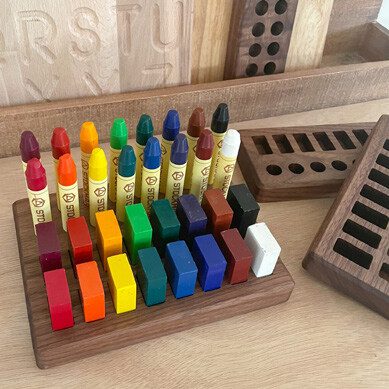
Stockmar Beeswax Crayons
Beeswax crayons allow for layering of colors and draw smoothly. They also last longer than traditional crayons. tinyurl.com/289usjem
Eco Finger Paint
Changing out art materials for different ages can help keep their interest up. Young children enjoy the opportunity to finger paint; this finger paint is made with food-grade materials, so you do not need to worry too much when painty fingers go into mouths. ecokidsusa.com/ eco-finger-paint/
Watercolor Pencils
Older children may like the many different ways to draw with watercolor pencils. tinyurl.com/2p9a6d5n
This all-natural, set of opaque watercolors has magnetic pots of color, so just a few can be used at a time. tinyurl.com/3ruhf9yu
Honeysticks
For younger children, who may even like to taste their paints, Honeysticks is a set made from food-grade ingredients. tinyurl.com/bdfjy9w9
Beeswax or Soft Dough
Younger children may find beeswax or soft dough easiest to use. Stockmar modeling beeswax warms up in your hands and smells delicious. tinyurl.com/mws8axc3
Include a container or two, to collect items for collage and sculpture making. Egg cartons, confetti, rubber bands, pom poms, whatever could be reused and is appropriate for their use, can go in the containers for building and creating. Be creative, and follow your child’s interests. Have fun with these ideas and supplies, and add your own art area in your home.
We often mention Family Meetings during our webinars but it has been awhile since we actually went through the process step by step with our participants. Please join us as our team members role play a family meeting in action on this broadcast.
A documentary produced this year is our top pick for all elementary-on-up children, educators, and parents to watch. It’s called The Biggest Little Farm.
In 2009, a California cinematographer and a food blogger met and married. The Biggest Little Farm follows the couple as they attempt to build a sustainable farm an hour north of Los Angeles, CA. With the help of a dedicated environmentalist, they work through the trials and tribulations of achieving perfect (almost, anyway) harmony with nature.
This is the movie to introduce or reinforce many of the Cosmic Education lessons. It will help everyone understand the fragile balance of nature and how easy it is to be destroyed. The visuals are stunning, and the relationship with the animals on the farm are endearing. This movie brought joy, tears, and hope to me, and I highly recommend sharing it with all families to open up discussion on what each of us needs to be aware of to help do whatever we can to respect nature and protect our earth. •
I have visited a number of Montessori schools as we consider a placement for our 3 and 4 year old children next year. I see the children all busy on different projects, and it all looks great. But can it really work? How can one teacher, even with an assistant, really keep track of who did what and be sure that each child is progressing and getting what she or he needs? All those children—all those needs. I can see it more for younger children, but I really get concerned in the Elementary grades. Does this method really work?
— A CONCERNED PARENT
Dear Concerned Parent,
I am so glad you are looking at Montessori schools for your children and that you have started the search so early. Many schools have rolling admissions and are open to admission at times other than the start of the school year or semester.
The Montessori Method works, as it is truly an individualized approach to education. Each child spends his or her school days in a carefully prepared environment with a group of multi-aged learners and a guide. A child chooses activities that call to her from within that environment while her guide watches her interests and offers lessons. From there, she develops a set of skills upon which to build. She practices the lessons she has learned and asks for new lessons as soon as those are comfortably mastered.
Children in the Montessori prepared environment also have the opportunity to watch others work and are often enticed by the work of those older children, aspiring to do what they do. This leads to more and more advanced work within the classroom as a whole and by your child individually. No child needs to wait for another child to have mastered a skill to move on! She has a new lesson as soon as she is able. Children also assist others younger than themselves, often teaching lessons they have already mastered. The child teaching lessons is one of the best ways to ensure mastery and confidence about something they have learned. It also leads to a kind and caring community.
Children have a say in what parts of the curriculum with which they engage and when they do so—always with awareness and support from the guide and other adults in the room.
Guides spend time observing the class to see which children are working at the mastery level on certain skills and are ready for a new lesson, which children need re-presentation, and which children need social
encouragement. They carefully chart these observations on paper or on the many computer programs that are now available and used in schools. While the classroom may look free flowing and easy going, it is actually a skill and data-driven environment, even though students do follow their own interests and work on projects and activities of their choosing. Their connection with their guide—often for three
years—enhances this relationship and connection and allows for learning to happen more easily from year to year. They offer carefully timed lessons to children as they are ready. These lessons are often one on one, but can be executed with the whole class or small groups. It is often hard to find the guide in the classroom as she is working with only a few children at a time.
In answer to your question, yes, the Method can and does work!
Children have a say in what parts of the curriculum with which they engage and when they do so— always with awareness and support from the guide and other adults in the room. Children learn initiative, self-control, and discipline while mastering basic skills. This method truly parallels the expectations and skills needed as a child grows and faces more adult challenges.
Enjoy your journey looking at schools! Montessori schools truly are unparalleled! •
Cathie Perolmanis a reading specialist, elementary educator, author, consultant, and creator of educational materials for primary and elementary students. Check out her new downloadable materials on her website cathieperolman.com.
For more than three decades she has dedicated her energies to improving reading for all youngsters.
She is the author of Practical Special Needs for the Montessori Method: A Handbook for 3-6Teachers and Homeschoolers published by the Montessori Foundation (available throughmontessori.org.) She is a regular contributor to Tomorrow’s Child and Montessori Leadership magazines.
Cathie Perolman holds a BS in Early Childhood Education and a MEd in Elementary Education with a concentration in reading. She is credentialed as a Montessori teacher. She is married and has two adult children and two adorable granddaughters. Cathie lives in Ellicott City, Maryland with her husband.
Elementary and middle school children, along with their parents and teachers, will love this book. It is a hilarious review of wild animals from around the world! Each animal is rated in a humorous way that tells the reader a little something about the creatures. Animals Reviewed also includes the common name for the animal, its scientific name, and a zoo or aquarium where it can be found. This information is great because some of these animals may tickle a child’s curiosity and may motivate them to do more in-depth research about the animal. They may even be able to go see the animal in person if a zoo or aquarium nearby has one in residence. Enjoy!
”I declare after all there is no enjoyment like reading! How much sooner one tires of any thing than of a book! When I have a house of my own, I shall be miserable if I have not an excellent library.”
—JANE AUSTEN
Make Music!
by Norma Jean Haynes, Ann Sayre Wiseman, and John Langstaff
Another wonderful book for adventurous children and grown ups who want to have fun making music! The book is laid out in categories starting with Beginning Notes (pun intended I’m sure!); Household Things that Ring and Ping; Body Music; Percussion Beats and Rhythms; Breath Music: the Winds, The String Section; Instruments from the Workshop; and Creating Music. I’m excited just writing down the names of the sections and that’s not all. This book has beautiful photos of real children in action and having so much fun with music. Make Music is a great resource for an afterschool studio or for the vacation home or cabin, or at home on a school break, or ongoing project. The audience for the projects would probably be elementary-age children because of their skill and social levels; although, very clever teachers or parents could probably modify some of the projects for younger children as well.
Hatching the Cosmic Egg
Written by Michael Dorer Illustrated by Beth Wilson Music by Andrew Kutt
Michael Dorer, a well- known Montessori educator, author, and conference presenter, has now written his first children’s book and it’s ‘wonder-full.’ Hatching the Cosmic Egg opens with a request for the reader to “think of the very biggest thing you can.” I’m already intrigued and excited, and I think elementary children will be, too!
On each of the next few pages is a gorgeous, two-page, colorful drawing of very large earthly things that children might imagine and the author asking; Is it a great, gray elephant? Next two-page spread: A tall, snowy mountain? And so on. Then he begins to ask about more stellar images like the sun and the stars. This is so cool because the book brings the child’s mind to bigger and bigger images leading up to: It’s the UNIVERSE!
Now the story begins! This book encourages and entices children to think big about the universe, about themselves, and their part in the universe. Dorer, being the great storyteller that he is, seamlessly incorporates concepts from the great lessons and brings the readers to an awesome affirmation that they are connected to and part of everything in the universe.
Beth Wilson’s illustrations are perfect for the story, both in style and simplicity. They add to the wonder of this book. And, there’s more. With each book comes a CD with music and song by Andrew Kutt that enhances the story for readers in a totally different genre. This book needs to be in every home and classroom!
The Memory Box
Written by Joanna Rowland Illustrated by Thea Baker
Editor’s Note: I would like to personally thank Lorna for picking this book to review. My family suffered a great loss this year. It has had an enormous impact on all of us, especially my two grandsons (ages seven and eight). After reading this review, I immediately ordered this book on Amazon. This is such a difficult part or ‘adulting,’ but it is so needed to help children who struggle (often silently) to understand and find a way to celebrate and remember someone they loved so much.
The Memory Box is a very helpful book for children who have lost a loved one. It brings to light a variety of emotions from fear to sadness to happiness that children may experience as they go through the grief process and beyond. Sometimes, adults find it difficult to talk about feelings and death, especially if the person who has died is someone they loved as well. This book helps adults, as it tells a story about a child who is grieving, what feelings she experiences, and how she creates a “memory box.” The illustrations are lovely, almost whimsical, and yet realistic. At the end of the book there is a section to help adults support children through their loss. Children four years old through elementary and possibly the middle school years would benefit from The Memory Box.
Treasure Basket Explorations
Written by Laura Wilhelm Photos by Gryphon House and Shutterstock
Treasure basket exploration is a terrific idea for not-yet-mobile infants. The concept could be modified in some ways to better fit toddler’s through kindergartener’s strong sense of order. I struggled a little bit with this concept because I know from my own observations, as well as those of Maria Montessori and interactions with children in the early childhood years (birth-6 years old), that this period of time in a child’s development is crucial for preparing an environment that instills a very orderly way of thinking. At the infant and toddler stage of development, little ones are all about moving and exploring, so the baskets work well. There is a certain amount of order to it because the objects are contained within the basket. They come out of the basket and, when finished, return to the basket (sometimes by the infant or toddler—more often than not by the parent or teacher). The baskets are almost like introductory work for the primary level (3-6 years old), where the activities are contained in baskets or on trays but are designed to teach a skill rather than just allow for exploration.
I need to do more research about “heuristic learning” to truly understand what it is. As I read this book, it sounds like you put a bunch of stuff in a pile and the children get to “explore” it. For me it sounds a bit too unstructured for 3-6-year-olds, as they are really ready for order and imitation rather strictly exploration. Their activities always have some flexibility for exploration but also have a beginning, a middle, and end within each activity.
So, there are some very usable ideas for the infant-toddler years, and some ideas that can be modified for older children in Treasure Basket Exploration.
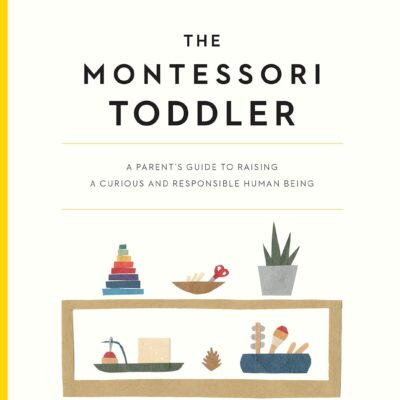
The Montessori Toddler: A Parent’s Guide to Raising a Curious and Responsible Being
Written by Simone Davies Illustrated by Hiyoko Imai
When I looked at the cover of this book I was intrigued. It was simple with a kind of unique illustration of a shelf with activities, and it was written for parents of toddlers—encouraging signs. Then I looked at the table of contents which was 3.33 pages long. Hmmm. Busy parents with small toddlers. Looks a little off-putting to me. So, I flipped through the book. I like photos and illustrations. There were very few photos and quite a few illustrations, but lots of words to read in this 248- page volume. Oh boy!
I made myself look more closely, and what I found was delightfully appealing. That huge table of contents I discovered was because the author listed each topic in each chapter, so it looked a lot more daunting than it truly is. Many of the topics listed are half a page to two pages at most. A parent can easily read a quick snippet and put the book down. They can also easily look up a specific topic that they are interested in because the topics are listed in such detail.
After looking more carefully, I really like the design. Simone Davies is very thorough. Her knowledge, understanding, and enjoyment of this age group is very apparent, and she shares it well with her audience. Often toddlers are misunderstood and so behave in ways that parents find difficult. Davies touches on some key points when thinking about toddlers. The first two chapters give parents valuable information about this stage in a child’s development and a brief introduction to Montessori. The rest of the book helps parents see their role as changing from a servant during infancy to a guide during toddlerhood and beyond. She brilliantly describes how to create a home environment that supports toddler success, both physically and emotionally, with furnishings and activities, as well as discipline.
The Montessori Toddler is a great resource for parents of infants, so that they can prepare for toddlerhood and for parents of toddlers who are already in the midst of toddlerhood.
If you like complex characters, a thrilling story, and Victorianesque setting, then you will love Six of Crows by Leigh Bardugo. This book tells the story of a convict, a sharpshooter, a runaway, a spy, a heart render, and a thief who band together to pull off an impossible heist.
Six of Crows takes place in the Grishaverse, a world where certain people called Grisha have the power to manipulate the tides, the wind, or even the chemicals in your body. Every chapter in this book follows the story from a different character’s point of view. The narrative switches between Kaz Brekker, a criminal underworld mastermind; Jesper, a sharpshooter, who can’t walk away from a bet; Wylan, the runaway son of a rich merchant; Inej, a circus performer turned into a deadly assassin; Nina, a Grisha heartrender far from home; and Matthias, a Drüskelle, witch hunter, and a convict. All of them must put aside their differences to complete an impossible heist, not only to save the world but for the money.
The first half of this book takes place in the city of Ketterdam, a city based on Amsterdam, specifically in The Barrel, the part of town with all the gambling halls are where anyone will do anything for the right price. The Barrel is home to thieves, conartists, and, most importantly, gangs. It’s a place where everyone is trying to outsmart everyone else. The second half takes place in the faraway country of Fjerda, a cold unforgiving country filled with Drüskelle. Overall, I loved the setting; I just wish we could have explored The Barrel more. Kaz, also known as Dirtyhands, is a lieutenant in a gang called the Dregs. Inej is a kind, yet dangerous, Suli acrobat who, through a series of unfortunate events, finds herself an assassin. Jesper is a jittery and funny sharpshooter, who can’t walk away from a wager. Nina is decisive and independent. Matthias is cold and a good soldier. Wylan is the moral compass of the team.
Six of Crows is a must-read for anyone who enjoys thrilling, suspenseful, and magical books. With its complex characters, engaging, and intriguing setting, Six of Crows is not only a good book but a masterpiece.
Reviewed by Daniel Pellizzari,10th grade
Matched
by Ally Condie
In the book Matched, a girl named Cassia lives in a tightly controlled society where decisions are made for her. Officials decide, no one else. They decide whom you love, where you work, when you die, and more.
Ally Condie’s husband gave her the idea to write the book, Matched. She had a conversation with him about marriage in the fall of 2008. He asked, “What if someone wrote the perfect algorithm for lining people up, and the government used it to decide whom you married, when you married, etc.?” But some of Condie’s inspiration also came from general experiences, such as becoming a parent and falling in love.
The main characters in this book are Cassia Reyes and Bram Reyes, Bram and Cassia’s parents, Cassia’s grandfather (Xander), and Ky. My favorite character is Cassia’s grandfather (aka Samuel Reyes) because he’s so sweet and he understands Cassia. He’s kind and gentle to everybody, and he loves poetry. In this story, Samuel is always there for his family, as well.
I would like to experience what living in that society would be like. Cassia is so closely monitored all the time and isn’t free to do whatever she pleases—other people control everything Cassia does from the time that she eats to the time that she dies. It would be really interesting to see what that would be like.
Matched is definitely one of my favorite books. It’s very well written and interesting to read. The book has many unexpected twists, turns, and lies that make you need to keep reading. If I could change one thing about this book, I would change something that happens to Cassia’s grandfather. If you want to know what happens to him, you should read the book!
I highly recommend this book because it opens up your mind and makes you more grateful to know that you aren’t always being watched or monitored at all times. It’s so crazy to think how free we are compared to these people who live in a place where they’re just like everyone else—from clothes, to school, to work, and even to falling in love. If you’re the type of person who likes family, adventure, fantasy, and love, then I believe that this would be the perfect book for you!
Reviewed by Maya Stutzman,9th grade
Flowers for Algernon
by Daniel Keyes
Flowers for Algernon is highly acclaimed, having earned the Nebula Award for Science fiction and Hugo award for best novel and considered a classic by many. Written initially as a short story in 1959, it was later expanded into a novel in 1966. The book challenges the status quo of science fiction, focusing not on laser guns, but on the human mind. When it was released in 1959, it changed the very definition of science fiction. However, besides the science aspect of the book, it also has a more important message about humanity.
The story follows Charlie Gordon, a developmentally delayed man who wants more than anything to be smart. When two scientists choose him to be part of a science experiment meant to raise his IQ, his view of the world is completely changed. Now he has to deal with the difficulties that come with intelligence and the painful memories that begin to manifest in his head. I won’t say that this book will change your life, but it should definitely make you think. For me, Flowers for Algernon really pulled at my heartstrings and made me feel emotions that few books have been able to elicit.
Before I elaborate more on the story, I would like to mention that this book is not for kids any younger than secondary school age or those who are afraid to feel a little uncomfortable. The reason I say this is as Charlie remembers more and more of his past, the book takes a darker turn. There are also some slightly mature moments in the second half of the book.
Charlie’s character goes through multiple changes as his intelligence increases. He starts off as a man who has the mind of a kid, working at a bakery owned by a family friend. This is the only place he is able to work, and the owner acts as a father figure to him. He can’t remember anything and is constantly bullied by the other workers. Then, when he receives surgery that slowly increases his intelligence, his character completely changes. He becomes a hyperintelligent person who remembers everything and is able to learn twenty different languages, but now he realizes everything that has happened to him in his life. He now understands that he was previously living in the moment but not able to understand the moment. He had no control over his life, yet now he does, and he’s impossibly frustrated by this. People treat him completely differently and are scared of him. He’s mad at the world, at people, and at his circumstances. He only finds true companionship with the lab mouse, Algernon, that was the scientists original laboratory test subject.
A cool aspect of Flowers for Algernon is how the book itself is written. The story is told in the first person and is written in progress reports by Charlie. This gives the reader a new way to look into the protagonist’s mind, and I really enjoyed reading something that is written so uniquely.
One of the major reasons why I truly recommend this book is its great message. It shows that people who have mental disabilities are still people. We shouldn’t treat people differently just because they struggle with simpler tasks. If anything, we should support them and help them like we would any other person.
Reviewed by Micah Levine,10th grade
Between Shades of Gray
by Ruta Sepetys
“Have you ever wondered what a human life is worth? That morning, my brother’s was worth a pocket watch.”
Between Shades of Gray is a historical fiction novel written by Lithuanian-American writer, Ruta Sepetys. Sepetys’ heritage inspired the creation of Between Shades of Gray, her first novel. This chilling novel is centered around the soul-crushing events of the sovietinvasion within the country of Lithuania in 1941. During this time, soviet police took men, women, and children and dispersed them wherever they pleased, all while leaving the captives uninformed of their destination. The soviets would tear families apart, leaving them to question the fate of their loved ones. The soviets essentially forced the Lithuanians to live as slaves under extremely harsh, inhumane conditions, while having to comply with every order given to them; if they failed to comply, it could mean instant death.
Between Shades of Gray begins with backstory on Kostas Vilkas. Kostas is the husband of Elena and father to Lina and Jonas. Like many other able-bodied men, he was taken and separated from his wife and children. His wife, Elena, is an intelligent and caring woman. Elena can be seen taking on the role of the voice of reason, as well as being a source of positivity. Their daughter, Lina, is a young teenage girl with a passion for art, only 15, when she and her family were taken from their home. Lina’s younger brother, Jonas, was only ten years old when their family was taken. Although they do have their mother by their side the majority of the time, both Lina and Jonas are forced to grow up extremely quickly due to the hardships they face within their situation. However, when the children briefly reconnect with their father, bumping into him in a nearby train car, Kostas gives the children words of wisdom, telling them to stay strong and not to give up. This empowers Lina and Jonas, making them want to keep going despite all their struggles.
The family, minus the father, was forced aboard a train headed towards Siberia. Here, they meet many fellow Lithuanian captives; most memorably, they meet Andrius Arvydas.
Andrius is around the same age as Lina, and during the novel, they become love interests. The family also meets Mr. Stalas, Mrs. Grybas, Ona, and others. They all soon come to be familiar with Komorov, the commander. It seems as if Komorov is the embodiment of evil; he is the main antagonist. Along with the commander, the Lithuanians also get to know Nikolai Kretzsky. Kretzsky is another soldier who takes part in torturing and ordering the captives around. However, as time progresses, Elena strikes an odd friendship with Kretzsky and it’s revealed that he isn’t completely evil.
Between Shades of Gray demonstrates many important themes, including: morality, sacrifice, integrity, strength, and much more. I love watching the characters develop and grow throughout their story. Each character looks at what it was like to be a captive in the mid 1900s from different perspectives; and you are somewhat put into their shoes. I especially appreciate that, to create this novel, Septeys interviewed real survivors of this time. The fact that everything happening directly stems from those peoples’ truths gives the story life; it gives the story more real feelings and emotions. It shows a more historically accurate representation of their hardships. Their stories must be shared, and the way Septeys delivers their stories is beautiful. Septeys makes the story more personal, incorporating thoughts directly from the protagonists’ minds.
Septeys brings to light the crushing tragedy of the persecution of Stalin’s victims in such a way that is extremely powerful and full of raw emotions. This novel covers such a real and touching topic, I would direct the novel to a more mature audience. Anybody who enjoys more intimate, emotional novels will love this book. Be warned, Between Shades of Gray is a rollercoaster; you better make sure to buckle up.
Reviewed by Katherine Laub,9th grade
Ninth and tenth grade students at NewGate School are reading and writing like crazy! Writing reviews for real publications provides students with an authentic reason for writing. Do you have students or children who would like to send in reviews? For submission guidelines, contact: lornamcgrath@montessori.org.




















 ”I declare after all there is no enjoyment like reading! How much sooner one tires of any thing than of a book! When I have a house of my own, I shall be miserable if I have not an excellent library.”