About 90% of the Montessori schools in the US are nonpublic. While many are nonprofit, the number of new for-profit privately owned Montessori schools continue to expand, and we see a growing number of networks or chains of schools cropping up.
In the early days of the Montessori movement in the US, new Montessori teachers often dreamed of having a school of their own. Sometimes opened with family money, perhaps a parent partner, and sometimes on a shoestring in a single classroom, Montessori has always had a sector of schools run as private businesses.
At the Montessori Foundation, we celebrate the many faces of Montessori, whether public, charter, private nonprofit, or private for-profit.
Some of the most interesting and stable Montessori schools are private businesses run by owners who love their school, offer exemplary Montessori programs, and earn a return on their investment.
While most Montessori educators want to see more programs offered to children who cannot afford private school tuition, creating and sustaining a high-fidelity Montessori school within the public sector has always been a challenge.
Even well-established public Montessori schools can suddenly go in a different direction if there is a change in school leadership, state regulations, or district priorities.
Nonprofit private Montessori schools can also find it challenging to stay true to their original vision and mission over time with an ever-changing board, school leaders who are not committed to Montessori, and the challenges often created by parent expectations.
We find it interesting to note the wide range and continuing growth of new schools opening in the small business world.
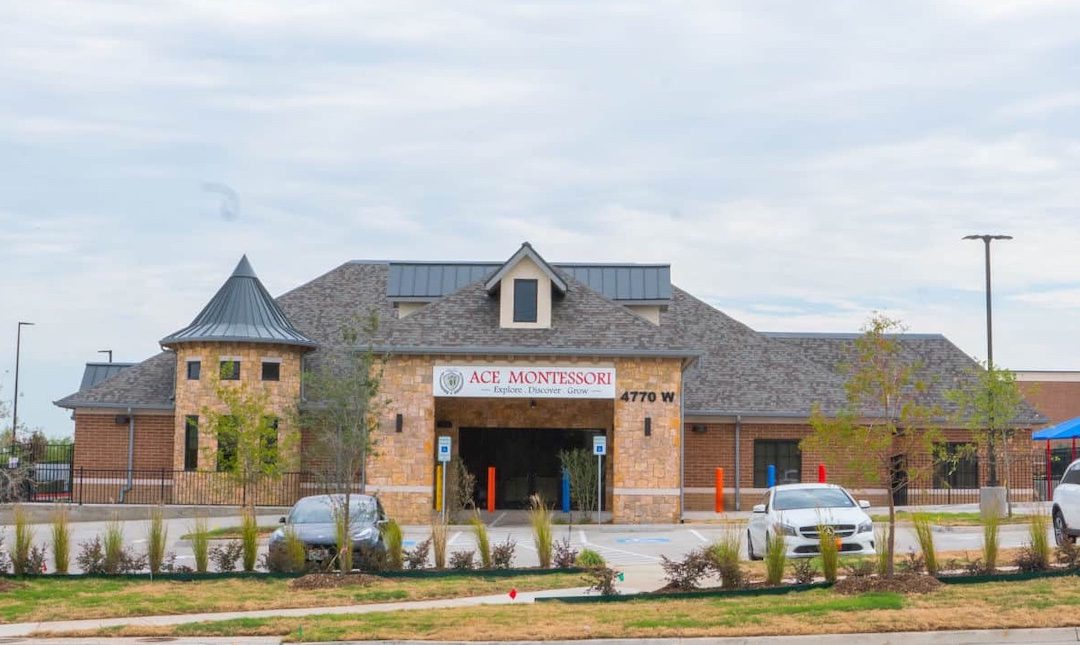
Let’s take a case in point: Painted Tree, a new residential community in McKinney, Texas, announced plans for a new Montessori school. Recently, the McKinney Courier-Gazette ran this story:
Oxland Group, a Dallas/Fort Worth-based development firm, today announced plans confirmed by the City of McKinney for the development of a Montessori school within Painted Tree. The 12,000-square-foot school will be located on a two-acre site on the northeast corner of Hardin Boulevard and Taylor Burke Drive. Developers will break ground on the new site in August 2022, enrollment will begin in January 2023, and the school is expected to open in the Summer of 2023.
“We couldn’t be more thrilled to bring a high-quality education facility to future residents of Painted Tree and greater McKinney,” says Tom Woliver, co-president and founder of Oxland Group. “The Montessori experience parallels our own vision for Painted Tree in fostering exploration, curiosity and engaging the natural world around us.”
The Montessori School at Painted Tree will provide educational experiences to approximately 200 students, ages 6 weeks to 6 years old. The school will offer employment to approximately 25 teachers and staff, following a curriculum that balances academic, creative and outdoor activities. Montessori education is student-led and self-paced but guided, assessed, and enriched by knowledgeable and caring teachers, leadership of their peers and a nurturing environment.
“Incoming residents and community partners have expressed a strong desire for a Montessori school at Painted Tree,” says Indu Pancharpula, owner and operator of Learning Tree Montessori. “We have found a great place for our future home at Painted Tree and look forward to raising up children and future generations for years to come.”
In addition to the Montessori school at Painted Tree, Pancharpula owns and operates three existing schools in Prosper, Anna, and Princeton; plans to open two locations in Celina and South McKinney in July 2022; plus, three more in Celina, Melissa and Frisco over the next two years.
We have not verified the facts in the story. Still, it illustrates a growing trend across the United States.
Investment groups or small partnerships see the potential of running Montessori programs in multiple locations with many centralized administrative functions.
A few well-known examples are the Le Porte schools, Guidepost Montessori, Montessori Unlimited, and Endeavor schools.
There are many smaller networks, such as the Montessori Schools of Silicon Valley that began in the Milpitas, California area and are now starting to expand to Texas.
We will continue to monitor this trend.
There is nothing inherently antithetical to Montessori if a school is run on a for-profit basis. My own family ran the Barrie School in Washington, DC that way for more than 50 years.
Even though the Montessori Foundation works within the nonprofit sector, we appreciate the stability and consistency that can be achieved with private ownership, especially when operating at a scale that allows for shared administrative coordination.
While many Montessori parents and teachers may feel that schools should be nonprofit, every school—public, private nonprofit, or private for-profit— is a business.
What matters most is the quality of the school’s programs and services and whether its culture leads to high staff morale, well-educated Montessori children, and satisfied families.
There is a myth that being for-profit is inherently inconsistent with authentic Montessori.
We have seen that be the case from time to time, but we see it just as often in nonprofit, public, and charter Montessori schools.
Let’s appreciate quality Montessori wherever we find it. We celebrate that families have a choice of where to send their children to school and recognize that Montessori schools are allowed to offer a program that is usually very different from most state schools.
Schools continue to look for ways to create a more diverse school community through the strategic use of financial aid drawn from within the school’s budget, or working with government income-based scholarship funds wherever they exist.
Always consider the trade-offs when we accept government money through programs that provide financial assistance to low-income families to help them afford the cost of preschool or alternative nonpublic school options. Look at the compromises we may be forced to make to qualify for those programs and consider whether the price is worth the reward..
If the price of participating in any state-funded program is unacceptable, is to charge tuition high enough that makes it possible to set aside a portion of your funds to provide your own need-based financial aid programs. Some schools do this on a sliding scale tuition basis. Instead, we recommend an outside financial aid management service that screens applications for your school.
Solving organizational role vacancies with staff already part of an organization can provide opportunities for those staff to grow and develop and for the organization to benefit from their organizational acumen. Unfortunately, too often our knee jerk reaction as organizational leaders is to start searching for outside hires that can fill these open positions. This Montessori Leadership Forum conversation will be led by Eric Harper and Dana Kaminstein. The conversation will focus on the way in which organizations miss opportunities by not promoting from within, how to develop and prepare people in the organization for potential new roles, and how solving talent puzzles internally can provide a growth opportunity for both the individual and for the organization.
This is the time of year when school leaders ask themselves the following questions. Who is staying and who is leaving, who needs to move on, and who needs to grow in their teaching practice or professionalism? Our discussion will focus on how we make staffing decisions empathically and objectively.
Join our special guest Renee DuChainey-Farkes and other school leaders as we talk about how to support and meet the needs of our faculty as they continue to move forward. The faculty are the heartbeat of our schools. What do we know about their needs?
Currently in the United States and in many places around the world costs are on the rise. This week, Tim and Marc Seldin will open a conversation on how schools can re-examine their projected budget for the coming school year and prepare for rising costs., With a tight job market, we can anticipate pressure on schools to increase salaries and benefits, even though tuition is probably already set for the coming school year. This will create new challenges in balancing our schools budget.
As leaders we want to be everything for our faculty, students, parents and communities. We want to build a strong culture, lead the best meetings, say the right things and make the brave calls. We want to have all of the patience and none of the reactions. We want only the positive human emotions and none of the stumbles or missteps of negativity. We think having risen into leadership means basically, we must be “better” than everyone else. While this striving for right action and goodness is a noble pursuit that is probably coming from the “right” place, it’s actually presumptuous and prideful. This is not equality. And it certainly doesn’t allow you to bring your authentic self to work. Equality is not just about lifting our community up. It’s also knowing how to lead when we come down to earth in our messy human forms. We will discuss 4 ways the circle of equality levels the playing field whether we like it or not.
Carson Montessori, one of the premier educational gems in Northern Nevada, is a real-world, hands-on learning center nestled in the foothills of the Sierra Nevada Mountains. CMCS follows the lead of the child and is enriched by the philosophies of Dr. Maria Montessori. Our Montessori guides use a simple approach of ‘less can definitely be more,’ and everyone embraces the fact that learning needs to be fun, magical, and jam-packed with wondrous discoveries. The mantra that it is important to be the least restrictive, best environment for each child who enrolls has transformed a warehouse into a little green school that has become a warm, welcoming, learning-centered home.
As a free, public Montessori school for grades K-6, we are required to blend the traditional ways of learning with the Montessori self-directed, hands-on, discovery style. Carson Montessori’s educational philosophy stands firm that the school and its highly qualified staff will not become mired in mandates or numbers-driven canned curriculum; instead, we follow the lead of the child, and if an idea is do-able, workable, and feasible, it is implemented with CMCS’ 48-hour launch. It is exciting to continually discover or invent cutting-edge opportunities and be able to implement them before they become trendy. The director doesn’t want to read about it or hear about it; she wants to see it in action every day in our classrooms.
Carson Montessori is an official Nevada Governor’s STEM School, and it is rich with community partnerships, which provide daily onsite learning experiences. Woven into the core subjects are individualized ‘passion’ projects that facilitate the making of decisions and choices. CMCS has a schoolwide Makers Lab, where students learn rocketry, robotics, build and use 3D printers, manufacture prosthetic hands that are sent around the world, have a green-screen studio to produce onsite newscasts, and when they can’t travel to exotic locations, they have access to virtual reality.
Currently, a student-research project has students actively engaged in using the Montessori Method in memory care. Students share Montessori lessons with their learning buddies at the LODGE Memory Care Center, while also supporting numerous local philanthropies. Through their Karma Box and products produced by Carson Montessori’s hydroponic garden, students provide services and products to Friends in Service Helping, which aids the homeless and the hungry in the Carson City community. Students even check Carson City’s water quality through a partnership with the Water Conservancy.
Students at CMCS learn grace and courtesy and how to handle emergencies.
They frequently experience hands-on career opportunities provided by local businesses and have a complete financial literacy curriculum that has been recognized by the Nevada Department of Education. They work on various bills during each legislative session and routinely testify before the Nevada State Legislature. During the 2019 session, the students wrote Assembly Bill 182, lobbied it through the legislature, and it passed unanimously making NEON Nevada’s State Element. By using curriculum wrapping, with nothing taught in isolation, and providing the setting for immediate application, learning is practical and purposeful.
Students are thriving at Carson Montessori, and that feeling of Montessori peace and calm, which is so often missing in today’s world, is alive and well. Students learn to cope with today’s challenging world. It definitely is a learning environment, while surrounding the child with positive, warm support that sparks the wonder and curiosity that ignites each child’s passion for learning. CMCS remains committed to producing exciting learning opportunities and is dedicated to nurturing that “wondrous, ah ha-amazement factor.” At Carson Montessori, students still have time to play, run with the wind, and dance in rain puddles, all while building a future of happy, well-rounded, lifelong learners.
We recently presented at the school board meeting to request a renewal of our charter and then before the Carson City Board of Supervisors. The entire presentation was student-led, and they were the stars who impressed our city officials with their public speaking skills and poised demeanor.
Jessica Barlow Daniels, a distinguished Nevada Educator who delights in following the lead of the child, is famous for climbing mountains in a little black dress and heels. As the Executive Director of Carson Montessori Charter School, she will go to any length to free a child’s potential by continually modeling that education is acquired by experiences in the environment and a Montessori teacher must prepare herself and truly work at it.
Montessori is great for little children but that’s it!
Montessori is warm and fuzzy. Children enjoy it, but the real world isn’t warm and fuzzy. They have to grow up sometime.
I’m worried that Montessori shelters my child from life.
Your children are still in Montessori. You should be thinking about their future. You do want them to go to college, don’t you?
As a Montessori parent, you’ve probably heard many statements like those above, and you can probably add a few of your own. These remarks often are expressed by parents to other parents. Sometimes they come from well-meaning relatives, co-workers, neighbors, and just about anybody who knows you have a child in a Montessori school. When it comes to Montessori, it seems that everyone has an opinion.
When my children first started Montessori many years ago, I heard the statement “It takes courage to be a Montessori parent.” I used to believe that it took courage because Montessori was an experimental program to which I was offering the use of my children as guinea pigs. As I became better informed, I quickly discovered this was not the case. Montessori has actually been around for over one hundred years and has been proven successful in many different educational environments throughout the world.
So what does it mean “It takes courage?” Maybe it’s because Montessori tends to encourage children to think for themselves and articulate their own opinions. This is all wonderful, but as a parent, there are moments when it would be a whole lot easier to deal with a six-year-old who blindly and obediently accepts your explanation for why you don’t want to create a recycling center right in the middle of your kitchen or a four-year-old who announces that she knows where hamburger really comes from and she’s never going to eat it or any other animal ever again, period!
That must be it, I thought. It takes courage to live with these self-actualized, intelligent little creatures that have been encouraged by Montessori to think logically and express their opinions. I stuck with this understanding of the “courage” statement for a number of years. As a parent of two children who grew up in a Montessori school for ten years, I’ve got a million examples of a Montessori mother’s courage in action, but that’s the subject of another article.
As my children got older, I came to understand the courage statement in a whole different light. About the time that my children hit kindergarten, I found myself constantly defending my choice to keep my children in Montessori through the elementary years. The opinions of relatives were the most difficult and the hardest to discount because they came from people who were legitimately concerned about their grandchildren, or nieces and nephews. A case in point. My husband went to a New England boarding school, followed by Yale, followed by medical school at Columbia. He later topped it off by obtaining a law degree. Observing his grandson working with little beads while lying flat on his belly during a visit to the school, it was clear from the bemused expression on my father-in-law’s face that Grampa Dan not only had doubts about Montessori, he also had doubts about us as parents.
The pressure can be enormous. There were many times when we were very tempted to walk away from Montessori and put our children into the capable hands of a more traditional school. After all, we turned out all right. Or did we?
Speaking only from my own personal experience, I question how we as a society have come to define “success.” Is a child who grows up to become a doctor or a lawyer any more successful than a carpenter or a musician or a teacher or a homemaker? Do well-intended parents unconsciously push their children into status careers that send out all the right messages that we as a society have come to accept as the true measure of success.
Does it matter to us that our child grows up to be happy with her choice in careers, that she has a sense of fulfillment every day that she goes to work, that she approaches each day of her adult life with the same enthusiasm and eagerness to grow that she experienced as a child in the Montessori classroom, that she is able to accept the challenges that life has to offer and has the ability to adapt to new ideas and technology, that she understands that whatever gifts of intelligence and ability she possesses they are truly gifts and that others have other abilities and gifts that are different from her own? If we as parents can answer yes to these questions, then I believe our children are well placed in a Montessori environment for as long as we are able to keep them there.
In designing the cover, we tried to find a provocative, and indeed a shocking way, to visually portray the question: Does Montessori prepare children for the real world? The cover has a great deal of personal significance to me for three reasons. First, the boy in the picture is my son. I can assure you he does not look like that in real life (see insert). Second, it is the first and possibly only time I have ever succeeded in getting him into a tie and jacket long enough to have a picture taken (my mother will be so happy). Third, and most importantly, as a young adult, I chose a career in law for all the wrong reasons.
I believed that becoming a lawyer would give me prestige and wealth. What it gave me that I hadn’t counted on was an ulcer and the nagging feeling that I should be doing something else with my life. Please don’t get me wrong. I don’t dislike lawyers (or tasseled loafers) — even trial lawyers are ok with me as long as I don’t have to join them in the courtroom. There is nothing wrong with the law, medicine, teaching, carpentry, or anything else as long as it is what is right for the individual.
If the answer to the question of whether or not Montessori prepares children for the real world is to be judged by whether or not great percentages of Montessori students will go on to a professional career, then the answer is maybe. If the answer to the question is to be judged by whether or not Montessori prepares children for life, the answer is an unequivocal yes.
As a parent, I have very high expectations for my children from Montessori. I expect them to be well prepared academically so that they will be able to follow their dreams wherever that may take them, but I hope that they will be able to continue making the responsible choices I see them make every day in their classrooms, I hope that they will be able to retain the love of learning and creativity that hasn’t been driven out of them by a system that is so intent upon conformity that it places individuality at grave risk.
I care about academics, but I know that my children will get them from any good school, Montessori or otherwise. For me, the true value of Montessori goes beyond academics. When I look at my own children, I see behavior patterns that are different from my own at their age. I feel very comfortable that Montessori prepares children for the real world. In an interview, David Kahn once remarked, “Montessori is the real world. It’s the dichotomy that’s false.” When you think about it, there’s a lot of sense behind that statement.
I often wish I could have had a Montessori experience as a child. Things might have turned out differently. For one thing, I could have saved all that money on law school, but then I really do believe that all learning experiences have value. Maybe a bit of Montessori did rub off on me after all. At the age of 35, I quit the practice of law and I’m now doing something I find much more fulfilling, something I probably should have done in the beginning if I had not tried so hard to jam my round-pegged personality into a square professional hole.
When I announced that I wasn’t going to practice law anymore, the initial overwhelming response was, “What do you mean you’re not going to practice law anymore. How do you think you’re going to survive in the real world without a profession?” Sound familiar?
More than anything, I hope that we as parents will have the courage to recognize and continue to support the human values and life lessons that our children are learning in their Montessori classrooms every day. As for my children growing up to pursue some kind of yuppie career, that’s ok as long as it’s right for them. Our world could probably use a lot more Montessori lawyers, politicians, and doctors who understand that there’s more to life than being book smart. Above all, though, I think that as parents and educators we must never accept the premise that our objective must be to teach children to survive life. Better we should help them learn to celebrate it!
The tendency of many families to transfer their children to conventional schools at kindergarten, and far more to leave at first grade, has been a great concern to Montessori schools around the world. Montessori educators often suppose that this is largely caused by most parents’ lack of understanding and appreciation of the importance of the third year in the early childhood program and the value of Montessori elementary education.
There is no doubt that many parents are uninformed, but ask yourself, if the parents who leave were better informed, would they really care? Heads of Schools from all over the world tell me that most families come to our schools looking for good childcare, or perhaps a fine start on the road to traditional education, but not for Montessori itself.
Despite this, many schools attempt to sell parents Montessori as an educational approach, a special and most appealing way to teach, but Montessori is much more.
Montessori is a philosophy of life that envisions life as a partnership among people, and a personal journey of self-discovery, rather than a competition in which adults, being older and better informed, mold the young person, establish their lives’ objectives and goals, and teach them to compete with others successfully.
Sadly, all too many people around the world live their lives as a reflection of what other people think is important and appropriate and worth pursuing, rather than following their own hearts and thinking for themselves. Far too many people value possessions more than personal fulfillment and happiness. And far more value power and social position as ends in themselves.
Montessori used different terms to explain her sense of the source of the focus, kindness, and intelligence that she found within the world’s children, and how the adult world, which generally wants nothing but the best for its children, instills in them passivity, mindless acceptance, and social competition and oneupmanship.
Montessori as a movement is about peace, not competition and war. Too many hear those words and assume that we do not value excellence, but they are mistaken.
We value excellence but recognize that it is not as rare among human beings as many people believe. We know that the best way to draw it forth is to inspire a sense of wonder and a habit of focusing our entire attention on whatever task we have at hand.
We nurture the creativity, curiosity, and imagination with which children are born. We help children to fully realize their inborn human spirit.
Montessori is about partnership, kindness, and respect.
How many of the parents in your school actually value things such as these?
Are not many parents intensively ambitious for their children, as well as themselves?
Do not many parents unconsciously see their children as “accessories,” which should add radiance to their beauty or standing among their friends and family?
Do most parents in your school really see their children as people, or as something in their lives to be shaped into what they have in mind?
Do many parents define themselves by the house in which they live, the car they drive, what they wear, who they know, and by what they do to earn a living?
If so, how can we be surprised by the small numbers of parents who continue with our schools once there are good public or more traditional private schools available?
Parent education can offer them ideas and information, but it rarely changes parents’ core values and beliefs. It may lead them to rethink assumptions that they came to with little thought, but only if they were more or less with you from the start.
Most parents don’t agree with Montessori’s core principles, and if they really understood it, they probably would never have enrolled.
For the last five thousand years or so, most human societies have been based on the idea that competition, domination, and violence are the natural order of things. As Riane Eisler, David Loye, and many others have shown, this does not appear to have been true before that point in human social evolution, but it has certainly dominated (pun intended) human experience since then. With a few lovely exceptions, such as Minoan Crete, human culture has born witness to organized warfare, social hierarchies based on domination and social elitism, and a social order in which women have been more or less considered chattels, rather than allowed to live in partnership with men.
Maria Montessori, coming from a highly competitive upwardly aspiring middle-class culture in Italy during the late 1800s, gradually came to recognize the falsehoods on which this world view was based, and the truth that, given the right environment, human children will reveal the true potential inherent within their souls and develop a perspective on the world that is based on compassion, self-confidence, and joy in lives well-lived.
While we are all capable of encouraging parents to feel this way, the truth is that if the message does not light a spark in their hearts, we are wasting our breath. They simply slip away at year’s end.
In addition to everything that we can do to build up a sense of community within our schools, we need to begin with the first step of seeking families who share similar values to our schools.
When you have gathered the right families together, parent education works because they are willing, if not eager, to listen and learn!
There are too few Montessori-oriented parents in the world. Many of the people who would most dearly love us have an inaccurate impression of what we believe.
As a result, our schools tend to be filled with three different groups of parents:
The first is the inner circle of True Believers. These wonderful parents get it and they tend to value what we bring to their lives. We need more of them!
At the outer fringe is the group that I call the Parking Lot Mafia! These are the inevitable group of parents who are disillusioned, resentful, and anxious to have the year come to an end so they can get their children in a much better school.
And then there is the group that represents the vast majority of parents in most schools: the Parents Who Haven’t Got A Clue! These are nice people, who are not dissatisfied, and who may even be quite active in your school, but they have no long-term commitment to you or Montessori. If you were dating them, these would the guys who just aren’t that into you! They have a nice time, but never call back!
It is disillusioning to work in a school that is largely filled with people who do not believe in what we value, and who do not wish these things for their children.
And the sad thing is that the problem is caused by us when we accept parents like these blindly, glad to have another space has been filled, without concern about whether or not these parents are with us for the right reasons.
But when these parents leave, they rarely leave alone. They are often very influential, and wherever they go next, you can bet that another one or two, or more, will go with them.
So, if you want to build your school, build it from the bottom up by becoming very clear about who you are, what you believe, and what you can honestly offer. Then go out and search for those rare parents who are looking for a school just like yours
Think it won’t work? Waldorf schools and others have been doing this for decades, and most are doing very well.
Most importantly, some Montessori schools have done this all along, and almost every one of them has prospered. We hope that you will heed our advice, and start looking for parents who need you as much in the long run as you need them.
This Montessori Leadership Forum will focus on helping Montessori school leaders cope with the onslaught of internal reactions they have to the recent catastrophic world events in order to better prepare them for leading the Montessori communities they serve. The emphasis of this Forum will be on discussing some of the assumptions about the current world events that will help us avoid dead ends and anxiety. Then we will discuss some practical ideas to help you do the inner work necessary in order to lead the Montessori community you serve with calm and without scapegoating others or nations.
Over the past decades, a constantly growing number of schools have approached the Montessori Foundation ready, willing, and anxious to begin the journey from being simply good Montessori schools to becoming great ones. We have called this process Building a world-class Montessori school.
This can be a daunting task. It normally requires several years of focused hard work, complex and difficult decisions, planning, and a considerable investment of resources. Once begun, the school cannot back off from its commitment to excellence. The school must be prepared to meet raised expectations among parents and staff and follow through on its commitments to the school community. This is not something to be undertaken lightly. It requires an absolute commitment to excellence. We recommend that you have this vision in mind as you begin your process of starting a school and hold it as your goal moving forward.
Principles Which Underpin Excellence
We have found several principles to be critical in building a Montessori School that is truly world-class.
PRINCIPLE 1: An uncompromising commitment to excellence.
World-class Montessori schools make an uncompromising commitment to becoming excellent in all areas of their programs, facilities, resources, and operations. They clearly define their identity, mission, and core values. They seek out and turn to examples of true excellence in Montessori practice around the world.
They consciously define what excellence will look like in every aspect of their programs, facilities, and operations. They have plans for how they will create and maintain this excellence in each area of school operation.
They have determined what it will cost to create and sustain excellence in all areas and have developed a plan for funding it.
PRINCIPLE 2: Institutional memory and integrity.
World-class Montessori schools ensure a strong sense of institutional memory and integrity within the school.
A school lives in the minds and vision of a group of people. No school can be great without a clear sense of its core values and the institution’s culture: this is who we are and how we do things here. World-class Montessori schools are not generic Montessori schools – they have a unique identity.
The character of any school will evolve, but it should evolve slowly and in a logical progression of maturation. Unfortunately, it is all too easy for Montessori schools to make compromises that threaten the integrity of their program because of tight budgets, lack of parent understanding and support, or because Montessori trained teachers are hard to find. Sometimes schools lose their clear identity because they grow too fast, adapting an initial vision to accommodate market pressures or to capture a growing market in a new area.
What we say our school does, and the principles we believe must be translated into day-to-day reality. A great school stands for something distinct. It cannot possibly please everyone. The school that some deeply respect and admire will not appeal to others.
PRINCIPLE 3: Clearly stated mission, core values, and educational beliefs.
World-class schools carefully define and write the school’s mission, core values, and educational beliefs. All policies and strategic decisions are based on these core values.
Many people assume that Montessori means the same thing to everyone. This is, however, not true. There is a wide variety in the way Montessori is applied. Unless a school can clearly define its unique character and understanding, parents, staff, and the wider community may become confused about the disparity between their assumptions and what the school is actually offering.
The ideas that define the nature of a school are the very soul of the school as an institution. It is essential to have a clear understanding and agreement about your mission, vision, and core values. Only by going through this process to develop clarity and consistency from class to class and level to level can you discover and define the school’s true nature as you want it to be.
PRINCIPLE 4: Consistency in philosophy and practice throughout the school.
World-class Montessori schools ensure that the school is consistent in philosophy and practice from class to class, from one level to the next, and from year to year.
Many Montessori schools are made up of individual teachers who do their own thing in their classrooms, without much awareness or concern about coordination with the other classes within the school. As a result, it is not unusual to find Montessori schools made up of several classrooms that bear little resemblance to one another. Parents and teachers often hold very different perspectives of the school’s mission, philosophy, and priorities.
For a school to grow and enjoy respect, parents should be confident that their children’s experience in the school will be highly consistent from year to year, from one class to another, and from one level to the next.
PRINCIPLE 5: Leadership by an inspiring and consensus building Montessori leader.
World-class schools have an inspiring and consensus-building Montessori Leader. Montessori schools that wish to remain faithful to their legacy need to be led by a first-rate Montessori educator. Being true to the underlying principles that distinguish them as Montessori programs, world-class schools will be based on a different set of assumptions and beliefs about the nature of learning, the definition of what constitutes a first-rate education, and the relationships among students, educators, families, and school to that on which excellent conventional schools will be based.
Research has consistently shown that the Head of School is the most influential person in any school. In great schools, the Head of School is, above all, a visionary who articulates and represents the school’s core values and educational philosophy. They are not simply an administrator or business manager. Such skills are essential, but administrators and managers are not necessarily leaders and can be hired more readily than a great educational leader. A first-rate Montessori Head of School can build a school from the ground up.
It is rare to find someone who is both a sophisticated independent school leader and trained and committed to Montessori education. While many non -Montessori trained educators can glibly espouse a Montessori -like philosophy and values, few understand or pay much more than lip service to it in practice. A Head of School who is not Montessori in both training and philosophical orientation will generally be ineffective as the school’s educational leader, may quickly get into conflict with the faculty, or in some cases will lead the school away from Montessori toward a traditional educational program.
Can you imagine asking a Catholic priest to run a Baptist church-affiliated school or a rabbi to head a school run by Quakers? Even with all the goodwill in the world, they are unlikely to share the school community’s culture, traditions, and values; and would not be likely to be seen by faculty and parents as appropriate leaders for this school.
At their core, authentic Montessori schools are based on an educational philosophy and system of beliefs as distinct as those of any school that promotes a specific religion or a culture quite different from the one held by most people in the local community.
All too many fine Montessori schools have suffered through a series of weak or disruptive leaders after the founder retires. In almost every case, these Heads of School were neither Montessori trained nor Montessori oriented in their educational philosophy or leadership style. We can all name non-Montessori-trained people who are highly effective Montessori leaders. However, each is ‘Montessori’ in everything but a teaching credential; each is genuinely committed to the Montessori vision.
We strongly believe that Montessori schools need sound Montessori leadership to thrive. Not doing so endangers the integrity and future of the school.
PRINCIPLE 6: Clear line of authority and accountability within the school.
World-class Montessori schools have a clear understanding of accountability and how it is embodied in a line of authority in the school.
Once a Head of School has been hired, she should oversee the entire school. All faculty and staff members should report to the Head of School. The Head of School should have clear day-to-day authority over the school’s programs and practice.
If there is a school Board, it is critical to clearly define the authority of the Head of School in contrast with that of the Board. All too often, confusion results when the roles of the Board and the Head of School are not clearly defined. It is not uncommon to see Board members performing administrative functions or making decisions more appropriately by the Head of School. This can lead to mistrust and conflict among the Head of School, the Board, and the faculty. This has the very real potential to destabilize the school.
Heads of School must be given the authority to manage the school within very broad guidelines established by the Board. For your school to continue along the lines of a caring, supportive, empowering community, it will always be essential to have a Head of School with the right balance of perspective, values, philosophy, skills, and experience. Finding the right person when you need one for your school is no mean feat.
PRINCIPLE 7: Admissions process – focuses on finding the perfect match.
World-class Montessori schools prioritize designing admissions processes that find families for whom the school is a perfect match. This contrasts with policies aimed at simply filling openings.
The process of admissions must be a Montessori school’s single biggest priority. The goal should not only be to fill each opening and thus meet our budget, but to gather children who will blossom within a Montessori setting, with families for whom the school is almost a perfect match with their values and long-term goals for their children.
Relatively few parents leave Montessori because of cost per se or are particularly unhappy with what the school has done. More often than not, they leave because they do not understand the benefit of a Montessori experience as opposed to the convenience and relatively lower cost of public schools. Whether they decide to move their children to a more traditional private school or the local public schools, parents leave Montessori because they have not been convinced that our schools offer their children opportunities for intellectual and social growth that are equal to and better in some unique way than the other schools in the community.
Too many families place their children in Montessori with little or no knowledge of what it is and what it offers, and certainly with no real thought given to any relationship beyond the next year or so. These families are simply looking for the best opportunities for their children, with no special commitment to Montessori education or as a specific school.
Montessori schools, however, need to find people who are willing to work with us as partners. We need families who share core values and goals for their children’s education that are compatible with the school’s. Ensuring that they stay with the school, it is important to challenge them to think long-term, weighing out carefully whether Montessori is the right fit for both their children and their family’s values before they enroll.
PRINCIPLE 8: Parents are kept very well informed about their children’s progress.
Parents expect to have many points of tangible and meaningful evidence confirming the wisdom of their decision and the effectiveness of the education that their children are receiving. World-class Montessori schools keep parents very well informed about their children’s education and academic progress.
Most parents do not simply look for academic evidence alone. We should not underestimate how vital social opportunities and extracurricular programs are to most children and parents. World-class Montessori schools find multiple ways to communicate with parents on an ongoing basis.
PRINCIPLE 9: Stable enrollment
Attrition refers to a reduction in enrolment from children leaving for reasons other than graduation. World-class Montessori schools work to reduce attrition from year to year. This means that the school actively works to retain students once enrolled. To be truly effective, the Montessori program requires that children stay for a full three-year cycle at the very least. Elementary programs depend on their success on children moving through from the 3 -6 program. Adolescent programs are designed to meet the needs of children who have had Montessori elementary experience—losing children before the end of a cycle and admitting children without previous Montessori experience at successive cycles impacts a school in several ways.
Firstly, children who leave early may not fully integrate their learning and may reflect poorly in-regard-to learning outcomes. This could create a negative opinion about the school. Secondly, the class may be left without its leaders when children leave early. Montessori classes need a full age span of at least three years to function properly. While some attrition is inevitable because of parents leaving the area, ideally, schools should aim for attrition of no more than 10%.
PRINCIPLE 10: Deliberate financial planning ensures that the school is financially sound.
To be excellent, a school must be financially sound. To become financially sound, a school must have a budget, a good bookkeeping system, and a financial plan that focuses on funding growth.
On December 3rd, Kitty Bravo and Maha Turner accepted the Dennis Schapiro Award for Innovation in Montessori Teacher Education. The Montessori Accreditation Council for Teacher Education (MACTE) grants this award annually to a Montessori teacher educator who has been truly inspiring and innovative and brought about significant change. The International Montessori Council (IMC) is thrilled to congratulate Kitty and Maha on this award for their lifetime contributions to the advancement of Montessori teacher education!
Kitty Bravo is the Director of Education with the Center for Guided Montessori Studies (CGMS). She accepted the 2020 award for her work envisioning, creating, and leading this groundbreaking online, low residency Montessori teacher education program, graduating over a thousand educators over its fifteen-year history. CGMS is a MACTE accredited and IMC-affiliated teacher education program.
Kitty Bravo’s acceptance speech
“It is a great honor to accept the MACTE 2020 Dennis Shapiro award for Innovation in Teacher Education and to have this recognition for my work with CGMS and online learning.
An innovator is usually someone with a good idea and I can’t take the credit for the idea of the Center for Guided Montessori Studies (CGMS). That credit goes to my partners, Marc Seldin, Tim Seldin, and Jon Wolff. It especially goes to Marc, who, as early as 1996, began telling his dad, Tim Seldin, that Montessori needed an online teacher education program. But in 1996, the Montessori community wasn’t ready.
Almost ten years later Tim, Marc, and Jon began to sketch out the plan for the first CGMS online course. Shortly after, the IMC board approved the CGMS pilot program as their first teacher education program affiliate.
But something was missing. When you have three good men working on a project, what do you need? A woman willing to work hard and get it done.
In 2006 I began working with my partners to develop the program. I also began working with MACTE. Being the first teacher Education Program (TEP) to seek accreditation for a program designed around online learning, there was a lot to figure out. Through many phone calls and emails, I worked with the MACTE staff and Gretchen Warner, the MACTE Executive Director at that time to figure out how to demonstrate we met the standards when
our format often did not quite fit into the usual charts. And some things just had not been determined, such as the number of hours required for the face-to-face residential session. I asked on numerous occasions but could not get an answer. Finally, it got down to the wire as we were getting ready to launch, and I called Gretchen. She told me to write a proposal to the MACTE board, and that is how we ended up with the 120-hour residential requirement that we still have today.
We launched the first cohort in the spring of 2008 and, in 2009, became the first blended learning TEP to receive MACTE accreditation. While we were the first to receive accreditation, we were not the first to begin dabbling in online learning. I want to give a shout-out to two people who really were pioneers, Elizabeth Parks from Chaminade and Barb Jens from Omaha. They both had done a lot of work with online learning in their programs and had shared their ideas at a MACTE meeting. Their work was an inspiration and greatly influenced what I did with CGMS.
It may surprise you that I did not come to the CGMS project completely sold on the benefits of online learning. I had no background in distance education and only mediocre computer skills. However, seeing many prestigious universities adding online degrees, I felt like it was an idea whose time had come. Though I will say, not many Montessorians in 2008 agreed it was time, or ever would be time for online Montessori of any kind. In fact, someone once told one of my partners that we and online learning would ruin Montessori.
It is never easy to boldly go where no one has gone before…
Even more than believing the time was right for online learning and that it was important for it to be done well, I was hopeful that this new format could provide an opportunity to enhance teacher training. I specifically hoped it would provide more opportunities for reflection and deep discussion that could support the transformation of the Montessori guide.
Remember, this was 15 years ago, before the advent of Facebook teacher’s groups where you can post a question and, in a flash, have 20 responses from Montessori educators with ideas and support. Our first online cohort was excited to have this new online platform for communication. We were eager each day to get up and check the discussion forums, often checking multiple times a day to see what had been added, what ideas our friends had to share.
Within just a few weeks, I felt our learning community was growing as strong as any teacher ed group I had worked with in a physical space. I also knew it was working to support the spiritual transformation of the teacher, when at just three weeks, one of my adult learners typed into a forum, “This is already changing what I do with children.”
It was also changing what I did with my adult learners. This new format required me to constantly examine teacher ed practices, I had to consider every assignment and all the usual expectations to understand their purpose and determine how they could be adapted to the virtual world.
Now let’s fast forward to 2020 when so many of you zoomed into the world of online education. I know it was challenging, but hopefully, your online work has helped you experience and imagine new ways to reach your adult learners and bring Montessori to the masses. Because, my friends, if we are truly going to have an impact in this world, that’s what we need to do. The world needs more Montessori graduates, and to make that happen, we need more Montessori teachers. Our world needs dreamers, problem solvers, peace makers, and innovators. No educational model does that better than us.
”The world needs more Montessori graduates, and to make that happen, we need more Montessori teachers. Our world needs dreamers, problem solvers, peace makers, and innovators. No educational model does that better than us.”
Innovation is at the heart of Montessori. Our educational approach exists because of the innovative ideas of Dr. Maria Montessori. She was bold and tireless in looking for solutions to the problems of society, especially those of women and children. She continued to develop and expand her educational approach throughout her life, always seeking to make it better, to adapt it to meet the needs of individual children and various cultures.
I believe her mandate to us is to continue to do the same; to constantly examine our practice, expand and adapt to meet the needs of our time and the unique needs of the people of this time. We can only meet those needs if we continue to stretch and grow. I believe this growth does not mean abandoning the core principles of Montessori. We can hold on to the most important principles that are the life and soul of Montessori while also being open to new ideas and adapting to make the best use of the technologies of our time.
One day back in early 2008, just before launching our first cohort, I got a phone call from Denny Schapiro. As always, Denny asked very direct and thought-provoking questions about how we would make this online program work. I remember he asked specifically if we would allow someone to do a practicum in their home without the materials. The answer was and still is no. The practicum experience in a well-prepared Montessori environment is essential for teachers to move from abstract ideas of Montessori to concrete practice and possibly is even more critical when the training is predominantly online.
Over the years, I often think of that conversation with Denny, especially when an unusual practicum situation arises or when an adult learner needs accommodation. We all have these kinds of situations, whether we are a hybrid program or an entirely onsite traditional program. We all face situations where we must find creative ways to make adaptations while still assuring our learners have the experiences needed to become competent Montessori guides.
I so appreciate Denny’s queries. He helped keeping us real. And these kinds of questions are essential as we continue to walk the razor’s edge, remaining committed to fidelity while being open to innovation. Both are essential to move Montessori forward and sustain it for future generations.
I am proud of the part CGMS has played in moving us toward that future. We have tried to set the bar high for Montessori distance education. I trust that many of you will help carry the work even further. As more of you wade into the waters of online learning and as technology continues to advance, I am confident we will find new innovative ways to support the development of our teachers.
I am proud to share this award with my partners Marc, Tim, and Jon. I also share it with Ann Winkler, Kathy Leitch, Lori Karmazin, and Cathie Perolman, who have been with CGMS from the beginning and continue to help us fine-tune and advance our programs. I also have to mention Ellyn and Heather and their admin team, who keep everything organized and running smoothly. And I share this honor with all of the CGMS instructors, the most amazing people that make up the CGMS faculty and staff. This award belongs to all of you, but it will be staying at my house.
I am grateful for the life of service Montessori has provided and for the wonderful community of learners and educators I share it with. Thank you to all for being on this journey with me. Thank you for your important work.
And a very special thank you to Denny’s family and MACTE for the honor of this award.”
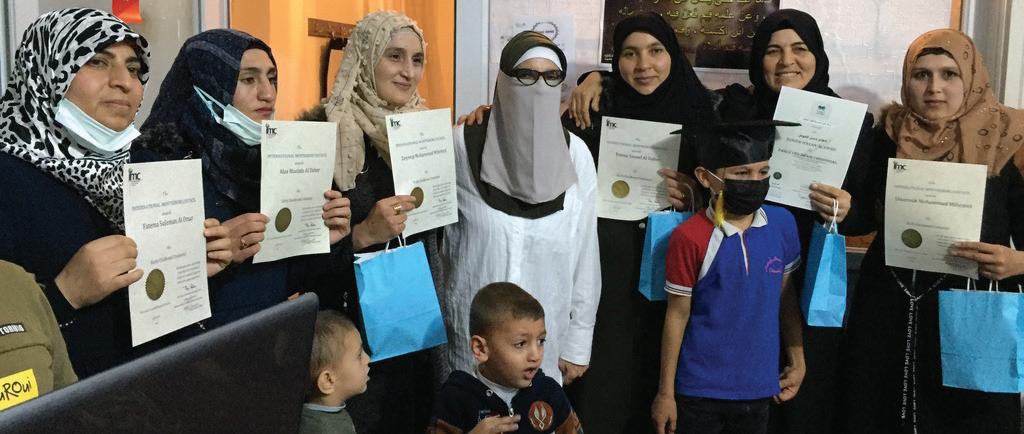
Maha Turner, a Montessori early childhood guide with twenty-five years experience at Somersfield Academy in Bermuda and an Instructional Guide with CGMS, is being recognized for founding an international, innovative opportunity for teacher education. Maha’s organization, Maha’s Mission Montessori, establishes schools for Syrian refugees in Jordan, Turkey, and Egypt. Her students were her inspiration. As they passionately discussed the Syrian refugee crisis with Mrs. Turner, they encouraged her to “… help them by starting a Montessori classroom and making sure you put in a Peace Table just like ours!”
Almost immediately, the refugee children, all of whom have endured war-related trauma, exhibit significant changes. They find peace, develop concentration, and discover the joy of learning. Over forty-one women who have received their IMC Early Childhood Montessori Teacher and Assistant Credentials are empowered in their community and on the road to independence! Over seven hundred children have benefited from a Montessori education through Maha’s work in the past five years.
Maha’s update on her mission
“I was introduced to Montessori education philosophy in 1991. The concepts I both learned and taught and the results I witnessed in the last thirty years prove beyond all doubt that the founder, Maria Montessori was a genius who understood child learning and development and the importance of collaborative and independent creativity combined with Peace Education. Along the way, I achieved Montessori certification through several training centers, among them New England Teacher Education Center. I earned a Master’s degree in early childhood education and completed doctoral courses in early childhood education. Learning is a life-long journey.
One of the primary purposes of Montessori education is to create a better world for humanity. In 2016, I made a conscious decision to use the knowledge and experience I acquired to assist those in the world who had lost all of the things many of us take for granted. We all hear news stories about refugees or forcibly displaced people in distant places around the world, but we rarely know their real stories and the horrors they have experienced. The compassionate among us tend to donate to the known charity organizations hoping that we can contribute to their plight in a meaningful way.
I began my new journey by traveling to Jordan and then South Turkey bordering Syria to assist the Syrian refugee women and children sheltering in mass tent camps, escaping their country’s devastation and persecution. This was a shock for me to see firsthand how desperate humans become when they have lost their entire existence and only have a few clothes and cooking utensils as comfort. Their immediate concern is shelter and survival; educating their children is a distant luxury in these conditions.
As I got to know the refugee families, I learned of the injustice and corruption that is a massive part of life for many people on earth. Sadly, power is the common corrupter in human society, and it is typically the poor that pay the price through persecution due to lack of resources, eventually becoming politically expendable. Education is the only tool that can eventually bring justice and equity to those that do not have a voice, perhaps not in the current generation but in the future.
With the welcomed assistance of the Center of Guided Montessori Studies; I have managed to train multiple cohorts of refugee women (mostly widowed) in both Turkey and Jordan by using their education material. These documents needed to be translated from English to Arabic. Fortunately, I was introduced to a skilled English to Arabic translator living in Germany who completed the huge task of translating all the resources to Arabic. The adult students subsequently completed their course and have taught and provided for their own families. They are now helping me to train more refugee adult students. I have opened Montessori schools in Jordan and Turkey with the help of donor friends that I am forever grateful to. Those schools were used for the adult students to complete their practicum phase. The school in Jordan is running itself with the help of UNICEF.
Presently, I have two schools in Turkey, one in Istanbul dedicated to the Uighur orphan refugees. They have suffered severe oppression at the hands of the Chinese and have emigrated to Turkey primarily from the North-Western region of Xinjiang. The horrors of their treatment have been well documented and personally verified. In addition to Montessori education, we also provide meals for the children at this facility. This school has two Montessori classrooms, which need to upgrade, their worn materials.
The second school is based in Nizip, South Turkey, near the refugee campsites that closed a couple of years ago. Earlier this year, we entered into a long-term agreement with the local authorities to secure a permanent 4-story building. The facility required significant upfront renovation to convert to a functional school assisted with generous private donations. One classroom is fully equipped and operating as a Montessori classroom for children between 3 and 6 years old. We are in the process of equipping two more Montessori classrooms in the building to make three classrooms. One room will be dedicated to infants and toddlers, 0-3 years old. Additional floors are used as after-school facilities and summer camps, where Arabic, English, and Turkish are taught. This project serves over 500 children between the ages of 0-17, and the demand continues to increase. The region of Nizip lacks Arabicspeaking schools, so there is a desperate need to expand this education project. The local government recognizes the value and importance of this project and has waived lease fees to acknowledge the structural renovation completed. However, the ongoing expenses of this institute will continue to be contingent on the support of valued donors to maintain the operation of the building and employment of the dedicated teachers.
Additionally, transportation to and from the school in Nizip is needed to ensure the younger children have access to early Montessori education. Turkey is a very cold country, and it rains a lot during the winter, making attendance very difficult for young children. We are trying to obtain funding for bus transportation.
Refugee or displaced children with learning disabilities do not always receive sufficient support from social providers. In our Montessori classrooms, a few children are in dire need of weekly speech and physiotherapy, which is currently unfunded.
While we are extremely grateful for significant individual contributions to get these projects initiated, we kindly ask for any denomination of donation to meet our projects’ ongoing needs in Istanbul and southern Turkey.
Currently, I am training a teacher cohort in Yemen’s war-torn, impoverished country. So far, we are meeting virtually and hoping to start a Montessori classroom for their practicum phase.
I share a charity site with two American friends at the URL below. Any support you or anyone in your network can provide towards the continued proliferation of the Montessori philosophy amongst those who are in the greatest need of peace and education is truly appreciated.”
A candid conversation with three Montessori Guides of Color
BY DR. CINDY ACKER
“We must never forget,” said Yvette Clarke, “that Black history is American history. The achievements of African Americans have contributed to our nation’s greatness.”
In a period in which we have begun a spiritual practice of opening our eyes to the contributions of those who have historically been invalidated. In this particular issue, we want to recognize a few of the many of those who have made contributions specifically in Montessori education. As we recognize Black History Month, we pause to acknowledge a few teachers of color who are bringing a contribution of their own to their classrooms. The more teachers of color we have in Montessori classrooms, the more we enhance our schools, and provide our children and our staff with positive models of educators and leadership.
Dr. Laura Turner-Essel, parent and psychologist, wrote:
Research shows that Black students experience school as more hostile and demoralizing than other students do, that they are disciplined more frequently and more harshly for typical childhood offenses…, that they are often labeled as deviant or viewed as deficient more quickly than other children, that teachers have lower academic expectations of Black students (which, in turn, lowers those students’ expectations of themselves), and that Black parents feel less respected and less engaged by their children’s teachers and school administrators. Perhaps these are some of the underlying reasons that Black students tend to underperform in most schools across the country.
The truth is that schools are more than academic institutions. They are places where children go to gain a sense of who they are, how they relate to others, and where they fit into the world. The best schools are places that answer these questions positively – ‘you are a valuable human being, you are a person who will grow up to contribute great things to your community, and you belong here, with us, exploring the world and learning how to use your gifts.’ Unfortunately, Black children looking for answers to these universal questions of childhood will often hit a brick wall once they walk into the classroom. If the curriculum does not reflect their cultural experiences, the teachers don’t appear to value them, and they spend most of their time being shamed into compliance rather than guided towards their highest potential, well… what can we really expect? How are they supposed to master basic academic skills if their spirits have been crushed?
Here’s the good news. In my years of school shopping…I have found that there are some educational approaches that consistently provide a safer, more enriching and more affirmative environment for Black children. The Montessori method, developed by Italian physician Maria Montessori and introduced to the U.S. in the early 20th century, is one such approach.
However, to support children of color, research indicates that teachers of color help close achievement gaps for students of color. The report, Diversifying the Teaching Profession: How to Recruit and Retain Teachers of Color, sadly finds that while the population of teachers of color overall is growing, Black and Native American teachers are a declining share of the teacher workforce and the gap between the percentage of Latinx teachers and students is larger than for any other racial or ethnic group.
In the fall 2019 issue of Montessori Public, Dr. Ayize Sabater (AMI-USA, Executive Director) chronicled the gathering of Montessorians who reminded us of the efforts of Black Montessori educators to bring Montessori education to children of color, from Black Montessori preschools founded in the 1920s to the Central Harlem Association of Montessori Parents (CHAMP) and the CHAMP Teacher Education Program (TEP).
The research, the history and lived experiences of others, indicates the emergent need that during the month of February AND every day of every month, children, teachers, and parents, live their own history of people of color. In our Montessori classrooms, we need to hear the voices of our children and teachers. In the information below, we asked teachers of color why they became Montessori teachers, what they see as our greatest challenges and their advice to people of color who are considering becoming Montessori teachers.
RAINA FORD
Lower Elementary
Why did you decide to embark on a journey of becoming a Montessori teacher?
Tiffani Battle I sought Montessori training after working in a school for two years. I was public school trained and had worked in a 1st-grade class for a time before discovering Montessori. I answered an ad out of a local paper and was blown away about the degree of concentration and the level of learning taking place in the Primary class. I have been hooked ever since.
Do you feel that you contribute to children of color or children of more European origin? If so, why?
Raina Ford Honestly, I feel that I make a contribution to any child that I have the pleasure of working with. What I can say is that I feel, as a Black teacher, I have the ability to connect to those children of color who otherwise may not have had that connection because we do still have discrimination and it is very much in schools. As a black teacher to children of European origins, I feel that I show them that people of color are in positions of leadership.
Tiffani Battle I definitely feel I make a difference for children of European descent. I had a child who licked me in my first year of teaching. I asked why and he explained that I looked and smelled like chocolate. At that time, I wore cocoa butter lotion. The child was about six and a half years old, so I was pretty surprised. But I realized then that I was his first encounter. From that moment forward, I used my platform as a teaching experience. In every class I have had, I introduce children to my culture.
What is the greatest obstacle to having more Montessorians of color in the classroom, and what can we do to overcome it?
Raina Ford I think the greatest obstacle to having more Montessorians of color in the classroom is exposure. As a woman of color, I did not know Montessori was a teaching option until I was in my 20’s. We cannot have more Montessorians of color come through the door if we do not share the beauty of Montessori with more of the world. We have to sort of hit people in the face with it because Montessori changed my life. I’m confident that if more educators of color knew about Montessori’s philosophy, we would see more of them taking on the training. Another issue is the cost of the training. We must do more to help support and sponsor educators of color to find and take the training.
Nargees Jumahan One of the obstacles I have had in my training was the lack of people of color as trainees – the lack of people of color in training programs. In the two years of my Montessori training, I encountered only three people of color who were trainers. I felt in my earlier years, my professors (who were of color) had a bigger impact on me as an educator.
Tiffani Battle The greatest obstacle is the actual knowledge of Montessori. It is usually only known in exclusive neighborhoods. If we could do a massive campaign to reach people on the margins, I think it would bring interest from diverse communities. I also believe that in the Montessori community, there is definite discrimination present on all levels. If we can tackle that head-on, it could help people of color to feel more welcome.
What has been your most treasured experience?
Nargees Jumahan My most treasured general experience is sparking curiosity in my students. However, an individual treasured experience involved a student in my class, who recently immigrated to the US and spoke very little English. I shared with her my story of immigration and my struggle with English and the challenge of slowly overcoming it. It completely changed her attitude towards the language. She began to express herself verbally and in writing. In the school, she opened up and connected with other students.
Tiffani Battle My most treasured experience has been to attend a Montessori Conference in Denver a few years back. It was the first time I went to a community event with the Montessorians of Color. It was the best experience to be in a space with others who are just like me. There is something to be said about what happens when one of few becomes one of many.
What is your advice to adults of color who are considering Montessori as their calling?
Raina Ford My advice to an adult of color considering Montessori as their calling, would be to go for it! We need you in our classrooms because we are underrepresented. Do it – and put your whole heart into it because once you enter into the world of Montessori, it really does change you. Taking the Montessori training helped me become more peaceful, and it widened my perspective. It can only add to your life and your qualifications. So if you have the opportunity to take Montessori training, reach out and grab that opportunity.
Nargees Jumahan I think my advice to adults of color seeking Montessori as their career would be to find other Montessorians of colors and build a support system to help them thrive.
Tiffani Battle I would advise this: Come. Join our Montessori world. We are making the world a better place, one student at a time.
If we truly believe that people of color have and are making a contribution to our worldwide tapestry, then we will fully commit to supporting the voice, access, structure, and equitable needs of children, families, and teachers of color. It is then that we can truly make the invitation, as Montessorian Tiffani Battle so aptly put it: “Come. Join our Montessori world. We are making the world a better place one student at a time.”
Dr. Cindy Acker holds degrees in human development, culture and spirituality and a doctorate in educational leadership from UC Berkeley. She is former VP of the National Child Care Association and has served as a public policy adviser for Montessori schools and school associations. She is a five-time award winner in areas of social justice, and has created platforms for school social justice and protocols for school re-entry post covid-19. She was trained by Ursula Thrush and is head of The Child Unique Montessori School and Montessori Elementary School in Alameda.
I am delighted to be sharing our work in Accreditation. Firstly, let me share the exciting News that IMC has 17 fully Accredited schools.
We have 12 Schools in the Self Study process from all over the United States, including Poland, Qatar, and the Cayman Islands. These schools are small, medium, and large public, charter, private, or affiliated with a religious organization.
Last year, we conducted an On-site Visit for Accreditation in the Virtual World. Starting in January, we will be back into our wonderful schools, celebrating and validating all of the great work happening. This Winter/Spring, we will be busy with visits to all of these schools who are first-time accreditation OR re-accreditation with IMC: Ghent School, VA; New Gate School, FL; Montessori Community School Salt Lake City, UT; Leap Montessori, NM; Innovation Montessori School, FL.
We updated the Accreditation Handbook and all forms that relate to the process. We have attracted over —-new volunteers to our Volunteer Corps to assist with accreditation visits.
Additionally, we are working on teams for joint Accreditation Organizations, ie. AMS, Cognia. Working with Regional, State, National, and International Organizations strengthens our relationships to support fully implemented Montessori Schools.
It is my privilege to spend time creating a personal relationship with schools, leaders, and teachers. If you would like to become a part of the Accreditation Volunteer Teams, kindly reach out. We have opportunities to read self-studies and become a part of On Site Verifying Teams.
At IMC, we are grateful for our community of IMC volunteers.
I am looking forward to building strong and lasting relationships within our community. Sheila Linville sheilalinville@montessori.org
Sheila Linville Director of Accreditation & Affiliation, International Montessori Council (IMC)
Sheila is passionate about Montessori Education and has three decades of experience as a Head of School, Classroom Guide on the Primary and Lower Elementary levels, and Leadership/Teacher Coach and Consultant. She currently serves as Director of School Accreditation and Affiliation with the International Montessori Council (IMC). She receives great satisfaction from helping schools organize a Guidance Program for their students and families. She is the Executive Director of The Andrews Educational Institute, a foundation for supporting Montessori and Progressive schools. Sheila has two sons, both who are Montessori graduates, and works alongside her dedicated and loving husband Scott.
The MPPI and it’s involvement in the Build Back Better Act
By Denise Monnier, Director of State Advocacy
The Build Back Better Act is a historic legislative proposal that if passed will change the landscape of early care and education in America by funding near universal access to child care and preschool, and raise early childhood educator and childcare provider income to levels more comparable to the important work that they do. We are optimistically anticipating the possibility of this legislation as it is comprehensive and will increase access to high-quality early childhood experiences enabling all children to have the advantage of a positive start to life.
We have been working to first understand the bill language and intent and its implication for both private and public Montessori schools, while meeting with Senators and Senate Committees to include language that would allow Montessori schools to participate in the funding opportunities without compromising on our comprehensive and researched pedagogy.
There are two enormous funding streams for early childhood which will be available to private schools/ child-care centers and public schools. Both will give our community the opportunity to serve many more children from lower income families and have funding for 3’s and 4’s where there currently is none to have a full 3 year age grouping for primary.
There will be a lot of significant advocacy work to be done at both the federal level and within each state to ensure that provisions in BBB do not impede full Montessori implementation. We need everyone informed and ready to jump into action when opportunities are identified.
What are your next steps?
Connect with your state advocacy leads so everyone in your state can work as a team and coordinate strategy and outreach. Let them know you’re willing to volunteer to help with the state level advocacy work for Build Back Better.
Montessori teacher education is more important than ever as many of our schools face teacher shortages which seems to have only been exasperated by COVID. The IMC-affiliated teacher education program, The Center for Guided Montessori Studies (CGMS), is working hard to tackle the problem, currently preparing over 500 active learners in MACTE accredited programs for teachers of all levels. With over 15 years of experience with blended learning Montessori teacher education, many schools turned to CGMS for support during the pandemic and continue to look to CGMS to provide convenient, high-quality courses to meet their teacher education needs.
by Kitty Bravo, Chair, IMC Teacher Ed Commission
In spring 2021, MACTE expanded its scope to include accreditation of School Administrator programs. CGMS was excited to be the first to apply right away and submitted the accreditation self-study for their School Leadership/Administrators credential program in November. Designed in partnership with the Montessori Foundation according to IMC guidelines, the course focuses on nine essential elements of school leadership presented from a Montessori perspective. The response from the first school leaders enrolled has been very positive. They especially appreciate the supportive community of learners, including school leaders from private and public schools and some individuals from international schools.
IMC is pleased to welcome a new affiliate applicant, Montessori Teacher’s College (MTC) in Sacramento, California, which is currently completing the join process for MACTE accreditation and IMC affiliation. The directors of Montessori Teacher’s College, Norman Lorenz and Sara Nelson are seasoned Montessori educators with a passion for supporting the development of teachers. In fact, Norman was one of the people who helped organize MACTE back in the 1990s. MTC began with a small cohort of local students in their first Early Childhood course, but with their blended learning format, hope to reach more students and eventually add an Elementary program.
The first IMC Early Childhood Assistant Teacher Credential was awarded in 2021 to adult learners who completed the Vietnam Montessori Advisory and Training Center program in Hanoi. VMAT has offered two sessions of the assistant teacher course with 32 graduates. CGMS will begin its first Early Childhood Assistant Teacher cohort in January 2022. With a focus on understanding the role of the assistant teacher, both the CGMS and VMAT programs provide learners a strong foundation in Montessori philosophy and classroom leadership and a robust overview of the Montessori Early Childhood curriculum. The IMC competencies for the Assistant Teacher credential serve as a guide to assure these new programs prepare individuals for a successful career as a Montessori paraprofessional and hopefully serve as a stepping stone for some who may later choose to take lead teacher training. IMC recognizes the importance of well-prepared adults in every role in our schools and looks forward to future affiliates offering these important assistant teacher credentials.
Are you, your staff, and your entire school community feeling overwhelmed and burned out by ups and downs of the pandemic? Would you like to find a way to help yourself, your staff, and your parents build resilience during this difficult time? Join us as Charlie Biggs leads us in exploring how we can use Appreciative Resilience to sustain ourselves and persevere despite adversity.
Join Renee Duchainey-Farkas leads our discussion on moving forward with new perspectives. Let’s support each other to elevate our aspirations as we get back to our mission and the work we love. It’s time!