IB Is Something I Never Expected I Would End Up Doing
by Madison Dodd, NewGate Student
I have always pursued alternative education, whether that be through Montessori, Waldorf, or homeschool. Therefore, it was a shock to me to think that I would be involved in a program so widely recognized across all types of schools. I remember my first day touring NewGate School as a high school freshman. I met with Tim Seldin, who showed me around campus and encouraged me to give the IB Diploma Program a shot once my junior year came, to which I replied, “But I can’t do math!” (to which he replied, “Just do an IB Certificate!”).
I did not expect how much I was going to push myself over the course of these two years. I wasn’t aware of how much I was truly capable of. I remember the first day of our science (Biology HL) class, our teacher told us there was going to be a ‘learning curve’ and that we should prepare ourselves to not always get A’s on our test like we may be accustomed to. Although my classmates and I took in this information, it didn’t quite set in until we all studied for one of our first big tests We thought it was our best work yet, but then we realized that we all just scored in the ‘2-3 range’ … out of 7!
Suddenly, our teachers were no longer there to give us all the tools to get a good grade in the class, to make sure our homework was done on time, or to make sure we were present for the lessons. By IB’s design, the weight was now put on us, as the students, and it was time to get to work.
WHAT IS IB?
In a nutshell, IB is a two-year diploma or certificate program that is internationally recognized across universities to award college credit. That means that from junior to senior year, you will be in the same classes preparing for (depending on your course) between two to three final exams that will be scored from 1 to 7 in each subject. These courses will be three higher level (HL) courses and three standard level (SL) courses. The difference simply being that a HL course may have some extra requirements that SL students don’t have to complete.
Along with the end-of-year exams, there is the Internal Assessment that you must complete in each IB course. In Biology, that might look like a science experiment that you write a paper about. In Literature and Performance, you adapt a short story or poem into a play. The teachers grade it and then send it off to IB to be assessed by them.
I did not enter the program feeling that I was someone who was even remotely able to tackle all of these requirements. However, by putting in the work, learning how to manage my time, and not get in the way of myself, I’m able to positively reflect on it now.
In addition to your coursework, you must complete the Extended Essay (EE), which is a 4000-word research paper that is situated in one of your six IB courses. Then, there is the additional class you must take called “Theory of Knowledge” or “TOK.” This is essentially a philosophy class, and the only two requirements for it are that you complete:
• One TOK essay using one of IB’s supplied prompts
• A TOK presentation in which you develop your own research question and explore it using a real-world example
All of these go towards your final IB score, which can be up to 45 points. I promise this will all begin to make more sense once you are in the course.
Finally, at the heart of IB’s program, there is CAS (Creativity, Action, and Service). This is something you complete outside of school and, most of the time, you are already doing it. Do you play a sport or an instrument? If so, the action and creativity boxes are already checked off.
The only requirement for CAS is that you create a portfolio containing reflections about these activities throughout your two years (mine is in the form of a blog) and that you complete one CAS project, which can involve one or all of the CAS components, and is at least six weeks long. While this does not go towards your score, you will not receive your diploma if you do not complete it.
Overall, IB takes a global approach by looking at big ideas across disciplines. You will notice yourself finding connections between something you learned in science class with something you are talking about in Spanish. No matter what you’re studying, students dig deep into subjects and try to find answers.
WHAT IF YOU DON’T WANT TO COMMIT TOALL THAT EXTRA COURSEWORK?
For whatever reason, if a student does not want to do the full IB Diploma, they can take up to three IB courses; they only need to complete what is required in that course. That means no CAS, no EE, and no TOK. This represents the difference between the higher level and the standard level requirements in the courses. This is beneficial for a student who might have a tighter schedule and doesn’t have time for the full diploma or has a subject area they do not want to take at such an intensive level.
MY EXPERIENCE
IB is usually perceived as a big, scary, and difficult program that only those suited for ivy leagues can survive. However, through my experience, I have learned that it is not the skills that you enter the program with that matter; rather, it is the skills you will acquire throughout the program that will carry you to the exams.
I did not think, at the beginning of my junior year, that I would be leading a discussion in my social and cultural anthropology class about hegemony in marginalized groups in East Harlem. I also did not think I would ever receive a 90 percent on a math test, but it happened! For me, IB has been a journey full of self-discovery and lots and lots of struggling. However, my own academic struggles have taught me so much about who I am and what I am capable of.
I did not enter the program feeling that I was someone who was even remotely able to tackle all of these requirements. However, by putting in the work, learning how to manage my time, and not get in the way of myself, I’m able to positively reflect on it now. I can’t speak for every school, but at New- Gate the support system from the teachers and students is something I attribute to why I entered IB in the first place. Therefore, I encourage anyone considering the program to try it. Your name is not even registered as an IB student until late in your senior year, meaning you have time to see if the program works for you and adapt accordingly.
Looking back, all the stress tears I cried, the coffee I consumed, and nights I stayed up were all formative in enabling me to believe in myself. Even though I am not at the finish line, it is now in my line of sight, and I am sprinting towards it faster than I ever have before, with my teachers and family cheering me on until I arrive. •

Madison Dodd is a high school senior in the IB Diploma Program attending NewGate School. She lives in Sarasota, Florida with her parents and younger brother.
Sample Discipline Policy – Damariscotta Montessori School (based on positive discipline)
Damariscotta Montessori School uses positive discipline, which is implemented in a developmentally and age-appropriate fashion to meet the needs of the individual child. Our focus is on how to help children resolve problems and empower them to have a successful experience in the classroom and school community. The goal of our discipline policy is to provide an environment that promotes respect and safety for each person as well as the space we share.
The need for discipline within a Montessori classroom is greatly reduced by the prepared environment. The teachers make a point of keeping engaging activities available for the children so there is never a lack of something interesting for each student to do. The teacher may also redesign the work areas, jobs available, number of children allowed in a work area, etc., in response to classroom behavior.
For younger children, the primary method in a Montessori classroom is redirection – moving the child from a disruptive activity and engaging him or her in something more productive. Emphasis is put on directing a child to what they may do (making appropriate choices) rather than telling them what they may not do. For elementary-aged children, the primary method used in a Montessori classroom is involving the child in making respectful and constructive choices. This may be done using mini-conferences, reflective listening and questioning, giving limited choices, making agreements, class meetings, helping to resolve conflict, etc.
The classrooms also utilize a peace area. This is a comfortable area in which the child may relax and calm down, or to try to resolve conflict with another child. The child may choose to go to the peace area her- or himself or may be requested to visit the area by a teacher, or, in the case of conflict resolution, by another child. On occasion, in the event of unsafe physical or verbal behavior, or a persistent problem, a child may be removed from the classroom for a period of time to collect him or herself and to give the staff an opportunity to help resolve the situation.
Parents will be notified of significant or persistent disciplinary problems at school in a timely manner. If it is necessary to involve parents in the resolution of a problem at school, it will be done with a spirit of cooperation and with the aim of helping the child. Parental support during that time is very much appreciated. Through conferences, goals will be mutually agreed upon. If the goals are not able to be met within an allotted time, further professional help or other school placement will be considered for the child. Parents or faculty may call upon the Head of School to act as a facilitator at any time. Should it become apparent that a family cannot be supportive of the school’s missions or goals, it may be necessary for the Head of School to consider whether it is in the best interest of the school to keep the child enrolled at DMS.
In order to provide an environment that is physically and emotionally safe for all children, suspension or expulsion procedures may be executed in the event of serious and/or persistent behavior problems. Such behavior includes but is not limited to: defacing or damaging property (school or other), profanity (verbal or written), triggering a fire alarm, violence, threats of violence, blatant disrespect, disorderly conduct, and endangering the safety of self or others. This kind of disciplinary action will be determined by the Head of School upon consultation with the faculty. The Board of Directors will be notified in the event that such disciplinary action is taken.
—
44 Deer Meadow Lane
Jefferson, ME 04348
207-380-3465
MACTE: We’re all about Accreditation!
Montessori in Action
Coping with COVID?
Why You Need a Blueprint of Your School’s Core Values and How to Prepare It As a Community
The Montessori School Blueprint Model
Introduction
Montessori schools are different – profoundly different – from the familiar traditional classrooms that most of us attended in our childhood years.
Those of us who have spent years around Montessori children know that Montessori works; however, while the average person has heard of Montessori, most know little about it and have conflicting impressions of what Montessori reflects. This is nothing new or unique. It has been the case since Dr. Montessori opened her first school outside Rome in 1907.
Some people rave about Montessori; others think that parents must be nuts to put their children in a Montessori school. Some are firmly convinced that Montessori is too rigid and robs children of their creativity, while others object that it is completely unstructured and without any academic standards.
“Isn’t Montessori the sort of school where they allow the children to do and learn whatever they want, whenever they want? Perhaps it will work for your little Sally, but I’m afraid that if my Danny were left to his own devices, he’d never choose to do a lick of schoolwork! He needs order, structure, a small class size, and discipline!”
Over more than thirty years leading two wonderful Montessori schools, I tried to help parents sort all this out so they could reassure themselves that Montessori is not going to leave their children academically handicapped and unable to make it in the real world. Most of the parents that I’ve known are sympathetic and enthusiastic, but it is still difficult for them to defend their decision to send their children to Montessori when the rest of the world seems so completely committed to a very different approach to raising children.
Having made the decision to take this course through the Center for Montessori Leadership, we hope that you will seriously consider the possibility of leading your school through this process of extensive self-evaluation and improvement. We think of this process as Building a World-Class Montessori School.
This is a daunting task. For most Montessori schools, taking the step from being a good Montessori school to becoming a great one will require a great deal of work, the investment of a year or longer, and a considerable amount of money. Moreover, once begun, it is very important that you not back off from your commitment to excellence. Your school must be prepared to meet your families’ and staff’s raised expectations, and you must follow through on the commitments that you have made to the school community. This is not something to be undertaken lightly.
You will begin with the process of clarifying your unique character and carefully defining the fundamental values on which your work from this point forward will be based. You will address a host of issues regarding your day-to-day operation and future plans. You need to make several complex decisions about enrollment, administration, and finances; raise capital and endowment funds; and begin to implement major change. And it is quite likely that you will face a host of additional issues that you have yet to identify.
Change is often stressful to a school community but also presents new opportunities for growth.
Like anything new, it is easier to go through the process for the first time if you have a guide who has been there before. While this book cannot do your homework for you, nor avoid the necessity of putting in countless hours of hard work, planning, and decision-making, it should make the nature of your journey more easily understood and may make the process easier for you and your school community.
By our definition, a world-class Montessori school has made an absolute commitment to excellence. The school clearly defines its identity, mission, and core values. The school community has sought out examples of true excellence in Montessori practice around the world and has consciously defined what excellence would look like in every aspect of its programs, facilities, and operations. Plans have been laid for how one might create and maintain this excellence in each area, not by chance, but year after year by deliberate design.
The school has further identified what it would cost to create and sustain excellence in all things and has developed a plan for funding the cost of excellence.
Montessori schools do not become world-class simply by building the right buildings or hiring the right teachers. First and foremost, a school lives in the minds and vision of those who are central to its life. No school can be great without a clear sense of its core values and the culture of the institution: this is who we are and how we do things here. The character of the school will evolve, but it should evolve slowly and in a logical progression of maturation.
Unfortunately, we all know that it is all too easy for a Montessori school to make compromises because of tight budgets, lack of parent understanding and support, or because Montessori-trained teachers are hard to find.
We all know the story of the Emperor’s New Clothes. We must not live out this fairy tale in our schools. Ideally, we should translate what we say our school does and believes into day-to-day operation. A great school stands for something quite distinct. It cannot possibly please everyone. The school that some deeply respect and admire will have no appeal for others.
Building a World-Class Montessori School
In time every school can drift away from its original vision and core values, just as a sailboat will eventually be blown off course by the wind, current, and tides. Educational leadership can be compared to navigating at sea. It requires a clear sense of where you are trying to go, close attention to where you really are, and periodic course corrections. A blueprint will give your school a tool that will allow you to remain true to your vision.
Over the years I have had the opportunity to work with and learn from several hundred different Montessori schools around the world. Experience has shown that the most effective schools are those which commit to an ongoing process of self-study that involves not only the faculty and administration but parents and older students as well. The Montessori Foundation recommends that schools prepare a Blueprint of fundamental values and beliefs, which is used to govern the schools’ activities and decision-making processes in every area of its operation. This procedure is the first step required of schools undertaking IMC accreditation. The Head of School and the Board make a formal public commitment in writing to make no decision that is not consistent with the school’s Blueprint of Core Values.
In building a world-class school, you will have a long list of policies and procedures to reconsider, decisions to make, and milestones to accomplish, including:
- Clarifying your understanding of what is meant by the concept of “world-class.” Identifying and getting to know one or more credible examples of schools that either are or are well on the way to being world-class examples of Montessori excellence.
- Conducting an initial assessment of some things that will need to be done at your school to bring it up to what could be considered a world-class Montessori standard.
- Arriving at a consensus within the core of your school community (board members, administrative team, faculty, and parent leaders) that your school is not yet world-class and that the achievement of that goal is both a realistic and desirable goal.
- Clarifying the unique character of your school and carefully defining the fundamental values on which your work from this point forward will be based.
- Establish several committees to analyze, evaluate, and develop a strategic plan for serious improvement in all areas of your school.
- Structure and organization
- Finances and investments
- Academic programs and extra-curricular opportunities that give your students and parents “bragging rights.”
- Utilization of space in your facilities, from the front entrance drive to parking, signage, and pathways around the campus, classroom layout, storage issues, office areas, playgrounds, gardens, landscaping, and sports fields.
- Maintenance of your buildings and grounds
- Day-to-day systems throughout your school
- Board-Head relations
- Auxiliary operations, such as summer programs and after-school activities
- Your school’s image and constituent relations
- Student recruitment, admissions, and attrition patterns
- The school culture.
- Fundraising
- Personnel procedures
- Your Board’s makeup, procedures, the orientation of new trustees
- Management-team analysis
- Student and faculty attitudes
- Cost-effective use of time /space /talents
- Support services
- … And many other topics
Bringing world-class vitality and commitment into an existing school is a complex process. If you are starting a new school, you can begin the process from day one, minimizing “mistakes” that need correcting later.
The Blueprint Model
We began this work more than thirty years ago at the Barrie School in Silver Spring, Maryland. Our goal was to break away from the familiar jargon-laden statements of philosophy so common in Montessori. After a great deal of self-study, we broke our philosophy down into a comprehensive statement of our fundamental values and core principles of educational practice. They were intended to present a detailed picture of who we thought we were and what we stood for that could be used as a reference by the future school community over the years.
To date, we have shared this document with almost a thousand schools around the world. The New Gate School was the first to completely rewrite Barrie’s original blueprint, creating something fresh to reflect its own vision. More than forty parents engaged in weekly meetings over a three-month period, adding up to more than fifty hours. Having worked with many schools, we were deeply impressed by the enthusiasm, positive energy, and commitment that these people shared in their dreams for the school they were beginning to build.
Once adopted by the school’s board of trustees, the blueprint can be used in planning for the future, setting policy, and for evaluating of the school’s facilities and evolving educational programs.
Using the Blueprint on a Day-to-Day Basis
Blueprints and similar philosophical statements are useless if no one knows them or cares. To be effective, they must be at the core of actual decisions and actions on a day-to-day basis. This is equally true for the administration, board, faculty, and staff. This excerpt from the New Gate Blueprint outlines how the Blueprint should be used:
Community Meetings
Community meetings are critical in building and retaining a healthy school and are indispensable for ensuring that the Blueprint is properly implemented.
The school schedules and guarantees that monthly Community Meetings of parents, teachers, administrators, trustees, and interested students will be held throughout the school year, regardless of levels of interest and attendance.
These meetings will be run according to the Montessori Rules for Meetings. They will be led by a rotating facilitator, who will never be an Administrator or Board Member. There will be no elected officers. The meeting is a direct voice for the school community.
- Any issue can be discussed, with only a few exceptions:
- We cannot discuss issues concerning a family or student in the school.
- We cannot discuss the private affairs of any employee of the school.
- We cannot harangue, threaten, or attack anyone.
- No one can be allowed to dominate the meeting.
- Everyone must be allowed to express his or her thoughts.
The community meeting is the official voice of the community as-a-whole. It is the place where the board introduces issues that are due to come before the board. This allows the community to hear the issue, listen to information about why this issue needs to be handled, consider how this issue would fit into the core values of the school as set forth in the Blueprint document, and gives them the opportunity to sign off with their support or to request a month to do some research and come back with it to the next monthly community meeting.
The community meeting can address questions or make official recommendations to the faculty, Head of School, or to the Board, knowing that each has agreed to respond to them following its next meeting.
Their response may be to explain that they need more time or that they respectfully disagree; however, their response would be official and timely. In each case, all parties would be expected to copy and paste into their communication not only a description of the question or recommendation, or response but the specific numbered elements of the Blueprint that affect this issue.
Likewise, when the Board meets to make policy decisions, it will first ask if it has brought this issue to the Community Meeting to allow the stakeholders to understand and respond to the issue under consideration.
Before the Board considers an issue, it will first identify and copy and paste into the minutes of the Board the numbered statements of core values and beliefs that should be kept in mind before the discussion begins. When the Board does vote on an issue, the minutes of the Board will include the text and item numbers of each element that they found that applies to this decision.
The formal agreement is that the Board and Administration agree that they will make no decision that is not consistent with the school’s values.
The Blueprint process will challenge the community to participate in an ongoing monthly meeting of parents, teachers, and administrators throughout the school year.
These issues can be mundane or very serious. Work can be done outside of the meetings, but recommendations or formal questions can only come from the Community Meeting itself. It is a place where all stakeholders can become part of a conversation, make recommendations, or ask questions of the board.
The blueprint will be used constantly in Community Meetings. It will also be used by the faculty, board, and administration in their meetings.
Board Meetings
Even though the Board is the highest authority in the school, and the Head of School is the Chief Executive Officer, they agree to policies or decisions that would be inconsistent with the school’s core values as represented in the Blueprint document. Furthermore, they are held up to public scrutiny and remain accountable to the school community.
The Board holds open meetings. Before considering any motion, the Board will review the Blueprint to see which of the hundreds of Core Values would influence a decision. Those values are copied and pasted into the minutes of the board beneath the motion.
By making this commitment and by making decisions openly under public scrutiny, parents can challenge the Board’s or Head of School’s decisions on the basis of the School’s Blueprint of Core Values in an appropriate public forum. The Board and Head of School do not need to agree, but if challenged based on the School’s Core Values, it becomes very difficult for them to defy the reason for the challenge, with the ultimate balance of power resting in their decision to continue to give the school their support.
The Blueprint is a constant reminder of the board’s mission to preserve and protect the school as a Montessori program through the years.
The Blueprint Process at Work
Here is one example of how a school used the Blueprint to resolve what could have been quite a challenging situation.
After the winter break, a child became ill when he reentered his classroom. Knowing that her child was exceptionally sensitive to many toxic chemical compounds, the child’s mother suspected that a carpet cleaning company had used a cleaning compound that had left a residue in the carpet that was making her child sick.
She came into the office and expressed her concern. The Head of School contacted the cleaning company, recognizing that the Blueprint requires her to take all such concerns seriously and with respect and courtesy. It turned out that the carpet shampoo could leave a residue in the carpet fibers if the operator did not manage to get all the compounds out of the rug. The solution is simple. The cleaners came back in and cleaned the rug a second time, this time using no chemicals. The school covered the expense for the second cleaning, even though it was not in the budget because each child’s health and well-being superseded normal budget priorities. The immediate problem was solved.
At the next monthly Community Meeting, the child’s mother and several of her friends proposed an addition to the school’s Blueprint under Section 5: Facilities: “No toxic chemical can be brought on to the campus without an advisory committee made up of volunteer scientists.”
The community meeting discussed this proposal and quickly agreed that it was impractical because no doctors or scientists would be comfortable committing the time or assuming the legal liability. So the proposal failed at the Community Meeting level, but a somewhat amended proposal was made and supported. This amendment to the Blueprint stated that the school will attempt to avoid using toxic substances for cleaning or pest control, and in selecting materials for the finishing of new facilities, will seek finishes and floor and wall coverings that are not known to be toxic. This proposal reached the board and was approved into school policy as part of the Blueprint.
The Benefits of Having a Blueprint for Your School: Schools that have a Blueprint in place tend to develop a strong sense of community among parents and staff. Parents and faculty have a clearer sense of the school’s fundamental values and are more likely to communicate concerns based on issues rather than personal likes and dislikes or factional loyalties. The Blueprint also provides a clear and impersonal means for resolving grievances.
One of the unexpected benefits of the process is that it normally leads to substantially higher levels of re-enrollment, especially at the ages where children typically tend to withdraw. It also tends to lead to a substantial increase in fundraising. It is not uncommon to see one or more major gifts come out of this process.
Developing the Blueprint: The Montessori Foundation recommends that the Blueprint is developed through a process involving the whole school community – Board, administration, faculty, parents, and students who are mature enough to understand and contribute to the process. The reason is that this results in a strong community that understands and has “buy-in” to the principles incorporated in the document.
Understand, however, that the Blueprint will always be a work in progress, which is able to be adapted to changing needs and circumstances. While it is possible to prepare a Blueprint over a series of meetings spread out over weeks or even months, the Montessori Foundation recommends that the work be done over a weekend —a “Blueprint Retreat.”
Intensive Communication: As you prepare for your Blueprint Retreat, use Intensive communication to let people know what you are up to, why this is important, and how the process will work. Give people at least a month’s lead time to allow them to understand what this is all about and to fit this into their calendar if they are interested.
Prepare a Sample Blueprint: Rather than begin with a blank page, we have found the process becomes much more manageable to start with another school’s Blueprint. Choose a Sample Blueprint which most corresponds with your school’s character and prepare for the weekend by making some minor adaptations.
The Board and Head of School go through the sample and shape it somewhat to fit their school – removing aspects that do not correspond with your school and noting any possible additions. No two schools will likely have the same Blueprint, although most schools will probably have much in common. The nine sections of the Blueprint document are aligned to the nine functions that are examined when a school is examined and evaluated for IMC School Accreditation.
- Educational program
- Faculty and personnel
- Facilities
- Finances
- Administration
- Governance (the Board) or ownership
- Recruitment and admissions
- Building your school’s sense of community – reducing attrition
- Fundraising – Sources of working capital
There is nothing magic in this way of looking at a school; someone else could have more or fewer sections in their frame of reference. We have found this to be a useful structure.
Communicate with the School Community: Send the sample Blueprint (the one from which you will start) to every school community member, either by email or printed copy.
Clarify the purpose and structure of the blueprint so that every member of the community understands the reasons for this process.
Emphasize the importance of this meeting. This is a watershed event in the history of the school. Tell parents and teachers that if they can only come for an hour or two, that they should still come for as long as they can. The process is enlightening, and even those people who stay for a few hours will often gain new insight into the school and Montessori. Everyone should feel comfortable coming for whatever amount of time they can invest. ‘If you care, you want to be there.’
Publish this information in a variety of ways to reach the widest possible number of community members. Send it home to all parents.
- Post it in the school hallway.
- Post it on your website.
- Send emails reminding people of what is happening, when, and why.
- Appoint a facilitator and a scribe.
The success of the experience depends on how good the facilitator is and how much he or she really knows about Montessori education. The facilitator should be more of a teacher than just a facilitator. In some ways, the Blueprint Retreat is like a college seminar that leads people, teachers, as well as parents to understand Montessori on a much deeper level.
You also need a scribe who will be able to alter the draft document as the meeting progresses, to project the changes onto a screen for the entire working group to view.
Hold a Blueprint Retreat.
We recommend that the Blueprint be drawn up in a marathon weekend retreat rather than being spread out over many weeks. We find that there is momentum that builds up over a weekend. When it is spread out, people tend to lose the thread of the discussions and do not develop a full sense of how the Blueprint ties together.
- Find a comfortable setting that is convenient for all the stakeholders. A typical schedule will look like this:
- Friday evening from 7:00 to 9:30 PM Saturday from 9:00 AM until 5:00 PM Sunday from 9:00 AM to 3:00 PM
- Print out additional copies of the sample Blueprint to have on hand during the retreat.
- Obviously, you have to provide a careful orientation at the beginning of the retreat and then review the process and goals from time to time as new people join in.
- If your school is not already following a structured and peaceful meeting process, it is essential that the principles of the “Montessori Meeting Guidelines” are explained before continuing.
Crafting the Blueprint Point by Point
The Facilitator leads from the front of the room.
The first item is projected on a screen large enough that everyone can see it. Go through the numbered items on the draft Blueprint one item at a time. A scribe with a laptop connected to a projector makes changes to the original text file as the group moves along. The entire group can see changes as they are made. Post the day’s work on your website so parents and teachers can see what has been accomplished.
- Participants take turns reading the next numbered item and leading the group through the discussion.
- Each element is carefully considered, point by point, to determine how well it captures their own school’s unique
- character.
- Does this value statement define what we believe, even if we are not currently living up to this belief in our daily practice?
- Are we prepared to commit ourselves to making this real?
- Does it work just as it is written?
- Does it need something reworded or added in?
- Can it be rewritten to capture the special flavor of this school better?
- Is a particular element inappropriate for describing this school’s programs and atmosphere?
- Is it completely wrong for your school and needs to be dropped from your Blueprint completely?
Do not attempt to write or amend your mission statement first. Even though it comes first in the document, reviewing your current mission statement, or writing one from scratch, should come after the Blueprint has fleshed out the nature of the school. It comes last in the process because it captures the spirit of all the details in the governing document.
Tackle the biggest and most important section first — the Educational Program: All great schools have a coherence of core principles and values that define their character. The educational program should not be the arbitrary creation of the teachers who happen to be at the school this year. The program should be based on a central and clearly defined model, which is consistently followed from class to class, from one level to the next, and from year to year.
These fundamental defining elements of practice are nonnegotiable. Teachers are to be hired on the basis of the school’s conviction that they have the skills, experience, and personality to faithfully and effectively implement the school’s program by conscious design, not chance. Anything behind these core issues can be added in as well, so long as the addition is consistent with the school’s core values.
At first, people tend to struggle with the process. Generally, this is because the Blueprint is not a statement of what is true in the school today. It is a statement of what we believe and what we are prepared to commit the school to follow. After the first hour, groups tend to move through the long document quickly.
Self-Study Working Committees: The self-study process will usually involve seven working committees focusing on the following areas:
Educational Program: This is clearly the largest area, and you may want to establish several subcommittees to focus on curriculum and program development in each major area, which might include:
- The sciences and technology education
- Mathematics
- Economics
- Cultural and physical geography
- History
- Anthropology
- Mythology
- Architecture
- Civics
- Reading
- Composition
- Research skills
- Literature and poetry
- Second language study
- The visual and performance arts
- Health and physical education
- Philosophy and ethics
- Human relations and conflict resolution skills
- Leadership training and cooperative teamwork skills
- Stress reduction.
- Creative thinking and problem-solving skills.
- Extracurricular clubs and activities
- Community service projects
- School-year calendar and the daily schedule
- Evaluation of the educational program
- Staffing needs
- Central educational resources and materials collection
- Facilities
- Defining the ideal campus, facilities for the arts, dance, performances, sports, swimming, riding, library, offices, teachers’ rooms, storage, parking, traffic flow on campus, landscaping, safety on campus, and environmental impact analysis.
- Enrollment
- Defining the ideal student body (ages, numbers, characteristics, recruitment of new families who share our fundamental values).
Community Relations
- Community outreach, public relations, recruitment and marketing, grandparents, intergenerational programs, and untapped community resources.
- Administration, Board, and Personnel
- Roles and task analysis, staffing needs, office space, hiring procedures, board development, board/staff roles, review of existing personnel policies, benefits program, salary structures, staff evaluation, and contracts.
- Finances
- Financial policies, appropriate controls and forecasting, cash flow analysis, budgeting process, general financial picture, long-term plan, guidelines for investing endowment.
- Institutional Advancement
- Fundraising strategies and policies, preparation for a capital campaign, endowment, planned to give, annual fund, development of corporate partnerships, foundation support.
- Steering committee
The work of the various committees will be coordinated and compiled into a central Self-Study report by a Steering Committee of five community members who are highly organized and skilled editors.
As the self-study gets underway, giving the entire school community information about your progress will be essential. We recommend that you hold regular “Town Meetings” to allow the committees engaged in the self-study process to report to the school community and invite their suggestions and involvement in the next phase.
You will also need to publish occasional progress reports.
The Blueprint of Core Beliefs and Values
After the Blueprint has been written, there is a four-step process to develop and implement the Blueprint of Core Beliefs and Values. The Blueprint document is developed following the procedure outlined below.
Working from the Blueprint, the school develops a simple, one-sentence mission statement that succinctly summarizes the fundamental reasons for the school’s existence and clearly communicates its special character.
- Once the Blueprint has been completed, identify your school’s strengths and weaknesses.
- List all areas where you can begin to improve your programs and facilities.
- Begin to prioritize those tasks that you want to focus on over the coming year. These will be your short-term strategic priorities.
- The fourth step involves the process of formal Self-Study. It will be the most important and certainly the most difficult step. It will require several committees and subcommittees which will each begin to focus in-depth on one aspect of the school’s programs and facilities, asking itself these questions:
If this were a perfect world and if your school had the resources to be the very best that it could be in this area, how would this program or these facilities have to look to be consistent with your school’s vision as set forth in our blueprint?
What does your school look like in this area today? How well are you doing?
What do you propose to do over the next three years to improve your program or facilities to make them more consistent with your institutional blueprint?
This last portion of each committee’s report should be very detailed and specific: tasks, cost, timing, who will supervise, how will you evaluate your progress.

Leading With Emotional Intelligence
On Cue Everyone, “Consider EQ before IQ”
by Dane Peters
“I knew I was a relatively smart guy, with an average or a little bit above average IQ, but I knew I had something going for me in my ability to connect with people, read situations, listen well, empathize, manage my impulses, and have pretty good follow-through. And I think I did well academically because I could do all those things.” 1
1 This quote is from Dr. Mitchel Adler, a keynote speaker, whom I met in Chicago at a conference; I also had the opportunity to interview him for an article, “Emotional Intelligence and Montessori Principles, Values, and Perspectives: An Interview with Mitchel Adler, PsyD.”
I love the quote above because it is an intelligence snapshot that speaks directly to the difference between EQ (Emotional Quotient) and IQ (Intelligence Quotient). Peters, Dane L., “Emotional Intelligence and Montessori Principles, Values, and Perspectives: An Interview with Mitchel Adler, PsyD,” Montessori Life, Winter 2015-16 2 Lillard, Angeline Stoll, Montessori: The Science Behind the Genius, Oxford University Press, 2005, p. 199
As we explore emotional intelligence in our Montessori world, it is important to reflect on the role ‘modeling’ plays, especially as it pertains to leadership, whether it applies to children in the three-year cycle, or a head of school modeling for faculty, staff, parents, and trustees. “Children also can learn about social behavior in Montessori classrooms by observing how others behave in natural, non-scripted situations. Whereas in traditional classrooms, children learn how to sit still and listen to the teacher, in Montessori, they can learn how to interact with each other. The oldest children in the classroom can serve as examples to the younger ones.” 2
I also want to highlight the importance of grace and courtesy in relationships and leadership. Back in 2016, I wrote “Lead With Grace & Courtesy,” published in Montessori Leadership. 3
I have found that grace, courtesy, and role modeling are critical to EQ coming before IQ.sIn my talks as a consultant to schools, I often refer to the history of intelligence quotients—both EQ and IQ.
In a recent International Montessori Council Webcast, “Leading with Emotional Intelligence,” I talked about the history of intelligence. Let me do a brief summary, so that we can better understand the evolution of the two. Do keep in mind that Emotional Intelligence (EI) is interchangeable with Emotional Quotient (EQ).
1949 – One of the earliest methods of measuring intelligence was through the use of the WISC (Wechsler Intelligence Scale for Children) that was developed by David Wechsler. The test is an individually administered intelligence test for children between the ages of 6 and 16. It was the test to assess how ‘smart’ a child was beyond school assessments and gave an IQ score in the range of 69 and below (Extremely Low) to 130 and above (Very Superior). H1980s – Howard Gardner introduced the idea that people have multiple intelligences beyond the WISC IQ standards as noted below. In 1983 he presented the groundwork for thinking beyond IQ with his popular book Frames of Mind.
- logical-mathematical
- inguistic-verbal
- spatial-visual
- body-kinesthetic
- existential
- musical
- interpersonal
- intrapersonal, and
- naturalistic intelligence
As a side note, while I was head of a Brooklyn Heights Montessori School, he joined the faculty for lunch, shared his wisdom with us, and was so well received.
1990 – Peter Salovey and John D. Mayer coined the term “personal intelligence”; it eventually became “emotional intelligence,” describing it as “a form of social intelligence that involves the ability to monitor one’s own and others’ feelings and emotions, to discriminate among them, and to use this information to guide one’s thinking and action.” Mayer’s book, Personal Intelligence – The Power of Personality and How It Shapes Our Lives became the springboard for the one who brought EI to the forefront of the study of intelligences.
1995 – Daniel Goleman was the loud speaker for EI / EQ when he authored the internationally best-selling book Emotional Intelligence, which spent more than one-and-a-half years on The New York Times best seller list. On the cover of the book’s 10th anniversary edition, it states: “Why it can matter more than IQ.”
2007 – Stanford professor, Carol Dweck, clarified measured intelligence in her revolutionary book Mindset: The New Psychology of Success. She helped us understand that individual intelligence can have a “fixed” or “growth” mindset. She helped us understand that intelligence does not have to remain stationary — or fixed — throughout life; in fact, intelligence can grow throughout life.
When I saw her at a conference, I was taken by her thoughtful and clear understanding of intelligences. She asked the question, “Are we raising our children for now or the future?” Watch her excellent YouTube video, Developing a Growth Mindset with Carol Dweck for an uplifting, enlightening view into her important work.
Considering Emotional Intelligence 2.0 4
Let us now look at EQ through this popular diagram from Goleman’s book that represents the four core emotional intelligence skills:
SELF AWARENESS
SELF MANAGEMENT
SOCIAL AWARENESS
RELATIONSHIP MANAGEMENT
To dive deeper into these skills, make it a point to read the book. My recommendation comes from an EQ perspective. I know how busy educators are these days with school, family, and personal life; the book is short, to the point, and an easy read that is most helpful in understanding EQ and the advantages that it has over IQ. Do give it a try, if you haven’t already. In the meantime, here are a few EQ considerations to think about: oConsider John Bariso’s 13 signs of high emotional intelligence 5
3 Peters, Dane L., “Lead With Grace & Courtesy,” Montessori Leadership, International Montessori Council, Volume 18, Issue 3, 2016
4 Bradberry, Travis & Greaves, Travis, Emotional Intelligence 2.0, TalentSmart, 2009
5 Bariso, Justin, “13 signs you are highly emotionally intelligent,” FLIPBOARD – Business Insider, March 1, 2018
Considering EMPATHY
Empathy and compassion are important parts of emotional intelligence. Donna Orem, NAIS (President of the National Association of Independent Schools) stated in her NAIS article “The Power of Empathy in Leadership and Governance” Recently, I read The Empathy Factor, and one line from the book encapsulated the key learning for me: ‘The main reason organizations that try to manage change fail is their tendency to treat human systems as though they were mechanical processes. We are all human. When we work from a place of understanding, we thrive, and our work prospers. 6
According to psychologist Mary Ainsworth, quoted in Angeline Lillard’s book Montessori: The Science Behind the Genius, “A second feature necessary to accurate interpretation, according to Ainsworth, is empathy. Adults who lack empathy, she said, would have detached, intellectual relations with babies instead of warm, sensitive ones.” 7
Considering HUMOR
In an excellent NYTimes article “Laughter May Be Effective Medicine for These Trying Times,” Dr. Miller said, ‘Having a good sense of humor is an excellent way to relieve stress and anxiety and bring back a sense of normalcy during these turbulent times.’ 8
Author Daniel Pink highly recommends the recently released book Humor, Seriously: Why Humor is a Secret Weapon in Business and Life 9
When you open the cover and read the inside flap, it states,“Top executives are in on the secret: 98 percent prefer employees with a sense of humor, and 84 percent believe that these employees do better work.” Also, the book is particularly thorough on talking about humor and its relationship to EI. Here is one example: “Having a sense of humor—both the ability to generate humor and to appreciate it—has repeatedly been found to correlate with measures of intelligence.” In the end, ask yourself, “How do I feel about the importance of humor in my school?” As a quick, recent example of considering humor in the hiring process, a staff appointment to NYSAIS (New York State Association of Independent Schools) was announced in a February 8, 2021 letter written by Mark Lauria, Executive Director, about the new hire, “Of course, a strong interest in building ‘community’ and a good sense of humor were also important!”
6 Orem, Donna, “The Power of Empathy in Leadership and Governance,” March 21, 2016
7 Lillard, Angeline Stoll, Montessori The Science Behind the Genius, Oxford University Press, 2005, p. 262
8 Richard Schiffman, “Laughter May Be Effective Medicine for These Trying Times,” New York Times, October 2, 2020
9 Jennifer Aaker & Naomi Bagdonas, Humor, Seriously: Why Humor is a Secret Weapon in Business and Life, Random House, 2021
Considering TRUST
Rolling into trust . . . Humor, Seriously states “Laughter triggers the release of oxytocin, often referred to as the “trust hormone” because of the way it prompts our brain to create emotional bonds.” 9 Emotional Intelligence 2.0 is clear about trust: “Trust is something that takes time to build, can be lost in seconds, and may be our most important and most difficult objective in managing our relationships.” The book then goes on to detail how trust is built?
1. Open communication
2. Willingness to share
3. Consistency in words, actions, and behavior over time
4. Reliability in following through on the agreements of the relationship
Considerations on why EQ comes before IQ
1) “When I compared star performers with average ones in senior leadership positions, nearly 90 percent of the difference in their profiles was attributable to emotional intelligence factors rather than cognitive abilities.” 10
2) Probably the most important aspect of having and using emotional intelligence is that in a school community, we are modeling these characteristics for the children and our colleagues on a daily basis. I believe it is the best way to teach: be a good role model.
In closing, the big reason why I believe we should take the cue “Consider EQ before IQ” is that the opening quote of this article could have come from me . . . except the part when Mitchel says, “And I think I did well academically because I could do all those things.” I was not a good student, but I loved to connect with people. I can remember being called into the Dean of Students’ office in the beginning of the spring semester of my freshman year of college. She said, “Dane, we have got to do something, your GPA (Grade Point Average) is at 1.48 out of 4.00. If you don’t bring it up, we will not be able to allow you to return next semester.” The fact that I was class president and playing two sports did not matter. I gulped and said that I would get on it right away, and I did—at least enough so that I was able to return and graduate three years later. Finally, a pertinent confession that, for me, validates EQ before IQ; it is clearly spelled out in an article I wrote in 2009, “930: A Secret Whose Time Has Come”. 11
9 Jennifer Aaker & Naomi Bagdonas, Humor, Seriously: Why Humor is a Secret Weapon in Business and Life, Random House, 2021
10 Harvard Business Review Guide to Emotional Intelligence, Harvard Business Review Press, 2017
11 Peters, Dane L., “930: A Secret Whose Time Has Come,” AMS Newsletter, Sept. 2009

Dane L. Peters Right after college, Dane Peters served as a Captain in the U. S. Marine Corps, and 40 years later, he retired as head of Brooklyn Heights Montessori School (BHMS), a toddler through eighth-grade school in Brooklyn, New York. Prior to heading BHMS for eleven years, he served as head of Mooreland Hill School in Connecticut for eleven years. He recently completed his service as the administrator for the New York State Association of Independent School’s (NYSAIS) Experienced Leaders Advising Schools program. He is currently teaching and serves on the Advisory Committee for the American Montessori Society’s (AMS) Emerging Leaders Fellowship program. Dane has written over 100 articles that have appeared in 30 different publications. His first book, Independent by Design, was published in 2014. His second book, Design for Independence, Inspiration, and Innovation: The New York State Association of Independent Schools at 70, was published in 2017. You can read many of his articles on his blog (www.danesedblog.blogspot.com).
So What Is Special Education?
Special education is inclusive education. It is education that says all children should have full access to the classroom, all children should be able to fully participate in all activities, and all children should receive the support they need to feel successful and thrive. Special inclusive education accepts, respects, and honors each child’s unique gifts, strengths, and, yes, challenges.
Special education begins with an attitude – a value and a belief that each child belongs in our classroom. It cultivates the open mind-set that we can prepare ourselves to serve and support every child in our classroom. It is making the commitment to learn, expand our skills, and really ‘see’ each of our students.
Regularly, I hear Montessori teachers say, “I can’t work with children with special needs. I wasn’t trained to do that.” And yes, that is true; most Montessori teacher education programs are not explicitly preparing educators to work with the full range of children we have in our classrooms. The number of children who have been put into label categories is larger than in the past; the number of children who seem to experience the world differently than we expect is larger than in the past. It’s also true, though, that our society is different than it was in the past, and we are all absorbing those changes. We are all different than we were in the past. So, might it be time to let go of clinging to the way it used to be and move on to what can be?
Many of Dr. Montessori’s observations of children are now verified by current research. She deeply understood what all children need to learn to become their own best selves. Are we practicing what she taught (e.g., children learn what interests them and motivates them; and children learn at their own pace and in their own way)? She knew the importance of guiding the whole child: the physical, cognitive, social-emotional, and the cultural self. Ask yourself: Am I teaching to my agenda, to my expectations, to my set of should, would, could, and ought, or am I willing to reflect and transform myself to guide each and every child? That is special education!
Easier said than done, right? Some students challenge us in ways that make us uncomfortable, who leave us feeling incompetent, who just confuse us, and “keep the classroom from being normalized.” And this is where that open mindset that is willing to learn comes in. We can gain knowledge of the characteristics associated with categories of diversity to better understand an individual child’s learning and behavior needs.
We can learn some strategies as a starting point to support an individual child’s learning and behavior differences. We can learn and practice how to observe with curiosity and inquiry to uncover what a child’s behavior might be trying to communicate. We can expand the way we use a material or give a presentation to better reach that child who is struggling.
We can begin with knowledge, understanding, and strategies not only to fill our toolbox but to have confidence that we know just what tool to choose to teach that individual child and guide her to success. We can all learn a framework for managing an inclusive classroom rooted in our Montessori foundations to work with all children in our schools. And this is, in part, what Montessori and special needs is all about.
Here is a place for you to learn, to practice, to learn from mistakes (yes, you’ll make some along the way) and to become a member of the Montessori community who says yes to diversity, to educating all kinds of learners in our classrooms and schools. And one day, maybe we won’t talk about special education, because all education will be special, just as each child is special and ready to grow with a true sense of belonging. I look forward to having you join me on this journey.

Christine Lowry With an M.Ed. and M.A. in special education, and a Montessori credential, Christine Lowry has taught students, toddlers to adolescents, with diverse behavior and learning needs in a variety of settings. She has founded, directed, and taught in two Inclusive Montessori schools. Christine shares her knowledge and experience with the Montessori community with workshops, customized professional development, online courses, presentations, and consultation and coaching that supports school leaders, educators, and families as they serve children with special behavior and learning needs. She has developed the Montessori-based Multi-tiered System of Support ® and provides guidance for implementation in classrooms and Montessori schools. Follow her at Montessori and Special Needs and Montessori-Now on Facebook and Montessori-Now.com She can be reached at christine@montessori-now.com

by Christine Lowry, MEd
Question:
We are seeing more and more children in our classrooms at every level with learning and behavior challenges. Our teachers really want to help these kids, but we just don’t know where to begin or how to support them.
Answer:
First, you are not alone. Many Montessori schools, private and public, are sharing the same concerns. The number of students with a range of disabilities and the need for additional and new kinds of support is growing- and not just in the Montessori community. Inclusion classrooms, where children with identified disabilities and challenges in learning and behavior are welcomed with acceptance and belonging in the same classroom with children’s whose learning and behavior are more in the “expected” range is the dominant model in the broader world of education and has been growing over the past 10-15 years. By default, many Montessori schools are becoming ‘inclusive schools’ without having the knowledge in how to manage it all. One of the most important starting points, then, for our Montessori community is to acknowledge the need for more knowledge, and strategies, techniques, and tools for working with “today’s children” and the wide range of challenges we are observing. Understanding the ways that children learn differently, the ways children’s sensory systems can result in challenging behaviors, and the impacts of the “collective trauma” from the last 18 months on children’s social-emotional development and mental health well-being is key to providing the kind of classroom that can offer the relationships and support children need for positive learning and behavior. Ideally, school leadership and staff can be open to this learning. Professional development, on-line course offerings, and ongoing consultation/coaching with a “guide” who has experience with Montessori education and current research and evidenced-based practices for inclusive education can be of crucial support in working with these challenges. One first step, though, and especially as we begin a new school year, is reflection on our “prepared environments.” As Montessorians, we are thoughtful about the way we arrange the furniture and the activities on our shelves but are we as thoughtful about the temporal environment and the classroom “tone”? This can be even more important in providing the structure that provides the much-needed sense of emotional safety that our children need now. A daily schedule that doesn’t change, the well-thought-out routines, transitions, and expectations for behavior, specific attention to social-emotional development are the consistency and predictability that is needed right now, and not just for children but for adults as well. As a school, or ideally by level, meet as a team to create a daily schedule that includes at least an hour of outside time. Discuss all the daily routines and transitions for success in your classroom- from toileting practice in toddlers, to hand washing, sitting a circle, putting away clothing and “work,” all the routines of lunch time, going outside, ending the day, and on and on from early childhood through adolescent classrooms. Decide on just what your expectations for behavior and interaction in the classroom community are beyond Grace and Courtesy. Then comes the trickier part – how are each of these to be explicitly taught, practiced, and used as “embedded” opportunities for guiding your students in developmentally appropriate ways for your group. Learning the specific supports that can be used to support the children who need them can be part of your “new” learning. This “new normal” demands a lot from us. But, hey, we are up to the task! As Montessorians, we know how to observe, we know a thing or two about reflection, we know that mistakes are opportunities to learn, and we know that learning is a life-long “task.”
This story is from:
pg 26-28
Spotlight on One of Our IMC Accredited Schools: Garden Oaks Montessori

The school was under-enrolled at 405 students with five Montessori and 19 traditional classrooms when Dr. Lindsey Pollock arrived in 2008. The district tasked her to convert the entire school to Montessori.
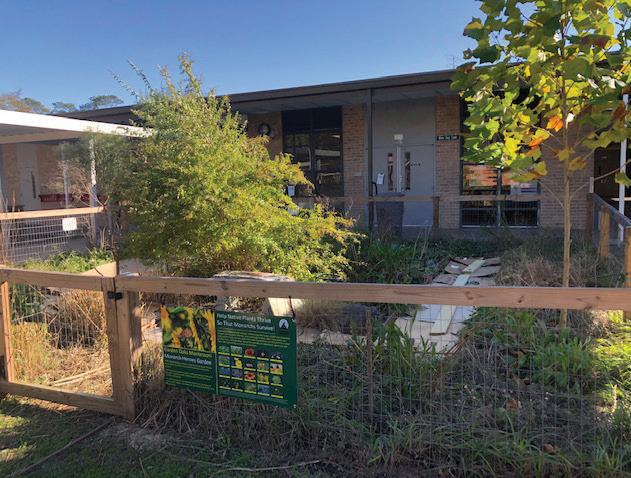
Today, under the guidance and direction of Dr. Pollock and her team, the school has completed construction of a three-story building that houses nine early childhood, eleven upper elementary, and four secondary Montessori classrooms, enrolled close to nine hundred students, and created areas on campus for environmental studies, such as gardens, water collection stations, a meteorology center, and two roosters.
They also have a technology center, a gymnasium, science lab, art room, library, cafeteria, nurses station, reception areas, and administrative offices. They recently received recognition from Educational Results Partnership (ERP) as a leader in student achievement. Garden Oaks is featured on their website – https://dataportal.edresults.org/Metrics/HonorRoll.
The IMC is proud of the accomplishments of Garden Oaks Montessori Magnet School and welcomes them as the first public IMC accredited school. Congratulations to Dr. Pollock and the Garden Oaks school community.
Amanda Sebba has been selected as the new principal of Garden Oaks Montessori. She has served as the assistant principal for the past four years at Braeburn Elementary School.

Book Review: Positive Discipline in the Montessori Classroom

I have been a Montessorian and educator for over forty years — as an assistant, a Primary and Lower Elementary head teacher, a school founder, a head of school, and a Montessori teacher educator. As I read Positive Discipline in the Montessori Classroom, I found myself revisiting all those roles, not to mention my personal roles as parent and grandparent. On every page of this book, I experienced flashes of insight — as well as flashbacks. I saw myself, as well as the teachers, assistants, and parents in my school, and the interns I’ve taught, in so many of the mistaken and misguided responses to children’s behavior over the years (as well as in some of the successful responses). If only we all had this book at the beginning of our Montessori journeys! I have no doubt that many of those mistakes would still have occurred, but the wisdom in this book would have helped me and others recognize and redirect ourselves, and, more importantly, helped us exit the shadows of self-doubt and uncertainty much more quickly.
I’ve used Jane Nelsen’s Positive Discipline books for years, both in my school and in my teacher education classes, but what Jane and Chip DeLorenzo have done with this book — bringing Positive Discipline and Montessori together — is groundbreaking. The authors draw fascinating historical connections between the work and philosophy of Alfred Adler and Rudolf Dreikurs (the forebears of Positive Discipline) and Maria Montessori. Now that Positive Discipline has been interpreted for and integrated into a Montessori context, it will be so much easier for educators to apply it.
Over the years, our classroom leadership and school training manuals have grown thicker and thicker as we have collected ever-growing research and resources on the social-emotional needs of children. This book easily replaces all these resources when it comes to the psychological, social, emotional, and spiritual aspects of preparing the environment. The authors have woven all this together in a way that exemplifies — and amplifies — Montessori’s thinking. This book will become a staple in teacher education, and will supplement, or even replace, a major part of schools’ training manuals.
Positive Discipline in the Montessori Classroom supports the very complex inner work of the transformation of the teacher. Moving from a position of controlling children to a position of observing, guiding and supporting children is challenging, even when one knows and believes it is the right thing to do. This book asks the questions and provides the evidence that will help us recognize our own barriers to change. Even more critically, it offers tools and practical advice for moving in a new direction. Every teacher faces moments when they have reacted badly or simply have no idea how to proceed in an effective, respectful way. In this book, they will find support, answers, and clear guidance. If I were still in the classroom, this book would probably be next to the bed for those sleepless nights when I was puzzling out what to do next with a child or a situation.
It begins with developing the skills of self-awareness, social awareness, and cultural awareness that allow one to resolve conflict with others. Positive Discipline in the Montessori Classroom beautifully addresses these skills, and as a result will become foundational for peace education segments of our teacher training, supplemented with the antibias and cultural awareness elements that we are confronting with fresh eyes at the moment.
This book asks the questions and provides the evidence that will help us recognize our own barriers to change.
I am grateful to Jane and Chip for writing this book, and for sharing their own personal stories. They also share many real-life experiences with children to which I think we can all relate. The authors detail appropriate and effective responses to situations by age level, so whether readers work with toddlers or adolescents (or anywhere in between), they will find rich, relevant material here. Questions for discussion at the end of each chapter spark thought, and can easily be converted into scenarios and reflections to make instructional use more active and engaging.
Reading Positive Discipline in the Montessori Classroom was a real pleasure. While I believe it’s essential to read the book cover to cover, to fully integrate the concepts into one’s practice, I envision readers will dog-ear many sections and return to them when new and challenging situations arise. Jane and Chip have given us a clear, contemporary, and practical roadmap for all Montessorians to follow, with dignity and respect for every child.

Mary Schneider is the director of the Montessori Education Institute of the Pacific NW in the Seattle area. She has been involved in Montessori teacher preparation since 1984 and served on the AMS teacher education committee from 2002 to 2017. She is also a former classroom teacher at the Early Childhood and Lower Elementary Levels, and the retired founder and Head of School of Woodinville Montessori School.
Looking Back and Moving Forward
Preparing an Early Childhood Learning Environment
Editor’s Note: We know that the authors of this article really meant it to help teachers remember how important setting up children’s environments is to maximize the potential of each child at each stage during the early childhood years. However, because of how broadly they talk about the classroom environment, the principles can also be applied to the home environment. If you are a parent, there may be two “take-aways’’ for you. One might be that you have a better understanding of the many facets to be considered by Montessori teachers as they prepare their classrooms for your child. The second might be ideas for setting up a rich and supportive environment for your child at home. I found it helpful to change the word “materials” in this article to toys or activities as I read through it.
Early Childhood, the period between birth and age six, is the most critical period in postnatal human development and learning. During this time, basic movements are mastered, speech is developed, senses are consolidated, and bodies acclimate to sensory input. With this tremendous development taking place, the environment where children spend their days must reflect the constantly changing needs of childhood.
During their first months, children are in a state of unconscious absorption in which they learn from their environment spontaneously and effortlessly. This period of intense mental activity gradually leads to a state of conscious absorption, allowing for more purposefully chosen activities. At the same time, there is a tremendous quest toward both independence and a need for order. The optimal early childhood environment will have opportunities for children to gain the self-help skills they need in order to build confidence and realize self-liberation; providing order in the physical arrangement of the furnishings, the materials, and the activities offered.
The role of the caregiver, or educator, is to prepare the environment to meet the needs of the unique group of children in their care. There are several factors that need to be considered in order to provide a space that will enrich their experience in a developmentally appropriate manner:
MEETING THE NEED FOR MOVEMENT
As we learned from Dr. Maria Montessori (1870 – 1952), movement is intrinsically satisfying. It also affects psychic and spiritual energies; eventually, it helps children acquire abstract thinking by first enabling them to experience abstract concepts through concrete forms. Young children need to move! Knowing the ages, developmental levels, and needs of the children in your care will enable you to arrange the environment to provide the appropriate amount of physical activity.
Infants and Toddlers: If you are serving infants, who need to creep or crawl, provide open, obstacle-free spaces with warm flooring surfaces of varying textures that they can safely navigate and explore. Toddlers need space for independent exploration, as well as secure objects for grasping and pulling themselves into sitting and standing positions. Later. they will need apparatus for stretching and developing their arm and leg muscles, such as climbing triangles, dome climbers, and short sets of stairs. At this age children begin to learn when and where it is appropriate to run and climb and when it is safer to walk or keep feet on the ground. With guidance, toddlers will start to make the appropriate choices.
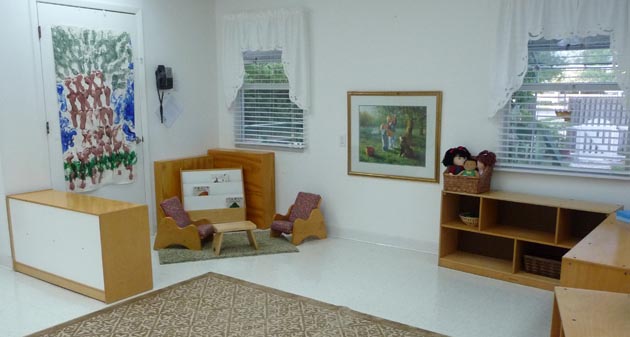
Preschoolers (ages 3—6): Preschoolers need spaces to: move back and forth between shelves, tables, and large open floor areas for unencumbered work; individual spaces, such as cozy reading corners, where they can settle, concentrate, and focus; and spaces to congregate in small and large groups. Long narrow openings tend to encourage running, which can be a safety hazard. Try to break up these long expanses with furniture or plants. A combination of child-sized tables and chairs (preferably adjustable to each child’s height); shelves and cubbies that they can comfortably reach; and open floor space will accommodate multiple types of activities.
MEETING SENSORY NEEDS IN THE ENVIRONMENT
Visual Component: Because young children are constantly adjusting to the barrage of sensory impressions they receive, what children see plays an important role in environment preparation. We live in a world focused on extensive visual stimulation. Although there is a trend to provide eye-popping bright colors or bold primary colors in early childhood environments, a palette of neutral colors and/ or colors from nature can be more conducive to learning and to promoting a sense of calm. A subtler background allows the materials to stand out and attract the child’s interest. In addition, urged on by décor manufacturers, early childhood educators (and parents) often plaster their environments with posters and other materials. However, uncluttered walls can be comforting, soothing, and far less distracting. Be selective and discriminating in choosing what is displayed and hang thoughtfully chosen artwork at the child’s eye level.
Considering your lighting is also important. Lots of natural light is optimal in any setting. If artificial lighting is also necessary, using incandescent bulbs will lend a warmer glow to your environment than the cool blue of fluorescents. You might also want to explore energy-efficient LEDs. In any case, remember safety considerations with young children, ensuring stability, taking care with cords, hot bulbs, and shades.
Auditory Component: Have you considered the sounds the children can hear in your learning environment? Just as your classroom can be visually cluttered, noises such as side conversations, small-group lessons, musical instruments, the rustle of leaves, or even the whisper of wind can make the classroom feel cluttered auditorily. Determine which of these noises are appealing and conducive to learning and which are distracting. Try to adjust the ones you’d like to control or mitigate by using sound-absorbing materials such as rugs and carpeting. Add soft pillows and child-sized upholstered chairs to the reading nook. Hang fabric curtains at the windows or draped across ceilings. If your budget allows, you may also want to consider unobtrusive acoustic panels for walls and ceilings.
Tactile Component: Are the surfaces of your furniture smooth and free of dangerous or pointy edges? Do you provide a variety of materials that appeal to the sense of touch, such as soft woolens, smooth silks, warm wooden objects, and cool metals, which encourage the child to explore and discover the unique characteristics of each? For babies and toddlers still crawling and creeping, have you considered the different sensations they feel on their hands and knees as they make their way around on varying surfaces?
Olfactory Component: What smells greet the children? Whenever possible, avoid the use of harsh-smelling chemical cleaners. Allow fresh air to permeate the environment. Objects with appealing scents, such as a cinnamon bark box or a clove box, can be enjoyed by the children. Fragrant herb plants that are safely edible, such as sage, rosemary, and lavender, also make lovely additions. Allow children to use a mortar and pestle to crush them to release their enticing scents into the air.
Choosing Materials: Besides the physical attributes of your home, there are various considerations to take into account regarding learning and play materials:
- Quality: Are the materials constructed to last through use by many children?
- Are they safe and free of sharp edges and small parts not suitable for children under three? Are they attractive and inviting?
- Relevance: Do the materials embody and respect the personal identifiers that make up the diversity of your family and the wider community in which you live, such as race, ethnicity, and languages? Do they take into consideration the children’s interests, and inspire new ones?
- Developmental levels: Do the materials and activities provide appropriate learning experiences for all the ages and ability levels in the class?
- Language development: Does the variety of materials offered expose the children to the vast array of living and non-living things offered by our world and the rich vocabulary associated with them to expand their burgeoning language development? Are there opportunities for them to express themselves?
In Conclusion: Considering these various factors when creating living and learning environments for young children will help you provide spaces that benefit them by enriching their experience in a developmentally appropriate manner that contributes to their physical, cognitive, and social-emotional growth and learning.
REFERENCES:
Bagnoli, D. (2021) “Montessori by Design: School Spaces That Stay True to the Montessori Method.” Montessori Life. 33 (1). 26 – 35.Montessori, M. (1964). The Montessori Method. New York, NY: Schocken Books.
Photos in this article courtesy of Alicia Diaz-David.
Reprinted with permission from Community Playthings www.communityplaythings.com
Marie M. Conti, M.Ed. is head of The Wetherill School in Gladwyne, PA, and a former member of the American Montessori Society board of directors. She has more than 40 years of experience as a Montessori classroom teacher and administrator. Contact her at marie@wetherillschool.org.
Marcy K. Krever is a freelance writer and the former Senior Director of Communication & Community at the American Montessori Society. Contact her at marcykremer@gmail.com.
Dear Cathie: How can I guide my children to help around the house?
DEAR CATHIE—
I have always done everything for my children. I just thought that is what good parents did! I thought it showed my love. But now that they are growing up, and I am learning more about the Montessori Method from their school and my reading, I understand that I need to expect more from them and let them help around the house. This is both a practical and a mindset change! Can you help me get started?
—AN EXCITED MOM
Dear Mom,
Congratulations on making the decision to afford your children more responsibility, and opportunities to contribute to the family. This is a key concept in happy and healthy families, and you cannot start too young. The key is to begin small, teach each skill to your children, and then have consistent expectations that the job has become their responsibility and is no longer yours. Let it happen naturally, as the child has the skills to take on a task!
Let’s choose one activity to use as an example: bath time. Your goal is for your child to learn to take a bath independently: from getting pajamas to leaving the bathroom as he found it. This is a process that will take years to learn, and we certainly are not advocating that you leave your child alone in a tub of water until he is mature enough to be safe.
Taking a bath requires a child to do a series of steps that will complete the goal. The child needs to: get pajamas and bring them into the bathroom; turn on the bath water at the correct temperature; undress; get in the bath; turn off the water, when the bath reaches the correct height/ temperature: wash the body; rinse off the soap; wash hair, if needed; rinse hair; get out of the bath; dry off; put on pajamas; let the water out of the tub; dry any spills; hang the towel; and put the dirty clothes in the hamper.
How can we begin to teach a child all those steps? Begin today to turn over one step at a time to the child. Do not do anything for your child that she can do herself.
Be sure your child can find her pajamas in the same place each night. (I always put them under the child’s pillow, and my children wore the same pair of pajamas until they were dirty. This saved on laundry and made life simpler for our family.) Say to your child, “Now that you are getting older, you are ready to start learning how to take your own bath. Please get your pajamas and bring them into the bathroom and then come and get me.” That is now a task for the child every night! You will need to be sure it is done, but you will never do it for her again.
You can turn on the water until she is old enough to do it herself. You can place a mark on the chrome that shows how far to turn the handle on the faucet. (A permanent marker works well.) This is especially important, if the turning the water on also controls the water temperature! Be there while the child does it for as long as it takes for you to be certain that she can manage it herself. This is one of the more difficult steps in the process, and you will need to be involved in it longer.
Teach your child how to wash. How does the soap get onto the washcloth? You may need to do that part, but they can do the actual washing. First you will be there while she is washing, watching to be sure she is doing it correctly. In time, you will come back and check and “help” to do the difficult parts.
The key is to begin small, teach each skill to your children, and then have consistent expectations that the job has become their responsibility and is no longer yours.
Washing hair is one part I helped with for many years. I checked to be sure the hair had all the soap removed. Eventually, she will wash her entire body herself! Even a very young child can rinse off alone. You may need to talk her through the process, check and be sure she rinsed all the spots and gotten all the soap off (especially in the folds of the skin), but you do not need to do it for her.
Once the child is rinsed, she can open the drain to let the water out of the tub. She can get out of the tub and begin to dry off. (Be sure to teach her to “hold on” as she exits the tub — as wet is often slippery.) You can come and help as needed. (I always said I needed a hug when they were in the towel, and I checked that my child was dry before putting on her pajamas). Dressing is a skill that children begin to learn as early as 18 months. By four, this is totally the child’s responsibility.
Drying the bathroom may require you to point out areas of water. Some people prefer to do this before the child is in pajamas, as she may get wet doing it! Children can hang up the towel if the hook is at an appropriate height for them. Hooks are now easy to buy and can be moved as the child grows!
A child as young as 18 months can learn to put her dirty clothes in the hamper, and that is an easy job to turn over to the child immediately.
When you are beginning to teach a series of skills, discuss the sequence of steps in the process with your child. What comes next? Can you do that part yourself? Always talk to your child about how she will be able to do this part in a few months/years This sets the tone that you know/expect that your child will ultimately be a self-sufficient person.
You can apply the same principles to any task. Let your child carry the laundry downstairs; put the toilet paper in the closet, and later onto the toilet paper holder, or put the vegetables in the veggie drawer when you come home with groceries. A child of three can even put three carrots in each small plastic container for lunch. Then, when packing lunch for himself, he simply removes a container.
Have fun letting your children take on more and more responsibility and let us know how it is going! ¢
Cathie Perolman is a reading specialist, elementary educator, author, consultant, and creator of educational materials for primary and elementary students. Check out her new downloadable materials on her website cathieperolman.com.
For more than three decades, she has dedicated her energies to improving reading for all youngsters. She is the author of Practical Special Needs for the Montessori Method: A Handbook for 3-6 Teachers and Homeschoolers published by the Montessori Foundation (available through montessori.org.) She is a regular contributor to Tomorrow’s Child and Montessori Leadership magazines.
Money Talks: Talking About Financial Uncertainty With Your School-Age Children
With the coronavirus crisis causing unprecedented job losses, many families are experiencing uncertainty around money. Even families with relatively solid financial footing are feeling a need to rethink family finances.
Our impulse as parents is to protect our children from financial difficulties. But our current situation creates an immense opportunity for family discussion—especially at a time when families need everyone pulling in the same direction.
Whatever your financial circumstances, you can step into age-appropriate conversations. Children can learn that everyone faces economic adversity at some point in life. But we can teach skills that build resilience. Let me suggest four steps to guide your conversations.
1. Start with the headlines.
Before you begin talking about money concerns as a family, clarify the facts you want to share: Focus on the news your child needs to know and how that news impacts your family. Keep it simple and straightforward. For example:
• Mom lost her job, and we need to talk about what that means for our family. • Dad’s job is secure, but we still think it’s time for us to be cautious. • Mom’s business has fewer customers, so that means less income for our family.
Those focused statements kick off further disclosure and conversation. While you can share additional details, your goal is to avoid a monologue. Move to dialogue!
Creating space for children to express their thoughts and feelings is crucial.
2. Invite feedback.
Creating space for children to express their thoughts and feelings is crucial. If you jump to solutionfinding too soon, you risk shutting down their responses. Draw out your child with open-ended questions:
• What questions do you have about what I just said? (Not:
“Do you have questions?” but
“What are your questions?”) • What do you think this means for us as a family? • How do you feel right now?
If your child doesn’t voice a response, that’s okay. Circle back to the question later in the discussion or within a day or two.
3. Brainstorm solutions together.
Adjusting family finances impacts everyone. Inviting everyone to find solutions improves buyin from all. Older children can help you consider key numbers in your family budget. Younger children think more readily about their own “money in, money out.” Consider these questions:
• How can we work together to increase our income? • What do we spend on that’s easy to cut back? • Which things feel most important to keep?
Now is the time to discuss any emergency funds you can access—money put away for a time like this. It’s a teachable moment for older children to understand that living on their own means building a reserve of at least three- to six-months income.
4. Speak and act with confidence.
Your family conversations can normalize the experience of adversity and teach your child to pivot quickly.
One of the best ways to display confidence is to find opportunities to share and volunteer—giving time, even if you can’t give money. Discuss how some people need help with everyday food insecurity, as well as what you can do for the elderly and others who are isolating alone.
As a family, you can’t always control what happens. But you can talk about it. Remind your child that you’re working together—and that you will get through this.
Nathan Dungan is the founder and president of Share Save Spend® . He speaks and consults with organizations and families on the topic of financial wellbeing. Nathan uses a Wellbeing Framework to help individuals and families build capabilities that are most relevant for them and the goals of their family.
He is the author of three books and numerous resources for organizations and families. Nathan’s newest resource, Money Sanity U®, is a subscriptionbased virtual learning library for organizations that addresses a variety of money topics in a simple and interactive format— all designed to help improve financial wellbeing. You can learn more at sharesavespend.com.
J1 Visa Program – Schools in USA
This may be of interest to Montessori schools in the USA
The J1 Visa program allows US schools to sponsor visiting teachers to teach at their schools for a number of years. Many Montessori schools use, have used, or have considered participating in the J1 program to find a well-qualified Montessori teacher from outside the United States.
We recently learned from Cultural Vistas, a US-based company that facilitates J1 Visas for teachers (www.culturalvistas.org) that the U.S. Department of State has revised its regulations regarding the J-1 visa for teachers, which take effect as of February 29, 2016. The following was provided to us by Cultural Vistas. We have used their services, and can attest to the benefits that many schools find in the cultural exchanges possible through the J1 Visa Program. Contact them for more information.
Here are the key changes to the rules, reported to us by Cultural Vistas:
– Teachers eligible for a three-year initial visa, with the possibility to request an extension for up to two years (previously, this was up three years)(see note below).
– Teachers may apply for a second J-1 visa for teachers AFTER being outside of the United States for two years (previously, there was no two-year requirement)
– Teachers need to have two years full-time teaching experience (previously, it was three years)
– Eligible schools are accredited public and private K-12 schools, including pre-kindergarten “language immersion” programs offered as a regular course of study in accredited primary schools (previously, teachers could not teach at the pre-K level; please understand that these are programs that are a part of an accredited primary school, NOT separate pre-K programs, and MUST be a part of a language immersion program)
– K-12 teachers who left teaching to pursue an advanced degree to enhance their credentials are now eligible to apply (previously, we could only consider current K-12 teachers)
– There is now a requirement for a cross-cultural component to be included in the program (previously, this was not required). This is somewhat broad, and Cultural Vistas is planning activities we hope will help teachers fulfill this requirement. The quality of the cross-cultural activities will be a determining factor in whether DOS grants a request for the extension beyond three years.
Current teachers who are completing their third (and final) year ARE eligible to request an extension for one or two years.
PLEASE NOTE that this extension must be approved by both Cultural Vistas and the State Department. And, to do so, applications for extensions must be received at least four months prior to the last day listed on the teacher’s DS-2019 form.
Please contact Cultural Vistas (teach@culturalvistas.org) if you are interested in learning more about this option.
Reaching & Maintaining Operational Sustainability
Reaching & Maintaining Operational Sustainability was a presentation given by Lisa Carling at the 2013 IMC conference.
Sustainability is a Process and a Journey, Not an End!
It involves all aspects of and decisions made within an organization supporting your mission and vision over the long-term
Operational Sustainability is ESSENTIAL!