by Cathie Perolman | Family Resources, MFA, Montessori Education, Montessori Family Life, Montessori Parenting, School Resources
Dear Cathie:
Q: As I begin to investigate Montessori schools for my preschooler, I hear two different philosophies about special classes provided outside of the regular Montessori curriculum. Both ‘camps’ seem proud of their position. But it seems vague to me. Why would a school choose not to have special classes for children unless they are just trying to save money?
A: You are right! There are two different views about special classes at the pre-school level in a Montessori school. It is confusing to sort it all out and ascertain what is best for your child.
One school of thought is this: It is best for children to be taught about special subjects such as foreign language, music, art, and physical education/movement by educators specializing in that subject. It is best to have children leave their regular class for such teaching in an environment apart from their regular Montessori class. Such classes are often done on a set weekly schedule and are teacher led. They seek to provide a common experience to all children in a class or an age group within that class. So, your three-year-old goes to French from 10:30 – 11 AM on Wednesdays and music from 9:30 – 10 on Mondays. The duration and frequency of the class is externally set, and the children attend according to their age and class. These are usually during the regular school hours and simply replace a half hour of a child’s work time in the classroom.
The other view is to provide activities such as art, music, and foreign language within the regular Montessori classroom. In this case, the education is provided by the Montessori guide and is on less of a set schedule. The guide is free to do a more (or less) detailed unit of study, depending on the interest of the children in the class. Often, an adult in a class has an area of particular interest which she/he can share with the children on an ongoing basis.
How can you tell which approach is best for your child? One of the basic tenants of the Montessori Method is that the child is free to pursue learning based on his own interest for a period of time that meets his needs. He should be free to work on a project for an entire work cycle or a whole week of work cycles if he is really engaged! This time should be uninterrupted, and all materials necessary for his study should be provided to him.
Special classes provide their own brand of challenges when integrated with the Montessori Method. Special classes tell the child what to study, how to study it, and for how long to pursue that study. It is impossible for a child to be able to extend that study within the time frame allotted for his class. In addition, he is leaving his self-selected activities to learn something that is externally imposed upon him. This is even more problematic when the child is working with a friend on a cooperative activity and only one of the children goes to the special class.
Some schools offer special classes to the three age groups within the classroom individually in order to meet their developmental needs. Even though these classes are often well taught and enjoyed by the children, they are often not in keeping with the spirit of the method.
It seems that many parents are misinformed and believe that more is better. They feel that a school that offers a Montessori program and special classes is superior to schools that simply provide a long uninterrupted work time in the main Montessori classroom. They feel that their child has more educational opportunities in a school that provides special classes for the children. The Montessori prepared environment stands on its own two feet and does not need anything else to provide all that a child needs to learn and grow. However, children need significant time to work within that environment to make optimal use of all that is contained within it.
A good Montessori classroom has art and music built into the curriculum for the children. Movement exercises are also available and, often, foreign language experiences as well. These can be self selected and repeated according to the needs and interest of each child.
Is there some compromise? Many schools try to offer special classes and not disrupt the work time. They use creative scheduling such as having children begin their day with specialists, cut the work time a little shorter, and have classes at the end of the morning, or offer them after the school day has ended. Others offer them during the aftercare portion of the day as a service to parents, who would otherwise provide these activities for their children after school. These are certainly better models and work well in many schools.
There is not one answer to your question, but I recommend that when you visit prospective schools, you discuss the length of the work cycle in the prepared Montessori classroom, as that is where the main bulk of the learning takes place. Please be wary of a school that has less Montessori work time and more specials. Such a school may be sacrificing the method to add unnecessary extras.
by Cathie Perolman | Family Resources, Infant-Toddler (0 to 3), MFA, Montessori Education, Montessori Family Life, Montessori Parenting
Dear Cathie,
Our family is planning to welcome a new baby in a few months and while we are very excited and thrilled we are worrying about the transition for our preschool child. We are wondering about what the plan should be at the Montessori school. What should we expect from the school and what changes might we want to make to her schedule to help her adjust to her role and her new sibling? -–An excited Mom and Dad
Dear Mom and Dad,
Congratulations on this exciting news and this wonderful time in your family’s growth! You can look forward to so many new experiences and changes in the dynamics of your family. Enjoy them all! I agree that there will be changes for each of you including your preschooler and your Montessori school community. Your child’s classroom can be a great source of support to your family and your child’s adjustment.
What can you expect? I would say that the biggest thing you can expect is that the school will be a great source of consistency and security for your child. The optimal thing to do is to keep her schedule regular if at all possible: for most children, the minimum schedule is full five mornings. Keeping similar hours is strongly recommended when the new baby arrives. Try to maintain her world as close to “her” normal as it had been before the arrival of the baby.
You can count on your child’s Montessori classroom teachers to do many things to support a child who is about to have a new sibling. They might have books in the classroom about becoming a big sister. These books would be in the book corner and read during story time. The discussion of new babies and siblings would probably come up in casual conversation in the classroom. They might put out picture cards that show a child growing up. These would let the child becoming a big sister think about how a child grows up. Other classrooms have a Practical Life exercise of baby washing. This is a popular way for children to practice learning to care for a baby. The children get to undress the baby, wash her, rinse her, dry her and redress her.
Once the new baby is born, I recommend sending in a picture of the big sister with the new baby to the classroom, and the teacher can make a poster welcoming the new baby by name. I have seen pictures put up in the classroom or on the door announcing the arrival of this new baby! This is exciting new for the entire school community as well as the child’s class! This is an opportunity for the older children to read a written “welcome” greeting that is with the picture and your child can invite all the children in her class over to the poster to show off this picture. Eventually the poster can come home to you and become part of the new baby’s (or the big sister’s) baby book!
Lastly, if your class does “sharing,” once it is safe for the new baby to be around a lot of children, your “big sister” can introduce the baby to her class for “sharing.” This is one more way for the big sister to share her new baby brother or sister with the classroom community. She can tell about caring for a new baby and show the baby to the class. All children and their parents are fascinated by a new baby!
Feel free to openly discuss this subject with your child’s teacher. The arrival of a big sister or brother is often the subject of lots of discussion in a Montessori classroom. Enjoy this exciting time! I am smiling just thinking about it!
– Cathie
by Cathie Perolman | Family Resources, Infant-Toddler (0 to 3), MFA, Montessori Education, Montessori Family Life, Montessori Parenting, Montessori students
Dear Cathie,
My wife and I are looking at preschools for our active three-year-old for next fall. We know that he loves to be “on the move” and is happiest when he is doing something. That is why we thought a Montessori school might be a good fit. We expected to see a big open space with lots of room for him to be active. But it seems that in each room there is one big rug space, and then most of the room is divided into small spaces. Can you explain why and calm our fears that out active little guy really will get enough movement during the morning? – Dad
Dear Dad,
Thank you for your concerns. As the mom of a son who seemed a lot like yours as a young child, I can totally identify with your worries.
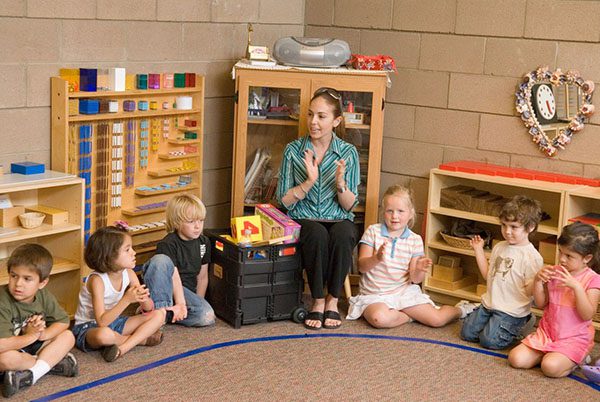
The Montessori classroom for 3- to 6-year-old children is designed to resemble a children’s house. It is scaled down in size to be a perfect fit for young children and is divided by area; think of it like rooms in a house. The shelves of materials or activities often divide the room, helping the children to see where each area ends and begins. Inside each area is workspace, where children can choose to put their work rugs if they so desire. Child-sized tables are also placed in some areas so that table work is encouraged to happen in that space. There are areas for one person to work as well as group work.
The big work rug that you noticed in each classroom serves as both a gathering space for the entire class when they have their ‘circle time” or “class meeting” and as a space to spread out and do larger rug works and partner works. This rug is often filled with the activities of many children during the morning, which creates the opportunities for your young child to see, absorb, and aspire to these.
The Montessori philosophy seeks to “control the environment and not the child.” Running is not permitted in the classroom due to safety, so we make the pathways in the classroom too small in which to run. Long stretches of space are obstructed with furniture so they encourage running. Children have to walk carefully in order to not bump into anything. This helps them learn to move carefully within the classroom, while still meeting their need for movement. The work rugs that are laid out on the floor create a sort of natural maze for the child to walk through. This creates a fun and sometimes challenging experience of careful walking in the classroom.
Classrooms have a line drawn or taped on the floor and children are taught to walk on that line. First they simply walk on that line. Later they carry things of greater and greater difficulty. This is a very popular movement activity for young children.
Many of the activities in the classroom also require movement to do them. A child may build the Pink Tower (a set of 10 graduated cubes from 10cm – 1cm) across the room with the random cubes on one rug and the emerging tower in order on another rug across the room. This is an enticing activity for young children. They may collect objects of a single color from around the room and bring them to their rug. They may match the pictures of the children in their class to the real children. These types of works keep children moving all morning and, yes, their need to movement is satisfied in a Montessori classroom. Children also choose the amount of movement that is right for them. They have choices as to which activity they select, how long they work with it and when they are finished. They might choose to have a water or a snack break in the middle of an activity. The Montessori classroom provides natural opportunities for movement.
Tomorrow’sChild / May 2017
by Mark Fish | Children with Exceptionalities, MFA, Montessori Education, Montessori Family Life, Montessori Materials, Montessori Parenting, Montessori students
Somewhere along the way, some talented spin doctors convinced us all that desks in rows, subject-specific textbooks that fail to make connections between academic disciplines, large numbers of children in age-specific groups, highly defined short time periods for subject-matter study, rote learning, and adult-centered teaching constitute “traditional” education. I object, vigorously and vociferously. If adult-centered, textbook-oriented, rote learning is “traditional”, where does that leave child-centered learning-by-doing? What does that make the Montessori approach? “Alternative?” “Non-traditional?” I object, vigorously and vociferously. I suggest that the “alternative” mantle, which has been placed on our shoulders, does not fit, and I reject the “non-traditional” label.
Instead, I embrace the adjectives “timeless” and “classical,” and I urge Montessori parents and educators to do the same. To do anything less unfairly marginalizes the Montessori movement and diminishes its importance in a timeless educational continuum. Why? Because the philosophy and concept at the heart of the Montessori methodology and approach are as old as the Chinese, as classical as the Greeks, and as timeless as Socrates and Plato. They are shaped by Comenius and honed by Pestalozzi. They are ageless, they are time-tested, and they are proven. And, inasmuch as Montessori is in the tradition of the great educators of the world, Montessori is traditional.
At least until the graduate level must concern itself. In his book The End of Education, in which he seriously questions the current course of education in the United States, Neil Postman writes, “Our genius lies in our capacity to make meaning through the creation of narratives that give point to our labors, exalt our history, elucidate the present, and give direction to our future.” In one sentence he has defined the heart of Montessori education.
“Without a narrative, life has no meaning. Without meaning, learning has no purpose. Without a purpose, schools are houses of detention, not attention, ” Postman continues. More often than not, he argues, that is what our schools have become: houses of detention, where we avoid profound truths, where we sidestep moral instruction, and where the “means ” somehow become disconnected from the “ends ” of education. It is with the end of education- “a transcendent and honorable purpose ” that allows children to prepare for life (and not just to prepare to make a living) — that Montessori education has always concerned itself, and it is that premise, and the carefully devised curriculum and materials that result, which makes Montessori enduring and successful.
If “traditional ” does not feel quite right, use “timeless ” and “classical. ” There is no question that Montessori is most certainly those. And when you refer to commonly accepted teacher-centered, textbook-oriented methodologies, refer to them as “conventional ” not “traditional. ” The roots of the time-honored moniker “traditional ” belong just as well with our Montessori schools
by Lorna McGrath | Early Adolescence (12-15), Family Resources, Infant-Toddler (0 to 3), Later Adolescence (15-18), Lower Elementary (6-9), MFA, Montessori Education, Montessori Family Life, School Resources
What burning question is on your mind about school or about parenting? We want to know because, at the Montessori Foundation, “We’re here to help!” Please send in your questions and we will attempt to answer them ourselves and with other experts. Remember that questions should be broad enough that many parents from many places will benefit from them. We look forward to hearing from you!
by Claire Salkowski | Emotionally Healthy Children, Empowerment, Entrepreneurship, Family Resources, MFA, Montessori Education, Montessori Family Life, Montessori Parenting, Webinars / MFA
Guest –
Claire Salkowski, MEd, Montessori Elementary Teacher, Educational Consultant
Creative ways to Learn, Earn, and Manage Money within the Context of Each Families Values
Download File
by Kath Kvols | MFA, Montessori Education, Montessori Family Life, Montessori Parenting
Comedian Rodney Dangerfield, frequently poked fun at on of most core desires: to be respected. We want to be respected and when our children aren’t respectful it often feels like we’ve been sucker punched. On the other hand, being told, “Your child is so respectful,” makes us feel like someone gave a a million dollars!
Children need to be taught how to be respectful. This may take a lot of time if you having been allowing and modeling disrespect. Below are 12 ways to create a more respectful family.
Model it: If you want them to do it, you have to do it too. Show respect by not yelling, knocking on their door before entering, asking for permission to read their private things. They are also watching how you are treating your spouse. (Yikes! that’s a scary thought!)
Understand it: Your children are growing and learning. Sometimes word choice and behaviors are made because they are not able to verbalize their feelings so they act them out instead. Practice giving them the correct words to use in place of their disrespectful behavior. “I’m frustrated,” “I’m angry,” or “I need space.”
Empathize with it: Empathizing is like a soothing balm. It often restores relationships. Your child feels heard and understood and what often follows is a sweet apology from our child. Use words like, “Wow you must be really hangry (a made up word for being angry and hungry at the same time)?” Or, “It’s really frustrating when your little sister goes in your room without asking permission.”
Teach it: Give children the tools they need to show you respect. Verbalize, “That’s not respectful. That is respectful” so they know what they are aiming for.
Discuss it: Pick out times when you see other children using respectful or disrespectful language or behavior and discuss with it your children. Or point it out in movies or books.
Practice it: Before you go to an event like a friends house or go to school, practice respectful behaviors that might be helpful during the day. For example, asking the teacher, “How are you today?” Or how to line up respectfully.
Expect it: When your expectations are reasonably high, children rise to the occasion. Often we let kids slide because they are too tired or too hungry or because WE are too hungry or tired! Word of caution: Do not be to demanding or critical. If you are you run the risk of your child becoming overly compliant, rebellious or sullen.
Question it: When we ask questions like, “Was that respectful?” or “How else could you say that more respectful?” we cause are children to have to think and be reflective. Children tend to learn more from non-judgmental questions than they do by us giving them directives.
Correct it: Be strong, firm and kind when teaching respect. Don’t just let things slide! Be sure to notice when respectful behavior is being exhibited and make sure to call them on disrespectful behavior!
Reinforce it: Remind children of their good decisions so that they remember how it felt and the results they got from being respectful.
Re-do it: Ask for a re-do. If your child says something disrespectful ask them to say what they want to say in a more respectful manner. It helps if they can ask you for a re-do also if you are being disrespectful.
Humor it: Humor usually disarms negative attitudes. Say something funny like, “Oh no, who let the Grinch in the house? Did you let him in?” The sillier you make it, the better.
Mix and match the tips above. One will work one day but not the next – so be kind to yourself.
Teaching respect takes patience, time, and a willingness to take a stand for creating a respectful family environment. It takes years to raise a respectful child and only moments to fill one with anger and disrespect. However, if you practice these 10 tips, you will be giving your child a gift that will take him or her far into their journey of life.
Copyright 2015 Kathryn Kvols – Our thanks to the author for allowing us to share her work.
by John Long | MFA, Montessori Family Life, Montessori Parenting
I‘ve learned that I don’t need to entertain my children,” said the mother.“If I just let them work–give them real opportunities to participate in the life of the family–to set the table, load the dishwasher, sort the socks–then they are happier and more settled. It was amazing,” she said to her older child’s teacher, “to watch the two boys unload the dishwasher. The three-year-old couldn’t reach the silverware drawer so he would take the knives and forks and spoons out of the basket and hand them to his five-year-old brother who put them away in the drawer. I’ve never seen them play together so well before–and this was work, not play. You’ve been telling me this for three years but I just didn’t get it. I’m beginning to understand what you’re talking about and it’s changing our lives.”
The brothers’ two teachers both reported to me this story at the end of parent conference day. They were so elated because a new connection had been forged, the golden spike had been driven in to open the transcontinental railroad. We aspire to work in partnership with you, the parents, and that means much more than asking you to help your children practice reading or memorize math facts. The teachers were pleased because one more parent experienced a personal epiphany, understanding the concrete, pedestrian reality of applying Montessori principles at home in the life of her family.
I was pleased because that partnership involves dialog; we need to listen to each other as you work at home and we work at school to serve your child. That these two conversations took place on conference day last week shows that process succeeding.
A week earlier, a parent with elementary children said, “I was so disappointed when the school eliminated catered lunches for children this year. It was so convenient for me, and my children actually liked the food. I read what the school said about the benefits to the children in helping with the whole lunch process but I was skeptical. It has been amazing to see how responsible they are in making their lunches the night before and how empowered they feel to help plan the menus, shop for groceries and prepare the food. It has added a very positive dimension to their lives–to all our life as a family.”
“Now I need help,” she said to the group assembled for the Wednesday morning “Montessori Talks to Parents” meeting. “How can we get out the door in the morning so we can get to school on time?”
This was another sort of dialog. Kathy Long and I were there with a mix of parents whose children ranged in age from infant to adolescent. The topic for the day was “Montessori in the home” and each person contributed to the conversation based on their personal experience. In response to the problem of getting out the door in the morning, someone recommended asking the children in a family meeting to make their own suggestions. I don’t know what their ideas were, but I do see them getting to school earlier, so something is working.
All of this reminds me of the questions I asked the men’s business breakfast several weeks ago. “How many of you identify yourselves as entrepreneurs?” All hands shot up. “How many of you learned that in school?” Not one hand was raised.
How does one learn to be an entrepreneur? How does one learn to be a self-starter? By learning that you are capable, that you can work, that you can contribute to the family and to the classroom community and, when you get a little older, to the community outside of school. By learning to make choices, to initiate activity, to shape your own learning, to make an impact on your physical and social environment, to find your joy.
Can putting away clean forks contribute to this growth? Does making your own lunch contribute to the formation of character? You betcha!
Montessori quoted the poet Wordsworth in saying, “The child is father to the man (and, I might add, mother to the woman).” She understood that these experiences mean more than their explicit content. We serve the child not by being his servant, not by making him his own lunch and delivering it to him just in time, for in so doing we enslave him to our help and keep him in an artificially extended period of dependence. We serve the child by helping him to help himself–not because we wish to rush him prematurely to physical independence from us, but because we know that the child gains a sense of dignity and power from his developing skills and from our confidence in him. That sense of dignity and power, and the well-developed skills themselves mark Montessori children as different. And more than any other system of education, Montessori is a training school for entrepreneurs.
by Maren Stark Schmidt | Challenging Behaviors, Family Resources, Infant-Toddler (0 to 3), Later Adolescence (15-18), Lower Elementary (6-9), MFA, Montessori Family Life, Montessori Parenting, Parenting on the Same Page, Primary (3-6), Upper Elementary (9-12), Webinars / MFA
Guest – Maren Schmidt, Montessori teacher, Montessori school owner and administrator, parenting coach and workshop leader. Explore ideas and strategies to help parents meet children’s needs and minimize sibling rivalry. Provide ways to help children work through disagreements and squabbles.
Download File
by Lorna McGrath | Infant-Toddler (0 to 3), MFA, Montessori Family Life
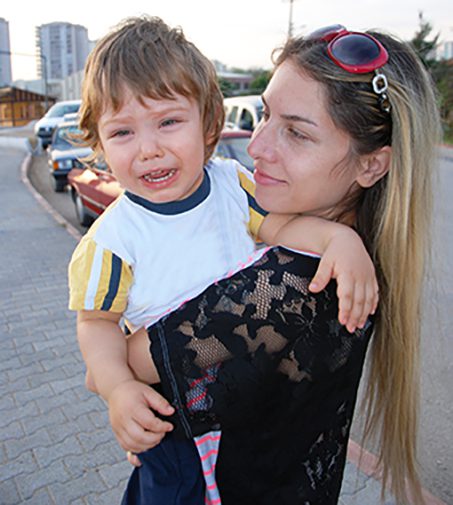
A Turkish mother and son are having fun.
The knots you feel in your stomach and the throbbing in your temples (which you are trying to ignore as you read this) are symptoms of what we call “separation anxiety.” You’re normal! Now, don’t you feel better?
The only good thing about separation anxiety is that it does end. “Not soon enough,” right? Right. Not before a few sleepless nights, a few tearful partings with your child at the door, not before you wonder if you’ve made the right decision to send your little one off to school. But, it does end.
Please believe me when I say that we all empathize with you. We’ve all been through it with our own children and we understand that there is nothing more difficult than leaving your child, whom you’ve loved and cared for since s/he was born, with people you barely know. I have two children. I remember well the day that Sue had to pry my son’s hands from my leg so that I could leave. I got into my car and sat there – a little shaky and tearful – for a good ten minutes before realizing that he was no longer crying, but actually playing happily with the other children inside. Brendan is going into his second year in the Elementary Class this week and plans to go to New England next summer by himself. We both look back on his early days of school with a smile now, but at the time it was difficult for both of us. Even though these next few days may not be easy for you and your child, just remember, “This too shall pass.”
There are a few tricks to getting some of these worrisome things in life to pass more easily than they otherwise might. One of the tricks to separation anxiety is understanding that it is the moment of separation that is most difficult. Making that moment short makes the separation shorter and therefore, the anxiety less. Please make your good-bye brief. Just say, “Good-bye. I’m going to work or to school or to the library, etc. See you soon!” Make your separating brief. Trick number two is that this brief separating also needs to be honest. Please do not slip away when your child isn’t looking. Teachers do not distract children so that their parents can leave. They want your child to learn to trust you and them and so they are very honest with children. Children soon learn that their teachers and parents can be relied upon. Their teachers tell the children that school is for children, not moms and dads, and that you will be back very soon to get them. And that we have lot’s of fun things to do first!
The teachers are masters at helping children quickly feel comfortable. They will do just about anything to bring a smile to your child’s face. So, have heart! Your child will soon be crying when you come back at the end of the day because s/he won’t want to go home!
P.S. Eleven years later we left Brendan at Northeastern University in Boston, and I was the one clinging to his arm. He was the one assuring me and saying, “ Good-bye”.
by Lorna McGrath | Early Adolescence (12-15), Infant-Toddler (0 to 3), Later Adolescence (15-18), Lower Elementary (6-9), MFA, Montessori Family Life
One of the things we long for the most during the holidays, and year round, are deep connections. Some of us never had a model of how to connect as children making it harder to know how to create it with our own families. Some of us just need some fresh ideas. In this webinar, we will give you some easy, practical ways that you can implement to make this one of the best holiday seasons ever! Webcast on December 8, 2015.