Classroom Management in a Nutshell

Classroom Management in a Nutshell

Here is a brief refresher on classroom management.

1. Remember to use Humor and Drama.

2. No “sh”ushing the children!!! Sing a quiet song, ring the bell to “practice” quiet, hold ten fingers up, and ask for silence until each finger is down- so you can “remember” what quiet sounds like. Have a child walk around with a sign that says “silence”, ask a child to be the “listener”, etc., but please do not shush them.

3. Asking chair – Create a procedure for the children to follow when they want to talk with the teacher, (rather than making yourself constantly and readily available). This will help the children to develop independence and problem-solving skills and stop precocious children from dominating all of your time. (This is harder for the adult to remember to follow than the child, but is SO worth the effort for everyone involved.)

4. SLOW DOWN. (Very important.)

5. Logical order – It is the teacher’s job to arrange the classroom and manage transitions to avoid chaos and provide order. Think about your procedures. Remove obstacles. Minimize disruptions.

6. Grace and Courtesy Lessons

  • Teach the children to LOOK AT YOU “in a snap ” when you whisper or call their name. I ask if they will show me how fast they can look when they hear their name, then I say, “Man, that’s good looking.’”
  • In a circle, I talk to a child’s toes, “Davis, what did you have for dinner last night?” (giggles). I repeat, talking to the child’s knees, then elbows. I ask the children, “Do we hear with our feet? elbows? back?” Encourage the children to go “TO their friends, WAIT ‘til their eyes look at you, THEN talk to them softly in their little ear” so others won’t be disturbed or interrupted.
  • Show children to put things down “without making a sound” – Challenge children to be aware of their movements.
  • Show a lesson in walking slowly. Stop and look, stop and look—“to make sure you do not bump into anyone or step on anyone’s work.”
  • Placement of rugs – Make sure that rugs do not block access to the shelves. Make sure that there are “roads” around the rugs (teachers may move rugs even with work in progress – to make space for other children to walk safely), and ask children to work on the same side of the rug (rather than across from each other).
  • Manners- “May I pass please?”, asking for a turn, passing an item, observing, sharing (and “okay, maybe next time”), carrying materials properly, etc.…
  • Peace table or procedure for conflict resolution.

7. Philosophy

  • The TEST of a true Montessori classroom is its ability to function without a teacher present. This is the goal we must always be working toward.
  • Three Stages of Discipline

1. Entertain and entice the children – The Teacher has permission to do whatever is necessary to make the children feel loved and happy while teaching the ground rules. Foster a sense of belonging. Be patient with the child’s lack of abilities.
2. The class is well-behaved, but the children are “good” because they want to please the teacher (an outside influence). Children also still imitate and can be easily influenced by others. Discipline is fragile.
3. Children have internalized the habits of goodness and work from the heart.

  • Do not allow the children to MUCK around (talking, playing while halfheartedly doing lessons). If the child is only working out of an obligation to follow the rules, then NOTHING is
    being accomplished. Children must be absorbed and interested in a task freely chosen. Help the child to develop the habit of finding their “true” work.
  • Power of example- Follow your own rules. Walk slowly. Talk softly.
  • INTERRUPTING – This is the fine art of Montessori education. Learn it well because it makes all the difference. Never interrupt a child that is absorbed. 
Classroom Management in a Nutshell

8. What to do when a child misbehaves

  • INTERRUPT THEM EVERY TIME!!! (The teacher or assistant must consistently do one of the following each and every time a child misbehaves: go to the child, whisper their name from across the room, use a hand signal to correct behavior or motion for them to come to you.)
  • If possible, give the child a chance to do things correctly.
  • Refer to the lesson – not the child. (Can you remember the lesson of walking slowly? Can you show me? Very nice. What happens to others when we walk fast and forget to watch where we are going in our classroom? [Someone can get hurt or something can get broken.] I know that you have so much goodness in your heart that you do not want to hurt anyone or break anything. Can you please show me walking in our classroom? What happens if you forget again? Yes, I will remind you again.)
  • What you can say in a sentence, say in a word (or a hand signal).
  • Spend time with the child who is having difficulties, observing other children and expressing glee in their abilities. Help the child to understand EXACTLY what behaviors you expect and share your confidence that they will be able to master these skills also. Hug the child. Rejoice with them in the possibilities.
  • Ask a child to stay with you or join your lesson. If a child is disrupting the class, but you are giving a lesson, motion to the child to come and watch your lesson. Do not scold or say anything. If necessary, say, “If you need a teacher to remind you when I am giving a lesson, then you will need to come and stay close to me.” If they protest, say to the child who is receiving the lesson, “I am sorry that your lesson is being interrupted. Have you been waiting for this lesson? Would you like to ask ______ to please stop interrupting your lesson? Continue with the lesson. The precise movements of the lessons will calm them. When the lesson is over, ask the child if they still need to be near you, or if they are ready to remind themselves. (I often have 2-4 children who are “watchers” at a lesson.) Or, you may determine that the child needs to stay with you for a while longer to attend more lessons, help you with a task, or just get the idea that freedom is worth the responsibility.
  • If children are having trouble working together without disturbing others, they can be asked to separate for a while. Many children will make a concerted effort to control their behavior in order to continue making their own choices.
  • Extreme cases and can be taken outside or to a different classroom. Sometimes, just a change of scenery can be a great help in a power struggle. If ALL other guidelines have truly been followed, these cases will be rare.
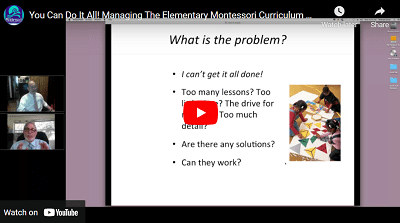
Managing The Elementary Montessori Curriculum Part 1

Managing The Elementary Montessori Curriculum Part 1

July 13th, 2016 This week Dr. Michael Dorer continued to explore an important topic for elementary teachers, How Can You Teach it All?

Many Montessorians struggle with the immensity of the whole curriculum, especially at the elementary level. There just seems to be so much. At the same time, they may grapple with how lessons should be planned, presented, completed, and followed up. These issues can actually be approached with a careful planning procedure, along with a healthy serving of gumption.

Join Michael as we explore lesson planning, curriculum and managing follow-up work. This is the beginning of a new direction in your school.

In this and the next webinar, we will explore the basics of lesson and curriculum management. This will serve as an introduction.

Managing The Elementary Montessori Curriculum Part 1

Managing The Elementary Montessori Curriculum Part 2

July 13th, 2016 This week Dr. Michael Dorer continued to explore an important topic for elementary teachers, How Can You Teach it All?

Many Montessorians struggle with the immensity of the whole curriculum, especially at the elementary level. There just seems to be so much. At the same time, they may grapple with how lessons should be planned, presented, completed, and followed up. These issues can actually be approached with a careful planning procedure, along with a healthy serving of gumption.

Join Michael as we explore lesson planning, curriculum and managing follow-up work. This is the beginning of a new direction in your school.

In this and the next webinar, we will explore the basics of lesson and curriculum management. This will serve as an introduction.

Managing The Elementary Montessori Curriculum Part 1

Managing the Elementary Montessori Curriculum Part 3

July 13th, 2016 This week Dr. Michael Dorer continued to explore an important topic for elementary teachers, How Can You Teach it All?

Many Montessorians struggle with the immensity of the whole curriculum, especially at the elementary level. There just seems to be so much. At the same time, they may grapple with how lessons should be planned, presented, completed, and followed up. These issues can actually be approached with a careful planning procedure, along with a healthy serving of gumption. Join Michael as we explore lesson planning, curriculum and managing follow-up work.

This is the beginning of a new direction in your school. In this and the next webinar, we will explore the basics of lesson and curriculum management.


Book Review:  Finish Strong

Book Review: Finish Strong

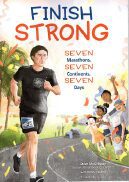
Finish Strong: Seven Marathons, Seven Continents, Seven Days

Written by Dave McGillivray with Nancy Feehrer
llustrated by Shululu

This book is categorized as a children’s non-fiction, biography for ages 7-10 years old. I think many children as young as five years old would enjoy it. It’s the story of Dave McGillivray, Boston Marathon Race Director. He starts by having to find a sport that he could be good at for his size and stamina, which turned out to be running. It is inspiring, interesting, and includes quite a bit of humor, too! On almost every page, there is a box at the bottom with some words of guidance, humor, or encouragement as he tells the story of the World Marathon Challenge. In this book, dreams, goals, charity, courage, and friendship are promoted as Dave runs around the world. Montessori students will appreciate the map of Dave’s journey as well as a sort of surprise letter and advice in the last few pages of the book. 

How can I help my child develop entrepreneurial skills?

How can I help my child develop entrepreneurial skills?

from Tomorrow’s Child Magazine – May, 2021 | by The Montessori Foundation

Parents can still encourage young entrepreneurs, even while facing ongoing career changes and challenges. You’re dealing with a lot right now, as a parent. Handling changes with your job, finances, and your children’s school routines are just some of the things on your to-do list. And now, you have a child who is starting their own business.

Teaching kids about career paths is hard enough when your life is stable. So, what should you tell your young entrepreneur about career paths when you’re facing so many changes with your own career? Here are four tips for how you can help your child choose a career path and develop his or her entrepreneurial skills.

1. HELP YOUR CHILD LEARN ABOUT THEIR OWN STRENGTHS AND INTERESTS.

Talk to your child about his or her business. How are things going so far? What do they like most about their business? What skills or tasks seem easy, from your child’s perspective? Consider assessment tests so that you can help your child choose a career path. For older children, such as high school students, you can suggest taking assessment tests such as an enneagram test or The Myers-Briggs test. (A good start would be Rising Innovator’s business idea quiz — take this quiz to see which business ideas match your personality.) These tests can help you and your child learn more about your child’s personality and interests. If your child chooses a business that fits his personality, he is more likely to work hard at developing the skills he needs to succeed.

2. FIND SUPPORT FOR YOU AND YOUR CHILD. 

Social gatherings are rare these days due to the Covid-19 pandemic. But you can still have a small group of people who support you so you can help your child choose and develop a business. Consider the people who you already turn to for advice about parenting, your career, and other issues. You can virtually check in with these people using email, social media, and/or informal Zoom calls. Then, encourage your child to think about their own friends. Which friends help them with school work? Which ones support their business or give great advice? Answering these questions will help children build their own group of supporters. You can also look for online parenting groups for yourself and find online groups for young entrepreneurs like your child.

3. HELP YOUR CHILD LOOK FOR A MENTOR.

Speaking of supporters, you don’t have to be the only positive, encouraging adult in your child’s life. A mentor can be a great resource and guide for your young entrepreneur since they can help your child choose a career path. Consider your own professional network or using LinkedIn to find potential mentors for your child.

4. BE PATIENT WITH YOURSELF AND YOUR CHILD. 

Having a great career is an ongoing journey that includes constant change, as many of us have learned during the past year or so. Be patient with yourself as you learn and adapt to how your own work life is changing. Use this experience to help your child choose a career path. Also, be patient with your children as they continue to learn and make decisions about their businesses, career plans, and dreams.

FINAL THOUGHTS. 

The recent coronavirus pandemic drastically changed how parents work while raising their children. As a parent, your work life and your life at home is more blended together compared to a year or so ago. You can use this situation to your advantage, especially if your child wants to be an entrepreneur or already has her own business.Keep these tips in mind so you can help your child get started on her entrepreneurial path and follow that path to success.

  1. Discuss with your child their strengths and interests.
  2. Virtually connect with people to support you and your child, along your child’s career path.
  3. Consider finding a mentor for your child.
  4. Be patient. Fortunately, you can use skills and experiences from your own life, and from other people, to teach your child about developing a business, even while facing changes and challenges.
Book Review:  The Earth | The Stars | The Sun | The Moon

Book Review: The Earth | The Stars | The Sun | The Moon

from Tomorrow’s Child Magazine – May, 2021 | by The Montessori Foundation

Picture Book Science Series: The Earth, The Stars, The Sun, The Moon

Written by Laura Perdew
llustrated by Li Hui

This series seems like it would be suited to and appeal to lower elementary students. There is quite a bit of text for students to read, and the vocabulary is above an emerging reader’s level. Obviously, there’s no harm in an older student/sibling with more reading proficiency or an adult to read it to a younger child. Although there is a lot of information in the books, it is wrapped in stories and illustrations of imaginary creatures. Again, this would definitely appeal to elementary-age students, but it might be a little out of a younger child’s ability to distinguish between reality and fantasy. These books provide a fun way to look at information about the stars, the earth, the moon, and the sun. There are other books in the series that take a closer look at different types of animals, as well. They are published by Nomad Press and can be purchased at www.amazon.com. 

Book Review:  Seeds and Trees

Book Review: Seeds and Trees

Seeds and Trees

Written by Brandon Walden
llustrated by Kristen& Kevin Howdeshell

I have to admit when I read the “Letter From the Author,” I became a little skeptical about whether or not this would be a well written book. Luckily, it turns out that it is written just fine. The story uses tree seeds as a metaphor for words and that words can be kind, supportive, and respectful (green seeds) or the opposite (dark seeds). In the beginning the prince gathers, plants, and nurtures both the green and the dark seeds, and both kinds flourish. After years, he realizes that the trees from the dark seeds were overtaking the trees from the green seeds. Fortunately, the prince has a friend, who helps him to get rid of the dark trees and only replace them by planting green seeds. The author conveys a message through this imaginary story in a way that children will probably be able to relate to. The illustrations are not only lovely, but they really depict the differences between the dark trees and the green trees. Children from 4-9 years old will enjoy reading and discussing the ideas in this book.

The Wonder of Woodworking

The Wonder of Woodworking

A Conversation between Lorna McGrath and Pete Moorhouse

Afew months ago, we had special guest, Pete Moorhouse, an expert on woodworking with kids on our weekly Montessori Family Life Webinar broadcast. In this interview with Pete, he shares some of his insights and ideas from woodworking with young children.

Lorna: What are your thoughts about why children get so enthusiastic about the idea of woodworking?

Pete: Woodworking is actually such a unique activity for young children to do. It’s so different from everything else—they use real tools and authentic materials to make their own constructions. And I think one of the things that really stands out is just how it draws in children’s curiosity. Woodworking captivates them, and you see astonishingly high levels of sustained engagement. 

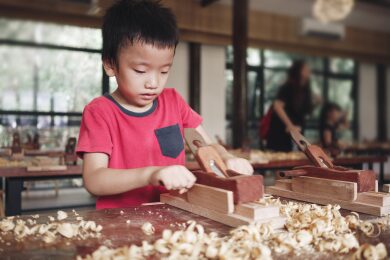
Children become really focused and concentrate on what they’re doing. The most astonishing thing about woodwork is the length of time children stay with this activity. They can span a whole morning or afternoon entirely engaged in their project. We see this across the world. It’s not unique to the United Kingdom. It’s absolutely everywhere, from the United States to Japan to the Middle East. Woodworking, using tools, is a universal language that gives children great enjoyment. And interestingly, in terms of education, this is nothing new. It used to be widespread in education right from the early 1900s, and it was pretty much embraced in schools around the world. 

Lorna: Why do you think educators and parents shied away from letting children have the experience of using tools?

Pete: What was very much widespread, in recent decades has very much fallen off the agenda. I think is to do with the risk aversion in a litigation culture. Educators were concerned about children getting injured and the possible legal liabilities. I think those worries made a big impact. But I think these days, people are much more willing to embrace this sort of challenge again, which is so positive. The other thing is, I think that culturally, we’ve been very much removed from the “making process” for many years, living in an overly commercialized world. Generally, there seems to be a real resurgence of interest in letting children make and create with their hands again. And I think woodwork’s no
exception to that. This seems particularly true in the United States, where the birth of the “maker space” originated. 

“Maker spaces” and labs have spread all over the United States, where adults and teenagers can get together. Now we see a lot of tinkering labs in the high schools, elementary schools, and in early childhood settings. I believe, particularly for children in early childhood, that woodwork is the best way for them to fully engage with the mind-set of STEM-based learning. There is another challenge at the moment. We have a new generation of children moving through. I often talk about this new generation of children learning how to swipe before they can walk. And I think this is having a significant impact. 

Lorna: So what do you see as the benefits of woodworking to this new generation?

Pete: We need to do our best to nurture children with some really positive influences to counteract the influence that gadgets and devices have on children. The physicality, the movement, and the hands-on experiential learning woodworking provides is a wonderful antidote for this two-dimensional, screen-based existence. It’s wonderful for children to really create something tangible with their hands. Finally, woodworking is really an exceptional activity for developing children’s thinking skills, as children envision and plan out their strategies for creating from wood.

It’s a constant problem-solving process as children go through making and creating with wood. Woodwork is just so rich, in imagining what they want to make and figuring all of those problems that they run into along the way. Creativity, in this context, is just so important. Children are increasing their communication skills with new vocabulary as well as using measurements and angles from math in real-life projects. Creativity has to be about the heart of that learning for it to be meaningful and remembered. Our world needs innovators to come up with solutions in these rapidly changing times, whether it is facing climate change or COVID-19. 

Lorna:  And might I add that Maria Montessori held hands-on learning as a fundamental principle of her method of education. She said that you cannot give something to the mind that you don’t first give to the hands. 

Pete: Absolutely. She talks about didactic material that children can really engage with on a significant level. And, there are so many materials and media that children can use, such as modeling clay. You could use it in so many ways. Wood is quite special because of the way that it draws children in and sustains engagement. I think it’s the excitement of using the tools and being able to master them that helps develop a child’s confidence and self-esteem. 

Lorna: One of our participants asks if is it safe for three- and four-year-olds to do woodworking. 

Pete: A lot of people are shocked at the thought of three- and four-year-olds using real tools like hammers and saws. We are quite careful in the choice of tools. There are certainly some tools that are much more ergonomically suited to young hands. Actually, children really step up to the responsibility of being given real tools. They actually suddenly take them quite seriously. We’ve found that their behavior with tools is absolutely exemplary. They take great pride from using them. 

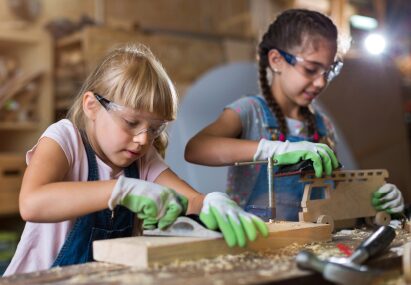
Occasionally, of course, there’s going to be the bumped thumb. We’re not going to eliminate that, but in 25 years, we have not had a serious accident. Often much worse happens just running across the playground and taking some skin off your knee. The type of injuries that happen while woodworking are actually very low-risk, small-scale things. There are obviously some health and safety measures that we need to put in place to reduce those risks. Teaching children to use tools properly, using safety precautions (like wearing safety glasses) and supervising their activity without doing it for them will help cut the risks. Small, stubby hammers work absolutely perfectly for little hands. Saws that actually cut as you pull them towards you are so much easier for children to use. So a lot of it is about having the right gear, proper lessons, and supervision. 

I’ll add that I think the real risk to children is that they don’t experience any risk at all. When we surround them in bubble wrap, and we don’t allow them to make their own decisions and judgments, when they get older they are not going to have that skill set to be able to make a decision. It’s a very important part of child development that adults allow children to encounter risk, obviously within controlled circumstances. We use hand tools, not power tools and very carefully manage those learning opportunities that include the possibility of risk.

Lorna: A dad asks, do you have tool recommendations, types and/or specific tools? Do you have recommendations for teaching safety? 

Pete: On my website there’s a free downloadable resource list and photos available of all the different tools. There’s also my book called Learning through Woodwork, which is available from Amazon. 

By being given tools to use for building, children are empowered. They feel a sense of responsibility and step up. At first children might be a little bit apprehensive because they may have never used real tools, but very quickly, with the right size and shape tools like the short, stubby hammers or screwdrivers, they gain confidence and skill. It’s actually what’s happening inside the child that boosts their pride, self-esteem, confidence, and delight in their work. 

Other areas of learning, with regard to physical developments, include hand-eye coordination, and fine-motor skills when gently tapping a nail into place. Using and coordinating large-muscle skills comes into play, as well, because every tool has got slightly different physical properties—from the rotation with the screwdriver to two-handed rotation with a hand drill and then posture and body poise needed when sawing. 

Woodworking can be a real antidote to continuous use of digital technology. Woodworking can involve literacy, as they do some research during the planning stage of the project. As they plan and envision what the project will be, they can draw it out on paper and later, they can write about what they’ve made. They use mathematical thinking to learn in a very natural way. They figure out what length nails they need to join things together. Quite a few bits of mathematical equipment are introduced in woodworking projects, and it is fantastic how they start using them in different applications. There are definitely a bunch of tape measures, rulers, t-squares, and levels in the woodwork area. 

I see woodwork as another way in which children use and express their imaginations. I think it’s important that children are at the center of their learning. Maria Montessori talked about the self-education of the child. So, rather than having predetermined projects for all the children, which strips the creativity out of it and turns it into an exercise in following instructions, allow children to plan and create what they want, using their intrinsic motivation to persevere and solve challenges along the way. It then becomes a delightful mixture of learning, creativity, problem solving, and fun!

Note: Pete had lots more to say in our broadcast. You can watch the entire session on montessori.org in the Montessori Family Alliance Resource Center, where over 300 webinars, hundreds of articles from Tomorrow’s Child magazine, and many audible recordings are archived when you subscribe to the Montessori Family Alliance for only $4.99USD per month. Become a member by clicking HERE

Teach Your Children Well

Teach Your Children Well

Montessori inspires children towards academic excellence and nurtures the creativity, curiosity, and imagination hidden within …

For many, paying tuition for private Montessori can be a struggle that demands certain sacrifices. Is it worth it? One parent discusses why she thinks so. 

Yarentsou’re driving through a fancy-pants neaighborhood daydreaming about kitchen upgrades and you hear it: that alluring little voice that reminds you that you, too, could have quartz counter tops if you just send your kids to public school. It’s not that public schools are bad. You went to public school and so did most of your friends—all are decent humans. Except Karen, but let’s not go there. 

You start to make a case for all the things you would do for your child if you didn’t have to pay that tuition: We could invest the money towards their college fund … We could take international trips and experience different cultures … or …. Let’s be real. It’s unlikely you will be diligent enough to put all the saved funds towards your kid’s 529 plan, and an international trip will be so much more meaningful to a child who has the  global understanding that comes with a Montessori education.

It’s normal to let this little voice take over sometimes. So far, you have made a selfless choice to sacrifice for the betterment of your child. But now, your child is starting kindergarten or the first grade, and there is a free option. It’s tempting to throw in the towel, or should I say “folding cloth.”

So why should you continue to send your child to a Montessori school instead of a more traditional elementary school? How do they differ and what makes Montessori better?

There are five aspects found in elementary Montessori program that you rarely find so well balanced in most schools: a love of learning, a desire to understand deeply, values that are universal, a global perspective, and a tradition of community service.

Okay, that’s great. How does this help my kid get into MIT? Let’s break it down … 

I. Inspiring Children to Work Hard and Achieve Academic Excellence

  • Montessori is one of the most sophisticated pre-collegiate programs available anywhere in North America. It has been described as the ultimate gifted-and-talented program that is offered to a very wide range of students. However, this doesn’t tell the whole story. What makes Montessori special is its ability to nurture talent without needless competition and stress. In a nutshell, Montessori children never lose the joy of learning.
  • Montessori is, first and foremost, concerned with a child’s character and emotional development, rather than academics for grades and test scores alone. Montessori inspires children toward academic excellence and nurtures the curiosity, creativity, and imagination hidden within every human being.
  • A Montessori program is based on warmth, kindness, and respect. There is a strong sense of community among the children. The classes are more like little villages, with powerful friendships and a clear sense of group identity. Teachers are normally seen as mentors and friends.

2.  Building Character and Teaching Universal Values

  • There is an old saying that if you abandon a garden, the weeds will run wild. Abandon a child’s moral and spiritual education, and the weeds of confusion, materialism, self-centeredness, and spiritual emptiness will take hold.
  • Dr. Montessori observed that the elementary years are a sensitive period for moral reasoning. The elementary program integrates character development and family involvement throughout the curriculum.
  • The teaching of kindness and courtesy, self-discipline and self-respect, and fundamental values is crucial in a child’s moral development, sense of dignity, and academic success. With proper guidance from parents and educators, children can (and will) excel.

3.   Montessori Schools Strive to Create Global Understanding

  • They tend to attract teachers from all over the world. It is normal to find an international student body in a Montessori school anywhere in the world.
  • Montessori schools generally teach at least one foreign language and often offer programs in several.
  • World geography, international cultural studies, and world history are central to the elementary Montessori curriculum. Elementary Montessori students begin to understand the global economy.
  • As more Montessori schools develop strong upper elementary and middle school programs, many are beginning to sponsor travel-study programs. Some participate in the Montessori Model United Nations and foreign exchange programs.

4 . Service

  • Children must be inspired to contribute to the betterment of the world. They often begin with projects that care for the environment: planting trees and flowers; composting garbage; controlling erosion around the campus; recycling; and cleaning up litter and debris in the local community. It is quite common for elementary classes to adopt an acre of rainforest in Costa Rica or work to support an environmental organization, such as the Wildlife Federation.
  • They will normally progress to projects that provide direct help to the needy. Younger children commonly collect canned goods, clothing, and toys for the homeless or needy families. As they are ready, most Montessori schools will take children out into the community.
  • As they reach the upper elementary class, Montessori children become quite concerned about issues of social justice and human rights. The rights of the poor, homeless, and hungry are of real concern. Some children will begin to explore the possibilities of supporting causes that are
    meaningful to them.

When my mind strays to thoughts of many ways that I could spend tuition money on so many other things, I remember that right now is the time that I can really help my child. As a parent, we don’t get do-overs. The seniors that graduate from my children’s Montessori school not only get into great colleges but, more importantly, go on to graduate. By the way, many Montessori graduates win scholarships, because colleges and universities recognize the value of a Montessori education.

Right now, when your child is too young to make choices about where they go to school, what they are going to eat for dinner, or how to budget for a new car to go on vacation, it’s all in the hands of their parents. By the time your children are in high school or college, they are ready and able to make more small and big choices for themselves; however, right now, the choices that determine the trajectory of your child’s life are in your hands. Choose well.

Return to Table of Contents

Five Crucial Reasons Why Schools Should Teach Entrepreneurship

Five Crucial Reasons Why Schools Should Teach Entrepreneurship

Teachers have a powerful role in helping students face an uncertain future .

What if teachers could give their students hope and empathy skills, even while society faces global health problems and divisive tensions? Teaching entrepreneurial skills can help teachers prepare their students for today’s rapidly changing world.

We can think of at least five reasons why schools should teach entrepreneurship. But first, let’s look at what entrepreneurship education means.

What Is Entrepreneurship Education?

Entrepreneurship education teaches students important life skills, such as:

  • Collaborating and working with a team
  • Speaking in public and preparing an effective presentation (digitally and
    in-person)
  • Collecting, analyzing, and using data
  • Utilizing social media for promotion and/or advocacy
  • Handling real, complex problems that don’t have a definitive answer
  • Using curiosity and creativity to find an innovative approach to difficult problems

Students learn what it takes to develop a product or service, create their own unique business proposals, and give multiple pitch presentations.

Entrepreneurship education does not just benefit those entering the fields of science, technology, and business. Students interested in the arts, social sciences, and similar fields can also develop their imagination and learn how to apply creative thinking skills to real-world problems.

Here are five benefits of schools teaching entrepreneurship:

 Prepare your students for an uncertain future.

The recent COVID-19 pandemic has taught all of us an important lesson: Our lives can dramatically change at any time. Some economic experts predicted many people’s jobs would become automated during the next few decades, even before the global pandemic.

Teachers can’t always predict exactly what students will need to know after they graduate. Still, teaching entrepreneurship skills can help students handle, and sometimes even welcome, the changes happening in technology, business, and society in general.

These skills include problem-solving, teamwork, empathy, as well as learning to accept failure as a part of the growth process.

 Students develop their creativity and collaboration skills.

Entrepreneurship education supports creativity, innovation, and collaboration. These skills are highly valued by the top colleges and most businesses in the world and will be used by your students well beyond their middle school and high school years.

Businesses are often rewarded for creating products and services that seem new and different. The best new ideas are usually a result of two or more people working well together.

 Teach students how to identify and recognize problems.

Students must know how to identify problems before learning how to solve them. Problem-solving exercises are a long-time staple of traditional education. However, the same cannot be said for identifying problems.

Traditionally, problem-solving is taught by presenting students with issues that are already clearly defined by someone else. In the real world, problems can only be solved when they have been properly identified and described.

Entrepreneurship education helps children learn how to identify problems they have never dealt with before. This skill is much needed now and will continue to be needed in the future.

 Help students become resilient.

Let’s be honest. Sometimes grades, socioeconomic status, and intelligence don’t accurately predict a student’s chances of having long-term success.

What’s a better predictor of a student’s future success? Their resilience, also known as “grit.”

Becoming an entrepreneur is an ongoing journey filled with ups and downs, even when the economy is thriving. Teaching entrepreneurship encourages students to figure out their passions and how to be persistent when pursuing their interests. Students also learn how to stick with a business idea, or similar project, especially when times are tough.

Learning how to work through problems and adapt to changes improves a student’s chances of having professional and personal success long after they leave your classroom.

 Encourage students to make the world a better place.

Entrepreneurs constantly look to solve problems and meet the needs with the help of their products and services. Entrepreneurship can start with a desire to make money and live a better life, for many aspiring business leaders of all ages.

But all successful businesses have one thing in common: they make life easier and/or more enjoyable for their customers. Teachers can support and encourage their students to be motivated by a desire to help people with a product or service.

Main Takeaways for Why Schools Should Teach Entrepreneurship

  • Teachers can play an important role in supporting aspiring and current young entrepreneurs.
  • Entrepreneurship education teaches students skills they can use well into their adult years. These skills include working with a team, using the internet and social media for marketing, as well as developing creative ways to create new products and solve complex problems.
  • Teaching entrepreneurship empowers students by preparing for an uncertain future and work to make life better for other people.
  • In other words, entrepreneurship lessons can give students hope for themselves and empathy for other people.
  • Those skills are needed now more than ever before. 
Return to Table of Contents

Rising Innovator:  Inspiration, Education, Support

Rising Innovator: Inspiration, Education, Support

Rising Innovator is an organization dedicated to inspiring, educating, mentoring, and supporting young entrepreneurs. Our website (www.risinginnovator.com) contains tools and information designed to help youth start and run businesses and to help their parents help them.

Our mission is to:

  • Facilitate a mindset and skillset to change the world
  • Improve the world through entrepreneurship
  • Help young entrepreneurs create thriving businesses
  • Rising Innovator’s ultimate goal is to make the world a better place.

You don’t improve the world by accident. And you don’t improve the world alone. And you don’t improve it in one fell swoop; you improve it one piece at a time.

Our piece is young innovators—people who come up with ways to make people’s lives more convenient, or make the world more fair, cleaner, more neighborly, more efficient or in some small (or big) way better. Innovators can become wealthy entrepreneurs, but we believe the first and most important step is to become more skilled and knowledgeable and to develop ways to make the world a better place for everyone. If you succeed in those goals,
success (or at least happiness) will follow.

Innovation and entrepreneurship are also excellent ways for economically disadvantaged people to create bridges that allow them to narrow the gap between the haves and have nots of the world.

We hope that our website (https://www.risinginnovator.com/category/for-kids-teens) gives young people all the resources they need to become innovators and entrepreneurs—and to connect with others on our forum who share the same goals (https://www.risinginnovator.com/forums).

Return to Table of Contents

The Path to Literacy

The Path to Literacy

The path to literacy is unique in the Montessori classroom. Rather than begin by identifying common simple words—cat, ball—we begin with sounds, and move first to writing, then reading.

We start with Sound Games, an activity with a child or with a small group, when we introduce the idea of sounds. I’m thinking of someone in our class whose name begins with mmm. Who is it? We start with sounds, rather than letter names, since, more often than not, the letter doesn’t say its name.

We might have a collection of small objects, or colors, language a child is already familiar with. We ask a question. “I’m thinking of a color on the rug that begins with ‘p,’ what is it?” Wait for the connection to be made. If a child isn’t identifying the sound, we provide assistance. “I’m thinking of a color in my hand that begins with ‘p,’ what is it?” Perhaps then the information syncs. Pink! It’s pink! We help solidify this knowledge. “Yep! Pink begins with ‘p.’” This isn’t a guessing game. You’re not trying to get the child to guess what you’re thinking; you’re trying to help her identify sounds.

When the initial sound is clear, we can introduce final sounds. Pink starts with ‘p’ and ends with ‘k,’ and then we can ask a child what other sounds she hears in “pink.” The initial and final sounds are typically the most obvious, but the middle sounds are just as important for attaching meaning.

Writing again takes an unexpected turn. There are two paths here: handwriting and composition.

Skills leapfrog one another. A child’s mind might be capable of identifying the sounds in a given word they’re interested in transcribing, but their hands are still developing control and coordination. These two parts of writing (the hand and the mind) are developing independently, and we don’t want to wait for one in order to aid the development of the other.

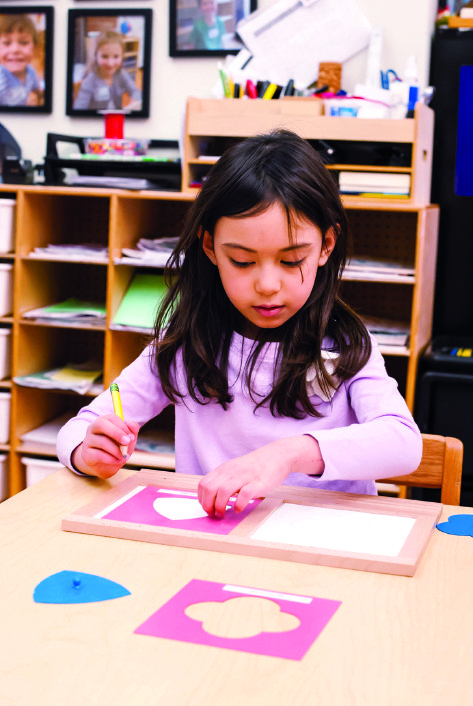
We’re getting a child’s hand ready through materials, such as the Cylinder Block or Pegged Puzzles, where she will hold the knob the same way as she will hold a pencil. Even before she sits down to write, her muscles are preparing.

There are various materials for art that encourage careful use of a tool: colored pencils and crayons; a brush for painting or for glue.

We’re practicing tracing shapes with the Geometry Cabinet and then with the Botany Cabinet. What is writing letters but replicating a shape?

The Metal Insets more closely resemble preparation for handwriting. A child traces a shape, then fills in the outline very carefully.

Composition is usually what we mean when we say a child has started writing. Composition starts after a child is comfortable with Sound Games. She can identify the first sound in words and sometimes even the last and middle sounds.

We’ll begin by selecting a few Sandpaper Letters and taking them to a table. We’ll say, “Remember mmm? What can we think of that has mmm in it?” Mom, money, mouth… “Would you like to see what mmm looks like?” We’ll turn it over and trace it.

We’ll introduce the Sandpaper Letters three at a time, until a child has mastered quite a few. We’ll continue to play Sound Games, refining the process until she’s quite familiar with the first, last, and middle sounds in words.

When we’re ready for composition, we introduce the Moveable Alphabet, a collection of letters in small compartments in a tray that a child uses to form words phonetically.

We’ll take the Moveable Alphabet, boxes with letters cut out, to a rug. We’ll make a list or gather a few objects we want to write. “Let’s think of colors. Red. What’s the first sound in red?” Instead of simply naming the sound aloud, we’ll find the letter that makes that sound. We’ll line them up, composing words.

Children might hear all the sounds or the first and last sounds. They might be mis-hearing sounds. There are phonograms, letters that come together to make a unique sound, like sh. At first, we’re not focusing on spelling. Spelling comes later. Spelling is important, but we don’t want a child to get hung up on spelling at first.

A child will write lists of words, phrases, or even whole sentences, and we might overhear her sounding out the letters on the rug, reading what she’s written. This is a good indication that a child is ready for reading.

We start by reading small, simple, phonetic words. We take out a material called the Phonetic Object Box and go through all the small items in the box. Perhaps a frog, a hen, a doll; we want to make sure the child knows what we’re calling these items, before we ask her to read them.

After naming all the objects, we’ll carefully write labels, one at a time. The child will sound out the letters and surprise herself when she strings them together to form a coherent word.

There’s lots and lots of practice with simple reading at this stage. She can certainly write more than she can read and comprehend far more than that. She’ll read labels and assign them to objects, cards, things around the room.

We’ll slowly introduce all the nuances of English: strange spellings; common phonograms; different ways to make the same sound (like ‘f’ and ‘ph’); the same way to make different sounds (like key and bee and lead).

The wonderful part about introducing literacy with sounds, is that a child can read any word she sees. She can decode it with the myriad tools she has, put them together, and ask: Does that make a word? She’ll end up memorizing common words through practice, but once she’s started reading, with a bit of time and patience, she can read anything.

 
Return to Table of Contents