by Robin Howe, EdD | Adolescence, Early Adolescence (12-15), Emotionally Healthy Children, Later Adolescence (15-18), MFA, Montessori students, Parent Education, Practical Life, TC September 2021

from Tomorrow’s Child – The Montessori Family Magazine – September/October 2021
By Robin Howe, Ed.D.
“Each preceding phase prepares the one that follows, forms its base, nurtures the energies that urge toward the succeeding period of life”
Maria Montessori. (From Childhood to Adolescence, 134)
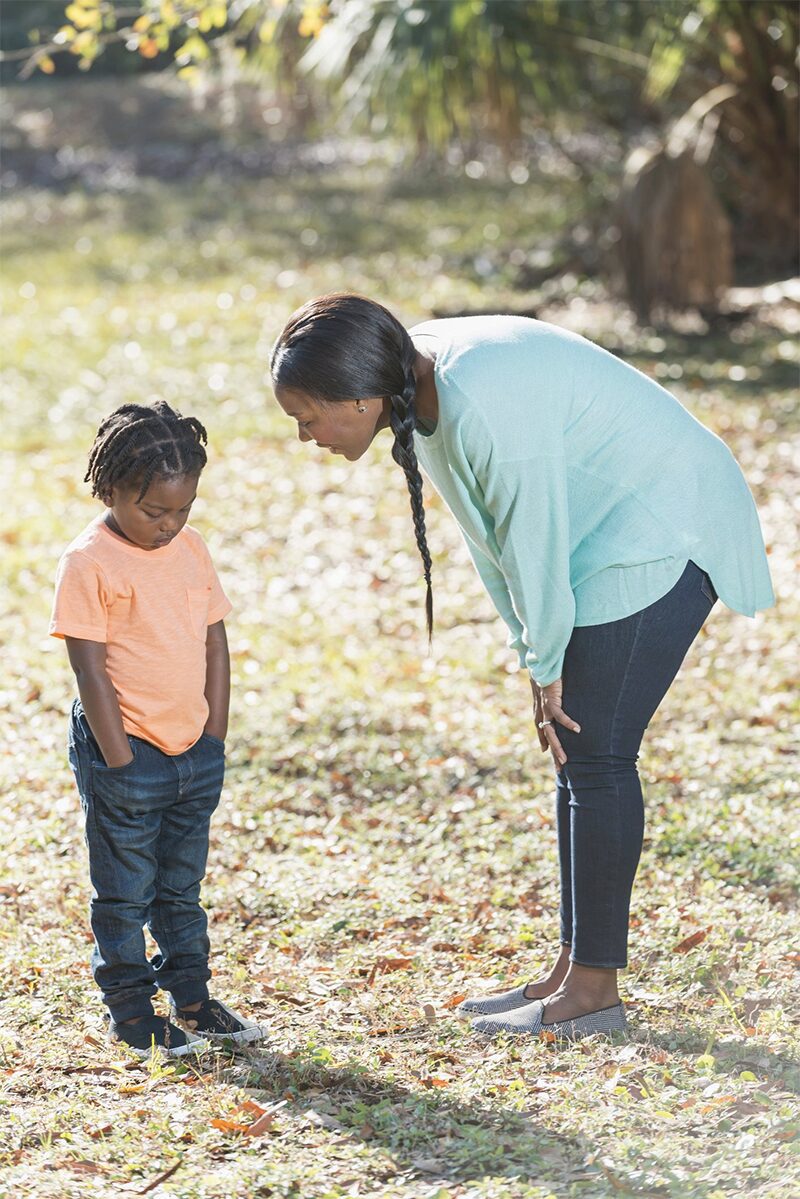
In early childhood (3 years to 6 years), there is a component of the Practical Life curriculum that is called “Grace and Courtesy.” It is a proper noun in that it has its own place in the early childhood curriculum. Some might say that it is the foundational piece, setting the expectations for behavior and interaction that lay the groundwork for successful work in the classroom; it is essential for the normalization of the class and the students in the class. As students progress through the early childhood and then elementary classrooms, Grace and Courtesy is acknowledged as an essential piece of Montessori, a continuum through which Montessori can effectively be implemented. As students get older, however, there seems to be a greater emphasis and division between a student’s behaviors (ability to demonstrate grace and courtesy) and their academic abilities. This does not mean that these two skills are mutually exclusive, but the importance or emphasis may change from the teachers’ perspective. In working with adolescents and adults, I consider myself lucky to have maintained contact with many past students, whom I have known through their childhood and into their adult lives. This has given me the opportunity to get to know these students as adults. Sometimes I wonder, though, if we have adequately prepared children for adulthood, and whether we allowed Grace and Courtesy to dissolve into memory from our early childhood years when children were learning how to walk carefully through a classroom while balancing a tray or how they politely interact-ed with others. Some questions I have been considering more and more are: • Does a four-year-old child having a tantrum in the middle of a grocery store have more leniency than a 17-year-old or a 25-year-old having the same level of a tantrum in the same grocery store? • Does a flippant remark from a six-year-old affect people differently than that of a 16-year-old?
Of course, the answer is yes! Even the most balanced four-year-old may have a moment when they lose control and it doesn’t matter why. Parents may be judged by bystanders on how they handle the situation but, ultimately, when the child is back in the car and eventually falls asleep to the motion of the vehicle, supporting a notion that the cause of this uncharacteristic outbreak was exhaustion, the situation is over. A young adult may not have this luxury. The threshold of understanding is much less for adults than it is for children and that is perfectly appropriate, based on our assumption that with age comes a level of self-control and maturity that would prohibit them from behaving in this way. So, my questions as a Montessori adolescent teacher are: • Are we adequately preparing our young adults for the succeeding period of life? • Are we preparing them for the expectations of existing in an adult world, even as they just enter adulthood?
I feel that Montessori does this better than other educational pedagogies in many ways. A few of them are outlined below. Internships and Work Experiences We encourage our students to explore careers and be amongst professionals, who may not have the patience of educators. The assumption is that if students behave outside of a span of “acceptable” behavior, they will be asked not to come back. Entrepreneurship Whether the students are participants in an Erdkinder program or other entrepreneurial experiences, they are learning about financial independence and being valued as part of the Montessori idea of “valorization.” A goal of any adolescent entrepreneurship experience is the appropriate appreciation for money, their own role in earning it, and an understanding of how their participation is something of value. Field Experiences Many Montessori secondary programs have opportunities for students to work both in their communities and the greater world beyond. The importance of a student experiencing other cultures and realizing that drinking water and plumbing are not guaranteed rights are incredibly important lessons. Leadership A tenant of any Montessori experience is the opportunity to be a leader. Whether the 6-year-old in the early childhood class or the 12th grader in a high school, this experience is incredibly powerful for both the student in a leadership role as well as the younger students who are observing. Each of these examples warrants entire courses and discussion, but is that enough?
On a recent trip with adolescent students, I passively listened to the conversations and observed behaviors, trying to demonstrate my own Montessori ability to know when and how to interact, while also trying not to be the misunderstanding adult, who (just a few years ago) might have been more understanding. While none of the behavior was egregious, in this heightened world of accountability, I found myself torn. Jokes that might have been accepted or even funny five years ago, may now be means for expulsion or even legal action. Flippant and loose language can be captured and reposted on a phone and can lead to the loss of scholarships and enrollment. Teachers do a lot, and some of these questions are the responsibility of the parent! Agreed! But, if we accept Montessori’s belief that “each preceding phase prepares for the one that follows,” are we doing enough? Should Montes-sori’s Grace and Courtesy curriculum more specifically prepare our young men and women for today’s world? Thinking back to that four-year-old who had the tantrum in the supermarket, do we have the expectation that young adults will have a much higher degree of control? But what if they don’t? How can we as Montessori parents, teachers, schools, and systems, support the changing expectations of young adults and prepare them for the post-secondary world where the expectations are higher than those of the four-year-old in the supermarket? The world we (the adults in the room) grew up in is not the same as that of our current students. Physiologically, science suggests that we are not different; however, earlier civilizations did not have cell phones and Instagram™. If our goal is ultimately to prepare students for the next stage of their life, whether it be university, a trade, etc. they have expectations as adults (even if they are not) that they need to be prepared for and the learning curve is not as long as it once was. In closing, while we consider Grace and Courtesy as a fundamental component of the Early Childhood curriculum, is it time to re-examine the importance for students in the third plane (12- to 18-year-olds)? As we prepare them for the succeeding experience, should this emphasis carry a capital G and C for our older students?
by Julia Volkman | Child's Work, MFA, Mixed Ages, Montessori Education, Montessori Materials, Parent Education, Prepared Environment, Primary (3-6), TC September 2021
By Julia Volkman
from Tomorrow’s Child – The Montessori Family Magazine – September/October 2021
So, you’re considering a Montessori school. Maybe you’ve read about the growing evidence that supports the long-term benefits of Montessori education. Maybe someone you know enrolled their child in a program and is always pestering you to put your child there. Maybe it’s just an accident (as happened with me) that when you feel your child is ready for school, the closest one to you happens to be a Montessori school. Whatever the reason, when you show up, you want to know that this particular school is a good school.
THE PHYSICAL SPACE
Now we can’t all live in the Taj Mahal, so the school may not be housed in the most modern building (we all have to start somewhere), but what you should see is that the space has something lovely about it. You’ll have a feeling that someone cared about the entryway, the hallways, the offices, the rooms, and, oh yes, the bathrooms. The walls will not be cluttered or overwhelming. Overall, it will feel calm, inviting, and maybe even elegant.
It may also make you feel like a bit of a giant because the whole school should be adapted to fit the smaller physical bodies of the students it serves. You should see benches, chairs, and/or tables that are quite small. Sinks will likely be lowered or the ground raised with solid stools. At all points, there will be a sense of order, care, and intelligence in the physical design.
OBSERVING
Once you’ve walked through the door, the staff at a good Montessori school will make you feel welcome. They will greet you and, even though they will be exceptionally busy, they will make you feel like your visit matters. At some point, they will invite you to see the classrooms in action. They’ll call this “observing” and in Montessori, scientific observation by the adult is essential.
You see, Montessori teachers are actually all scientists. We are trained to carefully and objectively notice what is going on with each child. We observe how the children use their hands and feet, how they articulate words, how they interact socially with others, how persistent they are in getting what they want, etc. All of these observations are then used by the teacher to customize each child’s curriculum. Every child is allowed to go at their own pace, repeating as often as they need to in order to figure something out.
On your first visit, you will receive some basic instructions on how to observe. You’ll be asked to enter the classroom very quietly so as not to interrupt the class. You’ll be shown to a chair where you can sit and maybe given a notepad, so you can write down your reflections. You are asked to be polite with the children but not to engage with them excessively. Instead, you are to put yourself busily to the task of seeing what’s happening.
Sometimes the school will even give you a sheet with written observation instructions. I think every school should put a big caution statement on the top of the observation instruction sheet. “WARNING: Sitting quietly and observing Montessori children without chatting or interfering is sometimes associated with excessive discomfort. Particularly gregarious people may experience mild dizziness, vertigo, or a twitching jaw.”
That’s meant to be a joke, but I’m actually serious. Our culture does not teach us to sit back and let children be children. Our culture teaches us that good parents/adults jump in and engage with children and direct them towards doing ‘important things.’ And at this moment, the Montessori school is asking you to go against our culture, sit down, and be quiet. Isn’t that the opposite of what good education is all about?
Actually, when it comes to education, what we really want is for the students to be active and for the adults to be in a support role. It’s like each child is the superhero, and the teacher is the sidekick. We’re the wingman. The Children
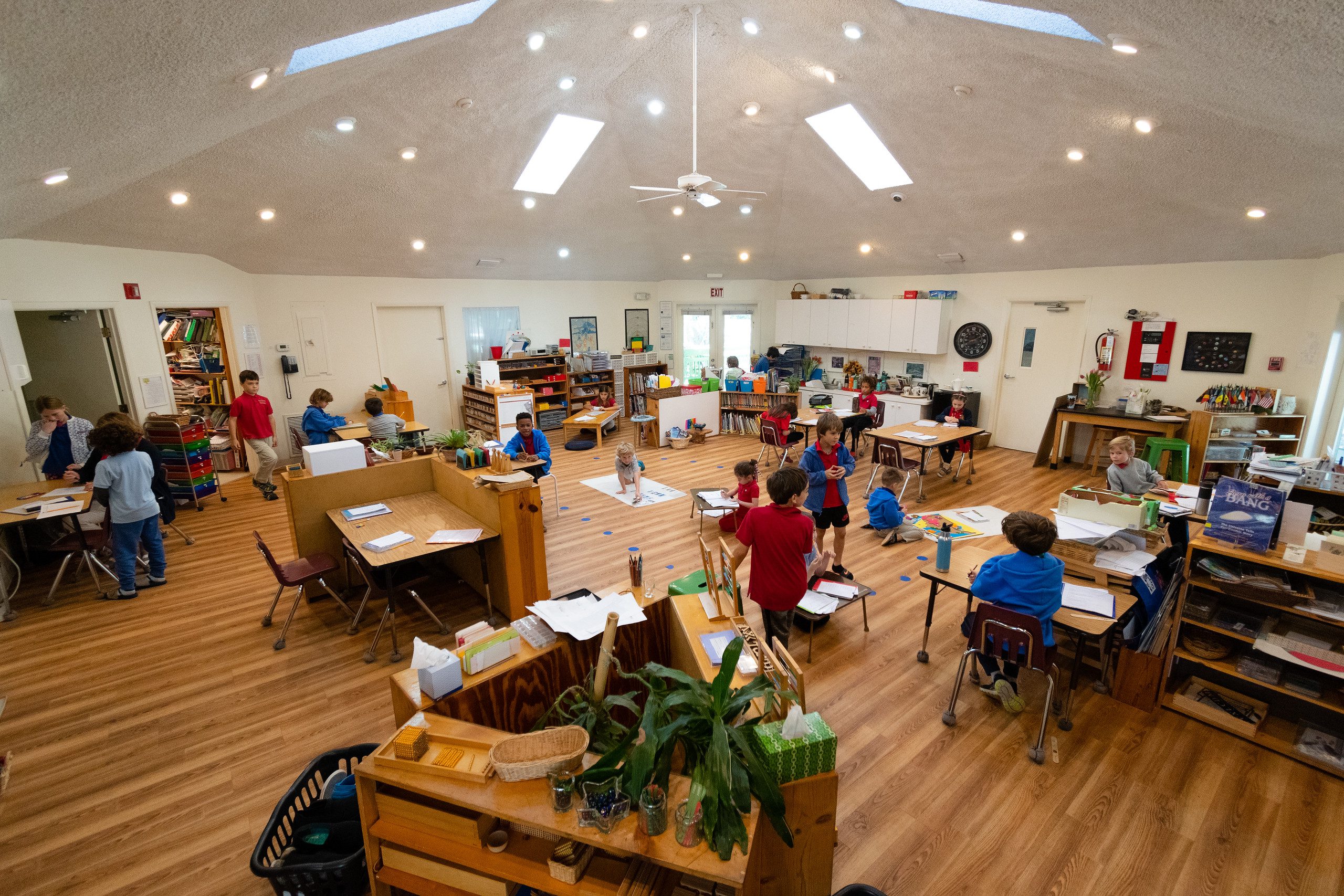
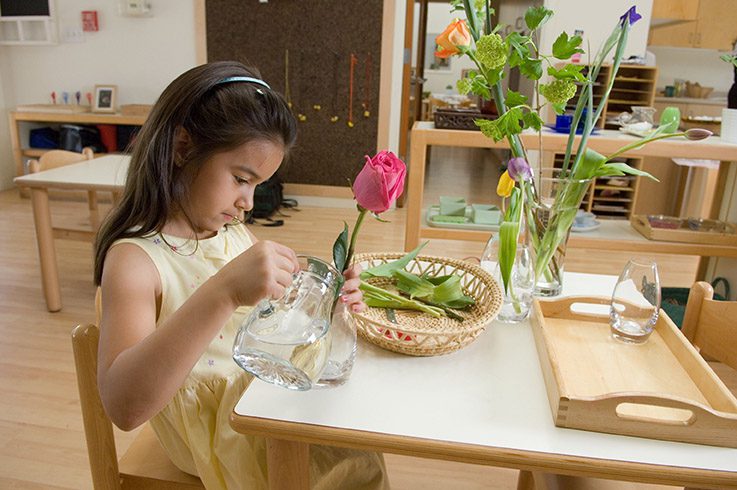
In the midst of all this patience rooted in scientific observation, you’ll see a mixed-age group of children doing all kinds of things. In a normalized classroom, the children will be quite busy. Some of them will be working by themselves at a table or on a rug. Some will be walking about gathering things or tidying things. Some will be chatting with another child or doing some activity together. Some will be tending to their physiologic needs. And, of course, some will be on the edge of mischief. The important things to look for in the children is that they seem to be interested in what they are doing and that the work seems to have some logical purpose. They won’t be playing with dolls or toys but will be using real-life materials (like real glasses, pitchers, and bowls) to do intelligent things. You will also usually see a sense of order in what they are doing.
You will also see a mixed-age group, generally with a three-year span. So for a primary or preschool/kindergarten class, this would mean around ages three to six. Now the really important thing to notice is that the younger children will look to the older children for guidance and the older children will be happy to offer it. Let me repeat that last part… the older children will be happy to offer help. I’m not kidding. That is the coolest part of the three-year mixed-age group. The older kids get to be leaders. They really flex their “I’m the one who knows how to do this and who can teach others” muscles. It’s gorgeous to watch.
Of course, the younger children also benefit tremendously because all humans learn more easily from peers than from authority figures. So, when the new children start coming to school, they will have a whole community of people who can help them learn the ropes, most of whom are about their same size.
The Teacher
The children will most likely be utterly accustomed to having observers visit. A few children may come over to greet you and welcome you to their room. Most will ignore you. Yes, that’s right, you will be less interesting to them than the schoolwork they are doing. There you have it; the next humbling truth of Montessori. The grown-up is the least revered thing in the room.
When you finally find the adult in the room, you should notice someone who:
§ Precisely and objectively watches the children
§ Dynamically engages the children with the hands-on materials
§ Models the most gracious, welcoming, and kind behavior you have ever seen
§ Demonstrates an insane amount of patience in waiting for the children to speak and get to where they need to go
Concentration
Okay, so all of these things are going on all around us as we take our seat in our observation chair. And, despite the observation instructions, usually the first thing we want to do is start talking with some child or children so we can see what they are doing. We want to strike up a nice little dialogue with one of these perfect Montessori students we’ve heard so much about. I mean, this is our chance to get the inside scoop from the ones who really know what’s going on, right? If we can just talk to the right child, we’ll find out what we really need to know.
Now, resist the urge, step back for a moment, and consider this. In the 21st century, one of the primary goals of education is to develop the capacity to pay attention to what is important and ignore what is not. Every day, we are immersed in an ocean of information overload. Somehow, we adults have to figure out what doesn’t matter, what does, and then maintain our attention on what does, so we can see a task through to completion. So school isn’t just about teaching factual knowledge anymore (although that’s fun and has its place). It’s much more about creating executive function or higher thinking capacities.
So if we succumb to our little bout of curiosity and interrupt a child so we can find out the real dirt on the school, we are actually interfering with the development of that child’s attention span. This is the cardinal sin of Montessori. The big teaching in Montessori is to prepare the environment so children can get what they need, teach the children how to engage with the environment, and then let them have at it! At this point, the adult is careful to fade and observe. If the child needs help, we offer it. If not, we disappear because we know that it is their effort that makes the difference, not ours.
Sit down, relax into your observation chair, and just enjoy what you see. Are the children happy? When there is a conflict or challenge, is it handled compassionately by the teacher and/or the children? Is there a light buzz of meaningful dialogue? Does everyone seem to know what they are doing?
You’ll know if it’s a good school or not because it will make you think…what if the world were like this?”
Really, everything I’ve said above is a distraction. You’ll know if it’s a good school or not, because it will make you think…what if the world were like this? What if everyone knew that they had something valuable to do and that they could do it on their own or with others, at their own pace, and get help if they needed it? What if everyone could apply themselves to work that matched their interests and strengths? What if everyone helped to care for the physical environment and helped those in need? These are the questions you will find yourself pondering while you relax into the observation chair of a good Montessori school.
This article was originally published in the July 2016 issue of Tomorrow’s Child.
Julia Volkman is the president/founder of Maitri Learning, a teaching fellow in the Neuroscience of Learning course at Harvard University (Extension School), a Montessori mentor (AMI primary/early childhood), and a mother of two. Julia learned her first second language during high school, where she participated in a student exchange program to France. After two weeks, she had her first dream in French, and everything became easy after that. She completed her Montessori studies in Montreal (a bilingual program where she was always asked to team up with the French speakers), studied German in college, and taught herself survival Russian to prepare for her two-month adoption journey through Kazakhstan. She has taught English to students from China, Cameroon, and Russia.
by Christine Chapman | Adolescence, Early Adolescence (12-15), Emotionally Healthy Children, Entrepreneurship, MFA, Montessori Education, Montessori Family Life, Montessori Parenting, Parent Education, TC September 2021
from Tomorrow’s Child – The Montessori Family Magazine – September/October 2021
by Christine Chapman
As I lay in savasana at yoga this morning, my teacher shared a quote that landed and resonated deeply for me as I reflected on parenting and guiding a high schooler to think about life after high school:
Awakening and enlightenment are accidents; but practice makes one accident-prone. Author unknown
As a parent, I’ve spent countless hours literally awakening (and, hopefully, enlightening) my children. In fact, I think that’s especially true now, as my first-born, Celia, progresses into her second year of high school, begins to grow independent, and starts to consider her future. Juggling my own work as an educational consultant and entrepreneur, along with managing all that comes with raising two kids in a COVID landscape, I often close my eyes, cross my fingers and hope that I am helping them attain their highest potential with what I am able to provide.
I first witnessed the aha moments I associate with awakenings and enlightenment when Celia was a student at a Montessori School on Cape Cod. She began at the Sandwich Montessori School at two years and nine months. She had always been that kid who insisted she could “do it myself!” and understanding that she had that spirit of exploration and that yearning to discover sensorily, I read everything I could about Montessori.
In Montessori, I believe Celia developed a solid foundation in math, language, and problem-solving, both academically and socially. But there was something more practical that drew me to the Montessori educational model; it was the life skills and sensory aspect to the program that I loved. Upon reflection, I believe these skills set Celia up for the awakenings and enlightenments she experienced in her early childhood. She practiced the work—whether it was learning to zip a garment, unbuckle a belt, sweep and mop, or pour and scrub. Through these Practical Life exercises, Celia learned to strengthen motor skills, navigate practical tasks in the world, and care for herself. She also learned about Grace and Courtesy in her interactions with her peers and adult guides. As a mom, I remember feeling a wave of emotion overcome me as I saw her developing in confidence and growing into independence, even as a three-year-old.
Flash forward a decade…
Celia was thirteen and in eighth grade when she approached me about educational alternatives for high school. I remember the morning well when she dropped ‘the bomb’ on me (her college counselor mom). She had decided she wasn’t really interested in attending our very highly ranked local public high school, and she was seriously considering our local vocational tech school to possibly major in cosmetology… unless I had other ideas or options I thought she should consider.
The vocational tech world was completely foreign to me, and the ignorant, college counselor snob in me just wasn’t ready to accept that pathway as a possibility for my very bright, capable, and talented first-born child. I threw myself into researching other options; digging into the different vo-tech programs and doing my due diligence by talking to parents, students, and alums. Celia ultimately applied to two vo-techs, understanding that our very strong public high school would serve as her backup option. We were thrilled and relieved when she received admissions to her first choice school: The Norfolk County Agricultural High School, with the intent to study animal science.
My daughter challenged my very traditional educational consultant viewpoint and approach, and she became my greatest educational experimental case. So far, the experience has exceeded my expectations in so many ways: Celia is life-ready, equipped with so many of the kinds of life skills that I marveled about when she was barely three and in Montessori. As a student in an agricultural vo-tech school, she’s learning about animals and plants, stewardship of the environment, woodworking, welding, and is even getting a little primer to mechanical engineering. I’m beyond proud; she’s acquired skills that I may never possess and, as her mom, I’m super grateful. Most importantly, she’s confident, happy, and not afraid of hard work.
The vocational route has opened my eyes and challenged my own preconceived notions of what a post-secondary path should look like. It’s also spurred many discussions about my daughter and her future plans. If my own experience as a mom and as an educational consultant/college coach can help inform some of your discussions with your children, as you embark on their post-high school plans, I’ll be pleased. But in order to write this piece, I’ve also had conversations with numerous parents who’ve been my predecessors on the journey to raising successful, introspective, and, ‘awakened’ adults.
“Remain open-minded. Don’t allow for any of your preconceived notions of what a postsecondary path should look like…”
So how do we, as parents, committed to the highest good of our children, engage our children in the practice of impactful communication about our futures? Talk to your kids. Remain open-minded. Remember, it’s theirs to own. Honor your child’s unique identity, experiences, and characteristics as you help them plan and navigate their own pathways.
Here are some additional tidbits of wisdom I’ve compiled that might help inform your practice of communication with your teen:
• Be transparent about issues around money and funding post-secondary education.
• Ask your children what brings them happiness and joy.
• Be open-minded and aware that our children (unlike our generation and previous generations) will have opportunities to pursue multiple career paths in their lifetime as working humans.
• Don’t be afraid of asking the big, seemingly daunting question: What do you want to do with your life? Don’t be alarmed when you face the big question mark in your child’s eyes. Instead, engage them in digging into the question by asking them what they imagine doing to make a living, what their goals are, and what their ideal work environment might look like. Do they imagine sitting at a desk? Working with their hands? With people? Behind the scenes?
• Ask them if they feel ready for college? If they’re not sure, give them the permission and guidance to look at other opportunities and jump in together. It might be a magical family experiment.
• Listen to them, poke and prod a bit at their responses to your questions, encourage them to both daydream and to be practical.
• Remind them that it takes time, inquiry, and a whole lot of practice to come to the awakenings/enlightenments and epiphanies that bring them the clarity they seek; and that they’re not alone.
Life’s road is not always a direct pathway to success. And taking the road less traveled may be exactly what your child needs permission to do. Remember that it’s often messy, muddy, and requires patience, space, and introspection.
As we started to come out of savasana this morning, my teacher shared a last tidbit that resonated with me on so many different levels. After class, I asked him for the full quote from the Tao Te Ching, or “The Way” by Lao Tzu:
Do you have the patience to wait until the mud settles and the water is clear?
For me, as a parent, the answer is a resounding yes. But the part of the extended quote that I didn’t hear in yoga class, but found even more relevant and resonated deeply with me as a parent, who is constantly trying to influence my children’s decisions and solve their problems for them was this line:
“Can you remain unmoving until the right action arises by itself?”
As a fellow parent, I challenge us to honor these deep pieces of wisdom and hope that we can help cultivate the practice of helping our kids become more “accident-prone” towards awakenings and enlightenment. As parents, all we can hope for, after all, is to guide our children towards becoming awakened towards their true paths and to honor their journeys as we walk alongside them: supporting, advising, challenging, and loving them along the way.
Christine Chapman is an educational consultant, and co-founder of Personalized Educational Solutions, Inc (www.pesglobal.org) and Education Station (www. educationstationhopkinton.com) She is grateful to do meaningful work that supports and empowers students from all over the world in finding their best educational matches in private schools and universities. She is a team builder, community contributor, and educational entrepreneur with almost 30 years of experience as a business owner involved in helping students develop and implement successful educational plans. She is a serial volunteer, lover of the arts, and committed to social and emotional wellness and youth empowerment. Christine is a musician, an aspiring yogi, lover of animals, and committed single mother of two amazing children.
As a committed, passionate college coach, Christine just started a new nonprofit called The College Axis Project (www. thecollegeaxisproject.org). She is grateful to be pursuing her vision and passion to make educational enrichment and college counseling available to everyone, regardless of race, socio-economic status, or gender/sexuality.
by Cheryl McCabe-Allen | Emotionally Healthy Children, MFA, Montessori Family Life, Montessori Parenting, Parent Education, Parent-Teacher Communication, TC September 2021, The International Montessori Council
from Tomorrow’s Child – The Montessori Family Magazine – September/October 2021
And Five Things Your Montessori Teacher Might Hesitate to Tell You (in descending order)
Make sure your child can dress themselves in the clothes worn to school. High-top sneakers look so cute, but if your child can’t put them on and tie them, they need to be only for out-of-school days and times.
Let your child walk to the classroom. Carrying your child tells your child they can’t do it on their own, and we want to encourage independence.
Make sure your child can manage their lunch items. Practice at home can help make lunch smoother for your child. If your older child will be cooking something in the microwave, let them try it at home first.
Limit the electronic babysitter, especially around school time. Screens certainly have their place, but try to use the time before and after school for music, audiobooks, conversation, or reading. This helps your child transition to and from school more easily.
Focus on specifics rather than giving a consistent “good job.” Share what you noticed (“I saw you running around the whole field.”)
Come to school on time. Make getting out the door on time a team effort by having your child complete some morning jobs. Getting to class on time allows your child more comfort when beginning their school day.
Communicate with your child’s guide, but consider the time. Let your child’s guide know if there is something that may affect the day, but try not to have a longer conversation just as class starts.
Help your child to “do it themselves.” Take the time to teach and then give the extra time it will take to allow your child to do whatever they can, from putting on shoes to preparing their lunch.
Ask “tell me more” before complaining about any information you hear from your child. Often, clarification makes a concern a funny story. For example, a child told her teacher that another child, “Said the f-word.” When the child was asked to whisper what was said, he leaned into me and said, “He said fat.” Crisis averted.
Always know that we are all on the same team: Team Your Child. Even when any of us have concerns, our goal is always to support your child to succeed.
And now…
Five Things Your Montessori Teacher Might Hesitate to Tell You:
Watching TV shows on the way to school does affect the way your child settles into class. Frankly, we do not move as fast and engage the brain the same way electronic screens do, so making that change can be difficult for many children.
Asking your child, “Why did you do that?” is not helpful and will probably not get a real answer. Try asking them to tell you the story of what happened, and ask how they were feeling before the incident; rarely do people know why they did something.
Have times when you are off your phone while you are with your child. Multitasking is sometimes necessary and so seductive, but some time without your child needing to compete with your phone is beneficial for both of you. Drop off and pick up from school are great times to be off your phone.
Be careful about what you say about the school, your child’s teacher, or your child’s classmate. Your child is probably listening. Vent to family or a friend at an appropriate time and place, or consider if it needs to be said at all.
When you talk about your child, as if they are not there, when they actually are there, they will hear you. Consider how children will take the information if it is new to them, and how they will feel about you sharing the information if it is not new. And, by the way, nobody appreciates being labeled
by Cassi Mackey | Emotional Intelligence (EQ), Emotionally Healthy Children, Empowerment, MFA, Montessori Family Life, Montessori Parenting, Parent Education, TC September 2021
from Tomorrow’s Child – The Montessori Family Magazine – September/October 2021
We want to raise our children to be great human beings, but how do we develop strength of character in our children? According to Dr. Montessori, “Character formation cannot be taught. It comes from experience and not from explanation.”
Centering strong character traits in your family through modeling, experiences, and conversations is the foundation of developing strength of character. Practicing character is a daily decision that needs to be made, time and time again. Practice brings permanence if it is purposeful and deliberate.
What follows are seven practices in helping children start to develop strong character.
Practicing Integrity
• Model integrity. Live your values. Do your actions and words reflect your family values?
• Articulate your family values so they become a natural way of thinking and behaving.
• Develop a moral vocabulary. Children need to understand words, such as honesty, trust, fairness, integrity, etc. Teach children behaviors that embody these words.
• Acknowledge children when they are demonstrating integrity, not rewarding them but acknowledging them by telling them how much you value their behavior.
• Discuss and give examples of the effects your child’s actions have on themselves and on others.
• Respond to children’s behavior with calmness and consistency. Be open to listening to your child’s reasoning for an action before instinctually admonishing and correcting, then remind them of the expectations and decide on a natural consequence that is consistent and clearly understood.
Practicing Kindness
• Model kindness. Children learn how to relate with others by observing the adults around them and how they treat other people. Show them what it means to be kind and name the action as kindness.
Try to always speak kindly to your children, especially when you are tired, frustrated, or angry.
• Share stories of kindness, whether personal stories, stories in books, stories on the news, etc. Stories are a wonderful way of building an understanding of kindness.
• Assess the teasing in your household. Is it demeaning, provoking, or humiliating?
Remember, children learn how to play and interact with peers by their own experiences at home.
• Discuss how their behavior affects those around them, whether it is positive or negative.
• Give your children opportunities to serve others. Show them that holding a door open for someone, smiling and saying hello, and thanking the cashier, are all demonstrations of kindness.
• Expect kindness when your child speaks to you. When your child speaks to you rudely, simply state how you would like to be talked to. Do not get into an exchange with them, just simply state your preferred specifics of communication. Be consistent.
Do not let poor tone or attitude slide.
Practicing Positivity
• Model being positive. Take the time to monitor how you present your life experience to your children. Do they hear you regularly speaking positively or negatively?
Try to point out the good side of events and experiences.
• Address failure as an opportunity for growth. Help your children self-evaluate situations. Ask the questions: What went well and what would you change if you could? Encourage your child to develop a plan of action to effect change the next time around.
• Challenge your children when they are personalizing (“It was all my fault”) globalizing (“I always make mistakes”), or catastrophizing (“I will never do anything right”). You do not have to contradict your children’s explanation, but encourage them to come up with positive outcomes to the situation.
• Encourage children to set their own goals and think through how they plan on achieving them. This process gives them agency and a sense of competence that often leads to success. Encourage them to focus on the best possible outcomes and, as such, they will align their thoughts in that way and work toward achieving the outcome they want.
Practicing Gratitude
• Model gratitude. Make it a habit to notice and verbalize the things for which you are grateful.
• Ask your children questions to help them start to notice things that deserve gratitude: What have you noticed today that you were given that you are grateful for? and, Are there things in your life that you are grateful for that aren’t gifts or material things?
• Create space for conversations regarding how they feel when they receive something (including non-material things).
Help them associate positive feelings with someone else’s actions. As often as possible, highlight the idea that people and events can give us good feelings.
• Teach gratitude through action. Ask your children if there is a way that they would like to show how they feel about a gift, an event, or a person. Children can use their special talent or interest, for example, and make up a song and/or paint a picture to express their gratitude.
Practicing Flexibility
• Model flexibility. Tell children when and how you are being flexible as things come up throughout the day, whether as part of a minor or major event. Explain how you are being flexible and, when appropriate, involve children in the new plan. the routine at home every once in a while, helping them become accustomed to managing change.
• Change the rules to board games; start out with small changes, so they can see how they can adjust. Then, make more changes.
• Give positive reinforcement when your children demonstrate flexibility and change their course of action.
• Teach your child strategies to take when a change occurs. Teach them to stop and breathe, state the problem, consider at least three possible solutions, then select one to try.
Practicing Effort
• Model effort. Show your willingness to take risks and try new things, even when they are hard.
• Acknowledge effort, bravery, risk-taking, open-mindedness, and keeping a positive outlook.
• Teach children to monitor their effort.
Help them reflect on whether they gave their best in an activity.
• Help children recognize and celebrate their effort by asking them, What was something you did today where you felt proud of how hard you tried?
• Make it easy to work hard by preparing the environment with the tools they need to succeed with a task.
• Help your children work through challenges by modeling self-talk. Children can learn how to persist if they talk out the problem, coupled with positive self-talk.
• Show your children the progress they have made. Remind them of where they started and how far they have come.
Practicing Accountability
• Model personal accountability. Demonstrate accountability by apologizing and making amends when necessary. You will show your children you are responsible for the consequences of your actions.
• It is important that your children know exactly what is expected of them and the consequences of not meeting expectations.
They also need to know what is non-negotiable and what is open for discussion and mutual agreement.
• Allow your children to be responsible for their actions. Even a three-year-old can clean up a spill; spilling is normal, but cleaning up the spill is also normal.
• Parents should not point fingers or make children feel defensive about behavior.
They should acknowledge when a child owns up to a mistake, and help them come up with a solution on how to make amends; and do something differently next time.
• Give children age-appropriate choices and chores.
• Encourage children to participate in decision-making to develop accountability.
The road to strong character is paved with practice. It is a journey, and it is going to have ups and downs. The term practicing is not inadvertent. Have patience and remember what your ultimate goal is for your child.
Cassi Mackey, M.Ed. is passionate about helping families create sacred spaces where love, joy, and honest connections are nurtured. Cassi has witnessed the transformational power when families engage in Montessori philosophy as an imputable practice. It is a promise of more meaningful relationships, greater depth of experience, and a broader, more compassionate view of oneself and the world. Cassi has lived, learned, and taught the Montessori pedagogy for the last 30 years as a Montessori 9-12 teacher, a school principal, and a consultant. She consults with (and provides advice to) Montessori communities and families that are intent on providing safe harbors for children. Contact Cassi via email at: cassimackey11@gmail.com.
by The Montessori Foundation Staff | Health / Nutrition, Later Adolescence (15-18), Lower Elementary (6-9), Montessori Parenting, Montessori Teachers, Parent Education, Practical Life, Primary (3-6), Upper Elementary (9-12)
Lunch should be made a major focus of the day, with children and teachers eating together in their classroom as a community with real tablecloths, napkins, plates, flower vases, pitchers, and silverware. Children should do almost all of the work of setting up, serving, and cleaning. Tablecloths and napkins should be purchased in enough quantity for three days or so per class, and dirty ones taken home at night to be washed and ironed by each family in turn.
Although local laws and issues of practical logistics normally get in the way, ideally, every classroom should include a kitchen designed with children in mind. Low worktables should allow children to cut, mix, roll dough, pour, and participate in virtually all of the steps of food preparation. Small refrigerators should keep perishables within reach. A low two- or three-part sink, or small dishwasher makes it possible for children to wash their glasses, plates, and silverware after eating. Front loading washers and dryers are available that can be built right into the classroom off in a small alcove. If you decide to explore these options, and find it difficult to locate very small appliances, consult a yachting supply company, such as BoatUS in the USA. The problem of small washers, dryers, dishwashers, and refrigerators was addressed long ago in the boating community.
If your children need to bring in their own lunch, we recommend that they use containers that can be reused rather than disposable drink containers and plastic bags to hold sandwiches and
other food items. Set aside a specific place in each class for lunch boxes and have the children remove their lunch and return the lunch box to the shelf before sitting down. Even in areas where local regulations prevent food preparation, you should be able to create a pleasant atmosphere by using table clothes or place mats.
Again, ideally each classroom should have access to a coffee pot and kettle for making tea. The children should be taught how to offer and prepare tea or coffee for visitors.
Older students (elementary and secondary) can make wonderful use of complete kitchens and benefit from having similar more formally organized meals together, especially when they themselves have planned, prepared, and serve the food, as well as cleaning up afterward.
by Ann Epstein Ph.D | Family Resources, MFA, Montessori Education, Montessori Family Life, Montessori Parenting, Montessori Teachers, Parent Education, Science
This handout was shared by Dr. Ann Epstein at the 2013 IMC conference.
See also her Power Point of the same title.
Download File
Baking Soda and Vinegar
Materials: mixing bowl, large metal or plastic spoon for mixing, 1 cup measuring cup, I Tablespoon measuring spoon, box of baking soda, white vinegar (optional: food coloring)
Process
o Measure 1 cup of baking soda into mixing bowl
o Measure 1 T baking soda
o Mix slowly and carefully, add vinegar by tablespoons until reaction occurs
o Encourage children to discuss how the bubbles are formed (gas is released when baking soda and vinegar are mixed)
Inquiry-based skills: observation, prediction
Dawn Dish Detergent and Whole Milk
Materials: small dish for mixing, q-tips, food coloring, small container with approximately half a cup of Dawn dish detergent, small pitcher of whole milk
Process
o Pour about ¼ cup of whole milk into small dish
o Add several drops of food coloring into dish (can be different colors)
o Dip q-tip into Dawn
o Gently lower q-tip to surface of milk and food coloring
o Encourage children to guess why swirls occur (detergent ”attacks” fat /grease in milk)
o Note: Can also use as an art activity to mix colors and create impressionistic swirls similar to Van Gogh’s (Starry Night)
Inquiry-based skills: observation, prediction
Black Pepper and Bar Soap
Materials: flat pan or plate with raised edges (glass pie plate works well), bar of soap (?hard? soap such as Dial works better than softer soap such as Ivory), pepper in shaker or original container, water
Process
o Pour about 2 cups of water into pan or plate
o Sprinkle pepper across entire surface
o Gently touch edge of bar of soap to surface
o Encourage children to guess why pepper quickly disperses (surface tension of water has been broken by soap)
o Repeating encourage children to guess why pepper does not move again (surface tension has already been broken, so won’t ?hold? pepper in place)
Inquiry-based skills: observation, prediction, comparing/contrasting with second attempt
Oobleck: Corn Starch and Water
Materials: large mixing bowl (glass works well so children can easily see through), large box of corn starch, pitcher of water, newspaper to cover table surface (or tray large enough for bowl), wooden mixing spoon
Process
o Pour about 1½ cups of corn starch into the bowl.
o Slowly pour water in, stirring as you pour.
o You may need to tweak these amounts. Your goal is a honey-like consistency.
o Gather a small amount into the palm of your hand. It should form a very soft ball.
o Clench your fist. As you do this, the mixture will turn to liquid and drip through your fingers
o Encourage children to discuss the transitions from liquid to solid and back to liquid. Why does this occur? Surface tension is again at work to hold particles in place. Pressure disturbs the surface tension, turning the solid form into liquid.
Inquiry-based skills: observation, prediction
Check out an amazing video at the end of this Oobleck description. Participants walk and run across, and then ink into a pool of Oobleck! http://sciencecafe.org/content/2008/12/22/how-to-make-oobleck/ (Participants are great fun to watch but we need our Spanish speakers to translate for us!)
Additional Kindergarten-age Science Activities
Simple circuits: large battery, wire, alligator clips, small light bulb with holder.
Sink and float
Magnetic and non-magnetic
Color mixing with shaving cream
Sprouting seeds: lima bean work well because they are large and will sprout in individual sandwich baggies with a ½ sheet of paper towel and a little water
How plants drink: stand celery stalk (with fresh cut at bottom) in colored water (red works well) for 2 ? 3 days, watch water creep up celery veins
Wind experiments
Bubble experiments
by Matthew Rich | Communication, Discipline, Family Resources, MFA, Montessori Family Life, Montessori Grandparenting, Montessori Parenting, Montessori Teachers, Parent Education
An article on Discipline without Violence
There are many instances in Dr. Montessori’s work where she explains why she “eventually…gave up either punishing or rewarding the children”.(1) She explains that this method is “always a form of repression”(2), and is based upon our – in her opinion tragically erroneous – belief that children “come into the world bad and full of naughtiness.”(3) She found, after careful observation, that both punishment and reward were equally ineffective tools for supporting the type of development that she felt was important (i.e. the normalization of the individual and the valorization of mankind). In fact she observed that children were disinterested in both of these methods and often could not even tell the difference between them (4). For many of us our experiences of being punished, and – in some instances – administering punishment, have proven this to be an accurate assessment. And the overwhelming and ever growing body of scientific evidence (for instance that collected by Alfie Kohn in his comprehensive work, Punished by Rewards) has served to put a final nail in the coffin of “pop-behaviorism”.
So how is it possible that many parents – sometimes even parents who appear to be making so-called holistic or alternative parenting choices – still choose to use punishment and reward strategies? And, even more alarmingly, choose instead of some of the sophisticated control mechanisms at their disposal the blunt, archaic approach of physical punishment (i.e. pain-based negative reinforcement)?
My contention is that the core issue here is to do with an understanding of the role and function of the human will. Women and men can be easily dominated when their will is destroyed. History has born witness that although we may imprison, torture, or manipulate the minds and bodies of people they will remain free, for as long as their will is their own. Conversely when people hand over their wills their bodies and minds become the captives of foolish desires and suggestions. Knowing this, many powerful organizations or ideologies have sought to break or ensnare the wills of individuals. As Simone de Beauvoir would have it, oppression is most effectively enforced by “changing the consciousness of the oppressed, not the situation which oppresses them”(5).
The construction of man as evil and in need of control is a pervasive one; if we want someone to behave in a particular way there can be few more effective methods than labeling the obedient as good and the disobedient as evil. When we succeed in doing this we are able to more easily create self-justifications for our acts of violence, and – ideally – as the will is progressively obliterated the acts of punishment will become less frequently necessary. This notion is put forward by the psychologist and popular parenting guru Dr. James Dobson in his book, The Strong-Willed Child. He writes,
“…take charge of your baby now, hold tightly to the reins of authority, and quickly begin building into her an attitude of respect and obedience. You will need every ounce of awe you can muster in coming years. Once you have established your right to lead, begin to let go of the reins systematically, year by year.”(6)
This is a trend in modern discipline, surveillance, and punishment which the Parisian social historian, Michel Foucault, documented in his work, particularly Discipline and Punish. He explains how the emergence of the panopticon prison (and the work of Jeremy Bentham) in the late 19th century lead to a gradual loosening of restrictions as prisoners became the “principles of their own subjection” and increasingly “docile bodies” who “internalized the gaze” of their captors, whilst unwittingly submitting themselves to a variety of techniques of testing, scrutiny, and control.(7)
So what was Dr. Montessori’s perspective on the child’s will? Dr. Montessori points out that there is no lack of obedience in the world today, people all over the place are blindly accepting and following those authorities whose threats are most apparent. Terrorism and despotism in all of its guises from apartheid, to the “war on terror”, to the Third Reich are fueled not by strong wills, but by weak and broken ones who follow blindly even to their own demise. Dr. Montessori writes,
“This kind of obedience (breaking the will) is the real reason why vast masses of human beings can be hurled so easily to destruction. It is an uncontrolled form of obedience which brings whole nations to ruin. There is no lack of obedience in our world: quite the contrary! What, unhappily, is absent, is the control of obedience.”(8)
Dr. Montessori believed that a different type of obedience was necessary for the development of mankind. Her biographer and protégé E.M. Standing clearly identifies obedience as an act of will (i.e. acceptance of adult guidance) as well as the ability to act from a place of true choice (as opposed to idle curiosity) as chief characteristics of normalization.(9)
So, in a nutshell, Montessori holds that in order for a person to choose to be obedient it makes sense for her will to be allowed to develop to its full potential rather than being systematically suppressed. She writes,
“Conscious will is a power which develops with use and activity. We must aim at cultivating the will, not at breaking it. The will can be broken in a moments. Its development is a slow process that evolves through a continuous activity in relationship with the environment.”(10)
A few pages later she continues with the following convincing and amusing argument:
“The basic error is to suppose that a person’s will must necessarily be broken before it can obey, meaning before it can accept and follow another person’s directions. Were this reasoning to be applied to intellectual education, we should have to destroy a person’s mind before we could give him any knowledge”.(11)
Dr. Montessori was able to see, quite clearly, that treated the human will as a kind of pathology formed an integral part of the schooling system. She noted that,
“… the ordinary school not only denies the child every opportunity for using his will, but it directly obstructs and inhibits its expression. Every protest on the child’s part is treated as rebellion, and one may truly say that the educator does everything possible to destroy the child’s will.”(12)
When one is able to take on this perspective it becomes clear that the active subject in most classroom power struggles is not a child who wishes not to obey, but an adult hell-bent on the notion that she should. In her – often under utilized – book, The Child in the Family, Dr. Montessori states the following,
“Now we can see that the so-called problems of education, especially those relative to individuality, character and intellectual development, have as their origin the permanent conflict between the child and the adult. The obstacles that the adult places in the way of the child are numerous and grave, and the degree of their danger is dependent upon the consistency with which the adult resorts to them – armed against the child, as it were, with moral law, science and the will to direct him according to his own convictions. It is therefore the adult closest to the child, the mother or the teacher, who presents the greatest danger to the formation of the child’s personality. … The question takes on, therefore, universal proportions of a cyclical nature in that the problem passes from adult to child and from child to adult”.(13)
The cyclical nature of systems of intimate violence are particularly important because of the ways which the simple act of spanking or slapping not only perpetuates itself, but can in fact mushroom out of all proportion. This is explored more in the work of – among others – Riane Eisler(14) and Alice Miller(15). The time is now right for adults to take responsibility for their own wills, attitudes, and actions rather than capitalizing upon our human propensity to shift blame on to the most vulnerable in our communities. I think Dr. Montessori puts it beautifully when she writes,
“When I see how the numbers of naughty and difficult children are increasing today, I see it is not a question of the morality of the children, of something wrong inside individual children. It is a question of a lack in the parents more than in the children and attention should be directed to them rather than to the little children. If we are to make better conditions for the children we must consider the parents…. First change these grown-up people who are so anxious to give little children a moral education. Grown-ups must adapt themselves to the needs of the times. The central point for little children is their need to go in a certain direction towards the adult. Adults are ignorant and see the children in only one aspect. They see only the naughtiness of the children. So the conclusion is that if we are to have a better humanity the grown-ups must be better. They must be less proud, think less of themselves, be less dictatorial. The adults must look at themselves and say “Yes, I understand this problem.””(16)
And elsewhere,
“The first step in the integral resolution of the problem of education must not, therefore, be taken toward the child, but toward the adult educator: he must clarify his understanding and divest himself of many preconceptions; finally, he must change his moral attitudes”.(17)
Particularly in Western society, and especially since the onset of the Christian era, we have developed an addiction to dualism. This causes us to perceive many false dilemmas and the area of parenting and education is no different. We are told by supposed authorities that we must either punish our children or adopt an entirely permissive and laissez faire approach to child-rearing. I don’t perceive that either of these are viable options, and neither did Montessori. She was emphatically clear that “…the liberty of the children should have as its limit the collective interest”. However, she clearly outlined a method of partnering with children in developing their own path to full choice with regards to their behavior, rather than by punishing them and robbing them of choice. For instance, she proposes that,
“It is true that we have said and repeated often enough, that when a child is absorbed in his work, one must refrain from interfering, so as not to interrupt his cycle of activity or prevent its free expansion; nevertheless, the right technique now (for misbehavior) is exactly the opposite; it is to break the flow of disturbing activity. The interruption may take the form of any kind of exclamation, or in showing a special and affectionate interest in the troublesome child. These distracting demonstrations of affection, which grow more numerous with the disturbing activities of the child, act on him like a series of electric shocks and they have their affect in time. Often a question will serve, such as, “How are you Johnny? Come with me, I have something for you to do.” Probably, he won’t want to be shown and the teacher will say “All right. It doesn’t matter. Lets go into the garden” and either she will go with him or send her assistant. In this way… the other children will cease to be disturbed by him”.(18)
I think that the argument in favour of nonviolent approaches to dealing with children is both cogent and convincing. What remains is for us to turn. It starts with us each taking a stand and then sharing our practice and beliefs with those parents and educators who surround us. Our method supplies us with many tools. Each voice is important if we are to help families, communities, churches, schools, and nations to turn. Every moment that we walk with a child who is growing in their own will and power is spent manifesting peace on earth. What could we ever do that might be more noble?
Published in Montessori Leadership, June 2009.
1. Maria Montessori. (1966) The Secret of Childhood. New York, New York: Ballantine Books. 123.
2. Maria Montessori. (1912) The Montessori Method. New York, New York. Stokes Books. 25.
3. Maria Montessori. (1995). The Child, Society and the World. Oxford, England: CLIO Press. 77. See also Education for Human Development. 26.
4. Maria Montessori, 1966. Op cit. 122-123.
5. Quoted by Paulo Freire (2000) Pedagogy of the Oppressed: 30th Anniversary Edition. New York, New York: Continuum Books. 74
6. James Dobson, The Strong-Willed Child, http://www.focusonthefamily.com/parenting/effective_biblical_discipline/the_strongwilled_child.aspx
7. Michel Foucault, Discipline and Punish, particularly from 195 onward.
8. Maria Montessori. (1988) The Absorbent Mind. Oxford, England: CLIO Press. 234.
9. Edwin Mortimer Standing, Maria Montessori: her life and work, 175 onward.
10. Maria Montessori, 1988. Op cit. p. 231.
11. Maria Montessori, 1988. Op cit. p. 234.
12. Maria Montessori, 1988. Op cit. p. 232.
13. Maria Montessori (1999) The Child in the Family. Oxford, England: CLIO Press. 70.
14. Riane Eisler (1995) The Chalice and the Blade. or Tomorrow’s Children
15. Alice Miller. (2002) For Your Own Good: Hidden Cruelty in Child-Rearing and the Roots of Violence – 4th edition. New York, New York: Farrar – Straus – Giroux.
16. Maria Montessori, 1995. Op cit. 75.
17. Maria Montessori, 1999. Op cit. 68.
18. Maria Montessori, 1988. Op cit. 279.
by Jake Mortenson | Administrative Team, Educational Program Coordination, Effective Boards, Montessori Administrators, Parent Education, Re-enrollment, Recruitment & Admissions, School Identity, School Leadership, The International Montessori Council
Refining your Marketing Message: Points to Ponder was published in the June 2006 issue of Montessori Leadership
By Jake Mortensen
Marketing your school can seem like an immense undertaking, but it does not have to be. Even a little marketing can go a long way if you approach it correctly, with a good strategy being as simple as knowing what to say and how to say it.
But determining what makes your school special and what prospective parents want to hear may not be as easy as it seems. Try considering a few key aspects of planning for your marketing efforts before you get started; they can help you make the connections you need to make your school really stand out.
Know Your Competition, Know Your Audience
In terms of marketing, knowing what makes your school special and unique is determined by two groups: your competitors and your parents. Your competitors are the yardstick by which you can measure your school, while parents determine what points are critical to include in your marketing message.
Your competition likely comes in two forms: public schools and other private schools, including other Montessori schools. By familiarizing yourself with what they offer, their advantages and deficiencies, you can concentrate your message on areas where your school shines. Lower student-to-teacher ratios, broader or more in-depth curriculum, or lower tuition are all examples of subjects on which you can focus when marketing your school. Even very basic online searches of the schools in your area can result in important information on how they operate, what they lack, and where they excel. This information will help you begin to shape an efficient and effective marketing message; parent input will help you refine that message.
Parents who are considering a Montessori school have already determined that something is lacking in the public school system, they just may not be sure what it is. Your marketing efforts should help parents define that “X-factor” and show them how your school can provide it. Parents, like all consumers, are motivated by fear, desire, wants, and needs. They fear that their child cannot get a good education elsewhere, they desire lower student-to-teacher ratios, they want a safe school environment, or they need the flexibility of after-school programs; be sure to speak to these types of motivators in your marketing message.
To help focus your marketing messages on what is important to parents and what separates your school from others, survey your current parents about why they chose your school. Listen carefully to their answers, and incorporate their responses into your marketing message. Their input can help you determine exactly what topics your message should include.
Points of Parity vs. Points of Difference
Points of parity are the generally accepted set of standards for schools that are expected by parents. In other words, these are the characteristics of your school that make it a school: competent teachers, adequate books, inviting classrooms, appropriate learning materials. These are the things that every school must have to be a school.
Unfortunately, highlighting such points is rarely useful in marketing your school because every school can offer them. Too often, schools will include vague mentions of “quality teachers” or “state-of-the-art classrooms” in their marketing campaigns; these are points of parity that are generally ineffective in marketing. Parents, especially those paying to send their child to a Montessori school, at the very minimum expect quality teachers and up-to-date materials, and using these terms really does nothing to make one school distinguishable from another.
Points of difference, however, are the positive aspects of your school that set it above your competition and make it a unique alternative for parents. Foreign language programs for elementary students, after-school classes and daycare, monthly field trips, or even the Montessori Method of teaching itself are the points of difference that should be included in your marketing message.
A critical aspect of a point of difference is that it should be difficult for your competition to reproduce or institute. Points of difference would not include anything that competition does not provide, but could with very little effort such as access to the Internet, a classroom aquarium, or parent classroom participation. After all, if your competition institutes your point of difference, it just becomes a point of parity.
Be specific with your points of difference. When possible illustrate your points with factual numbers or data. It is not enough to say that you have “a lower student-to-teacher ratio” than your competition. Instead say, “Other area schools average a 15 to 1 student to teacher ratio; our ratio is 5 to 1.” Drive home these positive differences in minds of parents.
Your Marketing Team
Marketing takes place every time you or a representative of your school interacts with a parent or potential parent. Remember that your parents and potential parents will not separate the head of the school from a teaching assistant when assessing the message your school sends. Every interaction from every staff member matters and one negative interaction can undermine months of hard work. Be sure that your staff understands the importance of keeping marketing in mind at all times.
Resistance to being labeled a “marketer” is not unheard of among educators. There is the sense that education should be above such gauche acts as marketing and selling. But make no mistake; running a Montessori school is a business and securing paying customers does matter.
By creating a cohesive team of marketers from your staff, understanding what message is best to communicate given your competition and parents’ desires, and determining what your positive points of difference are, you can begin to distinguish your school from the alternatives and establish a well-defined and thought out marketing message!
Jake Mortensen is the head writer/editor of Go Montessori, a company specializing in developing marketing and public relations programs and materials for Montessori schools. For more information about the author or Go Montessori, please visit www.GoMontessori.com.
by The Montessori Foundation Staff | Family Resources, Free Reads, MFA, Montessori Education, Montessori Family Life, Montessori Parenting, Parent Education
When Varnadore “Willie” Williamson first came to JABA’s Adult Day Healthcare Center he was still independent. Later, however, his Alzheimer’s had progressed to the point where he could no longer go to the bathroom by himself. He couldn’t unbuckle his belt.
Ellen Phipps, director of the healthcare center, went next door to the Montessori School and borrowed a buckle frame that three and four-year-olds use to learn to manage buckles.
She gave it to Willie. “He became totally absorbed,” she recalled. “Soon he had relearned a skill that had escaped him.”
That is just one way the Montessori method of teaching skills to preschoolers is finding a use in rehabilitation of Alzheimer’s patients.
In the early 1900s, Maria Montessori developed her method of teaching cognitive, social and functional skills to children. Using materials from everyday life, Montessori taught simple skills, making the tasks more complex as the child advanced.
On this level, Montessori’s method is used for the young who are just learning about their environment. On the other end of the spectrum are adults who are losing their knowledge of the environment. And as Phipps and others who work for the elderly have discovered, the Montessori method works here, too.
As adults advance in their dementia, this loss is a source of frustration and anger. The use of the Montessori tools can resharpen abilities that have been dulled by the disease.
“I used to have a dream that I could use the method to help the clients with the Montessori method,” Phipps said. Before working with adults, she had learned the Montessori method and had been an aide in a Montessori school, so she was well-versed in its concepts. “But could it work?”
From Cleveland, Ohio, came the answer and it was a resounding yes. Psychologist Cameron Camp is a research scientist with the Myers Research Institute of the Menorah Park Center for the Aging in Beachwood, a suburb of Cleveland. For three years he has been testing the method on clients at its adult day care center and he has discovered some amazing things.
* Patients with dementia can prolong the period in which they retain skills.
* Not only do they prolong their retention, they can teach skills to children.
* Agitation, aimless wandering and loss of attention, so prevalent in Alzheimer’s patients, decrease not only during the Montessori lesson period, but for an extended period of time.
No one professes that Montessori will prevent or stop the progression of Alzheimer’s. But Camp and Phipps both believe it delays it – and does something even more important.
It changes the way patients feel about themselves.
Self-worth! Self-esteem! Dignity! These are the words Camp used over and over again and Phipps echoed.
“We look for activities that can enhance their independence,” Camp explained. “If the activity doesn’t do that we change the activity.”
For instance, one activity used at Menorah Park has the client using a scoop to pick up white, yellow and red golf balls and place them in a muffin tin cups painted white, yellow and red.
“If the client can’t put the golf ball in its corresponding colored cup, then we change to balls and cups that are only one color,” Camp explained. “If they can’t use a scoop, they can use their hands.”
For those who have mastered scooping golf balls, they progress to scooping lima beans, then corn, then water – and pretty soon they can feed themselves soup.
Another activity involves a series of photographs. “Is that person happy or unhappy?” the patient would be asked, and the picture would be put into the “happy” or “unhappy” pile.
Music is especially useful, he said, and Phipps agreed that the musical events held at her day care center are very popular. Sing the first bar of music, she said, and the senior will respond with the second line.
The ability to read lasts for a long time, even in severe dementia cases, Camp said, “but the letters have to be a clear font, very large and very thick. If they are done the right way, people who didn’t recognize their own nametags can now read them.”
Word games are often used, such as word bingo or beginning a phrase and having the senior finish it.
“We had a woman who was reluctant to do anything,” Camp said. “We showed cards and she said she couldn’t read anymore. I held up the card ‘Chicago.’ She looked at it and said, ‘I’m from a small town.'”
Besides independence, the activities also enhance the patients’ awareness. Some Alzheimer’s patients doze all day long, remaining awake and aware only a few minutes at a time.
“After two months, one of our clients was awake 30 to 45 minutes at a time – even when we were not doing Montessori activities,” Camp said. “Another patient who had stopped talking, began again after two months of participation in Montessori activities.”
Perhaps the most remarkable feat is when people who were totally disengaged become involved in intergenerational activities. The children at the Montessori School which is located in the JABA building are frequent visitors to the Adult Day Healthcare Center, where they join in dancing and often perform for the seniors.
At Menorah Park, the children from the employees’ day care center, which is not Montessori-oriented, learn from the seniors. In one activity, a senior was paired with a child to whom the senior taught phonics using a block with a letter cut out of sandpaper.
The senior rubs the letter with her finger until she knows what it is, Camp explained. Then she is shown objects that have the letter; for instance for W she might be given a wagon or water. Once she is comfortable with the letter, she teaches it to the child.
“We had rehearsed a woman to be videoed for a scientific presentation,” Camp recounted. “The plan called for her to hand the child the block and have him trace the “T” all the while pronouncing it until he got it. Then she’d give him a toy. ‘Toy,’ she said. Then she took a teabag. ‘Teabag,’ she said, giving it to him.
“Then she asked, ‘What is the word on the teabag?’ We wondered what she was doing; she was going off script. ‘See,’ she said. ‘It says Lip-ton.'”
The Montessori method is working so well that Camp hopes to teach volunteers and family members to use it at home. He has developed a manual that offers guidelines for using the principles and directions for specific activities that Phipps is using to train her aides. It is Phipps’ hope to bring Camp to JABA for a training program.
Phipps has been borrowing Montessori equipment from the school, but she would like to have her own.
“If there is a handyman out there who loves creating, we would love to talk to him about making the Montessori toys. It could be very meaningful to someone’s life.”
Providing a purpose to a life is the point of the program. No one expects Maria Montessori’s methods for teaching children to reverse the progress of a degenerating disease.
“The purpose is to make their lives meaningful. To give them dignity. To foster their self-esteem,” she said. “What better way is there to do that than to make them feel useful and help them regain some independence.”
This article was republished with the author’s permission in Tomorrow’s Child magazine.
by Alfie Kohn | MFA, Montessori Education, Montessori Family Life, Montessori Parenting, Montessori Teachers, Parent Education
This article was written by Alfie Kohn and included here with the author’s permission.
Download File
You can tell a lot about a teacher’s values and personality just by asking how he or she feels about giving grades. Some defend the practice, claiming that grades are necessary to ”motivate” students. Many of these teachers actually seem to enjoy keeping intricate records of students’ marks. Such teachers periodically warn students that they’re going to have to know this for the test as a way of compelling them to pay attention or do the assigned readings and they may even use surprise quizzes for that purpose, keeping their grade books at the ready.
Frankly, we ought to be worried for these teachers’ students. In my experience, the most impressive teachers are those who despise the whole process of giving grades. Their aversion, as it turns out, is supported by solid evidence that raises questions about the very idea of traditional grading.
by Sharon Caldwell | Child's Work, Family Resources, MFA, Montessori Education, Montessori Family Life, Montessori Parenting, Montessori Teachers, Parent Education, Parenting on the Same Page
It makes no sense to me that a pedagogical approach based on spontaneous activity and free choice in the classroom would presume to dictate what a child should be doing at home. The idea of assigning homework is appropriated from the conventional schooling paradigm – sometimes because Montessori teachers have insufficient faith in the child or the Montessori approach, but more often to appease parents who are seduced by the notion that if children aren’t assigned some sort of “work” they will not do anything useful with their time.
The greatest help you can give your children is freedom to go about their own work in their own way, for in this matter your child knows better than you.
Maria Montessori, The Child, Society and the World, p. 5
Montessori-referenced arguments aside for the moment – there is plenty of opposition to homework even from conventional educators, who generally have fewer qualms about telling children what they should be learning and when. Despite many teachers’ claims to the contrary, there is no reliable evidence that increasing homework has any correlation to academic achievement. There is no reliable evidence that it has any non-academic benefits – such as promoting good work habits, either. Homework causes stress for the child and the family, often harming the parent/child relationship. Homework cuts into family time, and where homework is intended to be done with a parent, imposes choices made by the school over those made by the family. Homework is often dictated by the needs of the pre-planned syllabus and is not related in any way to the changing needs of a family or individual children.[1]
If a school, which has control of a child for the better part of the day still needs to assign work to be done at home, I would question what is happening in school. When most home-schooling families can cover the conventional school curriculum in between one and three hours a day why do schools need a child for five to six hours and then add on hours of homework in addition? There are many books and articles that state the case against homework in a regular schooling context far more comprehensively than is possible in this short article, so I will move on to an examination of the role of homework in the Montessori school.
There are many reasons why I would argue that “homework” (in the traditional sense, as teacher assigned activity) has no place in an authentic Montessori program. Firstly the Montessori approach is based on the understanding that children want to learn and have the ability to choose what they want to learn. Sometimes their learning looks more like play than work, but it is no less important to their development. Careful observation of the child’s attitude and level of engagement will reveal whether his spontaneous activity is developmentally appropriate and productive, as this type of activity results in concentration and a calm and satisfied demeanor following the activity.
… the child must learn by his own individual activity, being given a mental freedom to take what he needs, and not to be questioned in his choice. Our teaching must only answer the mental needs of the child, never dictate them. Just as a small child cannot be still because he is in need of co-ordinating his movements, so the older child, who may seem troublesome in his curiosity over the what, why and wherefore of everything he sees, is building up his mind by this mental activity, and must be given a wide field of culture on which to feed. The task of teaching becomes easy, since we do not need to choose what we shall teach, but should place all before him for the satisfaction of his mental appetite. He must have absolute freedom of choice, and then he requires nothing but repeated experiences which will become increasingly marked by interest and serious attention, during his acquisition of some desired knowledge.
Maria Montessori, To Educate the Human Potential, p.5.
So, from a Montessori perspective, the issue of homework comes down to an issue of the Liberty of the Child, (and faith):
These teachers have studied the method to the letter, but they do not have the necessary faith and therefore have not respected the liberty of the child. … they sought to interfere and to guide and by doing so they have interrupted the natural development and destroyed where they would edify.
Maria Montessori, The Child in the Family, p. 36.
In case it is argued that this applies only to the 3 – 6 group:
… we can no longer distinguish between preschool and school. In fact we do not have a program for instructing a child, but rather it is the child, who, living in the midst of, and developing himself with the help of, physical and intellectual labors, achieves different levels of culture which, generally speaking corresponds to his advance in age.
Maria Montessori, Discovery of the Child, p. 322.
If, as Montessori educators, we are expected to have faith that in a properly prepared environment which offers a wholesome field of study, which opens the child up to an exploration of the universe (in the broadest sense of that word), then surely we cannot presume to control what the child will do outside of the Montessori classroom. As a parent exploring Montessori schools, I would conclude that a Montessori school which was assigning homework would be even more controlling and limiting of a child’s choices in the school. This indicates a fundamental distrust in the ability of the prepared environment to provide the necessary inspiration for the child to take control of his or her own learning.
If a child is not productive much of the time, then the problem has a deeper cause. To be true to the ethos of Montessori, we need to find out what it is in the child’s school or home environment is preventing a child from seeking meaningful work.
Most children today are so overburdened with all the extra classes and activities their parents make them take, we would probably be doing them a service by assigning them some time to simply play. There is growing concern that children today have so little time for free, unstructured, undirected play. I am not referring only to small children in this regard, but older children, even adolescents and teens. There is so much research to show that even adults still need play, we need to chill-out and relax, unwind. Adults are taking courses on how to do this because we have forgotten how, and it looks like our children will have nothing to forget, never having had the opportunity to really learn how to play, how to learn through play.
Many parents are aware of the dangers of too much TV and too much time spent playing computer games, but seem unaware that those dangers are related predominantly to what children are not doing while taking part in those distractions – they are not moving, not playing, not interacting socially, not thinking for themselves. Thus, homework essentially poses the same problems for a child as too much electronic entertainment. What is the child NOT doing when he is doing the assigned work?
Children in Montessori classrooms freely choose their work. They arrive in the morning, look around the classroom, and decide what to do. They work on it for as long as they are inspired to, then they put it away and select something else. This cycle continues all day. … For the most part, children’s choices are limited only by the set of materials they have been shown how to use, by the availability of the material … And by what is constructive for both the self and society. Home time is also relatively free: few Montessori schools assign homework. Practically speaking, this is because the learning materials stay in the classroom. In addition, probably because of differences in structure, Montessori children appear to achieve enough during the school day to obviate the need for homework.
Angeline Stoll Lillard, Montessori: The Science Behind the Genius, p. 80.
A further problem I see with assigned homework is that it compounds an already almost insurmountable problem – that somehow work and learning and play are different things. Flow theory shows us that playful work is the most productive – or was that purposeful play? The phenomenon of deep concentration brought about by self-chosen purposeful work which Dr. Montessori identified in small children (resulting normalization) is in adolescents and adults in the state called “flow”.[2] Just as we protect the right to extended uninterrupted time in the prepared environment, so should we refrain from depriving the child of long periods of uninterrupted time in the afternoons and evenings, to find those activities which are most likely to lead to deep concentration and satisfaction.
When my sons were at regular school, I really resented the way that their homework intruded into our lives – often we could not go on an outing, have a discussion or read a book of our choice because they had homework to do. Weekend activities were curtailed by “projects” and studying for tests. None of the work they were required to complete was as interesting as the things we wanted to do together, or the things they wanted to do alone.
It could be argued that the homework assigned in a Montessori school is more relevant and interesting than the “busywork” assigned in regular schools. My reply is that it is still “assigned” and that is the problem – this is an imposition. Dr. Montessori wrote that “every lesson infringes the liberty of the child, and for this reason we allow it to last only for a few seconds”. (Maria Montessori, The Advanced Montessori Method Vol. 1, p. 35)
If this is the case in the classroom, how can we justify imposing on our children to the extent of telling them what to do at home?
These children have free choice all day long. Life is based on choice, so they learn to make their own decisions. They must decide and choose for themselves all the time… They cannot learn through obedience to the commands of another.
Maria Montessori, The Child Society and the World, p. 26.
REFERENCES:
Bennett, S. & Kalish, N. (2007) The Case Against Homework – How Homework Is Hurting Our Children and What We Can Do About It. Three Rivers Press.
Kohn, A. (2006). The Homework Myth: Why Our Kids Get Too Much of A Bad Thing, Cambridge MA; Da Capo.
Kralovec, E. & Bruell, J. (2000) The End of Homework: Hoe Homework Disrupts Families, Overburdens Children, and Limits Learning. Beacon.
Lillard, A. S. (2007) Montessori: The Science Behind The Genius. Oxford: OUP.
Montessori, M. (1989) To Educate the Human Potential. Oxford: Clio Press.
Montessori, M. (1965) The Advanced Montessori Method Vol. 1. Madras: Kalakshetra.
Montessori, M. (1989) The Child in the Family. Oxford: Clio Press.
Montessori, M. (1988) Discovery of the Child. Oxford: Clio Press.
Montessori, M. (1988) The Child, Society and the World. Oxford: Clio Press.
[1] . Readers interested in the studies underpinning these assertions can begin with any of a number of books dealing exclusively with the subject: Alfie Kohn, The Homework Myth: Why Our Kids Get Too Much of A Bad Thing (Da Capo 2006); Sara Bennett and Nancy Kalish, The Case Against Homework – How Homework Is Hurting Our Children and What We Can Do About It (Three Rivers Press, 2007); Etta Kralovec and John Bruell, The End of Homework: How Homework Disrupts Families, Overburdens Children, and Limits Learning (Beacon 2000). Chick Moorman and Thomas Haller supply Synthesis of Research Findings on Homework on http://www.janebluestein.com/articles/hw_research.html.
[2] . A list of the various books by Mihaly Csikszentmihalyi on Flow Theory is found on http:// en.wikipedia.org/wiki/. See https://www.montessori-namta.org/NAMTA/…/currentresearch.htm for research linking flow theory with Montessori.
by Tim Seldin | MFA, Montessori Education, Montessori Family Life, Montessori Parenting, Montessori Teachers, Parent Education
FIRST PLANE OF DEVELOPMENT
The work cycle is dependent on a three-hour uninterrupted period. It begins with preliminary work of a low order followed by a period of restlessness called false-fatigue. After this comes a period of more strenuous, challenging work which induces a period of rest (state of repose) when completed.
There should be no “opening exercises” at the start of the day. Likewise the adult should not intervene during the period of “false fatigue. If false fatigue does not disappear over time it is because there is intervention.
For a detailed discussion of this see Maria Montessori, Spontaneous Activity in Education, Schocken Books, New York, 1965.
Curves of work:
1. Weak child – low concentration (p. 102)
2. Development in Progress (p. 103)
3. Lofty stage of development (p. 104)
Contemplation/repose happens only after maximum effort is completed spontaneously. [Hence forced work can impede the development of the work cycle.]
SECOND PLANE OF DEVELOPMENT
The uninterrupted work cycle in elementary : An answer to a question regarding whether “extras” for elementary children can be provided in the morning with an uninterrupted work cycle in the afternoon.
by Tim Seldin
A mother posed the following question on an online discussion group:
“My children are part of a public Montessori that is a school within school. It has been proposed that their uninterrupted 3 hour morning work time be replaced with their specials – art, library, music, and physical education. They would have an uninterrupted work time in the afternoon instead. Could you please give input and any support material I could use to support the uninterrupted morning as opposed to afternoon work time.”
There is actually some debate about how sensitive elementary children who have grown up in Montessori are to interruptions. Certainly I can find no reference in Montessori’s writing to it at all at the elementary level. But common sense kicks in here to help one analyze this question.
The issue of whether an uninterrupted work period should be in the morning or afternoon has to do with whether the children in question are most focused and alert at one time of the day over the other. We know that young children under age six tend to become tired and less focused in the afternoon, at least in general this is the case. Likewise, studies are showing that many adolescents are at their worst intellectually in the morning, and show definite improvement in the afternoon and evening – again in most cases. Elementary children do not seem to show a consistent pattern – some seem to do better at one time of the day, others are the opposite, while still others seem to be more of less the same all day long.
The basic advice behind this is to consider why an uninterrupted work cycle is considered important, and then, if one has to interrupt the children at some point n the day, choose to protect the time when they seem to be the most focused and alert.
The second issue here though is freedom of choice. Ideally in all Montessori, children follow their hearts and interests, only controlled by rules pertaining to maintaining health, safety, and the general peace of the community. Establishing any sort of schedule is fine, so long as it is completely up to the children whether to participate. If their attendance is required, that is where one drifts away from the freedom of movement and honoring of children as independent human beings.
School is not a factory, children are not employees, and despite the attitude of some educators and parents, they should not have any quota of work output. The issue is not whether we care about their learning – oh we definitely all care. But the wise educator, or at least the authentic Montessori educator, understands that our job is to inspire a sense of wonder, to nurture children’s curiosity and imagination, and to awaken their spirit as human beings. We cannot hurry love. We cannot force lasting learning and creativity. We can only watch, wait, and continue to encourage and entice.
Why then do we think it is important to require children to attend classes, rather than to create resource centers and people trained in their use in which children can do art, music, Spanish, exercise, and so on when the moment is right?
Again, there is nothing wrong with telling a child that something is essential, but only sparing when it is truly important, because mandating things tends to engender resistance. Why not say to children, exercise is important. You need to do it for at least this much time every day, week, whatever… Choose from among these activities. Choose when you will do it. Group experiences are offered at these times. Attend of they interest you. The gym (just as we do with libraries) is open between this time and that.
Some Additional Resources:
Pottish-Lewis, Phyllis. Why the Extended Work Period is Central to Montessori Elementary Pedagogy, AMI Communications 203/2-3, 52 – 57.
by Dr. Maria Montessori | Maria Montessori, MFA, Montessori Education, Montessori Parenting, Montessori Teachers, Parent Education
Far too many schools have transformed the process of learning and discovery, which comes naturally to children at birth, into a stressful and often unpleasant experience. We tend to think about schools from a business perspective. We talk incessantly about high standards, competition, and holding children accountable. Somewhere along the way we forgot that schools are meant to nurture children’s natural development, not manufacture a product.
Montessori schools are obviously different from traditional education. But the use of hands-on materials and multi-age classes are just some of the most obvious surface differences. What really sets Montessori apart from conventional education is the outcome that we seek in our children.
Montessori’s goal is to prepare students for life, not just for admission to college. All over the world, our schools work to empower, liberate, and encourage young people to become self-confident people who think for themselves, creatively solve problems, and who possess the emotional and spiritual balance, interpersonal skills, compassion and moral courage that will prepare them to lead lives filled with purpose, meaning, and joy.
Children learn at their own pace and they learn in different ways. Learning to read, write, and use mathematics is not a race!
In general, the more we, as parents or educators, push children to do things against their will, the more likely it is that many will learn to quietly or openly resist.
An interesting piece of work that has been freely chosen, has the virtue of inducing concentration rather than fatigue and adds to children’s energies and mental capacities, and leads them to self-mastery.
… children must be free to choose their own occupations, just as they must never be interrupted in their spontaneous activities. No work may be imposed; no threats, no rewards, and no punishments used.
Maria Montessori
Today it has become common to find parents who feel the need to help their children to excel. They seem to fear that if they do not provide this external ‘push’, their children will not succeed.
Montessori demonstrates that children are normally born intelligent, curious, and creative. Without the need for external structure or encouragement, they will learn and explore whatever captures their attention. Keep in mind, though, that they want to learn what they find interesting, not what their parents or teachers choose for them.
Without realizing it, when parents and teachers put pressure on children to perform to adults standards they are showing them great disrespect. By using external rewards and pressure in an attempt to get them to do things that they are clearly not yet interested in enough to choose them for themselves.
But if a child ends up quietly resentful of lessons, tutors, workbooks, and tests, what have we really accomplished?
Montessori urges parents to allow children to develop at their own pace, within a home environment that sets a good example and provides all the right stimulation and support. In an atmosphere that truly respects children as people, we have to allow them to master new skills when they are ready, not when it says they should in a curriculum guide. Some children may begin to show interest at a very early age, others will not show the slightest interest until they are older. But with the right approach, we can increase the odds that, when they are ready, our children will want to learn with natural enthusiasm.
As a result, Montessori schools traditionally do not assign homework until the upper elementary grades or middle school, and even then, it rarely looks like the homework many parents remember from their own school years.
Why don’t we assign homework like everyone else? Don’t we want children to get into good colleges?
The answer is of course we do, but we ask a simple question: why do we believe that assigning hours of homework to children after a long school day is the right way to go about it.
My vision of the future is no longer of people taking exams and proceeding on that certificate from the secondary schools to the University, but of individuals passing from one stage of independence to a higher, by means of their own activity, through their own effort of will, which constitutes the inner evolutions of the individual.
Dr. Maria Montessori
School is only one part of a child’s day. Children work hard in school, just as their parents do at the office. All of the usual arguments that parents and mainstream teachers use to justify homework miss the point. Homework does not teach children responsibility, time management skills, self-discipline, or more of what they should be learning during the day. What it teaches is how to put up with a job that they dislike. Many teachers seem to think that they can help their students become better educated by requiring them to do tasks that few would ever do voluntarily. Gifted teachers get the job done in a normal school day by inspiring a sense of interest, curiosity, and enthusiasm among their students.
The secret of good teaching is to regard the child’s intelligence as a fertile field in which seeds may be sown, to grow under the heat of flaming imagination. Our aim is not only to make the child understand, and still less to force him to memorize, but so to touch his imagination as to enthuse him to his innermost core. We do not want complacent pupils, but eager ones. We seek to sow life in children, rather than theories, to help them in their intellectual, emotional, and physical growth, and for that we must offer them grand and lofty ideas to explore.
Maria Montessori
Our goal in Montessori is to inspire in children a sense of purpose in their lives, a sense of their own individual minds. We want them to pursue things that interest them, pursuing information, skills, and insights on their own, not waiting to be spoon fed by adults.
We both went to Montessori school and I think it was part of that training of not following rules and orders, being self-motivated, questioning what’s going on in the world, and doing things a little bit different, that contributed to our success.
Larry Page and Sergey Brin, Co-Founders of Google.com
After school, children should have time to follow their own interests and play with family and friends.
Homework can easily become a power struggle between children and adults. And the sad thing is that there is no need if schools instill a love of learning, rather than a sense of obligation and fear. Whenever children voluntarily decide to learn something, they tend to engage in their work with a passion and attention that few students will ever invest in tasks that have been assigned. Our goal is to inspire joyful thinking, not compliance.
Even though most Montessori schools do not require homework, many ask children to read and write daily. Reading is usually established as a suggested time to set aside for reading whatever children find interesting, and writing is commonly either in a journal or involves freely chosen creative or expository writing exercises.
Some schools send home a packet of suggested projects that children might want to work on at home. Here are just a few examples that students and families have found to be both interesting and challenging:
• Perform an act of charity or extraordinary kindness.
• Plan and prepare dinner for your family with little or no help from your folks.
• Plan and prepare a dinner for your family typical of what the ancient Greeks might have eaten.
• Read together books that touch the soul and fire the imagination. Discuss the books that the children are reading in class on Fridays.
• Visit a church or synagogue of a different faith than yours. Meet the rabbi, priest, or minister and learn as much as you can about this other faith.
• Go to a boatyard and learn what you can about different kinds of boats, their purpose, cost, advantages and disadvantages.
• Buy some stock and follow its course over time. Pretend that you have a thousand dollars to invest, ten thousand, a million.
• How many square feet of carpet would it take to cover your entire house? Convert this number into square yards. Call two carpet dealers. What kinds of carpet do they offer and what would it cost to carpet your house.
• Build a square model of the floor plan of your house out of cardboard, one floor at a time. Be as careful and exact as you can.
• Develop a pen pal in a Montessori school across the USA or in another country.
• Prepare a list of all the things that you would like to do with your life: career, cities to visit, mountains to climb, things you want to learn, etc.
• Teach your dog a new trick.
• Build a model of the Parthenon, an aqueduct, or some other historical structure.
• Plant a garden, tree, some bulbs around your house.
• Write a play and perform it with some friends for your class.
• Make puppets with your folks, build a puppet theater and put on a performance.
• Learn about magic and master a new trick.
• Build a bridge out of popsicle sticks held together with carpenter’s glue that will span a three-foot chasm and support several bricks.
• Interview your grandparents about their childhood. Write a biography or share what you learn.
• Using one of the better books on children’s science projects, select an experiment or project, carry it out, and prepare a report that documents what you did.
• Build a model sailboat using different types of sail plans. Race them on a pond with your class.
• Select a city somewhere in the world where you have never traveled. Find out everything that you can.
• Learn something new and teach it to someone in your class.
• Meet a real artist and visit her studio.
• Learn first aid.
• Prepare a timeline of the Presidents of the United States, along with picture cards, name tags, and fact cards. Study until you can complete the timeline on your own.
• Make your own set of constructive triangle, golden beads, or some other familiar Montessori material.
• Using 1 cm as a unit, build out of clay, wood, or cardboard pieces to make up units, tens, hundreds, thousands, ten thousands, hundred thousands, millions. up to one billion.
• Prepare a scale model of the solar system in which the distance from the sun to Pluto will be two miles. Prepare carefully measured models of the planets and sun and calculate the distance that each will need to be placed on the scale away from the sun.
by Ann Epstein Ph.D | Brain Development, Communication, Language, Language & Reading, MFA, Montessori Curriculum, Montessori Family Life, Montessori Parenting, Montessori Teachers, Parent Education, Reading
The development of language in early-childhood classrooms is an umbrella for the entire Montessori curriculum. Often teachers and parents consider activities on the shelves of the Language area as the heart of actual language learning. Certainly these activities provide powerful opportunities, but language learning occurs most profoundly in the moment-to-moment life of interactions within the classroom. Twenty years ago, working as a speech pathologist, I discovered the wonder of language development in young children. Although I detoured away from speech and language pathology into Montessori early-childhood education, I maintained my awe of how children learn to listen and speak and, later, to write and read. I have had the opportunity to share my language interests as a teacher educator with several Montessori teacher-education programs.
During the last four years, I have continued my learning in a slightly different context. As a supervisor for the University of Maryland’s undergraduate early-childhood special-education program, I have worked with teachers, students, and children in both inclusive and segregated special education settings, often working with children with language delays. In this article, I will suggest a foundation for the development of language skills, review key Montessori language materials and activities, and present suggestions for expanding language practices in Montessori early-childhood classrooms. Language Everywhere, All the Time, with Everyone: A Foundation for the Development of Language .
We know that the development of a young child’s language skills begins at conception. An infant is born into a family with a unique communication style. Family members may be quite open, freely expressing their wants, needs, and feelings. Alternatively, communication may be reserved or even restrained. Babies listen to and absorb not only what family members say but how they say it. A balanced environment, one that is open yet not chaotic or inappropriate, is the most conducive to language learning. We need to talk often and meaningfully with babies. Babies learn to trust their surroundings as older siblings and adults hold and cuddle them, engage them with smiles and coos, and most importantly, acknowledge their communications. Essential communication occurs when a busy father or mother looks directly at a little crying one, rocks her, and says in a comforting way, “Yes, I know, you are upset. You are having a hard time getting to sleep.” As distant as it seems, Dad and Mom are laying the foundation for listening to their child’s requests and statements. Reciprocally, their child is learning to trust that Dad and Mom can be counted on to listen and provide comfort. Years later, this child may enter a Montessori classroom. She enters with a consistently effective communication experience. Her past experiences have proven to her that she can initiate communication and be heard. She is learning to reverse these roles in order to be an effective listener and responder. These communication experiences are the foundation for language learning in the classroom.
Teachers, parents, and administrators need to recognize communication as the foundation for the meaningful development of language concepts and skills. Effective communication depends on authentic relationships between communicative partners. Teachers have the responsibility (actually, the opportunity) to develop and expand learning relationships with young children. This is truly the ultimate opportunity to make a difference. Seen in this light, conversations with young children on the playground, during field trips, on the way to the bathroom, in the midst of conflict resolution, during lessons, and countless other times create the context for the development of language skills. Relationships of trust are built between children and teachers and among peers. Classroom work further contributes to language concept and skill development within this context of meaningful communication. Montessori Language Work for the Young Child: Early Literacy Activities Activities related to the development of early literacy skills often greet young children when they visit the language area of a Montessori classroom. Loosely known as “reading readiness” during the 70s and 80s, these activities include opportunities for young children to expand vocabulary, listen carefully to common sounds, and look carefully to find likenesses and differences among objects and pictures.
Young children (particularly three and four year-olds) delight in matching sets of objects from cars and trucks to zoo animals. They enjoy learning the names of household tools, unusual fruits and vegetables, and geometric shapes, to name a few. The tape recorder corner is a popular spot as children listen to city, household, and garden sounds as well as favorite stories and songs. Teachers need to observe the “DQ” (dust quotient) carefully for when to change these early literacy activities. By rotating an engaging, dynamic array of vocabulary-building, auditory-. and visual-discrimination activities, teachers are providing children with continual opportunities to expand and refine their literacy skills throughout the three years they spend in primary classrooms. Dr. Maria Montessori personally developed only three language materials for the early-childhood classroom; however, the metal insets, the sand paper letters, and the movable alphabet have proven to be astoundingly effective. In fact, educators outside the Montessori world have recognized the effectiveness of these materials and created similar activities now being used in a variety of early-childhood settings.
Metal Insets Dr. Montessori designed the metal insets to provide appealing opportunities for young children to practice the component strokes of letters. Appalled by the tediousness of the early 20th century practice of requiring children to make rows and rows of straight and curved lines, she designed an alternative approach. Dr. Montessori reasoned that tracing complete shapes would be more satisfying for young children and still provide opportunities to refine pencil control. Children of the 1990s often make booklet after booklet of ovals, pentagons, quatrefoils, and trapezoids. As they first trace the frame of the shape and later the more challenging free-standing metal shape, they are gaining fine motor control. Why provide children as young as three and four with opportunities to strengthen hand control in order to write? Isn’t this too young? And don’t children learn to read before they write anyway? Montessori answered “no” to both the second and the third questions. She observed children in the slums of early twentieth Rome writing on whatever surfaces (floors, chairs, table tops) they could. Rather than seeing this as misbehavior, Montessori interpreted children’s writing behavior quite literally. She recognized their strong interest in writing. Montessori countered the prevailing practice of teaching reading before writing by providing purposeful opportunities for children to write.
Sandpaper Letters and the Movable Alphabet Long before early childhood educators began talking about multi-sensory education, Montessori recognized that young children learn by touching, listening and looking. She reasoned that stroking a sandpaper letter while hearing the sound of the letter and simultaneously seeing its form provided children with multiple opportunities to learn the sound and the visual shape of each letter. Once children learned to associate sounds and forms of letters, Montessori searched for a way for them to compose words. She had designed the metal insets to assist the development of children’s fine muscle control and the sandpaper letters to associate the sounds and forms of letters. How could children put these skills and concepts together to form words? Foreseeing struggles with pencil and paper, Montessori provided children with multiple sets of cut-out letters housed in a compartmentalized box. Children could then select individual letters to compose whatever words they desired.
Composing words is not the same as spelling words. Children at this stage of literacy are expressing themselves through print. Later in the elementary program they will learn to apply spelling rules. Thus, invented spelling is very much a part Montessori early childhood classrooms. Kathy Gray, Montessori directress at Doswell E. Brooks School in Prince George’s County, Maryland and language instructor with Œ kos, a Foundation for Education, shares this example: Yue miet not bee aible tue reed this but mie teecher can!! Are children reading as they compose words with the movable alphabet? Usually they are encoding (writing) print without decoding (reading). Montessori recognized writing as the process of sharing one’s own thoughts and reading as the more difficult process of interpreting the thoughts of others.
Recent research concerning early literacy confirms the importance of providing children with meaningful opportunities to see and use print. These experiences will then lead to meaningful reading. Reading in Contemporary Montessori early-childhood classrooms house carefully designed, sequential opportunities to assist young children as they build beginning reading concepts. Teachers have found that dictating sets of three letter rhyming words (sit, bit, fit, pit) for children to build with the movable alphabet provides them with a structured, success-oriented early experience. Again, children begin by “writing” (composing) the words and later discover they can read them. Often children enjoy the follow-up activity of writing these words and making lists or, even better, small booklets. Parents need assurance from teachers that the focus of this activity is not reading the words but building them.
Dr. Montessori wrote of the power of a very simple activity to help bridge children into the world of reading. She encouraged her directresses to assemble a collection of interesting small objects, slips of paper, and a pencil. After asking children to name each object, she wrote the name as the children watched. She then simply placed the labels next to corresponding objects and repeated the words. In today’s classrooms, children watch as the teacher writes and listen as he/she states the word. Children see the concrete connection between the word and the object. The teacher then invites the child to mix up the labels, look at them individually, recall the word and find the appropriate object. Often children recognize the beginning sound of the words. They use this and the overall configuration of the word as they decode.
Decades later, teachers recognize the above lesson as an example of a “whole -language” approach to reading. In Montessori classrooms, teachers incorporate both phonetic and whole-word strategies. The leading reading researchers acknowledge that we still do not know exactly how children learn to read. To meet the needs of all children, teachers need to use a variety of strategies. Our culture holds reading as an essential skill. Teachers and parents feel accountable for teaching children to read. Somehow, we have come to believe that the earlier a child reads, the smarter he or she is; however, solid research tells us otherwise. Teachers and parents need to remember that six and seven year-olds are often just learning to decode. Children this age are usually not demonstrating delays.
Parents of children in Montessori classrooms who begin reading around age seven report feeling anxious and even pressured. I recently asked Heidi Arseneault, a “Montessori Mom” and office manager for Œ kos, a Foundation for Education, to share her thoughts. Both Aidan (age 11) and Gabe (age 8) seem to have learned to read differently than many of their Montessori peers. Both boys are in a Montessori program that they began when they were three. Aidan learned very gradually. He did not remember sounds. He struggled through Max the Cat (the first in a commonly used reading series published by Modern Curriculum Press) at the end of his Kindergarten year and was very proud of his accomplishment! But he definitely knew that his friends were reading more than he was. Now he is a passionate reader. This summer he read the Redwall series and loved reading many Star Wars novels. He reads in the car, after school, and on week-ends — whenever he can! Gabe is just beginning to enjoy reading. We encourage him to read words he knows from bedtime books. We take turns reading sentences and pages. When Aidan was younger we read as many as six or seven stories a night and we still try to read as many as we can with Gabe. I guess both boys began with more of a whole word strategy. They often had difficulty and did not sound out words, particularly Gabe. Instead, I think they memorized words. They both would look ahead to figure out what the sentence was about and then come back to the word they were having trouble with. I remember being very relieved when one of their Montessori teachers told me that brain synapses are still forming when children are five and six years old. I felt anxious, and I worried that maybe I had not given them good enough genes! I was also concerned that the boys would feel pressured. We tried to keep them feeling good about themselves as readers, but it was especially hard with Gabe, maybe because of his personality. He often would tell us (and his teachers) that he was too tired, that he already did that work yesterday, that he couldn’t read, and that he just didn’t want to. We learned to compromise and work out deals. It really helped to be able to take home books that he was working on at school and relax with them in the evenings.
My advice to teachers and parents of children who are not learning to read at an early age is to be both patient and persistent. I believe it is important to realize that whether a child reads at five or eight really does not make a difference in the big scheme of life. Children can still grow up to be rocket scientists or whatever they want to be. It is crucial for teachers and parents to understand Heidi’s experience. In particular, teachers need to keep children feeling positive about themselves as they employ a variety of reading strategies. Some children actually have dyslexia (difficulty with an aspect of print resulting in a variety of reading and writing problems). Professor Jeanne Chall of Harvard University reports researchers agree that 10 to 15% of the population is dyslexic. Teachers and parents may not agree. While this figure suggests that teachers are right to be concerned about children like Aidan and Gabe, my experience leads me to believe that usually only one child (or two at the most) out of a class of twenty-five are truly struggling with dyslexia.
It is crucial to remember two points. First, children are indeed still developing at this young age. Second, dyslexia can be confused with a wide range of reading and writing problems (including auditory and visual discrimination, information processing, and coordinating one’s hand with one’s thoughts) that can be overcome with maturity and a variety of successful early experiences. On the other hand, parents and teachers need to be ready to seek out professional help for children who cannot overcome early problems on their own. Dr. Montessori advised us to design environments where children can learn on their own. A carefully designed language environment is characterized by an open, respectful, nurturing, communicative tone. Under this umbrella children select activities, from matching to the movable alphabet to Max the Cat, which lead them, like Aidan Arsenault, to become passionate about print.
by The Montessori Foundation Staff | Children with Exceptionalities, Language & Reading, Montessori Family Life, Montessori Parenting, Montessori Teachers, Parent Education, Reading, Writing
Katya was the youngest of the three sisters. She was about to become seven years old that coming Christmas time. Her birthday was December 26. She was a Christmas present that came a day late, her father used to say.
Katya had a pretty face and delicate hands but was crippled with bones that grew crooked rather than straight. She was loved greatly by her parents and protected from the harshness of the world.
Anna and Marion, her sisters, loved her, too, but in an appreciative rather than simply an affectionate way. They pitied the unfortunate Katya as one would pity a bird with a broken wing. When seeing Katya they would think: “Poor, unfortunate thing. I’m glad it’s not me.”
They gave her small gifts almost weekly as payment for bearing such a heavy curse of misery and shame on her shoulders. Like the wind which is known only in what it does,
Katya’s unbearable load was invisible to the eye, but was recognized in how severely the great weight bent her back and legs.
Something unseen but massive had been buckling her since birth. She never could crawl when she was a baby but only lie on the floor and slither like a worm when she
Her two older sisters in a way were paying Katya off for being the cursed one of the family. I do not believe Anna or Marion could ever reveal this truth openly to even their own conscious minds, but down below in the darker depths of their hearts they surely felt grateful that it was on Katya and not on themselves that this cruel affliction had fallen. Katya would sit for hour after hour curled up on the cottage’s west window seat with the family cat, both still as statues. The cat’s eyes were mostly shut, but not Katya’s. Her hazel eyes were wide open all day, for Katya wanted to see everything that existed in the world embraced by that window’s view. Although not as busy as her older sisters, Katya had so much to see. Her absorbent mind took in daily feasts of friendly familiar things like the old apple tree planted by her great grandfather, the thick bushes where the rabbits lived, the gray wooden fence in the distance that separated their yard from the cow pasture, the rolling rye fields that never ended but became the blue sky of God’s heavenly ocean which was above everything else forever.
And then there were the varied clouds that sailed throughout the day, ships of all sizes. There was always something absolutely brand new that would come walking or flying into view for a wonder filled while.
Katya saw everything and by the power of her seeing simply took everything into her bright mind and then deeper, deeper into her soul, there to be kept as the stuff her dreams were made of in the much later sacred and secret life of her sleep. You and I cannot appreciate what a blessing the night was to Katya.
Her whole life expanded in the night. It was as if she were magically changed into a rare moth and set free by the evening breeze to fly on beautiful wings within the midnight forest. During the day she was a humble caterpillar feeding her hungry soul by chewing and chewing every person and every thing her eyes came upon in that small but interesting world of the cottage yard. But in the night, sleep would come with its dream world where Katya’s bones were straight, and she could walk and run and dance for hours and hours. Her joy in being there in this land where wishes fly like doves was unbounded, and she would sense her feet leave the ground completely whether she was dancing, or running, or walking. In her heart’s heart, so alive within the magical world of her dreams,
Katya knew what it was like to be one of the free things of this world—what it was like to be a winged one. In the dark of night, Katya would dream her dreams—-dreams in which she always became just a little bit less than an angel. When the hidden passages of a mountain become superabundantly filled with the seep water of many rains and melting snows, a spring will burst forth into our world, a virgin spring of sweet, pure water. What a surprising blessing it is for the wild animals of the forest. The same happened for Katya after seven years of experiencing life. On the day after the great holiday of Christmas, she suddenly produced a virgin spring of written words.
The letters of these first words were at once so beautifully shaped that Katya astounded her parents and sisters. It seemed a miracle for no one had ever schooled Katya. Her parents never considered allowing Katya to go to the village school as did her sisters. Although her mind was the brightest of the three children, her grotesque and twisted body condemned her to home life. All that Katya learned, she learned from seeing and listening to what went on within the familiar but defined circle of her experiencing. She learned unconsciously yet constantly as did the feral kittens that lived in the hay barn. It all happened naturally, wonderfully, without formal schooling.
Katya was a keen listener and learned just from absorption how to talk with perfect pronunciation and unusual clarity of thought. Katya was perhaps even more keen at seeing details, and she mastered the meanings of those little black squiggly shapes printed on the pages of story books when she was but six and one half years old. Yes, she learned how to read even though she was never taught. She learned how to decipher written words by embracing each of them with her mind/heart/soul in a very intimate way. You see, her mother would place Katya curled up like a little rag doll in her comfortable lap whenever she would read stories to Anna and Marion.
The two big sisters would sit on the hearth rug looking up into their mothers sweet face as she read aloud. Katya, however, would be looking right at the open pages of the storybook, and as each word was spoken she would imagine that word coming right out of the black joined shape of the letters. She was probably helped at this by the fact that her mother read while moving her index finger along under each word to help her keep track while reading by the candlelight. Every next day when she was left alone in the house, Katya would gimp her way clumsily but surely to find the storybook. And then sitting wrapped up with it on the window sill, she would take her pleasure with the words, focusing on each of them intently, moving her thin finger slowly under them, remembering the spoken word that mysteriously came out of each configuration. It was a wonderful game to Katya. It was magical, for it seemed that her finger was like the needle of a phonograph moving on a record, and as it passed under each printed word she would hear it said aloud deep within her self.
And what was best of all, she would hear it spoken in her mothers’ sweet voice. Then, like an echo, she would repeat the word in a tender whisper to herself and to her angel listening. Each word so mastered by Katya was almost as personal to her as were her very sisters. This secret read language was just like all her other experience of words: it was profoundly personal and real. Words became familiar to Katya in this so basic family way to the total amazement of her own family! It was the best of schooling. It was as natural and as surprising as sneezing for Katya to then take up a thick black crayon on the day after Christmas and begin to draw the letter word configurations on a sheet of white paper. She was a pretty, crumpled up little girl of seven who now had discovered how to write words! It was as natural a happening for her as was learning how to read.
Writing words for Katya was from the start an act of pure artistry. She had long ago drawn pictures of the outside tree and the hills behind the fence. Why, she had even drawn a wonderful picture of the cat asleep in a spot of sunlight on the cottage floor. There seems to be this great desire within the heart/mind/soul of every person to capture the fleeting moment of an experience and then to represent it somehow later on to others as if asking the question: “Do you see what I see? ”
When personal seeing becomes passionate it becomes perceiving. You really take hold of something so that it will not fade away but last. When you perceive something especially good, true, or beautiful you want to make it a “keeper” and so you copy it, you draw it, or photograph it, or translate it into a poem, or even sing it as a song! Well, crippled and hunchbacked Katya had become just such an artist. A day never went by without her drawing the line of something. And she would not be satisfied until the lines she was drawing created the whatever more beautiful than ever.
She had discovered the magic about art that makes the drawing more special than the thing drawn. When she finished drawing a bird on a branch, somehow that bird took on something more ? it now contained her soul within it, and that made it peculiar in a perfected kind of way. The first time that Katya moved to draw words, she was not simply learning how to write like you or I did once upon a time. No, the first time she took up pencil and paper to copy words from a story book onto a sheet of blank white paper, she did so as an artist. She drew the letters and so also the words. She would make every letter shape a beautiful thing and therefore every completed word a gorgeous creature. The ancient word for such art is calligraphy which is Greek for beautiful writing. And so it was that Katya’s family discovered to their astonishment at Christmas time, that this little misshapen unschooled sister had not only learned how to read and write by herself, she had become an absolute master of such linguistics. Katya revealed herself to be not merely a reader and writer of words. She was an absolute genius, a magician with words. More than her big sisters, and more than her parents, it was plain for all to see that Katya delighted in making words come out of the tips of her fingers right on to plain paper as little works of art. Yes, it was pure magic when Katya began writing her own words that Christmas time. And best of all, as she wrote each dear word, she would read it aloud with a voice that sounded like that of a bird. Her face glowed with great joy as she did this before her wondering family. Katya had become all by herself a creator and a lover of words. And so she would always be.
Peace To you all — my brothers and sisters who love the Children of the World —
by The Montessori Foundation Staff | Emotional Intelligence (EQ), MFA, Montessori Education, Montessori Materials, Montessori Parenting, Montessori Teachers, Parent Education, Parent-Teacher Communication, Prepared Environment, Primary (3-6)
It is the week before school starts. I am busy setting up our 3-6 year old classroom, checking for parts of activities, making class lists and acclimating our new assistant. I look at the names of the children and carefully arrange them by age from youngest to oldest as I do each August. I stop, think about the third year children and smile! I begin making a list of work to have available the first day of school. Third year children are eager and ready for so much. I want our environment to be prepared with the most advanced material they might look for. I remember these children from last year and think about their work Juan and Sam love to build the 1-100 board, carefully arranging the tiles in order and then writing each number. I write, “1-100 papers” on my list.
Karen spent the last month of last year doing metal insets with three different shapes. She really did interesting things with the pentagon and the trapezoid. Although I usually start the year with just basic metal inset shapes available, I know Karen will need more than that. I write, “Put out all metal insets” on my list. Kasi loves to water the plants and cares so nicely for our plants. Some years I introduce that work after a week or so but I know it helps Kasi center and it gives him a feeling of importance in our class. He will help the youngest children learn to care for nature just by his example. So I write, “plant watering work” on my list. Mary Katherine ended last year reading a book for early readers every day. She will need a quick review I am sure, but I anticipate that she will be ready for work with ‘silent ‘E’ very shortly. I write ‘“silent e’” work on my growing list. Andres ended last year knowing all the States of the Union. He had begun coloring a big map but he was not finished. I know he will look for it first thing. So I write, “Find Andres’’ half colored map.”” On my list of things to do. These children, like millions of Montessori children around the world will use their third year to build on the foundation they created in the first two years. As their teacher, I will already know them very well. I know their families, their social needs and their learning style. The relationship built up during these years of working together is a basic feature of teaching in the Montessori way. We pick up in September right where each child left off. Many children actually choose their most advanced work from the previous year, when they were four, as their first work of their third year in the 3 to 6 class! As we get ready for a new school year, I try to anticipate what each child is ready for so that I will have it ready. I am right! When school reopens, Juan goes right for the 1-100 board and Sam skips a bit as he gets the familiar rug. Juan comes right over and announces Are we are going to write it down too! Boy am I glad I already xeroxed the papers. Kasi comes over and asks, ““Do we have any thirsty plants in our room. None of the little ones know how to do it yet! But I do. I’ve been here for a long time!?” I smile and nod as another year begins with the third year children setting the pace and leading the way!
by Tim Seldin | Lower Elementary (6-9), MFA, Montessori Curriculum, Montessori Education, Montessori Family Life, Montessori Parenting, Montessori Teachers, Parent Education, Primary (3-6), Upper Elementary (9-12)
The Barrie School
Curriculum Guide: Age 3 — 12
A Philosophy Of Curriculum
by Tim Seldin, Headmaster, 1971-93
The Barrie School is designed to prepare children both for university and for life.
There are three key ideas that are central to our mission as a school:
- It is not the adult who shapes the child; it is the child who, through his experiences, creates an adult human being.”
- Teaching is not something that one can do to another, we can only facilitate the natural process of learning.
- There is a clear connection between one’s sense of self, of being fully alive and open to new ideas and experience, and ability to learn.
Recognizing this, we are engaged in a process of facilitating the development of self-actualized renaissance men and women.
Such people are teacher-proof. They have learned how to learn, and see school as a center of an enjoyable lifelong experience. Children with values such as these will normally go on to college, perhaps after first taking a year off for work or travel, as the natural extension of their previous education.
For some time we have been struggling to resolve the debate over the appropriate balance between our objective of cultivating the child’s spontaneous interest in learning, and the expectations of parents and society.
Normally a school is perceived as the transmitter of culture from one generation to the next through a formal curriculum. This is certainly an important part of our mission. However, as a Montessori school, we are equally committed to the development of responsible members of the human family, and the protection of the child’s fragile spark of curiosity and creativity.
Most children know far more about the world before they start school then the will show a few years later when they have learned to be passive learners who don’t trust their senses, intellect, and imagination. Therefore, our greatest task is to help our students to rediscover their brain’s ability to think, intuit, and discover; to develop a sense of independence, sequence, and order; to learn how to learn.
At the same time, as an independent school, parents come to us and pay a great deal of money in tuition for services available from the government schools for which they have already paid through their taxes.
They come to us seeking quality programs and services!
Their highest priorities are:
1. academic excellence
2. character development
Clearly they expect their children to be well prepared for university, but beyond this, they are looking for a school experience that will offer something special that will make the school experience intellectually exciting and develop a wide-range of talents and interests.
The delivery of these services is difficult to document from our end, and from the parent’s end, even more difficult to evaluate.
Thus, parents expect to be kept abreast of the programs that address these goals, and, their children’s progress in each program.
As a result, we work carefully to maintain this delicate balance.
Our curriculum can be thought of as having two aspects:
1. The school’s basic expectations for what will be first introduced, worked on, or reviewed and targeted for mastery by 85%-90% of all students at each age/grade level.
2. The lessons that arise out of the children’s natural curiosity. While we follow a planned syllabus to give us cohesion and structure, we should never be satisfied with a year spent giving students set lessons from the prescribed syllabus: in order to satisfy, and at the same time, stimulate the children’s interest, we have to farther and faster than that! By providing the children with all sorts of books, pictures, specimens, and artifacts, we can almost guarantee that we will stir up their curiosity and encourage them to expand their scope of learning horizontally. By this, we mean to suggest that, instead of moving on through the set curriculum more quickly, that we allow the children to explore additional related topics that capture their interest.
Our curriculum should be designed to intrigue children and develop in them a lifelong love of learning. No topic is presented just once and forgotten; lessons are introduced quite concretely in the early years and are reintroduced later at increasing degrees of complexity and abstraction. Students at The Barrie School gain experience and develop skills at one level of understanding, which prepares them for more complex lessons at the next level.
The spiral of the Montessori curriculum has no end, and the depth to which any topic can be pursued is limited only by a student’s interests and ability. At the same time, our expectations as a college preparatory school are quite high; challenging each student to his/her fullest individual potential, and establishing a clear standard of achievement and quality of thought and work. We encourage accelerated students to expand their studies horizontally, researching topics at greater depth and a more sophisticated level of thought and analysis.
Our course of study is consciously multi-disciplinary. It is an examination of the natural world and the human experience that interconnects the traditionally separate subject disciplines. Units of study often cut across the curriculum, weaving together, as one example, the land, flora and fauna, folk tales, art, dance, poetry, architecture, history, everyday life, and cooking of a country under study.
Our curriculum has no outer limits except for humanity’s knowledge and imagination. At the same time, our core curriculum has been carefully structured to establish benchmarks for achievement of the normal student by the end of each level within the Academy. While we recognize that some students may not, for one reason or another, keep up with all of the benchmarks for his or her age level, they define a standard of our expectations.
At its finest, Montessori is an incredibly elaborate model of education. We don’t advocate using all these tricks and devices simply to make the school day pass more pleasantly or to better prepare students for their standardized tests at the end of the year. These are only secondary objectives. The real aim of education as we see it at The Barrie School is to prepare children to live lives filled with personal satisfaction, as responsible, concerned citizens of the Earth. An important element in achieving that goal is the development of knowledge and understanding about the world today: civilization. However, along with this must come self knowledge, self-respect, compassion, and a mind and heart open to new ideas and information. Our goal is to help children to learn how to learn.