by Tim Seldin | Montessori Administrators, School Identity, The International Montessori Council, Uncategorized
The Montessori Foundation encourages schools to clearly set down their core philosophy and beliefs into a very specific formal written document, The Blueprint, and thereafter to use it as a road map in making decisions, setting new policy, and evaluating the educational program. This document explains the process of initially developing the Blueprint for the first time.
Download File
This document is based on a document from Tim Seldin titled “bluerint process.doc” and has been modified. The document was re-formatted to save pages for printing.
-DHP
Preparing a Blueprint of Core Values and Principles Of Practice for Your Montessori School
Over the years I have had the opportunity to work with and learn from several hundred different Montessori schools around the world. Experience has shown me that the most effective schools consistently show a strong commitment to an on-going process of self-study that involves not only the faculty and administration, but parents and older students as well.
The first step is to engage the general school community in the development of a detailed blueprint of the school’s fundamental values and beliefs.
Rather than begin with a blank page, we have found the process becomes much more manageable when a team of parents and teachers sits down with an example of another school’ s Blueprint. Each element is carefully considered, point-by-point, to determine how well it captures their own school’ s unique character. Does each statement work just as it is written? Can it be rewritten to capture the special flavor of this particular school? Or is a particular element inappropriate for describing this school’ s programs and atmosphere?
We began this work more than thirty years ago at the Barrie School in Silver Spring, Maryland. Our goal was to break away from the familiar jargon laden statements of philosophy so common in Montessori. After a great deal of self-study, we broke the school’s philosophy down into a comprehensive statement of our fundamental values and the core principles of our Montessori educational practice. They were intended to present a detailed picture of who we thought we were and what we stood for that could be used as a reference by the future school community over the years.
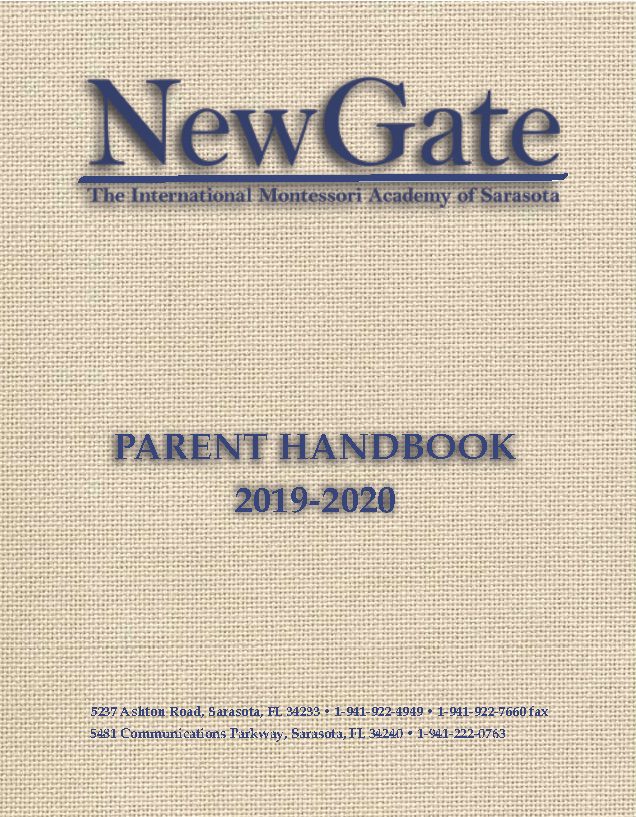
We’ve shared this document with hundreds of Montessori schools around the world, but the New Gate School was the first to completely rewrite Barrie’ s original work to create something fresh to reflect their own community’s vision. More than forty parents engaged in weekly meetings over a three month period; more than fifty hours. Having worked with many schools, we were deeply impressed by the enthusiasm, positive energy, and commitment that these people shared in their dreams for the school they were beginning to build
Once adopted by the school’s board of trustees, the blueprint can be used in planning for the future, setting policy, and evaluation of the school’ s facilities and evolving educational program.
In time every school drifts away from its original vision and core values, just as a sailboat will be eventually be blown off course by wind, current, and tides. Educational leadership can be compared to navigating at sea. It requires a clear sense of where you’re trying to go, close attention to where you really are, and periodic course corrections. A blueprint will give your school a tool that will allow you to remain true to your vision.
The secret of the Blueprint is that it’s useless unless there is a purpose behind it.
The blueprint is a document in which the Head of School’s and Board make a formal public commitment in writing to make no decision that is not consistent with the school’s Blueprint of Core Values. It is like the Republican Party’s Contract for America. We will live according to the following things, and agree to do these things.
The way it works is simple:
- The school schedules and guarantees that monthly Community Meetings of parents, teachers, administrators, trustees and interested students will be held throughout the school year, regardless of levels of interest and attendance.
- These meetings will be run along the lines of the Montessori Rules for Meetings and Decision Making.
- They will be led by a rotating facilitator, who will never be an Administrator or Board Member.
- There will be no elected board or officers. The meeting is a direct voice for the school community.
Any issue can be discussed, within a few guidelines:
-
- We cannot discuss issue concerning a school family or student in the school.
- We cannot discuss the private affairs of any employee of the school.
- We cannot harangue, threaten, or attack anyon
- No one can be allowed to dominate the meeting. Everyone must be allowed to express his or her thoughts
Classroom and Community Meetings, as well as the Montessori Rules For Meetings And Decision Making.
We use this format for meetings to build partnership, communication, and trust. We use this approach for all meetings, including school community meetings, class councils, faculty meetings, faculty committees, board committees, and meetings of the board of trustees itself. These procedures include these elements:
- Those who have power and authority, such as administrators or board members, should never lead meetings. A volunteer ‘traffic cop’ who keeps communication flowing should facilitate meetings, but does not himself/herself participate in the discussion or debate.
- Select a facilitator for meetings who is good at the job and is trusted by all sides to be fair and effective. This role could be appointed or rotating.
- Agree to start on time and end promptly on time.
- Never say something that is not absolutely true. Everyone must earn and enjoy the trust of the group, but this is especially important for the Head of School. He or she must never lie, attempt to pass off a white lie, misrepresent, or fail to be open and honest. That does not mean that he or she must answer every question. It is appropriate to honestly say something like, “I don’t know yet” or “I just can’t address that without breaching this person’s right to privacy.” Tell the truth, the whole truth, as best you can. The truth will set you free!
- Never allow anyone to sabotage the process by disrupting, being sarcastic, or by attacking any one else. Never allow the faculty to discuss a parent, student or fellow faculty member disrespectfully or unprofessionally. As Head, you are a police officer. Use your power wisely and rarely, but when you must, do so.
- Allow the group to establish its own agenda. A volunteer scribe should write the topics that the group wants to discuss on a flip chart sheet that the entire group can see.
- Allow any member to add any topic to the agenda at any point during the meetini) Allow the group to decide which topics it wants to discuss and in what order. They may or may not wish to establish a time allowed for each discussionii) Any topics not finished as the meeting ends should be recorded in the minutes of the meeting and held over at the next meeting
iii) It is not inappropriate for you, as Head of School, to identify certain topics on the agenda as issues that must be addressed. That is your prerogative as the boss. Use it carefully.
- Have the group appoint a scribe, or historian, who writes out the minutes of the meeting as the meeting progresses on a flip chart at the front of the room so that the entire group can see what has been discussed and agreed upon. As pages fill up, tape the filled pages up around the room. The scribe should preserve the original sheets until the next meeting (in case her minutes are challenged) and should prepare a written summary of the meeting that is duplicated and distributed the day after the meeting is held.
i) Have the entire staff maintain a copy of each set of minutes from faculty meetings and committee reports in a three-ring binder.
The community meeting would the place where the board would normally introduce issues that will need to come before the board in the near future. This allows the community to hear the issue, listen to information about why this issue needs to be handled, consider how this issue would fit into the core values of the school as set forth in the Blueprint document, and gives them the opportunity to sign off with their support or to request a month to do some research and come back with it to the next monthly community meeting.
The community meeting would the official voice of the community as a whole.
The Community Meeting can also address questions or make official recommendations to the faculty, Head of School, or to the Board, knowing that each has agreed to respond to them following its next meeting.
Their response may be to explain that they need more time, or that they respectfully disagree; however, their response would be official and timely.
In each case, all parties would be expected to copy and paste into their communication not only a description of the question or recommendation, or response, but the specific numbered elements of the Blueprint that affect this issue.
Likewise, when the Board meets to make policy decisions, first it will ask if it has brought this issue to the Community Meeting to allow the stakeholders the opportunity to understand and respond to the issue under consideration.
Before the Board considers an issue, it will first identify and copy and paste into the minutes of the Board the numbered statements of core values and beliefs that should be kept in mind before discussion begins. When the Board does vote on an issue, the minutes of the Board will include the text and item numbers of each element that they found which applies to this decision.
The formal agreement is that the Board and Administration agree that they will make no decision that is not consistent with the school’s values.
The community will be challenged by the Blueprint process to participate in an ongoing monthly meeting of parents, teachers, and administrators throughout the school year.
These issues can be mundane, or very serious. Work can be done outside of the meetings, but recommendations or formal questions can only come from the Community Meeting itself.
It is a place where all stakeholders can come to be part of a conversation, make recommendations, or ask questions of the board.
The blueprint will be used constantly in Community Meetings. It will also be used by the faculty, board, and administration in their meetings.
Here is an example of the process at work.
After the winter break, a child became ill when he reentered his classroom when school resumed. Knowing that her child was exceptionally sensitive to many toxic chemical compounds, the child’s mother suspected that a carpet cleaning company had used a cleaning compound that had left a residue in the carpet that was making her child sick.
She came in to the office and expressed her concern. The Head of School, recognizing that the Blueprint requires her to take all such concerns seriously and with respect and courtesy, contacts the cleaning company. It turns out that the carpet shampoo can leave a residue in the carpet fibers if the operator does not manage to get all of the compound out of the rug. The solution is simple. The cleaners came back in and cleaned the rug a second time, this time using no chemicals. The expense for the second cleaning was covered by the school, even though it was not in the budget, because each child’s health and well-being supercedes normal budget priorities. The immediate problem had been solved.
At the next monthly Community Meeting, the child’s mother and several of her friends proposed an amendment to the school’s blueprint under section 5, facilities.
“No toxic chemical can be brought on to the campus without an advisory committee made up of volunteer scientists.”
The community meeting discussed this proposal and quickly agreed that it was impractical, because no doctors or scientists would be comfortable committing the time or assuming the legal liability.
So the proposal failed at the Community Meeting level,, but a somewhat amended proposal was made and supported. This amendment to the Blueprint stated that the school will attempt to avoid using toxic substances for cleaning or pest control, and in selecting materials for the finishing of new facilities, will seek finishes and floor and wall coverings, etc. that are not known to be toxic.
This proposal reached the board, and was approved into school policy as part of the Blueprint.
A few other changes in Board practice are vital to the success of this process.
First, the board has to agree to hold open meetings.
Two, the board has to agree before considering a motion to first review the Blueprint to see which of the hundreds of Core Values would influence a decision on this issue. Those values are set out, one thought per paragraph, and numbered. The board agrees to copy and paste them into the minutes of the board beneath the motion,
Three, traditional Montessori techniques of decision making must be followed consistently by the board. These techniques include the use of a facilitator, scribe, and process monitor; a consistent reminder of the board’s mission to preserve and protect the school as a Montessori program down through the years,
So to summarize, through the use of the Blueprint, the Board and Administration agree to make no policy that would be inconsistent with the core values of the school, and to be held up to public scrutiny and to remain accountable to the school community, even though the Head of School is the Chief Executive Officer and the Board is the highest authority in the school
By making this commitment, and by making decisions openly under public scrutiny, parents are free to challenge the Board’s or Head of School’s decisions on a basis of the School’s Blueprint of Core Values in an appropriate public forum. The Board and Head of School do not need to agree, but if challenged on the basis of the School’s Core Values, it becomes very difficult for them to defy the reason of the challenge, with the ultimate balance of power resting in their decision to continue to give the school their support.
Communicate this concept to the stakeholders.
Grandparents, alumni, administration, teachers, students, teachers, faculty, parents
As you prepare for your Blueprint Retreat, use Intensive communication to let people know what you are up to, why this is important, and how the process will work. Give people at least a month lead-time to allow them to understand what this is all about and to fit this in to their calendar if they are interested.
Send them a copy of a sample Blueprint by email (or print them out if you wish), the one from which you are going to start.
Emphasize the importance of this meeting. This is a watershed event in the history of the school.
Tell parents and teachers that if they can only come for an hour or two, that they should still come for as long as they can. The process is enlightening in itself, and people who stay for a few hours will often gain a new insight into the school and Montessori. People should feel comfortable coming for whatever amount of time they can invest. ‘If you care, you want to be there.’
- Send it home to all parents.
- Post it in the school hallway
- Post it on your website.
- Send home notes and emails reminding people of what is happening, when, and why
- Explain the process.
A Weekend Retreat
We recommend that that the process be done in a marathon weekend retreat, not spread out over many weeks. We find that there is a momentum that builds up over a weekend. When it is spread out, people tend to lose the thread of the discussions and how the Blueprint ties together.
Normally it is held in a comfortable setting that is convenient for the stakeholders.
A typical schedule will look like this:
Friday evening from 7:00 to 9:30 PM
Saturday from 9:00 AM until 5:00 PM
Sunday from 9:00 AM to 3:00 PM
Print out additional copies of the sample Blueprint to have on hand during the retreat.
Before you share with community, the board and head of school may want to go through the Blueprint to shape it somewhat to best fit their school.
The success of the experience depends on how good the facilitator is, and how much he or she really knows about Montessori education. The facilitator should be more of a teacher than just a facilitator.
The Blueprint Retreat is actually like a college seminar leading people, teachers as well as parents, to understand Montessori on a much deeper level.
The process is that everyone has a print out of the initial draft of the Blueprint, which h was posted on the schools website.
A scribe with a laptop connected to a video projector makes changes to the original text file as the group moves along. The entire group can see changes as they are made. Post the day’s work on your website so parents and teachers can see what has been accomplished.
Go through the numbered items on the draft Blueprint one item at a time.
The Facilitator leads from the front of the room.
The first item is projected on a movie screen, large enough that everyone can see it.
Participants take turns reading the next numbered item, and leading the group through the discussion:
“Does this value statement define what we believe, even if we are not currently living up to this belief in our daily practice? Are we prepared to commit ourselves to making this for real?”
Does it need something reworded or added in?
Or is it completely wrong for your school, and needs to be dropped from your Blueprint completely?
Go through the Bleuprint point-by-point.
The community must understand the structure of the Blueprint:
The nine sections of the Blueprint document are tied to the nine functions that we examine in a school for evaluation and accreditation:
- Educational program
- Faculty and human resources
- Facilities
- Finances
- Administration
- Governance (the Board) or ownership
- Recruitment and admissions
- Building school community – reducing attrition
- Fundraising – Sources of working capital
There is nothing magic in this way of looking at a school, Someone else could have more sections in their frame of reference, or less.
The first is the biggest: the Educational Program.
All great schools have a coherence of core principles and values that define their character.
The educational program should not be the arbitrary creation of the teachers who happen to be at the school this year. The program needs to be based on a central and clearly defined model, which is consistently followed from class to class, from one level to the next, and from year to year.
These fundamental defining elements of practice are non-negotiable. Teachers should be hired on the basis of the school’s conviction that they have the skills, experience, and personality to faithfully and effectively implement the school’s program by conscious design, not chance. Anything behind these core issues can be added in as well, so long as the addition is consistent with the school’s core values.
One of the unexpected benefits of the process is that is normally leads to substantially higher levels of reenrollment, especially at the ages where children typically tend to withdraw. It also tends to lead to a substantial increase in fund raising. It is not uncommon to see one or more major gifts come out of this process.
Obviously you have to provide a careful orientation at the beginning of the retreat, annd then review the mission from time to time as new people join in.
At first, people tend to struggle with the process. Generally, this is because the Blueprint is not a statement of what is true in the school today. It is a statement of what we believe, and to what we are prepared to commit the school. After the first hour, groups tend to move through the long document fairly quickly.
Don’t attempt to look at your mission statement first. Even though it comes first in the document, reviewing your current mission statement, or writing one from scratch, should come after the Blueprint has fleshed out the nature of the school. It comes last in the process because it captures the spirit of all the details in the governing document.
Section 1.1 is a summary of the headings that follow. Don’t get bogged down. Instead, move on to the following sections, and, as your refine them, be sure that Section 1.1 has the final wording that you approved.
By the way, The Blueprint is the first step in the International Montessori Council School Accreditation Process.
Once the Blueprint has been defined, we ask the participants to evaluate the school against this long, detailed set of standards..
Once the blueprint has been completed, the next step is to identify an initial list of your school’ s strengths and areas where you can begin to improve your programs and facilities.
This in turn should quickly lead to the next step, in which the school community begins to prioritize those tasks that your want to focus on over the coming year. These will be your short-term strategic priorities.
The last step involves the process of the formal Self- Study. It will be the most important and certainly the most difficult. It will require several committees and sub-committees which will each begin to focus in depth on one aspect of the school’s programs and facilities, asking itself these questions:
- If this were a perfect world and if your school had the resources to be the very best that it could be in this area, how would this program or these facilities have to look to be consistent with your school’ s vision as set forth in our blueprint?
- What does your school look like in this area today? How well are you doing?
- What do you propose to do over the next three years to improve your program or facilities to make them more consistent with your institutional blueprint? This last portion of each committee’s report should be very detailed and specific: tasks, cost, timing, who will supervise, how will you evaluate your progress.
by The Montessori Foundation Staff | Emotional Intelligence (EQ), Empowerment, Family Resources, MFA, Montessori Education, Practical Life, Toddler (18 months-3 years), Uncategorized
The practical life exercises are the very foundation for the Montessori classroom. Concentration and development stem from these essential exercises. In this essay, I will discuss the importance of these exercises in conjunction with their aims and presentation.
Practical life exercises take on different appearances in different cultures. No matter if a child is setting the table with polished silverware or polished chopsticks one thing remains undisputed, these exercises are fun. Certainly they have aims and controls of error. They are preparation for countless developmental and academic skills, but what draws the child to practical life and keeps him coming back is sheer pleasure. E. M. Standing writes, ‘The first thing to realize about these exercises of practical life is that their aim is not a practical one. Emphasis should be laid not on the word ‘practical’ but on the word ‘life’.’ (Maria Montessori – Her Life and Work, page 213)
The American Heritage Dictionary includes in its definition of ‘practical’, ‘Designed to serve a purpose without elaboration’. Therefore, these exercises can be viewed as purposeful and sensible, yet powerful. They are individual yet cumulative, simple, enjoyable tasks with a multiplicity of rewards.
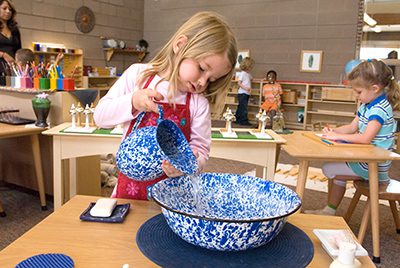
Initially, a child is drawn to the practical life exercises by the design and attractiveness of the material. A table washing activity for example could involve a brightly colored bucket with coordinating basin, pitcher and cleaning supplies.
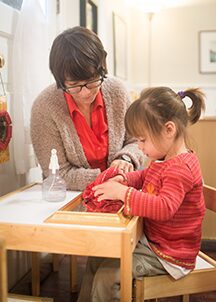
The lessons in the practical life area should be presented with precise movements and as few words as possible. The teacher must always bear in mind that the child will absorb more from watching than from verbal instructions. She should make every effort to maintain that the child’s attempt will be successful, thereby allowing him the freedom to pursue his inner needs and sensitivities. This is the direct aim of all practical life activities, to set forth the child’s ability and freedom to work in his own time and space. Indirectly, the child, through practical life, is addressing his attention to detail as each activity has a certain regiment of procedure and placement. While to the curious onlooker, these steps and placements seem tedious and exaggerated; it is satisfying to the child. We must remember that the purpose of these exercises such as polishing, may not be the end result of a polished piece of silver, but the concentration and attention given within the process itself.
Maria Montessori viewed the practical life area as the most critical are of the classroom. Some instructors believe that this vital area should account for 25% of the classroom environment. It is in this area that a new student is introduced to his taste of freedom through movement, and the unfolding mind awakens to new discoveries. Each activity of practical life, through its pleasure to the child, has an indirect preparation for things to come. As a whole, practical life subtly invokes independence, leading to greater self-confidence. Concentration is enhanced through repetition. I have observed many children who will wash the same table, day after day. Recently one girl brought in every shoe in her house which could be polished and rhythmically and enthusiastically polished every one, every day until she was finished. Did she know that the circular motion in which she used to polish the shoe was an indirect preparation for handwriting? She did not care. It was fun!
The child in the Montessori classroom has no physical or social restrictions, leaving him free to socialize while enjoying his work. This social interaction will develop self-esteem and social awareness. As the child becomes more proficient in his work, his sense of worth will be further boosted by his ability to present a lesson to a younger child. Acceptable social behaviour will evolve through interaction encouraged in practical life. The grace and courtesy lesson will enable the young child to proceed in life with respect for himself and his peers. He will have the vocabulary and manners necessary for polite and interesting conversation. Furthermore, this simple lesson in practical life will lay the foundation for his sense of community.
‘Through practical life exercises of this sort the children develop a true ?social feeling’, for they are working in the environment of the community in which they live, without concerning themselves as to whether it is for their own, or for common good.’ (The Discovery of the Child, page 95)
The child’s spirit is nurtured through such activities as the silence game. In this lesson, the child learns reverence for himself, and his ability to create his own surroundings. The game, often played collectively, allows the individual child to be in touch with himself, even his soul. It teaches the child how to create and appreciate silence, not as punishment, but as a joy of controlling oneself, a joy of living.
Exercises such as walking on the line and rolling a mat develop the refinement of the child’s large motor skills and movement around others. Presentations of such exercises can be given collectively, individually, or to a small group. Other activities within practical life promote fine motor skills, dexterity and coordination. The dressing frames promote all of these physical attributes, yet self-esteem is readily displayed the first morning a child dresses himself.
Polishing and pouring promote hand-eye coordination captivating the child through the points of interest within the exercises. In later years as he is writing and reading, he will not realize that these simple activities helped foster his current skills and love of learning.
The practical life exercises should entice, enrich and encourage the child. Intellectual enrichment is achieved through the child’s ability to absorb through his environment. He learns to organize his workspace in accordance with his environment. The cycle of activity in each exercise calls to his sense of order and self-esteem. I have seen children return their work to the shelf with great pride, then summon another child that the lesson is now ready for him. This independent cycle of activity invokes responsibility.
As adults, we would do these activities with our thoughts in a thousand different places doing different things. No so with the child. The child’s mind is focused on his task and each particular step involved. He is in control of each step, producing logical thinking. His inner sensitivity of order is rewarded through this methodical, precise exercise. The control of error in each exercise does not produce feelings of frustration, but feelings of logical order and control leading to self-confidence. ?Although the exercises are skill-oriented in the sense that they involve washing a table or shining one’s shoes, their purpose is not to master these tasks for their own sake. It is rather to aid the inner construction of discipline, organization, independence and self-esteem through concentration on a precise and completed cycle of activity.? (Montessori, A Modern Approach, page 71)
So one might ask, how, through this methodical, logical area of the Montessori classroom can the child enhance his creativity? Each unique practical life exercise has a point of interest, a part that draws the child from within.
Table washing has the soap on the sponge, the circles on the table made by the brush, the waterfall made by pouring the water from bucket to the floor sink. Many times children have brought me a sponge with a mound of suds on it and said, ‘Look Mrs. Bayliss, I made a wave.’ The points of interest are aptly named, and become points of creativity.
Practical life exercises have amazing purposes, aims, and developmental qualities, but I find that the beauty of practical life is that it is a place for children to relax. Time and time again, I have seen an older child busy with the rigors of the moveable alphabet or decimal system, then, their work complete, they enjoy a respite of pleasure through practical life. This phenomenon was illustrated to me recently at my own home. My eight year-old daughter had been in a Montessori school for four years. Now she is in a more traditional school with an adequate amount of homework. After we worked on her homework for a while, I gave her a break to go outside and play, to run off some energy before tackling another difficult phase of her studies. After some time outside, she came to me beaming, holding with the dog’s water bowl. ‘I washed the dog’s water bowl, doesn’t it look better?’ I laughed out loud and called her my Montessori child. She found solace and relaxation through her own practical life activity.
Practical life activities are to adults, a futile exercise, mundane drudgery, a means to an end. Yet to children, they are open doors to life and development. They are an enjoyable, intriguing adventure, a social gathering, a soothing comfort, a place to unwind. Practical life exercises are fun.
by Julia Volkman | Brain Development, Child's Work, Emotionally Healthy Children, Empowerment, MFA, Mindfulness, Montessori Education, Montessori students, Parent Education, Practical Life, Primary (3-6), TC March 2021, Uncategorized
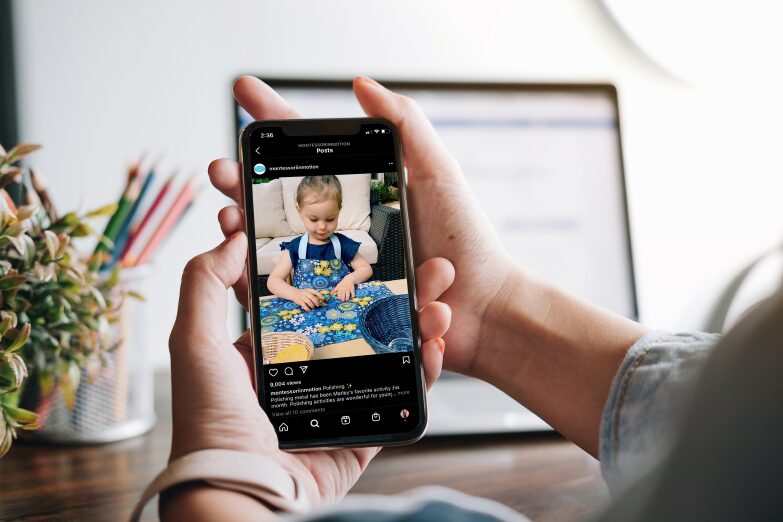
This article describes the benefits of polishing by deconstructing the actions of a child at work documented by an instagram video.
You can view the post by clicking
Parents often ask Montessori teachers why their children are learning so much about cleaning at school. Their children are learning how to wash dishes, sweep the floor, dust, and even polish silver. Can’t the school afford to hire their own cleaning staff?
The answer has nothing to do with keeping the classroom clean. In fact, teachers often have to go back after school and “re-clean” what the children have cleaned. The reason we teach them these “practical life” activities is all about aiding the child’s development.
A mom I know on Instagram (big shout out to @montessoriinmotion) posted a video of her daughter that illustrates some of the benefits of practical life activities. It’s just over one-minute long and is so rich in things to notice that I asked her permission to write about it here. Watch the video on your own first and then read on (and yes, she is sporting the matching Maitri Learning blue flower apron and mat).
Focused Attention
In the first few seconds, you can see that she couldn’t care less about the neighbor’s barking dog; she is very focused on her activity. She begins by setting up what she’ll need: the object to be polished (the turtle); the glass bowl (which will hold the polish); and the polish. While she is doing part of this, her eyes are fixed on the contents of the blue basket. She does not look at where she is placing the glass bowl. Why does this matter? It means that she has already learned how to place an object down with her hand (maintaining proprioceptive control) while her visual attention is focused elsewhere. So, when you think that where a child’s eyes are looking tells you what they are paying attention to, stop and think again!
Handedness
Did you notice that she uses her left hand to pick up and lay out each of these items? But when she gets to the polish, she starts opening it using her right hand. She reconsiders, possibly remembering that she doesn’t need to open it yet (self-correction), and places it down. Next, she switches to her right hand to take out the remaining items she’ll need.
When you see children choosing hands to work with at this age, you may see them switch from left to right, or you may see them strongly dominant already for the right or left hand. You don’t have to worry about it. When you present a lesson to them, just use your dominant hand, but if they struggle with that hand, simply say, “Maybe it will work better with your other hand. You can try it.”
Pausing
Once she has the polish on the mat, she pauses to organize her thinking. This pause is often a tricky spot for adults. We want to step in and make sure they know what to do next. But it is in the pause that so much great development happens (memory consolidation, toggling the default mode network, etc.). So, one of our biggest jobs is to restrain ourselves and give the child time to figure it out.
Sensory Learning
Now she uses her right hand to take out the sponge, cotton swab, and buffing cloth. As she takes out each one, she touches it an extra time as if to receive physical confirmation of what the object is. In neuroscience speak, we call this haptic engagement. She pushes down on the sponge and feels its spring. She uses the pincer grip to precisely place the cotton swab. She uses her whole hand to pat the buffing cloth. Each of these movements is different based on the properties of the object she touches. They also mirror the movements she will use later when putting each object to use.
As an aside, when I see her haptic engagement and her ability to follow logical steps/procedures, I am thinking she might be quite interested in the Sandpaper Letters. To prepare her for that work, this may be the right time to start playing some sound games. After a few weeks of sound games, you’ll be able to introduce the Sandpaper Letters.
Executive Function Development
Okay, back to the polishing work. After patting the buffing cloth, her eyes scan the basket until she finds the thing she needs next: the polish. I love how she nods to herself to validate that yes, now it is time to open the polish! So when we saw her hesitating with the polish when she first took it out, we actually saw her exhibiting inhibitory control: she stopped herself from opening it before it was time to open it. Inhibitory control is a key foundation for higher executive functions. You can google “marshmallow test” if you want to see many examples of young children flexing their inhibitory control abilities.
Now she uses her left hand to hold the polish bottle and her right hand to remove the top and squeeze the dropper (again using the pincer grip.) But when she is placing polish into the dish, you can just see that her eyes are scanning back and forth between the dropper and the dish. This means that her eyes are already moving ahead to the next step of confirming that she has the right amount of polish. Again, this is evidence of her developing executive function ability to plan ahead.
Concentration Overcomes Distraction
Right at about 50 seconds in, her brother comes over and starts talking with her mom about how they might possibly make the paint he wants to use to paint a baseball diamond on the front lawn. First of all, that is an utterly gorgeous thought process by her brother! He is absolutely ingenious in thinking about the chemical properties of paint. Second, his conversation does not phase his sister the tiniest bit. Her concentration remains 100 percent on her polishing activity; even when her eyes glance away. So when you hear someone say that two-year-olds are easily distracted, question if that is really true.
Refined Motor Skills
Right after she applies the polish to the turtle’s back, the turtle spins. This suggests that she used a little bit too much force. The natural consequence is that the turtle spins around. She then moves in for a very close look, and we don’t see the turtle spin again, suggesting that she is using a lighter touch. We just saw a natural consequence lead to the refinement of fine-motor skills!
The need for natural consequences is one of the reasons Montessori environments use items that might break if they are misused, like real glasses and dishes (not plastic or melamine). We expect things to break if they are handled roughly. We always model very careful use, but the child might not pick up on this right away. So, when an object breaks because it is mishandled, the children realize that they need to actually pay attention to what their hands are doing when they hold fragile items. I wish we could do a research study on this point but, in my experience, most children only break one or two things before they adapt and refine. Children who are always given plastic miss this opportunity when the mind is ripe for it.
Attention to Detail
Okay, let’s get back to polishing. When she finishes applying the polish, she holds onto the cotton swab in her right hand and picks up the sponge with her left. She dabs some polish off of the turtle with the sponge but then she uses the sponge to clean off the cotton swab. Only after the swab is wiped off does she place it on the mat. She sets the sponge down then but picks it up again when she notices there is still a bit more polish to wipe off. Once the sponge finally goes to the mat, she uses her left finger to rub the turtle’s back. It’s not clear if she is rubbing off an extra bit of polish or verifying that the polish is off. In either case, she is using her finger to attend to this tiny detail. My husband is always saying he wished his undergraduate chemistry students paid better attention to details in the lab. Maybe they needed to polish more when they were little.
Scaffold/Control of Error
Again, we have a pause where she scans the mat to determine her next step. The order of the materials on the mat acts as a scaffold; the order helps her to figure out what is coming next. She looks until she finds what she needs. In Montessori, we call this a built-in control of error. It means the adult doesn’t need to step in at all while the child is concentrating, the materials themselves will guide the child. This is essential because it allows her to keep working without interruption. That is what is strengthening the neural networks in her attention system. So again, we grown-ups need to step back and allow the child the opportunity to process, think, and choose.
Strengthening the Hand
Now comes the buffing. She starts to rub up a shine with her right hand only. But, this is no one-handed moment! She quickly brings in her left hand to stabilize the turtle so she can apply more force in her buffing. This variable application of strength not only refines her motor skills (as noted above), but also increases her muscular strength and control. And, of course, it creates a really nice shine!
Self-Esteem
The very last thing the video shows us is her enormous smile when she has reached the moment of completion. She is satisfied and happy with what she has accomplished. This, I believe, is where self esteem and self confidence truly come from. Hearing someone else tell us we did a good job is never as deeply satisfying as witnessing our own good work come to fruition.
So, there you have it, eleven ways in which a Montessori practical life activity contributes to the optimal development of the young child. The next time you wonder if you should engage your child in helping out around the house, think back on this. When we do work together with a child, prepare them to work independently, and then give them the freedom to work on their own. This helps them immeasurably.
Return to Table of Contents
by Jae Jun | Child's Work, Discipline, Emotionally Healthy Children, Empowerment, MFA, Montessori Family Life, Montessori Parenting, Parenting on the Same Page, TC March 2021, Uncategorized
Children!…they might be little, but their stuff is everywhere!
In my home, I have used five Montessori magic steps to organize all of my children’s stuff (including outgrown clothes, school work, gifts (birthday, goodie bag etc), kids ‘meal toys,’ and all the other stuff) that is involved in children’s lives. Maybe your child is so young that papers and school work are not even in the picture for you… this is the best time to start! Getting on top of the influx of stuff now is a great way to get started; the stuff only increases over time!
I’m a busy working mom with two children, and I know what you’re feeling; I can totally relate. Like you, my home can accumulate school work, toys, outgrown clothes, and so much more! So I’ve prepared some tips and suggestions that are easy to try and can really make the positive change in your home life that you are looking for.
It’s simple, it’s clean, and it works like a charm.
Now let me break down how it works. Here is the foundation:
The Five Montessori Steps to Success
1. Limit the number
2. Basket, tray or bin
3. Rotate
4. Access
5. Order
And please note … Dr. Montessori was really on to something: based on her deep understanding of children, she figured out that adults play a key role in setting up the home environment, where children can pursue their interests and cultivate their skills. In the Montessori world, we know that the set-up matters; how the space is set up can make or break the opportunity for independence.
Here’s how it all works!
1. Limit The Number
Young children truly enjoy an activity when it is limited in number. This allows them to really explore the toys and inspires creativity to work with them in different ways. Limiting the number of items in an activity also gives the child a better chance to put the activity away without any frustration or complication. If a game or activity comes with lots of parts, only put out the fewest number of parts needed and store away the rest.
2. Basket, Tray Or Bin
Once you’ve limited the number of items in an activity, it’s time to place it in a self-contained basket, tray, or bin. Putting an activity on a tray or in a basket puts the focus and interest on the activity itself, not the packaging it came in. Easy-to-carry baskets, trays, or bins makes it a breeze for children to clean up and put away!
3. Rotate
Once you limit items in an activity, use storage bins to store the extra pieces and parts. Now that the activities are limited you can rotate the contents regularly. Regular rotation keeps activities interesting to the child and keeps them engaged.
4. Access
Homes with siblings can still have activities available for each child within the same space. Once the activities have been limited and kept in a tray, bin, or basket, keep the older child’s activities in a place where only they can reach, and keep the younger child’s materials lower to the ground for easy access. If your home doesn’t have ways in which to raise the activities of an older child, you can put their toys in a container that the younger child cannot open.
5. Order
Once your child’s items are in smaller quantities and in easier-to-handle containers, it’s important to organize the space and determine where each activity will go: a place for everything and everything in its place. Children have a strong sense of order, and providing designated, consistent places for activities to be stored is directly linked to developing a logical mind. Also, the consistency of putting things in their place will avoid frustration and opposition when clean-up time comes around.
Now! Let’s take a look at some simple tricks for powerful tidy-up tips for your home. With these five steps, timing is essential. I realized there are at least five categories of stuff that constantly need putting away. Have you ever noticed, the stuff just keeps coming … and coming … and coming! I feel like every time my daughter leaves the house, she comes back with something more! Here are some general categories of stuff that comes:
- School work: paper, art work, etc.
- Toys: of all shapes and sizes
- Books: library books and ones you own.
- Gifts: goodie bags, birthday gifts, holiday gifts.
- Clothes: outgrown, no longer fit.
This Is Where It All Starts
My overall organizing area is in the garage. This is the place I immediately put things to be sorted out. By having this area in the garage, I catch things before they get into the house.
On the small table, the left basket is for little objects that do not have a place in the home. The basket on the right is a place that collects outgrown clothes or clothes I want to donate. If I come across one piece of outgrown clothing, I immediately take it to the garage instead of keeping it in the closet; each item that leaves brings more joy for us. And the container in the back is where I store paper goods.
When the baskets are full, I take action. The clothes get donated.
The small object collection: some are discarded, and some get recycled (i.e., for use in The Sound Game—“Can you bring me an object that starts with ruh?—the child selects ring).
Paper goods: What to do with all the paper—drawings, writing work, worksheets, and much more! My first step is to examine the piece of paper/artwork/writing, and ask myself: Does this spark joy? This is the all-important question I learned from the book The Life-Changing Magic of Tidying Up. So this is where I keep their precious work—the special ones that “spark joy.” I purchased a large folder/portfolio for each child to store the saved work.
Books! The main thing to keep in mind is rotation. Let your local library help you to keep a rotating, fresh collection of books for your kids. We have a designated return-to-library basket where books go when the children are done with them. Each of my daughters has a bag for our library trips that has a spot for their library card. Of the many books that might be available, keep rotating to highlight different books over time.
Another situation, what to do with goodie bags from birthday parties, trinkets, and freebie toys (e.g., from fast-food kids’ meals [note: not an endorsement])? Here’s the solution that has worked well for me: I have a designated tray to place little things on a temporary basis. For example, when my daughter comes home from a birthday party with a goodie bag, she wants to play with it right away. When she is done playing with it that day, she puts it on the tray. She can manage this step and gets it to the tray all by herself. After a few days, I toss the items or find a good way to recycle them (again, The Sound Game), or put them in the object basket in the garage to figure out later.
Now for the gifts from your child’s party; this year, Chelyn (age 9) invited eleven friends and received eleven gifts. That’s lots of things all at once! But thanks to our insanely powerful managing system, we immediately processed all eleven gifts and enjoyed each one of them in turn. Here’s how it worked: Chelyn chose three gifts that she wanted to play with and put them in the three baskets below. These three baskets are where items of current interest are stored. And where did the remaining eight gifts go? The other toys go to the big storage bin in the garage, where she keeps her things. She rotates three items into these three baskets from the big storage bin; she is old enough to manage this system on her own.
Here’s the best part, I usually revisit the girls spaces and things once or twice a year. I only have to spend 45-60 minutes each time I do this, thanks to the systems in place. I keep all of the things that I think the girls would like to use in the future in plastic bins in the garage. Everything I think they have outgrown, I give away right away. It is a constant weeding-out process, but well worth the effort. You will also start to look at the things you purchase differently. We rarely buy “toys’’ and stick more to supplies and open-ended materials that will last over time. And the good news is, all of these systems for keeping things organized and tidy didn’t come overnight. It’s been years of fine-tuning to figure out what works and what continues to work as my children’s interests and needs change. You can start with just a small tiny step. The most important thing is to start.
You can do it! you can overcome the constant influx of stuff and maintain a peaceful home environment! Everyone wins when there’s less clutter and more space for the things that truly spark joy. ′
Return to Table of Contents
by Kathryn Bowen | Uncategorized
Sitting in the sun-drenched dining room of her famed Berkeley restaurant, Chez Panisse, Alice Waters explained the philosophical principle guiding much of her life since 1944, the year she was born:
“Our senses are our pathways into our minds.”
Waters lingered over the point, which, like her food, is deceptively simple.
“So,” Waters continued, resolute, “we need to be educating those senses that have been dulled by fast-food culture, indoctrination. We need to touch, we need to taste, we need to listen.”
And that education, an edible education, is what the chef, author, and activist has attempted to provide not just to guests at Chez Panisse, but to a much wider, perhaps even pickier, swath of the dining public—children—since 1995, when she launched the Edible Schoolyard (ESY) Project, a garden, kitchen, and cafeteria curriculum at Martin Luther King Jr. Middle School in Berkeley. Two-and-a-half decades on, the organization has partnered with more than 5,600 schools around the world.
Now, as ESY launches into its 25th year, Waters and the organization’s staff talked lessons learned, challenges and their most ambitious pledge yet—to help Americans eat their way out of climate change.
How It All Began
It’s hard to say exactly where and when Waters began contemplating edible education. One thread traces to 1967, the year that Waters graduated from UC Berkeley. Soon after, she learned about the Montessori pedagogy from a family friend, according to her memoir, Coming to My Senses. Waters was immediately captivated by the aesthetically conscious, experiential approach to learning.
“I could never learn in the abstract, and Montessori was all about learning through your senses, learning by doing,” she wrote.
Waters’ fascination led her to an internship at a Montessori school in Berkeley, followed by a training program in London, and ultimately back to Berkeley for a teaching position.
But, as history would have it, Waters proved to be a far more effective chef than school teacher, and she was eventually let go from her Montessori position. Still, the experience gave her a guiding framework that she applied when Chez Panisse opened in 1971.
“I’ve used my Montessori principles in running this restaurant,” Waters said. “There’s flowers. There’s lights. There’s soft music. We want people to smell what’s happening in the kitchen, so it’s engaging people in almost an unconscious way.”
As Chez Panisse got its sea legs, life for Waters proceeded, and, in 1983, she had a child. Waters pondered: Where would she go to school? What were the schools like in Berkeley? These questions sparked an extension of the revolution that Waters began in the kitchen.
“I was going by King school, and I noticed how run down it looked. I thought it was abandoned. Truly I did. And I thought: How in this city, in Berkeley, could this be happening when we have a great University of California?’”
Waters voiced her view publicly to a reporter at the time. Not long after the story broke, her phone rang. It was Neil Smith, then the principal at King Middle School. “We immediately had a meeting of the minds,” Waters recalled. “He said, ‘I want to do something here. Can you help me?’”
By then, King Middle School had, according to Waters, outgrown its facilities on Rose Street, which are located just a half-mile from Chez Panisse. The buildings, Waters said, were built to accommodate roughly 500 children; in 1995, though, the school had a student population of 1,000 (a number it retains to this day). Still, King had an asset—room to grow. “It was built on 21 acres of land, which is kind of amazing,” Waters said.
So, while on a visit to the school, Waters had an epiphany.
“I looked around with Neil Smith, and I just had this complete vision, I guess, a kind of Montessori vision. I thought, let’s make a garden classroom.”
A Place of Learning by Doing
“Honestly, it could have used more olive oil.”
“Maybe a little more crisp.”
“It was okay, but not: ‘Oh My God.’”
“You didn’t put salt in it!”
Are these the takes of discerning guests at Chez Panisse? Or critiques from its studied cooks, huddled over some new dish? No, these are the honed opinions of seventh graders at King Middle School, dissecting a kale-pesto bruschetta that they’d spent roughly 90 minutes preparing during a class in the ESY kitchen.
“I looked around with Neil Smith, and I just had this complete vision, I guess, a kind of Montessori vision. I thought, let’s make a garden classroom.”The students’ assembly of that bruschetta demonstrates a similar culinary confidence, one that belies their age: a diminutive girl with spiraled hair eagerly grates Parmesan; three boys in athleisure huddle around an oven toasting bread. One student pounds garlic in a mortar and pestle, while another liberally adds olive oil that cascades into the receptacle.
“You’re seeing this program two-decades plus in, it wasn’t always like this,” said senior chef teacher and kitchen operations manager Esther Cook with a laugh. “Early on, it was crazy! It was so fun because it was new. We probably made every mistake in the book and still managed to feel successful, because we knew that what we were doing was landing the students in a really positive way.”
Cook is at once affable and earnest, with a name that well suits her profession. Before she began at ESY, Cook worked for years as a chef in the Bay Area, which is how she heard about Market Cooking for Kids, a program hosted by CUESA, in which local chefs led youth-targeted tastings and cooking projects.
“I was doing that twice a month for four years, and I started realizing how much I was looking forward to those days. And what exciting work it felt like,” Cook said.
So when a position with ESY opened up in 1997, Cook jumped at the opportunity. She got the job, and that year, Waters and Smith launched a kitchen classroom at King to complement the garden curriculum.
Now, ESY at King is a veritable operation. “We have 10 classes a week, roughly 30 students per class… it’s well over 250 people a week in each [kitchen and garden] class,” said Geoff Palla, the operations manager and senior garden teacher at King. Which means that, all told, King’s ESY teachers see about 500 students a week, or roughly half the school’s population of sixth, seventh, and eighth graders.
Like Cook, Palla radiates an educator’s energy, and comes to ESY with ample applied experience. Before joining the organization in 2008, Palla ran his own farm for about five years, and worked on several others. “I came into this job identifying as a grower, coming from a deep agricultural background, and I would say I blossomed into a teacher,” Palla reflected, a transformation that he attributes to professional development at ESY.
“I really believe in working with youth, and particularly this age group—middle school —with respect and kindness and patience,” Palla said. It’s an approach that takes assiduity, especially considering the volume of students that Cook and Palla oversee. One key to their success, Palla observed, is the team’s devoted staff, which comprises three full-time chef teachers, three full-time garden teachers, a part-time garden specialist, and a teaching and research fellow. But they have other strategies, too, that have allowed ESY at King to flourish.
“There’s a lot of routines that we’ve designed in order to make [classroom] experiences efficient,” Palla said. For instance, every 90-minute kitchen class commences with a chef’s meeting, when a teacher explains the dish that students will prepare. And in the garden, students begin by congregating under a wooden ramada to volunteer for positions harvesting, cultivating, or composting that day (the process is surprisingly democratic). “After that flow of the class experience is dialed in, kids know what to expect. Then we can go deeper,” said Palla.
These routines, Cook and Palla explained, also facilitate a natural progression as students move through grade levels at King. Sixth graders in their first semester focus on familiarization with systems, staff, the sequence of the class, and the connection between garden and kitchen.
“When they come back in the spring, that’s when we start to make the academic connections to what they’re doing in the classroom,” said Cook.
One popular ESY series, she noted, covers the Silk Road, in which children learn about Chinese, Indian, and Roman influences by making rice pudding (the lesson plan and corresponding recipe is available online, like myriad ESY materials).
When students reach the eighth grade, Palla said, “there’s much more autonomy.” Cook added: “By eighth grade, we’re asking and raising a lot more questions than we’re answering.”
Those questions are posed as part of a series called Debate Plate, which covers topics that are tough, timely, and important to consider—for individuals of any age: How do your food choices affect your own personal health? How do they affect the environment? How do they affect farm workers? Is access to healthy, clean food a right or a privilege?
The idea is to have students in their final year at King “think of themselves as consumers, and [to understand] that the choices that they make as consumers have repercussions out in their own lives and in the real world,” Cook said. Debate Plate’s analytical component brings the entire experience—growing and preparing and eating food—full circle. “With that mentality, you’re maybe a more informed voter on environmental things. You’re maybe a healthier person with your diet choices. Maybe you’re even more involved in local political decisions that affect you,” said Palla. “It’s untold what can come from that.”
An Edible Future for Everyone
Any smelling of celebratory roses will be brief for King staff, as they push ahead with improvements to commemorate the 25-year-old program. There will be a bundled restoration effort, says ESY’s partnerships and events manager, Claire Sullivan, which includes plans to upgrade the wooden ramada that serves as a physical touchstone for the garden class; build a new greenhouse; and plant a lavender hillside.
And while King’s ESY program has evolved in its complexity, the organization has also expanded globally, spreading to over 5,600 partner schools in 75 countries as well as 53 US states and territories. Accessibility and value-scaling play key roles in driving that growth, said ESY’s deputy executive director, Angie McKee-Brown.
“We don’t want to own what it means to become an Edible Schoolyard,” McKee-Brown said. “We wanted to make it free and accessible to anyone who wants to implement it within their school and their community. So that’s why we provide our curriculum online for free.”
Accordingly, to become part of the ESY network, schools just have to sign up—in addition, of course, to embracing the project’s pedagogy and practices. But Waters said that’s not as difficult as it seems:
“Even with planting plants in pots, on window sills. I mean, it can be the simplest thing.” She added: “I bet in every school, there’s a teacher who’s a gardener and who would love to connect children.”
Palla agreed. “It’s absolutely possible in other places,” he said, when asked whether ESY can be replicated as successfully outside of Berkeley. He pointed to summertime training sessions hosted at King, where educators learn to implement their own ESY projects. “People in these trainings are literally coming from every single type of town and city you can imagine. So that’s been a huge eye opener for me,” he noted.
What’s more, those training sessions are about to grow. On Jan. 16, ESY announced a partnership with UC Davis to establish The Alice Waters Institute for Edible Education, in Sacramento’s Aggie Square.
“We’re about to launch into a whole new era,” said McKee-Brown of the opening. “The Institute will enable us to provide training, year-round, to edible educators.”
Plus, the organization has kicked off on-the-ground efforts to implement Waters’ ambitious “Pledge to Public Education,” starting at Taylor Leadership Academy, a school in Stockton Unified School District (SUSD).
The pledge, which Waters announced at the 2018 Global Climate Action Summit in San Francisco, has three components: to provide free, sustainable school lunch for all students, from kindergarten through 12th grade; to shift procurement practices in public schools to buy directly from local farmers and ranchers with just environmental and labor practices; and to teach students the values of nourishment, stewardship and community through a cafeteria curriculum that McKee-Brown analogizes to ESY’s garden and kitchen programs.
The pledge is an extension of ESY’s values, which as applied to the organization’s work in SUSD, McKee-Brown described as “school-supported agriculture.” Ultimately, it’s about responding to climate change by investing in farmers who adopt regenerative agricultural practices.
“There’s 30 million kids eating school lunch every single day,” McKee-Brown said. “Imagine if we were to shift where that food comes from, and what that could mean for our agricultural sector, for small to midsize organic farmers, and for the health of our community.”
Taylor Leadership Academy is, in many ways, a litmus test for the pledge. After the program is rolled out there, McKee-Brown said the organization will develop a timeline for implementing similar efforts across the south side of Stockton. That area includes 15 public schools, the program’s focus for now.
“But ideally, we’re building tools and resources that are able to translate, and scale up,” she said.
A Delicious Revolution
“No question,” Waters responded, when asked if climate change is the most important issue facing the next generation: “It’s number one for me. Above everything; it has to be.”
Towards that end, school-supported agriculture, she said, could be a bellwether of efforts to address climate change, through regenerative farming—and at the same time, boost the financial prospects of organic growers. “I could imagine every school adopting a farm, buying locally, reestablishing a rural economy, with the schools being the engines. And that’s what we have to demonstrate in Stockton.”
Waters, then, strides with ESY into the next 25 years, exulting in the transformative potential of its core values—stewardship, community and nourishment—even as applied to more exigent circumstances. “Addressing [climate change] with food is a delicious revolution,” she said. “We can do it, and I want to make it feel so easy.”
Reprinted with permission from:
https://www.berkeleyside.com/2020/02/04/alice-waters-edible-schoolyard-project-changed-how-berkeley-students-eat-its-next-goal-to-fight-climate-change
by IMC | Uncategorized
Current IMC School Members in good standing may use the IMC School Logo on their literature and website. To avoid misunderstanding, the IMC Logo may not be used in any way to promote a Montessori teacher education program, or on certificates and diplomas, unless the teacher education program is currently MACTE accredited as an IMC affiliated Montessori Teacher Education Program. The IMC School Logo for an Associate Member School, Full Member School, or IMC Accredited School Logos may only be used if a school currently holds that level of membership.
by Chip DeLorenzo M.Ed. | Uncategorized
This workshop will connect you with other Montessori educators to learn how to implement a respectful and time-tested classroom management approach that builds responsibility, independence, motivation, and empathy within your classroom community.
by Dr Val Wise | Language, MFA, Montessori Parenting, Research, Social Justice, Uncategorized, Webinars / MFA
In the initial session – “Parenting Toward Anti-Racism” – we explored how parents can support their children in being anti-racist. During this session Dr. Wise is here again to continue our conversation and focus on the inner work that adults must do. Find out how knowledge of US history since the 16 hundreds, understanding of the language used when talking about race , and becoming an ally to those who are working for change and justice are keys to the inner work adults must do for themselves and their children. Recognizing our own implicit or explicit biases is a large step in supporting our children. Dr. Wise shares her knowledge, expertise, and resources on this topic with participants.
by Christine Lowry | Empowerment, Health / Nutrition, Kindergarten, Lower Elementary (6-9), MFA, Montessori Family Life, Montessori Parenting, Practical Life, Prepared Environment, Primary (3-6), Uncategorized, Webinars / MFA
Summer break is a great time to help children learn to make their own lunches. Christine will walk you through a “lesson” on teaching your child to prepare her/his own lunch for school. She will also offer ideas for setting up your kitchen “environment” so your child can be independent, for helping your child plan a “menu,” and then actually for preparing lunch.
by Tim Seldin | Uncategorized
Lisa Wagoner
The Montessori School of Winston-Salem, NC
In a previous issue of Tomorrow’s Child (Back to School/ 2002), I had written about our school’s decision to implement an All Day Montessori program at the 3-6 level this year. Our school year began in August, and in a few short months, we have already seen several positive outcomes.
Our class sizes are 22-24 children in the morning, and after lunch, about 15-17 children remain in the classroom. The main benefit of the new schedule and program is that there is little to no transition for most of the children who stay after noon. We offer Before and After School care for those families who need it; otherwise, our class time is from 8:30 a.m. until 3:00 p.m. (some children leave at noon).
The children enjoy lunch in their classroom, along with their teachers. Lunch was at best a hurried affair last year; now the meal has become an enjoyable experience. We use cloth tablecloths, relax, and enjoy each other’s company. Previously, we would have to have the majority of the children ready to go to their resting or napping location by 12:30 p.m. Lunchtime was geared towards being ready by that time, so it was not necessarily leisurely or relaxing.
Now, instead of leaving after lunch, the children help get their nap mats ready and prepare for 30 minutes of rest. The older children usually read at this time, while the younger children look at books, sketch, write or work with a quiet activity. We found a company that produced nap mats with sheet and pillow attached, and it is 100% machine washable. They look like mini sleeping bags and the children find them very cozy for resting. On average 2-5 children fall asleep during rest time. After thirty minutes, the children get up, put their things away and begin an afternoon work cycle.
Our building is very calm during the afternoons now. The four and five year-olds who remember going into another room to rest or nap are happy to stay in their classroom with their teacher and as a result, they have been quite productive. The children are happy to stay together and are eager for lessons, which has stimulated the five year-olds to pursue the larger academic works. The 5s now have an admiring audience when they complete the 45 Layout or a Language work with the moveable alphabet. In previous years, we would have the 5s alone in the classroom for the 1-2:50 p.m. time period, which wasn’t necessarily a realistic model for their educational life after
their time in our classroom—with the All Day program, they are now learning to organize their time, their academics and socializing.
Are there drawbacks to this program? Yes, at first, it was a tremendous amount of physical labor for the teachers. However, as the year progresses, the children do more of the work in getting their mats out, helping clean up, putting their things away, etc. The children are more interested in maintaining their classroom environment, and often offer to sweep, dust shelves and wash tables.
The children in the classroom have learned to be respectful of their sleeping classmates and I have seen children remind each other not to disturb their friends as they work nearby. We have witnessed some wonderful nurturing from the older children towards the younger and vice-versa—the classrooms are true communities. The parents also like having their children remain with their teachers all day, instead of just the mornings.
At first, some of the teachers had reservations about the five year-olds being distracted from their academic work. While this does occur from time to time, the children are also eager to work together. The 4s are eager to pursue some of the more academic works in the room, which in turn inspires the 5s to work with the more advanced Math and Language lessons.
So far, the response to the program has been good. Both families and staff have had positive experiences. Some of the classroom afternoon activities have included yoga, simple cooking projects and crafts, in addition to the works in the classroom. The beauty of the All Day program has been how the concept aids in the development of the whole child—not just the academic aspect. Our classrooms are communities with children learning so much from each other, from the environment, and from being together for the majority of the day. What a gift these children are receiving—the true benefits of a Montessori education!
(Please note: The final article in this series will focus on looking back over the school year—the highlights, what we learned from having this program, and whether any changes need to be made for the next school year).
Plans for 2003-2004
(Evolving into an All Day
Montessori Program)
By Lisa Wagoner
The Montessori School
of Winston-Salem, North Carolina
Plans are already in place for next year’s program at our school. In previous issues of Tomorrow’s Child, I have written about our program as we evolved into an All Day Montessori program. There were transitions to be made, as well as adjustments and changes, but we look forward to the coming school year.
The teachers and administrative staff reviewed the program we have in place and suggested improvements. The first change is the name—All Day will now be known as Children’s House. What an amazingly simple yet profound change and so true to the nature of the program! The children help care for each other, themselves and their classroom, in addition to working with the classroom materials. We experienced this previously, but we have definitely felt an enhancement, due to the lack of physical transitions for the children and the happiness they feel in staying in the same room for most of the day.
The other improvement was to have all three and four-year-old nappers go to a separate napping room to rest. There were several reasons for this decision. We discovered that the three year olds who stay after noon have had so much to assimilate—new classroom, new teachers, larger class size and higher expectations of independence. In addition, some children have been so excited by being with their friends that they don’t rest as fully as they should, which can lead to a difficult afternoon and evening for them. As a way to help them with their transition to a Primary classroom, and respecting their need for rest, we have decided to improve our program by having all nappers eat lunch and rest together in a large room available in our building (known as our multi-purpose room). Once the children wake up, they will have Montessori works available to them so that they can continue working on what they have learned in the mornings. As the children mature and no longer need a nap, they will rejoin their classmates and stay in the classroom after noon.
The children who remain in their classroom after noon will be the four-year-olds who no longer require a nap and the five and six- year-olds. They will still have a thirty-minute rest period, during which time they can rest their bodies by relaxing, reading, sketching or writing.
Change can be difficult but it can also be viewed as an exciting adventure. It has certainly been a year of growth and change for us as we implemented a new program to meet the needs of our families. Thank you for joining us on this journey—much has been learned and we look forward to improving and refining our program as the families’ and staffs’ needs evolve. The ultimate recipient of the positive results we have seen are the children in our school—our afternoons are calm, productive periods and the children have formed closer bonds with each other and felt a stronger sense of ownership of their environment. It is our hope that other schools look into this type of program as a beneficial way of furthering Maria Montessori’s vision—may the spirit of Casa de Bambini find its way into all of our programs and continue the type of education she pioneered.
by Tim Seldin | Child's Work, MFA, Montessori Family Life, Prepared Environment, Tomorrow's Child, Tomorrow's Child Online Issue, Uncategorized
What do Montessori children do all day? Simple. They do what they feel like doing, within the same reasonable limits that define the culture of the classrooms in the morning. When they are hungry, they eat. When tired, they sleep. They may read, write, paint or draw. They may work in the garden, watch the wildlife that surrounds the classrooms, They continue with their math, science, history or geography. They cook, clean, and explore the sensorial materials. They work alone or with a friend as they wish. Many classes will suggest that the children work on drama, dance, or strength-building activities in the afternoon. Puppet shows, dance routines, songfests, story telling are old favorites. The afternoons are a great time for hikes through the nearby woods or neighborhood. Many schools have their own little woodshops. Some have pottery studios. Some have small petting farms where ponies, sheep, ducks, and geese are raised. Imagine that the children are homeschooled.
What might young children do in an all day Montessori program in the afternoon? Answer…just imagine the possibilities!
- Learn about ecology
- Learn to swim
- Make their own puppets
- Make a clay pot
- Learn to paint from a professional artist
- Write and perform in their own plays
- Learn to sculpt
- Learn to cook breakfast for their moms and dads
- Make friends with a rabbit
- Build a children’s playhouse
- Learn to play soccer
- Make scenery for a play
- Build a model volcano
- Work with stage makeup
- Prepare their own cookbook
- Use a microscope
- Tumble Build and fly gliders
- Sing and dance
- Learn to play an autoharp
- Shoot baskets
- Compose a song
- Draw with charcoal
- Write their own play
- Study bubbles
- Learn to be a clown
- Dip candles
- Learn to play the violin
- Weave a basket
- Cook creatively
- Make a paper mache mask
- Design their own t-shirts
- Explore nature
- Perform scientific experiments
- Study the stars
- Discover their hidden talents
- Develop self-confidence and self-esteem
- And make friendships that will last a lifetime
by The Montessori Foundation | Archived Issues / Tomorrow's Child, Brain Development, MFA, Research, School Resources, Tomorrow's Child, Tomorrow's Child Online Issue, Uncategorized
Click on the cover to read this issue online.
by Sabrina H Bethurum | Early Adolescence (12-15), Health / Nutrition, Kindergarten, Lower Elementary (6-9), Mixed Ages, Montessori Education, Montessori students, Montessori Teachers, The International Montessori Council, Uncategorized, Upper Elementary (9-12)
Abstract
At Indian Harbour Montessori, the study of ecosystems through the construction of Biome Pyramids offers learners many opportunities in the upper elementary Montessori classroom by connecting teamwork, organization, research, science, geography, art, geometry, hands-on building, computer skills, and public speaking. Working in teams, our students select a biome anywhere in the world. They research the geography, climate, organisms, and flow of energy using a variety of books, maps, and card material found in the classroom. Children construct fractal pyramid models to represent five trophic levels in the biome using straws and curling ribbon. Artistic and accurate drawings of the organisms are created to hang within the structure of the color-coded pyramid. Students produce hand-drawn maps and typed research papers, then present their projects to each other and to other classes in the school. Specific numbers of Biome Pyramids are combined to build larger structures for an impressive culmination of the work. Self-evaluations are used following the project to guide reflection and enhance future teamwork skills for each learner. This is a fun, interactive curriculum idea that can easily be adapted to upper elementary and above.
Ribbon and Straws Help Montessori Students Build Teamwork and Biome Pyramids
The study of biomes, food chains, webs, and pyramids is something I’ve enjoyed with my students since I first started teaching in Montessori in 1996. It is an important way to offer insight into aspects of Cosmic Education including the interconnectedness of plants and animals within different environments. This work has evolved over time. Early methods were engaging and helped children visualize the concept, but failed to incorporate examples of specific plants and animals in a specific biome ecosystem.
Several years into teaching, I saw a Christmas decoration in the shape of a triangular pyramid in one of our 3-6 classrooms. I knew that it could be easily adapted to fit my biome curriculum. The structure, made of drinking straws and curling ribbon, was a modification of a Sierpinski Triangle fractal (Kuratowski, 1972; Kurt-Peker, 2011; Riddle, 2017).
That spring I tried the idea with my students for the first time, and over the years have refined the presentation and process so that it fits well with many aspects of our upper elementary curriculum. Through this hands-on, teamwork-based approach, we practice communication, collaboration, concentration, reading, writing, knot tying, and more.
First, the concepts of food chains and food webs are introduced so that children understand the flow of energy through an ecosystem. A food chain is a linear model, and a food web is a more accurate, yet more complicated way to show these relationships. Another model is the food pyramid, where each layer represents a specific trophic level. At the bottom are the primary producers, the plants. Plants use sunlight to do photosynthesis which allows them to make (produce) their own food. Their ability to capture energy from the sun and transform it for other members of the ecosystem makes them the base of most food pyramids on Earth. Primary consumers eat (consume) the plants, secondary consumers eat the primary consumers, tertiary consumers eat the secondary consumers, and the top predator feeds at the top. The pyramid shape shows that the available energy is depleted as it passes up through each level. Some hot-spring and deep-sea environments rely on chemosynthetic organisms to produce food (NOAA, 2013), but this is the exception.
Teams are chosen, either by the teacher or by the children. For this project, teams of three to five students work well. Depending on the class size, create either four or ten total teams in order to have the ability to assemble the larger collaborative sculpture at the end of the project. Each team chooses a biome and is provided a set of guidelines for the project. This year, my students chose the Amazon Rainforest of South America, the Himalayan Mountains of Asia, the Polar Regions of Alaska, and the Great Barrier Reef of Australia. Ocean ecosystems can present an added challenge to the teacher who must be sure to provide adequate reference materials, as most of the primary producers in the ocean are the phytoplankton.
The teacher provides the materials and a lesson on building a small pyramid. It takes 35 small pyramids to make one biome pyramid model. I usually invite only one student from each team to the small pyramid building lesson. In this way, students must teach each other. It is necessary to use clear drinking straws for this project. A local restaurant, Doubles Beachside, donated several boxes of these to our classroom over 10 years ago. I am still reusing the same batch of straws for this project, as the pyramids are deconstructed after presentations. Once the team calculates the amount of materials required, they can place an order with the teacher. Here is an opportunity for students to use math in a practical way.
Teams construct the 35 small pyramids by threading straws on the correctly colored ribbon in a specific order and tying knots to secure them. Each small pyramid requires 3 long straws, 3 short straws (1 short straw = ½ long straw), and 4 feet of ribbon. Each biome pyramid needs 15 primary producers, 10 primary consumers, 6 secondary consumers, 3 tertiary consumers, and 1 top predator. Hanging within each small pyramid on an ornament hook is a small full-color drawing of an organism which is backed with the corresponding color of construction paper to represent its level in the pyramid. On the back are the common name, Genus species name, and student’s name. In order to determine the trophic level in the pyramid, research must be done. Students take notes in their science journals (composition books) and discuss their findings with the team.
Once all of the small pyramids are finished, they are connected using small pieces of pipe cleaners or twist ties to form the large biome pyramid for that ecosystem. This is an exciting process as the students see their work rise before them in an organized way. Hand drawn maps and typed research reports are displayed with the pyramids. Teams practice explaining their projects to each other before inviting the other classrooms to visit.
In the same way that the 35 small pyramids were connected to make a larger biome pyramid, the large Biome Pyramids can be connected to form a bigger sculpture. This action reinforces the fractal nature of the design. Four teams can combine to create a two-level sculpture with three pyramids as the base and one on top. Ten teams can combine to produce a three-leveled sculpture (6 + 4 + 1), but this must be done outside, as most classrooms are not tall enough to accommodate this impressive work. Thin wooden dowels can assist in forming these larger structures. One year, after seeing the children present the project, a 3-6 student was inspired to use the Movable Alphabet to write a thank you note, which he also illustrated.
Following the sharing of the work, students individually complete evaluation forms about the process. This important reflection step helps students become better collaborators and communicators.
Eventually, the pyramids are deconstructed. Organism diagrams are returned to each student, and ornament hangers, pipe cleaners, dowels, and straws are sorted and stored to be used again. The only waste is the curling ribbon which must be cut to disassemble the pyramids.
This work offers other extensions that are not detailed here, including important tie-ins to geometry and math. Our students have benefitted from this work in many ways over the years and continue to love this project. It can easily be incorporated into upper elementary or above. Sharing the work with other classes in the school helps strengthen the sense of community while fostering a school-wide interest in art, geometry, and science.
References
Kuratowski, Kazimierz. (1972).Venceslao Sierpinski in Memoriam, Acta Arithmetica XXI. Retrieved from http://matwbn.icm.edu.pl/ksiazki/aa/aa21/aa2111.pdf
Kurt-Peker, Yesem. (2011). Sierpinski Triangle (Sierpinski Gasket), Science Teaching Institute 2011 UP with Math and Science. Retrieved from http://faculty.randolphcollege.edu/ykurt/Institute2011/Lessons/SierpinskiTriangle.pdf
NOAA Ocean Explorer. (2013, February 14). Photosynthesis and chemosynthesis are both processes by which organisms produce food; photosynthesis is powered by sunlight while chemosynthesis runs on chemical energy. Ocean Exploration Facts, A Habitable Earth. Retrieved from https://oceanexplorer.noaa.gov/facts/photochemo.html
Riddle, Larry. (2017, June 29). Sierpinski Gasket. Classic Iterated Function Systems. Agnes Scott College. Retrieved from http://ecademy.agnesscott.edu/~lriddle/ifs/siertri/siertri.htm
For over 20 years, Sabrina has guided students at Indian Harbour Montessori, where she currently co-directs the upper elementary program. She especially enjoys the challenges of developing cross-curricular opportunities that allow students to practice teamwork, creative problem solving, and communication skills in the Montessori environment. Her earliest Montessori memory includes washing dishes and feeding apples to the horse at the little schoolhouse she attended as a young child.
ML / September 2018 / pg 10
by Tim Seldin | Archived Issues / Montessori Leadership, Uncategorized
This insightful webinar offers leaders the unique opportunity to reflect on their ways of communicating for greater authenticity and open-mindedness. Based on new research, we will explore strategies for the development of the intelligence of the heart that increases meaningfulness with and acceptance of others. Examining how our thoughts can become obstacles to peace, we will learn how to overcome the three most problematic habits for leaders in attaining more self-awareness and creativity.
by Tim Seldin | Archived Issues / Montessori Leadership, Montessori Leadership Magazine Online Issue, Uncategorized
by Jono Landon | Montessori Administrators, School Leadership, The International Montessori Council, Uncategorized, Webcasts / IMC
In this webinar, Jono Landon from Hubbli, focused on strategic ways of using school management technology to substantially reduce office paperwork and free up hours from the drudgery of the daily, remedial, school office busy-work. He also talked about a manageable, and incremental approach for transitioning a school from old-school management processes to the most current best-practices that are being employed by efficiently run organizations around the world. This information will be based on data, and we will also show case-studies from real-life success stories.
by Duna Strachan | Infant, Infant-Toddler (0 to 3), Kindergarten, MFA, Montessori Family Life, Uncategorized, Webinars / MFA
There are so many experiences that grandparents can provide for their grandchildren that don’t involve technology, theme parks, expensive toys, etc. Duna provides easy and fun suggestions for grandparents when the grandchildren are around!
by Johann Christop Arnold | Brain Development, Communication, Computers in the Classroom, Parent Education, Tomorrow's Child, Uncategorized
Introduction
Another great article—thanks to Community Playthings! Often in Montessori schools, parents ask, “Why don’t you have computers or other technology in the early childhood classrooms?” or “Why isn’t there more technology in the elementary classrooms?”
In this article, the author talks about “white space.” We understand the value of white space. We understand that children must have time to develop human connections with all of their ups and downs, challenges, and opportunities for problem-solving and conflict resolution. Our classrooms are the space within.
Montessori also reveres wonder and solace of the natural world. For us, there is no question that there is a link between children’s time in the natural world and their ability to thrive—gardens, nature walks, quiet outdoor spaces. More white space!
Read this article to learn more about the effects of technology on our children.
—Lorna McGrath,
Program Director of the
Montessori Family Alliance
Children of the twenty-first century can navigate distant worlds from their video-game controllers, but are not equipped with an understanding of the real world outside the window. Fascinating entertainment options have them hooked almost as soon as they can focus their eyes.
As parents and teachers, we know that too much technology is bad for children. And we’ve all heard horror stories about cyber-bullying, easily accessible porn sites, and online sexual predators. Parents can try to put controls on what their children can see and limit their access time. But what if the technology itself turns out to be bad for childhood?
Rhonda Gillespie is an infant and toddler specialist who has worked in early childhood education for decades. When I asked her what she thought about technology and children, she shared her own story:
I have seen a devastating impact on children over the last twenty years. Technology attacks the foundation necessary for healthy development.
When I was a child, our neighborhood was safe and I played outside every day with my friends. We used our creativity and imagination, enhanced our problem-solving skills, and developed healthy bodies. But by the time my son was growing up, I rarely saw neighborhood children playing outside. The trend had shifted, and the outdoors was perceived to be unsafe.
I had to return to work full time, which meant long days and less evening time to play and enjoy the outdoors with my son. The biggest mistake I made was purchasing him his first video game console. It started off with rules and time limits, but as time progressed, so did the hours at the game controller.
At the beginning, it seemed like a win-win: he was interacting with children from all over the world and could casually socialize with his age group. He became good at some games and his confidence rose. I always thought that, at some point, he would find friends to play within the neighborhood. Socialization has always been a challenge for him, and video game companies often bill their products as a bridge to forming connections. Now I feel he was denied the chance to develop healthy interactions.
My son is seventeen years old now. He will text all day long, but when he’s around people, he does not know what to say or how to start a conversation. He says he is comfortable talking to people on the computer because he does not get bullied. But the flip side is that he did not learn to work through those awkward childhood moments that are an opportunity for growth. If he had never had the choice of online “friends,” would he have learned better social skills?
Part of childhood is about problem-solving, working out strategies and solutions to everyday life issues. Life became easier with technology, but it also made children unfamiliar with the process of success: hard work and patience. We have created a generation that expects things immediately without effort. For example, when I was in school I would spend months on a research paper, taking many trips to the library, spending hours studying and collecting verified data. My son can now produce the same report in a few hours, on his computer, without the element of verification or proof.
The accessibility of screen devices has caused a significant decline in children’s resilience, self-determination, desire for hard work, and sense of pride in achievement. And socialization among children is becoming extinct.
Technology affects people of all ages, simply because it transfers our interest and consideration from human beings to machines. It’s especially damaging for young children, who used to rely on the adults close to them for guidance and example. In his book, Simplicity Parenting, educator Kim John Payne touches on this point:
The late MIT professor and pioneer of artificial intelligence Joseph Weizenbaum came to wonder about the appropriateness of computer technology for young children. He questioned whether we want to expose our young children to artificial minds without human values or even common sense. Weizenbaum believed that there are transcendent qualities of human interaction that can never be duplicated by machines; he used as an example “the wordless glance that a father and mother share over the bed of their sleeping child.”
Used too soon, does the two-dimensional screen of a computer actually interfere with a young child’s complex learning systems of relationships and sensory exploration? I don’t believe that computers should be a part of a young child’s daily life. How curious will children be, how mentally agile, creative, and persistent in seeking answers to their questions, if, from a young age, they learn to Google first, and ask questions later (or not at all)?
There is no easy way to relieve the burden that technology places on children. But if we love them, we can’t slip into resignation just because we don’t know where to start. One way to take action is to give children more “white space.” In a book, white space is the room between the lines of type, the margins, the extra space at the beginning of a chapter. It allows the type to “breathe” and gives the eye a place to rest. White space is not something you’re conscious of when you read a book. It is what isn’t there. But if it were gone, you’d notice it right away. It is the key to a well-designed page.
Just as books require white space, so do children. They need room to grow, in a space shielded from the onslaught of the information age. It does not take a brilliant mind to see the effects of a lack of white space. When children are overwhelmed by entertainment, material goods, high-pressure academics, and frequently unstable home life, it’s as if their flashlight batteries are being run down. Their light gets dimmer, and they don’t know what’s wrong. If we deny them the time, space, and flexibility they need to develop at their own pace, they will not be able to recharge their batteries.
The ancient Chinese philosopher Lao-Tzu reminds us that “it is not the clay the potter throws that give the jar its usefulness, but the space within.” If stimulation and guidance are the clay, then time by oneself is the space within. Hours spent alone in daydreams or in quiet, unstructured activities—preferably out in nature—instill a sense of security and independence and provide a necessary lull in the rhythm of the day.
Children thrive on silence. Without external distractions, they will often become so inspired by what they are doing that they will be totally oblivious of everything around them. Unfortunately, silence is such a luxury that they are rarely allowed the opportunity for such undisturbed concentration.
As parents and caregivers, how can we find creative ways to give children more silence and space? We don’t all live as close to forests and streams as we might wish. But creative teachers can do a lot with a little. Dana Wiser, a friend of mine, remembers how his daughter’s teacher found a way to give her students white space during the day:
When my daughter Mary was in first grade, she was lucky to have a teacher wise in the ways of both children and nature. She encouraged every child to adopt one of the trees that were grouped around the children’s playground. Mary’s “pet tree” was a sycamore, strong and tall, and of a girth she could hide behind. Each child studied the adopted tree, tracing its leaves and bark pattern. Quiet time spent with their pet trees was extra special, and when something about the school day upset Mary, all she had to do was visit her Sycamore, drawing solace from its strength and comfort from its shade. She will love all trees, and especially sycamores, all her life; more than that, something of nature’s healing power lives in her heart as a gift from her pet tree.
Montessori Leadership/ Sept 2017/ Pg 14