by The Montessori Foundation Staff | Family Resources, MFA, Montessori Education, Montessori Family Life, Montessori Parenting
It is dark at 7:05 on this mid-winter’s morning when Jeanne Saunders pulls up to the drop off circle at Barrie, the Montessori school that her three children have attended since each was two-years-old.
Jeanne has made this trip so often over the years that Barrie feels like her second home. Jeanne works downtown and typically can’t leave work until after 5. Her husband teaches in the local public schools is off much earlier. He’ll pick the children up from the after school program by 4:30, but if he’s late, he knows that they’ll be fine until he arrives.
Barrie prides itself on being a family-friendly school. Working families appreciate its extended day and summer camp. Teddy, Josh, and Jennifer definitely think of Barrie as their second family. Jennifer is one of those children who, after ten years in Montessori, speaks about Montessori with affection and conviction. Visitors often find her coming up without a moments hesitation to greet them and offer a cup of coffee or campus tour. When people ask her if she likes it in Montessori, she will smile and say ‘Sure, how could anyone not love it here. Your teachers are your best friends, the work is really interesting, and the other kids are like my brothers and sisters. Its a family. You feel really close to everyone.’
Jennifer walks Teddy, age 4, and Josh, who’s 7, up to morning supervision. After dropping them off, she walks down the hill to the upper school where she is a 7th grader. She joins two of her friends in the commons, and sits and talks quietly waiting for her first class to start at 8:00.
Teddy’s morning supervision is in his normal classroom. After hanging up his coat, he walks over to Judy, the staff member in charge of his room until school officially begins at 8:30. He asks if there is anything ready to eat. Judy suggests that he help himself. He scoops out a bowl of cereal from a small bin, and adds milk. He takes his morning snack over to a table and eats. Children and their parents drift in to the room every so often, and gradually the number of children in the early morning program grows to about 15.
After eating his breakfast, Teddy meanders over to the easel and begins to paint with Teresa, a little girl just 3 who has only joined the class over the last few weeks. They paint quietly, talking back and forth about nothing in particular. Eventually Teddy tires of painting and cleans up. He is tempted for a moment just to walk away and leave the easel messy, but he carefully cleans up and puts his materials away as he has learned from more than two years in Montessori.
At 8:30, his two teachers arrive, along with several more children. Others follow over the next few minutes until all 30 students and two teachers quietly move about the room. Montessori children work with hands-on learning materials that make abstract concepts clear and concrete. They allow young students to develop a clear inner image of concepts in mathematics, such as how big is a thousand, what we mean when we refer to the ‘hundreds’ column, and what is taking place when we divide one number by another.
This approach makes sense to children. Through this foundation of concrete experiential learning, operations in Mathematics, such as addition, become clear and concrete, allowing the child to internalize a clear picture of how the process works.
Teddy and another child have begun to work together to construct and solve a mathematical problem. Using sets of number cards, each decides how many units, tens, hundreds, and thousands will be in his addend. The cards showing the units 1 to 9 are printed in green, the cards showing the numbers from 10 to 90 are printed in blue, the hundreds from 100 to 900 are printed with red ink, and the cards showing the numbers 1000 to 9000 are printed in green again because they represent units of thousands.
As Teddy and his friend construct their numbers, they decide how many units they want, find the card showing that quantity, and place it at the upper right-hand corner of their work space.
Next they go to the bank, a central collection of golden bead material, and gather the number of unit beads that corresponds with the number card selected. This process is repeated with the tens, hundreds, and thousands. The two addends are combined in the process we call addition. Beginning with the units, the children count the combined quantities to determine the result of adding the two together. If the result is nine or less, they simply find the large number card that represents the answer. If the addition has resulted in a quantity of ten beads or more, the children stop at the count of ten and carry these unit beads to the bank to exchange them for a ten-bar: ten units equals one unit of ten. This process is repeated with the tens, hundreds, and thousands.
Its about 10 o’clock now, and Teddy is a bit hungry. He wanders over to the snack table and prepares himself several pieces of celery stuffed with peanut butter. He pours himself a cup of apple juice, using a little pitcher that is just right for his small hands. When he is finished, Teddy wipes of his place mat.
Clearing up his snack has put Teddy in the mood to really clean something, and he selects table washing. He gathers the bucket, little pitcher, sponge, scrub brush, towel and soap needed and proceeds to slowly and methodically scrub down a small table. As he works, he s absorbed in the patterns that his brush and sponge made in the soap suds on the table’s surface. Teddy returns everything to its storage place.
When he is finished, the table is more or less clean and dry; a four-year-old washes a table for the sheer pleasure of the process; that it leads to a cleaner surface is incidental. What Teddy is learning above all else is an inner sense of order, a greater sense of independence, and a higher ability to concentrate and follow a complex sequence of steps.
Teddy moves freely around the class, selecting activities that capture his interest. In a very real sense, Teddy and his classmates are responsible for the care of this child-sized environment. When they are hungry, they prepare their own snack and drink. They go to the bathroom without assistance. When something spills, they help each other carefully clean things up.
We find children cutting raw fruit and vegetables, sweeping, dusting, washing windows. They set tables, tie their own shoes, polish silver, and steadily grow in their self-confidence and independence. Noticing that the plants needs watering, Teddy carries the watering can from plant to plant, barely spilling a drop.
Now its 11, and one of his teachers, Ann, comes over and asks him how the morning has been going. They engage in conversation about his latest enthusiasms, which leads Ann to suggest another reading lesson. She and Teddy sit down at a small rug with several wooden tablets on which the shapes of letters are traced in sandpaper. Ann selects a card and slowly traces out the letter d, carefully pronouncing the letter’s phonetic sound: duh, duh, duh. Teddy traces the letter with his tiny hand and repeats the sound made by his teacher. Teddy doesn’t know this as the letter d; for the next year or so, he will only call it by its phonetic sound: duh. This way, he never needs to learn the familiar process of converting from the letter name, d, to the sound it makes, duh.
Continuing on with two or three additional letters, Ann slowly helps Teddy build up a collection of letters which he knows by their phonetic sounds. Ann leads Teddy through a three-step process.
“Teddy, this is duh. Can you say duh? Terrific! Now, this is a buh (the letter b). Teddy, can you show me the duh? Can you give me the buh?. Okay, what is this (holding up one of the sandpaper letters just introduced)? Teddy responds, and the process continues for another few minutes. The entire lesson is fairly brief; perhaps fifteen minutes or so. Before long, Teddy will begin to put sounds together to form simple three-letter words.
Teddy’s day continues just like the morning began. He eats his lunch with the class at 11:45, after which he goes outside with his friends to play in the snow.
After lunch, the Spanish teacher comes into the room and begins to work with small groups of students. Eventually, she taps Teddy on the shoulder and asks him if he would like to join her for a lesson. He smiles, but graciously declines. He is too engaged in the project that he’s chosen.
In the afternoon he does some more art, listens to selections from a recording of the nutcracker ballet, works on his shape names with the geometry cabinet, and completes a puzzle map of the United States. When the day is over, Teddy has probably completed twenty to thirty different activities, most representing curriculum content quite advanced for someone who after all just turned four two months ago. But when his dad picks him up at 4:50, his response to the usual question of “What did you do in school today” is no different from many children; “Oh, I don’t know. I guess I did a lot of stuff!”
by Tim Seldin | Lower Elementary (6-9), MFA, Montessori Curriculum, Montessori Education, Montessori Family Life, Montessori Parenting, Montessori Teachers, Parent Education, Primary (3-6), Upper Elementary (9-12)
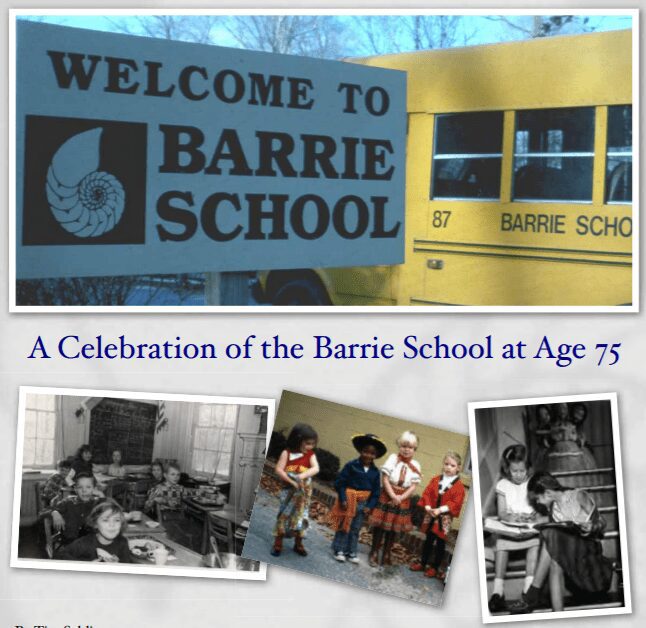
The Barrie School
Curriculum Guide: Age 3 — 12
A Philosophy Of Curriculum
by Tim Seldin, Headmaster, 1971-93
The Barrie School is designed to prepare children both for university and for life.
There are three key ideas that are central to our mission as a school:
- It is not the adult who shapes the child; it is the child who, through his experiences, creates an adult human being.”
- Teaching is not something that one can do to another, we can only facilitate the natural process of learning.
- There is a clear connection between one’s sense of self, of being fully alive and open to new ideas and experience, and ability to learn.
Recognizing this, we are engaged in a process of facilitating the development of self-actualized renaissance men and women.
Such people are teacher-proof. They have learned how to learn, and see school as a center of an enjoyable lifelong experience. Children with values such as these will normally go on to college, perhaps after first taking a year off for work or travel, as the natural extension of their previous education.
For some time we have been struggling to resolve the debate over the appropriate balance between our objective of cultivating the child’s spontaneous interest in learning, and the expectations of parents and society.
Normally a school is perceived as the transmitter of culture from one generation to the next through a formal curriculum. This is certainly an important part of our mission. However, as a Montessori school, we are equally committed to the development of responsible members of the human family, and the protection of the child’s fragile spark of curiosity and creativity.
Most children know far more about the world before they start school then the will show a few years later when they have learned to be passive learners who don’t trust their senses, intellect, and imagination. Therefore, our greatest task is to help our students to rediscover their brain’s ability to think, intuit, and discover; to develop a sense of independence, sequence, and order; to learn how to learn.
At the same time, as an independent school, parents come to us and pay a great deal of money in tuition for services available from the government schools for which they have already paid through their taxes.
They come to us seeking quality programs and services!
Their highest priorities are:
1. academic excellence
2. character development
Clearly they expect their children to be well prepared for university, but beyond this, they are looking for a school experience that will offer something special that will make the school experience intellectually exciting and develop a wide-range of talents and interests.
The delivery of these services is difficult to document from our end, and from the parent’s end, even more difficult to evaluate.
Thus, parents expect to be kept abreast of the programs that address these goals, and, their children’s progress in each program.
As a result, we work carefully to maintain this delicate balance.
Our curriculum can be thought of as having two aspects:
1. The school’s basic expectations for what will be first introduced, worked on, or reviewed and targeted for mastery by 85%-90% of all students at each age/grade level.
2. The lessons that arise out of the children’s natural curiosity. While we follow a planned syllabus to give us cohesion and structure, we should never be satisfied with a year spent giving students set lessons from the prescribed syllabus: in order to satisfy, and at the same time, stimulate the children’s interest, we have to farther and faster than that! By providing the children with all sorts of books, pictures, specimens, and artifacts, we can almost guarantee that we will stir up their curiosity and encourage them to expand their scope of learning horizontally. By this, we mean to suggest that, instead of moving on through the set curriculum more quickly, that we allow the children to explore additional related topics that capture their interest.
Our curriculum should be designed to intrigue children and develop in them a lifelong love of learning. No topic is presented just once and forgotten; lessons are introduced quite concretely in the early years and are reintroduced later at increasing degrees of complexity and abstraction. Students at The Barrie School gain experience and develop skills at one level of understanding, which prepares them for more complex lessons at the next level.
The spiral of the Montessori curriculum has no end, and the depth to which any topic can be pursued is limited only by a student’s interests and ability. At the same time, our expectations as a college preparatory school are quite high; challenging each student to his/her fullest individual potential, and establishing a clear standard of achievement and quality of thought and work. We encourage accelerated students to expand their studies horizontally, researching topics at greater depth and a more sophisticated level of thought and analysis.
Our course of study is consciously multi-disciplinary. It is an examination of the natural world and the human experience that interconnects the traditionally separate subject disciplines. Units of study often cut across the curriculum, weaving together, as one example, the land, flora and fauna, folk tales, art, dance, poetry, architecture, history, everyday life, and cooking of a country under study.
Our curriculum has no outer limits except for humanity’s knowledge and imagination. At the same time, our core curriculum has been carefully structured to establish benchmarks for achievement of the normal student by the end of each level within the Academy. While we recognize that some students may not, for one reason or another, keep up with all of the benchmarks for his or her age level, they define a standard of our expectations.
At its finest, Montessori is an incredibly elaborate model of education. We don’t advocate using all these tricks and devices simply to make the school day pass more pleasantly or to better prepare students for their standardized tests at the end of the year. These are only secondary objectives. The real aim of education as we see it at The Barrie School is to prepare children to live lives filled with personal satisfaction, as responsible, concerned citizens of the Earth. An important element in achieving that goal is the development of knowledge and understanding about the world today: civilization. However, along with this must come self knowledge, self-respect, compassion, and a mind and heart open to new ideas and information. Our goal is to help children to learn how to learn.
by The Montessori Foundation Staff | Adolescence, Early Adolescence (12-15), Later Adolescence (15-18), MFA, Montessori Education, Montessori Family Life, Montessori Parenting, Montessori Secondary / High School, Montessori Teachers, Parent-Teacher Communication, Parenting on the Same Page
by Jamie Wheal
“Schools as they are today are adapted neither to the needs of adolescence nor to the times in which we live.”
–Maria Montessori
“College admissions, wrote psychologist Michael Thompson in a recent essay on the subject, “can make normal people act nutty and nutty people act quite crazy.” The pressures of this “failed rite of passage” as he put it, can drive even the most confident teens and their families into a hyper-competitive tailspin that completely clouds the last two years of their high school experience. Even in so-called “progressive” schools that espouse student inquiry more than lecture, portfolios instead of examinations, interdisciplinary learning over isolated courses and all the other touchstones of such an approach, something unmistakable happens in that summer between 10th and 11th grade, if not sooner.
By then, regardless of what innovative and effective techniques and creative school culture exists before, they are often swept aside as the “Huns of Princeton” descend upon the unsuspecting campus. National Merit Scholarships, Standardized Aptitude Tests, Advanced Placement courses, and a “highly-selective admissions climate” all conspire to steamroll even the most defendable educational positions into rubble and what remains is a distressingly homogenized status quo that serves neither teachers nor parents, and least of all, students.
Many in the Montessori community feel the tremors of this battle, even when it is still years away from the children that they teach. By the upper elementary and middle school grades, attrition becomes a real issue for many Montessori schools, and recruitment for actual secondary programs a constant challenge. Even those with dedicated staff and committed parents face a growing sense of urgency as their children age. The occasionally voiced, but often unasked question is this: “How long can I keep my child in an alternative setting without leaving her at a competitive disadvantage for college and her career?”
Though comfortable and even delighted with the results of Montessori in the primary years, many parents, especially those with high ambitions for their children, begin to question how long they can remain committed to this approach. By third and fourth grade and sometimes sooner, these parents begin to hear stories of the staggering intensity and variety of experiences that some of the playmates of their children are receiving in other independent or public school environments. Often, Montessori schools respond to this pressure by supplementing their offerings with after school enrichment programs and other offerings that deliberately mirror some of the skills and information being covered in more mainstream settings.
By the end of the middle school years though, many Montessori schools find themselves on the horns of a rather intractable dilemma—how to further accommodate the demands of the college-prep machine (and maintain a healthy school with strong enrollment and fundraising) without diluting the core values and methods of Montessori?
Even the Barrie School of Maryland, which for years was the pioneer in Montessori secondary education, conceded on this point. After more than a decade (fact check please!) turning out well-adjusted Montessori graduates, its board of trustees decided that their high school would henceforth offer a more traditional curriculum to better prepare their students for college. Nor, was Barrie a solitary unfortunate example. As the well-documented trend toward ultra-competitive education reached younger and younger children, several other schools with long and rich traditions of Montessori education have all had to meet or succumb to the pressures of new parent bodies, less sympathetic school governance, and a general shift in values towards “accountability and results” and away from dedicated Montessori method in all but the earlier years.
Like the infamous Missouri Compromise, that sought to relieve the political tensions leading toward the American Civil War, these sorts of Montessori Compromises try to avert a larger crisis in American culture, but do not address the real issues. If Montessori is an effective and positive approach for young children, as has been well- documented for decades, then why, at the crucial juncture of adolescence, would it suddenly become detrimental? If the values of self-direction, inquisitiveness and responsibility are important for a five year-old, are they any less so for a sixteen year-old? If “following the child” can be an effective maxim for a decade of schooling, should we doubt that same child’s lead when he becomes a teen?
We do not even need to cite the drum beaters of teen crisis to make the case for Montessori high schools today. Dr. Montessori’s approach always seemed to be more visionary than alarmist, and focused on the potentials of the human experience more than its pitfalls. A quick survey of adolescent life today however, with its intense emotional and social pressures, alienation and sometimes tragic violence, would suggest that, if nothing else, the need for meaningful education of young adults is as strong as ever.
In the past five to ten years, it seems that many Montessori communities have perceived that need and have taken steps toward meeting it. Drawing on the earlier examples of Montessori high school from around the world, as well as from Dr. Montessori’s own tantalizingly brief appendices on “Erdkinder” education, schools from New England to Texas to Colorado to British Columbia are all creating exciting new visions of this final stage of Montessori education.
In the second half of this essay, I would like to discuss some concrete solutions for addressing the pressures of college preparation in a non-traditional setting, curricular strategies for effective Montessori high school programming, and helpful collaborations and alliances in the broader educational community.
An Interlude: Wilber and Montessori
Wilber began his published career in 1977 with his Spectrum of Consciousness which outlined the beginnings of a synthetic, interdisciplinary approach that combined the strongest insights of neurology, psychology, anthropology, philosophy, comparative religions, and contemplative experience. In over twenty further books and numerous articles, he has continued to argue for an integrative approach to academic disciplines that recognizes the valid truths of each, without becoming bogged down in rigid adherence to a particular school.
In the longest view, Wilber’s “rational mysticism” (in Rothberg, 1998, p.2) finds its origins in Pythagoras, Socrates, and Plato, its development in Plotinus, Augustine and Aquinas, and its modern articulation in Hegel, Koestler, and Heidegger. In each of these thinkers, one can trace a desire to contemplate the largest questions of existence from within an increasingly sophisticated (through successive articulations) logical framework. Wilber carries on this tradition, with much of the same implicit faith in skeptical, rational inquiry as a worthy means to the highest of ends.
In his own theorizing. Wilber builds most directly on the broad philosophies of Georg Hegel and Jurgen Habermas, and the developmental psychologies of Jean Piaget and Abraham Maslow. In general, Wilber either adds additional stages to these models (such as extending Piaget’s developmental model to include transpersonal realms) or clarifies their mystical/Romantic end-points (such as Hegel’s dialectic between history and the World Spirit). His general position supports these earlier theorists–as far as they went, but then maintains that they truncated their mapping prematurely, and thus compressed discrete higher stages into undifferentiated clumps.
Building on the assumptions of the Perennial Philosophy, Wilber contends that human evolution can extend itself far beyond conventional levels, and propel individuals and cultures to post-rational states. He maps out these transitions, identifies key problems, and advocates developing an “integral practice” that combines approaches from the humanities, the social, and clinical sciences toward this end.
Although clearly prescriptive in his conclusions, Wilber has consistently avoided immersing himself directly in educational practice or theory. Instead, he devotes his time to his writings and public lectures—declining to take on students or serve in any traditional capacity as a teacher. On several occasions though, he has, in print, indicated a need for others to develop a pedagogy based on the premise of integral transpersonal theory.
Despite his personal reticence, Wilber’s work speaks directly to the educational theories of the Twentieth century–from Rudolph Steiner, Maria Montessori, and John Dewey to Ted Sizer, John Gatto, and Daniel Goleman. Of those earlier pioneers in education, Wilber’s outlook perhaps most closely coincides with Montessori’s. Dewey, a classic Progressive, sought change through social scientific research applied to institutional reform. Steiner, rooted in the fin de ciecle mysticism of Theosophy and Anthroposophy advocated the internal growth of students’ souls. But Montessori sought both—aligning herself quite closely with the “rational mysticism” of Wilber—science in service to the potential of spirit.
In 1896 at the age of twenty six, Maria Montessori became Italy’s first female doctor and surgeon, and then went on to revolutionize early childhood education. Traveling from Rome through the rest of Europe and the world, Montessori continually researched which educational methods held true regardless of race, economics, and background, and could provide the foundation for a universalized practice . Like Wilber, she pursued her goal by immersing herself in a variety of academic disciplines. “Montessori spent…her life in the study of the conditions essential to the release of this human potential,” argues biographer Rosa Packand. “She looked at human education from the various perspectives of biology: as a medical practitioner, as an anthropologist, as an ecologist, as a natural scientist, and as an embryologist. She wanted to uncover, by the scientific method of observation and experiment, the ground rules for preparing environments where the discovered strength of children could flourish” (Packard, p.13). Although formally trained in medicine, Montessori expanded her search for answers to include most of the social and technical sciences—her goal of articulating a universal educational practice pushed her to disregard many of the norms of her world (e.g. separate gender and academic spheres) and create her own synthetic method.
Although rigorously scientific, Montessori was directly informed by a personal faith that seemed to transcend the formal observances of Catholic Italy. “Now let us imagine,” suggests Montessori, “an ardent mystic soul [the teacher] that observes all the revelations of a little child’s mind, so that with mingled feelings of respect, love, holy curiosity, and longing for the very heights of heaven, he may learn the way of his own proper perfection” (1967, p.8). In crafting her method, she presumed no limit to the degree of growth and learning that it could provide—both for the students, and also the teachers. For Montessori, the mundane world of educational practice blended seamlessly with the sublime one of human realization.
Balancing her inspiration with her application, Montessori saw the greatest potential in a blend of scientific rationalism and intuitive wonder. “Let us strive,” she exhorted, “to pour into a single soul the keen spirit of sacrifice of a scientist and the ineffable ecstasy of such a mystic, and we shall then have the perfect spirit of our ‘teacher’” (1967, 9).
Like Plato before and Wilber after, Montessori helped articulate a “transcendental humanism” that speaks directly to the potential of the human mind—combining the best of the Enlightenment twins of Rationalism and Romanticism. The transpersonal theorists, represented here by Wilber and others, carry on that tradition and give it a contemporary, post-post-modern interpretation that acknowledges the contextualism of theory and Absolutism of devotion without deferring to either.
*****
An integral model of education would identify a student’s basic stage of development and tailor cathartic experiences to provide a direct sense of the possibilities that awaited in subsequent stages. “When brought to birth,” scholar of religions Mircea Eliade notes, “man is not yet complete; he must be born a second time, spiritually…In a word, it may be said that human existence attains completion through successive initiations[emphasis mine]” (1957, p. 181). An integral model would recognize the power of these successive initiations and apply them to the transitions of human development.
Since the transition from the pre-personal to the personal occurs (baring severe trauma) at an age prior to most formal education (age two), we may choose to focus on the less frequent and more problematic transition from the personal to the transpersonal stages of human growth. Here, I am presupposing that the transpersonal state in which a person extends their sphere of concern beyond self and ethnicity to a global point of view is a preferred condition to remaining at earlier stages, and that, as educators we might consider our task to instruct our students to the highest level of integrated person-hood that they can reach.
Given this assumption–that we can and should teach learning beyond the personal stage–the question remains how. Before going into specific applications, it might be helpful to lay out a theory of how integral states could inform such a method, and the role they could play in successive personal development. To do that, we will need to establish the foundations of an integral educational approach in the Perennial Philosophy, the Great Chain of Being, and in contemporary Western research on human emotional, ethical, and cognitive development.
The Perennial Philosophy
Scholars like Aldous Huxley, Huston Smith, Joseph Campbell and Ken Wilber have done much in recent decades to reassert G.W. Leibniz’s seventeenth century notion of the philosophia perennis-the Perennial Philosophy—the underlying core of all the world’s wisdom traditions. “[It is] the ethic,” Huxley suggests, “that places man’s final end in the knowledge of the immanent and transcendent Ground of all being—the thing [the perennial philosophy]is immemorial and universal” (1944, p.vii). In other words, the perennial philosophy assumes that the Divine is both immanent—expressing itself in the material world, and transcendent—entirely Other and irreducible to human experience. “Homo Religiosus (religious man),” Mircea Eliade concurs, “always believes that there is an absolute reality, the sacred, which transcends this world but manifests itself in this world, thereby sanctifying it and making it real” (1957, p. 202).
In other words, Tat Tvam Assi—in Sanskrit—Thou Art That. The fundamental Godhead of experience is ineffable and mysterious and, at the same time, tangible and omnipresent. “[The Perennial Philosophy] may be found,” Huxley asserts, “among the traditionary lore of primitive peoples in every region of the world, and in its fully developed forms it has a place in every one of the world’s higher religions” (1944, p.vii). This essential insight expresses itself in cultures widely separated by time and space. “We are hardly aware of the extreme peculiarity of our own position,” agrees poet Alan Watts, “and find it difficult to realize the plain fact that there has otherwise been a single philosophical consensus of universal extent. It has been held by men and women who report the same insights and teach the same essential doctrine whether living today or six thousand years ago, whether from New Mexico in the Far West or from Japan in the Far East” (in Wilber 1997, p.38).
In his classic The World’s Religions, Huston Smith lays out the three central tenets of the perennial philosophy —Reality is simply more cohesive, more joyful, and more mysterious than what normal experience would suggest. “It is as if life were a great Tapestry,” Smith reflects, “which we face from the wrong side. This gives it the appearance of a maze of knots and threads, which for the most part, appear chaotic” (1991, p.388). The paradox is that these truths are both pervasive and elusive—that all wisdom traditions espouse them, but few humans embrace them.
The paradox dissolves however, when we realize that to experience what Smith described as the “cohesive, joyful, and mysterious” nature of things requires fully developed individuals residing in a transpersonal state—people who, through the bulk of human history, have been rare but influential contributors to humanity’s traditions. To paraphrase Joseph Campbell’s assessment of these Universal Heroes, “[they] must translate the Sacred to the Mundane, but they must also elevate the Mundane to the Sacred.” (1968, p.287).
Given the considerable challenges of this dual-edged task, we are fortunate to have such a clear and cross-cultural representation of the perennial philosophy. “It is either the single greatest intellectual error ever to appear in humankind’s history–an error so colossally widespread as to literally stagger the mind,” Wilber concedes, “or it is the single most accurate reflection of reality yet to appear” (1997, p.39). If we entertain that the perennial philosophy is more likely to be a relatively accurate representation of human experience than a “colossally widespread error” spread out across cultures and epochs, we can investigate further into its applications for contemporary education—and how we might be able to elevate greater numbers of pupils into those higher stages of personal development.
The Great Chain of Being
One of the central tenets of the perennial philosophy is the Great Chain of Being, which holds that all of existence is contained within the five broad categories of matter, body, mind, soul, and spirit. These stages contain increasing levels of complexity and development, but all are accessible to human experience. “The central claim of the perennial philosophy,” Wilber argues, “is that men and women can grow and develop (or evolve) all the way up the hierarchy to Spirit itself, therein to realize a “supreme identity” with Godhead—the ens perfectissimum toward which all growth and evolution yearns” (1997, p. 39). If we accept this ambitious goal as a real and legitimate potential state for human existence, then it presumably would inform both our specific educational practices, and how we determined the success of these practices.
Developmental Theory
If we are contemplating as educators how to apply integral experiences to aid students through significant transitions in their growth, we might first want to examine the varying stages of development—especially those included under the middle three categories of body, mind, and soul.
Here, we can briefly turn to three prominent developmental theorists, Jane Loevinger, Abraham Maslow , and Lawrence Kolberg to see how a summary of their research might inform our method. They have each articulated consistent developmental stages for different spheres of human growth—self identity, self-needs, and moral sense, respectively.
In her definitive work, Ego Development, Loevinger outlines the stages of a person’s self sense, or identity, from autistic, to impulsive, to conformist, to integrated. As an individual progresses through each stage of ego development, they gain greater access to self awareness and engagement with the surrounding world.
While choosing a slightly different emphasis with his investigation of self needs, Maslow, in The farther reaches of human nature, describes a progression of non-negotiable needs that range from the physiological (food and water) to basic safety, belongingness, self-esteem, and finally to self-transcendence. If any of these needs are not met, the person is compromised in their ability to step up to the subsequent stage. (e.g. hypothermic people tend not to make good poets).
Kolberg, in his Essays on Moral Development and other later works, lays out seven stages of moral orientation ranging from infantile wish fulfillment, through conformity to laws, to a universal/spiritual concern for all humanity (and even all sentient beings). He supposes that the higher a person’s moral state, the more ethical their behaviors will be.
While this sort of technical theorizing can easily descend into a jumble of jargon, Wilber has provided a simple metaphor to synthesize these ideas–the image of a person ascending a ladder. The rungs on the ladder are the discrete stages of growth, or “fulcrums” of development, the climber is the self-sense/needs of the individual, and the view is the perspective that the climber gains (morals/ethics) from her particular elevation on the ladder.
At each rung, the individual must go through a three step process of identification with that level, differentiation from that level, and finally, integration with the next higher level. But, cautions Wilber, “if anything goes wrong with this 1-2-3 process at any rung, then you will get a broken leg…and generally, the lower the rung, the more severe the pathology” (1996, p.145). When this trauma occurs, a person looses conscious access to a part of themselves, which remains an obstacle to any later growth. “At any given point in development,” Wilber maintains, “[the self] will tend to give around 50% of its responses from one level, 25% from a level above that and 25% from a level below it. No self is ever simply ‘at’ a stage” (1996, p.148). This “fogginess” of stages demands sensitivity and awareness on the part of any educator presuming to aid a student through one of their fulcrums.
*****
To restate the key conclusions from this survey of methodology: The Perennial Philosophy presupposes that humanity’s essential nature is the same as the Universal Ground, or Godhead. The Great Chain of Being assumes that a cohesive link exists between all stages from matter to body to mind to soul to Spirit, and that humanity’s ultimate goal is to recognize its own Original Nature. Developmental Theorists acknowledge that individual human growth proceeds through discrete stages that must be successfully integrated before lasting access to subsequent stages—and that these stages progress from the pre-personal to the personal to the trans-personal.
Integration and Development
In the other direction from the “broken leg” of repression is the “healed heart” of the integral experience. In this state, an individual transcends not only their repressed 25%, but also their median 50%, and elevates instead to a higher position. “Individuals,” Wilber suggests, “can have a spiritual experience—a peak experience—at almost any stage of their growth…and it can lead to an actual transformation or evolution or development in their consciousness” (1996, p.150). This view, of “a thousand miles more” can often provide the inspiration, motivation, and direction to prompt a step up to the next rung on the developmental ladder. Transpersonal psychologist Stan Grof goes further, “It is certainly possible to have powerful mystical experiences that do not result in spiritual evolution. On the other hand, it is also questionable how much spiritual development can occur without [them]” (in Rothberg 1998, p.109). In the truest sense of the term, ecstasy can propel a person from the stasis of one level toward the challenges (and rewards) of the next.
To adopt another metaphor, we may consider the self as a vegetable colander—where the depth of the container represents the overall stage of development and the drain holes represent repressed or underdeveloped parts of the self. If we flood this colander with water from the kitchen faucet (analogous to an integral experience), the colander will fill up, and even overflow, despite its perforations. As long as the faucet is flowing, and even for a few moments afterward, that colander (self) will experience what it is like to be a bowl instead of a sieve. She will know, from direct experience, what her self-awareness feels like from a higher stage of development, and will now have the option to continue her growth in that direction.
As the water drains however, the bowl regresses back to a colander, and the person is again bound by the leaks of their self-system. “Although a person can have a peak experience of a higher dimension,” Wilber clarifies, “the person’s self still has to grow and develop and evolve in order to permanently accommodate those higher or deeper dimensions” (1996, p.150). Like Cinderella having to run home after her coach turns back into a pumpkin, the mystes/initiate must return to the world she left behind her, before the magic began.
When a person refuses to accept this tenet, and tries instead to cling to a higher dimension that they have not fully developed, they tend to dissociate or devalue their current state. Like a sun-drenched Maui vacationer who cannot bear to go back to a home where their laundry molders in the washing machine, these “Bliss Junkies” crave their next peak more than they appreciate their current state. Eastern mystic and philosopher Sri Aurobindo emphasizes, “even if certain minor stages can be swallowed up or leaped over by a rapid and brusque ascension, the consciousness has to turn back to assure itself that the ground passed over is securely annexed” (in Wilber 1996, p.151). If the integral practitioner makes full use of their peak experience however, they can actually help transform themselves from a sieve into a container—they can use the inspiration from that higher level to inform their healing on lower levels, It is as if the aqua vitae filling the colander can help to fuse the holes of repression into the whole of integration.
High(er) School
Building on these assumptions, we may now examine the concrete steps and applications of an Integral Pedagogy. As an example, let us focus on the four years from age fourteen to eighteen that are traditionally covered in the American secondary system. While all ages of schooling can successfully apply integral methods, this period seems especially fruitful since it spans the fulcrum for so many of the profound changes of adolescence.
In many ways—physically, emotionally, socially, and intellectually—students enter high school old children and they leave young adults. Integral experiences built in to their education could help channel and focus this youthful energy, and also ease the transition into their adult life. “Certainly,” confirms Mircea Eliade, “the outstanding passage rite is represented by the puberty initiation, a passage from one age group to another [that] implies a radical change in…social status. But [in the modern world] all these ‘passages’ have lost their ritual character that is, they signify no more than is visible in the concrete act ”(1957, p.184).
Like many contemporary religious ceremonies, our secular rites of passage for young people have lost some of their deeper meaning. “The child,” maintains Eliade, “knows nothing of these experiences; the initiate…is a man who knows, who has learned the mysteries and incorporates them into his new personality” (1957, p.188). In following the letter of cultural observance, we have forgotten its spirit, and are no longer able to communicate the Mystery of our initiations.
In an address delivered to the 1997 Spirituality in Education Conference, the Fourteenth Dalai Lama offered his assessment of this current shortcoming in teaching. “From my rough impression of the Western educational system…the thing that seems to be lacking is the dimension of enhancing and developing the heart. The questions we must ask are how to promote these other human values? How to teach the development of a good heart?”
Here, the Dalai Lama echoes both the insights of the Perennial Philosophy and the conclusions of the developmental theorists—we can and should pursue growth of our students toward a transpersonal, compassionate position. But, he adds, “in order to be respectful, and in order to promote these important values to all people, the method of using a particular religious faith is not very appropriate…I think the best option is to develop secular ethics. Simply make clear the essential human values: a warm heart, a sense of caring for one another” (1997, p.92).
To do this, we might follow Ken Wilber’s suggestion of applying integral practices—approaches that recognize and actively develop all areas of the human experience. If we return to the middle three links in the Great Chain of Being—body, mind, soul—we can begin to articulate a cohesive plan. The following prescriptions fall into two categories—regular practices (designed to raise the overall plateau of integration between body, mind, and soul) and ritual ceremony (designed to precipitate an integral experience that provides access to integration from both the peaks and valleys of personal experience). The suggestions in each sub-section are simply that—suggestions. Any other possibilities that fit the basic intent of the category, are locally available, or personally appealing, should be fully explored.
Integrated Techniques of Ecstasy
Body
Diet—healthful, minimally processed/refined, chemical and pesticide free, with an emphasis on seasonally available fruits, vegetables, and whole grains. Particular avoidance of refined sugars, caffeine, and non-essential pharmaceuticals
Strength—overall body strength—arms, torso, legs. Simplest approach through daily body resistance work—push ups, pull ups, sit ups, back extensions, dips, hand stands, etc. Also, weight lifting, plyometrics, etc.
Conditioning—cardiovascular output—running, swimming, cycling, nordic skiing, aerobics, field sports, etc.
Flexibility—resiliency and range of motion for muscles and connective tissues—stretching, yoga, dance, Pilates method, Rolfing, massage, etc.
Vitality-circulation of bodily energy—Aikido, T’ai Chi, Qi Gong, Reiki, Yoga (intermediate/advanced), etc.
Mind
Individual—developing desire “to learn what intoxicates your soul.” Pursuing the course of inquiry to establish what questions are essential to this stage of your development—asking “what do I need to know next?” Self directed learning. In Buddhism, Dharma—the role of the individual in fulfilling what they ought to do.
Communal—taking that initial question into a dialogue with those surrounding you. Developing the art of rhetoric to refine and improve your original position through dynamic and respectful engagement with others. A community of teacher/learners. In Buddhism, Sangha—the spiritual community within which a seeker comes to know their Nature.
Universal—pursuing that question to its logical end in hermeneutics—the deepest meaning of the subject matter. An ultimate conclusion to rational inquiry, which, coupled with contemplation, can point the way to post- rational understandings of soul and spirit. Doorstep to the transpersonal. Buddha—the essential Godhead—intrinsic to all creation.
Soul
Contemplation—simple mindfulness directed at increasing awareness of the relationship between thoughts, self, and experience. Insight meditation, keeping a journal, nature walks, pottery—or any meditative activity that leaves enough attention left over to direct inwards in open-hearted reflection.
Inspiration—any practice that reminds us of the incontrovertible conclusion of
Tat Tvam Assi—Thou art That—our own Original Nature is always and already the same as the Godhead. Contemplating spiritual writing (including sacred scriptures), poetry, art, and music. Hagiographies of past spiritual teachers and discipleship with present ones. Music, Dance, Art, and any other creative practice pursued within an inspiring or sacred context. As a contemporary Rabbinical scholar maintained, “If a person doesn’t spend fifteen minutes a day trying to be a zaddick [righteous one], he hasn’t begun to be awakened” (in Glazer 1997, p. 230).
Application—any practice that engages and applies the transcendent insights of spiritual practice to the immanent challenges of the daily world. In Hindu, the karma yoga of making work holy. Community service—soup kitchens, elder care, child care, volunteer projects. Family connections— directing attention toward functional family dynamics and respectful, conscious relations. Literally, anything of this world that can be made better through compassionate engagement. In the Japanese parable of the Zen ox-herder, it is the tenth and final stage where the seeker has found spiritual completion and is now “returning home with helping hands” (in Hixon, 1992, p.77 ).
Integral Ritual
Body Mind SoulÃ?Spirit
Any functional technique of ecstasy that is appropriate for the developmental level of its participants, and the social context/values of its observers that produces a legitimate and reproducible peak experience for its participants . Culturally applicable rites of passage (bar/bat mitzvahs, confirmations, vision quests) rhythmic percussion–sonic driving, singing/chanting, dancing/movement, isolation/sensory deprivation, sweat baths (saunas, etc.) breathwork, Holotropy etc.
*****
To create a viable integral pedagogy from these headings, a teacher would select one or more practices from each category and apply them to a cohesive daily curriculum. When approaching a transition in the student’s learning (a fulcrum in development) the teacher could then incorporate an integral ritual to help prompt that transformation. These would not always be individual ceremonies, and could, like many existing ones (confirmation, prefect/proctor tapping, retreats, graduation, etc.) serve a larger number of pupils at approximately the same stage.
In trying to apply these integrated practices to an individual life, it is often helpful to display a simple checklist with the student’s selections from each category. Then, whenever that student encounters a challenge to her progress, she can return to this visible rubric to see what area needs attention. If a student is not getting the desired or expected results from her practice, she should return to the top of the list (Body-diet) and proceed to the next step only when that stage is properly addressed. Often, this requires a student to spend what seems to be an inordinate amount of time addressing the physical needs of the body, but it is time well spent. The subsequent levels of mind, soul, and spirit depend on a healthy and energized physical platform. As any structural engineer can attest, the taller the building, the stronger and broader the foundation must be.
Methodology in Action: The New Academy
Now that we have examined how the regular and ritual practices of an integral approach might accelerate student’s development, we can look at three concrete examples of these practices to see how they would actually fit into a teaching approach—the first is a case study of an existing secondary program, the second is a suggestion for a return to an ancient practice, and the third is an account of an actual integral rite of passage for adolescents .
The Rocky Mountain Semester: A Case Study
This first example comes from my experiences at the High Mountain Institute where I serve as Dean of Studies. Our central program, the Rocky Mountain Semester, offers motivated juniors and seniors in high school a chance to combine intensive academics with a field-based study of the natural world. While on-campus, students live in rustic cabins with lanterns for light and wood stoves for heat, and perform all of the cooking, maintenance, and upkeep for the school. While in the backcountry, students travel in a self-supported style, carrying all gear in backpacks or sleds (for winter courses), sleep under tarps, and learn navigation, campcraft, wilderness medicine, and all of their academic subjects.
While we are still very much in the process of testing and refining our curriculum at the RMS, we do address many of the categories under the prior heading of “regular practices.” Our diet is based on an abundance of natural foods that students learn how to prepare. From baking our own bread, to making soups and desserts from scratch, we make every effort to ensure that our students’ diet prepares them for the mental and physical challenges of the program. Each morning before breakfast, we meet in the main hall to engage in strength and flexibility exercises. We alternate between days of push-up, sit-ups, and back extensions (designed to build body strength/balance for our challenging backcountry courses) and days of basic Astanga Yoga (which increases flexibility and can reduce injuries in the field). Each afternoon between classes we encourage conditioning with an hour and a half of run/chop/ski, where students alternate between jogging, telemark skiing, or splitting wood for their cabins. With the possible exception of our morning yoga we are not currently teaching any of the practices of vitality.
For the mental stages of development, we speak directly to the interaction between the individual, communal, and universal. Each semester begins with an introductory talk entitled “Learning at the RMS” which encourages students to find answers to their own questions—individual inquiry. Throughout the semester in all of their classes, they then have the freedom to choose their research topics and discover conclusions for themselves, with their teachers acting more as resources than lecturers .
To address the communal component, students report their findings in class settings, have debates and practice public speaking in our Full Circle graduation ceremony—where each student reflects on their semester experiences by responding to an inspiring quote they have chosen. In the backcountry, we have regular “Circle” which serves as an open forum for anyone’s thoughts and reflections on the day. Each week on campus, we also hold a Quaker style community meeting in our yurt/chapel where we address community issues.
We also encourage taking the final step into the universal realm of hermeneutics—especially in our class Ethics of the Natural World. Beginning with our first backcountry course, we read environmental historian William Cronon’s essay “Getting Back to the Wrong Nature”—which completely deconstructs American notions of wilderness just as our new students are settling comfortably into that very experience. We follow up with an introduction to Western thought and provide several macro-models that allow students to identify ethical positions and find the fulcrum of heated debates . Armed with these tools, we then examine specific case-studies of Western resource conflicts (water, mining, recreational development, etc.) to illustrate just how cloudy theory can get when applied to human lives. In the field, we try to continue this kind of deep inquiry as we select camp sites, discuss minimum impact travel, and ponder our very presence in some of the pristine ecosystems of the Colorado Plateau.
For the treatment of the soul, we, like most American schools today, are a work in progress. The time that we allot for true contemplation is limited compared to how much energy we place in other areas. Granted, our students can slip into reverie during the rhythmic motions of splitting wood, skiing, or hiking down a canyon–and they have many assignments that ask them to write in class journals and reflect on their experience—but students and faculty agree that we could all do with more dedicated time for “un-productive reflection.” It seems that, like the seeker in the Zen parable, our students’ tea cups quickly overflow and cannot absorb anymore stimulus, no matter how engagingly we pour it. Without the time to soak in all of the emotional, intellectual, social, and physical change, they often withdraw mid-semester to process the information. To that end, we are considering making our Wednesday afternoon activity period a siesta where students must be on or in their bed, sleeping, resting, writing a letter or a personal journal, or reading something that has nothing to do with school. On Sundays, all activities are optional.
Our time for inspiration also occurs more incidentally than deliberately. We currently do not offer any class that speaks directly to possibilities of Spirit , and, in general, leave that discussion to individual happenstance rather than institutional programming. Many times, a stunning sunset, or an evening Circle watching a meteor shower can provide that experience, but we are not taking any curricular step to connect those aesthetic experiences with transpersonal insights.
Of the three subheadings for Soul, our application is perhaps the strongest. Each semester our students engage in a variety of service projects, from trail building, to work in bi-lingual classrooms, to visiting elders in a local hospital. Currently, we are developing an extended relationship with the Columbine Project—a program which offers experiential wilderness education to inner-city middle school children. RMS students are learning to mentor these young people (leading silviculture and field science projects), and are in turn, learning from them—both concrete skills like rock climbing, and subtle lessons, like the gifts of economic privilege and a supportive home.
In all, our approach produces some wonderful projects that stretch our students considerably. Like our approach to inspiration though, we are not making an overt connection between service and the Sacred. Perhaps no one has expressed this notion of sacred service more wonderfully than turn of the century Indian saint Ramakrishna, when he exalted “I am the dust on the feet of your servant’s servant!” (in Hixon 1992, p.74). Our students are approaching these service experiences from the Personal stages of development–as civic duty, and as giving back to community rather than as Karma Yoga—an expression of humble service that honors the Divine.
Our success under the heading of integral ritual follows our trend for the daily practices of the Soul. We have several meaningful ceremonies, or rites of passage in place, but we tend not to present them or conduct them in an openly integral or transpersonal manner. When students arrive on the first evening at the RMS, we gather at our fire circle for our First Circle. There, everyone is introduced to the concept of the forum and shares tentative thoughts on their arrival, the mountains of Colorado, leaving home, etc.
At the end of our semester students engage in a twenty four to thirty six hour solo, or small group expedition. While on that final retreat they all contemplate an inspiring quote they have selected, and prepare for their speeches at our Full Circle graduation ceremony. Some students choose to fast during this experience. After this physical separation and inward search, we all gather together again to hear everyone’s reflections on their experience that term. We conclude back at the fire circle where we began, with everyone touching their own lit candle to the bonfire to kindle it. We trade stories, tease, and award diplomas and parting gifts.
Occasionally, these final days provide some truly cathartic moments—students who, staring out at this community in the middle of their presentations, suddenly realize something that was hidden to them. Or, in the middle of a night alone in the freezing rain, find a strength or transcend a fear that they had not before. Often though, we enjoy a pleasant and entertaining wrap up to our semester, with many of our thoughts drifting to coming holidays, transitions, and next steps.
As with our service projects, we have built an admirable ritual structure but have neglected to include the elevator button to the top floors of the transpersonal. We have incorporated some definite “techniques of ecstasy” such as the isolation and fasting of the solo, the pressure and praise of the final speeches, and the symbolism and closure of our Full Circle, but we have not presented them in an overall package that leads definitively toward catharsis.
To accomplish that, we might choose to increase the intensity of the experience on the levels of Body and Mind and provide an intellectual and cultural framework to aid students in navigating the experience. We could lengthen the solo, encourage the fasting, include creative reflection (poems, journals, sketches), add a sauna bath, and include more music, song, and dance. Coupled with an RMS culture that built up to and highlighted the importance and significance of this transition, we might expect to see a notable increase in those students having a “peak experience” during the rite of passage of graduation. That heightened state could aid them in fully integrating all that they have learned during their time at the High Mountain Institute and also help them gain a broader perspective on their return home.
As a school attempting to provide an intensive and transformative educational experience, the Rocky Mountain Semester is developing a solid curriculum. It appears to be particularly strong addressing the needs of the physical Body and the communal Mind, but could continue to create more time for reflection—both on the personal and universal levels. The program is beginning to speak to possibilities of Soul, but also allows the natural beauty of its alpine setting and the personal strengths of its faculty to prompt much of the students’ inspiration and contemplation. Its rites of passage appear functional, but again, could be introduced and executed from a more deliberately transpersonal perspective. In all, the Rocky Mountain Semester offers a functional framework that already produces significant growth in its students—subsequent modifications promise only to increase the quality and quantity of those experiences.
Back to the Roots
Out of all of the sub-categories of Body and Mind, perhaps the easiest one to overlook as an institutional educator is that of Personal Inquiry. Driven by curriculum needs, standardized testing, administrative and parental expectations, and college pressures, many of us set out on a pre-determined course of content that is not directly informed by the interests of our actual pupils. Educational theorists from Maria Montessori to Ted Sizer have regularly advocated self-directed learning and its benefits , but few schools feel it is possible to actually restructure their curriculum so radically. Instead, even the most talented and engaging teachers must try and steer their students from whatever they are actually interested in toward the subject at hand.
This orthodox approach might be effective for training specialists and professionals within a work force, but it is rather less so for encouraging students’ to grow to transpersonal stages. “As your self trust [as a student] wanes,” argues author and educator John Taylor Gatto, “and school is there to drill you into distrusting yourself (what else do you think it means to wait for a teacher to tell you what to do?) you lose some self-respect” (1997, p.161). Many of the standard motivators to encourage productivity and compliance—like the carrots of report cards, Honor rolls, and public recognition, or the sticks of summer school, “tracking”, and public shaming/indifference, speak exclusively to the early and middle stages of development.
Loevinger identifies the self sense at those levels as the conscientious conformist—aware of himself, but still relying on external approval, Maslow places the needs of that person as belongingness and self-esteem, and Kolberg describes the moral sense of that individual as stage 3-4 hinging on the approval of others and deference to law and order. None of these stages stretch beyond the conventional level, and many, if institutionally supported, actually encourage developmental stasis. “That,” claims Rabbi Zalman Shacher-Shalomi, “is where we have given up in education. We want so much to give freedom and independence to people—so that they would become their own being—yet we haven’t given them the tools to become allies to that which is striving for holiness, for wholeness in them” (1997, p.221).
Here, I would propose the resurrection of the tutorial as a preferred transpersonal method for teaching secondary students. From Socrates, Plato and the peripatetic sages of antiquity, up to the modern colleges of Oxford and Cambridge, teachers have passed on their knowledge to students through improvised, personalized, guided studies. Combined with seminar lectures to a larger audience, teachers would then meet with each of their pupils and provide them with materials that fit their current needs. Students would assemble around interest and ability rather than age or mandatory subject matter, and learn to learn for themselves.
“One way out of the fix we’re in with schools,” Gatto agrees, “would be a return to discipleship in education. During adolescence students…might have a series of apprenticeships and mentorships which mostly involve self-education” (1997, p.159). Any momentary drop in the productivity of such a tutorial compared to a standard content-driven course would be more than compensated for by greater retention of material covered, development of synthetic and lateral thinking, potential movement to post-conventional stages of personal development, and the considerable benefits of the personalized student-teacher apprenticeship. “Socrates [and all the other great teachers] had good reason to compare himself to a midwife,” reflects Eliade, “for in fact he helped [students] be born to consciousness of self; he delivered the “new man” (1957, p.198).
This prospect of discipleship is so rooted in the Western tradition as to seem almost radical today—but when we remember that our current format for mass education is less than a century old, while the tutorial has thrived for millennia, we can perhaps allow ourselves to entertain this innovation” on the strength of its distinguished lineage alone .