by Kathy Leitch | Communication, Montessori Administrators, Peace Education, School Leadership, School Resources, Social Justice, The International Montessori Council, Webcasts / IMC
The Montessori Foundation panel shares insights and strategies for communicating with messages that are honest and reassuring. We have to convey how we will keep children, faculty, and families safe, as well as honor diversity and address inequities. All this while making sure we can stay in business, make payroll, and take care of ourselves. We encourage questions, comments, and sharing of stories and resources.
by Dr Val Wise | Adolescence, Brain Development, Communication, Early Adolescence (12-15), Infant-Toddler (0 to 3), Kindergarten, Language, Later Adolescence (15-18), Lower Elementary (6-9), MFA, Montessori Curriculum, Montessori Family Life, Peace Education, Primary (3-6), Social Justice, Toddler (18 months-3 years), Upper Elementary (9-12), Webinars / MFA
So many of you have asked, “How do we talk to our children about the social unrest in America? How do we support them as we navigate our way through so many feelings and questions? How and when do we talk to our children about race? Dr.Val Wise along with our other panelists begin to answer those questions and more. Research shows that infants as young as 3 months old have biases. In the beginning these inbred biases were there to protect the tiny human from harm. As children grow they are exposed to other peoples ideas and values which add to the list of biases that children have. Dr. Wise shares her knowledge, expertise, and resources on this topic with participants.
by The Montessori Foundation | Peace Education, Social Justice, The International Montessori Council
Our Hearts Grieve
To our fellow Montessorians;
We join the nation in grieving the death of George Floyd in Minneapolis, as well as the deaths of Breonna Taylor, a first responder in Louisville, Kentucky, shot in her own bed; Ahmaud Arbery, shot while jogging near Brunswick, Georgia; and far too many other black men and women, who have been the victim of racist action in our nation. The International Montessori Council (IMC) and the Montessori Foundation are committed to advancing world peace, equity, inclusion, and diversity. We recognize that these are not isolated incidents but emblematic of a longstanding, egregious pattern of systemic racism – and we stand against it. We must dedicate ourselves to the achievement of real justice and equality for all because injustice and inequality—against even one person—diminishes all of us.
We recognize that it is not enough for us to reject racism. We must be committed to fighting it, to eradicating it on individual and systemic levels. Michelle Obama wrote: “Race and racism is a reality that so many of us grow up learning to just deal with. But if we ever hope to move past it, it can’t just be on people of color to deal with it. It’s up to all of us—black, white, everyone—no matter how well-meaning we think we might be, to do the honest, uncomfortable work of rooting it out. It starts with self-examination and listening to those whose lives are different from our own. It ends with justice, compassion, and empathy that manifests in our lives and on our streets.”
We are aware that this work requires persistent self-awareness, constant self-examination and criticism, intentional systemic change, and a willingness to listen, call out, and stand up. We must send out into the field, Montessorians who are race-conscious guides, credentialed by an association which must model antiracist, conscious principles, and actions.
In a period in which individuals and organizations are not being held accountable, the IMC and Montessori Foundation are committed to this work and to being held accountable for our work to bring an end to racism within our structures.
We also remain committed to the ongoing work of building a diverse, equitable, and inclusive world community. The International Montessori Council (IMC) and The Montessori Foundation also recognize and acknowledge the internal work we all must do. To that end, we are now creating a Social Justice Task Force that will address and act on:
- The inner work of every Montessori teacher, parent, and leader to root out unconscious habits of prejudicial thinking and ideologies
- A Social Justice Curriculum and the instructional changes we must bring into every prepared environment and teacher education program
- Changing our schools’ culture, communications, hiring, and professional development practices and norms, to be more equitable, diverse, and inclusive
- The advocacy work Montessori educators and leaders must now engage in on local, national, and world stages
- Adding the voice of Montessorians of color to the IMC board of trustees
- Educating ourselves and Montessorians about the work of antiracism in all areas of living and working
- Using our voice as a platform for justice
If you have an interest in contributing your time and talents in any of these vital areas of social justice in the Montessori community, we invite you to step forward. Let us know about yourself and your preferred area(s) of focus and service.
In peace,
IMC Board of Trustees
Kathy Leitch, Executive Director IMC
Tim Seldin, President, The Montessori Foundation
June 30, 2020
by Tim Seldin | Emotionally Healthy Children, Empowerment, Family Resources, Free Reads, MFA, Montessori Curriculum, Montessori Teachers, Peace Education, School Leadership, Social Justice, The International Montessori Council, Webcasts / IMC
This was an initial conversation on issues of race and social justice with a panel that included Dr. Valaida Wise, Dr. Cindy Acker, Kristina Torres, Kathy Leitch, Jonathon Wolff and other, and a discussion about meaningful steps that Montessori educators and schools can and must take around the world to creating meaningful and enduring change. Click here to read our emailed statement on this issue. https://app.robly.com/archive?id=181e600a895e4488d7924fabc3e8abcd
by Angeline Lillard | Adolescence, Brain Development, Child's Work, Communication, Discipline, Early Adolescence (12-15), Emotional Intelligence (EQ), Emotionally Healthy Children, Empowerment, Free Reads, Infant, Infant-Toddler (0 to 3), Kindergarten, Later Adolescence (15-18), Lower Elementary (6-9), Mixed Ages, Montessori Curriculum, Montessori Education, Montessori Middle School, Montessori Parenting, Montessori Secondary / High School, Montessori students, Montessori Teachers, Parent Education, Peace Education, Primary (3-6), Psychology, Research, Upper Elementary (9-12), Video
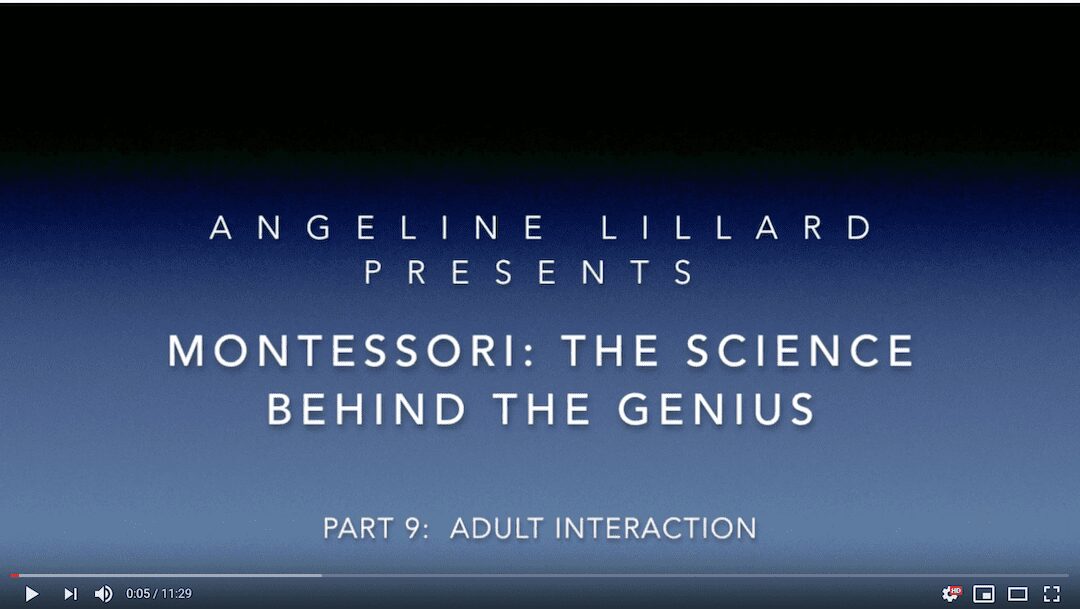
Dr. Angeline Lillard presents Maria Montessori’s key insights about childhood education, the subsequent educational research that has validated her approach, and how these ideas are implemented in a modern Montessori classroom.
From Montessori: The Science Behind the Genius
For more information, visit: http://montessori-science.org
by Frederic Luskin PhD | Emotional Intelligence (EQ), Emotionally Healthy Children, MFA, Montessori Administrators, Montessori Family Life, Montessori Parenting, Montessori Teachers, Parent Education, Peace Education, Psychology, School Leadership, Social Justice, Social Media, The International Montessori Council, Video
Dr. Fred Luskin founded and currently serves as Director of the Stanford University Forgiveness Projects. He is also Senior Consultant in Health Promotion/Wellness at the Stanford University Health Center and Department Chair in Clinical Psychology at Sofia University. At Stanford, Dr. Luskin teaches classes on Positive Psychology, The Art and Science of Meditation, Forgiveness, Wellness, Flourishing, and The Psychology of Storytelling to undergraduate and graduate students. He also conducts numerous workshops and staff development trainings in relationship enhancement, stress management, and positive psychology through the Stanford Be Well program. Dr. Luskin is the author of the best-selling books Forgive for Good: A Proven Prescription for Health and Happiness and Forgive for Love: The Missing Ingredient for a Healthy and Happy Relationship. Dr. Luskin has been interviewed on the topic of forgiveness in worldwide media including the New York Times, O Magazine, the Today Show, Los Angeles Times, Time Magazine, The Huffington Post, and CBS Morning News. He is also the author of Stress Free for Good: Ten Scientifically Proven Life Skills for Health and Happiness, a book that emerged from his 10 years as a researcher in preventive cardiology at the Stanford University School of Medicine. His work demonstrated the effect of enhancing stress management and positive emotion skills to help patients cope with congestive heart failure and arrhythmia. Dr. Luskin teaches stress management, emotional intelligence, and happiness skills to corporate clients throughout the United States. His work focuses on the research proven triad of a healthy and happy life: enhancing interpersonal relationships; creating a positive purpose in life; and guided practice in appreciation and other positive emotions.
by Lorna McGrath | Book Reviews, MFA, Montessori Family Life, Montessori Parenting, Peace Education, Reading, Social Justice
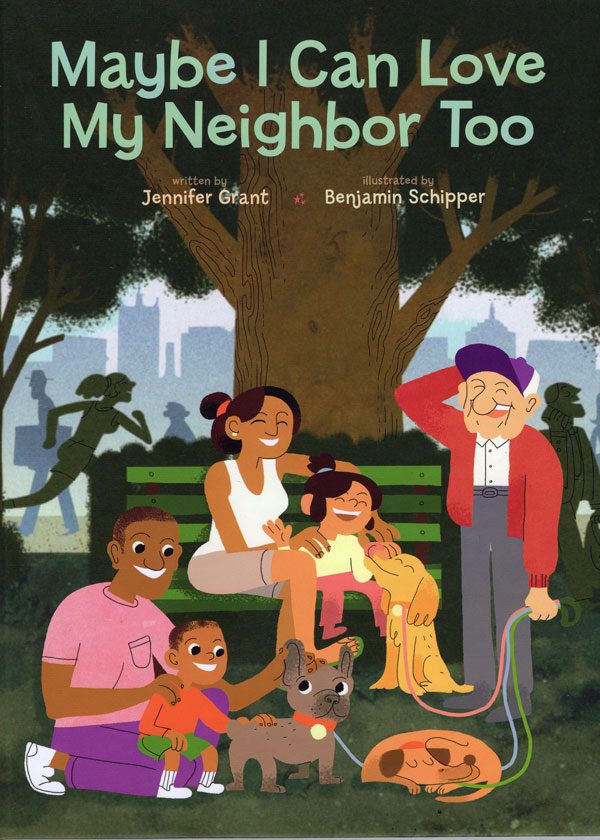
Written by Jennifer Grant
Illustrated by Benjamin Schipper
In this story, a young girl, who lives in the city, is wondering about a large apartment building that is being constructed across the street and she asks her mother, “Will all the new people be our neighbors, too?” Her mother’s response is that all people, near or far are neighbors. The girl knows that she is supposed to love her neighbors but doesn’t know how she could love so many people. As she and her mother go through their day, she notices many examples of how people can be loving to each other: helping an elderly man retrieve his dog; sharing toys with other children in the park; making a loaf of bread and giving it to a neighbor; helping someone carry their groceries; and more. By the end of the book, the girl feels confident that there are so many ways to show love to all her neighbors around the world. The illustrations have a colorful, sort of cartoon style. They depict people from many different backgrounds, ages, and ethnicities. This would be a good book for children three years old through the elementary grades.
by Frederic Luskin PhD | Emotional Intelligence (EQ), Emotionally Healthy Children, Mindfulness, Peace Education, Psychology, School Leadership, Social Justice, The International Montessori Council, Webcasts / IMC
Dr. Fred Luskin, (keynote speaker for our 2019 Annual International Conference) to explore forgiveness with the goal of reducing hurt and helplessness, letting go of anger and increasing confidence and hope as we learn how to release unwanted hurts and grudges. His presentations explore the HEAL process of forgiveness that, when learned, can lead to enhanced well-being through self-care.
In the Forgive for Good workshop and class series, Dr. Frederic Luskin presents the forgiveness training methodology that has been validated through six successful research studies conducted through the Stanford Forgiveness Projects.
by Christine Lowry | Children with Exceptionalities, Communication, Empowerment, Language, Mixed Ages, Montessori Education, Montessori students, Peace Education, Planes of Development, Sensorial, The International Montessori Council, Webcasts / IMC
by Kathy Leitch | Empowerment, Peace Education, Planes of Development, Prepared Environment, School Leadership, The International Montessori Council
Dear IMC members,
Well, we are almost there! By the time this issue of Montessori Leadership arrives, we will have celebrated the end of another school year and are well into preparing for the next, in most of the northern hemisphere. Where did the summer go? I like to consider the end of each school year as an opportunity to acknowledge our progress and many accomplishments, appreciate our staff, students and families, and begin making plans for “next year” as we reflect on plans for improvement. Each new school year brings us the opportunity to start with a fresh perspective and understanding of how we can better serve our Montessori students.
We, the International Montessori Council (IMC), are also exploring the most relevant and responsive ways to serve you, our members. Many of you have clearly expressed your interest in being actively involved with the IMC strategic initiatives for the future. As I have mentioned previously, we are focusing on four strategic domains to stay mission-aligned as we move forward.
We are currently forming strategic committees that will work directly with our board members to creating action plans for each of the following strategic initiatives:
1. Strengthen our governance, finance, and internal systems to ensure sustainable growth.
2. Develop an array of meaningful and responsive services aligned with our core values to attract, retain, and increase our membership.
3. Lead educational innovation with a unifying voice, impacting education, families, and Montessori worldwide.
4. Embrace inclusivity, seeking to understand and embody the principles and practices of social justice, restorative practice, and conflict resolution, encouraging Montessori’s vision of peace throughout the world.
We’ll use our Core Principles to guide our initiatives and reflect on our progress:
INCLUSION: A circle of equals where everyone has a voice.
SUPPORT: A global network of Montessori expertise.
OUTREACH: Making Montessori education more accessible.
LEADERSHIP: Building peaceful and positive school communities.
BEST PRACTICE: Promoting fully implemented Montessori education.
FAMILY: Helping parents apply Montessori at home.
PEACE: Living it, teaching it, promoting it through community service.
ADVOCACY: Opportunities for social justice and equity work.
SELF-CARE: Learning environments that enhance happiness and health.
You will find these core principles reflected throughout this issue of Montessori Leadership.
From inclusion to equity to advocacy to best practice…you will notice that each of our contributor’s views inspires an open mind, a paradigm shift, and the opportunity to explore our understanding of Montessori philosophy and practice.
Keep in mind, we’re here to help. Stay in touch and let us know how we can best serve your needs. We welcome your article submissions, school highlights, and book reviews. Please email me at kathyleitch@montessori.org with any questions or ideas.
Sincerely,
Kathy Leitch
Executive Director
International Montessori Council
Kathyleitch@montessori.org
ML/ August 2019/ Pg 4
by Dina Paulik | Empowerment, Maria Montessori, Outdoor Education / Resources, Peace Education, The International Montessori Council, Webcasts / IMC
A Montessori Retrospective With Dina Paulik
by Michael Dorer, EdD | Child's Work, Communication, Discipline, Empowerment, Mindfulness, Mixed Ages, Montessori Education, Peace Education, Planes of Development, Prepared Environment, The International Montessori Council, Webcasts / IMC
Teaching Positive Social Development to ALL Students
by Cathie Perolman | Communication, Discipline, Emotionally Healthy Children, Empowerment, Later Adolescence (15-18), Lower Elementary (6-9), MFA, Mixed Ages, Montessori Family Life, Peace Education, Planes of Development, Psychology, Sensitive Periods, Tomorrow's Child, Tomorrow's Child Online Issue, Upper Elementary (9-12)
Cute little boy is calming pretty little girl while they both are sitting on sofa at home
Dear Cathie— My children are not always nice to each other, and they sometimes admit they have been unkind to others at school or on play dates as well. I want them to learn to be kind and respectful. I have been expecting them to say “I’m sorry” when they act in this manner, such as when they hit or punch or grab something from a sibling or friend. I have been reading and hearing that there are other ways to handle these situations but those ways just feel so artificial. Can you help? — A Frustrated mom
Dear Mom,
We are all a product of our upbringing and, for many of us, saying “I’m sorry” was a get-out-of-jail-free card. The meanness or hurt was undone with two little words, but we all know that it really wasn’t. The place on the child’s arm that was punched still hurt; the sadness from the picture that was marred by scribble scrabble still remained; and the hurt feelings from the unkind words were still felt.
Montessori educators today are trying to help children of all ages view their hurtful actions through different, more compassionate eyes. We want them to look at their behavior, take ownership of it, and think of how it made the other person feel. This is how we aid in developing emotional intelligence. We want children to see how truly powerful their behavior can be and consider ways in which they can help make the situation better. It is not that children can’t make mistakes, but we want them to make logical and reasonable amends for those errors, whether they were intentional or unintentional. A child as young as two years old knows when he knocks someone over, he can help them up and check to see if they are uninjured! If your child is running and causes another to bump his or her head on a table, he can get the ice pack from the refrigerator. This is an apology of action rather than the less meaningful apologetic statement, “I’m sorry!”
Many of the mistakes toddlers make are unintentional as they are just beginning to learn social conventions and manners. Some of their errors are impulse driven, as when they hit another or snatch a material or toy they want. At times, they even bite to show their needs when they do not yet have words or forget to use them.
As children grow into their early childhood years, they begin to understand and start the use of words and actions as power. “I can run faster than you!” “Your picture is not pretty.” “I’m not going to be your friend anymore!” Sometimes these statements are as clear and hurtful as they sound, and other times they are used to convey another unspoken message. It is our job as adults and teachers in the child’s life to help him recognize and articulate those messages as he negotiates the evolving art of socialization. “I’m not going to be your friend anymore” may really mean, “I wish I got to sit next to you at the circle.” Having your child say, “I’m sorry” will not help him grow socially. He needs to recognize and unpack his feelings, his misinterpretation of what happened, and what he said versus what he really meant to convey. Then, he needs to make a plan to somehow get his emotional needs met. “Can we play together on the playground? Do you want to play in the sandbox with me?”
Although it takes time and energy to work with children to sort through feelings, this is paramount to their being able to do it automatically and independently as they grow and mature. When there are multiple social situations happening simultaneously, as in a preschool setting or on a busy playground, this can be even more challenging. Often, you may be unable to observe all involved in a particular situation. There can be events that occurred prior to your arrival before the “straw that breaks the camel’s back” takes place. I often ask, “what happened before you hit her? What were you thinking or feeling?” Although hitting is never the right answer, it is often the third or fourth step in a series of steps. I want to see where a child’s thinking went during this time. I often ask, “What else might you have done?” It is always the responsibility of the child who caused emotional or physical harm to ask how he can make the child he hurt feel better. “What can I do to make you feel better?” I might have to suggest some ideas, such as a hug; rub his back gently; get an icepack; say you’ll never do it again; a handshake; say I’m sorry and mean it; or the child who was hurt saying that he needs space to be away from the child who caused the hurt and have time to be angry. A child who has damaged something of someone else’s needs to make reparation. He needs to set up the block structure he knocked down, if the other child would like him to, go get the ball he threw across the playground or set up the activity he destroyed or marred.
Early elementary school children sometimes ignore or exclude another. A child who intentionally hurts another in this way has a more difficult challenge to rectify the situation. It helps to bring children together so that the excluded child can articulate his hurt feelings to the child or children who intentionally ignored or excluded him. This child can then express an apology of action by making an effort to be kind to that child. As a parent and adult in his life, you can help him think of ways to do this! Perhaps, he can draw him a picture using his favorite color, bring him a craft that he made at home, or even make an effort to meet his eyes and smile at him every time he walks by! Expressions of kindness can take many forms.
Rather than making every hurtful event have an automatic “I’m sorry” response, try encouraging your child to think about the other person’s feelings. First, ask “what happened,” and be sure your child is given an opportunity to explain what occurred. Be sure you understand what went wrong if the situation is not immediately clear. Let the other child explain what happened from her point of view. Often, there is more to the story. With practice, children can do this without adult assistance. Have the child ask what he can do to make the situation better. Encourage the child to fix the problem and make the other child feel better. Apologies of action are always better than words alone. Once this process becomes the culture of your family it will become automatic and effective. ′
Tomorrow’s Child/ April 2019 / Pg 34
by Marilyn Long Webster | Kindergarten, Lower Elementary (6-9), MFA, Mindfulness, Peace Education, Tomorrow's Child
It was the last day of school. I had taken my place by the front door where I have been every morning for the last 10 years, greeting the students as they arrive for class. This day, the excitement was in the air.
Children were tumbling out of their cars with flowers, gift bags, and fruit trays. Their faces were bubbling over with joy. At the door that day, many of my students had stopped to present me with a flower or a gift or a poem written from their hearts, and cards, from grateful parents, for an awesome year.
It was almost time for me to leave the door and walk down the hall to my students, excited to start their day. I was getting a bit restless, looking at my watch, thinking about all the activities planned for the morning. That is when Jonny and his mom drove up.
Jonny, a darling little four-year-old boy, had come to our school in the middle of the year. I had taught his older sister, Judy, several years earlier. She was a quiet and gentle little girl. Jonny was totally different from her. In a Montessori classroom, as in a family, every child is uniquely different, uniquely gifted, with untapped potential, waiting to unfold in natural stages. So it was with Jonny.
From the first day, he came in looking for playmates, always wanting to be part of the action. Jonny had a hard time sitting still and an even harder time listening. He loved the interaction, and many days, he turned the work into a vehicle for socialization.
As Jonny was learning to navigate the classroom, he bumped right into “respect,” a concept that would begin to develop and strengthen his ability to show value and emotional control. Respect for the environment, for the materials, for his friends, teachers and for himself, which is a foundational hallmark of the Montessori classroom, along with “grace and courtesy,” would be presented and modeled daily.
Jonny saw by example how to conduct himself and harness his emotional swings by himself. Along with the other students, he would be encouraged to always lace respectful words around his actions which, in the long run, would help diffuse moments of emotional conflict or misunderstandings.
Respect and fairness go hand in hand. Most of the time, children are very forgiving, but they know if you are authentic. They know by your consistency and fairness. They know by your love.
As you model respect to a child through your speech, mannerisms, and tone, they get a sense of well-being and a love for themselves which nourishes and smooths out emotional needs.
In return, as Jonny began to make choices to move throughout the classroom with “grace and courtesy,” he would gain a sense, maybe for the first time, of how it feels to be respected and treated with fairness by his peers. This new found respect empowered Jonny to grow in self-worth and self-respect, while at the same time, developing a more tender, understanding heart towards others. Mutual respect had emotionally bonded Jonny to his friends and to his teacher.
Jonny got out of the car, but he didn’t walk towards me. He just stood there, motionless until the mom finally got out of the car to see what was wrong. After much coaxing, Jonny began to slowly take steps towards me with his head down. So slowly, in fact, that mom had to walk with him. He was extremely upset. I could see it. Mom could see it.
She kept whispering to Jonny as they walked, but his unhappiness persisted. As Jonny reluctantly inched towards the door, he kept fidgeting, trying to carry his backpack and a small plastic water bottle that was almost empty. Getting a bit impatient, his mother called to me from the sidewalk, “Jonny is upset because he does not have a gift for you today.”
With that, I immediately left the door and walked towards him. “Oh Jonny, that’s okay,” I heard myself say. “We are going to have a party today and the Kindergartners are going to bring healthy treats!” There was no response.
Jonny did not look up. In fact, he walked right past me, through the door and towards the hall. His mom and I just looked at each other. We didn’t know what to say. All of a sudden, Jonny turned and came barreling back out the door. With his strawberry blonde hair glistening in the sun, I saw immediately that his countenance had changed.
Jonny stopped short, right in front of me, and with a happy grin and twinkling eyes, handed me his small, clear, almost empty water bottle. It was all he had to give that day, and he gave it to me, with all of his heart. With that, Jonny hurried to class and I just stood there, speechless.
When I finally walked to class, I had to choke back tears.
There were piles of lovely gifts waiting for me as I stepped into the classroom that day, but I found myself clutching that almost empty water bottle to my chest, as I told Jonny how much I loved it. Jonny beamed. Later that morning, Jonny’s mom brought a flower to school for him to present to me, which was so thoughtful, but our hearts had already connected, and that almost empty water bottle had become my treasure.
Marilyn Long Webster is a retired School Director of Midwest Christian Montessori Academy in Bolingbrook, Illinois. This article is from a journal entry written during her career as a guide.
Tomorrow’s Child / April 2019 / Pg 24
by Mary Helen Abel | Infant-Toddler (0 to 3), Kindergarten, Lower Elementary (6-9), MFA, Peace Education, Primary (3-6), Toddler (18 months-3 years), Upper Elementary (9-12), Webinars / MFA
Mary Helen Abel will share her experiences and inspiration for this artistic children’s peace project. She will explain how she went about putting the project together and the materials needed including a small item for the children to take home. She collaborated with a family in the school who owned a business in the local community to display children’s art.
by Frederic Luskin PhD | Communication, Emotionally Healthy Children, Empowerment, MFA, Mindfulness, Mixed Ages, Montessori Parenting, Peace Education, Planes of Development, Sensitive Periods, Tomorrow's Child
People’s hands show a heart sign. Valentines day relationship concept.
New studies look at forgiveness
To earn his doctorate in counseling and health psychology from Stanford in 1997, Fred Luskin had to write a dissertation. At the time, Luskin was furious with a friend. To complete his graduation requirement and to cope with the pain, Luskin researched and wrote about forgiveness.
“I couldn’t do it. I couldn’t forgive,” he said. “I was badly hurt by a friend of mine and it threw my world upside down.”
Luskin, now a research associate with the Stanford Center for Research in Disease Prevention, focused on Stanford students’ experiences when he initially began studying forgiveness. In 1999, after earning his doctorate, Luskin launched the original Stanford Forgiveness Project, which studied Bay Area residents. According to Luskin, the study involved 260 participants, including 100 men.
Research is conducted in a workshop format and typically lasts from five to six weeks, he said. In his research, he teaches forgiveness as a skill.
“The results were very positive,” Luskin said. “People showed less stress, less anger, more optimism, and more forgiveness.”
“It is not therapy. It is teaching people how to learn this kind of skill,” he said. “We can teach people to forgive and that will improve their well-being.”
The Stanford Forgiveness Project has evolved and now exists as an umbrella organization for numerous Stanford research projects that address forgiveness.
Over the years, researchers with the Stanford Forgiveness Project have worked with families from Ireland who have lost loved ones due to civil strife. The Stanford-Northern Ireland HOPE Project has conducted research on three different occasions with Irish families.
The process of forgiveness can be a liberating experience. One that, if practiced proactively, can lead to a wonderful experience of life. Interestingly, forgiveness can only occur because we have been given the gift of the ability to make choices. We have the choice to forgive or not to forgive and no one can force us to do either. Conversely, if we want to forgive someone, no one can stop us, no matter how poorly they may act. This ability to forgive is a manifestation of the personal control we have over our lives. It is nice to reflect upon and feel the respect that we have been given to be able to make such profound choices.
Compellingly, the option to forgive also implies that we had discretion as to whether or not we took offense in the first place. While forgiving may be a difficult enough choice for many of us, imagine how our lives would be if we rarely or never used our power of choice to take offense. Since we have a choice, wouldn’t it make sense to limit the amount of times we are hurt or offended so that the need to forgive rarely if ever arises? The ability to live life without taking offense, without giving blame, and by offering forgiveness are choices that offer a life of great peace.
The ability to offer proactive forgiveness proceeds along with four steps. At step one, you are filled with self-justified anger. At some point in your life, you have been hurt and you are mad at the person whom you feel wronged you. You blame the person committing the wrong for how you are feeling. It is their action and not your choice of response that you feel is at the cause of your anger. You have forgotten that you have a choice as to how you will react or are so angry that you are convinced that it would not be right to forgive the offense. At this stage, there is usually both active and submerged anger.
The second step towards forgiveness emerges when after feeling angry with someone for a while you realize that the anger does not feel good to you. It may be hurting your emotional balance or your physical health. Or you wish to repair the damage to the relationship. So you take steps to forgive. You may begin to see the problem from the other person’s point of view or you may simply decide to let the problem go. In either case, after an extended period of time, you are no longer angry and you have forgiven the person with whom you were angry. This process can be applied to anger at oneself, another person, or to life in general.
The third stage of forgiveness comes after you have seen the beneficial results of forgiveness and you choose to let go of your anger fairly quickly. In this stage, the choice is to feel the hurt for a short period of time, and then work to either repair the relationship or let go of seeing the situation as a problem. In either case, you decide to forgive because you have had some practice with it and see the benefit in your life. This could emerge in as simple a situation as being cut off by another car on the expressway or in a complex situation like an affair in a marriage. At this stage, you are aware that the length of time you experience the situation as a grievance is primarily up to you.
The fourth stage of forgiveness involves the proactive choice to rarely if ever get angry. This often means to forgive in advance of a specific trigger. This stage often emerges at the same time as some or all of the following thoughts:
I don’t want to waste my precious life in the discomfort caused by anger so I will choose to feel differently. I am able to forgive myself, forgive others, forgive life, and forgive God.
I know how it hurts when people don’t forgive me. I do not want to hurt other people with my anger so I will let it go.
Life is filled with incredible beauty and I am missing some if I am experiencing unresolved anger. I forgive myself for getting sidetracked.
People do the best they can and if they err I can best help them by offering to understand. The first step in this process is to forgive the specific offense.
Everyone, including myself, operates primarily out of self-interest. I must expect that some times I, in my self-interest, will be annoyed by someone else’s expression of their self-interest. If I can understand that this is an ordinary part of life, what is there to be upset about? If I understand that self-interest is the way that I behave, how can I but offer forgiveness to everyone, including myself for behaving that way?
These four stages of forgiveness will not be followed in the same way by all people and in all relationships. There are some people for whom we feel such love that we are almost always at stage four: open-hearted and ready to forgive. There are other people for whom we feel so egregiously hurt and our well of goodwill for them is so dry that we can spend years at stage one. What is critical to remember is the power of personal choice and the importance of exercising that choice to forgive so that we can bring peace and healing into our relationships and ourselves. ′
Frederic Luskin, Ph.D. is a keynote speaker at our upcoming Annual Conference. Read more about him on page 23.
by Punum Bhatia Ph.D | Empowerment, Maria Montessori, MFA, Mindfulness, Montessori Charter Schools, Montessori Education, Peace Education, Practical Life, Prepared Environment, Research
“The first essential for the child’s development is concentration. It lays the whole basis for his character and social behavior.” (Montessori, 1988, p.202)
Dr. Maria Montessori (1870-1952) believed that children have an inner directive for their optimum self-construction and that concentration is the key to their natural development. This was perhaps one of her major contributions to the world: that if protected and nurtured, the child’s inner guide will lead to the development of the child’s full potential. She asked those working in her schools for close observations of the children’s behavior, and it was Signorina Maccheroni in Rome who first provided specific information concerning the way in which the children were working:
“The child keeps still for a while, and then chooses some task he finds easy, such as arranging the colors in gradation; he continues working at this for a time, but not for very long; he passes on to some more complicated task, such as that of composing words with the Moveable Letters and perseveres with this for a long time (about half an hour). At this stage, he ceases working, walks about the room, and appears calm; to a superficial observer, he would seem to show signs of fatigue. But after a few minutes, he undertakes some much more difficult work and becomes so deeply absorbed in this that he shows us that he has reached the acme of his activity…When this work is finished, his activity comes to an end. In all serenity; he contemplates his handiwork for a long time, then approaches the teacher, and begins to confide in her…The appearance of the child is that of a person who is rested, satisfied, and uplifted.”
(Montessori, 1917/1965, p. 97).
Many years of observation convinced Montessori that the work of the child and the formation of the personality occur during periods of intense concentration, which she called “polarization of attention” (Montessori, 1917/1965, p. 68). She observed that children deeply engaged and fully concentrating on a task at hand were transformed and “showed extraordinary spiritual qualities, recalling the phenomena of higher consciousness” (Montessori, 1917/1965,p. 68). After completing a cycle of activity, children seemed refreshed, calm, and satisfied. This is similar to what Csikszentmihalyi (1997) termed “flow” and can be understood as an ability to focus on an interesting activity, which leads not only to quality performance but, most of all, to maximum effort and intensity of concentration.
For all of this to happen, there are certain key elements that need to be in place and, because this is not always the case, there are many differences in Montessori schools. The adults in Montessori settings facilitate children’s learning by preparing a favorable environment that meets the needs of the children and challenges them as well. They use observation as a vital tool for understanding and nurturing the individual potential within each child, offering plenty of opportunities for spontaneous engagement in activities. This requires the adult (or guide) to be well trained. Montessori placed the preparation of the teacher and the cultivation of her attitudes and values at the center of the process of becoming a teacher. In Montessori teacher training, preparing the adult emotionally and spiritually is fundamental to the education of future teachers. According to Montessori,
“The first essential is that the teacher should go through an inner, spiritual preparation; cultivate certain aptitudes in the moral order. This is the most difficult part of her training, without which all the rest is of no avail…She must study how to purify her heart and render it burning with charity towards the child. She must “put on humility,” and above all, learn how to serve. She must learn how to appreciate and gather in all those tiny and delicate manifestations of the opening life in the child’s soul. Ability to do this can only be attained through a genuine effort towards self-perfection. (Standing, 1957, p. 298).
Montessori teacher education is unique to others in placing more emphasis on developing self-awareness than on building theoretical knowledge. Inner preparation cannot be seen as effortless or resulting in an immediate transformation; it requires a lifetime of both deep reflection and passionate commitment. Given the inherent difficulty in changing existing beliefs, coupled with the relatively short duration of some Montessori teacher training programs, developing a valid lens through which a candidate can become a self-aware adult is not a simple undertaking. There are so many schools that I visit where the adult is not Montessori trained or may have had the bare minimum of training. It always surprises me how anyone can take on a classroom with only six months of online training!
Montessori teacher trainings can vary greatly from one to another, and this can get confusing for someone who is new to it all. A good benchmark to follow is to determine if the training center is a MACTE (Montessori Accreditation Council of Teacher Education) accredited institution. This way certain standards have been met, but there will always be some training centers that emphasize more on the methodology and others on the philosophy. The schools also have a role to play in whether they support the teacher’s observing daily and using their findings as a foundational tool to guide each child’s learning. Montessori was very firm on this aspect of “following the child.” At Montessori Casa International, the teachers have an hour every day of the morning work cycle to observe the classroom, a particular child, or themselves. Later, they get together as a team and discuss their findings with the intent of improving their practice. They also undertake regular professional development to enable them to be reflective practitioners and lifelong learners. Learning does not stop once the training and the albums are done! It is an ongoing process, as the child makes abundantly and repeatedly clear. In order to serve as the best facilitators for the child’s natural development, learning, and discovery, it is crucial that they be well trained.
Another element that makes a difference in Montessori schools is the prepared environment. Montessori classrooms are “usually a large, open-feeling space, with low shelves, different sizes of tables that comfortably seat one to four children, and chairs that are appropriately sized for the children in the classroom” (Lillard, 2005, p. 18). Montessori describes this environment as a place where the child is nurtured, for its design meets his needs for self-construction and helps him reveal his personality and growth patterns to us. In the calm, ordered space of the Montessori ‘prepared environment,’ children work on activities of their own choosing and at their own pace. They experience a blend of freedom and self-discipline in a place specially designed to meet their
developmental needs.
A collection of materials (apparatus) is displayed on the shelves, with everything carefully ordered and in its place. The materials entice the child because they are: placed in the center of his vision; are within easy reach; and have a sensory appeal, varying in color, shape, size, texture, and possibilities of manipulation. The array of sensory contrasts, however, suggests purposeful variation rather than a random placement of brightly colored objects. A well-trained teacher will be able to organize the classroom according to the Montessori principles and, with some years of experience, will be able to make it aesthetically pleasing, ordered, and well maintained. Again, it baffles me how some are able to take on this job with little or no training. Surely it has to be daunting; the didactic apparatus/materials have a language and history all their own, and it takes years and years of practice to understand it.
Some schools choose to go with materials that are not the highest quality, without understanding the impact this makes on the lessons. For example, the experience of the biggest cube compared to the smallest one is not only in size but also in weight. I have seen some Pink Towers that are as light as can be! Budgets can be constraining, but isn’t it better to go with less but of the highest quality than more that one has to replace constantly? The licensing supervisor who came to our school was very confused about the range of materials she had seen in the various Montessori schools she visited and said she could not approve of some. When I expressed surprise, she walked to the shelf with me and pointed to the Constructive Triangles, which she said had dangerous points to them.
This is worth exploring further—why is it that there is such a range of Montessori schools? We know that the Method was never copyrighted; anyone can open a school and call it Montessori. There is no governing body that holds the schools accountable. Some are a little more honest and declare their school as “Montessori inspired” or “Montessori Lite.” Others don’t even do this! I caution the families that tour my school that what they see here can be totally different from the next Montessori school they visit. Admittedly, this can be very confusing for families that are seeking only the best for their children. A grandparent who visited our school recently and is an educator complimented me on not “warehousing” our children. She said she had never seen anything quite like this school and the way we develop the child’s individuality. I really am not sure why other schools cannot do the same. Is it a lack of understanding the Montessori philosophy, a scarcity of overall education, or is it a pursuit of profit that makes for compromises?
Another element that makes for an authentic Montessori school is multi-age groupings aligned with the planes of development. There was a reason why Montessori divided the classrooms the way she did and, yet, we often see two-year-olds in the primary classroom and sometimes a classroom only for the three-year-olds! Many a time, you don’t even have to visit the school to see this happen: it is on their website! So also is the lack of the three-hour uninterrupted work period for the 3-6 age group and a two-hour work period for the 1-3 age group. A work cycle of three hours allows the child adequate time to become involved in his/her work, to observe, and then become significantly engaged in an activity. “There is a vital urge to the completeness of action, and if the cycle of this urge is broken, it shows in deviations from normality and lack of purpose” (Montessori, 1948/1967, p. 57). This is part of what makes Montessori unique and, as much as possible, this work cycle should be respected. An interruption, no matter how beneficial an adult may consider it to be, disturbs the growing development of the child’s concentration and focus. In fact, if children are aware that they may be interrupted during the course of the morning, they may choose not to work at all. Hence, it is crucial that all Montessori schools respect the three-hour uninterrupted work cycle, knowing that it is the foundation for the child to achieve lengthened periods of concentration, discipline, and normalization.
Montessori writes:
“Only normalized children, aided by their environment, show in their subsequent development those wonderful powers that we describe: spontaneous discipline, continuous and happy work, social sentiments of help and sympathy for others”
(Montessori, 1988, p.188).
Another element that makes the difference between the quality and authenticity of a Montessori school is the school’s vision, commitment to improvement, and leadership. Is the educational leader/director knowledgeable about Montessori? I always joke that I would never accept a job as a Supervisor/Manager at Home DepotTM because my knowledge of tools and building supplies is nil. How then does a person who does not know what Montessori is accepting a job as the leader of a Montessori school? How can s/he ensure that all aspects of the school are guided by Montessori principles? Doesn’t the difference start there?
In order to provide the highest level of Montessori experiences for children, we should be determined to provide them with the best start in life, not finding short cuts but staying true to the philosophy and methodology. The Montessori light should guide us, and we must not forget our teacher who allowed no obstacle to steer her away from her path of service to the child. In the words of Signorina Maccheroni:
“In the strange and wonderful life that has been hers, destiny has led her from country to country, from enterprise to enterprise, destroying, again and again, all she has created. But her courage and faith have continued unabashed wherever she was. No matter what her circumstances of life, she has continued her work for a better humanity, for peace, and for an understanding of the mission and nature of childhood” (1947, p. 108-109).′
References
Lillard, A. S. (2005). Montessori: The science behind the genius. New York: Oxford University Press.
Maccheroni, A.M. (1947). A true romance: Maria Montessori as I knew her. The Darien Press, Edinburgh
Montessori, M. (1917/1965). Spontaneous activity in education: The advanced Montessori method. Oxford: Clio
Montessori, M. (1988). The absorbent mind. Oxford: Clio
Standing, E.M. (1957). Maria Montessori: Her life and work. New York: Penguin.
ML/ Feb 2019 / Pg 11
by Michael Dorer, EdD | Montessori Education, Montessori Teachers, Peace Education, Planes of Development, Prepared Environment, School Leadership, The International Montessori Council, Webcasts / IMC
The International Montessori Council Where Will We Be 20 Years From Now