by Chelsea Howe, PsyD | Communication, Psychology, Sensorial, Tomorrow's Child, Tomorrow's Child Online Issue, Young Adolescent, Young Adults
 With a fast-paced society that often turns to medication for ‘quick fixes,’ we often perpetuate stigmas and neglect to consider all information prior to making diagnoses. As a psychologist and a mother, I know all too well how difficult it is to watch children struggle to find their way in classrooms that work to produce (and support) other “neurotypical” children.
But, what if our children are “neurotypical” but deviate only slightly (perhaps a half standard deviation) from the normal bell-curve? Do we provide supportive assistance to them to help maintain their self-esteem and guide them on their way? Or, are we too quick to judge that Johnny, at age four, “fits the criteria” for Attention Deficit Hyperactivity Disorder (ADHD)?
When I first started graduate school, over ten years ago, mind you, the ‘hot topic’ was ADHD. Everyone and their siblings were being diagnosed with ADHD, and why not? Wouldn’t we love all of our children to fit the “seen-but-not-heard” perfect-child stereotype and slap some medications into those neurotransmitters to help them “focus.” But, in my years of practicing, other trends are now popping up: Autism Spectrum Disorders; Bipolar Disorders; Sensory-Processing Disorders; and so on. But, these disorders have always existed, or have we just not paid attention? Or, were these kids just labeled weird, quirky, or angry?
Far too often, in my opinion, children get diagnoses that, truly, they do not deserve. That’s not to say that all are misdiagnosed, as many should and will benefit from pharmaceutical treatment. However, let’s remember that children at age four will be active (and quite active, at that). First and foremost, energy is a given at age four. Not being able to sit in a seat and focus for long intervals is also normal and typical; we call this “driven by a motor” or “restlessness” in the Diagnostic and Statistical Manual-Fifth Edition. The reality, however, is that developmentally, per age, we are asking kids to fit a norm that is counter-intuitive to what is biologically warranted. Children are being diagnosed (more than ever) with Bipolar Disorder or Disruptive Mood Dysregulation Disorder (both of which are real disorders), but we are not inclined to consider environmental and attachment patterns that mimic both disorders, in which case, drugs would not be the treatment of choice).
But, all of this takes time. It takes hours and hours of evaluation to determine what is really going on with each child. Thankfully, many schools are beginning to require psychologists to use testing to confirm a diagnosis rather than solely accepting diagnoses from pediatricians, who (respectfully) are not as well trained in the nuances of diagnosis. Further, we need to begin considering other factors.
How many hours is a child sitting in front of a television per day? While there is some research to suggest that television (particularly specific shows, such as Sesame Street) can help in acquiring language and beginning to learn (not develop) empathy, most are not beneficial. We know that television can be a ‘black hole’ for our minds (and particularly our children’s minds). Imagine if little Johnny is watching television all day long, while the parent or caregiver is trying to get laundry done, dinner made, and activities scheduled? And, Johnny doesn’t care! You know why? Because he’s happy! So, when he is at school, we are asking him to focus on something less stimulating when his ‘baseline’ is that of over-stimulation by watching television.
What about Johnny’s sleep and appetite? Is he getting adequate sleep per night? Is he attending to night-time rituals to help him both fall asleep and stay asleep? If not, perhaps that should be considered? And food? Does your child (like mine) exist on chicken nuggets, pizza, cheese, and yogurt? While there are worse foods that could be eaten, these are not nutrient-dense foods. So, we have a thriving child with less than “thriving” food upon which his brain is attempting to rely on fuel. At the very least, a good multivitamin and Omega-3 fatty acid supplement should be given. But, teaching kids at a young age about eating nutritious foods is important! Even attempting to “sneak in” nutritious foods is also important.
Teachers are also doing a great job of ‘thinking outside of the box.’ Kids are intrinsically active, more so the lower the age. My child, for example, fidgets non-stop. He plays with his tie, he eats his tie, he put his tie up his nose. Not the most hygienic of examples. There are options out there! If the teacher is willing to work with your child, all the better! There are sensory tools that exist for this reason—and they are not the classic fidget-spinners. There are necklaces, rubber rulers, mesh pockets, and so much more. They are tiny and unassuming, and children simply touch them while completing their work as a way to ‘stay busy.’ When used properly, they are discreet and can be quite helpful in helping children to be busy but focused.
Some teachers will also have children stand up to learn, as they know that sitting for long periods of time can be particularly difficult. Again, when done discreetly, this can be quite helpful. The key is to ‘normalize’ this rather than calling attention to it. I’ve seen teachers (with psychologist’s support) even use bouncy balls for kids to sit on while completing projects in class. Kids may also benefit from seat-bands, which help kids fidget with their feet to self-stimulate while working.
Again, the key to all of these techniques is to support the child, not stigmatize the child. We all have our habits when we get nervous or over-stimulated. We may chew on our nails, play with our hair, tap our pen, or bounce our legs. By providing kids with these outlets, we are treating their need for stimulation rather than diagnosing them with ADHD. If the behavior persists and/or worsens, there are certainly further accommodations and treatments that are available. But, in the interim, perhaps we should support our children and their development and try to find ways to hone in on their excitability rather than begin with diagnoses.
As a side note, my child is one of these children. He is a brilliant little boy with ‘magic hands’ that are incessantly busy. He has peeled just about every sticker and taped item from his workspace and his folders. A quick necklace fidget has fixed the busy hands, and he has frequent ‘breaks’ to go to the water fountain for a ‘change of scenery.’ And, our teacher has worked closely with us to help support him to be the best learner possible!
It’s worth a try rather than a pill.
Tomorrow’s Child/ April 2018/ pg 22
by Lorna McGrath | Autism, Book Reviews, MFA, Mixed Ages, Montessori Parenting, Sensorial, Tomorrow's Child Online Issue
By Sophie Walker
There are so many books that one can choose from to read about children and families affected by autism. I have many in my library. I remember the first one that I read in the 1980s called Dibbs: In Search of Self. Back then, we didn’t even call what Dibbs suffered from by a name. I was a Montessori teacher and didn’t even know anything about the spectrum or ADD or OCD or ODD, but I knew that I had children in my classrooms that didn’t behave in ways that most children did. And I searched for ways to help them to be a part of our classroom and school community.
Then came my own children—both of them beautiful and smart and quirky in their own ways. As they grew and developed, we did our best to figure out the ways to support each of them. Their uniqueness’ caused joy, pride, heartache, and confusion at times.
When I began to read this book, Grace, Under Pressure, I realized that Sophie’s marathon was not the London Marathon but the agonizing struggle to find what is right for her child, for herself, and for her family. If you have a child on the spectrum, if you teach a child on the spectrum, if you love a child on the spectrum, you will be moved and inspired by this mom’s determination to find answers and support. This book gave me insight into the frustration of not knowing, into how alone parents feel as they deal with the everyday struggles of life with a child with special needs, and into what it means to take on the system for your child.
I highly recommend this book for parents and teachers of all children. You will not be able to put it down!
Tomorrow’s Child / April 2014 / p 22
by Tim Seldin | Kindergarten, Lower Elementary (6-9), Mixed Ages, Montessori Curriculum, Montessori Education, Montessori Materials, Montessori Teachers, Parent Education, Primary (3-6), Sensorial
The Pink Tower(left) is one of the Sensorial materials that children enjoy working with early in their Montessori experience. The Pink Tower, or Tower of Cubes, is composed of a graduated series of ten wooden cubes. The largest cube has a square section of 10 centimeters per side and is 10 centimeters high. Thus, it measures 10 x 10 x 10 centimeters.The square section and height of each of the succeeding cubes decreases by 1 centimeter, down to the smallest cube, which measures 1 x 1 x 1 centimeter.
Children carefully carry the Tower, cube by cube, to a little rug that defines their work area. They carry each cube comfortably at waist height, as they take the cubes and place them in random order upon the carpet. As they manipulate the cubes and carry them across the room, children get a very strong impression of size and weight. When all the cubes have been carried to the rug, a child looks for the largest one and begins to build the Tower, one cube at a time. At each step, he looks through the cubes that have not yet been added to the Tower to find the largest. As each is placed on the Tower, the child controls his movements to place the cube gently down right in the center of the larger cube on which it is rested. Once the Tower has been constructed, the child carefully takes it down and either begins again or returns the cubes, one by one, to their proper place on the shelf.
Some people have heard that in Montessori, children are taught that there is only one way to work with each material. In truth, the children explore and discover all sorts of creative ways to work with them. For example, students will construct the Tower horizontally, or line up two edges to create a vertical stairway. The children will also build the Pink Tower in various combinations with the Brown Stair along with some of the other Sensorial materials.
The Montessori Bells
The Montessori Bells (below left) extend the child’s ability to distinguish sounds into the area of musical pitch. They are a lovely set of bells fixed to little wooden bases. Each bell is tuned to either a whole or a half note on the standard musical scale. The entire set comprises one entire octave, including sharps and flats. The set includes one set of bells with tan bases for both half and whole notes; there is a second set in which the bases of the bells that sound the whole notes are painted white, and those for the sharps and flats are painted black.
At first the children learn how to strike the bells with a small mallet to produce a clear note and dampen them with a little felt-covered rod.
Then the teacher will set out two or three pairs of bells from the two sets. The children match the pairs that produce identical notes. When they can do this easily, additional pairs are added until they can match entire sets.
A more difficult exercise challenges the children to grade the bells of just one set by pitch, from the lowest to highest notes. As they become more familiar with the bells, children will commonly learn how to play and compose little melodies.
The Brown Stair … also known as the Broad Stair
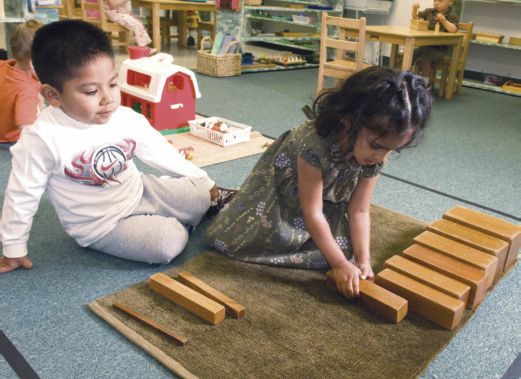
The Brown Stair,which is sometimes called the Broad Stair, is made up of ten rectangular prisms, with bases that have exactly the same graduated measurements as the cubes of the Pink Tower, but which are uniformly 20 centimeters long. The child is challenged to scatter them around her rug and then sort them by size to place all ten prisms in proper order from thickest to thinnest.This results in a graduated series of rectangular prisms that resembles a little stairway. Because the squared sides of each prism correspond to the dimensions of the cubes of the Pink Tower, the two materials are often used together for all sorts of exploration and designs.
The Sensorial Exercises
A child interacts with the physical world through her senses. From birth, she will look, listen, touch, taste, pick up, manipulate, and smell almost anything that comes into her grasp. At first, everything goes into the mouth. Gradually, she begins to explore each object’s weight, texture, and temperature. She may watch something that catches her attention, such as a butterfly, with infinite patience. The Sensorial curriculum is designed to help children focus their attention more carefully on the physical world, exploring with each of their senses the subtle variations in the properties of objects.
At first, children may simply be asked to sort among a prepared series of objects that vary by only one aspect, such as height, length, or width. Other exercises challenge them to find identical pairs or focus on very different physical properties, such as aroma, taste, weight, shades of color, temperature, or sound. These exercises are essentially puzzles, and they tend to fascinate children because they are just difficult enough to represent a meaningful challenge. Each has a built-in control of error that allows children who are observant to check their own work.
The Sensorial exercises include lessons in vocabulary, as the children master the names of everything from sophisticated plane and solid geometric figures to the parts of familiar plants and animals. As the Inuit people of the Arctic demonstrate to us with their many different words for snow, we observe that as the children learn the correct names for things, the objects themselves take on meaning and reality as the children learn to recognize and name them.
Why is it so important to educate the young child’s senses? We certainly don’t believe that we can improve a child’s hearing or sight through training. However, we can help children to pay attention, to focus their awareness, and to learn how to observe and consider what comes into their experience. In a way, the Sensorial curriculum accomplishes something like a course in wine tasting or music appreciation; one learns to taste, smell, or hear what is experienced with a much deeper awareness and appreciation. These exercises can help children understand and appreciate their world more fully.
Red Rods
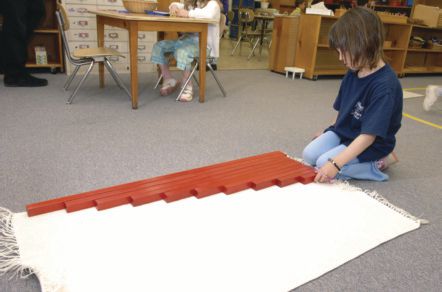
The Red Rods (above) are a series of ten rods (thin rectangular prisms) of which the height and width are uniform; however, they range in length from 1 decimeter (10 centimeters) to a full meter (10 decimeters or 100 centimeters).
The child scatters the rods around her rug and looks for the longest.As each is arranged next to the others in a series, the child discovers the regular progression of length. The teachers introduce vocabulary: short, shorter, shortest; long, longer, longest.
The Red Rods are exactly the same dimensions as the Red and Blue Rods in the Math area, which help children learn to count by showing the growth of quantity as length, distinguished by alternating patterns of red and blue to represent each number.
The Knobbed Cylinder Blocks
The Knobbed Cylinder Blocks are a set of four naturally finished (unpainted) rectangular blocks of wood, into which have been cut ten cylindrical holes. Each hole is filled with a matching wooden cylindrical inset, fitted with a little knob on the top to make it easy for a child’s small hand to grasp and lift it out of its perfectly fitted hole.
Each set of cylinders is constructed to vary in a regular sequence by either diameter, length, or both. The children remove each cylinder in turn, carefully tracing its length and circumference and the depth and circumference of each hole with one finger.
Knobless Cylinders
Once all ten cylinders have been removed and placed on the rug, the children take each in turn and find the hole into which it fits perfectly, with the top of the cylinder flush with the top of the cylinder block. If they’ve made a mistake, the children can normally see it for themselves because all ten cylinders will not fit correctly.
The children quickly begin to challenge themselves by attempting to ‘see’ which hole is likely to fit the cylinder in their hand rather than trying to fit each into one hole after the other. After a while, they will begin to do the same exercise with their eyes blindfolded, relying on touch alone. When they are ready for a greater challenge, the children will mix the cylinders from two, three, or all four blocks together and try to fit them all into the corresponding holes.
The Knobless Cylinders correspond to the four Knobbed Cylinder Blocks. With this material, each of these sets is painted red, yellow, blue, or green. With no cylindrical holes, the children depend upon sight or touch alone to arrange the cylinders.
Children will sometimes work with both the Knobless Cylinders and the more familiar Knobbed Cylinders, finding the match between each brightly painted and unpainted cylinder in turn. By working with all four sets of Knobless Cylinders together, children discover all sorts of geometric patterns and progressions within the material.
Mystery Bag or Mystery Box
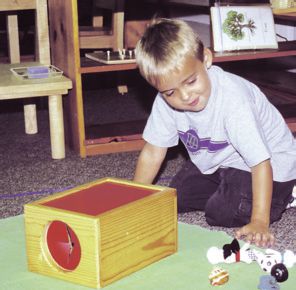
One of the children’s favorite activities is the Mystery Bag or Box (shown above).Normally, it is simply a cloth bag or box with a hole for their hands in which they touch and manipulate objects that they cannot see. One activity is to place things that are familiar to the children inside and challenge them to identify them by touch alone.
Rough & Smooth Boards
Another exercise begins with the Rough and Smooth Boards (shown above), which have a surface that alternates between the roughness of sandpaper and a smooth finished surface.The children wash their hands in warm water before beginning to make them more sensitive.
Sandpaper Tablets
The Sandpaper Tablets (above) are a set of wooden tablets covered with several different grades of sandpaper. The challenge is to identify pairs that have the same degree of roughness, working by touch alone. An extension of these activities is commonly created by assembling a collection of pairs of cloth swatches cut from many different materials, each with its own texture. Again, working with eyes blindfolded, the children attempt to find the pairs by touch. Like all Montessori exercises, there is a built-in control of error. In this case, the children learn to check their work by removing the blindfold and seeing if they have identified the correct pair.
The Color Tablets
The Color Tablets help the child learn to distinguish among primary and secondary colors and tones, while mastering the words used to describe each color and shade.There are three separate boxes of Color Tablets.All of the tablets have the same shape and differ only in color. The first box of Color Tablets contains six tablets, two each of yellow, red, and blue. The children simply match the pairs and learn the spoken names of the colors. The second box of Color Tablets contains eleven pairs of secondary colors and tones, which the children match and name. The third box of Color Tablets contains seven different shades of nine different colors, which the children learn to sort in order from lightest to darkest shade.
When all of the tablets are laid out in an array it creates a lovely display of color. There are many ways in which the children and teachers can make the color tablets more challenging.For example, the children will try to find the tablet that is closest in color to something in the environment. Another challenge is to give the child a color tablet from the third box and ask him to go to the box and, by memory alone, bring back the tablet that is just one shade lighter or darker.
The Smelling Jars
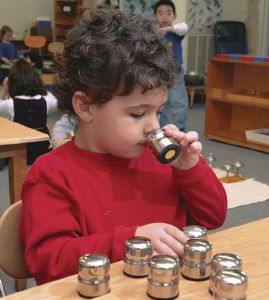
Children enjoy using the Smelling Jars to learn to identify different non-toxic smells using their olfactory senses. Typically, aromatic oils or extracts (such as lemon or peppermint) are placed inside the canister (using a cotton ball and a few drops of oil). Other cannisters might contain spices, such as cinnamon.
The Sound Cylinders
The Sound Cylinders are six pairs of sealed containers filled with substances that make distinct sounds when shaken, such as beach sand or dried peas of different sizes. The children carefully listen to the sounds and match the containers that have the same sound.
The Geometry Cabinet
The Geometry Cabinet is a set of puzzles made in the shapes of the essential plane geometric figures. It consists of six drawers, each of which is fitted with several wooden frames, inset with a geometric form. In addition to the familiar circle, square, and rectangle, the child is introduced to a much broader array of complex figures, from the right scalene triangle to the decagon; and from ellipse to the curvilinear triangle through the quatrefoil.
In addition to removing the pieces and replacing them in their frames, children sequence some shapes by size and classify other shapes by type. They also learn how to match them against three sets of printed cards that represent the same figures in increasing degrees of abstraction. The first set represents each shape completely colored in on the card in the same size as the piece from the cabinet. The children simply cover each card with the matching puzzle piece.
In the second set, the geometric shapes are printed as outlines drawn with broad lines that leave the inner area white. In the third set, the figures are simply traced with thin lines. As children gradually begin to recognize the more abstract representations of the three-dimensional objects, they are preparing themselves to recognize the little lines and squiggles of the written word.Gradually, children learn the names of each of the geometric shapes. Once children begin to read and can verbally identify the shapes, they begin to label them with pre-printed name cards. Eventually, the children will be able to prepare their own cards from scratch.
The Geometric Solids
The logical basis for the Geometry Cabinet is the set of Geometric Solids. The children learn the names of these beautiful wooden forms, identifying them, at first, by sight and eventually when blindfolded.
The set includes a sphere, cube, rectangular prism, a square-based and broad pyramid, triangular pyramid, ovoid, ellipsoid, and a cone. The children quickly begin to look for each geometric form in their environment. They also begin to discover the relationship between the two-dimensional figures and the solid forms: a circle is related to a sphere; a square to a cube; etc.
As they begin to read, children will learn to match Geometric Solids to a set of prepared label cards. Eventually, they will be able to prepare their own. This early introduction to geometry continues in the Elementary Montessori program. After years of hands-on experience with geometric figures and other mathematical exercises, children normally find it very easy to grasp more advanced concepts, from the definitions of geometric terms to the calculation of area, volume, and circumference.
The importance of puzzles in the Montessori approach
This young child is working with a Number Puzzle
Everyone who has worked with young children, whether a parent or teacher, knows how much they enjoy wooden puzzles; however, most of us take puzzles for granted and fail to appreciate their hidden potential as an educational tool. The puzzles that we commonly give to young children depict little animals or cute scenes.
Dr. Montessori came to recognize that the attraction of fitting the pieces of a puzzle into the insets on their frames lies in the process of manipulating an object in all directions and finally discovering the one and only correct way that it will fit. There is more to all this than simply the satisfaction of solving a puzzle. Somehow, we find that young children experience things that they can touch and manipulate quite differently from a picture of something printed on a piece of paper. In short, the positive and negative insets of a puzzle are much more real and interesting to a child than a simple two-dimensional picture.
In the Montessori classroom, puzzles are not only used to help children learn to manipulate objects and assemble a complex whole from several parts; they are used to introduce children to a tremendous range of concepts and vocabulary, from geometric shapes to the countries of the world and the parts of a Flower.
The Binomial & Trinomial Cubes
These cubes are two of the most fascinating materials in the Montessori curriculum.At one level, they are simply a complex puzzle in which the child is challenged to rebuild the cubes and rectangular prisms contained in the box back into the form of a larger cube. Color coding on the outside of the box and the sides of certain pieces helps the child detect the pattern. The material is also an exercise in algebra and geometry, representing in concrete form the cube of a binomial (a+b)3 (above left) and a trinomial (a+b+c)3 (left) where a=2 cm., b=3 cm., and c=4 cm.
A Trinomial Cube
Editorial Note: The materials described on these two pages may not seem to the layperson to be Sensorial in nature, as much as algebraic or geometric.They are, however, included in the Sensorial curriculum, because this is where they are introduced to Montessori students in the early years.
The Constructive Triangles
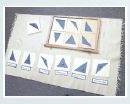
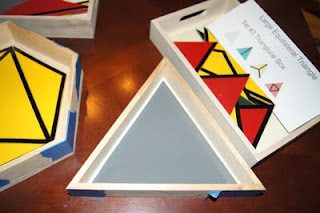
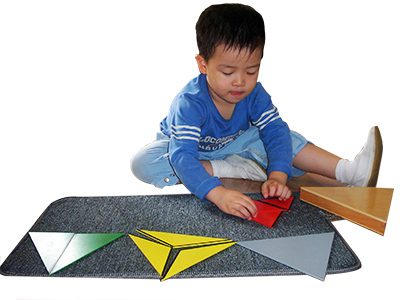
The Constructive Triangles allow children to explore the geometric possibilities inherent within several different types of triangles. The material consists of six boxes, each of which contains a set of brightly colored, flat wooden triangles, which can be manipulated like a puzzle to explore congruency and equivalence. For example, two right triangles joined together along the hypotenuse form a rectangle. To help the young child recognize the essential relationships, most of the triangles have a line drawn along those edges that join together to form new figures, such as rectangles, squares, trapezoids, and polygons. Working with the Constructive Triangles, children explore how various triangles can form regular polygons in geometry.
by Subash Lama | Archived Issues / Montessori Leadership, Infant-Toddler (0 to 3), Language & Reading, Montessori Education, Outdoor Education / Resources, Planes of Development, Reading, Sensorial, The International Montessori Council, Writing
NOTE: This is a peak into a developing Montessori school in Nepal in their own words. You may find things in this school that are similar to your school and others that sound distinctly different. There are many threads within the Montessori tapestry.
About the School:
Toddlers International Pre-School was established in 2012. aiming for the overall development of children through the Montessori System of Learning. It is located in Anandpur, Boudha-6 in the suburbs of the Kathmandu Valley, away from the noise and pollution of the busy city life. The pre-school is managed by a professional team, including people coming from different backgrounds and having deep experience and broad knowledge in the domain of Montessori education and management. Toddlers International Pre-School has been a member of the International Montessori Council (IMC) since 2014. More than 100 students have been enrolled since its establishment. The school operates from the Nepali month of Baishakh (mid-April) to Chaitra (mid-March) except on public holidays.
Toddlers International Pre-School has an affordable fee structure, quiet and peaceful environment, state-of the-art classroom and Montessori-based teaching materials. We provide healthy and hygienic food, and pure drinking water, as well as regular health check-ups and excursions for the overall development of the children.
Furthermore, the activities of all the students are updated on our website on a regular basis. Parents can check on their children’s development from the comfort of their home or office.
MISSION AND PHILOSOPHY
Our mission is to provide exceptional care to children while fostering each child’s intellectual, social, physical and moral development in a Montessori-based environment.
We believe the core skills needed for a successful, productive life are learned and enlarged by the time children leave pre-school. Learning, communication, emotional and interpersonal skills are developed during these formative years. In a safe and caring environment, we nurture each child so that he or she will become creative, intellectual, social and independent. Therefore, we focus on stimulating each child’s innate craving for knowledge, keeping in mind the fact that each child is special with his/her own sets of talents and needs.
In Montessori education, we allow free activity within a ‘prepared environment,’ meaning an educational environment tailored to basic human characteristics, to the specific characteristics of children at different ages, and to the individual personalities of each child. The function of this environment is to help and allow the child to develop independence in all areas according to his or her inner psychological directives.
Safety and security is the highest priority at Toddlers International Pre-School. We have administrators visit each room at least hourly to visually and verbally monitor the safety of all children in each classroom. Rooms are purposely designed to accommodate at least two teachers. There are provisions for sick room and nap room.
TEACHING METHODOLOGY
Teacher, child, and environment create a learning triangle. Our classrooms and Montessori labs are prepared by the teacher to encourage independence, freedom within limits, and a sense of order. The child, through individual choice, makes use of what the environment offers to develop him/herself, interacting with the teacher when support and/or guidance is needed. This ensures that each child’s identity and talent is secure and encouraged.
Children are exposed to a wide variety of experiences to expand creative thinking and make each day exciting. Programs offered by the school are participatory, with an emphasis on independence; freedom within limits; and respect for a child’s natural psychological, physical, and social development.
Our curriculum includes:
Language development
Social and emotional development
Reading
Art
Music
Small/big motor skills
Dance
Garden visits
Excursions and more.
What makes us special is that we do not take tests for the sole purpose of testing knowledge. We believe that a child shouldn’t be pressured into learning. We do take three evaluation tests to let parents know about their child’s journey ahead. However, there will be no marking in such evaluation tests.
We have special programs to instill in children skills and knowledge that they need to live harmoniously in society. We do so by teaching them the significance of every festival and public holiday that we have. We believe that learning one’s culture is a way of learning religious tolerance, harmony, and respect. With this in mind, we celebrate each festival (such as, Saraswati Puja, Eid, Dashain, Christmas, Buddha Jayanti, etc.) in a way that children can understand and learn.
All these activities are updated on our website so that parents can better understand their child’s learning processes. Parents are encouraged to make comments and suggestions on such activities. The school management will act upon them immediately.
A typical day at Toddler’s:
Assembly time
Circle time
Classes (various subjects)
Free play
Lunch time
Montessori lab
Garden visit
Arst and Crafts
Singing
Dance classes
Montessori Leadership/ Sept 2017/ Pg 30
by Georgina Hood | Infant-Toddler (0 to 3), MFA, Montessori Parenting, Psychology, Sensorial
In recent years, extensive neuroscience research of this age range has proven the importance of providing stimulating resources, opportunities, time, and space for play.
Through many years of research, it has been proven that providing sensory play for children is an essential part of their development. This type of stimulation makes connections in the brain, develops memory, and assists learning through multi-sensory emphasis. It also encourages discovery, problem solving, health and well-being.
The Sensory Stages are divided into three areas:
- Treasure Baskets / What is it?
- Heuristic play / What can I do with it?
- Further development /What else can this be?
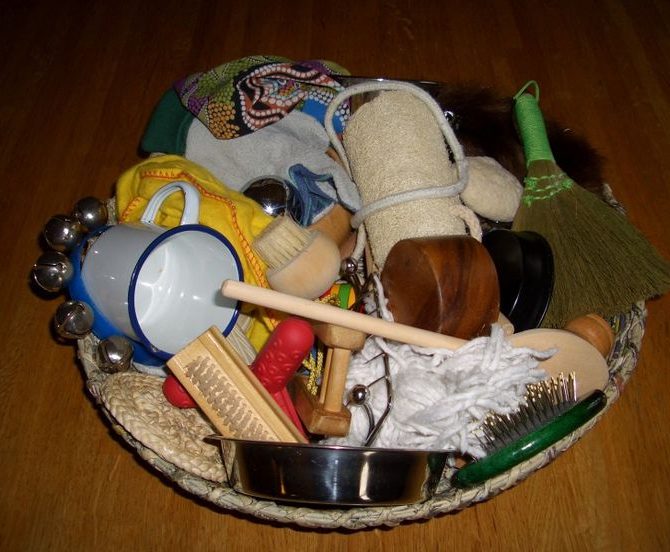
Treasure Baskets were developed by Elinor Goldschmied in the 1940s and were traditionally designed, in their purest form, for the infant who is sitting but then moves to walking (6 – 12 months). This round basket includes 40 – 80 natural objects and offers the child texture, color, shape, weight, sensory interest and play value, with safety paramount at all times.
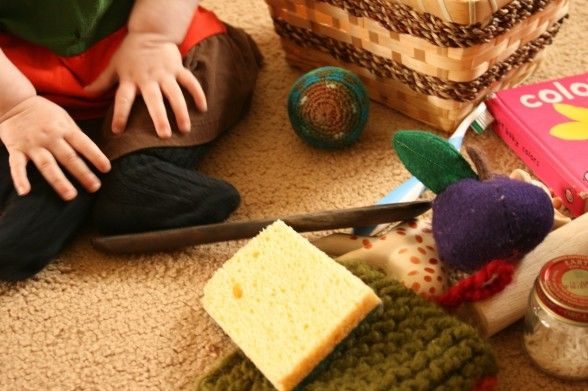
The objects include natural items (such as: sponges, chestnuts, feathers, and pebbles, as well as objects made from metal, wood, wicker/bamboo, and pottery.) The items are not ‘bought’ toys or plastic; they should be washable, and most are common in everyday use by adults. The adult should feel confident about the items in the Treasure Basket,ensuring that anything they deem unsuitable is not included.
When introducing a Treasure Basket to the seated infant, it should be placed to the side or in front of him/her. This type of play is entirely child led; they will initiate their explorations by themselves and for themselves.
During this named time, the adult sits supporting them, observing at all times; however, the adult should resist the temptation to constantly offer comments, questions, or lead with their own ideas about how the baby should play with the objects in the basket. Through choosing, sucking, waving, handling, and banging these objects, infants will concentrate their attention for considerable periods of time, often up to one hour.
In recent years, extensive neuroscience research of this age range has proven the importance of providing stimulating resources, opportunities, time, and space for play. Babies are now commonly portrayed as sensory beings with incredible capabilities.
There are endless benefits of introducing Treasure Baskets to babies. They develop concentration, independence, confidence, fine- and gross-motor skills, hand/eye co-ordination, and logical reasoning. They also encourage language development, communication, social skills, creativity, and imagination.
The purpose of the collection of items in the basket is to offer maximum interest through:
- Touch texture, shape weight
- Smell variety of scents
- Taste limited scope but possible
- Sound ringing, tinkling, banging
- Sight color, form, length, shine
By 12 – 18 months, most babies are on the move and are developmentally ready for a further challenge. Heuristic play offers children of 12 months – 3 years the opportunity to play with lots of similar objects, including collections of bangles, bowls, balls, chains, or poms poms. The extensive range of materials offers the child open opportunities to investigate and are laid out in the form of a market stall. They explore the ‘cause and effect,’ (i.e: What can I do with it?) and through simple object categorisation, the child’s sensorial experiences are increased. Heuristic play enhances the child’s social interaction, and they experiment, share, take turns, and consider the needs of others.
In some nursery settings, the treasure basket idea has been expanded into interest baskets, which are usually a collection of similar objects, for example: collections of balls, bangles, or chains. Alongside the interest baskets, the adult may also provide activity cards for the children, if suitable.
In 1988, I founded Paint Pots Montessori Schools and Creative Classes, and my interest in Treasure Baskets grew when I had my first child 17 years ago. The first Paint Pots Treasure Baskets class was introduced a few years later and, to this day, is a cornerstone of what we do. We continue to offer infant classes, creative workshops, and Montessori education for children from birth – 6 years. The classes are a gentle introduction to parents as they embark on their Montessori journey.
I get great enjoyment from working with mothers and babies, and during these unique classes, they are introduced to Treasure Baskets, Heuristic Play and music, with guitar and voice. It is an amazing privilege to see so many families, who initially started attending my baby class and have progressed into one of our schools at Paint Pots.
When introducing music to the babies, they are each given a basket, similar to the Treasure Basket. Each basket initially contains one small egg shaker and builds up with a variety of instruments and props, introduced as the session progresses. The music session finishes with the child having a full basket of props and instruments and everyone singing the goodbye song.
Alongside the creative classes and the Montessori schools, I also offer parenting classes, where the focus is on using creative development to empower parents and enhance their understanding, knowledge, health and well-being.
In recent years I founded Heart Montessori and this International consultancy grew out of the experience and knowledge that I gained over two decades of research and practice in Montessori settings. I regularly speak at workshops and training sessions in locations, including Jordan and China. I am very excited to be leading a workshop at the Montessori Foundation’s Annual Conference “Peaceful Classrooms, Peaceful Children, Peaceful Schools” in Florida this November.
For over 17 years, I have introduced Treasure Baskets and Heuristic Play to many families and I believe that my approach achieves an ideal balance between the academic, social, and psychological development of the child and the adult. Whether it’s working in the class with children, parents, or teachers, my aim is to leave an imprint of care and creativity.
Tomorrow’s Child / September 2014 / p 35
by Greg Hicks | Mathematics, MFA, Montessori Education, Montessori Materials, Primary (3-6), Sensorial
It was Plato who said,
Geometry is the experience of the eternally existent. The study of the ‘One’ is among those that lead the mind on and turn it to the vision of reality.”
This is the basis of the sacred work of geometry. It is the study of the universe, the world we live within, and our interconnected relationship with it. It is called ‘sacred’ not because it adheres to a specific religious or spiritual ideology but, rather, because it offers the practitioner a way to appreciate the world with wonder and to explore life’s most fundamental questions. This is done through physical means, through the practice of geometry. Maria Montessori shared in this vision of geometry in speaking of, “the reciprocal relationship between man and the objects of the environment.”
It is this geometric exploration into the interconnectedness of the universe and themselves that truly speaks to the child. Children look upon the world to explore, discover, and reveal who they are: psychologically, emotionally, physically, and spiritually. This happens through their interactions with, and observations of, this relative, physical world. It is in this pursuit that sacred geometry entices the child. It offers the child a spiritual exploration through physical means, that guides and leads the child to the mystical wholeness they find within their own hearts and minds. In the child, Sacred Geometry fosters wonder, keen observation and a holistic understanding of the universe and the environment where they live.
It begins with the study of the ‘One,’ as Plato suggests. This is shown through the circle.
Children will find delight in using the compass to form all sorts and sizes of circles. The circle manifests as the image of oneness and is well represented in the art and architecture of the world’s great spiritual traditions, as in the “O of Giotto,” the Zen “Enso,” or in the stained glass of the famous Chartres Cathedral in Paris, France. Through the meditative practice of creating the circle, and reflecting on it, the image of wholeness is reflected back as the child’s own completeness.
The child then discovers how the ‘One’ becomes two. This is represented through creating an exact emanation of the original circle, formed on the circumference of the original. This precise emanation creates the birthplace of geometric shapes, the coming of duality and the construction of the world as we experience it.
This space, within the intersecting points of the two circumferences sharing the same radius is called the “Vesica Piscis,” or “Bladder of the Fish.” The “Vesica Piscis” holds the pure creative potentiality of the universe. It is at this point that children’s creative energy will flow freely and their minds are “turned to the vision of reality” as they discover the many shapes, images and artwork that arises within the “Vesica Piscis” and, ultimately, from the original circle or oneness.
They discover a line and its division, the constructive triangle, the manifest square, rectangle, and the many polygon constructions. Children’s sensitive periods for imagination are stimulated and come to life as they construct and observe each shape and experience the structures of the world. The child finds familiarity in these shapes through observing their environment and within themselves.
As children continue creating polygons within the original, with more and more sides through the bisection of the constructive triangles, they find something quite extraordinary: the many has returned to the “One.” How is this possible?
We experience it in geometry as the polygon slowly becomes the circle again, as more and more sides are added to it. The child might even say, “Look, it’s becoming the circle again!” But how does the “eternally existent” manifest in our own lives? This is the real question of Sacred Geometry and one for each of us to discover through our own practice, as the child does quite naturally through concentrated work. (Please note that this is a very brief introduction and overview of this topic and process, and is in no way meant to be taken as an exhaustive account.)
Each step along this geometric journey affords the child the opportunity to realize something about themselves and the environment in which they live. This ultimately manifests in beautiful artwork and mandalas that the children create from the spark in their heart/mind. Not just artwork on paper but the beautiful artwork of their being.
It is important that children are able to discover of their own accord and not be told what they might find or experience through this work. While this description is quite abstract, the child’s experience is real and actual and devoid of such unneeded intellectualizing. Any such explanation would only serve to diminish the child’s interest and wonder.
The study is also one that will take time and patience. No specific timeline should be set, it will come when it is ready. Some guidance on the process is all that is needed; a direction into the use of the compass and straight-edge and how to create the basic constructions is helpful. This is truly a journey of self-exploration and it is through the child’s self-discovery that Maria Montessori’s vision of peace in the world becomes a reality of humankind’s future.
Now, for the Montessori guide, the practice of Sacred Geometry leads us into our own inquiry. It offers us a medium for the internal work and preparation necessary to follow and guide the child with fresh eyes; within our classrooms and in the world. Working with the compass and straight-edge, we find a meditation on the building blocks of our life. Like the child, we begin with the circle and move step-by-step. We encounter our edges as we bump up against our own challenges. We must learn and practice patience and focus as we come to the work each time.
It gives us insight into the child’s challenges as well, as we realize our own limitations. Perhaps we notice our own insecurities in our ability to create the work as we would like. Or, we struggle with our desire for perfection, and with our comparisons to others. Ultimately, through practice, we come to see the shapes as complete as they are and realize that we, too, are complete as we are.
As we gaze upon these shapes and observe our world, we see that geometry is everywhere; it is this life itself and in and through each and every one of us. It is nature and the whole of the universe. Like the child, we discover things about ourselves that helps us appreciate our children and the wonder they experience in the world.
I encourage each and every one us to join in this exploration of the fascinating and awe-inspiring practice of Sacred Geometry. Learn and guide your children in how to utilize the geometer’s tools, the compass and straight-edge, to create inspiring geometric works, and take a personal journey of self-discovery, as we explore the structures and building blocks of the world in which we live.
Tomorrow’s Child / Sept 2016 / p 9
by Tim Seldin | Montessori Materials, Montessori Teachers, Primary (3-6), Sensorial, The International Montessori Council, Video, Webcasts / IMC, Webinars / MFA
This week, we will take a look at that most iconic Montessori material, the Pink Tower.:
What is it?
How is it used?
What does it teach?
Why is it pink?
What about all of those variations and extensions? Where do they fit in?
by John Long | MFA, Montessori Education, Primary (3-6), Sensorial
His hands were stretched far apart, but not all the way to the ends of the red rod, the longest one of a graduated set of ten. He walked with the slight wobble of a three year old as he carried the one meter long rod across the classroom. He stopped to wait for two older children to move so that he could maneuver past. He navigated around several rugs that were laid out on the floor to define the work spaces of other children. Finally he came to the shelf where the red rods are kept and he carefully laid down the one he had been carrying. He headed back to his own work rug, walking carefully across the classroom, to get the next rod, and the next one, carrying them one by one until all ten were returned to the proper place on the shelf.
Montessori education is movement education. This young boy was spending a long time moving purposefully from one side of the classroom to the other. The movement was careful and controlled – exactly what is needed by this young boy as he refines both his ambulatory powers and the awareness of his own body in space. Grace and courtesy guide him even as he furthers their development within – the respect for the activity and the space of his classmates guides him around their work rugs (rather than marching across them or leaping over them).
The ten trips back and forth to the shelf indicate that the characteristic of repetition is fully alive in this young one. That he carried suceedingly smaller rods each time gives evidence of his sense of order. The Montessori primary classroom assumes these characteristics in the young child and utilizes them to aid the child in the natural course of development as he builds himself physically and cognitively.
Why ten rods rather than five or nine or twelve? Many of the Montessori sensorial materials, the ones that appeal to the youngest children in the primary classroom, come in sets of ten. As the children work with them, they build up at an unconscious level, a muscular memory of the number ten which is the foundation of our decimal number system. The Montessori materials designed for both direct and indirect purposes.
What about vocabulary enrichment? This young boy will have a powerful sensorial experience of long, longer, longest, short, shorter, shortest – the specific vocabulary tied to this lesson.
Who chose this work? He did, though his teacher had introduced it to him because she knew he was ready for it, in the sensitive period for work with this kind of material. In choosing the work for himself, he is developing the will, his future ability to act, to operate with self-direction. And by the time the last rod had been returned to its place on the shelf and the rug rolled up an returned to its basket, he had work for far longer than most of society dares to expect from a three year old, and at the same time, experienced the beginning, middle and end of completing work. These are lessons that show up as subtle lessons in character development — the kinds of results that lead parents to observe, “Montessori kids are different.”
Yes, they are. And those differences are rooted in the work of the very youngest children – long before obvious academic work begins.
We want to once again thank John Long and the Post Oak School for allowing us to republish John?s wonderful essays in Tomorrow?s Child and in our online resource collections.


 With a fast-paced society that often turns to medication for ‘quick fixes,’ we often perpetuate stigmas and neglect to consider all information prior to making diagnoses. As a psychologist and a mother, I know all too well how difficult it is to watch children struggle to find their way in classrooms that work to produce (and support) other “neurotypical” children.