by Margot Garfield-Anderson | MFA, Montessori Administrators, The International Montessori Council

I’m an experienced international traveler. I’ve traveled around the US and overseas for work many times. I am an organized person and pride myself on my time-management skills. I organize international travel for people coming to the US as well as going overseas. I’ve accompanied children on international excursions. These are just the facts, yet, I never stop learning from these adventures because somehow, something usually happens along the way that I hadn’t anticipated. So, I thought I might share some of these experiences with our members to help make traveling a tiny bit easier, should you encounter any of the following situations yourself, because let’s face it, the glamorous days of travel are long past. Most of us are road warriors, and traveling is a necessary part of how we do our jobs.
Passports and Visas
These are government-issued documents, and each country and region has a different requirement you will need to investigate before planning a trip overseas. Passports need to be renewed, and names must match exactly how they appear on your tickets (plane or train).
As of recently, many countries will not allow you to travel if your passport is within 6 months of needing to be renewed.
Allow yourself plenty of time to get renewals or name changes done. When you post out your documents, you are usually required to send the version of the passport you have in hand. Spend the extra money to send this using a traceable method, because we all know the expression, the check is in the mail, right? You want to know you can track those documents.
Visas are often needed to be able to travel from one country to another. Hong Kong, for instance, is a free port and generally very easy to get in and out of with no special visa unless you are coming from a country such as Nigeria. Several of the IMC members from Nigeria, who had planned on coming to our conference in Hong Kong, ran into great difficulties because Hong Kong doesn’t even have a custom’s office here, and Nigeria does not have an embassy presence either. So, before you book your tickets or pay for a conference, you need to learn about visas and passport details way in advance.
In another instance, a foreign-exchange student here in the US was on a class trip to another country. When they reached the airport, it was determined that a
special visa was needed for this student to leave the US and travel abroad. If you are taking children on class trips abroad, it is usually the parent’s responsibility to provide the school and organizer with any kind of special visas, so let them know well in advance that they need to get that paperwork into the school so that someone is not only not disappointed but, potentially, turned away.
Finally, I always recommend that you take a color photocopy of your passport on your trip with a duplicate copy of your passport picture and have it stored safely away from your passport. In the event that your passport becomes lost or stolen, you will be able to get a replacement with a lot less difficulty having these back-up items with you in hand.
Plane Travel
Unless you are able to afford an upgraded seat, international plane flights are generally not terribly comfortable. Being crammed into that tiny space for long periods of time is not only uncomfortable but can be detrimental to your health. Here are some of the best tips I can offer up to aid you.
Invest in compression socks. They are readily available and have come down in cost over the years. They help with circulation and just feel as if your calves are getting a mild massage.
Buy a bottle of water with electrolytes before boarding the plane. This will help with leg cramps and keep you nice and hydrated, which is essential in lessening jet lag.
Avoid the salted peanuts. Bring your own snacks that are low in salt so you aren’t retaining water.
Stretch your legs. If you are able to stand and walk in a plane, try to get up and stretch your legs through out the flight. If you are like me and can’t walk during flights, you can do all kinds of leg extensions flexing your calves and feet to help get your circulation going throughout the trip.
Invest in a good set of earphones. Airline versions have terrible sound and most overseas planes have hours worth of free entertainment to pass the time. Even if you never turn on the system, a good pair of noise-reducing headphones may aid you in getting some sleep without the background noise.
Bring some hand sanitizer or wipes along with you. I read that the magazines in the plane are the biggest germ-carrying items because people often put their fingers in their mouths before turning a page and this leaves germs all over the magazines. You may want to give it a wipe down before you start reading.
Currency Exchange
If you are left on your own to get from an international airport to your lodgings, remember not all country’s transportation systems use credit cards; local currency will be important. Don’t change a huge amount, but have what you think you will need on hand before leaving.
Those kiosks in the airport are not the best place to exchange funds. Neither are your local banks and, in fact, it may take a local bank 24-48 hours to get your currency. Before leaving on our trip to Hong Kong, my bank told me about a place that gave a better exchange rate than any bank. The company is called CXI, and in Florida, for instance, it’s called Florida Currency Exchange. They had a coupon for 50 percent off their fees, which were very reasonable to begin with and if you keep your receipt and have money to convert back upon return they waive that fee altogether. And, indeed, the exchange rate was significantly better than the bank or airport kiosks.
Most credit card companies are waiving international transaction fees, so check with yours to make certain they do as well and, if not, you may want to consider changing companies in favor of one that does.
Using a credit card for all your purchases while away makes a lot of sense. Besides the fact that the exchange rate is based on the day’s listing that it posts, you have a trail of purchases in the event your luggage doesn’t make it home, and all your gifts and supplies for school are in that bag. Having just experienced that issue on the way home from Hong Kong, it made it that much easier to have everything on the credit card detail to provide the airlines with proof of purchases.
Lost or Stolen Luggage
It happens. As I said, my luggage was stolen on the way back from Hong Kong (during my inside-the-US portion of the trip, no less). The bag was a generic black suitcase and yet it had my nametag on it. But, from now on, I’ll not sneer at all colorful suitcases or funny luggage tags that help people identify their property. I’d also recommend that your name and address information are taped to the inside cover of a suitcase as well just incase the tag on the outside comes off. And, above all else, keep your checked luggage-claim tickets. Long gone are the days when there was someone checking those tickets before you could leave the airport!
It is most important that you notify the police right on the spot about an incident, so that they may look at airport surveillance tapes and, perhaps, spot your luggage. Again, having something very distinguishing about your luggage may help them identify it.
Many police departments are now having you file online claims. Do it right away so there is an official report with the police as well as the airline’s luggage department. Did you book your business trip through your company-issued credit card? They are in line after the airlines for placing a claim and often will work in conjunction with the airlines so that your indemnification doesn’t exceed the value of the loss. In our case, our corporate credit-card policy will only give us a credit on our statement for the excess value of the claim and not
reimbursement in the form of cash
or check.
Trip Insurance
If you are going to purchase trip insurance, remember that premiums are, in part, determined by your age. It also can be written to only cover losses due to illness or death and may exclude loss of personal property altogether. Be certain that when you shop for trip insurance you are buying what you think you will need. In my situation, the trip insurance did cover loss of personal property, so I had a third provider from which to collect.
Another colleague missed her flight, and the trip insurance did not cover the cost of the flight regardless of reason. Again, it’s that fine print you want to read.
Special Dietary Needs
Thankfully, more and more consumers have made their dietary needs known, and some of the airlines are taking notice. I called our international carrier’s customer service line when I booked our flights. Both Tim Seldin and I avoid wheat and gluten, and since we’d be served three meals on each leg of the journey, I was able to make sure our meals were at least gluten-free. As a matter of fact, our meals were served first, and, even if our trays were in the up position, our meals were left for when we woke up. It’s worth investigating.
While overseas it may be worth it to you to find out how to ask for gluten-free or other dietary needs in the language common to the area and carry around a card with this phrase on it so when you go to a restaurant you will be able to communicate that need. Gluten-free is not as available in many countries and just starting to make a presence.
How to Communicate While You Are Abroad
Not all of us have global mobile phones. Most of us these days do carry smart phones. There are apps available that will let you call and text for no additional charges or no need to swap out a phone with a rental. We used a free download program called Viber™ while in Asia. It worked better than other programs, as long as we had our phones on wifi. If you use it without wifi, you will get charged the roaming fees, which are huge.
On this last trip, some of our group went to Mainland China to do some training. While the trainers’ spouses had copies of itineraries, they were back in the US. Although I was the organizer of part of the trip, I did not have a copy of the itinerary. I felt that I should have had this information (just in case) and will never leave that one to chance again. Since the Mainland comes under a different set of controls than Hong Kong, getting in touch with them was virtually impossible, and I did not like that feeling one bit.
Finally, do not be embarrassed to wear a fanny pack. OK, it doesn’t have to be the size of a piece of carry-on luggage but having a secure place for passport, some cash, emergency items on your person, that you can tuck under a shirt or sweater so that it’s not easy pickings could help prevent some very unnecessary stress in your travels. Be ever aware of your surroundings, be present, and safe travels.
Margot Garfield-Anderson has worked for the Montessori Foundation in a number of capacities for over 15 years. She is the organizer and co-ordinator of the Montessori Foundation’s Annual International Conference.
Montessori Leadership/ June 2015 / pg 18
by Kathy Stenger Marcus Brutlag Larry Cecio | MFA, Montessori Administrators, Montessori Education, Montessori Family Life, Montessori Middle School, Montessori Parenting, Montessori Teachers, Parent Education, The International Montessori Council
For many families facing the transition from elementary to middle school, a common belief persists that it is time for the fish to enter a bigger pond. This has indeed become the norm in the path for most American adolescents, continuing their social development by navigating the open waters of traditional middle school. Although largely accepted as the natural step for adolescents, as they begin to yearn for more freedom and responsibility, mounting research and experience continue to question the social environment of traditional middle school and the timing of this transition.
As educators and parents who have directly witnessed both paths, we wholeheartedly support taking a deeper look at the social factors when deciding between traditional and Montessori middle school. Greater concentration on how we swim and the water we swim in is proving more influential than the size of the pond and a highly beneficial developmental step before venturing into larger and uncharted bodies of water.
There is no questioning the inherent urge for increased independence and emergence into a larger social setting among early adolescents. This desire serves as necessary motivation for the acceptance of responsibility and greater maturity. It is important, however, to differentiate this desire from actual readiness for this transition. The perception and self-awareness of an adolescent is, by definition, still in development.
This is a time when a child’s brain is going through the most changes since infancy. For the most part, traditional middle school gives little attention to these still developing social abilities and assumes preparedness for a large relinquishing of guidance; however, a Montessori environment is not only socially in-line with adolescent concerns and interests, but also actively addresses and embeds social awareness into the programming and curriculum. With smaller, more communal Montessori middle schools, what is often perceived as a social ‘sacrifice’ is, in actuality, a more fitting and potentially enriching social experience.
We are a collective of teachers, fascinated with educational research and encouraged by the findings on the outcomes of a Montessori adolescent education. We have consequently created an environment that fosters the ability to live in relationship with others and work through human problems, to experience what it means to make a contribution, and to recognize human interdependence and the need to cooperate. We aim for graduates to go to the next level equipped with a social consciousness, understanding the benefits of an active role in society, balancing individual needs with communal ones, and appreciating the value of rules and their importance for harmonious living. Even before espousing the research on the effectiveness of these pursuits, we have already seen, first hand, the development of these skills within our own program.
The beauty of jumping into the role as creators of Village Gate Middle School is that it has given us the opportunity not just to read about, but to experience, what it means to guide adolescents in the way Maria Montessori envisioned. What we have witnessed has, quite gratifyingly, corresponded brilliantly with the empirical data found through our research. One of numerous anecdotes of our students’ successful social dynamics has come in the form of play. For a while, a couple of boys wanted to play wildly crazy imaginative games; a few others wanted to play structured group games; and the girls would rather just wander the playground and observe for the most part. Now, through guidance, patience, and trial and error, the group consistently plays, most often in some sort of combination of the above. They love basketball, and recently kickball, and they give the games their own rules to add the necessary silly quotient. They also break out to sit and watch when they feel like it. All of this happens fluidly with disputes handled quickly and respectfully, with encouragement given whenever necessary.
Montessori’s focus for secondary education as a “school of experience in the elements of social life” (Kahn) is echoed in David Hutchinson’s principle of developing a “spirit of place” for adolescents. This spirit of place is “rooted in community relationships” and defines place as “a community to which the adolescent feels he or she both belongs and contributes” (Kahn).
We have seen that our students have learned to be in relationship with each other. Each does his or her part to work through disagreements and hurt feelings, building on peace table skills carried with them from elementary but now taking on conflict resolution with a more sophisticated and nuanced dialogue.
They feel their interdependence deeply, aware that without every member’s cooperation, no compromise can be reached. As a result of our close classroom community dynamic, they have become autonomous in reaching agreement. It is now far more effective to leave the room and permit the kids to figure out a new classroom arrangement or daily schedule than to stay and try to lead them. Through early guidance and encouragement to stay committed to the community, the fruits of responsibility and accountability are nourished within this interdependent social landscape, where each is finding a healthy place and role.
The benefits of developing a personal sense of place and importance at this critical age cannot be touted enough. Self-esteem is based upon how children view themselves within an environment, so to be placed into an uncontrolled arena without the tools or guidance to navigate their way seems counter intuitive to nurturing this valuable element of development. Susan Harter presents this conflict in her article “Self and Identity Development,” a contribution to the Harvard University Press publication, At the Threshold: The Developing Adolescent.
Findings suggest that self-esteem begins to decline at age 11 and reaches its low point between the ages 12 and 13. As our prototypical adolescent recounts, she changed (“I felt terrible”) when she went to junior high school. The extent of change depends, in large part, on shifts in the school environment, as well as on pubertal change. Children making the shift to junior high school in the seventh grade show greater losses of self-esteem than those who make the school transition later, after eighth grade. Moreover, students making the earlier change, particularly girls, do not recover these losses in self-esteem during the high school years. A development-readiness hypothesis has been proposed to explain this pattern, suggesting that children can be thrust into an environment before they are psychologically equipped to deal with the social and academic demands of the new school structure (Harter).
Middle school is simultaneously a time of self-discovery and expression and a time of increased pressure to conform. The result is that adolescents feel intense discomfort and ambivalence about revealing their burgeoning personalities. The goal, therefore, should be to create a place where students feel at ease exploring who they are, able to take risks and try new experiences,
all the while being seen and accepted by a supportive community.
Researcher and writer Kevin Rathunde also supports the Montessori environment as conducive to not only adolescent academic development but social as well. Rathunde, in association with The NAMTA Journal (North American Montessori Teacher’s Association), has conducted extensive research on Montessori middle school. He explores the social context in a 2003 study, while looking at the roots of reports of negative experiences and lack of motivation from traditional middle school students.
The study points to three social findings:
- a growing distance in teacher-student relations at a time in early adolescence when adult support is crucial; fewer opportunities for meaningful peer interaction at a time when peers are becoming more highly valued; and
- fewer opportunities for meaningful peer interaction at a time when peers are becoming more highly valued; and a growing emphasis placed on one-directional communication (e.g., lectures, seat work, and viewing media) just as young adolescents are becoming more capable of more complex thought and communication (Rathunde 32).
- a growing emphasis placed on one-directional communication (e.g., lectures, seat work, and viewing media) just as young adolescents are becoming more capable of more complex thought and communication (Rathunde 32).
Montessori students expressed greater connections and support from their teachers, reporting that they felt that their teachers were fair and interested in them. This is most likely a result of the structure of the Montessori middle school program. The time the Montessori teacher has to observe and work with a given student is intentionally designed to provide this sense of security. Perhaps equally important is the drastically different social context Montessori and traditional students perceived with respect to their peers. While traditional students predominantly saw their peers as classmates, “Montessori students more often perceived their peers as friends-and-classmates” (Kahn 37).
Montessori groups are often structured by shared interests rather than students’ ability levels, and a significantly less amount of class time is spent in one-directional lectures. These are both elements that aid in forming closer relationships among students while engaged in work time. The Montessori work environment provides continual opportunities to participate socially and create community instead of delineating factions between class and social time. Group and class discussion and exploration are integral components of the Montessori classroom and serve as safe experiences for students to express their questions, concerns, and opinions amongst both trusted instructors and peers.
Our final piece of evidentiary support comes from a more general look at wisdom and how it is attained in a recent New York Times article, “The Science of Older and Wiser.” The ultimate aim of any educational journey is arguably to achieve wisdom, as wisdom is not only the possession of knowledge but the practice of applying knowledge as well as “maintaining positive well-being and kindness in the face of challenges” (Korkki).
In developing a socially equipped and happy student, we look to a few of the major tenets of wisdom offered by Professor Ursula M. Staudinger, including: “self-insight; the ability to demonstrate personal growth; self-awareness; and an understanding that priorities and values, including your own, are not absolute” (Korkki). Laying the groundwork for this type of wisdom is a foremost objective of our program and of a Montessori adolescent education because these are the skills necessary to live happily and contribute positively to a greater community. The social factor is at the root of our program, guiding the academic development since we see the two as absolutely inseparable.
The students within the Village Gate Middle School program take part in a heroic journey of self-reflection and discovery based upon Joseph Campbell’s universal archetypes. The journey requires students to recognize their personal challenges and to see how they not only influence their own lives but how these challenges affect the community as well.
The heroic journey recognizes the natural desire for each student to venture away from the comforts of home and into a larger setting, this being the call; however, this developmental construct also acknowledges that a right of passage must be undertaken to first ready oneself for this transition. Although the adolescent impatiently desires to enter the new setting upon receiving the call, it is the role of the “threshold guardian” to create an environment where the developing youth can test him or herself safely and to know when each trial has been met before incrementally opening each gate upon the way.
We must not forget our roles as the threshold guardians for our children. It is the role of the threshold guardian to help them recognize not only themselves but also the water that they swim within. Equipped with an understanding of the water and how they swim will enable them to find success and happiness no matter how big or small a pond they find themselves. This is the pursuit of the Montessori adolescent education: to provide an opportunity for our children to not only recognize their place within the greater community but to trust themselves to confidently forge their own path within it.
Montessori Leadership / June 2015 / p 14
by Dr. Maria Montessori | Maria Montessori, Montessori Administrators, Montessori Education, Montessori Teachers, School Leadership, The International Montessori Council
Editor’s Note: This is an excerpt from Dr. Maria Montessori’s Education for a New World (re-printed 1989 by Clio Press). Please note that there are some nuances and terms that might, today, be considered ‘politically incorrect.’ However, the spirit behind her words is clearly as relevant today as it was when she wrote it so many years ago.
Superficial judgment of the Montessori Method is too often that it requires little of the teacher, who has to refrain from interference and leave the children to their own activity. But when the didactic material is considered, its quantity and the order and details of its presentation, the task of the teacher becomes both active and complex. It is not that the Montessori teacher is inactive where the usual teacher is active; rather all the activities we have described are due to active preparation and guidance of the teacher, and her later inactivity is a sign of her success, representing the task successfully accomplished. Blessed are the teachers who have brought their class to the stage where they can say, “ Whether I am present or not, the class carries on. The group has achieved independence.” To arrive at this mark of success, there is a path to follow for the teacher’s development.
An ordinary teacher cannot be transformed into a Montessori teacher but must be created anew, having rid herself of pedagogical prejudices. The first step is self-preparation of the imagination, for the Montessori teacher has to visualize a child who is not yet there. She must have faith in the child who will reveal himself through work. The different types of deviated children do not shake the faith of this teacher, who sees a different type of child in the spiritual field and looks confidently for this self to show when attracted by work that interests. She waits for the children to show signs of concentration.
In this work there are three stages of development:
1. As guardian and custodian of the environment, the teacher concentrates on this, instead of being preoccupied with the difficulties of the problem child, knowing that from the environment the cure will come. Here lies the attraction that will polarize the will of the child.
The didactic material must always be beautiful, shining, and in good repair, with nothing missing, so that it looks new to the child, and is complete and ready for use.
The teacher, as part of the environment, must herself be attractive, preferably young and beautiful, charmingly dressed, scented with cleanliness, happy and graciously dignified. This is the ideal, and cannot always be perfectly reached, but the teacher who presents herself to the children should remember that they are great people, to whom she owes understanding and respect.
She should study her movements, making them as gentle and graceful as possible, that the child may unconsciously pay her the compliment of thinking her as beautiful as his mother, who is naturally his ideal of beauty.
2. In the second stage, the teacher has to deal with the children who are still disorderly, with those aimlessly wandering minds which have to be attracted to concentration on some work.
The teacher needs to be seductive and can use any device (except, of course, the stick) to win the children’s attention.
She can do what she likes more or less because as yet she upsets by her intervention nothing very important. A bright manner in suggesting activities is the chief necessity.
Children who persist in molesting others must be stopped, as such activity is not of the nature that needs completion of its cycle.
3. Once the children’s interest has been aroused, usually by some exercise of practical life, the teacher withdraws into the background and must be very careful not to interfere—absolutely not, in any way.
Mistakes are often made here, as for instance by uttering an encouraging “Good,” in passing a hitherto naughty child, who (at last) is concentrating on some work.
Such well-meant praise is enough to do damage; the child will not look at work again for weeks.
Again, if the child is in some difficulty, the teacher must not show him how to get over it, or the child loses interest, for the point to him is just conquest of that difficulty, not the task in itself. A child who is lifting something too heavy for him does not want help; even for him to see the teacher looking at him is often enough to stop him working.
As soon as concentration appears, the teacher should pay no attention, as if that child did not exist. At least, he must be quite unaware of the teacher’s attention.
Even if two children want the same material, they should be left to settle the problem for themselves unless they call for the teacher’s aid.
Her duty is only to present new material as the child exhausts the possibilities of the old.
The child who has done some concentrated work may choose to show it to the teacher, to get approbation, and then he should have it ungrudgingly and sincerely: “How beautiful!” The teacher rejoices with the child over the flower of accomplishment.
Montessori teachers are not servants of the child’s body, to wash, dress and feed him; they know that he needs to do these things for himself in developing independence.
We must help the child to act for himself, will for himself, think for himself; this is the art of those who aspire to serve the spirit. It is the teacher’s joy to welcome the manifestations of the spirit, answering her faith. Here is the child as he should be: the worker who never tires, the calm child who seeks the maximum of effort, who tries to help the weak, while knowing how to respect the independence of others, in reality, the true child.
Our teachers, thus, penetrate the secret of childhood and have a knowledge far superior to that of the ordinary teacher who becomes acquainted only with the superficial facts of the children’s lives. Knowing the child’s secret, she has a deep love for him, perhaps for the first time understanding what love really is, on a different level from the personal love. The difference has been brought about by the children, who by their revelations of spirit, have profoundly moved their teacher, bringing her to a level of which she had not known the existence; now she is there and she is happy.
Her happiness before was perhaps to draw as high a salary as she could get and do as little as she needs for it; some satisfaction there was for her in her exercise of power and influence, and her hope was to become a headmistress or an inspectress. But there is no real happiness in this, and one would readily leave it all to feel the greater spiritual happiness which the child can give.
Montessori Leadership / June 2015 / p 11
by Tim Seldin | Montessori Administrators, Montessori Teachers, The International Montessori Council
Successful Montessori schools know what the right teacher would look like, they know how to recruit them, and they know how to retain them over the years. An organization is no better than the people who work there. This is equally true for a school as it is for any other type of business.
The most successful schools tend to take the time to find and hire the right people and tend to make few mistakes. Other schools tend to hire in haste, but then find themselves reluctant to let someone go if they don’t fit in with their personality and objectives.
The secret is to understand that there is a correct fit for everyone, but not all prospective employees will do well at your school. A teacher can be well trained and very skilled but be a complete mismatch with one school, while having been very successful at another.
Remember, seeking the right staff members is a two-way process. The candidate is considering the same questions: is this school a good match for me? Don’t try to sell your school to a candidate, and don’t expect the candidate to sell him or herself to you. Just relax, be honest, and take your time if possible. Get to know each other.
“Marry in haste. Repent at leisure.”
To hire the right person for the job, we have to remember to consider that there are three elements of the job-match equation:
1. How well trained must a new staff member be to succeed in your school?
Are you willing and able to train them yourself, or do you need master teachers from the first day? The answer will often vary according to the position. You may be willing to train a new aide but expect each Montessori teacher
to be thoroughly grounded in philosophy, curriculum, child psychology, and classroom management.
2. How much on-the-job experience do we expect from new staff members?
No matter how well trained, people learn on the job and develop new skills and insights from years of field experience. While previous experience is no guarantee that an individual was paying attention and learned from her experience, it is often an important consideration. Once again, you may or may not be willing to accept an inexperienced staff member on your team, and your needs may vary according to the nature of the position. For example, if elementary Montessori teachers are difficult to find, you may be willing to accept a recent graduate with the understanding that they will need more support.
3. Will the new staff member fit into your team?
Your staff may be a close-knit family or a delicate balance of conflicting personalities. Will the new team member fit in well, and will he or she be happy at your school? This is often an important consideration in a Montessori school, but may not be a primary concern in some other businesses.
The candidate’s attitude toward your school’s expectations is equally important. It can be a disaster to have a superbly qualified faculty member who disagrees with your philosophy, policies, or practices. Each school has its own expectations. For example, you may expect your teachers to stay after school for staff meetings and come back for parent events. Some teachers would regard that as an inappropriate expectation.
The goal is to find people who want to be part of your team, understanding the job conditions and expectations that go along with a position at your school. It is far better to weed out candidates who will be disgruntled before you bring them on board than to be frustrated with them afterward.The key question is, after you have clarified your school’s needs and expectations, how will you objectively determine how a candidate stacks up?
Most of us hire on the basis of a brief review of someone’s resumé and letters of recommendation, followed by one or two interviews. We are all exceedingly busy, and it may seem impractical to spend even more time on the selection process, but I highly recommend that you explore new strategies to determine how well prospective candidates will really fit into your setting.
As an exercise, ask yourselves to define the characteristics of an ideal teacher at your school.
Some issues might include:
- Commitment to teaching in Montessori at this age level
- Personality
- Relationships with parents
- Relationships with fellow teachers
- Relationships with the administration
- Teaching style with the children
- Energy
- What do we expect to find in their classroom? Loyalty issues, Common sense.
- Loyalty issues
- Common sense.
Then ask yourselves, how can you know for sure whether a person has many of these characteristics? How can you determine that this candidate really has the skills and knowledge needed to succeed in your school? What questions will you ask?
Consider some of the things that other schools have found successful. Ask yourself, how can you confirm that the candidate has actual experience in successfully demonstrating the skills and knowledge needed to succeed in our school? Some of the same strategies may be useful in the overall process of considering a candidate.
We don’t suggest that any school can employ all of these methods to find the perfect match, but these ideas may get you started on defining your own strategies.
Montessori Leadership / June 2015 / p 9
by Hildy Gottlieb | Montessori Administrators, School Leadership, The International Montessori Council
If we were to ask organizational leaders for their top three complaints about boards, micro management would absolutely make that list. Both board members and CEOs talk about board micromanagement as if it were the weather —they complain about it, but they assume there is not much they can do about it.
Unlike the weather, there is something you can do to stop a board from micromanaging. The first step is to see micromanagement for what it really is. Only then can you determine how to get boards to stop.
The Problem:
In our experience, micromanagement is not a problem unto itself. It is a symptom of several problems. These are listed in no particular order, and they are NOT mutually exclusive. As a matter of fact, they are often interrelated.
Problem #1:The board has no clear sense of its role in the organization, and no systems to guide that role. Board Members think this is what they should be doing.
Board members are generally chosen because they are movers and shakers—they know how to get things done. Without a clear understanding of the role of the board, Board Members simply assume their job is to roll up their sleeves and do what they do best—get things done.
And so they scrutinize the accounting and the level of activity of the line employees; they talk directly to clients and employees and then take up those client/employee concerns at board meetings. Everywhere they look, there are things that could be done better, and because they think that’s what their job is supposed to be, they pitch right in to help get that job done right. Very often, board members micromanage because they think that’s what they should be doing. And there are no systems in place that guide them to do anything differently.
Problem #2: The board has no policies or procedures delineating appropriate roles for staff vs. the board.
This is related to the first problem but extends it further. Boards that micromanage generally have no clear set of procedures to define which decisions belong to the staff, and which belong to the board. With neither guidelines nor any discussion of these issues, board members venture into the staff’s area of responsibility, simply because there is nothing telling them not to.
Problem #3: Most people have no experience in “leading.” Our real-life experience is mostly “doing.”
Most of us don’t ‘lead’ in our everyday lives. Most of us ‘do’. The laundry and the dishes don’t get done by leading; the report doesn’t get written, the engine rebuilt. The customer isn’t served by our ‘leading’ but by our ‘doing.’
When people serve on a board, they assume ‘doing’ is how they will help the organization. They feel proud to share what they are so good at, until they are reprimanded for doing it, at which point they are confused. “Why is everyone complaining, when ‘doing’ is why they asked me here in the first place?”
Which leads to Problem #4.
Problem #4: Board Members are recruited to perform tasks, not to lead.
We’ve all heard it, and you may actually have said it. “We need an accountant on the board, or an attorney, or a PR person, etc.” Organizations invite folks on the board to perform pro bono staff roles. Then when they start doing what they were invited to do, they are accused of micromanaging! The accountant on the board is asked to review the books, and before you know it, that accountant is critical of everything the bookkeeper does, including where she keeps her pencils! (Don’t laugh – we’ve actually experienced this.)
Remember: if you invited board members to serve as volunteer staff, they are doing exactly what you asked them to do.
Problem #5: Remnants of Crisis.
If your board has just experienced (or is in the midst of experiencing) a crisis, they have had to jump in with both feet to get the job done and make sure the organization survives. Perhaps the CEO has just quit with no notice, or was in a car accident. In times of crisis, the board may have to act outside its role, as they may be the only ones left to do so. (That is one of the reasons we have boards – to provide the organization with continuity).
Once the crisis time is over, though, if the board doesn’t have a clear sense of its own role vs. that of the staff, it will be VERY hard for that board to stop its management role. The danger here is that the memory of crisis becomes institutionalized, lingering long beyond the memories of just the current board members. These residual behaviors will likely be inadvertently taught to new board members, as they learn from watching. The board continues to act as if there is a crisis long after the crisis is over, micromanaging from some cellular level that is handed down over time until no one knows where it came from – it is simply the board’s culture – the way things are done.
Problem #6: Fear.
At the root of virtually all micromanagement is fear. Fear that if they don’t do it, no one else will (or no one will do it as well). Fear that the organization will fail, will have horrible things happen to it. Fears about money, about bad press. When individuals behave badly it is usually because they feel their comfort or security is threatened in some way. When boards behave badly (and micromanagement is just one symptom of this), they are usually concerned about the health and safety of the organization. If you can keep in mind that boards micromanage because they care and therefore have fears and concerns, and NOT because they are power hungry control freaks, then you will be better equipped to get them to stop.
Solving Problems, Or Moving Forward?
Once we acknowledge that micromanagement is a symptom of one or more of these problems, our natural tendency is to try to solve the problems. Typically, organizations work first on creating policies that clearly delineate the role of the staff from the role of the board. To accomplish that, the group may seek a consultant or workshop to teach the board about its own role, to help the board understand what it should and should not do.
This problem-solving approach, while well-meaning, typically has one of two effects:
Nothing much changes, or Everything changes. Unfortunately, those changes are often followed by the unintended consequence of a swing to the other end of the spectrum: The board becomes disengaged, as their new governance system was designed almost entirely in reaction to their initial micromanaging ways.
One Part Compassion, One Part Wisdom
In our experience, problem-solving cannot solve complex problems. Yes, that seems counterintuitive. But the reality we have seen in the prior section is that problem-solving approaches tend to be narrowly focused when the problems themselves are inter-related and complex. Problem-solving tends to aim at the symptom (micro management) in a vacuum, rather than addressing everything that relates to causing that symptom. Because of its narrow focus, problem-solving tends to lead to unintended consequences – like the disengaged boards noted above.
So then, what can work? The answer is to look beyond the situation you do NOT want (the problem), and instead, aim your efforts squarely at achieving the situation you DO want. Instead of aiming to solve the problem of micromanagement, you will aim at creating an effective, high functioning board.
To accomplish that will require one part compassion and one part wisdom. The compassion will help you ease board members through their own well-meaning reasons for micromanaging. This will require not just that those micromanaging board members change, but that you change your assumptions about their reasons for doing what they are currently doing.
From there, wisdom will guide you to proactively create situations where the board will simply have no reason to micromanage.
Compassion: Why Boards Micromanage
As we noted in Problem # 6 above, at the root of virtually all micromanagement is fear.
Fear, concern, and worry (and all the other words we use for this emotional reaction) are all responses to feeling threatened. They arise from our natural instinct for self-preservation. Board members could be afraid that the finances are shaky. Or that the finances are ok now, but you never know. They could be unsure about a surge in organizational growth, or a sense of stagnation.
The fear could be personal – an individual may be afraid that his/her position of authority on the board will be threatened by a particular action. Or they could simply be feeling unsure of their own role within the organization.
Regardless of the cause, as a general rule, when folks act badly, you can pretty well guess they feel threatened in some way, either personally or on behalf of the organization.
Consider what the ‘best practice’ in governance dictates boards should be holding themselves accountable for – legal oversight, operational oversight, financial oversight.
Those internal oversight functions, done in the way most boards handle them, all tend to be reactive, primarily aimed at limiting risk and liability. These are the functions current standards and practices instruct as the main role of a board.
They also are functions that virtually drip with fear. No wonder boards micro manage!
Boards are right to be concerned that the organization may be financially unstable. They are right to be concerned that the CEO has no succession plan in the event she wins the lottery and heads to Tahiti. They are right to be concerned that they aren’t paying their staff what they can get by working in the private sector. These are important issues, and the board is ultimately accountable for all of it.
So the first step is to stop treating micromanagement as if it is a disease that comes from a few control-freak board members. The first step is to be compassionate. Boards that micro manage are not evil demons sent to make your life miserable.
Compassion leads us to realize: Board members micromanage because they care, they are scared, and they don’t know what else to do.
If we can be grateful for the fact that they care; if we can compassionately acknowledge that none of us acts well when we’re scared; and if we can compassionately encourage them to learn how to be more proactive than reactive – their micromanagement will go away.
That is where wisdom comes in.
Wisdom: Creating Engaged Boards Who Govern Proactively
As noted above, if we aim at solving the micromanagement symptom, we will only get so far. However, if we look beyond the problem we do NOT want, and aim our efforts instead at the positive situation we DO want, we will solve our problems on the way to creating something positive.
What would that positive scenario be for your board? What would you like them to be?
Engaged? Energized? Passionate about the mission and passionate about making your organization’s vision a reality in your community? Perhaps a board that knows its role, and understands how to do its job? A board that communicates well? Engages others in the work of the organization? A board that is more proactive than reactive?
You can already see that if that described your board, they would not be micromanaging. You can see that their micromanagement problem could be solved as they reach for the best possible end result.
The following approaches will help you create that positive, community-focused, proactive board in a way that is honest and compassionate about their current fears.
Encouraging the Board to Want More
If boards micromanage in part because they think that is what they are supposed to be working on, how can you encourage your board to want more than that minimum level of fiduciary oversight, especially if they think that is not their job?
The following exercise will help your board want to learn more about how to lead and govern for the board’s highest potential. Its purpose is to inspire and encourage the board to want to learn a different way, rather than prescribing that they must. It will do that by helping board members see that there is important and exciting work they are NOT doing because they are spending their time on the day-to-day.
Exercise: Have board members review all the board’s agenda items for the past several meetings. For each agenda item, mark which category it fits:
S (Staff) Is this activity a duplication or review of a task staff already does or has done? Is it a rubber stamp of a staff recommendation / staff initiated item?
P (Past) Is this a review / discussion of something that already happened? (This will include staff reports, committee reports, financial reports, etc., most of which review PAST actions.)
V (Values) Does the item pertain to the organization’s core values? Is it a discussion of how decisions are made, how actions are determined to be right or wrong, how the board ensures the organization is walking its talk?
M Is this a discussion of the effect the organization has (Vision & in the community? A discussion of the impact the (Mission) organization will create for individuals and for the community? Is it an item about how you will make more of a difference in people’s lives?
Tally up the time your board spends on each of these items. What percentage of your time are you spending discussing things the staff is primarily responsible for? What percentage are you spending on things that have already occurred?
What percentage of your time are you spending talking about the impact the organization is making and has the potential to make in the community? What percentage of your time are you spending on the values and ethics that guide your decisions?
Once the board sees both what it is spending its time on, and (most importantly) what it has the potential to spend its time on, you can begin to shift the agenda to spend more time looking forward than looking back. The board can begin to consider the proactive leadership function of governance, in addition to the reactive oversight functions. They can begin to govern for what is possible, rather than governing for what they are afraid of.
See: http://www.help4nonprofits.com/NP_Bd_Governing_for_What_Matters1-Art.htm
Addressing Fear through Proactive Planning
The board does its work in two places – in annual planning sessions and at the board table during regular meetings. First let’s consider how boards can plan proactively. That will turn your annual planning session into the first stop in preventing the reactive fear that can lead to micromanagement.
In a proactive plan, the board (working with key staff) proactively determines what they want success to look like in the community they serve. “As a result of your efforts, what do you want to be different in the community?” (Note that this is not reactive planning that looks to ‘solve community problems’ but instead looks to proactively to create the community you want, solving problems along the way.)
To ensure the organization is healthy enough to accomplish its community-driven goals, the board and staff will also review all the organization’s internal operational functions. For each and every operational function of the organization, the group asks:
What do we need to have in place to be successful in achieving our mission?
“What liability issues do we fear might harm our chances for success?”
Personnel and finance. Facilities and regulatory issues. Cultural competence and administrative support. The group will answer those two questions for every single operational function of the organization.
That simple step within the larger planning process will get both the board’s fears and their aspirations out on the table, under the planning banner that says, “If we are to create a better future in our community, our organization must be strong.”
From each item on that list, the board and staff can then create a plan to proactively encourage what they DO want, and to proactively prevent what they do NOT want. In this one step, the board and staff will have worked together to eliminate the fear that feeds the micromanagement beast.
This planning process is described in detail in The Pollyanna Principles (pages 136-184) http://pollyannaprinciples.org/info/
Montessori Leadership / 2014 / pg\ 15
by Maren Stark Schmidt | Montessori Administrators, Montessori Parenting, Montessori Teachers, Parent Education, The International Montessori Council
Young mom with her daugher at psychologist consultation
What I found over the years is that most people will tell you what you want to hear. To find those families that were the best fit for my school, I took a tip from Elvis Presley. Elvis’ business manager, Colonel Tom Parker, required every venue that asked Elvis to perform to deliver a matchbook from their business to him at an appointed day and time. If the matchbook was delivered correctly, the Colonel booked Elvis with them. If not, well… Elvis never played there. What the Colonel knew is that talk is cheap. Being able to follow through is what you want from someone you are doing business with.
Here is my version of having the matchbook delivered:
Before an enrollment application would be considered, both parents (even if they were divorced) had to come and visit the school and do a tour. Usually, in February/March, we had a Saturday or Sunday open house where we could accommodate many families at once. These open houses would be adults only. I’d give a 30-minute talk about our school and Montessori and then answer questions from the parents. There was also time for them to explore the classroom, and I had a few activities set out for them to do with instruction cards, such as a Binomial Cube; the Moveable Alphabet; the Sandpaper Letters; the South America Puzzle Map; and the Multiplication Board. I’d also do the same in the elementary classroom.
During this talk, I stressed that ours was a nine-year program for three to twelve-year-olds.
After that meeting, their enrollment application would be reviewed. They would be invited to an interview (with the parents and the child). Again, both parents were required to attend. We usually did this on a Saturday and allocated 30 minutes for each family. The classroom teacher took the child into the classroom and did a preliminary evaluation of how the child reacted to the environment. I visited with the parents in the observation room while we watched. This all took about 15 to 20 minutes. We normally could do eight interviews on a Saturday morning.
After their application was accepted, there was another meeting before school started. Again, both parents were
required to attend.
Families entering in the fall were invited (grandparents and siblings, too) to our school picnic in May. After school started, there was a 90-day probationary period with another parent meeting required. During that period, the school could ask the family to leave if the fit wasn’t good, and the family could leave if the school was not the right place for them. After 90 days, the contract was fully enforced. With this process, we usually had families that were a very good fit for our school.
Montessori Leadership / 2014 / p 13
by Anita Amos Ph.D. | Montessori Administrators, Montessori Teachers, School Leadership, The International Montessori Council
“Growth is not merely a harmonious increase in size, but a transformation.” —Dr. Maria Montessori
While embracing change is not always easy, it is a vital component of our continued growth as individuals. Fortunately, technology has made it easier than ever to embrace change based on real-world data. Want to track the food you eat? Miles you run? Money you spend? There’s an app for that! That brings us to your classroom. In an age where nearly every other aspect of one’s life can be, in many cases, managed more efficiently and effectively online, is it time to consider technology as a way to help transform your classroom?
Let’s discuss the top five reasons why a Montessorian should consider moving on from antiquated, paper-driven record keeping and embrace an online solution.
1.Consistent curriculum yields clarity for the entire school community.
Montessori classrooms can often function as isolated islands with their own nuances, styles, and, in some cases, curriculum. This can lead to confusion and overall lack of cohesiveness for members of the school staff. It can also be misinterpreted by parents as disorganized and deviating in perceived quality from one classroom to the next. When a school’s team of educators collaborates to define an organized Scope & Sequence, this necessitates agreement upon consistent approaches and yields clarity for all involved. Students in parallel classrooms can receive a comparable experience, regardless of variance in teacher training or professional affiliations. An online record-keeping system makes it easy for schools to adhere to a consistent, high-quality Montessori Scope & Sequence for each classroom, with an option to align curriculum to national, state, or provincial standards when required. Furthermore, academic portfolios can travel with the child through the cycle years and be easily understood by all of the stakeholders in the educational process: administrators, teachers, and parents.
2.Turning your authentic assessments into action can increase the velocity in which your students progress through the classroom.
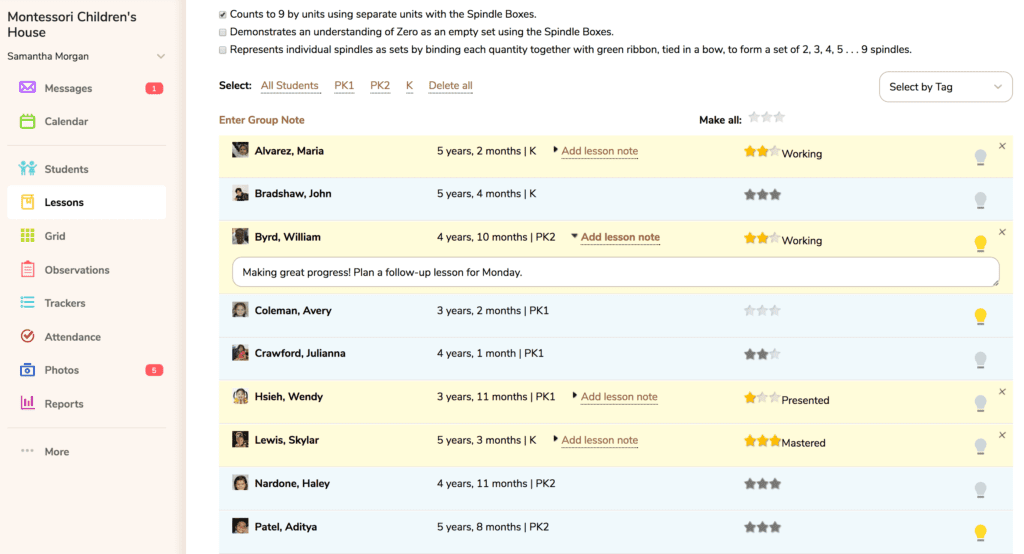
Charting the individual learning paths for upwards of 20+ students in your classroom is challenging. Doing so in the absence of traditional test-based metrics is exceedingly difficult. Authentic assessments require careful observation coupled with a sophisticated level of organization. Despite one’s best efforts, it is still far too easy to observe a child’s work and think to yourself, “Mary is ready for the Teen Board, I will present it tomorrow,” only to have that thought slip your mind the following day. Using an online record-keeping system can go a long way towards eliminating this kind of human error by effectively turning your authentic assessments into an actionable task. As you observe a child’s work, plan the next lesson, or simply make note of a lesson idea (i.e., works you would like to do with a child when you have the opportunity in the future). Making the shift to charting a digital learning path for each child will do more than just help you remember to present Mary the Teen Board tomorrow. Your classroom will begin to run more smoothly, increasing the velocity in which students progress through the classroom. Over the course of the three-year cycle, the benefits of this more optimized learning environment will compound, yielding tremendous benefits for every child in the classroom.
3. Comprehensive progress reports provide an opportunity to turn Montessori parents into advocates.
In the absence of tests, grades, homework, etc., progress reports take on a particular importance at Montessori schools. With so many misconceptions about the Method itself, parents may begin to question the decision to continue their child’s Montessori journey. Parents that are inundated with images of their friends ‘Honor Roll’ student on Facebook need to see evidence of a significant return on their investment in a Montessori education. Progress reports represent a remarkable opportunity to not only allay potential doubt in the minds of parents but to truly astonish them with the beauty, elegance, and efficacy of the Montessori approach. Creating comprehensive and effective progress reports for your classroom no longer has to be the painstaking, papercut-inducing process from yesterday. Online record keeping greatly simplifies this process by compiling all lessons presented to a student over the desired period of time, in seconds flat. Reports can be further customized with personal growth assessments and anecdotal teacher comments. The parent education component of the progress report actually comes as part of the Scope & Sequence. Instead of providing a simple list of lessons/materials with names unfamiliar to most parents (e.g., Red Rods, Metal Insets, Golden Beads, etc.), the Scope & Sequence can contain parent-friendly descriptions and images designed to better convey the direct and indirect aims of each lesson. Instead of taking a crash course in Montessori, this helps parents become more acclimated with the approach by learning alongside the child (i.e., as the child works with the Red Rods, the parent can be educated on the material’s benefits.) By helping parents to gain an increased awareness and appreciation for Montessori, you really have an opportunity to inspire some of these parents to contribute to the Montessori advocacy movement.
4. Enhanced insight from classroom activity provides pathways for meaningful change and growth.
Online record keeping can provide unique opportunities to gain both a macro and micro view of how your students are progressing through the Scope & Sequence. This makes it easier to identify patterns of behavior and trends in your classroom. Here are some examples. Are the students working with the Farm? If not, perhaps there is something that can be done to make it more appealing. Would placement of the material in the classroom make a difference? Is it too tucked away? Are the students spending time in the Cultural Studies area? If not, what could be altered? Are the works being refreshed too infrequently? Or too frequently? What about the balance between the time being spent by students in the Language and Mathematics areas? What is working? What could be improved?
These classroom-wide macro views can be applied to individual students as well. For example: Is a particular student spending an inordinate amount of time in one area of the classroom? What can be done to encourage the student to spend time in other areas? When you review the student’s online records, you can examine what works have been recently recorded. Is there commonality about these works that appeals to the student? Can this appeal be found and encouraged in other areas of the classroom?
There is much to be gleaned from your classroom activity and online record keeping makes this data more accessible than ever before. Instead of relying on memory or paging through reams of paper records, answers to difficult questions are only a few keystrokes away. It is essential to routinely analyze and reflect on your record-keeping data. The insight gained may yield pathways for meaningful change and growth opportunities that can benefit your entire classroom.
5. 24/7 access to classroom observations provides the ultimate in flexibility.
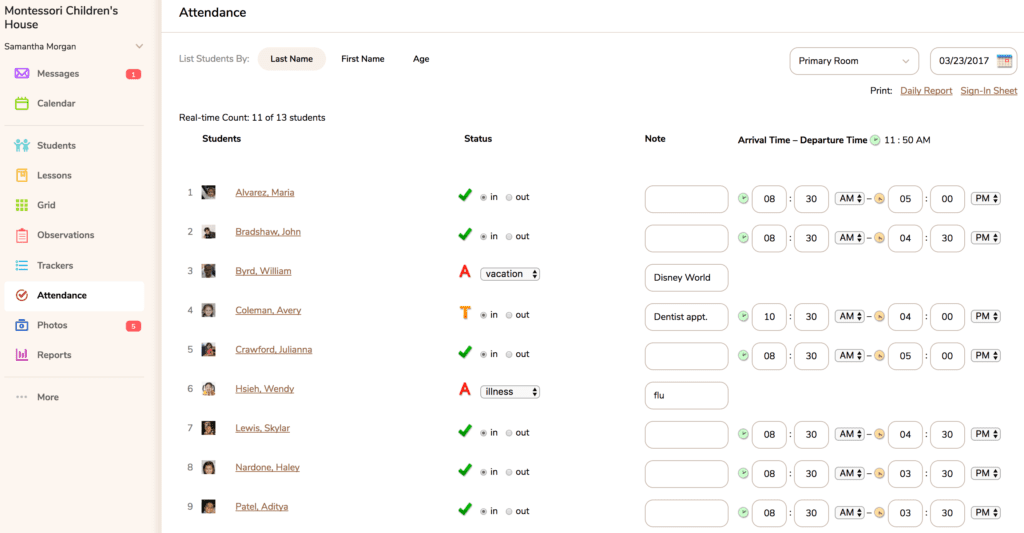
Documenting daily classroom observations is a vital component in charting individual learning paths. However, maintaining well-organized observations in an effort to facilitate effective lesson planning can be a real challenge. Online record keeping provides an opportunity to utilize a virtual ‘fresh sheet of paper’ for each student every day of the week, all in the same convenient location. Whether it’s a one-liner or multiple paragraphs, observations are instantly saved to individual student profiles and easily accessible. For quick, hands-free documentation in the classroom, you can even use speech-to-text on your smartphone! Having all of your virtual student notebooks visible at a glance enables you to know exactly which students have been observed and which have not. It also makes it easy to see which students have been busy and which may require additional encouragement.
Finally, having all of your record keeping and observations in the same centralized location provides the ultimate in flexibility because you can access it anytime, anywhere, from any web-enabled device.
Montessori Leadership / January 2014 / p 11
by Julie Cash | Montessori Administrators, Montessori Charter Schools, Peace Education, School Leadership, The International Montessori Council
I had an experience in my classroom that is a potent reminder of what is possible to bring out in children when they are taught to show considerate behavior, and given the guidance, safety, and structure needed to voice their feelings and engage in respectful, honest, and constructive dialogue. This particular discussion was focused on taking responsibility for hurtful behavior and making amends.
I teach a multiage class of 26 students, in a Title 1, public Montessori school. My first, second, and third graders spend three years in my classroom, and most have also been in our Children’s House program, which is comprised of classes of four- and five-year- olds. Since entering our school, the children have been in an educational environment, where respect, peaceful problem solving, and attunement to the individual child are deeply valued and practiced by our entire faculty. It is a huge advantage to teach in an atmosphere of a shared philosophy, where there is a school-wide culture of respectful communication and attention to the social and emotional development of the child.
It was Friday afternoon, the end of a stressful week, in which I’d found myself wondering how much longer I can continue teaching in the current climate of inappropriate testing, overload of curricular mandates, and large class sizes, where the system seems to be losing sight of what is most important in our work with children. I was leading a lesson with my multi-aged class of first, second, and third graders. Seated before me on the carpet was a first-grade boy, who started to make noises while I was speaking. I directed him to sit at a table and think about what he needed to be able to do in order to rejoin the group.
Making disturbing sounds has been a recurring problem with this child. I felt irritated, and I had the urge to reprimand him; instead, when I invited him back to the group, a question on our school’s reflection form sprang to mind. It asks, “What will you do to make amends?” Instead of chastising him, I found myself telling the class that there is something appropriate to do when we’ve done something that is disrespectful. I said that taking responsibility for what we’ve done (and offering an apology) is a way to make things better, and we call this “making amends.” I added that it takes a lot of maturity and strength to be willing to admit a mistake and say we are sorry.
I modeled the language for him, and he was willing to repeat these words: “I’m sorry for making noises when you were talking.” “Thank you for apologizing,” I answered. “Please try not to do it again.” Then I asked the class if anyone else had something they would like to apologize for. A second-grade girl raised her hand, and, with no prompting, said, “I have an apology for Julie. I’m sorry that I was talking when you were talking.” “I appreciate your apology. Thank you,”
I replied.
After that, there was a flurry of hands. It was surprising how many children wanted a chance to apologize to someone—and in such a public way! For about the next 30 minutes, one child after another raised his or her hand to offer an apology, or, as I suggested they might also want to do, ask someone for an apology. “I’m sorry I called you stupid.” “I’m sorry I didn’t let you play.” “I’d like to apologize for hitting you.” “I need an apology for when you told me you weren’t my friend.” And so it went, with many children expressing feelings of being hurt or regret for causing harm.
When one boy, who struggles with impulsivity, was asked by one child after another for an apology for his behavior towards them, I saw him shrinking, and I knew I needed to let him see that his classmates also cared for him. I told him that sometimes he did things that bothered other people, but he also knows how to be a good friend. Taking a chance, I asked his classmates to raise their hands if they could think of a way he had been a good friend to them.
I was wonderfully surprised and touched when a number of kids put their hands up. One by one, each child had the opportunity to tell him a way they have seen him be a good friend. “You asked me if I was okay when I fell down.” “You always help pick up the beads when they spill.” “You ask me to play at recess.” “You included me in the kickball game.” “This is who you are—a good friend!” I reinforced to a now-smiling boy.
The number of children who raised their hands, wanting a chance to make an apology, with no coaxing whatsoever, was astounding, and the sense of safety and love in the room was palpable. It seemed that the kids needed to have a way to express the things they had done, that they knew were not okay, and which they obviously regretted, and their apologies were said with great seriousness and sincerity.
When a child was asked to apologize for something he or she did not think happened, or perhaps was not ready to admit to, I modeled the words, “If I did that, I’m sorry.” I also taught them to say, in response to an apology, “I accept your apology,” or “Thank you for apologizing,” as well as, “Please don’t do that again,” rather than saying the usual, “That’s okay,” and so these phrases were added to their repertoire of skillful responses.
The meeting had gone on for so long that I needed to call an end to it, although hands were still being raised, requesting more turns. I said that perhaps this is something we’d like to do each Friday, to “clear the air” and make a fresh start each Monday!
Most children in my class qualify for free breakfast and lunch, and half the class is composed of second-language learners. Showing vulnerability is not something my students typically learn at home or in their neighborhood. I was deeply touched and felt a tremendous sense of pride in how far we have come together and how my effort to create a community of caring and respect in our classroom has borne fruit and had manifested during this particular class gathering.
Children always let us know, by their engrossed attention and active participation, when they are involved in an activity that is deeply meaningful. During this lengthy discussion, they paid rapt attention to everything being said, with no calling out and no inappropriate remarks or laughter. I felt awed by, and proud of, the capacity for self-reflection, generosity, and caring that my young students were displaying. By their seriousness, stillness, and focus, I knew that I wasn’t the only one aware that something precious was transpiring.
Once again, I am reminded of the possibilities that exist in each of our classrooms, in particular, the possibility that six-, seven-, and eight-year-olds can learn the skills of respectful, honest, and caring dialogue and the peaceful resolution of their differences.
Montessori Leadership / January 2014 / p 9
by The Montessori Foundation Staff | Book Reviews, MFA, Montessori Administrators, The International Montessori Council
The Joyful Child: Montessori Global Wisdom for Birth to Three (Michael Olaf, 2013) is Susan Mayclin Stephenson’s latest book. Susan draws on her extensive experience working with children in different cultures and socioeconomic contexts around the world, combined with deep insight into the philosophical and pedagogical underpinnings of the Montessori approach.
The book begins with a guide for parents of children in the first year of life, with many details on what to look for and enjoy in the first days and months. There are specific developmental steps to watch for and support, such as: the important visual and auditory experience of the child in the first days of life; the importance of language in the environment; and the development of movement stages of the whole body and the hand—reaching, grasping, sitting, crawling, pulling up, and walking.
Since we know that the first three years are vital in feeding the physical and mental development of the child in the correct way, there are many ideas for introducing the child to: the areas of practical life; sensorial toys and puzzles; music; language; art; people; plants and animals; the physical sciences; and math. These are useful not only for parents in the home but also for Montessori teachers at this level.
The appendix contains a child’s perspective on the process of weaning in 15 pages, with pictures, titled, “How I Weaned Myself,” which is based on the Montessori Assistants to Infancy Program that was initiated in Rome in 1947 by Maria Montessori. It also contains a reprint of an article previously published in Communications, the Journal of The Association Montessori International, comparing the Assistant to Infancy practices with the age-old traditions in Bhutan.
The author writes in such a way that the sometimes esoteric Montessori concepts are easily understood. As a result, this book has been used with adolescents in Montessori Human Development classes, as an overview in Montessori training courses at all levels from birth through the middle school years, and is being translated into several languages. As examples, the Japanese translation of an earlier version of The Joyful Child is a text for an online parenting course in that country and is being shared, chapter by chapter, with parents of schools in Russia.
The author’s first exposure to the international study of human development was as a college sophomore in 1962-1964; she took a course researching international practices of family life while traveling by ship, participating in intensive studies and in field trips in Europe, the Middle East, and Asia. She has been working in the Montessori field for almost 45 years, the last 25 in the area of the child in the first 3 years of life. She has been writing The Joyful Child throughout this time, constantly adapting the text to answer questions by parents, and during her work as a Montessori consultant, speaker, and examiner for Montessori 0-3 courses in many countries including Nepal, India, Bhutan, Russia, Holland, and China. Her website, if you would like to know more about this devoted Montessori mother, grandmother, and teacher, is www.susanart.net.
The book contains 260 pages with 160 black and white pictures of children. Published by Michael Olaf Montessori Company. Arcata, California. It is availavle through AMAZON.
Montessori Leadership / January 2014 / g 7
by Hillary Drinkell | Montessori Administrators, School Leadership, The International Montessori Council
It is unusual for Montessorians to discuss the subject of bullying; in fact, in our well-prepared peace environments and community conscious classrooms, bullying is rarely an issue. However, it seems that more and more scenarios that would fit within the definition of bullying are cropping up in our elementary and upper school environments. The following points serve as a platform to assist you in recognizing the basics surrounding this topic. We welcome your feedback, experiences, and solutions.
Bullying is repetitive, hurtful behavior with a conscious intent to hurt someone. The person being bullied often does not have the skills to defend himself and hence the repetitive nature of the act
Types of bullying: physical, such as hitting, and taking belongings; verbal, such as insults, name-calling or racial remarks; psychological (emotional), spreading rumors, excluding someone from a group
A bully: attention seeker; tests limits and receives no repercussions to the behavior thus perpetuating it; power/popularity seeker
A victim: poor social skills; few friends; lacks self-confidence; often thinks he is deserving of the bullying
Warning signs of bullying: withdrawal from usual behaviors, complaints regarding physical symptoms such as headaches, stomachaches and the like, withdrawal from friends, changes in work habits or in enjoyment of school
Administrator’s role: have clear policies and guidelines in the parent and faculty handbooks specifying bullying behaviors and consequences (remember to include social media within these guidelines); talk openly with faculty – spend time role-playing how to handle a variety of situations; discuss, record and maintain consistent classroom management expectations and how to work with students if needed – consistency is key here; talk openly with parents about school policy on this issue; follow through on policy and be consistent with your response/s if needed
Faculty’s role: discuss openly with your class community (preferably at neutral moments at the beginning of the school year) what bullying is and the community’s expectations community regarding this; brainstorm and create a class community contract that sets the stage for a well-functioning, peaceful class community; give students opportunities and skills to voice their concerns in an open, supportive forum; ensure that you have clearly communicated how students can get help from each other or adults if they feel unsafe – most times guides have a series of steps to help students work out their differences, but to also enlist the help of others when needed; if you have an issue with bullying behavior in the class, ask the class community for help and brainstorm how to resolve it, if the victim is comfortable with this – if the situation persists, speak to your administrator; have regularly scheduled class meetings, preferably once per week so students feel class community ownership and develop the skills to communicate kindly and respectfully with each other; check in with your classroom management style – is it consistent, kind, but firm?
The Montessori environment’s advantage: we support a curriculum of peace; we work to enhance students’ exposure to many cultures thereby developing tolerance of differences; we look at the big picture and how we fit into it, developing a sense of belonging and unity; we are a community, at the class level, then at the school level, thereby helping to avoid a sense of isolation from any stakeholders and hopefully developing tolerance of all community members
Resources:
www.onenessfamily.org/blog.html
www.interventioncentral.org
www.tolerance.org
www.nobully.org.nz/guidelines.htm
www.helpguide.org/mental/bullying.htm
www.apa.org/helpcenter/bullying.aspx
Join the conversation, email Hillary Drinkell.
Montessori Leadership / Summer 2013 / p 21
by Claire Salkowski | Montessori Administrators, Montessori Teachers, Peace Education, School Leadership, The International Montessori Council
Career Confessions & Fond Hopes of a Montessori Educator and ADR Specialist
I confess. I’ve been living a double life for a long time. Since early in my career, begun almost forty years ago, I’ve had one foot in the Montessori world and the other in the ADR (Alternative Dispute Resolution) world, yet I’ve still managed to dance quite well in both worlds. In fact, both fields have informed the work I do and intersect in the place where I hold my most deeply held and cherished beliefs and hopes for making the world a more peaceful place. As I reflect upon the work I do, I realize that I was drawn to each field because they called to my fervent desire for work that allowed me to realize my passion for advancing the goal of creating peace in the world through work with children and families in a variety of ways.
I first began as a secondary school teacher, but after five years of working in the traditional classroom I became frustrated with a system that I felt did not allow me to meet the real needs of my students or maximize my goals as a teacher. That’s when I remembered Montessori. In the early 1900s, as Italy’s first female physician, Dr. Maria Montessori approached education from a completely different perspective.
She discovered what she considered universal truths about the nature of children and how they developed and learned. Her concepts about internal motivation, the value of auto- education, and experiential hands-on learning have since been validated by today’s scientific brain research, which is exactly what she said would happen. She developed the best way to prepare an environment that allowed children to take responsibility for their own learning, a radical concept then as now. She taught that the role of the adult was to facilitate and guide rather than dictate or impose and that the purpose of education was to teach children how to realize their full potential and live their best life in the world. She passionately believed that the way to change the world and create peace was through the education of children, and that was a sentiment that drew me to her work.
I first heard about Montessori from my best friend in college and decided that if I ever had children I’d like them to go to a Montessori school.
In the midst of my public school career, the day came when my oldest daughter was enrolled in a Montessori school, and when I observed the classroom and the peaceful, holistic way the children operated in that beautiful space, I knew instantly that I had stumbled upon something important. In 1979, I left my job with the public schools, took my first Montessori training, and started my own school, while continuing with additional Montessori training at the elementary level. While I taught and ran the school in those early years, I became enthralled with the idea of creating a peace curriculum that could be implemented as carefully as the academic skills we presented to the children so precisely. I believed fervently that the affective side of education was equally as important as the academic side if we wanted children to become whole and healthy human beings.
As a Quaker, I was also drawn to the early work of CCRC (Children’s Creative Response to Conflict) and began to implement those activities in my classroom and school. Their beliefs about the need for nurturing peace spoke to my profound need for cultivating not only the skills of peacemaking but awakening the deeper spiritual dimension as well. Quakers (The Society of Friends) have always been considered one of the “peace churches,” and they have long supported the teaching of peacemaking and problem solving to young children. Much of the work began in the early 70s with CCRC grew out of the work of the Quaker Project on Community Conflict (QPCC) under the auspices of the New York Yearly Meeting of the Society of Friends and the Nonviolence and Children Program of the Friends Peace Committee in Philadelphia.
These early pioneers in the field of peace education recognized the need to create a foundation for children to develop the ability to solve problems in peaceful ways by focusing on communication skills, identifying and understanding feelings and finding unique ways to resolve problems and prevent unnecessary conflicts. (Prutzman et al, 1988) That, too, matched my deepest need to align belief and values with work and practice. So began the dual life. I have since been privileged to work with some of these pioneers as we have attempted to advance this work in schools across the county through the CRETE (Conflict Education in Teacher Education) project, which seeks to train teachers in the vast array of skills and techniques that have been amassed in the important field of peace education and conflict resolution since those early days.
It was in the mid-80s that I discovered the field of conflict resolution and peer mediation and began to teach my students the basic skills in social emotional learning, perspective taking, communication, problem-solving, and then finally conflict resolution. Eventually, I began training my students and others in the growing field of peer mediation. My work in the ADR world greatly expanded in the mid-90s when I was first trained as a mediator to work in the program I recently directed and in community mediation. With this work, I made the leap from working solely with children to working with adults and the wider community. And so, my dual roles expanded, as I continued to teach and operate the school but continued training students and faculties in peer mediation and began doing cases in the community center and for the Court program regarding custody and visitation issues.
My training as a mediator also helped immensely in my work as the school’s administrator dealing with faculty and parent issues. Later I added divorce mediation and elder mediation to my repertoire of skills as a mediator and then discovered additional approaches in restorative practices such as Community Conferencing and Peacemaking Circles. Conflict Coaching as a way to assist individuals through the labyrinth of conflict has been another wonderful addition to the range of options we can now offer to anyone seeking understanding and a better way to manage ongoing conflict.
As Director of Mediation and Educational Programs, I was able to truly blend the work of each field and to integrate the various approaches afford by the ADR world. The Peaceable Education Program we offered to schools seeking a nonviolent approach grew directly out of my work in the classroom, as it blended with my ADR work. Although I recently stepped down as Head of School, I am still involved in the school I founded and the wider Montessori world. I have introduced my colleagues here to many of the wonderful techniques and approaches from the ADR field. I’ve also tried to merge both fields by teaching at the university level and in Montessori training centers in a number of places as well.
I’ve found that Circles are a wonderful tool for conducting faculty meetings and parent groups, especially if there are thorny issues to discuss or conflicts that need to be resolved. Peacemaking Circles have also been useful in helping families deal with bullying issues or long-standing conflicts between students that have not been resolved by other approaches or measures. And more than once, I have officially and “unofficially” mediated between staff members or parents who needed the assistance of a trained neutral third party.
Within these many diverse approaches and varied fields, the central goal is to assist individuals in actualizing their own goals and in discovering their special purposes in life so that they may also contribute their gifts to the whole while, recognizing and honoring the gifts of others—and, thus, create a better world. The roles of mediator, teacher, or facilitator differ, but they emanate from a common philosophy.
Montessori saw the teacher not as the all-knowing, benevolent authority who gave knowledge to the child, but rather as the guide and facilitator of the child’s own process of discovery and learning. It was a position of deep respect, walking as it was beside the child, and sometimes behind, but rarely, if ever, in front. We adopt an optimistic philosophy about the nature of the child and believe deeply in the inherent goodness and ultimate potential of the individual. Recognizing that the child’s becoming or development of self-belongs not to the teacher, parent, or anyone else, but unequivocally to the child, the Montessori teacher views her role from a place of great humility.
In honoring and assisting the child, however, knowing when to step in and when to get out of the way requires great skill in observation, a wealth of knowledge about the development and developmental needs of the child, and much practice. Judgment is called for in assessing the needs of the child at any given moment and being able to respond with the appropriate match of activity, experience, or interaction. All of this grows out of a deep, abiding respect and belief in the awakening powers of the individual life we are attempting to serve. No easy task to be sure. We must know and examine our own biases, prejudices, and individual orientations. We must constantly search and examine the places where we have imposed our own will to the detriment of the child. There are times, she told us, when it is appropriate to “use our authority” but always with the goal of encouraging the child to master the lesson and discover the inner truth for herself.
In my ADR work, as a mediator, conflict coach, and Circle facilitator, I take an approach that is very similar to the Montessori approach to teaching children, beginning with foundational respect for each individual party. I try to help remove the obstacles so that the parties are released from patterns of negativity and can reach new levels of positive functioning and inner growth. Although mediation or any other ADR approach is clearly not therapy, it often has a therapeutic effect. The parties experience new insights and inner growth takes place.
This transforming, spiritual response to conflict comes from viewing conflict as an opportunity to learn, to grow, and to be changed. Conflict is often a powerful challenge to our clouded perceptions and serves as a wake-up call to change. Often it can motivate us to move in different, more positive directions in our relationships and inspire us to create more functional patterns of behavior. The spiritual nature of conflict manifests itself when we are transformed and begin to act in harmony and cooperation with others, when we are awakened to our own potential for growth, and when we recognize the potential, dignity and rightful respect of others.
By recognizing the very special nature of my relationship to the parties and acting as a catalyst for change, we enable the participants to move from fear and despair to hope and optimism; from anger, jealousy, and greed to acceptance, empathy, and generosity. In successful mediations, Circles, or coaching sessions, the parties are able to develop new perspectives on the meaning of life and come to understand their interconnected role in it. Creativity is unleashed, and the parties come to understand their true needs and are willing to respond to the needs of the other. New ways of thinking and feeling are opened up, and communication is enhanced. The relationship is improved, and the parties strive toward cooperation and collaboration in resolving the issues between them. They are empowered to make their own decisions and creative solutions inevitably arise from such insight (Sidy, 1996).
As a mediator, Circle facilitator, conflict coach, or teacher, I have witnessed the vast transforming and growth-enhancing power of each approach. In both the classroom and the ADR room, individuals have been deeply touched by the significant change that has come into their lives from being respected, empowered and recognized for the unique individuals that they are and the gifts that they bring to the world. They have discovered, for themselves, the power that resides within and have moved in ever-widening circles of understanding, while achieving deep personal growth. When parties truly connect with one another, their spirits are lifted and they become enriched.
Last year I conducted a Conflict Circle in one of the schools that was having difficulty with two fourth-grade girls, who had been in conflict with each other since the second grade. Each girl felt the other had repeatedly bullied them, and the parents shared the same perspective. The administrators, teachers, and the counselor had all had many discussions and tried various interventions with both the children and their parents, to no avail. It had gotten to the point that it was infecting the entire fourth grade, and everyone agreed that some workable solutions had to be found.
We all met at the school for the first of several sessions. The principal, vice principal, counselor, and the girls’ teachers as well as their parents were all in attendance. The grandmother of each girl was also in attendance. At one point, one of the grandmother’s vehemently expressed a lot of negative emotion about the situation and, in frustration, threw the talking piece at the principal. For several seconds, there was only stunned silence, as the group weighed the magnitude of the act. It was a critical moment, and much to the enormous credit of the principal, he remained calm and did not respond with anger or as the “authority” in the group but sat quietly while the father of the other child carefully picked the talking piece from the floor and eloquently moved the group back to a place where feelings were heard and perspectives understood.
As the facilitator, or Circle Keeper, I allowed the group to own the situation rather than immediately intervening to try and “make things right.” It was a real lesson in the power of the process to illuminate and heal with the collective wisdom of the group. We met two more times and, as the group worked together, there was no doubt that they had all been deeply touched and had grown from the Circle experience. By the end of the year, the fourth grade was transformed. Both girls had come to appreciate each other and learned to treat one other with true respect. They had each changed and grown so much that they were named as honorary “peacemakers of the year” by their school in our annual award ceremony.
Very recently I worked with a school faculty that had become deeply divided by contention over the departure of a Director who had been there for the last ten years. The faculty had split along sides in support of the Director and those who were glad to see her leave. All who participated in the healing circle that was conducted expressed a pervading sense of loss and real grief, as well as the emotional exhaustion of dealing with the trauma and drama of the year.
The structure of the Circle and the power of the process allowed all voices and all perspectives to be heard and acknowledged. Each person was deeply touched and impacted by the stories they were able to tell. By the end of the session, the focus had shifted, and everyone was unified in their support for each other and their fervent desire to move forward in the best interest of the school. Without the willingness of everyone to devote the time to engage in such a process and to openly and honestly participate, while drawing upon the collective wisdom of the group, this faculty may have remained divided, and the devision would have further eroded morale and contaminated the proud and positive history of this highly regarded school.
I am deeply convinced that part of our Montessori education should include extensive work in peace education and the art and techniques of conflict resolution. Conflict is, indeed, a fact of life and learning to manage it in the classroom and the school is vital to creating and maintaining a healthy and loving school community. Students can and should be systematically taught to create peace and resolve conflicts, but without the conducive climate and school culture, and real modeling coupled with specific instruction by the adults around them, they will not gain the skills needed to manage these important life skills.
Skilled, trained, and practiced adults are critically needed in our school communities. Many Montessori teachers are familiar with the use of Circles in their classrooms; so additional training or experiences with peacemaking circles would greatly expand their repertoire of skills. Administrators would be enriched and become more effective with such knowledge and experience as well.
In my role as mediator or ADR specialist, much like my role as Montessorian, I must always prepare the environment, and observe carefully in order to assess the needs of the parties. I endeavor to recognize and honor each person for where they are in their own development and personal growth. My task is to make the match between the needs of the parties and the experience of the ADR process. I facilitate and assist the parties through the ADR process, but never impose or try to do “it” for them. The ADR process belongs to the parties, just as the learning process belongs to the student, the problem-solving process belongs to the parent or faculty group, or the healing process belongs to the client in therapy.
Parents cannot make their children grow any more than teachers can make their students learn or mediators can force a resolution of conflict. The issues in mediation, Circles, or coaching belong to the parties and cannot be owned by the ADR specialist, any more than the teacher can learn for the child, or the therapist can be healed for her client. At a much deeper level, mediators, facilitators, teachers, parents, and any who assume such a posture in their role to aid the individual have the potential to create a space for personal transformation and intense individual and spiritual growth. The quality of the relationship assumes a dimension far beyond what we generally assume. There is a depth of relationship and sacredness in our connection. We invest deeply in our inner most humanity. Thus, is the work of the peacemaker and thus I continue to embark upon this marvelous journey down an entwined path that takes me in and out of both worlds on a daily basis.
References
- Prutzman, P. et al. (1988) The Friendly Classroom for a Small Planet. Santa Cruz, CA. New Society Publishers.
- Salkowski, C.J. (2000) Developing the Spiritual Dimension of Mediation
- Salkowski, Claire J. (1999, Fall) “Montessori and Mediation: Midwife to a Process.” Montessori Leadership. 1(2), 34- 43.
- Salkowski, Claire J. (2000, Winter) “Mediation: Midwife to a Process. Practical Dispute Resolution.” Montessori Leadership 2(1), 24-28.
- Salkowski, Claire J. (2001, Spring) “Developing the Spiritual Dimension of Mediation. Practical Dispute Resolution.” Montessori Leadership 2(2), 1-8.
- Sidy, R.( 1996 ) “Spiritual Dimensions of Conflict. “The Fourth R 74 ( Aug/Sept.). pp.18-20.
- Montessori Leadership/ Summer 2013/ pg 22
by Cindy Venezia | Montessori Administrators, Montessori Teachers, The International Montessori Council
Our preschool, which is a part of a non-profit agency serving a socioeconomically challenged area of Fort Myers, Florida, gives children a stronger ground to stand on upon entering public school. But this wasn’t always the case…
In 2007 I entered the day care I was going to convert to a Montessori preschool and began accessing what we would need. I quickly realized I would need the help of others to do this. I started with two local Montessori schools: Renaissance School and Montessori Academy of Naples (through years of support and collaborations we call each other “sister schools”).
I taught 13 years at affluent schools and never realized just how lucky my students and I were when we received brand new materials. Getting new materials was like getting presents on a special holiday! But now I needed to ask others to share whatever they could. What we received was a blessing but it was also humbling. These materials are the ones that are on their last leg and are being replaced by something that is cleanly cut and freshly painted. But we knew these pieces of work, chipped and dented, were going to change lives.
We had mismatched shelves that volunteers sanded and stained for us, pieces of the work that had been repaired the best that we could and eight person table tops that had been cut down to two and four person table tops. Our classes had the very basics but still needed more. One day I get a phone call from Margot telling me a school had shut down and they were entrusting her to give the materials to someone in need. I couldn’t believe it! She was delivering a massive amount of beautifully chipped and dented materials to us! Our classes were fairly complete now.
A relationship with a group of individuals from a local neighborhood had been growing for a couple of years. Those individuals held an event that raised enough money for us to buy brand new, never been chipped or dented, materials! At the same time the new material was coming in I got a phone call from my mentor, Drina Madden. A Guatemalan orphanage, where her granddaughters were adopted from, needed materials…Montessori materials. Within a couple of weeks the chipped, dented and much-loved materials were traveling again to a teacher and students that would most likely feel as blessed as we did.
If I ever think giving is a lost art I think about the journey the “red rods” and how they have brought people from different states and countries together.
Montessori Leadership / Summer 2013 / p 28
by Sharon Caldwell | Montessori Administrators, Montessori Teachers, The International Montessori Council
The “Spiritual Preparation” of the Adult
Maria Montessori saw the role of the adult in educating the child as something fundamentally different to the conventional role of the teacher. She postulated that: “… a prejudice has found its way into the adult—the notion that life can be changed or improved only though teaching. This prejudice impedes the understanding that the child constructs himself, that he has a teacher within himself, and that this inner teacher also follows a program and technique of education, and that we adults by acknowledging the unknown teacher may enjoy the privilege and good fortune of becoming its assistants and faithful servants by helping it with our co-operation.”
She further noted that the world in which the child finds himself works against his natural development, rather than supporting it.
When we consider the nature of the Absorbent Mind and the sensitivity of the young child to adult influence, it is evident that the child will be greatly affected by the attitudes and actions of any adult with whom he or she comes into contact. For this reason, Montessori placed great emphasis on what she called “the spiritual preparation of the adult.” It is not sufficient that the adult has a theoretical knowledge of child development and of appropriate pedagogical principles and methodology; what matters more is that he or she has the right attitude and disposition.
Sometimes, this “spiritual preparation” is represented as something almost esoteric, as a personal spiritual nurturance of the adult. While there is certainly a place for that, Montessori’s meaning as expressed in her own writings is something much more pragmatic. What she means is simply that the adult has to identify and remove any preconceptions, any beliefs and prejudices that will prevent a proper understanding of, and interaction with, the child. Simple to say, but not so simple to do. For Montessori, this is an examination of the consciousness.
The point is made by quite clearly by A.M. Joosten:
“… the adult has always been trying to mold the child, to turn the child into something he is not and is not meant to be.”
If this is true, then there are profound implications for decisions made within classes and schools regarding not only behavioral expectations but also the requirements for academic progress, assessment, and other external criteria imposed on children. It implies that the solution to “problem children” is to be looked for in the adults who interact with them and in the physical environment, rather than in the children themselves.
All this concerns the intellectual aspect of the preparation that we definitely have to give to ourselves. There still remains, even more importantly than this, the spiritual preparation that we have to give to ourselves, the preparation of our spirit with regard to our task in favor of the development of the human being and with regard to our attitude towards both the human being and its development. This is not merely a question of learning something.
It is a question of achieving a revolution within ourselves and of our whole outlook, of our whole attitude, and of everything we are (knowingly or unknowingly). The discovery and exploration of all that we are without having been aware of it is one of the most exhilarating and fascinating experiences, because we precisely discover unknown factors within ourselves. To try and set right the manner in which we conceive our mission, and accordingly, should fashion and shape our attitude and being, that is spiritual preparation.
Using the best of the most significant words at our disposal to express how radically we must change ourselves, and to remind ourselves how far this change should go, we may use the word conversion. It is we who have to be converted in our attitude and with regard to our real task concerning the child.
So how then is this “conversion” achieved? Dr. Montessori gives certain directives:
- “He/she must be free of preconceptions, and must have faith in the innate ability and potentials of the child.”
- “He/she must be humble, and constantly seek out means for personal growth and improvement.”
- “She needs to have an understanding in the ability and natural tendency of the child towards normality, and will regard her role as an assistant, rather than as the cause of this process.”
- “She would have the approach of a scientist—always seeking a greater understanding of the object of her study—the child.”
- “She will suppress her own personality, needs and wants, likes and dislikes, so that the true personality of the child can flourish.”
- “Ultimately it is neither through lectures nor book learning, nor through any act of the intellect that this transformation of the adult comes about; it is through her interest in the child and her ability to learn from the child.”
Roles of the Adult in the Prepared Environment In a very real sense the role of the adult in the environment is defined more by what she does not do than by what she does do.
First, do no harm
First and foremost the adult should apply the principle of non-maleficence: first, do no harm. This may appear, at first glance as obvious: What adult would deliberately set out to harm a child? From Montessori’s perspective, however, it is exactly our good intentions, our drive to help and to teach, that become the greatest obstacle for a child. It is the “resumptions and “vain prejudices” of the adult that make her an obstacle to the development of the child.”
Thus, education is aimed at facilitating individual freedom. The adult helps the child to meet his needs, to become independent. If the adult acts on behalf of the child, development is impeded. The result is what Dr. Montessori calls “psychic illnesses” and “deviations,” what we would today call behavioral or learning difficulties.
Some adult behaviors mentioned by Dr. Montessori which can be an obstacle for children are:
continual surveillance; correction, admonishments; arbitrary commands;and encouragements or rewards.
This principle of non-intervention should not be construed as abandonment. The child is not simply left free to his own devices—to a hit-or-miss approach that leaves the child helpless.16
Prepare and Maintain the Environment
Over and over, in her writings and lectures, Montessori makes it abundantly clear that the first duty of the adult is to prepare the environment for the child and then to keep it in a state that enables the child to develop according to natural laws, guided by the absorbent mind and the sensitive periods.
The teacher’s first duty is to watch over the environment, and this takes precedence over all the rest. Its influence is indirect, but unless it is well done, there will be no effective and permanent results of any kind: physical, intellectual or spiritual.
This preparation would include, amongst other things:
Ensuring that the physical environment is properly prepared and maintained. This would entail acquiring or making the necessary materials, choosing suitable furnishings and tools, and attending to the display and condition of this equipment.
Attending to her own inner, spiritual preparation, which will help her to focus on her primary tasks of preparing the environment and of observing the children. In addition, she will need the wisdom and knowledge that will help her know when to refrain from interfering in the work of the children and the self-control to act on that knowledge.
Ensuring that an atmosphere of calm prevails.
Ensuring that the children’s self-initiated and self-directed activity is in no way interrupted or impeded either by other children or other adults. This may include helping other adults in the environment understand the necessity for the requirements of non-interference.
Observe.
In order to choose appropriate activities to meet the children’s needs, the directress must carefully observe and assess each child. Only by meticulous observation can the directress identify sensitive periods to guide the child to the next phase. Observation entails watching, as unobtrusively as possible, without judgment. It is necessary to observe for long periods before forming an opinion. The environment is the teacher; the adult is merely an observer.
Observation is also essential to understand how the environment needs to be adapted or corrected, to understand how the adult needs to adapt his own behavior and attitudes, to know what intervention, if any, is necessary to prevent or limit disturbances, and so on. The importance of observation cannot be overemphasized, nor can the difficulty of proper observation be underestimated.
Montessori stressed the importance of preparation for observation:
- Children must not be disturbed “because the purpose of the observation is to see what the children are doing independent of our presence.”
- The observer is to remain absolutely silent and motionless.
- The observer must not be tempted to show admiration or annoyance.
- Observers should not communicate impressions to one another.
- Observers should not cease from observing ALL the children.
- Observers must know what to observe.
Intervene To Give the Help that Is Necessary.
This is the point at which we come across something in Dr. Montessori’s writings that appears as an extreme contradiction. It is an issue which has contributed to a wide range of approaches to “discipline” in the Montessori environment ranging from an “anything goes” type of license on one extreme to a rigid authoritarianism on the other. Adult authority in all things is sometimes justified by citing that “Dr. Montessori believed in freedom within limits,” the limits being decreed by the adult in the environment.
Neither of these extremes gives justice to what Dr. Montessori was proposing. But just what she was proposing is quite difficult to come to grips with. It relies on a thorough understanding of the complexities both of Montessori’s understanding of the child, and of nuances of the application of the methodology. It is no cookbook approach. There is evidence of real frustration in Dr. Montessori’s work as she attempted to explain the balance between necessary intervention and non-intervention.
One way of looking at this is explained by Susan Feez: “Montessori teachers are trained to remove obstacles, such as distractions or interruptions, when children are absorbed in activity marked by effort.”
Present Materials and Other Lessons.
This is the one role of the Montessori adult, which most closely resembles teaching in the conventional sense of the word. The adult helps the child brings the child into contact with his environment and helps the child to interpret the environment in a number of ways. The main “teaching” method is the presentation of materials. By simple and precise demonstrations, the child is shown how to handle materials in a way that will lead to independent exploration and learning.
It is necessary to know the exact steps involved in each presentation. Considering her observations of the child, the adult will decide which materials to present. The presentation is treated as a call to the child, an invitation to concentration and to work. The adult must not be too eager to present new materials, and should wait until the child has exhausted all the possibilities of those he was using before.
As soon as the child becomes interested in the activity, the adult must withdraw and allow the child to work and develop concentration. It is generally very difficult, especially if the adult has previously worked or trained in a regular school, to know when to intervene and when to keep back. Dr. Montessori considered obtaining a “simple lesson’ from a conventionally trained teacher as a particular challenge.
For this reason, it is essential that the adult clearly understands the purpose of the various materials as well as the needs and intentions of the child. The adult should not intervene to correct errors, but should rather find a time to represent lessons later. Vocabulary lessons, and lessons which convey factual content are to be kept extremely short and to the point.
Advocate for the Child to Society at Large.
Maria Montessori felt that those trained in her approach had a role beyond the prepared environment, but extended to actually “bringing about a new attitude toward children on the part of adults.”
What’s in a name?
Words can define reality—what we call something is what it becomes. Dr. Montessori tried to find a name for the adult in the environment that would be an accurate description of the role played by the adult. Initially, she chose the word direttoressa translated into English by Anne George as directress. For older children, she used the term maestra. Feez highlights the problem of using the word directress:
“The meaning of the Italian word direttore is less about telling people what to do, and more about steering people in the right direction. The word is used for conductors and editors, as well as for managers. When English-speaking Montessori teachers use the term, it still has the valeur of its original Italian use, but to English-speakers outside the movement, the word can seem harsh when referring to someone who works with small children.”
While some Montessori schools favor “guide,” many revert to “teacher.” Montessori professionals may argue that the name of the people working in a Montessori classroom does not matter too much, provided that they follow the role of a “Montessori teacher.” On the other hand, it would seem, that for a large majority of people, at least, the word “teacher” is used to describe one who teaches. If this word is used to describe the adult in the Montessori environment, why are we surprised when parents expect to see a great deal of “teaching” taking place? Even trained Montessori staff may feel they are not doing their jobs (as “teachers”) if they are not “teaching.”
So how about “guide.” Does that adequately describe the role of the adult in a Montessori environment? I would argue not. A guide is a person who tells you which way to go. A guide (either a person or a text) provides a detailed commentary or set of instructions. A guide is a primary source of information. A cursory reading of Montessori’s writings on the role of the adult would indicate that the adult is required to do little talking and much observing.
As the real guide in the Montessori environment is the child’s inner guide, (the sensitivities and tendencies appropriate to each plane, along with the environment are the primary sources of information), it seems that the use of the word “guide” is an appropriation of these functions. Small wonder, then, that very often the adults in Montessori classes tend to talk too much and give too many instructions to children, who could be acting independently. So the adult is neither “teacher” nor “guide.”
As Susan Feez has pointed out, in much of the world today “directress” just does not work either, for many reasons. It would seem to me that until we find more suitable terminology to describe what we are doing in our “prepared environments,” we are going to continue to slip into the roles prescribed by the terminology we are using. For this reason, I prefer to simply refer to the paid adults as “staff,” which carries no added implications.
Training and Preparation
Lakshmi Kripalani, who was trained by Maria Montessori, has commented that some teacher trainers have “misread history and suggest that, from the beginning, Montessori put minimally prepared individuals in charge of her classrooms.” Nothing could be further from the truth. The early “teachers” in the schools in Rome were not direttoressa, but merely “custodians,” whose duty was to observe and record in detail whatever the children did. It was Dr. Montessori, who interpreted these observations and provided material and activities for the children.
Once she began her lecture series, Maria Montessori did not regard the courses as sufficient to prepare someone lead a classroom unsupervised. She granted certificates of attendance, with diploma’s being awarded once the teacher had “demonstrated success with children.”
Many Montessori classrooms today are staffed by well-intentioned people, who have received only a cursory training and “left on their own or under a principal or supervisor, who has only the vaguest idea how to help new Montessori teachers.” Kripalani warns that this tends towards new teachers being pushed “toward mechanical teaching or over dependency on the material” in order to meet the demands of standardized tests.
The Preparation of the Adult for Elementary and Higher
It is sometimes assumed that the directives outlined above only apply in the context of adults working with children under the age of six and that for the “teachers” of elementary and upward, the role becomes more similar to that seen in regular schools (and this may be supported by the use by Dr. Montessori of the word maestra to describe that role). Even Montessori schools, which respect Montessori’s admonitions of non-interference at the earlier levels, may condone increased levels of direction and control at the higher levels. Dr. Montessori, however, insisted that even for children over the age of nine, the main focus should be removing obstacles:
Only thus can they obey the “natural process of psychic development.” It is true that the teacher or lecturer has an ever more important role to play as culture reaches higher levels, but this role consists rather in stimulating interest than in actual teaching.
Dr. Montessori argues for a large degree of freedom even at the elementary level. In Formation of Man Dr. Montessori describes children carrying out numerous activities, which adults would regard as “a waste of time,” but notes that the children, nonetheless, “make exceptional progress in all the branches of culture and also in art.”
She argues that educational reform does not consist of changing what is or is not taught but rather constitutes examining “prejudices relating to the child himself.”
In her work, Maria Montessori assumed that anyone taking “classes of the advanced type” would have completed the earlier course and, thus, be familiar with the psychology, which “plays a bigger part in preparation for the whole method,” and that more than anything else, the adult should “shed omnipotence and to become a joyous observer.”
Lack of preparation leads adults to do what they find the easiest: “repress, command, destroy.”33 Knowledge of the content to be taught is also not sufficient. Besides “loving and understanding the child,” the Montessori teacher for the second plane must “first love and understand the universe. She must, therefore, prepare herself and work at it.”
Clearly, the notion of the “spiritual preparation” of the adult holds true at least through elementary schools. But what of those working with adolescents? From Montessori’s brief guidelines for the “high school,” it is amply clear that very different skills and attitudes would be needed, in contrast to those normally required for conventional teaching.
“The adolescent teacher must have the greatest respect for the young personality, realizing that in the soul of the adolescent, great values are hidden.”
Again, as with the earlier planes, it would appear that to be able to see the adolescent as he truly is, to be able to get past the preconceptions and the contradictions, the demands of society and of the schooling paradigm, a “spiritual preparation” is needed.
REFERENCES
- Montessori, M. (2007/1955). The Formation of Man. Montessori-Pierson Publishing. 46.
- Montessori, M. (1989/1975). The Child in the Family. Clio Press. 41-42.
- Montessori, M. (1966/1936). The Secret of Childhood. Ballantine. 149; Montessori, M. (1965/1918). The Advanced Montessori Method I. Kalakshetra. 107.
- For Montessori’s use of “psychic” and “spirit,” see Feez, S. (2007). “Montessori’s Mediation of Meaning: A Social Semiotic Perspective.” Retrieved Oct 10, 2009, from http://ses.library.usyd.edu.au/handle/2123/1859?mode=full
- Joosten, A. M. (1974). The spiritual preparation of the adult. Around The Child. 15 (11).
- Ibid.
- Montessori, M. (1988/1949). The Absorbent Mind. Clio Press. 252.
- Montessori, M. The Secret of Childhood. 153.
- Montessori, M. The Child in the Family. 63.
- Montessori, M. (1912). The Montessori Method. Frederick A. Stokes Company. 7 & 9; Kripalani, L. (2010) Montessori in Practice: Observations from a First-Generation Montessorian. Montessori Services. 86-87.
- Montessori, M. The Absorbent Mind. (1988/1949), pp. 240-251
- Montessori, M. (1965/1918), 131
- Montessori, M. The Child in the Family. 1989/1975), 24
- Montessori, M. (2007/1949). Education and Peace. Montessori-Pierson.
- Montessori, M. The Child in the Family. pp. 26, 27, 33
- Montessori, M. Education and Peace. (2007/1949), 106.
- Montessori, M. The Absorbent Mind. 253.
- Montessori, M. The Child in the Family. (1989/1975), 28.
- Montessori, M. (1921). “Some Suggestions and Some Advice upon the Method of Observing.” Course 1921, Lecture 3.
- Montessori, M. The Child in the Family, 33.
- Feez, S. Montessori’s Mediation of Meaning. 321.
- Montessori, M. The Absorbent Mind. 256.
- Montessori, M. The Montessori Method, 113.
- Montessori, M. Education and Peace, 77.
- Feez, S. Montessori’s Mediation of Meaning 42-43.
- Kripalani, L. More Montessori in Practice: Further Observations from a First-Generation Montessorian. Montessori Services. 169.
- Ibid., 168.
- Ibid., 169-170.
- Montessori, M. The Formation of Man. 40.
- Ibid., 42-43.
- Ibid., 45.
- Montessori, M. (1989/1948). To Educate the Human Potential. Oxford, England: Clio Press. 83.
- Ibid., 84.
- Montessori, M. (1994/1948). From Childhood to Adolescence. Clio Press. 20.
- Ibid., 72.
Montessori Leadership / Summer 2013 / p 4
by Montessori Now | Montessori Administrators, The International Montessori Council
“Montessori education is no longer going to be an option.” This was the opinion recently shared by a fellow Montessori educator now working in the world of educational policy.
A pretty dire prediction but it might just be true. Universal Pre-K with its Quality Rating and Improvement Systems, Professional Registry/Career Ladders, and Licensing Rules and Regulations; K-12 and Early Childhood Education changes with ESSA, student assessments, and School Report Cards policies, and almost none of it accurately measures or even recognizes alternative pedagogies.
As people committed to high-quality Montessori education, what can we do? Do we just give in? Do we accept less than we know we have to offer?
There is an alternative. Together we can work for change. How?
Grassroots: (grass-roots) noun. A movement driven by the “politics” of a community. Its creation is natural, spontaneous, and organic. It is at a local level. It is common or ordinary people rather than the leadership of a social organization. It is managed by volunteers to support local issues that can lead to helping national issues.
Advocacy: (ad-vo-ca-cy) noun. Public support for a particular cause with a group process that aims to influence social systems or institutions (like a state agency). Advocacy can represent a series of actions taken with issues highlighted to change the “what is” into “what should be.”
Advocacy is a process that:
1. questions the implementation of policy
2. raises issues of significance
3. is inclusive and engaging—providing opportunity for public conversation
4. proposes solutions
Activism: (ac-tiv-ism) noun. The action of using a vigorous campaign, or collaborative efforts, to bring about change.
Activists try to persuade people to change behavior, or impacts, through various means including:
1. community building
2. cooperative movement
3. voluntary simplicity
4. social media
5. direct action
Everyone one of us can contribute. The time is now. Will you join the grassroots advocacy activism in support of
Montessori education?
Montessori Leadership / September 2016 / p 27
by Punum Bhatia Ph.D | Montessori Administrators, The International Montessori Council
“Wouldn’t it be cool to have a school in a historic hangar?” I asked my friend. We had been driving around Lowry (the site of the former Air Force Base in Colorado) for well over an hour, looking for a suitable site to open a preschool. Five real estate agents had given us the very disappointing news that the market here was saturated and nothing was available. Not prepared to give up and determined to find something in this area, we decided to set out on our own! “Just call,” she said, pulling into the parking lot. I did, and the rest is as they say, history.
I believe everything happens for a reason. Reflecting back on my life, I can clearly see the steps that have brought me to this point. Today, as I sit in my office and hear the hum of the children busy at work, my heart fills with joy and gratitude. It has not been an easy journey. In fact, most of it has been very hard as I struggled against odds to keep Montessori in its purest form.
I was introduced to Montessori whilst pregnant with my first child. Since then it has been my philosophy for life, gently guiding me and keeping me anchored through all the storms that I have weathered. We have lived in several parts of the world and in each, I have carried my beliefs, fine tuning my understanding of Montessori and, spreading it only in it’s purest form.
Back in the USA, after a five-year stint in Indonesia where I had been running a Montessori teacher-training center, I opened one in the basement of our home. Within the first year of operation our center received its non-profit status, accreditation from MACTE and, soon after, Title IV recognition.
The students that I trained loved the atmosphere of being in a home, felt very nurtured and often called it “the womb”. The problems began when they completed the academic portion of their training and went out to do their internship. None of the schools met the standards to which they had been trained and they often returned to me telling me about their frustrations. I always encouraged them to “work it out” and that every experience, no matter how negative, provided one with an opportunity to learn. However, I could see that I was failing them. For their training to be complete they needed to see and work in classrooms that followed the philosophy and methodology as they had been taught.
Eventually I had to put my foot where my mouth had been all along and decided it was time to open a primary classroom alongside the teacher-training center. It was June and we were still driving around looking for space with the intention of opening the school in August! We received a lucky break when the administration from the Hangar called us back and fixed a time to see the place. They were not very sure if this was going to work for us and asked if we had peeked in through the windows to sort of get an idea of what the space was like. We had not and what lay ahead was a big surprise to say the least!
We walked into a room that was dark with brick walls and concrete floors. The windows had been taped over and it did not seem that anyone had entered this place for many years. We were informed that Hangar 2 is a historic hangar from the time of the Second World War and where we were now standing were the administrative offices. In 1934, the US Army had sought a new training site for its growing Army Air Corps and chose Denver as the location for the new facility.
Named after 2nd Lt. Francis Lowry, whose plane was shot down during World War 1, Lowry Field was used to train thousands of incoming servicemen during World War II. After the war, Lowry Field became Lowry Air Force Base, and President Dwight D. Eisenhower even chose Lowry as the location of his Summer White House from 1952 to 1955. As a part of the national downsizing of the US armed forces in the early 1990s, Lowry Air Force Base was decommissioned and closed in 1994. Since then the historic Hangar No. 2 has been placed on the National Register of Historic Structures in recognition of its heritage.
Despite the looks of the place, I knew we were standing in history and could not help but feel butterflies in my stomach. I walked across the large room and could see a Primary classroom. The high ceilings were a definite advantage and the room had no obstacles such as a pillar down the center. I hoped the windows would provide enough light once the coverings had been removed. In any case, I had always said it did not matter where it was, I could create a pure Montessori classroom. Well, here was my chance and my challenge.
Little did I know of the challenges that lay ahead…this was a historic building and permits and permissions to redevelop it can have you holding your breath for a very long time. One of the earliest buildings in the country to be constructed with steel trusses, the structure has an interior span of more than three football fields in area. However, the building was unused since the base closure and bringing it up to modern safety standards was not only expensive but also difficult. Added to this was the even bigger challenge of meeting state licensing requirements for opening a center with preschool children.
My heart was set and no obstacle was too big to be overcome. Montessori was my inspiration and nothing had stopped her. I loved the idea of having my school surrounded by history. The landlords worked with me, encouraging me to draw up a plan with a needs and wants list. What more could I possibly ask for? I got to work and in no time at all I could clearly see the classroom with all the different curriculum areas. It was not hard at all. I had lived and breathed Montessori for the past thirty years and had trained my teacher trainees to think about Montessori as a philosophy for life.
I had always said it was not the Pink Tower or the Golden Beads that made a Montessori school. In fact one should be able to open a Montessori school with none of the materials and only natural resources available. If one is trained correctly, one should be able to do Montessori anywhere!
Impulsively I chose yellow for the walls and a few years down the road realized why I had done so—it was the exact shade of yellow of the original Casa dei Bambini in San Lorenzo. We had to cover the concrete floors and I thought wooden floors would be beautiful. However, the budget had to be reckoned with and on a whim I went to Lumber Liquidators and asked them if they would consider donating the floor to a school. No one was more surprised than I was when they agreed and all they wanted in return was to make a video on our school.
The playground was a whole different story! I had dreams of an all-natural playground that were obviously not coming to fruition. For all we had to play with was this solid tarmac from the 1930s. We decided it was best not to try and break it but to work around it and we did the best we could with what we had.
In the end, the children loved it and that’s all that mattered. We used natural timber for a balance beam and stepping-stones and had big planters so we could have some greenery. We had natural musical instruments and even created a labyrinth and Zen garden.
A few months behind schedule, our school opened with four children and a teacher-training center. We were blessed to have David Elkind (author of The Hurried Child; The Power of Play, etc.) cut the ribbon and open the school with the very touching opening remarks:
“One small step for Punum, one great step for childhood.”
Montessori Leadership / September 2016 / p 15
by Jacqueline Cossentino Ed.D | MFA, Montessori Administrators, Montessori Family Life, Montessori Parenting, The International Montessori Council
Editor’s Note: The following is an excerpt from Following the Family: Practical Lessons for Educating Human Potential, a new book by Jacqueline Cossentino, Ed.D., Senior Associate and Director of Research at the National Center for Montessori in the Public Sector.* Following the Family, along with the US Montessori Census, is the result of a collaborative research project: What, Why and How: Establishing a Framework for Researching Montessori.
Chapter 1: Introduction
Following the Family is about relationships. It’s also about poverty, early learning, community development, and education policy. But mostly it’s about relationships.
Told through the stories of four pioneering programs that serve young children and their families, Following the Family explores how these programs have succeeded in transforming the life paths of thousands of families in some of our nation’s most vulnerable neighborhoods. Each program is unique in its organizational culture and, at the same time, all four are intimately linked through a common set of principles that guide their practice.
Crossway Montessori Communities in Kensington, Maryland, builds social capital through intergenerational learning focused on single mothers and their young children. Family Star Montessori, in Denver Colorado, uses Early Head Start and Head Start funding to provide continuous, family-centered education starting at three months of age. Lumin Education, in Dallas Texas, links multiple funding streams, including Early Head Start, to provide a pathway leading from the toddler years all the way through third grade. And Montessori Partners Serving All Children in St. Paul, Minnesota, is building a network of providers, all committed to high standards of Montessori practice, all serving vulnerable populations, and all engaged in
strengthening their local communities.
While Montessori education has been part of the American educational landscape for more than a century, it is not commonly understood as an approach to ameliorating poverty or social transformation—at least not by the general public or policymakers. This is because Montessori education in the US has, since the 1960s, tended to be most visible in affluent communities. Rising out of a post-war economic boom, which led to a new population of college educated mothers searching for better solutions for their children, Montessori surged as a boutique pre-school option in the leafy suburbs of major US cities.
In the sixties, better education meant student-centered, hands-on, constructivist classrooms, which nurtured children’s natural tendencies to explore and develop. Today, a similar trend is visible. After nearly two decades of efforts to close a stark and persistent achievement gap through back-to-basics teaching driven by high-stakes testing, teachers, funders, policymakers, and, most of all, parents are fed up with the impact of a narrowed curriculum: the stress caused by excessive testing and the general joylessness that characterizes many public schools today. Calls for deep learning, ideal learning, big-picture learning, and re-imagined learning driven by play, projects, and personalization are growing louder and more frequent by the day.
Moreover, these calls, which are part of a predicable pendulum swing in the culture of education, are now buttressed by science. And not just science, but brain science. Neuropsychologists now offer evidence proving that healthy brain development requires things such as: free movement; varied social interactions: multi-sensory experiences; complex learning environments; and lots of opportunities to focus, experiment, and learn from mistakes. Cognitive scientists are also addressing the timing of human development, affirming that early childhood constitutes a major period of rapid and consequential brain development.
Birth to six, indeed, is no longer understood to be the period before real learning begins. Rather, study after study supported by brain scan after brain scan demonstrates that 85 percent of the human brain’s development is complete by age five. Not only is growth rapid during this period, but the brain’s plasticity makes the acquisition of important executive function skills such as inhibition, working memory, and cognitive flexibility especially robust at this time. Taken together, this research confirms not only that these years are most significant in determining future success, but that investing in the very young produces dramatic economic as well as developmental returns.
Perhaps, not surprisingly, the proliferation of new research on neurodevelopment, early learning, and cognition has, in part, fueled significant policy initiatives at all levels. Recent federal investments, such as the Race to the Top – Early Learning Challenge, combined with legislation enabling state-supported pre-Kindergarten in 44 states have made early learning much more common for many more people. In 2015, almost 1.4 million US four-year-olds were enrolled in a state-funded pre-Kindergarten program, a jump of about 37,000 from the prior year.
Within this convergence of research, public opinion, and political will, a new and expanding consensus has emerged on what “better education” entails. It should start early. It should support the development of executive functions and social-emotional skills. It should be personalized, hands-on, and deeply engaging to students. It should prepare students not just to pass tests, but to participate in an increasingly complex social, political, and economic world, a world in which creativity and innovation are necessary not just for economic participation, but for human flourishing. And within this environment, Montessori is slowly but surely drawing attention to itself as a model of education that not only does all these things but has been doing them steadily for the past hundred years.
And not just for affluent families. Despite public perception, Montessori is firmly established as a public school option for more than 125,000 US children, and that number grows by approximately 5 percent annually. Slightly under half of the children who attend public Montessori schools live in poverty, and many are located in urban centers with especially high concentrations of racial and economic isolation. In cities like Milwaukee, Chicago, Dallas, Denver, Baltimore, Memphis, St. Louis, Hartford, St. Paul, and Washington, DC, public Montessori schools not only serve low-income families, they are integrated communities, serving rich and poor, side by side.
How—and Why—This Book Came to Be
The programs described here represent distillations of the very best that Montessori has to offer American society. They show us what “better education” can look like for very young children and their families. Just as important, they show us how to do it.
I began following these programs in 2011, when I first became engaged with the work of Crossway Montessori Communities. Within the Montessori community, all four programs have been celebrated as exemplars of social reform, and, within their local communities, each has been recognized for its contributions to the social and civic life of its respective city. But the larger story of family-centered, multi-generational, place-based learning, grounded in an ambitious theory of action had not been told. Moreover, just as news of these programs began to spread within the Montessori community, the world outside was beginning
to take deeper notice of early learning and its potential impact on larger issues of social and educational policy.
In 2012 I spent several months embedded at Crossway Montessori Communities, which Executive Director, Kathleen Guinan, describes as “Montessori boarding school for mothers and their children,” aiming to discern the elements of what I came to understand as the Crossway Model. Spending time with Crossway staff and residents was my introduction to the way relationships determine individual and family destiny. The following vignette is drawn from a tour conducted by Guinan inside one of the 46 apartments occupied by Crossway residents.
Abeba
The first thing I notice about the two-bedroom apartment that Abeba and her two daughters (Malia, age 2 and Selassi, age 5) share is how spotlessly clean it is. As we step inside, we are asked to remove our shoes. We pad across the beige-carpeted living room, flooded with natural light from a large window overlooking a garden, and are invited first to inspect the girls’ bedroom, which contains two twin beds, a single white chest of drawers and small table with two child-sized chairs. There are bright calico curtains that match the bedding and family photos of mother and daughters on the chest. Next door, Abeba’s bedroom, the smaller of the two, is also decorated simply and includes more photos of the family trio along with samples of the girls’ art work tacked neatly on the wall.
Abeba has lived at Crossway for two years, and she is likely to stay for at least a year longer. When she arrived, she was pregnant with Malia, seeking refuge from an abusive relationship with Malia’s father. At the urging of a local women’s shelter, Abeba attended one of Crossway’s “Prevention” classes: two-hour workshops focused on explaining how Crossway works and what is necessary to be part of the community. She was inspired by the approach and possibilities described, and soon after the class, Abeba applied to become a resident.
On the stove, a pot of chicken curry is simmering, and Abeba smiles patiently as we coo over the order, the light, the delicious smells, the peacefulness of this home. We have interrupted her as she studies for an upcoming test at the University of Maryland, where she is taking courses leading to a degree in Computer Science. Her books and computer are open on a desk in the living room, where, next to the adult-sized sofa, there is a child-sized seating area and a shelf neatly arranged with books and toys.
We are conscious of Abeba’s time and eager to move on to the next stop on the tour, but Guinan, who is serving as our guide, can’t let us leave without seeing “the closet.” “You won’t believe this,” she says, barely containing her glee. She opens the door to reveal a study in space design. What once was a linen closet has been transformed into meticulously arranged storage space for the girls’ clothes, toys, and books. It looks like an advertisement for a professional organizing service. Items are color coded, with every inch of space maximized. Items still in use by the girls are placed at child level so that both children can share responsibility for keeping the space neat and usable. Abeba explains that she has attempted to imitate the manner in which the children’s classrooms, located on the ground floor of the building, are organized. Since becoming part of the Crossway community, she has come to see a direct relationship between an orderly physical space and a more peaceful emotional life. Guinan softly shakes her head and smiles. This is what keeps her coming to work each day.
Lines and Circles
For Abeba, along with all the other mothers who live at Crossway, the line between poverty and prosperity is both thin and stark. Guinan explains that Crossway is “not a homeless shelter; it’s not for people who are unable to help themselves.” To be admitted, women must demonstrate that they have both the will and the resources to change their lives. Sometimes programs like this are criticized for not “saving” the neediest. Guinan, however, sees it differently. “For these women,” she explains, “this program is the difference between making it and spiraling permanently into poverty.”
Joining the community also means agreeing to a strict set of expectations: signing in and out, observing a curfew, registering any visitors, observing daily rituals, attending weekly meetings and semi-monthly progress reviews. Along with these expectations is a wide and varied set of practical supports. When residents move in, for instance, they are assisted by Crossway staff in setting up their apartments, including locating furniture and living supplies. Communal meals are shared at least bi-weekly, technology and other job training resources are provided in what looks like a hotel business center, and Crossway staff members are available around the clock to respond to challenges residents may be experiencing. This unique blend of structure and support is what distinguishes, not just Crossway, but all four of the programs described in these pages.
Abeba’s closet, in many ways, exemplifies the importance as well as the complexity of structure in supporting families. It is an oasis of order in the midst of what, prior to her arrival at Crossway, had been a chaotic life. Just as important, Abeba, with the assistance of Crossway’s Practical Life Coordinator, was recreating the precise tidiness that characterizes her children’s Montessori classroom. She made this closet as much for them as for her. When Abeba directs her attention to bringing order to her physical environment, she not only produces a space that is functional for her family, she is practicing a skill that is central to gaining control of her life path. Delineating the boundary between what is within and what is beyond her control constitutes a powerful step toward agency and self-efficacy.
Lines, indeed, have multiple meanings for all four programs described here. In addition to serving families that live either on or very close to the poverty line, all four programs aim to offer stability, in part, through clear limits. Finally, all four programs are devoted to supporting people who, in many cases, dwell on the margins of society: immigrants, single mothers, infants and toddlers. These audiences not only represent the highest rates of poverty in the US, they are notoriously under-funded within the non-profit realm, and, as a result, all four programs walk a constant tightrope of financial survival.
But lines are only part of the story. Just as important are the circles of support and relationship that define the way communities are created, nurtured, and enlarged. These programs all operate within in complex constellations of partners, stakeholders, and audiences. They are constantly cultivating relationships between and among disparate circles—housing and community development agencies, health providers, universities, public and independent schools, Montessori trainers, and private funders. They are constantly working to parlay basic, transactional needs, such as childcare, into larger, more encompassing interventions in order to provide transformative opportunities for families and children.
A Way of Thinking About our Work: Montessori as a Theory of Action
“What’s different about us compared to other programs that try to do what we do,” explains Kathleen Guinan,“ is that we have a way of thinking about our work.” She is talking about the way in which the entire Crossway
environment is prepared to meet the needs of its residents, from infants to women in their late teens and twenties. She is talking about the simple, natural beauty of both the interior and exterior space; the gardens, art work, and lighting that make the entire campus look more like a high-end condominium complex than a residential program for single mothers. She is talking about the blend of freedom and limits that characterizes the expectations of both the campus as a whole and the Montessori classrooms on the building’s first floor. She is talking about a constant emphasis on the practical details of living: how to keep your room clean; how to prepare and share a meal; how to write a thank-you note; how to have a conversation; how to be a friend.
This way of thinking is the theory of action that governs everything that happens, not just at Crossway, but at all four programs. Though rooted in Maria Montessori’s theories of child development, these core concepts of beauty, freedom within limits, practical life, and work are applied not just to children, but to all aspects of the organization. When Connie Black describes the core work of her organization as “leading with our ears, listening to what parents and families think, dream, and worry about, so that we can most appropriately respond to needs,” she is articulating core Montessori concepts that are as much about attitude as skills. This stance defines what these organizations are about.
They are about honoring human development as a natural process that requires patience and modeling as much as instruction, and that occurs best in community. They are about building trust one interaction at a time, through intentional listening and careful observation. And, perhaps most of all, they are about respecting all people, especially parents, regardless of their circumstances, as agents of their own destiny, with gifts to offer to their children as well as their communities.
This focus on responsive rather than directive interaction is a signature feature of Montessori education, whose tagline “follow the child,” refers to the way adults are trained to organize all learning around individual children’s needs and interests rather than pre-determined curriculum mandates. All four programs are deeply committed to following the child, yet they understand and organize themselves around the belief that children are always connected to families.
Following the family, therefore, means moving relationships with families to the center of the enterprise of education. It means intentionally creating space-physical, emotional, social, and intellectual—for families to learn how children develop, both at home and at school, and creating meaningful opportunities for families to engage with the program, with one another and with their children.
Montessori Leadership / September 2016 / p 10
by Julia Volkman | Montessori Administrators, Montessori Teachers, The International Montessori Council
I remember the first parent-teacher conference I had. My daughter was not quite 3 years old and I had no idea what to expect. Her teacher, Maggie Radzik (an-amazing Montessorian who deeply inspired me), sat down with me and said, “She’s doing fine. I have no concerns. Do you have any questions?”
That was unexpected. She let me lead the dialogue and I had TONS of questions (like what are those ‘metal insects’ my daughter wants to get her hands on so badly and how come she puts on her shoes all by herself here but not at home). That was the beginning of our teacher-parent friendship. It was also my introduction to this Montessori way of non-judgmentally and optimistically accepting each child for who they are.
Later, when I was a trained Montessorian myself and had to hold my own parent-teacher conferences, I always kept Maggie’s example in mind. I don’t think I did as well as her at first. I was nervous. I spoke too much. Sometimes I got caught up in deviations rather than focusing on normalization. But in every meeting, it turned out that the parents were actually the teachers and I was the student.
Over the years, I have seen many forms, templates, and articles to try and help teachers “run” their parent conferences. Some of these were helpful but others, not so much. I think it ultimately boils down to three main things:
- Let the family know that you see the value in their child.
- Use photos/work samples to provide evidence for what you say (you have to mean it).
- Get the families talking… and listen well.
All families love their children. Even the ones where someone is in jail and someone is using and someone is abusing. Even the ones who are working so much that they see their children less than we do. All families love their children. They may not be skillful in demonstrating that affection, but it is always there and it is our job to nurture that deep love. Why? Because if the child knows that s/he is loved, everything is possible.
Teachers are in a position of tremendous power, whether we realize it or not. A great weight hangs on our ‘assessment’ of each child. It begins to paint a picture of how that child is perceived by society. Are they one of the smart ones? Are they a trouble maker? Do they have a learning/behavioral problem? Do they have great potential?
The truth is that all children have tremendous potential. Even if they are from the roughest, nastiest family you have ever seen, they could become the kindest, most exceptional adult you have ever met. Their development is not at all set in stone. Let me explain what I mean.
While I was working on the Advisory Panel for the Neuroscience & the Classroom course, I got to know Dr. Mary Helen Immordino-Yang. Mary Helen worked with a boy who had to have the left half of his brain removed and with another boy who had to have the two halves of the brain disconnected in order to survive. Most of us would think, well, that’s that for those boys. But the support systems for those boys decided otherwise. They never gave up on them and the boys are now adults who can read, speak, play ball, and express themselves through art.
Here’s another example. One day I asked my professor a question about the visual field and dyslexia. He referred me to another Harvard professor who was researching in this area, Dr. Matt Schneps. When I went to meet Matt, I had to go to his office at the Harvard-Smithsonian Center for Astrophysics.
I had no idea what I was doing there. I mean, what the heck does dyslexia have to do with astrophysics? As it turns out, there are a lot of astrophysicists who have dyslexia. There are also many Nobel laureates in the sciences who have dyslexia. So while society and schools may think, “Oh no, dyslexia is bad,” the evidence indicates that the dyslexic brain has some rather extraordinary talents.
What I am trying to say is that a child’s potential is not bound by genetics or environment, it is created by them. Their potential reveals itself as they respond to life. And children will choose their responses based on the possibilities they have seen. This is the message we must share with families. They must know that the child’s future is not yet determined. Their brain is developing in front of our eyes. We can encourage that development along a skillful and beneficial path or we can neglect it or discourage it.
So the first step to a successful parent-teacher conference is to get to know each child. Meticulously and deeply observe them. Find their beauty. Find their talents. Notice and draw out their strengths. Actually, the step before this is to invite the families to the conference! And remind them more times than you think anyone would ever need of the date and time.
Be like my annoying dentist who texts me, emails me, and calls me six times to remind me of the appointment I have already safely tucked away in my Google calendar! You have to get them to show up or else the rest is pointless. Offer them dinner and dancing if you have to, but get them in!
Step two is to collect evidence of the great things you can witness in this child. Use photographs, stories, and work samples to illustrate the points you are trying to make. This is especially important for families who may have difficulty seeing their child’s strengths. This is your chance to change negative perceptions… and quietly imagine the lifelong impact that may have.
Now, this is easy to say, but what about the firecrackers in your classroom? Don’t you need to fess up to their folks about how they are pushing and pulling and biting and who knows what? Of course, but there are ways to communicate this information that assumes a growth-mindset.
Here’s what I mean. For two years I had a boy in my class who I disliked tremendously. Really. I’m not kidding. Me, who loves children more than chocolate. I did not like this child! I couldn’t believe I felt that way. In my defense, he was cruel to the other children. He would laugh this demonic laugh as he would pretend to stab another child in the back with scissors. He seemed to be intentionally mean much of the time.
I spoke with my trainer (Sybil Devereux) about him and she said that I had to love that child more than all the rest. I had to keep him close to me (so I could keep him out of trouble) and I had to find the tiniest good things in him and draw them out. This was the most difficult task I ever had as a teacher. But, a few months after I began this work of forcing myself to like him, one of the other students in the class commented, “I think Julia likes him the best.”
So, it seems that ‘fake it till you make it’ can work sometimes.
When I met with this boy’s mom, I focused on the positive changes I saw. I was honest about the tricky things that had happened but I was also able to give her true evidence of positive change… but only because I had forced myself to find it. As I did so, she broke down in tears. She had felt completely lost and helpless in the face of his upsetting behavior. She said she was afraid he was going to grow up to be a psychopath. She didn’t know what to do. But now she had someone to talk to about it. Now she had someone to help.
So, step three is to hush up and listen. Show the family their child’s strengths and free them to talk about what they see. Give them a chance to ask questions… to confide in you. Let them know that you are part of their support system because their child matters deeply to you. And I know that their child matters deeply to you because you are a teacher. Teachers care deeply about their students… even the firecrackers.
When my husband and I were courting, I asked him what he wanted from me. What did he want in a woman? He said, “I want you to be Julia, as big as you can be.” I think that is the message we need to give each family. “I want you to be you, as big as you can be.”
Julia Volkman is Founder and President of Maitri Learning. She has been teaching children and mentoring teachers in private and public schools since 1997. She is a consultant for the National Center for Montessori in the Public Sector, a recurrent Teaching Assistant for Harvard University’s Neuroscience of Learning/Mind, Brain, Health, and Education course (Extension School), a Montessori Mentor consulting with public and private schools across the nation, a member of the Advisory Panel for the Montessori Training Center of the Northeast’s Boston AMI Training initiative, a former columnist for the Public School Montessorian, and a former intern supervisor for the Northeast Montessori Institute (AMS).
Montessori Leadership / February 2017 / p 12
by Ben Young | Montessori Administrators, The International Montessori Council
In one of the fastest-growing systems of education in the world, The Global Citizen Hong Kong Montessori Conference took place at the International Montessori School (IMS) in Stanley Market from October 7-8.
The event featured over 300 delegates from 30 different countries, as well as dozens of informative workshops which catered to specific questions and needs regarding Montessori education. Montessori is the opposite of the way most schools operate, says Tim Seldin, chairman of the International Montessori Council and one of the events keynote speakers. Many are based on the sense of education as a burden, as something terribly serious.
Our argument is that children are capable of amazing things. They are all born incredibly different, and their gifts will look different. They don’t need to operate in a culture of fear, he says. The curriculum has been widely successful in North America and Europe; however, Montessori has recently seen a boom in popularity in Hong Kong and different parts of Asia. ͞The growth of IMS shows what a huge demand there is for Montessori, says Anne Sawyer, school founder of IMS.
When we first started we had 68 children, we were a small community school. Now we have about 900 kids, she notes. Although Montessori is known mostly as an education framework for kindergarteners, IMS has helped the primary school curriculum gain traction in Hong Kong. If you look back 13 years ago, people thought Montessori was just kindergarten, says Karin Ann, another school founder of IMS.
We were the first school to bring primary here, and since then, the proliferation of primary curriculum all around the world has really grown. IMS is now the first internationally accredited Montessori primary school in greater China, and the second in Asia. Some notable attributes of Montessori education include the diverse age groups in classes, in which older children may serve as mentors to the younger ones.
While the children are given specific assignments and tasks which they must complete, they are granted the freedom to choose when, how and with whom they do the work, meaning classmates can help each other depending on their specific strengths and weaknesses.
Follow the child, a core philosophy of Montessori is based on the idea that each child has a unique style of learning, and should not be forced to learn in a rigid, pre-determined way, as is often the case with some local Hong Kong schools. Ann, who experienced a local Hong Kong education growing up, believes Montessori engaging teaching method is what appeals so strongly to parents.
The way we teach here at IMS, the children are often so engaged and challenged at just the right level, that it allows them to focus naturally without having to get told off, Says. Tim Seldin believes that the follow the child philosophy ultimately makes discipline less of an issue than with traditional, assembly line styles of teaching. If you spend much time around good Montessori schools, you’re not going to see much in the way of misbehavior, He says.
The way we go about things is we believe in prevention, not punishment. We believe that we teach correct behavior the same way other schools teach spelling and math. We demonstrate the correct behavior ourselves because It’s ridiculous and hypocritical to yell at a child and tell them to be silent, he adds.
Tim Seldin acknowledges that cultivating such a productive learning atmosphere can be challenging and that high-level teaching is a necessary component in achieving this. We put our teachers on a pedestal, He says. We look for the best and the brightest; and we put them through really rigorous, graduate-level training.
Unlike many other popular curricula, Montessori education isn’t owned by a single corporation or governing body. Montessori is not a company, it’s a scientific approach to thinking about how children learn, explains Seldin, while noting that Maria Montessori, founder of Montessori education didn’t copyright it because she was a scientist. She thought what she was discovering about humanity belonged to the world.
While the lack of copyright has allowed for Montessori education to expand at an exponentially fast rate, Ann and Sawyer urge parents who are considering enrolling their children in Montessori schools to check their credentials. Any school can just slap the Montessori name on it, says Ann. We tell parents what to look for, explains Sawyer. There are a lot of subtleties to look for, to see if a school is truly a Montessori school, but are you accredited? is a great one, she explains.
If you get the accreditation, they look at everything; where your teachers were trained, how are your finances, how do you build your community, what your curriculum? Sawyer believes that IMS primary curriculum provides a smooth transition into even the most rigorous secondary school curricula, such as those of the International Baccalaureate Diploma Program. She adds that IMS is open to developing and running a Montessori secondary school curriculum in the future. That is something which we as a school are committed to looking at strategically this year, she says.
Reprinted with permission from Education Post (http://www.educationpost.com.hk). Ben Young is assistant editor of Education Post. This article can be found online at http://tinyurl.com/ed-post-hk
Montessori Leadership / February 2017