Helping Your Board through Succession and Sustainability Planning

Helping Your Board through Succession and Sustainability Planning

A few years ago, my husband and I attended a Montessori leader’s seminar and the question was raised and reiterated by several people in the room: “Where are the future leaders?” I came away with the determination that we would raise them up in our organization. We began and continue to do some of those activities. In looking towards the future more and more questions about succession planning and sustainability planning were voiced. As we talked more about this, I came to the realization that we had to start at the Board level. This article is about the process that we have taken and the planning that we are doing with our Board of Directors—all in the present tense because we are still working on it.

I had been reading about “change” models, and there are numerous ones available. Probably the most well known is Kotter’s 8-Step Change Model. All change models contain many of the same elements. However, we are a nonprofit educational organization and terminology is important to the people we want to engage. There is nothing wrong with Kotter’s “create a powerful coalition” but it feels different from “co-construct the future” from the Cooperrider, Whitney, and Stavros (2008) “Appreciative Inquiry” approach. The Appreciative Inquiry approach creates opportunities to develop a knowledge base and engage everyone affected by the changes that will come. The Board did not, and does not, know that we have followed this or any change model––but we have.

Here’s a brief summary of the Appreciative Inquiry, four-step approach to change. Step one is Discover the Historical Context. This step allows you to highlight the positives from the past and sincerely appreciate past service of members and leaders. Step two is Dream. This is the moment to envision what could be and explore additional knowledge to help make good decisions about that vision. Step three is Design. This is the time to make decisions about the knowledge you learned in step two that lead to the next step. Step four is Destiny. These are the actions that lead to the fulfillment of the dreams and implement the design.

One of the challenging aspects for us, and for many Montessori Schools is that the leader is often the founder of the school. Whether you are non-profit or for profit, at some point the founder has to make a decision about what to “do” with the school. It is unrealistic and unhealthy for the organization or the leader to work until they wheel him or her out on a gurney without planning for the continuation of the business. In our school, my husband and I are part of the second generation of the family to run the nonprofit school that his mother started in 1967.

Since there is not a third generation to step up, if the organization is going to survive, then we have to prepare it, not only to survive but to thrive. We have an ethical obligation to the 80-plus employees and the 250 families we serve for the school to continue into the future. We want to leave the organization in a better place than when we arrived to honor his mother’s legacy.

At the beginning of this process a board member mentioned in a board meeting that we needed to recruit a new board member. As the discussion progressed I asked the following questions: Why? What exactly are we recruiting this person for? Are we doing what we need to do as a board? How do we identify the right person? Do we even know where we want the board to be in the next 10-15-20 years and who we need? Lack of answers led to a period of board development and learning and ultimately resulted in all of those questions being answered using the Appreciative Inquiry change model.

We reviewed the historical context and life cycle of the board in step one. We began, as most state laws require, with a three-person board. This board was made up entirely of family members. Over time we included parents—which didn’t work well; teachers—that didn’t work at all; and reviewed how the current board developed. Discussion about the pros and cons of our board history helped us determine the composition of board members that worked best for our organization. We reviewed personal and organizational values, mission, vision, and purpose of the board including the past and present needs.

We explored roles and responsibilities of boards. We examined how structures and governance styles impact those roles and responsibilities before we made decisions about whom the future board should contain. This process allowed us to engage in step two of the Appreciative Inquiry change model and fully dream about the board itself, its role in the organization, and naturally led into step three—Design.

Although we examined all types of board structures we made minor adjustments to the actual structure but we were prepared to make bigger changes if it had been necessary. We adjusted our bylaws to include the larger mission of our organization since we now have a satellite school and a teacher-training center. We reviewed and made recommendations about the vision and mission of the administrative team. We defined roles of board members and defined the limits of the role of the board.

The culmination of this board change was step four—Destiny—to effectively and purposefully recruit new board members and assign specific roles to board members. We had defined the role of the board members; now we had to develop a process that would identify who we were looking for. Once that process was implemented, we added three new board members within a year. This prepared us to take on the bigger tasks of what succession looks like and the priority of sustainability.

The Appreciative Inquiry approach is fairly intuitive. We’ve used the same approach as we have discussed succession and sustainability planning beyond developing a plan for the board of directors. We reviewed the historical context and its current influence on the dynamics of the school (including educational, cultural, and financial impact). We spent time discussing or dreaming about what we want the future of the organization to look like. We have worked through step three to co-construct the future of the organization and lay out plans that over time can be implemented in step four.

Some of the issues we have and are addressing are: when family members should come off of the board; defining and identifying job functions of the administrative team; dividing multiple roles of family members into reasonable expectations for recruiting and hiring of replacements; head compensation; and replacement of the Head of School/Executive Director. We are also trying to identify internal staff members for leadership roles, addressing compensation of administrative staff, and compensation and benefit packages for all staff. Then, of course, the big elephant left in the room is how to fund for sustainability— so we are addressing that issue too. We are looking at the roles of the Head of School/Executive Director to determine what should be on that job description and what should be outsourced or moved to another job description even if it means creating a new position.

One of the actions taken in step four of this change process is to “write it down.” We have used a timeline to communicate and identify how and when succession will take place and as a guide for the board to realize when they need to progress in their responsibilities. An example is developing a competitive compensation package for the Head of School/Executive Director prior to beginning a search for a new Head of School. Since this has been a family run non-profit, the board has never actually been involved in the process of hiring, evaluating, or compensating the head of school. Yet, this is a necessary step that has to be taken to prepare the organization and make the organization sustainable.

Another thing the timeline does is communicate to the board “the family is stepping down”—not just the head of school. In the board recruiting process, we have been very clear that the purpose of the board is to bring strategic minds together to help us move through a succession and sustainability plan. The timeline says we are serious about this and we give a timeline for when we plan to step out. Ours is a ten-year plan. These things cannot happen overnight but the timeline outlines progressive steps that show a definitive end to family involvement and a gradual progression of passing the torch to a new generation. Ultimately, this is needed for the organization to survive and Montessori education to thrive in our community.

References

Cooperrider, D. L., Whitney, D., and Stavros, J. M. (2008). The Appreciative Inquiry Handbook: For Leaders of Change. Crown Custom Publishing, Inc., Brunswick, OH.


Montessori Leadership / February 2017 / p 15

Following the Child Exploring Montessori

Following the Child Exploring Montessori

Reflecting on the Montessori concept of “follow the child,” which was the main theme of The Montessori Foundation’s 20th Annual International Conference. I found that it was an invitation to rediscover the child, understand his nature, and encourage him to explore his inner potentials, without interventions to shape him according to our own desires and wishes. Montessori clarified this point when she stated:

The adult has not understood the child or the adolescent and is, therefore, for subjected to continual strife with him. The remedy is not that the adult should learn something intellectually or complete a deficient culture. The adult must find a different starting point. In their dealing with children, adults look upon the child as something empty that is to be filled with their own efforts, as something inert and helpless, for which they do everything, as something lacking an inner guide and in constant need of direction…But if a child has within himself the key to his own personality, these must be delicate powers indeed, and an adult by his untimely interventions can prevent their secret realization (The Secret of Childhood, 1936).

“Follow the child” is an invitation to observe how actively each child interacts with what he/she learns, with the environment, with the materials, with other children, and with adults, including his parents and family, teachers, peers, and the community. Teachers and parents need to observe how the child, through such interactions, communicates, connects, and collaborates to develop physically, cognitively, emotionally, socially, and spiritually. It is in this full development of the child as a whole that the future of humanity lies.

As a matter of fact, learning emerges from interactions. Since the basic principle of the Montessori Method centers on “following the child,” the main concern of a Montessori teacher is how to prepare motivating environments, based on interactions. Educators and parents who believe in Montessori education, always ask themselves, what is the Montessori Method? A good way to learn how the Montessori Method works is to observe a classroom in action.

Montessori Interactive Teaching

Interactive teaching is based on encouraging children to be part of the lesson instead of being passive learners who memorize information. Interactive teaching methodology is learner centered rather than teacher centered, encouraging imagination, creativity, and strengthening critical and creative thinking, problem-solving skills, and emotional and social skills. The Montessori Method is an interactive teaching method to assist children to explore their surroundings using open-ended questions to tap into their ability to wonder, so as to manipulate, innovate, and create. Therefore, Montessori teachers must design stimulating, positive environments that allow children to interact actively while working individually or in groups. Working in groups, children interact socially and culturally, thus acquiring advanced social skills, while absorbing and creating knowledge. Children also manage to develop self-organized and self-directed personalities through interactions. It is through interactions that children increase their learning opportunities.

Tracing interactive teachings can go back to many theorists, including Montessori herself. The cognitive constructivist social learning theories of Vygotsky, Bandura, and the situated theory of Lave are rooted in interactive teaching. As a constructivist herself, Montessori believed that learning means “discovery,” when children learn concepts from working and interacting with materials and people. Children develop self-construction by means of interaction with people and environments. According to Montessori, children who choose freely within a positive environment can act spontaneously for optimal development. Therefore, interactive teaching strategies address the individual need for children to be active in the learning process as children can strengthen their knowledge by interacting with their classmates.

Montessori interactive teaching provides numerous opportunities for children to foster their observational, listening, communication, and interpersonal skills. Therefore, the role of the Montessori teacher is to prepare hands-on materials and group activities that are relevant to the real world. Montessori stressed the importance of providing a nurturing environment to teach social interaction and emotional skills. Montessori believed that “These children have free choice all day long. Life is based on choice, so they learn to make their own decisions. They must decide and choose for themselves all the time. They cannot learn through obedience to the commands of another” (The Child, Society, and the World: Unpublished Speeches and Writings, 1989).

Children need social interactions to develop independently into whole individuals who are capable of making appropriate decisions and expressing themselves creatively. Therefore, the Montessori teacher should be able to design a developmentally responsive, culturally relevant learning environment, i.e., interactive. The main role of the teachers who employ interactive teaching is to let learning happen spontaneously. In such stimulating environments, children discover their human potential. The activities that can enrich the Montessori learning environments include sensorial and practical practice when art is an integral element.

Montessori through Art

Montessori believed that “If we try to think back to the dim and distant past… what is it that helps us reconstruct those times, and to picture the lives of those who lived in them? It is their art… It is thanks to the hand, the companion of the mind, that civilization has arisen” (The Absorbent Mind, 1949). Learning spontaneously can be achieved through art. Art is a language that children should learn.

Actually, the main foundation of Montessori curriculum is artistic, and it is linked to art, in terms of the activities that children use in math, science, culture, geography, botany, and language arts. Such activities associate learning with colors of sounds, letters, and shapes. Children learn to mix colors using a dropper to identify different colors and smells. Children also use primary and secondary colors in motor activities, and they use colors in line and geometric shapes. Children’s activities include the use of art trays and the leaf chalk art. Children use assorted colors in learning about earth, continents, and countries. Children use art in clay and dough activities, and in painting sandpapers to make flowers or alphabet letters. In addition, art is used in Montessori cards for math, language arts, culture, and science, the Montessori pink series, the farm activities, the collage work, the colorful quilts, spice painting, and in making nature paintings.

All these are art-based activities that are immersed in the Montessori curriculum.

In fact, art is woven into Montessori activities. Montessori aimed at encouraging parents and teachers to expose their children to fine art since birth. She also wanted parents and teachers to provide children with famous artists’ works to enhance creativity and a natural appreciation of art. It is through art that children develop a sense of aesthetic value and understand valuable meanings of life and human nature. Art brings not only order and beauty to children’s environment but also gives them opportunities to enjoy their individual expression. Art helps children explore their self-identities. Children develop their skills in mathematics, science, engineering, architecture, and fine arts through enhancing Montessori sensorial and practical life experiences. An example of how Montessori activities resonate in real life is Mohammed Abl’s Tower painting, which resembles the Montessori Pink Tower.

Abla Interactive Method Applied in Montessori Curriculum

Mohamed Abla is the prominent international Egyptian artist, who initiated his interactive art method to help children interact socially in the real world. Abla has used his interactive method with children and adults in Egypt and in Arab countries, such as Kuwait, Bahrain, Dubai, and worldwide in Germany, Norway, Sweden, India, and in Boston, USA. Abla also used his method with children with special needs. Abla’s interactive method is based on using paint. It does not have to be expensive paint so that schools can afford to practice this method regularly. Using plastic wraps as a silhouette, children interact with each other through drawing and painting on the plastic stretched sheets. Children are divided into two groups: the first group stands behind the sheet of plastic to become the models while the second group stands in front of the sheet to become the painters and paint them. Children alternate so the model children become painters and the children painters become models. While the painting session takes place, children introduce themselves to each other and share their ideas, opinions, and stories, which makes this interactive method very effective in helping children acquire social, emotional, and communicative skills spontaneously.

Abla’s interactive method is based on the philosophy that art is life. Abla believes that “we can see others as we see ourselves… Bringing the children and adults together through this interactive art method is a natural way to spread love, compassion, and peace among people.” When implemented at schools, children can use this interactive method in language arts to write stories about their experiences. The wall becomes the script for telling their stories. Children can also sing songs or share poems while painting together on the plastic silhouette. In science, children use the plastic silhouette to play the role of scientists as they play the role of artists, models, and viewers. They can also practice the numerals tables, addition, subtraction, and division while being engaged in painting each other. When children work on social studies activities, including geography, history, and culture, they can wear the costumes of their own cultures; hence, the plastic silhouette becomes a real-life script of the children’s passionate and authentic expressions of their cultural identities.

Abla also used the same silhouette plastic interactive method with teachers at schools to help them relax and renew their energies. Creating a caravan of social interactions, this method helps teachers to enhance engagement with children and their parents. In this relaxing environment, teachers and children enjoy that their paintings tell
their stories.

Abla’s interactive method is compatible with the Montessori environment, since teachers can provide open-ended art activities that help children express themselves freely to discover their abilities and acquire new life skills. Montessori believed that “when a free spirit exists, it has to materialize itself in some form of work and, for this, the hands are needed. Everywhere, we find traces of men’s handwork, and through these we can catch a glimpse of his spirit and the thoughts of his time” (The Absorbent Mind, 1949).

Similarly, Abla believes that art is a way of approaching life, and it cannot be separated from life. Abla explained, “I give children and adults the opportunity to meet in life and be part of what is happening and engage directly to alternate the imaginative with the experience… I give them the opportunity to perceive reality in different contexts, to know the others, and recognize, respect, and love themselves. My method is a form of life and action in the existing reality that occurs as a result of the sequence of relations between individuals and the surrounding world. Children think, reflect, communicate, connect, and create in happiness and joy. I give them the opportunity to celebrate life within, in others, and around themselves.” In other words, one can say that the plastic silhouette becomes social scripts for exploring the perceptions of the other—mentally, emotionally, socially and culturally—while each child discovers his/ her own creativity. As such, this interactive method has many advantages.

Advantages of Abla Interactive Method

The most important advantage of using Abla interactive method at Montessori schools is that it helps children to enhance cognitive and metacognitive abilities. It helps create positive learning environments, where children can demonstrate diligence and positive work ethics while embracing integrity and accountability. Children use their interpersonal and intrapersonal skills to solve problems. It is also a unique way to leverage the strengths of others and support the goals of the community. It is also an effective way to enhance children’s affective skills. It helps children to connect with each other in an interactive manner to reinforce human bondage and values.

Another important outcome of Abla interactive method, which is aligned with Montessori principles, is that it provides a platform for Socratic discussions, which can foster the values of the Montessori community. Moreover, being involved in art sessions can ease the dominance of technology in the lives of children and help in changing disruptive impulses and negative behaviors, as children learn to respect the protocol of taking turns, listening attentively, and supporting their different perspectives.

Abla’s interactive method is didactic and can be used smoothly in Montessori schools. It is a unique way to explore Montessori from the perspective of contemporary art and to deepen our understanding of how to “follow the child” and penetrate into his nature.

Designing dynamic activities that incorporate art helps in increasing children’s imagination. As Montessori stated, “We cannot teach a person to be an artist, but we can help him develop an eye that sees a hand that obeys, and a soul that feels. Imagination does not become great until a person, given the courage and strength, uses it to create. If this does not occur, the imagination addresses itself only to a spirit wandering in emptiness” (The Absorbent Mind, 1949). Without the faculty of imagination, creativity stumbles, and learning becomes imitation and not real or spontaneous. Consequently, children will not be able to grow in healthy and safe environments, where they can develop themselves as whole beings, and our humanity will not be able to progress. Education should not limit itself to transmission of knowledge. As Montessori noted, “Its aim must be to give the necessary aid to human development. This world, marvelous in its power, needs a “new man.” It is, therefore, the life of man and his values that must be considered”(From Childhood to Adolescence, 1987). Interactive teaching is a way to move beyond the confinement of the classroom, helping teachers to become proactive agents for improving their classrooms and schools while children acquire the skills that are necessary to awaken and nurture the proactive human being within, the inner force and spark of life. Indeed, “follow the child because within the child lies the future of humanity.”


Acknowledgment; The author wishes to acknowledge Mr. Mohamed Abla for providing me with the information needed to document his method with research studies in the field of education.

Montessori Leadership / February 2017 / p 25

Webcast:  What’s Going to be Different this School Year?

Webcast: What’s Going to be Different this School Year?

On July 26, 2017, our webcast topic was “What’s Going to Be Different This School Year?”
Guiding Staff to Look at Themselves, Their Classrooms, and Professional Relationships With Fresh Eyes


What would happen if every teacher and staff member in your school were to start the year with the attitude, “This is the beginning of something new, something different, something truly special? What happened last year is behind us. From day one this is going to be a better place to learn and work – because I am committed to bettering myself.” What might be different about your Montessori program and school community if everyone expressed this sentiment on the last day of prep week?
How transformative leaders kindle enthusiasm and a commitment to relinquishing old habits and hurts, in order to stimulate better teaching, stronger relationships, and a more peaceful community, is the topic of this week’s webinar. Guiding our conversation will be Kathy Leitch, Tanya Ryskind, and Jonathan Wolff
Remember, we store videos of all of our webcasts and much more in The International Montessori Council member’s resource center. If you or your school are not members yet, you should look into it. stage.montessori.org/IMC.The IMC offers great benefits, especially to schools, and is very affordable because of its connection to the Montessori Foundation. It only takes a moment to join online.
No More Packed School Lunches

No More Packed School Lunches

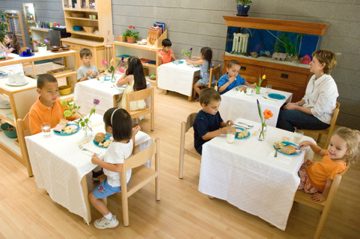
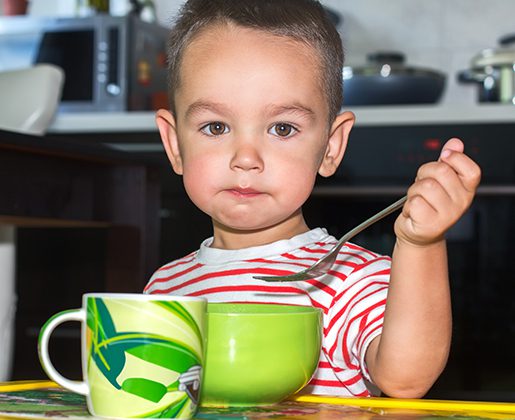
Flipping the pattern of thinking, so that meal preparation, meal-time, and cleanup are essential lessons in Practical Life and Grace and Courtesy Often, school meals, along with the associated cooking and cleaning, are regarded as an intrusion on the school day. What is required is to flip this pattern of thinking over, to see meal preparation and the washing of dishes as integral to Practical Life and the meal process as an essential exercise in Grace and Courtesy.

Remember that the words ‘Montessori Classroom’ are something of a misnomer that contributes to incorrect thinking about the purpose of the environment. The Montessori prepared environment for children between 3 and 6 was called Casa dei Bambini by Maria Montessori, and the correct translation of this is Children’s Home. The implication is that this is a home-like, rather than a school-like environment.

That applies not only to décor but also to the way the day is arranged (no school or office-like schedules) and the interactions between the people using the space (occupants of a home have a significantly different relationship with the furnishings and other objects than do the occupants of a school room or office).

One of the implications of this way of thinking is that it places meals and eating into a very different focus. In a typical school or workplace, meals intrude on the real business or learning or producing some end-product of commercial value. The Montessori environment is focused on the living human child and the process of growing and developing. This allows us to see mealtimes as an opportunity rather than a problem.

Margot Waltuch, describing La Maison des Enfants in Sèvres, France, between 1933 and 1938, writes that:

“Sometimes at the beginning of the school year, when first meeting the children, it would be enough simply to let them talk. We would listen to music, or we would share some food, or simply go on a little walk and pick wildflowers. Presentations were much shorter and fewer than what are done with a new class today.” (Waltuch, 1996).

Waltuch explains how cooking and eating were integrated into the day:

“Through cooking, children are introduced to a whole new world of sensations: tastes, smells, colors, textures, blending, and changing —all that cooking entails. They are given the opportunity to explore the otherwise forbidden realm of knives and fires. Working with the tools of cooking develops manual dexterity. And, of course, cooking and eating is an occasion for interaction with one another. We had a full-course meal daily. We ate with the children and discussed their experiences in the parks, the museums, their parties, etc. They talked about future events and past events, always making laughter and jokes. The French children were masters of conversation at the table. Also, typically French, was the style of waiting on the table. The eating and talking alone usually took an hour. Introduction of foods and their preparation is still another form of sensory exploration. Noodle-making, bread-making, peeling, cutting, grinding, chopping, slicing, grating, squeezing—these are not only ways of extracting from nature what you need to eat but great builders of hand-eye coordination, sequence, and social life”
(Waltuch, 1996).

To incorporate meals into the day in the way described above requires that the curriculum be re-examined. Mealtimes become not an addition or a necessity but are interwoven into the Practical Life, Sensorial, Math, Language, and Cultural areas of learning.

PRACTICAL LIFE AREA

The Practical Life area includes many activities that help the children learn the basic skills and movements necessary for them to take part in food preparation, table preparation, serving, and cleaning up afterwards. Shelf activities must be carefully analyzed to ensure that they contain real activities that develop real skills, with lots of food-preparation activities. Once children have mastered basic skills (such as: buttering bread, washing, peeling, and chopping fruit and vegetables, mixing, whisking, and so forth), they are able to take part in helping prepare the midday meal.

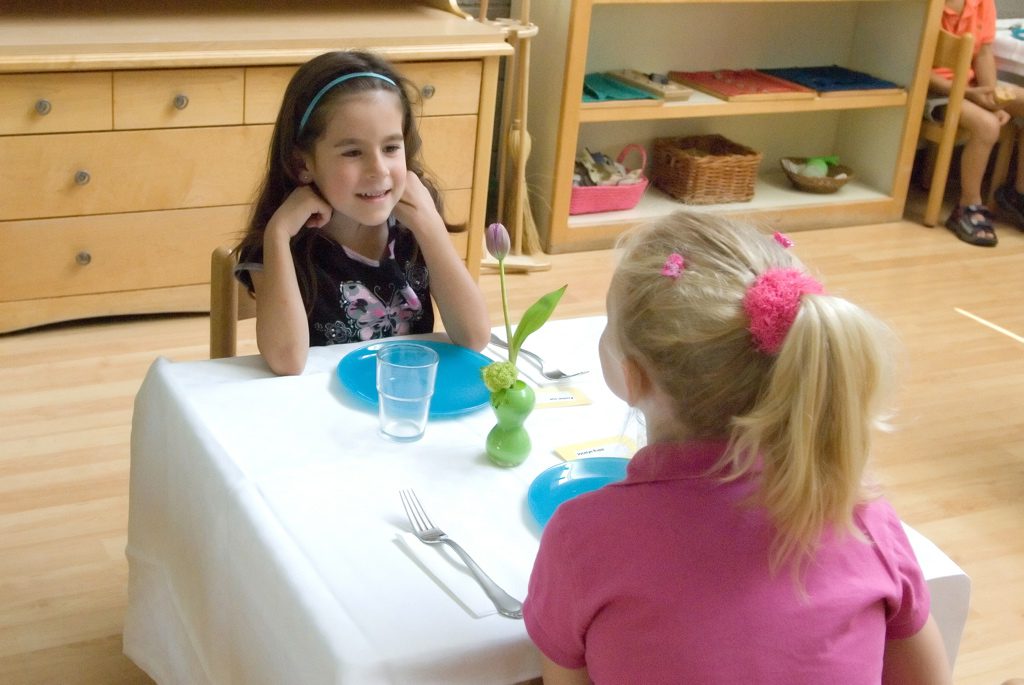
Presentations of carrying tables and chairs allow children to re-arrange the furniture for lunch. Instead of contrived shelf-based table-setting work, children lay the table for lunch. If tablecloths and cloth serviettes are used, this provides a continuous stream of cloths for washing, drying, and ironing (or at the very least, folding) by the children. Controlled washing activities extend into washing the lunch dishes and packing them away.

The children serve the meals. There are a number of ways to do this. Meals can be served buffet style, where children serve their own food; alternatively, bowls can be placed on the table for the children to help themselves. Another option is for a few children to serve as waitstaff, as is described by Waltuch and by Maria Montessori herself:

“Anyone who has watched them setting the table must have passed from one surprise to another. Little four-year-old waiters take the knives, forks, and spoons and distribute them to the different places; they carry trays holding as many as five water glasses, and, finally, they go from table to table, carrying big
tureens full of hot soup” (Montessori, 1912, p. 346).

Not a mistake is made, not a glass is broken, not a drop of soup is spilled. All during the meal, unobtrusive little waiters watch the table assiduously; not a child empties his soup bowl without being offered more; if he is ready for the next course, a waiter briskly carries off his soup bowl. Not a child is forced to ask for more soup, or to announce that he has finished” (Montessori, 1912, p. 349).

Adults eat with the children, which provides an opportunity to model and present a wide range of skills, including: asking for more; offering; passing food; eating politely; excusing oneself courteously; and engaging in appropriate conversation at the meal table.

If you have a garden (or even space for pots of herbs that the children can tend), you can incorporate that into your cooking, but if you can grow lettuce, tomatoes, carrots, etc., then children can plant, harvest, prepare, cook, and eat foods from your garden. This leads perfectly into lessons that would normally be lifeless materials on the cultural shelves.

SENSORIAL, CULTURAL, MATHEMATICS AND LANGUAGE EXTENSIONS

Food preparation and eating provide endless opportunities for children to extend their senses of taste, smell,
texture, color and even sound, which have been refined through working with the Sensorial materials. Take time over food preparation and mealtimes to talk about how each food item tastes. What is the texture? Does the child enjoy (or not enjoy) a particular food or the way it has been prepared?

Have special days during which you research and prepare food from a particular culture and experience the mealtime courtesy that relates to that culture. Talk about the origins of certain foods and link shelf materials, nomenclature cards, and other items in the classroom to the real, concrete experiences the children have had at mealtime. You could even use culture-specific dishes and utensils.

The opportunities to include Math concepts are endless. Begin with simple one-to-one correspondence. For example, you can suggest that a child “Set enough places at the table for everyone in the class” and allow the child to solve the problem. On another day, say “There are two children away today, how many places to you think we will need?” This type of real problem is far better than the contrived ‘problem sums’ found in conventional workbooks. The challenges progress to fractions and ratios. This kind of activity helps children understand the purpose of mathematical operations and encourages them to think mathematically.

ELEMENTARY

At the Elementary level, food preparation and meal planning can be taken to a higher level and integrated into studies related to fundamental human needs, history, science, biology, and so on. Students can research and plan menus, assign tasks, budget, buy ingredients, prepare meals, and even undertake
research that gathers feedback from
other students.

PRACTICALITIES

Besides requiring something of a paradigm shift, the approach to school meals suggested above requires planning and adjustments to your classroom design. Some areas have licensing requirements that make this very difficult, and you may need to negotiate around these limitations. Where you are able to legally cook and eat with the children, it makes sense to take full advantage of the opportunity. It is obviously easier to incorporate this approach into small schools. If you have a larger school, with a full commercial kitchen then you can explore different options.

Schools in Reggio Emilia, Italy, ensure that the kitchen staff is trained to work with the children, and every day children are invited to help with food preparation. Alternatively, a specialized, child-sized kitchen area can be created, and the different classes in the school have the opportunity to use it on a rotational basis. Every situation will be different, but I have no doubt that every school can find ways to introduce these activities for their children to some degree.

TIME ALLOCATION

So how much time do you allow for lunch? My response would be: As long as you need! Preparation can take place the whole morning interspersed with other work. This is doubly true if you ensure that your work cycle is uninterrupted by pull-outs and special lessons and if you limit whole-group activities (such as circle/line-time).
I would argue that sitting down together for a meal is possibly the only whole-group activity that is most indispensible in a Montessori environment. If you are not interrupting the work-cycle with myriad other distractions, there is plenty time to prepare and eat a civilized meal.

All cooking-related activity is Practical Life and, thus, has all the benefits normally attributed to activities of Practical Life. If you take full advantage of all the opportunities offered, you are covering many other curriculum areas as well and can record them as such if you are concerned about documenting ‘standards’ and ‘outcomes.’ This is not a break in the work cycle; it is part of the work cycle, and if meal preparation is planned and executed in such a way that it does not call the whole group away from other work, it can enrich rather than disrupt the more academic program elements. Not all the children are involved in these activities every day, so other work gets done as well.

BIBLIOGRAPHY

  • Kahn, D. (1996). All day Montessori: Notes on the history of the experiment. The NAMTA Journal, 21(3), 1–7.
  • Montessori, M. (1912). The Montessori method. (A. George, Trans.) (2nd ed.). New York: Frederick A. Stokes. Retrieved from http://digital.library.upenn.edu/women/montessori/method/method.html
  • Stephenson, M. (2000). Reminiscences and thoughts about Montessori day care. NAMTA Journal, 25(3), 45–52.
  • Verschuur, M. B. (1986). Montessori and daycare: Making a distinction. The NAMTA Journal, 12(1), 66 – 73.
  • Verschuur, M. B. (1996). All-day Montessori: Making it work. The NAMTA Journal, 21(3), 57–68.
  • Waltuch, M. R. (1996). The casa of Sèvres France. The NAMTA Journal, 21(3), 43–54.

Montessori Leadership / August 2014 / p 13

Some Samples of Radio Ads for Montessori Schools

This is a series of 5 ads made for the Jefferson Montessori School in Idaho Falls, Idaho in the USA and shared with us at the Montessori Foundation several years ago as examples for other Montessori schools. They are very well done in our opinion.

Many thanks to Jefferson Montessori School for sharing these ads.

Webcast:  What’s Going to be Different this School Year?

Webcast: Effective Board and Admin Team Relationships / Part 2


This week, began to explore the topic of how to build effective working relationships between the school’s administrative team and the board.
For those of you who own your school, this will probably still be just as relevant.
The relationship between the individual or family owners, and the leadership of the school or actually quite similar to those in the nonprofit world.
Boards and school leaders can make an amazing team or ultimately create havoc. Creating a culture of wisdom, institutional memory, and effective development of policies and plans can make all the difference in .
This is a small taste of a special live course developed at the Montessori Foundation which goes into much more depth. We will be sending out more information on the full staff development program soon, but sharing information this week.
Remember, we store videos of all of our webcasts and much more in The International Montessori Council member’s resource center. If you or your school are not members yet, you should look into it. stage.montessori.org/IMC
The IMC offers great benefits, especially to schools, and is very affordable because of its connection to the Montessori Foundation. It only takes a moment to join online.
If you’d like to know more about having any of us from the Montessori Foundation, including Jonathan Wolf, Paul Epstein, Michael Dorer, Kathy Leitch, Lorna McGrath, Robin Howe, or me come to your school or present a live online class by video broadcast to your entire staff, contact me at timseldin@montess

A Montessori Bibliography

An extensive bibliography of works by or about Maria Montessori and Montessori education.

Note: If you know of any works that should be in this list please contact Tim Seldin.

Adler-Golden, Rachel; Gordon, Debbie. (1980) Beginning French for Preschoolers: A Montessori Handbook. Hemet, CA: Education System Publisher.

Albanesi, Franco. (1990) Montessori Class Management. Dallas: Albanesi Educational Center.

Alex, Joanne DeFilipp; Wolf, Aline. (2003) I Wonder What’s Out There: A Vision of the Universe for Primary Classes. Hollidaysburg, PA: Parent Child Press.

Appelbaum, Phyllis. (1971) “The Growth of the Montessori Movement in the U.S.: 1909-1970? (an unpublished doctoral dissertation for New York University, available through University Microfilms International, 300 North Zeeb Road, Ann Arbor, Michigan 48106.

Association Montessori Internationale. (1970) Maria Montessori: A Centennial Anthology. AMI(out of print).

Baumann, Harold. (1999). On the Historical Background of the Montessori-Piaget Relations. Amsterdam: AMI.

Beck, Joan. (1999). How to Raise a Brighter Child: The Case for Early Learning. Rev. ed. New York: Pocket Books.

Berryman, Jerome W. (1995). Godly Play: An Imaginative Approach to Religious Education. Augsburg Fortress Publishers.

Berryman, Jerome W. (1995). Teaching Godly Play: The Sunday Morning Handbook. Nashville, KY: Abingdon Press.

Berryman, Jerome W. (2002). The Complete Guide to Godly Play. 3 volumes: 1. How to Lead Godly Play Lessons; 2. 14 Presentations for Fall; 3. 20 Presentations for Winter. Denver, CO: Living the Good News.

Berryman, Jerome W. (2003). Godly Play: 10 Core Presentations for Spring. Denver, CO: Living the Good News.

Berryman, Jerome W. (2003). Practical Helps from Godly Play Trainers. Denver, CO: Living the Good News.

Bethune, Ade. (1964). Uniscript: A New Method for Teaching Handwriting. Newport, RI: St. Leo League. Nienhuis Montessori USA.

Bethune, Ade. (1980). Teaching the Child to Write. pamphlet. Newport, RI: St. Leo League. Available from Nienhuis Montessori USA.

Blessington, John. (1975). Let My Children Work! Garden City, NY: Anchor Press/ Doubleday; (reissued in 1999) New York, NY: ToExcel. AMS and The Montessori Foundation

Brehony, Kevin J. (2000). “The Montessori Phenomenon: Gender and Internationalism in Early Twentieth-Century Innovation.” In Practical Visionaries: Women, Education, and Social Progress, 1790-1930. Ed. Mary Hilton & Pam Hirsch. New York: Longman.

Britton, Lesley. (1992). Montessori Play & Learn: A Parents’ Guide to Purposeful Play from Two to Six. New York: Random House. Also published 1992, Crown Publishing.

Camp, Cameron J. (1999). Montessori-Based Activities for Persons with Dementia: Volume 1. Beachwood, OH: Myers Research Institute.

Cavalletti, Sofia. (1992). The Religious Potential of the Child: Experiencing Scripture and Liturgy with Young Children. 2nd ed. Chicago: Liturgy Training Publications.

Cavalletti, Sofia. (1998). Living Liturgy: Elementary Reflections. Chicago: Liturgy Training Publications.

Cavalletti, Sofia. (1999). History’s Golden Thread: The History of Salvation. Trans. Rebekah Rojcewicz. Chicago: Liturgy Training Publications.

Cavalletti, Sofia. (2002). The Religious Potential of the Child Six to Twelve Years Old. Chicago, IL: Liturgy Training Publications.

Cavalletti, Sofia; Coulter, Patricia; Gobbi, Gianna; Montanaro, Silvana Q. (1996). The Good Shepherd and the Child: A Joyful Journey. Chicago: Liturgy Training Publications.

Chattin-McNichols, John. (1991). The Montessori Controversy. Albany, NY: Delmar. Available from AMS.

The Child, the Family, the Future. (1995). AMI International Study Conference Proceedings, July 1924, 1994, Washington, DC. Rochester, NY: AMI/USA.

Claremont, Claude A. (1962). Montessori Education: The Hope of the Future. Amsterdam: AMI.

DeJesus, Raquel. (1988, 2000). Design Guidelines for Montessori Schools. Milwaukee, WI: Univ. of Wisconsin-Milwaukee, Center for Architecture/Urban Planning Research.

Duffy, Michael; Duffy, D’Neil. (2002). Children of the Universe: Cosmic Education in the Montessori Elementary Classroom. Hollidaysburg, PA: Parent/Child Press.

Dwyer, Muriel I. A Path for the Exploration of Any Language Leading to Writing and Reading. Essex, England: Doppler Press. NAMTA.

Epstein, Ann, Ph.D. “Children with Exceptionalities.” The Montessori Way, The Montessori Foundation, 2003

Epstein, Ann, Ph.D. “School-Wide Discipline with a Montessori Perspective.” Montessori Leadership, Spring, 2001.

Epstein, Ann, Ph.D.; Collins, B.; Reiss, T.; and Lowe, V. “Including Children with Mental Retardation in the Religious Community.” Teaching Exceptional Children, May/June, 2001.

Epstein, Ann, Ph.D. “The Behavior Part is the Hardest: Montessori Teachers and Young Children with Challenging Behaviors.” Montessori Life, Fall, 1998.

Epstein, Ann, Ph.D. “How Teachers Accommodate for Young Children with Special Needs.” Montessori Life, Summer, 1997.

Epstein, Ann, Ph.D. “Montessori Early Childhood Language: Life-Long Literacy.” Tomorrow’s Child, 1996.

Epstein, Ann, Ph.D.; Schonfeld, J. “We Are All Authors!” Montessori Life, 1996.

Epstein, Ann, Ph.D. “Is Montessori Education Right for My Child?” The Public School Montessorian, 1994.

Epstein, Paul, Ph.D. “An Ethnographic Investigation of a Teenage Culture in a Montessori Junior High School,” Unpublished dissertation, SUNY, Buffalo, 1986.

Epstein, Paul, Ph.D. “Serving on the Front Line.” Tomorrow’s Child, 2003.

Epstein, Paul, Ph.D. “Montessori Moments.” Tomorrow’s Child, 2001.

Epstein, Paul, Ph.D. “The Spiritual Preparation of the Teacher.” Open Forum, 2001.

Epstein, Paul, Ph.D. “It Takes a Whole Child to Raise a Village. Accomplishing Educational Reform in Nepal.” Montessori Leadership, 2000.

Epstein, Paul, Ph.D. (with Epstein, A., Ph.D.) “Computers. Are There New Secrets of Childhood.” Montessori Leadership, 2000.
Epstein, Paul, Ph.D. “The Necessity for Spirituality in Education: A Montessori Example.” Montessori Leadership, 1999.

Epstein, Paul, Ph.D. “Computers in the Classroom.” Tomorrow’s Child, 1998.

Epstein, Paul, Ph.D. “A Parent’s Guide to Middle Schools.” Tomorrow’s Child, 1998.

Epstein, Paul, Ph.D. “Implementation: Preparing and Developing a Public School Management Guide.” in B. Weiss, Ed., The Montessori School Management Guide, The American Montessori Society, 1998.

Epstein, Paul, Ph.D. “Middle Level Programs ? Models of Understanding,” Research for Families and Children Newsletter, Fall 1997.

Epstein, Paul; Seldin Tim. (2003). The Montessori Way: An Education for Life. The Montessori Foundation.

Education for the Twenty First Century: AMI International Study Conference Proceedings. (1989). Rochester, NY: AMI/USA.

Farrow, Elvira; Hill, Carol. (1973). Montessori on a Limited Budget: A Manual for the Amateur Craftsman. Ithaca, NY: Montessori Workshop. Nienhuis Montessori USA. Also published 1984, Hemet, CA: Education System Publisher.

Fleege, Virginia; others. (1974). Montessori Index. Annotated bibliography of primary and secondary Montessori works. 2nd ed. River Forest, IL: Montessori Publications. Nienhuis Montessori USA.

Freedom & Responsibility: A Glorious Counterpoint. (2001). Proceedings of AMI/ USA Conference, Boston, MA, July, 2000. Rochester, NY: AMI/USA.

Fresco, Grazia Honegger. (1993). Montessori Material Contained in Some of the Catalogues Published in New York, London, Bucharest, Berlin, Gonzaga from 1910 up to the 30s, 2nd ed. Dual language edition, English and Italian.

Castellanza, Italy: Il Quaderno Montessori Editions. Available in the U.S. through Kaybee Montessori.

Futrell, Kathleen H. (1988). The Normalized Child. Rev. ed. Cleveland, OH: NAMTA.

Gettman, David. (1988). Basic Montessori: Learning Activities for Under-Fives. New York: St. Martin’s Press.

Gillet, Anne Marie. (1970). Introduction to Biology. Offprint from AMI Communications. Amsterdam: AMI.

Gobbi, Gianna. (2000). Listening to God with Children. Trans. Rebekah Rojcewicz. Loveland, OH: Treehaus Communications.

Goertz, Donna Bryant. (2001). Children Who Are Not Yet Peaceful: Preventing Exclusion in the Early Elementary Classroom. Berkeley, CA: Frog, Ltd.

Gordon, Cam. (2001). Together with Montessori: The Guide to Help Montessori Teachers, Assistant Teachers, Resource Teachers, Administrators & Parents Work in Harmony to Create Great Schools. 2nd ed. Minneapolis, MN: Jola Publications. Nienhuis Montessori USA and The Montessori Foundation.

Grace and Courtesy: A Human Responsibility. (1999). Proceedings of AMI/ USA Conference, Oak Brook, IL, July, 1998. Rochester, NY: AMI/USA.

Gross, Michael John. (1986). Montessori’s Concept of Personality. Dissertation, Univ. of Nebraska, 1976. University Press of America.

Gupta, Rajendra K. (1983). A New Approach to Zoology Nomenclature. Oak Park, IL: Montessori Center for the Child. Nienhuis Montessori USA.

Gupta, Rajendra K. (1986). Science Experiences for Montessori Children Part 1. Minnesota: Montessori Research and Development Center. Nienhuis Montessori USA.

Gupta, Rajendra K. (1986). Science Experiences for Montessori Children Part 4. Minnesota: Montessori Research and Development Center. Nienhuis Montessori USA.

Gupta, Rajendra K. (1986). Science Experiences for Montessori Children Part 5. Minnesota: Montessori Research and Development Center. Nienhuis Montessori USA.

Gupta, Rajendra K. (1987). Researching Montessori Zoology Program. Minnesota: Montessori Research and Development Center. Nienhuis Montessori USA.

Gupta, Rajendra K. (1995). Botany as a Means of Development (Based on the Montessori Approach). Minnesota: Montessori Research and Development Center. Nienhuis Montessori USA.

Gupta, Rajendra K. (1995). Science Experiences for Montessori Children Part 2. Minnesota: Montessori Research and Development Center. Nienhuis Montessori USA.

Gupta, Rajendra K. (1995). Science Experiences for Montessori Children Part 3. Minnesota: Montessori Research and Development Center. Nienhuis Montessori USA.

Hainstock, Elizabeth G. (1997). The Essential Montessori. Rev. ed. New York: Plume.

Hainstock, Elizabeth G. (1997). Teaching Montessori in the Home: The Preschool Years. Rev. ed. New York: Plume.

Hainstock, Elizabeth G. (1997). Teaching Montessori in the Home: The School Years. Rev. ed. New York: Plume.

Hardinge, Joy. (1992). The Voice of Dr. Maria Montessori: Lectures, Madras, India, 1941-1942. Lectures taken in shorthand. Silver Spring, MD: International Montessori Society.

Hardinge, Joy. (1993). Montessori Method. Lecture notes, India, 1941-42. Silver Spring, MD: International Montessori Society.

Homfray, Margaret. (n.d.). Word Lists for Reading and Writing Scheme. London: Montessori Centre. Avail. Montessori Centre International.

Homfray, Margaret; Child, Phoebe. (n.d.). Primary Math. San Luis Obispo, CA: Montessori World Educational Institute.

Homfray, Margaret; Child, Phoebe. (1983). Primary Grammar. San Luis Obispo, CA: Montessori World Educational Institute.

Joosten, A. M. (n.d.). Learning from the Child. Excerpts from inaugural and valedictory addresses of the 25th and 26th Indian Montessori Training courses, Hyderabad, 1960-62. Amsterdam: AMI.

Joosten, A. M. (1987). The Montessori Method: Principles, Results, Practical Requirements. Rev. ed., Madras, India: Kalakshetra.

Joosten, A. M. (1990). Exercises of Practical Life: Introduction and List. Ed. Rajendra K. Gupta. Rev. ed. Bombay, India: Indian Montessori Training Courses. Available from Nienhuis Montessori USA.

Joosten, A. M.; Gupta, Rajendra; et al. (1985). Montessori Language Program (New Insights and Techniques). Mesa, AZ: Montessori Research Center. Available from Nienhuis Montessori USA.

Joosten, Albert. (1994). Education as a Help to Life. Ed. R.K. Gupta. Minnesota: Montessori Research & Development Center. Nienhuis .

Joosten, Albert. (1995). The Child’s Right to Develop. Ed. R.K. Gupta. Minnesota: Montessori Research and Development Center. Nienhuis Montessori USA.

Jordan, H. J. (1971). Montessori High School. Amsterdam: AMI.

Kahn, David. (1995). What Is Montessori Elementary? Cleveland, OH: NAMTA.

Kahn, David. (1995). What Is Montessori Preschool? Cleveland, OH: NAMTA.

Kahn, David; Dubble, Sharon; Pendleton, D. Renee. (1999). The Whole-School Montessori Handbook. Cleveland, OH: NAMTA.

Katzen-Luchenta, Jan. (1999). Awakening Your Toddler’s Love of Learning. Phoenix, AZ: Emunah Pub Co.

Kilpatrick, William Heard. (1971). The Montessori System Examined. Ayer Company Publishers (originally published in 1922).

Kocher, Marjorie B. The Montessori Manual of Cultural Subjects. (1973) T.S. Denison & Company, Inc.

Kramer, Rita. (1988). Maria Montessori: A Biography. 2nd ed. Reading, MA: Addison-Wesley.

Lanaro, Pamela Z. (1992). Montessori Materials Research Foundation Mathematics Manual I. San Leandro, CA: Montessori Materials Research Foundation.

Lanaro, Pamela Z. (1992). Montessori Materials Research Foundation Mathematics Manual II: Elementary Level. San Leandro, CA: Montessori Materials Research Foundation.

Lawrence, Lynne. (1998). Montessori Read and Write: A Parents’ Guide to Literacy for Children. New York: Crown Publishing.

Lillard, Paula Polk. (1988). Montessori: A Modern Approach. Rev. ed. New York: Schocken Books.

Lillard, Paula Polk. (1996). Montessori Today: A Comprehensive Approach to Education from Birth to Adulthood. New York: Schocken.

Lillard, Paula Polk. (1997). Montessori in the Classroom. Rev. ed. New York: Schocken.

Lillard, Paula Polk; Jessen, Lynn Lillard. (2003). Montessori from the Start: The Child at Home from Birth to Age Three. New York: Schocken.

Lillig, Tina. (1998). The Catechesis of the Good Shepherd in a Parish Setting. Oak Park, IL: Catechesis of the Good Shepherd Publications.

Lineburgh, Nancy E. (1996). Integrating Music into the Preprimary, Montessori Classroom. Golden Clef Publishing.

Loeffler, Margaret Howard (Ed.). (1992). Montessori in Contemporary American Culture. Proceedings of AMS symposium, Arlington, VA, April, 1990. Portsmouth, NH: Heinemann.

Long, John; Kahn, David. (1985). Montessori Children’s Project. Three volumes: 1. In the Beginning; 2. The Search for the First Humans; 3. The Human Family. Cleveland, OH: NAMTA.

Malloy, Terry. (1987). Montessori and Your Child: A Primer for Parents. 2nd ed. New York: Schocken Books.

McCarrick, Sr. Anne. (1972). Montessori Matters. Cincinnati, OH: Montessori Matters and E-Z Learning Materials. Available from Nienhuis Montessori USA.

McFarland, Sonnie. (1993). Shining Through: A Teacher’s Book on Transformation. Buena Vista, CO: Shining Mountains Center for Cooperation.

Miller, Jean. (2000). Montessori Music: Sensorial Exploration and Notation with the Bells. Mountain View, CA: Nienhuis Montessori USA.

Montanaro, Silvana. (1991). Understanding the Human Being: The Importance of the First Three Years of Life. Mountain View, CA: Nienhuis Montessori USA.

Montanaro, Silvana Q. (1997). The Child Is Father of the Man. Dual-language: English/ Italian. Rome: Edizioni Opera Nazionale Montessori. Nienhuis Montessori USA.

Montessori 1907-1957. (1958). Reprint of AMI Communications, 1957 #3/4. Amsterdam: AMI.

Montessori Jr., Mario M. (1992). Education for Human Development: Understanding Montessori. Ed. Paula Polk Lillard. Oxford: Clio Press.

Montessori, Maria. (n.d.). The Decimal System. Excerpts from Psicoaritmetica, with afterword by A. M. Joosten. Amsterdam: AMI.

Montessori, Maria. (1912). The Montessori Method: Scientific Pedagogy as Applied to Child Education in ?The Children’s Houses.? (U.S. title: The Montessori Method) The following editions are currently in print: 1976, Mattituck, NY: Amereon Ltd.; 1988, New York: Schocken, with intro. by J. McV. Hunt; 1990, Madras, India: Kalakshetra; 2000, Ridgefield, CT: Roger A. McCaffrey Publishing; 2001, Murrieta, CA: Classic Books; 2002,
Mineola, NY: Dover Publications; 2002, New York: Eighteen Hundred Seventy Three Press (E-book format).

Montessori, Maria. (1914). Dr. Montessori’s Own Handbook. The following edition is currently in print: 1988, New York: Schocken (with intro by Nancy McCormick Rambusch).

Montessori, Maria. (1917). The Advanced Montessori Method, Vol. I: Spontaneous Activity in Education; Vol. II: The Montessori Elementary Material. Trans. Lily Hutchinson, Arthur Livingston, Florence Simmonds. The following editions are currently in print: 1989, New York: Schocken (with intro by John J. McDermott; vol. 1 subtitled ?Her Program for Educating Elementary School Children?; vol. 2 subtitled ?Materials for Educating Elementary School Children?); 1990, Madras, India: Kalakshetra; 1984, Hemet, CA: Education System Publisher; 1991, Oxford, England: Clio Press.

Montessori, Maria. (1932). Peace and Education. Address given at 2nd International Montessori Congress, Nice, France, 1932. Editions currently in print: 2002, New York: AMS; 1971, 5th ed., Madras, India: Theosophical Publishing House (available /AMI).

Montessori, Maria. (1932). The Mass Explained to Children. The following edition is currently in print: 1998, Ridgefield, CT: Roman Catholic Books.

Montessori, Maria. (1936). The Child in the Family. Trans. Nancy Rockmore Cirillo. The following editions are currently in print: 1989, Oxford, England: Clio Press; Madras, India: Kalakshetra.

Montessori, Maria. (1936). The Secret of Childhood: A Book for All Parents and Teachers. The following editions are currently in print: 1936, Calcutta: Orient Longmans (Trans. Barbara Barclay Carter); 1982, New York: Ballantine (Trans. M. Joseph Costelloe); 1983, Adyar, Madras, India: Kalakshetra (Carter translation); 1998, London & Hyderabad: Sangam Books (Carter translation).

Montessori, Maria. (1946). Education for a New World. The following editions are currently in print: 1946, Madras, India: Kalakshetra Publications; 1989, Oxford, England: Clio Press.

Montessori, Maria. (1948). The Child. Adyar, Madras, India: Theosophical Publishing House. Available from AMI.

Montessori, Maria. (1948). Child Education. Lectures delivered on All-India Radio. Adyar, Madras, India: Kalakshetra Publications.

Montessori, Maria. (1948). The Discovery of the Child. Revised and enlarged edition of The Montessori Method (1912). The following editions are currently in print: 1948, Adyar, Madras, India: Kalakshetra Press (Trans. Mary A. Johnstone, based on 3rd Italian edition); 1976, Mattituck, NY: Amereon Ltd.; 1986, New York: Ballantine (Trans. M. Joseph Costelloe); 1988, Oxford: Clio (Trans. M. Joseph Costelloe, based on 6th Italian edition).

Montessori, Maria. (1948). To Educate the Human Potential. The following editions are currently in print: 1948, Adyar, Madras, India: Kalakshetra Publications; 1989, Oxford, England: Clio Press.

Montessori, Maria. (1948). Reconstruction in Education. Adyar, Madras, India: Theosophical Publishing House. Available/ AMI.

Montessori, Maria. (1948). What You Should Know about Your Child. The following editions are currently in print: 1961, Adyar, Madras, India: Kalakshetra; 1989, Oxford, England: Clio Press.

Montessori, Maria. (1949). The Absorbent Mind. The following editions are currently in print: 1959, Thiruvanmiyur, Madras, India: Kalakshetra (First publication of edition rewritten by Montessori in Italian and translated by Claude Claremont. All subsequent English editions based on this one); 1988, Oxford, England: Clio Press Ltd.; 1993, Cutchogue, NY: Buccaneer Books, Inc. (an imprint of Random House); 1995, New York: Henry Holt & Co. (with intro. By John Chattin-McNichols).

Montessori, Maria. (1955). The Formation of Man [also published as Childhood Education]. Trans. A.M. Joosten. The following editions are currently in print: 1986, Madras, India: Kalakshetra; 1989, Oxford: Clio Press.

Montessori, Maria. (1961). The Two Natures of the Child and the Meaning of Adaptation. Two lectures. Amsterdam: AMI.

Montessori, Maria. (1971). The Four Planes of Education. From lectures given in Edinburgh, 1938, and London, 1939. Ed. Mario Montessori. Amsterdam: AMI.

Montessori, Maria. (1972). Education and Peace. First published in Italy, 1949, as Educazione e Pace. Incorporates new translation of 1932 address in Nice, France, text of 1947 Montessori Magazine article ?Educate for Peace!? and other lectures. Trans. Helen R. Lane. The following editions are currently in print: 1992, Oxford, England: Clio Press; Madras, India: Kalakshetra.

Montessori, Maria. (1973). From Childhood to Adolescence. First published 1948 in German. Contains ?The Erdkinder? and ?The Functions of the University.? The following editions are currently in print: 1996, Oxford, England: Clio Press (Trans. A.M. Joosten); Madras, India: Kalakshetra.

Montessori, Maria. (1989). The Child, Society and the World: Unpublished Speeches and Writings. Ed. GÃ1⁄4nter Schulz-Benesch. Trans. Caroline Juler; Heather Yesson. Oxford, England: Clio Press.

Montessori, Maria. (1994, 1998). Creative Development in the Child: The Montessori Approach, Vol. 1 & 2. Edited and compiled notes from 1939 Madras course that Mario Montessori translated as a study aid. Ed. Rukmini Ramachandran. Trans. Mario M. Montessori. Madras, India: Kalakshetra.

Montessori, Maria. (1997). Basic Ideas of Montessori’s Educational Theory: Extracts from Maria Montessori’s Writings and Teachings. Comp. Paul Oswald; GÃ1⁄4nter Schulz-Benesch. Trans. Lawrence Salmon. Oxford, England: Clio Press.

Montessori, Maria. (1997). The California Lectures of Maria Montessori, 1915: Collected Speeches and Writings. Ed. Robert G. Bucken-meyer. Oxford, England: Clio Press.

Montessori, Mario M. (1960). Those Horrible Mathematics! Amsterdam: AMI.

Montessori, Mario M. (1960). What about Free Expression and Education as a Help to Life. Two essays. Amsterdam: AMI.

Montessori, Mario M. (1966). The Human Tendencies and Montessori Education. Amsterdam: AMI.

Montessori, Mario M.(1976). Cosmic Education. Amsterdam: AMI.

Montessori, Mario; Montessori, Ada. (1998). Correspondence: Mario and Ada Montessori to Margot Waltuch. Rochester, NY: AMI/USA.

The Montessori Method: Science or Belief. (1968). Collection of all the articles from a debate appearing in AMI Communications 1964-1966. Amsterdam: AMI.

Montessori, Renilde. (2000). Educateurs sans Frontières. Paris: Desclée de Brouwer.

The Montessori School Management Guide. (1977). New York: AMS.

Mooney, Carol Garhart. (2000). Theories of Childhood: An Introduction to Dewey, Montessori, Erikson, Piaget and Vygotsky. St. Paul, MN: Redleaf Press.

Motz, Sr. Mary. (1985). Montessori Matters: A History Manual. Cincinnati: Montessori Matters and E-Z Learning Materials. Nienhuis Montessori USA.

Mueller, Thomas; Schneider, Romana. (2002). Montessori: Teaching Materials 1913-1935 Furniture and Architecture. German and English. Lakewood, NJ: Prestel USA.

Neubert, Ann Burke. (1972). A Way of Learning: A Montessori Manual. Orlando, FL: Distributed by The Early Education Company.

Neubert, Ann Burke. (1972). Understanding the Child: The Preparation and Management of the Classroom. Orlando, FL: Distributed by The Early Education Company.

O’Connor, Barbara. (1993). Mammolina: A Story about Maria Montessori. Biography for children; foreword by Margot R. Waltuch. Minneapolis, MN: Carolrhoda Books Inc.

Orem, Reginald C. (1967). Montessori for the Disadvantaged. Capricorn Books. (Out of print, but may be available from used book dealers and online sources)

Orem, Reginald C. (1969). Montessori for the Special Child. Capricorn Books.

Oriti, Patricia. (1994). At Home with Montessori. Ed. David Kahn. Cleveland, OH: NAMTA.

Packard, Rosa Covington. (1972). The Hidden Hinge. Notre Dame, IN: Fides Publishing Co. Nienhuis Montessori USA.

Parkhurst, Hellen. (1922). Education on the Dalton Plan. New York, NY: E.P. Dutton & Co.; (Reissued 1982): New York, NY: The Dalton School.

Pendleton, D. Renee. (2002). The NAMTA Montessori Bibliography and Research Guide, Third Edition. Special issue. The NAMTA Journal 27:2.

Perry, Celma Pinho. (1986). Facilitating a Montessori All-Day Program: for Teachers and Parents. Clarendon Hills, IL: MECA-Seton Teacher Education Program.

Perry, Celma Pinho; Perry, Desmond F.; Fedorowicz, Meg. (2001). The Cosmic Approach: A Montessori Science Curriculum 0-6 Years Old. 3rd ed. Clarendon Hills, IL: MECA-Seton Teacher Education Program.

Perry, Desmond. (2001). The Child: What Every Caring Parent Needs to Know. Includes parent discussion guide. Clarendon Hills, IL: MECA Seton Teacher Education Program.

Rambusch, Nancy McCormick. (1998). Learning How to Learn: An American Approach to Montessori. Rev. ed. New York: AMS.

Rambusch, Nancy M.; Stoops, John A. (1992). The Authentic American Montessori School: A Guide to the Self-Study, Evaluation, and Accreditation of American Schools Committed to Montessori Education. New York: AMS and The Commission on Elementary Schools of The Middle States Association.

The Relevance of Montessori Today: Meeting Human Needs, Principles to Practice. (1997). Proceedings of National Conference, July 25-28, 1996, Bellevue, WA. Rochester, NY: AMI/USA.

Rohrs, Herman. (1997). “Maria Montessori.” In Thinkers on Education. Volume 3. Ed. Zaghloul Morsy. India: UNESCO Publishing. Available from Bernan Assoc.

Schapiro, Dennis. (2003). Montessori Community Directory. Issued annually. Minneapolis, MN: Jola Publications.

Schmid, Jeannine. (1998). Nurturing Your Child’s Spirit: A Montessorian Approach. 3rd ed. Loveland, OH: Treehaus Communications.

Seldin, Tim. (1979). “The Need for Secondary Montessori Education in the United States”; AMS, The Constructive Triangle; Spring, 1979.

Seldin, Tim. (1979). “The First Montessori High School in the United States,” AMS, The Constructive Triangle; Winter, 1983.

Seldin, Tim. (2001). A Guide for the Self-Evaluation, Institutional Development and Accreditation of Montessori Schools Around the World. The Montessori Foundation and the International Montessori Council.

Seldin, Tim.(2002). Finding The Perfect Match: How to Recruit and Retain the Right Families for Your School. The Montessori Foundation.

Seldin, Tim. (2003 revised edition). A Montessori Curriculum Scope And Sequence: Ages 2-14. The Montessori Foundation. (Originally issued in 1983 by the Barrie Press)

Seldin, Tim and Donna. (1986). The World in the Palm of Her Hand: The Montessori Approach to History and Geography for the Young Child. The Montessori Foundation.

Seldin Tim; Epstein, Paul. (2003). The Montessori Way: An Education for Life. The Montessori Foundation.

Seldin, Tim; Meyer, Musya. (1986). Celebrations of Life ? The Montessori Approach to International Studies. Barrie Press (available through The Montessori Foundation).

Seldin, Tim; Wolff, Jonathan. (2001). Organizing a New Montessori School Step by Step. The Montessori Foundation.

Seldin, Tim; Wolff, Jonathan. (2001). Building a World Class Montessori School, The Montessori Foundation.

Seldin, Tim; Wolff, Jonathan. (2003). Master Teachers/Model Programs: A Montessori Approach to Curriculum Development and Coordination, Staff Development and Professional Supervision. The Montessori Foundation and the International Montessori Council.

Shepherd, Marie Tennent. (1996). Maria Montessori: Teacher of Teachers. Biography for children. Minneapolis: Lerner Publications.

Smart, J. Ewart. (1970). Dr. Maria Montessori 1870-1952: The Origins of Montessori. Amsterdam: AMI.

Spietz, Heidi Anne. (1989). Modern Montessori at Home [Vol. 1]: A Creative Teaching Guide for Parents of Children Six through Nine Years of Age. Rossmoor, CA: American Montessori Consulting.

Spietz, Heidi Anne. (1990). Modern Montessori at Home II: A Creative Teaching Guide for Parents of Children 10 – 12 Years of Age. Rossmoor, CA: American Montessori Consulting.

Spietz, Heidi A. (1991). Montessori at Home: A Complete Guide to Teaching Your Preschooler at Home Using the Montessori Method. Rev. and expanded ed. Rossmoor, CA: American Montessori Consulting.

Spietz, Heidi A. (1993). A Complete Guide to Teaching Your Child Beginning Spanish. Rossmoor, CA: American Montessori Consulting.

Spietz, Heidi A. (1993). Reading, Writing and Spelling in Spanish 1. Rossmoor, CA: American Montessori Consulting.

Spietz, Heidi A. (1994). Basic French Vocabulary. Rossmoor, CA: American Montessori Consulting.

Spietz, Heidi Anne. (1999). Montessori Resources: A Complete Guide to Finding Montessori Materials for Parents and Teachers. Rossmoor, CA: American Montessori Consulting.

Standing, E.M. (1998). Maria Montessori: Her Life and Work. Rev. ed., with introduction by Lee Havis. New York: Dutton-Plume.

Stephenson, Margaret E. (1971). Montessori ? an Unfolding ? the Child from 3 to 6. Amsterdam: AMI.

Stephenson, Margaret E. (2002). A Collection of Essays by Margaret E. Stephenson. Limited edition ? individually bound previously published lectures. Rochester, NY: AMI/USA.

Stephenson, Susan. (2003). Michael Olaf’s Essential Montessori. Catalog/booklet in two volumes: The Joyful Child (birth to three) and Child of the World (three to twelve+). Arcata, CA: Michael Olaf Montessori Company.

Thrush, Ursula. (1982). Maria Montessori Farmschool Erdkinder. San Francisco: Author. Nienhuis Montessori USA.

Thrush, Ursula. (1992). Peace 101: The Introduction of Education for Peace as a Mandatory Subject of the Montessori Teacher Education Curriculum.Nienhuis Montessori USA.

Tornar, Clara. (2001). Montessori Bibliografia Internazionale/International Bibliography 1896-2000. Dual-language edition, Italian and English, with CD-ROM. Rome: Edizioni Opera Nazionale Montessori.

Turner, Joy Starry. (1997). The Montessori Life Index: Volumes 1 to 9 Fall 1989-Fall 1997. New York: AMS.

Waltuch, Margot. (1986). A Montessori Album: Reminiscences of a Montessori Life. Cleveland, OH: NAMTA.

Wentworth, Roland A. Lubienski. (1999). Montessori for the Millennium: Practical Guidance on the Teaching and Education of Children of All Ages, Based on a Rediscovery of the True Principles and Vision of Montessori. Mahwah, NJ: Erlbaum.

Wild, Rebeca. (2000). Raising Curious, Creative, Confident Kids: The Pestalozzi Experiment in Child-Based Education. Boston: Shambhala.

Wolf, Aline D. (Comp.). (1978). Look at the Child: An Expression of Maria Montessori’s Insights. Altoona, PA: Parent Child Press.

Wolf, Aline. (1980). A Parents’ Guide to the Montessori Classroom. Altoona, PA: Parent Child Press.

Wolf, Aline. (1981). A Book about Anna for Children and Their Parents. Altoona, PA: Parent Child Press.

Wolf, Aline. (1982). The World of the Child. Altoona, PA: Parent Child Press.

Wolf, Aline. (1984). Mommy, It’s a Renoir! Altoona, PA: Parent Child Press.

Wolf, Aline. (1989). Peaceful Children, Peaceful World. Altoona, PA: Parent Child Press.

Wolf, Aline. (1991). Our Peaceful Classroom. Altoona, PA: Parent Child Press.

Wolf, Aline. (1994). Andy and His Daddy: A Book for Children and Their Parents. Altoona, PA: Parent Child Press.

Wolf, Aline. (1996). Nurturing the Spirit in Non-Sectarian Classrooms. Altoona, PA: Parent-Child Press.

Wolff, Jonathan; Ball, Edgar. (1999). Empowering Staff to Support Organizational Objectives: Creating an Administrative Environment That Fosters Harmony, Loyalty and Teamwork. Encinitas, CA: Learning for Life.

Yankee, Helen M. (1983). Montessori Math: The Basics. Hemet, CA: Education System Publisher.

Yankee, Helen M.; Schifrin, Ann. (1984). Montessori Geography. Manual. Hemet, CA: Education System Publisher.

Yankee, Marie. (1997). Montessori Curriculum Manual. Hemet, CA: Education System Publisher.

Authors’ Note: Our thanks to the North American Montessori Teachers’ Association (NAMTA) for their assistance in compiling this bibliography.


Best-Practice Handbooks

Dr. Montessori’s legacy needs to be preserved in the face of rapid expansion and adaptation in a wide array of situations. We are concerned that Montessori could one day become “whatever anyone does in her name” and the value of the method for children will be lost. Montessori is both a set of practices and a condition of mind. The joining of these two parts is what distinguishes good effective Montessori classrooms.

The idea of “best practice” has the power to promote a higher level of professionalism, because it can engage Montessori teachers in meaningful discussions at a much deeper level, leading perhaps to a better understanding of human nature. It could certainly lead to be teaching practices within a school.

Dr. Montessori’s thoughts need to be the core of our work. As Paula Lillard once told me, “If we could just allow our egos to be less dominant and focus on what Dr. Montessori said and did, it would be more than enough to occupy a professional life. It is too bad that more Montessori schools are based less on a rigorous study of Dr. Montessori’s practice and insights than on our competing personalities.”

Having said that, I have to gently point nut that much of the Montessori legacy was handed down through an oral tradition. She hesitated to put too much in writing because of her fear that people would mistakenly believe that you could master the skills and develop the profound insights and perspective that she was trying to pass down through independent reading. Much as I treasure the books, I know that they represent only a small and far less than complete collection of her knowledge and practical teachings. Perhaps the fact that she earned her living in part through the operation of personally supervised teacher training programs also influenced her, but there seems to be little doubt of her strong position in this matter.

Dr. Montessori was also very clear about her concerns about well-intentioned people who attempted to use part of her approach, but not all, or those who similarly attempted to blend her ideas in with many others. It seems that she taught through an extended process of lectures, demonstrations, work with associates, and supervised periods of observing and working with children. While there does not appear to have been one consistent model used throughout her career, all Montessori teacher preparation programs during her lifetime were personally supervised by Dr. Montessori and ran for periods of a year or longer. Mr. Joosten’s often spoke about the value of taking training several times from different centers, gaining a fresh perspective each time. Hilda Rothschild gently joked that every time she read the Absorbent Mind, someone slipped in new pages that she never noticed before.

We need to always begin by going back to the source. However, we need to do so understanding the limitations inherent in the published literature, and recall the countless monographs, speeches, interviews, recollections of those who worked with her, and other first hand sources of information.

The question is what did Dr. Montessori write, say, or actually do in her schools?

As to the process of compiling a “Best Practices” handbook, I don’t see the process as one of simply allowing a simple majority to rule.

The challenge is to get several people working together on a faculty, each coming with individual insights, previous experience, and less than perfect memories and understanding, to wrestle with, define, and hopefully agree on the way specific issues will be addressed at a given school. Since there are no “Montessori Police” to arrest those of us who do not faithfully implement her legacy, we do much better to go through a process intended to refresh our memories, deepen our understanding, and wrestle with legitimate questions of whether or not there is an even better way to address something than what she did.

Five Steps to Best Practice

The Montessori Foundation recommends that schools follow a five-step process in working towards a definition of Best Practice.

  1. Define a burning issue in writing as a clearly stated question. For example: Is there any compelling reason why we must keep our five year olds in the same room as the three and four-year-olds?
  2. Take a really close look as a staff at what Dr, Montessori said, wrote, or did. Identify your sources. Establish the best reference library that you can get.
  3. Turn to the experts, the Montessori mentors in your life, and ask them what they believe to be true. While a David Kahn, Miss Stevenson, Harvey Hallenberg, Celma Perry, or whomever you most respect and admire may not always agree with Dr. Montessori or offer infallible opinions and advice, they are a reasonable and highly legitimate resource.
  4. Next, try to find out what is believed to be best practice outside of Montessori. In many cases, we can gain valuable insights by looking beyond our limited community to see what others are doing. Frankly, that’s what Dr. Montessori did when she lovingly adopted the ideas and many practices of Jean Itard and Eduard Seguin. Just because it wasn’t invented here, doesn’t mean that someone else’s research is invalid.
  5. And, finally, put your insights down in writing, with the commitment to make this become universal practice within your school

As Albert Einstein said about science, the whole process is a search for what is true. The airplane flies not because we believe it to be true, but because the laws of the universe work a certain way.

Webcast:  What’s Going to be Different this School Year?

Webcast: Effective Board and Admin Team Relationships / Part 1

This week, began to explore the topic of how to build effective working relationships between the school’s administrative team and the board.

For those of you who own your school, this will probably still be just as relevant.

The relationship between the individual or family owners, and the leadership of the school or actually quite similar to those in the nonprofit world.

Boards and school leaders can make an amazing team or ultimately create havoc. Creating a culture of wisdom, institutional memory, and effective development of policies and plans can make all the difference in .

This is a small taste of a special live course developed at the Montessori Foundation which goes into much more depth. We will be sending out more information on the full staff development program soon, but sharing information this week.

Remember, we store videos of all of our webcasts and much more in The International Montessori Council member’s resource center. If you or your school are not members yet, you should look into it. stage.montessori.org/IMC

The IMC offers great benefits, especially to schools, and is very affordable because of its connection to the Montessori Foundation. It only takes a moment to join online.

If you’d like to know more about having any of us from the Montessori Foundation, including Jonathan Wolf, Paul Epstein, Michael Dorer, Kathy Leitch, Lorna McGrath, Robin Howe, or me come to your school or present a live online class by video broadcast to your entire staff, contact me at timseldin@montessori.org

Hands: Discovering Your Child’s Dominant Hand

Hands: Discovering Your Child’s Dominant Hand

Tips for right-handed parents with left-handed children…and left-handed parents with right-handed children…and for all of our children and all of our teachers!

I often find that parents may need some kind of ‘manual’ to help them cope with a child whose dominant hand is the opposite of the rest of his/her family, and especially to help protect their child in an environment of opposites.

This was made clear to me one morning on a flight from Los Angeles to Mexico City. A young mother was sitting next to me with her two young sons (probably 4 – 5 ½) sitting across the aisle from us. They were constantly popping out of their seats to show her the coloring books they were working on, coloring the pages and writing their names on the pages.

The youngest one was doing a fair job for his age on his work, but the oldest was having trouble staying within the lines and reversing his letters when writing his name. I couldn’t help watching, and finally the mother turned to me and said, “I don’t know what’s wrong with my oldest. He always gets everything mixed up and his little brother doesn’t.”

That was all I needed. I advised her: “The solution is easy; he is left-handed, and you are teaching him with your right hand. His little brother is right-handed, so your instructions are correct for him. Here he comes now, use your left hand to show him how to write his name.”

She did exactly that and was amazed when he immediately did his letters correctly. She colored a bit on his booklet with her left hand and he caught on right away. She turned to me, asking: “Why didn’t anyone tell me?”

We talked for an hour, me giving her tips on how to help her little one.

Then she said, “Why isn’t there something that tells parents what you are telling me?” I promised her I would write one, and here it is, a helping hand pamphlet for families with cross-handed children.

FINDING OUT

Before starting, it’s necessary to get rid of the words left-handed and right-handed. The proper terms are dominant hand (DH) and sub-dominant hand (SubDH), and this usage will make understanding much easier. Of course, his or her sub-dominant hand is the one that is opposite the dominant one. The next thing is to find out which is the child’s DH if it is not yet known.

Something that often works for small children is to roll a ball to them 25 times and ask them to kick it back; then, throw a ball to them 25 times and ask them to throw it back. By counting the times they kick or throw it back with each hand or foot, you may get a good idea of which is his/her DH. They may be very dexterous with both hands, but usually, they kick with their dominant foot. Now, when their DH is known for sure, some planning must be done. If their DH is the same as everyone else’s in the family, then no one needs to worry anymore; however, if their DH is different from everyone else’s then changes need to be made in some of the family techniques.

First, establish where the child with the opposite DH is in the family structure. There can be many different positions (such as the oldest sibling, middle sibling, and smallest sibling), and the parents themselves may not have the same DH. Wherever our target child is, everyone in the family, especially the parents, needs to know that they must be careful to recognize what hand they are using whenever showing something to him or her.

An important rule when dealing with a child who uses the opposite hand from her parents or siblings is that people showing the child something must use their own hands, as if they have the same DH as the child. (Don’t worry that it looks and feels a bit awkward; children feel an immense sense of relief when they realize that we have the same problem trying to use our opposite hand as they do trying to copy our hand.)

Try using your child’s DH for a day or so, or make a game with the rest of the family to do things with their SubDH. It can be fun, and will show the other children what difficulties their brother or sister faces or classroom peers experience when trying to copy someone using the reverse hand. It also will give a huge load of confidence to the ‘odd man out’ when they see their family struggling to do things in reverse.

One must also be very observant of the younger child who may adore his/her older sibling and want to copy everything he or she does. I especially remember a little right-handed girl who wanted to do everything her left-handed brother and father did. The first week of school, she dropped five small jugs of water, and I did not realize until much later that she was trying to do everything with her left hand.

Be sure that the children in the family sit where their knife-cutting hand is next to that edge of the table and sit on the side of the car where it is most comfortable to open doors and windows.

Remember that, when it comes to writing, allow plenty of space for their DH elbow and place their writing pad at a comfortable angle. Spiral workbooks can be especially difficult for left-handed children, as their hand may be resting on the spiral. Try turning the book over and start from the back if they are having this problem.

When they begin to write, sometimes it is necessary to make a small dot on the beginning of each line to help the child find exactly where he or she should start writing. Remember that our left-to right and up to down system is not native to humanity; other cultures use opposite systems such as down to up and right to left.

A bit of logical thought and observation will make life easier for the child who does not use the hand that is used by the rest of the family. It’s a question of seeing everything in reverse. The problem is much more obvious for a left-handed child in a right-handed world, but the opposite is also true: those right-handed children brought up in a left-handed family face the same problems.

It is an entirely different problem for his/her teacher who does not realize what is happening with a few children in her classroom. The teacher may be doing all her teaching by writing on the chalkboard with the opposite DH of some of her students. If you hold up your hand on a chalkboard and write the letter a with your right hand, the left-handed child will write it with exactly the same movement, and it will come out backward.Try it yourself. That will happen with all the letters (except a few, like 1 and l).

The child will make this mistake repeatedly until:

  1. He or she is pronounced dyslectic or with learning or reading problems, and sent to therapy.
  2. Somehow his/her brain sorts it out for itself, and he/she starts writing with inverse movements, and the letters come out correctly. Often children have to work with the hand curved around over the top of the letter.
  3. The teacher realizes what is wrong, sits down beside the child and gives the reading and writing lessons, matching her hand to the child’s DH.
  4. Children become so confused that they have problems reading and writing for the rest of their lives.
  5. Or, left-handed children are taught with some of the many new writing instruments designed for left-handed children (and, if possible, by a left-handed teacher).

EXAMPLES

My husband went to a strict European school many years ago, where left-handed children were not allowed to write with their left hand. He was amazed that our Montessori daughters learned to write painlessly and with beautiful styles all of their own. He still writes with his right hand and draws with his left.

The daughter of my Montessori kindergarten director is left-handed. Her mother followed all the tips I am recounting here, and she is now in high school and has never shown any problem with writing, inverting letters, or reading.

A young friend of mine (now a well-known radio broadcaster) recounted some of the difficulties he has had throughout his life. He says that one of his pet peeves is that in restaurants, he must invert all the tableware, and the worst is that every time they serve him coffee, the handle of the cup is always pointed to the right.

Years ago, when I was giving the Montessori Early Childhood teacher training, one of the young trainees (22 years old) sat back on her heels after she finished presenting the red rods, her first material in her sensorial exam. Her finished efforts brought a complete silence from all of us. She had done the entire exercise the reverse of the way it had been presented to the class.

Finally I broke the silence, “Elizabeth,” I said, amazed, “Are you left-handed?” “No,” she replied, evidently surprised by the question.

Another long silence followed her answer as we all looked at each other. Again, I ventured another question, “Is somebody in your family left-handed?”

She looked at me in surprise, a strange expression on her face. “Yes,” she faltered, amazed, “All my family are left-handed.”

Her mother called me early the next morning. “What happened to Elizabeth? She came home yesterday afternoon and cried all evening. When we went to bed, she was still crying.”

When Elizabeth came to class the next day, she called me aside. “All my life, I thought there was something wrong with me, that I saw everything backwards. Now I know I wasn’t crazy; it was my world that was turned around, and I no longer have to reverse everything. It has been a wonderful relief for me.”

A similar thing happened last week. I was making some copies behind my elementary director’s chair when I noticed the writing of one of the two therapists of our special-needs children who, was reporting to our director.

“Sara,” I told her, “you must be very careful how you hold your pen and be sure to use your right hand when working with right-handed children.”

She looked at me in surprise, “But Beverley, I am right-handed, although my daughter is left-handed!”

I turned my hand around in my mind. Sure enough, she was writing with her right hand, although it was wrapped around her words the way some left-handed people do. I felt very surprised and a little ashamed, but then it hit me.

“Sara, was your kindergarten teacher or your first grade teacher left-handed?” Now it was her turn to be surprised, as she thought back to her childhood: “How did you know? My first grade teacher was left handed!”

She is a college graduate in special needs therapy, but no one had ever taught her about the problems caused by left-hand and right-hand cross teaching.

Today, after many, many years, that little right-handed girl who dropped so many little jugs so long ago because she was copying the movements of her left-handed family, is now a Montessori guide herself. When I told her mother (also a Montessori guide) about this article, the first thing she asked me was: “Why didn’t you tell me about her trying to use her brother’s hand? It would have helped my family so much.”

I had to admit that I did not know about the problems mentioned here, but I did know to teach with the dominant hand. This mother and Montessori guide had taken my original course 25 years ago, where using the dominant hand was stressed. She had even gone on to take the elementary Montessori course as well as many others. She had taught all these years and had never experienced the simple techniques I am writing about in this article.

Tomorrow’s Child / September  2014 / p 11

Webcast:  What’s Going to be Different this School Year?

Webcast: Looking Back on the School Year to Plan for Next Fall / Webcast

This week, Jonathan Wolff, Kath Leitch, and Michael Dorer explored the topic of how we can take a look back at the school year that is ending, and use the insights we can glean from that reflection to strengthen our programs, special events, and Montessori practice.

“What can we celebrate?”

Let’s take a look back at the quality, results, and impact of our Montessori program(s), community events, and working relationships with parent and with each other as professionals at the conclusion of each school year

What can we enhance on behalf of the children, families, professional staff, and communities we serve?”

This is a small taste of a special live course developed at the Montessori Foundation by Andrew Kutt and Jonathan Wolff, which goes into much more depth. We will be sending out more information on the full staff development program soon, but sharing information this week.

Remember, we store videos of all of our webcasts and much more in The International Montessori Council member’s resource center. If you or your school are not members yet, you should look into it. stage.montessori.org/IMC

The IMC offers great benefits, especially to schools, and is very affordable because of its connection to the Montessori Foundation. It only takes a moment to join online. CLICK HERE

Webcast:  What’s Going to be Different this School Year?

Webcast: Montessori Compass – The story behind the software

This week, our guests will be Rob and Anita Amos, co-founders of Montessori Compass. We will have a lively conversation about why it is important for Montessori educators to keep careful records, to plan, and to keep parents informed. Rob and Anita will share reflections on how the software was developed, how it has evolved, and what changes have been made in the latest release.

The Bridge between Happy Families and Healthy Communities

The Bridge between Happy Families and Healthy Communities

We have been able to implement a number of strategies already into our school, including yoga, sensory-integration techniques, emotional expression through art, and creative relaxation through breathing and visualization.

Maria Montessori advocated the critical importance of early childhood development. We recognize this in the structure of her philosophy in classrooms and in life outside school walls. Fueled by this main tenet, Robin Johnson, Director of River Song School in Bend, Oregon, has made it her mission to support the youngest members of her community. River Song School has recently piloted a whole-child wellness initiative called Happy Families. This program is targeting the primary age group (3-6 years old) of children in the community of Bend and stressing the importance of early screening on the facets of behavioral, social, and physical health. During its first three years, River Song School was part of Project LAUNCH through Deschutes County to promote wellness in early childhood.

Through Project LAUNCH, a specialist was engaged in observation of our classrooms and subsequent consultation with teachers. The observations provided information and training for classroom teachers on handling individual differences or challenges that arose. This project turned into a catalyst for Happy Families’ inception and bringing River Song School into the community to raise awareness for early-childhood healthcare. It is no coincidence that the first developmental plane is also the most crucial period in which to recognize and treat mental or physical health challenges.

The staff at River Song School has found that there is a local deficit in programming, screening, and intervention resources available to preschoolers in an educational setting. Although there is a basic screening system available, the follow-through and support during the process of referral is limited. As well, the community resources for pediatric behavioral health are in such great demand that there are waiting lists and limits to availability. Any intervention or services that do exist tend to be reserved for children at infant and toddler age and at the elementary school age of five to six years old.

Many of our students attend River Song School, beginning at age three until kindergarten or first grade and then move to public school. Because this may be their first experience in an academic setting, it is often where behavior or social problems are initially displayed. By providing Happy Families at our school, we are proactively targeting this age group before they make the transition elsewhere. If we can do behavioral health screenings early on, our hope is that unnecessary diagnosis may be avoided and the potential to help in areas of challenge can be done sooner. It seems that once children come out of the primary stage, they can more easily become overlooked for individual differences and needs.

The basic structure of Happy Families will involve continuing partnerships with other nonprofits in the community that work with this age group and families. We will be establishing a network of professionals in the mental and physical health fields that are able to provide screening and referral at a low cost. Beyond screening, the referrals we make will direct families to the proper personnel to help with issues they may have. The staff at River Song School is highly skilled and trained, but adding Happy Families training will further establish a safety net around the students.

River Song is fortunate to have parents that are specialists in the field of mental health and are dedicated to cultivating the concept even more. We have been able to implement a number of strategies already into our school, including yoga, sensory-integration techniques, emotional expression through art, and creative relaxation through breathing and visualization.

River Song School has been approached many times by families seeking academics for their preschool student who may require additional support. Because Montessori education is conducive to children with individual needs, we believe that supporting the whole person with Happy Families will create the most success in and out of school. Happy Families was born out of the belief that children should thrive mentally and physically in school while enjoying their education.

Based on this foundation, the pieces of our initiative have been built. We have two parents of River Song School graduates who are also mental health specialists and have contributed to the implementation of Happy Families. With the help of these parent volunteers, River Song has created “soft landing pads” in each of our three classrooms, where students can bring their bodies to rest and prepare themselves to work. In those areas are small reminders of peace, such as calming pictures, hand-held fidgets, and stress-reduction items. We have seen such a positive response from the children, as they often go on their own to sit for a short time and be restful.

Another related component to Happy Families is River Song’s involvement in The Dalai Lama Foundation’s Peace Curriculum, which teaches compassion, peace, and living a meditative life. Through The Dalai Lama Foundation, we were fortunate to receive a visit from The Monks of Gaden Shartse Dokhang Monastery in June 2014 on their tour promoting the spread of peace. The children were able to share their peace song and be witness to the Monks chanting and praying for world peace.

River Song School is proud to share our wellness initiative, Happy Families. We feel that there is no better opportunity to encourage this type of early childhood program than in the Montessori tradition. Combining the safe structure of education while targeting basic needs will result in healthier children. As we nurture younger populations into healthy living and whole wellness by natural progression, our communities become stronger and healthier as well. Our hope with the Happy Families Initiative is to be a model for other schools to bring this whole child healthcare strategy into their own environment.

Tomorrow’s Child / November 2014 / p 32

Celebration of Life: Musya Meyer

Celebration of Life: Musya Meyer

In Memoriam

With the recent passing of Musya Meyer, the Montessori community lost an educator who loved to share her love of nature and multi-cultural celebrations with thousands of children and parents. Musya was the founding head of Hudson Montessori Schools in New Rochelle, NY and Danbury, CT. Her son, Mark Meyer, and his wife, Megin Meyer, continue her legacy as Directors of Hudson.

For Musya, an immigrant to America from Sarata, Romania, helping children understand their present culture (while remembering and celebrating their cultural heritage) was very important and led her to collaborate with Tim Seldin (President of The Montessori Foundation) to write a book for Montessori teachers and parents:  Celebrations of Life.

Musya was a featured presenter at national and international conferences in Europe, Cuba, China, and South America. Musya was also a good friend and frequent contributor to Tomorrow’s Child, sharing her love of nature and gardening, along with ongoing tips and new ideas to expand our international awareness in our classrooms and in our homes.

The following article was originally published in 1990. It preceded the publication of Celebrations and is even more relevant today. I have taken a few editorial liberties to include references to the internet. If you have been following our series of “Celebrations” in Tomorrow’s Child, you have seen a portion of an updated version of Celebrations that we hope to publish in the near future. This article may seem to be aimed at Montessori educators, but, in fact, it contains ideas that can be implemented at home and describes how international studies and celebrations are integrated directly into the Montessori curriculum.

It is also a call to action for parents to participate in the creation or expansion of an international curriculum. All cultures should be represented. We need to expand our knowledge, and parents can help make this possible.

Musya was a woman of many interests and talents. For me, I will remember her as a person who understood the tragedy of war and devoted her life to influence the manner in which we see and treat other people with compassion and understanding. Musya was a teacher of peace and the world is a better place because of her work and her life.

Tomorrow’s Child / November 2014 / p18

Pychological Evaluations: What does it all mean?

Pychological Evaluations: What does it all mean?

I was recently asked to do a psychological evaluation for a child at a Montessori school. Many believe that it is incongruent for one to get testing while going to a Montessori school. After all, the myth is that Montessori schools have no curriculum and don’t even require tests in their school. But, this is actually just that—a myth! More and more, schools are implementing psychological testing to help provide answers and recommendations to best help the child. Psychologists can help provide information that might not be observed in a classroom by a teacher or at home by a parent; we are trained to look holistically at all information (personal, academic, intellectual, behavioral, and mental) to provide a conceptualization to help the child best function.

If a teacher asks for a psychological assessment for your child, don’t assume that it is for a negative reason. In fact, giftedness evaluations are done with as much frequency as problem behavior to help ensure that the child is being as academically stimulated as possible.

Take Emma, for example (her name has been changed for confidentiality purposes). Emma presented in school with “behavioral problems.” She was often distracted during lessons, took longer than peers to complete assignments, and would often “goof off.” The parents were increasingly frustrated by the notes home asking for “extra attention” to homework and providing a detailed description of “problematic behaviors” in the classroom. The school was increasingly frustrated because the parents were not overly concerned and seemed minimally responsive.

In situations such as Emma’s, subsequent parent-teacher conferences are met with increased frustration because the child is not functioning as well as others. If behavioral issues are a concern, parent and teacher frustration can exacerbate the situation. If the child starts to be labeled as “that child,” it’s easy for her to start falling into that role. What happens all to often is that the parents grow more frustrated with their own child and the school, rather than being curious about what is really happening. I always encourage parents to “be curious” rather than jump to the conclusion that their child has attention or opposition problems.

Emma came to me for a psychological evaluation. When I told the parents the cost, they originally gasped at the price. Tests are expensive! As a fellow parent, I would feel the same. As a psychologist, I will share that I am typically spending two hours at the child’s school for observation of the student, interviewing parents and teachers for at least several hours, and then doing two days of testing. Then I’m writing a 10-15 page report. Many parents fail to recognize that it is generally a week’s worth of information gathering and result writing that truly needs to be completed. So, it’s expensive for a reason. Please, try not to be dissuaded by the cost, if you really want the help for your child. I can say with certainty that testing typically does give answers—many of which were never even considered.

Emma was a delight. She was wonderful in my office. She was pleasant and polite and, while initially nervous, very excited to come for testing. I asked her all kinds of questions, some of which were totally benign and some of which really provided me a glimpse of her life. Her parents were constantly fighting. One parent had lost his job. Emma was feeling emotionally bullied by a peer at school. And, finally, she felt bored with the schoolwork. Then I started with the testing …

I quickly learned that Emma is completely under-stimulated and bored. She kept telling me that she loved doing this testing because she liked to see what she could really do and it was “fun!” (How thrilled would I be if my kids described intelligence, achievement, and memory testing as fun.) And, as the results came in, I realized that Emma is actually functioning at least two grade levels above what she is being taught! Put all of this together, including the home challenges, and you see a better picture of how she is attempting to cope, which, in Emma’s case, is actually backfiring.

The beautiful aspect of this is that, by doing this testing, I was able to give a glimpse into her personal and academic life to both parents and teachers. Neither party needed to be defensive. It wasn’t any one person’s fault. The facts that were revealed through the data showed that neither school nor home life was truly providing the most optimal environment for Emma to thrive.

The irony is that, despite common knowledge, Montessori schools are the perfect places for children to get psychological evaluations (particularly if there is a good referral question). As you probably know, Montessori is different from other private and public schools, as evidenced in their mixed-age classrooms. Thus, the rate at which a child advances through the Montessori curriculum can actually be adjusted for each child. Emma, in this case, could be given more stimulating lessons without being overly frustrated; in fact, this is what she was asking for without knowing how to ask for it. Additionally, if a child needs more structure or more breaks, that can be implemented. I also discovered that Emma learns best from visual cues and through manual
manipulation, so that was provided as a recommendation.

Similarly, the parents didn’t realize how much Emma was picking up about their marital discord. We, as parents, often assume that, although children are present, they are unaware of the non-verbal cues that we provide to our spouse with whom we are fighting. Not only did she notice, she didn’t have the words to ask if they were okay. Emma also explained to me that she didn’t want to tell her parents about her peers bullying her because “they are already angry at each other.” What a beautiful little girl with incredible emotional intelligence and sensitivity. There were issues at school and at home. Emma was truly just trying to do the best she could, while carrying the weight of the world on her shoulders.

As an outside party, I came in and met with all parties, including Emma. I was able to talk about the troubles that she reported, the difficulties that she was experiencing, and we collectively came up with a plan. There was no blaming or frustration. It also helped teachers and parents incorporate changes into their own environments. Emma could and would succeed now that there was an understanding of the source of these behaviors. As a result, there was less frustration from the teachers, the parents, and most especially Emma. Now, Emma had a voice and learned how to say what was truly bothering her, knowing that she had an active audience. Emma also learned to take responsibility for how she might be contributing to the situation (as she admitted that sometimes she goofs off, knowing that she will get in trouble, just to get attention).

Generally, problems and difficulties arise at various points throughout a child’s life (whether it’s potty training, test anxiety, performance problems). While teachers are well trained at identifying problems and implementing solutions, sometimes there is a need for something more.

Don’t be afraid to ask for help; early intervention is best. It’s an investment in your child to help them succeed.

Tomorrow’s Child / November 2014 / p 26

How To Run a Successful Silent Auction

How To Run a Successful Silent Auction

Most schools will either run an annual fund or an annual special fundraising event. The most successful schools do both and have learned how to do them well with minimal stress.

A successful silent auction is usually the key to the success of fundraising event.

In this article, I’m going to tell you not only how to run a successful silent auction, but how to make it the biggest revenue driver on the day/night of your fundraising event. We’ll focus on the mechanics and logistics of organizing and running a seamless silent auction during your fundraiser, while also providing our best tips along the way.

So, let’s talk about how to minimize last-minute stress and guarantee that your fundraising event will go off without a hitch.

To start, let’s assume that you have a great committee, and they’ve already collected amazing items from your sponsors and donors. If so, you’ve already accomplished one of the hardest parts of pulling off a successful silent auction.

Before we jump into the details, let’s recap what a silent auction is. In your donation collection process, you’ve probably received a number of in-kind donations for various vacation packages, sports tickets, art, etc. A silent auction is a great way to monetize those items, by allowing your event attendees to bid on them. Each item will have a starting bid and a minimum bid increment, with the highest bidder winning the item at the silent auction’s conclusion. Unlike a live auction, silent auction bids are submitted online, by text message, or on old-fashioned sheets of paper.

ITEMS

As you may have already guessed, your silent auction items will be the focal point of your silent auction, and will be a huge driver behind the excitement and proceeds generated for your fundraiser.

At this point in your planning, you may be asking, “What is the ideal number of silent auction items to include at my event?” Well, if you feel like you have too many items, there’s a good chance that you might.

OVERCHOICE EXISTS!  

Your responsibility, as the host of your fundraising event, is to make it as easy as possible for your guests to submit bids and donate to your cause. Providing too many silent auction items will lead to your guests having a difficult time when it comes to making a decision on which items to bid for. As a general guide, aim to have approximately one item/bundle per ten guests.

If you already have more items than this, don’t worry! You can easily (and strategically) bundle together some of your related items. We’ve found that packages such as “A Night on the Town,” which might include a restaurant gift card, night at a hotel, and a show or game, tend to perform very well. Bundled items can also make for a great grand prize, which you can use to help market and promote the silent auction and event.

PRICING

When it comes to pricing the items for your silent auction, there are two elements to consider—the starting bid and the minimum bid increment. We often see a natural tendency to price items too high, because of familiarity with an item’s fair market value.

Instead, we suggest setting a starting bid between 25 percent – 35 percent of the item’s fair market value, depending on the number of items and people at your event. Setting a lower starting bid will attract more initial bidders, sparking their interest and creating bidding wars. These bidding wars drive the competitive spirit that can lead to a higher final bid than if you had chosen a higher starting bid amount.

As for the bid increment, 20 percent of the starting value tends to keep people bidding, while still increasing the item’s price substantially with each bid. While you’re at it, try to keep the bid increments as straightforward as possible (units of $5 or $10 are usually best)—you won’t want your potential donors struggling with math after a couple of cocktails!

ORGANIZATION

Proper organization leading up to your fundraising event is crucial for a successful silent auction. Typically, there are two major hiccups that can cause your silent auction planning to become a giant headache:

  1. Neglecting to properly track all silent auction items from day one leaves the event host playing catch-up the whole time.
    Last-minute additions and subtractions to your auction item list.
  2. As much as you’d like to accept every item donation that you are offered, we suggest having a cut-off time for confirming an item donation. The last thing you need is to find yourself updating 200-item lists an hour before your guests arrive at your event (I know from experience)!

Some tips to stay organized on the day or night of your event include:

  • Use an online silent auction system. Online fundraising platforms will allow you to digitally store information on all of your items, making your auction better organized and easier to track!
  • Group your items by category (travel, food, art, music, etc.). A mobile silent auction system like Accelevents will also let you group your items by category, allowing you and your donors to easily sort through your items!
  • Label items with a three-letter code or number—this will make it easier for your runners to find items during checkout.
    Print all gift certificates/gift cards and keep them in alphabetical order in an accordion folder.

PROMOTING YOUR ITEMS

Pre-Event:  There are several tactics you can use to generate buzz about your silent auction items in the days and weeks leading up to your fundraising event.

As we mentioned before, collecting a few high-value items will give your team something to talk about when promoting your silent auction and fundraising event to your potential audience and guest list. Great items will create excitement and awareness for your event and can even lead to increased attendance. We suggest highlighting your best items / grand prize on social media and in email communications sent to your audience or attendee list.

If you’ve decided to use a mobile or online silent auction, you can also use your custom fundraising page as a promotion tool by emailing your silent auction link to your audience or even posting on your social media or Eventbrite pages. Furthermore, online auctions allow you to open your silent auction prior to your physical event. This can add huge value to your fundraiser, as you effectively increase the amount of time that your donors can support your cause!

During Your Event:  Proper layout and promotion of items on the day or night of your event will also help optimize the bidding process and increase your proceeds. When preparing the layout of your venue, we recommend arranging your venue’s traffic pattern in a way that encourages guests to walk past your silent auction items on their way into the main event space. Setting up near the entrance usually works well, and also helps with distributing items when your attendees are on their way out.

Showing your guests the items early will inevitably start to build excitement about all of your awesome items, leading to early bidding that will continue throughout the night!.

Another essential step for the day/night of your event is making it easy for your guests to find information about your items, regardless of where in the venue they may be. Placing item catalogs in various locations (bars, cocktail tables, or dinner tables) will make it easy for your guests to find information on items and place their bids. Item catalogs will also act as subtle reminders for your guests to support your cause by continuing to bid, bid, bid!

AUDIENCE

Your ability to engage your audience will significantly impact how much money you are able to raise from your silent auction. While having great items will certainly entice your audience, it is also important to reach a sufficient number of people in order to increase your potential donor pool.

Too often, we notice that silent auction organizers rely only on those people who are attending their physical event. While this approach can be successful, organizers are neglecting a massive portion of potential supporters. This group consists of those who cannot attend the event or those who are aware of the event but live too far away to attend.

Using a mobile bidding system will allow you to share your silent auction with anyone who has access to the internet. Donors can view your online fundraising page, browse your items, and bid on/ pay for your silent auctions from anywhere in the world!

The result? You’ve potentially increased your donor pool (and proceeds) significantly!

BIDDING

Chances are, your silent auction will be the biggest revenue driver at your fundraising event, so stay on top of it throughout the day/night!

Prior to your event, we suggest planning out different times over the course of the event to remind guests to participate in the silent auction. Do you have a band, DJ, or keynote speaker? Having these people give quick reminders about your silent auction can go a long way in driving additional bids! We recommend having announcements as frequently as every 30 minutes—and remember to remind your attendees what their donation is being used for.

The key here is to get people to submit at least one bid—once your guests have passed this barrier, they will be more likely to continue bidding throughout the night. And if you are using a mobile fundraising platform, your guests will receive instant notifications if they have been outbid. This will lead to a massive increase in engagement and bid frequency!

Finally, scheduling your auction closing time will also require some careful thought and planning. Do not set the silent auction end time too late!

The last few minutes of an auction will get competitive. If you make your end time too late, your biggest donors might be more invested in the dance floor (or another part of the event) than in your silent auction. Or worse, they may have already left!

We recommend ending your silent auction anywhere from one to two hours before your event’s conclusion.

CHECK OUT

Checkout is the last thing your donors are going to remember about their silent auction experience, so be sure to make this process as smooth as possible.

  • Our first tip here is that every item should have some physical aspect that the winner can take home. It’s a good thing you printed out all of our gift certificates!
  • Another way to streamline checkout is to organize your items as we mentioned previously (using categories and keeping everything orderly).
  • If you have a lot of items, form multiple lines to your checkout table, then split your team into cashiers and runners. When a winner comes forward, the cashiers are responsible for confirming payment, while your runners will retrieve the items for your guests.

Online silent auction solutions will make checkout even easier—contributing to your auction checkout in two major ways:

  1. Allowing your auction winners to pay with a credit card. Bidders can even pay for their items from their own mobile device!
  2. Track payment in real time, so that you know which winners have paid and which haven’t.

Finally, we suggest having a plan for unclaimed and unsold items. At the end of a long event, your committee will be ready to go enjoy themselves and then head home. Having a plan in place for any unsold items will allow you to quickly clean up and minimize last-minute stress. We suggest saving these items for a follow-up auction that you can publicize to your event attendees and supporters!

CONCLUSION

We hope that you’ve found our silent auction guide to be informative and actionable! We encourage you to get started early, in order to guarantee that your silent auction lives up to its full potential.

Accelevents and Wow Factor partner to create an end-to-end fundraising experience. By combining mobile silent auctions and raffles with amazing travel packages, this offering allows for increased fundraiser reach, engagement, and donations! 

Tomorrow’s Child / Nov 2016 / p 20

Small Steps

Small Steps

“Wouldn’t it be cool to have a school in a historic hangar?” I asked my friend. We had been driving around Lowry (the site of the former Air Force Base in Colorado) for well over an hour, looking for a suitable site to open a preschool. Five real estate agents had given us the very disappointing news that the market here was saturated and nothing was available. Not prepared to give up and determined to find something in this area, we decided to set out on our own! “Just call,” she said, pulling into the parking lot. I did, and the rest is as they say, history.

I believe everything happens for a reason. Reflecting back on my life, I can clearly see the steps that have brought me to this point. Today, as I sit in my office and hear the hum of the children busy at work, my heart fills with joy and gratitude. It has not been an easy journey. In fact, most of it has been very hard as I struggled against odds to keep Montessori in its purest form.

I was introduced to Montessori whilst pregnant with my first child. Since then it has been my philosophy for life, gently guiding me and keeping me anchored through all the storms that I have weathered. We have lived in several parts of the world and in each, I have carried my beliefs, fine tuning my understanding of Montessori and, spreading it only in it’s purest form.

Back in the USA, after a five-year stint in Indonesia where I had been running a Montessori teacher-training center, I opened one in the basement of our home. Within the first year of operation, our center received its non-profit status, accreditation from MACTE and, soon after, Title IV recognition. The students that I trained loved the atmosphere of being in a home, felt very nurtured and often called it “the womb”.

The problems began when they completed the academic portion of their training and went out to do their internship. None of the schools met the standards to which they had been trained and they often returned to me telling me about their frustrations. I always encouraged them to “work it out” and that every experience, no matter how negative, provided one with an opportunity to learn. However, I could see that I was failing them. For their training to be complete they needed to see and work in classrooms that followed the philosophy and methodology as they had been taught.

Eventually, I had to put my foot where my mouth had been all along and decided it was time to open a primary classroom alongside the teacher-training center. It was June and we were still driving around looking for space with the intention of opening the school in August! We received a lucky break when the administration from the Hangar called us back and fixed a time to see the place. They were not very sure if this was going to work for us and asked if we had peeked in through the windows to sort of get an idea of what the space was like. We had not and what lay ahead was a big surprise, to say the least!

We walked into a room that was dark with brick walls and concrete floors. The windows had been taped over and it did not seem that anyone had entered this place for many years. We were informed that Hangar 2 is a historic hangar from the time of the Second World War and where we were now standing were the administrative offices. In 1934, the US Army had sought a new training site for its growing Army Air Corps and chose Denver as the location for the new facility.

Named after 2nd Lt. Francis Lowry, whose plane was shot down during World War 1, Lowry Field was used to train thousands of incoming servicemen during World War II. After the war, Lowry Field became Lowry Air Force Base, and President Dwight D. Eisenhower even chose Lowry as the location of his Summer White House from 1952 to 1955. As a part of the national downsizing of the US armed forces in the early 1990s, Lowry Air Force Base was decommissioned and closed in 1994. Since then the historic Hangar No. 2 has been placed on the National Register of Historic Structures in recognition of its heritage.

Despite the looks of the place, I knew we were standing in history and could not help but feel butterflies in my stomach. I walked across the large room and could see a Primary classroom. The high ceilings were a definite advantage and the room had no obstacles such as a pillar down the center. I hoped the windows would provide enough light once the coverings had been removed. In any case, I had always said it did not matter where it was, I could create a pure Montessori classroom. Well, here was my chance and my challenge.

Little did I know of the challenges that lay ahead… this was a historic building and permits and permissions to redevelop it can have you holding your breath for a very long time. One of the earliest buildings in the country to be constructed with steel trusses, the structure has an interior span of more than three football fields in area. However, the building was unused since the base closure and bringing it up to modern safety standards was not only expensive but also difficult. Added to this was the even bigger challenge of meeting state licensing requirements for opening a center with preschool children.

My heart was set and no obstacle was too big to be overcome. Montessori was my inspiration and nothing had stopped her. I loved the idea of having my school surrounded by history. The landlords worked with me, encouraging me to draw up a plan with a needs and wants list. What more could I possibly ask for? I got to work and in no time at all, I could clearly see the classroom with all the different curriculum areas. It was not hard at all. I had lived and breathed Montessori for the past thirty years and had trained my teacher trainees to think about Montessori as a philosophy for life. I had always said it was not the Pink Tower or the Golden Beads that made a Montessori school. In fact, one should be able to open a Montessori school with none of the materials and only natural resources available. If one is trained correctly, one should be able to do Montessori anywhere!

Impulsively I chose yellow for the walls and a few years down the road realized why I had done so—it was the exact shade of yellow of the original Casa dei Bambini in San Lorenzo. We had to cover the concrete floors and I thought wooden floors would be beautiful. However, the budget had to be reckoned with and on a whim, I went to Lumber Liquidators and asked them if they would consider donating the floor to a school. No one was more surprised than I was when they agreed and all they wanted in return was to make a video on our school.

The playground was a whole different story! I had dreams of an all-natural playground that were obviously not coming to fruition. For all, we had to play with was this solid tarmac from the 1930s. We decided it was best not to try and break it but to work around it and we did the best we could with what we had.

In the end, the children loved it and that’s all that mattered. We used natural timber for a balance beam and stepping-stones and had big planters so we could have some greenery. We had natural musical instruments and even created a labyrinth and Zen garden.

A few months behind schedule, our school opened with four children and a teacher-training center. We were blessed to have David Elkind (author of The Hurried Child; The Power of Play, etc.) cut the ribbon and open the school with the very touching opening remarks:

“One small step for Punum, one great step for childhood.”

Tomorrow’s Child / November 2016 / p 34