Finding Motivation the Montessori Way
Daniel Pink in his bestseller, Drive: The Surprising Truth About What Motivates Us makes the point that motivation is an individual and internal process. Notice the little ‘I” in the book’s title. The little “I” signifies intrinsic motivation.
External rewards and punishments rarely motivate our behavior for the long term. Money, good grades, stickers, and prizes get us to change our behavior for a while. Punitive measures, in the long run, create fear, rebellion, and worse.
External rewards sometimes coincide with our internal motivation and create a perceived cause and effect that is perhaps not valid.
Edward Deci and Richard Ryan, psychologists at the University of Rochester, describe deep human needs in their work with “self-determination theory,” an overarching construct of human motivation and personality that focuses on how an individual’s behavior is self-motivated and self-determined.
Deci and Ryan describe three deep human needs: the need to be able to direct our own lives; the need to grow, learn, and create new ideas, experiences, and objects; and the need to have a sense of purpose to make our lives and the lives of those around us better.
These three psychological needs motivate each of us to initiate a task and seek out essential activities that create our psychological health and physical well-being. Deci and Ryan refer to these as the need for competence, the need for autonomy, and the need for relatedness. Pink uses the terms mastery, autonomy, and purpose. This article will use the terms autonomy, mastery, and purpose. These three words also form an easy-to-remember acronym: AMP.
Fundamental Needs.
The needs for autonomy, mastery, and purpose are considered to be fundamental needs in self-determination theory. In our Montessori teacher training, discussions on fundamental needs and human tendencies comprise part of our philosophy lectures and readings. The underlying idea is that human beings have behaviors that stem from innate needs and tendencies, much like a bird has the instincts to build a nest, a spider will spin a web, and cows will stampede when frightened.
According to Montessori philosophy, human beings have two types of fundamental needs—physical and spiritual. Psychological or social might be substituted here for the term spiritual.
Physical needs include the following: air, food, light, movement, protection from danger, sleep, sexual expression, shelter, touch and water. Spiritual or psychological needs include the following: acceptance, appreciation, becoming, be- longing, celebration, closeness, community, consideration, contribution, emotional safety, empathy, honesty, love, re- assurance, respect, support, trust, understanding, warmth, movement, exercise, creativity, exploration, orientation, inspiration, laughter, fun, contemplation, silence, ability to choose dreams, goals and values, ability to create self worth, ability to create meaning, ability to create an authentic person, and ability to create personal integrity, beauty, harmony, peace, repetition, precision and exactness.
Human beings have certain tendencies toward behavior. These include tendencies toward activity, becoming, be- longing, exploration, orientation, order, communication, imagination, exactness repetition and perfection. As you can see, human tendencies and fundamental needs have some overlap. Each of these fundamental needs and human tendencies relate to one or more of the needs of autonomy, mastery and purpose.
The idea of human behavior being driven by needs in not a new one in the
Montessori world of learning and teaching. It is one of the basic ideas Montessorians use to view and understand child development and behavior.
This knowledge of human tendencies and fundamental needs form some of the building blocks of Montessori prepared environments, special places designed to help children meet their needs and tendencies at whatever their stage of personal development.
Dr. Montessori saw that child development changed in approximately six- year phases or, as she referred to them, planes of development. Each plane of development has unique characteristics with the individual trying to meet the needs and tendencies of that period of development.
The first plane begins at birth though approximately the age of six years; second plane of development is from age six to twelve years; the third plane is from ages 12 to 18 years; and the fourth plane is from 18 to 24 years. Each plane is divided into two three-year sub-stages. Growth is more rapid in the first substage. In the second sub-stage growth is slower and more stable. Each sub-stage for the first three planes of development has a special prepared environment for a three-year multi-age group of children.
In the first plane of development, from birth through six years, movement, language, the refinement of sensory perceptions, social relations and order are the lens through which a child’s development can be understood.
As the first tooth is lost, the child begins to move into the second plane of development and we can observe the changes in the child’s needs and tendencies toward certain behaviors. The freely chosen activities of the six to twelve-year-old are centered on moral reasoning, use of the imagination, group dynamics, getting out of the narrow circle of family and close friends, and using a developing sense of right and wrong.
The third plane of development is characterized by rapid physical growth, sexual maturation and boundless energy; developing abilities to abstract, conjecture, predict and create; a need to be with peers and accepted; a need to be individually mentored by an adults who are not their parents; a need to understand What am I good at? and What am I good for?; strong and often harsh self- criticism; a need for meaningful work that contributes to adult communities; a need to express new interests, thought, and emotions; the need to acquire flexible and inquiring habits of the mind; and the need to develop a personal vision.
The young adult in the fourth plane of development has a need to go out into the world and create his or her own experiences. The young adult takes on the challenge of deciding to start college, creating new experiences through relationships and travel, and beginning career and married life. At the end of the fourth plane of development, the true adult should emerge.
With these concepts of fundamental needs, human tendencies, and the four planes of development, Montessori prepared environments—consisting of people, tools, ideas and nature—are perhaps perfect places for children to meet their innate needs for autonomy, mastery and purpose.
Autonomy: the need to direct our own lives
The four essential components necessary for autonomy to thrive, according to Deci and Ryan, are having decision- making authority about task, time, tech- nique and team. We need the ability and assurance that we can choose what to do, when to do it, how to do it, and with whom to do it.
Authentic Montessori classrooms have these basic components:
- Adults professionally trained in Montessori philosophy, methods and materials for the group they are teaching
- Specially prepared environments based on three-year age groups
- Children’s free choice of activity within a three-hour protected work cycle.
Activities in our Montessori classrooms have been designed and refined over a hundred years all over the world with all types of children—rich, poor, gifted, challenged—using observation of the child involved in self-selected activities while keeping the ideas of human tendencies, fundamental needs and planes of development in the forefront.
Task.
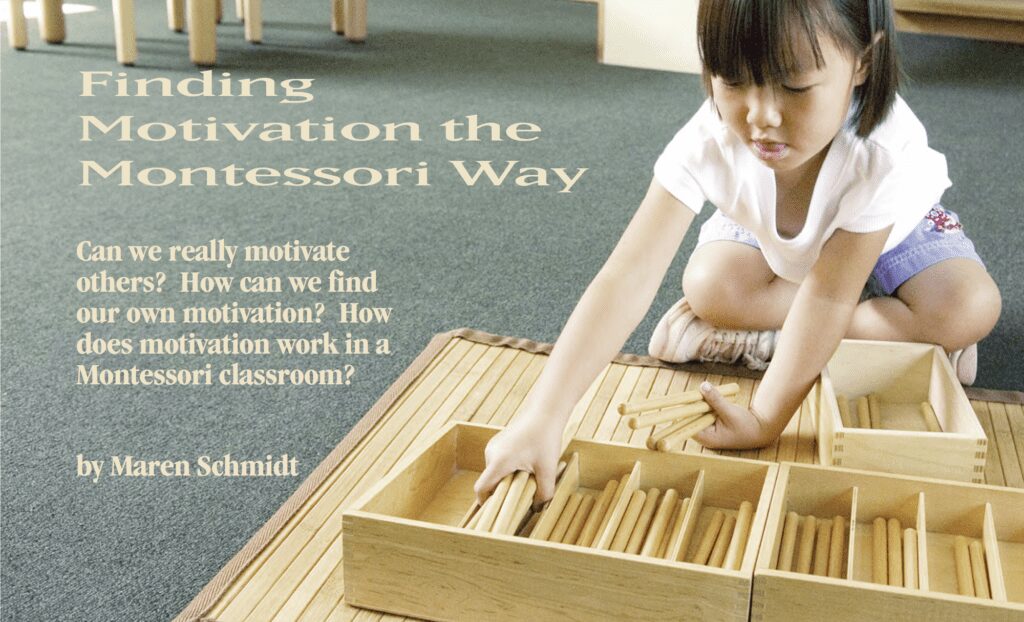
Children in Montessori classroom environments are given the freedom to choose their tasks. Once a child has been shown how to get lesson materials off the shelf, and given a preliminary lesson on how to use and return the lesson materials to order, the child is free to choose that task. In a matter of a few weeks upon entering a Montessori classroom a three-year-old has dozens of activities to select.
Time.
Children in a Montessori environment are also given time. In the optimum situations children have a protected three- hour-work cycle in which to do their self-selected tasks. The children are allowed to do a particular task as long as they choose. When they are finished with the task, the children return the lesson materials to the designated place on the shelf, and select the next task.
This gift of choice of time and task help the children develop confidence in their choices and helps them develop concentration as well as independence—all aspects of autonomy.
Also, remaining in a classroom for a three- or four-year period contributes to this factor of time in the development of autonomy.
Technique.
Another aspect of autonomy is having the ability to choose how you do a task. Children in Montessori environments are allowed to find their own method of working with the materials. Each set of Montessori materials has a preliminary lesson, followed by other lessons as the Montessori guide (teacher) observes the child requiring new challenges while working on his or her self-selected tasks.
The child is allowed to explore the limitations of the materials as long as the material is not abused or used to harm others. For example, the Pink Tower is a set of ten cubes varying in dimension from one to ten centimeters. The preliminary lesson shows the child how to move the Pink Tower to a rug, build a tower with the largest cube on the bottom, then how to return the cubes to their place. As the child explores the limits of the Pink Tower over a three-year period in the early childhood environment, a variety of designs may be seen as the child chooses self-discovered techniques, not simply imitating a teacher’s example. Every lesson, within the limits of safety, can be freely explored to allow the child this important development of technique.
Another aspect of technique is that the children have a variety of materials to explore different ideas. In the exploration of addition the child can choose from Red Rods, Golden Bead Materials, the Snake Game, the Stamp Game, Addition Strip Board and the Small Bead Frame, to only mention a few of the math materials available to the child to promote autonomy using task, time and technique.
Team.
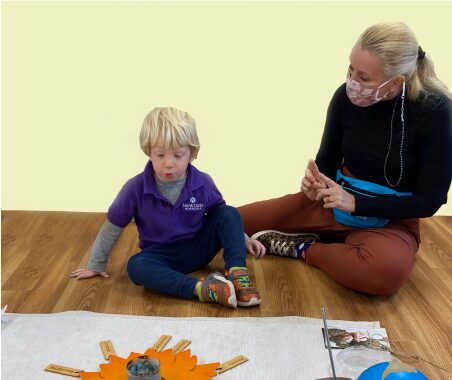
The last of our four T’s of autonomy is team, or the ability to choose with whom you will work. One interesting aspect of a Montessori environment is that children are allowed to politely decline a teacher’s invitation to a lesson. “No, thank you. I’d rather choose to work on something else,” is not an uncommon phrase. As you observe Montessori environments of all ages, you’ll see a fluidity of small work groups. Five-year-old Max may do reading exercises with four-year-old Emily, then choose to work with six-year-old Jane and Tom to do some four-digit addition problems. Among the children, there is a quiet acknowledgement of acceptance or refusal to join others in self-selected tasks.
The children honor others’ rights to choose their task, time, technique and team. It is this deep respect of autonomy in our Montessori classrooms that create the happy hum of children busy working, working toward another deep human need, mastery.
Mastery: The Need to Grow, Learn, and Create
As we learn and repeat new tasks, we need, what Pink refers to as, “Goldilocks’ tasks” – tasks that are not too hot or not too cold, but just right. When there is a mismatch of what we can do and the next level of desired learning, we create a source of frustration. When we are given tasks that are too difficult, we become anxious or give up in resignation. If we are asked to do something too easy, boredom ensues and behavior can range between passivi-ty to creating chaos.
As we learn new skills, we want to be in the “zone of proximal development” (ZDP) to use a term from the psychologist Lev Vygotsky. We can think of learning tasks falling into three categories: the level where we know how to do something and find the work lacks challenge; the level of skill building where we don’t have the necessary preparation to be successful, and the third or middle level, where we have the foundational skills and can move forward when we are shown how to do a new set of tasks. The ZDP is where we find our Goldilocks’ tasks of being “just right.”
When the task given combines skill and interest, an interesting phenomenon occurs. The child yearns to learn. In the words of Dr. Montessori, “The role of education is to interest the child profoundly in an external activity to which he will bring all his potential.”
In our Montessori prepared environments the child is surrounded with and introduced to various tasks that he or she may later choose. If the child meets an obstacle or requires fresh challenge, the watchful Montessori teacher is there to give a lesson that is “just right” for the individual’s child’s zone of proximal development.
The prepared environment of children and adults, lesson materials, underlying principles, and the outdoors, calls the child interests, while providing the appropriate tasks, time, techniques and team that lead the child to mastery.
A Montessori teaching technique that keeps children walking the tightrope be- tween repetition and excitement is called “indirect preparation.” For example, we know that reading and writing will be two essential skills students will want to master. Many of the tasks offered to the young child three-to six–years old prepare the children indirectly and incrementally for the tasks of writing and reading. (Note: In Montessori teaching we regard writing as indirect preparation for reading. But that is for another article for another day.)
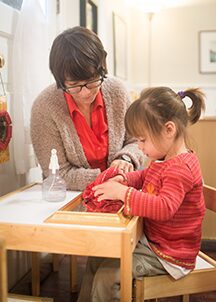
A two-and-a-half to three-year-old enters the classroom and learns to wash a table using a counterclockwise circular motion, starting with the first stroke at the upper left hand corner of the table. The child scrubs across the table to the right until he or she reaches the right hand edge. The child then begins again on the left under the first row of scrub- bing, and continues thus until the entire top of the table is scrubbed. The three=year-old is happy making soap bubbles in a self-selected activity that nourishes the young child’s natural tendencies to learn practical living skills. The child has no idea that this task is indirectly ready- ing his hands and eyes for the job of writing.
Writing and spelling emerge as self- selected tasks around the age of four- and-a-half years. With the indirect prepa- ration of washing a table and other practical life jobs, as well as the indirect preparation of using the Sandpaper Letters, the child desiring to write finds that he is in the Goldilocks chair.
The practical life tasks of the young child appear non-academic but serve as powerful preparation for the hand and eye to work together to ensure writing and reading success. The young child is offered many practical life skills that create coordination for later cognitive development and academic learning.
Three Laws of Mastery.
Pink refers to the three laws of mastery. Mastery is a mindset. Mastery is a pain. Mastery is an asymptote. Mastery is a mindset. The idea of mastery becomes an attitude or expectation. “Good, better, best. Never let it rest. Until your good is better, and your better, best.”
When we give our students in our Montessori classrooms autonomy to choose their tasks, times, technique and team, the idea of continual improvement is in the air. Children choose their work groups for a variety of reasons, but many times it is because they know their co-workers are better than they are at a particular task, and that working with them will help them get better. In a multi-age classroom there is always someone who can do something better than you can. Plus, there is always someone to help. Mastery is part of the Montessori culture.
Mastery is a pain. Improvement requires focused effort, and that can be a pain. But when something is important, we are willing to work for it and to exert the effort to meet our objectives.
Persevering with passion is a key ingredient to obtaining mastery. Mastery is not about innate talent but the ability to have focused practice for many years— over 10,000 hours of conscious practice in trying to improve. When we live in an environment where searching out and choosing challenging tasks is a habit, passionate perseverance helps us overcome the difficulty of becoming good, better, best. As we strive for our personal best, we come upon a paradox of mastery. As hard and long as we might try, we will never reach perfection. And that is okay.
Mastery is an asymptote. An asymptote is a line that approaches a curved line but never quite touches it, all the way to infinity. Such is the paradox of mastery. We can never reach perfection, but it is that innate drive to be better that makes life fun and helps us have a sense of purpose.
Purpose: the need to have a reason to make life better
To be a help to life” is the Montessori call to action. Montessori prepared environments are designed to meet the developmental needs and human tendencies for a particular age group of chil- dren. Montessori teaching techniques promote autonomy and mastery, creating powerful learning for children in a Montessori environment. Tapping into a sense of purpose, though, brings one’s abilities to a higher level.
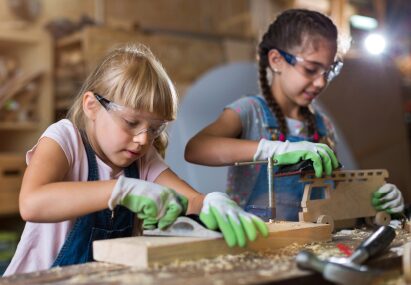
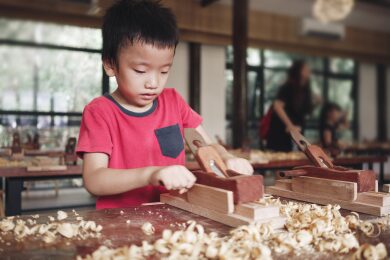
Beginning with young children learn- ing to wash their hands, to button their coats, and to zip their pants, these practical life skills tap into a child’s innate desires for independence and to be self-directed. Independence as an innate purpose has three-year-olds’ sweeping floors, dusting, or cutting vegetables with a skill and care you might observe in children many years older.
The activities of making and serving snack for themselves and others feed into the children’s sense of purpose. Practical life activities that involve caring for yourself, caring for others, and caring for the indoor and outdoors create a sense of purpose not only for the three- to six-year-old groups, but also with the elementary and adolescent communities.
Whereas young children are content with the purposeful activity within the confines of their classroom community, elementary aged children’s sense of purpose begins to be concerned with the larger world and this age’s developing sense of morality and justice. The young child’s purpose is found in sweeping the classroom floor. Perhaps, the elementary child’s purpose is realized with sweeping the pavilion at the park as community work. For the adolescent purposeful work may be sweeping the floor of an ill neighbor or family member.
Purpose makes us feel important and that the work we do for our family and community is vital. The five-year-old for- gets to sweep the floor after lunch, and her friends will have to sit in crumbs. Forget to sweep the pavilion, the park looks trashy. Forget to go to the neighbors and the young teen finds that his help is vital to the smooth running of someone else’s life.
Purpose is found in our Montessori classrooms by the offering of self-selected challenging activities that passionately engage the intellectual, the physical, the emotional and the social aspects of our children.
Summary.
Support for the deep fundamental needs of autonomy, mastery, and purpose—the keys to intrinsic motivation, and a lifetime of well being—are found in our Montessori classrooms for all ages of children. Montessori teaching and learning techniques, that include an understanding of fundamental human needs, human tendencies and a continuum of child development, form the basis of the special Montessori prepared environments for each three year sub-stage of child development.
To be a help to life we need to observe, nourish, protect and strengthen our children by tapping into the powerful intrinsic motivation that exists from birth. It shouldn’t surprise us that our Montessori schools are uniquely posi- tioned to help our children gain autonomy, mastery and purpose for a live well lived.
REFERENCES:
Deci, E. L., & Ryan, R. M. Intrinsic Motivation and Self-Determination in Human Behavior. (Plenum Press) New York: 1985
Deci, E. L, & Ryan, R.M. Handbook of Self- Determination Research (University of Rochester Press) Rochester, NY: 2002
Pink, Daniel H. DRiVE: The Surprising Truth About What Motivates Us (Riverhead Books) New York: 2009
Montessori, Maria. From Childhood to Adolescence (ABC –Clio Ltd.) Oxford, England: 1948, 1994, page 11
Montessori, Mario. The Human Tendencies and Montessori Education (Association Montessori Internationale, Second Edition) Amsterdam: 1956
Schmidt, Maren. Understanding Montessori: A Guide for Parents (Dogear Publishing) Indianapolis, Indiana: 2009
Vygotsky, L. S. Mind in Society: Development of Higher Psychological Processes
(Scribner) New York, 1978
Maren Stark Schmidt, an award- winning teacher and writer, found- ed a Montessori school, and holds a Masters of Education from Loyola College in Maryland. She has over twenty-five years experience working with young children and holds teaching credentials from the Association Montessori Internationale. She currently writes a syndicated parenting column, available at www.KidsTalkNews.com and recently completed a book Understanding Montessori: A Guide For Parents. Contact her at Maren@KidsTalk News.com. Copyright 2009.
This article was originally published in the September, 2010 issue of Tomorrow’s Child with the author’s permission.