by Marilyn Long Webster | Emotionally Healthy Children, Empowerment, MFA, Montessori Parenting, Primary (3-6)
The most powerful thing in the universe, after God, is our ability to think and choose. When you think, you build a thought, and these thoughts become physical substances in your brain. You think all day long, and you think even when you are asleep. Daytime thinking is a building process. Nighttime thinking is a sorting process. Humans think approximately 30,000 thoughts per day.
Choice creates a signal in your mind when you are thinking. As you think, you contemplate a decision of some kind. As you think, you choose, and as you choose, you cause genetic expression to happen in your brain. This means you form proteins, and proteins form your thoughts.
As children are given the freedom to choose and begin to focus their undisturbed attention for longer periods of time, this affects the chemicals, proteins and wiring of their brains as it changes and functions.
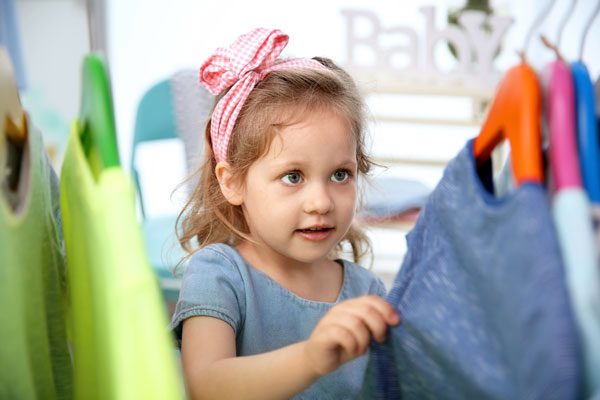 Your child is a thinking being. Begin to give your young child choices between two acceptable things. As you direct them at home, whether it is a choice between toys, about what to wear to school, or eat for breakfast, begin to stimulate their thought process for making good choices, presenting logic and reason along the way. “Since it is cold outside, which sweater would you like to wear to school? Would you like a sandwich or soup for lunch today?” Choice empowers the child to step into their decision-making process.
When children walk into a Montessori classroom, they are met with choices: what work to take from the shelf; whether to sit at a table or on a rug; what to do next? As materials are presented each day to children, they begin processing information and ordering their minds. This preparation will help them as they begin to independently make good choices.
As they work in the classroom, making choices from a place of order and free will, it will encourage their thinking, which produces their state of mind. Good choices enhance brain function. Negative thoughts and choices will disturb their normal brain function.
Choices are real. All thinking, which leads to choosing, is real and can be seen on various types of brain imaging. As a child moves throughout the Montessori classroom, thinking and making choices within the environment, there is a deliberate, but quiet, building of an inner foundation for learning. This foundation must be built from the concrete, which will later sustain the more abstract, setting the stage for more complex and creative thinking to take place. When the children are presented steps to good choices within the classroom, they begin building life experiences that will improve their intellect and increase their capacity for further learning.
As children are given the freedom to choose and begin to focus their undisturbed attention for longer periods of time, this affects the chemicals, proteins
and wiring of their brains as it changes and functions.
Thinking and choosing causes children to redesign the landscape of their brains. Certain areas in their brain light up when they think and choose. Their thoughts produce words and behaviors, which, in turn, stimulates more thinking and more choices that build more thoughts.
Thinking and choice go hand in hand. Maria Montessori understood this important aspect, infusing her extraordinary Method, not only with components of respect, order, control, concentration and independence, but of choice, preparing the child for a fulfilling life of learning.
References
Leaf, Caroline PhD (2007). Who switched off my brain? The Switch On Your Brain Organization: Johannesburg, South Africa.
Note: Dr. Leaf has many other books and videos that are available online for those who wish to know more.
Tomorrow’s Child / October 2019 / Pg. 30
by Frederic Luskin PhD | Emotional Intelligence (EQ), Emotionally Healthy Children, Mindfulness, Peace Education, Psychology, School Leadership, Social Justice, The International Montessori Council, Webcasts / IMC
Dr. Fred Luskin, (keynote speaker for our 2019 Annual International Conference) to explore forgiveness with the goal of reducing hurt and helplessness, letting go of anger and increasing confidence and hope as we learn how to release unwanted hurts and grudges. His presentations explore the HEAL process of forgiveness that, when learned, can lead to enhanced well-being through self-care.
In the Forgive for Good workshop and class series, Dr. Frederic Luskin presents the forgiveness training methodology that has been validated through six successful research studies conducted through the Stanford Forgiveness Projects.
by Lorna McGrath | Discipline, Emotionally Healthy Children, Infant-Toddler (0 to 3), Kindergarten, Lower Elementary (6-9), MFA, Montessori Family Life, Webinars / MFA
Have you ever been in any of these situations with your children: trying to get out of the house on time without a tantrum, grocery shopping and getting into a battle with your child about buying something she wants but it’s not on the list, putting toys away before going to bed without a 30 minute negotiation? If any of these scenarios sound familiar, please join us for this session on boundaries and limits.
by Cindy Acker Sarah McArthur LeValley | Emotionally Healthy Children, Empowerment, Mindfulness, Mixed Ages, Montessori Charter Schools, Prepared Environment, School Leadership, Sensitive Periods, Social Justice, The International Montessori Council, Webcasts / IMC
Webcast The Importance of Social Justice Practice in Montessori Schools
by Brynn Rangel Maria Chaffin | Children with Exceptionalities, Communication, Emotionally Healthy Children, Mixed Ages, Montessori Education, Montessori students, Montessori Teachers, Psychology, Sensitive Periods, The International Montessori Council, Webcasts / IMC
Webcast How Montessori Can Help Students Impacted by Trauma
by Christine Lowry | Adolescence, Communication, Early Adolescence (12-15), Emotionally Healthy Children, Infant, Infant-Toddler (0 to 3), Kindergarten, Later Adolescence (15-18), Lower Elementary (6-9), MFA, Montessori Family Life, Montessori Parenting, Primary (3-6), Toddler (18 months-3 years), Upper Elementary (9-12), Webinars / MFA
In this webinar Christine Lowry will guide us in how to help not only our children to be able to self-regulate their emotions but also, how we can develop better skills in this area along with our children. She will provide important information about how adults influence the level of emotion that our children experience. Whether adults up-regulate or down-regulate their own emotions impacts how children respond to stresses. She will also share six steps to help children down-regulate when they are experiencing a meltdown. The ideas and strategies that she shares apply from infancy through adolescence.
by Cathie Perolman | Communication, Discipline, Emotionally Healthy Children, Empowerment, Later Adolescence (15-18), Lower Elementary (6-9), MFA, Mixed Ages, Montessori Family Life, Peace Education, Planes of Development, Psychology, Sensitive Periods, Tomorrow's Child, Tomorrow's Child Online Issue, Upper Elementary (9-12)
Cute little boy is calming pretty little girl while they both are sitting on sofa at home
Dear Cathie— My children are not always nice to each other, and they sometimes admit they have been unkind to others at school or on play dates as well. I want them to learn to be kind and respectful. I have been expecting them to say “I’m sorry” when they act in this manner, such as when they hit or punch or grab something from a sibling or friend. I have been reading and hearing that there are other ways to handle these situations but those ways just feel so artificial. Can you help? — A Frustrated mom
Dear Mom,
We are all a product of our upbringing and, for many of us, saying “I’m sorry” was a get-out-of-jail-free card. The meanness or hurt was undone with two little words, but we all know that it really wasn’t. The place on the child’s arm that was punched still hurt; the sadness from the picture that was marred by scribble scrabble still remained; and the hurt feelings from the unkind words were still felt.
Montessori educators today are trying to help children of all ages view their hurtful actions through different, more compassionate eyes. We want them to look at their behavior, take ownership of it, and think of how it made the other person feel. This is how we aid in developing emotional intelligence. We want children to see how truly powerful their behavior can be and consider ways in which they can help make the situation better. It is not that children can’t make mistakes, but we want them to make logical and reasonable amends for those errors, whether they were intentional or unintentional. A child as young as two years old knows when he knocks someone over, he can help them up and check to see if they are uninjured! If your child is running and causes another to bump his or her head on a table, he can get the ice pack from the refrigerator. This is an apology of action rather than the less meaningful apologetic statement, “I’m sorry!”
Many of the mistakes toddlers make are unintentional as they are just beginning to learn social conventions and manners. Some of their errors are impulse driven, as when they hit another or snatch a material or toy they want. At times, they even bite to show their needs when they do not yet have words or forget to use them.
As children grow into their early childhood years, they begin to understand and start the use of words and actions as power. “I can run faster than you!” “Your picture is not pretty.” “I’m not going to be your friend anymore!” Sometimes these statements are as clear and hurtful as they sound, and other times they are used to convey another unspoken message. It is our job as adults and teachers in the child’s life to help him recognize and articulate those messages as he negotiates the evolving art of socialization. “I’m not going to be your friend anymore” may really mean, “I wish I got to sit next to you at the circle.” Having your child say, “I’m sorry” will not help him grow socially. He needs to recognize and unpack his feelings, his misinterpretation of what happened, and what he said versus what he really meant to convey. Then, he needs to make a plan to somehow get his emotional needs met. “Can we play together on the playground? Do you want to play in the sandbox with me?”
Although it takes time and energy to work with children to sort through feelings, this is paramount to their being able to do it automatically and independently as they grow and mature. When there are multiple social situations happening simultaneously, as in a preschool setting or on a busy playground, this can be even more challenging. Often, you may be unable to observe all involved in a particular situation. There can be events that occurred prior to your arrival before the “straw that breaks the camel’s back” takes place. I often ask, “what happened before you hit her? What were you thinking or feeling?” Although hitting is never the right answer, it is often the third or fourth step in a series of steps. I want to see where a child’s thinking went during this time. I often ask, “What else might you have done?” It is always the responsibility of the child who caused emotional or physical harm to ask how he can make the child he hurt feel better. “What can I do to make you feel better?” I might have to suggest some ideas, such as a hug; rub his back gently; get an icepack; say you’ll never do it again; a handshake; say I’m sorry and mean it; or the child who was hurt saying that he needs space to be away from the child who caused the hurt and have time to be angry. A child who has damaged something of someone else’s needs to make reparation. He needs to set up the block structure he knocked down, if the other child would like him to, go get the ball he threw across the playground or set up the activity he destroyed or marred.
Early elementary school children sometimes ignore or exclude another. A child who intentionally hurts another in this way has a more difficult challenge to rectify the situation. It helps to bring children together so that the excluded child can articulate his hurt feelings to the child or children who intentionally ignored or excluded him. This child can then express an apology of action by making an effort to be kind to that child. As a parent and adult in his life, you can help him think of ways to do this! Perhaps, he can draw him a picture using his favorite color, bring him a craft that he made at home, or even make an effort to meet his eyes and smile at him every time he walks by! Expressions of kindness can take many forms.
Rather than making every hurtful event have an automatic “I’m sorry” response, try encouraging your child to think about the other person’s feelings. First, ask “what happened,” and be sure your child is given an opportunity to explain what occurred. Be sure you understand what went wrong if the situation is not immediately clear. Let the other child explain what happened from her point of view. Often, there is more to the story. With practice, children can do this without adult assistance. Have the child ask what he can do to make the situation better. Encourage the child to fix the problem and make the other child feel better. Apologies of action are always better than words alone. Once this process becomes the culture of your family it will become automatic and effective. ′
Tomorrow’s Child/ April 2019 / Pg 34
by Frederic Luskin PhD | Communication, Emotionally Healthy Children, Empowerment, MFA, Mindfulness, Mixed Ages, Montessori Parenting, Peace Education, Planes of Development, Sensitive Periods, Tomorrow's Child
People’s hands show a heart sign. Valentines day relationship concept.
New studies look at forgiveness
To earn his doctorate in counseling and health psychology from Stanford in 1997, Fred Luskin had to write a dissertation. At the time, Luskin was furious with a friend. To complete his graduation requirement and to cope with the pain, Luskin researched and wrote about forgiveness.
“I couldn’t do it. I couldn’t forgive,” he said. “I was badly hurt by a friend of mine and it threw my world upside down.”
Luskin, now a research associate with the Stanford Center for Research in Disease Prevention, focused on Stanford students’ experiences when he initially began studying forgiveness. In 1999, after earning his doctorate, Luskin launched the original Stanford Forgiveness Project, which studied Bay Area residents. According to Luskin, the study involved 260 participants, including 100 men.
Research is conducted in a workshop format and typically lasts from five to six weeks, he said. In his research, he teaches forgiveness as a skill.
“The results were very positive,” Luskin said. “People showed less stress, less anger, more optimism, and more forgiveness.”
“It is not therapy. It is teaching people how to learn this kind of skill,” he said. “We can teach people to forgive and that will improve their well-being.”
The Stanford Forgiveness Project has evolved and now exists as an umbrella organization for numerous Stanford research projects that address forgiveness.
Over the years, researchers with the Stanford Forgiveness Project have worked with families from Ireland who have lost loved ones due to civil strife. The Stanford-Northern Ireland HOPE Project has conducted research on three different occasions with Irish families.
The process of forgiveness can be a liberating experience. One that, if practiced proactively, can lead to a wonderful experience of life. Interestingly, forgiveness can only occur because we have been given the gift of the ability to make choices. We have the choice to forgive or not to forgive and no one can force us to do either. Conversely, if we want to forgive someone, no one can stop us, no matter how poorly they may act. This ability to forgive is a manifestation of the personal control we have over our lives. It is nice to reflect upon and feel the respect that we have been given to be able to make such profound choices.
Compellingly, the option to forgive also implies that we had discretion as to whether or not we took offense in the first place. While forgiving may be a difficult enough choice for many of us, imagine how our lives would be if we rarely or never used our power of choice to take offense. Since we have a choice, wouldn’t it make sense to limit the amount of times we are hurt or offended so that the need to forgive rarely if ever arises? The ability to live life without taking offense, without giving blame, and by offering forgiveness are choices that offer a life of great peace.
The ability to offer proactive forgiveness proceeds along with four steps. At step one, you are filled with self-justified anger. At some point in your life, you have been hurt and you are mad at the person whom you feel wronged you. You blame the person committing the wrong for how you are feeling. It is their action and not your choice of response that you feel is at the cause of your anger. You have forgotten that you have a choice as to how you will react or are so angry that you are convinced that it would not be right to forgive the offense. At this stage, there is usually both active and submerged anger.
The second step towards forgiveness emerges when after feeling angry with someone for a while you realize that the anger does not feel good to you. It may be hurting your emotional balance or your physical health. Or you wish to repair the damage to the relationship. So you take steps to forgive. You may begin to see the problem from the other person’s point of view or you may simply decide to let the problem go. In either case, after an extended period of time, you are no longer angry and you have forgiven the person with whom you were angry. This process can be applied to anger at oneself, another person, or to life in general.
The third stage of forgiveness comes after you have seen the beneficial results of forgiveness and you choose to let go of your anger fairly quickly. In this stage, the choice is to feel the hurt for a short period of time, and then work to either repair the relationship or let go of seeing the situation as a problem. In either case, you decide to forgive because you have had some practice with it and see the benefit in your life. This could emerge in as simple a situation as being cut off by another car on the expressway or in a complex situation like an affair in a marriage. At this stage, you are aware that the length of time you experience the situation as a grievance is primarily up to you.
The fourth stage of forgiveness involves the proactive choice to rarely if ever get angry. This often means to forgive in advance of a specific trigger. This stage often emerges at the same time as some or all of the following thoughts:
I don’t want to waste my precious life in the discomfort caused by anger so I will choose to feel differently. I am able to forgive myself, forgive others, forgive life, and forgive God.
I know how it hurts when people don’t forgive me. I do not want to hurt other people with my anger so I will let it go.
Life is filled with incredible beauty and I am missing some if I am experiencing unresolved anger. I forgive myself for getting sidetracked.
People do the best they can and if they err I can best help them by offering to understand. The first step in this process is to forgive the specific offense.
Everyone, including myself, operates primarily out of self-interest. I must expect that some times I, in my self-interest, will be annoyed by someone else’s expression of their self-interest. If I can understand that this is an ordinary part of life, what is there to be upset about? If I understand that self-interest is the way that I behave, how can I but offer forgiveness to everyone, including myself for behaving that way?
These four stages of forgiveness will not be followed in the same way by all people and in all relationships. There are some people for whom we feel such love that we are almost always at stage four: open-hearted and ready to forgive. There are other people for whom we feel so egregiously hurt and our well of goodwill for them is so dry that we can spend years at stage one. What is critical to remember is the power of personal choice and the importance of exercising that choice to forgive so that we can bring peace and healing into our relationships and ourselves. ′
Frederic Luskin, Ph.D. is a keynote speaker at our upcoming Annual Conference. Read more about him on page 23.
by Tesha Miller | Communication, Emotionally Healthy Children, MFA, Mindfulness, Mixed Ages, Peace Education, Tomorrow's Child
Portrait Of Pupils At Montessori School During Outdoor Break
If we are to teach real peace in this world…we shall have to begin with the children.
—Mahatma Gandhi
Montessori education has been referred to as “peace education”; Montessorian Sonnie McFarland calls peace education a “Montessori best practice” (Montessori Life, January 2005); and even Gandhi praised Montessori’s approach to world peace. So, how is peace cultivated in a Montessori classroom?
The Quiet Hum of Peaceful Activity
Visitors often marvel at how Montessori classrooms seem to have a “hum” to them. It is no wonder that children in a Montessori classroom seem joyful, relaxed, and happy. They are able to choose an activity and work at it as long as they like. The children interact with their peers and move about the room freely. The teacher’s main goals are to make sure children are engaged, to connect children with the prepared environment, and to protect their work once they are immersed in concentration. One can sense a spirit of purpose, satisfaction, and joy permeating the room.
But this does not happen magically! It is the teacher who helps to protect children’s work by showing other children in the classroom how to watch, how to walk around a work rug, or how to interrupt politely. With ongoing Grace and Courtesy lessons, we are able to give children tools for resolving conflicts peacefully and ways to cultivate a peaceful and productive environment for learning.
Although the process of engaging in purposeful work, itself, evokes a sense of calm, it is also due, in large part, to our Grace and Courtesy presentations. Based on observed behavior, these related presentations contribute to what can become a harmonious state. It is also through the Grace and Courtesy framework that we are able to teach in a proactive, rather than reactive, way.
Constructing Grace & Courtesy Lessons
Grace and Courtesy lessons can be carefully planned or done in an impromptu fashion. By keeping a few of these lessons in the back of one’s mind, they can be a great way to fill in the gaps during transition times. These lessons can be modeled by the teacher and/or rehearsed and modeled by the children themselves.
At the beginning of the year, it may be necessary to introduce and practice up to seven or eight Grace and Courtesy ‘skits’ per day. From modeling “how to walk around a work rug” to “how to ask for help,” these quick lessons (sometimes with words and sometimes without) give children tools to navigate their environment and social landscape. Other lessons are more social and provide a way to establish a classroom management technique that is child-driven rather than teacher-driven.
Always relevant to the classroom community, Grace and Courtesy lessons empower children to be responsible, self-aware, and independent. These activities are about respecting children’s needs and considering the whole classroom community as a collective unit. Practicing modeled behaviors at neutral moments allows children to discover much-needed tools, and they are grateful to know what to do and say in frustrating or difficult circumstances.
Through the structure of Grace and Courtesy, children are able to practice respectful communication, and they are given tools to respond to others. Grace and Courtesy lessons are an invaluable tool for the teacher in the way that they allow us to put special energy on behavior we want to support. The lessons serve our classrooms well because we can revise what lessons are given, as needed, in response to observing how the children interact with certain objects and/or others.
The Value of the “Invisible Curriculum”
Angeline Lillard, in her book Montessori: The Science Behind the Genius, wrote that the lessons of Grace and Courtesy “are on par with lessons in math, music, and language.” (2007, 198-99) There are no physical materials on the shelf to remind us of the importance of Grace and Courtesy; these activities cannot be seen, but they mustn’t be forgotten. Ginni Sackett (AMI trainer, Montessori Institute Northwest) has said that Grace and Courtesy is a part of Montessori’s “ invisible curriculum.” Other “invisible” activities that can be considered a part of this curriculum are Spoken Language, Silence, and Walking on the Line. This “invisible curriculum” is one of the most significant components of the Montessori environment. In fact, because of the invisible aspect of these activities, it is all the more critical that the Montessori teacher is conscientious about implementing them.
Grace and Courtesy presentations are an ongoing, collaborative aspect of our curriculum that invites the children and teachers to work together to forge a culture of responsibility, tolerance, and harmony. Every classroom is unique, and the great beauty of a Montessori classroom is that its educational construct and style allows each classroom’s own definition of peace to develop and flourish. We are not teaching to a test or moving children along, and we are able to pause to explore the dynamics of an issue or problem.
How to Make Lessons Most Effective
When presented, Grace and Courtesy lessons should have the same points of interest and analysis of movement that a Practical Life or Sensorial lesson would contain. Emphasis on body mechanics, body language, and enunciating words clearly (if the skit includes words) are all critical, as children may absorb every aspect of the modeled behavior. Often, we take for granted the behavior we have mastered as adults; whereas, children might see our actions as a flurry of movement that they couldn’t possibly master themselves. So backing up, and even reviewing what you might do to execute a specific series of motions that make up a complete action, can be helpful when emphasizing certain aspects of a Grace and Courtesy lesson to children.
Just as a scientist evaluates his data, the Montessori teacher is advised to watch and discern what is and is not working as a result of a Grace and Courtesy lesson and to revise the variables accordingly. For example, if a Grace and Courtesy lesson on “what to do when you say excuse me” isn’t working (i.e., the children are still bumping into each other), you could follow up by isolating the words and then the movements. Re-present the lesson with not just the words, “excuse me,” but 1) by first verbalizing “excuse me,” and 2) by then making a very clear demonstration of how you would move your body by stepping to the side.
A Framework for Peace
Grace and Courtesy lessons are our framework for modeling peace. Participating in Grace and Courtesy skits gives children the confidence they need to function independently in the classroom, and since the classroom is a microcosm of the larger world, these rehearsed social scenarios are great tools for life. As Montessori teachers, we have a built-in foundation for peace education; all we have to do is come up with the appropriate Grace and Courtesy lessons to model.
A Sampling of Grace
& Courtesy Lessons
How to walk around a rug
How to ask for a hug
How to blow your nose
How to greet a visitor
How/when to say “excuse me”
How to ask for help from a teacher/friend
What to say if someone says “you’re not my friend”
How to walk with scarcely making a sound
How to tell someone you want to be alone
How to watch someone do work
How to clean up your snack
What to do if you’re really angry
How to agree to disagree
Tomorrow’s Child / Jan 2019 / Pg 23
by Maureen Healy | Communication, Emotionally Healthy Children, Empowerment, Kindergarten, Lower Elementary (6-9), MFA, Mixed Ages, Montessori Teachers, Peace Education, Planes of Development, Primary (3-6), Tomorrow's Child, Upper Elementary (9-12)
Cute toddler boy and his pretty sister with long curly hair sitting at the dinner table and eating delicious pasta with hands
“It is our responsibility to learn to become emotionally intelligent. These are skills. They’re not easy. Nature didn’t give them to us. We have to learn them.” —Paul Ekman
Children today are more emotional, strong-willed, and reactive than ever before. They have big feelings and oftentimes don’t yet know how to constructively release them. Of course, this is one of the reasons I wrote the book, The Emotionally Healthy Child, which gives adults the ideas and tools to help their children with these emotions. But you have a front-row seat witnessing your child’s emotions whether she’s saying, “That’s not fair” followed by tears or your son doing his happy dance when he finds out today’s a snow day!
Boys and girls tend to react to their emotions quickly—sometimes in smart ways, and sometimes the opposite. The good news is that any healthy child can learn how to slow down and make smarter choices, even when challenged emotionally– and I know it means that the classroom becomes a central place for this education. Just today, I had a teacher ask me: What makes an emotionally healthy classroom? In this short article, I’ll share what emotional health is and what it looks like in today’s 21st-century classroom.
Emotional Health: A Starting Point
The starting point for emotional health is learning to identify your emotions, and then beginning to express them constructively. Of course, there’s much more to emotional health, but to simplify the concept, that’s where we begin. And it’s approximately age four and up when we can expect children to be able to make more logical (smarter) choices consistently. Before the age of four, logic and reason aren’t commonly online in your child yet. Remember Jerry Seinfeld said, “Having a toddler is like having a blender that you do not have the top for,” which explains their high energy and emotional disorganization.
Older children can begin their journey in earnest of mastering their emotions and expressing them constructively through education. But remember this isn’t simply a lesson for children—cultivating positive emotional health is a lifelong endeavor. Some days we’re learning about enthusiasm and excitement, while other days it’s disappointment and loss. But the school, and even more specifically, the classroom is where many children’s feelings bubble up, from disappointment to sadness to excitement and enthusiasm, and oftentimes they don’t yet have the skills to handle.
The Emotionally Healthy Classroom
What makes a classroom go from good to great? I would say the teacher, but when it comes to emotional health and the classroom, the teacher is doing certain things to elevate that room. He or she is:
1. Handling emotions first.
2. Creating connections second.
3. Focusing on learning third.
The emotionally healthy classroom puts emotional health front and center. They don’t hope that children learn about their emotions or gain self-awareness at home, but they teach children how to calm and connect with the present moment. Take for example a group of first-graders returning from recess, which may include some quiet and some rowdy children. Using a breathing tool, (for example, “Five for Five” from my new book, The Emotionally Healthy Child) when children get back into the classroom can help them become calm and centered before they start their next project.
Along with teaching children what emotions are, how they work, and smart ways to express them, the emotionally healthy classroom teaches how to interact with others. Every classroom has children from varying backgrounds—some dealing with serious issues, whether it’s a parent with chronic health problems or a wildfire in their community—life isn’t always easy for today’s children. But helping children make, keep, and repair relationships are essential to cultivating positive emotional health. Take Tommy for example, he forgot his lunch, but his cousin Juniper was quick to share hers with him. This is a healthy connection, which mitigates stress and challenges.
Of course, the emotionally healthy classroom also inspires children to learn. This is one of the main tenets of Montessori education, as you know. Maria Montessori said, “The greatest sign of success for a teacher … is to be able to say, ‘The children are now working as if I did not exist.’” Because learning happens when we, as adults (teachers, professionals, parents), create the conditions for learning to occur, then step back and allow children to use their curiosity and ability to discover new things on their own. Yes, we can point them in certain directions, coach them, and keep them safe, but, ultimately, learning is a solo act that happens when the conditions are correct.
Emotional Health is a Learnable Skill
Children who feel their best can do their best. This isn’t rocket science, but deliberately including exercises and activities to help children manage their emotions is the first step towards creating a well-being centered classroom. Also, there isn’t shame or embarrassment if someone cries, or stomps their feet to the other side of the room. Instead, the teacher says: “What do you need right now?” and helps that child calm down as well as come back to center so engagement and connection can begin again. So along with children learning, adults are learning how to feel our best and, ultimately, do our best, too.
We’re all in it together!
Tomorrow’s Child/ Jan 2019 / pg 12
by Maureen Healy | Brain Development, Communication, Discipline, Emotionally Healthy Children, Empowerment, Kindergarten, Lower Elementary (6-9), MFA, Mindfulness, Montessori Family Life, Primary (3-6), Upper Elementary (9-12), Webinars / MFA
While growing up has never been easy, today’s world undeniably presents kids and their parents with unprecedented challenges. In this session, award-winning author Maureen Healy will share highlights from her new book, “The Emotionally Healthy Child,” and answer real-life questions from anyone wanting to raise emotionally healthy children. Come and learn some new strategies to help your children stop, calm and make smarter choices even when emotionally charged.
by Lorna McGrath | Communication, Emotionally Healthy Children, Kindergarten, Lower Elementary (6-9), MFA, Mindfulness, Montessori Family Life, Montessori Parenting, Primary (3-6), Webinars / MFA
In Part 1 Lorna McGrath discussed learning styles and how they are related to self-calming. In Part 2 she will expand on what listeners already know about learning styles by sharing how to create individual self-calming spaces which include activities that are in alignment with each person’s dominant learning style. When individual self-calming spaces are designed in this way family members are more easily able to center themselves, to express their feelings and needs, and return to family life.
by Kath Kvols | Archived Issues / Tomorrow's Child, Challenging Behaviors, Discipline, Emotional Intelligence (EQ), Emotionally Healthy Children, Empowerment, Grace and Courtesy, MFA, Mixed Ages, Montessori Family Life, Montessori Grandparenting, Montessori Parenting, Psychology, Tomorrow's Child
What Are Limits?
Limits tell your family under what condition you are willing or unwilling to do something. They tell your family where you “draw the line.” They tell what you will or will not tolerate. Their purpose is to take care of you. Limits are not designed to control or manipulate someone else’s behavior. Here are three examples:
Example 1. A mother was playing basketball with her two teenage sons. The boys were getting competitive and soon the game wasn’t fun. Mother announced, “It is not fun for me when you two fight. When you are ready to make it fun again, come and get me. I’d love to play again.”
Example 2. Children need you to set limits so that they can recognize and respect other people’s limits. I was holding hands roller-skating with my daughter. She said in a very demanding tone of voice, “Skate faster!” This wasn’t the first time I had noticed that she was being demanded, so I said, “I am unwilling to have you talk like that to me. It makes me feel like not cooperating with you, and if you continue, I will skate by myself.”
Example 3. A daughter asked her mother to take her to the video store and rent a movie. Her daughter had already spent her allowance that week. Mom said, “I’d be willing to take you to the video store, but I am unwilling to rent a movie for you.” Limits give others important information about you to help them know what they can or cannot expect from you. They are about you, not about criticizing someone else’s behavior or about trying to make them act in a certain way.
Why Do Children Need Limits?
Children need you to set limits so that they can recognize and respect other people’s limits.
Limits provide a sense of security. When children don’t know your limits, they feel lost in an abyss. They feel confused and sometimes literally bounce around trying to find some.
Limits make children feel that we care about them. Children that are raised without limits often feel abandoned.
Children need limits to learn how to deal with conflict. What happens when someone tells me I have overstepped their limits? What happens when someone disrespects mine?
Children need limits to help them define themselves. Limits set by parents help children clarify their own limits because they have seen your model.
Limits help them to learn what is socially acceptable and what is not.
Children need to learn that if they go past a certain point, there will be consequences. Some of
them may be serious.
What Issues Need Limits?
You may want to set limits on the use of your belongings, TV watching, bedtime, your time, the use of profanity, mealtime, chores, care of pets. This is not a conclusive list. Make a list of your important issues.
How Do We Know When Our Limits Are Being Violated?
The best clue to determine whether or not your limits are being violated is by being in touch with your feelings.
If any of the following feelings sound familiar, you know that your limits are being dishonored or that you are not being clear about them:
I feel anger, resentment, imposed upon, smothered, taken advantage of, and/or abused.
I feel as if I am pulling more than my fair share of the weight.
I feel unappreciated.
I feel as if I am being divided between two people I love.
I feel taken for granted.
I feel like a taxi cab driver.
What about me?
Why Do We Have A Difficult Time Setting Limits?
Our ability to set and follow through with limit setting will be largely determined by how we were parented as a child. Setting limits may be difficult for you if you were in any of the following situations:
Not having any limits as a child, being unsupervised.
Being given messages, such as: Don’t make waves; Children are to be seen and not heard; You are being selfish.
If you were told it wasn’t “nice” to assert yourself.
If there was abuse in the home or at work that was mental, physical, emotional, sexual, drug or alcohol related.
If there was someone in your family that you had to give up your needs for because they were sick or disabled.
If self-sacrifice was modeled and expected of you.
If intimidation was used to motivate you.
If you don’t set limits because you don’t feel you deserve them.
If you feel guilty about your own actions such as, working too much or getting a divorce.
What We Do Instead Of Setting Limits?
Because we are afraid of creating conflict, we often choose one of the following behaviors rather than setting limits We are afraid the other person will get angry, leave us, or reject us. We may even feel that what we say or do will not make a difference anyway. Instead of directly setting limits, we sometimes indirectly handle these situations by:
Deny it (act or pretend as though it didn’t happen).
Ignore it and hope it’ll go away.
Talk yourself out of how you are feeling (I shouldn’t feel that way because of … ).
Make excuses for the other person’s behavior (he only said that because he was tired).
Ruminate about the issue (Going over and over the event in your mind, trying to make sense of it).
Blame someone else.
Blame yourself (if I had only done … he wouldn’t act this way).
Get even.
Hide behind righteousness (I’m above having those feelings).
Pretend that you don’t care.
Withhold your love or your communication.
What Can We Expect When We Start Setting Limits?
When you first start setting limits, you can expect that your children’s behavior will get worse. They will test you. They will try everything in their power to get you to go back to the way you used to be. So, make sure your seatbelt is fastened. You may be going for a ride!
Steps For Setting Limits
1. Honor your feelings. Remember, feelings are neither right nor wrong.
They just are.
2. Get clear about what you want. What you are and are not willing to do.
3. Present the information to your family member using an “I” statement. For example, “I am unwilling to wash clothes that are not in the hamper.” There should be no blame, shame, guilt, exaggerations, or complaining. Do this step as soon as possible to prevent an unnecessary build-up of resentment.
4. Be ready to ‘stick to your guns.’ Be consistent and follow through.
Tomorrow’s Child/ November 2017
by Tim Seldin | Archived Issues / Tomorrow's Child, Challenging Behaviors, Discipline, Emotionally Healthy Children, Empowerment, Grace and Courtesy, Maria Montessori, MFA, Mixed Ages, Montessori Family Life, Montessori Grandparenting, Montessori Parenting, Parenting on the Same Page, Peace Education, Tomorrow's Child
Many parents believe that the word discipline means to punish. In reality, it means to teach.
In a Montessori-inspired home, parents are empathetic, caring, and respect children as real and separate human beings. However, children also need to develop a sense of empathy for others and must learn the rules of courteous everyday behavior.
To accomplish this, we need to help them develop a sense of self-respect with both compassion and respect for others. Since we cannot always be with them, we need to teach them to act with honor and integrity whether or not someone is watching. Since we can’t prepare them for every situation that they will face over the years, we need to teach them how to apply general rules of kind behavior to new situations.
Babies and Toddlers
Infants and toddlers don’t respond to discipline, rules, and punishments, but they do respond to unconditional love. They are not yet at a stage where they know right from wrong. They live in the moment, when they want something, they want it right now!
One secret to living happily with very young children is to go out of your way to attempt to understand what they are trying to communicate when they cry. Certainly, don’t take it personally! Even though, in the heat of the moment, it may feel as if your baby is being deliberately defiant, crying is one of the very few ways that young children can use to communicate. It can mean that they are hungry or that they need to be burped, they may be in an uncomfortable position, or they may need a diaper change.
Remember, babies are people too! They can become frightened. They may be bored or lonely. They may have had a bad dream. Watch and listen carefully. If you pay attention to your children, even when they are very young, ultimately, you will be able to determine what they are trying to tell you. Just as most parents learn to recognize the sound of their baby’s cry, we can learn to recognize the way they cry to communicate different emotions.
At this stage, their behavior is impulse-driven, with a limited ability to make the choice to follow ground rules. While you always want to model good behavior and explain why a given behavior is okay or not okay, don’t be surprised when your words go in one ear and out the other.
In a climate of love and respect, toddlers slowly develop the ability to understand our words and will begin consciously to respond to them. Eventually, they begin to imitate our actions when we model polite behavior and will begin to cooperate, in part, to make us happy. Most toddlers have good days when they are cooperative and angelic, and days when they seem to be testing us constantly.
We want to take our children beyond simple obedience, where they do what we ask in hope of a reward or to avoid something unpleasant. We want to help them to develop an internalized sense of right and wrong and courteous behavior. This requires that they eventually develop a social conscience and a sense of self-discipline. This develops slowly as children mature. For better or worse, all parents are moral educators. Our goal is to teach our children the values that we hold dear and teach them in such a way that our children live by them.
Children that achieve this goal develop a high level of self-respect. They also tend to find it much easier to establish strong friendships. They tend to respect the rights of others and are generally pleasant to be around.
Don’t Punish, Teach!
As children get older, do not take it for granted that they will automatically know how to handle a new situation. It’s always better to teach them the right way to act rather than to wait for them to misbehave and then scold, threaten, or punish. If your children do act inappropriately, stop their misbehavior calmly, but firmly, and show them how to handle the situation in a socially acceptable way.
Children have the same emotions as adults, but they don’t instinctively know how to express frustration and anger appropriately, nor do they automatically know how to solve conflicts. As parents, we have to teach our children how to get along with other people.
Montessori teachers call these the ‘Lessons in Grace and Courtesy.’ These lessons set a tone of respect and kindness. We teach our children how to shake hands, greet a friend, and say goodbye. We teach them how to ask politely to join other friends who are playing and how to respond if they are rejected.
We teach them how to interrupt someone who is busy and how to tell someone ‘no thank you’ politely. We teach them how to speak indoors, so their shouts don’t hurt our ears, and how to play without damaging anything or hurting someone. We show them how to offer a sincere apology and how to resolve conflicts peacefully.
To teach a lesson in grace and courtesy we explain a situation in simple terms and demonstrate the right way to handle it. Then we have our children practice with us, role-playing the sequence of events. Most children enjoy these lessons if they are kept short and sweet, and if they have not been embarrassed or threatened because they made a mistake.
For example, if your children tend to yell at the top of their lungs inside the house, you obviously need to give them a lesson in how to keep the indoor noise to a level that does not disturb other people.
First, as it is happening, instead of scolding, instruct them firmly, but politely, to please speak softly in the house.
Wait for a moment when the situation is not emotionally charged and neither you nor the children are upset about the behavior. Then, give them the lesson on the right way to speak indoors.
Rather than giving them a lecture, speak to them in very simple language and show them what you mean. For example, you might say:
“I want to talk to you about indoor voices. When we are outdoors, it’s so big, and sometimes we need to yell so we can hear each other when we’re far away. Outdoors, it does not hurt our ears when someone talks loudly, unless they do it right in our ear. That hurts! So outdoors, we can use our outdoor voices.
But when we are indoors, it hurts our ears and bothers the neighbors, too, if we talk too loudly. Indoors, we use our indoor voices.”
Now show them what you mean. Talk very loudly, and ask, “Was I using my indoor voice or my outdoor voice?” Talk normally. “What do you think? Was I using my indoor or my outdoor voice? Indoors, we use our indoor voices. Outdoors, we use our outdoor voices.”
You can teach all sorts of lessons this way, such as saying “please” and “thank you” or closing doors without slamming.
Practice with each other. Some families have the ‘manner of the week’. They introduce a new rule of everyday courtesy and practice it with one another over meals and around the house.
Other Children and Adults Are Role Models, Too
To teach your children good manners, they need to see that their parents, older siblings, and friends follow them consistently as well. The example that we set through our own behavior is more powerful than anything we say. Especially when they are very young, children are absorbing everything they see us do, and soon they begin to talk and act just like us. We are their role models.
Their brothers and sisters, grandparents, friends and playmates, babysitters, and preschool teachers play a similar and very powerful role as well. Knowing that your children will be influenced profoundly by the people around them, choose wisely the children and adults with whom your children will spend time.
Especially with children under age six, avoid loud, chaotic situations where large groups of children are over-stimulated and generally behave rudely, such as indoor children’s amusement parks with lots of expensive and noisy games and rides.
Choose your child’s play-dates thoughtfully. If your children spend time with a family that allows them to create havoc in their home, tearing up the living room, knocking over lamps, and shoving one another around in rough-and-tumble play, don’t be surprised when your children bring that behavior home with them. Pay attention to the way prospective play-date parents supervise their children. Do they ignore them or talk on the phone amidst chaos? It is not your place to judge other families, but it is your obligation to make good choices for your children.
Positive Discipline: Establishing a Climate of Love
Children are actually so sensitive and impressionable that we should monitor everything we say and do, for everything we say and do will be engraved in their memories forever.
Our children love us with a profound affection. When they go to bed, they want us to stay with them as they go to sleep. When we work in the kitchen, they often want to help. When we sit down to dinner, they want to join us. We may worry that we’ll spoil them if we listen to their pleas, but we shouldn’t. They only want us to pay attention to them. They want to be part of the group.
Children are extremely sensitive to the emotional climate within the family. They love us and basically want us to be pleased with them. This doesn’t mean that they will always behave.
Why Children Test Our Limits
Every child will test the rules to some degree. In fact, most acts of testing parents are a normal part of the child’s process of growing up.
When children test adults, it is often their way of expressing feelings that they don’t understand, and from our responses, they gradually learn how to handle their emotions appropriately. By testing the limits, they learn that we really care about certain ground rules of grace and courtesy in our relationship. In acting out, they are taking their first tentative steps toward independence, attempting to demonstrate that we don’t control them completely.
Agree on your family ground rules and get them written down, where both parents can refer to them. Teach your children how to do the right thing rather than focusing on their infractions.
Family Ground Rules
In the Montessori-inspired home, there are normally just a few basic ground rules:
Be kind and gentle.
Treat everyone with respect.
If you use something, put it back correctly when you are done.
If you break something, clean it up.
Tell the truth and don’t be afraid to admit when you make a mistake.
You should be absolutely clear in your mind about your family ground rules.
Explain your family ground rules positively, rather than as prohibitions. Instead of saying, “Don’t do that!” ground rules should tell children what should be done.
Teach your children how to follow the family ground rules as if you were teaching any lesson in everyday living skills and grace and courtesy.
Model the same behaviors that you are trying to encourage in your children.
Consciously try to catch your children doing something right—reinforce and acknowledge even small steps in the right direction. Don’t wait until they have mastered every new skill. Encourage them along the way.
When your child is breaking a ground rule, there are several things you can do other than scold, threaten, or punish.
You can redirect them by suggesting a more appropriate choice.
You can remind them of the ground rule and politely, but firmly, ask them to stop.
If the event is not emotionally charged, you can calmly re-teach the basic lesson about how to handle such situations.
Be consistent!
If you can’t bring yourself to reinforce a rule again and again, it shouldn’t be a ground rule at your house.
A few good rules are much better than dozens of rules that are often ignored.
Why We Don’t Use Threats or Punishments
Threats and punishments are not good tools to get children to behave. While they tend to produce immediate results, they are rarely long-lasting. They only work as long as the person being threatened cares. Many children who respond to threats and are shaken by punishments are anxious to please us and win back our love. On the other hand, when children are angry or are asserting their independence, they often act out and don’t care if they are punished. Punishment is simply not as effective as people tend to believe.
Teach children to do things correctly and emphasize the positive rather than using insults and anger. It’s not always easy. Above all else, try never to ask your children unanswerable questions, such as, “How many times do I have to tell you … ?” to which the appropriate response would be, “I don’t know, Dad! How many times do you have to tell me?” If you ask a silly question, you’re likely to get a silly answer.
Children can correct their own mistakes
Many parents and teachers believe that they can shape a child’s personality and future through strict discipline, but children carry within themselves the key to their own development. Their early attempts to express their individuality are hesitant and tentative. Our children think that adults are all-wise and all-powerful. They are easily overwhelmed by our best intentions. Our efforts to protect children from mistakes that seem so obvious from our perspective tend to frustrate children about the process of learning for themselves about life.
Our goal should be to help children become mature, independent, and responsible. Unfortunately, as parents, we sometimes tend to overprotect our children, not realizing that they can only learn about life through experience, just as we did.
We want to help our children learn to live in peace and harmony with themselves, with all people, and with the environment. We work to create a home in which our children can learn to function as independent, thinking people. To succeed, we need to treat them with respect as full and complete human beings, who happen to be in our care. Our children need to feel that it is okay to be themselves.
Children must feel our respect; it is not simply enough to say the words. If children believe that they are not living up to their parents’ expectations, that their parents are disappointed in the people that they are becoming, there is a very good chance that their lives will be emotionally scarred.
Cutting down on the word “no”
Sooner or later, every child will stubbornly say No, I don’t want to! This is the classic power struggle that starts in the toddler years and, in many cases, continues through adolescence. Many people call the toddler stage the ‘terrible twos,’ but they don’t have to be—not with two-year-olds nor with older children.
Power struggles start in situations where parents and children are each determined to get their own way and are not willing to back down. Underneath, each feels frustrated and threatened. Parents feel that their children are directly challenging their authority. Children, on the other hand, in situations like this, are feeling generally powerless and are attempting to assert their autonomy and establish more of a balance of power in their relationship.
Here are some strategies that may work for you to reduce the number of power struggles and the word No! in your relationships with your children.
Give your children choices. Children desperately long to feel powerful and resent feeling powerless. Whenever you can, look for ways to let your children make a choice between two equally acceptable alternatives. Would you like water or apple juice with dinner tonight?
Teach your children to say no politely. Mom, I really do not feel like doing
that now.
Remember that the secret is to speak to them firmly and kindly.
Remember Robert Heinlein’s golden rule of family life: “Kindness and courtesy are even more important between husbands and wives, and parents and children, than between total strangers.”
Look for ways that allow you to back down gracefully from a power struggle without simply giving in. Often, through compromise, both you and your children can get most, if not all, of what you want. “Mom, I have so much homework and an essay to write. Do I have to help with the dishes?” Mom responds, “Yes darling, we all have to help clean up, but working together, it will only take a few minutes. Would you like my help in planning the outline of your essay before you begin?”
Many power struggles seen in some homes are cut down to a minimum simply by teaching your children how to be more independent and giving them meaningful levels of independence and responsibility. This tends to make children feel powerful and grown-up.
Preventing some of the stress in children’s lives
Do not over-schedule your children
Many families try to do too much. Sometimes it is unavoidable, but think long and hard before you sign your child up for dance lessons, baby gym, or any other prescheduled classes for young children. Racing from one scheduled activity to another raises everyone’s stress level and sets the stage for temper tantrums. Allow enough time so that you will not have to race to meet a deadline.
Look for patterns in your children’s behavior
Often there are patterns in family life. If your child tends to have a tantrum when you go shopping, why not leave her with her other parent, a grandparent, or a babysitter?
Talk things through in advance
Children do best when they know their limits in advance. For example, if you are going to the store and your children want to buy a toy, tell them in advance what you will agree to and stick with it.
Resolving Conflicts
In Montessori classrooms, the Peace Table is a child-sized table, a plant, a bell, an artificial rose, and possibly a candle. Two children who are having a disagreement decide to retreat to the Peace Table to solve their problem. This can take place at home as well.
Sometimes, children may not remember, and the suggestion might come from the parent or an older brother or sister who, observing the disagreement, might bring them a peace rose (an artificial long-stemmed rose) with the suggestion that they solve their problem at the Peace Table.
Once arrived at the table, a certain procedure ensues. The one who feels wronged places her hand on the table, indicating that she wants to have her say uninterruptedly. The other hand she places on her heart, indicating that she speaks the truth. She then looks her classmate in the eye, speaks her name, and proceeds to explain how she feels, “Sarah, I felt very angry because…” and continues to state why she feels that way, e.g., “because you didn’t let me play with you!”
She then proceeds to state what she wants to see happen to resolve the conflict: “And I don’t want you to do that ever again if you want to be my friend!”
Now that she has stated her case and opened the door for further discussion, she withdraws her hand from the table and from her heart and gives the other child a chance to respond.
The second child proceeds that same way, placing her hands on table and heart, looking the first in the eye, and responds:
“Emily, I feel unhappy that you are angry. I did not mean to hurt your feelings.”
With that, she is finished and withdraws her hands. Now it is the first child’s turn to agree or disagree, in any case, to continue the dialogue until they reach some kind of agreement, even if that means that they disagree. At least they are talking, without yelling, screaming, and blaming. They want to solve the problem. When they have reached an agreement, they ring the bell to let the rest of the class or family know.
In case they cannot come to a positive conclusion, they may ask for a mediator. This may be an older sibling/classmate or a parent/teacher, who has to remain impartial and to listen well.
However, if the problem or conflict is too involved, then one of them may ask for a class or family council, where the entire class or family sit down in a circle, listens to first one, then the other person’s side of the story contributes what they can to it either as facts of what they have seen or heard, or as ethics, right and wrong, or in perspective to rules upon which all have agreed upon previously.
The core experience the children gain from these procedures is that it is necessary to resolve disturbances honestly and with goodwill to maintain an authentically harmonious and cooperative atmosphere. n
Tomorrow’s Child/ November 2017
by Mayo Clinic | Archived Issues / Tomorrow's Child, Emotional Intelligence (EQ), Emotionally Healthy Children, Family Resources, MFA, Montessori Parenting, Parenting on the Same Page, Tomorrow's Child
After a tragedy, you might feel helpless—but your child needs your support. Here’s help knowing what to say.
When a tragedy—such as a natural disaster, mass shooting, or terrorist attack—occurs, it can be hard to talk to your child about what happened. How do you explain it? How much will he or she understand? Find out how to start the conversation and what you can do to help your child cope.
Do I need to talk to my child about a tragedy?
Talking to your child about a tragedy can help him or her understand what’s happened, feel safe, and begin to cope. If you don’t speak to your child about a tragedy, there’s a chance that he or she might hear about it elsewhere.
How do I start a conversation with my child about a tragedy?
Take time to think about what you want to say. If possible, choose a time when your child is most likely to want to talk, such as before dinner. Ask your child what he or she already knows about the tragedy—and what questions or concerns he or she might have. Let your child’s answers guide
your discussion.
How do I explain the tragedy to my child?
Tell the truth. Focus on the basics, and avoid sharing unnecessary details. Don’t exaggerate or speculate about what might happen. Avoid dwelling on the scale or scope of the tragedy.
Listen closely to your children for misinformation, misconceptions, and underlying fears. Provide accurate information. Share your own thoughts and remind children that you’re there for them. Reassure children that what happened isn’t their fault.
Children’s age will affect how they process information about a tragedy. Consider these tips:
Preschool children. Get down to children’s eye level. Speak in a calm and gentle voice using words they understand. Explain what happened and how it might affect them. For example, after a severe storm you might say that a tree fell on electrical wires and now the lights don’t work. Share steps that are being taken to keep everyone safe and give hugs.
Elementary and early middle school children. Children in this age range might have more questions about whether they’re truly safe. They might need help separating fantasy from reality.
Upper middle school and high school children. Older children will want more information about the tragedy and recovery efforts. They’re more likely to have strong opinions about the causes, as well as suggestions about how to prevent future tragedies and a desire to help those affected.
How might my child react?
After a tragic event, children might experience a range of emotions, including fear, shock, anger, anxiety, and grief. Age will affect how they handle the stress of a tragedy. For example:
Preschool children. Children in this age range might have trouble adjusting to change or loss. They might become clingy or mimic your emotions. Some children might also revert to wetting the bed or sucking their thumbs. Avoid criticizing this behavior.
Elementary and early middle school children. Children in elementary and early middle school might have nightmares or other sleep problems. They might fear going to school, have trouble paying attention in school, or become aggressive for no clear reason.
Upper middle school and high school children. Older children might deny that they’re upset. Some children might complain of physical aches and pains because they’re unable to identify what’s really bothering them. Others might start arguments or resist authority.
These reactions are normal. However, if children continue to display these behaviors for more than two to four weeks, they might need more help coping. If your child has experienced previous trauma, remember that he or she might be at greater risk of a severe reaction. If you’re concerned about your child’s reaction, talk to a mental health provider.
What can I do to help my child cope?
You can take steps to help your child process what happened. For example:
Remain calm. Children will look to you for cues about how to react. It’s OK for children to see adults sad or crying, but consider excusing yourself if you’re experiencing intense emotions.
Reassure children of their safety. Point out factors that ensure children’s immediate safety and the safety of the community. Consider reviewing your family’s plans for responding to a crisis.
Limit media exposure. Don’t allow young children to repeatedly see or hear coverage of a tragedy. Even if your young children are engrossed in play, they are likely aware of what you’re watching and might become confused or upset. Older children might want to learn more about a tragedy by reading or watching TV. However, avoid repetitive loops of news information once you have the facts. Constant exposure to coverage of a tragedy can heighten anxiety.
Avoid placing blame. If the tragedy was caused by human violence or error, be careful not to blame a cultural, racial or ethnic group, or people who have mental illnesses.
Maintain the routine. To give your child a sense of normalcy, keep up your family’s usual dinner, homework, and bedtime routine.
Spend extra time together. Special attention can foster children’s sense of security. Spend a little more time reading to them or tucking them in at night. If your children are having trouble sleeping, allow them to sleep with a light on or to sleep in your room for a short time. Extra cuddles might help, too.
Encourage the expression of feelings. Explain that it’s OK to be upset or cry. Let children write about or draw what they are feeling. Physical activity might serve as an outlet for feelings or frustration. If they are acting out, explain that there are other ways of coping.
Seek out school resources. If their school offers counseling after a tragedy, take advantage of the opportunity to meet with a counselor.
Do something for those affected by the tragedy. Consider ways that you and your child can help victims and their families. You might take your child to your place of worship or write thank-you notes to first responders.
What else can I do?
It might be the last thing on your mind, but caring for yourself after a tragedy is important. Pay attention to your own feelings of grief, anger, or anxiety. Lean on loved ones for support or talk to a mental health provider. Get enough sleep, eat a healthy diet, and stay active. Taking care of yourself will enable you to care for your child and serve as a role model for how to cope.
Retrieved from http://www.mayoclinic.org/healthy-lifestyle/childrens-health/in-depth/helping-children-cope/art-20047029?pg=1
Tomorrow’s Child/ November 2017
by Zahra Kassam | Archived Issues / Tomorrow's Child, Emotionally Healthy Children, Family Resources, Infant, Infant-Toddler (0 to 3), MFA, Montessori Parenting, Toddler (18 months-3 years), Tomorrow's Child
Eighty-Five Percent Of The Brain Is Formed By Age Three
The core structure of the brain is formed in the first three years. By age three, the brain has established a pattern of processing information that will be used throughout life. As such, a child’s early experiences affect the quality of his brain architecture, forming the foundation upon which future development rests. Early experiences also have a greater impact on the developing brain because new experiences are stored in relation to previous ones. Because the architecture of the brain is formed between birth and three, children’s early experiences are ingrained at a deeper level and have lasting effects. Many children do not have access to good Montessori schools at this age. Enhancing the home environment with Montessori materials and guidance can help to fulfill and expand a child’s potential.
Environment Shapes Brain Development
While some say the only toy a baby needs is a cardboard box, numerous research studies show that children who grow up in more stimulating environments do better than those who have fewer opportunities to learn. Brain development is activity-dependent, so everything a child touches, tastes, sees, hears, and smells impacts the brain’s circuitry. The environment directly influences the structure of the brain. Exposing babies to a variety of age-appropriate stimuli, meeting their developmental needs, and providing just enough challenge to stretch their skills will lay the best foundation for the future.
Montessori Builds Better Brains
Motor development and cognitive development are fundamentally intertwined. It is for this reason that researchers emphasize the importance of learning through play and that Montessori activities always involve mind, body, and senses. Babies and toddlers learn most when presented with just the right amount of challenge, not so easy that they are bored and not so difficult that they are frustrated. The Montessori birth-to-three materials are thoughtfully designed and timed so that children are repeatedly entering this ideal zone for learning.
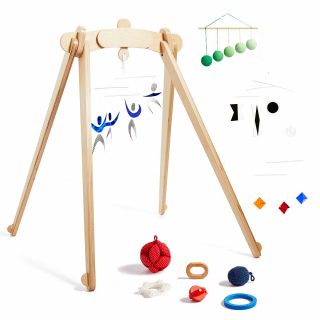
For example, at two weeks old, a baby cannot distinguish colors well but can detect light, movement, contrast, and patterns. The Montessori Munari is the ideal first mobile, having a contrasting black and white pattern that captures a baby’s attention, allowing him to distinguish its shapes, practice visual tracking, and build concentration.
The Munari is also designed according to a mathematical formula so that all its components are in proportion. This mathematical relationship appeals to a baby’s innate number sense. Research shows that the strength of an infant’s number sense predicts performance on math activities in preschool. Montessori recognized this sense and called it the “human tendency of the mathematical mind.” A professor at the Duke Institute of Brain Sciences calls it “the conceptual building block upon which mathematical ability is built.” We can support even the youngest baby’s mathematical potential by offering toys that appeal to this innate number sense.
As children get older, the Montessori materials continue to support physical and cognitive development. When a child plays with the Curved Dowel, she strengthens her wrist preparing her hand for writing, sports, and everyday tasks like dressing independently. As she holds the base of the dowel with one hand and uses the other hand to thread the ring, her arm crosses the midline of her body. Crossing the midline, the ability to move her hands and eyes together, across and to the other side of her body, is important for her development. It helps her integrate sensory feedback across brain hemispheres and enhances bilateral coordination (using the two sides of her body together). Crossing the midline is also a prerequisite for lateralization, or the process of one eye, hand, foot, and ear becoming dominant. Lateralization allows a child to function at her most efficient level.
Guiding Parents
Unfortunately, parents are left guessing how to create a stimulating environment during the formative years of birth to three. Monti KidsTM gives parents access to world-renowned Montessori materials along with simple guidance. We provide customers with recurring home deliveries of Montessori educational toys and an online curriculum for parents, tailored to their child’s stage of development.
Learn more at www.montikids.com
Tomorrow’s Child/Sept 2017
by Cheryl McCabe-Allen | Brain Development, Child's Work, Emotionally Healthy Children, Empowerment, Lower Elementary (6-9), MFA, Montessori Education, Montessori students, Montessori Teachers, Practical Life, Prepared Environment, School Leadership, The International Montessori Council, Upper Elementary (9-12), Webinars / MFA
Some may say, “What is OCCI?” Some may say, “I thought OCCI was just during the Primary years.” Cheryl says, “Let’s see how we can continue to support the development of order, concentration, coordination, and independence during the elementary years.” Join us for some interesting insights.
by Claire Salkowski | Emotionally Healthy Children, Empowerment, Entrepreneurship, Family Resources, MFA, Montessori Education, Montessori Family Life, Montessori Parenting, Webinars / MFA
Guest –
Claire Salkowski, MEd, Montessori Elementary Teacher, Educational Consultant
Creative ways to Learn, Earn, and Manage Money within the Context of Each Families Values
Download File