
Workbooks – Is there a place for them in Authentic Montessori
Download PDF of Article: Workbooks – Is there a place for them in Authentic Montessori Education?

Download PDF of Article: Workbooks – Is there a place for them in Authentic Montessori Education?
By Tim Seldin and Jonathan Wolff
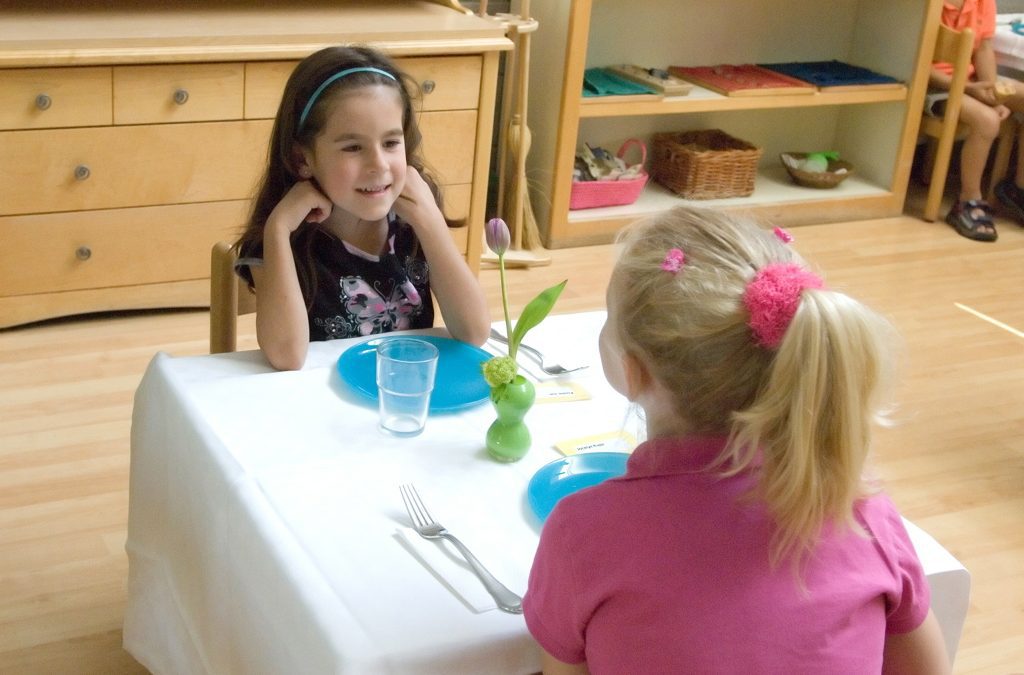
The exercises in Practical Life are the very heart of Montessori education. As young children wash tables, pour liquids, polish silver, sweep and dust, they are developing the inner aptitudes of calmness, order, concentration, coordination, and fine motor skills. At the same time, through the process of learning to meet their own needs, learning to take care of the classroom environment, and through the experience of helping others, children in Montessori programs begin to develop independence, self-confidence, and self-respect.
Observations and Reflections on Current Practice
As Montessori consultants and teacher educators, between us we have observed hundreds of Montessori programs all over the United States. Among countless examples of beautiful environments and excellent Montessori classes at work, we have tended to notice that the area of Practical Life in many Montessori classrooms deserves a fresh look.
For example, in many early childhood programs, there seems to be the assumption that five-year-olds are ready for “real work.” New Practical Life lessons are no longer presented and the older children are discouraged from wasting their time doing Practical Life activities. But while these children may have mastered the simple tasks that absorbed them when they were three, and while they may not particularly enjoy table scrubbing any longer, Practical Life is just as vital as it was before.
The key is to keep in mind once again the two distinct objectives of Practical Life at any age level:
1) to help children continue to develop concentration, coordination, self-reliance, and self-discipline; and
2) to help children master increasingly challenging and developmentally appropriate tasks and situations that lead them toward the care of self and of the social community within which they live and learn.
Observation in many Montessori classrooms we see children rarely spending much time on Practical Life after age four-and-a-half as if it is not developmentally or socially necessary.
Reflection The fine motor development that children are working toward in the basic Practical Life tasks needs to continue through the elementary years and into adolescence, as does the development of calmness, concentration, order, and independence. Often times in classrooms where teachers complain about children who are restless, disruptive, and unfocused, you see an absence or weak presence of Practical Life work.
Observation Many Montessori teachers rapidly rotate their Practical Life materials; every month we see new variations on the basic exercises.
Reflection Montessori pedagogy is based on allowing children to move toward self-mastery. If we rotate exercises out of the environment too quickly, we prevent them from mastering each task in turn. For example, when we begin to teach young children how too pour liquids, we show them how to hold the front of the pitcher with their non-dominant hand. The extension of this exercise comes when the child is ready to pour using just one hand.
Observation In many classes, we find a great many short sequence activities, such as cloth folding, water pouring, rice spooning, as opposed to the more complex sequence exercises, like table washing, dishwashing, food preparation, and polishing.
Reflection If there is one developmental competency lacking in American children of all ages it is the ability to focus on one task through to completion. In providing children with Practical Life activities that are completed very quickly with just a few steps, we are not adequately addressing the need for children to interactively practice skills of concentration and perseverance. In following the many steps involved in washing a table, children learn to attend to an entire sequence of visual-motor tasks.
Observation In many classrooms, Practical Life exercises tend to be discrete developmental tasks on a shelf. There is no transfer of the skills learned abstractly to the real-life application of caring for the environment or oneself. For example, in some classes, children learn to sweep by pouring dried beans on the floor and sweeping them onto a square laid down with tape, but then fail to progress to taking charge of sweeping the room on a daily basis.
Reflection The Montessori classroom for three, four, and five-year-olds is designed to be a “Children’s House.” The children are guided to participate fully in the actual life of their community. They help to prepare snacks and meals, clean the environment, and maintain the order of the classroom. In this way, they develop not only muscular control and competency over daily tasks, but a deep sense of self-respect, independence, and interdependence.
Observation In many classrooms, we observe teachers presenting most of the lessons to younger children themselves instead of encouraging older children to take the lead.
Reflection Who ultimately do we want to own and operate the classroom community: the children or the adults? Who ultimately needs to learn to lead, mentor, and be mentored by their peers? Who ultimately ties the shoes in your classrooms? Who prepares the snacks? Who sets the tables, washes the dishes, and cleans up the spills? What is the role of the older children? Do they mentor and teach the younger ones?
Toward best practice: Suggestions for enhancing the Exercises in Practical Life
• When new materials arrive from the manufacturer, consider showing the children how to carefully unwrap and unpack them; just one more exercise in Practical Life and a first step toward appreciating the beauty of the materials and the importance of using them carefully.
• Place a photo on each shelf showing how the entire shelf looks when it is set up with all the materials that belong there placed in proper order. This allows the children to use the photo as a Control of Error whenever they take the materials off the shelves to work, dust, polish, or inspect them for damage.
• When a piece of Montessori material needs repair, rather than taking it home or working on it after school, consider working on it right in the classroom when the children are present. Where appropriate and practical, teach the children how to help you repair or do simple repairs themselves.
• Likewise, when you have new card materials that have been laminated, consider sitting back to quietly observe the children at work while you cut them out from the laminate. Older children can be taught how to help you with this process.
• Demonstrate how you personally take responsibility for the care of the environment and encourage the children to do likewise on a daily basis. Draw their attention to the small details, such as picking up stray paper, beads, or other debris from the floor.
• In selecting trays, pitchers, and other utensils for Practical Life exercises, look for the most attractive materials that you can find and afford. Design activities that will draw the child’s interest and create a prepared environment that is harmonious and beautiful.
• If possible, avoid using plastic pitchers, bowls, trays, and other materials in preparing Practical Life activities. Children respond to the beauty of wood, glass, silver, brass, and similar natural materials.
• Whenever possible, Montessori exercises are designed with a control of error. By the same principle, Practical Life exercises should be created with materials that will break if they are dropped or misused. This becomes a superb teaching tool for the child in the prepared environment, and an opportunity for a re-presentation by the teacher or further exploration by the child. It may also lead to a new lesson in problem-solving (“How do I gather up all those beads?” or safely clean up the broken pieces. )
• Practical Life exercises should not be confined to a small tiled area of the room, with the exception of exercises that may lead to damaged carpet or similar concerns. Practical Life should be integrated into every area of the classroom throughout the day and should be a natural outgrowth and progression from the introductory shelf exercises designed to help the children gain initial mastery and control. For example, every shelf and piece of material in the prepared environment can be regularly dusted, washed or polished, and inspected for damage; books returned to order on the shelf; plants watered, and class pets feed.
• In providing opportunities for young children to negotiate across the classroom carrying materials balanced on a tray, children are challenged to become courtesy and self aware of others’ needs. Being careful not to step on other children’s work or bump into them, walking slowly and carefully, and remaining aware of the tray’s position in space are all integrated.
• Two critical areas of Practical Life that are often underdeveloped are grace and courtesy (the language of respect) and lessons in control and coordination of movement.
A few grace and courtesy lessons
• Saying please and thank you
• Using an appropriate indoor voice
• Begging pardon/apologizing
• Asking for permission to observe
• Asking for assistance
• Asking for permission to join in an activity
• Declining a request graciously
• Greetings
• Shaking hands
• Greeting visitors/offering coffee or tea/serving as a tour guide
• Expressing complements and appreciation
• Expressing one’s feelings appropriately
• Setting personal boundaries and being appropriately assertive
Experiences in the control and coordination of movement:
• Montessori saw a direct correlation between the child’s ability to move through the environment gracefully with control. In orienting and reorienting children into your class, take care to emphasize the importance of careful and purposeful movement.
• Remember the importance of modeling the process of walking on the line every day. Teach the children to walk along the line that you have made on your classroom floor, walking heel to toe, carefully balancing their bodies while carrying small flags. They can do the same exercise while carrying things on trays or cups on saucers.
The under-utilized and unappreciated Silence Game:
• The Silence Game helps children to develop a higher level of self-discipline, along with a greater awareness of the beauty of silence and subtlety of sound.
• In this group activity, the teacher will get the children’s attention either by ringing a small bell or by hanging up a sign with the command “Silence.” The children stop where they are or gather on the line, close their eyes, and try to remain perfectly still. The children sit still with their eyes shut and wait to hear the teacher whisper their name. When they hear it ever so softly spoken, they silently rise and join the teacher. Sometimes the teachers will vary the Silence Game by challenging the children to carry bells across the room with allow them to ring, or they may use the calm atmosphere to introduce the children to guided visualization. At first, the younger children may not be able to hold the silence for more than 20 or 30 seconds, but gradually their ability to relax, listen and appreciate the perfectly calm environment increases. In many classes, the Silence Game is an important daily ritual.
A few examples of elementary and middle school exercises in Practical Life
• Animal training
• Assertiveness skills
• Self-defense
• Affirmation skills
• Project and time management
• Stress management
Setting personal goals
• Knowledge and respect for common laws
• Calligraphy
• Care of one’s clothing: ironing, using the washing machine, spot removal
• Child care & baby-sitting
• Computer skills
• Cooking
• Public speaking
• Dancing
• Peer mediation
• Community service
• Mentoring younger children
• Craft skills: how to make gifts
• Earning your own spending money
• First aid and CPR
• Group communication skills
• Growing flowers in the garden
• Growing food in the garden
• Growing plants in a greenhouse
• Hobby skills: model building
• How to resolve conflicts peacefully
• How to use a public library
• How to use public transportation
• How to win and keep friends
• How to write formal letters
• Map reading – finding your way about town
• Nutrition: menu planning
• Operating audio-visual equipment
• Outdoor camping and hiking skills
• Photography
• Physical fitness: keeping in shape
• Planning a luncheon for guests
• Planning your own field trip
• Practical politics: How to speak out effectively on public issues
• Practical rules of social etiquette
• Preparing food for a large group
• Preserving food: canning, drying
• Public speaking
• Raising classroom pets
• Raising small farm animals: chickens, ducks, rabbits, goats, or sheep
• Safety at home and school
• Sewing and knitting: making clothes
• Shorthand
• Simple acts of charity and kindness
• Study skills
• Swimming and canoeing skills
• Test-taking skills: playing the game well
• The young citizen and the law
• Typing: speed and accuracy
• Using hand tools for simple carpentry
• Writing and putting together a play
In summary, we recommend that Montessori teachers keep 5 points about Practical Life in mind:
Practical Life exercises have individual developmental objectives like calmness, concentration, cooperation, self-discipline, and self-reliance.
Practical Life exercises have social objectives, such as self-awareness, sensitivity to others, and service to the community.
To have meaning, Practical Life exercises must be applied to real life.
Lessons in Practical Life skills and their application to daily living are as important at age 18 as they are at age 3 and at every age in between.
As Montessori teachers, we bear the responsibility of setting the tone and serving as daily role models for Practical Life skills. We need to be poised, purposeful, precise, caring and giving.
Quotes
“In the special environment prepared for him in our schools, the children themselves found a sentence that expressed their inner need: “Help me to do it by myself!” His work will no longer weigh him down.” Montessori
“No one can be free unless he is independent. Little children, from the moment they are weaned, are making their way toward independence.” Montessori
“The essence of independence is to be able to do something for one’s self.” Montessori
“Such experience is not just play. It is work he must do in order to grow up.” Montessori
“Just as the little child cries out “help me to do it by myself” through his actions, so does the older child demonstrate the same need at successive levels of sophistication as he grows.” Montessori
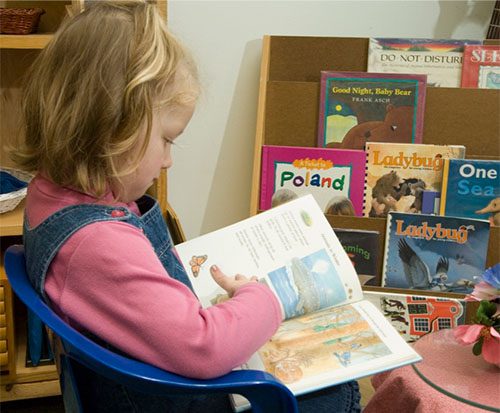
The development of language in early-childhood classrooms is an umbrella for the entire Montessori curriculum. Often teachers and parents consider activities on the shelves of the Language area as the heart of actual language learning. Certainly these activities provide powerful opportunities, but language learning occurs most profoundly in the moment-to-moment life of interactions within the classroom. Twenty years ago, working as a speech pathologist, I discovered the wonder of language development in young children. Although I detoured away from speech and language pathology into Montessori early-childhood education, I maintained my awe of how children learn to listen and speak and, later, to write and read. I have had the opportunity to share my language interests as a teacher educator with several Montessori teacher-education programs.
During the last four years, I have continued my learning in a slightly different context. As a supervisor for the University of Maryland’s undergraduate early-childhood special-education program, I have worked with teachers, students, and children in both inclusive and segregated special education settings, often working with children with language delays. In this article, I will suggest a foundation for the development of language skills, review key Montessori language materials and activities, and present suggestions for expanding language practices in Montessori early-childhood classrooms. Language Everywhere, All the Time, with Everyone: A Foundation for the Development of Language .
We know that the development of a young child’s language skills begins at conception. An infant is born into a family with a unique communication style. Family members may be quite open, freely expressing their wants, needs, and feelings. Alternatively, communication may be reserved or even restrained. Babies listen to and absorb not only what family members say but how they say it. A balanced environment, one that is open yet not chaotic or inappropriate, is the most conducive to language learning. We need to talk often and meaningfully with babies. Babies learn to trust their surroundings as older siblings and adults hold and cuddle them, engage them with smiles and coos, and most importantly, acknowledge their communications. Essential communication occurs when a busy father or mother looks directly at a little crying one, rocks her, and says in a comforting way, “Yes, I know, you are upset. You are having a hard time getting to sleep.” As distant as it seems, Dad and Mom are laying the foundation for listening to their child’s requests and statements. Reciprocally, their child is learning to trust that Dad and Mom can be counted on to listen and provide comfort. Years later, this child may enter a Montessori classroom. She enters with a consistently effective communication experience. Her past experiences have proven to her that she can initiate communication and be heard. She is learning to reverse these roles in order to be an effective listener and responder. These communication experiences are the foundation for language learning in the classroom.
Teachers, parents, and administrators need to recognize communication as the foundation for the meaningful development of language concepts and skills. Effective communication depends on authentic relationships between communicative partners. Teachers have the responsibility (actually, the opportunity) to develop and expand learning relationships with young children. This is truly the ultimate opportunity to make a difference. Seen in this light, conversations with young children on the playground, during field trips, on the way to the bathroom, in the midst of conflict resolution, during lessons, and countless other times create the context for the development of language skills. Relationships of trust are built between children and teachers and among peers. Classroom work further contributes to language concept and skill development within this context of meaningful communication. Montessori Language Work for the Young Child: Early Literacy Activities Activities related to the development of early literacy skills often greet young children when they visit the language area of a Montessori classroom. Loosely known as “reading readiness” during the 70s and 80s, these activities include opportunities for young children to expand vocabulary, listen carefully to common sounds, and look carefully to find likenesses and differences among objects and pictures.
Young children (particularly three and four year-olds) delight in matching sets of objects from cars and trucks to zoo animals. They enjoy learning the names of household tools, unusual fruits and vegetables, and geometric shapes, to name a few. The tape recorder corner is a popular spot as children listen to city, household, and garden sounds as well as favorite stories and songs. Teachers need to observe the “DQ” (dust quotient) carefully for when to change these early literacy activities. By rotating an engaging, dynamic array of vocabulary-building, auditory-. and visual-discrimination activities, teachers are providing children with continual opportunities to expand and refine their literacy skills throughout the three years they spend in primary classrooms. Dr. Maria Montessori personally developed only three language materials for the early-childhood classroom; however, the metal insets, the sand paper letters, and the movable alphabet have proven to be astoundingly effective. In fact, educators outside the Montessori world have recognized the effectiveness of these materials and created similar activities now being used in a variety of early-childhood settings.
Metal Insets Dr. Montessori designed the metal insets to provide appealing opportunities for young children to practice the component strokes of letters. Appalled by the tediousness of the early 20th century practice of requiring children to make rows and rows of straight and curved lines, she designed an alternative approach. Dr. Montessori reasoned that tracing complete shapes would be more satisfying for young children and still provide opportunities to refine pencil control. Children of the 1990s often make booklet after booklet of ovals, pentagons, quatrefoils, and trapezoids. As they first trace the frame of the shape and later the more challenging free-standing metal shape, they are gaining fine motor control. Why provide children as young as three and four with opportunities to strengthen hand control in order to write? Isn’t this too young? And don’t children learn to read before they write anyway? Montessori answered “no” to both the second and the third questions. She observed children in the slums of early twentieth Rome writing on whatever surfaces (floors, chairs, table tops) they could. Rather than seeing this as misbehavior, Montessori interpreted children’s writing behavior quite literally. She recognized their strong interest in writing. Montessori countered the prevailing practice of teaching reading before writing by providing purposeful opportunities for children to write.
Sandpaper Letters and the Movable Alphabet Long before early childhood educators began talking about multi-sensory education, Montessori recognized that young children learn by touching, listening and looking. She reasoned that stroking a sandpaper letter while hearing the sound of the letter and simultaneously seeing its form provided children with multiple opportunities to learn the sound and the visual shape of each letter. Once children learned to associate sounds and forms of letters, Montessori searched for a way for them to compose words. She had designed the metal insets to assist the development of children’s fine muscle control and the sandpaper letters to associate the sounds and forms of letters. How could children put these skills and concepts together to form words? Foreseeing struggles with pencil and paper, Montessori provided children with multiple sets of cut-out letters housed in a compartmentalized box. Children could then select individual letters to compose whatever words they desired.
Composing words is not the same as spelling words. Children at this stage of literacy are expressing themselves through print. Later in the elementary program they will learn to apply spelling rules. Thus, invented spelling is very much a part Montessori early childhood classrooms. Kathy Gray, Montessori directress at Doswell E. Brooks School in Prince George’s County, Maryland and language instructor with Œ kos, a Foundation for Education, shares this example: Yue miet not bee aible tue reed this but mie teecher can!! Are children reading as they compose words with the movable alphabet? Usually they are encoding (writing) print without decoding (reading). Montessori recognized writing as the process of sharing one’s own thoughts and reading as the more difficult process of interpreting the thoughts of others.
Recent research concerning early literacy confirms the importance of providing children with meaningful opportunities to see and use print. These experiences will then lead to meaningful reading. Reading in Contemporary Montessori early-childhood classrooms house carefully designed, sequential opportunities to assist young children as they build beginning reading concepts. Teachers have found that dictating sets of three letter rhyming words (sit, bit, fit, pit) for children to build with the movable alphabet provides them with a structured, success-oriented early experience. Again, children begin by “writing” (composing) the words and later discover they can read them. Often children enjoy the follow-up activity of writing these words and making lists or, even better, small booklets. Parents need assurance from teachers that the focus of this activity is not reading the words but building them.
Dr. Montessori wrote of the power of a very simple activity to help bridge children into the world of reading. She encouraged her directresses to assemble a collection of interesting small objects, slips of paper, and a pencil. After asking children to name each object, she wrote the name as the children watched. She then simply placed the labels next to corresponding objects and repeated the words. In today’s classrooms, children watch as the teacher writes and listen as he/she states the word. Children see the concrete connection between the word and the object. The teacher then invites the child to mix up the labels, look at them individually, recall the word and find the appropriate object. Often children recognize the beginning sound of the words. They use this and the overall configuration of the word as they decode.
Decades later, teachers recognize the above lesson as an example of a “whole -language” approach to reading. In Montessori classrooms, teachers incorporate both phonetic and whole-word strategies. The leading reading researchers acknowledge that we still do not know exactly how children learn to read. To meet the needs of all children, teachers need to use a variety of strategies. Our culture holds reading as an essential skill. Teachers and parents feel accountable for teaching children to read. Somehow, we have come to believe that the earlier a child reads, the smarter he or she is; however, solid research tells us otherwise. Teachers and parents need to remember that six and seven year-olds are often just learning to decode. Children this age are usually not demonstrating delays.
Parents of children in Montessori classrooms who begin reading around age seven report feeling anxious and even pressured. I recently asked Heidi Arseneault, a “Montessori Mom” and office manager for Œ kos, a Foundation for Education, to share her thoughts. Both Aidan (age 11) and Gabe (age 8) seem to have learned to read differently than many of their Montessori peers. Both boys are in a Montessori program that they began when they were three. Aidan learned very gradually. He did not remember sounds. He struggled through Max the Cat (the first in a commonly used reading series published by Modern Curriculum Press) at the end of his Kindergarten year and was very proud of his accomplishment! But he definitely knew that his friends were reading more than he was. Now he is a passionate reader. This summer he read the Redwall series and loved reading many Star Wars novels. He reads in the car, after school, and on week-ends — whenever he can! Gabe is just beginning to enjoy reading. We encourage him to read words he knows from bedtime books. We take turns reading sentences and pages. When Aidan was younger we read as many as six or seven stories a night and we still try to read as many as we can with Gabe. I guess both boys began with more of a whole word strategy. They often had difficulty and did not sound out words, particularly Gabe. Instead, I think they memorized words. They both would look ahead to figure out what the sentence was about and then come back to the word they were having trouble with. I remember being very relieved when one of their Montessori teachers told me that brain synapses are still forming when children are five and six years old. I felt anxious, and I worried that maybe I had not given them good enough genes! I was also concerned that the boys would feel pressured. We tried to keep them feeling good about themselves as readers, but it was especially hard with Gabe, maybe because of his personality. He often would tell us (and his teachers) that he was too tired, that he already did that work yesterday, that he couldn’t read, and that he just didn’t want to. We learned to compromise and work out deals. It really helped to be able to take home books that he was working on at school and relax with them in the evenings.
My advice to teachers and parents of children who are not learning to read at an early age is to be both patient and persistent. I believe it is important to realize that whether a child reads at five or eight really does not make a difference in the big scheme of life. Children can still grow up to be rocket scientists or whatever they want to be. It is crucial for teachers and parents to understand Heidi’s experience. In particular, teachers need to keep children feeling positive about themselves as they employ a variety of reading strategies. Some children actually have dyslexia (difficulty with an aspect of print resulting in a variety of reading and writing problems). Professor Jeanne Chall of Harvard University reports researchers agree that 10 to 15% of the population is dyslexic. Teachers and parents may not agree. While this figure suggests that teachers are right to be concerned about children like Aidan and Gabe, my experience leads me to believe that usually only one child (or two at the most) out of a class of twenty-five are truly struggling with dyslexia.
It is crucial to remember two points. First, children are indeed still developing at this young age. Second, dyslexia can be confused with a wide range of reading and writing problems (including auditory and visual discrimination, information processing, and coordinating one’s hand with one’s thoughts) that can be overcome with maturity and a variety of successful early experiences. On the other hand, parents and teachers need to be ready to seek out professional help for children who cannot overcome early problems on their own. Dr. Montessori advised us to design environments where children can learn on their own. A carefully designed language environment is characterized by an open, respectful, nurturing, communicative tone. Under this umbrella children select activities, from matching to the movable alphabet to Max the Cat, which lead them, like Aidan Arsenault, to become passionate about print.
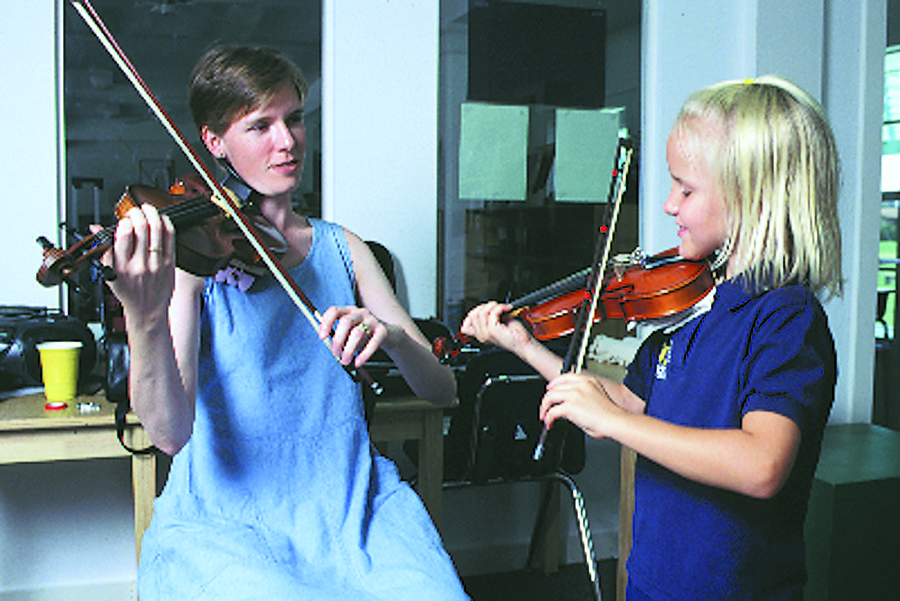

On the other hand, these “specialist” programs often leave Montessori educators concerned and frustrated. Why?
First, salaries for art, music, movement and foreign language teachers are an additional burden on limited school operating budgets.
Secondly, scheduling different specialists among several classrooms often becomes a logistical challenge. Special classes typically end up interrupting the children’s morning work cycle, at the cost of their focus and concentration on extended projects. Due to parental expectations, many schools feel compelled to shuffle the children off to their next specialist, whether or not it would be their individual preference at that time.
Finally, both parents and teachers tend to become frustrated with uneven program quality and at times lack of real skill development over the years. I’ve heard many a Montessori parent express the opinion that their children are doing the same things in foreign language that they I’ve done for several years previously.
The Studio Program model is one approach that may allow you to enhance your school’s co-curricular activities program, while reducing or eliminating interruptions in the children’s prime work cycles by concentrating special classes in the late morning and afternoon. Finally, by moving specialist activities out of the mornings into the afternoons, it is possible to extend them beyond the present school day, thereby making high quality programs available to all students in place of the typically mediocre after-school child care program.
Studio programs are typically offered at different times for the early childhood and elementary levels.
For the preprimary classes, classes may be offered in to blocks: one in the late morning and another just after lunch
For the elementary students, classes will meet either once or twice a week as shown on the tentative schedule that follows.
An optional Studio Session will be held after school, offering additional courses and activities to students who are interested and able to stay. With perhaps a few exceptions involving some extraordinary activity, such as riding lessons, there will not be an additional fee for the after school studio activities.
At the elementary level, classes will be scheduled in four-week blocks. Students and parents will sign up for two-month’s of classes at a time by registering on sheets prepared for each studio. Space in each class will naturally be limited, and while there will hopefully always be several choices available in each period, we will not always be able to guarantee that every student will be able to enroll in his or her first choice.
Some classes will be organized just for students, some will be designed for students and parents together, and some may be scheduled for just adult members of the Countryside community.
Our intention is to offer over the year a wide-range of electives, some four-week classes basically fitting together to create a course that will run for the entire year, but organized into independent month-long units. Classes will be organized in the areas of art, music, dance, drama, foreign languages, computer education, physical education, academic enrichment programs, and clubs. The scouts could, as one example, fit into the studio program.
Classes can be taught by any specialist teachers on your school’s faculty (such as art, music, drama, Spanish, and movement/physical education), by the elementary teachers who can be expected to offer various clubs and programs during at least two or three of the blocks during the afternoon, by guest instructors can either be hired on an hourly basis or enticed into donating their time for a few hours a week over one or two months, and by interested parents.
The Studio Program Coordinating Committee
Interested parents and faculty members can invited to join a standing committee which will assist the administration in planning and operating the studio program. This committee will normally be a working committee (rather than one which recommends policy), reporting directly to the Head of School.
A sample weekly schedule
| Monday | Tuesday | Wednesday | Thursday | Friday | |
| 11:15 | Primary A | Primary A | Primary A | Primary A | Primary A |
| 12:00 | |||||
| 12:00 | Lunch | Lunch | Lunch | Lunch | Lunch |
| 12:30 | |||||
| 12:30 | Primary B | Primary B | Primary B | Primary B | Primary B |
| 1:15 | |||||
| 1:15 | Break | Break | Break | Break | Break |
| 1:45 | |||||
| 1:45 | Elementary | Elementary | Elementary | Elementary | Special |
| 3:00 | A | B | A | B | Events |
| 3:00 | Class meetings/ Dismissal/ Free play ——————–> | ||||
| 3:30 | |||||
| 3:30 | Elementary | Elementary | Elementary | Elementary | Elementary |
| 5:00 | C | D | C | D | E |
A few examples of studio programs
Student Clubs and activities
A student newspaper
Student government (Grades 1-7)
Yearbook
Kids’ Court/Future Lawyers Club and Moot court
Future doctors/holistic healers of America
Career club
Stamp collecting club
Outdoor model railroad club
Future architects club
Cooking club
Chess club
Veterinarian’s clinic
Young peacemakers
Community service club
Academic enrichment
French club
Russian cub
Marine biology
Young naturalists
Gardening
Future farmers club
First aid
Open computer lab
Astronomy club
Math club
History club
Sports and Physical Ed
Track and field
Tennis
Golf
Tee-ball
Soccer
Swimming
Basketball
Horseback riding
Ice skating
Yoga
Tai Chi
Massage
Bicycling club/ bike repair
Skin diving
Volleyball
The Arts
Creative drama
Countryside Players
Chorus
Folk dance
Computer keyboarding class
Computer art
Desktop publishing
Photography
Video production
Needle point
Suzuki violin group lessons
Wood working
Open art studio
Sculpture
Drawing and painting
Pottery
Print making
Folk crafts
Jewelry making

The Barrie School
Curriculum Guide: Age 3 — 12
A Philosophy Of Curriculum
by Tim Seldin, Headmaster, 1971-93
The Barrie School is designed to prepare children both for university and for life.
There are three key ideas that are central to our mission as a school:
Recognizing this, we are engaged in a process of facilitating the development of self-actualized renaissance men and women.
Such people are teacher-proof. They have learned how to learn, and see school as a center of an enjoyable lifelong experience. Children with values such as these will normally go on to college, perhaps after first taking a year off for work or travel, as the natural extension of their previous education.
For some time we have been struggling to resolve the debate over the appropriate balance between our objective of cultivating the child’s spontaneous interest in learning, and the expectations of parents and society.
Normally a school is perceived as the transmitter of culture from one generation to the next through a formal curriculum. This is certainly an important part of our mission. However, as a Montessori school, we are equally committed to the development of responsible members of the human family, and the protection of the child’s fragile spark of curiosity and creativity.
Most children know far more about the world before they start school then the will show a few years later when they have learned to be passive learners who don’t trust their senses, intellect, and imagination. Therefore, our greatest task is to help our students to rediscover their brain’s ability to think, intuit, and discover; to develop a sense of independence, sequence, and order; to learn how to learn.
At the same time, as an independent school, parents come to us and pay a great deal of money in tuition for services available from the government schools for which they have already paid through their taxes.
They come to us seeking quality programs and services!
Their highest priorities are:
1. academic excellence
2. character development
Clearly they expect their children to be well prepared for university, but beyond this, they are looking for a school experience that will offer something special that will make the school experience intellectually exciting and develop a wide-range of talents and interests.
The delivery of these services is difficult to document from our end, and from the parent’s end, even more difficult to evaluate.
Thus, parents expect to be kept abreast of the programs that address these goals, and, their children’s progress in each program.
As a result, we work carefully to maintain this delicate balance.
Our curriculum can be thought of as having two aspects:
1. The school’s basic expectations for what will be first introduced, worked on, or reviewed and targeted for mastery by 85%-90% of all students at each age/grade level.
2. The lessons that arise out of the children’s natural curiosity. While we follow a planned syllabus to give us cohesion and structure, we should never be satisfied with a year spent giving students set lessons from the prescribed syllabus: in order to satisfy, and at the same time, stimulate the children’s interest, we have to farther and faster than that! By providing the children with all sorts of books, pictures, specimens, and artifacts, we can almost guarantee that we will stir up their curiosity and encourage them to expand their scope of learning horizontally. By this, we mean to suggest that, instead of moving on through the set curriculum more quickly, that we allow the children to explore additional related topics that capture their interest.
Our curriculum should be designed to intrigue children and develop in them a lifelong love of learning. No topic is presented just once and forgotten; lessons are introduced quite concretely in the early years and are reintroduced later at increasing degrees of complexity and abstraction. Students at The Barrie School gain experience and develop skills at one level of understanding, which prepares them for more complex lessons at the next level.
The spiral of the Montessori curriculum has no end, and the depth to which any topic can be pursued is limited only by a student’s interests and ability. At the same time, our expectations as a college preparatory school are quite high; challenging each student to his/her fullest individual potential, and establishing a clear standard of achievement and quality of thought and work. We encourage accelerated students to expand their studies horizontally, researching topics at greater depth and a more sophisticated level of thought and analysis.
Our course of study is consciously multi-disciplinary. It is an examination of the natural world and the human experience that interconnects the traditionally separate subject disciplines. Units of study often cut across the curriculum, weaving together, as one example, the land, flora and fauna, folk tales, art, dance, poetry, architecture, history, everyday life, and cooking of a country under study.
Our curriculum has no outer limits except for humanity’s knowledge and imagination. At the same time, our core curriculum has been carefully structured to establish benchmarks for achievement of the normal student by the end of each level within the Academy. While we recognize that some students may not, for one reason or another, keep up with all of the benchmarks for his or her age level, they define a standard of our expectations.
At its finest, Montessori is an incredibly elaborate model of education. We don’t advocate using all these tricks and devices simply to make the school day pass more pleasantly or to better prepare students for their standardized tests at the end of the year. These are only secondary objectives. The real aim of education as we see it at The Barrie School is to prepare children to live lives filled with personal satisfaction, as responsible, concerned citizens of the Earth. An important element in achieving that goal is the development of knowledge and understanding about the world today: civilization. However, along with this must come self knowledge, self-respect, compassion, and a mind and heart open to new ideas and information. Our goal is to help children to learn how to learn.
This is a static image of the Montessori Foundation’s Language Arts curriculum scope and sequence database, available from our publications center.
We have an even more comprehensive version that has been fully aligned to the Common Core State Standards as part of the Montessori Compass student record keeping and parent communication software solution: www.montessoricompass.com
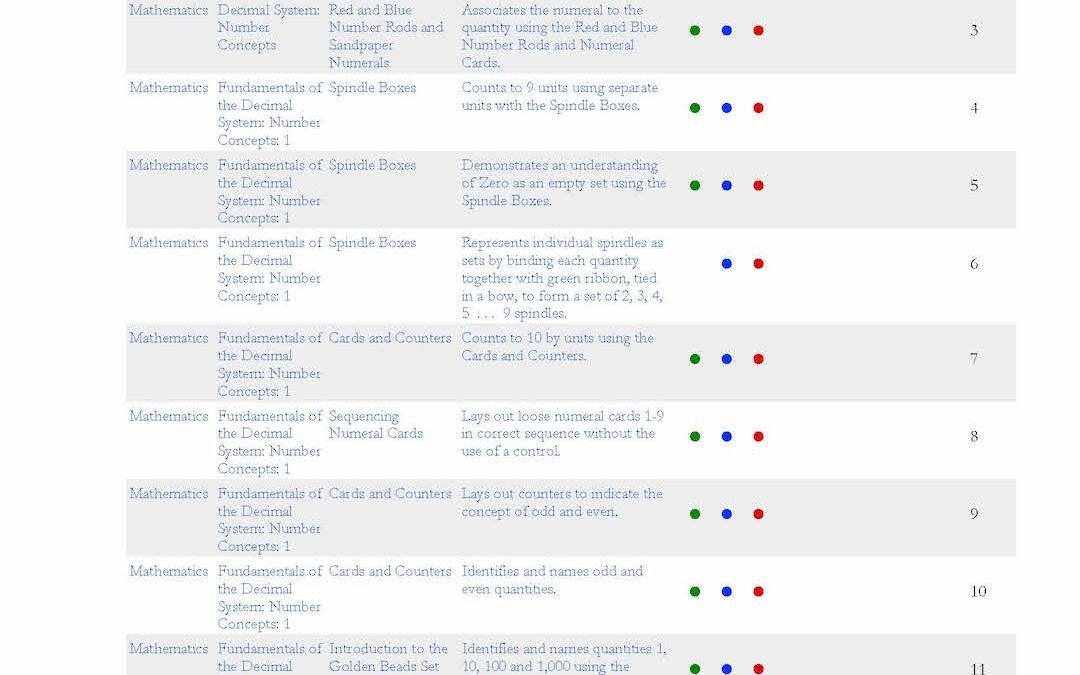
We have an even more comprehensive version that has been fully aligned to the Common Core State Standards as part of the Montessori Compass student record keeping and parent communication software solution: www.montessoricompass.com
This is a static PDF of the Montessori Foundation’s science curriculum scope and sequence database, available from our publications center.
We have an even more comprehensive version that has been fully aligned to the Common Core State Standards as part of the Montessori Compass student record keeping and parent communication software solution: www.montessoricompass.com
This is a static image of the Montessori Foundation’s Practical Life curriculum scope and sequence database, available from our publications center.
We have an even more comprehensive version that has been fully aligned to the Common Core State Standards as part of the Montessori Compass student record keeping and parent communication software solution: www.montessoricompass.com
This is a static image of the Montessori Foundation’s Sensorial curriculum scope and sequence database, available from our publications center.
We have an even more comprehensive version that has been fully aligned to the Common Core State Standards as part of the Montessori Compass student record keeping and parent communication software solution: www.montessoricompass.com
This is a static image of the Montessori Foundation’s Visual Arts curriculum scope and sequence database, available from our publications center.
We have an even more comprehensive version that has been fully aligned to the Common Core State Standards as part of the Montessori Compass student record keeping and parent communication software solution: www.montessoricompass.com
This is a static image of the Montessori Foundation’s History curriculum scope and sequence database, available from our publications center.
We have an even more comprehensive version that has been fully aligned to the Common Core State Standards as part of the Montessori Compass student record keeping and parent communication software solution: www.montessoricompass.com
This is a static image of the Montessori Foundation’s Geography curriculum scope and sequence database, available from our publications center.
We have an even more comprehensive version that has been fully aligned to the Common Core State Standards as part of the Montessori Compass student record keeping and parent communication software solution: www.montessoricompass.com
This is a static image of the Montessori Foundation’s Toddler curriculum scope and sequence database, available from our publications center.
We have an even more comprehensive version as part of the Montessori Compass student record keeping and parent communication software solution: www.montessoricompass.com
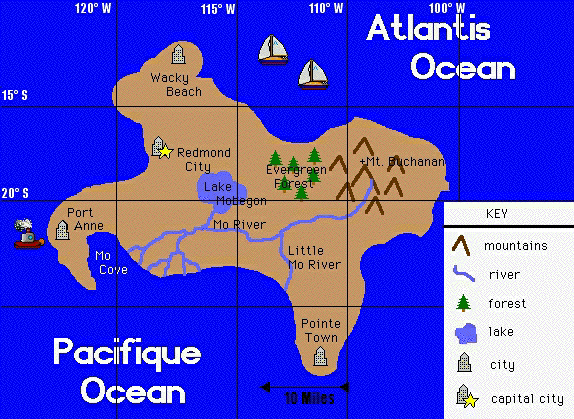
By Tim Seldin
This is an excerpt from the Second Edition of The World In The Palm Of Her Hand.
The Imaginary Island Project was developed by my friend, Harvey Hallenberg, and introduced to the Montessori community in the 1980s through the Institute for Advanced Montessori Studies in Silver Spring, Maryland, which we co-founded.
In the Montessori curriculum, children in the early childhood and elementary classes are of course introduced to an extensive set of land and water forms. They first see them as three-dimensional models and three-part cards, learning the vocabulary and definitions of not only the introductory land and water forms taught in most Montessori classrooms.
In the elementary classes, older children go beyond the basic land and water forms to learn many more land features in Physical geography, such as foothills, summit, river delta, marshlands, tributary, archipelago, lagoon, and many more. Children construct models of these landforms out of clay and in combinations on sand and water tables.
As the extension of all this work, we invite interested children to create an entire island from their imagination.
The Areas of the Curriculum: Physical and Cultural Geography
Materials That You Will Need:
The children will be creating both two-dimensional drawing and three-dimensional dioramas of their imaginary islands and will need a wide range of art supplies: large sheets of paper, drawing pencils or charcoal, pastels or paints to create pictures of their islands, and clay or some other modeling media for constructing their dioramas (which will then be painted). They will also need various materials like sawdust dyed green to simulate grass, lichen, and small twigs to simulate trees and materials from which they can construct small model houses, such as small rectangular blocks of balsa wood.
Our Aims: To help the children to integrate their present level of understanding about physical geography, biomes, how human beings meet their needs in different settings, and cultural geography through the creative development of imaginary islands placed somewhere on the globe.
Preparation: Children can participate in this activity at many different levels of understanding, depending on their interest and grasp of the many concepts involved in physical geography, earth science, biomes, and how human societies may be organized. A good basic level of preparation would include work with the land and water forms, land features, an introduction to biomes, the needs of human beings, and experiences in cultural geography.
Age: This activity has been used with children from as young as age five through early adolescence. In some schools, it will be reintroduced in the upper elementary of junior high school levels. We might recall that books like Frank Herbert’s Dune are based on an entire planet—its climate, ecology, and human civilization—created from the author’s imagination.
Presentation:
The First Activity:
Invite the children to imagine an island somewhere in the oceans of the world, where they can decide everything from its size and shape, rivers and lakes, cities and villages, as well and the plants, animals, and people who live there.
To get the children started, you might want to make a first crude drawing of an island yourself with charcoal. Now invite the children to prepare a drawing of their own imaginary island, coloring it in with paints or pastels, and showing anything on it that they wish. Challenge them to place their lakes, rivers, mountains and cities carefully, because once there, they would be very hard to move, no?
You might want to give the children a paper like this to remind them of points to consider:
The name of my island is _____________
Are there any mountains?
Are there any lakes?
Are there any rivers?
Are there any roads?
What is the name of the capital city?
How many people live in the capital city?
Are there any other cities and villages?
Are there any beaches?
Are there are forests on your island?
Is there an isthmus on your island?
Is there a peninsula on your island?
Is there a cape on your island?
Is there a bay on your island?
Is your island part of an archipelago?
Is your island an atoll?
Are there any valleys on your island?
Does your picture of your imaginary island show them? Have you given them names and labeled them on your picture?
When the children are done, invite them to share with you and their friends anything they wish to tell about their island. Some will say little; others will most likely come up with involved explanations and stories. Ask them if they have thought of a name for their island. Some will have named their island, others may prefer to wait until the right name comes to mind.
The Second Activity:
Ask the children if any would be interested in making a new drawing/painting of their islands. This time invite them to label their drawing with a name for their island and to think about what sort of animals and plants live there. As the children complete their work and share with their friends, continue to ask them new questions, like the ones below, and invite them to either prepare still another drawing of their island showing these things or add them to the drawing that they’ve made.
Are there any people on the island? Show what their houses look like. Do they live alone, in villages, or in cities? Invite the children to begin to name these cities and villages, as well as any major
What is the weather like on the island? What sort of clothes do they wear?
How do they get from place to place? Do they walk everywhere, ride horses, or drive cars?
What food do they eat on the island? Where does it come from? Is it grown there or brought in by ship or airplane? Where do ships dock and where do airplanes land, if they do stop at the island?
How many people are on the island? How did they come to be there?
Are there any children on the island? Where do they go to school? What is their school like? Is it shown on the map yet? What do the children do for fun on the island?
What natural resources are there on the island? How have people used them to make things for their own use or to export to other places?
Continue to gather informally with individual children or small groups who finish, to discuss what they found in their imagination. This process normally goes on over many days or weeks, and sometimes, over many years.
The Third Activity:
Prepare a three-dimensional model showing the island to scale, with land features, cities, roads, etc. depicted as realistically as the child can using art and craft materials.
Hold a geography fair in which all of the children’s imaginary islands are displayed in the school’s halls or All-Purpose room.
An Optional Introductory Activity: The Imaginary Island Puzzle
This material was developed by Judy Martell and is available from Mandala Classroom Resources. As an elementary teacher, Judy found that while many students loved the imaginary island project, others found the project “too huge, too open-ended, too full of possibilities; they needed the door cracked open a little rather than flung wide.” * To meet their needs, Judy designed a new classroom material to bridge this gap.
Judy wanted to create something that could act as a springboard to the Imaginary Island Project without limiting it; a way for students to be invited naturally to use the vocabulary of the land and water forms as they moved toward the Imaginary Island Project, gaining confidence in their own imagination and exploring without inhibition.
The Imaginary Island Puzzle is a set of 84 square cards showing various individual land and land and water features that can be combined in many different ways to depict an imaginary island. Students use them to create an infinite variety of islands, modifying them at will and using the vocabulary words easily in conversation in the process.
Judy found that the puzzle acted as a springboard for the Imaginary Island Project. “Children who had been overwhelmed at first could more easily visualize their personal island after shaping it with the pieces of the Imaginary Island Puzzle. They could then elaborate on their islands and move into greater and greater detail as Harvey Hallenberg’s project invited them to, eventually putting their creations on paper, writing their reports, and presenting them to others.”
* Please Pass the Penisula: A Recipe for a New Montessori Material, Judy Martell, Tomorrow’s Child Magazine, May, 1997/Vol 5/Number 3
Mandala Classroom Resources
1001 Green Bay Rd. #190
Winnetka, IL 60093-1721
Phone: 847-446-2812
Points of Interest: The combination of various land and water features. The creative and intellectual activities blended together to construct the island in one’s imagination.
Points of Consciousness: The idea that an island is a complete and independent system of land, plants, animals, climate, natural resources, and people’s impact on the environment.
Control of Error: There really is none in this activity, except that ideas proposed by the children can be challenged or confirmed by research into various areas of geography, climate, ecology, and cultural patterns found in islands located in that general area of the Earth.
Extensions:
Locate the imaginary islands precisely on the globe in terms of degrees of longitude and latitude.
Determine the distance from given points of the Earth to this location in terms of miles and kilometers.
Determine the course one would have to follow by boat or airplane, in terms of degrees on the compass rose, to travel from given points of the Earth to this location.
Identify the nearest points of land within 500 miles of this location, if applicable. Research one or more of these nearby islands to see what can be learned by comparing the climate, rainfall, biomes, and lifestyle of the people who inhabit those islands.
Study wind patterns and ocean currents to see how they might influence the climate and weather patterns on the imaginary island.
Prepare a more precise scale map of the island, and calculate the distances between given points by both direct point-to-point measurement and by following the routes made practical because of the island’s geography.
Prepare a topographical map of the island.
Prepare an illustrated history of the people who inhabit your imaginary island.
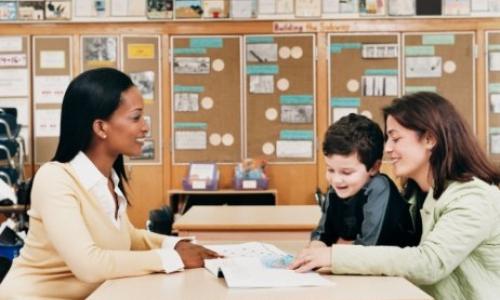
In Appendix B of From Childhood to Adolescence Maria Montessori suggests that students in the third plane of development make a detailed study of “one period, event, or the life of some personage who has aroused special interest.”(1)
One such “personage” could well be Leonardo da Vinci, which would provide inspiration and material to explore in just about every area of the curriculum.
The reason is clear from an article by Fritjof Capra: “Learning from Leonardo.”
“Most authors who have discussed Leonardo’s scientific work have looked at it through Newtonian lenses. This has often prevented them from understanding its essential nature, which is that of a science of organic forms, of qualities, that is radically different from the mechanistic science of Galileo, Descartes, and Newton. And this is precisely why Leonardo’s science is so relevant today, especially for education, as we are trying to see the world as an integrated whole, making a perceptual shift from the parts to the whole, objects to relationships, quantities to qualities.”
Read the full article here. http://www.ecoliteracy.org/essays/learning-leonardo
(1) Maria Montessori, From Childhood to Adolescence, ABC-Clio, 1994. 79.
 Montessori Family Alliance School Group Membership (Print & Digital 2026 1/2 year pricing)
Original price was: $30.00.$15.00Current price is: $15.00.
Montessori Family Alliance School Group Membership (Print & Digital 2026 1/2 year pricing)
Original price was: $30.00.$15.00Current price is: $15.00.
 The Montessori Way, Revised and Expanded: An Education for Life; A Comprehensive Guide for Parents and Teachers
$25.00
The Montessori Way, Revised and Expanded: An Education for Life; A Comprehensive Guide for Parents and Teachers
$25.00
 The Montessori Child: A Parent's Guide to Raising Capable Children with Creative Minds and Compassionate Hearts (The Parents' Guide to Montessori)
$20.00
The Montessori Child: A Parent's Guide to Raising Capable Children with Creative Minds and Compassionate Hearts (The Parents' Guide to Montessori)
$20.00
 The Montessori Toddler: A Parent's Guide to Raising a Curious and Responsible Human Being (The Parents' Guide to Montessori)
$20.00
The Montessori Toddler: A Parent's Guide to Raising a Curious and Responsible Human Being (The Parents' Guide to Montessori)
$20.00
 Montessori in Action: Building Resilient Montessori Schools 1st Edition
$29.95
Montessori in Action: Building Resilient Montessori Schools 1st Edition
$29.95