by Tim Seldin | Adolescence, Early Adolescence (12-15), Later Adolescence (15-18), MFA, Montessori Administrators, Montessori Curriculum, Montessori Education, Montessori Middle School, Montessori Parenting, Montessori Secondary / High School, Montessori students, Upper Elementary (9-12)
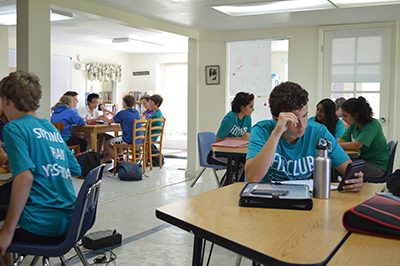 Montessori Extends through High School
Everyone remembers their high school years. Few of us want to remember middle school. And no one, except perhaps our mothers, remembers the preschool that we attended until we were old enough to go to ‘real school.’
But wait, that may be true for most of us, but it is rarely true among children who grow up in Montessori schools.
Originally developed to serve children under age six, most Montessori schools today extend at least through age twelve, and increasingly they are adding on adolescent communities for the middle school years. Today, more and more Montessori high schools can be found in the US and abroad.
Adolescence (age 12 to 18) is the developmental period in which a child begins the transition into adulthood. It is normally a time of life marked by uncertainty, self-consciousness, and conflicting emotions. Most adults recognize that the teenage years are a difficult passage. Leaving the childhood years behind, young adolescents enter a stage of life in which their very bodies betray them. Not only must they cope with their emerging sexuality, but as sudden spurts of growth begin, they often become so awkward and gangly that the body’s center of balance is thrown off. At the same time, as their muscular development proceeds, many literally don’t know their own strength. It is not surprising that so many teens worry about the image they project to the outer world!
Here’s a shockingly simple concept: secondary education does not need to dehumanize adolescents any more than early childhood and elementary programs need to destroy children’s creativity and joy for learning!
Working a hundred years ago in Europe, Maria Montessori recognized that the basic developmental tasks of adolescence are not scholastic but, rather, social and emotional. She believed that the ultimate objective of education at the secondary level must be to help young people to discover, accept, and confirm themselves as individuals.
Montessori observed that adolescents often find it difficult to concentrate on their studies, even though they are expected to prepare for university or most careers, until their social and emotional needs are met.
Normally, schools see their role as presenting students with its curriculum: factual knowledge that is often outdated soon after it is taught. In Montessori, we cover the curriculum that universities expect, but we also focus on helping students to really learn how to learn. Instead of giving them the right answers, we most often pose the right questions! They learn to do their own research, think deeply, and are encouraged to think outside of the box. They develop executive function and self-regulation skills, such as goal setting, planning, monitoring, organization, positive thinking, stress management, and a balanced daily routine.
Here’s a shockingly simple concept: secondary education does not need to dehumanize adolescents any more than early childhood and elementary programs need to destroy children’s creativity and joy for learning!
What makes a Montessori approach to education so viable and increasingly preferable to other models? Nationally and around the world, students who stay in a Montessori environment seem to never lose their sense of wonder, their love for learning, creating, and building. They innovate. They collaborate. They celebrate their lives. If you’ve known any Montessori graduates, you’ve probably seen this for yourself. The genius of Maria Montessori’s work lives through each graduate, and we believe as she did, that “wisdom begins in wonder.”
As a physician doing pioneering work on brain development and child psychology, Dr. Maria Montessori was also well aware of the rigors of the European educational system, so she never dismissed the adolescent’s need to develop intellectually; she simply heralded a new approach to academics in harmony with the adolescent’s developmental needs. She recognized and identified four different planes of development and characterized development as “a series of rebirths” (Montessori, The Absorbent Mind). Montessori saw adolescence, the third plane of development, as a period of great creativity, specific psychological needs, and intense physical and emotional transformations. She identified and articulated the fundamental human needs as both physical
and spiritual.
Montessori envisioned adolescents living, learning, and working in a carefully managed rural residential learning community, a farm school, close to nature, and involved with a variety of lessons in practical life skills and learning how to live and work with others in a model society. The farm was to be their ‘Land Lab,’ and the adolescents, ‘Children of the Earth’ or ‘Erdkinder.’ Many secondary Montessori programs across the country still look to this model as an ideal, but during Montessori’s lifetime, boarding schools were a much more common option in Europe. These options are not as popular, or readily available in the United States. Today, and only a few boarding Montessori middle and high schools have been formed.
The NewGate School
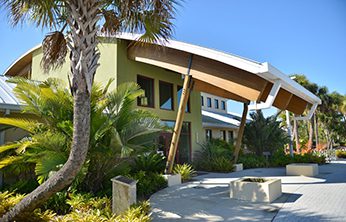
NewGate is the Montessori Foundation’s Lab School in Sarasota, Florida. It is an international school, attracting students and families, who move to Sarasota as a destination for their children’s education. At NewGate, students can start in Montessori classrooms as toddlers and go all the way to graduation in 12th grade. NewGate graduated its first senior class in 2004, and each year its high school graduates have gone on to university and beyond, leading fulfilled and productive lives.
And this year, NewGate’s Montessori Secondary Program has a new home: the former Center For Building Hope, a Gold Level Green Building set on 5 acres. The setting is lovely. There are benches everywhere, quiet spots for contemplation, bubbling fountains, a labyrinth, a walking trail, and a tower to observe the beauty of the adjacent lake. The building itself is a children’s house on a much larger scale. It is perfect for up to 150 students for grades 7 to 12.
NewGate prepares students for life in the 21st century by incorporating Montessori’s philosophy, and vision for adolescent education focusing on the activities of practical life, wellness education, and valorizing the distinct needs of each adolescent.
The core of a Montessori education is based on the Montessori educational syllabus, which consists of ‘integrated academic components’ in three overarching areas: Self-Expression; Social, Emotional and Spiritual Development; and Preparation for Adult Life. Within these recognized areas, NewGate’s Upper School offers its students rigorous coursework in a variety of academic subjects, including: our much-celebrated drama-immersion weeks; experiential learning and in-the-field experiences; a variety of seminars and collaborative learning projects; training in organization and personal responsibility; and an annual internship week, which has proven very successful over the years. NewGate’s international emphasis also offers students opportunities for travel, not to mention a rich international student population, which brings the world home to NewGate, broadening student perspectives and engaging different ideas and ideologies. In addition, NewGate’s dedication to the development of the whole human being emphasizes community meetings and adherence to Montessori rules of grace and courtesy, which govern and inform all interactions on campus.
NewGate School understands that an education is not simply learned in books and through academic coursework. As Montessori defined it, education is “an intellectual and moral process that renders individuals capable of making their own way in life.” In her 1937 Public Lecture, she added: “Adaptability is the most essential quality, for the progress of the world is continually opening new careers and at the same time closing or revolutionizing the traditional types of employment. This does not mean that in secondary schools, there should be no preparation for intellectual professions, and still less that ‘culture’ should be neglected. On the contrary, education must be very wide and very thorough, and not only in the case of professional intellectuals but for all [men] [and women] living at a time that is characterized by progress of science and its technical applications….” (“A New Education for the Secondary School,” Public lecture given at Ulrecht [January 19, 1937])
NewGates Secondary or, as we call it, ‘Upper School’ reflects this commitment to prepare graduates for a constantly changing world within the context of three, 2-year cycles. The First Cycle is comprised of 7th and 8th-year students. The Second Cycle consists of 9th and 10th-year students; and the Third Cycle defines the 11th and 12th-year students. This approach allows for a symbiotic and seamless incorporation of Montessorian values with the International Baccalaureate Program.
NewGate is an International Montessori IB World School and, following Montessori principles, students continue to work in multi-age learning environments. By the last two years of high school, they are more capable of abstract thought and more comfortable and capable of exercising their independence. They are interested in a wider social context outside of their immediate peers, and they have a desire to more fully understand adult behavior.
The coursework in this cycle of the program spirals up, and responds to the student who is now ready to refine and apply his or her skills and knowledge with deeper understanding. Students participate in challenging seminar, labs, and project-based courses lasting for two years in Science, Mathematics, History, English, Spanish, Art, Physical Education, and Service Learning that foster the academic and intellectual capacities of adolescents and set the foundation for college-level work. These courses require in-depth and self-motivated participation, close attention to detail, self-directed independent work, writing, solid research, discussion, and analysis, and a learned trust that their guides and other members of their community will provide the support necessary. That is, students at NewGate are nurtured through every step of their human development. Class meetings provide support and structure for their work.
While some of our students do not elect to sit for the IB Diploma examinations, they participate fully in the IB course of study. At the end of the program, students have a greater depth of understanding about themselves and the world, sophisticated reasoning abilities, and experience with a wide range of tools, modes of expression, and courses that prepare them for college, life, and thoughtful citizenship. The goals begin and remain meaningful, and as secondary students at NewGate move through their studies they are encouraged to ask the important questions: Who am I? Who do I want to be? Where is my place in the history of humankind? Where is my voice in the great conversation? What will I say, and what will be my contribution to society? How will I encourage peace in the world? How will I exercise my freedom to choose?
An education based on the freedom to learn in a safe and nurturing environment allows students to ask these very questions. In this manner, their education informs the totality of their human development. Maria Montessori once said, “Free choice is one of the highest of all the mental processes.” The programs of study in the Upper School stress Montessori’s definition of freedom with the understanding that not only does freedom come with the burden of responsibility, sustaining and developing freedom for individuals and the community is also an intellectual and ethical process to which all must commit if we hope to create peace in the world. In her seminal book, Education and Peace (1949), Montessori wrote:
“Peace is a goal that can only be attained through common accord, and the means to achieve this unity for peace are twofold: first, an immediate effort to resolve conflicts without recourse to violence—in other words, to prevent war—and second, a long-term effort to establish a lasting peace among men.”
She expressed consternation that a recognized ‘science of war’ existed but not a ‘science of peace,’ and she poignantly asked, “In comparison with the problem of Peace, of what value are even the most sublime branches of human knowledge?”
Montessori expressed that the values attached to life and the principles involved in preserving life were entirely contradictory to war, and she pressed that if civilized society truly wanted to begin a “sane and psychical rebuilding” of humankind, we would have to return to the child “as an inspired being and a regenerator of society.” This hope for peace that Montessori saw in the proper development of the child is at the core of NewGate’s mission to cultivate a love of life.
In fact, at the heart of our move to the new campus, The Center for Building Hope, NewGate’s commitment to Montessori’s values finds expression in a pedagogy of place. The new campus will encourage students to connect their lived Montessori experience to the message of the original organization.
After years of serving the community of Sarasota, NewGate has been working to revolutionize the way we educate teenagers in America and abroad.
Tomorrow’s Child / November 2016 / p 6
by Tim Seldin | Mixed Ages, Montessori Administrators, Montessori Charter Schools, Montessori Education, The International Montessori Council
A hundred years ago most schools were very small in comparison with the large elementary schools and enormous middle and high schools that we find across America and in much of the rest of the world.
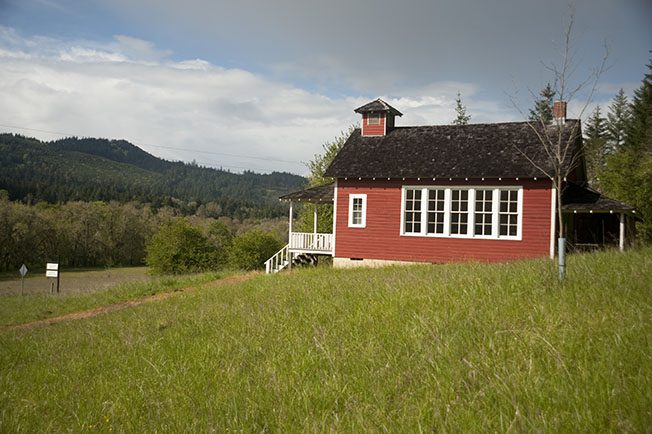
The one-room schoolhouse was the traditional American classroom model. Classes were multi-aged. Students learned from each other, especially the older students in the class, as well as from their teachers.
Junior and senior high schools were typically combined and commonly had enrollments of less than 400 students. With small enrollments, the choice of friends was limited. One benefit was that school friendships tended to grow strong and last for a lifetime.
Over the last hundred years, this tradition changed, and the one with which we are familiar became the norm. It is worth remembering how this came to be.
Before 1900, less than 10 percent of all students attended high school. Most began school at age six and left after the eighth grade. By 1910, the percentage attending high school had risen to 35 percent, but only 4 percent of American youth went on to college. In the past, high school was seen as preparation for college, and college was simply not seen as being needed for employment in most professions.
As the 20th century dawned, several social movements came together to transform the American educational system, and ultimately influence education throughout the world.
The first was the vigorous progressive drive to improve wages and working conditions in the increasingly urbanized and industrial economy of North America. One aspect was the campaign to discourage businesses and industries from employing children. The goal was both child protection and the elimination of this tremendous and inexpensive pool of labor. This laudable goal was accomplished by making child labor illegal and by requiring parents to send children to school.
The second great impetus to build even larger schools was the great wave of immigrants who came to the United States and Canada from Europe during the 1890s and early years of the twentieth century.
This was also a period of major growth in many industries, from mining to manufacturing, and the labor movement began to organize in response to low wages, long hours, and poor working conditions. This influx of immigrants and labor unrest led to a growing fear of socialism and foreign influences. As immigrant populations gathered in large cities and around industrial and mining communities, free (but compulsory) education was seen as the surest way to turn foreigners into loyal citizens. The public schools became the great ‘American Melting Pot’ and were idealized as a central part of the shared American experience. Whatever the positive outcomes of this trend, it also led to a movement from small independent local schools to large bureaucratic school systems.
As the economy began to shift, young teenagers who did not live on farms began to find it increasingly difficult to find a job, and social and economic pressure led many to stay in school longer.
At the same time, educational reformers saw the need to better prepare young people for the world of work, whether or not they had any interest in going on to college.
Thus, with both a growing population and a burgeoning number of young people between the age of 6 and 16 required to attend public schools, our cities began to find ways to house and educate a rapidly growing number of students.
Finally, to understand how schools grew from small neighborhood settings to modern shopping-mall-sized buildings that can house five hundred and more elementary students, and thousands of middle and high school students, under one roof, we have to remember that in the first half of the twentieth century most of North America was fascinated with industrial efficiency. Henry Ford popularized the idea of the assembly line, but many management experts contributed to the idea of standardization of parts, setting performance expectations, and laying out plans for making entire organizations more efficient.
Many good things came from this process, primarily greater output, technological innovation, and many more household goods and major purchases that have come to shape our lives. There is a direct line from the start of the modern industrial revolution to the cars that we drive, the modern kitchen, the entertainment industry, our cell phones, and the internet. The is also a direct connection between it and climate change, the pollution of our oceans, and the depersonalization of our society, which begins with our schools.
Whatever reasons explain (and perhaps once justified) the creation of large schools, today there is a strong case to reverse the trend.
From both studies and the experience of thousands of smaller public and nonpublic schools, we find that in these more personalized settings, students get a better education and feel more connected to the school community than in the large settings that many of us take for granted. This is true in inner cities and affluent suburban communities. It is true at every level, from elementary to high school. Major education reform groups, such as the Bill and Melinda Gates Foundation, have come to the same conclusion and invest vast sums into supporting the development of new small high school models.
As Jordan Hylden at Harvard University observed in 2004:
Students in small schools perform better academically, graduate at higher levels, are more likely to attend college, and earn higher salaries later on in life.
They participate more in extracurricular activities, have better rates of attendance, report greater positive attitudes towards learning, and are less likely to face school-related crime and violence.
Their teachers report greater job satisfaction and are more likely to feel as if they are succeeding in their work.
Their administrators and teachers are often more able to identify problems, respond innovatively and effectively, and adapt to change.
Their parents and relatives are more likely to become involved in the school.
Small schools are often characterized by personalized attention, curriculum integration and specialization, relational trust and respect, a student’s sense of belonging, a strong positive ethos, greater accountability, and a sense of communal mission.?
The point that I want to make is that bigger is not necessarily better, especially when it comes to designing schools. But large schools have become the norm.
Endless numbers of movies and television sitcoms showcase large public middle and high schools. Children take for granted that this is the way things are supposed to be. All through elementary school, many children long for the day when they can make the rite of passage and go to a big school. In affluent communities, the modern secondary level campus is shiny and new, and costs enough to keep property tax rates higher than ever.
Public education enjoys almost universal support from the American public. We take pride in our large schools. On the other hand, we hear conflicting messages from all sides, most commonly that our country’s students are falling further and further behind those of much of the rest of the world. We decry the state of schools today in America as a whole while reassuring each other that our local schools are among the best in the nation.
The seemly obvious solution is to spend still more money on our schools. There are inequities still to be found in American public education. Some districts have much greater resources, and some schools are grossly underfunded. But the evidence of the last several decades is that much of the money invested had led to modest outcomes in terms of overall student learning and the emotional climate within our schools. We have much more large modern buildings, Ipads, laptops, Smartboards, and educational technology that looks and sounds good but is not the direct link to deeper learning. Education is still centered around the direct relationship of children and adults who know how to facilitate their learning.
We hear snide jokes about the wasteful spending of the government, forgetting that the biggest spending arm of our government is typically right in our own community, where the public school system is often the largest employer in town and usually spends almost as much on centralized administration as on its classroom programs.
In recent years, technology is often seen as the answer, forgetting the wisdom of this old truth:
- Tell me about something and I may quickly forget.
- Show me and I may remember and understand.
- But lead me to do something on my own, to experience it firsthand, and I will almost certainly remember it for a lifetime.’
Children learn best by doing, and they learn best of all within a school setting in which they feel safe, respected, and emotionally connected to their teachers and fellow students.This is very difficult to do in a school system that is obsessed with state-mandated standards, constantly changing curriculum, high-stakes testing, and students who are trained to follow instructions rather than think deeply and become engaged in their education.
Smaller School Size Is Not Enough
There are obvious trade-offs with a smaller enrollment. With fewer students and teachers, it becomes difficult to offer as many extra-curricular programs and widely varying courses of study.
But how much is enough? Which is more important: a choice among thirty different social studies courses or a school in which you find your own voice, live and work within a strong supportive community, and, as a young person, feel that adults really listen and treat you with kindness, warmth, and respect?
Today, many charter and private schools are increasingly specialized, offering families a greater range of choice. Smaller schools that put children at the center, rather than the teachers’ lesson plans, tend to create far more humane, kind, and effective educational outcomes in the long run, not only in terms of what can be measured on test scores, but in terms of the quality of relationships, character, and ability to work together to get things done.
It is time to go back to the good old days when schools were small, and everyone knew your name.
by Tim Seldin | MFA, Montessori Administrators, Montessori Education, Montessori Parenting, School Leadership, The International Montessori Council
Not long ago, a mother wrote: “My daughter attends a Montessori school. She loves school and tells me about all the wonderful things she does. I just have one question, could someone please explain the term Normalization?”
Normalization is a term that causes a great deal of confusion and some concern among many new Montessori parents. Normalization is a terrible choice of words. It suggests that we are going to help children who are not normal to become “normal.” This is not what Dr. Montessori meant to suggest at all. Normalization is just Montessori-talk that describes the process that takes place every year in tens and tens of thousands of Montessori classrooms around the world, in which young children, who typically have a short attention span, learn to focus their intelligence, concentrate their energies for long periods, and take tremendous satisfaction from their work.
Another mother put it this way: “My child just does not act the same now that he’s been in Montessori a while. He is usually happy, laughing, and running from one thing to another. In Montessori he looks interested, sometimes puzzled, and often completely absorbed. I think of normalization as a kind of satisfaction that he seems to take from what he calls hard work.?
In his book, Maria Montessori: Her Life and Work, E.M. Standing described the following characteristics of normalization in the child between the age of three and six:
- A love of order
- A love of work
- Profound spontaneous concentration
- Attachment to reality
- Love of silence and of working alone
- Sublimation of the possessive instinct
- Obedience
- Independence and initiative
- Spontaneous self-discipline
- Joy
- The power to act from real choice and not just from idle curiosity
Ours was a house for children, rather than a real school. We had prepared a place for children where a diffused culture could be assimilated, without any need for direct instruction…Yet these children learned to read and write before they were five, and no one had given them any lessons. At that time it seemed miraculous that children of four and a half should be able to write, and that they should have learned without the feeling of having been taught.We puzzled over it for a long time. Only after repeated experiments did we conclude with certainty that all children are endowed with this capacity to ‘absorb’ culture. If this were true – we then argued – if culture can be acquired without effort, let us provide the children with other elements of culture.
-
And then we saw them ‘absorb’ far more than reading and writing: botany, zoology, mathematics, geography, and all with the same ease, spontaneously and without getting tired.And so we discovered that education is not something, which the teacher does, but that it is a natural process, which develops spontaneously in the human being. It is not acquired by listening to words but in virtue of experiences in which the child acts on his environment. The teacher’s task is not to talk, but to prepare and arrange a series of motives for cultural activity in a special environment made for the child.My experiments, conducted in many different countries, have now been going on for forty years (ed. now ninety-two years), and as the children grew up parents kept asking me to extend my methods to the later ages. We then found that individual activity is the one factor that stimulates and produces development and that this is not truer for the little ones of preschool age than it is for the junior, middle, and upper school children.” – Montessori, The Absorbent Mind, 1947
Kay Futrell in her classic little book, The Normalized Child, describes Dr. Montessori’s amazement when the 60 frighten and ill-disciplined inner-city children of her first Children’s House began to respond to the new environment.
?What followed seemed incredible even to Dr. Montessori, for the deprived children blossomed under this freedom and the possibility of doing work suited to their needs. They revealed to her not only their enormous capacity for intellectual accomplishment but a strange character of sweetness and serenity. They displayed a truly uncorrupted spirit, scorning rewards and punishment, and finding their joy in the prodigious work which involved them. They came from these labors refreshed, as from a creative experience, and as they worked, they grew in inner discipline and peace.
The sight of these children who displayed the truly ‘normal’ characteristics of childhood, was the force which motivated Montessori for the remainder of her life. This secret of childhood she pursued with all the vitality of the genius who found her raison d’etre and from her tireless observations and efforts, evolved her perception of the child’s psychic personality.
As she traveled from country to country, lecturing, training teachers, helping to establish school after school, this same phenomenon was observed wherever conditions promoting its growth were perfectly realized.
This normalized child is the image which Montessori teachers keep uppermost in their minds. This is what we are striving for, what we hope will achieve. However, this child will only appear only if we conscientiously prepare ourselves and our classrooms and if we can build on the proper preparation in the child’s home.?
Normalization is another word for what we call Montessori’s Joyful Scholars.
by Tim Seldin | Montessori Administrators, School Leadership, The International Montessori Council, Webcasts / IMC
This is a discussion that Tim Seldin of the Montessori Foundation had with Aggie Sung Tang of Princeton, NJ public television about Montessori early childhood education (preschool).
by Michael Dorer, EdD | Montessori Administrators, Montessori Education, Montessori Teachers, Prepared Environment, School Leadership, The International Montessori Council
Please click the button below to download a List of Suggested Montessori Furniture for Montessori Classrooms.
by Michael Dorer, EdD | Lower Elementary (6-9), Montessori Administrators, Montessori Charter Schools, Montessori Curriculum, Montessori Education, Montessori Materials, Montessori Teachers, Prepared Environment, Primary (3-6), School Leadership, School Resources, The International Montessori Council, Upper Elementary (9-12)
Authorized List of Montessori Materials for Montessori Classrooms
Organized and Edited by Michael Dorer
Contributors: Michael Dorer, Syneva Barrett, Lois Bobo, Rose Dorer, Peter Hanson, Shanna Honan, Maria Kaminstein, Angela Lord-Carsrud, Ann Luce, Chris Sacerdote, Larry Shankar, Maria Verhaal
Copyright Michael Dorer Shared with members and students on the Montessori Foundation and International Montessori Council with the author’s permission.
Montessori Materials List for age 3 to 12 from Michael Dorer
by Tim Seldin | Kindergarten, Montessori Administrators, Montessori Parenting, Montessori Teachers, Parent Education, School Leadership, The International Montessori Council
Many schools face the challenge of convincing more parents of 5 year-olds to stay on for elementary. I wrote the enclosed letters for one school to send out over the Head’s signature.
I thought that you might find them useful in preparing an evening and invitation to attend of your own. Many schools send home a copy of the Montessori Foundation’s kindergarten video (Montessori For The Kindergarten Year: A Time To Blossom) to each parent of a four-year-old and a copy of the elementary video (Joyful Scholars: Montessori Elementary Education) to the parents of his kindergarten students.
The obvious goal is to reduce attrition to an absolute minimum, in part by holding special talks and events for parents, but also by bringing the issue right out into the open. From my experience, attrition can be reduced to less than 5% with the right programs in admissions and community building. I know that this is something that you care about deeply as well, so please feel free to adapt the letters to your use if they seem to be right for your situation. I hope that this year you can hold on to more of your kids at the key transition points than ever before.
PS: Our elementary video, Joyful Scholars: Montessori for the Elementary Years, is the third video in our series of videos designed to help parents get a clear look at the benefits of Montessori at the key transition points: initial application, kindergarten, and elementary.
We offer a special price for IMC members who want to purchase multiple copies to share with parents. If you keep one more child as a result of sending the tapes home, they would have paid for themselves several times over.
Orders can be mixed quantities of all three videos if you prefer. If you decide to place a bulk order, email or call Margot Garfield in our publication center in Sarasota, Florida: email: montessoriimcpubs@comcast.net/ Phone 941-359-6376/800-632-4124.
Here are few suggestions about organizing kindergarten presentations or elementary moving up meetings. A sample letter to send to parents follows:
1. Send out your invitation at least 2 weeks in advance. 4 weeks is better. Follow up your invitation with a personal invitation by phone. Personal contact is what really gets people’s attention. To really ensure success, call a second time a few days before the event to remind them.
2. invite the entire school plus any outsiders who are interested in your program.
3. Tell people what you’re going to do at the meeting
4. Offer free childcare during the meeting. It’s worth it.
5. Don’t ask your teachers to give a formal presentation
- Many are not terribly comfortable at public speaking
- Parents tend not to believe teachers as unbiased experts in these settings. They do want to hear teachers respond to direct questions.
6. Invite a noted Montessori educator from outside your school community to speak about Montessori at the elementary level from both a theoretical and personal perspective. As an outsider normally they will be seen as believable and interesting by many parents. The Administrator and teachers should be ready to answer specific questions.
7. Show them the new elementary video. Some schools may choose to purchase enough copies to lend to their parents whose children will be moving up. The videos can be sent home with the invitation to the meeting or sent home afterward. In either event, showing the video afterward provides repetition and sets the mood. Remember, most people have to hear something several times to “get” the message.
8. Invite 3-5 of your best students and their parents to come and share their perspectives and answer questions.
9. Invite all of your elementary kids to come. Have each select a piece of material or a lesson to teach to visiting parents. Let parents wander from booth to booth
10. Hand out a formal curriculum guide at the meeting or in advance. We have an 8-page document on the website (stage.montessori.org that could be printed up as a booklet.
11. Watch for the article on why kindergarten and elementary Montessori that comes out in the current (Winter) issue of Tomorrow’s Child.
12. Publicly announce your intention to persuade every parent to stay at least through 6th grade. That is the real goal anyway, so be honest.
Here is the letter. Again, feel free to use it as a springboard for your own invitations.
Dear Parents:
By now you should all be aware that, having been founded as an early childhood education center, our school has made the commitment to develop an outstanding and internationally accredited academic program through the middle school level.
One of the next and very important challenges facing our school is its need to build up the school’s elementary enrollment as quickly as possible over the next few years, hopefully by retaining as many present primary students as possible, in preference over elementary students transferring in from other schools.
There are two reasons why this is important to the school community:
The first is that children who grow up in Montessori schools like ours tend to be quite different from the students usually found in other schools. This difference is not simply in what they know and what they can do, it lies in their attitude and approach to learning and to life.
Montessori children are normally enthusiastic learners. They look upon their teachers as mentors, guides and friends. They have held onto the curiosity, creativity, and imagination that most children bring into the world. Unlike so many school children, they don’t see school as boring, nor schoolwork as a burden. They are generally not fearful, nor sarcastic and cynical to their friends on the playground. I like to call them joyful scholars.
Students like them simply can never be replaced. Our school clearly needs them, and hopefully, you as their parents can see what they are becoming and can trace it to a large degree back to their experience thus far in Montessori.
The second reason why it is so important that we continue to retain almost all of our students from year-to-year is that these children have grown up together in an atmosphere of warmth, kindness, and respect. By now, most of your children are probably bonded quite closely to our school, their teachers, and their friends. This is their community.
Most children in American school watch their friends come and go from their lives. One of our goals in schools like ours is to create a community that has substance and depth, to gather together a group of parents, children, and teachers who share common values and form lasting friendships.
I realize as the school begins this process, many of you may have come to Montessori with no goal in mind beyond finding a good preschool. I know that some of you have come to care deeply for the school, and are urging us to expand up through middle school. I also understand that some of you are undecided.
Now that your children are nearing the end of their kindergarten year, each of you must be asking whether or not your children should continue in Montessori for the elementary program.
We are all looking for what will be best for our children, and I imagine that some of you may be concerned whether Montessori will actually prepare your children well for the real world?
A lifetime of experience as a Montessori student (age two through the twelfth grade), as the parent of two Montessori students, I know that the answer is a resounding YES! But I realize that each of us must sort through the pros and cons for ourselves.
Today I am writing to invite you to join us for a very special evening focused on Montessori at the elementary level. This meeting will be held on _______(date) at ____ o’clock at _________(location). It will offer you the solid information and insights that you need to make a thoughtful decision for your child.
To help you organize your thoughts, I have enclosed a copy of a video on Montessori elementary programs produced for parents by the Montessori Foundation. Please feel free to share it with any friends who might be interested as well, and feel free to invite them to the meeting on the _________. When you are finished with it, I would appreciate it if you would return your copy of the video to the office so it may be shared with other families in the future.
Sincerely yours,
by Tim Seldin | Emotional Intelligence (EQ), Free Reads, Kindergarten, Lower Elementary (6-9), MFA, Mixed Ages, Montessori Administrators, Montessori Education, Montessori Parenting, Montessori students, Montessori Teachers, Parent Education, Primary (3-6), School Leadership, School Resources, The International Montessori Council
Having sent a child to Montessori for the first three years, by now you have probably got a young person who is very full of herself, very self-assured, independent, and who absolutely loves to go to school.
As your child approaches the end of her third year in the Children’s House, I know that you are giving careful thought as to whether or not to continue with Montessori. Having had the gift of this sort of education myself through high school, and having seen my five children blossom in Montessori at the elementary level and beyond, I want to encourage you to remember that an investment in a fine education pays the best dividends. In the elementary Montessori program at your school, your children will have the opportunity to learn absolutely amazing things!
One of the things that you will see when you enter their new elementary classroom is joy, excitement, and enthusiasm. These are not children who are given workbooks and simplistic assignments to do over and over again. These will normally become deeply engaged in work that they will find interesting, meaningful, and often intriguing.
You will find that the elementary Montessori curriculum is highly enriched and challenging.
It is organized into three streams:
The first stream is the Mastery of Fundamental Skills and the acquisition of Basic, or Core, Knowledge. During the elementary years, Montessori students study all the basics found in a traditional curriculum, such as the memorization of math facts, spelling lessons, and the study of vocabulary, grammar, sentence analysis, creative and expository writing, and library research skills. But there is so much more to Montessori than the? Basics?
Elementary Montessori students explore the realm of mathematics, science and technology, the world of myth, great literature, history, world geography, civics, economics, anthropology, and the basic organization of human societies.
In this second stream of the Montessori curriculum are found what we call? Great Lessons? These are key areas of interconnected studies that are traditionally presented to all elementary Montessori students. They include the story of how the world came to be, the development of life on the Earth, the story of humankind, the development of our language and writing, and the development of mathematics and technology. They are intended to give children a cosmic perspective of the Earth and humanity’s place within the cosmos.
The third stream of the Montessori curriculum is Individually Chosen Research. As their proficiency in reading and composition grows, elementary Montessori students are encouraged to explore ever topic that captures their imagination.Students rarely use textbooks.They do a great deal of independent reading and library research.They gather information, assemble reports and portfolios and handmade books of their own, and teach what they have learned to their friends.Their oral presentations and written research reports grow in sophistication and complexity over the years.
At the elementary level, learning continues to be a hands-on experience, as students learn by trial, error, and discovery.
The old familiar Montessori materials continue to become more sophisticated. For example, in mathematics, the advanced elementary Montessori materials move on to more complex and abstract concepts in mathematics, such as long multiplication and division, operations with simple and decimal fractions, geometry, and pre-algebra.
The learning materials with which students work in the elementary program are so exciting, starting with the great lessons. For example, the Timeline of Life tells the story of the history of the Earth beginning with the Big Bang and the formation of the stars, leading down the geological eras of Earth’s history and the emergence of life over the millennia. These Great Lessons engage children and then send them off to do all kinds of research, which they are allowed to do on their own rate and their own pace. When students are excited about something and feel connected to it in their environment, that’s where real learning takes place, and that’s where Montessori shines.
Montessori helps children to be flexible, self-disciplined, independent learners and self-actualized adults. We all want our children to be able to master or learn anything they wish. I can figure it out, I can find the information, I can learn it, I can apply it. That is essentially what we strive to nurture in the elementary program.
Think about your Montessori child as she has grown thus far as he or she nears the end of the third year in the Children’s House or Casa as you call it in Canada. Now think ahead. What would you like to see your son or daughter be like at age 18?
If your dreams include a young man or young woman who truly loves school, thinks outside the box, thinks about others, then you’ve certainly done the right thing by giving your child the gift of a Montessori education. You’ve laid the right foundation.
Like me, like my family, and like so many million others like us, you’ve taken the first step. And now the question is what’s next?
I invite you to join us and let your child reap the benefits of continuing her Montessori education. The best is yet to come.
by Kathy Leitch | Montessori Administrators, Montessori Curriculum, Montessori Education, Montessori Teachers, School Leadership, School Resources, The International Montessori Council, Webcasts / IMC
A webcast with Tim Seldin, Kathy Leitch, and Michael Dorer.
A Montessori Horizontal Curriculum
What kind of Montessori curriculum does your school have?
We look at curriculum offerings in terms of their overall direction. A curriculum can have three directions: vertical, horizontal, or something in between.
Michael talked about these directions. so that you can see where your classrooms fall. Usually, the Vertical element is overemphasized. Our focus should be to maximize the horizontal qualities of the curriculum. In this webinar, we’ll learn eight main ways to move towards a more horizontal orientation.
by The Montessori Foundation | Montessori Administrators, Montessori students, Montessori Teachers, School Leadership, The International Montessori Council
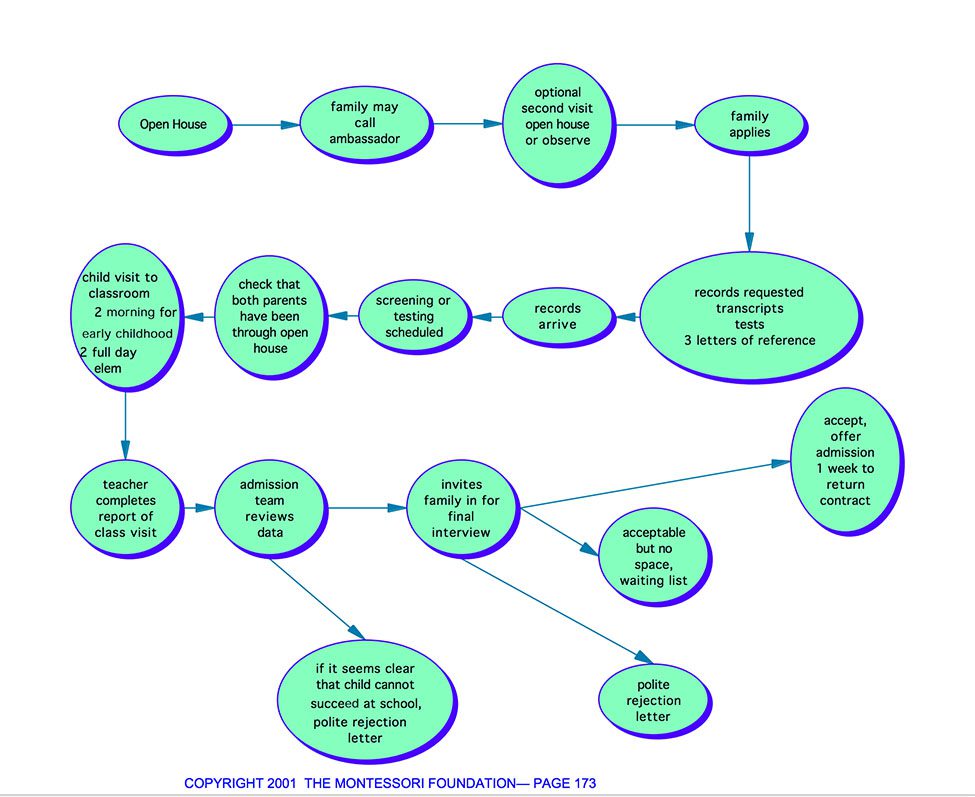
This is an example of a flowchart of the steps in a well developed multi-step admissions process. Click the link below to download a pdf.
https://stage.montessori.org/assets/dynamic_image/content/content_file_36645_60890.pdf
by The Montessori Foundation Staff | MFA, Montessori Administrators, School Resources, The International Montessori Council
Our thanks to Zach Hagopian and our friends at Accelevents for permission to share this list. Accelevents is a company that offers online software to handle silent auctions and raffles. HTTP://WWW.ACCELEVENTS.COM
So you’ve decided to use a silent auction at your fundraiser. You may have even identified a MOBILE FUNDRAISING platform to expand your reach and raise more money.
But before finalizing plans for your fundraiser, you will first need to COLLECT THE BEST SILENT AUCTION items! A great first step here is identifying the best kinds of items to pursue. With your silent auction items, you will want to attract a large donor base and create some extra excitement around your fundraiser. There are many options for items out there, and prioritizing the best silent auction items for your audience can quickly become overwhelming.
Once collected, enticing silent auction items will create additional buzz and awareness around your cause, and will also provide another channel through which your audience can donate. Great silent auction items also create a halo effect for your fundraiser and cause. When someone wins an amazing silent auction item at your fundraiser, they will associate the positive memories from using that item with your fundraiser, and will be likely to return again next year! This is a great way to establish a loyal donor base.
To save you some time in your busy fundraiser planning schedule, we’ve put together a quick list of the best silent auction items for you to focus on before soliciting items. We broke these down into 5 essential categories in order to keep things simple
1. Travel
Travel-related silent auction items are always a huge hit. Whether you are able to collect an all-inclusive trip to the Caribbean, or even just a weekend getaway in New England, fundraiser guests love having the chance to win an amazing trip. Travel items are experiential in nature, and provide your guests with the chance to create new memories. Some great places to start include:
- Airline Tickets or Miles
- Hotel Stays
- Weekend Getaways
- All-Inclusive Trips
2. Outings / Experiences
Continuing on the experiential theme, unique outings or activities often create a ton of excitement at silent auctions. Guests love bidding on unique experiences, because these items typically present an activity that the bidder has never tried before.
Outings/experiences can include a wide range of items, but some of our favorite include:
- Spa days
- Local brewery tours
- Sunset or harbor cruises
- Museum tickets
- Comedy night
- Hot air balloon rides
- Outdoor activities (hiking, kayaking, bungee jumping)
- Theme park tickets
3. Sports Tickets / Memorabilia
Anything sports-related will always be a huge hit at your fundraiser. Be sure to pay special attention to where your audience lives – you will want most of your sports items to relate to your audience’s home team:
- Tickets
- Signed memorabilia
- Chance to meet local celebrity athletes
- Golf Outings
- Ski Passes
- Yoga Classes
- Spin Classes
4. Music
Everybody enjoys music of some type. Whether your audience trends more towards country music, pop, or rock n’ roll, including music-related items will always garner high bidding traffic. When thinking of music items, try not to limit yourself to concert tickets only!
- Concert Tickets
- Backstage passes / chance to meet the musician
- Signed instruments / albums from famous musicians
- Music Lessons
5. Food
Making an appearance at almost every silent auction, food-related items have become a staple of most fundraisers. People love going out to dinner, trying new restaurants, or even trying a new kind of food for the first time. From a collection standpoint, you shouldn’t have trouble collecting many food-related items, as there are hundreds of restaurants in every city, and most are willing to promote their themselves. Some great ideas include:
- Restaurant gift certificates
- Catering service certificates
- Dinner & wine pairing
- Cooking Classes
- Food gift baskets
After reviewing our list above, you probably noticed an underlying theme across the five categories; most of these amazing items are experiential, not material.
In general, we have found that experiential items outperform material items again and again. Experiential items create memories and journeys for your guests that start during your fundraiser and continue throughout the duration of the item. Such great experiences will form lasting connections between your donors and fundraiser, as donors will quickly begin to associate their fun memories with the moment that they won the item at your event.
Even better is that your donors will tell their friends and family about the great experiences they have had, and will certainly connect the prize to your fundraiser. This sharing creates amazing word-of-mouth recommendations for your fundraiser, resulting in an even larger donor base for your next fundraiser!
One final tip here – do not be selfish with this list! This guide should be shared with each member of your committee or volunteer staff, so that they can also have success in soliciting the best possible items for your silent auction!
by Tim Seldin | Boards, Effective Boards, Montessori Administrators, School Leadership, School Resources, The International Montessori Council
It is common practice to divide the basic rules of an organization into two documents.
The Articles of Incorporation typically defines the primary characteristics of the organization – its name and purpose and essential elements of the make-up of the board and its function.
A second document, called the Bylaws, defines in somewhat greater detail the roles of the board and executive director, and how decisions are made and broad and enduring policy established.
Typically, the Bylaws cover the structure and operating rules of the organization, including the responsibilities and authority of the board of directors, officers, and committees
This is an example of one school’s Bylaws
Sample Bylaws
by The Montessori Foundation | Boards, Montessori Administrators, School Leadership, School Resources, The International Montessori Council
It is common practice to divide the basic rules of an organization into two documents.
The Articles of Incorporation typically defines the primary characteristics of the organization – its name and purpose and essential elements of the make-up of the board and its function.
A second document, called the Bylaws, defines in somewhat greater detail the roles of the board and executive director, and how decisions are made and broad and enduring policy established.
Typically, the Bylaws cover the structure and operating rules of the organization, including the responsibilities and authority of the board of directors, officers, and committees
This is an example of one school’s Articles of Incorporation
sample articles of incorporation
by The Montessori Foundation | MFA, Montessori Administrators, Montessori Education, Montessori Family Life, Montessori Parenting, Montessori Teachers, Tomorrow's Child
A Vintage Typewriter on a wooden table.
We are grateful to all who wish to contribute an article or photo essay to share with the readers of Tomorrow’s Child magazine. Over the years, we’ve been asked many questions regarding format, length, usage, etc so we’ve put together this checklist to help the novice writer through the process.
Articles should be submitted in a word document or in the body of an email. PDFs are not accepted.
Do not worry about grammar issues, our editorial staff is here to help with that aspect.
Articles do not have word count minimums or maximums, as each story is different. A general rule of thumb is somewhere between 1,000 and 1,500 words.
Submissions with Artwork / Graphics
When you embed a graphic into a word document, it is the equivalent of a placeholder. The artwork should be attached as an EPS, JPEG or TIFF. If it was created in a program such as IllustratorTM or PhotoshopTM, the native AI or PSD files will work as well.
Photographs need to be high resolution (300 DPI). Photo releases for any picture with children or staff must either be on record at the Foundation or sent with your articles, so that we have permission to use.
Citations used in any article should be included at the end of each article. This includes the use of any internet references.
Bios of each writer should be sent each time you submit an article in its entirety. We do not maintain a database of each, so it’s important for the author to update accordingly.
Articles that have appeared in any other publication carrying a trademark or copyright must be submitted with a copy of a permission from that publication’s editor or equivalent, allowing us to not only reprint but reformat it into our magazine’s specs. This is for everyone’s protection. Please send your submissions to: info@montessori.org. Should your photo files be too big to attach we can arrange for you to upload to a Dropbox folder.
We are grateful to all who wish to contribute an article or photo essay to share with the readers of Tomorrow’s Child magazine. Over the years, we’ve been asked many questions regarding format, length, usage, etc so we’ve put together this checklist to help the novice writer through the process.
Articles should be submitted in a word document or in the body of an email. PDFs are not accepted.
Do not worry about grammar issues, our editorial staff is here to help with that aspect.
Articles do not have word count minimums or maximums, as each story is different. A general rule of thumb is somewhere between 1,000 and 1,500 words.
When you embed a graphic into a word document, it is the equivalent of a placeholder. The artwork should be attached as an EPS, PDF, JPEG or TIFF. If it was created in a program such as Illustrator™ or Photoshop™, the native AI or PSD files will work as well.
Photographs need to be high resolution (300 DPI). Photo releases for any picture with children or staff must either be on record at the Foundation or sent with your articles, so that we have permission to use.
Citations used in any article should be included at the end of each article. This includes the use of any internet references.
Bios of each writer should be sent each time you submit an article in its entirety. We do not maintain a database of each, so it’s important for the author to update accordingly.
Articles that have appeared in any other publication carrying a trademark or copyright must be submitted with a copy of a permission from that publication’s editor or equivalent, allowing us to not only reprint but reformat it into our magazine’s specs. This is for everyone’s protection. Please send your submissions to: info@montessori.org. Should your photo files be too big to attach we can arrange for you to upload to a Dropbox folder.
- What makes your school special?
- An event your students helped to plan and carry out.
- Charitable works your students led and implemented.
- Global connections with other schools.
- Celebrations of holidays that are universal and show your school’s cultural diversity.
- Student-led micro-economies.
- Book reviews.
- Alumni updates: where are they now and what great works are they doing?
- How you’ve involved parents and grandparents into your school’s community.
- And, of course, why Montessori is so important to your school’s community.
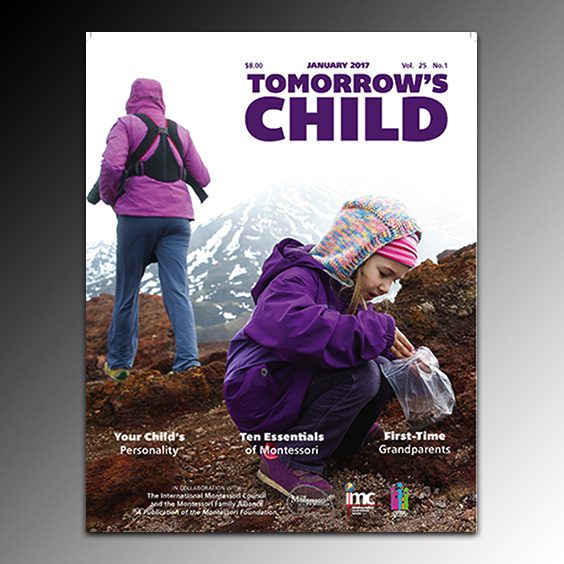
Tomorrow’s Child / January 2017 / p 23
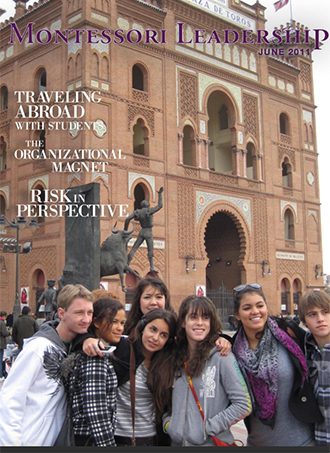
by IMC | Archived Issues / Montessori Leadership, Montessori Administrators, Montessori Leadership Magazine Online Issue, Montessori Teachers, School Leadership, The International Montessori Council
by Tim Seldin | Montessori Administrators, The International Montessori Council, Webinars / MFA
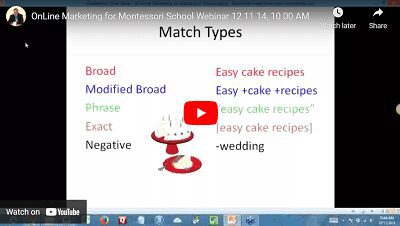
Our guest was author and Online Marketing Expert, Barry Abraham, Barry revisits an area that many Montessori schools ask about: How to Use Google ads and online marketing effectively.
Download File
by Tim Seldin | Administrative Team, Montessori Administrators, School Leadership, The International Montessori Council, Webinars / MFA
On December 11, 2014, Tim Seldin spoke with online marketing expert, Barry Abraham of Brickway Marketing on the topic of Online Marketing for Montessori Schools. Barry talked about internet marketing, search engine optimization, asking families for endorsements that you can display online, and much more.
by IMC | Archived Issues / Montessori Leadership, Montessori Administrators, Montessori Leadership Magazine Online Issue, School Leadership, The International Montessori Council