by Lorna McGrath | Book Reviews, Lower Elementary (6-9), MFA, Montessori Education, Montessori Parenting, Science, Upper Elementary (9-12)
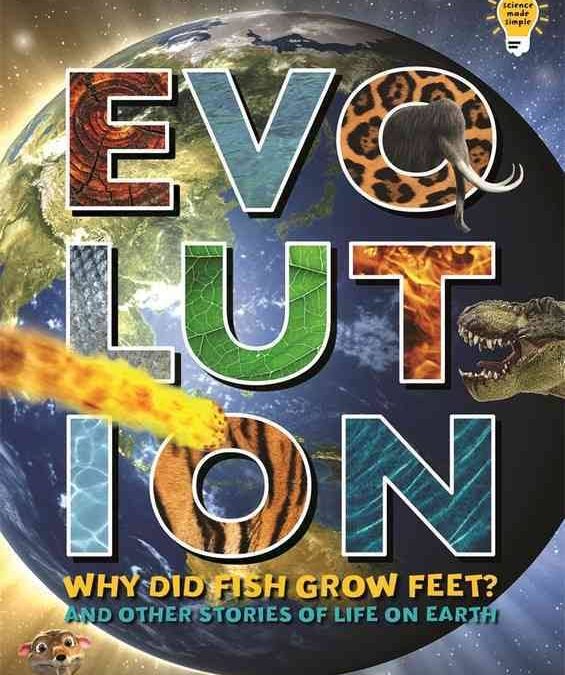
 Evolution: Why Did Fish Grow Feet?
By Anne Rooney
Anne Rooney does a great job of explaining evolution from a scientific point of view. The information is clear and concise. The illustrations of plants and animals are large and colorful. This book could easily be used in Montessori Elementary classrooms as an accompaniment to the Time Line of Life. Elementary-age children are fascinated with how things began: the Earth, humans, animals, plants. I can remember in my childhood, my older brother was quite taken with the evolution of humans. As a class project, he drew each of the stages of the human evolution. He was very engaged in the project. This fascination with the world and its beginnings is age-old. This book would be a great addition to a school library or at home. Available at Amazon.com.
Reviewed by Lorna McGrath
Tomorrow’s Child January 2015/ Pg 22
by Lorna McGrath | Adolescence, Book Reviews, Early Adolescence (12-15), Lower Elementary (6-9), Mathematics, MFA, Montessori Middle School, Science
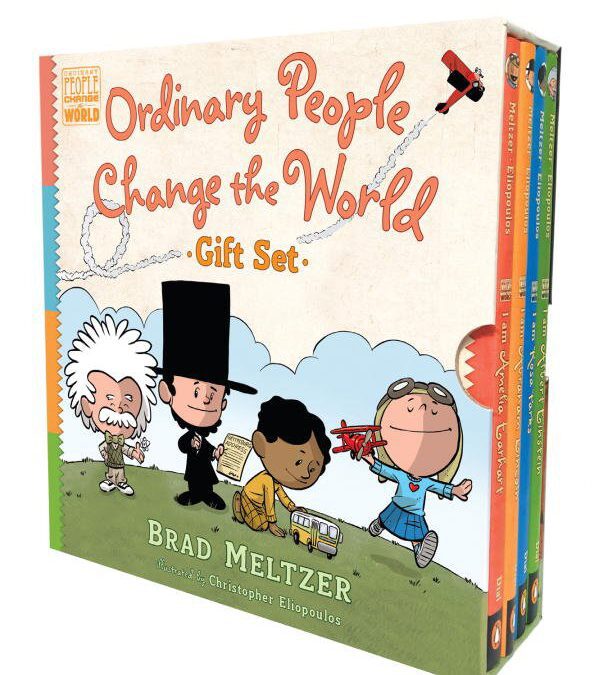
Ordinary People Change the World
Written by Brad Meltzer
illustrated by Christopher Eliopoulos
This is a great set of books! I checked with our elementary teacher and she said definitely for Lower Elementary age children (6-9 years old). The four books that are in this gift set are: I am Rosa Parks; I am Amelia Earhart; I am Abraham Lincoln; and I am Albert Einstein. Quite a line up, right? The author says these were all ordinary people who became world changers.
Each book tells the story of the person’s life from the beginning. Each person had something very strong about themselves. Rosa Parks stood up for herself her whole life. Albert Einstein was not afraid to be different and ask questions. Amelia Earhart loved adventure and never let anyone talk her out of trying new things, and Abraham Lincoln stood up to bullies and sought fairness for all. I found the stories to be fascinating.
The illustrations are cartoons that elementary children will really like. At the end of each book there is a timeline of the person’s life and actual photographs of some times in their lives. I wish that the author would write even more children’s books like these. They are available in book stores and online.
Reviewed by Lorna McGrath
Tomorrow’s Child / September 2016 / p 32
by Michael Dorer, EdD | Emotional Intelligence (EQ), Imagination, Kindergarten, Later Adolescence (15-18), Lower Elementary (6-9), Montessori Curriculum, Montessori Education, Montessori Middle School, Montessori Secondary / High School, Montessori Teachers, Primary (3-6), School Leadership, Science, The International Montessori Council, Upper Elementary (9-12), Webcasts / IMC
Take a Deep Breath! Get Inspired!
Having an atmosphere of inspiration can perk up and deeply enhance any Montessori program. But, how to be inspiring?
Be part of this webinar with Michael Dorer to consider ten Strategies for Inspiration.
Your classroom and your school can be an inspiring place, brimming with enthusiasm.
Breathe deeply!
Now get started with Michael, Tim, and Kathy to focus on motivating inspiration.
by Prairie Boulmier | Montessori Teachers, Science, The International Montessori Council
I have been blessed. Not only have I had the opportunity to find a wonderful approach to education for my children, but I have also discovered an education for myself, after years of searching for meaning and context for my own life. Grateful am I for the chance to ponder the work of Dr. Maria Montessori, the legacy and invitation to discovery I feel she left for each of us to embark upon. Considering the environmental, social and economic issues facing out planet, perhaps her example is ever more pressing for us to draw inspiration from. For me, the adventure has brought me into environments I have only dreamed of on this lush and beautiful planet, but none so complex and odd as that of my own self.
The process of self-discovery and Cosmic Education may be the most valuable experience I have received through the study of Dr. Montessori’s work and The Institute of Educational Studies (TIES) in the Montessori Integrative Learning program. Though painful at times, it has been also exhilarating at others. Through sharing my own journey, I hope to open a space for others seeking transformation and new paths.
It may have been over one hundred years since Montessori education was born, but for me her vision of education still feels like a radical new path into the future. This opportunity of sharing was given to me at the annual American Montessori Society conference, where my thesis, “Montessori Education and Learning in Living Systems,” was recognized as a valuable contribution to the continuing dialogue in the field. This is a great honor for me, especially considering the community of Montessorians that I look to for direction. So, it is, with some hesitation, that I share some snapshots of my adventure.
I began my M.Ed with a desire to explore the value of outdoor environments in a Montessori setting: school gardens, outdoor classrooms, and school kitchens, all practices I have been engaging with for some time. As my studies deepened, however, my interest shifted towards the organization of living systems themselves. This organization, the free flow of spontaneous activity found in nature, became the center of my personal inquiry.
I felt strongly that while outdoor environments are very important in Montessori settings, the way that they are presented and made accessible to a community of learners is of far more importance. I wondered what such environments would feel like, what qualities they would exhibit. Looking at models, such as fractal geometry, chaos theory, and autopoiesis, caused a few key concepts to bubble to the surface for me, including individual autonomy within a unified whole, dialogue, and web-like connectivity. These concepts are what really drew my attention to explore. Taken together, these concepts describe what I call “living systems.”
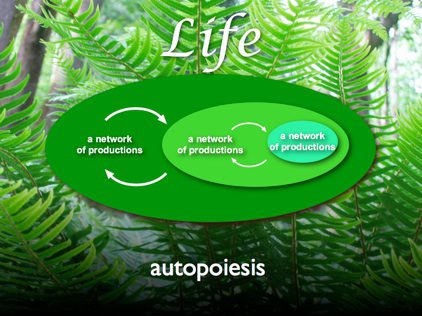
An explanation of my conception of living systems may be helpful for the context of this work. Living systems may be regarded as “systems that produce themselves in a ceaseless way” and are “at the same time the producer and the product”—autopoietic systems. (Mariotti, 2012) Examples of autopoietic living systems can include simple cells, complex organisms, ecosystems, water and carbon cycles, the earth, the universe, and myself.
In eighteen months at TIES, I studied living systems in two seemingly disparate lands: the arid upper Rio Grande region around Española, New Mexico, and the fertile Mediterranean oasis of Algiers, Algeria. Early into my program, La Tierra Montessori School of the Arts and Sciences, a public charter school, and my five-year volunteer project, was approved in New Mexico. Six months later, my family and I packed for North Africa to help establish a trilingual Montessori school, a project I had worked on for two years. I did not expect that either of these opportunities would bear fruit, let alone both of them. My experiences of environment, culture, society and education in these two settings wove into my work at TIES. I experienced the “Arab spring,” mshimsha fruits, and couscous in the Maghreb. I became familiar with Common Core Standards, federal school law, record drought, and local politics in New Mexico. I also observed the living system of myself in these different, yet connected, environments.
I asked, “Why is there a need for learning in living systems or outdoor education?” and “What is the benefit for such an education in a Montessori context?” I feel the education of children is inextricably connected to the environmental, social and economic climates that affect living systems on Earth today. To face these issues, I asserted that adjusting the very premise of education may be a vital part of the solution for the future of our planet. The kinds of adjustments necessary appeared so monumental and urgent that they may collectively be thought of as a “paradigm shift” and what Thomas Berry (1999) called to “reinvent the human—at the species level” for humanity. (p. 159) Berry, a historian, religious scholar, and ecological advocate, wrote The Great Work: Our Way into the Future. He wrote:
“New achievements in science, technology, industry, commerce, and finance had indeed brought the human community into a new age. Yet those who brought this new historical period into being saw only the bright side of these achievements. They had little comprehension of the devastation they were causing on this continent and throughout the planet, a devastation that finally led to an impasse in our relations with the natural world.” (p. 2-3)
To shift out of the impasse, Berry suggested a need “to carry out the transition from a period when humans would be present to the planet in a mutually beneficial manner.” (p. 3)
This transition could be placed into context “by relating the human venture to the larger destinies of the universe.” (p. 1) In his vision of our “Great Work,” Berry called on educators to utilize the earth as a primary teacher (p. 65) and to build a framework of learning centered on nature:
“In this new context of a viable human mode of being, the primary educator, as well as the primary lawgiver and the primary healer, would be the natural world itself. The integral earth community would be a self-educating community within the context of a self-educating universe.” (p. 64)
Given the complex challenges we face on Earth today, I feel there is a pressing need for learning in living systems. But why Montessori? It was clear to me that Montessori education can clearly provide context of a viable human mode of being. I believe Dr. Montessori designed an approach oriented to support the patterns, processes, and structure of living systems. For me, this begins with Cosmic Education. She wrote, “The universe is an imposing reality and an answer to all questions” (p. 5) and, “The child’s intelligence becomes whole and complete because of the vision of the whole that has been presented to [her], and [the child’s] interest spreads to all, for all are linked and have their place in the universe on which [her] mind is centered.” (p. 6)
The TIES program offered us a vision of the universe based on recent and emerging information from Einstein’s Theory of Relativity onward, all the way up to the discovery of the Higgs Boson. This new vision, offered to us by cosmologist Brian Swimme, Berry, and others, not only confirms what Montessori wrote about, but expands on it in ways that I find truly dazzling.
It is a comfort to me that consciously or not, we have been “evolving the cosmos” for around 14 billion years, and I have my place in that evolution as well. To me, that knowledge really changes the story, and it is one I feel we must share with out children, as they struggle with the confusion and turmoil of daily life, trying to find their own place, their own cosmic task. For that reason, I am convinced that Montessori education is ideally suited for living systems education. The convergence of sciences that appear to confirm Dr. Montessori’s work and their prescience today are stunning to me.
As a scientist, Montessori used observation to inform her work. She spoke and wrote frequently about the problems of society as she observed them. During a lecture tour in 1946, she spoke about the age of technology and the unification of common global interests. In addition to the triumph of technological accomplishments, she asserted that humanity’s ability to keep pace with those advances was lagging and that technology had become a “menace.” (p.70) One can only wonder what she might say about the menace of technology today! In Education for Human Development, Mario Montessori Jr. stated his own concerns for humanity and for education’s role in the transition:
“The individual personality must develop the independence and maturity needed to see the present situation clearly and to visualize the future. It will then be possible to consider the direction in which we are going and how to influence matters so that we, with our powers of adaptability, our intelligence, and our creativity, can find a constructive way to handle our world, a world which, in itself, is a beautiful place to live in and which could be much more agreeable than it happens to be at the moment.” (p. 93-94)
While Montessori would not have known the language of modern physics, her words are in keeping with the co-evolving nature of living systems: “No matter what we touch, an atom, or a cell, we cannot explain it without knowledge of the wider universe.” (p. 6) She also wrote extensively about the inner transformation of the adult. I assumed she was talking about other adults, not me. I was mistaken. Philosopher Jiddu Krishnamurti, in his book Education and the Significance of Life, offered the invitation in this way: “To understand life is to understand ourselves, and that is the beginning and the end of education.” (p. 14) It did become crystal clear to me that continued inner development was an integral part of my studies. Okay, the central part. We spent considerable time reading and discussing embodied cognition. Systems thinker Fritj of Capra described cognition thus:
“Cognition, then, is not a representation of an independently existing world, but rather a continual bringing forth of a world through the process of living. The interactions of a living system with its environment are cognitive interactions, and the process of living itself is a process of cognition. In the words of Maturana and Varela, ‘To live is to know.’” (1997, p. 267)
Capra further suggested that cognition “involves the entire process of life—including perception, emotion, and behavior” (1997, p. 267) and that, in the individual, cognition is a representation of an individual’s perception of the world:
“What is brought forth by a particular organism in the process of living is not the world but a world, one that is always dependent upon the organism’s structure. Since individual organisms within a species have more or less the same structure, they bring forth similar worlds.” (1997, p. 270)
It was already clear to me that the world I bring forth is “my” world, and that there are quite a few “other” worlds being brought forth within my own species, in my own family, in the different cultures I have experienced, and certainly within the realms of education and Montessori education. Starting both a public Montessori school and one in a traditional Muslim community has certainly brought this concept alive for me. What seem like perfectly obvious interpretations of Montessori education (my interpretations) can be received with a stunning array of other perceptions, some of them seeming to be in direct opposition to my own! Making room for this to be so has been a challenging task for me.
After much trial and error, reflection and bringing forth, I have found that allowing the paradox of perceptions to flower may be the most authentic representation of embracing living-systems education, difficult as it may be. As if it could be any other way. However, I do strive to find more worlds coming forth that reflect the insights I perceive as authentic Montessori and others, such as Berry, Swimme, and Capra. In the meantime, I have my own paradoxical thoughts, behaviors, and emotions to address. Reflecting on these things might be challenging for any individual, as philosopher Henry David Thoreau wrote, in the classic book, Walden:
“There are continents and seas in the moral world in which every man is an isthmus or an inlet, yet unexplored by him, but that it is easier to sail many thousand miles … than it is to explore the private sea, the Atlantic and Pacific Ocean of one’s being alone.” (p. 246)
My studies at TIES included inquiry into Montessori education and learning in living systems. I studied the living systems of La Tierra Montessori School and Madrasat Ardh al Amel, and others, especially the living system that is myself. I did a great deal of research and preparation, including developing Montessori lesson plans that cover the Brian Swimme’s vision of “the Great Flaring Forth” through 13.7 billion years and the school gardens and kitchens of today’s schools. I developed organizational charts and democratic school processes based on living systems. Yet, in the end, I learned far more about myself than any other subject matter. This process of self-inquiry is one that I would heartily recommend to others. I am deeply honored that the American Montessori Society has found merit in this most personal, and often painful, but rewarding inner journey that I have taken, by choosing to recognize my contribution to the ongoing dialogue concerning Montessori education, and I look forward to many more unexplored continents and seas, as I continue to pursue the hidden secrets of childhood to which so many of us aspire.
Finally, I want to continue to dare to bring forth a world in which Montessori education can play a major role in softening the menace, in visualizing the future, and for making our planet more agreeable than we find it at present. I want to step out of the way enough to trust “that the nature of childhood can offer a solution for a problem which we adults cannot solve—that from the child [comes] the fusion of what our mind conceives only as a contrast.” (Montessori, 1955/2009, p. 28-29). I thank all those who have come before me in this continual bringing forth, and invite others to join hands once again in the ways we can to carry this vision on into a bright and healthy Earth community.
Prairie Boulmier is an AMS 3-6 credentialed guide, as well as holding an M.Ed from TIES, Endicott College in Beverly, MA, and a BA in Early Childhood Education from New Mexico State University. She is a mother of four children ages 18, 12, 10, and 4. She is currently an independent Montessori consultant and can be reached at prairieonz@yahoo.com.
References
Berry, T. (1999). The Great Work: Our Way into the Future. New York, Random House.
Bohm, D. (1996). On Dialogue. New York: Routledge Books.
Boulmier-Darden, P., Montoya, R. (2011). La Tierra Montessori School of the Arts and Sciences. Santa Fe, NM: New Mexico Public Education Department. Retrieved from http://ped.state.nm.us/Charter/2011/index.html
Capra, F. (1997). The Web of Life: A New Scientific Understanding of Living Systems. New York, NY: Random House.
Krishnamurti, J. (1953/1981). Education and the Significance of Life. New York, NY: Harper Collins Publishers.
Mariotti, H. (n.d.). Autopoiesis, Culture and Society. Retrieved from http://www.oikos.org/mariotti.htm
Montessori, M. (1948/2007). To Educate the Human Potential. Amsterdam, Netherlands: Association Montessori Internationale.
Montessori, M. Jr. (1976/1992). Education for Human Development: Understanding Montessori. Amsterdam: Montessori-Pierson Publishing.
Thoreau, H. (1854/Kindle version). Walden. Seattle Washington: downloaded from Amazon Kindle.
Montessori Leadership / 2013 / p 18
by Michael Dorer, EdD | Emotional Intelligence (EQ), Imagination, Lower Elementary (6-9), Montessori Curriculum, Montessori Education, Montessori Middle School, Montessori students, Parent Education, Primary (3-6), Science, The International Montessori Council, Upper Elementary (9-12), Webcasts / IMC, Writing
Download PDF of slides
Is Montessori education purely a reality-based program or is it a means of stimulating and developing the imagination? Are these two goals incompatible or complimentary? Michael and Tim discuss the meaning of imagination, kinds of imagination, its role in Montessori schools, and to compare it in Montessori to conventional schools. We compare and contrast imagination in both the Children’s House and the Elementary levels.
by Michael Johnson | Montessori Teachers, Science, The International Montessori Council
If you could expand your primary equipment set to include the fundamentals of physics and technology without the use of video screens or computers of any kind, but rather by using simple, elegant equipment that applies the Montessori Method in principle, technique and aesthetic, and if you could do this for less than the cost of a fully populated Bead Cabinet, would you?
If you could access an open curriculum that presents the actions, language, and ideas of primary physics in simple terms and logical order, would you?
If you could adapt physics demonstrations ordinarily, and totally unnecessarily, reserved for high school and college students to activities well within the capabilities of the primary age child, would you?
If you could integrate current models like STEAM (http://www.steam-notstem.com/) and Maker Spaces (http://makerspace.com) into your Montessori classroom in a way visible to parents and supporters but not requiring the realignment of building space and traffic patterns, would you?
If you could produce original work furthering the Montessori Method in terms of the physical sciences and the technological culture in which the child lives, would you?
The Montessori Method is replete with the Life Sciences. We have the Great Lessons, the Botany Cabinet and the Land and Water Forms. We tend gardens and study Biomes. We use shell, bone, feather, and seed samples. We have the plants, fish, reptiles, and small mammals that inhabit our classrooms. We apply to these subjects the fundamental technologies of language and mathematics, household implements, printed media, rulers, clocks and scales, and a unique set of tools providing intentional sensory training.
Our world culture has, however, evolved since the Method reached its mature expression in the 20th century. While the Method itself is perfectly suited to the present task, the equipment set needs to be expanded to include the mechanical, optical, electrical and electronic technologies that pervade the child’s daily experience and academic future. It is crucial that these technologies not be neglected in favor of the information technologies that so dominate the market place and the marketing of schools themselves. Smart phones, touch tablets and laptops are an end point, not the foundation, of what the primary child needs to learn. While they are as ubiquitous, powerful and as necessary as printed books they are also, like printed books, just one technological tool that the child will need to use.
They are by no means the only tool. When they are used principally as wireless communication devices, unable to access the myriad real-world input and output devices, the recorders, sensors, processors, printers, and manufacturing machines that are readily available even at the elementary level, they contribute to a culture of passive consumerism rather than active creation. Used with a lack of understanding of what makes them possible, they result in dependency rather than efficacy.
It is clear that by upper elementary, we need to provide the student the tools of desktop production and equally clear that these tools are computer driven. At this stage of the market place, realistically affordable desktop production includes digital media of all kinds, but it also includes the means of physical production: ink printing and optical etching; light- and heat-cured materials; 3D manufacturing (both printing and milling); robotics; and scientific data generation.
Physical production, making things, begins in early childhood. It begins before computing. It begins before language. It begins with the child’s intimate familiarity with the physical world.
It is too easy, at this stage of our teaching practice, to find older students who can navigate FacebookTM but cannot assemble a circuit connecting a battery to a motor, let alone explain what’s inside the motor, why it turns, and how to measure the amount of energy it converts. The fact is that there is nothing in our primary equipment set that will show the child what a motor is and why it turns.
It is too easy to find a student who can GoogleTM the music from Frozen but has no idea, from the tuning of the acoustic instruments to the editing of digital tracks, to the pressing of vinyl and burning of optical discs, how the music is produced.
It is too easy to find a child who can SkypeTM or FaceTimeTM someone literally on the other side of the planet but has no idea how the sound and images get to the other side of the planet. There is nothing in our equipment set that shows the child how physical events are converted to electrical signals that can be processed, mined, recombined, moved to another place and then used to produce new physical events. The primary equipment set simply does not address the existence of electricity.
We confuse the words technology and computer. Electronic computation, for all of its overwhelming impact, convenience and importance in our lives is still a small and culturally recent subset of technology in general. Electricity itself is an older, deeper technology than electronically based computation. Mechanical computation, think abacus or slide rule, is older than electricity. Steam engines are older than electric motors. Wind, water, and muscle-driven machines are older than fuel burning heat engines. Hand tools and the use of intense heat itself are ancient technology. The specialized tools and materials of art, music, and food predate engines of any kind.
Infatuation with information technology distracts from the real issue, which is the child’s concrete, sensory interaction with the real world. As 21st century teachers, we can significantly expand that interaction. A great deal of our world is not readily apparent to the senses or practically accessible in everyday life and yet can be made so with equipment as easily acquired as a cell phone. The electronic virtual reality of phones and tablets can, in fact, augment a Montessori primary education and is as inevitable in the primary classroom as the printed virtual reality we all accept without question, but neither can substitute for the physical action, the doing, that is the core of the Montessori Method.
What can we give the primary child that will lead to technological understanding and creativity?
More specifically, we might ask these questions about the classroom. Is there a set of hand tools? A set to build electrical circuits? A set to build wire frame structures in three dimensions? A set of springs? Are there nuts and bolts that can be sorted, ordered and used to join other parts together? Is there a gyroscope, a pendulum or a flywheel? Levers, pulleys and gears? A remotely controlled robot? Any way to produce waves in any medium? Is there a solar cell? An example of plasma? A way to measure radiation? A way to measure PH in garden soil? A set of prisms, filters and fibers? A way to record sound? Anything to reveal the presence of a magnetic field? Electricity in any practical, manageable form?
Is there a way to show the child the action of the mind itself?
All of these things are available, affordable, and actually a lot of fun.
I suggest that the logical starting point for practical change in the classroom is with the presentation of electricity, magnetism, and enhanced measurement, using a combination of items that are either easily made or easily purchased. Some of these items present straightforward physical events, some present electronic data resulting from physical events.
PrimaryCoil.com is a great teacher’s resource. The organizational strategy is to present electricity and magnetism separately to isolate their properties at first and then join them together by presenting induction which is
nothing more or less than the interaction between a magnetic field and conductive metal, specifically a coil of wire. The electric coil is in the same class as the lever, the wheel, and the valve in its importance to our way of life. A primary coil gives the child access to primary forces. The chart also presents examples of converting electricity into other forms of energy and vise versa and finally examples of enhanced measurement.
This approach to electricity and magnetism can be applied to light, heat, sound, motion, chemical reaction and consciousness itself. The tools exist. It is possible to give the child concrete experience completely aligned with the Montessori Method that will lead directly to sophisticated computer aided design capabilities, preparing the child for the virtual world by grounding her in the real world.
Michael Johnson is an AMI certified primary teacher with forty years teaching and training experience and a special interest in science, technology and music.
Montessori Leadership / January 2016
by Ann Epstein Ph.D | Infant-Toddler (0 to 3), MFA, Montessori Education, Science
Science may not be a topic that families emphasize with their toddlers. Instead, families may focus on sharing story books, building structures with blocks, exploring crayons and paint, and simply playing with toddlers’ favorite toys. These are all excellent choices, but the world of inquiry-based science offers surprising opportunities for toddlers too. The following article describes how Montessori principles contribute to inquiry-based learning for young children.
Examples of engaging, developmentally appropriate activities come from Rochester Montessori School’s toddler learning environment as well as a traditional toddler classroom. The latter is consistent with fundamental Montessori principles and is located on the campus of the University of Wisconsin in La Crosse, WI (UW-L). Activities can easily be adapted for exploration at home, with adult supervision. Both classrooms serve children between 24 and 36 months. Dawn Hayes teaches at Campus Child Care and Sarah Dennis is an assistant teacher at Rochester Montessori. Dawn’s toddler class includes teaching assistants and student teachers from UW-L.
INQUIRY BASED LEARNING APPLIED TO YOUNG SCIENCE LEARNERS
The Educational Broadcasting System, Thirteen Ed Online, and the Disney Learning Partnership collaborated ten years ago to create a series of research-based online professional development workshops that remain timely. Their Inquiry-based Learning workshop states that “the process of inquiring begins with gathering information and data through applying the human senses: seeing, hearing, touching, feeling tasting and smelling” (Exline & Costas, 2004). Inquiry based learning is the guiding premise for toddler exploration and learning.
Dr. Montessori advised teachers and families to design learning environments that foster concentration, order and independence as well as fine motor coordination (Montessori, 1967a). Of these four developmental aims, concentration typically captures the attention of classroom visitors. Both professional educators and prospective parents often express surprise at the degree of concentration displayed by children as young as 20 months. Lillard (2005) points out a possible connection between concentration and self-regulation.
“…Concentration might be an engine of self-regulation, which is associated with many positive personality variables. Dr. Montessori saw concentration as the moment of self-development” (pp. 265 – 266).
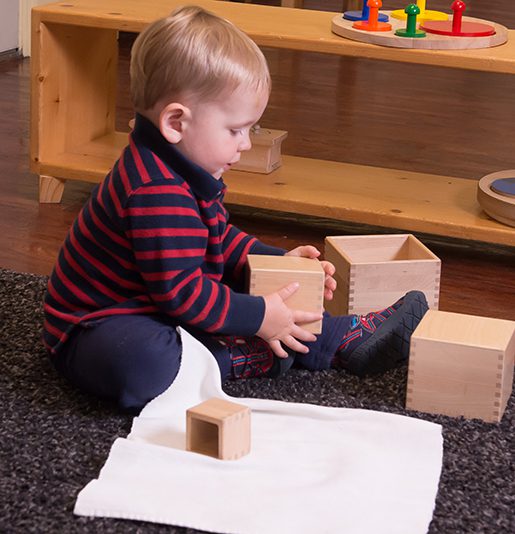
Science activities, if designed appropriately, offer opportunities for toddlers to develop concentration. For example, a toddler may explore what is magnetic and what is not magnetic through repeated trials for as long as 15 minutes. He/she may explore pushing a tractor through a bin of dried beans, pausing to attach a wagon and load it with beans, and then resume investigating how to pull the tractor with the loaded wagon. Careful and amazingly patient concentration accompanies these scientific investigations.
The National Science Teachers Association emphasizes the importance of an inquiry-based approach for young children in the following statement.
Scientific inquiry reflects how scientists come to understand the natural world, and it is at the heart of how students learn. From a very early age, children interact with their environment, ask questions, and seek ways to answer those questions. (NSTA Position Statement, 2004).
Posing open-ended questions that ask why and how something happens is an essential aspect of inquiry-based learning. While toddlers are not quite ready to fully answer such questions, they listen attentively to follow-up responses. For example, a parent might encourage his or her toddler to make a prediction with the following question. “Will the piece of paper sink or float?” Once the toddler responds, provide a short explanation. “The paper gets heavy as it absorbs water. Then it sinks.” Developmentally appropriate statements and succinct questions nurture toddler inquiry as they explore their environment. The ultimate goal is to promote and extend curiosity and purposeful approaches to science learning.
AMAZING DEVELOPMENTAL COMPETENCIES OF TODDLERS
Toddlers ages 24 to 36 months are naturally curious. They wonder, “What will happen if…” as they explore their surroundings with keen focus and high energy (Honig, 2002). Will this car fit inside this box? Can I push this wagon over this hill? What’s going on in that room around the corner? Toddlers are driven to explore their surroundings (Copple & Bredekamp, 2009;Montessori, 1967b).
Skills within each developmental domain contribute to the success of these ongoing explorations. Most young toddlers are sturdy walkers, and many are competent runners. This mobility helps as they move from one object of interest to the next. Even more helpful, they are typically able to move from standing to kneeling, to squatting, to sitting, and then back to standing with ease.
They are able to pick up and explore small items and generally can resist mouthing them. Young toddlers understand simple requests and are learning new words at an amazing rate. Eighteen month olds have a vocabulary of approximately 5 to 20 words. At 24 months they have increased their vocabulary to a range of 150 to 300 words (Child Development Institute, 2012). They can express their own feelings and are beginning to recognize how
others feel as well.
Young toddlers work at making sense of their world by comparing and contrasting. As they explore similarities and differences, they are building perceptual foundations that eventually form the basis for understanding such abstract questions as, “What is the same?” and “What is different?” All of these skills contribute to young toddlers’ inner drive to explore and interact with their immediate environment (Copple & Bredekamp, 2009; Montessori, 1967).
THE IMPORTANCE OF YOUR INTERACTIONS
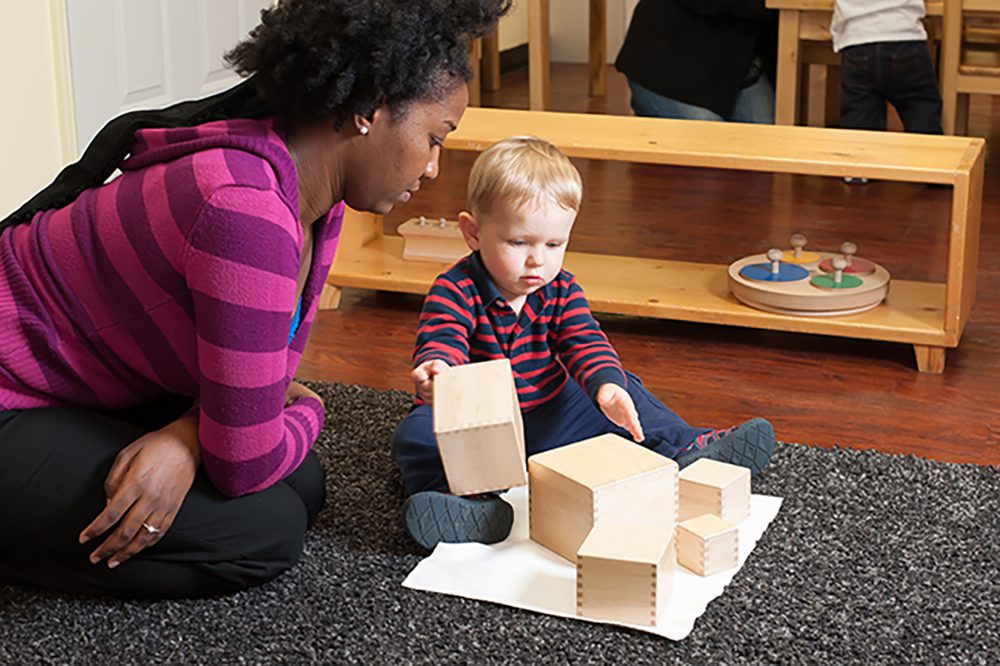
The quality of interactions between adults and young toddlers is the heart of true learning. Dawn and Sarah model respectful, reciprocal, responsive interactions (Gonzalez-Mena & Eyer, 2009). They facilitate learning by following toddlers’ cues. For example, they recognize that some children prefer to watch from a distance while other enthusiastic young scientists prefer to jump into activities with zest. Similarly, parents learn to match their interactions with their child’s temperament and personality.
An example of following a child’s lead can be found in Sarah’s decision to allow toddler “Tim” to turn a sewing project into a fishing activity. Rather than redirecting Tim to “stitch” in and out of holes punched around a cardboard rabbit, Sarah simply watched as he dangled the yarn over the edge of his table and murmured quietly, “Come on, fishes! Here (you) go, fishes.” She noted Tim’s ability to maneuver his fishing pole successfully as he judged the amount of “line” needed to attract his catch.
SCIENCE ACTIVITIES FOR YOUNG TODDLERS
The following descriptions offer examples of engaging inquiry-based learning activities for toddlers. Some were carried out at Rochester Montessori School and some at the Child Care Center on the campus of the University of Wisconsin at La Crosse. All required an in-depth appreciation of how toddlers learn, an understanding of inquiry-based learning, and respectful adult-child interactions. Descriptions are modified to provide families with ideas for carrying out these activities at home.
LIFE SCIENCE
Your child might be hesitant to touch the gooey pulp inside pumpkins. If so, gently squish and squeeze the strands yourself. Point out the slippery texture as well as the earthy aroma. You might separate out the seeds with your child so they could be baked for a snack. Touching, smelling, and eventually eating pumpkin seeds provides your toddler with a rich sensory experience.
Standing in the shadow of a towering sunflower can spark a sense of wonder among young toddlers. Families can plant sunflower seeds, help them grow, harvest the amazingly big flowers, remove the seeds (eyebrow tweezers work well), and then feed the seeds to friendly birds visiting your family bird feeder.
PHYSICAL SCIENCE
Investigating a variety of items is an inviting aspect of sink/float activities. Dependent variables include weight (heavy and light) as well as texture (absorbent and repellent). While young toddlers are not yet able to process these abstractions, they readily embrace guessing (a precursor to predicting) whether items will sink or float.
Midwestern winters bring frozen sidewalks. Rock salt is used to melt icy walkways in order to make them safe for young children. Toddlers are fascinated with this chemical reaction. Parents can create a safe and meaningful way to explore this phenomena by placing ice in a clear plastic tub, making colored salt water solutions in small containers, and then helping your toddler fill an eye dropper with this solution. Your young explorer can dispense the solution onto the ice, observe it melt and then see the formation of new colors.
Toddlers love balls. Set up a simple inclined plane experiment with a plastic dish tub, one or two boards rested against a low table or stool, and several balls of differing sizes. Engage your toddler in figuring out how to roll balls down as well as up the planes. Explore whether two balls can fit down a narrow plane together and if it’s possible to bounce a ball down an inclined plane. The trial and error of problem solving is intriguing and fun with simple physical science investigations.
CROSS-CURRICULAR INVESTIGATIONS
Combine art and science by offering your toddler cupcake-sized blocks of frozen paint. These are easily made with tempera paint, cupcake paper wrappers and pipe cleaners (for handy holders). Watch to see if your toddler is interested in how the paint melts onto paper, the cold temperature of the paint and/or how colors combine. Follow his or lead. Once you identify your child’s interest, encourage more investigating with simple suggestions and questions. “I wonder what will happen if we use some blue and yellow together.” “Do you think your warm hand is helping the icy paint melt?”
ASK AND THEY WILL LEARN: THE ROLE OF QUESTIONS IN INQUIRY-BASED LEARNING
A key to the success of learning activities for toddlers is the use of specific, developmentally appropriate questions. Opportunities to engage children through questions occur naturally as children investigate the world around them. Appropriate science activities provide a structure for closer investigations. Six inquiry processes provide a helpful framework for investigative questions (Martin, Jean-Sigur, & Schmidt, 2005; Padilla, 1990). Investigations begin with observation, for example looking carefully at how the tempera ice melts on paper. Simple questions help young children focus their observations (What color is the paint now?). Classification occurs as children form groups of objects (Is the pumpkin a flower or a vegetable?).
Young toddlers communicate new concepts as they respond to questions about their discoveries (Tell me how the pulp feels, how can you make the balls roll up the plane?). Investigations may involve measurement (How many droppers will it take to begin melting the ice? Will more beans fit in the tractor wagon?) or predictions (Will this ping-pong ball sink or float?). As young toddlers mature, they begin to make inferences (Does this tall sunflower remind you of your Dad?) as they draw on previous experiences with similar scientific phenomena. While most young toddlers are not able to process this level of thinking, exposing them to meaningful inferences lays the foundation for later abstractions.
The six components of the inquiry cycle are typically applied to science. However, they apply to the wider realm of the learning process. Toddlers learn about the world around them through each of these six processes. They observe, predict, infer and communicate as they explore picture books or make muffins or count ants on the playground. Montessori recognized this natural
process as the heart of education.
We discovered that education is not something which the teacher does, but that it is a natural process which develops spontaneously in the human being. It is not acquired by (only) listening to words, but by virtue of experiences in which the child acts on his environment.
Have fun as you engage your toddler in the fascinating world of inquiry-based science. Your young explorer is certainly
ready to embrace this rich learning opportunity!
Tomorrow’s Child / September 2015 / p 32
by Margot Garfield-Anderson | Kindergarten, MFA, Montessori Parenting, Montessori Teachers, Primary (3-6), Science
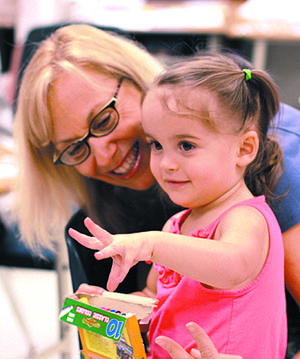
It was time again for my annual weekend visit with Blakely Jayne, my oldest granddaughter (she’ll turn four at the end of March). Each year since she was born, my son-in-law ventures down from Rochester, New York to Sarasota, Florida, where I live. While he plays golf with his granddad, I get special time with Blakely. It’s a win-win for all.
While she’s here, I invite her to participate in experiences that will always stay with her and will build on our collective memories. She still talks about our visit to Jungle Gardens and the parade we had with the hundreds of flamingoes following us around, and she looks forward to our visits. Now that she’s older, some of the fun activities can be found right in our own kitchen.
The decision this year was easy because the Kitchen Science Experiments I chose for our time together were presented at the Montessori Foundation’s 16th Annual International Conference this past November in Sarasota. Each year, hundreds of Montessori teachers, guides, administrators, heads of schools, board members, and parents gather for a weekend of workshops and inspiring keynotes. One of our regular presenters is Dr. Ann Epstein, Early Childhood/Middle Childhood Program Coordinator for the University of Wisconsin at La Crosse. When Ann submitted her proposals for this year’s conference, I was immediately drawn to the science experiments, knowing these would be fun to try with Blakely. I picked a few science experiments and went ‘shopping’ in my own kitchen for the ingredients. I actually had almost all of them.
Although I don’t have a specific early childhood environment in my house, I do have a nice, large covered lanai that made for the perfect outdoor alternative. It’s very important to set the child up to succeed, regardless of the activity, and it is important to make certain that a ‘prepared environment’ is at the top of the list to achieve this goal.
As we took all our ingredients to the table, I read the questions Dr. Epstein says we should pose. These questions are geared not only to make children think beyond their own personal space, but to help engage them in conversation while introducing them to new words and ideas. Always remember to conclude activities before a child gets too tired. Always end on a high note.
These are some of the activities we did together. Since some required precise measuring that is a bit beyond her skill set, I pre-measured some of the ingredients, but let her do all the mixing, pouring, and transferring. We had a wonderful time with our experiments and hope that you do as well.
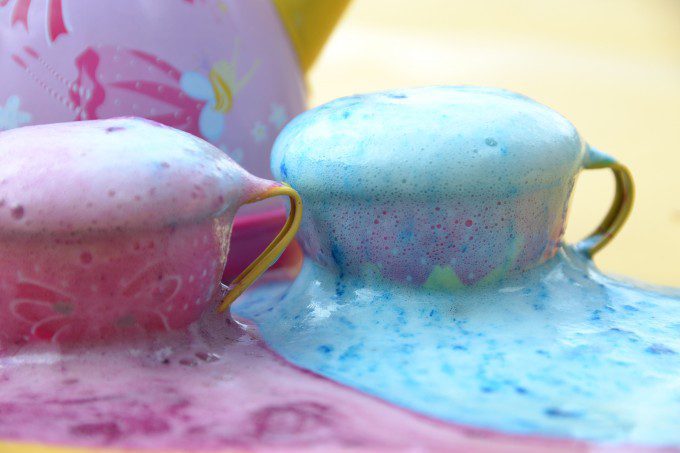
Experiment 1: Baking Soda and Vinegar
Materials
mixing bowl
large metal or plastic spoon
1-cup measuring cup
1 measuring spoon
box of baking soda
white vinegar
food coloring (optional)
Process
Measure 1 cup of vinegar into mixing bowl.
Measure 1 T baking soda.
Mix slowly and carefully; add vinegar by tablespoons until reaction occurs.
Encourage children to discuss how the bubbles are formed (gas is released when baking soda and vinegar are mixed).
Experiment 2: Dish Detergent and Whole Milk
Materials
small dish for mixing
Q-tips
food coloring
small container with approximately half
a cup of dish detergent
small pitcher of whole milk
Process
Pour about ¼ cup of whole milk into small dish.
Add several drops of food coloring into dish (can be different colors).
Dip Q-tip into dish detergent.
Gently lower Q-tip to surface of milk and food coloring.
Encourage children to guess why swirls occur (detergent ‘attacks’ fat /grease in milk).
Experiment 3: Black Pepper and Bar Soap
Materials
flat pan or plate with
raised edges (glass pie
plate works well)
bar of soap (‘hard’
soap such as Dial™ works better than ‘softer’ soap such as Ivory™)
black pepper in shaker
water
Process
Pour about 2 cups of water into pan or plate.
Sprinkle pepper across entire surface.
Gently touch edge of bar of soap to surface.
Encourage children to guess why pepper quickly disperses to the edge of the container (surface tension of water has been broken by soap).
Repeat. Encourage children to guess why pepper does not move again (surface tension has already been broken, so it won’t ‘hold’ pepper in place).
Experiment 4: Oobleck (Corn Starch and Water)
Materials
large mixing bowl (glass works best)
large box of corn starch
pitcher of water
newspaper to cover table surface (or tray large enough for bowl)
wooden mixing spoon.
Process
Pour about 1½ cups of corn starch into the bowl.
Slowly add water, stirring as you pour.
You may need to tweak these amounts. Your goal is a honey-like consistency.
Gather a small amount into the palm of your hand. It should form a very soft ball.
Clench your fist. As you do this, the mixture will turn to liquid and drip through your fingers.
Encourage children to discuss the transitions from liquid to solid and back to liquid.
Why does this occur? Surface tension is, again, at work to hold particles in place. Pressure disturbs the surface tension, turning the solid for liquid.
Additional Kindergarten-Age Science Activities You Can Do at Home
- Simple circuits: large battery, wire, alligator clips, small light bulb with holder.
- Sink and float
- Magnetic vs. non-magnetic
- Color mixing with shaving cream
- Sprouting seeds: lima beans work well because they are large and will sprout in individual sandwich baggies with a ½ sheet of paper towel and a little water
- How plants drink: stand celery stalk (fresh cut at bottom) in colored water (red works well) for 2 – 3 days; watch water creep up celery veins
- Wind experiments
- Bubble experiments
We actually created our own extension of the baking soda and vinegar experiment. We took all the mixed ingredients and scooped them onto a plate. We patted it down and felt it with our fingers. It was wet but didn’t seem to leave liquid on our hands. We set it in the sun to dry. Once the vinegar was absorbed by the sun (after several hours), it hardened. It gave Blakely something more to think about.
Upon completion, I gave Blakely a pail of water and a small sponge, and she did a lot of table scrubbing. This kept her almost as busy and engaged as the experiments themselves, and she did all the cleaning up. Guiding your grandchildren to maintain the environment from start to finish is all part of the process they are learning in their Montessori classrooms. As grandparents, we try to support, encourage, and foster these same values when we are enjoying time with them.
PS: Margot Garfield-Anderson is the IMC Membership Director and Conference Coordinator for the Montessori Foundation’s Annual Conferences in Sarasota (Florida) and San Jose, (California). She’s grandmother to three granddaughters now, and while Blakely isn’t able to attend Montessori, we try to bring as many Montessori moments into Blakely’s life as possible. Creating traditions, memorable experiences, and giving Blakely a foundation steeped in Montessori principles and practices is very important to her. We hope that you will share these experiences with your child’s grandparents as well, so that they, too, can create special times together.
Tomorrow’s Child /January 2014 /p 13
by Cathie Perolman | MFA, Science, Uncategorized
Dear Cathie,
We are hearing so much about global warming. Although I want my child to develop good habits with respect to the earth, I am unsure about how much information to give him. I want to be sure it does not come across as frightening to a preschooler. Do you have any thoughts on this subject? — Mom
Dear Mom:
I applaud your efforts to help your young child develop a healthy respect for our earth and realize how each person’s actions affect it. Young children are very busy learning about everything in their environment. While the future of our planet and care of the environment may seem overwhelming and even frightening to us as adults, it is just one more thing for a young child to learn about. A matter of fact approach is the way to go.
Be sure your family is reducing, reusing, and recycling. Children learn habits best by watching their parents and emulating them. Living these values help children appreciate that they are a part of their parent’s lives and will naturally be integrated into their lives as well.
Let’s talk about the specific things that you and your young child can discuss and do. Give your child basic information about the earth. Explain that metal comes from deep inside the earth. People have to work very hard with big machines to get the metal out. There is a finite amount of metal in our earth and that once it is used up it can never be replaced. So we need to be careful to only use what we absolutely need. Explain the concept of recycling. Tell your child that metal can be melted down and reshaped to make another can or a different size or shape can. Then we don’t need to take more metal out of our earth. We can help by saving our used cans and making sure they are reused. Discuss how your family will do this. Some towns have curbside recycling and others have to take their cans to a regional recycling center.
Explain that paper is made by grinding up trees. It takes many years for a tree to grow big enough to make into paper. Discuss our responsibility to replace the trees we cut down and make into paper by planting new trees. Share with your child that used paper can be made into new paper. Show this process by actually making recycled paper with your child. (See the recipe for making paper on page 21.)
Encourage your child to use both sides of a sheet of paper and to make the most of each sheet. Discuss how your family will recycle the paper that they use.
Reduce the amount of material you consume. Use cloth bags for carrying groceries and other purchases when shopping. Pack school and work lunches in cloth bags. Put foodstuffs in containers that can be washed and reused. Discourage the use of disposable forks and spoons by including real ones with your child’s lunch or at your family picnic. Talk to your child about the importance of bringing utensils home so they can be washed and reused. Wrap birth- day gifts in reusable gift bags or boxes rather than wrapping paper that will be thrown away.
Be sure your home has a child accessible place for recycling. The experience of dividing recycling into plastic, paper and cans can be an excellent sorting activity for your child as well as teach him what materials things are made from. Recycle all that you can. Encourage your child to consider each and every piece of trash as something that can potentialy be recycled. Encourage your child to be responsible for all things that come into their life. Bring home cans from picnics if there is not recycling container nearly.
Young children can embrace the concept of “being green” when they have some basic understanding of the concept and some concrete ways to in which to participate and make a difference. This is just a start and food for further thought. There are many more activities and areas of conservation to discuss and learn about. As children get older their level of awareness grows and there are more opportunities for green based activities. Look for summer camps that emphasize conservation. Many parks, schools and church groups have specific activities as well.
by John Long | MFA, Outdoor Education / Resources, Science
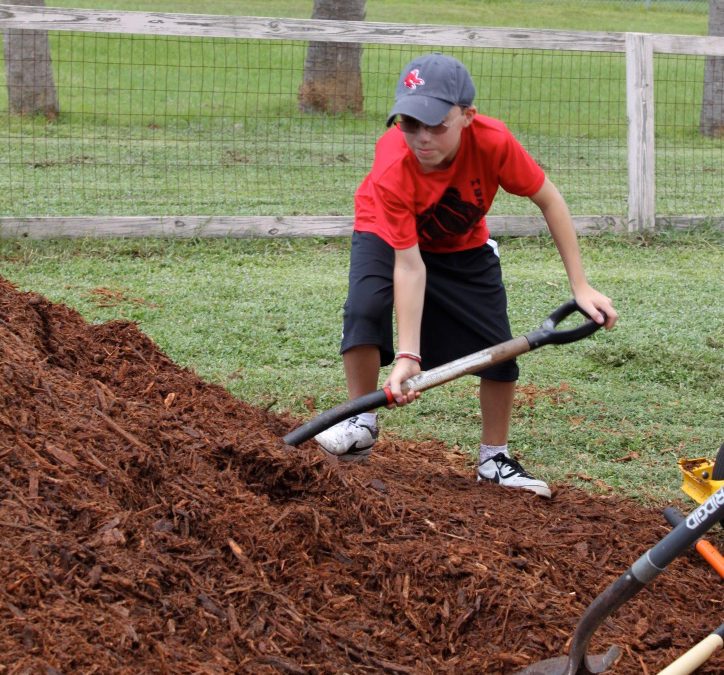
Using pitchforks and wheel barrows we were clearing dead water hyacinths from the boat ramp and the exposed lake bed. Five middle school students, the park naturalist, Ms. Freund and myself were hard at work, restoring access to a recreational area. It was hard work and we were all working hard – and with good spirits.
Why were we doing this on a perfectly good Thursday? Was this school work?
There was an academic component to this work. On a previous visit students had been asked how to rid the lake of its noxious plants. They suggested several methods and on this visit were testing out their hypotheses. One possible method was to physically remove the plants from the lake after it was drained. This was real science in action.
In fact, there were other science components to this week-long stay in the park. They tested the water that remained in the lake for the presence of certain pollutants.They examined the water for the presence of micro-organisms. They scooped up an alligator gar from the shallows where it had been trapped. They collected a great variety of mussels and worked with the naturalist to classify and identify the different specimens.
For an hour at sunset they sat quietly in front of a hollow tree in order to see 85 rare bats fly into the insect-laden sky. All of this was real science — much more real than a chapter in a textbook with questions at the end.
But they were also simply at work. They were helping to clear a boat ramp in a state park so that people could enjoy the lake. They were doing real work, useful work. They were working side by side with adults. Maria Montessori said that adolescents need to know that they are capable of real work. They need to know that they are capable of joining the adult world. They need to be accepted by that world, they need to have their contributions recognized. Such work is ennobling. It lifts the spirit. It provides context for academic work in a well designed program.
I asked what was the hardest work they had ever done, other than removing water hyacinths from the lake bed. One student remembered helping friends move onto the third floor. That sounded like hard work. No one else could think of anything.
It is a gift of the spirit to be asked to do hard work, real work, physical work — in addition to real mental work. Is this school work? It is in a Montessori school where the finished product is the young person herself: a capable young adult who has glimpsed her possibilities and is ready to take on the work of the world.
We want to once again thank John Long and the Post Oak School for allowing us to republish John’s wonderful essays in Tomorrow’s Child and in our online resource collections.

 Evolution: Why Did Fish Grow Feet?