by The Montessori Foundation Staff | Lower Elementary (6-9), MFA, Montessori Curriculum, Montessori Education, Montessori Teachers, Primary (3-6), School Leadership, Science, Upper Elementary (9-12)
This is a static PDF of the Montessori Foundation’s science curriculum scope and sequence database, available from our publications center.
We have an even more comprehensive version that has been fully aligned to the Common Core State Standards as part of the Montessori Compass student record keeping and parent communication software solution: www.montessoricompass.com
Download File
[pdf-embedder url="https://stage.montessori.org/wp-content/uploads/2023/07/Montessori-Curriculum-Scope-and-Sequence-Science.pdf"]
by The Montessori Foundation Staff | Kindergarten, Montessori Education, Montessori Teachers, Primary (3-6), Science, The International Montessori Council
Science Topics to Cover in the Montessori 3-6/Primary Classroom
by Erin Gutierrez
Setting up a science area in your classroom:
Things to consider
Topics to cover (This is not an exhaustive list, merely a beginning!)
Lesson ideas
Resources
Topics to cover
Living/non-living
Plant/animal
Zoology
• Animals in the environment
• Vertebrate/Invertebrate
• Matching animals (objects then cards)
• Classes of animals (mammals, birds, fish, reptiles, amphibians, arthropods, mollusks, and sea life)
• Other ideas of interest; animal homes, animal young, animal camouflage, animal tracks, birds; types of nests, beaks, feet, shell identification, human body (systems, teeth, nutrition).
Botany
• Plants in the environment (care and observation)
• Plant care
• Activities for matching and sorting;
• Fruits and vegetables
• Leaves
• Seeds
• Fruit and vegetable identification (let them eat!)
• Experiments with seeds/plants
• Measuring growth
• Gardening
• Parts of a flower/leaf puzzles, botany cabinet, nomenclature
Physical Science
• Matter (gas, solid, liquid)
• Properties of matter (buoyancy, magnetism, surface tension, evaporation, volume, weight, measurement, etc.)
Earth Science
• Rocks
• Minerals
• Space, solar system, constellations
• Land and water forms
• Volcanoe
by The Montessori Foundation Staff | Montessori Curriculum, Montessori Teachers, Science, The International Montessori Council
In Appendix B of From Childhood to Adolescence Maria Montessori suggests that students in the third plane of development make a detailed study of “one period, event, or the life of some personage who has aroused special interest.”(1)
One such “personage” could well be Leonardo da Vinci, which would provide inspiration and material to explore in just about every area of the curriculum.
The reason is clear from an article by Fritjof Capra: “Learning from Leonardo.”
“Most authors who have discussed Leonardo’s scientific work have looked at it through Newtonian lenses. This has often prevented them from understanding its essential nature, which is that of a science of organic forms, of qualities, that is radically different from the mechanistic science of Galileo, Descartes, and Newton. And this is precisely why Leonardo’s science is so relevant today, especially for education, as we are trying to see the world as an integrated whole, making a perceptual shift from the parts to the whole, objects to relationships, quantities to qualities.”
Read the full article here. http://www.ecoliteracy.org/essays/learning-leonardo
(1) Maria Montessori, From Childhood to Adolescence, ABC-Clio, 1994. 79.
by Cynthia Argentine | Child's Work, Family Resources, Imagination, Montessori Parenting, Nature, Science, Video, Webinars / MFA, Writing
Do you often separate scientific topics from artistic or creative ones? Do you think of the study of science as different from the study of literature and art? Cynthia will guide us through a discussion of how scientific topics can relate to and inspire artistic and creative pursuits. She will include ideas for outdoor and indoor activities that bridge these connections, touching on observation, nature journaling, classification, and more. Cynthia will suggest creative writing activities and also recommend several exciting resource books.
by Christoph Simon, Ph.D & Christine M. A. Lapierre, Ph.D. | Science, TC May 2021
 from Tomorrow’s Child Magazine – May, 2021 | by The Montessori Foundation
We are all scientists at heart. Do you remember how curious you were as a child when you were growing up? You would question your parents and teachers about how things worked in your environment, sometimes unceasingly. When you had your queries answered, you were joyful and, consequently, more motivated to come up with additional questions to examine. In reflecting about this natural tendency in yourself, you could now appreciate the interests of young children today as parents and as teachers, when they inquire about how and why certain phenomena are the way they are in their environment. The variety and number of questions they ask demonstrate to us that they are budding scientists and need to have their fascinations addressed genuinely, in order to not lose that capacity as they grow older.
Maria Montessori stated that children are natural scientists and that we can nurture that inquisitiveness and enthusiasm with thoughtful, caring replies. As an avid scientist herself, cultivated from her studies as a physician, Maria Montessori indicated that science and math were her favorite subjects. Consequently, she encouraged teachers and parents to bring to the attention of young children the real names of objects in their environment and not be concerned that the words would be too difficult for them. As children mastered their language and acquired new vocabulary, all words had the same intricacies for them. Montessori also advised adults to introduce children to all the sciences, in a manner that would respect the children’s level of understanding. What happens if, as parents and teachers, you are hesitant about teaching science and do not know the answers to the children’s questions?
You may think that it is too difficult, that you don’t understand it, and that you don’t have the abilities to converse with children about science. You may have a little voice in your head that tells you that discovering new knowledge about science is just not something you are capable of doing. While topics about biology and botany may come easier for you, because you studied it in school or university, many people shy away from delving into the ‘hard’ sciences (e.g., physics and chemistry) with children. When children sense this fear of science in adults, they can adopt these feelings as their own and become reticent about exploring their environment. However, there are a number of ways that you can embrace science and enjoy it. Christoph has some great solutions on how to lower this barrier of being fearful of science.
First of all, science is everywhere around us. Therefore, you can make science more relevant to the children’s everyday experiences. For example, everyone needs energy. We, and other animals, get it from our food. Plants get it from the sun and use some of it to make food for us. The plants can turn into coal and oil, which still contains some of that energy that they got from the sun. We can burn these things to make heat, steam, and electricity, which can do work.
A related example is heat. You can explain to children that it is the disordered movement of atoms or molecules. This helps explain how water goes from ice, which is a solid, to liquid water, to steam, which is a gas, as water is heated up. First the molecules are arranged in a neat orderly way (ice), then they start moving around but still stick together (liquid water), then finally they move so much that they fly apart (steam). Children can act that out by being close together for ice, farther apart and moving for liquid water, to moving around the room rapidly, for gas. Other examples are the concepts of electricity and magnetism. Children can learn about them using simple, everyday objects. The child can rub balloons to create static electricity, and fridge magnets can demonstrate magnetism. In both cases the children can see that objects don’t need to touch each other to have an effect on each other.
If your understanding is not perfect, it is still acceptable. You can acquire the spirit of being comfortable with not knowing about everything. Instead, you can be transparent by telling children that you are not sure about a response, and you can do the research together to seek the answers. In science, there are always open questions. When you deepen your understanding of how things work, you develop a mindset that is wonderful for children to see: like the children, it is fine to not know. You can be like children, open-minded. Instead of becoming discouraged, you can learn that it is enjoyable to learn new things. It will change the way you view the world. On a cautionary note, we would like to emphasize that it is important not to give children incorrect information. As an alternative, it is valuable to say to the children, “I am not sure.” They will realize that adults do not know everything, and we are all learning together. Everybody can learn at their level. Even experts in science do not know everything. Taking this stance, we can all teach science to young children. like Montessori, that children have a natural scientific mindset. They want to explore new phenomena to them, learning about them repeatedly under different conditions to really understand how they work. This would be what changes, what remains the same, what is important and what is coincidental. We encourage you to take the plunge and begin exploring new facets of science to convey to the attention of young children. It will bring them joy.
References
Montessori, M. (1972). The secret of childhood. New York: NY: Random House Publishing Group. Montessori, M. (1995). The absorbent mind. New York: NY: Hold Paperback.
Christine M. A. Lapierre, PhD enjoys being a parent and is passionate about the Montessori philosophy. She holds a PhD in adult learning and sees everyone as a lifelong learner. Being a MACTE trained early childhood teacher, she believes strongly in bringing Montessori principles to teams, businesses, and other organizations. She can be reached at clapierr@ucalgary.ca.
Christoph Simon, PhD is a happy father of twins currently attending a Montessori elementary school. He is a professor of physics at the University of Calgary, where he studies applications of quantum physics to information technology and neuroscience. He can be reached at csimo@ucalgary.ca.
by Lorna McGrath | Book Reviews TC MAY 2021, Lower Elementary (6-9), Montessori Education, Science, TC May 2021, Upper Elementary (9-12)
from Tomorrow’s Child Magazine – May, 2021 | by The Montessori Foundation
Picture Book Science Series: The Earth, The Stars, The Sun, The Moon
Written by Laura Perdew
llustrated by Li Hui
This series seems like it would be suited to and appeal to lower elementary students. There is quite a bit of text for students to read, and the vocabulary is above an emerging reader’s level. Obviously, there’s no harm in an older student/sibling with more reading proficiency or an adult to read it to a younger child. Although there is a lot of information in the books, it is wrapped in stories and illustrations of imaginary creatures. Again, this would definitely appeal to elementary-age students, but it might be a little out of a younger child’s ability to distinguish between reality and fantasy. These books provide a fun way to look at information about the stars, the earth, the moon, and the sun. There are other books in the series that take a closer look at different types of animals, as well. They are published by Nomad Press and can be purchased at www.amazon.com.
by Margot Garfield-Anderson | Family Resources, Health / Nutrition, MFA, Montessori Family Life, Montessori Grandparenting, Outdoor Education / Resources, Practical Life, Science
Not all Montessori schools run summer programs, but with some careful planning, you can keep your children fully engaged in learning and maintaining skills without having to micromanage them.
Over the years, we’ve gathered lots of ideas from lots of places. We’ll just list a few of them here with some guiding principles to keep it in the ‘Montessori Way’ of parenting.
Picking Produce
Many local farms have all-you-can-pick opportunities, and some even have hayrides, petting zoos, educational programs, or festivals to enjoy. Check to see what’s available in your area. Children love being outside, connecting with the earth. Families can easily make a day out of this activity. One big consideration for my family is the subject of pesticides. We try to find organic farms. If not, we highly recommend you very thoroughly wash and dry your purchases with a natural product designed to help remove some of the residue.
Casually engage children in a discussion of the seasons. See if the farm offers any small talks for children about the crop being harvested or cooking classes, and have a plan for what you are going to do with your pickings when you get home. Depending on the age of the children, vegetables can be roasted, blanched and frozen, cleaned and eaten raw, or put into soups or stews to be put away for cooler weather.
Fruits. Just thinking about all the summer fruits makes your mouth water. Of course, being able to eat fruit and vegetables fresh off the vine or tree is the best way to enjoy, but cold summer fruit soups can be delicious if some of your pickings become a bit too soft to use. When my twins were infants, I took that fruit, milled, and pureed it and then froze it in small batches. I did this with vegetables as well.
Strawberries, blueberries, raspberries, and blackberries are delicious if you place on a baking sheet, separated out and then frozen; same with grapes. Children love to eat frozen fruit on a hot summer day, and berries are super-fruits!
My daughters, now mothers to my four adorable granddaughters, plant summer gardens each year. The girls tend the garden by watering and weeding. They check the plants all through the growing season and delight in showing me the progress when we Facetime. My youngest, Harper, LOVES basil and eats it as soon as it’s ready. Little cherry tomatoes are a universal favorite for all my girls. Allowing young children to tend to their plants gives them an introduction to the cosmic nature of all living things, a responsibility for a living thing, and opens up discussion topics to keep them engaged.
Sand and Water Play
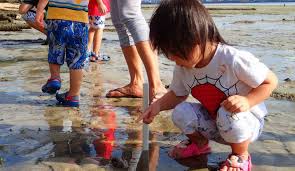
For those fortunate to live near a beach or lake with shorelines, you already know how much children enjoy this kind of outing.
Building sand castles can turn into short little lessons on geometry or discussions about ancient castles and how long they took to build. Building or playing during the tides can turn into short discussions about the effects of the moon on tides. Hunting for shells introduces some zoology if you know what animals live in the shells. Beach shops usually carry those beautifully illustrated or photographed books that can help you and your children make identifications. Of course, we discourage any collection of shells still containing their inhabitants.
Our grandchildren don’t live near this kind of body of water, so they had sand tables and did lots of table washing and water painting on all the surfaces (my feet usually prime targets) with both brushes and sponges. Children love to squeeze sponges, and this is a great way for them to develop strong grips. For younger children, table washing is one of the first practical life lessons at the primary level. Table washing is great preparation for writing. It also helps develop hand/eye coordination, and an extra benefit is that your outdoor furniture can stay nice and clean if you let them enjoy this activity.
Woodworking
Children love to use tools. Many schools introduce woodworking with young children using real tools made for smaller hands. There are easy kits for those that don’t have the skills to create their own, and there are many projects on websites, such as Pinterest, for more experienced builders. The important thing to remember is that parents let the child actually do the work with you, making sure to follow safety protocols. Try to estimate how long a project might take so that it can be segmented into intervals that will hold their attention and are geared towards their level of handling tools. Talk about the different shapes and angles the pieces have to reinforce geometry. Try letting them count the pieces, read the instructions (if they are old enough), or figure out directions from the pictures for younger children. Talk about the scale of what you are building to reinforce some concepts such as big and small; tall and short; hard and soft; the kind of materials, e.g,, metal or wood, etc,). Besides having a great experience with your children, you are aiding them in keeping up on skills learned during the school year, along with some new ones.
Family Drives
Need to be in the car with your children on a long drive? Don’t want to simply hand them a device to lock them into for countless hours of mind-numbing screen time? It might feel a bit old fashioned, but my dad and I searched for license plates from different states. We had a map of the US and stamps with sample license plates. When we both spied one, I put the stamp on the state. Then we’d count how many were able to spot. We’d be listening to classical music on the radio, and he’d tell me the story of the music. Not only was this precious and special time with my dad, who was on the road much of the week, it reinforced my love of classical music that I value to this day.
Not into license plates? Try having your child be the navigator using a paper map or compass? These are great almost lost skills for anyone to have.
Have them read road signs. One summer I challenged my granddaughter to an hour of reading every day. She was huffing and puffing over this, but when we added up all the time she was in charge of reading any kind of instructions for recipes or art projects, road signs, or directions on a map along with some book reading, she was shocked that an hour or more was achieved without her even realizing.
Rainy Days
Summertime isn’t all sunshine time. What to do on rainy days? My go to is always the public library. I take my girls to different locations so they don’t get bored. Libraries often have all kinds of free or very low-cost activities for children. Story times, craft projects, movies, games, etc. Check in with your library for their schedule. And, of course, let children pick out some books to bring home. Many libraries have bookstores where you can purchase used books for pennies on the dollar. Children love counting out the money and choosing a book for themselves. Lessons in money are important skills to help children learn to budget and understand the bigger picture of using money.
Children’s Museums
All my girls grew up going to museums. I was an art major in college, and sharing my love of art with them was important to me. As a child, my mother took me to museums, galleries, and art events at a very early age, and it was always the highlight of my time with her. Many museums have free or low-cost activities for children. Look online for these kinds of events and use them as your rainy-day experiences.
Supermarket Shopping
My youngest granddaughter used to LOVE going food shopping when I was visiting. I let her pick out the fruit and vegetables and put them on the scales to weigh them and print out the labels. We’d always stop at the fish counter, where the live lobsters were kept. The people behind the counter loved to take out a lobster and give her a short lesson on the life of a lobster. When we got home, we’d cut up a plate of rainbow-colored fruits and vegetables for our snack. When children are engaged in the process of food selection, they are more apt to be willing to try a variety when offered.
Summer Holidays
Between Memorial Day and Labor Day, some of the most important holidays in American history take place. It’s easy to just say it’s another day to party or day to wear red, white, and blue, but sharing the important of history with children is important. Towns and cities usually host events that celebrate with booths that have all kinds of related activities for children. Pinterest can also help you find some fun projects. Baking a cake and using sliced strawberries and blueberries as the stars and stripes on the American flag is a great way to review counting and recounting the story of American freedom. Our story of obtaining freedom is one all children should remember and since the 4th of July falls right in the middle of the summer break, it’s a great one to use for some civics lessons.
These are just a few of the ways parents and grandparents can help them retain skills learned during the year without too many power struggles.
by Christoph Simon, Ph.D & Christine M. A. Lapierre, Ph.D. | Mathematics, MFA, Science
Christoph: I am a physics professor, so I was naturally interested in trying to teach science and math to my twin boys as early as possible. My wife has a PhD in physics, too, so she shared this interest. I didn’t just want to transmit content knowledge, although that is definitely important to me, but also the scientific way of thinking. I will elaborate on that in the examples below. I feel that science provides a unique, often interesting (and even fun), perspective on the world, and I wouldn’t want my children to miss out on that.
My efforts in this respect were significantly enriched by my discussions with Christine, who is an experienced Montessori early childhood teacher. Our conversations started with a fortuitous encounter in a campus parking lot several years ago and have continued ever since. Thanks to my professional background, I was also able to make suggestions for themes and concepts to incorporate into a Montessori classroom.
Christine: I am a Montessori early childhood teacher, and I was really interested in how Christoph could integrate science into his everyday activities at home. I shared with him how Montessori classrooms honor Maria Montessori’s deep belief that science, as well as mathematics, are core areas of learning for young children. I learned from Christoph new concepts in science that can be a basis for any Montessori parent and Montessori classroom.
Christoph: Overall, the most striking discovery for me has been how ready children really are for scientific knowledge and concepts, even at a very early age. For example, when they were three and a half years old, I explained to them how the earth goes around the sun, while also rotating around its axis, which causes day and night. I used fruit (an apple and a mandarin) to demonstrate. To my surprise and delight, they understood this perfectly and were very happy to demonstrate it multiple times later on.
Christine: The solar system is a standard topic in Montessori preschools. It was great to see how Christoph was able to introduce it to his children. Parents are encouraged to teach the solar system, with the sun and the planets, to their children using objects that they can find at home. They can also show their children pictures of the planets, discussing with them how they are different from each other.
Christoph: I talked with my children early on about seemingly more advanced topics too. For example, we talked about how all matter is made out of atoms, and how these atoms form larger structures called molecules. They were interested in drawing simple molecules, such as water and oxygen, and even more complicated ones such as the different kinds of sugar.
Christine: Atoms and molecules are somewhat new concepts for the Montessori early childhood classroom. Yet, they are foundational to science. The way in which Christoph explained it to his children can be an example for all of us, whether parent or teacher, and we can teach it with confidence.
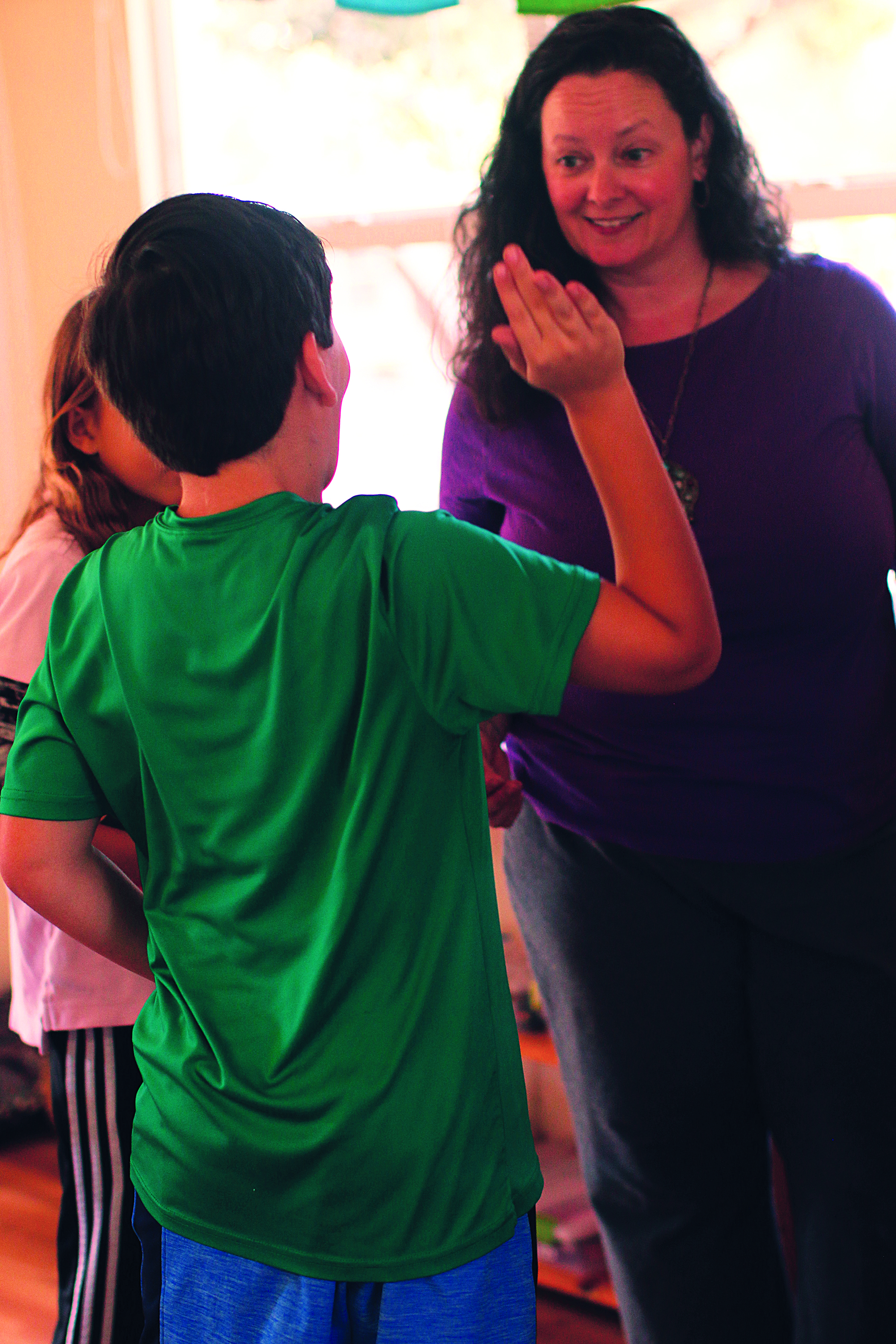
Christoph: My children were very interested to learn that heat is the disorderly movement of these atoms and molecules. We discussed phase transitions, such as freezing/melting and evaporation/condensation from this perspective. For example, freezing means that the water molecules arrange themselves in an orderly fashion, while evaporation means that they fly apart. This is fun to act out. For a solid, the children sit in an orderly arrangement. For a liquid, they move around but stay close to each other. For a gas, the children run all around the room.
Christine: A Montessori parent can conduct an experiment with children to teach phase transition using simple materials. You would use an ice cube to show that water can be a solid, a cup of water to show how water is a liquid, and a water kettle that boils water, releasing water vapor, to show that water can also be a gas.
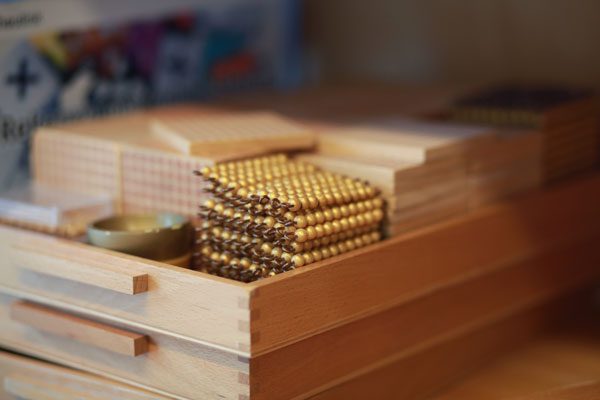
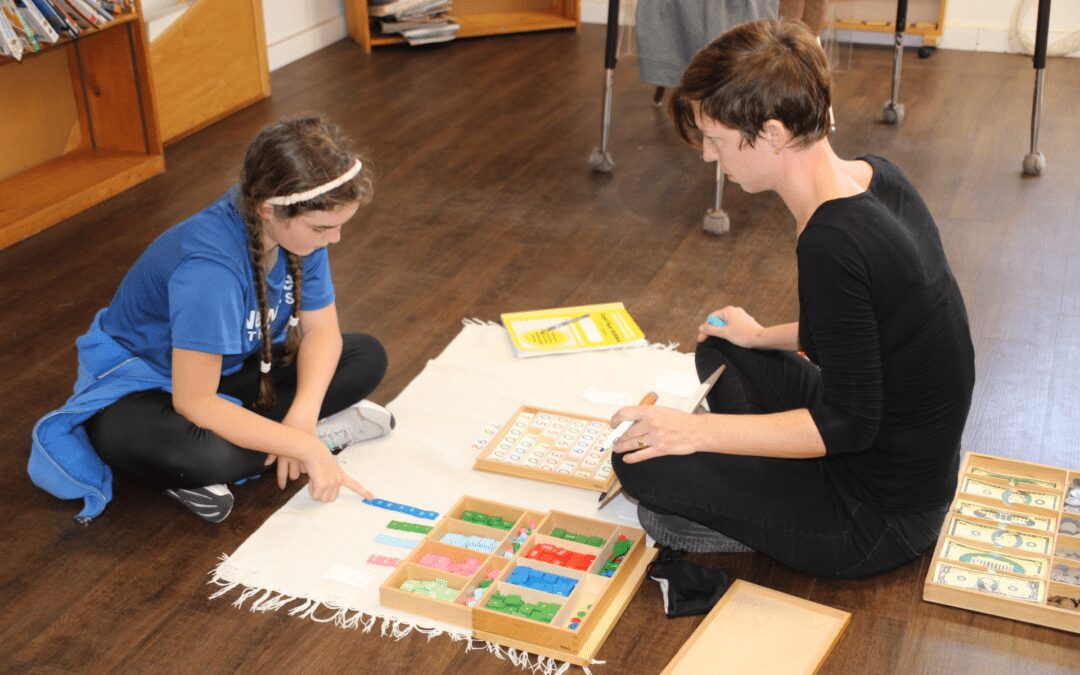
Christoph: When our boys were about five, my wife and I were inspired to make counting beads for them by what I had seen in a Montessori classroom. We made single beads, rows of ten (stuck together), and squares of a hundred. This was the time when they started to get a weekly allowance and wanted to figure out what toys they would be able to afford. They quickly became really proficient at doing these calculations with the beads. This example really demonstrated the importance of motivation to me. It also showed that they were completely capable of learning practical mathematics when given appropriate tools.
Christine: The Golden Beads are a wonderful math material to use with children. As Christoph mentioned, parents can make their own basic ones at home. They can work with their children on everyday activities requiring math, such as counting how many toys the children have, how many different building blocks they have, and what ages they are.
Christoph: There were many opportunities to talk about the scientific mindset. Also around age five, a friend of theirs claimed that he could run faster than a car. They wanted to know how they could decide if that was really true. I suggested asking him to show them. They did that, but he responded that he had done it only once. After some discussion, they concluded that it was probably not true.
In the language of science, we would say that if a result is not reproducible, then it is probably not valid. This (and similar experiences with them) makes me think that the scientific way of thinking is really quite natural for kids, and they just need a moderate amount of encouragement and guidance to develop it consciously. My main contribution was the suggestion to ask for a demonstration, i.e. basically to do an experiment. I think that they not only did that for this particular instance, but they also remembered it as a good general principle when faced with (maybe dubious) claims.
Christine: We can all learn from Christoph about how to introduce the scientific mindset to children. Parents who are courageous to do so, can follow Christoph’s line of thinking. Once parents begin to introduce scientific concepts and to do experiments with their children, they will be inspired to do more with science. As Maria Montessori discovered, children are natural scientists.
Christoph: As they grow older, we talk about increasingly sophisticated topics, for example the concept of probability. In 2018, when they were almost seven, we spent a fair amount of time watching the soccer World Cup. Before a game, we would talk about what we thought was the chance that team A (say Germany) would beat team B (say South Korea). For example, we might decide that the chance was 80 percent in this case because Germany is usually a really strong team. But then, in the game, something unexpected might happen: South Korea might score the first goal. We would talk about how that changed our estimate for the probability of winning, and we might agree that now the probabilities were more like 50/50. Another goal by South Korea might convince us to make another update to our probability estimate, maybe 80 percent in favor of South Korea now. Then, as the game time ran out, our estimate of the probability of South Korea winning would become closer and closer to 100 percent, until it reached 100 percent (certainty) at the final whistle. These concepts (a priori probabilities and updates to probabilities based on new information) are sometimes thought of as quite advanced. But they also seem to be quite natural for the human mind. At least these two seven-year-olds had no difficulty with them at all, when there was a real-life and fun example such as an exciting soccer game.
Christine: While the mention of probabilities may make a parent reticent to talk about it with their children, Christoph demonstrates how his children grasped the concept very quickly in the discussions about soccer. Taking a topic that is close to the children, such as sports, can enhance their understanding of how we come to conclusions about everyday life.
We can all learn from Christoph about how to introduce the scientific mindset to children. Parents, who are courageous to do so, can follow Christoph’s line of thinking.
Christoph: I realize that different parents and teachers will have different comfort levels introducing and discussing concepts such as these. From my experience, I would say that at least one doesn’t have to worry about the children; they seem to be ready. It is also OK to still learn things oneself. They have now reached an age where I often can’t answer their questions perfectly, without some support (say some specifics about black holes, to give a recent example). I think the fact that I also still have to learn new things is a good lesson for them. Sometimes, in simpler cases, we might look up the answer together. There are times I will get back to them after having organized my answer a bit. I am also learning a lot from them now, such as all kinds of facts about animals on land and in the sea.
My wife and I really liked what we learned from Christine about Montessori schools, and we decided to enroll our boys in one starting with lower elementary (first grade). I am happy to report that they are thriving there. They do quite complex projects, sometimes alone, sometimes in teams, on a wide range of topics (outer space, different animals, but also ancient Rome etc.). They are learning lots of great skills, such as organizing their time, working constructively with others, and presenting their results to their peers. As an academic, I feel that they are already developing many of the skills that are essential for graduate students later on. But I am sure that the same skills are also valuable for many other careers. Most importantly, they are excited about learning new things every day.
Christine: We hope that from this dialogue interested parents can see how they can introduce more science and mathematics to their children at home, in support of what they are learning at school.
Christoph: This has been a lot of fun. The more my kids responded positively to these ideas, the more I was motivated to introduce new concepts to them in concrete ways.
Christine: It can be thrilling to learn something new and then teach it to your children. In essence, you are learning alongside them. ¢
Tomorrow’s Child / October 2019 /pg. 18
by Kelly Johnson | Kindergarten, Language, Lower Elementary (6-9), MFA, Outdoor Education / Resources, Primary (3-6), Science, Toddler (18 months-3 years), Upper Elementary (9-12), Video, Webinars / MFA
Kelly Johnson is a talented writer, artist, and naturalist who also happens to be a Montessori certified elementary teacher. She has written two outstanding books, “Wings,Worms and Wonder” and “Wonder and Wander” that link home and school activities for discovering the awesomeness of our natural world. In this session she will share some activities from each book and show you how what you do at home can be aligned with Montessori classroom lessons and materials.
by NewGate Secondary Students | Book Reviews, Language & Reading, Later Adolescence (15-18), MFA, Science, Tomorrow's Child, Upper Elementary (9-12)
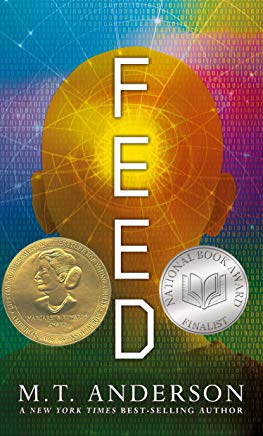
Feed –by M.T. Anderson
Feed by M.T. Anderson is a thrilling dystopian sci-fi novel where anything you want to watch, anything you want to buy, anything you want to know, anyone you want to talk to, is just one thought away. This is a reality for Titus and his teenage friends because of the Feed. The Feed is a device, implanted into the brains of 73% of Americans, which directly connects them to the Feednet, a futuristic Internet. Because of the Feed, Titus and his friends spend most of their days watching Feednet and buying things, but that all changes the day Titus meets Violet.
Titus’ character development was something very interesting like nothing I’ve seen before. Titus starts hanging out with his friends getting drunk and being reckless. This all changes when he meets Violet. Titus goes from not caring about the truth of the Feed’s purpose to wanting to know and understand what the Feed was really doing. Titus wanted to not be taken as an idiot by Violet. This really spoke to me because I crave knowledge and want to be taken seriously.
Although it is set in the future, it is just close enough to our time that you can relate to most of the things Titus and his friends go through. For example, everyone who has been a teenager understands that feeling of just wanting to have fun and not caring what happens. Once I began reading, I was immersed in its story and couldn’t stop. This book made me wonder if our future is really going to take such a dark dystopian form. It made me put in some real thought about how much technology affects and will affect us.
I loved this book and all of its funny jokes, teenage problems and most of all its questioning of if we control technology or if it controls us. I would recommend this book to anyone who likes dystopian novels that really make you question your future. Overall this was an amazing book; it was a book that will really feed your imagination.
Reviewed by Daniel Pellizzari, 9th grade,
NewGate School, Sarasota, FL
Tomorrow’s Child / April 2019 / Pg 30
by Sue Fitzpatrick | Adolescence, Early Adolescence (12-15), Empowerment, Imagination, Later Adolescence (15-18), Lower Elementary (6-9), Mathematics, MFA, Montessori Education, Montessori Middle School, Montessori Secondary / High School, Science, Upper Elementary (9-12), Webinars / MFA, Young Adolescent
In this session Sue Fitzpatrick discusses each of the six interconnected components of STEM that in 2016 the US Department of Education described as key to putting the program into classrooms. She gives actual photos and examples of Montessori students in action for each of the components. Participants will go away with lots more information about STEAM and a better understanding of its goals and how it fits with Montessori.
by Jackie Grundberg | Computers in the Classroom, Imagination, Kindergarten, Lower Elementary (6-9), Mathematics, Montessori Parenting, Primary (3-6), Research, Science, Upper Elementary (9-12), Webinars / MFA
Do you ever question or are asked, “How do STEM and Montessori overlap?” or “Should I choose a STEM or Montessori school for my child?” We’ll take a look at how Montessori incorporates STEM philosophy, and what you can do next.
by Michael Dorer, EdD | Brain Development, Communication, Early Adolescence (12-15), Empowerment, Infant-Toddler (0 to 3), Kindergarten, Language, Language & Reading, Later Adolescence (15-18), Lower Elementary (6-9), Mindfulness, Mixed Ages, Montessori Education, Montessori Family Life, Planes of Development, Primary (3-6), Psychology, Reading, Science, Sensorial, The International Montessori Council, Upper Elementary (9-12), Webcasts / IMC, Young Adolescent, Young Adults
Webcast: Building Brains With Kathy Leitch and Michael Dorer
by The Montessori Foundation Staff | MFA, Science, Tomorrow's Child, Tomorrow's Child Online Issue
Dr. Ann Epstein, one of the presenters at The Montessori Foundation’s 2017 Annual Conference, demonstrated a variety of science experiments that are sure to pique a young learner’s curiosity while having some great fun at the same time.
Most of the items used in these experiments are readily available, don’t take much time to do, and will (we hope) inspire some great discussions over the process and results obtained.
We thank Ann for putting together these experiments and Cheryl Allen’s Lower Elementary class at the Newgate School.
Air Pressure
Materials:
θ 2 kitchen sponges
θ 1 plastic zip lock bag
θ 1 drinking straw
θ 1 pom-pom ball
Explaining the concept of air pressure to preschoolers can be tricky. It can sometimes be difficult for them to grasp the idea that spaces are filled with air, and that air can have a force and move objects.
This is so simple to set up. Simply place the two kitchen sponges, one on top of the other, inside the plastic zip lock bag. Place the drinking straw between the two sponges so that one end of the straw is inside the bag and the other end is sitting outside the bag. Seal up the bag. In addition to closing the zip lock seal on the bag, you will also need to seal it with adhesive tape.
Place a pom-pom on a flat surface and place the bag behind it so that the straw is positioned to blow the pom-pom. Press down hard on the sponges and watch the pom-pom roll away! If you want greater momentum, blow more air into the straw, filling up the bag as much as possible.
Try holding the bag at different angles. How does this affect the pom-pom? It would be fun to turn this into a game of air-soccer. Simply lay a container (e.g., a paper cup or an empty tin can) on its side and try to shoot the pom-pom into the goal.
We also tried to move other objects such as toy cars and LegoTM mini figures. Some of them moved and others didn’t. Try to make predictions about what you think will be moved and then test your theories. Can you think why some objects are moved by the air and others aren’t?
https://tinyurl.com/air-pressure-kids
Make Eggs Magical
Materials:
θ glass jar
θ hard-boiled egg (peeled)
θ match (adults only!)
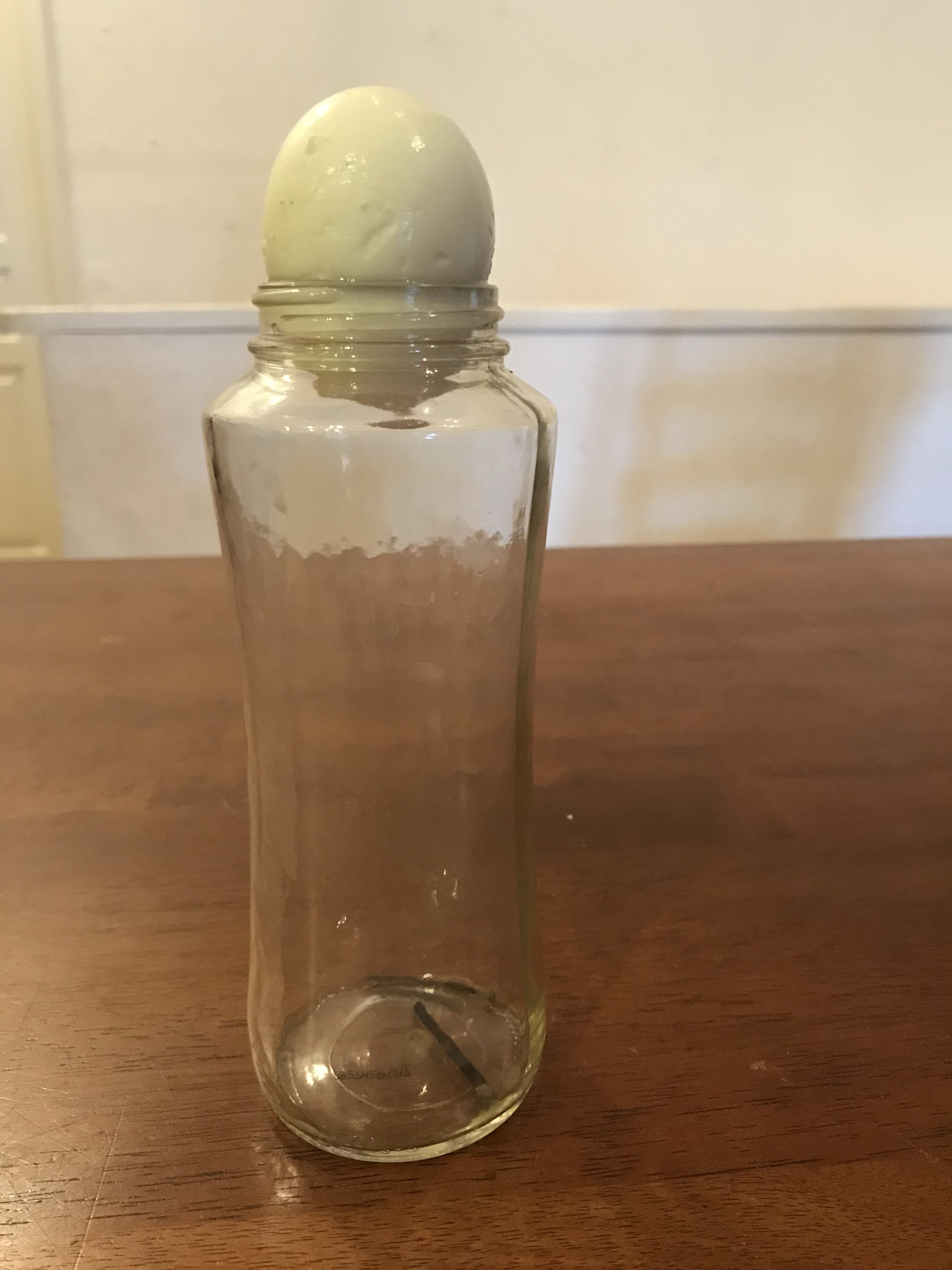
This “look ma, no hands, wires, or mirrors” trick will get them every time; an egg being sucked into a jar while your little scientist delightedly looks on is always a hit. To perform this illusory feat, you’ll need a glass jar with an opening just smaller than an egg (think: old school milk jar) and of course, a peeled, boiled egg. When you and your Little One have checked these items off your list, it’s time to start the show. Mom or dad should toss a lit match into the glass jar. Have your minilab assistant, quickly set the egg over the opening. Abracadabra! Alakazam! The match dies out; the egg gets (seemingly) inexplicably sucked into the bottle. And just like that, you’ve performed another bit of parent magic without breaking a sweat.
Why it works: The match uses up the air inside the bottle. Once that happens the pressure outside the bottle is greater and pushes the egg down into the bottle.
Note: You may need more than one match, and it may take awhile!
Tomorrow’s Child / January 2018 / p 30
by Lorna McGrath | Book Reviews, Infant-Toddler (0 to 3), MFA, Montessori Education, Montessori Parenting, Primary (3-6), Science, Tomorrow's Child Online Issue
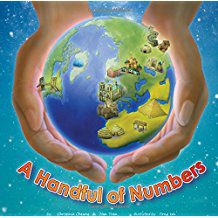
A Handful of Numbers
Written by Christinia Cheung & Han Tran
Illustrated by Tong Wu
This is a great little board book. The counting and numbers are all related to things about the Earth and our universe. Example: 2 poles (north and south); 5 geologic layers; etc. The illustrations are beautiful!
On the left page is the number written in large type. Then, there is a description of what the illustration shows, and in the bottom left corner of that page is the corresponding number rod. On the opposite page is a beautiful illustration. Example: 3; three oceans; description of the oceans and what they do; the third number rod.
It is especially nice in the way that it is connecting counting and numbers with our geography studies. Children at the primary level and older toddlers will enjoy this book.
Tomorrow’s Child / November 2016 / pg 32
by Tim Seldin | Archived Issues / Tomorrow's Child, Children with Exceptionalities, Emotional Intelligence (EQ), Executive Functioning, Language & Reading, Mathematics, MFA, Montessori Curriculum, Montessori Education, Montessori students, Peace Education, Re-enrollment, Reading, Science, Sensitive Periods, Tomorrow's Child, Writing
To inspire academic excellence; nurture curiosity, creativity, and imagination; and awaken the human spirit
As children near the end of their kindergarten year in Montessori, many parents struggle with the question of whether or not to keep their children in Montessori for the elementary program.
On the one hand, the typical Montessori five-year-old’s self-confidence and love of learning lead many families to ask: Why tamper with something that is clearly working?
Other parents feel that, since their kindergarten graduate will be moving on to another class one way or the other, next year might be the logical time to make the transition from Montessori.
A major consideration for many families will be the opportunity to save the cost of private school tuition by taking advantage of the local public schools. Some will wonder if a more highly structured and competitive independent school will give their child a better preparation for college.
If you are facing this choice, I encourage you to take a good look at your school’s elementary program. Although you will, of course, want to gain an impression of the teachers, focus your attention on the students themselves. Elementary students are often the best spokespeople for the value of a Montessori education!
There are four aspects of the elementary program:
Academic Excellence
Universal Values
Global Understanding
Service
Inspiring Children To Work Hard and AchieveAcademic Excellence
Let’s begin by being very clear. Montessori is one of the most sophisticated pre-collegiate programs available anywhere in North America. It has been described as the ultimate gifted-and-talented program that is offered to a very wide range of students. However, this doesn’t tell the whole story. What makes Montessori special is its ability to nurture talent without needless competition and stress. In a nutshell, Montessori children never lose the joy of learning.
Montessori is, first and foremost, concerned with a child’s character and emotional development, rather than academics for grades and test scores alone. We inspire children toward academic excellence and nurture the curiosity, creativity, and imagination hidden within every human being.
Many Parents Worry That Montessori Will Not Prepare Their Children For The ‘Real World.’
Hearing that we do not give children letter grades (at least until high school), assign hours of nightly homework, give children weekly tests, or expect students to compete for the highest rank in the class, some parents wonder if we’ve lost our minds! After all, who wants to run the risk that Montessori, which was so charmingly right when they were young, doesn’t work in the elementary years or prepare children for the Real World?
Montessori Elementary Education Is Distinctly Different
First, let’s talk about highly selective programs for ‘gifted’ children.
Montessori demonstrated that intelligence is common among human beings. Most schools assume that giftedness is statistically rare and that, given half a chance, children will accomplish little without external structure, extrinsic rewards, and the fear of being embarrassed.
Many of us attended challenging elementary schools. Do you remember what happened in your highly disciplined classrooms when your teacher left the room? In many cases, it was disorder. What use is it to earn high grades, keep your notebook neat, pass every test, and hate your schoolwork? Many children in many good schools are bored, apathetic, or overwhelmed. They do only what must be done to get along. That is not a sound foundation for a real education. In truly wonderful schools, classrooms are filled with students who retain a sense of wonder, curiosity, and eagerness to learn. Those qualities are the almost universal description of elementary Montessori children.
I find the difference between the way many of us think about gifted children in this country and the attitudes we find abroad quite interesting. Americans unconsciously assume that intellectual ability and scholastic success is inborn, i.e. a child is born with special talents and abilities. Many parents in other countries assume that success is more the result of hard work, self-discipline, and high personal motivation.
In writing this, I don’t mean to suggest that truly gifted children (and adults) can’t be found. They are simply uncommon. What we focus on is the human potential hidden within young children.
Montessori demonstrated that intelligence has many forms and that children learn in different ways at different paces. Anyone who has worked with children knows this is true, but traditional schools normally follow a pre-established curriculum.
Montessori felt it was illogical to dismiss a child who finds it difficult to memorize facts without understanding or to remember what the teacher covers in a lecture. She also understood the powerful connection between a child’s inner emotional life, self-confidence, self-esteem, and the ability to learn.
A Montessori elementary program is based on warmth, kindness, and respect. There is a strong sense of community among the children. The classes are more like little villages, with powerful friendships and a clear sense of group identity. Teachers are normally seen as mentors and friends.
Building Character and Teaching Universal Values
There is an old saying that if you abandon a garden, the weeds will run wild. Abandon a child’s moral and spiritual education, and the weeds of confusion, materialism, self-centeredness, and spiritual emptiness will take hold.
Dr. Montessori observed that the elementary years are a sensitive period for moral reasoning. The elementary program integrates character development and family involvement throughout the curriculum.
The teaching of kindness and courtesy, self-discipline and self-respect, and fundamental values is crucial in a child’s moral development, sense of dignity, and academic success. With proper guidance from parents and educators, children can and will excel.
Montessori Schools Strive to Create Global Understanding
They tend to attract teachers from all over the world.
It is normal to find an international student body in a Montessori school anywhere in the world.
Montessori schools generally teach at least one foreign language and often offer programs in several.
World geography, international cultural studies, and world history are central to the elementary Montessori curriculum.
Elementary Montessori students begin to understand the global economy.
As more Montessori schools develop strong upper elementary and middle school programs, many are beginning to sponsor travel-study programs. Some participate in the Montessori Model United Nations and foreign exchange programs.
Service
Children must be inspired to contribute to the betterment of the world. They often begin with projects that care for the environment: planting trees and flowers; composting garbage; controlling erosion around the campus; recycling; and cleaning up litter and debris in the local community. It is quite common for elementary classes to adopt an acre of rainforest in Costa Rica or work to support an environmental organization, such as the Wildlife Federation.
They will normally progress to projects that provide direct help to the needy. Younger children commonly collect canned goods, clothing, and toys for the homeless or needy families. As they are ready, most Montessori schools will take children out into the community.
As they reach the upper elementary class, Montessori children become quite concerned about issues of social justice and human rights. The rights of the poor, homeless, and hungry are of real concern. Some children will begin to explore the possibilities of supporting causes that are meaningful to them.
Elementary Classes Are Multi-Age Group Communities
Elementary Montessori classes continue to bring children of different age levels together. Classes span three age/grade levels, with the common divisions being ages 6 to 9 (grades 1-3) and ages 9 to 12 (grades 4-6). Some schools may follow a somewhat different scheme of grouping their children.
Elementary Montessori Educators Serve As Mentors, Guides, and Friends
The best elementary Montessori teachers tend to be renaissance men and women; individuals who are equally interested in mathematics, the sciences, the arts, architecture, literature, poetry, psychology, economics, technology, and philosophy. Elementary Montessori teachers are generalists rather than a single subject-matter instructor. They provide a blend of structure to ensure that the ‘basics’ are mastered while encouraging and guiding children to explore topics and ideas that capture their imagination.
The elementary Montessori curriculum is very demanding, and requires teachers to have a broad and thorough education of their own. With lessons that range from the history of mathematics to the physics of flight, mineralogy, chemistry, algebra, geometry, linguistics, and literature, to name just a few, the average teacher would be lost.
But beyond this, elementary Montessori educators need patience, understanding, respect, enthusiasm, and a profound ability to inspire a sense of wonder and imagination. Such teachers are very rare but absolutely magical!
Becoming an elementary Montessori teacher requires almost two years of graduate study and student teaching, and many hours of hard work to gather or create the curriculum materials that constitute a fully authentic elementary Montessori environment.
The Montessori Materials And The Passage To Abstraction
At the elementary level, learning continues to be a hands-on experience, as students learn by trial, error, and discovery.
The advanced elementary Montessori materials move on to more complex and abstract concepts in mathematics, geometry, and pre-algebra. The goal is to lead students away from a dependency on concrete models that visually represent abstract concepts towards the ability to solve problems with pen and paper alone.
Part of this is made possible by the growing child’s brain’s ability to grasp abstractions, but it has been greatly enhanced over the years by countless hours of work with the concrete materials that made the abstract real, and helped him visualize the abstraction.
Similar hands-on Montessori materials help students understand grammar, sentence analysis, geographical facts, and concepts in science.
Three Elements Of The Elementary Montessori Curriculum
1. Mastery of Fundamental Skills and Basic Core Knowledge
Montessori’s international curriculum evolved out of a tradition of academic excellence and offers a rigorous course of study even in the elementary years. Elementary Montessori students explore the realm of mathematics; science and technology; the world of myth; great literature; history; world geography; civics; economics; anthropology; and the basic organization of human societies. Their studies also cover the basics found in the traditional curriculum: the memorization of math facts; spelling lessons; the study of vocabulary, grammar, sentence analysis, creative and expository writing; and research skills.
2. Montessori’s Great Lessons
The Great Lessons are five key areas of interconnected studies traditionally presented to all elementary Montessori students in the form of inspiring stories, related experiences, and research projects.
The Great Lessons include the story of how the world came to be: the development of life on Earth; the story of humankind; the development of language and writing; and the development of mathematics. They are intended to give children a ‘cosmic’ perspective of the Earth and humanity’s (and their own) place within the cosmos.
3. Individually Chosen Research
Elementary students are encouraged to explore topics that capture their imagination. Most former Montessori students look back on this aspect of the elementary program with particular fondness in later years.
Montessori curriculum guides students to become proficient at research and inquiry. Elementary Montessori students rarely use textbooks. The approach is largely based on library research, with children gathering information, assembling reports, teaching what they have learned to their fellows, and assembling portfolios and handmade books of their own. Students are taught how to use reference materials, libraries, and the Internet to gather information and uncover the facts. Their oral presentations and written research reports tend to grow in sophistication and complexity every year.
Is Montessori Opposed To Competition?
No. Dr. Montessori simply observed that competition is an ineffective tool to motivate children to learn and work hard in school.
Traditionally, schools challenge students to compete with each other for grades, class rankings, and special awards. In Montessori schools, students learn to collaborate rather than mindlessly compete. In an atmosphere in which children learn at their own pace and compete only against themselves, they learn to not be afraid of making mistakes. They quickly find that few things in life come easily, and they can try again without fear of embarrassment.
Dr. Montessori, herself an extraordinary student and a very high achiever, was never opposed to competition on principle. Her objection was to using competition to create an artificial motivation to get students to achieve.
Homework, Tests, And Grades
Many parents have heard that Montessori schools do not believe in homework, grades, and tests. This is a misunderstanding. Because Montessori believes in individually paced academic progress and encourages children to explore their interests, rather than simply complete work assigned by their teachers, we don’t assign grades or rank students within each class according to their achievement.
Whenever students voluntarily decide to learn something, they tend to engage in their work with a passion and attention that few students will ever invest in tasks that have been assigned.
Providing Structure: Setting High, But Individually Tailored, Expectations
Montessori children normally work with a written study plan for the day or week. It lists the basic tasks that they need to complete while allowing them to decide how long to spend on each and what order they would like to follow. Beyond these basic individually tailored assignments, children explore topics that capture their interest and imagination, and share them with their classmates.
Montessori children usually don’t think of our assessment techniques as tests so much as challenges. Most elementary teachers will give their students informal, individual oral exams or have the children demonstrate what they have learned by either teaching a lesson to another child or by giving a formal presentation.
Standardized Tests
Montessori educators frequently argue that standardized testing is inaccurate, misleading, and stressful for children. Many feel that standardized tests are unnecessary, since any good teacher who works with the same children for three years and carefully observes their work, knows far more about their progress than a typical paper and pencil test reveals.
However, in our culture, test-taking skills are just another practical life lesson that children need to master. Most Montessori schools regularly give students quizzes on the concepts and skills that they have been studying, and many schools use standardized tests of one sort or another, with students over first grade. Often these may be formative tests that measure each student’s progress over the course of each year, and these will be only part of a comprehensive system of monitoring and documenting learning within the school.
When tests (formal and informal) are used as a feedback loop, at times indicating that a student needs a new lesson and more practice, instead of a mark of shame and failure, then they can be quite useful. Children will face tests throughout their education, and they certainly need to develop good test-taking skills.
Homework
Homework in an elementary Montessori class rarely involves busywork assignments; instead, they are extensions and enrichment of the curriculum. Some classes will allow the children to freely pursue projects that interest them at home, while others prefer to give children a number of optional assignments or challenges. In either case, the Montessori version of homework will rarely be boring and will normally challenge students to think, explore, and pursue tangible projects that give them a sense of satisfaction.
An Integrated Curriculum
Literature, art, music, dance, drama, history, social issues, political science, economics, architecture, science, and the study of technology all complement one another in the elementary curriculum. This integrated approach is one of the elementary Montessori program’s great strengths.
An Exceptional Curriculum In Language Arts And The Humanities
The elementary Montessori language arts program places great stress on the development of strong skills in composition and creative writing. Students are asked to write continuously, emphasizing, at first, the development of an enjoyment of the writing process, rather than the strict use of correct grammar and spelling. However, formal grammar, spelling, and sentence analysis are systematically taught.
Elementary children are normally very interested in words and sentences. They like to parse and analyze; for, in this way, they are clarifying their understanding of the structure of language that they absorbed unconsciously in the primary class. Montessori takes advantage of children’s natural interest and gives them a rich assembly of learning material; for while they study the theory of grammar, spelling, and sentence analysis, they are also perfecting their knowledge of written language.
Creative writing continues to be equally important, and students are encouraged to write and share with others their stories, plays, poetry, and class newspapers.
Finally, and most importantly, the key to the elementary language arts curriculum is the quality of the material Montessori gives children to read. They are introduced, from an early age to first-rate children’s books and fascinating works on science, history, geography, and the arts. Many elementary classes follow the Junior Great Books program, with formal literary studies continuing every year through graduation. By introducing students to the very best literature available for young people, Montessori cultivates a deep love for the world of books.
Unified Mathematics
Montessori math is based on the European “Unified Math” model, which introduces elementary students to the study of the fundamentals of algebra, geometry, logic, and statistics, along with the principles of arithmetic.
Montessori students learn to recognize complex geometric shapes and figures. They learn to define, calculate, and draw all sorts of geometric relationships: angles; polygons; circumference; area; volume; squares and square root, cubes of polynomials, to name just a few. In Montessori, arithmetic, algebra, and geometry are interrelated.
Elementary Montessori students gain hands-on experience by applying math in a wide range of projects, activities, and challenges, such as graphing the daily temperature and computing the average for each month or adjusting the quantities called for in a recipe for a larger number of people. Because children love to work outdoors, we try to prepare tasks that use the school grounds whenever possible.
History And Culture Come Alive In The Elementary Class
One of Montessori’s key objectives is to develop a global perspective, and the study of history and world cultures forms the cornerstone of the curriculum.
Physical geography begins in the elementary program with the study of the formation of the Earth, the emergence of the oceans and atmosphere, and the evolution of life. Students learn about the world’s rivers, lakes, deserts, mountain ranges, and natural resources. Elementary students study the customs, housing, diet, government, industry, arts, history, and dress of countries around the world. They also study the emergence of the first civilizations and the universal needs of humankind. In the upper elementary class, the focus is usually placed on early man, ancient civilizations, and American history.
International studies continue throughout the elementary years, integrating art, music, dance, drama, cooking, geography, literature, and science. The children learn to prepare and enjoy dishes from all over the world. They learn the traditional folk songs and dances in music and explore traditional folk crafts in art. They read traditional folk tales, literature, and reference materials about the cultures under study and prepare reports about them. Units often culminate in marvelous international festivals.
Montessori’s Hands-On Approach to Science
The Montessori science curriculum is focused on the study of life, the laws and structure of the universe, and how humanity has struggled throughout history to put our understanding to practical use.
Much of Montessori science takes place out of doors. Classes grow flowers and vegetables in small gardens. They often raise class pets and sometimes even small farm animals.
Students are encouraged to learn to recognize and name local trees, flowers, birds, and animals.
Older children begin to keep journals of their observations of classroom animals and write poems and stories that attempt to capture the sense of wonder and beauty all around us. Back in the classroom, they pursue their investigations using a wide variety of charts and displays, research materials, and reference books.
More formal elements of biology are taught as well, particularly at the upper elementary levels. Dr. Montessori found that systematic knowledge allows one to discriminate details among species, literally to see on a whole new level; therefore, we introduce the student to the classification of the plant and animal kingdom. The study of the internal and external anatomy of plants and animals likewise gives children a new level of awareness and sensitivity in their observation and study of life. They compare different anatomical systems among species, such as the eyes, teeth, hooves, and claws of various animals.
Elementary students also learn a wide range of important basic concepts of physics and chemistry, such as: the structure of atoms and molecules; the difference between elements and compounds; the chemical composition of familiar compounds; the three states of matter; and chemical and physical change. Students also enjoy doing research about the elements and have a first exposure to the Table of Elements.
Elementary children love to work with scientific apparatus and delight in seeing mixtures change color, testing liquids with litmus paper, experimenting with small electrical circuits, or building models of atomic compounds. Students learn to observe and record what takes place during their experiment. The goal is to teach both the scientific method and techniques for safely working with science equipment.
Foreign Languages
As part of the international studies program, most Montessori schools offer a second language. The primary goal in a foreign language program is to develop conversational skills, vocabulary, the ability to understand basic written information in the second language, and an appreciation for the culture of the countries where the language is spoken.
The Arts Are Integrated Into Every Subject
In Montessori schools, the arts are normally integrated into the rest of the curriculum. They are modes of exploring and expanding lessons that have been introduced in science, history, geography, language arts, and mathematics. For example, students might make a replica of a Grecian vase; study calligraphy and decorative writing; sculpt dinosaurs for science; create dioramas for history; construct geometric designs and solids for math; and express their feelings about a musical composition through painting.
Students participate in singing, dancing, and creative movement with teachers and music specialists. Students’ dramatic productions make other times and cultures come alive.
The ideal elementary Montessori health and physical education program challenges students to develop a personal program of lifelong exercise, recreation, and health management.
The Montessori approach to health and fitness helps children to understand and appreciate how their bodies work and the care and feeding of a healthy human body.
Field trips are often an integral part of elementary Montessori programs. Students take all sorts of trips over the years to planetariums, art galleries, the zoo, museums, and many other destinations. They visit the centers of local government, colleges, hospitals, veterinary clinics, wildlife refuges, libraries, laboratories, factories, and businesses.
Social Skills, Character, And Community Service
The elementary classroom is not only a community of close friends, it is a source of countless life lessons in social skills, everyday courtesy, and ethics. Montessori noted that elementary children not only enjoy each other’s company, they naturally form little social groups of friends, each with its own internal hierarchy and rules of conduct.
The elementary classroom takes advantage of this tendency by operating as a small social community in which children learn to work together, resolve conflicts peacefully, encourage and acknowledge each other, and work as committees to complete complex tasks. Dr. Montessori also noted that the elementary years are a time when children are developing their sense of justice and moral reasoning.
Most classes go beyond simple lessons in grace and courtesy to begin a serious exploration of moral philosophy. It is common to find elementary Montessori students discussing questions, such as: Why are some things considered a sin? What happens to us when we die? Why is it important for the fortunate to lend a hand to the poor? If kindness is so important, what can I do when I am feeling angry?
During the elementary years, Montessori children begin to seriously address the question of aid to the elderly, handicapped, critically ill, and economically disadvantaged. They explore international issues from the perspective of building bridges toward world peace. They study ecology, wildlife preservation, and conservation of natural resources.
Through these and many other efforts, we begin to introduce Montessori children to moral questions in personal relationships to encourage the awakening of their social conscience. n
Tomorrow’s Child/ November 2017/ Pg 18
by Lorna McGrath | Book Reviews, Kindergarten, Lower Elementary (6-9), MFA, Primary (3-6), Science
Eye to Eye: How Animals See the World
By Steve Jenkins
At our annual Barnes and Noble/NewGate Book Fair last weekend, I found this book that the teachers chose to place in the Lower Elementary box of books they wished to have in the classroom. When I sat down to read it and look at the illustrations I couldn’t put it down!
It is a fascinating book for 5-9-year-olds! Any child who is curious about the natural world will get excited about this book. Having it at home for outdoor adventures or having it at school in the science area are both great places for children to learn and research amazing things about the animal world.
As Cheryl Allen, a NewGate Lower Elementary teacher so aptly put it, “I love Steve Jenkins’ books because they are scientifically accurate, easy for students to digest, and beautifully illustrated!”
Reviewed by Lorna McGrath
by Lorna McGrath | Book Reviews, Gender, Language & Reading, MFA, Science, Upper Elementary (9-12)
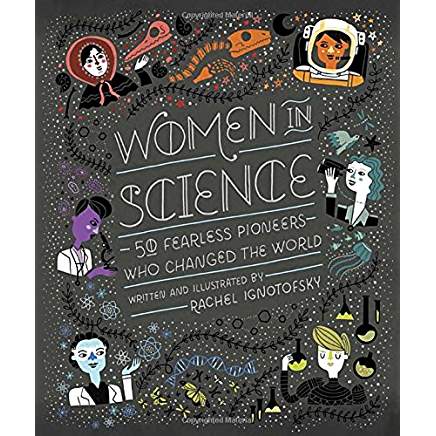
Women in Science
Written & illustrated
By Rachel Ignotofsky
These are two-page stories of women who were curious, inventive, smart, strong, and determined. They made their way in a field that has been thought of for centuries as a man’s field: Science. They contributed to our world in powerful ways.
The illustrations are fascinating and detailed. I recommend this book for Upper Elementary children for two reasons:
- the print is extremely small, so it would be very difficult for Lower Elementary children to read; and
- Upper Elementary years are the time when many girls begin to think that math and science are not for them. It is an interesting and fun book!
Reviewed by Lorna McGrath