How Montessori educators use stories in the Montessori program
Story Telling In Montessori Education
by Dr. Paul Clement Czaja
The word “story” comes from the ancient Greek word “histor” and means literally “a narration from a learned man.” Since the beginnings of human time, noble men and women who had survived life long enough to be old would share stories of wisdom to all who would gather around the fire and listen. I say they were “stories of wisdom” because in the particular happenings they told about the hero survives by not being foolish. A great story told has always been the leading edge of personal communication for it is the sharing of a wisdom – a piece of common sense – a tale of selfless courage – a victory of the good — which can provide those who hear the chance to share in a life experience in a way that makes words come alive and practical advice about living become personal and truly experiential.
The problem in sharing wisdom with others is that the profundity – the complexity — of the human person makes every personal experience hard to express directly for often the truth within a human life is ineffable: “more than words can tell” as the saying goes when we are in love.
Such personal living is based on a felt experiencing that has more to do with the revelation of truth and beauty (or lies and chaos, or of the good and the evil, or of our deepest hopes and fears) than words by themselves could ever relate. And this is precisely what storytelling is all about. It must be a personal telling if it will have the power to uncover the “heart of the matter” for those who can hear. By telling the story one is able to share a human act on a much higher level of communication than just talking can, and that is so because storytelling is an art form, while mere blabbing is not. Coming to meet and know a life story gives one the opportunity to meditate on its reality and then to contemplate the storyteller ‘s personal communion with it measure for measure. Such a story is full of accessible wisdom.
The telling of a story from the storyteller ‘s heart/mind/soul imbues the saying with the magic inherent to every truly creative act. A story well told has the power to set imaginations aflame, to engage the listener ‘s feelings, to become a matter of life revealing life. The art of storytelling involves the storyteller filling the story with vitality. When the storyteller tells a story rather than merely reciting the cold facts, he or she recreates a human experience that has vibrant existence. When storytelling has vitality, it will reveal to those listening a life-reality with all its possible dangers together with all its hopeful victories – and also with the choices that must be met. As the ancient prophet has God say to a man: “I put before you life and death, my child. Choose life. ”
The prophetic revelation of the storyteller is always brand new news — even if that means newly seeing something that has been there around the listeners a long time without them coming to know about it really. So the storyteller is a modern day prophet who stands up before a crowd and proclaims a story that says: “Once upon a time, a man had to make a choice because he was free to choose. This is what he did. This is what happened. ” Within such a listening, one is deeply touched by the act of deciding and feels the decision was made for all mankind. The listener in a secret, deep way lives the consequences of the hero ‘s choice and within the sacred place of conscience actually weeps or rejoices over it. “Did the hero choose wisely or foolishly? What would I choose if such a choice came to me? ” From such an encounter, wisdom is gained – and with the story, a way has been found to share such wisdom with others.
The primary problem to overcome by anyone moving to take the first steps toward becoming a storyteller is how to move away from the strong habit of conceptualization (surface-thinking) which our past schooling has laid on us all. We are in the habit of looking at a “tree” as a noun, as an abstraction. There are no inch worms on its juicy leaves – no squirrels scurrying up its trunk – no man sitting in its shade thinking, resting, soon to get up and return to work. No in our schooling we are introduced and kept focused on the noun “tree ” which had no real living going on – and so Montessori suggests to the child to place a black triangle shape over it like a tombstone. A tree is a tree, is a tree (to hint at Gertrude Stein ‘s insight) and the mental presumption of sameness obscures us from the innate gift of intuition that here is life with all its wonder happening gloriously right there before us. Perceiving living trees and all the living going on within their noble company through the myriad seasons is the life spark of religious experience and the blossoming of our inner life where music is felt and art created and is the communion that is knowing becoming loving care.
The path to becoming a storyteller requires us to develop in our daily life a new habit of being aware of our immediate and direct experiencing. We have to become attentive to the concrete in the here and now – and to become aware at the same time of the meanings – the connections – the implications — existing within the “thing ” we are experiencing.
To experience human life in such an existential manner we must become like the experiencing child – or like the alert native walking off trail moving through a primeval forest so keenly sensing everything out there, above him, around him, and under each stepping foot. To be able to do this, we each must stop being a “somebody” and begin to become for that time of observation a “nobody.” By that I mean, being a “somebody” is when you are focused on yourself — on your cortex thinking – on ideation rather then on the ongoing experiencing of what is there outside of you with all its existential reality. Being a “nobody ” is when you are so focused on observing the other that you are no longer conscious of your self but completely taken up in the taking in of what is there in all its immediacy – there dragging its past, showing its present, and so obviously leaning into its future. This “nobody, ” philosopher ‘s teach, is our soul ‘s “I ” which is able to experience truly with humility and disinterest and is open enough to meet the other as a “thou ” – and so perhaps to connect personally enough to commune with this other being – becoming for that time a mutually beneficial “we. ” It is when the artist before the stretched canvas or the athlete on the cinder track, or the child at play or the native in the deep forest becomes such a “nobody ” that instinct and body knowledge and intuition and creative genius take over and accomplish truly wonderful deeds.
The tragedy is that such existential experiencing was so naturally ours when once we were babies and little children – when we all were “little Indians ” — before our schooling caused us to be almost always completely distracted by thoughts and so hindered from experiencing our experiences. Our schooling did not reward intuition or creativity or any other jazzy human act. Too interested in the products of their teaching – the ability to do the times table thoughtlessly – the ability to remember without a shudder of horror the date in Civil War history when thirty thousand young men died in bloody battle – the ability to copy and copy correctly paragraph after paragraph of their chalk written notes on the big black board without ever being given the opportunity to compose anything of our own, to be creative –no, our teachers were trained to be solely interested in the testable products of their teaching. And because of this regime of mass teaching, our teachers were too uninterested in what was going on there within us where the authentic organic life of our truest selves reigned in a so hidden kingdom. They were more interested in teaching us something. They would have us skip over the beginnings and put our energies on the finished work — not respecting the primacy of the sacred ground that personal experience of a truth is for all people.
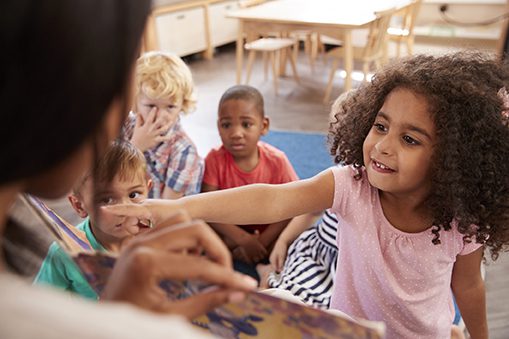
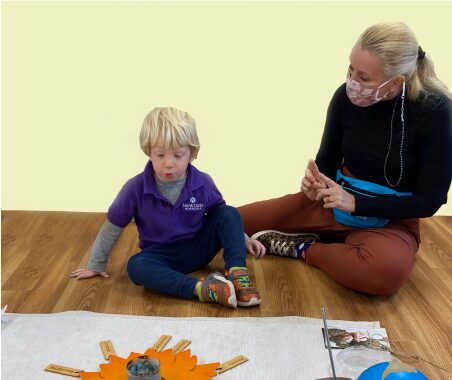
So what are we to do? Here is Montessori ‘s answer: Bring everything to the children “indirectly ” through a storytelling that reveals to their deepest knowing the challenge, the truth, the meaning that lies hidden within. Storytelling is the only way. Storytelling has the power to give the experience of that which is ineffable — that given reality of another which can never be put into words but only can be captured in the life of the telling – in the drawing – in the music – in the dance – in the story. Sharing such a given causes a communion to take place between us, the educators, and them, the listeners sitting right there before us. The magic comes from the fact that in the act of storytelling we ourselves return to innocent experiencing, to that primeval connecting with others sitting around the fire that alone is the sacred place of wisdom sharing. To become a storyteller we must first of all be gloriously alive–alive to ourselves–alive to all that is going on around us–alive in our seeing, hearing, touching. The sure sign that we are becoming the storytellers we need to be will be found in the pure fact of this happiness of our being alive.
Storytelling every “academic subject ” with the children enables us to possess and share with them every aspect of human life in a timeless experiential way that has wisdom at its core. Once the story has had its way with them, they are ready to work and to make all their learning a personal, self-motivated act. The profoundly personal sharing that is storytelling is the beginning of wisdom for children — and is the wellspring of human compassion without which knowledge is soulless and without purpose. Without wisdom and human compassion, knowledge is pernicious. So of all the skills we must master in our craft as Montessori educators, the art of storytelling is primary.
Adolescence Without Tears – The Montessori High School
Adolescence Without Tears – The Montessori High School A special issue from Tomorrow’s Child.
Adolescence is the middle ground between childhood and the world of adults. Teenagers are neither child nor adult. One minute they are one, next the other. Their bodies are growing overnight, and as sudden spurts of growth begin, they often become awkward as the body’s center of balance is thrown off. As their muscular development proceeds, many literally don’t know their own strength.
Leaving childhood behind them, teenagers enter a stage of life in which they are betrayed by their own bodies. With the onset of puberty, both their bodies and emotions tend to change dramatically. Some mature precociously and have to learn to deal with the body of a 16 year old and the way that it affects their social relationships with peers and older teens, while others wait impatiently for puberty, convinced that they’ll never mature. They have to cope with emerging sexuality and hormonally driven conflicting emotions. It is normally a time of life marked by uncertainty and self-consciousness.
Between their changing bodies, changing social roles, the emergence of mature sexuality, and raging hormones, it is not surprising that early adolescents worry so much about the image they project to the outer world!
To read more on this topic, Download File.
How to be an Effective Advocate for Montessori
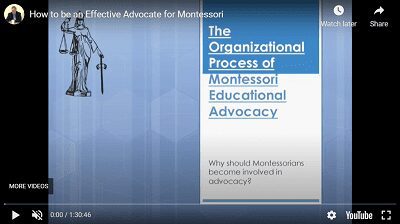
On January 8th, 2015, Cindy Acker and Tim Seldin recorded this workshop for anyone interested in learning how to be an effective advocate for Montessori at the State level. We discussed the importance of advocacy for the entire Montessori community and how effective advocacy works from a practical perspective. While prepared for members of the International Montessori Council’s State and National Delegates Network, it will be of interest to any members of the Montessori community who want to get involved in Montessori advocacy.
Becoming a Montessori Teacher
Montessori parents often make the best Montessori teachers. The same things that draw enthusiastic parents to a Montessori school in the first place, inspire some to become Montessori teachers themselves. Some parents approach their children’s school, or are themselves approached, about the possibility of taking Montessori teacher training. Many Montessori teachers and administrators began as Montessori parents themselves.
Perhaps the most important thing to keep in mind is that Montessori is not simply a teaching method; it’s a philosophy of life.
Most courses in the United States require a college degree; although, candidates who have yet to complete their undergraduate diploma may be able to take a Montessori teacher education course and receive a provisional Montessori teaching certificate. Some states require teachers to hold a 4-year degree, and may also require teachers to hold a state teaching credential as well. Check on the requirements in your state.
Anyone who is interested in becoming a Montessori teacher should be aware that the quality of Montessori teacher education programs can vary, and an important thing to keep in mind is the credibility of the diploma that will be received once the course is completed.
In North America, and increasingly abroad, accreditation from The Montessori Accreditation Commission for Teacher Education (MACTE) is widely recognized as an essential element in for Montessori teacher education programs.
Several Montessori organizations affiliate more than 100 Montessori teacher education programs in the United States, Canada, and other countries under the umbrella of MACTE accreditation. In some cases, an exception may be individual courses run by the Association Montessori Internationale (AMI), which is a world-wide teacher education organization that accredits its own courses.
In North America, the two largest Montessori associations are the American Montessori Society (AMS) and the Association Montessori Internationale (AMI). There are several other Montessori associations, which, while not as well-known, also play significant roles. They include the International Montessori Council (IMC), Montessori Educational Programs International (MEPI), and the Pan American Montessori Society (PAMS). In North American there are also a dozen or so smaller Montessori associations, and a growing number of independent Montessori teacher education programs, many of which are also accredited by MACTE.
Montessori teacher education programs usually involve a year or more of concentrated study and formal student teaching. The course of study almost always includes Montessori educational theory and philosophy for the age level of students for which the course is designed to prepare teachers to guide, child development and brain research, group and individual psychology, child study and observation skills, tracking individual progress, classroom management, and the Montessori curriculum and educational methods designed for the given age range of students in the areas of everyday living skills, sensorial development, language arts, mathematics and geometry, geography, history, science, the arts, movement education, and peace education. Accredited courses will also include field experience observing well-established classrooms are work, and the completion of a supervised student teaching experience.
Montessori Teacher Education Programs usually follow one of three primary approaches:
A full-time course of study that may run for a year or more of intensive residential study, or a series of full-time intensive summer sessions, adding up to the equivalent of the year-long course, which are run over two, three, or four years depending on the level of Montessori education being studied. The Association Montessori Internationale (AMI) traditionally organizes their courses into one of these models, as do some courses that are affiliated with the American Montessori Society and other teacher education associations. Montessori teacher education courses that are sponsored by universities, typically offering a Masters in Montessori education also tend to follow this model.
Summer Intensive Residential Courses: A second model organizes the formal course of study into one or more summer institutes of six to ten weeks of full time study at Montessori Teacher Education Center, followed by a supervised year-long student teaching experience. Weekend institutes may be included. Many programs that are affiliated with the American Montessori Society (AMS), Montessori Educational Programs International (MEPI), the Pan American Montessori Society (PAMS), and many of the independent courses follow this model.
Accredited Blended Residential and Distance Learning: A third model involves a blend of residential and distance learning, which, offers both the time for extensive coursework without the need to spend a year in full-time study. Programs following this approach normally require a residential program of one or two three-weeks, but a very extensive distance learning program that runs from eighteen to twenty-six months, depending on the age level being studied. A year-long student teaching experience is also required. These accredited programs involve very formal work in cohort groups over the duration of the course. Extensive use is made of streaming video of lectures, classrooms at work, lessons being presented, and strategies for observing and tracking student progress. The Center for Guided Montessori Studies (www.guidedstudents.com), which is affiliated with the International Montessori Council, pioneered the design of MACTE accredited programs that follows this blended approach. Several other blended programs have now been accredited by MACTE as well.
All three models –full-time, summer institutes, and blended low-residency and formal distance learning– have their own distinct strengths, and tend to appeal to different learners. Speaking personally, I find that spending an extensive period of time in residential programs is extremely rewarding, but the cost and requirements of residential programs are daunting to many people. Blended programs are in general more convenient, flexible, and have the advantage of allowing student teachers to go back over lessons any time they want to review. On the other hand, I find that some people don’t want to work as hard as the year-long programs, both residential and blended, require. Also, some learners are not comfortable with online learning. They prefer being there in person. Speaking as someone who has taught in both types of Montessori teacher education programs, I enjoy the residential experience more, but am amazed to see the same sort of community spirit and collaboration develop in very well-designed distance learning courses.
There is no question that modern internet communication makes it possible to learn things from afar that one could only do through by spending long periods away from home before. Each model has its loyal advocates, and selection of one over the other is a matter of personality and preference.
Teacher training is typically offered at the infant-toddler (birth to age 2), early childhood (ages 3-6), lower elementary (ages 6-9), upper elementary (ages 912), and secondary levels (ages 12-15 and ages 15-18).
Several organizations offer distance courses that do not meet the standards for MACTE accreditation. Please be aware that some states and provinces, and many individual schools, and Montessori School Accreditation programs, will not recognize these credentials. If you are considering an online or correspondence course, it is important to check with several schools at which you would like to teach to determine if this sort of training will meet their standards.
Finally, it is also important to recognize that individual schools may be committed to only hiring teachers with a credential from one specific organization to ensure consistency of their program. If you have a specific school in mind where you hope to join the faculty, speak with them about their individual requirements.
Salaries for Montessori teachers in independent schools are generally acceptable, but may be lower than those offered by local public schools. Teachers in independent Montessori schools generally report that lower salaries and benefits are more than offset by greater job satisfaction and freedom from the paperwork and bureaucracy found in many public-school systems. Montessori teachers are generally in short supply, and in many situations certified teachers will find several schools competing for their services.
For more information about Montessori teacher training programs, here are some of the organizations in North America that may be able to help you find a program that meets your needs:
Montessori Accreditation Council for Teacher Education (MACTE)
108 Second Street, S.W., Suite # 7, Charlottesville, Virginia 22902
Phone: (434) 202-7793 Fax: (888) 525-8838 Website: www.macte.org Email: rebecca@MACTE.org
The American Montessori Society (AMS) 116 East 16th Street, NY, NY 10003 P: 212-358-1250 F: 212-358-1256 E: ams@amshq.org
Association Montessori Internationale/USA (AMI/USA)
410 Alexander St. Rochester, NY 14607 Phone: (585) 461-5920 Fax: (585) 461-0075 (website: http://montessori@amiusa.org
International Montessori Council, 19600 State Road 64, Bradenton, FL 34212 Phone 941-729-9565 Fax: 941-745-3111 Website: https://stage.montessori.org/IMC
Montessori Educational Programs International (MEPI) PO Box 6, Smithville, IN 47458 Phone: 812-824-6366 Fax: 888-708-2470 Website: http://www.mepiforum.org
Pan American Montessori Society (PAMS) 752 Red Coat Cove, Kennesaw, GA 30152. 678/594-2269 FAX 678/594-2289 website: http://www.panamericanmontessorisociety.com
Sample Blueprint of a Montessori School’s Core Values
The Sample Montessori School
A Blueprint of Our Fundamental Values and Beliefs
Our Vision
Our broadest vision is of a world that lives in peace, a world community based on interdependence and respect for all life and all people. Our vision for our school is a Montessori school community of supportive parents, dedicated teachers and staff, and joyful learners.
Our Mission
The Mission of the Sample Montessori School is
To inspire a passion for excellence
To nurture the curiosity, creativity, and imagination born within us all
To give our children a vision of the universe
And to awaken the human spirit of every child
Our program rests on four pillars
1 The cultivation within our students of a passion for excellence in everything they do, both in and outside of school
2 The development a strongly held set of universal values, which include self-respect, respect for others, honesty, integrity, responsibility, empathy, compassion, kindness, peacefulness, a sense of concern for others, warmth, and a love of community
3 The development of a global perspective and sense of international understanding
4 And a lifelong commitment to give something back through service to others who are in need
1. Educational Program
1.1. The Fundamental Nature of our School
1.1.1. The Montessori approach to learning is the educational framework of our educational program.
1.1.2. Sample Montessori School is committed to being an international and multicultural school.
1.1.3. Sample Montessori School is designed to prepare students both for the university and for life.
1.1.4. Our school teaches children to be at home in the world of nature.
1.1.5. Sample Montessori School is a family-friendly school.
1.1.6. We are committed to character and values.
1.1.7. We are committed to diversity.
1.1.8. Sample Montessori School is a close-knit community of students, educators, parents, and friends of the school.
1.2. The Montessori approach to learning is the educational framework of our educational program.
1.2.1. The Montessori approach to learning in its most authentic understanding is the framework of our educational program. We understand that Maria Montessori’s methods and materials are a logical system based on fundamental principles, not a closed/rigid system, and we commit to apply the words, wisdom, and practical advice of Maria Montessori as the lens through which we select, design, and evaluate our program and our curriculum.
1.2.1.1 We will reference the International Montessori Council criteria for the definition of authentic Montessori programs as approved by the IMC Board in March of 2009.
1.2.2. The nature of the child and the learning process
1.2.2.1. We affirm that education begins at birth and continues throughout life. While our emphasis is on our children, we are a center of support for people of all ages to continue learning and developing toward becoming whole, balanced, and healthy individuals.
1.2.2.2. We believe that intelligence is not rare among human beings, nor is it fixed at birth.
1.2.2.3. We believe that the vast majority of people have the intelligence and natural ability required to learn everything they need to lead full, happy, and productive lives.
1.2.2.4. We believe that wisdom can be cultivated.
1.2.2.5. We believe that true wisdom is the ability to listen to your heart and know how best to put your intelligence to work for you. In order to achieve this goal, self-esteem, human dignity, and emotional well-being, as well as the ability to communicate and cooperate effectively with others, must be valued at least as highly as academic and material success.
1.2.3. We approach learning by seeking to understand and respect each student’s uniqueness and by guiding them individually at their own pace through the range of learning skills so that they fully realize their potential.
1.2.4. We celebrate the natural diversity of human beings, be it in learning style, interests, or definition of what makes a happy and successful life.
1.2.5. We affirm the ideal of the Renaissance person. Our ultimate goal is to produce renaissance men and women who have not only learned how to learn but also have an innate love of learning, a wide range of interests, and an openness to new ideas and possibilities.
1.2.6. We nurture self-esteem and affirm that it is a crucial ingredient for the full expression of a person’s potential. This is the very fabric of our community and our educational methods.
1.2.7. We teach students not to be afraid of failure. We support them in stepping outside of their comfort zone and to not fear taking risks. We encourage them to learn from their experiences—both successes and failures—and to accept the outcome as non-threatening feedback on their progress and personal growth.
1.2.8. We nurture intellectual, emotional, spiritual, and physical growth in developing a whole, healthful being.
1.2.8.1. Intellectual. The intellect is an important tool in shaping our world. Through developing our thinking abilities, we refine our emotional responses, clarify our picture of the universe, and develop the discipline to maintain vibrant health and well-being.
1.2.8.2. Emotional. Our emotions are complex and powerful, and it is very important that we learn to feel them fully and without fear, to identify them correctly (in ourselves and others), to respect them, and accept them. It is equally important, however, that we learn to harness their power and not let them control our lives unchecked.
1.2.8.3. Spiritual. We recognize that it is each individual‘s task to develop their own understanding of the nature of the universe and the individual’s place in it. We encourage children to celebrate life, focus on the positive, develop the spiritual side of their lives according to their individual beliefs, and [enjoy/find/experience/strive for] inner peace [or the peace within].
1.2.8.4. Physical. We seek to help our students discover, understand and adopt the most appropriate and beneficial lifestyle habits for our bodies and minds. Among these are fresh air, pure water, exercise, sunlight, and a proper diet.
1.2.9. Developmental Approach to Education. Our educational approach is centered around the stages of human development.
1.2.9.1. Developmental stages. Our faculty is actively involved in the continuous study of human development. This study includes keeping abreast of current theories on development, regular student observation, and a constant evaluation of the curriculum to ensure that it is appropriate for the developmental stages of our students.
1.2.9.2. Individualization. We strive for individualized pacing and adaptation of the classroom program (when possible) to meet varied styles of learning.
1.2.9.3. Flexibility. Our educational program is designed for flexibility in its methodology and use of resources.
1.2.9.4. Academic expectations in an individualized approach. We establish and follow an individualized educational curricular framework of basic academic achievement leading each child toward graduation or progress to the next level or phase of their education.
1.2.10. Active learning. We promote active rather than passive learning.
1.2.10.1. We promote spontaneous, self-initiated learning by encouraging students to explore their personal interests.
1.2.10.2. We use hands-on, “experiential” learning whenever possible rather than lecture and drill. This includes such things as concrete manipulative learning materials, experimental discovery, seminar discussions, independent library research, field investigation, or computer simulations.
1.2.10.3. We reinforce the continuing sense of student accomplishment, closure, and recognition through identifying, pursuing, and reaching pre-established learning goals.
1.2.11. The Passage to Abstraction. We help students to move from the concrete stage of learning through seeing, touching, and manipulating learning materials to stages of increasingly abstract understanding and the ability to apply concepts and skills.
1.2.11.1 To facilitate this process, we consistently work from a very concrete level of experience to the abstract.
1.2.11.2 To aid students in learning, we begin by giving them the “big picture” (a sense of gestalt), and work from this toward increasing detail.
1.2.11.3 This concept has created a spiraling curriculum in which skills and concepts are presented and reintroduced at increasing levels of complexity and abstraction over the years.
1.2.12. External structure. Our goal is to help children develop an inner sense of order and self-motivation. As necessary, we provide them with “just enough” of a foundation of external structure and support that helps them continue developing during the time when they have not yet developed that structure for themselves.
1.2.12.1. We want to “follow the child”; however, we acknowledge that within our society, there are cultural expectations where children are expected to conform to certain benchmarks. If a child’s best efforts are not developing those skills within a certain amount of time, we will try to provide additional structure as necessary to help the child progress within those guidelines.
1.2.13. Freedom within order. We strive for a balance between freedom, order, and responsibility.
1.2.14. Diverse Learning Styles. We acknowledge that children learn in different ways and at different paces.
1.2.14.1 Our goal is to view each child as a unique human being and to be as flexible as possible in addressing his or her learning style and needs as an individual learner.
-
-
-
- We seek to provide an environment open to students with diverse learning styles, while our primary focus will always be the well-being and best interests of those students who will thrive in our Montessori environment. In every case, we assess whether our school is able to meet a student’s needs while keeping the integrity of the classroom.
-
-
1.2.15. We nurture curiosity, creativity, and imagination.
1.2.15.1. We consciously work to encourage creativity in writing, problem-solving, and research.
1.2.15.2. We value artistic growth and expression.
1.2.15.3. As is appropriate for each age group, we encourage students to become aware of our day’s major social, political, economic, environmental, and ethical issues. After carefully considering different perspectives, we encourage students to formulate and support a personal position. If they wish, we challenge them to take a stand for themselves and/or explore ways of making a positive personal contribution to society.
.2.16. Interpersonal Communication Skills. We encourage our children to become self-confident, articulate, and assertive in their interpersonal communication skills. To that effect, we model and encourage effective communication among students and adults. We would like all community members to be versed in skills of active listening, negotiation, fair fighting (verbally), conflict resolution and debate, empathy for another person’s position, and the ability to stand up for oneself and say no without guilt if someone is encroaching on their rights.
1.3. We are committed to being a multi-cultural international school.
1.3.1. We embrace and teach a global perspective as a philosophy for building a diverse community grounded in knowledge that encourages understanding, respect, and acceptance of all peoples.
1.3.2. We value and celebrate a diverse multicultural and international community of students, faculty, and staff and acknowledge the unique contributions of all individuals who enrich and inspire our personal growth.
1.3.3 We model and teach respect at every age level while discouraging stereotypes in an age-appropriate way.
1.3.3.5. We seek to develop a global perspective and international understanding, weaving international education through our curriculum at every age level:
1.3.3.5.1. through the study of modern foreign languages;
1.3.3.5.2. through the study of physical, cultural, and economic geography;
1.3.3.5.3. through correspondence, international travel, and student exchange programs with our sister Montessori schools (as is age appropriate);
1.3.3.5.4. through encouraging families to share their cultural traditions, travel experiences, and traditional festivals;
1.3.3.5.5. by utilizing our international families as a tremendous teaching resource;
1.3.3.5.6. through an ongoing experiential program of international cultural education.
1.4. Sample Montessori School prepares students for university.
1.4.1. We want our students to be well-educated in the basic academic disciplines, to fulfill their creative potential, and to gain satisfaction in their physical, emotional, spiritual, social, and intellectual development.
1.4.2. We offer a rigorous college preparatory curriculum:
1.4.2.1. Science. Students will study science every year. Our curriculum will be consciously integrated, incorporating topics from botany, zoology, physical science, machines and technology, astronomy, geology, ecology, earth science, weather, and the medical sciences. We teach students not only scientific facts but the process, history, and true nature of science. We want them to understand that science is not the subjects that scientists study, like the nature of atoms, but the process of studying the world, with the goal of arriving at conclusions about what is probably true and what is probably not. Its end product is simply reliable information.
1.4.2.2. Foreign Language. As an international school, our students will study a modern foreign language every year. The goal is for each student to work towards fluency in at least one modern language in addition to their native language.
1.4.2.3. Mathematics. Our approach will be Unified Math: integrating topics in arithmetic, geometry, pre-algebra, statistics, logic, algebra, trigonometry, and calculus. Whenever possible, we will help students grasp the underlying concepts of math through the use of concrete apparatus and through the application of mathematics to real-world tasks.
1.4.2.4. Economics. We want to be known as a “School for Entrepreneurs.” Our children will live in a world in which economics is a constant basic element of their lives. While money is not the most important thing in our lives, the stress that follows a lack of sufficient money to pay one’s bills can have a negative impact on everything that is important. Our goal is for our students to both understand the principles of economic freedom and to feel comfortable with financial and business matters. Whether or not they choose to run their own businesses, we want them to develop an entrepreneurial spirit.
1.4.2.5. Geography. As an international school, we seek to develop a global perspective and international understanding, teaching world geography (physical, cultural, political, and economic) at every level of the school.
1.4.2.6. History. We develop a strong historical perspective through the study of prehistory and history, following an anthropological orientation into fundamental needs of humankind and the cultures, lifestyles and technology of the past. We cultivate an appreciation of family and community heritage. History sets the stage for integrated learning at every age level.
1.4.2.7. Anthropology and Mythology. Again, as part of our nature as an international school, we teach students the basic elements of anthropology, addressing the question of what makes us human, the nature of culture, and how cultures have attempted to explain or illuminate the great questions of life through story, myth, and cultural archetypes.
1.4.2.8. Major World Religions. We believe that our students should be familiar with the traditions and basic beliefs of the world’s major religions. While we do not teach religion, nor advocate any particular belief system, we encourage students to explore questions raised by religious teachers and develop the spiritual side of their lives (the ability to find peace within and hear the small voice within us all).
1.4.2.9. Architecture. We all live surrounded by buildings. We believe that our students should understand the patterns of architecture found around us, how houses are constructed and designed, and develop an appreciation for the timeless beauty of well-designed spaces.
1.4.2.10. Civics and Law. We strongly believe that our students should understand how government works at the local, state, and federal levels, and the role that citizens can and should play in shaping consensus, advocating their point of view, and making informed decisions before they vote. They should also understand how the legal system works and have an informed working knowledge of and respect for the law. Our goal is to lead young men and women to keep informed about current issues and to play an active and responsible role as citizens of our nation.
1.4.2.11. Language Arts and Literature. Naturally, we are looking to develop students who read and write with facility, and both read voraciously and write with enjoyment. We explore all forms of human communication. We recognize that we live in a time when the various languages of art, (visual, written, spoken and musical) particularly through mass media, have a profound impact on our lives. We develop in each person the ability to understand and filter this influence. We also believe that by developing our ability to use these languages we strengthen our self-esteem and enhance our ability to express more effectively our thoughts and feelings.
1.4.2.12. Research Skills. Rather than having students memorize facts mindlessly, we would rather teach them to learn mindfully and develop great skill in the process of doing investigations and research using the library, internet, public records, and primary and secondary source materials. Interviewing skills are also very important skills that we emphasize. We seek to have our students learn how to organize the information that they compile into increasingly sophisticated reports and presentations. As a result, textbooks will play an insignificant role within our educational program.
1.4.2.13. The Visual and Performing Arts. Our program places great emphasis on the Fine Arts, both through the contributions of our Music and Art specialists and through classroom programs and experiences initiated by the teachers to foster art and music appreciation and creative drama.
1.4.2.14. Physical Education, Health, and Athletics. We want our students to understand, appreciate, and adopt a healthy lifestyle that includes exercise, proper diet, intelligent choices regarding personal health, and stress reduction. We believe that individual and competitive team sports make up an important element in reaching these goals.
1.4.2.15. Peace Education. Human relations and conflict resolution skills, nonviolence, leadership training and cooperative teamwork skills, and communication skills are all important elements in nurturing our students. Peace Education will be as vital an element of our curriculum as mathematics and science.
1.4.2.16. Creative thinking and problem solving skills.
1.4.3. Academic standards. In all cases we set our expectations high, not asking individuals to do more than that of which they are capable, but consistently stressing at all levels the importance of careful work and pride in accomplishment. The reward is not in the quantity of work achieved but the satisfaction of work done well for its own sake. We carefully build a supportive environment for the unhurried mind to move steadily toward the pursuit of excellence.
1.4.3.1 Students’ practical life experiences will include opportunities to research and apply for additional learning experiences beyond their Sample experience.
1.4.3.2. Assisting students with applications process. Students will have an understanding of what needs to be done to complete the admissions process for university and other professional schools.
1.4.3.3. Competition. We believe that it is neither necessary nor appropriate to inspire unrestrained academic pressure and scholastic competition among students. We cultivate the ability to accept success with grace, and failure or loss with dignity, and resolve to build on the experience. We ensure the right to choose whether or not to participate in competitive activities, and we stress the principles of good sportsmanship.
1.4.4. Success. We design our educational program to maximize each person’s academic and personal success. We strive to encourage people to build on their strengths and personal learning styles and learn from their mistakes.
1.4.4.1. Academic success. We encourage skills that support independent and successful learning, critical thinking, cooperative projects, reflective reading, problem solving, library research, use of technology, techniques for effective study, test-taking strategies, and techniques for focusing attention.
1.4.4.2. Personal success. We consider it equally important that our community members be successful human beings who can establish healthy relationships and achieve happiness in their personal lives. We teach our students to pay attention to and respect feelings, both their own and those of others. We help them to learn to solve conflicts effectively and fairly, and to express their feelings in a healthy manner. Group dynamics and communication skills are also stressed.
1.5. Sample Montessori School prepares students for life (Our goal is to inspire a passion for excellence and a lifelong love of learning) Sample Montessori School provides a broad preparation for life, balancing academic excellence with the development of personal and practical life skills.
1.5.1. We teach universal values
1.5.1.1. Empowerment: We make a concerted effort to empower people at our school, helping them to learn how to make responsible choices for themselves, to recognize that they are assuming increasing control over their lives as they mature, and to discover how to make a difference in the world around them by positive efforts and contributions to others.
1.5.1.2. Our goals for students are for them to be open-minded and compassionate, to gain a sense of themselves and others, and to understand and appreciate the diversity of the human spirit.
1.5.1.3. To facilitate the development of independence and a sense of engagement with the community we strongly encourage participation in day-to-day classroom management, care of the environment and decision making. We seek to help each student to feel a commitment both to the local and the global community of humankind. We want each student to understand that the good of the individual and that of the community are interdependent.
1.5.1.4. We want students to love learning and to value knowledge, creativity, and humor. Finally, we hope they will be responsible, critical, and caring members of a pluralistic society and recognize that they have the power and resources to effect change as well as the self-esteem and confidence to pursue their goals.
1.5.1.5. We respect the fundamental human needs, rights, and dignity of each person, no matter how young, as a full and independent person who is engaged in the ongoing process of development. During this process, while honoring the right to self-determination, we model and encourage certain values: kindness, honesty, warmth and openness, respect for each person’s uniqueness, tolerance, cooperation, good sportsmanship, and nonviolence.
1.5.1.6. Celebration of Diversity As educators, parents and citizens of the world with the mutual goal of world peace, we consider it our responsibility to model and encourage acceptance and celebration of cultural, racial, religious beliefs, appearance, socio-economic position, and other differences among people , both to our children and to each other.
1.5.2. Discipline
1.5.2.1. Ultimately we wish for every community member to be willing to accept full responsibility for their behavior, their attitudes, their experiences, and in short for their lives. The enormous reward that comes with accepting this responsibility is the freedom to choose and create the type of person they wish to be, and the life they wish to lead.
1.5.2.2. In keeping with the true meaning of the word discipline, which is to teach, we prefer to model and encourage appropriate, kind, and considerate ways to behave in various situations.
1.5.2.3. School should be safe. We endeavor to provide a school environment that will promote and protect the physical and emotional well being of our students and staff.
1.5.2.4. Rather than focus on rules and the consequences for students of breaking them, we prefer to teach students beforehand appropriate, kind, and considerate ways to behave in given situations. We use positive reinforcement whenever possible to praise their progress, acknowledge their contributions, and strengthen character. As necessary, we cue and remind students of appropriate behaviors before they forget, and, when behavior is inappropriate and a gentle reminder isn’t enough, we intervene and respectfully, but firmly, stop the behavior.
1.5.2.5. We will never permit the use of corporal punishment.
1.5.2.6. We encourage and model ways to negotiate in conflict situations so that whenever possible everyone can win and at the very least everyone feels heard and that her feelings and needs are respected.
1.5.2.7. As necessary we cue and remind people of appropriate behaviors before they forget.
1.5.2.8. When behavior is inappropriate and a gentle reminder isn’t enough, we intervene and respectfully but firmly stop the behavior.
1.5.2.10 Our ultimate goal is to encourage self- discipline and self-motivation as the reasons for behavior rather than fear or motivation from without.
1.5.2.11 We do not label a child as “bad,” but instead try to recognize the mistaken goals of the misbehavior that usually involve an attempt at searching for a place in the family or community, even if it is an undesirable place. We then look to find appropriate ways to encourage the individual.
1.5.2.12 While we are normally successful with a very wide range of students, we can never be right for every child. One of our greatest challenges is to be objective, compassionate, yet realistic in considering the needs of each child as a unique individual. When we fail despite our best efforts to work with the child to help him/her meet appropriate behavioral expectations within the school’s fundamental ground rules, we sadly and reluctantly counsel the family to seek out another school setting in which the child can experience success.
1.6 Community Service
1.6.2 We seek to show and teach our students that the freedom and education they receive here come with the responsibility to help others both in the community, and those less fortunate but no less deserving. To show them that the responsibility to change our world for the better lies with all of us, and that service needs to be an accepted part of everyone’s life if we are to achieve this goal. Opportunities to perform community service in the community at large include, the adoption of needy families by the classes at holiday time, sharing of clothes and toys with underprivileged children, and opportunities to volunteer at nursing homes, soup kitchens and hospital nurseries.
1.7 Practical Life skills: To facilitate and encourage a sense of independence, we deliberately teach a wide range of practical life skills appropriate to each child’s level of development. We regard this as a vital element affecting the design of our entire curriculum. These practical life skills include the following:
1.7.1. Eye-hand coordination and the use of simple tools.
1.7.2. Grace and courtesy: appropriate ways to handle situations kindly.
1.7.3. Practical economics: the value and use of money, including how to earn and manage spending money.
1.7.4. Technology: the safe use of technology, such as more complex tools, telephones, computers, classroom audio-visual equipment, and household appliances.
1.7.4.1. Computers: We use the computer as a fundamental tool for learning, not only as an element of contemporary practical life, but also as an aid in the development of logical planning and problem solving.
1.7.5. Transportation: As appropriate at each age level in our school, the safe use of alternate means of transportation other than a parent’s car, such as hiking and bicycling, public transportation, and (if we ever extend to the secondary level) driver’s education.
1.7.6. Communication: the appropriate use of the technology of personal and mass communication, from writing letters to using the telephone, using the word processor, preparing the newsletter, speaking before an audience and designing audiovisual presentations.
1.7.7. Care of ones Environment: how to clean and set tables, do dishes, cook, sew, iron, infant and childcare and laundry.
1.7.8. Health and Safety: the development of sound habits of safety, nutrition and hygiene, along with the acquisition of first-aid skills and as developmentally appropriate, CPR.
1.8. The world of nature
1.8.1 Strengthening our connection with nature and the environment is an integral part of Woodland Hill.
1.8.2. We seek to instill in our students, parents, and staff not only a reverence for the earth, its waters, and all living things, but also a sense of stewardship for the environment based on a conviction of our individual responsibility for the beauty of the land and the health of our ecosystems.
1.8.3. We seek to instill in our students, parents, and staff not only a reverence for the earth, its waters, and all living things, but also a sense of stewardship for the environment based on a conviction of our individual responsibility for the beauty of the land and the health of our ecosystems.
1.8.4. We believe that being at home in the world of nature is basic to being a whole and healthy human being.
1.8.5. We consciously work to foster in each person a strong sense of belonging to the web of life. We accomplish this goal through:
1.8.5.1 Programs in outdoor education, and field biology at every age level in the school, using the natural setting of our campus and the wide variety of natural resources around us as a classroom out of doors.
1.8.5.2 Programs in gardening and small animal care
1.8.5.3 Programs in camping, canoeing and field ecological studies in natural wilderness settings.
1.8.5.4 We stress recycling and environmentally friendly packaging for lunches and all foods and products used in our community.
1.9. We are committed to being a family-friendly school
1.9.1. In establishing policies and procedures, we attempt to remain sensitive to the needs, desires, and factors that might add unnecessary stress and pressures onto our families.
1.9.2. Also, in establishing policies and procedures, along with setting the calendar of school events, we will attempt to avoid conflicting with the religious traditions and holy days of our families. We recognize that this at times may be virtually impossible considering our diversity, but at the very least every effort will be made to create a balanced and respectful approach to this issue.
1.9.3. From time to time, we will survey our families or hold special community meetings to explore how the school could be more family friendly.
2. Faculty
2.1 We carefully identify the duties and responsibilities of each position in the school.
2.2 We carefully identify the skills and knowledge, experience, educational philosophy, core values, and interpersonal skills needed to be successful in each position at our school.
2.3 We take great care in our hiring process to find new members of our faculty and staff who bring the right mix of skills, knowledge, experience, values, and personality to succeed at our school.
2.4 We will clearly communicate to all members of the faculty and staff our expectations, personnel policies, and benefits and professional development opportunities that may be applicable to their positions.
2.5 In evaluating the school’s programs and performance of each member of the faculty we will be as objective and positive as possible, encouraging individual initiative, self-evaluation, and continuous professional growth.
2.6 We consciously follow fair and equal employment practices in hiring, assigning, promoting, and compensating both teaching and non-teaching staff members. We endeavor to employ persons solely on the basis of the factors necessary in the performance of the job and the operation of our school without discrimination on the basis of religious affiliation, race, national origin, gender, and any other factor on which discrimination is prohibited by the laws of the jurisdiction within which our school is located.
2.7 No official of our school will seek to induce a teacher who is under contract at another school to break that contract. [There is nothing deemed improper if a member of the teaching or administrative staff of one school independently approaches another school about possible employment.]
2.8 Our school will not offer employment to a member of the faculty or staff of another school without communicating with the Head of the school at which he or she is presently employed or committed for the upcoming school year to request a frank evaluation of a candidate’s qualifications. This information will be considered absolutely confidential.
2.9 Our school will take all reasonable and lawful precautions to maintain the confidentiality of records and information concerning teachers and other staff members who are applying for employment at another school, in accordance with the rights of the individual.
2.10 Any materials brought to School by a member of our faculty and staff, purchased with his or her own funds, shall remain his or her property.
2.11 It is mutually understood that any teacher-made educational materials produced by a member of the faculty and staff during the term of this Agreement using school materials and supplies shall be considered the property of the school. However, faculty and staff members may use school materials to make a duplicate set of these materials for his or her own professional library.
2.12 Should a faculty member develop any new curricula, teaching techniques, teaching aids, or any other educational materials during the course of his or her employment with the School, he or she grants to the School a perpetual license to utilize said materials or ideas in its educational programs with both children and teacher training.
2.13 Any teaching aids, materials, or curricula developed by the School, as well as any mailing lists of the School’s students and families, represent the proprietary property of the School. No member of the faculty will be authorized to sell, transfer, assign, or disseminate said materials to a third person or a competitor of the School without first obtaining the Head of School’s written approval.
3. Facilities
3.1 We will deliberately seek to create a campus of timeless beauty that communicates to our students that the buildings and grounds are expressions of our love and commitment to their education and success.
3.2 Whatever the size of our enrollment, or the age levels encompassed in our programs, our buildings and grounds will support the implementation of our educational program and institutional mission as ideally as possible.
3.3 Buildings will not be constructed for the sake of having space. Consistent with this blueprint, each will be carefully considered in terms of need, ideal space and configuration, and integration into the pattern language developed for our master plan.
3.4 As a Montessori school, we a very high priority for us will be to have a campus large enough to include areas set aside for natural habitat, as well as areas set aside for extensive programs in horticultural education, outdoor education, animal husbandry, and if possible, an equestrian program.
3.5 Whenever possible, the school will do everything in its power to keep the buildings and grounds free from toxic substances and environmental irritants. Whenever possible, pesticides and cleaning products will be found that are non-toxic and which do not induce allergic reactions in students or staff members.
3.6 The school will consciously follow safety procedures designed to protect students and staff. :
3.6.1 all power tools, fuels, paint removers, and other hazardous substances will be kept under lock and key
3.6.2 no lawnmowers or other potentially hazardous machinery will be used anywhere in the vicinity where children are present.
4 Finances
4.1 Our school honors its financial commitments to parents, staff, vendors, and others.
4.2 The board will not pass a deficit operating budget. We will operate on a balanced budget.
We are committed to building a contingency/reserve fund.
The budget will include a contingency/reserve line item.
We will endeavor to maintain a balanced operating budget without depending on income from fund raising projects.
4.3 Tuition will be set on the basis of what it costs to do the job right and meet the fundamental beliefs and values embodied in this blueprint.
4.4 We are committed to making this experience truly inclusive by pursuing funding sources and endowments to offer scholarships financial assistance for families who are unable to fund their child’s education themselves. We will set aside a portion of our tuition income every year to help support the school’s financial aid assistance program.
4.5. We will communicate accurate information about the financial state of the school in an annual report to the community and, from time to time, on a more frequent basis.
4.6 We will endeavor to operate without depending on income from fund raising projects
4.7 6. We expect all of our families, as members of our community, to honor their financial obligations to the school in a timely and responsible manner.
5 Recruitment and admissions
5.1 Admissions: Our primary goal in the recruitment and admissions process is to help each family determine whether our school is the perfect match with their values and goals, and the school setting that will work best for their individual child.
5.1.1 When we admit a new student, we are not simply bringing him or her into the school community. We are bringing the child, his or her parents, siblings, and extended family into the mix.
5.1.2 In making admissions decisions, we will weigh many factors, placing the greatest emphasis on whether the parents are deeply committed to sending their children to our school, hopefully for the long run and hopefully for the right reasons, and whether their values and goals for their children’s education are a close match with those of our school.
5.1.3 In making admissions decisions, we will normally give strong preference to families who we believe are committed to keeping their children in the school at least through the elementary years.
5.1.4 A Montessori student can never be replaced. Our secondary goal in the process of admissions and recruitment is to find families for whom the school will be a perfect match. We are seeking families who share common values and goals with the school, and who, after careful consideration and exploration, have concluded that our school is something that they want very much for their children, for the right reasons.
5.1.5 Hopefully the children whom we admit in the early years will graduate from our school. Ideally it will be so much a part of each family’s life that eventually the children of our graduates will attend our school as well. We want to be a family tradition.
5.1.6 In the admissions process, we consciously treat parents with respect as partners in exploring whether or not we would be the perfect match for their child. We do not use gimmicks, such as the hint that spaces are filling up fast.
5.1.7 We will not try to convince prospective parents that our school is right for them and for their child. Instead we will tell the truth, help them to grasp the true nature of the school and what it has to offer, and allow them to weigh all the factors out as they consider whether our school is indeed the right match for them and their child.
5.1.8 We will welcome prospective parents with open arms and make it as easy as we can for them to learn what our school is really all about:
5.1.8.1 We will hold open houses at least once a week and gladly schedule individual tours during school hours if for some reason the normal open house time is inconvenient.
5.1.8.2 We will normally make a list of the names and home phone numbers of Ambassador parents available to prospective parents who would like to speak with another family.
5.1.8.3 We will arrange frequent and convenient times when prospective parents can observe in our classrooms.
5.1.8.4 We will spend as much time with prospective parents as possible in order to answer their questions, address their concerns, and assist them in determining whether it feels to them as if our school would be a good match for their child.
5.1.8.5 We will consider applications for admission on a case by case open admission basis. We will do our best once an application has been received to arrange for the student’s visits and evaluations, gather all of the information needed to evaluate the application, and schedule all meetings and interviews in the most timely manner possible. We will endeavor to make and communicate all admissions decisions to the families as quickly as possible.
5.2 Non-discrimination Our school does not discriminate in matters of admission on the basis of race, creed, religion, national or ethnic background. We consciously teach children to celebrate the rich cultural diversity of the global community. We regard a mix of backgrounds and abilities as a positive and important element in our community.
5.3 Truth in Advertising As a member of the International Montessori Council, w We pledge to represent our school truthfully and accurately to the general public and internally to our parent community.
5.4 Negative Public Relations: We further pledge ourselves to respect the diversity of the community of Montessori schools. We will not engage in negative public relations nor make any negative statements about another Montessori school or any other school.
5.5 We will promptly consult with parents should it ever become clear that a student is not benefiting from the school’s program, or if the school is not the best program to meet his/ or her needs.
5.6 Our school recognizes each family’s right to visit and consider other schools and to hold preliminary discussions regarding admission without feeling compelled to notify the school, which that their children presently attend.
5.7 While we welcome inquiries and interest in our school, we will never knowingly attempt to recruit and enroll an individual student away from his or her current Montessori program who is presently enrolled in or committed to attend another Montessori program.
5.8. Before filing an application for admission, we ask that families advise their children’s present schools and authorize in writing the release to us of their children’s academic records and student recommendations upon our request.
6 Building Community
6.1 We are a close-knit community of students, educators, parents, and friends of the school.
6.2 Community is the invisible web that structures our pluralist beliefs. Culturally, historically and individually, our communities represent the best of our shared experiences. Our School presents an opportunity to expand the web of inclusion in our local community.
6.3 2. We recognize that a Montessori school is more than a place of learning; it is a community of children and adults that has a significant impact on our students’ capacity to learn, grow, create, develop, assimilate values, and relate peacefully and respectfully to other people and to the natural world.
6.4 3 We treat all students, families, teachers, and staff members, and all people with kindness, warmth, and respect.
6.5 4 We consciously work to build a constructive partnership between the family and school in support of each child’s educational development.
6.6 5. Within reasonable guidelines established to ensure the integrity of our educational program and the privacy of other students’ records, parents are welcome to visit the school to observe their child in class or to review his or /her academic progress.
6.7 6 We believe that every member of our community has a fundamental right to be treated with respect, regardless of age.
6.8 7 We place a primary emphasis on building relationships partnerships with families as early as possible in order to help parents recognize the uniqueness of their child. We also work together to enhance the help parents ‘ ability to parent incorporate Montessori philosophy into their family life.
6.9 8 We are an extended family community whose participants are supported at all levels by all others in the community.
6.10 9 We believe in the principle that those matters which affect individual community members directly impact all others in our community, We consider input from all of our community members in our decision making processes in order to take into account the needs of our total community.
We are committed to the creation of programs that stress personal development for all members of the community.
6.11 Parenting Center: We encourage parents to participate in programs that can help them to refine their parenting strategies, to facilitate the development of independence, responsibility, self-confidence and self- respect in their sons and daughters and in themselves. We recognize parenting as an extremely difficult, rewarding and valuable job for which we have had little preparation and for which in the modern world we get little support. We are committed to find ways to provide that support for families from birth through adulthood by the creation of a parenting center to include parenting classes, and ongoing support groups, and a parenting library, and car pooling.
6.12 The Ambassador Parent Program: We understand the special needs of new participants in the community and the necessity of a program to match new families with ones experienced in the community to provide support and information.
6.13 Support for Community Businesses: We will encourage and facilitate methods for members of our community to access the services of other community members.
6.14 Adult Development Programs: We encourage the establishment a program of adult classes and seminars on a variety of topics guided by community interest, in keeping with our commitment to a lifelong process of learning and personal growth.
6.135 Commitment to the values of the school: We expect all adult members of the school community to treat one another and the children in accordance with the core values of the school as embodied in this document. Members of our community, students, parents, teachers and support staff to be committed, contributing members of the community, and to show support for the ground rules, values, and principles established by the community, and we are prepared to support them in this effort as in some cases it may involve a paradigm shift.
6.146 Class and Community Meetings: We believe in holding monthly class and community meetings to allow and encourage a free and open exchange of ideas and information. Children are welcome to participate in these meetings.
7 Administration
7.1 The goal of our administration is to provide educational leadership, more than business administration.
7.2 The primary role of the Head of our school is to articulate the core values and vision, provide academic leadership, take leadership in the admissions and recruitment process, build community and reduce attrition among students and families, recruit and coach faculty members and staff, oversee the financial health of the school and support fundraising, serve as the school’s primary spokesman spokesperson to the larger community, and lead the process of internal self-evaluation and long-term planning.
7.3 The Head of School will ensure that excellence and consistency with our values and vision permeate the school seamlessly from class to class, from level to level, and from one year to the next.
7.4 Naturally the Head of School will support his or her faculty and attempt to provide similar support and counsel to the school’s families. However, the ultimate factor on which difficult decisions must be balanced is what is best for each individual child and what is consistent with the core values of the school.
7.5 When conflicts arise within the school, whether they involve parents, staff members, students, or administrators or board, every attempt will be made to find the best and highest resolution of the issues under dispute that is most consistent with the school’s fundamental values and is most oriented to a win-win model.
7.6 The administration of the school will ensure a smooth and timely flow of communication about important dates and information to parents, students, and staff, and board.
7.7 The administration will follow a collegial model in working with faculty members and staff, inviting their input and participation whenever appropriate in important questions facing the school.
8 Governance
8.1 The Board of Trustees shall be comprised of people who share a deep sense of commitment to the Sample Montessori School and Montessori philosophy. In all matters, they consider the overall best interests of the school over their own interests or over the interests of any constituent group within the school community.
8.1.1 The primary responsibility of the Board of Trustees is to ensure that the institutional identity, mission, and core values and beliefs about education that define the nature of the school are established and re-examined and refined and from time to time, reexamine, and if necessary refine, the institutional identity, mission, and core values and beliefs about education that define the nature of the school with the involvement of the community.
8.1.28.1.2 That The school’s mission, institutional identity, and core values and beliefs will be set down in writing in a working community document called the “Blueprint.”
8.1.3 Before beginning to consider voting on any motion made before the Board, the Board of Trustees will first consult the Blueprint to identify the underlying values and beliefs that would support whatever decision is made on the issue before the Board.
8.1.3.1 The Board will only approve motions that are supported by the core values and beliefs that are consistent with the blueprint.
8.1.4 If the Blueprint does not address the issue, or if the Board concludes that the Blueprint needs to be amended to more completely address the school’s underlying values and beliefs, it will go through the process of amending the Blueprint, with the input of the community as set forth below, before voting on the motion.
8.1.4.1 Before amending the blueprint, the board will formally request the school community review the proposed amendment and provide feedback.
8.1.5 The minutes of the meetings of the Board will reflect not only the motions passed, but also the text of the underlying elements of the Blueprint and will cite the section of the blueprint that supports the action.
8.1.6 Except when confidential matters are being considered, board meetings are normally open.
8.1.7 6 Except for confidential issues, the major actions of the board will be communicated to the school community in a timely fashion. These communications will include the motions passed, including the text of the underlying elements of the Blueprint.
8.1.7 Except when confidential matters are being considered, board meetings are open.
8.1.8 Concerned parents or staff members may request the opportunity to address their opinion to the board.
9 Fundraising
9.1 Every gift given to our school will be a gift of love, generously offered in support of our work
9.2 We will not nickel and dime our families to death with petty fundraisers. We will limit fundraising activities to major programs, such as the Annual Fund and Spring Benefit.
9.3 While donations of funds, tangible goods, services, or real property are deeply appreciated, the school can never accept any gift that would require it to violate any of its core beliefs outlined in this document.
9.3.1 While individuals wishing to donate funds to the school are welcome to designate the use to which they may be used, it is up the Board of Trustees to establish policy about who will decide on behalf of the school if they can be accepted in light of the conditions established.
9.3.2 Only the Board of Trustees can accept a gift of real property or tangible goods on behalf of the school that would potentially require the expenditure of funds to repair or maintain.
9.4 The Board of Trustees should be a key element in leading and promoting the school’s fundraising efforts.
10 Supporting Activities
10.1 (food service, transportation, after school programs)
11 Supporting Programs (summer programs, teacher training centers, parenting centers, etc.)
See also Why You Need A Blueprint of Your School’s Core Values And How To Prepare It As A Community
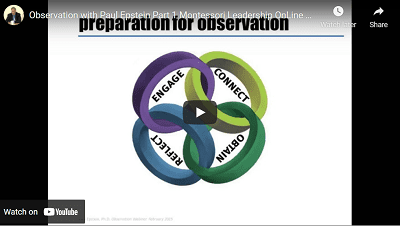
Observation with Paul Epstein Part 1
Paul Epstein and Tim Seldin
Dr. Paul Epstein is the well known author of a Montessori Observer’s Handbook. We will discuss best practices in ongoing reflective observation.
Secondary Montessori Education
This PDF is an excerpt from The Montessori Way by Tim Seldin and Paul Esptein.
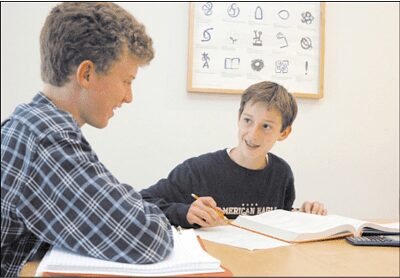
Your children have been in Montessori all their lives. They love school and learn enthusiastically. Montessori has been the perfect match, but your children are approaching the age where they will have to leave Montessori if their school doesn’t do something soon! And so you ask, “Why aren’t there any Secondary Montessori programs in our town? What would it take to start a middle school class at our school?” Most Americans have the impression that Montessori is just for early childhood. Even though Montessori schools have spread all over the world during the last century, most schools in the United States stop after kindergarten. Some schools run through sixth grade, but Secondary Montessori schools are very rare. This is beginning to change as more and more Montessori schools open elementary classes, and many have either opened or are exploring the possibility of developing middle school programs.
To read more, Download File.
Geography and History in the Early Childhood Classroom
This brief introduction to the topic was written by Tim Seldin in his excerpt from his book The World in the Palm of her Hand.
The Montessori Alliance Leadership Webinar
This week, Kathryn Kvols and Tim Seldin discussed the Montessori Family Alliance.
Tips to Handle Your Child’s “No” Gracefully
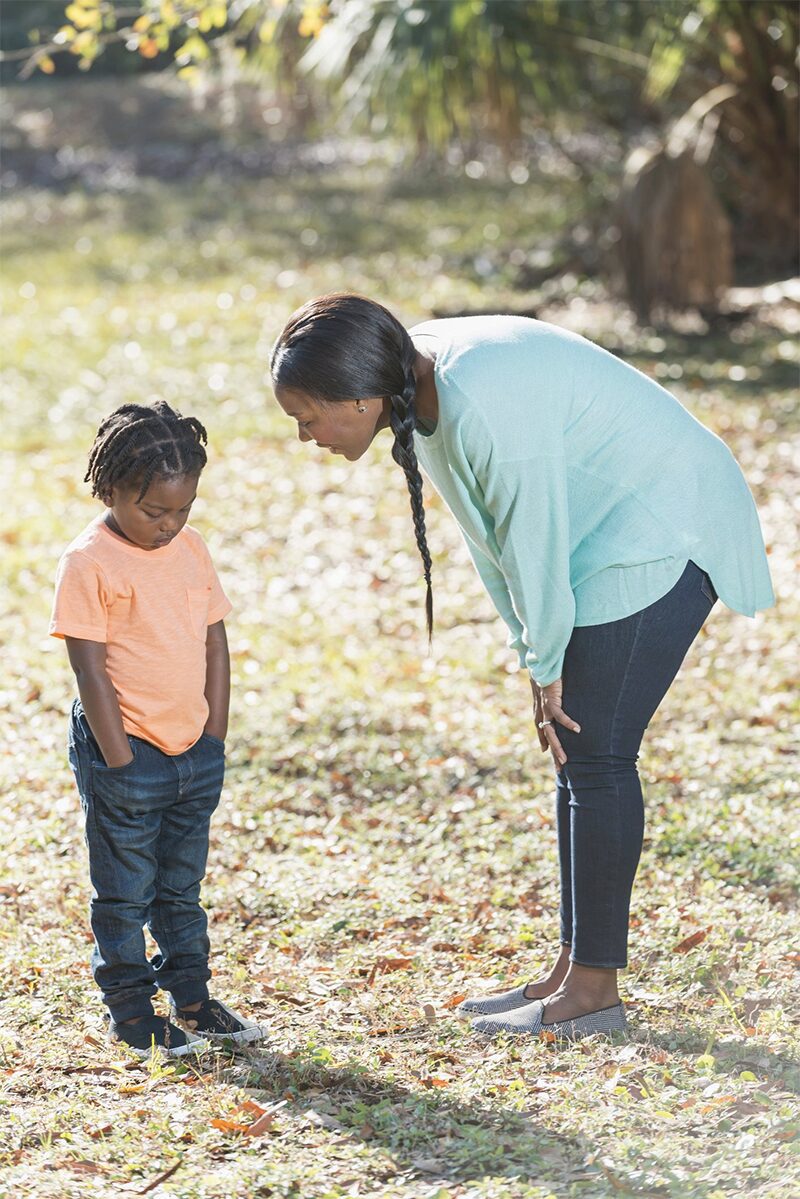
There are few words less nerve-wracking than hearing your child say “no” to you. Rest assured, your child is very normal. If she asserts herself with a “no,” you can pat yourself on the back. You have not raised a submissive child! The fascination with “no” stems from the fact that toddlers (and tweens) are starting to realize they are individuals who have a will of their own. This is the early beginning of your child learning to stand up for herself and knowing what she wants. She is learning to set her own boundaries and build the foundation for healthy relationships.
Children who become compliant at a young age often suffer later in life from lack of will and passion. As parents, we need to think very carefully about how we choose to respond to their lack of compliance.
How to Handle Their “No”
Check these first. Is he tired, thirsty, hungry, or getting sick? If yes, meet his physical needs first. Connect before you make a request. Children need to feel connected. If they don’t, they are more likely not to want to cooperate. Play a quick game of peek-a-boo, chase her around the kitchen island, and then make your request.
Ask questions instead of giving directives. When we give our children orders, it creates resistance. Learn to change your commands into questions, i.e., “Put your toys away” becomes “Where do your toys belong?” This is very simple, but most of my clients report fast immediate results. Don’t argue with him. This is a battle that can’t be won. It has no good ending, often with one or both of you in tears. Respect their “no.” When you can, say “Thank you for telling me.” Wait a few minutes and try again with your request.
When a relative tries to give your child an unwanted kiss (or hug) say, “Ellie doesn’t feel like kissing today,” instead of coercing to comply. Respect-ing her “no” allows her to feel safe to set her boundaries. Change your irritating thoughts. Switch your negative thoughts to a positive outcome. Change “She is driving me crazy” to “She is going to be a wonderfully assertive woman someday!” Don’t offer a choice that your child can answer with a “no.” For example, “Do you want to help set the table,” allows her to say “no” versus saying, “Please help set the table.”
Give your child lots of opportunities to feel powerful. The more competent they feel, the less they need to be powerful by resisting you. One way to do this is to ask for their help frequently. Youngsters love to help. Use distraction. Nothing delights and distracts a youngster like a parent being silly. Break out into a song or dance. Try getting them to do the task again. Let your child know that you hear him. There is usually an emotion behind the “no,” such as frustration, irritation, or anger. When your child feels heard beyond their “no,” it often dissipates. For example, “I see you are still a little sleepy and grumpy. Let’s try getting dressed after we snuggle for a few minutes.”Provide a reason for your request. Reasoning with your child at this stage is possible. As long as you keep it short and to the point, your child will be more likely to be inclined to cooperate. “The slide is wet and dirty. Let’s swing instead.” Versus, “Get off the slide!”
Teach your child how to say “no” respectfully. An important life skill your child needs to learn is how to say “no” in a non-offensive way. A disrespectful or mean response to your requests can be redirected by giving your child the tools. At a friendly time (children can’t learn at a time of conflict), give your child acceptable ways he can tell you “no.” If you don’t, he may find subtle (and sometimes not so subtle) ways, i.e. forgetting, dawdling, or doing the job haphazardly. Avoid using “no” as much as you can. Your child learns from you and wants to be like you. If she is hearing “no” several times a day, she is likely to mimic you. For more information on alternative ways to say no, go to www.incaf.com and download the handout: “19 Creative Ways to Say “No.
Why Schools Fundraise
Bake sales, special events, art auctions, annual funds, capital campaigns, endowments… It sometimes seems like the nonprofits in our lives are constantly asking us to give. Even if your children attend a local public or charter school, it’s likely that fundraising through the parents’ association goes on year after year. Why?
Philanthropy – literally
a “love of one’s fellow human beings.”
You may find this particularly galling if you send your children to a private school, and you are already paying a not inconsiderable tuition every year.
“So, tell me again why most schools ask parents to make donations of time, money, or something tangible like an old car or maybe some stocks when we’ve already paid our tuition or taxes?”
It’s a fair question. We are often asked why schools don’t simply make do with what they bring in from tuition or government funding? Or, in the case of private schools, why don’t they simply raise the price of tuition?
The answer is fairly straightforward. In many cases, unless the government offers funding that supports children’s tuition, most schools can’t set a tuition that’s high enough to cover all of the schools operating expenses, while also set money aside in reserve for emergencies and major capital investments.
Education is expensive, and most independent schools want to attract as diverse a community of learners as possible. This is why so many colleges and schools of all sorts create a financial-aid program, setting aside some of the funds that come in to provide scholarships or financial aid to families who, otherwise, could not afford to enroll their children.
Fundraising is an essential element for almost every public and private school. It’s a rare situation where government funding is adequate to cover all the programs that school parents might want for their children. As a result, parent-teacher associations have historically raised money year after year.
Non-public schools are independent of the government, leaving them dependent on tuition, gifts, and grants.
This is especially true when schools need to make a major purchase, such as a new facility, an expansion, or a major repair. These (often unexpected) expenses usually can’t be covered by most schools’ operating budgets.
So, in countries like the United States, where there has been a tradition of support for independent or faith-based non-public schools, families (along with extended family and friends) are asked to help the school accomplish important goals.
Fundraising is probably easiest to understand when the entire school community recognizes the need to buy a new building or expand what they have; however, it’s not always obvious why the same school would run a fundraising campaign every year.
The answer is fairly simple.
In much of the world, gifts made to non profit charitable organizations, such as a non profit school, may be deducted from corporate or personal income tax. This can have significant advantages to the donor. One member of a board would often propose that we should have school tuition set at $10 a year and ask everyone to make a “gift” of $10,000 to $20,000. At first glance, it sounds appealing, because a tax deduction means a true saving on taxes paid and may even lower the donor’s tax bracket. Many people prefer the ability to designate some of their tax dollars to a worthy cause of their own choosing.
However, gifts must be made voluntarily. If a nonprofit school required parents to make a donation in order to send their children to school, their “gift” is unlikely to be considered tax-deductible.
So, whether your children attend a private school or one that is publicly funded, you are likely to be asked to support their fundraising efforts. Montessori schools are no exception.
The relationship between fundraising and independent schools is complex.
Giving takes many forms. Whether a gift takes the form of a monetary contribution, a gift of stock, or the giving of one’s time and talent (usually not tax deductible), the act of giving is an important demonstration of
support and recognition for the ideals, philosophy, and goals we all share for our children.
Fundraising should not feel like arm twisting. It should be a kind invitation to join with other families, grandparents, faculty, and friends of the school to achieve a specific goal. Wise schools cultivate a culture of community, caring, and support. They encourage their stakeholders to consider their ties to the school and discover the many ways people share the gifts of time, talents, experience, wisdom and financial support with the enduring institution called the School.
Gifts to Montessori schools are an important source of revenue not only to accomplish
the school’s present goals but to provide the type of ongoing support that enables it to remain on the cutting edge and remain true to its mission.
Because of the support of faculty, families, and alumni, Montessori schools become strong and stable; and it is the responsibility of all who love a particular school to maintain this strength by responding generously when they are asked to give. ′
Developing Attention Span via Polishing
This article describes the benefits of polishing by deconstructing the actions of a child at work documented by an instagram video.
You can view the post by clicking
< HERE:
Parents often ask Montessori teachers why their children are learning so much about cleaning at school. Their children are learning how to wash dishes, sweep the floor, dust, and even polish silver. Can’t the school afford to hire their own cleaning staff?
The answer has nothing to do with keeping the classroom clean. In fact, teachers often have to go back after school and “re-clean” what the children have cleaned. The reason we teach them these “practical life” activities is all about aiding the child’s development.
A mom I know on Instagram (big shout out to @montessoriinmotion) posted a video of her daughter that illustrates some of the benefits of practical life activities. It’s just over one-minute long and is so rich in things to notice that I asked her permission to write about it here. Watch the video on your own first and then read on (and yes, she is sporting the matching Maitri Learning blue flower apron and mat).
Focused Attention
In the first few seconds, you can see that she couldn’t care less about the neighbor’s barking dog; she is very focused on her activity. She begins by setting up what she’ll need: the object to be polished (the turtle); the glass bowl (which will hold the polish); and the polish. While she is doing part of this, her eyes are fixed on the contents of the blue basket. She does not look at where she is placing the glass bowl. Why does this matter? It means that she has already learned how to place an object down with her hand (maintaining proprioceptive control) while her visual attention is focused elsewhere. So, when you think that where a child’s eyes are looking tells you what they are paying attention to, stop and think again!
Did you notice that she uses her left hand to pick up and lay out each of these items? But when she gets to the polish, she starts opening it using her right hand. She reconsiders, possibly remembering that she doesn’t need to open it yet (self-correction), and places it down. Next, she switches to her right hand to take out the remaining items she’ll need.
When you see children choosing hands to work with at this age, you may see them switch from left to right, or you may see them strongly dominant already for the right or left hand. You don’t have to worry about it. When you present a lesson to them, just use your dominant hand, but if they struggle with that hand, simply say, “Maybe it will work better with your other hand. You can try it.”
Pausing
Once she has the polish on the mat, she pauses to organize her thinking. This pause is often a tricky spot for adults. We want to step in and make sure they know what to do next. But it is in the pause that so much great development happens (memory consolidation, toggling the default mode network, etc.). So, one of our biggest jobs is to restrain ourselves and give the child time to figure it out.
Sensory Learning
Now she uses her right hand to take out the sponge, cotton swab, and buffing cloth. As she takes out each one, she touches it an extra time as if to receive physical confirmation of what the object is. In neuroscience speak, we call this haptic engagement. She pushes down on the sponge and feels its spring. She uses the pincer grip to precisely place the cotton swab. She uses her whole hand to pat the buffing cloth. Each of these movements is different based on the properties of the object she touches. They also mirror the movements she will use later when putting each object to use.
As an aside, when I see her haptic engagement and her ability to follow logical steps/procedures, I am thinking she might be quite interested in the Sandpaper Letters. To prepare her for that work, this may be the right time to start playing some sound games. After a few weeks of sound games, you’ll be able to introduce the Sandpaper Letters.
Executive Function Development
Okay, back to the polishing work. After patting the buffing cloth, her eyes scan the basket until she finds the thing she needs next: the polish. I love how she nods to herself to validate that yes, now it is time to open the polish! So when we saw her hesitating with the polish when she first took it out, we actually saw her exhibiting inhibitory control: she stopped herself from opening it before it was time to open it. Inhibitory control is a key foundation for higher executive functions. You can google “marshmallow test” if you want to see many examples of young children flexing their inhibitory control abilities.
Now she uses her left hand to hold the polish bottle and her right hand to remove the top and squeeze the dropper (again using the pincer grip.) But when she is placing polish into the dish, you can just see that her eyes are scanning back and forth between the dropper and the dish. This means that her eyes are already moving ahead to the next step of confirming that she has the right amount of polish. Again, this is evidence of her developing executive function ability to plan ahead.
Concentration Overcomes Distraction
Right at about 50 seconds in, her brother comes over and starts talking with her mom about how they might possibly make the paint he wants to use to paint a baseball diamond on the front lawn. First of all, that is an utterly gorgeous thought process by her brother! He is absolutely ingenious in thinking about the chemical properties of paint. Second, his conversation does not phase his sister the tiniest bit. Her concentration remains 100 percent on her polishing activity; even when her eyes glance away. So when you hear someone say that two-year-olds are easily distracted, question if that is really true.
Refined Motor Skills
Right after she applies the polish to the turtle’s back, the turtle spins. This suggests that she used a little bit too much force. The natural consequence is that the turtle spins around. She then moves in for a very close look, and we don’t see the turtle spin again, suggesting that she is using a lighter touch. We just saw a natural consequence lead to the refinement of fine-motor skills!
The need for natural consequences is one of the reasons Montessori environments use items that might break if they are misused, like real glasses and dishes (not plastic or melamine). We expect things to break if they are handled roughly. We always model very careful use, but the child might not pick up on this right away. So, when an object breaks because it is mishandled, the children realize that they need to actually pay attention to what their hands are doing when they hold fragile items. I wish we could do a research study on this point but, in my experience, most children only break one or two things before they adapt and refine. Children who are always given plastic miss this opportunity when the mind is ripe for it.
Attention to Detail
Okay, let’s get back to polishing. When she finishes applying the polish, she holds onto the cotton swab in her right hand and picks up the sponge with her left. She dabs some polish off of the turtle with the sponge but then she uses the sponge to clean off the cotton swab. Only after the swab is wiped off does she place it on the mat. She sets the sponge down then but picks it up again when she notices there is still a bit more polish to wipe off. Once the sponge finally goes to the mat, she uses her left finger to rub the turtle’s back. It’s not clear if she is rubbing off an extra bit of polish or verifying that the polish is off. In either case, she is using her finger to attend to this tiny detail. My husband is always saying he wished his undergraduate chemistry students paid better attention to details in the lab. Maybe they needed to polish more when they were little.
Scaffold/Control of Error
Again, we have a pause where she scans the mat to determine her next step. The order of the materials on the mat acts as a scaffold; the order helps her to figure out what is coming next. She looks until she finds what she needs. In Montessori, we call this a built-in control of error. It means the adult doesn’t need to step in at all while the child is concentrating, the materials themselves will guide the child. This is essential because it allows her to keep working without interruption. That is what is strengthening the neural networks in her attention system. So again, we grown-ups need to step back and allow the child the opportunity to process, think, and choose.
Strengthening the Hand
Now comes the buffing. She starts to rub up a shine with her right hand only. But, this is no one-handed moment! She quickly brings in her left hand to stabilize the turtle so she can apply more force in her buffing. This variable application of strength not only refines her motor skills (as noted above), but also increases her muscular strength and control. And, of course, it creates a really nice shine!
Self-Esteem
The very last thing the video shows us is her enormous smile when she has reached the moment of completion. She is satisfied and happy with what she has accomplished. This, I believe, is where self esteem and self confidence truly come from. Hearing someone else tell us we did a good job is never as deeply satisfying as witnessing our own good work come to fruition.
So, there you have it, eleven ways in which a Montessori practical life activity contributes to the optimal development of the young child. The next time you wonder if you should engage your child in helping out around the house, think back on this. When we do work together with a child, prepare them to work independently, and then give them the freedom to work on their own. This helps them immeasurably.
Return to Table of Contents
Teach Your Children Well
Montessori inspires children towards academic excellence and nurtures the creativity, curiosity, and imagination hidden within …
For many, paying tuition for private Montessori can be a struggle that demands certain sacrifices. Is it worth it? One parent discusses why she thinks so.
Yarentsou’re driving through a fancy-pants neaighborhood daydreaming about kitchen upgrades and you hear it: that alluring little voice that reminds you that you, too, could have quartz counter tops if you just send your kids to public school. It’s not that public schools are bad. You went to public school and so did most of your friends—all are decent humans. Except Karen, but let’s not go there.
You start to make a case for all the things you would do for your child if you didn’t have to pay that tuition: We could invest the money towards their college fund … We could take international trips and experience different cultures … or …. Let’s be real. It’s unlikely you will be diligent enough to put all the saved funds towards your kid’s 529 plan, and an international trip will be so much more meaningful to a child who has the global understanding that comes with a Montessori education.
It’s normal to let this little voice take over sometimes. So far, you have made a selfless choice to sacrifice for the betterment of your child. But now, your child is starting kindergarten or the first grade, and there is a free option. It’s tempting to throw in the towel, or should I say … “folding cloth.”
So why should you continue to send your child to a Montessori school instead of a more traditional elementary school? How do they differ and what makes Montessori better?
There are five aspects found in elementary Montessori program that you rarely find so well balanced in most schools: a love of learning, a desire to understand deeply, values that are universal, a global perspective, and a tradition of community service.
Okay, that’s great. How does this help my kid get into MIT? Let’s break it down …
I. Inspiring Children to Work Hard and Achieve Academic Excellence
- Montessori is one of the most sophisticated pre-collegiate programs available anywhere in North America. It has been described as the ultimate gifted-and-talented program that is offered to a very wide range of students. However, this doesn’t tell the whole story. What makes Montessori special is its ability to nurture talent without needless competition and stress. In a nutshell, Montessori children never lose the joy of learning.
- Montessori is, first and foremost, concerned with a child’s character and emotional development, rather than academics for grades and test scores alone. Montessori inspires children toward academic excellence and nurtures the curiosity, creativity, and imagination hidden within every human being.
- A Montessori program is based on warmth, kindness, and respect. There is a strong sense of community among the children. The classes are more like little villages, with powerful friendships and a clear sense of group identity. Teachers are normally seen as mentors and friends.
2. Building Character and Teaching Universal Values
- There is an old saying that if you abandon a garden, the weeds will run wild. Abandon a child’s moral and spiritual education, and the weeds of confusion, materialism, self-centeredness, and spiritual emptiness will take hold.
- Dr. Montessori observed that the elementary years are a sensitive period for moral reasoning. The elementary program integrates character development and family involvement throughout the curriculum.
- The teaching of kindness and courtesy, self-discipline and self-respect, and fundamental values is crucial in a child’s moral development, sense of dignity, and academic success. With proper guidance from parents and educators, children can (and will) excel.
3. Montessori Schools Strive to Create Global Understanding
- They tend to attract teachers from all over the world. It is normal to find an international student body in a Montessori school anywhere in the world.
- Montessori schools generally teach at least one foreign language and often offer programs in several.
- World geography, international cultural studies, and world history are central to the elementary Montessori curriculum. Elementary Montessori students begin to understand the global economy.
- As more Montessori schools develop strong upper elementary and middle school programs, many are beginning to sponsor travel-study programs. Some participate in the Montessori Model United Nations and foreign exchange programs.
4 . Service
- Children must be inspired to contribute to the betterment of the world. They often begin with projects that care for the environment: planting trees and flowers; composting garbage; controlling erosion around the campus; recycling; and cleaning up litter and debris in the local community. It is quite common for elementary classes to adopt an acre of rainforest in Costa Rica or work to support an environmental organization, such as the Wildlife Federation.
- They will normally progress to projects that provide direct help to the needy. Younger children commonly collect canned goods, clothing, and toys for the homeless or needy families. As they are ready, most Montessori schools will take children out into the community.
- As they reach the upper elementary class, Montessori children become quite concerned about issues of social justice and human rights. The rights of the poor, homeless, and hungry are of real concern. Some children will begin to explore the possibilities of supporting causes that are
meaningful to them.
When my mind strays to thoughts of many ways that I could spend tuition money on so many other things, I remember that right now is the time that I can really help my child. As a parent, we don’t get do-overs. The seniors that graduate from my children’s Montessori school not only get into great colleges but, more importantly, go on to graduate. By the way, many Montessori graduates win scholarships, because colleges and universities recognize the value of a Montessori education.
Right now, when your child is too young to make choices about where they go to school, what they are going to eat for dinner, or how to budget for a new car to go on vacation, it’s all in the hands of their parents. By the time your children are in high school or college, they are ready and able to make more small and big choices for themselves; however, right now, the choices that determine the trajectory of your child’s life are in your hands. Choose well.
Return to Table of Contents
Bedtime Routines for Younger Children
This is ann excerpt from Tim Seldin and Lorna McGrath’s upcoming book Montessori for Everyone
The type of sleeping arrangements for infants and toddlers are debatable and based on the family’s beliefs, cultural background, and values. In Montessori-inspired homes, we strive to help our children become independent even for sleeping arrangements. So, while there are no strict rules for sleeping arrangements, we do want to help our children to be able to settle themselves and sleep on their own.
Often, during the first few months of an infant’s life, they sleep in a bassinet in the same room as their parents. The bassinet is a small cozy space for a newborn and convenient for night feedings. It doesn’t take long for an infant to outgrow the bassinet and move onto a floor bed or into a crib in another room.
Many parents choose a floor bed instead of a crib for their infants. The floor bed is basically a small mattress that may or may not have a frame to lift it a few inches off the floor. A floor bed allows for more independent movement when they begin to crawl and climb. It also eliminates the need for the interim use of a crib between bassinet and a bed that is higher up and has no sides.
If you do choose a crib, when your toddler begins to try to climb out, it’s time to put the sides down so that they can safely get in and out of the crib. The next step in bedding may be a mattress on the floor, a junior bed, or a regular size twin bed. The decision is up to you to decide what’s best for your child.
A gate in the bedroom doorway or closing the door helps them to stay in their room during this transition. You must be sure that the room is set up in such a way that they will be totally safe if they are awake and alone in the room.
Even infants and toddlers can be overstimulated by lots of activity, screen time, or noise in the house before going down for the night. After the evening meal, you will want to choose activities that will soothe and settle rather than excite them. A warm bath, a story, or just snuggle time in a rocking chair all can help them to be ready for sleep. Be cautious about using a motorized swing or rocking with you holding them. They are good for calming, but you want to put your child in their bed before they actually fall asleep so that they become used to being in bed and falling asleep on their own.
If they should awaken during the night, and it’s not time for feeding or changing a diaper, go to their room quietly, but don’t pick them up. Instead, wait a minute or two and see if they can settle back down by themselves. If you feel that your child needs your help, gently talk to them. Tell them that it is still night and time for sleep. Sit next to the crib for a few minutes while they settle back to sleep.
Winding down from active play to quiet, calm for sleeping can be difficult when children, who have been playing one minute are suddenly told that it is time to go to sleep the next. One solution is to get the children into a habit of getting ready for bed earlier in the evening and then allowing them to look at books, snuggle with a favorite stuffed animal, or read quietly by themselves in bed with the lights on.
You might want to try tucking them in at the beginning and then come back for bedtime whispers and lights off as they are falling asleep. Whispers are messages of love that you speak softly into your child’s ear after you tuck them in. There is an intimacy about quietly speaking into a child’s ear that sends them to sleep feeling cherished.
If your child wakes from a bad dream or monster, calmly reassure your child that you understand that is scary, you are there, and it is safe in their bedroom. Night lights are helpful for some children or a special snuggly thing.
One family had a designated old, worn stuffed animal that used to belong to mom or dad when they were young as the family’s “Bad Dreams Chaser.” This faithful companion guarded over anyone who is having difficulty falling asleep or who wakes up after a bad dream.
Bedtimes As Children Grow
In today’s plugged-in world, it’s difficult to imagine for many of us not having our smartphone, a TV, or tablet in or near the bed. Digital technology is so pervasive that many parents today cannot really appreciate how important it is to think carefully before allowing any digital technology into their children’s bedrooms.
From a very early age, it is wise not to allow devices in the bedroom, because once they are allowed in, it’s difficult to establish in children’s minds that the bedroom is a place to sleep and dress. As with any kind of digital technology, you will want to carefully monitor what your children are doing and watching. Once digital technology gets behind a closed door, you really can’t monitor what is going on. It’s just as easy for a child to sit in bed under the covers with some sort of portable digital device or tablet and play games until late in the night, or exchange instant messages with friends who are also awake, as it was for many of us when we were young to read books under the covers by flashlight. The difference is that digital devices are far more stimulating and tend to keep our brains, whether child or adult, much more active and make it difficult to fall asleep.
It’s important for children to develop a good sleep routine. By the way, it’s equally important for us as adults to develop one, too. There has been considerable research into the effect of the blue light given off by the screens of digital devices, whether phone, laptop, or a television set. The light is problematic on a number of levels, but for now, let’s just think about the effect of flashing lights on our brains as we drift off to sleep. It should be self-evident that falling asleep to the background sound of a TV show or movie is not likely to lead to the kind of calm, deep sleep that we all need to restore ourselves with a good night’s rest. Most schools around the world can tell countless stories of students who arrive for class sleep deprived, cranky, or half-asleep.
It’s important to appreciate that each digital device has its own benefits and challenges. For example, smartphones are small and easily slipped out of sight, and they allow children to watch movies, surf the web, talk to their friends all night long, or play games among many other uses. We forget sometimes that a modern smartphone is essentially a powerful computer. Likewise, any of the gaming consoles may allow players to engage in much more realistic and sophisticated games. While it would be much more difficult for children to hide the fact that they are playing, even if they are listening to the audio through headphones, those console games are often so engaging that they can become highly addictive. We also have to remember that many contemporary game devices allow children to play in real time with other players, who may be their best friends or strangers online somewhere around the world.
So, for those reasons, we strongly recommend you have a firm policy that bedrooms are not a place for any digital devices, including TVs, smartphones, tablets, or computers. If you find yourself uncomfortable being consistent on that policy, at least strive to have a clear lights-out policy that you really check on and enforce. A good example might be that all digital technology has to be turned off and possibly left on the dining room table after a specific time, which obviously can be adjusted as children get older.
Here is some advice from most sleep experts:
- Avoid caffeinated drinks after 2pm and before bedtime.
- Dim the lights in the room.
- Turn off or turn down the volume on any music that might be playing.
- Avoid using the bed for anything other than calming activities that help in falling asleep.
- Advise adolescents to get up, get out of bed, go into another room, and do something that won’t wake them up further, such as take a bath, if they wake in the night.
In a Montessori-inspired home, we want to deliberately organize the environment to facilitate the development of good habits and avoid addictive behaviors that can interfere with children’s optimal health and development. Help your child to make a clear connection in their minds that the bedroom is a place to relax and sleep. ′
Return to Table of Contents
The Path to Literacy
The path to literacy is unique in the Montessori classroom. Rather than begin by identifying common simple words—cat, ball—we begin with sounds, and move first to writing, then reading.
We start with Sound Games, an activity with a child or with a small group, when we introduce the idea of sounds. I’m thinking of someone in our class whose name begins with mmm. Who is it? We start with sounds, rather than letter names, since, more often than not, the letter doesn’t say its name.
We might have a collection of small objects, or colors, language a child is already familiar with. We ask a question. “I’m thinking of a color on the rug that begins with ‘p,’ what is it?” Wait for the connection to be made. If a child isn’t identifying the sound, we provide assistance. “I’m thinking of a color in my hand that begins with ‘p,’ what is it?” Perhaps then the information syncs. Pink! It’s pink! We help solidify this knowledge. “Yep! Pink begins with ‘p.’” This isn’t a guessing game. You’re not trying to get the child to guess what you’re thinking; you’re trying to help her identify sounds.
When the initial sound is clear, we can introduce final sounds. Pink starts with ‘p’ and ends with ‘k,’ and then we can ask a child what other sounds she hears in “pink.” The initial and final sounds are typically the most obvious, but the middle sounds are just as important for attaching meaning.
Writing again takes an unexpected turn. There are two paths here: handwriting and composition.
Skills leapfrog one another. A child’s mind might be capable of identifying the sounds in a given word they’re interested in transcribing, but their hands are still developing control and coordination. These two parts of writing (the hand and the mind) are developing independently, and we don’t want to wait for one in order to aid the development of the other.
We’re getting a child’s hand ready through materials, such as the Cylinder Block or Pegged Puzzles, where she will hold the knob the same way as she will hold a pencil. Even before she sits down to write, her muscles are preparing.
There are various materials for art that encourage careful use of a tool: colored pencils and crayons; a brush for painting or for glue.
We’re practicing tracing shapes with the Geometry Cabinet and then with the Botany Cabinet. What is writing letters but replicating a shape?
The Metal Insets more closely resemble preparation for handwriting. A child traces a shape, then fills in the outline very carefully.
Composition is usually what we mean when we say a child has started writing. Composition starts after a child is comfortable with Sound Games. She can identify the first sound in words and sometimes even the last and middle sounds.
We’ll begin by selecting a few Sandpaper Letters and taking them to a table. We’ll say, “Remember mmm? What can we think of that has mmm in it?” Mom, money, mouth… “Would you like to see what mmm looks like?” We’ll turn it over and trace it.
We’ll introduce the Sandpaper Letters three at a time, until a child has mastered quite a few. We’ll continue to play Sound Games, refining the process until she’s quite familiar with the first, last, and middle sounds in words.
When we’re ready for composition, we introduce the Moveable Alphabet, a collection of letters in small compartments in a tray that a child uses to form words phonetically.
We’ll take the Moveable Alphabet, boxes with letters cut out, to a rug. We’ll make a list or gather a few objects we want to write. “Let’s think of colors. Red. What’s the first sound in red?” Instead of simply naming the sound aloud, we’ll find the letter that makes that sound. We’ll line them up, composing words.
Children might hear all the sounds or the first and last sounds. They might be mis-hearing sounds. There are phonograms, letters that come together to make a unique sound, like sh. At first, we’re not focusing on spelling. Spelling comes later. Spelling is important, but we don’t want a child to get hung up on spelling at first.
A child will write lists of words, phrases, or even whole sentences, and we might overhear her sounding out the letters on the rug, reading what she’s written. This is a good indication that a child is ready for reading.
We start by reading small, simple, phonetic words. We take out a material called the Phonetic Object Box and go through all the small items in the box. Perhaps a frog, a hen, a doll; we want to make sure the child knows what we’re calling these items, before we ask her to read them.
After naming all the objects, we’ll carefully write labels, one at a time. The child will sound out the letters and surprise herself when she strings them together to form a coherent word.
There’s lots and lots of practice with simple reading at this stage. She can certainly write more than she can read and comprehend far more than that. She’ll read labels and assign them to objects, cards, things around the room.
We’ll slowly introduce all the nuances of English: strange spellings; common phonograms; different ways to make the same sound (like ‘f’ and ‘ph’); the same way to make different sounds (like key and bee and lead).
The wonderful part about introducing literacy with sounds, is that a child can read any word she sees. She can decode it with the myriad tools she has, put them together, and ask: Does that make a word? She’ll end up memorizing common words through practice, but once she’s started reading, with a bit of time and patience, she can read anything. ′
Return to Table of Contents
Parenting with Intention
Do you recall that Bob Marley song? When I visit my daughter (Jenn) and son-in-law (Patrick), it is typical that I hear some version of reggae or Bob Marley playing before I go home (even perhaps in his chiropractic office). It is with intention that they move in life, down to the music they listen to. Pat even renamed his chiropractic office in Seattle to reflect being intentional in life—it is called Conscious Chiropractic. I often tell myself that I want to grow up to be like Jenn and Pat, being so intentional about everything that I do. I have found myself of late, borrowing the words from Bob Marley’s song, when the information on the news or on The Rachel Maddow Show is just more than the heart needs to bear: “One love, one heart … Let’s get together and feel all right.”
Montessori education is respected in research for its strength in the sciences, including social sciences and mathematics. Montessori is a science-based method of responding to the developmental and educational needs, challenges, and abilities of children. Compatible with brain-based, multi-sensory teaching, Montessori education maintains more focus on critical thinking and mastery of skills, and less focus on test-outcome teaching. And it is a method of education in which the arts and sciences are not diametrically opposed. There is an exactness involved in Montessori education that can be confusing when you watch it, until you understand that there are building blocks that have to do with pure science, and with spatial recognition—what goes where, and how do you go from there, how does this fit. From critical thinking to expressive reasoning, the mind can go in many different directions, when adults don’t direct it, and this gives rise to creativity.
But the miraculous thing is that Montessori education combines this science-based educational methodology with—of all things, peace education. One would think they have no connection. However, if one can be so creative as to design solutions to complex math and science problems, one can create solutions to environmental challenges, disease, and war.
This makes Montessori education a unique pedagogy. It is a complex scientifically based methodology, which responds to the entire being of the child—from how the brain responds to stimuli via many different modalities, to the psychological development of the human being, which directly responds to the brain’s ability to take in knowledge. And peace resonates with the brain: it feeds it; it nourishes it. When the brain is positively engaged, there is more access to complex reasoning, more internal space to take a step back and do more—more pathways in the brain to create different solutions, to look behind you, then ahead to see where things are going, to observe, reflect, hypothesize, to see the causal effects of things.
When you think about it, many acts of violence happen in a moment when the brain perseverates over anger. Think about the result of engaged children who are so interested in what they are learning, who from toddler age on, are challenged to discover the joys of geography, geometry, history, science, and the arts. Think about the result of older children being in the living laboratory of the classroom, where children are encouraged to think about what they are thinking about.
If it is true that the arc of history bends toward justice, we must extrapolate; if the arc of gratitude and love is long, it must bend towards peace.
The other natural extrapolation that occurs within an atmosphere bounded by peace on all sides, is that both love and gratitude become “brain changers.” In Greater Good Magazine, Joshua Brown and Joel Wong share gratitude research and its effect on the brain. They randomly divided participants into three groups. They asked one group to write one letter of gratitude to someone every week for three weeks; the second group was asked to write their deepest negative thoughts and experiences; and the third group had no assignment. Of the groups who wrote, those who wrote gratitude letters reported significantly better mental health for 4 weeks and then 12 weeks after the exercise was over.
What was interesting, was the research that followed. The group that wrote the gratitude letters was compared with the group that did no letter writing to find out if their brains were processing differently. “Most interestingly,” they posited, “when we compared those who wrote the gratitude letters with those who didn’t, the gratitude letter writers showed greater activation in the medial prefrontal cortex when they experienced gratitude in the MRI scanner. This is striking as this effect was found three months after the letter writing began. This indicates that simply expressing gratitude may have lasting effects on the brain.”
If this is true, being centered in love, grounded in peace and bounded in gratitude, we model a life strengthening gift for our children—as parents, at home; as teachers in the classroom; as school leaders in our schools.
If it is true that the arc of history bends toward justice we must extrapolate; if the arc of gratitude and love is long, it must bend towards peace. In our classrooms, we want our students to be engaged and joyful; to learn and play; to hold solid values and to stand up for what is right. To be intentional and attentional. To be caring and kind. To be, as Bob Marley says: “One love, one heart.” In our world now, we must learn and guide children to be change-makers who help “get us all together, and we’ll be
all right.” ′
Return to Table of Contents